×
Hero Background
English
Chinese
French
Japanese
Korean
German
Spanish

Holographic Images Market Trends

ID: MRFR/MED/0577-HCR
110 Pages
Rahul Gotadki
October 2025

Holographic Imaging Market Research Report Information By Product Type (Holographic Display, Microscopes, Software, Holographic Prints), by Application (Medical Imaging, Medical Education, Surgery Preplanning & Assistance), and by End-User- Global Forecast Till 2035

Share:
Download PDF ×

We do not share your information with anyone. However, we may send you emails based on your report interest from time to time. You may contact us at any time to opt-out.

Holographic Images Market Infographic
Purchase Options

Market Trends

Key Emerging Trends in the Holographic Images Market

The Holographic imaging market is witnessing dynamic shifts, pushed by means of technological improvements and growing packages across numerous industries. This progressive era has evolved beyond conventional uses and is now finding its way into clinical imaging, enjoyment, schooling, and more. One distinguished trend within the Holographic imaging market is the surge in demand for scientific applications. Holography is revolutionizing medical imaging by imparting three-dimensional representations enhancing diagnostics, surgical planning, and clinical schooling. The market is witnessing elevated adoption in hospitals and clinics internationally. Companies are investing significantly in R&D to push the boundaries of holographic imaging. Continuous innovation is fostering the development of more advanced holographic technologies, contributing to a market boom. This trend is specifically obtrusive as businesses strive to create smaller, more transportable holographic gadgets. Holographic imaging is making waves in training, imparting immersive mastering stories. From anatomy instructions with three-dimensional holographic models to historical reenactments, educators are incorporating holography to make getting to know extra enticing and powerful. The retail quarter is embracing holographic imaging for digital strive-on studies and interactive product shows. E-trade systems are leveraging holography to offer customers a more sensible representation of products, enhancing the net purchasing revel. Despite the demanding traits, demanding situations remain in phrases of commercialization and affordability. High costs related to holographic generation have constrained massive adoption, especially in purchaser markets. However, ongoing efforts to reduce production fees are predicted to cope with this task in the coming years. With the increasing consciousness of sustainability, the holographic imaging market is witnessing efforts to broaden eco-friendly holographic materials and technology. This displays a broader enterprise trend towards accountable and environmentally aware practices. As holographic imaging expands into numerous sectors, regulatory and privacy concerns have become more distinguished. Striking a balance between innovation and ensuring the moral use of holographic technology is critical for enterprise stakeholders and policymakers alike. Collaborations between era businesses, research institutions, and enterprise gamers are at the upward thrust. The purpose of these partnerships is to combine know-how and assets to boost the development and deployment of holographic imaging answers, fostering collaborative surroundings.


Author
Rahul Gotadki
Assistant Manager

He holds an experience of about 7+ years in Market Research and Business Consulting, working under the spectrum of Life Sciences and Healthcare domains. Rahul conceptualizes and implements a scalable business strategy and provides strategic leadership to the clients. His expertise lies in market estimation, competitive intelligence, pipeline analysis, customer assessment, etc. In addition to the above, his other responsibility includes strategic tracking of high growth markets & advising clients on the potential areas of focus they could direct their business initiatives

Leave a Comment

FAQs

At what CAGR is the holographic imaging market expected to grow over the forecast period?

The holographic imaging market is predicted to grow at a 21.3% CAGR between 2023-2032.

Who are the key competitors in the holographic imaging market?

Key competitors in the holographic imaging market include Zebra Imaging (US), Leia (US), Phase Holographic Imaging AB (Sweden), Eon Reality (US), NanoLive SA (Switzerland), Lyncee Tec. (Switzerland), Holoxica Ltd. (UK), zSpace, Inc. (US), Ovizio Imaging systems (Belgium), Realview Imaging Ltd. (Israel), Mach7 Technologies Ltd. (US), and EchoPixel, Inc. (US).

What are key factors driving the holographic imaging market growth?

Growing awareness about holographic imaging and increasing adoption by surgeons and biomedical researchers are boosting market growth.

Which factors may deter the holographic imaging market growth?

High computational processing cost, the need for complicated and sophisticated recording techniques, and problems related to projection under sunrays may deter market growth.

Which region is predicted to dominate the holographic imaging market?

North America is predicted to dominate the holographic imaging market.

Market Summary

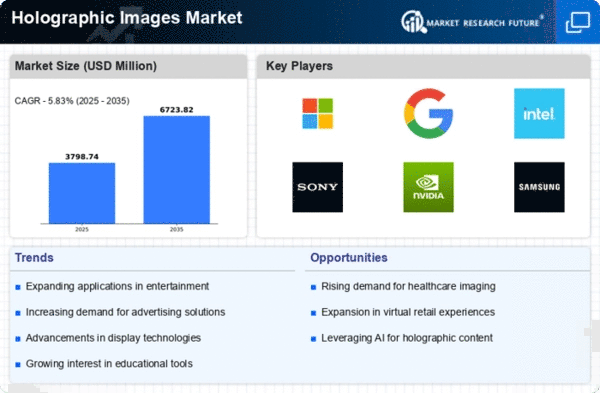
As per MRFR analysis, the Holographic Images Market Size was estimated at 3589.47 USD Million in 2024. The holographic images industry is projected to grow from 3839.86 in 2025 to 6723.82 by 2035, exhibiting a compound annual growth rate (CAGR) of 5.83 during the forecast period 2025 - 2035.

Key Market Trends & Highlights

The Holographic Images Market is poised for substantial growth driven by technological advancements and diverse applications.

  • The integration of holographic images with augmented and virtual reality is transforming user experiences across various sectors.
  • North America remains the largest market for holographic images, while Asia-Pacific is emerging as the fastest-growing region.
  • In the advertising segment, holographic images are increasingly utilized for innovative marketing strategies, whereas medical imaging is witnessing rapid growth due to technological advancements.
  • Key market drivers include rising demand in retail and marketing, alongside increased investment in research and development.

Market Size & Forecast

2024 Market Size 3589.47 (USD Million)
2035 Market Size 6723.82 (USD Million)
CAGR (2025 - 2035) 5.83%
Largest Regional Market Share in 2024 North America

Major Players

<p>Microsoft (US), Google (US), Sony (JP), Intel (US), NVIDIA (US), Vive (HTC) (TW), RealView Imaging (IL), Looking Glass Factory (US), Leia Inc. (US)</p>

Market Trends

The Holographic Images Market is currently experiencing a transformative phase, driven by advancements in technology and increasing applications across various sectors. Industries such as entertainment, healthcare, and education are increasingly adopting holographic imaging solutions, which enhance user experience and provide innovative ways to visualize complex data. The integration of augmented reality and virtual reality with holographic images appears to be a key factor in this growth, as it allows for immersive experiences that were previously unattainable. Furthermore, the demand for interactive displays and advertising solutions is likely to propel the market forward, as businesses seek to engage consumers in more dynamic ways. In addition, the Holographic Images Market seems to be influenced by the rising interest in digital content creation and the need for effective communication tools. As organizations strive to differentiate themselves in a competitive landscape, the use of holographic images for marketing and branding purposes is becoming more prevalent. This trend indicates a shift towards more visually engaging content, which could redefine how information is presented and consumed. Overall, the Holographic Images Market is poised for substantial growth, with numerous opportunities for innovation and expansion across various industries.

Integration with Augmented and Virtual Reality

The convergence of holographic images with augmented and virtual reality technologies is reshaping user interactions. This integration enhances the immersive experience, allowing users to engage with content in a more interactive manner. As these technologies evolve, their combined potential could lead to groundbreaking applications in entertainment, training, and education.

Increased Adoption in Healthcare

The healthcare sector is increasingly recognizing the value of holographic imaging for surgical planning and patient education. By providing three-dimensional visualizations, holographic images facilitate better understanding of complex medical conditions. This trend suggests a growing reliance on advanced imaging techniques to improve patient outcomes and enhance medical training.

Emergence of Holographic Advertising

Holographic images are gaining traction in advertising, offering brands a novel way to capture consumer attention. This trend indicates a shift towards more engaging marketing strategies, as businesses leverage holographic displays to create memorable experiences. The potential for interactive advertisements may redefine consumer engagement and brand loyalty.

Holographic Images Market Market Drivers

Market Growth Projections

The Global Holographic Imaging Market Industry is poised for substantial growth, with projections indicating a market value of 6.18 USD Billion in 2024 and an anticipated increase to 51.7 USD Billion by 2035. This represents a remarkable growth trajectory, with a compound annual growth rate (CAGR) of 21.3% expected from 2025 to 2035. Factors contributing to this growth include advancements in technology, increasing applications across various sectors, and rising consumer demand for immersive experiences. As industries continue to explore the potential of holographic imaging, the market is likely to expand significantly, reflecting the transformative impact of this technology.

Technological Advancements

The Global Holographic Imaging Market Industry is witnessing rapid technological advancements that enhance imaging quality and application versatility. Innovations in light field technology and computational holography are driving the development of more sophisticated holographic systems. For instance, the integration of artificial intelligence in holographic imaging systems allows for real-time processing and improved accuracy. This trend is expected to contribute significantly to the market's growth, with projections indicating a market value of 6.18 USD Billion in 2024. As these technologies evolve, they are likely to open new avenues for applications across various sectors, including healthcare, entertainment, and education.

Market Trends and Challenges

The Global Holographic Imaging Market Industry faces various trends and challenges that could influence its growth trajectory. While the demand for holographic imaging is on the rise, challenges such as high costs of implementation and the need for specialized skills to operate advanced holographic systems may hinder market penetration. Additionally, the integration of holographic technology into existing systems requires significant investment, which could pose a barrier for smaller enterprises. Despite these challenges, the overall outlook for the market remains positive, as ongoing research and development efforts aim to address these issues and enhance the accessibility of holographic imaging solutions.

Increased Demand in Healthcare

The healthcare sector is a major driver for the Global Holographic Imaging Market Industry, as holographic imaging offers unique advantages in medical imaging and diagnostics. Holography enables three-dimensional visualization of complex structures, which can enhance surgical planning and training. For example, holographic representations of organs can assist surgeons in understanding anatomy better before procedures. The increasing adoption of holographic imaging in medical applications is anticipated to propel the market, with a projected growth rate of 21.3% CAGR from 2025 to 2035. This growth reflects the healthcare industry's ongoing commitment to improving patient outcomes through advanced imaging technologies.

Growing Demand in Entertainment and Media

The entertainment and media sectors are increasingly adopting holographic imaging technologies, significantly impacting the Global Holographic Imaging Market Industry. Holography is being utilized in concerts, exhibitions, and immersive experiences, allowing audiences to engage with content in unprecedented ways. For instance, holographic performances of artists have gained popularity, creating a new form of entertainment. This trend is likely to drive market growth, with estimates suggesting that the market could reach 51.7 USD Billion by 2035. As consumer preferences shift towards more interactive and immersive experiences, the demand for holographic solutions in entertainment is expected to rise.

Rising Adoption in Education and Training

The Global Holographic Imaging Market Industry is experiencing increased adoption in educational and training environments, where holography enhances learning experiences. Holographic displays can create interactive 3D models that facilitate better understanding of complex subjects, such as anatomy or engineering. Institutions are beginning to incorporate holographic technology into their curricula, providing students with innovative tools for learning. This trend is likely to contribute to the market's expansion, as educational institutions recognize the value of immersive learning. As a result, the demand for holographic imaging solutions in education is expected to grow, further driving the market's overall trajectory.

Market Segment Insights

By Application: Advertising (Largest) vs. Medical Imaging (Fastest-Growing)

<p>In the holographic images market, the application segment is characterized by a diverse range of uses including advertising, medical imaging, entertainment, education, and military. Currently, advertising holds the largest share due to its effectiveness in capturing consumer attention. With brands increasingly looking for innovative ways to engage customers, the adoption of holographic technology in advertising is gaining momentum, overshadowing other applications. Medical imaging, while smaller in market share, has been witnessing significant growth, driven by advancements in imaging technologies and a rising demand for non-invasive diagnostic methods. The growth trends within the application segment indicate that while advertising leads the market, sectors such as medical imaging are rapidly emerging due to technological advancements and an increasing focus on enhanced patient outcomes. The entertainment segment is also evolving with new applications in virtual reality and gaming, although it remains secondary to advertising and healthcare. Education is carving out a niche for immersive learning experiences, while military applications leverage holography for training and simulations, marking a robust push across various fronts of application.</p>

<p>Advertising (Dominant) vs. Medical Imaging (Emerging)</p>

<p>Advertising stands out as the dominant segment in the holographic images market, appealing directly to consumers through striking visual experiences that enhance brand messaging. Companies invest heavily in holographic displays to create memorable campaigns that engage audiences more effectively than traditional media. In contrast, medical imaging is emerging as a pivotal sector, focusing on non-invasive technologies that offer improved diagnostic accuracy and patient comfort. This segment benefits from continuous research and development, with innovations that enable clearer imaging and more detailed visualization of complex medical data. While advertising captivates consumers visually, medical imaging is crucial for advancing healthcare practices, showcasing the distinct yet complementary nature of these segments in the broader market landscape.</p>

By Technology: Laser Holography (Largest) vs. Digital Holography (Fastest-Growing)

<p>The holographic images market is primarily driven by Laser Holography, which holds the largest share of market distribution among the various technologies. This segment has established itself as a reliable and widely adopted method for producing superior-quality holographic images in applications ranging from security to data storage. On the other hand, Digital Holography is rapidly gaining traction, attracting interest due to its adaptability and cost-effectiveness, making it a competitive player in the evolving market landscape. Growth trends indicate that while Laser Holography continues to dominate, the surge in Digital Holography is noteworthy. As industries leverage advancements in digital technology, there has been a marked increase in applications such as 3D imaging and augmented reality. The rise of consumer electronics incorporating holographic displays has also amplified the demand for Dynamic Digital Holography, further fueling its expansion within the market, suggesting a dynamic shift in end-user preferences.</p>

<p>Technology: Laser Holography (Dominant) vs. Digital Holography (Emerging)</p>

<p>Laser Holography is renowned for its precision and clarity, positioning itself as the dominant force within the Holographic Images Market. It is primarily utilized in applications where high-quality image replication is crucial, such as in security features on currency and identification documents. Meanwhile, Digital Holography represents an emerging technology that is rapidly evolving. It offers flexible and low-cost solutions for creating holograms, making it increasingly attractive for various sectors, including telecommunications and medical imaging. The adaptability of Digital Holography, combined with a lower barrier to entry, fuels its growth and interest, promising to reshape the market dynamics in the near future.</p>

By End Use: Consumer Electronics (Largest) vs. Healthcare (Fastest-Growing)

<p>In the Holographic Images Market, Consumer Electronics stands out as the largest segment, holding the most substantial market share. This dominance is attributed to the widespread adoption of holographic displays in devices such as smartphones, tablets, and televisions. The increasing demand for immersive visual experiences within consumer electronics not only boosts the segment's growth but also drives innovations in holographic imaging technology across various devices. Conversely, the Healthcare segment is emerging as the fastest-growing area in the holographic images landscape. Factors contributing to this growth include the rising implementation of holography in medical imaging, surgical procedures, and education. The potential for enhanced precision and visual understanding in complex medical fields promotes continuous investment and development, fostering rapid advancements in holographic applications within the healthcare sector.</p>

<p>Consumer Electronics: Dominant vs. Healthcare: Emerging</p>

<p>The Consumer Electronics segment in the Holographic Images Market is characterized by its broad application across devices featuring holographic displays, catering to consumers seeking cutting-edge visual experiences. The segment benefits from significant penetration in smartphones and tablets, where novel holographic technologies facilitate more engaging user interfaces and applications. As manufacturers innovate to create more immersive entertainment and functional displays, Consumer Electronics remains the dominant force in this market. On the other hand, the Healthcare segment, while currently smaller, is rapidly evolving and gaining attention due to the integration of holography in diagnostics and surgical practices. This emerging segment is marked by pilot projects and partnerships aimed at enhancing 3D visualizations for training, patient education, and planning complex surgeries, thereby opening new avenues for growth.</p>

Get more detailed insights about Holographic Imaging Market Research Report- Forecast To 2035

Regional Insights

North America : Innovation and Market Leadership

North America continues to lead the holographic images market, holding a significant share of 1794.74M in 2025. The region's growth is driven by rapid technological advancements, increasing demand for immersive experiences in gaming, healthcare, and education, and supportive government initiatives promoting innovation. Regulatory frameworks are evolving to facilitate the integration of holographic technologies across various sectors, enhancing market potential. The competitive landscape in North America is robust, featuring key players like Microsoft, Google, and NVIDIA. These companies are at the forefront of developing cutting-edge holographic solutions, leveraging their technological expertise and substantial R&D investments. The presence of a strong startup ecosystem further fuels innovation, ensuring that North America remains a pivotal hub for holographic advancements.

Europe : Emerging Market with Growth Potential

Europe's holographic images market is valued at 1073.68M in 2025, showcasing a growing interest in immersive technologies across various industries. The region benefits from strong regulatory support aimed at fostering innovation and enhancing digital infrastructure. Demand is particularly driven by sectors such as entertainment, education, and healthcare, where holographic applications are increasingly being adopted to improve user engagement and experience. Leading countries like Germany, the UK, and France are spearheading advancements in holographic technology, supported by significant investments from both public and private sectors. Major players, including Sony and Intel, are actively involved in research and development, ensuring that Europe remains competitive in the global market. The collaborative efforts between industry and academia further enhance the region's innovation landscape.

Asia-Pacific : Rapid Growth and Adoption

The Asia-Pacific region, with a market size of 605.69M in 2025, is witnessing rapid growth in the holographic images sector. This surge is fueled by increasing investments in technology, a growing consumer base, and rising demand for advanced visualization solutions in industries such as gaming, retail, and education. Governments in the region are also implementing policies to support digital transformation, further driving market expansion. Countries like Japan, China, and South Korea are leading the charge in holographic technology adoption. Major companies, including HTC and RealView Imaging, are making significant strides in developing innovative holographic solutions. The competitive landscape is characterized by a mix of established players and emerging startups, fostering a dynamic environment for growth and collaboration in the holographic market.

Middle East and Africa : Untapped Market with Opportunities

The Middle East and Africa region, with a market size of 115.36M in 2025, presents significant opportunities for growth in the holographic images market. The increasing adoption of advanced technologies across various sectors, including healthcare, education, and entertainment, is driving demand for holographic solutions. Government initiatives aimed at enhancing digital infrastructure and promoting innovation are also contributing to market development. Countries such as the UAE and South Africa are emerging as key players in the holographic landscape, with investments in technology and innovation. The presence of global companies and local startups is fostering a competitive environment, encouraging collaboration and knowledge sharing. As the region continues to embrace digital transformation, the holographic market is poised for substantial growth.

Key Players and Competitive Insights

The Holographic Images Market is currently characterized by a dynamic competitive landscape, driven by rapid technological advancements and increasing applications across various sectors, including entertainment, healthcare, and education. Major players such as Microsoft (US), Google (US), and NVIDIA (US) are at the forefront, leveraging their substantial R&D capabilities to innovate and enhance their product offerings. Microsoft (US) has focused on integrating holographic technology into its existing platforms, while Google (US) emphasizes cloud-based solutions to facilitate real-time holographic rendering. NVIDIA (US) continues to push the boundaries of graphics processing, enhancing the realism of holographic images, which collectively shapes a competitive environment that is increasingly reliant on technological prowess and strategic partnerships.

Key business tactics within the Holographic Images Market include localizing manufacturing and optimizing supply chains to enhance efficiency and reduce costs. The market structure appears moderately fragmented, with a mix of established players and emerging startups. This fragmentation allows for diverse innovation pathways, although the collective influence of key players like Sony (JP) and Intel (US) remains significant, as they continue to set industry standards and drive market trends.

In November 2025, Sony (JP) announced a strategic partnership with a leading healthcare provider to develop holographic imaging solutions for surgical applications. This collaboration is poised to enhance surgical precision and training, indicating a shift towards specialized applications of holographic technology in critical sectors. Such partnerships not only expand market reach but also underscore the importance of tailored solutions in driving adoption.

In October 2025, Intel (US) unveiled a new line of processors specifically designed for holographic computing, aimed at improving processing speeds and energy efficiency. This development is crucial as it addresses the growing demand for high-performance computing in holographic applications, potentially positioning Intel (US) as a leader in the hardware segment of the market. The introduction of these processors may catalyze further innovations and applications in the holographic space.

In September 2025, NVIDIA (US) launched a new software suite that integrates AI capabilities with holographic rendering, enhancing the user experience by providing more interactive and immersive environments. This move reflects a broader trend towards the integration of AI in holographic technologies, suggesting that future developments will increasingly focus on creating more engaging and responsive holographic experiences.

As of December 2025, current competitive trends in the Holographic Images Market are heavily influenced by digitalization, sustainability, and AI integration. Strategic alliances are becoming increasingly vital, as companies recognize the need to collaborate to enhance their technological capabilities and market reach. Looking ahead, competitive differentiation is likely to evolve from traditional price-based competition to a focus on innovation, advanced technology, and reliable supply chains. This shift indicates a maturation of the market, where the ability to deliver cutting-edge solutions will be paramount.

Key Companies in the Holographic Images Market market include

Industry Developments

November 2023:RealView Imaging, a leading provider of holographic imaging systems, announces a partnership with Microsoft to develop new holographic applications for the Microsoft HoloLens mixed reality headset.

October 2023:Ovizio Imaging systems, a Belgian company that develops holographic microscopes, receives CE Mark approval for its HoloMonitor microscope. The HoloMonitor is the world's first holographic microscope to be approved for medical use.

September 2023:zSpace, a US company that develops augmented reality and virtual reality solutions for education, announces the launch of its new zSpace Inspire holographic display system. The zSpace Inspire is designed to provide students with a more interactive and engaging learning experience.

August 2023:Holoxica, a UK company that develops holographic technology for a variety of industries, announces a partnership with Boeing to develop new holographic applications for aircraft manufacturing and maintenance.

July 2023:Lyncee Tec, a Swiss company that develops holographic microscopes for the life sciences industry, announces the launch of its new CellScope holographic microscope. The CellScope is designed to provide researchers with a high-resolution and real-time view of living cells.

Future Outlook

Holographic Images Market Future Outlook

<p>The Holographic Images Market is projected to grow at a 5.83% CAGR from 2024 to 2035, driven by advancements in technology, increasing demand for immersive experiences, and applications in various industries.</p>

New opportunities lie in:

  • <p>Development of holographic advertising solutions for retail environments.</p>
  • <p>Integration of holographic displays in virtual reality platforms.</p>
  • <p>Creation of customized holographic content for educational institutions.</p>

<p>By 2035, the Holographic Images Market is expected to be robust, reflecting substantial growth and innovation.</p>

Market Segmentation

Holographic Images Market End Use Outlook

  • Consumer Electronics
  • Healthcare
  • Aerospace
  • Automotive
  • Retail

Holographic Images Market Technology Outlook

  • Laser Holography
  • Digital Holography
  • Computer-Generated Holography
  • Acoustic Holography

Holographic Images Market Application Outlook

  • Advertising
  • Medical Imaging
  • Entertainment
  • Education
  • Military

Report Scope

MARKET SIZE 20243589.47(USD Million)
MARKET SIZE 20253839.86(USD Million)
MARKET SIZE 20356723.82(USD Million)
COMPOUND ANNUAL GROWTH RATE (CAGR)5.83% (2024 - 2035)
REPORT COVERAGERevenue Forecast, Competitive Landscape, Growth Factors, and Trends
BASE YEAR2024
Market Forecast Period2025 - 2035
Historical Data2019 - 2024
Market Forecast UnitsUSD Million
Key Companies ProfiledMicrosoft (US), Google (US), Sony (JP), Intel (US), NVIDIA (US), Vive (HTC) (TW), RealView Imaging (IL), Looking Glass Factory (US), Leia Inc. (US)
Segments CoveredApplication, Technology, End Use
Key Market OpportunitiesAdvancements in augmented reality applications drive growth in the Holographic Images Market.
Key Market DynamicsTechnological advancements drive competitive forces, enhancing holographic image applications across various industries.
Countries CoveredNorth America, Europe, APAC, South America, MEA

FAQs

At what CAGR is the holographic imaging market expected to grow over the forecast period?

The holographic imaging market is predicted to grow at a 21.3% CAGR between 2023-2032.

Who are the key competitors in the holographic imaging market?

Key competitors in the holographic imaging market include Zebra Imaging (US), Leia (US), Phase Holographic Imaging AB (Sweden), Eon Reality (US), NanoLive SA (Switzerland), Lyncee Tec. (Switzerland), Holoxica Ltd. (UK), zSpace, Inc. (US), Ovizio Imaging systems (Belgium), Realview Imaging Ltd. (Israel), Mach7 Technologies Ltd. (US), and EchoPixel, Inc. (US).

What are key factors driving the holographic imaging market growth?

Growing awareness about holographic imaging and increasing adoption by surgeons and biomedical researchers are boosting market growth.

Which factors may deter the holographic imaging market growth?

High computational processing cost, the need for complicated and sophisticated recording techniques, and problems related to projection under sunrays may deter market growth.

Which region is predicted to dominate the holographic imaging market?

North America is predicted to dominate the holographic imaging market.

  1. Scope of the Study
  2. Research Objective
  3. Assumptions
  4. Limitations
    1. Primary Research
    2. Secondary Research
    3. Market Size Estimation
    4. Restraints
    5. Opportunities
    6. Challenges
    7. Macroeconomic Indicators
    8. Technology Trends & Assessment
      1. Bargaining Power of Suppliers
      2. Bargaining Power of Buyers
      3. Threat of New Entrants
      4. Threat of Substitutes
      5. Intensity of Rivalry
    9. Value Chain Analysis
    10. Investment Feasibility Analysis
    11. Pricing Analysis
  5. Global Holographic Imaging Market, by Product Type6.1 Introduction
    1. Holographic Display
      1. Laser
      2. Touchable
      3. Piston
      4. Semi-transparent
    2. Microscopes
    3. Market Estimates & Forecast, 2020-2027
  6. Market Estimates & Forecast, by Region/Country, 2020-2027
    1. Software
    2. Market Estimates & Forecast, 2020-2027
  7. Market Estimates & Forecast, by Region/Country, 2020-2027
    1. Holographic Prints
    2. Market Estimates & Forecast, 2020-2027
  8. Market Estimates & Forecast, by Region/Country, 2020-2027
    1. Others
    2. Market Estimates & Forecast, 2020-2027
  9. Market Estimates & Forecast, by Region/Country, 2020-2027
  10. Global Holographic Imaging Market, by Application7.1 Introduction
    1. Medical Imaging
      1. Ophthalmology
      2. Dentistry
      3. Urology
      4. Otology
      5. Orthopedics
      6. Others
    2. Medical Education
    3. Market Estimates & Forecast, 2020-2027
  11. Market Estimates & Forecast, by Region/Country, 2020-2027
    1. Surgery Preplanning & Assistance
    2. Market Estimates & Forecast, 2020-2027
  12. Market Estimates & Forecast, by Region/Country, 2020-2027
    1. Interventional Cardiology
    2. Market Estimates & Forecast, 2020-2027
  13. Market Estimates & Forecast, by Region/Country, 2020-2027
    1. Digital Intimacy
    2. Market Estimates & Forecast, 2020-2027
  14. Market Estimates & Forecast, by Region/Country, 2020-2027
    1. Biomedical Research
    2. Market Estimates & Forecast, 2020-2027
  15. Market Estimates & Forecast, by Region/Country, 2020-2027
    1. Others
  16. Global Holographic Imaging Market, by End-User8.1 Introduction
    1. Pharmaceutical & Biotechnology companies
    2. Market Estimates & Forecast, 2020-2027
  17. Market Estimates & Forecast, by Region/Country, 2020-2027
    1. Research organizations
    2. Market Estimates & Forecast, 2020-2027
  18. Market Estimates & Forecast, by Region/Country, 2020-2027
    1. Academic medical centers
    2. Market Estimates & Forecast, 2020-2027
  19. Market Estimates & Forecast, by Region/Country, 2020-2027
    1. Hospitals & Clinics
    2. Market Estimates & Forecast, 2020-2027
  20. Market Estimates & Forecast, by Region/Country, 2020-2027
    1. Others
    2. Market Estimates & Forecast, 2020-2027
  21. Market Estimates & Forecast, by Region/Country, 2020-2027
  22. Global Holographic Imaging Market, by Region
    1. Introduction
    2. Americas
  23. Market Estimates & Forecast, by Region, 2020-2027
  24. Market Estimates & Forecast, by Product Type, 2020-2027
  25. Market Estimates & Forecast, by Application, 2020-2027
  26. Market Estimates & Forecast, by End-User, 2020-2027
  27. North America
  28. Market Estimates & Forecast, by Product Type, 2020-2027
  29. Market Estimates & Forecast, by Application, 2020-2027
  30. Market Estimates & Forecast, by End-User, 2020-2027
  31. US
  32. Market Estimates & Forecast, by Product Type, 2020-2027
  33. Market Estimates & Forecast, by Application, 2020-2027
  34. Market Estimates & Forecast, by End-User, 2020-2027
  35. Canada
  36. Market Estimates & Forecast, by Product Type, 2020-2027
  37. Market Estimates & Forecast, by Application, 2020-2027
  38. Market Estimates & Forecast, by End-User, 2020-2027
  39. South America
  40. Market Estimates & Forecast, by Product Type, 2020-2027
  41. Market Estimates & Forecast, by Application, 2020-2027
  42. Market Estimates & Forecast, by End-User, 2020-2027
    1. Europe
  43. Market Estimates & Forecast, by Region, 2020-2027
  44. Market Estimates & Forecast, by Product Type, 2020-2027
  45. Market Estimates & Forecast, by Application, 2020-2027
  46. Market Estimates & Forecast, by End-User, 2020-2027
  47. Western Europe
  48. Market Estimates & Forecast, by Product Type, 2020-2027
  49. Market Estimates & Forecast, by Application, 2020-2027
  50. Market Estimates & Forecast, by End-User, 2020-2027
  51. Germany
  52. Market Estimates & Forecast, by Product Type, 2020-2027
  53. Market Estimates & Forecast, by Application, 2020-2027
  54. Market Estimates & Forecast, by End-User, 2020-2027
  55. France
  56. Market Estimates & Forecast, by Product Type, 2020-2027
  57. Market Estimates & Forecast, by Application, 2020-2027
  58. Market Estimates & Forecast, by End-User, 2020-2027
  59. UK
  60. Market Estimates & Forecast, by Product Type, 2020-2027
  61. Market Estimates & Forecast, by Application, 2020-2027
  62. Market Estimates & Forecast, by End-User, 2020-2027
  63. Italy
  64. Market Estimates & Forecast, by Product Type, 2020-2027
  65. Market Estimates & Forecast, by Application, 2020-2027
  66. Market Estimates & Forecast, by End-User, 2020-2027
  67. Spain
  68. Market Estimates & Forecast, by Product Type, 2020-2027
  69. Market Estimates & Forecast, by Application, 2020-2027
  70. Market Estimates & Forecast, by End-User, 2020-2027
  71. Rest of Western Europe
  72. Market Estimates & Forecast, by Product Type, 2020-2027
  73. Market Estimates & Forecast, by Application, 2020-2027
  74. Market Estimates & Forecast, by End-User, 2020-2027
  75. Eastern Europe
  76. Market Estimates & Forecast, by Product Type, 2020-2027
  77. Market Estimates & Forecast, by Application, 2020-2027
  78. Market Estimates & Forecast, by End-User, 2020-2027
    1. Asia-Pacific
  79. Market Estimates & Forecast, by Country, 2020-2027
  80. Market Estimates & Forecast, by Product Type, 2020-2027
  81. Market Estimates & Forecast, by Application, 2020-2027
  82. Market Estimates & Forecast, by End-User, 2020-2027
  83. Japan
  84. Market Estimates & Forecast, by Product Type, 2020-2027
  85. Market Estimates & Forecast, by Application, 2020-2027
  86. Market Estimates & Forecast, by End-User, 2020-2027
  87. China
  88. Market Estimates & Forecast, by Product Type, 2020-2027
  89. Market Estimates & Forecast, by Application, 2020-2027
  90. Market Estimates & Forecast, by End-User, 2020-2027
  91. India
  92. Market Estimates & Forecast, by Product Type, 2020-2027
  93. Market Estimates & Forecast, by Application, 2020-2027
  94. Market Estimates & Forecast, by End-User, 2020-2027
  95. Australia
  96. Market Estimates & Forecast, by Product Type, 2020-2027
  97. Market Estimates & Forecast, by Application, 2020-2027
  98. Market Estimates & Forecast, by End-User, 2020-2027
  99. Republic of Korea
  100. Market Estimates & Forecast, by Product Type, 2020-2027
  101. Market Estimates & Forecast, by Application, 2020-2027
  102. Market Estimates & Forecast, by End-User, 2020-2027
  103. Rest of Asia-Pacific
  104. Market Estimates & Forecast, by Product Type, 2020-2027
  105. Market Estimates & Forecast, by Application, 2020-2027
  106. Market Estimates & Forecast, by End-User, 2020-2027
    1. The Middle East & Africa
  107. Market Estimates & Forecast, by Region, 2020-2027
  108. Market Estimates & Forecast, by Product Type, 2020-2027
  109. Market Estimates & Forecast, by Application, 2020-2027
  110. Market Estimates & Forecast, by End-User, 2020-2027
  111. Middle East
  112. Market Estimates & Forecast, by Product Type, 2020-2027
  113. Market Estimates & Forecast, by Application, 2020-2027
  114. Market Estimates & Forecast, by End-User, 2020-2027
  115. Africa
  116. Market Estimates & Forecast, by Product Type, 2020-2027
  117. Market Estimates & Forecast, by Application, 2020-2027
  118. Market Estimates & Forecast, by End-User, 2020-2027
  119. Company Landscape
    1. Introduction
    2. Market Share Analysis
    3. Key Development & Strategies
  120. Company Profiles
    1. EON Reality
      1. Company Overview
      2. Product Overview
      3. Financials
      4. SWOT Analysis
    2. Holoxica Limited
      1. Company Overview
      2. Product Overview
      3. Financial Overview
      4. Key Developments
      5. SWOT Analysis
    3. Mach7 Technologies Limited
      1. Company Overview
      2. Product Overview
      3. Financial Overview
      4. Key Development
      5. SWOT Analysis
    4. Phase Holographic Imaging
      1. Company Overview
      2. Product/Business Segment Overview
      3. Financial Overview
      4. Key Development
      5. SWOT Analysis
    5. Ovizio Imaging Systems NVSA
      1. Company Overview
      2. Product Overview
      3. Financial overview
      4. Key Developments
    6. Zebra Imaging, Inc.
      1. Company Overview
      2. Product Overview
      3. Financial Overview
      4. Key Developments
    7. Nanolive SA
      1. Overview
      2. Product Overview
      3. Financials
      4. Key Developments
      5. SWOT Analysis
    8. RealView Imaging Ltd.
      1. Overview
      2. Product Overview
      3. Financials
      4. Key Developments
      5. SWOT Analysis
    9. EchoPixel, Inc.
      1. Overview
      2. Product Overview
      3. Financials
      4. Key Developments
      5. SWOT Analysis
    10. Lyncee Tec SA
      1. Overview
      2. Product Overview
      3. Financials
      4. Key Developments
      5. SWOT Analysis
    11. zSpace, Inc.
      1. Overview
      2. Product Overview
      3. Financials
      4. Key Developments
      5. SWOT Analysis
    12. Musion Das Hologram Ltd.
      1. Overview
      2. Product Overview
      3. Financials
      4. Key Developments
      5. SWOT Analysis
    13. Provision Holdings Inc.
      1. Overview
      2. Product Overview
      3. Financials
      4. Key Developments
      5. SWOT Analysis
    14. Qualcomm
      1. Overview
      2. Product Overview
      3. Financials
      4. Key Developments
      5. SWOT Analysis
    15. Others
  121. Appendix
  122. LIST OF TABLES
  123. Holographic imaging Industry Synopsis, 2020-2027
  124. Global Holographic imaging Market Estimates and Forecast, 2020-2027, (USD Million)
  125. Global Holographic imaging Market, by Region, 2020-2027, (USD Million)
  126. Global Holographic imaging Market, by Product Type, 2020-2027, (USD Million)
  127. Global Holographic imaging Market, by Application, 2020-2027, (USD Million)
  128. Global Holographic imaging Market, by End-Users, 2020-2027, (USD Million)
  129. North America Holographic imaging Market, by Product Type, 2020-2027, (USD Million)
  130. North America Holographic imaging Market, by Application, 2020-2027, (USD Million)
  131. North America Holographic imaging Market, by End-Users, 2020-2027, (USD Million)
  132. US Holographic imaging Market, by Product Type, 2020-2027, (USD Million)
  133. US Holographic imaging Market, by Application, 2020-2027, (USD Million)
  134. US Holographic imaging Market, by End-Users, 2020-2027, (USD Million)
  135. Canada Holographic imaging Market, by Product Type, 2020-2027, (USD Million)
  136. Canada Holographic imaging Market, by Application, 2020-2027, (USD Million)
  137. Canada Holographic imaging Market, by End-Users, 2020-2027, (USD Million)
  138. South America Holographic imaging Market, by Product Type, 2020-2027, (USD Million)
  139. South America Holographic imaging Market, by End-Users, 2020-2027, (USD Million)
  140. Europe Holographic imaging Market, by Product Type, 2020-2027, (USD Million)
  141. Europe Holographic imaging Market, by End-Users, 2020-2027, (USD Million)
  142. Western Europe Holographic imaging Market, by Product Type, 2020-2027, (USD Million)
  143. Western Europe Holographic imaging Market, by End-Users, 2020-2027, (USD Million)
  144. Eastern Europe Holographic imaging Market, by Product Type, 2020-2027, (USD Million)
  145. Eastern Europe Holographic imaging Market, by Biomaterial, 2020-2027, (USD Million)
  146. Eastern Europe Holographic imaging Market, by End-Users, 2020-2027, (USD Million)
  147. Asia-Pacific Holographic imaging Market, by Product Type, 2020-2027, (USD Million)
  148. Asia-Pacific Holographic imaging Market, by End-Users, 2020-2027, (USD Million)
  149. Middle East & Africa Holographic imaging Market, by Product Type, 2020-2027, (USD Million
  150. Middle East & Africa Holographic Imaging Market, by Application, 2020-2027, (USD Million)
  151. Middle East & Africa Holographic imaging Market, by End-Users, 2020-2027, (USD Million)
  152. LIST OF FIGURES
  153. Research Process
  154. Segmentation for Global Holographic imaging Market
  155. Segmentation Market Dynamics for Holographic imaging Market
  156. Global Holographic imaging Market Share, by Product Type 2020
  157. Global Holographic imaging Market Share, by Application 2020
  158. Global Holographic imaging Market Share, by End-Users, 2020
  159. Global Holographic imaging Market Share, by Region, 2020
  160. North America Holographic imaging Market Share, by Country, 2020
  161. Europe Holographic imaging Market Share, by Country, 2020
  162. Asia-Pacific Holographic imaging Market Share, by Country, 2020
  163. Middle East & Africa Holographic imaging Market Share, by Country, 2020
  164. Global Holographic imaging Market: Company Share Analysis, 2020 (%)
  165. EON Reality: Key Financials
  166. EON Reality: Segmental Revenue
  167. EON Reality: Geographical Revenue
  168. Holoxica Limited: Key Financials
  169. Holoxica Limited: Segmental Revenue
  170. Holoxica Limited: Geographical Revenue
  171. Mach7 Technologies Limited: Key Financials
  172. Mach7 Technologies Limited: Segmental Revenue
  173. Mach7 Technologies Limited: Geographical Revenue
  174. Phase Holographic Imaging: Key Financials
  175. Phase Holographic Imaging: Segmental Revenue
  176. Phase Holographic Imaging: Geographical Revenue
  177. Ovizio Imaging Systems NVSA: Key Financials
  178. Ovizio Imaging Systems NVSA: Segmental Revenue
  179. Ovizio Imaging Systems NVSA. Geographical Revenue
  180. Zebra Imaging, Inc. Key Financials
  181. Zebra Imaging, Inc. Segmental Revenue
  182. Zebra Imaging, Inc. Geographical Revenue

Holographic Imaging Market Segmentation

Market Segmentation Overview

  • Detailed segmentation data will be available in the full report
  • Comprehensive analysis by multiple parameters
  • Regional and country-level breakdowns
  • Market size forecasts by segment
Infographic

Free Sample Request

Kindly complete the form below to receive a free sample of this Report

Get Free Sample

Customer Strories

Compare Licence

×
Features License Type
Single User Multiuser License Enterprise User
Price $4,950 $5,950 $7,250
Maximum User Access Limit 1 User Upto 10 Users Unrestricted Access Throughout the Organization
Free Customization
Direct Access to Analyst
Deliverable Format
Platform Access
Discount on Next Purchase 10% 15% 15%
Printable Versions