Request Free Sample ×

Kindly complete the form below to receive a free sample of this Report

* Please use a valid business email

Leading companies partner with us for data-driven Insights

clients tt-cursor
Hero Background
English
Chinese
French
Japanese
Korean
German
Spanish

Hip Implants Market Share

ID: MRFR/HC/6976-HCR
111 Pages
Nidhi Mandole
April 2026

Hip Implants Market Research Report Information By Product (Total Hip implants, Fixed-Bearing Hip Implants, Mobile-Bearing Total Hip Implants, Partial Hip implants, Hip Resurfacing Implants and Revision Hip implants), By End-User (Hospitals, Orthopedic Clinics and Ambulatory Surgical Centers), By Material (Metal-on-Polyethylene, Ceramic-on-Metal, Metal-on-Metal, Ceramic-on-Polyethylene and Ceramic-on-Ceramic), And By Region (North America, Europe, Asia-Pacific, And Rest Of The World) –Market Forecast Till 2035

Share:
Download PDF ×

We do not share your information with anyone. However, we may send you emails based on your report interest from time to time. You may contact us at any time to opt-out.

Hip Implants Market Infographic
Purchase Options

Market Share

Hip Implants Market Share Analysis

The hip implants market is a vital section of the orthopedic enterprise, addressing the developing needs of a growing older populace and growing cases of hip-associated ailments. Market proportion positioning strategies play a pivotal role in figuring out the fulfillment of agencies on this aggressive panorama. To effectively role themselves, organizations have first to grasp the market dynamics, including demographic developments, technological improvements, regulatory landscape, and patron preferences. This complete information paperwork is the inspiration for strategic decision-making. Collaboration with healthcare institutions, surgeons, and research corporations may be instrumental in market percentage growth. Establishing strategic alliances permits companies to leverage shared expertise, access a much wider community, and enhance their market presence through joint ventures and partnerships. Targeting new geographical areas provides possibilities for increase. Companies strategically input untapped markets wherein there is a growing demand for hip implants. Adapting merchandise to fulfill specific nearby necessities and setting up a sturdy distribution network are key elements of this method. Acknowledging the range of affected persons' desires, a hit company's consciousness on customization. Tailoring implants to particular patient traits complements the overall efficacy of the product. An affected person-centric approach no longer best attracts surgeons but additionally contributes to fantastic patient outcomes, fostering emblem loyalty. Building a robust emblem photo is vital for market proportion positioning. Effective advertising campaigns, participation in medical meetings, and endorsements by using famous surgeons contribute to emblem visibility. Positive phrase-of-mouth from satisfied patients and healthcare professionals similarly solidifies a corporation's market position. Emphasizing the significance of clinical proof through rigorous trials and studies instills self-assurance among surgeons and sufferers. Companies invest in generating scientific information that helps the protection and efficacy of their implants. Evidence-based advertising serves as a compelling tool to steer purchasing selections. Providing complete post-income support, which includes schooling for surgeons and healthcare specialists, is indispensable. Companies that put money into ongoing education and help services create a positive atmosphere for the cease-customers, reinforcing their market function and fostering long-term relationships. Strict adherence to regulatory requirements and maintaining the highest best requirements is non-negotiable within the healthcare industry. Companies that prioritize regulatory compliance and invest in robust, high-quality warranty measures build trust amongst surgeons, healthcare establishments, and sufferers.


Author
Author Profile
Nidhi Mandole
Senior Research Analyst

She is an extremely curious individual currently working in Healthcare and Medical Devices Domain. Nidhi is comfortably versed in data centric research backed by healthcare educational background. She leverages extensive data mining and analytics tools such as Primary and Secondary Research, Statistical Analysis, Machine Learning, Data Modelling. Her key role also involves Technical Sales Support, Client Interaction and Project management within the Healthcare team. Lastly, she showcases extensive affinity towards learning new skills and remain fascinated in implementing them.

Leave a Comment

FAQs

What is the current valuation of the Hip Implants Market as of 2024?

<p>The Hip Implants Market was valued at 10.18 USD Billion in 2024.</p>

What is the projected market valuation for the Hip Implants Market in 2035?

<p>The market is projected to reach 14.93 USD Billion by 2035.</p>

What is the expected CAGR for the Hip Implants Market during the forecast period 2025 - 2035?

<p>The expected CAGR for the Hip Implants Market during 2025 - 2035 is 3.54%.</p>

Which companies are considered key players in the Hip Implants Market?

<p>Key players in the market include DePuy Synthes, Stryker, Zimmer Biomet, Smith & Nephew, Medtronic, Exactech, B. Braun, Aesculap, and Wright Medical.</p>

How does the Total Hip Replacement segment perform in terms of market valuation?

<p>The Total Hip Replacement segment was valued at 6.09 USD Billion in 2024 and is expected to grow to 8.67 USD Billion by 2035.</p>

What is the market valuation for the Partial Hip Replacement segment?

<p>The Partial Hip Replacement segment had a valuation of 2.54 USD Billion in 2024, projected to increase to 3.56 USD Billion by 2035.</p>

What are the projected values for the Hip Resurfacing segment?

The Hip Resurfacing segment was valued at 1.55 USD Billion in 2024 and is anticipated to reach 2.7 USD Billion by 2035.

Which materials dominate the Hip Implants Market?

In 2024, the market valuation for Metal implants was 3.5 USD Billion, while Ceramic, Polyethylene, and Composite implants were valued at 2.0, 2.5, and 2.18 USD Billion respectively.

What is the market performance of the Cementless fixation type?

The Cementless fixation type was valued at 4.5 USD Billion in 2024 and is projected to grow to 6.5 USD Billion by 2035.

How do patient demographics influence the Hip Implants Market?

The Age Group segment was valued at 3.0 USD Billion in 2024, with expectations to rise to 4.5 USD Billion by 2035, indicating a growing focus on demographic factors.

Market Summary

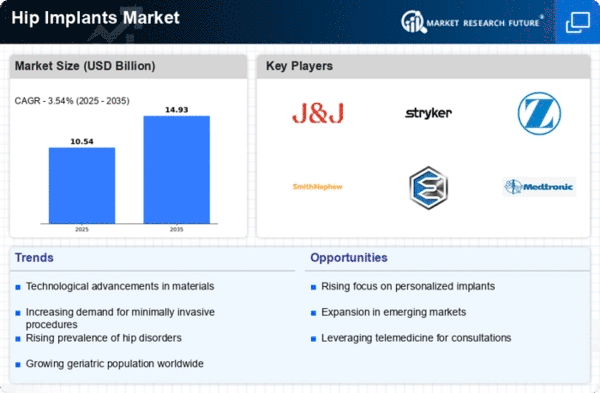
As per MRFR analysis, the Hip Implants Market Size was estimated at 10.18 USD Billion in 2024. The Hip Implants industry is projected to grow from 10.54 USD Billion in 2025 to 14.93 USD Billion by 2035, exhibiting a compound annual growth rate (CAGR) of 3.54% during the forecast period 2025 - 2035.

Key Market Trends & Highlights

The Hip Implants Market is experiencing robust growth driven by technological advancements and increasing healthcare demands.

  • North America remains the largest market for hip implants, driven by a high prevalence of hip-related disorders. The Asia-Pacific region is emerging as the fastest-growing market, fueled by rising healthcare investments and an expanding patient base. Total Hip Replacement continues to dominate the market, while Partial Hip Replacement is witnessing the fastest growth due to its minimally invasive nature. Key market drivers include the aging population and rising healthcare expenditure, which are significantly influencing demand for hip implants.

Market Size & Forecast

2024 Market Size 10.18 (USD Billion)
2035 Market Size 14.93 (USD Billion)
CAGR (2025 - 2035) 3.54%
Largest Regional Market Share in 2024 North America

Major Players

DePuy Synthes (US), <a href="https://www.stryker.com/us/en/portfolios/orthopaedics/joint-replacement/hip.html">Stryker </a>(US), Zimmer Biomet (US), Smith &amp; Nephew (GB), Exactech (US), Medtronic (US), B. Braun (DE), Wright Medical (US), Aesculap (DE)

Market Trends

The Hip Implants Market is currently experiencing a dynamic evolution, driven by advancements in technology and increasing demand for orthopedic solutions. Innovations in materials and design are enhancing the performance and longevity of hip implants, which appears to be a key factor influencing patient choices. Furthermore, the growing prevalence of hip-related disorders, coupled with an aging population, suggests a sustained need for effective surgical interventions. As healthcare systems adapt to these trends, the market is likely to witness a shift towards more personalized and minimally invasive procedures, which may improve recovery times and overall patient satisfaction. In addition, the competitive landscape of the Hip Implants Market is becoming increasingly complex, with numerous players striving to differentiate their offerings. Collaborations between manufacturers and healthcare providers are emerging, potentially leading to improved product development and patient outcomes. Regulatory frameworks are also evolving, which may impact the approval processes for new technologies. Overall, the Hip Implants Market appears poised for growth, with a focus on innovation, patient-centric solutions, and enhanced surgical techniques.

Technological Advancements

The Hip Implants Market is witnessing rapid technological advancements that enhance the functionality and durability of implants. Innovations in materials, such as the use of ceramics and advanced polymers, are likely to improve wear resistance and biocompatibility, potentially leading to better patient outcomes.

Minimally Invasive Techniques

There is a growing trend towards minimally invasive surgical techniques within the Hip Implants Market. These approaches may reduce recovery times and postoperative complications, appealing to both patients and healthcare providers seeking efficient solutions.

Personalized Medicine

The concept of personalized medicine is gaining traction in the Hip Implants Market. Tailoring implants to individual patient anatomy and needs could enhance the effectiveness of treatments, suggesting a shift towards more customized surgical options.

Hip Implants Market Market Drivers

Market Growth Projections

The Global Hip Implants Market Industry is projected to experience substantial growth over the coming years. By 2024, the market is anticipated to reach 10.2 USD Billion, with further growth expected to 14.9 USD Billion by 2035. This trajectory suggests a robust demand for hip implants driven by various factors, including demographic changes and advancements in medical technology. The compound annual growth rate (CAGR) of 3.54% from 2025 to 2035 indicates a steady expansion of the market, reflecting the increasing need for hip replacement surgeries and the ongoing development of innovative implant solutions.

Technological Advancements

Technological innovations in hip implant design and materials are transforming the Global Hip Implants Market Industry. The introduction of minimally invasive surgical techniques, coupled with advanced materials such as ceramics and titanium alloys, enhances the durability and performance of implants. These advancements not only improve patient outcomes but also reduce recovery times, making hip replacement surgeries more appealing. For example, the development of 3D printing technology allows for customized implants tailored to individual patient anatomy, which could potentially lead to better fit and function. Such innovations are likely to contribute to the market's growth, with projections indicating a CAGR of 3.54% from 2025 to 2035.

Rising Geriatric Population

The increasing geriatric population globally is a primary driver of the Global Hip Implants Market Industry. As individuals age, the incidence of hip-related ailments, such as osteoarthritis and fractures, tends to rise significantly. For instance, by 2024, the global market is projected to reach 10.2 USD Billion, largely due to the growing number of elderly individuals requiring hip replacement surgeries. This demographic shift necessitates advanced medical solutions, thereby propelling demand for hip implants. Furthermore, the World Health Organization indicates that the population aged 65 and older is expected to double by 2050, further emphasizing the need for effective orthopedic interventions.

Rising Healthcare Expenditure

The growing healthcare expenditure across various regions is positively influencing the Global Hip Implants Market Industry. Governments and private sectors are investing significantly in healthcare infrastructure, which includes orthopedic services. This increase in funding allows for better access to advanced medical technologies and surgical procedures, thereby facilitating more hip replacement surgeries. For instance, countries with robust healthcare systems are witnessing a surge in hip implant procedures, reflecting the willingness to invest in quality healthcare. As healthcare spending continues to rise, the demand for hip implants is expected to grow, aligning with the overall expansion of the healthcare market.

Awareness and Education Initiatives

Awareness and education initiatives regarding hip health and available treatment options are crucial drivers of the Global Hip Implants Market Industry. Healthcare organizations and professionals are increasingly focusing on educating the public about the importance of early diagnosis and treatment of hip disorders. Campaigns aimed at promoting healthy lifestyles and preventive measures are likely to lead to earlier interventions, which may require hip implants. As patients become more informed about their options, the demand for hip replacement surgeries is expected to rise. This growing awareness is essential for fostering a proactive approach to hip health, ultimately contributing to market growth.

Increasing Prevalence of Hip Disorders

The rising prevalence of hip disorders, including arthritis and traumatic injuries, is a significant factor driving the Global Hip Implants Market Industry. As lifestyles become more sedentary and obesity rates increase, the incidence of hip-related conditions is likely to escalate. According to health statistics, millions of individuals worldwide suffer from hip pain, leading to a greater demand for surgical interventions. This trend is expected to sustain the market's growth trajectory, with estimates suggesting that by 2035, the market could reach 14.9 USD Billion. The increasing awareness of treatment options among patients further fuels the demand for hip implants, as more individuals seek solutions for their hip-related ailments.

Market Segment Insights

By Application: Total Hip Replacement (Largest) vs. Hip Resurfacing (Fastest-Growing)

<p>The Hip Implants Market exhibits a diversified application segment with Total Hip Replacement (THR) holding the largest market share. THR has established itself as a standard procedure for severe hip joint problems, leading to a significant majority of the market's share. On the other hand, Partial Hip Replacement (PHR) and Hip Resurfacing, while considerably smaller in market share, provide essential alternatives for specific patient demographics. Their combined presence has contributed to the overall vitality of the market.</p>

<p>Total Hip Replacement (Dominant) vs. Hip Resurfacing (Emerging)</p>

<p>Total Hip Replacement is characterized by its capability to restore function and relieve pain for patients with advanced arthritis or severe hip injuries, making it a go-to solution in orthopedic practice. The procedure's familiarity among surgeons contributes to its dominance in the market. Meanwhile, Hip Resurfacing is emerging as a preferred option for younger and more active patients; it conserves more bone and allows for quicker recovery. This less invasive technique appeals particularly to those seeking longevity in their hip mobility and has witnessed rapid growth due to increasing orthopedic advancements and patient preference.</p>

By Material: Metal (Largest) vs. Ceramic (Fastest-Growing)

In the Hip Implants Market, the material segment showcases a diverse distribution, where metal components are the largest portion, favored for their durability and strength. Metal, particularly titanium and cobalt-chrome, accounts for the majority share in hip implant manufacturing, providing patients with reliable and long-lasting solutions. In contrast, ceramic materials, known for their wear resistance and biocompatibility, are emerging rapidly, catering to a growing segment of patients seeking alternatives to metal implants. The market trends indicate a shift towards more advanced materials as patient preferences evolve. The demand for ceramic implants is being driven by a rise in minimally invasive procedures and increased awareness regarding the benefits of ceramic technology, thus positioning them as the fastest-growing option within the materials segment.

Material: Metal (Dominant) vs. Composite (Emerging)

Metal remains the dominant choice in the hip implants market due to its unparalleled strength and reliability, making it suitable for high-load-bearing applications. Its long history of successful use in orthopedic surgeries further solidifies its leadership in this segment. On the other hand, composite materials are emerging in the market, offering a unique blend of properties that can reduce weight while maintaining structural integrity. Composites are appealing due to their potential for customization and improved biomaterial properties. As research and technology advance, composite hips are becoming a compelling option for both surgeons and patients, offering new possibilities in surgical outcomes and patient satisfaction.

By End Use: Hospitals (Largest) vs. Ambulatory Surgical Centers (Fastest-Growing)

In the Hip Implants Market, hospitals hold the largest share, providing the most extensive facilities and resources for hip replacement surgeries. Their capacity to perform complex procedures and offer post-operative care makes them the preferred choice for many patients. In contrast, ambulatory surgical centers are gaining ground due to their efficiency and lower costs, catering to patients seeking outpatient surgery options where recovery times are minimized. The increasing preference for minimally invasive procedures highlights their growing role in the market.

Hospitals (Dominant) vs. Ambulatory Surgical Centers (Emerging)

Hospitals, as the dominant segment in the Hip Implants Market, benefit from their comprehensive infrastructure, skilled medical personnel, and specialized surgical teams. Patients prioritize hospitals for their reputation and access to advanced technologies, allowing for better surgical outcomes. On the other hand, ambulatory surgical centers are emerging as a competitive alternative, particularly for elective surgeries that do not necessitate overnight stays. Their increasing popularity is driven by patient preferences for convenience, reduced costs, and the efficiency of care, making them a significant growth factor in the sector.

By Fixation Type: Cemented (Largest) vs. Cementless (Fastest-Growing)

The hip implants market is predominantly segmented into three fixation types: Cemented, Cementless, and Hybrid. Among these, the Cemented fixation type boasts the largest market share, attributed to its established efficacy and long-standing usage in hip replacement procedures. The Cementless segment, although smaller, has shown significant growth potential, appealing to a younger demographic and favorable for surgeons prioritizing bone integration. The Hybrid category combines methods, attracting surgeons for specific patient needs, though it currently holds a smaller share in comparison. In terms of growth trends, the Cementless fixation segment is emerging as the fastest-growing choice in the hip implants market. This trend is driven by technological advancements, increased awareness about minimally invasive surgeries, and a focus on enhancing post-operative outcomes. Market dynamics indicate a shifting preference towards Cementless options as they promote better osseointegration, appealing to patients looking for longer-lasting solutions. Moreover, the aging population seeking hip replacements contributes to the rising demand and innovation in all fixation types, paving the way for hybrid models that cater to varied patient needs.

Cemented (Dominant) vs. Cementless (Emerging)

The Cemented fixation method has long been the cornerstone of hip implant solutions, characterized by its reliability and proven results. It involves using bone cement to adhere the implant securely within a patient’s bone structure, ensuring stability and immediate load-bearing capacity. This method is particularly favored in older patients or those with weakened bone quality, where immediate stability is crucial. Conversely, the Cementless category is emerging as a favored choice among younger patients and surgeons advocating for bone integration without cement. It relies on a rough surface allowing the bone to grow into the implant, fostering greater long-term stability and minimizing wear. As the focus on longevity and recovery times intensifies, Cementless implants are increasingly seen as a viable alternative, marking a significant shift in preferences within the hip implants landscape.

By Patient Demographics: Age Group (Largest) vs. Gender (Fastest-Growing)

<p>In the Hip Implants Market, the distribution of patient demographics plays a crucial role. The Age Group segment remains the largest, with older adults, particularly those aged 65 and above, making up the majority of hip implant recipients. In contrast, the Gender segment has shown a notable trend, with an increasing proportion of women undergoing hip replacement surgeries, indicating a shift in demographic patterns within the market.</p>

<p>Age Group: 65+ (Dominant) vs. Gender: Female (Emerging)</p>

<p>The Age Group segment, particularly individuals aged 65 and older, dominates the market with a significant demand for hip implants, driven by age-related degenerative conditions such as osteoarthritis. This demographic values long-term mobility and quality of life. Conversely, the Gender segment has indicated an emerging trend, with more females receiving hip implants, possibly due to increased awareness and changing social norms surrounding women's health. As these women often seek to maintain active lifestyles, the market is witnessing innovations tailored to this demographic.</p>

Get more detailed insights about Hip Implants Market Research Report - Global Forecast till 2035

Regional Insights

North America : Market Leader in Hip Implants

North America is poised to maintain its leadership in the hip implants market, holding a significant share of 5.5 billion in 2024. The region's growth is driven by an aging population, increasing prevalence of hip disorders, and advancements in implant technology. Regulatory support and favorable reimbursement policies further enhance market dynamics, fostering innovation and accessibility for patients. The competitive landscape is characterized by major players such as DePuy Synthes, Stryker, and Zimmer Biomet, which dominate the market with their innovative products and extensive distribution networks. The U.S. remains the largest market, supported by robust healthcare infrastructure and high healthcare expenditure. This competitive environment encourages continuous improvement and development of new technologies, ensuring North America's position as a hub for hip implant advancements.

Europe : Emerging Market with Growth Potential

Europe's hip implants market is valued at 3.0 billion, reflecting a growing demand driven by an increasing elderly population and rising awareness of joint health. Regulatory frameworks in countries like Germany and France are evolving to support innovative solutions, enhancing patient access to advanced hip implant technologies. The region is also witnessing a shift towards minimally invasive surgical techniques, which are gaining traction among healthcare providers. Leading countries in this market include Germany, France, and the UK, where key players like Smith & Nephew and B. Braun are making significant contributions. The competitive landscape is marked by collaborations and mergers aimed at enhancing product offerings and market reach. As the market continues to expand, Europe is expected to play a crucial role in the global hip implants sector, driven by innovation and regulatory support.

Asia-Pacific : Rapidly Growing Market Segment

The Asia-Pacific region, valued at 1.8 billion, is experiencing rapid growth in the hip implants market, driven by increasing healthcare expenditure and a rising geriatric population. Countries like China and India are witnessing a surge in demand for hip replacement surgeries, fueled by urbanization and lifestyle changes. Regulatory bodies are also enhancing frameworks to facilitate the introduction of advanced medical technologies, further propelling market growth. China and India are leading the charge in this region, with significant investments from key players such as Medtronic and Wright Medical. The competitive landscape is evolving, with local manufacturers emerging alongside established global brands. As healthcare systems improve and awareness of joint health increases, the Asia-Pacific market is set to become a vital player in the global hip implants industry, offering substantial opportunities for growth.

Middle East and Africa : Emerging Market with Challenges

The Middle East and Africa region, valued at 0.88 billion, presents a unique landscape for the hip implants market, characterized by emerging demand and significant challenges. Factors such as increasing urbanization, rising disposable incomes, and a growing elderly population are driving the need for hip replacement surgeries. However, regulatory hurdles and limited access to advanced healthcare facilities pose challenges to market growth. Countries like South Africa and the UAE are leading the market, with key players such as Aesculap and Exactech making inroads. The competitive environment is gradually evolving, with a focus on improving healthcare infrastructure and increasing awareness of joint health. As the region continues to develop, it holds potential for growth in the hip implants market, albeit with challenges that need to be addressed.

Key Players and Competitive Insights

The Hip Implants Market is characterized by a dynamic competitive landscape, driven by technological advancements, an aging population, and increasing demand for minimally invasive surgical procedures. Major players such as DePuy Synthes (US), Stryker (US), and Zimmer Biomet (US) are at the forefront, each adopting distinct strategies to enhance their market positioning. DePuy Synthes (US) focuses on innovation through the development of advanced materials and designs, while Stryker (US) emphasizes strategic acquisitions to broaden its product portfolio. Zimmer Biomet (US) is actively pursuing digital transformation initiatives, integrating AI and data analytics into its operations, which collectively shapes a competitive environment that is increasingly reliant on technological differentiation.Key business tactics within the Hip Implants Market include localizing manufacturing to reduce costs and optimize supply chains. The market structure appears moderately fragmented, with several key players exerting influence over various segments. This fragmentation allows for niche players to thrive, while larger companies leverage their scale to dominate market share. The collective influence of these key players fosters a competitive atmosphere where innovation and operational efficiency are paramount.
In November Stryker (US) announced the launch of its new robotic-assisted surgical system, which is designed to enhance precision in hip implant procedures. This strategic move is likely to position Stryker as a leader in the growing segment of robotic surgery, potentially increasing its market share and reinforcing its commitment to innovation. The introduction of this technology may also lead to improved patient outcomes, thereby enhancing the company's reputation in the market.
In October Zimmer Biomet (US) unveiled a partnership with a leading AI firm to develop predictive analytics tools aimed at optimizing surgical outcomes for hip implant patients. This collaboration signifies a strategic shift towards data-driven decision-making in surgical procedures, which could enhance operational efficiencies and patient care. By integrating AI into its offerings, Zimmer Biomet is likely to differentiate itself in a competitive landscape increasingly focused on technological advancements.
In September DePuy Synthes (US) completed the acquisition of a smaller firm specializing in advanced biomaterials for hip implants. This acquisition is indicative of a broader trend towards consolidation in the market, as larger players seek to enhance their product offerings and technological capabilities. By integrating these advanced materials into its portfolio, DePuy Synthes may improve the performance and longevity of its implants, thereby appealing to both surgeons and patients.
As of December current competitive trends in the Hip Implants Market are heavily influenced by digitalization, sustainability, and AI integration. Strategic alliances are increasingly shaping the landscape, allowing companies to pool resources and expertise to drive innovation. The competitive differentiation appears to be shifting from price-based competition to a focus on technological advancements, supply chain reliability, and enhanced patient outcomes. This evolution suggests that companies that prioritize innovation and operational excellence will likely emerge as leaders in the market.

Key Companies in the Hip Implants Market include

Industry Developments

March 2023 Exactech, a well-known manufacturer of medical devices with a focus on orthopaedic implants and surgical equipment, recently announced the addition of a new customized shoulder implant to its line of products. The new implant, known as the Alteon® Cup Humeral Resurfacing, is made to suit each patient specifically and enhance clinical results.

February 2023  Johnson & Johnson and Zhongchao Inc., a major Chinese supplier of online medical education and healthcare information, have renewed their collaboration. The two businesses will continue to collaborate on the creation of cutting-edge healthcare products for the Chinese market.

May 2022 To aid with hip and knee replacement, Parkash Hospital in Amritsar introduced the United States Food and Drug Administration-approved Mako Robotic-Arm Assisted Technology.

March 2022 For complete hip and hemiarthroplasty surgeries, Stryker's Joint Replacement Division introduced the Insignia Hip Stem, which was designed to maximize patient fit and surgeon ease of installation in muscle-sparing techniques.

Future Outlook

Hip Implants Market Future Outlook

The Hip Implants Market is projected to grow at a 3.54% CAGR from 2025 to 2035, driven by technological advancements, increasing geriatric population, and rising prevalence of hip disorders.

New opportunities lie in:

  • <p>Expansion into emerging markets with tailored product offerings. Development of biodegradable hip implants for sustainability. Investment in <a href="https://www.marketresearchfuture.com/reports/telemedicine-market-2216">telemedicine </a>platforms for post-operative care management.</p>

By 2035, the Hip Implants Market is expected to achieve robust growth, reflecting evolving healthcare needs.

Market Segmentation

Hip Implants Market End Use Outlook

  • Hospitals
  • Ambulatory Surgical Centers
  • Orthopedic Clinics

Hip Implants Market Material Outlook

  • Metal
  • Ceramic
  • Polyethylene
  • Composite

Hip Implants Market Application Outlook

  • Total Hip Replacement
  • Partial Hip Replacement
  • Hip Resurfacing

Hip Implants Market Fixation Type Outlook

  • Cemented
  • Cementless
  • Hybrid

Hip Implants Market Patient Demographics Outlook

  • Age
  • Gender
  • Activity Level

Report Scope

MARKET SIZE 2024 10.18(USD Billion)
MARKET SIZE 2025 10.54(USD Billion)
MARKET SIZE 2035 14.93(USD Billion)
COMPOUND ANNUAL GROWTH RATE (CAGR) 3.54% (2025 - 2035)
REPORT COVERAGE Revenue Forecast, Competitive Landscape, Growth Factors, and Trends
BASE YEAR 2024
Market Forecast Period 2025 - 2035
Historical Data 2019 - 2024
Market Forecast Units USD Billion
Key Companies Profiled DePuy Synthes (US), Stryker (US), Zimmer Biomet (US), Smith & Nephew (GB), Exactech (US), Medtronic (US), B. Braun (DE), Wright Medical (US), Aesculap (DE)
Segments Covered Application, Material, End Use, Fixation Type, Patient Demographics
Key Market Opportunities Integration of advanced materials and minimally invasive techniques enhances patient outcomes in the Hip Implants Market.
Key Market Dynamics Technological advancements and regulatory changes drive innovation and competition in the hip implants market.
Countries Covered North America, Europe, APAC, South America, MEA

FAQs

What is the current valuation of the Hip Implants Market as of 2024?

<p>The Hip Implants Market was valued at 10.18 USD Billion in 2024.</p>

What is the projected market valuation for the Hip Implants Market in 2035?

<p>The market is projected to reach 14.93 USD Billion by 2035.</p>

What is the expected CAGR for the Hip Implants Market during the forecast period 2025 - 2035?

<p>The expected CAGR for the Hip Implants Market during 2025 - 2035 is 3.54%.</p>

Which companies are considered key players in the Hip Implants Market?

<p>Key players in the market include DePuy Synthes, Stryker, Zimmer Biomet, Smith & Nephew, Medtronic, Exactech, B. Braun, Aesculap, and Wright Medical.</p>

How does the Total Hip Replacement segment perform in terms of market valuation?

<p>The Total Hip Replacement segment was valued at 6.09 USD Billion in 2024 and is expected to grow to 8.67 USD Billion by 2035.</p>

What is the market valuation for the Partial Hip Replacement segment?

<p>The Partial Hip Replacement segment had a valuation of 2.54 USD Billion in 2024, projected to increase to 3.56 USD Billion by 2035.</p>

What are the projected values for the Hip Resurfacing segment?

The Hip Resurfacing segment was valued at 1.55 USD Billion in 2024 and is anticipated to reach 2.7 USD Billion by 2035.

Which materials dominate the Hip Implants Market?

In 2024, the market valuation for Metal implants was 3.5 USD Billion, while Ceramic, Polyethylene, and Composite implants were valued at 2.0, 2.5, and 2.18 USD Billion respectively.

What is the market performance of the Cementless fixation type?

The Cementless fixation type was valued at 4.5 USD Billion in 2024 and is projected to grow to 6.5 USD Billion by 2035.

How do patient demographics influence the Hip Implants Market?

The Age Group segment was valued at 3.0 USD Billion in 2024, with expectations to rise to 4.5 USD Billion by 2035, indicating a growing focus on demographic factors.

  1. SECTION I: EXECUTIVE SUMMARY AND KEY HIGHLIGHTS
    1. | 1.1 EXECUTIVE SUMMARY
    2. | | 1.1.1 Market Overview
    3. | | 1.1.2 Key Findings
    4. | | 1.1.3 Market Segmentation
    5. | | 1.1.4 Competitive Landscape
    6. | | 1.1.5 Challenges and Opportunities
    7. | | 1.1.6 Future Outlook
  2. SECTION II: SCOPING, METHODOLOGY AND MARKET STRUCTURE
    1. | 2.1 MARKET INTRODUCTION
    2. | | 2.1.1 Definition
    3. | | 2.1.2 Scope of the study
    4. | | | 2.1.2.1 Research Objective
    5. | | | 2.1.2.2 Assumption
    6. | | | 2.1.2.3 Limitations
    7. | 2.2 RESEARCH METHODOLOGY
    8. | | 2.2.1 Overview
    9. | | 2.2.2 Data Mining
    10. | | 2.2.3 Secondary Research
    11. | | 2.2.4 Primary Research
    12. | | | 2.2.4.1 Primary Interviews and Information Gathering Process
    13. | | | 2.2.4.2 Breakdown of Primary Respondents
    14. | | 2.2.5 Forecasting Model
    15. | | 2.2.6 Market Size Estimation
    16. | | | 2.2.6.1 Bottom-Up Approach
    17. | | | 2.2.6.2 Top-Down Approach
    18. | | 2.2.7 Data Triangulation
    19. | | 2.2.8 Validation
  3. SECTION III: QUALITATIVE ANALYSIS
    1. | 3.1 MARKET DYNAMICS
    2. | | 3.1.1 Overview
    3. | | 3.1.2 Drivers
    4. | | 3.1.3 Restraints
    5. | | 3.1.4 Opportunities
    6. | 3.2 MARKET FACTOR ANALYSIS
    7. | | 3.2.1 Value chain Analysis
    8. | | 3.2.2 Porter's Five Forces Analysis
    9. | | | 3.2.2.1 Bargaining Power of Suppliers
    10. | | | 3.2.2.2 Bargaining Power of Buyers
    11. | | | 3.2.2.3 Threat of New Entrants
    12. | | | 3.2.2.4 Threat of Substitutes
    13. | | | 3.2.2.5 Intensity of Rivalry
    14. | | 3.2.3 COVID-19 Impact Analysis
    15. | | | 3.2.3.1 Market Impact Analysis
    16. | | | 3.2.3.2 Regional Impact
    17. | | | 3.2.3.3 Opportunity and Threat Analysis
  4. SECTION IV: QUANTITATIVE ANALYSIS
    1. | 4.1 Healthcare, BY Application (USD Billion)
    2. | | 4.1.1 Total Hip Replacement
    3. | | 4.1.2 Partial Hip Replacement
    4. | | 4.1.3 Hip Resurfacing
    5. | 4.2 Healthcare, BY Material (USD Billion)
    6. | | 4.2.1 Metal
    7. | | 4.2.2 Ceramic
    8. | | 4.2.3 Polyethylene
    9. | | 4.2.4 Composite
    10. | 4.3 Healthcare, BY End Use (USD Billion)
    11. | | 4.3.1 Hospitals
    12. | | 4.3.2 Ambulatory Surgical Centers
    13. | | 4.3.3 Orthopedic Clinics
    14. | 4.4 Healthcare, BY Fixation Type (USD Billion)
    15. | | 4.4.1 Cemented
    16. | | 4.4.2 Cementless
    17. | | 4.4.3 Hybrid
    18. | 4.5 Healthcare, BY Patient Demographics (USD Billion)
    19. | | 4.5.1 Age Group
    20. | | 4.5.2 Gender
    21. | | 4.5.3 Activity Level
    22. | 4.6 Healthcare, BY Region (USD Billion)
    23. | | 4.6.1 North America
    24. | | | 4.6.1.1 US
    25. | | | 4.6.1.2 Canada
    26. | | 4.6.2 Europe
    27. | | | 4.6.2.1 Germany
    28. | | | 4.6.2.2 UK
    29. | | | 4.6.2.3 France
    30. | | | 4.6.2.4 Russia
    31. | | | 4.6.2.5 Italy
    32. | | | 4.6.2.6 Spain
    33. | | | 4.6.2.7 Rest of Europe
    34. | | 4.6.3 APAC
    35. | | | 4.6.3.1 China
    36. | | | 4.6.3.2 India
    37. | | | 4.6.3.3 Japan
    38. | | | 4.6.3.4 South Korea
    39. | | | 4.6.3.5 Malaysia
    40. | | | 4.6.3.6 Thailand
    41. | | | 4.6.3.7 Indonesia
    42. | | | 4.6.3.8 Rest of APAC
    43. | | 4.6.4 South America
    44. | | | 4.6.4.1 Brazil
    45. | | | 4.6.4.2 Mexico
    46. | | | 4.6.4.3 Argentina
    47. | | | 4.6.4.4 Rest of South America
    48. | | 4.6.5 MEA
    49. | | | 4.6.5.1 GCC Countries
    50. | | | 4.6.5.2 South Africa
    51. | | | 4.6.5.3 Rest of MEA
  5. SECTION V: COMPETITIVE ANALYSIS
    1. | 5.1 Competitive Landscape
    2. | | 5.1.1 Overview
    3. | | 5.1.2 Competitive Analysis
    4. | | 5.1.3 Market share Analysis
    5. | | 5.1.4 Major Growth Strategy in the Healthcare
    6. | | 5.1.5 Competitive Benchmarking
    7. | | 5.1.6 Leading Players in Terms of Number of Developments in the Healthcare
    8. | | 5.1.7 Key developments and growth strategies
    9. | | | 5.1.7.1 New Product Launch/Service Deployment
    10. | | | 5.1.7.2 Merger & Acquisitions
    11. | | | 5.1.7.3 Joint Ventures
    12. | | 5.1.8 Major Players Financial Matrix
    13. | | | 5.1.8.1 Sales and Operating Income
    14. | | | 5.1.8.2 Major Players R&D Expenditure. 2023
    15. | 5.2 Company Profiles
    16. | | 5.2.1 DePuy Synthes (US)
    17. | | | 5.2.1.1 Financial Overview
    18. | | | 5.2.1.2 Products Offered
    19. | | | 5.2.1.3 Key Developments
    20. | | | 5.2.1.4 SWOT Analysis
    21. | | | 5.2.1.5 Key Strategies
    22. | | 5.2.2 Stryker (US)
    23. | | | 5.2.2.1 Financial Overview
    24. | | | 5.2.2.2 Products Offered
    25. | | | 5.2.2.3 Key Developments
    26. | | | 5.2.2.4 SWOT Analysis
    27. | | | 5.2.2.5 Key Strategies
    28. | | 5.2.3 Zimmer Biomet (US)
    29. | | | 5.2.3.1 Financial Overview
    30. | | | 5.2.3.2 Products Offered
    31. | | | 5.2.3.3 Key Developments
    32. | | | 5.2.3.4 SWOT Analysis
    33. | | | 5.2.3.5 Key Strategies
    34. | | 5.2.4 Smith & Nephew (GB)
    35. | | | 5.2.4.1 Financial Overview
    36. | | | 5.2.4.2 Products Offered
    37. | | | 5.2.4.3 Key Developments
    38. | | | 5.2.4.4 SWOT Analysis
    39. | | | 5.2.4.5 Key Strategies
    40. | | 5.2.5 Medtronic (US)
    41. | | | 5.2.5.1 Financial Overview
    42. | | | 5.2.5.2 Products Offered
    43. | | | 5.2.5.3 Key Developments
    44. | | | 5.2.5.4 SWOT Analysis
    45. | | | 5.2.5.5 Key Strategies
    46. | | 5.2.6 Exactech (US)
    47. | | | 5.2.6.1 Financial Overview
    48. | | | 5.2.6.2 Products Offered
    49. | | | 5.2.6.3 Key Developments
    50. | | | 5.2.6.4 SWOT Analysis
    51. | | | 5.2.6.5 Key Strategies
    52. | | 5.2.7 B. Braun (DE)
    53. | | | 5.2.7.1 Financial Overview
    54. | | | 5.2.7.2 Products Offered
    55. | | | 5.2.7.3 Key Developments
    56. | | | 5.2.7.4 SWOT Analysis
    57. | | | 5.2.7.5 Key Strategies
    58. | | 5.2.8 Aesculap (DE)
    59. | | | 5.2.8.1 Financial Overview
    60. | | | 5.2.8.2 Products Offered
    61. | | | 5.2.8.3 Key Developments
    62. | | | 5.2.8.4 SWOT Analysis
    63. | | | 5.2.8.5 Key Strategies
    64. | | 5.2.9 Wright Medical (US)
    65. | | | 5.2.9.1 Financial Overview
    66. | | | 5.2.9.2 Products Offered
    67. | | | 5.2.9.3 Key Developments
    68. | | | 5.2.9.4 SWOT Analysis
    69. | | | 5.2.9.5 Key Strategies
    70. | 5.3 Appendix
    71. | | 5.3.1 References
    72. | | 5.3.2 Related Reports
  6. LIST OF FIGURES
    1. | 6.1 MARKET SYNOPSIS
    2. | 6.2 NORTH AMERICA MARKET ANALYSIS
    3. | 6.3 US MARKET ANALYSIS BY APPLICATION
    4. | 6.4 US MARKET ANALYSIS BY MATERIAL
    5. | 6.5 US MARKET ANALYSIS BY END USE
    6. | 6.6 US MARKET ANALYSIS BY FIXATION TYPE
    7. | 6.7 US MARKET ANALYSIS BY PATIENT DEMOGRAPHICS
    8. | 6.8 CANADA MARKET ANALYSIS BY APPLICATION
    9. | 6.9 CANADA MARKET ANALYSIS BY MATERIAL
    10. | 6.10 CANADA MARKET ANALYSIS BY END USE
    11. | 6.11 CANADA MARKET ANALYSIS BY FIXATION TYPE
    12. | 6.12 CANADA MARKET ANALYSIS BY PATIENT DEMOGRAPHICS
    13. | 6.13 EUROPE MARKET ANALYSIS
    14. | 6.14 GERMANY MARKET ANALYSIS BY APPLICATION
    15. | 6.15 GERMANY MARKET ANALYSIS BY MATERIAL
    16. | 6.16 GERMANY MARKET ANALYSIS BY END USE
    17. | 6.17 GERMANY MARKET ANALYSIS BY FIXATION TYPE
    18. | 6.18 GERMANY MARKET ANALYSIS BY PATIENT DEMOGRAPHICS
    19. | 6.19 UK MARKET ANALYSIS BY APPLICATION
    20. | 6.20 UK MARKET ANALYSIS BY MATERIAL
    21. | 6.21 UK MARKET ANALYSIS BY END USE
    22. | 6.22 UK MARKET ANALYSIS BY FIXATION TYPE
    23. | 6.23 UK MARKET ANALYSIS BY PATIENT DEMOGRAPHICS
    24. | 6.24 FRANCE MARKET ANALYSIS BY APPLICATION
    25. | 6.25 FRANCE MARKET ANALYSIS BY MATERIAL
    26. | 6.26 FRANCE MARKET ANALYSIS BY END USE
    27. | 6.27 FRANCE MARKET ANALYSIS BY FIXATION TYPE
    28. | 6.28 FRANCE MARKET ANALYSIS BY PATIENT DEMOGRAPHICS
    29. | 6.29 RUSSIA MARKET ANALYSIS BY APPLICATION
    30. | 6.30 RUSSIA MARKET ANALYSIS BY MATERIAL
    31. | 6.31 RUSSIA MARKET ANALYSIS BY END USE
    32. | 6.32 RUSSIA MARKET ANALYSIS BY FIXATION TYPE
    33. | 6.33 RUSSIA MARKET ANALYSIS BY PATIENT DEMOGRAPHICS
    34. | 6.34 ITALY MARKET ANALYSIS BY APPLICATION
    35. | 6.35 ITALY MARKET ANALYSIS BY MATERIAL
    36. | 6.36 ITALY MARKET ANALYSIS BY END USE
    37. | 6.37 ITALY MARKET ANALYSIS BY FIXATION TYPE
    38. | 6.38 ITALY MARKET ANALYSIS BY PATIENT DEMOGRAPHICS
    39. | 6.39 SPAIN MARKET ANALYSIS BY APPLICATION
    40. | 6.40 SPAIN MARKET ANALYSIS BY MATERIAL
    41. | 6.41 SPAIN MARKET ANALYSIS BY END USE
    42. | 6.42 SPAIN MARKET ANALYSIS BY FIXATION TYPE
    43. | 6.43 SPAIN MARKET ANALYSIS BY PATIENT DEMOGRAPHICS
    44. | 6.44 REST OF EUROPE MARKET ANALYSIS BY APPLICATION
    45. | 6.45 REST OF EUROPE MARKET ANALYSIS BY MATERIAL
    46. | 6.46 REST OF EUROPE MARKET ANALYSIS BY END USE
    47. | 6.47 REST OF EUROPE MARKET ANALYSIS BY FIXATION TYPE
    48. | 6.48 REST OF EUROPE MARKET ANALYSIS BY PATIENT DEMOGRAPHICS
    49. | 6.49 APAC MARKET ANALYSIS
    50. | 6.50 CHINA MARKET ANALYSIS BY APPLICATION
    51. | 6.51 CHINA MARKET ANALYSIS BY MATERIAL
    52. | 6.52 CHINA MARKET ANALYSIS BY END USE
    53. | 6.53 CHINA MARKET ANALYSIS BY FIXATION TYPE
    54. | 6.54 CHINA MARKET ANALYSIS BY PATIENT DEMOGRAPHICS
    55. | 6.55 INDIA MARKET ANALYSIS BY APPLICATION
    56. | 6.56 INDIA MARKET ANALYSIS BY MATERIAL
    57. | 6.57 INDIA MARKET ANALYSIS BY END USE
    58. | 6.58 INDIA MARKET ANALYSIS BY FIXATION TYPE
    59. | 6.59 INDIA MARKET ANALYSIS BY PATIENT DEMOGRAPHICS
    60. | 6.60 JAPAN MARKET ANALYSIS BY APPLICATION
    61. | 6.61 JAPAN MARKET ANALYSIS BY MATERIAL
    62. | 6.62 JAPAN MARKET ANALYSIS BY END USE
    63. | 6.63 JAPAN MARKET ANALYSIS BY FIXATION TYPE
    64. | 6.64 JAPAN MARKET ANALYSIS BY PATIENT DEMOGRAPHICS
    65. | 6.65 SOUTH KOREA MARKET ANALYSIS BY APPLICATION
    66. | 6.66 SOUTH KOREA MARKET ANALYSIS BY MATERIAL
    67. | 6.67 SOUTH KOREA MARKET ANALYSIS BY END USE
    68. | 6.68 SOUTH KOREA MARKET ANALYSIS BY FIXATION TYPE
    69. | 6.69 SOUTH KOREA MARKET ANALYSIS BY PATIENT DEMOGRAPHICS
    70. | 6.70 MALAYSIA MARKET ANALYSIS BY APPLICATION
    71. | 6.71 MALAYSIA MARKET ANALYSIS BY MATERIAL
    72. | 6.72 MALAYSIA MARKET ANALYSIS BY END USE
    73. | 6.73 MALAYSIA MARKET ANALYSIS BY FIXATION TYPE
    74. | 6.74 MALAYSIA MARKET ANALYSIS BY PATIENT DEMOGRAPHICS
    75. | 6.75 THAILAND MARKET ANALYSIS BY APPLICATION
    76. | 6.76 THAILAND MARKET ANALYSIS BY MATERIAL
    77. | 6.77 THAILAND MARKET ANALYSIS BY END USE
    78. | 6.78 THAILAND MARKET ANALYSIS BY FIXATION TYPE
    79. | 6.79 THAILAND MARKET ANALYSIS BY PATIENT DEMOGRAPHICS
    80. | 6.80 INDONESIA MARKET ANALYSIS BY APPLICATION
    81. | 6.81 INDONESIA MARKET ANALYSIS BY MATERIAL
    82. | 6.82 INDONESIA MARKET ANALYSIS BY END USE
    83. | 6.83 INDONESIA MARKET ANALYSIS BY FIXATION TYPE
    84. | 6.84 INDONESIA MARKET ANALYSIS BY PATIENT DEMOGRAPHICS
    85. | 6.85 REST OF APAC MARKET ANALYSIS BY APPLICATION
    86. | 6.86 REST OF APAC MARKET ANALYSIS BY MATERIAL
    87. | 6.87 REST OF APAC MARKET ANALYSIS BY END USE
    88. | 6.88 REST OF APAC MARKET ANALYSIS BY FIXATION TYPE
    89. | 6.89 REST OF APAC MARKET ANALYSIS BY PATIENT DEMOGRAPHICS
    90. | 6.90 SOUTH AMERICA MARKET ANALYSIS
    91. | 6.91 BRAZIL MARKET ANALYSIS BY APPLICATION
    92. | 6.92 BRAZIL MARKET ANALYSIS BY MATERIAL
    93. | 6.93 BRAZIL MARKET ANALYSIS BY END USE
    94. | 6.94 BRAZIL MARKET ANALYSIS BY FIXATION TYPE
    95. | 6.95 BRAZIL MARKET ANALYSIS BY PATIENT DEMOGRAPHICS
    96. | 6.96 MEXICO MARKET ANALYSIS BY APPLICATION
    97. | 6.97 MEXICO MARKET ANALYSIS BY MATERIAL
    98. | 6.98 MEXICO MARKET ANALYSIS BY END USE
    99. | 6.99 MEXICO MARKET ANALYSIS BY FIXATION TYPE
    100. | 6.100 MEXICO MARKET ANALYSIS BY PATIENT DEMOGRAPHICS
    101. | 6.101 ARGENTINA MARKET ANALYSIS BY APPLICATION
    102. | 6.102 ARGENTINA MARKET ANALYSIS BY MATERIAL
    103. | 6.103 ARGENTINA MARKET ANALYSIS BY END USE
    104. | 6.104 ARGENTINA MARKET ANALYSIS BY FIXATION TYPE
    105. | 6.105 ARGENTINA MARKET ANALYSIS BY PATIENT DEMOGRAPHICS
    106. | 6.106 REST OF SOUTH AMERICA MARKET ANALYSIS BY APPLICATION
    107. | 6.107 REST OF SOUTH AMERICA MARKET ANALYSIS BY MATERIAL
    108. | 6.108 REST OF SOUTH AMERICA MARKET ANALYSIS BY END USE
    109. | 6.109 REST OF SOUTH AMERICA MARKET ANALYSIS BY FIXATION TYPE
    110. | 6.110 REST OF SOUTH AMERICA MARKET ANALYSIS BY PATIENT DEMOGRAPHICS
    111. | 6.111 MEA MARKET ANALYSIS
    112. | 6.112 GCC COUNTRIES MARKET ANALYSIS BY APPLICATION
    113. | 6.113 GCC COUNTRIES MARKET ANALYSIS BY MATERIAL
    114. | 6.114 GCC COUNTRIES MARKET ANALYSIS BY END USE
    115. | 6.115 GCC COUNTRIES MARKET ANALYSIS BY FIXATION TYPE
    116. | 6.116 GCC COUNTRIES MARKET ANALYSIS BY PATIENT DEMOGRAPHICS
    117. | 6.117 SOUTH AFRICA MARKET ANALYSIS BY APPLICATION
    118. | 6.118 SOUTH AFRICA MARKET ANALYSIS BY MATERIAL
    119. | 6.119 SOUTH AFRICA MARKET ANALYSIS BY END USE
    120. | 6.120 SOUTH AFRICA MARKET ANALYSIS BY FIXATION TYPE
    121. | 6.121 SOUTH AFRICA MARKET ANALYSIS BY PATIENT DEMOGRAPHICS
    122. | 6.122 REST OF MEA MARKET ANALYSIS BY APPLICATION
    123. | 6.123 REST OF MEA MARKET ANALYSIS BY MATERIAL
    124. | 6.124 REST OF MEA MARKET ANALYSIS BY END USE
    125. | 6.125 REST OF MEA MARKET ANALYSIS BY FIXATION TYPE
    126. | 6.126 REST OF MEA MARKET ANALYSIS BY PATIENT DEMOGRAPHICS
    127. | 6.127 KEY BUYING CRITERIA OF HEALTHCARE
    128. | 6.128 RESEARCH PROCESS OF MRFR
    129. | 6.129 DRO ANALYSIS OF HEALTHCARE
    130. | 6.130 DRIVERS IMPACT ANALYSIS: HEALTHCARE
    131. | 6.131 RESTRAINTS IMPACT ANALYSIS: HEALTHCARE
    132. | 6.132 SUPPLY / VALUE CHAIN: HEALTHCARE
    133. | 6.133 HEALTHCARE, BY APPLICATION, 2024 (% SHARE)
    134. | 6.134 HEALTHCARE, BY APPLICATION, 2024 TO 2035 (USD Billion)
    135. | 6.135 HEALTHCARE, BY MATERIAL, 2024 (% SHARE)
    136. | 6.136 HEALTHCARE, BY MATERIAL, 2024 TO 2035 (USD Billion)
    137. | 6.137 HEALTHCARE, BY END USE, 2024 (% SHARE)
    138. | 6.138 HEALTHCARE, BY END USE, 2024 TO 2035 (USD Billion)
    139. | 6.139 HEALTHCARE, BY FIXATION TYPE, 2024 (% SHARE)
    140. | 6.140 HEALTHCARE, BY FIXATION TYPE, 2024 TO 2035 (USD Billion)
    141. | 6.141 HEALTHCARE, BY PATIENT DEMOGRAPHICS, 2024 (% SHARE)
    142. | 6.142 HEALTHCARE, BY PATIENT DEMOGRAPHICS, 2024 TO 2035 (USD Billion)
    143. | 6.143 BENCHMARKING OF MAJOR COMPETITORS
  7. LIST OF TABLES
    1. | 7.1 LIST OF ASSUMPTIONS
    2. | | 7.1.1
    3. | 7.2 North America MARKET SIZE ESTIMATES; FORECAST
    4. | | 7.2.1 BY APPLICATION, 2025-2035 (USD Billion)
    5. | | 7.2.2 BY MATERIAL, 2025-2035 (USD Billion)
    6. | | 7.2.3 BY END USE, 2025-2035 (USD Billion)
    7. | | 7.2.4 BY FIXATION TYPE, 2025-2035 (USD Billion)
    8. | | 7.2.5 BY PATIENT DEMOGRAPHICS, 2025-2035 (USD Billion)
    9. | 7.3 US MARKET SIZE ESTIMATES; FORECAST
    10. | | 7.3.1 BY APPLICATION, 2025-2035 (USD Billion)
    11. | | 7.3.2 BY MATERIAL, 2025-2035 (USD Billion)
    12. | | 7.3.3 BY END USE, 2025-2035 (USD Billion)
    13. | | 7.3.4 BY FIXATION TYPE, 2025-2035 (USD Billion)
    14. | | 7.3.5 BY PATIENT DEMOGRAPHICS, 2025-2035 (USD Billion)
    15. | 7.4 Canada MARKET SIZE ESTIMATES; FORECAST
    16. | | 7.4.1 BY APPLICATION, 2025-2035 (USD Billion)
    17. | | 7.4.2 BY MATERIAL, 2025-2035 (USD Billion)
    18. | | 7.4.3 BY END USE, 2025-2035 (USD Billion)
    19. | | 7.4.4 BY FIXATION TYPE, 2025-2035 (USD Billion)
    20. | | 7.4.5 BY PATIENT DEMOGRAPHICS, 2025-2035 (USD Billion)
    21. | 7.5 Europe MARKET SIZE ESTIMATES; FORECAST
    22. | | 7.5.1 BY APPLICATION, 2025-2035 (USD Billion)
    23. | | 7.5.2 BY MATERIAL, 2025-2035 (USD Billion)
    24. | | 7.5.3 BY END USE, 2025-2035 (USD Billion)
    25. | | 7.5.4 BY FIXATION TYPE, 2025-2035 (USD Billion)
    26. | | 7.5.5 BY PATIENT DEMOGRAPHICS, 2025-2035 (USD Billion)
    27. | 7.6 Germany MARKET SIZE ESTIMATES; FORECAST
    28. | | 7.6.1 BY APPLICATION, 2025-2035 (USD Billion)
    29. | | 7.6.2 BY MATERIAL, 2025-2035 (USD Billion)
    30. | | 7.6.3 BY END USE, 2025-2035 (USD Billion)
    31. | | 7.6.4 BY FIXATION TYPE, 2025-2035 (USD Billion)
    32. | | 7.6.5 BY PATIENT DEMOGRAPHICS, 2025-2035 (USD Billion)
    33. | 7.7 UK MARKET SIZE ESTIMATES; FORECAST
    34. | | 7.7.1 BY APPLICATION, 2025-2035 (USD Billion)
    35. | | 7.7.2 BY MATERIAL, 2025-2035 (USD Billion)
    36. | | 7.7.3 BY END USE, 2025-2035 (USD Billion)
    37. | | 7.7.4 BY FIXATION TYPE, 2025-2035 (USD Billion)
    38. | | 7.7.5 BY PATIENT DEMOGRAPHICS, 2025-2035 (USD Billion)
    39. | 7.8 France MARKET SIZE ESTIMATES; FORECAST
    40. | | 7.8.1 BY APPLICATION, 2025-2035 (USD Billion)
    41. | | 7.8.2 BY MATERIAL, 2025-2035 (USD Billion)
    42. | | 7.8.3 BY END USE, 2025-2035 (USD Billion)
    43. | | 7.8.4 BY FIXATION TYPE, 2025-2035 (USD Billion)
    44. | | 7.8.5 BY PATIENT DEMOGRAPHICS, 2025-2035 (USD Billion)
    45. | 7.9 Russia MARKET SIZE ESTIMATES; FORECAST
    46. | | 7.9.1 BY APPLICATION, 2025-2035 (USD Billion)
    47. | | 7.9.2 BY MATERIAL, 2025-2035 (USD Billion)
    48. | | 7.9.3 BY END USE, 2025-2035 (USD Billion)
    49. | | 7.9.4 BY FIXATION TYPE, 2025-2035 (USD Billion)
    50. | | 7.9.5 BY PATIENT DEMOGRAPHICS, 2025-2035 (USD Billion)
    51. | 7.10 Italy MARKET SIZE ESTIMATES; FORECAST
    52. | | 7.10.1 BY APPLICATION, 2025-2035 (USD Billion)
    53. | | 7.10.2 BY MATERIAL, 2025-2035 (USD Billion)
    54. | | 7.10.3 BY END USE, 2025-2035 (USD Billion)
    55. | | 7.10.4 BY FIXATION TYPE, 2025-2035 (USD Billion)
    56. | | 7.10.5 BY PATIENT DEMOGRAPHICS, 2025-2035 (USD Billion)
    57. | 7.11 Spain MARKET SIZE ESTIMATES; FORECAST
    58. | | 7.11.1 BY APPLICATION, 2025-2035 (USD Billion)
    59. | | 7.11.2 BY MATERIAL, 2025-2035 (USD Billion)
    60. | | 7.11.3 BY END USE, 2025-2035 (USD Billion)
    61. | | 7.11.4 BY FIXATION TYPE, 2025-2035 (USD Billion)
    62. | | 7.11.5 BY PATIENT DEMOGRAPHICS, 2025-2035 (USD Billion)
    63. | 7.12 Rest of Europe MARKET SIZE ESTIMATES; FORECAST
    64. | | 7.12.1 BY APPLICATION, 2025-2035 (USD Billion)
    65. | | 7.12.2 BY MATERIAL, 2025-2035 (USD Billion)
    66. | | 7.12.3 BY END USE, 2025-2035 (USD Billion)
    67. | | 7.12.4 BY FIXATION TYPE, 2025-2035 (USD Billion)
    68. | | 7.12.5 BY PATIENT DEMOGRAPHICS, 2025-2035 (USD Billion)
    69. | 7.13 APAC MARKET SIZE ESTIMATES; FORECAST
    70. | | 7.13.1 BY APPLICATION, 2025-2035 (USD Billion)
    71. | | 7.13.2 BY MATERIAL, 2025-2035 (USD Billion)
    72. | | 7.13.3 BY END USE, 2025-2035 (USD Billion)
    73. | | 7.13.4 BY FIXATION TYPE, 2025-2035 (USD Billion)
    74. | | 7.13.5 BY PATIENT DEMOGRAPHICS, 2025-2035 (USD Billion)
    75. | 7.14 China MARKET SIZE ESTIMATES; FORECAST
    76. | | 7.14.1 BY APPLICATION, 2025-2035 (USD Billion)
    77. | | 7.14.2 BY MATERIAL, 2025-2035 (USD Billion)
    78. | | 7.14.3 BY END USE, 2025-2035 (USD Billion)
    79. | | 7.14.4 BY FIXATION TYPE, 2025-2035 (USD Billion)
    80. | | 7.14.5 BY PATIENT DEMOGRAPHICS, 2025-2035 (USD Billion)
    81. | 7.15 India MARKET SIZE ESTIMATES; FORECAST
    82. | | 7.15.1 BY APPLICATION, 2025-2035 (USD Billion)
    83. | | 7.15.2 BY MATERIAL, 2025-2035 (USD Billion)
    84. | | 7.15.3 BY END USE, 2025-2035 (USD Billion)
    85. | | 7.15.4 BY FIXATION TYPE, 2025-2035 (USD Billion)
    86. | | 7.15.5 BY PATIENT DEMOGRAPHICS, 2025-2035 (USD Billion)
    87. | 7.16 Japan MARKET SIZE ESTIMATES; FORECAST
    88. | | 7.16.1 BY APPLICATION, 2025-2035 (USD Billion)
    89. | | 7.16.2 BY MATERIAL, 2025-2035 (USD Billion)
    90. | | 7.16.3 BY END USE, 2025-2035 (USD Billion)
    91. | | 7.16.4 BY FIXATION TYPE, 2025-2035 (USD Billion)
    92. | | 7.16.5 BY PATIENT DEMOGRAPHICS, 2025-2035 (USD Billion)
    93. | 7.17 South Korea MARKET SIZE ESTIMATES; FORECAST
    94. | | 7.17.1 BY APPLICATION, 2025-2035 (USD Billion)
    95. | | 7.17.2 BY MATERIAL, 2025-2035 (USD Billion)
    96. | | 7.17.3 BY END USE, 2025-2035 (USD Billion)
    97. | | 7.17.4 BY FIXATION TYPE, 2025-2035 (USD Billion)
    98. | | 7.17.5 BY PATIENT DEMOGRAPHICS, 2025-2035 (USD Billion)
    99. | 7.18 Malaysia MARKET SIZE ESTIMATES; FORECAST
    100. | | 7.18.1 BY APPLICATION, 2025-2035 (USD Billion)
    101. | | 7.18.2 BY MATERIAL, 2025-2035 (USD Billion)
    102. | | 7.18.3 BY END USE, 2025-2035 (USD Billion)
    103. | | 7.18.4 BY FIXATION TYPE, 2025-2035 (USD Billion)
    104. | | 7.18.5 BY PATIENT DEMOGRAPHICS, 2025-2035 (USD Billion)
    105. | 7.19 Thailand MARKET SIZE ESTIMATES; FORECAST
    106. | | 7.19.1 BY APPLICATION, 2025-2035 (USD Billion)
    107. | | 7.19.2 BY MATERIAL, 2025-2035 (USD Billion)
    108. | | 7.19.3 BY END USE, 2025-2035 (USD Billion)
    109. | | 7.19.4 BY FIXATION TYPE, 2025-2035 (USD Billion)
    110. | | 7.19.5 BY PATIENT DEMOGRAPHICS, 2025-2035 (USD Billion)
    111. | 7.20 Indonesia MARKET SIZE ESTIMATES; FORECAST
    112. | | 7.20.1 BY APPLICATION, 2025-2035 (USD Billion)
    113. | | 7.20.2 BY MATERIAL, 2025-2035 (USD Billion)
    114. | | 7.20.3 BY END USE, 2025-2035 (USD Billion)
    115. | | 7.20.4 BY FIXATION TYPE, 2025-2035 (USD Billion)
    116. | | 7.20.5 BY PATIENT DEMOGRAPHICS, 2025-2035 (USD Billion)
    117. | 7.21 Rest of APAC MARKET SIZE ESTIMATES; FORECAST
    118. | | 7.21.1 BY APPLICATION, 2025-2035 (USD Billion)
    119. | | 7.21.2 BY MATERIAL, 2025-2035 (USD Billion)
    120. | | 7.21.3 BY END USE, 2025-2035 (USD Billion)
    121. | | 7.21.4 BY FIXATION TYPE, 2025-2035 (USD Billion)
    122. | | 7.21.5 BY PATIENT DEMOGRAPHICS, 2025-2035 (USD Billion)
    123. | 7.22 South America MARKET SIZE ESTIMATES; FORECAST
    124. | | 7.22.1 BY APPLICATION, 2025-2035 (USD Billion)
    125. | | 7.22.2 BY MATERIAL, 2025-2035 (USD Billion)
    126. | | 7.22.3 BY END USE, 2025-2035 (USD Billion)
    127. | | 7.22.4 BY FIXATION TYPE, 2025-2035 (USD Billion)
    128. | | 7.22.5 BY PATIENT DEMOGRAPHICS, 2025-2035 (USD Billion)
    129. | 7.23 Brazil MARKET SIZE ESTIMATES; FORECAST
    130. | | 7.23.1 BY APPLICATION, 2025-2035 (USD Billion)
    131. | | 7.23.2 BY MATERIAL, 2025-2035 (USD Billion)
    132. | | 7.23.3 BY END USE, 2025-2035 (USD Billion)
    133. | | 7.23.4 BY FIXATION TYPE, 2025-2035 (USD Billion)
    134. | | 7.23.5 BY PATIENT DEMOGRAPHICS, 2025-2035 (USD Billion)
    135. | 7.24 Mexico MARKET SIZE ESTIMATES; FORECAST
    136. | | 7.24.1 BY APPLICATION, 2025-2035 (USD Billion)
    137. | | 7.24.2 BY MATERIAL, 2025-2035 (USD Billion)
    138. | | 7.24.3 BY END USE, 2025-2035 (USD Billion)
    139. | | 7.24.4 BY FIXATION TYPE, 2025-2035 (USD Billion)
    140. | | 7.24.5 BY PATIENT DEMOGRAPHICS, 2025-2035 (USD Billion)
    141. | 7.25 Argentina MARKET SIZE ESTIMATES; FORECAST
    142. | | 7.25.1 BY APPLICATION, 2025-2035 (USD Billion)
    143. | | 7.25.2 BY MATERIAL, 2025-2035 (USD Billion)
    144. | | 7.25.3 BY END USE, 2025-2035 (USD Billion)
    145. | | 7.25.4 BY FIXATION TYPE, 2025-2035 (USD Billion)
    146. | | 7.25.5 BY PATIENT DEMOGRAPHICS, 2025-2035 (USD Billion)
    147. | 7.26 Rest of South America MARKET SIZE ESTIMATES; FORECAST
    148. | | 7.26.1 BY APPLICATION, 2025-2035 (USD Billion)
    149. | | 7.26.2 BY MATERIAL, 2025-2035 (USD Billion)
    150. | | 7.26.3 BY END USE, 2025-2035 (USD Billion)
    151. | | 7.26.4 BY FIXATION TYPE, 2025-2035 (USD Billion)
    152. | | 7.26.5 BY PATIENT DEMOGRAPHICS, 2025-2035 (USD Billion)
    153. | 7.27 MEA MARKET SIZE ESTIMATES; FORECAST
    154. | | 7.27.1 BY APPLICATION, 2025-2035 (USD Billion)
    155. | | 7.27.2 BY MATERIAL, 2025-2035 (USD Billion)
    156. | | 7.27.3 BY END USE, 2025-2035 (USD Billion)
    157. | | 7.27.4 BY FIXATION TYPE, 2025-2035 (USD Billion)
    158. | | 7.27.5 BY PATIENT DEMOGRAPHICS, 2025-2035 (USD Billion)
    159. | 7.28 GCC Countries MARKET SIZE ESTIMATES; FORECAST
    160. | | 7.28.1 BY APPLICATION, 2025-2035 (USD Billion)
    161. | | 7.28.2 BY MATERIAL, 2025-2035 (USD Billion)
    162. | | 7.28.3 BY END USE, 2025-2035 (USD Billion)
    163. | | 7.28.4 BY FIXATION TYPE, 2025-2035 (USD Billion)
    164. | | 7.28.5 BY PATIENT DEMOGRAPHICS, 2025-2035 (USD Billion)
    165. | 7.29 South Africa MARKET SIZE ESTIMATES; FORECAST
    166. | | 7.29.1 BY APPLICATION, 2025-2035 (USD Billion)
    167. | | 7.29.2 BY MATERIAL, 2025-2035 (USD Billion)
    168. | | 7.29.3 BY END USE, 2025-2035 (USD Billion)
    169. | | 7.29.4 BY FIXATION TYPE, 2025-2035 (USD Billion)
    170. | | 7.29.5 BY PATIENT DEMOGRAPHICS, 2025-2035 (USD Billion)
    171. | 7.30 Rest of MEA MARKET SIZE ESTIMATES; FORECAST
    172. | | 7.30.1 BY APPLICATION, 2025-2035 (USD Billion)
    173. | | 7.30.2 BY MATERIAL, 2025-2035 (USD Billion)
    174. | | 7.30.3 BY END USE, 2025-2035 (USD Billion)
    175. | | 7.30.4 BY FIXATION TYPE, 2025-2035 (USD Billion)
    176. | | 7.30.5 BY PATIENT DEMOGRAPHICS, 2025-2035 (USD Billion)
    177. | 7.31 PRODUCT LAUNCH/PRODUCT DEVELOPMENT/APPROVAL
    178. | | 7.31.1
    179. | 7.32 ACQUISITION/PARTNERSHIP
    180. | | 7.32.1

Healthcare Market Segmentation

Healthcare By Application (USD Billion, 2025-2035)

  • Total Hip Replacement
  • Partial Hip Replacement
  • Hip Resurfacing

Healthcare By Material (USD Billion, 2025-2035)

  • Metal
  • Ceramic
  • Polyethylene
  • Composite

Healthcare By End Use (USD Billion, 2025-2035)

  • Hospitals
  • Ambulatory Surgical Centers
  • Orthopedic Clinics

Healthcare By Fixation Type (USD Billion, 2025-2035)

  • Cemented
  • Cementless
  • Hybrid

Healthcare By Patient Demographics (USD Billion, 2025-2035)

  • Age Group
  • Gender
  • Activity Level
Infographic

Free Sample Request

Kindly complete the form below to receive a free sample of this Report

Get Free Sample

Customer Strories

Compare Licence

×
Features License Type
Single User Multiuser License Enterprise User
Price $4,950 $5,950 $7,250
Maximum User Access Limit 1 User Upto 10 Users Unrestricted Access Throughout the Organization
Free Customization
Direct Access to Analyst
Deliverable Format
Platform Access
Discount on Next Purchase 10% 15% 15%
Printable Versions
%>