Request Free Sample ×

Kindly complete the form below to receive a free sample of this Report

* Please use a valid business email

Leading companies partner with us for data-driven Insights

clients tt-cursor
Hero Background
English
Chinese
French
Japanese
Korean
German
Spanish

High Voltage Amplifier Market Share

ID: MRFR/SEM/2886-HCR
100 Pages
Ankit Gupta
April 2026

High-Voltage Amplifier Market Size, Share and Research Report By Type (Bipolar and Unipolar), By Application (Medical, Industrial, Nuclear, and Telecommunications), And By Region (North America, Europe, Asia-Pacific, And Rest Of The World) –Industry Forecast Till 2035

Share:
Download PDF ×

We do not share your information with anyone. However, we may send you emails based on your report interest from time to time. You may contact us at any time to opt-out.

High Voltage Amplifier Market Infographic
Purchase Options

Market Share

High Voltage Amplifier Market Share Analysis

Effective market share positioning strategies are essential for companies operating in the High Voltage Amplifier market if they want to gain a competitive edge and succeed in it. Product differentiation is one of the most common strategies. Companies can distinguish their high-voltage amplifiers from those of competitors by offering unique features, superior performance, and innovative technologies. This way, customers seeking specific functionalities will be attracted while at the same time enhancing brand loyalty. Additionally, cost leadership is also often focused on by firms. Strategic partnerships and collaborations play a pivotal role in market share positioning. Such alliances with other players from related industries or key suppliers could provide access to critical resources such as technology and a larger customer base, thereby strengthening them in terms of market power. Subsequently, marketing and branding strategies have a vital role to play in building and maintaining its share of the market. Branding will then be integrated within all promotional activities so that it can create perceptions about high voltage amplifiers differently from other products in this category by communicating unique selling propositions through various media channels such as print advertising, sponsorship events, etc. Finally, being proactive toward regulatory compliance has great implications for positioning oneself as a brand leader within target markets. Building trust amongst consumers entails manufacturing goods that conform to and even exceed relevant guidelines set by industry regulators across all sectors of operation they choose to enter. The importance of sustainability-related trends has grown exponentially, especially due to awareness campaigns on environmental issues around the globe. Today's business environment calls for sustainable and eco-friendly practices; these include recycling programs as well as utilizing renewable materials for packaging purposes, among others, since this approach would appeal greatly to such organizations, although it should be noted at present time there exists above 5000 eco-labels having been registered globally. Thus, this represents another way through which companies may find a place in customer's hearts while enhancing their global reputation.


Author
Author Profile
Ankit Gupta
Team Lead - Research

Ankit Gupta is a seasoned market intelligence and strategic research professional with over six plus years of experience in the ICT and Semiconductor industries. With academic roots in Telecom, Marketing, and Electronics, he blends technical insight with business strategy. Ankit has led 200+ projects, including work for Fortune 500 clients like Microsoft and Rio Tinto, covering market sizing, tech forecasting, and go-to-market strategies. Known for bridging engineering and enterprise decision-making, his insights support growth, innovation, and investment planning across diverse technology markets.

Leave a Comment

FAQs

What is the projected market valuation of the High-Voltage Amplifier Market by 2035?

<p>The projected market valuation for the High-Voltage Amplifier Market is 2.073 USD Billion by 2035.</p>

What was the market valuation of the High-Voltage Amplifier Market in 2024?

<p>The overall market valuation of the High-Voltage Amplifier Market was 0.6328 USD Billion in 2024.</p>

What is the expected CAGR for the High-Voltage Amplifier Market during the forecast period 2025 - 2035?

<p>The expected CAGR for the High-Voltage Amplifier Market during the forecast period 2025 - 2035 is 11.39%.</p>

Which companies are considered key players in the High-Voltage Amplifier Market?

<p>Key players in the High-Voltage Amplifier Market include Texas Instruments, Analog Devices, National Instruments, and Maxim Integrated.</p>

What are the main application segments of the High-Voltage Amplifier Market?

<p>The main application segments include Telecommunications, Medical, Industrial, and Nuclear.</p>

What was the market size for Bipolar and Unipolar types in 2024?

<p>In 2024, the market size for Bipolar and Unipolar types was 0.3164 USD Billion each.</p>

How does the market size for Telecommunications compare to Medical applications in 2024?

In 2024, the market size for Telecommunications was 0.189 USD Billion, while Medical applications were valued at 0.158 USD Billion.

What is the projected growth for the Industrial application segment by 2035?

The Industrial application segment is projected to grow from 0.143 USD Billion in 2024 to a higher valuation by 2035.

What is the expected market trend for the Nuclear application segment in the coming years?

The Nuclear application segment is expected to grow from 0.142 USD Billion in 2024, indicating potential for future expansion.

How do the valuations of Bipolar and Unipolar types evolve from 2024 to 2035?

The valuations for both Bipolar and Unipolar types are anticipated to increase significantly from 0.3164 USD Billion in 2024 to higher figures by 2035.

Market Summary

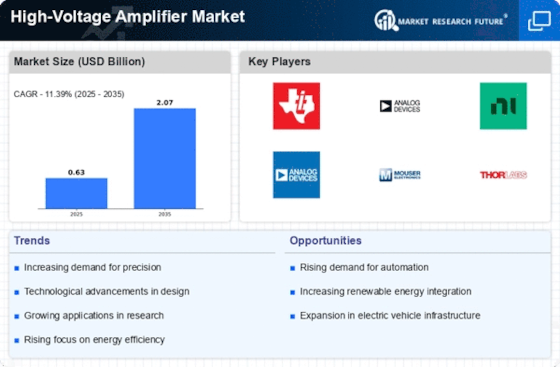
As per Market Research Future analysis, the High-Voltage Amplifier Market Size was estimated at 0.6328 USD Billion in 2024. The High-Voltage Amplifier industry is projected to grow from USD 0.7049 Billion in 2025 to USD 2.073 Billion by 2035, exhibiting a compound annual growth rate (CAGR) of 11.39% during the forecast period 2025 - 2035

Key Market Trends & Highlights

The High-Voltage Amplifier Market is poised for substantial growth driven by technological advancements and increasing demand across various sectors.

  • North America remains the largest market for high-voltage amplifiers, driven by robust telecommunications infrastructure. Asia-Pacific is emerging as the fastest-growing region, fueled by rising investments in renewable energy solutions. The bipolar segment continues to dominate the market, while the unipolar segment is experiencing rapid growth due to its applications in innovative technologies. Key market drivers include technological advancements and the rising demand for renewable energy solutions, particularly in the telecommunications and medical device sectors.

Market Size & Forecast

2024 Market Size 0.6328 (USD Billion)
2035 Market Size 2.073 (USD Billion)
CAGR (2025 - 2035) 11.39%
Largest Regional Market Share in 2024 North America

Major Players

Texas Instruments (US), Analog Devices (US), National Instruments (US), Maxim Integrated (US), Mouser Electronics (US), Thorlabs (US), Keysight Technologies (US), B&amp;K Precision (US)

Market Trends

The High-Voltage Amplifier Market is currently experiencing a notable evolution, driven by advancements in technology and increasing demand across various sectors. This market encompasses a range of applications, including industrial automation, medical devices, and telecommunications, where high-voltage amplifiers play a crucial role in signal processing and power management. As industries continue to innovate, the need for reliable and efficient amplification solutions becomes paramount. Furthermore, the integration of high-voltage amplifiers in emerging technologies, such as electric vehicles and renewable energy systems, suggests a promising trajectory for market growth. In addition to technological advancements, the High-Voltage Amplifier Market is influenced by regulatory frameworks and environmental considerations. Manufacturers are increasingly focusing on developing energy-efficient products that comply with stringent regulations. This shift not only enhances product appeal but also aligns with global sustainability goals. As the market evolves, collaboration between stakeholders, including manufacturers, suppliers, and end-users, appears essential for fostering innovation and addressing challenges. Overall, the High-Voltage Amplifier Market is poised for growth, driven by technological advancements and a commitment to sustainability.

Technological Advancements

The High-Voltage Amplifier Market is witnessing rapid technological advancements, particularly in the areas of miniaturization and efficiency. Innovations in semiconductor materials and circuit design are enabling the development of amplifiers that are not only more compact but also deliver superior performance. This trend is likely to enhance the applicability of high-voltage amplifiers in various sectors, including telecommunications and medical devices.

Sustainability Initiatives

There is a growing emphasis on sustainability within the High-Voltage Amplifier Market, as manufacturers strive to create energy-efficient solutions. This trend reflects a broader commitment to environmental responsibility, with companies investing in research and development to produce amplifiers that minimize energy consumption while maintaining performance. Such initiatives may resonate well with environmentally conscious consumers and industries.

Increased Demand in Emerging Markets

Emerging markets are showing a rising demand for high-voltage amplifiers, driven by industrial growth and technological adoption. As countries invest in infrastructure and modernization, the need for reliable amplification solutions becomes more pronounced. This trend indicates a potential expansion of the High-Voltage Amplifier Market, as manufacturers seek to capitalize on opportunities in these developing regions.

High Voltage Amplifier Market Market Drivers

Technological Advancements in High-Voltage Amplifier Market

The High-Voltage Amplifier Market is currently experiencing a surge in technological advancements, which are pivotal in driving market growth. Innovations in semiconductor technology and materials science have led to the development of more efficient and compact amplifiers. These advancements enable higher performance levels, which are essential for applications in telecommunications, medical devices, and industrial automation. The integration of digital signal processing with high-voltage amplifiers is also enhancing their functionality, allowing for improved signal fidelity and reduced distortion. As a result, the market is projected to grow at a compound annual growth rate of approximately 6.5% over the next five years, reflecting the increasing reliance on high-performance amplifiers across various sectors.

Growing Applications in Medical Devices in High-Voltage Amplifier Market

The High-Voltage Amplifier Market is experiencing growth due to the expanding applications in medical devices. High-voltage amplifiers are essential components in various medical imaging technologies, such as MRI and ultrasound systems, where precise signal amplification is crucial for accurate diagnostics. The medical device market is anticipated to reach over 600 billion dollars by 2025, driven by an aging population and increasing healthcare needs. This trend suggests a rising demand for high-voltage amplifiers that can support advanced medical technologies. As healthcare providers seek to enhance diagnostic capabilities, the High-Voltage Amplifier Market is likely to benefit from increased adoption in medical applications, further solidifying its market position.

Rising Demand for Renewable Energy Solutions in High-Voltage Amplifier Market

The High-Voltage Amplifier Market is witnessing a notable increase in demand for renewable energy solutions. As countries strive to meet sustainability goals, the need for efficient energy conversion and management systems has become paramount. High-voltage amplifiers play a crucial role in renewable energy applications, such as solar inverters and wind turbine control systems. The market for renewable energy is expected to expand significantly, with investments projected to reach over 2 trillion dollars by 2030. This growth is likely to drive the demand for high-voltage amplifiers, as they are essential for optimizing energy output and ensuring system reliability. Consequently, the High-Voltage Amplifier Market is poised for substantial growth as it aligns with the global shift towards sustainable energy.

Expansion of Telecommunications Infrastructure in High-Voltage Amplifier Market

The expansion of telecommunications infrastructure is a significant driver for the High-Voltage Amplifier Market. With the ongoing rollout of 5G networks and the increasing demand for high-speed internet, the need for robust amplification solutions is more pronounced than ever. High-voltage amplifiers are critical in ensuring signal integrity and coverage in telecommunications systems. The telecommunications sector is projected to invest over 1 trillion dollars in infrastructure development by 2025, which will likely boost the demand for high-voltage amplifiers. As service providers strive to enhance network performance and reliability, the High-Voltage Amplifier Market is expected to see substantial growth, driven by the need for advanced amplification technologies.

Increased Investment in Research and Development in High-Voltage Amplifier Market

Investment in research and development within the High-Voltage Amplifier Market is a critical driver of innovation and market expansion. Companies are increasingly allocating resources to develop next-generation amplifiers that offer enhanced performance and efficiency. This focus on R&D is particularly evident in sectors such as aerospace, defense, and telecommunications, where high-voltage amplifiers are integral to advanced systems. The global R&D expenditure in the electronics sector is projected to exceed 800 billion dollars by 2026, indicating a robust commitment to technological advancement. As companies strive to maintain competitive advantages, the emphasis on R&D is likely to propel the High-Voltage Amplifier Market forward, fostering new applications and improving existing technologies.

Market Segment Insights

By Type: Bipolar (Largest) vs. Unipolar (Fastest-Growing)

<p>The High-Voltage Amplifier Market is distinctly divided into two main types: Bipolar and Unipolar amplifiers. Bipolar amplifiers hold the majority share due to their established reliability and extensive application range in various industries. Their ability to provide high voltage gain and efficiency makes them preferred for critical applications such as signal processing and audio amplification. Meanwhile, Unipolar amplifiers, though currently accounting for a smaller portion of the market, exhibit significant growth potential, driven by their rising demand in emerging applications like RF signal amplification and telecommunications. Growth trends in the High-Voltage Amplifier Market show a steady rise in the adoption of Unipolar designs, primarily driven by advancements in technology and the increasing need for efficient power management solutions. The shift towards renewable energy sources and electrification across several sectors is fueling investments in innovative amplifier solutions. Consequently, Unipolar amplifiers are anticipated to witness an accelerated growth rate as they cater to specific applications that require lightweight and compact designs, thus creating a dynamic competitive landscape between the two types of amplifiers.</p>

<p>High-Voltage Amplifiers: Bipolar (Dominant) vs. Unipolar (Emerging)</p>

<p>Bipolar amplifiers are recognized as the dominant technology in the High-Voltage Amplifier Market, attributed to their high voltage handling capability and robustness. They are extensively used in various sectors, including industrial control, medical devices, and consumer electronics, thanks to their versatility and proven performance. In contrast, Unipolar amplifiers are emerging as a viable alternative, particularly in niche applications such as high-frequency RF amplification and portable systems. With a simpler design, they exhibit lower power consumption, making them suitable for modern electronic devices that prioritize energy efficiency. The evolving preferences in end-user industries, coupled with an increasing focus on compact and energy-efficient solutions, are positioning Unipolar amplifiers as a strong contender in the marketplace.</p>

By Application: Telecommunications (Largest) vs. Medical (Fastest-Growing)

<p>The High-Voltage Amplifier Market is prominently shaped by its diverse application segments, notably telecommunications and medical. Telecommunications holds the largest market share, driven by the increasing demand for reliable communication infrastructure and high-performance signal processing. The medical segment, while smaller, is rapidly gaining traction due to advancements in diagnostic equipment and therapeutic applications, further diversifying the market landscape. Growth trends in the High-Voltage Amplifier Market are significantly influenced by technological innovations and the expanding role of amplifiers in various applications. The telecommunications sector benefits from ongoing investments in broadband and cellular technology, facilitating enhanced performance. In contrast, the medical application is emerging as the fastest-growing segment, spurred by advancements in healthcare technology and the rising demand for high-precision medical devices that require powerful amplification solutions.</p>

<p>Telecommunications (Dominant) vs. Medical (Emerging)</p>

<p>The telecommunications sector is the dominant segment of the High-Voltage Amplifier Market, characterized by substantial demand for high-frequency signals essential for various communication technologies. This segment thrives on the backbone of the growing global telecommunications infrastructure, promoting the deployment of advanced amplifiers. In contrast, the medical segment is emerging, characterized by its innovation-driven landscape where amplifiers play a crucial role in enhancing the capabilities of medical imaging and treatment devices. The increasing focus on healthcare quality and precision fuels the growth of this segment, highlighting a shift towards integrated systems that rely on advanced amplification for accurate diagnostics and therapeutic interventions.</p>

Get more detailed insights about High Voltage Amplifier Market Research Report- Forecast 2035

Regional Insights

North America : Innovation and Market Leadership

North America is the largest market for high-voltage amplifiers, holding approximately 45% of the global market share. The region benefits from a robust technological infrastructure, significant investments in R&D, and a growing demand for high-performance electronic devices. Regulatory support for innovation and sustainability initiatives further drives market growth, making it a key player in the global landscape. The United States leads the market, with major companies like Texas Instruments, Analog Devices, and National Instruments headquartered there. The competitive landscape is characterized by continuous innovation and strategic partnerships among key players. The presence of advanced manufacturing facilities and a skilled workforce enhances the region's capability to meet the increasing demand for high-voltage amplifiers.

Europe : Regulatory Support and Growth

Europe is the second-largest market for high-voltage amplifiers, accounting for around 30% of the global share. The region's growth is driven by stringent regulations promoting energy efficiency and sustainability, alongside increasing demand in sectors like automotive and telecommunications. The European Union's Green Deal and various funding initiatives are pivotal in fostering innovation and market expansion. Leading countries include Germany, France, and the UK, where companies like Thorlabs and Keysight Technologies are prominent. The competitive landscape is marked by a mix of established players and emerging startups, all vying for market share. The presence of advanced research institutions and collaborative projects further enhances the region's innovation capabilities.

Asia-Pacific : Rapid Growth and Adoption

Asia-Pacific is witnessing rapid growth in the high-voltage amplifier market, holding approximately 20% of the global share. The region's expansion is fueled by increasing industrialization, a booming electronics sector, and rising investments in research and development. Countries like China and India are at the forefront, with government initiatives supporting technological advancements and infrastructure development. China is the largest market in the region, followed by Japan and South Korea. The competitive landscape is evolving, with both local and international players striving to capture market share. Companies are focusing on innovation and cost-effective solutions to meet the growing demand for high-voltage amplifiers in various applications, including telecommunications and automotive sectors.

Middle East and Africa : Untapped Potential and Growth

The Middle East and Africa region is gradually emerging in the high-voltage amplifier market, currently holding about 5% of the global share. The growth is driven by increasing investments in infrastructure, energy, and telecommunications. Governments are focusing on diversifying their economies, which is expected to boost demand for advanced electronic components, including high-voltage amplifiers. Countries like South Africa and the UAE are leading the market, with a growing number of local and international players entering the scene. The competitive landscape is characterized by a mix of established companies and new entrants, all aiming to leverage the region's untapped potential. As the market matures, innovation and strategic partnerships will be crucial for success.

Key Players and Competitive Insights

Leading market players invested heavily in research and Development (R&D) to scale up their manufacturing units and develop technologically advanced solutions, which will help the High-Voltage Amplifier market grow worldwide. Market participants are also undertaking various organic or inorganic strategic approaches to strengthen and expand their global footprint, with significant market developments including new product portfolios, contractual deals, mergers and acquisitions, capital expenditure, higher investments, and strategic alliances with other organizations. Businesses are also coming up with marketing strategies such as digital marketing, social media influencing, and content marketing to increase their scope of profit earnings.The High-Voltage Amplifier industry must offer cost-effective and sustainable options to survive in a highly fragmented and dynamic market climate.Manufacturing locally to minimize operational expenses and offer aftermarket services to customers is one of the critical business strategies organizations use in the global High-Voltage Amplifier industry to benefit customers and capture untapped market share and revenue. The High-Voltage Amplifier industry has recently offered significant advantages to the Test and Measurement industry. Moreover, more industry participants are utilizing and adopting cutting-edge technology has grown substantially.Major players in the High-Voltage Amplifier market, including Aerotech, Inc, Trek, Inc, Dewetron GmbH, Texas Instruments, Inc, HVP High, Voltage Products GmbH, Analog Devices, Inc, Linear Technology, Tabor Electronics, Accel Instruments GmbH, and Falco Systems, Inc are attempting to expand market share and demand by investing in R&D operations to produce sustainable and affordable solutions.Trek Inc. is a company that creates and manufactures measurement tools and gadgets. Amplifiers, piezo motorists, piezoelectric batteries, and electrophotography solutions are available from the company. Trek works on a global scale. Their mission is to be known worldwide as the most trusted source for breakthrough electrostatic measuring and high-voltage products. Trek, Inc. is a high voltage amplifier market leader recognized for its superior technology, precise measurement, and waveform creation skill. Texas Instruments & Analogue Devices, Inc. are also market leaders, providing excellent amplifiers for various purposes.Accel is venture capital that engages individuals and their businesses at all stages of private business growth. The firm was created in 1983 and is headquartered in California, USA. Accel Instruments, an established player referred to for its creative high-voltage amplifiers, is the latest entry in the sector. In contrast, HVP High Voltage Items GmbH and Dewetron GmbH are newly formed companies focused on offering high-voltage devices for studies and industrial use.

Key Companies in the High Voltage Amplifier Market include

Industry Developments

  • Q2 2024: Texas Instruments launches new high-voltage amplifier series for industrial automation Texas Instruments announced the release of its latest high-voltage amplifier series designed for precision industrial automation applications, expanding its portfolio to address growing demand in robotics and factory automation.
  • Q1 2024: Trek, Inc. Announces New High-Voltage Amplifier Model 2220 for Piezoelectric Applications Trek, Inc. introduced the Model 2220, a new high-voltage amplifier specifically engineered for piezoelectric and electrostatic applications, featuring enhanced bandwidth and output voltage capabilities.
  • Q3 2024: Analog Devices Expands High Voltage Amplifier Market Portfolio with ADA4523 Series Analog Devices launched the ADA4523 series, a new line of high voltage amplifiers targeting test and measurement, medical instrumentation, and industrial control markets.
  • Q2 2024: Accel Instruments Opens New Manufacturing Facility for High Voltage Amplifiers in Singapore Accel Instruments inaugurated a new manufacturing facility in Singapore to increase production capacity for its high voltage amplifier products, aiming to meet rising demand in Asia-Pacific.
  • Q1 2025: Falco Systems Appoints New CEO to Drive Global Expansion in High Voltage Amplifier Market Falco Systems announced the appointment of Dr. Anna Vermeer as CEO, with a mandate to accelerate international growth and product innovation in the high voltage amplifier sector.
  • Q2 2025: Stanford Research Systems Partners with National Instruments for Advanced High Voltage Amplifier Market Integration Stanford Research Systems entered a partnership with National Instruments to integrate its high voltage amplifiers into NI’s automated test systems, targeting semiconductor and aerospace customers.
  • Q3 2024: Matsusada Precision Launches High-Speed High Voltage Amplifier Market for MEMS Testing Matsusada Precision introduced a new high-speed high voltage amplifier designed for MEMS device testing, offering improved slew rate and voltage range for advanced R&D applications.
  • Q2 2024: Tabor Electronics Unveils All-in-One High Voltage Amplifier Market Platform for Research Labs Tabor Electronics launched an all-in-one high voltage amplifier platform aimed at research laboratories, featuring modular design and multi-channel support for flexible experimental setups.
  • Q1 2025: Apex Microtechnology Announces Strategic Partnership with Mouser Electronics for Global Distribution Apex Microtechnology formed a strategic partnership with Mouser Electronics to expand global distribution of its high voltage amplifier products, enhancing availability for OEMs and design engineers.
  • Q2 2025: Kepco, Inc. Secures Major Contract to Supply High Voltage Amplifiers for European Fusion Research Project Kepco, Inc. won a significant contract to provide high voltage amplifiers for a European fusion energy research initiative, supporting advanced plasma control systems.
  • Q3 2024: NF Corporation Launches Ultra-Low Noise High Voltage Amplifier Market for Quantum Computing Applications NF Corporation released a new ultra-low noise high voltage amplifier tailored for quantum computing research, addressing the need for precise voltage control in quantum experiments.
  • Q1 2024: PiezoDrive Raises $10 Million Series B to Accelerate High Voltage Amplifier Market Development PiezoDrive completed a $10 million Series B funding round to expand R&D and accelerate the development of next-generation high voltage amplifiers for industrial and medical applications.

Future Outlook

High Voltage Amplifier Market Future Outlook

The High-Voltage Amplifier Market is projected to grow at 11.39% CAGR from 2025 to 2035, driven by advancements in technology, increasing demand in industrial applications, and the rise of renewable energy systems.

New opportunities lie in:

  • Development of compact, high-efficiency amplifiers for portable applications.</p><p>Expansion into emerging markets with tailored solutions for local industries.</p><p>Partnerships with renewable energy firms to integrate amplifiers in solar and wind systems.

By 2035, the High-Voltage Amplifier Market is expected to achieve substantial growth and innovation.

Market Segmentation

High Voltage Amplifier Market Type Outlook

  • Bipolar
  • Unipolar

High Voltage Amplifier Market Application Outlook

  • Telecommunications
  • Medical
  • Industrial
  • Nuclear

Report Scope

MARKET SIZE 2024 0.6328(USD Billion)
MARKET SIZE 2025 0.7049(USD Billion)
MARKET SIZE 2035 2.073(USD Billion)
COMPOUND ANNUAL GROWTH RATE (CAGR) 11.39% (2025 - 2035)
REPORT COVERAGE Revenue Forecast, Competitive Landscape, Growth Factors, and Trends
BASE YEAR 2024
Market Forecast Period 2025 - 2035
Historical Data 2019 - 2024
Market Forecast Units USD Billion
Key Companies Profiled Texas Instruments (US), Analog Devices (US), National Instruments (US), Maxim Integrated (US), Mouser Electronics (US), Thorlabs (US), Keysight Technologies (US), B&K Precision (US)
Segments Covered Type, Application, Region
Key Market Opportunities Growing demand for high-voltage amplifiers in renewable energy applications presents significant market opportunities.
Key Market Dynamics Technological advancements drive demand for high-voltage amplifiers in diverse applications, enhancing performance and efficiency.
Countries Covered North America, Europe, APAC, South America, MEA

FAQs

What is the projected market valuation of the High-Voltage Amplifier Market by 2035?

<p>The projected market valuation for the High-Voltage Amplifier Market is 2.073 USD Billion by 2035.</p>

What was the market valuation of the High-Voltage Amplifier Market in 2024?

<p>The overall market valuation of the High-Voltage Amplifier Market was 0.6328 USD Billion in 2024.</p>

What is the expected CAGR for the High-Voltage Amplifier Market during the forecast period 2025 - 2035?

<p>The expected CAGR for the High-Voltage Amplifier Market during the forecast period 2025 - 2035 is 11.39%.</p>

Which companies are considered key players in the High-Voltage Amplifier Market?

<p>Key players in the High-Voltage Amplifier Market include Texas Instruments, Analog Devices, National Instruments, and Maxim Integrated.</p>

What are the main application segments of the High-Voltage Amplifier Market?

<p>The main application segments include Telecommunications, Medical, Industrial, and Nuclear.</p>

What was the market size for Bipolar and Unipolar types in 2024?

<p>In 2024, the market size for Bipolar and Unipolar types was 0.3164 USD Billion each.</p>

How does the market size for Telecommunications compare to Medical applications in 2024?

In 2024, the market size for Telecommunications was 0.189 USD Billion, while Medical applications were valued at 0.158 USD Billion.

What is the projected growth for the Industrial application segment by 2035?

The Industrial application segment is projected to grow from 0.143 USD Billion in 2024 to a higher valuation by 2035.

What is the expected market trend for the Nuclear application segment in the coming years?

The Nuclear application segment is expected to grow from 0.142 USD Billion in 2024, indicating potential for future expansion.

How do the valuations of Bipolar and Unipolar types evolve from 2024 to 2035?

The valuations for both Bipolar and Unipolar types are anticipated to increase significantly from 0.3164 USD Billion in 2024 to higher figures by 2035.

  1. SECTION I: EXECUTIVE SUMMARY AND KEY HIGHLIGHTS
    1. | 1.1 EXECUTIVE SUMMARY
    2. | | 1.1.1 Market Overview
    3. | | 1.1.2 Key Findings
    4. | | 1.1.3 Market Segmentation
    5. | | 1.1.4 Competitive Landscape
    6. | | 1.1.5 Challenges and Opportunities
    7. | | 1.1.6 Future Outlook
  2. SECTION II: SCOPING, METHODOLOGY AND MARKET STRUCTURE
    1. | 2.1 MARKET INTRODUCTION
    2. | | 2.1.1 Definition
    3. | | 2.1.2 Scope of the study
    4. | | | 2.1.2.1 Research Objective
    5. | | | 2.1.2.2 Assumption
    6. | | | 2.1.2.3 Limitations
    7. | 2.2 RESEARCH METHODOLOGY
    8. | | 2.2.1 Overview
    9. | | 2.2.2 Data Mining
    10. | | 2.2.3 Secondary Research
    11. | | 2.2.4 Primary Research
    12. | | | 2.2.4.1 Primary Interviews and Information Gathering Process
    13. | | | 2.2.4.2 Breakdown of Primary Respondents
    14. | | 2.2.5 Forecasting Model
    15. | | 2.2.6 Market Size Estimation
    16. | | | 2.2.6.1 Bottom-Up Approach
    17. | | | 2.2.6.2 Top-Down Approach
    18. | | 2.2.7 Data Triangulation
    19. | | 2.2.8 Validation
  3. SECTION III: QUALITATIVE ANALYSIS
    1. | 3.1 MARKET DYNAMICS
    2. | | 3.1.1 Overview
    3. | | 3.1.2 Drivers
    4. | | 3.1.3 Restraints
    5. | | 3.1.4 Opportunities
    6. | 3.2 MARKET FACTOR ANALYSIS
    7. | | 3.2.1 Value chain Analysis
    8. | | 3.2.2 Porter's Five Forces Analysis
    9. | | | 3.2.2.1 Bargaining Power of Suppliers
    10. | | | 3.2.2.2 Bargaining Power of Buyers
    11. | | | 3.2.2.3 Threat of New Entrants
    12. | | | 3.2.2.4 Threat of Substitutes
    13. | | | 3.2.2.5 Intensity of Rivalry
    14. | | 3.2.3 COVID-19 Impact Analysis
    15. | | | 3.2.3.1 Market Impact Analysis
    16. | | | 3.2.3.2 Regional Impact
    17. | | | 3.2.3.3 Opportunity and Threat Analysis
  4. SECTION IV: QUANTITATIVE ANALYSIS
    1. | 4.1 Semiconductor & Electronics, BY Type (USD Billion)
    2. | | 4.1.1 Bipolar
    3. | | 4.1.2 Unipolar
    4. | 4.2 Semiconductor & Electronics, BY Application (USD Billion)
    5. | | 4.2.1 Telecommunications
    6. | | 4.2.2 Medical
    7. | | 4.2.3 Industrial
    8. | | 4.2.4 Nuclear
    9. | 4.3 Semiconductor & Electronics, BY Region (USD Billion)
    10. | | 4.3.1 North America
    11. | | | 4.3.1.1 US
    12. | | | 4.3.1.2 Canada
    13. | | 4.3.2 Europe
    14. | | | 4.3.2.1 Germany
    15. | | | 4.3.2.2 UK
    16. | | | 4.3.2.3 France
    17. | | | 4.3.2.4 Russia
    18. | | | 4.3.2.5 Italy
    19. | | | 4.3.2.6 Spain
    20. | | | 4.3.2.7 Rest of Europe
    21. | | 4.3.3 APAC
    22. | | | 4.3.3.1 China
    23. | | | 4.3.3.2 India
    24. | | | 4.3.3.3 Japan
    25. | | | 4.3.3.4 South Korea
    26. | | | 4.3.3.5 Malaysia
    27. | | | 4.3.3.6 Thailand
    28. | | | 4.3.3.7 Indonesia
    29. | | | 4.3.3.8 Rest of APAC
    30. | | 4.3.4 South America
    31. | | | 4.3.4.1 Brazil
    32. | | | 4.3.4.2 Mexico
    33. | | | 4.3.4.3 Argentina
    34. | | | 4.3.4.4 Rest of South America
    35. | | 4.3.5 MEA
    36. | | | 4.3.5.1 GCC Countries
    37. | | | 4.3.5.2 South Africa
    38. | | | 4.3.5.3 Rest of MEA
  5. SECTION V: COMPETITIVE ANALYSIS
    1. | 5.1 Competitive Landscape
    2. | | 5.1.1 Overview
    3. | | 5.1.2 Competitive Analysis
    4. | | 5.1.3 Market share Analysis
    5. | | 5.1.4 Major Growth Strategy in the Semiconductor & Electronics
    6. | | 5.1.5 Competitive Benchmarking
    7. | | 5.1.6 Leading Players in Terms of Number of Developments in the Semiconductor & Electronics
    8. | | 5.1.7 Key developments and growth strategies
    9. | | | 5.1.7.1 New Product Launch/Service Deployment
    10. | | | 5.1.7.2 Merger & Acquisitions
    11. | | | 5.1.7.3 Joint Ventures
    12. | | 5.1.8 Major Players Financial Matrix
    13. | | | 5.1.8.1 Sales and Operating Income
    14. | | | 5.1.8.2 Major Players R&D Expenditure. 2023
    15. | 5.2 Company Profiles
    16. | | 5.2.1 Texas Instruments (US)
    17. | | | 5.2.1.1 Financial Overview
    18. | | | 5.2.1.2 Products Offered
    19. | | | 5.2.1.3 Key Developments
    20. | | | 5.2.1.4 SWOT Analysis
    21. | | | 5.2.1.5 Key Strategies
    22. | | 5.2.2 Analog Devices (US)
    23. | | | 5.2.2.1 Financial Overview
    24. | | | 5.2.2.2 Products Offered
    25. | | | 5.2.2.3 Key Developments
    26. | | | 5.2.2.4 SWOT Analysis
    27. | | | 5.2.2.5 Key Strategies
    28. | | 5.2.3 National Instruments (US)
    29. | | | 5.2.3.1 Financial Overview
    30. | | | 5.2.3.2 Products Offered
    31. | | | 5.2.3.3 Key Developments
    32. | | | 5.2.3.4 SWOT Analysis
    33. | | | 5.2.3.5 Key Strategies
    34. | | 5.2.4 Maxim Integrated (US)
    35. | | | 5.2.4.1 Financial Overview
    36. | | | 5.2.4.2 Products Offered
    37. | | | 5.2.4.3 Key Developments
    38. | | | 5.2.4.4 SWOT Analysis
    39. | | | 5.2.4.5 Key Strategies
    40. | | 5.2.5 Mouser Electronics (US)
    41. | | | 5.2.5.1 Financial Overview
    42. | | | 5.2.5.2 Products Offered
    43. | | | 5.2.5.3 Key Developments
    44. | | | 5.2.5.4 SWOT Analysis
    45. | | | 5.2.5.5 Key Strategies
    46. | | 5.2.6 Thorlabs (US)
    47. | | | 5.2.6.1 Financial Overview
    48. | | | 5.2.6.2 Products Offered
    49. | | | 5.2.6.3 Key Developments
    50. | | | 5.2.6.4 SWOT Analysis
    51. | | | 5.2.6.5 Key Strategies
    52. | | 5.2.7 Keysight Technologies (US)
    53. | | | 5.2.7.1 Financial Overview
    54. | | | 5.2.7.2 Products Offered
    55. | | | 5.2.7.3 Key Developments
    56. | | | 5.2.7.4 SWOT Analysis
    57. | | | 5.2.7.5 Key Strategies
    58. | | 5.2.8 B&K Precision (US)
    59. | | | 5.2.8.1 Financial Overview
    60. | | | 5.2.8.2 Products Offered
    61. | | | 5.2.8.3 Key Developments
    62. | | | 5.2.8.4 SWOT Analysis
    63. | | | 5.2.8.5 Key Strategies
    64. | 5.3 Appendix
    65. | | 5.3.1 References
    66. | | 5.3.2 Related Reports
  6. LIST OF FIGURES
    1. | 6.1 MARKET SYNOPSIS
    2. | 6.2 NORTH AMERICA MARKET ANALYSIS
    3. | 6.3 US MARKET ANALYSIS BY TYPE
    4. | 6.4 US MARKET ANALYSIS BY APPLICATION
    5. | 6.5 CANADA MARKET ANALYSIS BY TYPE
    6. | 6.6 CANADA MARKET ANALYSIS BY APPLICATION
    7. | 6.7 EUROPE MARKET ANALYSIS
    8. | 6.8 GERMANY MARKET ANALYSIS BY TYPE
    9. | 6.9 GERMANY MARKET ANALYSIS BY APPLICATION
    10. | 6.10 UK MARKET ANALYSIS BY TYPE
    11. | 6.11 UK MARKET ANALYSIS BY APPLICATION
    12. | 6.12 FRANCE MARKET ANALYSIS BY TYPE
    13. | 6.13 FRANCE MARKET ANALYSIS BY APPLICATION
    14. | 6.14 RUSSIA MARKET ANALYSIS BY TYPE
    15. | 6.15 RUSSIA MARKET ANALYSIS BY APPLICATION
    16. | 6.16 ITALY MARKET ANALYSIS BY TYPE
    17. | 6.17 ITALY MARKET ANALYSIS BY APPLICATION
    18. | 6.18 SPAIN MARKET ANALYSIS BY TYPE
    19. | 6.19 SPAIN MARKET ANALYSIS BY APPLICATION
    20. | 6.20 REST OF EUROPE MARKET ANALYSIS BY TYPE
    21. | 6.21 REST OF EUROPE MARKET ANALYSIS BY APPLICATION
    22. | 6.22 APAC MARKET ANALYSIS
    23. | 6.23 CHINA MARKET ANALYSIS BY TYPE
    24. | 6.24 CHINA MARKET ANALYSIS BY APPLICATION
    25. | 6.25 INDIA MARKET ANALYSIS BY TYPE
    26. | 6.26 INDIA MARKET ANALYSIS BY APPLICATION
    27. | 6.27 JAPAN MARKET ANALYSIS BY TYPE
    28. | 6.28 JAPAN MARKET ANALYSIS BY APPLICATION
    29. | 6.29 SOUTH KOREA MARKET ANALYSIS BY TYPE
    30. | 6.30 SOUTH KOREA MARKET ANALYSIS BY APPLICATION
    31. | 6.31 MALAYSIA MARKET ANALYSIS BY TYPE
    32. | 6.32 MALAYSIA MARKET ANALYSIS BY APPLICATION
    33. | 6.33 THAILAND MARKET ANALYSIS BY TYPE
    34. | 6.34 THAILAND MARKET ANALYSIS BY APPLICATION
    35. | 6.35 INDONESIA MARKET ANALYSIS BY TYPE
    36. | 6.36 INDONESIA MARKET ANALYSIS BY APPLICATION
    37. | 6.37 REST OF APAC MARKET ANALYSIS BY TYPE
    38. | 6.38 REST OF APAC MARKET ANALYSIS BY APPLICATION
    39. | 6.39 SOUTH AMERICA MARKET ANALYSIS
    40. | 6.40 BRAZIL MARKET ANALYSIS BY TYPE
    41. | 6.41 BRAZIL MARKET ANALYSIS BY APPLICATION
    42. | 6.42 MEXICO MARKET ANALYSIS BY TYPE
    43. | 6.43 MEXICO MARKET ANALYSIS BY APPLICATION
    44. | 6.44 ARGENTINA MARKET ANALYSIS BY TYPE
    45. | 6.45 ARGENTINA MARKET ANALYSIS BY APPLICATION
    46. | 6.46 REST OF SOUTH AMERICA MARKET ANALYSIS BY TYPE
    47. | 6.47 REST OF SOUTH AMERICA MARKET ANALYSIS BY APPLICATION
    48. | 6.48 MEA MARKET ANALYSIS
    49. | 6.49 GCC COUNTRIES MARKET ANALYSIS BY TYPE
    50. | 6.50 GCC COUNTRIES MARKET ANALYSIS BY APPLICATION
    51. | 6.51 SOUTH AFRICA MARKET ANALYSIS BY TYPE
    52. | 6.52 SOUTH AFRICA MARKET ANALYSIS BY APPLICATION
    53. | 6.53 REST OF MEA MARKET ANALYSIS BY TYPE
    54. | 6.54 REST OF MEA MARKET ANALYSIS BY APPLICATION
    55. | 6.55 KEY BUYING CRITERIA OF SEMICONDUCTOR & ELECTRONICS
    56. | 6.56 RESEARCH PROCESS OF MRFR
    57. | 6.57 DRO ANALYSIS OF SEMICONDUCTOR & ELECTRONICS
    58. | 6.58 DRIVERS IMPACT ANALYSIS: SEMICONDUCTOR & ELECTRONICS
    59. | 6.59 RESTRAINTS IMPACT ANALYSIS: SEMICONDUCTOR & ELECTRONICS
    60. | 6.60 SUPPLY / VALUE CHAIN: SEMICONDUCTOR & ELECTRONICS
    61. | 6.61 SEMICONDUCTOR & ELECTRONICS, BY TYPE, 2024 (% SHARE)
    62. | 6.62 SEMICONDUCTOR & ELECTRONICS, BY TYPE, 2024 TO 2035 (USD Billion)
    63. | 6.63 SEMICONDUCTOR & ELECTRONICS, BY APPLICATION, 2024 (% SHARE)
    64. | 6.64 SEMICONDUCTOR & ELECTRONICS, BY APPLICATION, 2024 TO 2035 (USD Billion)
    65. | 6.65 BENCHMARKING OF MAJOR COMPETITORS
  7. LIST OF TABLES
    1. | 7.1 LIST OF ASSUMPTIONS
    2. | | 7.1.1
    3. | 7.2 North America MARKET SIZE ESTIMATES; FORECAST
    4. | | 7.2.1 BY TYPE, 2025-2035 (USD Billion)
    5. | | 7.2.2 BY APPLICATION, 2025-2035 (USD Billion)
    6. | 7.3 US MARKET SIZE ESTIMATES; FORECAST
    7. | | 7.3.1 BY TYPE, 2025-2035 (USD Billion)
    8. | | 7.3.2 BY APPLICATION, 2025-2035 (USD Billion)
    9. | 7.4 Canada MARKET SIZE ESTIMATES; FORECAST
    10. | | 7.4.1 BY TYPE, 2025-2035 (USD Billion)
    11. | | 7.4.2 BY APPLICATION, 2025-2035 (USD Billion)
    12. | 7.5 Europe MARKET SIZE ESTIMATES; FORECAST
    13. | | 7.5.1 BY TYPE, 2025-2035 (USD Billion)
    14. | | 7.5.2 BY APPLICATION, 2025-2035 (USD Billion)
    15. | 7.6 Germany MARKET SIZE ESTIMATES; FORECAST
    16. | | 7.6.1 BY TYPE, 2025-2035 (USD Billion)
    17. | | 7.6.2 BY APPLICATION, 2025-2035 (USD Billion)
    18. | 7.7 UK MARKET SIZE ESTIMATES; FORECAST
    19. | | 7.7.1 BY TYPE, 2025-2035 (USD Billion)
    20. | | 7.7.2 BY APPLICATION, 2025-2035 (USD Billion)
    21. | 7.8 France MARKET SIZE ESTIMATES; FORECAST
    22. | | 7.8.1 BY TYPE, 2025-2035 (USD Billion)
    23. | | 7.8.2 BY APPLICATION, 2025-2035 (USD Billion)
    24. | 7.9 Russia MARKET SIZE ESTIMATES; FORECAST
    25. | | 7.9.1 BY TYPE, 2025-2035 (USD Billion)
    26. | | 7.9.2 BY APPLICATION, 2025-2035 (USD Billion)
    27. | 7.10 Italy MARKET SIZE ESTIMATES; FORECAST
    28. | | 7.10.1 BY TYPE, 2025-2035 (USD Billion)
    29. | | 7.10.2 BY APPLICATION, 2025-2035 (USD Billion)
    30. | 7.11 Spain MARKET SIZE ESTIMATES; FORECAST
    31. | | 7.11.1 BY TYPE, 2025-2035 (USD Billion)
    32. | | 7.11.2 BY APPLICATION, 2025-2035 (USD Billion)
    33. | 7.12 Rest of Europe MARKET SIZE ESTIMATES; FORECAST
    34. | | 7.12.1 BY TYPE, 2025-2035 (USD Billion)
    35. | | 7.12.2 BY APPLICATION, 2025-2035 (USD Billion)
    36. | 7.13 APAC MARKET SIZE ESTIMATES; FORECAST
    37. | | 7.13.1 BY TYPE, 2025-2035 (USD Billion)
    38. | | 7.13.2 BY APPLICATION, 2025-2035 (USD Billion)
    39. | 7.14 China MARKET SIZE ESTIMATES; FORECAST
    40. | | 7.14.1 BY TYPE, 2025-2035 (USD Billion)
    41. | | 7.14.2 BY APPLICATION, 2025-2035 (USD Billion)
    42. | 7.15 India MARKET SIZE ESTIMATES; FORECAST
    43. | | 7.15.1 BY TYPE, 2025-2035 (USD Billion)
    44. | | 7.15.2 BY APPLICATION, 2025-2035 (USD Billion)
    45. | 7.16 Japan MARKET SIZE ESTIMATES; FORECAST
    46. | | 7.16.1 BY TYPE, 2025-2035 (USD Billion)
    47. | | 7.16.2 BY APPLICATION, 2025-2035 (USD Billion)
    48. | 7.17 South Korea MARKET SIZE ESTIMATES; FORECAST
    49. | | 7.17.1 BY TYPE, 2025-2035 (USD Billion)
    50. | | 7.17.2 BY APPLICATION, 2025-2035 (USD Billion)
    51. | 7.18 Malaysia MARKET SIZE ESTIMATES; FORECAST
    52. | | 7.18.1 BY TYPE, 2025-2035 (USD Billion)
    53. | | 7.18.2 BY APPLICATION, 2025-2035 (USD Billion)
    54. | 7.19 Thailand MARKET SIZE ESTIMATES; FORECAST
    55. | | 7.19.1 BY TYPE, 2025-2035 (USD Billion)
    56. | | 7.19.2 BY APPLICATION, 2025-2035 (USD Billion)
    57. | 7.20 Indonesia MARKET SIZE ESTIMATES; FORECAST
    58. | | 7.20.1 BY TYPE, 2025-2035 (USD Billion)
    59. | | 7.20.2 BY APPLICATION, 2025-2035 (USD Billion)
    60. | 7.21 Rest of APAC MARKET SIZE ESTIMATES; FORECAST
    61. | | 7.21.1 BY TYPE, 2025-2035 (USD Billion)
    62. | | 7.21.2 BY APPLICATION, 2025-2035 (USD Billion)
    63. | 7.22 South America MARKET SIZE ESTIMATES; FORECAST
    64. | | 7.22.1 BY TYPE, 2025-2035 (USD Billion)
    65. | | 7.22.2 BY APPLICATION, 2025-2035 (USD Billion)
    66. | 7.23 Brazil MARKET SIZE ESTIMATES; FORECAST
    67. | | 7.23.1 BY TYPE, 2025-2035 (USD Billion)
    68. | | 7.23.2 BY APPLICATION, 2025-2035 (USD Billion)
    69. | 7.24 Mexico MARKET SIZE ESTIMATES; FORECAST
    70. | | 7.24.1 BY TYPE, 2025-2035 (USD Billion)
    71. | | 7.24.2 BY APPLICATION, 2025-2035 (USD Billion)
    72. | 7.25 Argentina MARKET SIZE ESTIMATES; FORECAST
    73. | | 7.25.1 BY TYPE, 2025-2035 (USD Billion)
    74. | | 7.25.2 BY APPLICATION, 2025-2035 (USD Billion)
    75. | 7.26 Rest of South America MARKET SIZE ESTIMATES; FORECAST
    76. | | 7.26.1 BY TYPE, 2025-2035 (USD Billion)
    77. | | 7.26.2 BY APPLICATION, 2025-2035 (USD Billion)
    78. | 7.27 MEA MARKET SIZE ESTIMATES; FORECAST
    79. | | 7.27.1 BY TYPE, 2025-2035 (USD Billion)
    80. | | 7.27.2 BY APPLICATION, 2025-2035 (USD Billion)
    81. | 7.28 GCC Countries MARKET SIZE ESTIMATES; FORECAST
    82. | | 7.28.1 BY TYPE, 2025-2035 (USD Billion)
    83. | | 7.28.2 BY APPLICATION, 2025-2035 (USD Billion)
    84. | 7.29 South Africa MARKET SIZE ESTIMATES; FORECAST
    85. | | 7.29.1 BY TYPE, 2025-2035 (USD Billion)
    86. | | 7.29.2 BY APPLICATION, 2025-2035 (USD Billion)
    87. | 7.30 Rest of MEA MARKET SIZE ESTIMATES; FORECAST
    88. | | 7.30.1 BY TYPE, 2025-2035 (USD Billion)
    89. | | 7.30.2 BY APPLICATION, 2025-2035 (USD Billion)
    90. | 7.31 PRODUCT LAUNCH/PRODUCT DEVELOPMENT/APPROVAL
    91. | | 7.31.1
    92. | 7.32 ACQUISITION/PARTNERSHIP
    93. | | 7.32.1

Semiconductor & Electronics Market Segmentation

Semiconductor & Electronics By Type (USD Billion, 2025-2035)

  • Bipolar
  • Unipolar

Semiconductor & Electronics By Application (USD Billion, 2025-2035)

  • Telecommunications
  • Medical
  • Industrial
  • Nuclear
Infographic

Free Sample Request

Kindly complete the form below to receive a free sample of this Report

Get Free Sample

Customer Strories

Compare Licence

×
Features License Type
Single User Multiuser License Enterprise User
Price $4,950 $5,950 $7,250
Maximum User Access Limit 1 User Upto 10 Users Unrestricted Access Throughout the Organization
Free Customization
Direct Access to Analyst
Deliverable Format
Platform Access
Discount on Next Purchase 10% 15% 15%
Printable Versions
%>