Request Free Sample ×

Kindly complete the form below to receive a free sample of this Report

* Please use a valid business email

Leading companies partner with us for data-driven Insights

clients tt-cursor
Hero Background
English
Chinese
French
Japanese
Korean
German
Spanish

High Temperature Insulation Market Trends

ID: MRFR/CnM/1474-HCR
140 Pages
Anshula Mandaokar
March 2026

High-Temperature Insulation Market Research Report Information By Product (Insulating Firebrick, Ceramic Fiber, and Calcium Silicate), By Application (Petrochemicals, Glass, Aluminum, Iron & Steel, Cement, and Refractory), And By Region (North America, Europe, Asia-Pacific, And Rest Of The World) –Market Forecast Till 2035

Share:
Download PDF ×

We do not share your information with anyone. However, we may send you emails based on your report interest from time to time. You may contact us at any time to opt-out.

High Temperature Insulation Market Infographic
Purchase Options

Market Trends

Key Emerging Trends in the High Temperature Insulation Market

With more focus on saving energy and being efficient, businesses that work in hot places are using high-temperature insulation materials more and more. In industrial processes, these materials help keep heat from escaping, make thermal efficiency better, and save energy overall. A lot of different end-use businesses, like petroleum, metals, ceramics, and power production, are buying more high temperature insulation. As these areas grow, they need effective insulation materials that can stand up to high temperatures more than ever. This is what drives market growth. Aerospace and car companies are using high-temperature insulation materials to make parts that are exposed to high temperatures work better. Lightweight, long-lasting, and heat-resistant insulation options are in higher demand for everything from airplane engines to car exhaust systems. For strict fire safety rules and building codes, the construction industry is using high-temperature insulation materials. Buildings, especially high-rises and industrial sites, are better because of these materials, which make them more fire resistant. Latest improvements in high-temperature insulation materials are the result of ongoing research and development. Companies are looking into new materials that are better at handling heat, last longer, and are better for the environment. Some new trends in high-temperature insulation are nanotechnology and solutions based on aerogel. Many businesses have to choose the right insulating materials because of rules about the environment and goals for sustainability. Environmentally friendly, non-toxic, and reusable high-temperature insulating materials are becoming more popular. This is in line with the worldwide movement toward better and more sustainable practices. As a result of fast development in places like China and India, the Asia-Pacific area is becoming a major growing market for high-temperature insulation. The need for effective insulation solutions is largely caused by the growth of industrial and building projects in the area. There are problems in the High Temperature Insulation Market with the cost and supply of raw materials like silica, alumina, and calcium silicate. Changing prices for these products can affect how much it costs to make something, which can change pricing tactics and the way the market works.


Author
Author Profile
Anshula Mandaokar
Team Lead - Research

Anshula Mandaokar holds an academic degree in Chemical Engineering and has been contributing to the field for more than 5 years. She has expertise in Market Research and Business Consulting and serves as a Team Lead for a reputed Market Research firm under the Chemicals and Materials domain spectrum. She has worked on multiple projects, generating explicit results in a quick turnaround time. Her understanding of data interpretation justifies her role as a leader.

Leave a Comment

FAQs

What is the current valuation of the High-Temperature Insulation Market?

<p>The market valuation was 3.52 USD Billion in 2024.</p>

What is the projected market size for the High-Temperature Insulation Market by 2035?

<p>The market is projected to reach 7.641 USD Billion by 2035.</p>

What is the expected CAGR for the High-Temperature Insulation Market during the forecast period?

<p>The expected CAGR for the market from 2025 to 2035 is 7.3%.</p>

Which product segment is anticipated to show significant growth in the High-Temperature Insulation Market?

<p>The Ceramic Fiber segment is expected to grow from 1.5 USD Billion in 2024 to 3.2 USD Billion by 2035.</p>

How do insulating firebricks perform in the High-Temperature Insulation Market?

<p>Insulating Firebricks are projected to increase from 0.9 USD Billion in 2024 to 1.9 USD Billion by 2035.</p>

What applications are driving the demand for High-Temperature Insulation?

<p>Key applications include Petrochemicals, which are expected to grow from 0.84 USD Billion in 2024 to 1.8 USD Billion by 2035.</p>

Which companies are leading the High-Temperature Insulation Market?

Key players include Morgan Thermal Ceramics, Unifrax, and RHI Magnesita, among others.

What is the growth outlook for the Calcium Silicate segment in the market?

Calcium Silicate is projected to grow from 1.12 USD Billion in 2024 to 2.54 USD Billion by 2035.

How does the Iron & Steel application segment perform in the market?

The Iron &amp; Steel application segment is expected to increase from 0.68 USD Billion in 2024 to 1.5 USD Billion by 2035.

What trends are influencing the High-Temperature Insulation Market?

Trends include increasing demand in industries such as Cement and Aluminum, with projected growth in their respective segments.

Market Summary

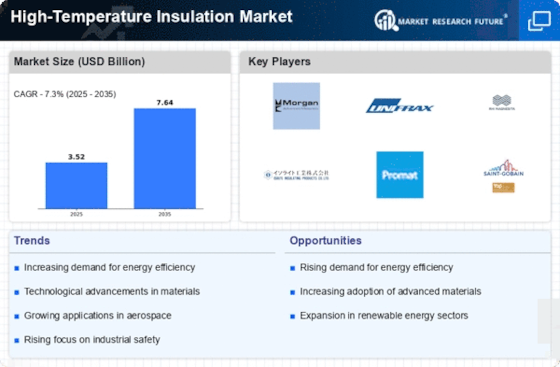
As per Market Research Future analysis, the High-Temperature Insulation Market size was estimated at 3.52 USD Billion in 2024. The High-Temperature Insulation industry is projected to grow from 3.777 USD Billion in 2025 to 7.641 USD Billion by 2035, exhibiting a compound annual growth rate (CAGR) of 7.3% during the forecast period 2025 - 2035

Key Market Trends & Highlights

The High-Temperature Insulation Market is poised for robust growth driven by sustainability and technological advancements.

  • North America remains the largest market for high-temperature insulation, driven by industrial applications and energy efficiency regulations. The Asia-Pacific region is emerging as the fastest-growing market, fueled by rapid industrialization and increasing energy demands. Insulating firebricks dominate the market, while ceramic fiber is witnessing the fastest growth due to its lightweight and high-performance characteristics. Rising demand in industrial applications and stringent energy efficiency regulations are key drivers propelling market expansion.

Market Size & Forecast

2024 Market Size 3.52 (USD Billion)
2035 Market Size 7.641 (USD Billion)
CAGR (2025 - 2035) 7.3%
Largest Regional Market Share in 2024 North America

Major Players

Morgan Thermal Ceramics (GB), Unifrax (US), RHI Magnesita (AT), Isolite Insulating Products (JP), Promat (BE), Saint-Gobain (FR), 3M (US), Koei Chemical (JP), Pyrotek (AU), Thermal Ceramics (US)

Market Trends

The High-Temperature Insulation Market is currently experiencing a notable transformation, driven by the increasing demand for energy efficiency and sustainability across various industries. As organizations strive to reduce their carbon footprints, the adoption of advanced insulation materials has become paramount. This shift is particularly evident in sectors such as aerospace, automotive, and manufacturing, where high-performance insulation solutions are essential for maintaining operational efficiency and safety. Furthermore, the growing emphasis on regulatory compliance regarding emissions and energy consumption is propelling the market forward, as companies seek to meet stringent standards while optimizing their processes. In addition to regulatory pressures, technological advancements are playing a crucial role in shaping the High-Temperature Insulation Market. Innovations in material science are leading to the development of lightweight, durable, and highly effective insulation products. These advancements not only enhance thermal performance but also contribute to overall cost savings for end-users. As industries continue to evolve, the demand for customized insulation solutions tailored to specific applications is likely to increase, indicating a dynamic and competitive landscape. Overall, the High-Temperature Insulation Market appears poised for growth, driven by a confluence of environmental considerations and technological progress.

Sustainability Initiatives

The High-Temperature Insulation Market is witnessing a surge in sustainability initiatives as industries prioritize eco-friendly practices. Companies are increasingly opting for insulation materials that minimize environmental impact, aligning with global efforts to combat climate change. This trend reflects a broader commitment to sustainable development, influencing product innovation and selection.

Technological Advancements

Technological advancements are reshaping the High-Temperature Insulation Market, with new materials and manufacturing processes enhancing insulation performance. Innovations such as nanotechnology and advanced composites are emerging, offering improved thermal resistance and durability. These developments are likely to drive market growth as industries seek efficient and effective insulation solutions.

Customization and Specialization

Customization and specialization are becoming prominent trends within the High-Temperature Insulation Market. As diverse industries require tailored solutions for specific applications, manufacturers are focusing on developing bespoke insulation products. This trend indicates a shift towards meeting unique customer needs, fostering innovation and competition in the market.

High Temperature Insulation Market Market Drivers

Expansion of the Manufacturing Sector

The High-Temperature Insulation Market is benefiting from the expansion of the manufacturing sector, particularly in emerging economies. As manufacturing activities ramp up, there is a growing need for high-performance insulation materials to support various processes, including metal processing and glass production. High-temperature insulation is crucial for maintaining optimal operating conditions and enhancing energy efficiency in these manufacturing processes. Data suggests that the manufacturing sector is expected to grow at a rate of approximately 4.0% annually, driving demand for high-temperature insulation solutions. This expansion presents opportunities for manufacturers to innovate and cater to the evolving needs of the industry, thereby bolstering the overall market.

Growth in Energy Efficiency Regulations

The High-Temperature Insulation Market is significantly influenced by the increasing emphasis on energy efficiency regulations across various sectors. Governments and regulatory bodies are implementing stringent standards aimed at reducing energy consumption and greenhouse gas emissions. This regulatory landscape compels industries to adopt high-temperature insulation materials that not only enhance thermal performance but also contribute to sustainability goals. For example, the power generation sector is mandated to utilize insulation solutions that minimize heat loss, thereby improving overall efficiency. As a result, the market for high-temperature insulation is expected to expand, with estimates suggesting a growth rate of around 4.8% annually as industries adapt to these evolving regulations.

Rising Demand in Industrial Applications

The High-Temperature Insulation Market is experiencing a notable surge in demand driven by various industrial applications. Industries such as aerospace, automotive, and power generation are increasingly adopting high-temperature insulation materials to enhance energy efficiency and reduce operational costs. For instance, the aerospace sector utilizes these materials to withstand extreme temperatures during flight, thereby improving safety and performance. According to recent data, the insulation market in the aerospace industry is projected to grow at a compound annual growth rate of approximately 5.2% over the next five years. This trend indicates a robust demand for high-temperature insulation solutions, as industries seek to optimize their processes and comply with stringent environmental regulations.

Increasing Adoption in the Oil and Gas Sector

The High-Temperature Insulation Market is witnessing a significant uptick in adoption within the oil and gas sector. As exploration and production activities intensify in challenging environments, the need for reliable insulation solutions becomes paramount. High-temperature insulation materials are essential for maintaining operational efficiency and safety in refineries and petrochemical plants, where extreme temperatures are commonplace. Recent statistics indicate that the oil and gas industry accounts for a substantial share of the insulation market, with a projected growth rate of around 4.2% over the next few years. This trend underscores the critical role of high-temperature insulation in ensuring the integrity and efficiency of energy production processes.

Technological Innovations in Insulation Materials

Technological advancements are playing a pivotal role in shaping the High-Temperature Insulation Market. Innovations in material science have led to the development of advanced insulation products that offer superior thermal resistance and durability. For instance, the introduction of aerogel-based insulation materials has revolutionized the market, providing lightweight yet highly effective solutions for extreme temperature applications. These innovations not only enhance performance but also reduce the overall weight of insulation systems, which is particularly beneficial in sectors like aerospace and automotive. The market is projected to witness a growth trajectory of approximately 5.5% as manufacturers continue to invest in research and development to create cutting-edge insulation technologies.

Market Segment Insights

By Product: Insulating Firebricks (Largest) vs. Ceramic Fiber (Fastest-Growing)

The High-Temperature Insulation Market is primarily segmented into Insulating Firebricks, Ceramic Fiber, and Calcium Silicate. Insulating Firebricks hold the largest share of the market due to their exceptional thermal resistance and capacity to withstand high temperatures, making them favored in applications like <a href="https://www.marketresearchfuture.com/reports/steel-processing-market-2150">steel</a> production and glass manufacturing. Ceramic Fiber, while smaller in market share, has been gaining traction due to its lightweight nature and flexibility, making it ideal for diverse high-temperature applications. Calcium Silicate, although not the largest player, continues to contribute to market dynamics with its unique insulation properties, especially in industrial settings.

Insulating Firebricks (Dominant) vs. Ceramic Fiber (Emerging)

Insulating Firebricks are regarded as the dominant segment in the High-Temperature Insulation Market, known for their high compressive strength and thermal stability, which makes them critically valuable in numerous industrial applications. Their robustness ensures they maintain integrity even under intense heat, particularly in furnaces and kilns. On the other hand, <a href="https://www.marketresearchfuture.com/reports/ceramic-fiber-market-7269">Ceramic Fiber</a> is positioned as an emerging segment thanks to its superior insulation capabilities at high temperatures, coupled with its lightweight and versatility. This fiber is increasingly being utilized in various industrial sectors, including aerospace and automotive, where weight reduction without compromising thermal efficiency is paramount, thereby elevating its market position.

By Application: Petrochemicals (Largest) vs. Glass (Fastest-Growing)

In the High-Temperature Insulation Market, petrochemicals represent the largest share, driven by the industry's increasing demand for insulation materials that can withstand extreme temperatures during various manufacturing processes. This segment has established itself as a cornerstone for demand, supporting fundamental operations and ensuring energy efficiency throughout the sector. Glass, on the other hand, is emerging as the fastest-growing segment, bolstered by innovations in manufacturing processes and the rising popularity of glass-based products requiring significant insulation to maintain high performance under temperature stress.

Glass: Emerging vs. Aluminum: Dominant

In the High-Temperature Insulation Market, the glass application is characterized by rapid technological advancements and increasing usage in high-performance applications, making it a strong emerging segment. As more industries recognize the benefits of glass insulation, its adoption is expected to rise significantly. Conversely, aluminum continues to be a dominant application due to its wide-ranging applications in high-temperature environments, thanks to its lightweight and excellent thermal conductivity. The stringent regulations regarding energy efficiency and sustainability further bolster aluminum's position, making it a staple in the market as companies seek reliable and efficient insulation solutions.

Get more detailed insights about High Temperature Insulation Market Report - Global Forecast till 2035

Regional Insights

By Region, the research provides market insights into North America, Europe, Asia-Pacific, and the Rest of the World. North American Region will dominate this market by 45.8% in 2022, owing to growing urbanization and growth in the automotive and construction industries that fuel the growth of the high-temperature insulation market.

Further, the major countries studied in the market report are The U.S., Canada, German, France, the UK, Italy, Spain, China, Japan, India, Australia, South Korea, and Brazil.

Figure 2:  High-Temperature Insulation Market Share by Region 2022 (%)

Europe’s High-Temperature Insulation market accounts for the second-largest market share due to rising industrialization with European Union initiatives to promote energy efficiency within industries. Further, the German High-Temperature Insulation market dominated the market, and the UK High-Temperature Insulation market is expected to grow quickly in the European Region.

The Asia-Pacific High-Temperature Insulation Market is expected to grow significantly during the projected timeframe. This is due to capital expenditure and high investment in petrochemical industries. Moreover, China’s High-Temperature Insulation market contributes the highest market share due to its dominance in the manufacturing sector. The Indian High-Temperature Insulation market is expected to grow significantly in Asia.

For instance, total real estate investment in China increased substantially from 2019 to 2020. The development of China's construction industry is primarily driven by real estate investment, which is mostly concentrated on housing and also commercial facilities. As a result, this scenario is anticipated to increase demand in the industry.

Key Players and Competitive Insights

Leading market players are investing heavily in research and development to increase their production capacity, which will help the High-Temperature Insulation market to grow significantly. Market participants are also strategic approaches to establish and grow their international footprint, with important market developments including product lines, partnerships, mergers and acquisitions, capital expenditure, and strategic alliances with other organizations. The high-Temperature Insulation industry must offer cost-effective solutions to survive in fragmented markets.Manufacturing locally to minimize expenses is one of the key business tactics used by industry players in the High-Temperature Insulation industry to benefit consumers and expand their market share. Recently, the High-Temperature Insulation industry has offered significant advantages to industrialization and urbanization.Major players in the High-Temperature Insulation market, including 3M Company (US), ADL Insulflex Inc (US), Dyson Group (Australia), Hi-Temp Insulation Inc. (US), Insulcon Group (UK), Isolite Insulating Products Company Ltd (US), Pacor Inc. (US), Promat International NV (Belgium), Pyrotek (India), Skamol A/S (Denmark), Unifrax (India) and Thermal Ceramics (UK), are attempting to cater market demand by investing in research and development to produce maximum output at affordable cost.The Sun King founded the Saint-Gobain, a French international enterprise, in Paris in 1665. It started producing mirrors but now does a range of operations. Saint-Gobain will employ more than 170,000 people in 2022 and is active in 76 countries. Saint-Gobain began business operations in India in 1996, growing strongly and profitably. It now has 22 manufacturing facilities and is a leader in its core industries. In May 2019: Saint-Gobain purchased Pritex, a significant producer of composite materials with polymer-based thermal insulation solutions targeted at the mobility sector.With the aid of this acquisition, Saint-Gobain High-Performance Systems' mobility business unit was able to diversify beyond the automotive glass and offer solutions for comfort, safety, and energy efficiency. The thin glazing capabilities from Sekurit and the knowledge of Pritex in thermo-acoustic materials for insulation and design allowed them to expand their offer of specialized thermal solutions for the automobile sector.Leading high-temperature insulation manufacturer, Unifrax offers creative heat management techniques and energy-efficient products for various sectors. Through their Product Stewardship Programme (PSP), which acts as an example for the industry, Unifrax also plays a leading role in ensuring product management's safety and the industry's well-being. They supply soluble fiber solutions and other high-performance insulation goods that can help you save significant money on energy bills and the environmental impact of your business operations.

In January two new items were added to Unifrax's popular Durablanket product line. The most recent items are Fiberfrax Durablanket LT and Durablanket LT Z Blankets.Freudenberg Performance Materials Apparel (Freudenberg), a top supplier of cutting-edge technical solutions to the apparel sector, introduced two cutting-edge thermal insulation products into the comfortemp brand's global lineup in 2023. Comfortemp is made from recycled PET fibers (rPET) that have low levels of Bisphenol A (BPA). The launch of Fiberball WB 400LB and Down Feel WA 150LB demonstrates Freudenberg's dedication to sustainability and innovation.The Rs 2000 Cr ALP Group subsidiary ALP Aeroflex (I) Pvt Ltd stated today that it has introduced 'Aerocell Rail,' a line of better thermal insulation that has been approved for fire safety and is appropriate for use in contemporary rail and metro coaches. High-end insulation was imported at the time. With its exceptional thermal qualities and rubber foundation, this novel insulation material doesn't emit smoke. The company announced that the material has passed the most stringent fire rating test by railways namely EN 45545 -2 – HL3 – R1, which is better than, what is internationally specified.

Key Companies in the High Temperature Insulation Market include

Industry Developments

January 2021: Unifrax's popular Durablanket product line has added two new items. The most recent items are Fiberfrax Durablanket LT and Durablanket LT Z Blankets.

July 2020: Calderys purchased the company Hysil. The acquisition allowed the purchasing company to broaden its product offering and get access to the vast customer base of the acquired business.

April 20, 2023: A team of researchers from the University of California, Berkeley, developed a new type of high-temperature insulation made from graphene. The insulation is reportedly able to withstand temperatures up to 2,000 degrees Fahrenheit, making it a promising candidate for use in applications such as jet engines and power plants.

May 10, 2023: A company called Ultramet announced the development of a new type of high-temperature insulation made from a ceramic material called yttrium barium copper oxide (YBCO). The insulation is reportedly able to withstand temperatures up to 1,800 degrees Fahrenheit, making it a potential alternative to boron nitride, which is currently the most widely used high-temperature insulation material.

June 1, 2023: A team of researchers from the National Institute of Standards and Technology (NIST) developed a new method for manufacturing high-temperature insulation from a material called alumina. The method is reportedly more efficient and cost-effective than traditional methods, making it a promising new way to produce high-temperature insulation.

Future Outlook

High Temperature Insulation Market Future Outlook

The High-Temperature Insulation Market is projected to grow at a 7.3% CAGR from 2025 to 2035, driven by industrial demand, energy efficiency regulations, and technological advancements.

New opportunities lie in:

  • Development of advanced ceramic fiber products for aerospace applications.</p><p>Expansion into emerging markets with tailored insulation solutions.</p><p>Integration of IoT technologies for real-time monitoring of insulation performance.

By 2035, the market is expected to achieve robust growth, positioning itself as a leader in thermal management solutions.

Market Segmentation

High Temperature Insulation Market Product Outlook

  • Insulating Firebricks
  • Ceramic Fiber
  • Calcium Silicate

High Temperature Insulation Market Application Outlook

  • Petrochemicals
  • Glass
  • Aluminum
  • Iron & Steel
  • Cement
  • Refractory

Report Scope

MARKET SIZE 2024 3.52(USD Billion)
MARKET SIZE 2025 3.777(USD Billion)
MARKET SIZE 2035 7.641(USD Billion)
COMPOUND ANNUAL GROWTH RATE (CAGR) 7.3% (2025 - 2035)
REPORT COVERAGE Revenue Forecast, Competitive Landscape, Growth Factors, and Trends
BASE YEAR 2024
Market Forecast Period 2025 - 2035
Historical Data 2019 - 2024
Market Forecast Units USD Billion
Key Companies Profiled Morgan Thermal Ceramics (GB), Unifrax (US), RHI Magnesita (AT), Isolite Insulating Products (JP), Promat (BE), Saint-Gobain (FR), 3M (US), Koei Chemical (JP), Pyrotek (AU), Thermal Ceramics (US)
Segments Covered Product, Application, Region
Key Market Opportunities Growing demand for energy-efficient solutions drives innovation in the High-Temperature Insulation Market.
Key Market Dynamics Rising demand for energy efficiency drives innovation and competition in the high-temperature insulation market.
Countries Covered North America, Europe, APAC, South America, MEA

FAQs

What is the current valuation of the High-Temperature Insulation Market?

<p>The market valuation was 3.52 USD Billion in 2024.</p>

What is the projected market size for the High-Temperature Insulation Market by 2035?

<p>The market is projected to reach 7.641 USD Billion by 2035.</p>

What is the expected CAGR for the High-Temperature Insulation Market during the forecast period?

<p>The expected CAGR for the market from 2025 to 2035 is 7.3%.</p>

Which product segment is anticipated to show significant growth in the High-Temperature Insulation Market?

<p>The Ceramic Fiber segment is expected to grow from 1.5 USD Billion in 2024 to 3.2 USD Billion by 2035.</p>

How do insulating firebricks perform in the High-Temperature Insulation Market?

<p>Insulating Firebricks are projected to increase from 0.9 USD Billion in 2024 to 1.9 USD Billion by 2035.</p>

What applications are driving the demand for High-Temperature Insulation?

<p>Key applications include Petrochemicals, which are expected to grow from 0.84 USD Billion in 2024 to 1.8 USD Billion by 2035.</p>

Which companies are leading the High-Temperature Insulation Market?

Key players include Morgan Thermal Ceramics, Unifrax, and RHI Magnesita, among others.

What is the growth outlook for the Calcium Silicate segment in the market?

Calcium Silicate is projected to grow from 1.12 USD Billion in 2024 to 2.54 USD Billion by 2035.

How does the Iron & Steel application segment perform in the market?

The Iron &amp; Steel application segment is expected to increase from 0.68 USD Billion in 2024 to 1.5 USD Billion by 2035.

What trends are influencing the High-Temperature Insulation Market?

Trends include increasing demand in industries such as Cement and Aluminum, with projected growth in their respective segments.

  1. SECTION I: EXECUTIVE SUMMARY AND KEY HIGHLIGHTS
    1. | 1.1 EXECUTIVE SUMMARY
    2. | | 1.1.1 Market Overview
    3. | | 1.1.2 Key Findings
    4. | | 1.1.3 Market Segmentation
    5. | | 1.1.4 Competitive Landscape
    6. | | 1.1.5 Challenges and Opportunities
    7. | | 1.1.6 Future Outlook
  2. SECTION II: SCOPING, METHODOLOGY AND MARKET STRUCTURE
    1. | 2.1 MARKET INTRODUCTION
    2. | | 2.1.1 Definition
    3. | | 2.1.2 Scope of the study
    4. | | | 2.1.2.1 Research Objective
    5. | | | 2.1.2.2 Assumption
    6. | | | 2.1.2.3 Limitations
    7. | 2.2 RESEARCH METHODOLOGY
    8. | | 2.2.1 Overview
    9. | | 2.2.2 Data Mining
    10. | | 2.2.3 Secondary Research
    11. | | 2.2.4 Primary Research
    12. | | | 2.2.4.1 Primary Interviews and Information Gathering Process
    13. | | | 2.2.4.2 Breakdown of Primary Respondents
    14. | | 2.2.5 Forecasting Model
    15. | | 2.2.6 Market Size Estimation
    16. | | | 2.2.6.1 Bottom-Up Approach
    17. | | | 2.2.6.2 Top-Down Approach
    18. | | 2.2.7 Data Triangulation
    19. | | 2.2.8 Validation
  3. SECTION III: QUALITATIVE ANALYSIS
    1. | 3.1 MARKET DYNAMICS
    2. | | 3.1.1 Overview
    3. | | 3.1.2 Drivers
    4. | | 3.1.3 Restraints
    5. | | 3.1.4 Opportunities
    6. | 3.2 MARKET FACTOR ANALYSIS
    7. | | 3.2.1 Value chain Analysis
    8. | | 3.2.2 Porter's Five Forces Analysis
    9. | | | 3.2.2.1 Bargaining Power of Suppliers
    10. | | | 3.2.2.2 Bargaining Power of Buyers
    11. | | | 3.2.2.3 Threat of New Entrants
    12. | | | 3.2.2.4 Threat of Substitutes
    13. | | | 3.2.2.5 Intensity of Rivalry
    14. | | 3.2.3 COVID-19 Impact Analysis
    15. | | | 3.2.3.1 Market Impact Analysis
    16. | | | 3.2.3.2 Regional Impact
    17. | | | 3.2.3.3 Opportunity and Threat Analysis
  4. SECTION IV: QUANTITATIVE ANALYSIS
    1. | 4.1 Chemicals and Materials, BY Product (USD Billion)
    2. | | 4.1.1 Insulating Firebricks
    3. | | 4.1.2 Ceramic Fiber
    4. | | 4.1.3 Calcium Silicate
    5. | 4.2 Chemicals and Materials, BY Application (USD Billion)
    6. | | 4.2.1 Petrochemicals
    7. | | 4.2.2 Glass
    8. | | 4.2.3 Aluminum
    9. | | 4.2.4 Iron & Steel
    10. | | 4.2.5 Cement
    11. | | 4.2.6 Refractory
    12. | 4.3 Chemicals and Materials, BY Region (USD Billion)
    13. | | 4.3.1 North America
    14. | | | 4.3.1.1 US
    15. | | | 4.3.1.2 Canada
    16. | | 4.3.2 Europe
    17. | | | 4.3.2.1 Germany
    18. | | | 4.3.2.2 UK
    19. | | | 4.3.2.3 France
    20. | | | 4.3.2.4 Russia
    21. | | | 4.3.2.5 Italy
    22. | | | 4.3.2.6 Spain
    23. | | | 4.3.2.7 Rest of Europe
    24. | | 4.3.3 APAC
    25. | | | 4.3.3.1 China
    26. | | | 4.3.3.2 India
    27. | | | 4.3.3.3 Japan
    28. | | | 4.3.3.4 South Korea
    29. | | | 4.3.3.5 Malaysia
    30. | | | 4.3.3.6 Thailand
    31. | | | 4.3.3.7 Indonesia
    32. | | | 4.3.3.8 Rest of APAC
    33. | | 4.3.4 South America
    34. | | | 4.3.4.1 Brazil
    35. | | | 4.3.4.2 Mexico
    36. | | | 4.3.4.3 Argentina
    37. | | | 4.3.4.4 Rest of South America
    38. | | 4.3.5 MEA
    39. | | | 4.3.5.1 GCC Countries
    40. | | | 4.3.5.2 South Africa
    41. | | | 4.3.5.3 Rest of MEA
  5. SECTION V: COMPETITIVE ANALYSIS
    1. | 5.1 Competitive Landscape
    2. | | 5.1.1 Overview
    3. | | 5.1.2 Competitive Analysis
    4. | | 5.1.3 Market share Analysis
    5. | | 5.1.4 Major Growth Strategy in the Chemicals and Materials
    6. | | 5.1.5 Competitive Benchmarking
    7. | | 5.1.6 Leading Players in Terms of Number of Developments in the Chemicals and Materials
    8. | | 5.1.7 Key developments and growth strategies
    9. | | | 5.1.7.1 New Product Launch/Service Deployment
    10. | | | 5.1.7.2 Merger & Acquisitions
    11. | | | 5.1.7.3 Joint Ventures
    12. | | 5.1.8 Major Players Financial Matrix
    13. | | | 5.1.8.1 Sales and Operating Income
    14. | | | 5.1.8.2 Major Players R&D Expenditure. 2023
    15. | 5.2 Company Profiles
    16. | | 5.2.1 Morgan Thermal Ceramics (GB)
    17. | | | 5.2.1.1 Financial Overview
    18. | | | 5.2.1.2 Products Offered
    19. | | | 5.2.1.3 Key Developments
    20. | | | 5.2.1.4 SWOT Analysis
    21. | | | 5.2.1.5 Key Strategies
    22. | | 5.2.2 Unifrax (US)
    23. | | | 5.2.2.1 Financial Overview
    24. | | | 5.2.2.2 Products Offered
    25. | | | 5.2.2.3 Key Developments
    26. | | | 5.2.2.4 SWOT Analysis
    27. | | | 5.2.2.5 Key Strategies
    28. | | 5.2.3 RHI Magnesita (AT)
    29. | | | 5.2.3.1 Financial Overview
    30. | | | 5.2.3.2 Products Offered
    31. | | | 5.2.3.3 Key Developments
    32. | | | 5.2.3.4 SWOT Analysis
    33. | | | 5.2.3.5 Key Strategies
    34. | | 5.2.4 Isolite Insulating Products (JP)
    35. | | | 5.2.4.1 Financial Overview
    36. | | | 5.2.4.2 Products Offered
    37. | | | 5.2.4.3 Key Developments
    38. | | | 5.2.4.4 SWOT Analysis
    39. | | | 5.2.4.5 Key Strategies
    40. | | 5.2.5 Promat (BE)
    41. | | | 5.2.5.1 Financial Overview
    42. | | | 5.2.5.2 Products Offered
    43. | | | 5.2.5.3 Key Developments
    44. | | | 5.2.5.4 SWOT Analysis
    45. | | | 5.2.5.5 Key Strategies
    46. | | 5.2.6 Saint-Gobain (FR)
    47. | | | 5.2.6.1 Financial Overview
    48. | | | 5.2.6.2 Products Offered
    49. | | | 5.2.6.3 Key Developments
    50. | | | 5.2.6.4 SWOT Analysis
    51. | | | 5.2.6.5 Key Strategies
    52. | | 5.2.7 3M (US)
    53. | | | 5.2.7.1 Financial Overview
    54. | | | 5.2.7.2 Products Offered
    55. | | | 5.2.7.3 Key Developments
    56. | | | 5.2.7.4 SWOT Analysis
    57. | | | 5.2.7.5 Key Strategies
    58. | | 5.2.8 Koei Chemical (JP)
    59. | | | 5.2.8.1 Financial Overview
    60. | | | 5.2.8.2 Products Offered
    61. | | | 5.2.8.3 Key Developments
    62. | | | 5.2.8.4 SWOT Analysis
    63. | | | 5.2.8.5 Key Strategies
    64. | | 5.2.9 Pyrotek (AU)
    65. | | | 5.2.9.1 Financial Overview
    66. | | | 5.2.9.2 Products Offered
    67. | | | 5.2.9.3 Key Developments
    68. | | | 5.2.9.4 SWOT Analysis
    69. | | | 5.2.9.5 Key Strategies
    70. | | 5.2.10 Thermal Ceramics (US)
    71. | | | 5.2.10.1 Financial Overview
    72. | | | 5.2.10.2 Products Offered
    73. | | | 5.2.10.3 Key Developments
    74. | | | 5.2.10.4 SWOT Analysis
    75. | | | 5.2.10.5 Key Strategies
    76. | 5.3 Appendix
    77. | | 5.3.1 References
    78. | | 5.3.2 Related Reports
  6. LIST OF FIGURES
    1. | 6.1 MARKET SYNOPSIS
    2. | 6.2 NORTH AMERICA MARKET ANALYSIS
    3. | 6.3 US MARKET ANALYSIS BY PRODUCT
    4. | 6.4 US MARKET ANALYSIS BY APPLICATION
    5. | 6.5 CANADA MARKET ANALYSIS BY PRODUCT
    6. | 6.6 CANADA MARKET ANALYSIS BY APPLICATION
    7. | 6.7 EUROPE MARKET ANALYSIS
    8. | 6.8 GERMANY MARKET ANALYSIS BY PRODUCT
    9. | 6.9 GERMANY MARKET ANALYSIS BY APPLICATION
    10. | 6.10 UK MARKET ANALYSIS BY PRODUCT
    11. | 6.11 UK MARKET ANALYSIS BY APPLICATION
    12. | 6.12 FRANCE MARKET ANALYSIS BY PRODUCT
    13. | 6.13 FRANCE MARKET ANALYSIS BY APPLICATION
    14. | 6.14 RUSSIA MARKET ANALYSIS BY PRODUCT
    15. | 6.15 RUSSIA MARKET ANALYSIS BY APPLICATION
    16. | 6.16 ITALY MARKET ANALYSIS BY PRODUCT
    17. | 6.17 ITALY MARKET ANALYSIS BY APPLICATION
    18. | 6.18 SPAIN MARKET ANALYSIS BY PRODUCT
    19. | 6.19 SPAIN MARKET ANALYSIS BY APPLICATION
    20. | 6.20 REST OF EUROPE MARKET ANALYSIS BY PRODUCT
    21. | 6.21 REST OF EUROPE MARKET ANALYSIS BY APPLICATION
    22. | 6.22 APAC MARKET ANALYSIS
    23. | 6.23 CHINA MARKET ANALYSIS BY PRODUCT
    24. | 6.24 CHINA MARKET ANALYSIS BY APPLICATION
    25. | 6.25 INDIA MARKET ANALYSIS BY PRODUCT
    26. | 6.26 INDIA MARKET ANALYSIS BY APPLICATION
    27. | 6.27 JAPAN MARKET ANALYSIS BY PRODUCT
    28. | 6.28 JAPAN MARKET ANALYSIS BY APPLICATION
    29. | 6.29 SOUTH KOREA MARKET ANALYSIS BY PRODUCT
    30. | 6.30 SOUTH KOREA MARKET ANALYSIS BY APPLICATION
    31. | 6.31 MALAYSIA MARKET ANALYSIS BY PRODUCT
    32. | 6.32 MALAYSIA MARKET ANALYSIS BY APPLICATION
    33. | 6.33 THAILAND MARKET ANALYSIS BY PRODUCT
    34. | 6.34 THAILAND MARKET ANALYSIS BY APPLICATION
    35. | 6.35 INDONESIA MARKET ANALYSIS BY PRODUCT
    36. | 6.36 INDONESIA MARKET ANALYSIS BY APPLICATION
    37. | 6.37 REST OF APAC MARKET ANALYSIS BY PRODUCT
    38. | 6.38 REST OF APAC MARKET ANALYSIS BY APPLICATION
    39. | 6.39 SOUTH AMERICA MARKET ANALYSIS
    40. | 6.40 BRAZIL MARKET ANALYSIS BY PRODUCT
    41. | 6.41 BRAZIL MARKET ANALYSIS BY APPLICATION
    42. | 6.42 MEXICO MARKET ANALYSIS BY PRODUCT
    43. | 6.43 MEXICO MARKET ANALYSIS BY APPLICATION
    44. | 6.44 ARGENTINA MARKET ANALYSIS BY PRODUCT
    45. | 6.45 ARGENTINA MARKET ANALYSIS BY APPLICATION
    46. | 6.46 REST OF SOUTH AMERICA MARKET ANALYSIS BY PRODUCT
    47. | 6.47 REST OF SOUTH AMERICA MARKET ANALYSIS BY APPLICATION
    48. | 6.48 MEA MARKET ANALYSIS
    49. | 6.49 GCC COUNTRIES MARKET ANALYSIS BY PRODUCT
    50. | 6.50 GCC COUNTRIES MARKET ANALYSIS BY APPLICATION
    51. | 6.51 SOUTH AFRICA MARKET ANALYSIS BY PRODUCT
    52. | 6.52 SOUTH AFRICA MARKET ANALYSIS BY APPLICATION
    53. | 6.53 REST OF MEA MARKET ANALYSIS BY PRODUCT
    54. | 6.54 REST OF MEA MARKET ANALYSIS BY APPLICATION
    55. | 6.55 KEY BUYING CRITERIA OF CHEMICALS AND MATERIALS
    56. | 6.56 RESEARCH PROCESS OF MRFR
    57. | 6.57 DRO ANALYSIS OF CHEMICALS AND MATERIALS
    58. | 6.58 DRIVERS IMPACT ANALYSIS: CHEMICALS AND MATERIALS
    59. | 6.59 RESTRAINTS IMPACT ANALYSIS: CHEMICALS AND MATERIALS
    60. | 6.60 SUPPLY / VALUE CHAIN: CHEMICALS AND MATERIALS
    61. | 6.61 CHEMICALS AND MATERIALS, BY PRODUCT, 2024 (% SHARE)
    62. | 6.62 CHEMICALS AND MATERIALS, BY PRODUCT, 2024 TO 2035 (USD Billion)
    63. | 6.63 CHEMICALS AND MATERIALS, BY APPLICATION, 2024 (% SHARE)
    64. | 6.64 CHEMICALS AND MATERIALS, BY APPLICATION, 2024 TO 2035 (USD Billion)
    65. | 6.65 BENCHMARKING OF MAJOR COMPETITORS
  7. LIST OF TABLES
    1. | 7.1 LIST OF ASSUMPTIONS
    2. | | 7.1.1
    3. | 7.2 North America MARKET SIZE ESTIMATES; FORECAST
    4. | | 7.2.1 BY PRODUCT, 2025-2035 (USD Billion)
    5. | | 7.2.2 BY APPLICATION, 2025-2035 (USD Billion)
    6. | 7.3 US MARKET SIZE ESTIMATES; FORECAST
    7. | | 7.3.1 BY PRODUCT, 2025-2035 (USD Billion)
    8. | | 7.3.2 BY APPLICATION, 2025-2035 (USD Billion)
    9. | 7.4 Canada MARKET SIZE ESTIMATES; FORECAST
    10. | | 7.4.1 BY PRODUCT, 2025-2035 (USD Billion)
    11. | | 7.4.2 BY APPLICATION, 2025-2035 (USD Billion)
    12. | 7.5 Europe MARKET SIZE ESTIMATES; FORECAST
    13. | | 7.5.1 BY PRODUCT, 2025-2035 (USD Billion)
    14. | | 7.5.2 BY APPLICATION, 2025-2035 (USD Billion)
    15. | 7.6 Germany MARKET SIZE ESTIMATES; FORECAST
    16. | | 7.6.1 BY PRODUCT, 2025-2035 (USD Billion)
    17. | | 7.6.2 BY APPLICATION, 2025-2035 (USD Billion)
    18. | 7.7 UK MARKET SIZE ESTIMATES; FORECAST
    19. | | 7.7.1 BY PRODUCT, 2025-2035 (USD Billion)
    20. | | 7.7.2 BY APPLICATION, 2025-2035 (USD Billion)
    21. | 7.8 France MARKET SIZE ESTIMATES; FORECAST
    22. | | 7.8.1 BY PRODUCT, 2025-2035 (USD Billion)
    23. | | 7.8.2 BY APPLICATION, 2025-2035 (USD Billion)
    24. | 7.9 Russia MARKET SIZE ESTIMATES; FORECAST
    25. | | 7.9.1 BY PRODUCT, 2025-2035 (USD Billion)
    26. | | 7.9.2 BY APPLICATION, 2025-2035 (USD Billion)
    27. | 7.10 Italy MARKET SIZE ESTIMATES; FORECAST
    28. | | 7.10.1 BY PRODUCT, 2025-2035 (USD Billion)
    29. | | 7.10.2 BY APPLICATION, 2025-2035 (USD Billion)
    30. | 7.11 Spain MARKET SIZE ESTIMATES; FORECAST
    31. | | 7.11.1 BY PRODUCT, 2025-2035 (USD Billion)
    32. | | 7.11.2 BY APPLICATION, 2025-2035 (USD Billion)
    33. | 7.12 Rest of Europe MARKET SIZE ESTIMATES; FORECAST
    34. | | 7.12.1 BY PRODUCT, 2025-2035 (USD Billion)
    35. | | 7.12.2 BY APPLICATION, 2025-2035 (USD Billion)
    36. | 7.13 APAC MARKET SIZE ESTIMATES; FORECAST
    37. | | 7.13.1 BY PRODUCT, 2025-2035 (USD Billion)
    38. | | 7.13.2 BY APPLICATION, 2025-2035 (USD Billion)
    39. | 7.14 China MARKET SIZE ESTIMATES; FORECAST
    40. | | 7.14.1 BY PRODUCT, 2025-2035 (USD Billion)
    41. | | 7.14.2 BY APPLICATION, 2025-2035 (USD Billion)
    42. | 7.15 India MARKET SIZE ESTIMATES; FORECAST
    43. | | 7.15.1 BY PRODUCT, 2025-2035 (USD Billion)
    44. | | 7.15.2 BY APPLICATION, 2025-2035 (USD Billion)
    45. | 7.16 Japan MARKET SIZE ESTIMATES; FORECAST
    46. | | 7.16.1 BY PRODUCT, 2025-2035 (USD Billion)
    47. | | 7.16.2 BY APPLICATION, 2025-2035 (USD Billion)
    48. | 7.17 South Korea MARKET SIZE ESTIMATES; FORECAST
    49. | | 7.17.1 BY PRODUCT, 2025-2035 (USD Billion)
    50. | | 7.17.2 BY APPLICATION, 2025-2035 (USD Billion)
    51. | 7.18 Malaysia MARKET SIZE ESTIMATES; FORECAST
    52. | | 7.18.1 BY PRODUCT, 2025-2035 (USD Billion)
    53. | | 7.18.2 BY APPLICATION, 2025-2035 (USD Billion)
    54. | 7.19 Thailand MARKET SIZE ESTIMATES; FORECAST
    55. | | 7.19.1 BY PRODUCT, 2025-2035 (USD Billion)
    56. | | 7.19.2 BY APPLICATION, 2025-2035 (USD Billion)
    57. | 7.20 Indonesia MARKET SIZE ESTIMATES; FORECAST
    58. | | 7.20.1 BY PRODUCT, 2025-2035 (USD Billion)
    59. | | 7.20.2 BY APPLICATION, 2025-2035 (USD Billion)
    60. | 7.21 Rest of APAC MARKET SIZE ESTIMATES; FORECAST
    61. | | 7.21.1 BY PRODUCT, 2025-2035 (USD Billion)
    62. | | 7.21.2 BY APPLICATION, 2025-2035 (USD Billion)
    63. | 7.22 South America MARKET SIZE ESTIMATES; FORECAST
    64. | | 7.22.1 BY PRODUCT, 2025-2035 (USD Billion)
    65. | | 7.22.2 BY APPLICATION, 2025-2035 (USD Billion)
    66. | 7.23 Brazil MARKET SIZE ESTIMATES; FORECAST
    67. | | 7.23.1 BY PRODUCT, 2025-2035 (USD Billion)
    68. | | 7.23.2 BY APPLICATION, 2025-2035 (USD Billion)
    69. | 7.24 Mexico MARKET SIZE ESTIMATES; FORECAST
    70. | | 7.24.1 BY PRODUCT, 2025-2035 (USD Billion)
    71. | | 7.24.2 BY APPLICATION, 2025-2035 (USD Billion)
    72. | 7.25 Argentina MARKET SIZE ESTIMATES; FORECAST
    73. | | 7.25.1 BY PRODUCT, 2025-2035 (USD Billion)
    74. | | 7.25.2 BY APPLICATION, 2025-2035 (USD Billion)
    75. | 7.26 Rest of South America MARKET SIZE ESTIMATES; FORECAST
    76. | | 7.26.1 BY PRODUCT, 2025-2035 (USD Billion)
    77. | | 7.26.2 BY APPLICATION, 2025-2035 (USD Billion)
    78. | 7.27 MEA MARKET SIZE ESTIMATES; FORECAST
    79. | | 7.27.1 BY PRODUCT, 2025-2035 (USD Billion)
    80. | | 7.27.2 BY APPLICATION, 2025-2035 (USD Billion)
    81. | 7.28 GCC Countries MARKET SIZE ESTIMATES; FORECAST
    82. | | 7.28.1 BY PRODUCT, 2025-2035 (USD Billion)
    83. | | 7.28.2 BY APPLICATION, 2025-2035 (USD Billion)
    84. | 7.29 South Africa MARKET SIZE ESTIMATES; FORECAST
    85. | | 7.29.1 BY PRODUCT, 2025-2035 (USD Billion)
    86. | | 7.29.2 BY APPLICATION, 2025-2035 (USD Billion)
    87. | 7.30 Rest of MEA MARKET SIZE ESTIMATES; FORECAST
    88. | | 7.30.1 BY PRODUCT, 2025-2035 (USD Billion)
    89. | | 7.30.2 BY APPLICATION, 2025-2035 (USD Billion)
    90. | 7.31 PRODUCT LAUNCH/PRODUCT DEVELOPMENT/APPROVAL
    91. | | 7.31.1
    92. | 7.32 ACQUISITION/PARTNERSHIP
    93. | | 7.32.1

Chemicals and Materials Market Segmentation

Chemicals and Materials By Product (USD Billion, 2025-2035)

  • Insulating Firebricks
  • Ceramic Fiber
  • Calcium Silicate

Chemicals and Materials By Application (USD Billion, 2025-2035)

  • Petrochemicals
  • Glass
  • Aluminum
  • Iron & Steel
  • Cement
  • Refractory
Infographic

Free Sample Request

Kindly complete the form below to receive a free sample of this Report

Get Free Sample

Customer Strories

Compare Licence

×
Features License Type
Single User Multiuser License Enterprise User
Price $4,950 $5,950 $7,250
Maximum User Access Limit 1 User Upto 10 Users Unrestricted Access Throughout the Organization
Free Customization
Direct Access to Analyst
Deliverable Format
Platform Access
Discount on Next Purchase 10% 15% 15%
Printable Versions