
×
Request Free Sample ×

Kindly complete the form below to receive a free sample of this Report

* Please use a valid business email

Leading companies partner with us for data-driven Insights

clients tt-cursor
Hero Background
English
Chinese
French
Japanese
Korean
German
Spanish

High Temperature Composite Resin Market Share

ID: MRFR/CnM/4891-HCR
140 Pages
Anshula Mandaokar
October 2025

High-Temperature Composite Resin Market Research Report Information by Type (Bismaleimides, Polyimides), Manufacturing Process (Layup, Compression Molding), End-Use Industry (Aerospace and Defense, Transportation, and Others), and Region — Global Forecast till 2035

Share:
Download PDF ×

We do not share your information with anyone. However, we may send you emails based on your report interest from time to time. You may contact us at any time to opt-out.

High Temperature Composite Resin Market Infographic
×
High Temperature Composite Resin Market Infographic Full View
Purchase Options

Market Share

High Temperature Composite Resin Market Share Analysis

In the realm of the High-Temperature Composite Resin Market, establishing a strong market share necessitates a thoughtful approach to positioning strategies. These strategies revolve around several key focal points aimed at gaining a competitive edge and maximizing market presence.

One primary strategy is differentiation. High-temperature composite resins are versatile materials used in various industries like aerospace, automotive, and construction. To stand out, companies emphasize unique features such as enhanced heat resistance, superior durability, or innovative manufacturing processes. By highlighting these distinctive qualities, businesses carve a niche, attracting consumers seeking specific benefits or applications.

Another pivotal strategy involves market segmentation. Recognizing diverse consumer needs and preferences, companies tailor their products to specific segments within the market. For instance, targeting aerospace manufacturers might emphasize lightweight yet robust materials, while focusing on the automotive sector could highlight heat-resistant properties suited for engine components. This segmentation enables precise targeting and customization, resonating more effectively with different customer groups.

Moreover, pricing strategies play a crucial role in market share positioning. Some companies opt for a cost leadership approach, offering competitive pricing to capture a broader market share. Others leverage premium pricing, positioning their products as high-quality, premium solutions for industries demanding top-tier performance and reliability. Balancing price with perceived value is key, as it directly impacts consumer perception and market penetration.

Collaborations and strategic partnerships form another vital aspect of market share positioning. Aligning with industry leaders or complementary businesses can amplify market reach and credibility. Collaborations might involve joint product development, distribution agreements, or technology sharing, allowing companies to leverage each other's strengths for mutual benefit. Such alliances not only expand market presence but also foster innovation and resource optimization.

Furthermore, marketing and promotional efforts significantly influence market positioning. Effective branding, targeted advertising campaigns, and comprehensive market outreach initiatives are instrumental. Highlighting success stories, case studies, and testimonials showcasing the advantages and applications of high-temperature composite resins can bolster brand visibility and credibility within the industry.

Additionally, continuous innovation and R&D investments are imperative for sustaining a competitive edge. Companies investing in research and development continually improve product performance, introduce new variants, or develop more cost-effective manufacturing processes. Innovation not only attracts customers seeking advanced solutions but also reinforces the company's position as an industry leader.

Lastly, global expansion and geographic diversification contribute to market share positioning strategies. Identifying emerging markets or regions with high demand for high-temperature composite resins allows companies to expand their footprint strategically. Adapting products and strategies to suit regional requirements and preferences fosters sustainable growth and market dominance on a global scale.


Author
Anshula Mandaokar
Team Lead - Research

Anshula Mandaokar holds an academic degree in Chemical Engineering and has been contributing to the field for more than 5 years. She has expertise in Market Research and Business Consulting and serves as a Team Lead for a reputed Market Research firm under the Chemicals and Materials domain spectrum. She has worked on multiple projects, generating explicit results in a quick turnaround time. Her understanding of data interpretation justifies her role as a leader.

Leave a Comment

FAQs

How big is the high temperature composite resin market?

High temperature composite resin market is projected to reach USD 2.1 Billion by 2035

What are the major companies involved in the high-temperature composite resin market?

The major companies are Hexcel Corporation (US), Huntsman International LLC (US), Koninklijke Ten Cate BV (Netherlands), Sumitomo Bakelite Co., Ltd (Japan), Lonza (Switzerland), Hexlon (US), DIC Corporation (Japan), Arkema (France), Evonik Industries AG (Germany), UBE Industries, Ltd (Japan), and Celanese Corporation (US).

Which region is the fastest-growing high-temperature composite resin market?

The Asia Pacific region has the fastest growth driving capacity.

What are the types of high-temperature composite resin market?

The high-temperature composite resin market has segments like polyimides, bismaleimides, phenolic, epoxy, cyanate resins, thermoplastic, benzoxazine, and others.

What is the manufacturing process involved in the high-temperature composite resin market?

Major segments are involved in the discussion are injection molding, resin transfer molding, layup, pultrusion, filament winding, compression molding, and others.

Which region has the largest high-temperature composite resin market share?

The North American market has the maximum market share.

Market Summary

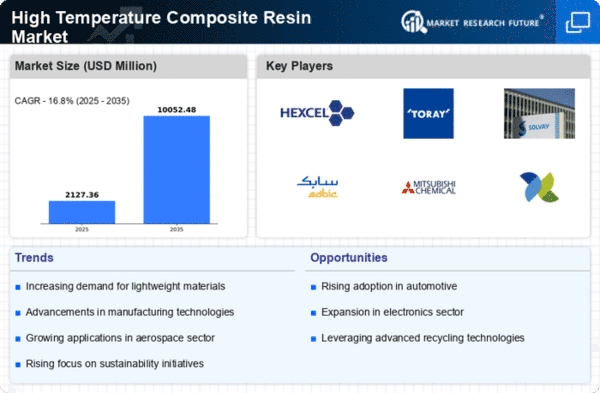
As per MRFR analysis, the High Temperature Composite Resin Market was estimated at 1821.37 USD Million in 2024. The High Temperature Composite Resin industry is projected to grow from 2127.36 USD Million in 2025 to 10052.48 USD Million by 2035, exhibiting a compound annual growth rate (CAGR) of 16.8 during the forecast period 2025 - 2035.

Key Market Trends & Highlights

The High Temperature Composite Resin Market is poised for substantial growth driven by technological advancements and increasing demand across key sectors.

  • Technological advancements in manufacturing processes are enhancing the performance and application of high temperature composite resins.
  • Sustainability initiatives are becoming increasingly integral to the development and adoption of these materials in various industries.
  • The aerospace sector remains the largest market for high temperature composite resins, while the automotive sector is experiencing the fastest growth.
  • Key market drivers include technological innovations and the rising demand for lightweight materials, particularly in aerospace and defense applications.

Market Size & Forecast

2024 Market Size 1821.37 (USD Million)
2035 Market Size 10052.48 (USD Million)
CAGR (2025 - 2035) 16.8%
Largest Regional Market Share in 2024 North America

Major Players

Hexcel Corporation (US), Toray Industries Inc. (JP), Solvay S.A. (BE), SABIC (SA), Mitsubishi Chemical Corporation (JP), Hexion Inc. (US), Royal DSM N.V. (NL), BASF SE (DE), Cytec Industries Inc. (US)

Market Trends

The High Temperature Composite Resin Market is currently experiencing a notable transformation, driven by advancements in material science and increasing demand across various industries. This market encompasses a range of high-performance resins that can withstand extreme temperatures, making them suitable for applications in aerospace, automotive, and industrial sectors. The growing emphasis on lightweight materials, coupled with the need for enhanced durability and thermal resistance, appears to be propelling the adoption of these composites. Furthermore, the ongoing innovations in manufacturing processes and formulations are likely to expand the scope of applications, thereby fostering market growth. In addition, sustainability concerns are influencing the High Temperature Composite Resin Market, as manufacturers seek to develop eco-friendly alternatives without compromising performance. The integration of recycled materials and bio-based resins is gaining traction, reflecting a shift towards more sustainable practices. As industries increasingly prioritize environmental responsibility, the demand for high temperature composites that align with these values is expected to rise. Overall, the market seems poised for continued expansion, driven by technological advancements and a growing focus on sustainability in material selection.

Technological Advancements in Manufacturing

Recent innovations in manufacturing techniques are enhancing the production efficiency and performance characteristics of high temperature composite resins. These advancements may lead to improved material properties, enabling broader applications across various sectors.

Sustainability Initiatives

The High Temperature Composite Resin Market is witnessing a shift towards sustainable practices, with an increasing focus on developing eco-friendly materials. This trend suggests that manufacturers are exploring bio-based and recycled options to meet environmental standards.

Growing Demand in Aerospace and Automotive Sectors

The aerospace and automotive industries are driving the demand for high temperature composite resins due to their lightweight and durable nature. This trend indicates a potential for significant growth as these sectors continue to prioritize performance and efficiency.

High Temperature Composite Resin Market Market Drivers

Rising Demand in Aerospace Sector

The Global High-Temperature Composite Resin Market Industry is experiencing a surge in demand, particularly from the aerospace sector. As aircraft manufacturers seek to enhance fuel efficiency and reduce weight, high-temperature composite resins are increasingly utilized in structural components. For instance, Boeing and Airbus are integrating these materials into their latest aircraft models, which could lead to a market valuation of 1.48 USD Billion in 2024. This trend suggests a robust growth trajectory, as the aerospace industry continues to prioritize advanced materials that can withstand extreme conditions, thereby driving the overall market forward.

Market Segment Insights

By Application: Aerospace (Largest) vs. Automotive (Fastest-Growing)

In the High Temperature Composite Resin Market, the application segments exhibit a diverse distribution of market share. Aerospace dominates due to the high demand for lightweight and heat-resistant materials in aerospace components, contributing to its largest market share. Following closely, the automotive segment is experiencing substantial growth as electric vehicles and high-performance cars increasingly require durable, high-temperature materials to enhance performance and safety.

Aerospace: Dominant vs. Automotive: Emerging

The aerospace industry represents a dominant force within the High Temperature Composite Resin Market, benefiting from stringent regulatory standards requiring lightweight yet strong materials for aircraft production. These composites are essential in making airframes, engine components, and other critical parts, contributing significantly to the sector's robust growth. On the other hand, the automotive segment, while currently emerging, shows rapid growth potential as manufacturers strive towards lightweight solutions to improve fuel efficiency and meet environmental regulations. The shift towards electric vehicles, in particular, is a key driver, necessitating innovative composite materials that can withstand high temperatures while ensuring performance and safety.

By End Use: Structural Components (Largest) vs. Thermal Protection Systems (Fastest-Growing)

The High Temperature Composite Resin Market is witnessing a diverse distribution of market share across its various end-use segments. Structural components hold the largest share in this market, primarily due to their critical applications in aerospace, automotive, and construction industries, where strength and heat resistance are crucial. Following closely are thermal protection systems, which, though smaller in share, are emerging rapidly as industries focus more on thermal management in complex systems like braking and engine components.

Structural Components (Dominant) vs. Thermal Protection Systems (Emerging)

Structural components, as the dominant segment, are characterized by their robust performance in applications that require high strength-to-weight ratios and thermal stability. They are extensively utilized in aerospace and automotive sectors, where their properties significantly enhance operational efficiency and safety. On the other hand, thermal protection systems represent an emerging segment, gaining traction due to their increasing demand in high-performance applications, such as aerospace engines and military vehicles. These systems are designed to withstand extreme temperatures while providing essential thermal insulation, thereby driving innovation and integration with advanced materials.

By Type: Epoxy Resins (Largest) vs. Polyimide Resins (Fastest-Growing)

The High Temperature Composite Resin Market is characterized by a diverse range of resin types, each contributing differently to the overall market share. Epoxy Resins hold a significant portion of the market, being the largest segment due to their outstanding adhesive properties and thermal resistance. Thermosetting Resins and Thermoplastic Resins also occupy vital roles, catering to various industrial applications, while Hybrid Resins are gaining recognition for their versatility. Polyimide Resins, although currently smaller in share, are noted for their increasing adoption across advanced aerospace and automotive applications.

Epoxy Resins (Dominant) vs. Polyimide Resins (Emerging)

Epoxy Resins have established themselves as the dominant player in the High Temperature Composite Resin Market due to their superior thermal stability and mechanical performance. They are widely used in applications that require high strength and toughness, making them a preferred choice in industries like aerospace and automotive. Conversely, Polyimide Resins are emerging as a significant force due to their exceptional heat resistance and insulation properties. These resins are increasingly utilized in high-tech applications, particularly within the aerospace sector, where lightweight and high-performance materials are essential. The growing demand for energy-efficient materials is driving interest in Polyimide Resins, positioning them for rapid growth in the coming years.

By Form: Prepregs (Largest) vs. Bulk Resins (Fastest-Growing)

In the High Temperature Composite Resin Market, the distribution of market share among different forms reflects a varied landscape of applications and industry practices. Prepregs hold the largest share, largely due to their extensive use in aerospace and automotive sectors requiring high-performance materials. Following closely, Molding Compounds and Resin Infusion Systems contribute substantially but remain secondary in terms of overall market dominance. Meanwhile, Bulk Resins are emerging as a rapidly growing segment, driven by increasing demand for cost-effective and versatile composite solutions in diverse industries.

Prepregs (Dominant) vs. Bulk Resins (Emerging)

Prepregs represent the dominant form in the High Temperature Composite Resin Market, known for their excellent strength-to-weight ratio and temperature resistance. They are primarily utilized in high-stress applications such as aerospace and defense, where performance is critical. These materials enable complex shapes and high-rate production, aligning perfectly with industry demands for efficiency and reliability. In contrast, Bulk Resins are an emerging segment characterized by their flexibility and lower cost, making them particularly attractive for industries requiring large volume production while maintaining acceptable performance. This growing interest indicates a shift towards more accessible composite materials, catering to a broader range of applications and expanding the market reach.

By Processing Technique: Autoclave Processing (Largest) vs. Resin Transfer Molding (Fastest-Growing)

In the High Temperature Composite Resin Market, the processing techniques showcase a diverse landscape of applications catering to various industry needs. Autoclave Processing holds the largest market share, driven by its superior quality and performance in producing high-strength composite materials. On the other hand, Resin Transfer Molding is witnessing rapid growth, largely due to its increasing adoption in industries requiring intricate shapes and excellent surface finish, making it appealing for automotive and aerospace applications. The growth trends within these processing techniques are significantly influenced by advancements in technology and rising demand for lightweight materials. Autoclave Processing maintains its dominant position due to the stringent performance requirements in high-performance sectors, whereas Resin Transfer Molding is emerging as a popular alternative, benefiting from enhancements in speed and efficiency that cater to the evolving needs of manufacturers prioritizing quick turnaround times without compromising quality.

Autoclave Processing (Dominant) vs. Resin Transfer Molding (Emerging)

Autoclave Processing is renowned for its capability to produce high-performance composites with exceptional quality control. This technique is prevalent in industries that demand robust and reliable materials, such as aerospace and military applications. Its comprehensive process involves curing composite materials under heat and pressure, ensuring uniformity and strength. While Autoclave Processing remains dominant, Resin Transfer Molding is carving a niche as an emerging technique. It allows for the rapid production of complex geometries with a clean and efficient process that utilizes pre-formed dry reinforcements and liquid resin injection. The versatility and efficiency of Resin Transfer Molding make it increasingly attractive, particularly in automotive and consumer goods sectors where innovation is critical.

Get more detailed insights about High-Temperature Composite Resin Market Research Report – Forecast to 2035

Regional Insights

North America : Market Leader in Innovation

North America is poised to maintain its leadership in the High Temperature Composite Resin Market, holding a significant market share of $910.0M in 2024. The region's growth is driven by increasing demand from aerospace and automotive sectors, alongside stringent regulations promoting lightweight materials. The push for sustainability and energy efficiency further catalyzes market expansion, with innovations in resin formulations enhancing performance and durability. The United States stands as the primary contributor, hosting key players like Hexcel Corporation and Hexion Inc. The competitive landscape is characterized by ongoing R&D investments and strategic partnerships among leading firms. This dynamic environment fosters advancements in composite technologies, ensuring North America's continued dominance in high-performance applications.

Europe : Emerging Market with Growth Potential

Europe's High Temperature Composite Resin Market is projected to grow significantly, with a market size of $550.0M in 2024. The region benefits from robust automotive and aerospace industries, which are increasingly adopting advanced composite materials for their lightweight and high-performance characteristics. Regulatory frameworks aimed at reducing carbon emissions are also driving demand for innovative materials that enhance fuel efficiency and sustainability. Leading countries such as Germany, France, and the UK are at the forefront of this market, supported by major players like Solvay S.A. and BASF SE. The competitive landscape is marked by a focus on technological advancements and collaborations among manufacturers to meet evolving industry standards. As the market matures, Europe is expected to play a crucial role in shaping the future of high-temperature composites.

Asia-Pacific : Rapidly Growing Market Segment

The Asia-Pacific region is witnessing rapid growth in the High Temperature Composite Resin Market, with a market size of $300.0M in 2024. This growth is fueled by increasing industrialization and the rising demand for lightweight materials in sectors such as automotive, aerospace, and electronics. Government initiatives aimed at boosting manufacturing capabilities and technological advancements are also contributing to market expansion, making the region a focal point for investment. Countries like Japan and China are leading the charge, with key players such as Toray Industries Inc. and Mitsubishi Chemical Corporation driving innovation. The competitive landscape is characterized by a mix of established companies and emerging players, all vying for market share. As the region continues to develop, the demand for high-performance composite materials is expected to surge, further solidifying its position in the global market.

Middle East and Africa : Emerging Market with Untapped Potential

The Middle East and Africa (MEA) region is gradually emerging in the High Temperature Composite Resin Market, with a market size of $61.37M in 2024. The growth is primarily driven by increasing investments in infrastructure and aerospace sectors, alongside a growing awareness of the benefits of composite materials. Regulatory support for advanced manufacturing processes is also fostering a conducive environment for market expansion, as industries seek to enhance performance and reduce weight in applications. Countries like the UAE and South Africa are leading the way, with a focus on developing local manufacturing capabilities. The competitive landscape is still evolving, with opportunities for both local and international players to establish a foothold. As the region continues to develop its industrial base, the demand for high-temperature composites is expected to rise, presenting significant growth opportunities.

Key Players and Competitive Insights

The High Temperature Composite Resin Market is currently characterized by a dynamic competitive landscape, driven by increasing demand across aerospace, automotive, and industrial applications. Key players are actively pursuing strategies that emphasize innovation, sustainability, and regional expansion to enhance their market positions. For instance, in November 2025, Hexcel Corporation (US) announced a new partnership with a leading aerospace manufacturer to develop advanced composite materials aimed at reducing weight and improving fuel efficiency in aircraft. This move underscores Hexcel's commitment to innovation and its strategic focus on the aerospace sector, which is pivotal for growth in high-temperature applications.In terms of business tactics, companies are increasingly localizing manufacturing to mitigate supply chain disruptions and optimize logistics. The market structure appears moderately fragmented, with several key players exerting considerable influence. This fragmentation allows for competitive pricing strategies, yet the presence of major corporations like Toray Industries Inc. (JP) and Solvay S.A. (BE) suggests a trend towards consolidation through strategic alliances and mergers.

In October Toray Industries Inc. (JP) expanded its production capabilities by investing in a new facility in Southeast Asia, aimed at increasing its output of high-performance composite resins. This strategic investment not only enhances Toray's manufacturing footprint but also positions the company to better serve the growing demand in the Asia-Pacific region, which is expected to witness significant growth in high-temperature applications.Similarly, in September 2025, Solvay S.A. (BE) launched a new line of eco-friendly high-temperature resins designed to meet stringent environmental regulations while maintaining performance standards. This initiative reflects Solvay's strategic emphasis on sustainability, aligning with global trends towards greener manufacturing processes. The introduction of these products is likely to strengthen Solvay's competitive edge in a market increasingly focused on environmental impact.

In August SABIC (SA) announced a collaboration with a leading automotive manufacturer to develop lightweight composite materials for electric vehicles. This partnership highlights the growing intersection of high-temperature composites and the automotive sector, particularly as manufacturers seek to enhance vehicle efficiency and performance. Such collaborations are indicative of a broader trend where companies leverage partnerships to drive innovation and meet evolving market demands.

As of December the competitive trends in the High Temperature Composite Resin Market are increasingly shaped by digitalization, sustainability, and the integration of AI technologies. Strategic alliances are becoming more prevalent, as companies recognize the need to pool resources and expertise to remain competitive. The shift from price-based competition to a focus on innovation, technology, and supply chain reliability is evident, suggesting that future differentiation will hinge on the ability to deliver advanced, sustainable solutions that meet the complex demands of various industries.

Key Companies in the High Temperature Composite Resin Market include

Industry Developments

Future Outlook

High Temperature Composite Resin Market Future Outlook

The High Temperature Composite Resin Market is projected to grow at a 16.8% CAGR from 2024 to 2035, driven by aerospace advancements, automotive innovations, and increasing demand for lightweight materials.

New opportunities lie in:

  • Development of high-performance thermosetting resins for aerospace applications.
  • Expansion into emerging markets with tailored composite solutions.
  • Investment in recycling technologies for sustainable resin production.

By 2035, the market is expected to achieve substantial growth, solidifying its position as a leader in advanced materials.

Market Segmentation

High Temperature Composite Resin Market Form Outlook

  • Prepregs
  • Films
  • Molding Compounds
  • Resin Infusion Systems
  • Bulk Resins

High Temperature Composite Resin Market Type Outlook

  • Thermosetting Resins
  • Thermoplastic Resins
  • Hybrid Resins
  • Epoxy Resins
  • Polyimide Resins

High Temperature Composite Resin Market End Use Outlook

  • Structural Components
  • Thermal Protection Systems
  • Insulation Materials
  • Electrical Insulation
  • Composites

High Temperature Composite Resin Market Application Outlook

  • Aerospace
  • Automotive
  • Electronics
  • Industrial
  • Marine

High Temperature Composite Resin Market Processing Technique Outlook

  • Autoclave Processing
  • Resin Transfer Molding
  • Filament Winding
  • Vacuum Bagging
  • Compression Molding

Report Scope

MARKET SIZE 20241821.37(USD Million)
MARKET SIZE 20252127.36(USD Million)
MARKET SIZE 203510052.48(USD Million)
COMPOUND ANNUAL GROWTH RATE (CAGR)16.8% (2025 - 2035)
REPORT COVERAGERevenue Forecast, Competitive Landscape, Growth Factors, and Trends
BASE YEAR2024
Market Forecast Period2025 - 2035
Historical Data2019 - 2024
Market Forecast UnitsUSD Million
Key Companies ProfiledHexcel Corporation (US), Toray Industries Inc. (JP), Solvay S.A. (BE), SABIC (SA), Mitsubishi Chemical Corporation (JP), Hexion Inc. (US), Royal DSM N.V. (NL), BASF SE (DE), Cytec Industries Inc. (US)
Segments CoveredApplication, End Use, Type, Form, Processing Technique
Key Market OpportunitiesGrowing demand for lightweight materials in aerospace and automotive sectors drives High Temperature Composite Resin Market expansion.
Key Market DynamicsRising demand for lightweight materials drives innovation and competition in the High Temperature Composite Resin Market.
Countries CoveredNorth America, Europe, APAC, South America, MEA

FAQs

How big is the high temperature composite resin market?

High temperature composite resin market is projected to reach USD 2.1 Billion by 2035

What are the major companies involved in the high-temperature composite resin market?

The major companies are Hexcel Corporation (US), Huntsman International LLC (US), Koninklijke Ten Cate BV (Netherlands), Sumitomo Bakelite Co., Ltd (Japan), Lonza (Switzerland), Hexlon (US), DIC Corporation (Japan), Arkema (France), Evonik Industries AG (Germany), UBE Industries, Ltd (Japan), and Celanese Corporation (US).

Which region is the fastest-growing high-temperature composite resin market?

The Asia Pacific region has the fastest growth driving capacity.

What are the types of high-temperature composite resin market?

The high-temperature composite resin market has segments like polyimides, bismaleimides, phenolic, epoxy, cyanate resins, thermoplastic, benzoxazine, and others.

What is the manufacturing process involved in the high-temperature composite resin market?

Major segments are involved in the discussion are injection molding, resin transfer molding, layup, pultrusion, filament winding, compression molding, and others.

Which region has the largest high-temperature composite resin market share?

The North American market has the maximum market share.

  1. SECTION I: EXECUTIVE SUMMARY AND KEY HIGHLIGHTS
    1. | 1.1 EXECUTIVE SUMMARY
  2. SECTION II: SCOPING, METHODOLOGY AND MARKET STRUCTURE
    1. | 2.1 MARKET INTRODUCTION
    2. | 2.2 RESEARCH METHODOLOGY
  3. SECTION III: QUALITATIVE ANALYSIS
    1. | 3.1 MARKET DYNAMICS
    2. | 3.2 MARKET FACTOR ANALYSIS
  4. SECTION IV: QUANTITATIVE ANALYSIS
    1. | 4.1 Chemicals and Materials, BY Application (USD Million)
    2. | 4.2 Chemicals and Materials, BY End Use (USD Million)
    3. | 4.3 Chemicals and Materials, BY Type (USD Million)
    4. | 4.4 Chemicals and Materials, BY Form (USD Million)
    5. | 4.5 Chemicals and Materials, BY Processing Technique (USD Million)
    6. | 4.6 Chemicals and Materials, BY Region (USD Million)
  5. SECTION V: COMPETITIVE ANALYSIS
    1. | 5.1 Competitive Landscape
    2. | 5.2 Company Profiles
    3. | 5.3 Appendix

High-Temperature Composite Resin Market Segmentation

Market Segmentation Overview

  • Detailed segmentation data will be available in the full report
  • Comprehensive analysis by multiple parameters
  • Regional and country-level breakdowns
  • Market size forecasts by segment
Infographic

Free Sample Request

Kindly complete the form below to receive a free sample of this Report

Get Free Sample

Customer Strories

Compare Licence

×
Features License Type
Single User Multiuser License Enterprise User
Price $4,950 $5,950 $7,250
Maximum User Access Limit 1 User Upto 10 Users Unrestricted Access Throughout the Organization
Free Customization
Direct Access to Analyst
Deliverable Format
Platform Access
Discount on Next Purchase 10% 15% 15%
Printable Versions