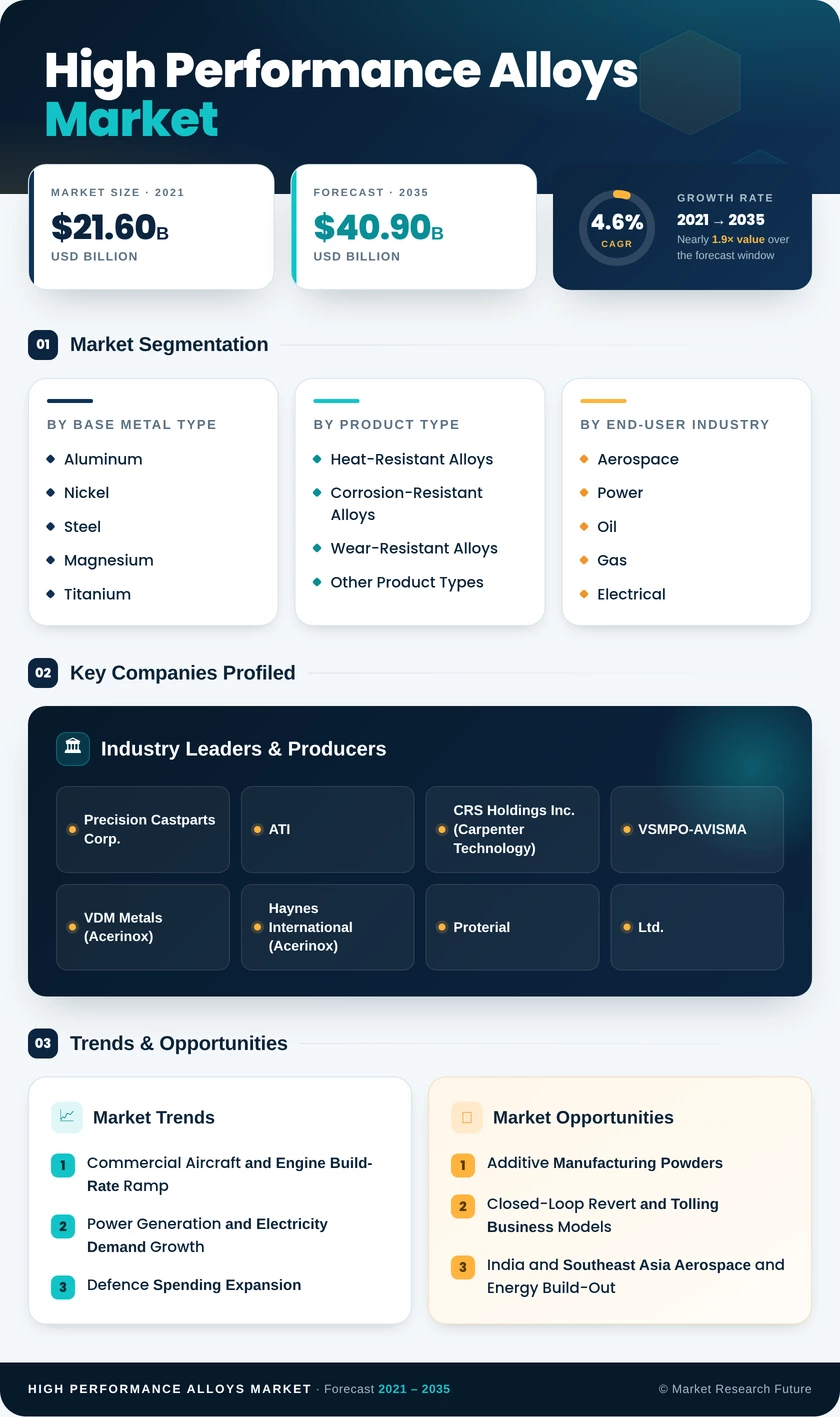
Segmentation Quick Reference
| Dimension | Sub-Segments | Dominant Segment | Fastest Growing Segment |
|---|
| By Base Metal Type | Aluminum; Nickel; Steel; Magnesium; Titanium; Other Base Metal Types | Nickel (44.0% share) | Titanium (5.9% CAGR) |
| By Product Type | Heat-Resistant Alloys; Corrosion-Resistant Alloys; Wear-Resistant Alloys; Other Product Types | Heat-Resistant Alloys (41.5% share) | Corrosion-Resistant Alloys (5.2% CAGR) |
| By End-user Industry | Aerospace; Power; Oil and Gas; Electrical and Electronics; Automotive; Other End-user Industries | Aerospace (46.0% share) | Automotive (5.8% CAGR) |
| By Region | North America; Europe; Asia-Pacific; South America; Middle East & Africa | Asia-Pacific (38.5% share) | Asia-Pacific (38.5% share) |
Market Segmentation Overview
| Sub-Segment | Key Trend |
|---|
| Aluminum | Aerostructure plate demand tied to narrowbody build rates |
| Nickel | Hotter engine cores raise alloy content per turbine |
| Steel | High-strength grades retained in landing gear and bearings |
| Magnesium | Lightweight castings in aerospace and automotive housings |
| Titanium | Composite-intensive airframes and new long-term supply contracts |
| Other Base Metal Types | Cobalt and refractory grades in niche hot-section parts |
Nickel leads because turbine discs and blades need strength retention above 700°C that titanium and steel cannot provide. Titanium grows fastest, as composite-intensive airframes require galvanically compatible structures and new guaranteed-share contracts lift mill output. Aluminum and steel remain volume staples in airframe plate and landing gear.
| Sub-Segment | Key Trend |
|---|
| Heat-Resistant Alloys | Rising turbine inlet temperatures in engines and gas turbines |
| Corrosion-Resistant Alloys | Higher-nickel grades in chemical, LNG and sour-gas service |
| Wear-Resistant Alloys | Valve, pump and mining equipment replacement cycles |
| Other Product Types | Controlled-expansion and magnetic alloys for electronics |
Heat-resistant alloys dominate through aero-engine and power turbine hot sections, where temperature capability sets fuel efficiency. Corrosion-resistant alloys expand fastest as chemical processors and LNG operators specify higher-nickel grades to extend inspection intervals. Wear-resistant alloys follow equipment replacement cycles in mining and flow control.
| Sub-Segment | Key Trend |
|---|
| Aerospace | Multi-year aircraft backlogs and rising defence budgets |
| Power | Gas turbine backlogs and nuclear life extensions |
| Oil and Gas | Sour-gas and offshore projects requiring corrosion resistance |
| Electrical and Electronics | Semiconductor fab investment and high-purity components |
| Automotive | Turbocharger, exhaust and electric drivetrain parts |
| Other End-user Industries | Medical implants, marine and industrial equipment |
Aerospace leads, because engine and airframe build rates anchor most premium alloy tonnage. Automotive grows fastest, as turbocharger housings and electric drivetrain parts adopt heat- and corrosion-resistant grades. Power and oil and gas contribute steady demand tied to turbine orders and corrosive-service projects.


 Noah Malgeri
Co-Founder

 Peter Groot koerkamp
Account and Business Manager

 Younghwan Choi
Senior Retail Manager

 Mark Irwin
Management Consultant

 Akif Moroglu
Strategy & Business Development Director

 Guilherme Gomes Martins
Product Management Director

 Joseph Aguayo
Sales Operations & Pricing Manager

 La Terria Dodd
Program Support Specialist

 Rob Kooiker
Group Product Manager HVAC & Fire Protection GMA