×
Request Free Sample ×

Kindly complete the form below to receive a free sample of this Report

* Please use a valid business email

Leading companies partner with us for data-driven Insights

clients tt-cursor
Hero Background
English
Chinese
French
Japanese
Korean
German
Spanish

Hexamethylenediamine Market Trends

ID: MRFR/CnM/3455-HCR
140 Pages
Priya Nagrale
October 2025

Hexamethylenediamine Market Research Report Information by Application (Nylon Synthesis, Lubricants, Coating, Adhesives and others), End-Use Industry (Textile, Paints & Coatings, Automotive, Water Treatment, Petrochemical and others) and Region (Asia-Pacific, North America, Europe, Latin America and Middle East & Africa) - Forecast till 2035

Share:
Download PDF ×

We do not share your information with anyone. However, we may send you emails based on your report interest from time to time. You may contact us at any time to opt-out.

Hexamethylenediamine Market Infographic
×
Hexamethylenediamine Market Infographic Full View
Purchase Options

Market Trends

Key Emerging Trends in the Hexamethylenediamine Market

The trends affecting hexamethylenediamine (HMDA) markets are experiencing noticeable shifts, which include growing demand for nylon production, technological developments in manufacturing techniques, and increasing emphasis on sustainability. Its use as a key building block for nylon 66 production and polyurethane resins makes it applicable in textiles, automotive, and adhesives, among many other industries. One major trend witnessed in this industry is an increased preference for sustainable or bio-based options besides conventional ones. Owing to its use as a precursor to nylon 66, among others, there has been more demand for nylon 66, especially from the automobile industry, with consumer goods following closely behind it due to high strength properties like durability against wear and tear under high temperatures used to make parts such as auto components, electric connectors among others. Technological advancement is another important development taking place within the HMDA sector's manufacturing processes. Manufacturers continue to invest in research work aimed at making production activities related to HMDA safer for the surrounding environment while at the same time improving their cost effectiveness so that global warming can be reduced significantly. The general focus here regards technological innovations that will make HMDA a more competitive product in the market by ensuring a continuous supply of derivatives to these industries. Furthermore, the HMDA market is showing a shift on a geographical basis as well. Although North America and Europe have traditionally been major players, Asia-Pacific has also emerged as one of the significant contributors to the global HMDA industry. Demand for HMDA in different applications, such as textile or automobile components, is driven by strong industrial growth witnessed in this region, particularly in China and India. Asian production capacities, which are closer to consumers and complemented by an expanding consumer base, serve to increase their importance in relation to HMDA. Additionally, the market is responding to an increased need for polyurethane resins produced using hexamethylenediamine (HMDA). Polyurethanes from diisocyanates combined with HMDA are utilized in adhesives, coatings, and foam making. As industries seek versatile and high-performance materials, they drive up demand for HMDA due to the increased use of polyurethane resins. This trend is seen mostly within packaging sectors, but it is also relevant for construction and furniture because, based on polyurethanes, varieties of products can be manufactured.

Author
Priya Nagrale
Senior Research Analyst

With an experience of over five years in market research industry (Chemicals & Materials domain), I gather and analyze market data from diverse sources to produce results, which are then presented back to a client. Also, provide recommendations based on the findings. As a Senior Research Analyst, I perform quality checks (QC) for market estimations, QC for reports, and handle queries and work extensively on client customizations. Also, handle the responsibilities of client proposals, report planning, report finalization, and execution

Leave a Comment

FAQs

At what CAGR is the Hexamethylenediamine Market predicted to grow during the forecast period?

Hexamethylenediamine Market is predicted to grow at 5.30 % through forecast period of 2025-2035.

What is the forecast period of Hexamethylenediamine Market research report?

The forecast period for Hexamethylenediamine Market research report is 2025-2035.

Which region will lead the Hexamethylenediamine Market?

Hexamethylenediamine Market is dominated by APAC region.

Who are the key players in the Hexamethylenediamine Market?

The major players operating in the INVISTA (US), BASF SE (Germany), Asahi Kasei Corporation (Japan), TORAY INDUSTRIES, INC. (Japan), Merck KGaA (Germany), Evonik Industries AG (Germany), Solvay (Belgium), Ascend Performance Materials (US), DuPont (US), and LANXESS (Germany)

Market Summary

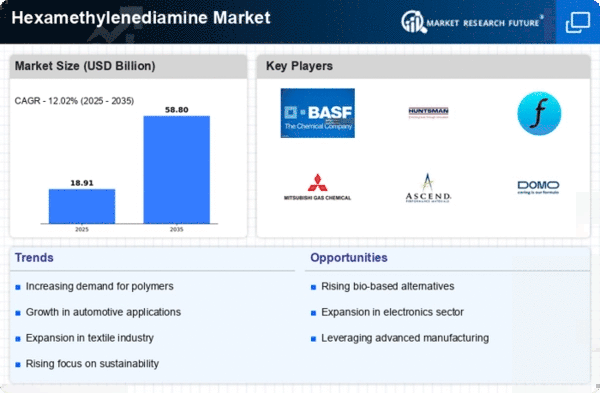
As per MRFR analysis, the Hexamethylenediamine Market Size was estimated at 16.88 USD Billion in 2024. The Hexamethylenediamine industry is projected to grow from 18.91 USD Billion in 2025 to 58.8 USD Billion by 2035, exhibiting a compound annual growth rate (CAGR) of 12.02 during the forecast period 2025 - 2035.

Key Market Trends & Highlights

The Hexamethylenediamine market is poised for growth driven by sustainability and technological advancements.

  • Sustainable production practices are increasingly being adopted across the Hexamethylenediamine market.
  • North America remains the largest market, while Asia-Pacific is recognized as the fastest-growing region.
  • The polyamide production segment continues to dominate, whereas the coatings segment is experiencing rapid growth.
  • Rising demand in the automotive sector and increasing use in the textile industry are key drivers of market expansion.

Market Size & Forecast

2024 Market Size 16.88 (USD Billion)
2035 Market Size 58.8 (USD Billion)
CAGR (2025 - 2035) 12.02%
Largest Regional Market Share in 2024 Asia-Pacific

Major Players

BASF SE (DE), Huntsman Corporation (US), Invista (US), Mitsubishi Gas Chemical Company (JP), Ascend Performance Materials (US), Domo Chemicals (DE), Kraton Corporation (US), Nippon Shokubai Co., Ltd. (JP)

Market Trends

The Hexamethylenediamine Market is currently experiencing notable developments driven by various factors. The increasing demand for this chemical compound in the production of nylon and other polymers appears to be a primary catalyst for market growth. Additionally, the rising awareness regarding sustainable practices may lead to a shift towards bio-based alternatives, which could influence traditional manufacturing processes. Furthermore, the expansion of the automotive and construction industries is likely to bolster the need for hexamethylenediamine, as it is utilized in adhesives, coatings, and other applications. This evolving landscape suggests that stakeholders must remain vigilant to adapt to changing consumer preferences and regulatory frameworks. Moreover, the Hexamethylenediamine Market seems poised for further evolution as technological advancements continue to emerge. Innovations in production techniques may enhance efficiency and reduce environmental impact, potentially reshaping competitive dynamics. The market's future trajectory could also be influenced by geopolitical factors and trade policies, which might affect supply chains and pricing strategies. As the industry navigates these complexities, it is essential for market participants to engage in strategic planning and collaboration to harness opportunities while mitigating risks associated with market fluctuations and regulatory changes.

Sustainable Production Practices

There is a growing emphasis on sustainable production methods within the Hexamethylenediamine Market. Manufacturers are increasingly exploring bio-based feedstocks and eco-friendly processes to meet consumer demand for greener products. This trend may lead to innovations that not only reduce environmental impact but also enhance product appeal.

Technological Advancements

The Hexamethylenediamine Market is witnessing a wave of technological advancements that could transform production efficiency. Innovations in chemical synthesis and processing techniques may streamline operations, reduce costs, and improve product quality, thereby positioning companies for competitive advantage.

Expansion in End-Use Industries

The demand for hexamethylenediamine is likely to rise due to its applications in various end-use industries, including automotive and construction. As these sectors continue to grow, the need for high-performance materials and adhesives is expected to drive market expansion, creating new opportunities for manufacturers.

Hexamethylenediamine Market Market Drivers

Rising Demand in Automotive Sector

The Global Hexamethylenediamine Market Industry is experiencing a surge in demand from the automotive sector, where it is utilized in the production of various components such as polyamides and coatings. As the automotive industry evolves towards lightweight materials for enhanced fuel efficiency, hexamethylenediamine serves as a crucial building block for high-performance polymers. This trend is expected to contribute significantly to the market, with projections indicating a market size of 8.87 USD Billion in 2024. The automotive sector's shift towards sustainability and innovation is likely to further bolster the demand for hexamethylenediamine-based products.

Market Segment Insights

By Application: Polyamide Production (Largest) vs. Coatings (Fastest-Growing)

The Hexamethylenediamine market is significantly impacted by various applications, with Polyamide Production holding the largest share. This segment is essential as hexamethylenediamine serves as a vital monomer in the production of polyamides, which are widely used in engineering plastics, fibers, and coatings. Other applications, such as Coatings, Adhesives, Textiles, and Pharmaceuticals, also contribute to the market, but they occupy smaller portions compared to polyamide production. The growing demand from the automotive and construction industries is driving this distribution. In recent years, the Coatings segment has emerged as the fastest-growing area, fueled by increasing urbanization and infrastructure development. The rising need for durability and environmental compliance in coatings formulations is shifting focus towards hexamethylenediamine-based products. Despite being smaller in share, sectors like Adhesives and Pharmaceuticals are also witnessing growth due to innovative applications and R&D activities aimed at enhancing the performance characteristics of end products. Collectively, these trends reflect a dynamic market landscape with diverse growth opportunities.

Polyamide Production (Dominant) vs. Pharmaceuticals (Emerging)

Polyamide Production is a dominant segment in the hexamethylenediamine market, leveraging its integral role in creating high-performance polyamide materials. This sector benefits from robust demand across automotive, aerospace, and industrial applications, where polyamides deliver exceptional mechanical strength and thermal stability. On the other hand, the Pharmaceuticals segment is emerging and gaining traction, primarily due to the increasing application of hexamethylenediamine derivatives in drug formulation and synthesis. This growth is propelled by ongoing advancements in pharmaceutical research and the need for innovative therapeutics, leading to an expandig usage of hexamethylenediamine in medical applications.

By End Use: Automotive (Largest) vs. Construction (Fastest-Growing)

In the Hexamethylenediamine Market, the end use segment is prominently led by the automotive industry, which dominates market share due to its extensive applications in manufacturing various car components such as nylon resins and coatings. Following automotive, the construction sector is rapidly gaining traction, utilizing hexamethylenediamine in concrete admixtures and insulation materials, thus reflecting a growing trend in infrastructure development across several regions. The growth trends in the end use market highlight the increasing demand from emerging economies, where automotive and construction industries are expanding at a rapid pace. Furthermore, innovative applications of hexamethylenediamine in new product formulations in the consumer goods and electronics segments are also anticipated to drive growth. The sustainability focus has led companies to seek high-performance materials that incorporate hexamethylenediamine for greater durability and efficiency, further propelling market advancements.

Automotive (Dominant) vs. Construction (Emerging)

The automotive end use segment remains the dominant force within the Hexamethylenediamine Market, driven by its integral role in producing high-performance polymers used in vehicles. This segment benefits from significant technological advancements, emphasizing lightweight materials that enhance fuel efficiency and sustainability. Conversely, the construction sector is emerging as a vital player due to increasing investments in infrastructure. The demand for high-strength materials and rapid urbanization has led to greater consumption of hexamethylenediamine in construction applications, positioning it as a driving force behind market growth.

By Form: Liquid (Largest) vs. Powder (Fastest-Growing)

In the Hexamethylenediamine market, the form segment reveals a diverse distribution among liquid, solid, and powder forms. Predominantly, the liquid form holds the largest market share, largely due to its extensive applications in various industries and ease of handling. However, solid forms also maintain a significant presence in the market, serving specific end-user needs, particularly in the production of specialty chemicals and polymers. The powder form is emerging as the fastest-growing segment, driven by its increasing demand in applications such as plastics and textiles. Factors contributing to this growth include the rising interest in lightweight materials and innovations in manufacturing processes that favor powdered forms. As industries evolve, the demand for varying forms of Hexamethylenediamine continues to diversify, showcasing significant potential for future developments.

Liquid (Dominant) vs. Powder (Emerging)

Liquid Hexamethylenediamine is the dominant form in the market, adored for its versatility and ease of processing in chemical formulations. Its properties make it suitable for use in high-performance coatings, adhesives, and resins, ensuring its stronghold in traditional applications. Conversely, the powdered form is emerging as a key player, recognized for its advantages in specific applications, such as being easily mixed and distributed in various formulations. This form caters to industries demanding finer consistency and specialty applications, especially where lightweight materials are gaining traction. The unique characteristics of both forms indicate a balanced demand in the market, with liquid leading but powder rapidly catching up due to industry shifts.

By Purity Level: High Purity (Largest) vs. Standard Purity (Fastest-Growing)

In the Hexamethylenediamine market, the purity level segment is primarily dominated by High Purity grades, which command a substantial share due to their extensive application in specialized industries such as pharmaceuticals and advanced materials. Standard Purity versions also hold a significant place, appealing to a range of industrial applications, but their overall market share is under pressure from the growing demand for higher quality products.

High Purity (Dominant) vs. Standard Purity (Emerging)

High Purity Hexamethylenediamine is crucial for applications that require the highest standards of performance, particularly in the production of high-performance polymers and specialty chemicals. This segment is characterized by stringent quality controls and a high level of processing, making it the preferred choice among manufacturers seeking reliability and consistency in their outputs. On the other hand, Standard Purity grades are emerging as a suitable alternative for less demanding applications, appealing to cost-sensitive industries while still meeting essential technical specifications. These segments are competing closely, driven by ongoing advancements and increasing applications across various sectors.

By Distribution Channel: Direct Sales (Largest) vs. Online Sales (Fastest-Growing)

In the Hexamethylenediamine Market, the distribution of sales among the channels shows that direct sales lead significantly in market share. This is primarily due to established relationships between manufacturers and end-users, allowing for streamlined transactions. Distributors follow, providing essential support to manufacturers by reaching a broader client base. Online sales, while currently a smaller segment, are rapidly gaining traction as consumers increasingly seek convenience and accessibility, indicating a shift in purchasing behavior.

Direct Sales (Dominant) vs. Online Sales (Emerging)

Direct sales play a dominant role in the Hexamethylenediamine Market, as they offer manufacturers the ability to maintain closer relationships with key customers. This channel allows for tailored solutions and direct feedback, enhancing customer satisfaction. Meanwhile, online sales are emerging as a significant player in the market, driven by consumer demand for convenience and the growth of e-commerce platforms. Manufacturers are increasingly adopting digital channels to provide better accessibility and service, making online sales the fastest-growing distribution channel. This shift represents a crucial strategic focus for industry players looking to adapt to evolving market conditions and consumer preferences.

Get more detailed insights about Hexamethylenediamine Market Research Report - Global Forecast till 2035

Regional Insights

North America : Established Market with Growth Potential

The North American hexamethylenediamine market is projected to reach $3.5 million by December 2025, driven by increasing demand in automotive and construction sectors. Regulatory support for sustainable practices and innovations in chemical manufacturing are key growth catalysts. The region's focus on reducing carbon emissions is also influencing market dynamics, leading to a shift towards eco-friendly production methods. Leading countries like the US and Canada dominate the market, with major players such as Huntsman Corporation and Invista establishing a strong presence. The competitive landscape is characterized by strategic partnerships and technological advancements. As companies invest in R&D, the market is expected to witness enhanced product offerings and improved supply chain efficiencies.

Europe : Innovation and Sustainability Focus

Europe's hexamethylenediamine market is anticipated to grow significantly, reaching $4.5 million by December 2025. The region benefits from stringent regulations promoting sustainable chemical production, which drives innovation and demand. The automotive and textile industries are key consumers, with a growing emphasis on eco-friendly materials and processes, aligning with the EU's Green Deal objectives. Germany, France, and the UK are leading countries in this market, hosting major players like BASF SE and Domo Chemicals. The competitive landscape is marked by a strong focus on R&D and collaboration among industry stakeholders. As companies adapt to regulatory changes, the market is poised for robust growth, with an increasing number of sustainable product offerings.

Asia-Pacific : Rapid Growth and Market Leadership

Asia-Pacific is the largest market for hexamethylenediamine, projected to reach $8.5 million by December 2025. The region's growth is fueled by rising industrialization, particularly in countries like China and India, where demand for hexamethylenediamine in textiles and automotive applications is surging. Government initiatives to boost manufacturing and infrastructure development are also significant growth drivers. China and Japan are the leading countries in this market, with key players such as Mitsubishi Gas Chemical Company and Nippon Shokubai Co., Ltd. establishing strong footholds. The competitive landscape is characterized by rapid technological advancements and increasing investments in production capacity. As the region continues to expand, the market is expected to see a rise in innovative applications and product diversification.

Middle East and Africa : Emerging Market with Growth Opportunities

The Middle East and Africa hexamethylenediamine market is projected to reach $0.38 million by December 2025, driven by increasing industrial activities and infrastructure projects. The region's growth is supported by government initiatives aimed at diversifying economies and enhancing manufacturing capabilities. As demand for hexamethylenediamine rises in construction and automotive sectors, the market is poised for gradual expansion. Countries like South Africa and the UAE are emerging as key players in this market. The competitive landscape is still developing, with local and international companies vying for market share. As investments in infrastructure and industrialization increase, the presence of key players is expected to grow, leading to enhanced market dynamics and opportunities for innovation.

Key Players and Competitive Insights

The Hexamethylenediamine Market is currently characterized by a competitive landscape that is both dynamic and multifaceted. Key growth drivers include the increasing demand for polyamides in various applications, particularly in automotive and electronics sectors. Major players such as BASF SE (Germany), Huntsman Corporation (US), and Invista (US) are strategically positioned to leverage their extensive R&D capabilities and global supply chains. BASF SE (Germany) focuses on innovation in sustainable production methods, while Huntsman Corporation (US) emphasizes strategic partnerships to enhance its market reach. Collectively, these strategies contribute to a competitive environment that is increasingly shaped by technological advancements and sustainability initiatives.In terms of business tactics, companies are increasingly localizing manufacturing to reduce lead times and optimize supply chains. The market structure appears moderately fragmented, with several key players exerting significant influence. This fragmentation allows for niche players to emerge, yet the collective strength of major companies like Mitsubishi Gas Chemical Company (Japan) and Ascend Performance Materials (US) ensures that competition remains robust. The emphasis on supply chain optimization and localized production is likely to enhance operational efficiencies across the board.

In November BASF SE (Germany) announced a new initiative aimed at reducing carbon emissions in its production processes. This strategic move underscores the company's commitment to sustainability and positions it favorably in a market increasingly driven by environmental considerations. The initiative is expected to not only enhance BASF's competitive edge but also align with global trends towards greener manufacturing practices.

In October Huntsman Corporation (US) expanded its partnership with a leading automotive manufacturer to develop advanced materials for electric vehicles. This collaboration is indicative of Huntsman's strategic focus on innovation and its ability to adapt to evolving market demands. By aligning with the automotive sector's shift towards electrification, Huntsman is likely to capture new growth opportunities and reinforce its market position.

In September Invista (US) launched a new line of hexamethylenediamine products tailored for high-performance applications in the electronics industry. This product launch reflects Invista's commitment to innovation and its strategic intent to cater to specialized market segments. By diversifying its product offerings, Invista is poised to enhance its competitive positioning and respond effectively to the unique needs of its customers.

As of December current competitive trends in the Hexamethylenediamine Market are increasingly defined by digitalization, sustainability, and the integration of AI technologies. Strategic alliances are becoming more prevalent, as companies seek to pool resources and expertise to navigate the complexities of the market. Looking ahead, it is anticipated that competitive differentiation will evolve, shifting from traditional price-based competition to a focus on innovation, technological advancements, and supply chain reliability. This transition is likely to reshape the competitive landscape, fostering an environment where companies that prioritize sustainability and technological integration will thrive.

Key Companies in the Hexamethylenediamine Market include

Industry Developments

    • In February 2020, Invista, a US-based fiber, resin, and intermediates firm, reported that its USD 1.2 billion adiponitriles (ADN) project in China is still on track, despite the coronavirus outbreak that is causing disruption and raising the possibility of an economic slowdown. In January, officials granted environmental and safety licenses to the 400,000t/yr ADN factory in Shanghai's chemical park.
    • The total value of China's nylon exports in 2018 was USD 137.70 million. As a result, it is now one of the top three global nylon exporters.

Intended Audience

    • Traders and distributors of hexamethylenediamine
    • Potential investors
    • Raw material suppliers
    • Hexamethylenediamine Market manufacturers
    • Distributors
    • Industry associations

Future Outlook

Hexamethylenediamine Market Future Outlook

The Hexamethylenediamine Market is projected to grow at a 12.02% CAGR from 2025 to 2035, driven by increasing demand in automotive and textile applications.

New opportunities lie in:

  • Expansion into bio-based hexamethylenediamine production
  • Development of high-performance polymers for automotive applications
  • Strategic partnerships with textile manufacturers for innovative product solutions

By 2035, the Hexamethylenediamine Market is expected to achieve robust growth and enhanced market positioning.

Market Segmentation

Hexamethylenediamine Market Form Outlook

  • Liquid
  • Solid
  • Powder

Hexamethylenediamine Market End Use Outlook

  • Automotive
  • Construction
  • Electronics
  • Consumer Goods
  • Aerospace

Hexamethylenediamine Market Application Outlook

  • Polyamide Production
  • Coatings
  • Adhesives
  • Textiles
  • Pharmaceuticals

Hexamethylenediamine Market Purity Level Outlook

  • High Purity
  • Standard Purity
  • Technical Grade

Hexamethylenediamine Market Distribution Channel Outlook

  • Direct Sales
  • Distributors
  • Online Sales

Report Scope

MARKET SIZE 202416.88(USD Billion)
MARKET SIZE 202518.91(USD Billion)
MARKET SIZE 203558.8(USD Billion)
COMPOUND ANNUAL GROWTH RATE (CAGR)12.02% (2025 - 2035)
REPORT COVERAGERevenue Forecast, Competitive Landscape, Growth Factors, and Trends
BASE YEAR2024
Market Forecast Period2025 - 2035
Historical Data2019 - 2024
Market Forecast UnitsUSD Billion
Key Companies ProfiledBASF SE (DE), Huntsman Corporation (US), Invista (US), Mitsubishi Gas Chemical Company (JP), Ascend Performance Materials (US), Domo Chemicals (DE), Kraton Corporation (US), Nippon Shokubai Co., Ltd. (JP)
Segments CoveredApplication, End Use, Form, Purity Level, Distribution Channel
Key Market OpportunitiesGrowing demand for sustainable materials in the Hexamethylenediamine Market presents significant opportunities.
Key Market DynamicsRising demand for hexamethylenediamine in automotive and textile industries drives competitive dynamics and innovation.
Countries CoveredNorth America, Europe, APAC, South America, MEA

FAQs

At what CAGR is the Hexamethylenediamine Market predicted to grow during the forecast period?

Hexamethylenediamine Market is predicted to grow at 5.30 % through forecast period of 2025-2035.

What is the forecast period of Hexamethylenediamine Market research report?

The forecast period for Hexamethylenediamine Market research report is 2025-2035.

Which region will lead the Hexamethylenediamine Market?

Hexamethylenediamine Market is dominated by APAC region.

Who are the key players in the Hexamethylenediamine Market?

The major players operating in the INVISTA (US), BASF SE (Germany), Asahi Kasei Corporation (Japan), TORAY INDUSTRIES, INC. (Japan), Merck KGaA (Germany), Evonik Industries AG (Germany), Solvay (Belgium), Ascend Performance Materials (US), DuPont (US), and LANXESS (Germany)

  1. SECTION I: EXECUTIVE SUMMARY AND KEY HIGHLIGHTS
    1. | 1.1 EXECUTIVE SUMMARY
    2. | 1.1.1 Market Overview
    3. | 1.1.2 Key Findings
    4. | 1.1.3 Market Segmentation
    5. | 1.1.4 Competitive Landscape
    6. | 1.1.5 Challenges and Opportunities
    7. | 1.1.6 Future Outlook
  2. SECTION II: SCOPING, METHODOLOGY AND MARKET STRUCTURE
    1. | 2.1 MARKET INTRODUCTION
    2. | 2.1.1 Definition
    3. | 2.1.2 Scope of the study
    4. |-- 2.1.2.1 Research Objective
    5. |-- 2.1.2.2 Assumption
    6. |-- 2.1.2.3 Limitations
    7. | 2.2 RESEARCH METHODOLOGY
    8. | 2.2.1 Overview
    9. | 2.2.2 Data Mining
    10. | 2.2.3 Secondary Research
    11. | 2.2.4 Primary Research
    12. |-- 2.2.4.1 Primary Interviews and Information Gathering Process
    13. |-- 2.2.4.2 Breakdown of Primary Respondents
    14. | 2.2.5 Forecasting Model
    15. | 2.2.6 Market Size Estimation
    16. |-- 2.2.6.1 Bottom-Up Approach
    17. |-- 2.2.6.2 Top-Down Approach
    18. | 2.2.7 Data Triangulation
    19. | 2.2.8 Validation
  3. SECTION III: QUALITATIVE ANALYSIS
    1. | 3.1 MARKET DYNAMICS
    2. | 3.1.1 Overview
    3. | 3.1.2 Drivers
    4. | 3.1.3 Restraints
    5. | 3.1.4 Opportunities
    6. | 3.2 MARKET FACTOR ANALYSIS
    7. | 3.2.1 Value chain Analysis
    8. | 3.2.2 Porter's Five Forces Analysis
    9. |-- 3.2.2.1 Bargaining Power of Suppliers
    10. |-- 3.2.2.2 Bargaining Power of Buyers
    11. |-- 3.2.2.3 Threat of New Entrants
    12. |-- 3.2.2.4 Threat of Substitutes
    13. |-- 3.2.2.5 Intensity of Rivalry
    14. | 3.2.3 COVID-19 Impact Analysis
    15. |-- 3.2.3.1 Market Impact Analysis
    16. |-- 3.2.3.2 Regional Impact
    17. |-- 3.2.3.3 Opportunity and Threat Analysis
  4. SECTION IV: QUANTITATIVE ANALYSIS
    1. | 4.1 Chemicals and Materials, BY Application (USD Billion)
    2. | 4.1.1 Polyamide Production
    3. | 4.1.2 Coatings
    4. | 4.1.3 Adhesives
    5. | 4.1.4 Textiles
    6. | 4.1.5 Pharmaceuticals
    7. | 4.2 Chemicals and Materials, BY End Use (USD Billion)
    8. | 4.2.1 Automotive
    9. | 4.2.2 Construction
    10. | 4.2.3 Electronics
    11. | 4.2.4 Consumer Goods
    12. | 4.2.5 Aerospace
    13. | 4.3 Chemicals and Materials, BY Form (USD Billion)
    14. | 4.3.1 Liquid
    15. | 4.3.2 Solid
    16. | 4.3.3 Powder
    17. | 4.4 Chemicals and Materials, BY Purity Level (USD Billion)
    18. | 4.4.1 High Purity
    19. | 4.4.2 Standard Purity
    20. | 4.4.3 Technical Grade
    21. | 4.5 Chemicals and Materials, BY Distribution Channel (USD Billion)
    22. | 4.5.1 Direct Sales
    23. | 4.5.2 Distributors
    24. | 4.5.3 Online Sales
    25. | 4.6 Chemicals and Materials, BY Region (USD Billion)
    26. | 4.6.1 North America
    27. |-- 4.6.1.1 US
    28. |-- 4.6.1.2 Canada
    29. | 4.6.2 Europe
    30. |-- 4.6.2.1 Germany
    31. |-- 4.6.2.2 UK
    32. |-- 4.6.2.3 France
    33. |-- 4.6.2.4 Russia
    34. |-- 4.6.2.5 Italy
    35. |-- 4.6.2.6 Spain
    36. |-- 4.6.2.7 Rest of Europe
    37. | 4.6.3 APAC
    38. |-- 4.6.3.1 China
    39. |-- 4.6.3.2 India
    40. |-- 4.6.3.3 Japan
    41. |-- 4.6.3.4 South Korea
    42. |-- 4.6.3.5 Malaysia
    43. |-- 4.6.3.6 Thailand
    44. |-- 4.6.3.7 Indonesia
    45. |-- 4.6.3.8 Rest of APAC
    46. | 4.6.4 South America
    47. |-- 4.6.4.1 Brazil
    48. |-- 4.6.4.2 Mexico
    49. |-- 4.6.4.3 Argentina
    50. |-- 4.6.4.4 Rest of South America
    51. | 4.6.5 MEA
    52. |-- 4.6.5.1 GCC Countries
    53. |-- 4.6.5.2 South Africa
    54. |-- 4.6.5.3 Rest of MEA
  5. SECTION V: COMPETITIVE ANALYSIS
    1. | 5.1 Competitive Landscape
    2. | 5.1.1 Overview
    3. | 5.1.2 Competitive Analysis
    4. | 5.1.3 Market share Analysis
    5. | 5.1.4 Major Growth Strategy in the Chemicals and Materials
    6. | 5.1.5 Competitive Benchmarking
    7. | 5.1.6 Leading Players in Terms of Number of Developments in the Chemicals and Materials
    8. | 5.1.7 Key developments and growth strategies
    9. |-- 5.1.7.1 New Product Launch/Service Deployment
    10. |-- 5.1.7.2 Merger & Acquisitions
    11. |-- 5.1.7.3 Joint Ventures
    12. | 5.1.8 Major Players Financial Matrix
    13. |-- 5.1.8.1 Sales and Operating Income
    14. |-- 5.1.8.2 Major Players R&D Expenditure. 2023
    15. | 5.2 Company Profiles
    16. | 5.2.1 BASF SE (DE)
    17. |-- 5.2.1.1 Financial Overview
    18. |-- 5.2.1.2 Products Offered
    19. |-- 5.2.1.3 Key Developments
    20. |-- 5.2.1.4 SWOT Analysis
    21. |-- 5.2.1.5 Key Strategies
    22. | 5.2.2 Huntsman Corporation (US)
    23. |-- 5.2.2.1 Financial Overview
    24. |-- 5.2.2.2 Products Offered
    25. |-- 5.2.2.3 Key Developments
    26. |-- 5.2.2.4 SWOT Analysis
    27. |-- 5.2.2.5 Key Strategies
    28. | 5.2.3 Invista (US)
    29. |-- 5.2.3.1 Financial Overview
    30. |-- 5.2.3.2 Products Offered
    31. |-- 5.2.3.3 Key Developments
    32. |-- 5.2.3.4 SWOT Analysis
    33. |-- 5.2.3.5 Key Strategies
    34. | 5.2.4 Mitsubishi Gas Chemical Company (JP)
    35. |-- 5.2.4.1 Financial Overview
    36. |-- 5.2.4.2 Products Offered
    37. |-- 5.2.4.3 Key Developments
    38. |-- 5.2.4.4 SWOT Analysis
    39. |-- 5.2.4.5 Key Strategies
    40. | 5.2.5 Ascend Performance Materials (US)
    41. |-- 5.2.5.1 Financial Overview
    42. |-- 5.2.5.2 Products Offered
    43. |-- 5.2.5.3 Key Developments
    44. |-- 5.2.5.4 SWOT Analysis
    45. |-- 5.2.5.5 Key Strategies
    46. | 5.2.6 Domo Chemicals (DE)
    47. |-- 5.2.6.1 Financial Overview
    48. |-- 5.2.6.2 Products Offered
    49. |-- 5.2.6.3 Key Developments
    50. |-- 5.2.6.4 SWOT Analysis
    51. |-- 5.2.6.5 Key Strategies
    52. | 5.2.7 Kraton Corporation (US)
    53. |-- 5.2.7.1 Financial Overview
    54. |-- 5.2.7.2 Products Offered
    55. |-- 5.2.7.3 Key Developments
    56. |-- 5.2.7.4 SWOT Analysis
    57. |-- 5.2.7.5 Key Strategies
    58. | 5.2.8 Nippon Shokubai Co., Ltd. (JP)
    59. |-- 5.2.8.1 Financial Overview
    60. |-- 5.2.8.2 Products Offered
    61. |-- 5.2.8.3 Key Developments
    62. |-- 5.2.8.4 SWOT Analysis
    63. |-- 5.2.8.5 Key Strategies
    64. | 5.3 Appendix
    65. | 5.3.1 References
    66. | 5.3.2 Related Reports

Chemicals and Materials Market Segmentation

Chemicals and Materials By Application (USD Billion, 2025-2035)

  • Polyamide Production
  • Coatings
  • Adhesives
  • Textiles
  • Pharmaceuticals

Chemicals and Materials By End Use (USD Billion, 2025-2035)

  • Automotive
  • Construction
  • Electronics
  • Consumer Goods
  • Aerospace

Chemicals and Materials By Form (USD Billion, 2025-2035)

  • Liquid
  • Solid
  • Powder

Chemicals and Materials By Purity Level (USD Billion, 2025-2035)

  • High Purity
  • Standard Purity
  • Technical Grade

Chemicals and Materials By Distribution Channel (USD Billion, 2025-2035)

  • Direct Sales
  • Distributors
  • Online Sales
Infographic

Free Sample Request

Kindly complete the form below to receive a free sample of this Report

Get Free Sample

Customer Strories

Compare Licence

×
Features License Type
Single User Multiuser License Enterprise User
Price $4,950 $5,950 $7,250
Maximum User Access Limit 1 User Upto 10 Users Unrestricted Access Throughout the Organization
Free Customization
Direct Access to Analyst
Deliverable Format
Platform Access
Discount on Next Purchase 10% 15% 15%
Printable Versions