Request Free Sample ×

Kindly complete the form below to receive a free sample of this Report

* Please use a valid business email

Leading companies partner with us for data-driven Insights

clients tt-cursor
Hero Background
English
Chinese
French
Japanese
Korean
German
Spanish

Hepatitis C Diagnosis Treatment Market Share

ID: MRFR/MED/1040-HCR
90 Pages
Satyendra Maurya
April 2026

Hepatitis C Diagnosis and Treatment Market Size, Trends and Growth Analysis By Diagnosis (Liver Function Tests, Liver Biopsy, Blood Tests and others), Treatment (Antiviral Medications, Immuno-Modulators, Liver Transplantation and others), End User (Hospitals & Clinics, Diagnostic Centers and others) and Region (Americas, Europe, Asia-Pacific and Middle East & Africa) - Forecast till 2035

Share:
Download PDF ×

We do not share your information with anyone. However, we may send you emails based on your report interest from time to time. You may contact us at any time to opt-out.

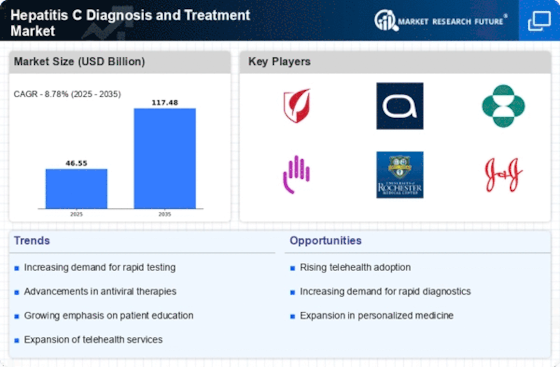
Hepatitis C Diagnosis Treatment Market Infographic
Purchase Options

Market Share

Hepatitis C Diagnosis Treatment Market Share Analysis

To have a strong impact on the health industry and make significant changes in it, companies in the Hepatitis C diagnosis and treatment domain need to develop their market share positioning strategies. One way that is commonly used is differentiation of products where investments are made heavily on research and development to create innovative diagnostic tools as well as therapeutic options. These firms aim at differentiating themselves from other manufacturers by providing advanced solutions that are more accurate and efficient. The second principle cost leadership approach is a core strategy used by several companies in the field of HCV diagnosis and treatment. Companies through operational efficiency management, favorable supplier contracts negotiation, economies of scale use tries to cut down costs incurred during total testing processes for diagnosing or treating hepatitis C patients. The affordability issue thus helps in addressing a wider audience across particular regions with regard to access to healthcare services. Market segmentation is an often used technique within the HCV sector. In this regard, companies focus their diagnostic and treatment offerings based on specific patient demographics, geographies, or stages of disease progression. It aids in marketing more precisely, personalizing patient care services hence making possible strategic positioning with small niche markets resulting into higher market shares. The commercial performance of companies involved in the Hepatitis C diagnosis and treatment market can be enhanced through collaborations and partnerships. For instance, collaboration between healthcare institutions, government agencies as well as organizations conducting research among others enables these companies gain collective expertise which helps them expedite regulatory processes so that they can quickly produce diagnostics test equipments and drugs for hepatitis C for example . Therefore such moves boost branding efforts overall.

Customer-centered approaches are increasingly taking root within the Hepatitis C sector. Companies could opt to educate patients about hep c; provide support programs; ensure user-friendly interfaces for their tests etc., all aimed at enhancing overall customer experience. Not only does it build confidence and brand loyalty amid patients but also positively impacts perceptions on health matters thereby boosting its market share too. Many companies in the diagnosis and treatment market for Hepatitis C, recognize that global expansion is a strategic necessity. This allows them to enter new markets, meet unmet health care needs, navigate different regulatory environments as well as culture specific solutions. It may require such expansions to partner with local healthcare providers or ensuring compliance to region specific guidelines or even aligning business promotion to fit within a given healthcare system and patient demographic. In the Hepatitis C market, continuous innovation is essential in maintaining current market shares and expanding them. They must be up to date with advancements in diagnostic technologies and treatment modalities so that they can offer great services at all times. Thus regular updates on tools’ accuracy of diagnosing HCV, as well as development of treatment alternatives, help sustain competitiveness in the marketplace.


Author
Author Profile
Satyendra Maurya
Research Analyst

An accomplished research analyst with high proficiency in market forecasting, data visualization, competitive benchmarking, and others. He holds a pronounced track record in research and consulting projects for sectors such as life sciences, medical devices, and healthcare IT. His capabilities in qualitative and quantitative analysis have resulted in positive client outcomes. Working on niche market trends, opportunities, sales, and forecasted value is part of his skill set.

Leave a Comment

FAQs

What is the current valuation of the Hepatitis C Diagnosis and Treatment Market?

<p>The market valuation was 46.55 USD Billion in 2024.</p>

What is the projected market size for the Hepatitis C Diagnosis and Treatment Market by 2035?

<p>The market is projected to reach 117.48 USD Billion by 2035.</p>

What is the expected CAGR for the Hepatitis C Diagnosis and Treatment Market during the forecast period?

<p>The expected CAGR for the market from 2025 to 2035 is 8.78%.</p>

Which companies are the key players in the Hepatitis C Diagnosis and Treatment Market?

<p>Key players include Gilead Sciences, AbbVie, Merck & Co, and Bristol-Myers Squibb.</p>

What are the main segments of the Hepatitis C Diagnosis market?

<p>The main segments include Liver Function Tests, Liver Biopsy, Blood Tests, and Others.</p>

How much is the Blood Tests segment valued in the Hepatitis C Diagnosis Market?

The Blood Tests segment was valued at 25.0 USD Billion in 2024 and is projected to reach 60.0 USD Billion.

What is the valuation of Antiviral Medications in the Treatment segment?

Antiviral Medications were valued at 25.0 USD Billion in 2024 and are expected to grow to 65.0 USD Billion.

What is the projected growth for the Liver Transplantation segment in the Treatment market?

The Liver Transplantation segment was valued at 5.0 USD Billion in 2024 and is projected to reach 15.0 USD Billion.

Which end users dominate the Hepatitis C Diagnosis and Treatment Market?

Hospitals &amp; Clinics and Diagnostic Centers are the dominant end users in the market.

What is the projected valuation for the Diagnostic Centers segment by 2035?

The Diagnostic Centers segment is expected to grow from 14.0 USD Billion in 2024 to 34.0 USD Billion by 2035.

Market Summary

As per Market Research Future analysis, the Hepatitis C Diagnosis and Treatment Market was estimated at 46.55 USD Billion in 2024. The Hepatitis C industry is projected to grow from 50.64 USD Billion in 2025 to 117.48 USD Billion by 2035, exhibiting a compound annual growth rate (CAGR) of 8.78% during the forecast period 2025 - 2035

Key Market Trends & Highlights

The Hepatitis C Diagnosis and Treatment Market is experiencing transformative advancements driven by technology and rising disease prevalence.

  • Advancements in diagnostic technologies are enhancing the accuracy and speed of Hepatitis C detection, particularly in North America. The emergence of novel antiviral therapies is reshaping treatment protocols, with a notable focus on personalized medicine in the Asia-Pacific region. Integration of telemedicine is facilitating patient care and follow-up, especially in remote areas, thereby improving access to treatment. Rising prevalence of Hepatitis C and increased government initiatives and funding are driving market growth across both diagnostic and treatment segments.

Market Size & Forecast

2024 Market Size 46.55 (USD Billion)
2035 Market Size 117.48 (USD Billion)
CAGR (2025 - 2035) 8.78%
Largest Regional Market Share in 2024 Americas

Major Players

<a title="Gilead Sciences" href="https://www.gilead.com/stories/gilead-sets-sights-on-hepatitis-c-elimination-as-it-marks-10-years-of-curative-therapies" target="_blank" rel="noopener">Gilead Sciences</a> (US), AbbVie (US), Merck &amp; Co (US), Bristol-Myers Squibb (US), Roche (CH), Johnson &amp; Johnson (US), GlaxoSmithKline (GB), Hoffmann-La Roche (CH), AstraZeneca (GB)

Market Trends

The Hepatitis C Diagnosis and Treatment Market is currently experiencing a transformative phase, driven by advancements in medical technology and a growing awareness of the disease's impact on public health. Innovative diagnostic tools are emerging, enhancing the accuracy and speed of Hepatitis C detection. This evolution is complemented by the development of new antiviral therapies, which are showing promise in improving patient outcomes. As healthcare systems worldwide prioritize the elimination of Hepatitis C, there is a noticeable shift towards integrated care models that encompass prevention, diagnosis, and treatment. This holistic approach appears to foster better patient engagement and adherence to treatment protocols. Moreover, the landscape of the Hepatitis C Diagnosis and Treatment Market is influenced by increasing collaborations between pharmaceutical companies and healthcare providers. These partnerships aim to streamline access to therapies and improve the overall management of the disease. Additionally, the rise of telemedicine is reshaping how patients interact with healthcare professionals, potentially increasing the reach of diagnostic services and treatment options. As the market evolves, it seems poised to address the challenges of Hepatitis C more effectively, ultimately contributing to the global goal of reducing the burden of this viral infection.

Advancements in Diagnostic Technologies

The Hepatitis C Diagnosis and Treatment Market is witnessing a surge in innovative diagnostic technologies. These advancements are enhancing the precision and efficiency of Hepatitis C detection, allowing for earlier intervention and improved patient management. New methods, such as point-of-care testing, are becoming increasingly prevalent, facilitating rapid diagnosis in diverse healthcare settings.

Emergence of Novel Antiviral Therapies

The development of novel antiviral therapies is reshaping treatment paradigms within the Hepatitis C Diagnosis and Treatment Market. These new medications are designed to be more effective and have fewer side effects, potentially leading to higher rates of patient compliance. This trend indicates a shift towards personalized treatment approaches that cater to individual patient needs.

Integration of Telemedicine in Patient Care

The integration of telemedicine into the Hepatitis C Diagnosis and Treatment Market is transforming patient care dynamics. This approach allows for remote consultations and monitoring, which can enhance access to healthcare services, particularly in underserved areas. Telemedicine may also facilitate ongoing patient education and support, contributing to better health outcomes.

Hepatitis C Diagnosis Treatment Market Market Drivers

Rising Prevalence of Hepatitis C

The increasing prevalence of Hepatitis C infections is a primary driver for the Hepatitis C Diagnosis and Treatment Market. According to estimates, millions of individuals are living with chronic Hepatitis C worldwide, with a notable rise in cases reported in certain regions. This surge in prevalence necessitates enhanced diagnostic and treatment solutions, thereby propelling market growth. The World Health Organization has indicated that Hepatitis C is a significant public health concern, leading to liver disease and other complications. As awareness of the disease grows, healthcare systems are compelled to invest in advanced diagnostic technologies and effective treatment options, further stimulating the Hepatitis C Diagnosis and Treatment Market.

Increased Awareness and Education

The growing awareness and education surrounding Hepatitis C are pivotal for the Hepatitis C Diagnosis and Treatment Market. Public health campaigns and educational programs have played a significant role in informing individuals about the risks and consequences of Hepatitis C. This heightened awareness encourages individuals to seek testing and treatment, thereby increasing the demand for diagnostic services and therapeutic interventions. Healthcare providers are also becoming more knowledgeable about the disease, leading to improved patient management and care. As awareness continues to rise, the Hepatitis C Diagnosis and Treatment Market is expected to expand, driven by the need for comprehensive care and support for affected individuals.

Government Initiatives and Funding

Government initiatives aimed at combating Hepatitis C are crucial for the Hepatitis C Diagnosis and Treatment Market. Various countries have implemented national strategies to eliminate Hepatitis C, which include funding for screening programs and treatment accessibility. For instance, some governments have allocated substantial budgets to enhance public health campaigns and improve healthcare infrastructure. These initiatives not only raise awareness but also facilitate early diagnosis and treatment, which are essential for controlling the disease's spread. The financial support from governments encourages research and development in the Hepatitis C Diagnosis and Treatment Market, leading to innovative solutions and improved patient outcomes.

Integration of Personalized Medicine

The integration of personalized medicine into Hepatitis C treatment strategies is emerging as a key driver for the Hepatitis C Diagnosis and Treatment Market. Tailoring treatment plans based on individual patient profiles, including genetic factors and disease progression, enhances treatment efficacy and minimizes adverse effects. This approach not only improves patient outcomes but also fosters a more efficient allocation of healthcare resources. As healthcare systems increasingly adopt personalized medicine, the demand for diagnostic tools that can accurately assess patient-specific factors is likely to grow. Consequently, the Hepatitis C Diagnosis and Treatment Market may witness a shift towards more individualized treatment paradigms, reflecting the evolving landscape of healthcare.

Technological Innovations in Treatment

Technological advancements in treatment options are significantly influencing the Hepatitis C Diagnosis and Treatment Market. The introduction of direct-acting antiviral agents has revolutionized the treatment landscape, offering higher cure rates and shorter treatment durations. These innovations have made Hepatitis C treatment more effective and accessible, attracting a larger patient population. Furthermore, ongoing research into new therapeutic agents continues to expand the treatment arsenal, which is expected to enhance patient compliance and outcomes. As healthcare providers adopt these advanced therapies, the Hepatitis C Diagnosis and Treatment Market is likely to experience substantial growth, driven by the demand for effective and efficient treatment solutions.

Market Segment Insights

By Diagnosis: Blood Tests (Largest) vs. Liver Biopsy (Fastest-Growing)

Within the Hepatitis C Diagnosis and Treatment Market, Blood Tests dominate the segment, accounting for the largest share among diagnostic tools. They are widely used due to their effectiveness in detecting the Hepatitis C virus (HCV) and are considered a standard practice in the diagnostic process. In comparison, Liver Biopsy, although smaller in market share, is emerging rapidly due to the increasing emphasis on accurate liver assessment and damage evaluation, contributing significantly to its growth potential in the market.

Blood Tests (Dominant) vs. Liver Biopsy (Emerging)

Blood Tests hold a dominant position in the Hepatitis C diagnosis landscape as they are essential for initial screening and follow-up to confirm HCV infection. Their non-invasive nature and efficiency make them the preferred choice among healthcare providers. Conversely, Liver Biopsy, while invasive, is gaining traction as an emerging technique, particularly for detailed liver damage assessment. This method offers critical insights into the stage of liver disease, often supporting treatment decisions. Increasing awareness about liver health and ongoing advancements in biopsy techniques are driving its growth, positioning it as a vital tool for comprehensive Hepatitis C management.

By Treatment: Antiviral Medications (Largest) vs. Immune-Modulators (Fastest-Growing)

In the Hepatitis C Diagnosis and Treatment Market, the primary contributors stand out, highlighting the dynamics of market share distribution. Antiviral medications dominate the landscape, claiming a significant portion. In contrast, immune-modulators, while currently a smaller market player, are rapidly gaining traction among healthcare providers, reflecting a shift towards a more holistic treatment philosophy.

Antiviral Medications (Dominant) vs. Immune-Modulators (Emerging)

Antiviral medications serve as the cornerstone in the treatment of Hepatitis C, renowned for their efficacy in eradicating the virus and leading to sustained virological response in patients. These therapies, including direct-acting antivirals (DAAs), have transformed patient outcomes. On the other hand, immune-modulators represent a burgeoning area in treatment innovation. Although still developing, they are showing promise in enhancing the body's immune response against the virus, positioning them as an attractive option for future therapies. As research continues to progress, the potential of immune-modulators could revolutionize treatment paradigms further.

By End User: Hospitals & Clinics (Largest) vs. Diagnostic Centers (Fastest-Growing)

In the Hepatitis C Diagnosis and Treatment Market, hospitals and clinics command the largest market share due to their comprehensive healthcare services and access to advanced diagnostic technologies. These facilities cater to a significant patient demographic, thereby playing a crucial role in the management of hepatitis C treatment protocols. Conversely, diagnostic centers, while holding a smaller market share, are rapidly gaining ground as more patients seek specialized services that these facilities provide. This shift emphasizes the growing reliance on precision diagnostics and targeted treatment plans.

Hospitals &amp; Clinics (Dominant) vs. Diagnostic Centers (Emerging)

Hospitals and clinics remain the dominant segment in the Hepatitis C Diagnosis and Treatment Market, offering a wide range of services that encompass the entire spectrum of patient management, from diagnosis to treatment and follow-up care. Their established infrastructure and skilled healthcare professionals enable them to deliver high-quality care, making them the first point of contact for most patients. On the other hand, diagnostic centers are emerging as vital players in this landscape. With a growing emphasis on rapid and accurate diagnostics, these centers focus on specialized services tailored to hepatitis C, appealing to both physicians and patients seeking more efficient healthcare solutions. As technological advancements continue to enhance diagnostic capabilities, the growth prospects for this segment are notably robust.

Get more detailed insights about Hepatitis C Diagnosis and Treatment Market Research Report - Forecast till 2035

Regional Insights

North America : Leading Market for Innovation

North America is the largest market for Hepatitis C diagnosis and treatment, accounting for approximately 45% of the global market share. The region benefits from advanced healthcare infrastructure, high prevalence rates, and significant investments in research and development. Regulatory support from agencies like the FDA has accelerated the approval of new therapies, driving demand for innovative treatment options. The United States is the primary contributor to this market, with key players such as Gilead Sciences, AbbVie, and Merck & Co leading the competitive landscape. The presence of these major pharmaceutical companies, along with ongoing clinical trials and partnerships, enhances the availability of effective treatments. The focus on patient access and affordability further strengthens the market position in this region.

Europe : Growing Focus on Treatment Access

Europe is witnessing significant growth in the Hepatitis C diagnosis and treatment market, holding approximately 30% of the global share. The region's growth is driven by increasing awareness, improved screening programs, and favorable reimbursement policies. Regulatory bodies are actively promoting the use of direct-acting antivirals (DAAs), which are crucial in managing the disease effectively. Leading countries such as Germany, France, and the UK are at the forefront of this market, supported by strong healthcare systems and innovative treatment options. Major players like Roche and Bristol-Myers Squibb are enhancing their presence through strategic collaborations and product launches. The competitive landscape is characterized by a mix of established companies and emerging biotech firms, all aiming to improve patient outcomes.

Asia-Pacific : Emerging Market Potential

The Asia-Pacific region is emerging as a significant player in the Hepatitis C diagnosis and treatment market, accounting for about 20% of the global market share. The growth is fueled by rising infection rates, increasing healthcare expenditure, and government initiatives aimed at improving access to treatment. Countries like China and India are leading the charge, with substantial investments in healthcare infrastructure and awareness campaigns. China is the largest market in this region, with a growing number of patients seeking treatment. The competitive landscape includes both multinational corporations and local firms, with key players like Johnson & Johnson and GlaxoSmithKline actively participating. The focus on affordable treatment options and public health initiatives is expected to drive further growth in this market.

Middle East and Africa : Untapped Market Opportunities

The Middle East and Africa region represents an untapped market for Hepatitis C diagnosis and treatment, holding approximately 5% of the global market share. The growth potential is significant, driven by increasing awareness of the disease, government initiatives, and international support for healthcare improvements. However, challenges such as limited access to healthcare and varying levels of disease prevalence hinder rapid market expansion. Countries like South Africa and Egypt are leading the market, with efforts to enhance screening and treatment access. The competitive landscape is evolving, with both local and international players seeking to establish a foothold. The presence of organizations focused on public health initiatives is crucial for addressing the challenges and improving treatment outcomes in this region.

Key Players and Competitive Insights

The Hepatitis C Diagnosis and Treatment Market is characterized by a dynamic competitive landscape, driven by the increasing prevalence of Hepatitis C infections and the ongoing advancements in treatment modalities. Key players such as Gilead Sciences (US), AbbVie (US), and Merck & Co (US) are at the forefront, each adopting distinct strategies to enhance their market positioning. Gilead Sciences (US) focuses on innovation, particularly in developing next-generation antiviral therapies, while AbbVie (US) emphasizes strategic partnerships to expand its treatment portfolio. Merck & Co (US) is actively pursuing regional expansion, particularly in emerging markets, thereby diversifying its revenue streams. Collectively, these strategies contribute to a competitive environment that is increasingly centered on innovation and collaboration.

The market structure appears moderately fragmented, with several players vying for market share. Key business tactics such as localizing manufacturing and optimizing supply chains are becoming prevalent as companies seek to enhance operational efficiency and reduce costs. The influence of major players is significant, as their strategic initiatives often set the tone for market trends and competitive dynamics.

In August 2025, Gilead Sciences (US) announced a collaboration with a leading biotechnology firm to develop a novel Hepatitis C treatment that targets resistant strains of the virus. This strategic move is likely to bolster Gilead's position in the market by addressing unmet medical needs and enhancing its product offerings. The collaboration underscores the importance of innovation in maintaining competitive advantage in a rapidly evolving landscape.

In September 2025, AbbVie (US) launched a new digital platform aimed at improving patient engagement and adherence to Hepatitis C treatment regimens. This initiative reflects AbbVie's commitment to leveraging technology to enhance patient outcomes and streamline treatment processes. By integrating digital solutions, AbbVie is not only improving its service delivery but also positioning itself as a leader in patient-centric care.

In October 2025, Merck & Co (US) expanded its manufacturing capabilities in Asia to meet the growing demand for Hepatitis C treatments in the region. This expansion is strategically significant as it allows Merck to enhance its supply chain reliability and respond more effectively to regional market needs. Such moves indicate a shift towards localized production, which may become a critical factor in competitive differentiation.

As of October 2025, current trends in the Hepatitis C Diagnosis and Treatment Market are increasingly defined by digitalization, sustainability, and the integration of artificial intelligence in treatment protocols. Strategic alliances are shaping the landscape, fostering innovation and enhancing the capabilities of key players. Looking ahead, competitive differentiation is likely to evolve from traditional price-based competition to a focus on technological advancements, innovative treatment solutions, and robust supply chain management. This shift may redefine how companies compete, emphasizing the importance of reliability and innovation in meeting patient needs.

Key Companies in the Hepatitis C Diagnosis Treatment Market include

Industry Developments

In India, Abbott introduced "LiverHealth," a project to make it easier to diagnose liver function and promote awareness about hepatitis C.

The market is consolidated, with Gilead Sciences, Inc. accounting for roughly 80.1 percent of the market share, with the majority of revenue coming from the sales of the medications Harvoni and Sovaldi. Bristol-Myers Squibb Company and AbbVie Inc. are the other main participants.


Future Outlook

Hepatitis C Diagnosis Treatment Market Future Outlook

The Hepatitis C Diagnosis and Treatment Market is projected to grow at an 8.78% CAGR from 2025 to 2035, driven by advancements in diagnostics, increased awareness, and improved treatment options.

New opportunities lie in:

  • <p>Development of point-of-care testing devices for rapid diagnosis. Expansion of telemedicine services for remote patient management. Investment in personalized medicine approaches for tailored treatment regimens.</p>

By 2035, the market is expected to be robust, driven by innovation and increased accessibility.

Market Segmentation

Hepatitis C Diagnosis Treatment Market End User Outlook

  • Hospitals & Clinics
  • Diagnostic Centers
  • Others

Hepatitis C Diagnosis Treatment Market Diagnosis Outlook

  • Liver Function Tests
  • Liver Biopsy
  • Blood Tests
  • Others

Hepatitis C Diagnosis Treatment Market Treatment Outlook

  • Antiviral Medications
  • Immune-Modulators
  • Liver Transplantation
  • Others

Report Scope

MARKET SIZE 2024 46.55(USD Billion)
MARKET SIZE 2025 50.64(USD Billion)
MARKET SIZE 2035 117.48(USD Billion)
COMPOUND ANNUAL GROWTH RATE (CAGR) 8.78% (2025 - 2035)
REPORT COVERAGE Revenue Forecast, Competitive Landscape, Growth Factors, and Trends
BASE YEAR 2024
Market Forecast Period 2025 - 2035
Historical Data 2019 - 2024
Market Forecast Units USD Billion
Key Companies Profiled Gilead Sciences (US), AbbVie (US), Merck & Co (US), Bristol-Myers Squibb (US), Roche (CH), Johnson & Johnson (US), GlaxoSmithKline (GB), Hoffmann-La Roche (CH), AstraZeneca (GB)
Segments Covered Diagnosis
Key Market Opportunities Advancements in direct-acting antiviral therapies enhance treatment efficacy in the Hepatitis C Diagnosis and Treatment Market.
Key Market Dynamics Rising demand for innovative therapies drives competition and regulatory scrutiny in the Hepatitis C diagnosis and treatment market.
Countries Covered North America, Europe, APAC, South America, MEA

FAQs

What is the current valuation of the Hepatitis C Diagnosis and Treatment Market?

<p>The market valuation was 46.55 USD Billion in 2024.</p>

What is the projected market size for the Hepatitis C Diagnosis and Treatment Market by 2035?

<p>The market is projected to reach 117.48 USD Billion by 2035.</p>

What is the expected CAGR for the Hepatitis C Diagnosis and Treatment Market during the forecast period?

<p>The expected CAGR for the market from 2025 to 2035 is 8.78%.</p>

Which companies are the key players in the Hepatitis C Diagnosis and Treatment Market?

<p>Key players include Gilead Sciences, AbbVie, Merck & Co, and Bristol-Myers Squibb.</p>

What are the main segments of the Hepatitis C Diagnosis market?

<p>The main segments include Liver Function Tests, Liver Biopsy, Blood Tests, and Others.</p>

How much is the Blood Tests segment valued in the Hepatitis C Diagnosis Market?

The Blood Tests segment was valued at 25.0 USD Billion in 2024 and is projected to reach 60.0 USD Billion.

What is the valuation of Antiviral Medications in the Treatment segment?

Antiviral Medications were valued at 25.0 USD Billion in 2024 and are expected to grow to 65.0 USD Billion.

What is the projected growth for the Liver Transplantation segment in the Treatment market?

The Liver Transplantation segment was valued at 5.0 USD Billion in 2024 and is projected to reach 15.0 USD Billion.

Which end users dominate the Hepatitis C Diagnosis and Treatment Market?

Hospitals &amp; Clinics and Diagnostic Centers are the dominant end users in the market.

What is the projected valuation for the Diagnostic Centers segment by 2035?

The Diagnostic Centers segment is expected to grow from 14.0 USD Billion in 2024 to 34.0 USD Billion by 2035.

  1. SECTION I: EXECUTIVE SUMMARY AND KEY HIGHLIGHTS
    1. | 1.1 EXECUTIVE SUMMARY
    2. | | 1.1.1 Market Overview
    3. | | 1.1.2 Key Findings
    4. | | 1.1.3 Market Segmentation
    5. | | 1.1.4 Competitive Landscape
    6. | | 1.1.5 Challenges and Opportunities
    7. | | 1.1.6 Future Outlook
  2. SECTION II: SCOPING, METHODOLOGY AND MARKET STRUCTURE
    1. | 2.1 MARKET INTRODUCTION
    2. | | 2.1.1 Definition
    3. | | 2.1.2 Scope of the study
    4. | | | 2.1.2.1 Research Objective
    5. | | | 2.1.2.2 Assumption
    6. | | | 2.1.2.3 Limitations
    7. | 2.2 RESEARCH METHODOLOGY
    8. | | 2.2.1 Overview
    9. | | 2.2.2 Data Mining
    10. | | 2.2.3 Secondary Research
    11. | | 2.2.4 Primary Research
    12. | | | 2.2.4.1 Primary Interviews and Information Gathering Process
    13. | | | 2.2.4.2 Breakdown of Primary Respondents
    14. | | 2.2.5 Forecasting Model
    15. | | 2.2.6 Market Size Estimation
    16. | | | 2.2.6.1 Bottom-Up Approach
    17. | | | 2.2.6.2 Top-Down Approach
    18. | | 2.2.7 Data Triangulation
    19. | | 2.2.8 Validation
  3. SECTION III: QUALITATIVE ANALYSIS
    1. | 3.1 MARKET DYNAMICS
    2. | | 3.1.1 Overview
    3. | | 3.1.2 Drivers
    4. | | 3.1.3 Restraints
    5. | | 3.1.4 Opportunities
    6. | 3.2 MARKET FACTOR ANALYSIS
    7. | | 3.2.1 Value chain Analysis
    8. | | 3.2.2 Porter's Five Forces Analysis
    9. | | | 3.2.2.1 Bargaining Power of Suppliers
    10. | | | 3.2.2.2 Bargaining Power of Buyers
    11. | | | 3.2.2.3 Threat of New Entrants
    12. | | | 3.2.2.4 Threat of Substitutes
    13. | | | 3.2.2.5 Intensity of Rivalry
    14. | | 3.2.3 COVID-19 Impact Analysis
    15. | | | 3.2.3.1 Market Impact Analysis
    16. | | | 3.2.3.2 Regional Impact
    17. | | | 3.2.3.3 Opportunity and Threat Analysis
  4. SECTION IV: QUANTITATIVE ANALYSIS
    1. | 4.1 Healthcare, BY Diagnosis (USD Billion)
    2. | | 4.1.1 Liver Function Tests
    3. | | 4.1.2 Liver Biopsy
    4. | | 4.1.3 Blood Tests
    5. | | 4.1.4 Others
    6. | 4.2 Healthcare, BY Treatment (USD Billion)
    7. | | 4.2.1 Antiviral Medications
    8. | | 4.2.2 Immune-Modulators
    9. | | 4.2.3 Liver Transplantation
    10. | | 4.2.4 Others
    11. | 4.3 Healthcare, BY End User (USD Billion)
    12. | | 4.3.1 Hospitals & Clinics
    13. | | 4.3.2 Diagnostic Centers
    14. | | 4.3.3 Others
    15. | 4.4 Healthcare, BY Region (USD Billion)
    16. | | 4.4.1 North America
    17. | | | 4.4.1.1 US
    18. | | | 4.4.1.2 Canada
    19. | | 4.4.2 Europe
    20. | | | 4.4.2.1 Germany
    21. | | | 4.4.2.2 UK
    22. | | | 4.4.2.3 France
    23. | | | 4.4.2.4 Russia
    24. | | | 4.4.2.5 Italy
    25. | | | 4.4.2.6 Spain
    26. | | | 4.4.2.7 Rest of Europe
    27. | | 4.4.3 APAC
    28. | | | 4.4.3.1 China
    29. | | | 4.4.3.2 India
    30. | | | 4.4.3.3 Japan
    31. | | | 4.4.3.4 South Korea
    32. | | | 4.4.3.5 Malaysia
    33. | | | 4.4.3.6 Thailand
    34. | | | 4.4.3.7 Indonesia
    35. | | | 4.4.3.8 Rest of APAC
    36. | | 4.4.4 South America
    37. | | | 4.4.4.1 Brazil
    38. | | | 4.4.4.2 Mexico
    39. | | | 4.4.4.3 Argentina
    40. | | | 4.4.4.4 Rest of South America
    41. | | 4.4.5 MEA
    42. | | | 4.4.5.1 GCC Countries
    43. | | | 4.4.5.2 South Africa
    44. | | | 4.4.5.3 Rest of MEA
  5. SECTION V: COMPETITIVE ANALYSIS
    1. | 5.1 Competitive Landscape
    2. | | 5.1.1 Overview
    3. | | 5.1.2 Competitive Analysis
    4. | | 5.1.3 Market share Analysis
    5. | | 5.1.4 Major Growth Strategy in the Healthcare
    6. | | 5.1.5 Competitive Benchmarking
    7. | | 5.1.6 Leading Players in Terms of Number of Developments in the Healthcare
    8. | | 5.1.7 Key developments and growth strategies
    9. | | | 5.1.7.1 New Product Launch/Service Deployment
    10. | | | 5.1.7.2 Merger & Acquisitions
    11. | | | 5.1.7.3 Joint Ventures
    12. | | 5.1.8 Major Players Financial Matrix
    13. | | | 5.1.8.1 Sales and Operating Income
    14. | | | 5.1.8.2 Major Players R&D Expenditure. 2023
    15. | 5.2 Company Profiles
    16. | | 5.2.1 Gilead Sciences (US)
    17. | | | 5.2.1.1 Financial Overview
    18. | | | 5.2.1.2 Products Offered
    19. | | | 5.2.1.3 Key Developments
    20. | | | 5.2.1.4 SWOT Analysis
    21. | | | 5.2.1.5 Key Strategies
    22. | | 5.2.2 AbbVie (US)
    23. | | | 5.2.2.1 Financial Overview
    24. | | | 5.2.2.2 Products Offered
    25. | | | 5.2.2.3 Key Developments
    26. | | | 5.2.2.4 SWOT Analysis
    27. | | | 5.2.2.5 Key Strategies
    28. | | 5.2.3 Merck & Co (US)
    29. | | | 5.2.3.1 Financial Overview
    30. | | | 5.2.3.2 Products Offered
    31. | | | 5.2.3.3 Key Developments
    32. | | | 5.2.3.4 SWOT Analysis
    33. | | | 5.2.3.5 Key Strategies
    34. | | 5.2.4 Bristol-Myers Squibb (US)
    35. | | | 5.2.4.1 Financial Overview
    36. | | | 5.2.4.2 Products Offered
    37. | | | 5.2.4.3 Key Developments
    38. | | | 5.2.4.4 SWOT Analysis
    39. | | | 5.2.4.5 Key Strategies
    40. | | 5.2.5 Roche (CH)
    41. | | | 5.2.5.1 Financial Overview
    42. | | | 5.2.5.2 Products Offered
    43. | | | 5.2.5.3 Key Developments
    44. | | | 5.2.5.4 SWOT Analysis
    45. | | | 5.2.5.5 Key Strategies
    46. | | 5.2.6 Johnson & Johnson (US)
    47. | | | 5.2.6.1 Financial Overview
    48. | | | 5.2.6.2 Products Offered
    49. | | | 5.2.6.3 Key Developments
    50. | | | 5.2.6.4 SWOT Analysis
    51. | | | 5.2.6.5 Key Strategies
    52. | | 5.2.7 GlaxoSmithKline (GB)
    53. | | | 5.2.7.1 Financial Overview
    54. | | | 5.2.7.2 Products Offered
    55. | | | 5.2.7.3 Key Developments
    56. | | | 5.2.7.4 SWOT Analysis
    57. | | | 5.2.7.5 Key Strategies
    58. | | 5.2.8 Hoffmann-La Roche (CH)
    59. | | | 5.2.8.1 Financial Overview
    60. | | | 5.2.8.2 Products Offered
    61. | | | 5.2.8.3 Key Developments
    62. | | | 5.2.8.4 SWOT Analysis
    63. | | | 5.2.8.5 Key Strategies
    64. | | 5.2.9 AstraZeneca (GB)
    65. | | | 5.2.9.1 Financial Overview
    66. | | | 5.2.9.2 Products Offered
    67. | | | 5.2.9.3 Key Developments
    68. | | | 5.2.9.4 SWOT Analysis
    69. | | | 5.2.9.5 Key Strategies
    70. | 5.3 Appendix
    71. | | 5.3.1 References
    72. | | 5.3.2 Related Reports
  6. LIST OF FIGURES
    1. | 6.1 MARKET SYNOPSIS
    2. | 6.2 NORTH AMERICA MARKET ANALYSIS
    3. | 6.3 US MARKET ANALYSIS BY DIAGNOSIS
    4. | 6.4 US MARKET ANALYSIS BY TREATMENT
    5. | 6.5 US MARKET ANALYSIS BY END USER
    6. | 6.6 CANADA MARKET ANALYSIS BY DIAGNOSIS
    7. | 6.7 CANADA MARKET ANALYSIS BY TREATMENT
    8. | 6.8 CANADA MARKET ANALYSIS BY END USER
    9. | 6.9 EUROPE MARKET ANALYSIS
    10. | 6.10 GERMANY MARKET ANALYSIS BY DIAGNOSIS
    11. | 6.11 GERMANY MARKET ANALYSIS BY TREATMENT
    12. | 6.12 GERMANY MARKET ANALYSIS BY END USER
    13. | 6.13 UK MARKET ANALYSIS BY DIAGNOSIS
    14. | 6.14 UK MARKET ANALYSIS BY TREATMENT
    15. | 6.15 UK MARKET ANALYSIS BY END USER
    16. | 6.16 FRANCE MARKET ANALYSIS BY DIAGNOSIS
    17. | 6.17 FRANCE MARKET ANALYSIS BY TREATMENT
    18. | 6.18 FRANCE MARKET ANALYSIS BY END USER
    19. | 6.19 RUSSIA MARKET ANALYSIS BY DIAGNOSIS
    20. | 6.20 RUSSIA MARKET ANALYSIS BY TREATMENT
    21. | 6.21 RUSSIA MARKET ANALYSIS BY END USER
    22. | 6.22 ITALY MARKET ANALYSIS BY DIAGNOSIS
    23. | 6.23 ITALY MARKET ANALYSIS BY TREATMENT
    24. | 6.24 ITALY MARKET ANALYSIS BY END USER
    25. | 6.25 SPAIN MARKET ANALYSIS BY DIAGNOSIS
    26. | 6.26 SPAIN MARKET ANALYSIS BY TREATMENT
    27. | 6.27 SPAIN MARKET ANALYSIS BY END USER
    28. | 6.28 REST OF EUROPE MARKET ANALYSIS BY DIAGNOSIS
    29. | 6.29 REST OF EUROPE MARKET ANALYSIS BY TREATMENT
    30. | 6.30 REST OF EUROPE MARKET ANALYSIS BY END USER
    31. | 6.31 APAC MARKET ANALYSIS
    32. | 6.32 CHINA MARKET ANALYSIS BY DIAGNOSIS
    33. | 6.33 CHINA MARKET ANALYSIS BY TREATMENT
    34. | 6.34 CHINA MARKET ANALYSIS BY END USER
    35. | 6.35 INDIA MARKET ANALYSIS BY DIAGNOSIS
    36. | 6.36 INDIA MARKET ANALYSIS BY TREATMENT
    37. | 6.37 INDIA MARKET ANALYSIS BY END USER
    38. | 6.38 JAPAN MARKET ANALYSIS BY DIAGNOSIS
    39. | 6.39 JAPAN MARKET ANALYSIS BY TREATMENT
    40. | 6.40 JAPAN MARKET ANALYSIS BY END USER
    41. | 6.41 SOUTH KOREA MARKET ANALYSIS BY DIAGNOSIS
    42. | 6.42 SOUTH KOREA MARKET ANALYSIS BY TREATMENT
    43. | 6.43 SOUTH KOREA MARKET ANALYSIS BY END USER
    44. | 6.44 MALAYSIA MARKET ANALYSIS BY DIAGNOSIS
    45. | 6.45 MALAYSIA MARKET ANALYSIS BY TREATMENT
    46. | 6.46 MALAYSIA MARKET ANALYSIS BY END USER
    47. | 6.47 THAILAND MARKET ANALYSIS BY DIAGNOSIS
    48. | 6.48 THAILAND MARKET ANALYSIS BY TREATMENT
    49. | 6.49 THAILAND MARKET ANALYSIS BY END USER
    50. | 6.50 INDONESIA MARKET ANALYSIS BY DIAGNOSIS
    51. | 6.51 INDONESIA MARKET ANALYSIS BY TREATMENT
    52. | 6.52 INDONESIA MARKET ANALYSIS BY END USER
    53. | 6.53 REST OF APAC MARKET ANALYSIS BY DIAGNOSIS
    54. | 6.54 REST OF APAC MARKET ANALYSIS BY TREATMENT
    55. | 6.55 REST OF APAC MARKET ANALYSIS BY END USER
    56. | 6.56 SOUTH AMERICA MARKET ANALYSIS
    57. | 6.57 BRAZIL MARKET ANALYSIS BY DIAGNOSIS
    58. | 6.58 BRAZIL MARKET ANALYSIS BY TREATMENT
    59. | 6.59 BRAZIL MARKET ANALYSIS BY END USER
    60. | 6.60 MEXICO MARKET ANALYSIS BY DIAGNOSIS
    61. | 6.61 MEXICO MARKET ANALYSIS BY TREATMENT
    62. | 6.62 MEXICO MARKET ANALYSIS BY END USER
    63. | 6.63 ARGENTINA MARKET ANALYSIS BY DIAGNOSIS
    64. | 6.64 ARGENTINA MARKET ANALYSIS BY TREATMENT
    65. | 6.65 ARGENTINA MARKET ANALYSIS BY END USER
    66. | 6.66 REST OF SOUTH AMERICA MARKET ANALYSIS BY DIAGNOSIS
    67. | 6.67 REST OF SOUTH AMERICA MARKET ANALYSIS BY TREATMENT
    68. | 6.68 REST OF SOUTH AMERICA MARKET ANALYSIS BY END USER
    69. | 6.69 MEA MARKET ANALYSIS
    70. | 6.70 GCC COUNTRIES MARKET ANALYSIS BY DIAGNOSIS
    71. | 6.71 GCC COUNTRIES MARKET ANALYSIS BY TREATMENT
    72. | 6.72 GCC COUNTRIES MARKET ANALYSIS BY END USER
    73. | 6.73 SOUTH AFRICA MARKET ANALYSIS BY DIAGNOSIS
    74. | 6.74 SOUTH AFRICA MARKET ANALYSIS BY TREATMENT
    75. | 6.75 SOUTH AFRICA MARKET ANALYSIS BY END USER
    76. | 6.76 REST OF MEA MARKET ANALYSIS BY DIAGNOSIS
    77. | 6.77 REST OF MEA MARKET ANALYSIS BY TREATMENT
    78. | 6.78 REST OF MEA MARKET ANALYSIS BY END USER
    79. | 6.79 KEY BUYING CRITERIA OF HEALTHCARE
    80. | 6.80 RESEARCH PROCESS OF MRFR
    81. | 6.81 DRO ANALYSIS OF HEALTHCARE
    82. | 6.82 DRIVERS IMPACT ANALYSIS: HEALTHCARE
    83. | 6.83 RESTRAINTS IMPACT ANALYSIS: HEALTHCARE
    84. | 6.84 SUPPLY / VALUE CHAIN: HEALTHCARE
    85. | 6.85 HEALTHCARE, BY DIAGNOSIS, 2024 (% SHARE)
    86. | 6.86 HEALTHCARE, BY DIAGNOSIS, 2024 TO 2035 (USD Billion)
    87. | 6.87 HEALTHCARE, BY TREATMENT, 2024 (% SHARE)
    88. | 6.88 HEALTHCARE, BY TREATMENT, 2024 TO 2035 (USD Billion)
    89. | 6.89 HEALTHCARE, BY END USER, 2024 (% SHARE)
    90. | 6.90 HEALTHCARE, BY END USER, 2024 TO 2035 (USD Billion)
    91. | 6.91 BENCHMARKING OF MAJOR COMPETITORS
  7. LIST OF TABLES
    1. | 7.1 LIST OF ASSUMPTIONS
    2. | | 7.1.1
    3. | 7.2 North America MARKET SIZE ESTIMATES; FORECAST
    4. | | 7.2.1 BY DIAGNOSIS, 2025-2035 (USD Billion)
    5. | | 7.2.2 BY TREATMENT, 2025-2035 (USD Billion)
    6. | | 7.2.3 BY END USER, 2025-2035 (USD Billion)
    7. | 7.3 US MARKET SIZE ESTIMATES; FORECAST
    8. | | 7.3.1 BY DIAGNOSIS, 2025-2035 (USD Billion)
    9. | | 7.3.2 BY TREATMENT, 2025-2035 (USD Billion)
    10. | | 7.3.3 BY END USER, 2025-2035 (USD Billion)
    11. | 7.4 Canada MARKET SIZE ESTIMATES; FORECAST
    12. | | 7.4.1 BY DIAGNOSIS, 2025-2035 (USD Billion)
    13. | | 7.4.2 BY TREATMENT, 2025-2035 (USD Billion)
    14. | | 7.4.3 BY END USER, 2025-2035 (USD Billion)
    15. | 7.5 Europe MARKET SIZE ESTIMATES; FORECAST
    16. | | 7.5.1 BY DIAGNOSIS, 2025-2035 (USD Billion)
    17. | | 7.5.2 BY TREATMENT, 2025-2035 (USD Billion)
    18. | | 7.5.3 BY END USER, 2025-2035 (USD Billion)
    19. | 7.6 Germany MARKET SIZE ESTIMATES; FORECAST
    20. | | 7.6.1 BY DIAGNOSIS, 2025-2035 (USD Billion)
    21. | | 7.6.2 BY TREATMENT, 2025-2035 (USD Billion)
    22. | | 7.6.3 BY END USER, 2025-2035 (USD Billion)
    23. | 7.7 UK MARKET SIZE ESTIMATES; FORECAST
    24. | | 7.7.1 BY DIAGNOSIS, 2025-2035 (USD Billion)
    25. | | 7.7.2 BY TREATMENT, 2025-2035 (USD Billion)
    26. | | 7.7.3 BY END USER, 2025-2035 (USD Billion)
    27. | 7.8 France MARKET SIZE ESTIMATES; FORECAST
    28. | | 7.8.1 BY DIAGNOSIS, 2025-2035 (USD Billion)
    29. | | 7.8.2 BY TREATMENT, 2025-2035 (USD Billion)
    30. | | 7.8.3 BY END USER, 2025-2035 (USD Billion)
    31. | 7.9 Russia MARKET SIZE ESTIMATES; FORECAST
    32. | | 7.9.1 BY DIAGNOSIS, 2025-2035 (USD Billion)
    33. | | 7.9.2 BY TREATMENT, 2025-2035 (USD Billion)
    34. | | 7.9.3 BY END USER, 2025-2035 (USD Billion)
    35. | 7.10 Italy MARKET SIZE ESTIMATES; FORECAST
    36. | | 7.10.1 BY DIAGNOSIS, 2025-2035 (USD Billion)
    37. | | 7.10.2 BY TREATMENT, 2025-2035 (USD Billion)
    38. | | 7.10.3 BY END USER, 2025-2035 (USD Billion)
    39. | 7.11 Spain MARKET SIZE ESTIMATES; FORECAST
    40. | | 7.11.1 BY DIAGNOSIS, 2025-2035 (USD Billion)
    41. | | 7.11.2 BY TREATMENT, 2025-2035 (USD Billion)
    42. | | 7.11.3 BY END USER, 2025-2035 (USD Billion)
    43. | 7.12 Rest of Europe MARKET SIZE ESTIMATES; FORECAST
    44. | | 7.12.1 BY DIAGNOSIS, 2025-2035 (USD Billion)
    45. | | 7.12.2 BY TREATMENT, 2025-2035 (USD Billion)
    46. | | 7.12.3 BY END USER, 2025-2035 (USD Billion)
    47. | 7.13 APAC MARKET SIZE ESTIMATES; FORECAST
    48. | | 7.13.1 BY DIAGNOSIS, 2025-2035 (USD Billion)
    49. | | 7.13.2 BY TREATMENT, 2025-2035 (USD Billion)
    50. | | 7.13.3 BY END USER, 2025-2035 (USD Billion)
    51. | 7.14 China MARKET SIZE ESTIMATES; FORECAST
    52. | | 7.14.1 BY DIAGNOSIS, 2025-2035 (USD Billion)
    53. | | 7.14.2 BY TREATMENT, 2025-2035 (USD Billion)
    54. | | 7.14.3 BY END USER, 2025-2035 (USD Billion)
    55. | 7.15 India MARKET SIZE ESTIMATES; FORECAST
    56. | | 7.15.1 BY DIAGNOSIS, 2025-2035 (USD Billion)
    57. | | 7.15.2 BY TREATMENT, 2025-2035 (USD Billion)
    58. | | 7.15.3 BY END USER, 2025-2035 (USD Billion)
    59. | 7.16 Japan MARKET SIZE ESTIMATES; FORECAST
    60. | | 7.16.1 BY DIAGNOSIS, 2025-2035 (USD Billion)
    61. | | 7.16.2 BY TREATMENT, 2025-2035 (USD Billion)
    62. | | 7.16.3 BY END USER, 2025-2035 (USD Billion)
    63. | 7.17 South Korea MARKET SIZE ESTIMATES; FORECAST
    64. | | 7.17.1 BY DIAGNOSIS, 2025-2035 (USD Billion)
    65. | | 7.17.2 BY TREATMENT, 2025-2035 (USD Billion)
    66. | | 7.17.3 BY END USER, 2025-2035 (USD Billion)
    67. | 7.18 Malaysia MARKET SIZE ESTIMATES; FORECAST
    68. | | 7.18.1 BY DIAGNOSIS, 2025-2035 (USD Billion)
    69. | | 7.18.2 BY TREATMENT, 2025-2035 (USD Billion)
    70. | | 7.18.3 BY END USER, 2025-2035 (USD Billion)
    71. | 7.19 Thailand MARKET SIZE ESTIMATES; FORECAST
    72. | | 7.19.1 BY DIAGNOSIS, 2025-2035 (USD Billion)
    73. | | 7.19.2 BY TREATMENT, 2025-2035 (USD Billion)
    74. | | 7.19.3 BY END USER, 2025-2035 (USD Billion)
    75. | 7.20 Indonesia MARKET SIZE ESTIMATES; FORECAST
    76. | | 7.20.1 BY DIAGNOSIS, 2025-2035 (USD Billion)
    77. | | 7.20.2 BY TREATMENT, 2025-2035 (USD Billion)
    78. | | 7.20.3 BY END USER, 2025-2035 (USD Billion)
    79. | 7.21 Rest of APAC MARKET SIZE ESTIMATES; FORECAST
    80. | | 7.21.1 BY DIAGNOSIS, 2025-2035 (USD Billion)
    81. | | 7.21.2 BY TREATMENT, 2025-2035 (USD Billion)
    82. | | 7.21.3 BY END USER, 2025-2035 (USD Billion)
    83. | 7.22 South America MARKET SIZE ESTIMATES; FORECAST
    84. | | 7.22.1 BY DIAGNOSIS, 2025-2035 (USD Billion)
    85. | | 7.22.2 BY TREATMENT, 2025-2035 (USD Billion)
    86. | | 7.22.3 BY END USER, 2025-2035 (USD Billion)
    87. | 7.23 Brazil MARKET SIZE ESTIMATES; FORECAST
    88. | | 7.23.1 BY DIAGNOSIS, 2025-2035 (USD Billion)
    89. | | 7.23.2 BY TREATMENT, 2025-2035 (USD Billion)
    90. | | 7.23.3 BY END USER, 2025-2035 (USD Billion)
    91. | 7.24 Mexico MARKET SIZE ESTIMATES; FORECAST
    92. | | 7.24.1 BY DIAGNOSIS, 2025-2035 (USD Billion)
    93. | | 7.24.2 BY TREATMENT, 2025-2035 (USD Billion)
    94. | | 7.24.3 BY END USER, 2025-2035 (USD Billion)
    95. | 7.25 Argentina MARKET SIZE ESTIMATES; FORECAST
    96. | | 7.25.1 BY DIAGNOSIS, 2025-2035 (USD Billion)
    97. | | 7.25.2 BY TREATMENT, 2025-2035 (USD Billion)
    98. | | 7.25.3 BY END USER, 2025-2035 (USD Billion)
    99. | 7.26 Rest of South America MARKET SIZE ESTIMATES; FORECAST
    100. | | 7.26.1 BY DIAGNOSIS, 2025-2035 (USD Billion)
    101. | | 7.26.2 BY TREATMENT, 2025-2035 (USD Billion)
    102. | | 7.26.3 BY END USER, 2025-2035 (USD Billion)
    103. | 7.27 MEA MARKET SIZE ESTIMATES; FORECAST
    104. | | 7.27.1 BY DIAGNOSIS, 2025-2035 (USD Billion)
    105. | | 7.27.2 BY TREATMENT, 2025-2035 (USD Billion)
    106. | | 7.27.3 BY END USER, 2025-2035 (USD Billion)
    107. | 7.28 GCC Countries MARKET SIZE ESTIMATES; FORECAST
    108. | | 7.28.1 BY DIAGNOSIS, 2025-2035 (USD Billion)
    109. | | 7.28.2 BY TREATMENT, 2025-2035 (USD Billion)
    110. | | 7.28.3 BY END USER, 2025-2035 (USD Billion)
    111. | 7.29 South Africa MARKET SIZE ESTIMATES; FORECAST
    112. | | 7.29.1 BY DIAGNOSIS, 2025-2035 (USD Billion)
    113. | | 7.29.2 BY TREATMENT, 2025-2035 (USD Billion)
    114. | | 7.29.3 BY END USER, 2025-2035 (USD Billion)
    115. | 7.30 Rest of MEA MARKET SIZE ESTIMATES; FORECAST
    116. | | 7.30.1 BY DIAGNOSIS, 2025-2035 (USD Billion)
    117. | | 7.30.2 BY TREATMENT, 2025-2035 (USD Billion)
    118. | | 7.30.3 BY END USER, 2025-2035 (USD Billion)
    119. | 7.31 PRODUCT LAUNCH/PRODUCT DEVELOPMENT/APPROVAL
    120. | | 7.31.1
    121. | 7.32 ACQUISITION/PARTNERSHIP
    122. | | 7.32.1

Healthcare Market Segmentation

Healthcare By Diagnosis (USD Billion, 2025-2035)

  • Liver Function Tests
  • Liver Biopsy
  • Blood Tests
  • Others

Healthcare By Treatment (USD Billion, 2025-2035)

  • Antiviral Medications
  • Immune-Modulators
  • Liver Transplantation
  • Others

Healthcare By End User (USD Billion, 2025-2035)

  • Hospitals & Clinics
  • Diagnostic Centers
  • Others
Infographic

Free Sample Request

Kindly complete the form below to receive a free sample of this Report

Get Free Sample

Customer Strories

Compare Licence

×
Features License Type
Single User Multiuser License Enterprise User
Price $4,950 $5,950 $7,250
Maximum User Access Limit 1 User Upto 10 Users Unrestricted Access Throughout the Organization
Free Customization
Direct Access to Analyst
Deliverable Format
Platform Access
Discount on Next Purchase 10% 15% 15%
Printable Versions
%>