Hemostats Market (2026 - 2035)

ID: MRFR/HC/4952-HCR 200 Pages Rahul Gotadki Last Updated: September 15, 2026
Hemostats Market Research Report: Size, Share, Trend Analysis By Product Type (Thrombin-based Hemostats, Gelatin-based Hemostats, Collagen-based Hemostats, Cellulose-based Hemostats, Other Hemostatic Agents), By Applications (Surgical Procedure, Traumatic Injury, Dental Procedure, Obstetrics and Gynecology, Other Applications), By Formulation (Lyophilized Powder, Liquid, Ready-to-use, Foam, Other Formulations), By End Use (Hospitals, Ambulatory Surgical Centers, Research Laboratories, Military Institutions) and By Regional (North America, Europe, South America, Asia Pacific, Middle East and Africa) - Growth Outlook & Industry Forecast 2025 To 2035
Hemostats Market
Market Size
Forecast Period2026-2035
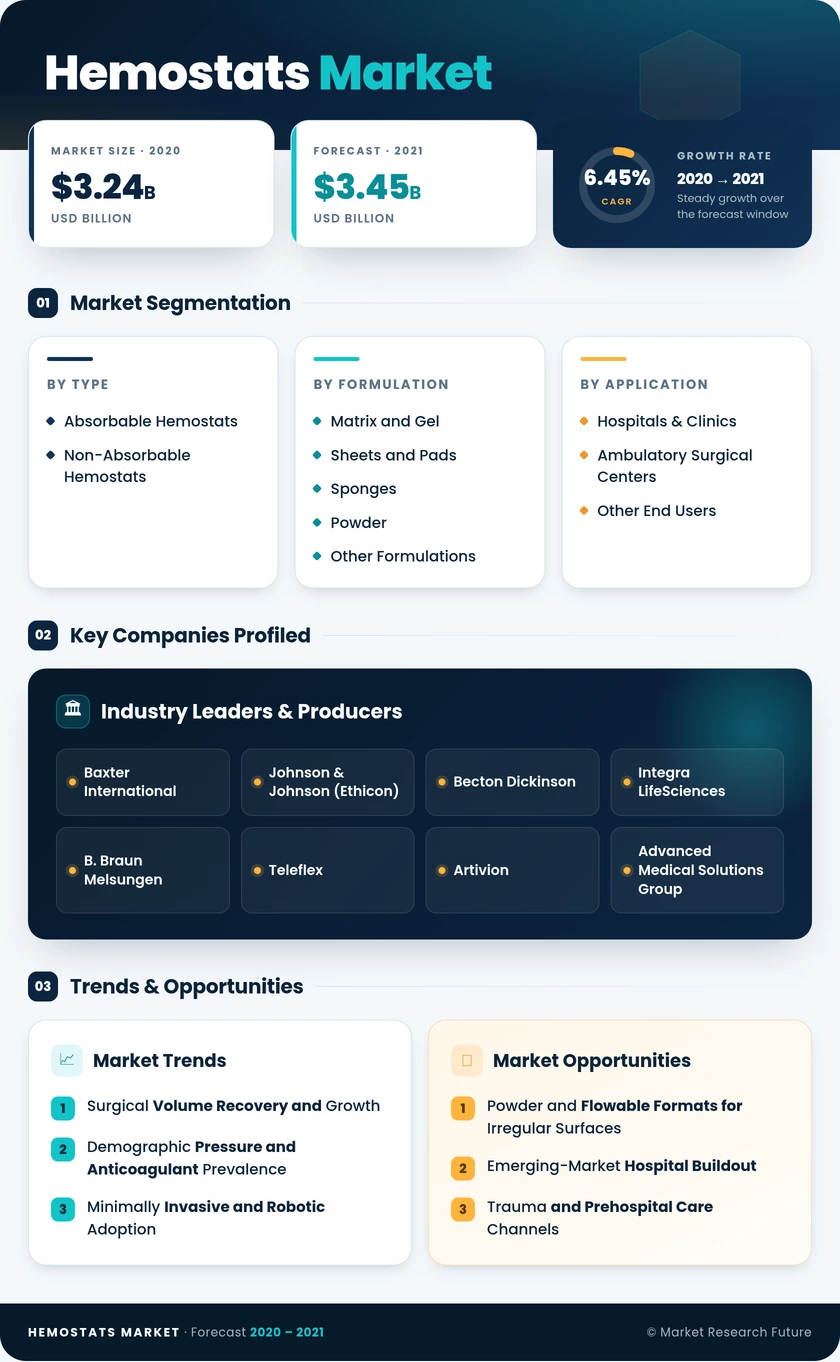
CAGR (2026-2035)6.45%
Key Players
Baxter International
Johnson & Johnson
Becton Dickinson
Integra LifeSciences
B. Braun Melsungen
Teleflex
Opportunities
  • Powder and Flowable Formats for Irregular Surfaces
  • Emerging-Market Hospital Buildout
  • Trauma and Prehospital Care Channels
  1. 1 Market Overview |
    1. 1.1 Study Assumptions & Market Definition |
    2. 1.2 Scope of the Study |
    3. 1.3 Research Methodology |
    4. 1.4 Market Summary
  2. 2 Market Summary & Key Report Takeaways |
    1. 2.1 Key Takeaways by Type |
    2. 2.2 Key Takeaways by Sector |
    3. 2.3 Key Takeaways by Geography
  3. 3 Global Market Size & Forecast (2021–2035) |
    1. 3.1 Historical Market Size (2021–2024) |
    2. 3.2 Base Year Assessment (2025) |
    3. 3.3 Current & Forecast Market Size (2026–2035) |
    4. 3.4 Year-over-Year Growth Analysis
  4. 4 Market Dynamics — Drivers |
    1. 4.1 Surgical Volume Recovery and Growth |
    2. 4.2 Demographic Pressure and Anticoagulant Prevalence |
    3. 4.3 Minimally Invasive and Robotic Adoption |
    4. 4.4 Ambulatory Surgical Center Migration |
    5. 4.5 Driver Impact Assessment Matrix
  5. 5 Market Dynamics — Restraints |
    1. 5.1 Volume-Based Procurement and Price Compression |
    2. 5.2 Regulatory Burden Under EU MDR |
    3. 5.3 Raw Material and Biologic Supply Concentration |
    4. 5.4 Restraint Impact Assessment Matrix
  6. 6 Market Opportunity Analysis |
    1. 6.1 Powder and Flowable Formats for Irregular Surfaces |
    2. 6.2 Emerging-Market Hospital Buildout |
    3. 6.3 Trauma and Prehospital Care Channels |
    4. 6.4 Outcome-Linked Contracting and Data Services |
    5. 6.5 Plant-Derived and Synthetic Substitutes |
    6. 6.6 Industry Value Chain Analysis |
    7. 6.7 Porter's Five Forces Analysis
  7. 7 Regional Market Share & Country-Level Analysis |
    1. 7.1 North America | |
      1. 7.1.1 US | |
      2. 7.1.2 Canada | |
      3. 7.1.3 Mexico |
    2. 7.2 Europe | |
      1. 7.2.1 Germany | |
      2. 7.2.2 UK | |
      3. 7.2.3 France | |
      4. 7.2.4 Italy | |
      5. 7.2.5 Spain | |
      6. 7.2.6 Nordic Countries | |
      7. 7.2.7 Russia | |
      8. 7.2.8 Rest of Europe |
    3. 7.3 Asia-Pacific | |
      1. 7.3.1 China | |
      2. 7.3.2 India | |
      3. 7.3.3 Japan | |
      4. 7.3.4 South Korea | |
      5. 7.3.5 ASEAN | |
      6. 7.3.6 Rest of Asia-Pacific |
    4. 7.4 South America | |
      1. 7.4.1 Brazil | |
      2. 7.4.2 Argentina | |
      3. 7.4.3 Rest of South America |
    5. 7.5 Middle East & Africa | |
      1. 7.5.1 Saudi Arabia | |
      2. 7.5.2 UAE | |
      3. 7.5.3 South Africa | |
      4. 7.5.4 Egypt | |
      5. 7.5.5 Rest of Middle East & Africa
  8. 8 Future Outlook (2026–2035) |
    1. 8.1 Bioengineered Materials Reach Cost Parity |
    2. 8.2 Procedural Data as a Commercial Asset |
    3. 8.3 Manufacturing Localization |
    4. 8.4 Sustainability and Waste Reduction
  9. 9 Market Segmentation Analysis |
    1. 9.1 By Type | |
      1. 9.1.1 Absorbable Hemostats | |
      2. 9.1.2 Non-Absorbable Hemostats |
    2. 9.2 By Formulation | |
      1. 9.2.1 Matrix and Gel | |
      2. 9.2.2 Sheets and Pads | |
      3. 9.2.3 Sponges | |
      4. 9.2.4 Powder | |
      5. 9.2.5 Other Formulations |
    3. 9.3 By Application | |
      1. 9.3.1 General Surgery | |
      2. 9.3.2 Cardiovascular Surgery | |
      3. 9.3.3 Orthopedic Surgery | |
      4. 9.3.4 Neurological Surgery | |
      5. 9.3.5 Gynecological & Urological Surgery | |
      6. 9.3.6 Other Applications |
    4. 9.4 By End User | |
      1. 9.4.1 Hospitals & Clinics | |
      2. 9.4.2 Ambulatory Surgical Centers | |
      3. 9.4.3 Other End Users
  10. 10 Competitive Landscape |
    1. 10.1 Market Concentration Analysis (2026) |
    2. 10.2 Competitive Benchmarking Matrix |
    3. 10.3 Company Profiles | |
      1. 10.3.1 Baxter International | |
      2. 10.3.2 Johnson & Johnson (Ethicon) | |
      3. 10.3.3 Becton Dickinson | |
      4. 10.3.4 Integra LifeSciences | |
      5. 10.3.5 B. Braun Melsungen | |
      6. 10.3.6 Teleflex | |
      7. 10.3.7 Artivion | |
      8. 10.3.8 Advanced Medical Solutions Group | |
      9. 10.3.9 Stryker | |
      10. 10.3.10 Pfizer (Hospital) | |
      11. 10.3.11 CSL Behring
  11. 11 Recent News & Developments
  12. 12 Report Scope & Methodology |
    1. 12.1 Study Period & Base Year |
    2. 12.2 Data Sources & Estimation Approach |
    3. 12.3 Abbreviations
  13. 13 Detailed Sources and Citations
  14. 14 Frequently Asked Questions
  15. 15 LIST OF TABLES
  16. 16 LIST OF FIGURES

Segmentation Quick Reference

DimensionSub-SegmentsDominant SegmentFastest Growing Segment
By TypeAbsorbable Hemostats; Non-Absorbable HemostatsAbsorbable HemostatsNon-Absorbable Hemostats
By FormulationMatrix and Gel; Sheets and Pads; Sponges; Powder; Other FormulationsMatrix and GelPowder
By ApplicationGeneral Surgery; Cardiovascular Surgery; Orthopedic Surgery; Neurological Surgery; Gynecological & Urological Surgery; Other ApplicationsGeneral SurgeryOrthopedic Surgery
By End UserHospitals & Clinics; Ambulatory Surgical Centers; Other End UsersHospitals & ClinicsAmbulatory Surgical Centers
By GeographyNorth America; Europe; Asia-Pacific; South America; Middle East & AfricaNorth AmericaAsia-Pacific


Market Segmentation Overview

By Type

Sub-SegmentKey Trend
Absorbable HemostatsShift from passive gelatin sponges toward active thrombin-loaded matrices with faster clot initiation
Non-Absorbable HemostatsExpansion beyond the operating room into prehospital, military, and civilian emergency response kits


Type remains the cleanest way to segment this category because it dictates the surgical workflow. Absorbable products dominate closed-cavity work; non-absorbable products own the external and field-care channel and are growing on the back of expanding trauma protocols.

By Formulation

Sub-SegmentKey Trend
Matrix and GelFlowable presentations engineered for laparoscopic and robotic applicator delivery
Sheets and PadsCombination products layering active agents onto conventional cellulose backings
SpongesPrice-driven commoditization and rising private-label penetration
PowderRapid uptake for diffuse parenchymal bleeding where sheets cannot conform
Other FormulationsSprayable sealants and dual-syringe systems for specialty indications


Formulation is where product differentiation now lives. Delivery engineering — applicator length, spray consistency, single-hand operation — increasingly determines formulary wins more than the underlying chemistry does.

By Application

Sub-SegmentKey Trend
General SurgeryHighest absolute volume; strong price sensitivity and multi-source tendering
Cardiovascular SurgeryPremium product mix driven by heparinization and large suture lines
Orthopedic SurgeryArthroplasty growth combined with accelerating site-of-service migration
Neurological SurgeryZero-tolerance bleeding requirements sustaining premium collagen and cellulose use
Gynecological & Urological SurgeryMinimally invasive adoption favouring flowable and powder formats
Other ApplicationsENT, dental, and dermatologic procedures adopting scaled-down presentations


Application analysis separates volume from value. General surgery supplies the case count while cardiovascular and neurological work supplies disproportionate revenue per procedure, making mix management the central commercial discipline for suppliers.

By End User

Sub-SegmentKey Trend
Hospitals & ClinicsConsolidated group purchasing driving multi-year framework pricing
Ambulatory Surgical CentersDemand for smaller pack sizes, consignment inventory, and bundled-cost transparency
Other End UsersGovernment stockpiling and EMS contracts creating lumpy but high-margin demand


End-user structure is shifting faster than any other dimension. Suppliers built around hospital tender cycles must now serve a fragmented ASC channel with different pack economics and far shorter purchasing decision timelines.




Download PDF ×

We do not share your information with anyone. However, we may send you emails based on your report interest from time to time. You may contact us at any time to opt-out.