×
Hero Background
English
Chinese
French
Japanese
Korean
German
Spanish

Heat Stabilizers Market Analysis

ID: MRFR/CnM/4671-HCR
100 Pages
Chitranshi Jaiswal
October 2025

Heat Stabilizers Market Research Report Information By Form (Liquid and Solid), By Type (Metallic Soaps, Organotin and Others), By Application (Pipes & Fittings, Profiles & Tubing, Wires & Cables, Coatings & Floorings and Others), And By Region (North America, Europe, Asia-Pacific, And Rest Of The World) –Market Forecast Till 2035

Share:
Download PDF ×

We do not share your information with anyone. However, we may send you emails based on your report interest from time to time. You may contact us at any time to opt-out.

Heat Stabilizers Market Infographic
Purchase Options

Market Analysis

In-depth Analysis of Heat Stabilizers Market Industry Landscape

The market dynamics of Heat Stabilizers are shaped by a multitude of factors that influence the demand, supply, pricing, and overall trajectory of this industry. Understanding these dynamics is crucial for stakeholders to navigate the ever-evolving landscape.

One of the fundamental driving forces in the Heat Stabilizers market is the demand generated by various industries. The construction, automotive, packaging, and electrical industries heavily rely on Heat Stabilizers for enhancing the durability and performance of their products. Consequently, any shifts or advancements within these sectors directly impact the demand for Heat Stabilizers. For instance, trends in urbanization, infrastructure development, and technological advancements in these industries influence the type and volume of stabilizers required.

Raw material availability and pricing significantly impact the Heat Stabilizers market dynamics. The primary constituents of stabilizers, including metal compounds and organic acids, are subject to market fluctuations and availability. Variations in the prices or scarcity of these raw materials directly influence the production costs, thereby affecting the final pricing of Heat Stabilizers in the market. Manufacturers closely monitor these factors to maintain profitability and competitiveness.

Government regulations and environmental policies play a pivotal role in shaping the market dynamics of Heat Stabilizers. Increased emphasis on sustainability and environmental concerns has led to stringent regulations regarding the use of certain stabilizers containing harmful components like heavy metals. This has triggered a shift towards eco-friendly alternatives, compelling manufacturers to invest in research and development for compliant and environmentally safe products. Compliance with these regulations not only impacts the manufacturing processes but also influences consumer preferences, driving the market towards greener solutions.

Technological advancements drive innovation and competitiveness within the Heat Stabilizers market. Companies continuously invest in research and development to develop advanced stabilizers that offer improved performance, better heat resistance, and reduced environmental impact. Innovations in manufacturing processes and formulations contribute to cost-efficiency, quality enhancement, and the development of new products, thereby shaping the market landscape.

The global economic conditions and market trends have a substantial impact on the Heat Stabilizers industry. Economic fluctuations, trade policies, and geopolitical tensions affect market growth, investment decisions, and consumer behavior. Additionally, emerging markets with increasing industrialization and infrastructural development contribute to the expansion of the Heat Stabilizers market.

The competitive landscape significantly influences market dynamics in the Heat Stabilizers sector. Intense competition among key players drives innovation, pricing strategies, and market expansion efforts. Companies engage in mergers, acquisitions, or strategic partnerships to consolidate market share, access new technologies, or broaden their product portfolios, thereby influencing market dynamics.

Consumer preferences and awareness are pivotal in shaping the Heat Stabilizers market. Growing awareness of environmental issues has led to a shift in consumer preferences towards sustainable and eco-friendly products. This shift in demand has propelled manufacturers to focus on developing and promoting greener alternatives, influencing the market dynamics and product offerings.

Author
Chitranshi Jaiswal
Research Analyst Level I

In her 3 years of experience in the market research field, she has handled critical cross-domain projects. She has an in-depth knowledge of market estimation & analysis, problem-solving, primary as well as secondary research, and team management.She holds an engineering degree and is an MBA professional from a well-known university, capable of evaluating the market and competitive conditions. An exceptional strategist with excellent communication skills and a passion for delivering cutting-edge & practical insights for the market. Proficient in multi-tasking, and can successfully deal with competing demands, while maintaining complete confidentiality. Generated business through active client and project development, networking, and high-quality responses. Her knowledge and skills have helped in making solid business decisions, securing funding from investors, and avoiding business failures.

Leave a Comment

FAQs

What is the projected market valuation of the Heat Stabilizers Market by 2035?

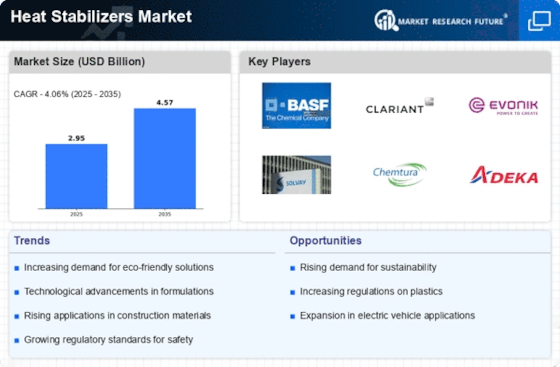
The projected market valuation of the Heat Stabilizers Market is 4.571 USD Billion by 2035.

What was the market valuation of the Heat Stabilizers Market in 2024?

The market valuation of the Heat Stabilizers Market was 2.95 USD Billion in 2024.

What is the expected CAGR for the Heat Stabilizers Market during the forecast period 2025 - 2035?

The expected CAGR for the Heat Stabilizers Market during the forecast period 2025 - 2035 is 4.06%.

Which companies are considered key players in the Heat Stabilizers Market?

Key players in the Heat Stabilizers Market include BASF SE, Clariant AG, Evonik Industries AG, Solvay SA, Chemtura Corporation, Adeka Corporation, Kraton Corporation, and Songwon Industrial Co., Ltd.

What are the projected valuations for liquid and solid heat stabilizers by 2035?

By 2035, the projected valuation for liquid heat stabilizers is 2.73 USD Billion, while solid heat stabilizers is 1.84 USD Billion.

How do metallic soaps and organotin compare in terms of market valuation by 2035?

By 2035, metallic soaps are projected to reach 1.35 USD Billion, whereas organotin is expected to reach 1.65 USD Billion.

Market Summary

As per MRFR analysis, the Heat Stabilizers Market Size was estimated at 2.95 USD Billion in 2024. The Heat Stabilizers industry is projected to grow from 3.07 in 2025 to 4.571 by 2035, exhibiting a compound annual growth rate (CAGR) of 4.06 during the forecast period 2025 - 2035.

Key Market Trends & Highlights

The Heat Stabilizers Market is poised for growth driven by sustainability and technological advancements.

  • The North American region remains the largest market for heat stabilizers, reflecting a strong demand across various industries.
  • Asia-Pacific is emerging as the fastest-growing region, fueled by increasing industrialization and urbanization.
  • Liquid heat stabilizers dominate the market, while solid heat stabilizers are witnessing rapid growth due to evolving applications.
  • Sustainability initiatives and rising demand from the automotive sector are key drivers propelling market expansion.

Market Size & Forecast

2024 Market Size 2.95 (USD Billion)
2035 Market Size 4.571 (USD Billion)
CAGR (2025 - 2035) 4.06%
Largest Regional Market Share in 2024 North America

Major Players

<p>BASF SE (DE), Clariant AG (CH), Evonik Industries AG (DE), Solvay SA (BE), Chemtura Corporation (US), Adeka Corporation (JP), Kraton Corporation (US), Songwon Industrial Co., Ltd. (KR)</p>

Market Trends

The Heat Stabilizers Market is currently experiencing a dynamic evolution, driven by the increasing demand for high-performance materials across various industries. This market encompasses a range of additives that enhance the thermal stability of polymers, particularly in applications such as construction, automotive, and electrical sectors. As environmental regulations become more stringent, manufacturers are compelled to innovate and develop sustainable solutions that not only meet performance standards but also align with eco-friendly practices. The shift towards greener alternatives is likely to shape the future landscape of this market, as stakeholders seek to balance functionality with environmental responsibility. Moreover, the ongoing advancements in polymer technology are expected to further propel the Heat Stabilizers Market. Innovations in formulations and processing techniques may lead to enhanced product performance, thereby expanding the application scope of heat stabilizers. The growing awareness regarding the benefits of using these additives in improving the longevity and durability of materials is also contributing to market growth. As industries continue to evolve, the Heat Stabilizers Market appears poised for substantial growth, driven by both technological advancements and a commitment to sustainability.

Sustainability Focus

The Heat Stabilizers Market is witnessing a notable shift towards sustainable practices. Manufacturers are increasingly prioritizing eco-friendly formulations that minimize environmental impact. This trend is driven by regulatory pressures and consumer demand for greener products, prompting companies to innovate in their offerings.

Technological Advancements

Ongoing advancements in polymer technology are significantly influencing the Heat Stabilizers Market. Innovations in formulations and processing methods are enhancing the performance of heat stabilizers, allowing for broader applications across various industries. This trend suggests a continuous evolution in product capabilities.

Rising Demand in Emerging Markets

Emerging markets are exhibiting a growing demand for heat stabilizers, driven by rapid industrialization and urbanization. As these regions develop, the need for durable and high-performance materials is increasing, which could lead to expanded opportunities for heat stabilizer manufacturers.

Heat Stabilizers Market Market Drivers

Technological Innovations

Technological advancements play a pivotal role in shaping the Heat Stabilizers Market. Innovations in polymer chemistry and material science have led to the development of more efficient and effective heat stabilizers. These advancements not only enhance the performance of heat stabilizers but also improve their compatibility with various polymers. For instance, the introduction of nanotechnology in stabilizer formulations has shown promising results in enhancing thermal stability and prolonging the lifespan of products. The market is witnessing a surge in demand for high-performance stabilizers, which are expected to capture a significant share, potentially exceeding 30% of the total market by 2026. This trend underscores the importance of continuous innovation in maintaining competitive advantage.

Sustainability Initiatives

The increasing emphasis on sustainability within the Heat Stabilizers Market is driving demand for eco-friendly products. Manufacturers are now focusing on developing heat stabilizers that are less harmful to the environment, aligning with global regulations and consumer preferences. This shift is evident as companies invest in research and development to create bio-based and recyclable stabilizers. The market for sustainable heat stabilizers is projected to grow at a compound annual growth rate of approximately 6% over the next five years, indicating a robust trend towards environmentally responsible solutions. As industries seek to reduce their carbon footprint, the adoption of sustainable heat stabilizers is likely to become a key differentiator in the market.

Growth in Construction Activities

The construction industry is experiencing a resurgence, which is positively impacting the Heat Stabilizers Market. As new building projects emerge, the demand for materials that can withstand extreme temperatures is increasing. Heat stabilizers are crucial in ensuring the performance and longevity of construction materials, particularly in regions with harsh climates. The construction sector is expected to contribute significantly to the heat stabilizers market, with projections indicating a growth rate of around 5% annually over the next few years. This growth is driven by the need for durable and reliable materials that can meet the demands of modern architecture and infrastructure. Consequently, the heat stabilizers market is likely to see a substantial uptick in demand from this sector.

Regulatory Compliance and Standards

Regulatory compliance is becoming increasingly stringent across various industries, which is influencing the Heat Stabilizers Market. Governments are implementing stricter regulations regarding the use of additives in plastics and other materials, necessitating the adoption of compliant heat stabilizers. This trend is particularly evident in the packaging and consumer goods sectors, where safety and environmental standards are paramount. Companies are compelled to invest in heat stabilizers that not only meet regulatory requirements but also enhance product performance. The market for compliant heat stabilizers is anticipated to grow, with estimates suggesting a potential increase of 7% in demand as industries adapt to these evolving regulations. This shift underscores the critical role of regulatory compliance in shaping market dynamics.

Rising Demand from Automotive Sector

The automotive sector is a major driver of growth in the Heat Stabilizers Market. As manufacturers strive to meet stringent safety and performance standards, the demand for high-quality heat stabilizers has surged. These stabilizers are essential in ensuring the durability and longevity of automotive components, particularly in high-temperature environments. The automotive industry is projected to account for over 25% of the total heat stabilizers market by 2026, reflecting a significant increase in the use of advanced materials. Furthermore, the shift towards electric vehicles is likely to further boost demand, as these vehicles require specialized heat stabilizers to manage thermal stability effectively. This trend indicates a robust future for heat stabilizers in the automotive sector.

Market Segment Insights

Heat Stabilizers Market Form Insights

The heat stabilizers market segmentation, based on form includes Liquid and Solid. The liquid segment dominated the market owing to its versatility and ease of use. Liquid heat stabilizers are principally used in the production of polyvinyl chloride (PVC) products, which are widely used in a variety of industries, including construction, automotive, and packaging. For PVC products, liquid heat stabilizers enhance processing, increase product longevity, and provide exceptional heat stability. Incorporating Heat Stabilizers Market into the production process is also made simpler by their liquid form, which boosts productivity and cuts costs.

Figure 1: Heat Stabilizers Market, by Form, 2022 & 2032 (USD Billion)

Source: Secondary Research, Primary Research, Market Research Future Database and Analyst Review

Heat Stabilizers Market Type Insights

The heat stabilizers market segmentation, based on type, includes Metallic Soaps, Organotin and Others. The metallic soaps category generated the most income. Metal soaps have enhanced functional and aesthetic properties, which is causing the market to expand. The primary uses of these soaps are in siding, coating, cables, and flooring, and window profiles. Specifically comprised of metal and salts, metal soaps are a specific kind of solid waste. Additionally called liquid mixed metals or metal soap with calcium.

Metal soaps are employed in heat stabilizers because of their capacity to reduce the temperature of hot water by collecting heat from the environment, making them appropriate for usage in solar thermal systems, geysers, and swimming pools.

Heat Stabilizers Market Application Insights

The heat stabilizers market segmentation, based on application includes Pipes & Fittings, profiles & tubing, Wires & Cables, Coatings & Floorings and Others. The pipes & fittings segment dominated the market. Heat stabilizers are regularly used in the production of PVC pipes and fittings, which are widely used in a range of applications such as irrigation, sewage, drainage systems, and water supply. Heat Stabilizers Market increase the thermal stability of PVC pipes and fittings, increase the product's lifespan, and increase its resistance to chemicals and UV rays.

The Pipes & Fittings segment is estimated to grow over the course of the projected period as a result of increasing building activity and rising PVC pipe and fitting demand in emerging regions.

Get more detailed insights about Heat Stabilizers Market Research Report - Global Forecast Till 2035

Regional Insights

North America : Innovation and Demand Surge

North America is witnessing significant growth in the heat stabilizers market, driven by increasing demand from the automotive and construction sectors. The region holds approximately 40% of the global market share, making it the largest market for heat stabilizers. Regulatory support for sustainable materials and innovations in polymer technology are further propelling market expansion. The United States and Canada are the leading countries in this region, with major players like BASF SE and Chemtura Corporation establishing a strong foothold. The competitive landscape is characterized by continuous innovation and strategic partnerships among key players, ensuring a robust supply chain and product availability.

Europe : Regulatory Framework and Growth

Europe is the second-largest market for heat stabilizers, accounting for approximately 30% of the global share. The region's growth is fueled by stringent regulations aimed at reducing environmental impact and promoting the use of sustainable materials. The European Union's REACH regulations are pivotal in shaping market dynamics, encouraging manufacturers to innovate and comply with safety standards. Germany, France, and the UK are the leading countries in this market, with companies like Clariant AG and Evonik Industries AG playing a crucial role. The competitive landscape is marked by a focus on research and development, with firms investing heavily in eco-friendly solutions to meet regulatory demands and consumer preferences.

Asia-Pacific : Emerging Markets and Opportunities

Asia-Pacific is emerging as a powerhouse in the heat stabilizers market, driven by rapid industrialization and urbanization. The region holds about 25% of the global market share, with countries like China and India leading the charge. The increasing demand for heat stabilizers in the automotive and electronics sectors is a key growth driver, supported by favorable government policies promoting manufacturing. China is the largest market in this region, with significant contributions from local players like Adeka Corporation and Songwon Industrial Co., Ltd. The competitive landscape is evolving, with both multinational corporations and local firms vying for market share, leading to innovations and competitive pricing strategies.

Middle East and Africa : Resource-Rich and Growing Demand

The Middle East and Africa region is witnessing gradual growth in the heat stabilizers market, holding around 5% of the global share. The growth is primarily driven by increasing investments in infrastructure and construction projects, particularly in the Gulf Cooperation Council (GCC) countries. Regulatory frameworks are also evolving to support sustainable practices, which is expected to boost market demand. Countries like South Africa and the UAE are at the forefront of this market, with a growing presence of international players. The competitive landscape is characterized by a mix of local and global companies, focusing on expanding their product offerings to cater to the unique needs of the region's industries.

Key Players and Competitive Insights

Leading market players are investing heavily in research and development in order to expand their product lines, which will help the heat stabilizers market, grow even more. Market participants are also undertaking a variety of strategic activities to expand their footprint, with important market developments including new product launches, contractual agreements, mergers and acquisitions, higher investments, and collaboration with other organizations. To expand and survive in a more competitive and rising market climate, heat stabilizers industry must offer cost-effective items.

Manufacturing locally to minimize operational costs is one of the key business tactics used by manufacturers in the heat stabilizers industry to benefit clients and increase the market sector. In recent years, the heat stabilizers industry has offered some of the most significant advantages to market.

Major players in the heat stabilizers market attempting to increase market demand by investing in research and development operations include Kisuma Chemicals (Netherlands), GOLDSTAB ORGANICS PVT LTD (India), Galata Chemicals (US), MODERN CHEMICALS AND PLASTICS (India), ADEKA CORPORATION (Japan), Baerlocher GmbH (Germany), Amfine Chemical Corporation (US), Chemson Polymer-Additive AG (Austria), Clariant (Switzerland), BASF SE (Germany), BRUNO BOCK (Germany), and REAGENS SPA (Italy).

Manufacturer and distributor of chemical and culinary goods is Adeka Corp (ADEKA). Its line of chemical products includes polyolefin, polyvinyl chloride (PVC) plasticizers/stabilizers, adhesives, sealing materials, emulsions, and painting materials, propylene glycol, antioxidants, water-borne resins, flame retardants, epoxy resins, surfactants, and others. Under the brand name RISU, it sells food items such margarines, shortenings, oils, and fats for chocolate. Adeka also offers management, construction, and civil engineering services through its subsidiaries. In the Japanese cities of Nagoya, Sapporo, Sendai, Fukuoka, and Osaka, it runs sales offices, production facilities, and R&D facilities.

Providing specialized chemicals, Clariant International Ltd. is a division of Clariant AG. It creates, produces, distributes, and sells a wide variety of specialized chemicals utilised in clients' manufacturing and treatment processes. The company's product line consists of emulsions, petrochemical catalysts, agricultural wastes, automotive fluids, surfactants, mining chemicals, and additives. Products from the business are used in the industrial, paints and coatings, crop protection, personal care, automotive, plastic, transportation, refining, and pharmaceutical industries.

Key Companies in the Heat Stabilizers Market market include

Industry Developments

January 2021: The price of plastic additives such lubricants, pigments, UV stabilizers, heat stabilizers for PVC, heat stabilizers, processing aids, antioxidants, and processing aids will increase by up to 10% starting immediately, according to a BASF announcement. The business blamed rising transportation and raw material prices, similar to other suppliers of plastic additives. A division of BASF Performance Chemicals, BASF Plastic Additives is a business. The portfolio offers services to clients in consumer goods, energy and resources, chemicals, plastics, automotive and transportation, as well as petrol and lubricant solutions, kaolin materials, oilfield and mining solutions.

August 2020: It was revealed that LyondellBasell Industries Holdings B.V. had created a brand-new heat stabiliser named Purell KR. The product is made to be used in applications involving polyethylene (PE) and polypropylene (PP), and it is claimed to have greater thermal stability, making it perfect for usage in the construction and automotive industries.

June 2020: Licocene HST, a new line of heat stabilisers, was introduced by Clariant International Ltd. For applications based on polyolefins, the product is intended to offer excellent heat stability and UV protection.

Future Outlook

Heat Stabilizers Market Future Outlook

<p>The Heat Stabilizers Market is projected to grow at a 4.06% CAGR from 2024 to 2035, driven by increasing demand in construction and automotive sectors.</p>

New opportunities lie in:

  • <p>Development of bio-based heat stabilizers for eco-friendly applications.</p>
  • <p>Expansion into emerging markets with tailored product offerings.</p>
  • <p>Investment in advanced manufacturing technologies to enhance production efficiency.</p>

<p>By 2035, the Heat Stabilizers Market is expected to achieve robust growth, reflecting evolving industry needs.</p>

Market Segmentation

Heat Stabilizers Market Form Outlook

  • Liquid
  • Solid

Heat Stabilizers Market Type Outlook

  • Metallic Soaps
  • Organotin
  • Others

Heat Stabilizers Market Application Outlook

  • Pipes & Fittings
  • Profiles & Tubing
  • Wires & Cables
  • Coatings & Floorings
  • Others

Report Scope

MARKET SIZE 20242.95(USD Billion)
MARKET SIZE 20253.07(USD Billion)
MARKET SIZE 20354.571(USD Billion)
COMPOUND ANNUAL GROWTH RATE (CAGR)4.06% (2024 - 2035)
REPORT COVERAGERevenue Forecast, Competitive Landscape, Growth Factors, and Trends
BASE YEAR2024
Market Forecast Period2025 - 2035
Historical Data2019 - 2024
Market Forecast UnitsUSD Billion
Key Companies ProfiledMarket analysis in progress
Segments CoveredMarket segmentation analysis in progress
Key Market OpportunitiesGrowing demand for eco-friendly heat stabilizers in sustainable construction and automotive applications.
Key Market DynamicsRising demand for eco-friendly heat stabilizers drives innovation and regulatory compliance in the plastics industry.
Countries CoveredNorth America, Europe, APAC, South America, MEA

FAQs

What is the projected market valuation of the Heat Stabilizers Market by 2035?

The projected market valuation of the Heat Stabilizers Market is 4.571 USD Billion by 2035.

What was the market valuation of the Heat Stabilizers Market in 2024?

The market valuation of the Heat Stabilizers Market was 2.95 USD Billion in 2024.

What is the expected CAGR for the Heat Stabilizers Market during the forecast period 2025 - 2035?

The expected CAGR for the Heat Stabilizers Market during the forecast period 2025 - 2035 is 4.06%.

Which companies are considered key players in the Heat Stabilizers Market?

Key players in the Heat Stabilizers Market include BASF SE, Clariant AG, Evonik Industries AG, Solvay SA, Chemtura Corporation, Adeka Corporation, Kraton Corporation, and Songwon Industrial Co., Ltd.

What are the projected valuations for liquid and solid heat stabilizers by 2035?

By 2035, the projected valuation for liquid heat stabilizers is 2.73 USD Billion, while solid heat stabilizers is 1.84 USD Billion.

How do metallic soaps and organotin compare in terms of market valuation by 2035?

By 2035, metallic soaps are projected to reach 1.35 USD Billion, whereas organotin is expected to reach 1.65 USD Billion.

  1. SECTION I: EXECUTIVE SUMMARY AND KEY HIGHLIGHTS
    1. EXECUTIVE SUMMARY
      1. Market Overview
      2. Key Findings
      3. Market Segmentation
      4. Competitive Landscape
      5. Challenges and Opportunities
      6. Future Outlook
  2. SECTION II: SCOPING, METHODOLOGY AND MARKET STRUCTURE
    1. MARKET INTRODUCTION
      1. Definition
      2. Scope of the study
    2. RESEARCH METHODOLOGY
      1. Overview
      2. Data Mining
      3. Secondary Research
      4. Primary Research
      5. Forecasting Model
      6. Market Size Estimation
      7. Data Triangulation
      8. Validation
  3. SECTION III: QUALITATIVE ANALYSIS
    1. MARKET DYNAMICS
      1. Overview
      2. Drivers
      3. Restraints
      4. Opportunities
    2. MARKET FACTOR ANALYSIS
      1. Value chain Analysis
      2. Porter's Five Forces Analysis
      3. COVID-19 Impact Analysis
  4. SECTION IV: QUANTITATIVE ANALYSIS
    1. Chemicals and Materials, BY Form (USD Billion)
      1. Liquid
      2. Solid
    2. Chemicals and Materials, BY Type (USD Billion)
      1. Metallic Soaps
      2. Organotin
      3. Others
    3. Chemicals and Materials, BY Application (USD Billion)
      1. Pipes & Fittings
      2. Profiles & Tubing
      3. Wires & Cables
      4. Coatings & Floorings
      5. Others
    4. Chemicals and Materials, BY Region (USD Billion)
      1. North America
      2. Europe
      3. APAC
      4. South America
      5. MEA
  5. SECTION V: COMPETITIVE ANALYSIS
    1. Competitive Landscape
      1. Overview
      2. Competitive Analysis
      3. Market share Analysis
      4. Major Growth Strategy in the Chemicals and Materials
      5. Competitive Benchmarking
      6. Leading Players in Terms of Number of Developments in the Chemicals and Materials
      7. Key developments and growth strategies
      8. Major Players Financial Matrix
    2. Company Profiles
      1. BASF SE (DE)
      2. Clariant AG (CH)
      3. Evonik Industries AG (DE)
      4. Solvay SA (BE)
      5. Chemtura Corporation (US)
      6. Adeka Corporation (JP)
      7. Kraton Corporation (US)
      8. Songwon Industrial Co., Ltd. (KR)
    3. Appendix
      1. References
      2. Related Reports
  6. LIST OF FIGURES
    1. MARKET SYNOPSIS
    2. NORTH AMERICA MARKET ANALYSIS
    3. US MARKET ANALYSIS BY FORM
    4. US MARKET ANALYSIS BY TYPE
    5. US MARKET ANALYSIS BY APPLICATION
    6. CANADA MARKET ANALYSIS BY FORM
    7. CANADA MARKET ANALYSIS BY TYPE
    8. CANADA MARKET ANALYSIS BY APPLICATION
    9. EUROPE MARKET ANALYSIS
    10. GERMANY MARKET ANALYSIS BY FORM
    11. GERMANY MARKET ANALYSIS BY TYPE
    12. GERMANY MARKET ANALYSIS BY APPLICATION
    13. UK MARKET ANALYSIS BY FORM
    14. UK MARKET ANALYSIS BY TYPE
    15. UK MARKET ANALYSIS BY APPLICATION
    16. FRANCE MARKET ANALYSIS BY FORM
    17. FRANCE MARKET ANALYSIS BY TYPE
    18. FRANCE MARKET ANALYSIS BY APPLICATION
    19. RUSSIA MARKET ANALYSIS BY FORM
    20. RUSSIA MARKET ANALYSIS BY TYPE
    21. RUSSIA MARKET ANALYSIS BY APPLICATION
    22. ITALY MARKET ANALYSIS BY FORM
    23. ITALY MARKET ANALYSIS BY TYPE
    24. ITALY MARKET ANALYSIS BY APPLICATION
    25. SPAIN MARKET ANALYSIS BY FORM
    26. SPAIN MARKET ANALYSIS BY TYPE
    27. SPAIN MARKET ANALYSIS BY APPLICATION
    28. REST OF EUROPE MARKET ANALYSIS BY FORM
    29. REST OF EUROPE MARKET ANALYSIS BY TYPE
    30. REST OF EUROPE MARKET ANALYSIS BY APPLICATION
    31. APAC MARKET ANALYSIS
    32. CHINA MARKET ANALYSIS BY FORM
    33. CHINA MARKET ANALYSIS BY TYPE
    34. CHINA MARKET ANALYSIS BY APPLICATION
    35. INDIA MARKET ANALYSIS BY FORM
    36. INDIA MARKET ANALYSIS BY TYPE
    37. INDIA MARKET ANALYSIS BY APPLICATION
    38. JAPAN MARKET ANALYSIS BY FORM
    39. JAPAN MARKET ANALYSIS BY TYPE
    40. JAPAN MARKET ANALYSIS BY APPLICATION
    41. SOUTH KOREA MARKET ANALYSIS BY FORM
    42. SOUTH KOREA MARKET ANALYSIS BY TYPE
    43. SOUTH KOREA MARKET ANALYSIS BY APPLICATION
    44. MALAYSIA MARKET ANALYSIS BY FORM
    45. MALAYSIA MARKET ANALYSIS BY TYPE
    46. MALAYSIA MARKET ANALYSIS BY APPLICATION
    47. THAILAND MARKET ANALYSIS BY FORM
    48. THAILAND MARKET ANALYSIS BY TYPE
    49. THAILAND MARKET ANALYSIS BY APPLICATION
    50. INDONESIA MARKET ANALYSIS BY FORM
    51. INDONESIA MARKET ANALYSIS BY TYPE
    52. INDONESIA MARKET ANALYSIS BY APPLICATION
    53. REST OF APAC MARKET ANALYSIS BY FORM
    54. REST OF APAC MARKET ANALYSIS BY TYPE
    55. REST OF APAC MARKET ANALYSIS BY APPLICATION
    56. SOUTH AMERICA MARKET ANALYSIS
    57. BRAZIL MARKET ANALYSIS BY FORM
    58. BRAZIL MARKET ANALYSIS BY TYPE
    59. BRAZIL MARKET ANALYSIS BY APPLICATION
    60. MEXICO MARKET ANALYSIS BY FORM
    61. MEXICO MARKET ANALYSIS BY TYPE
    62. MEXICO MARKET ANALYSIS BY APPLICATION
    63. ARGENTINA MARKET ANALYSIS BY FORM
    64. ARGENTINA MARKET ANALYSIS BY TYPE
    65. ARGENTINA MARKET ANALYSIS BY APPLICATION
    66. REST OF SOUTH AMERICA MARKET ANALYSIS BY FORM
    67. REST OF SOUTH AMERICA MARKET ANALYSIS BY TYPE
    68. REST OF SOUTH AMERICA MARKET ANALYSIS BY APPLICATION
    69. MEA MARKET ANALYSIS
    70. GCC COUNTRIES MARKET ANALYSIS BY FORM
    71. GCC COUNTRIES MARKET ANALYSIS BY TYPE
    72. GCC COUNTRIES MARKET ANALYSIS BY APPLICATION
    73. SOUTH AFRICA MARKET ANALYSIS BY FORM
    74. SOUTH AFRICA MARKET ANALYSIS BY TYPE
    75. SOUTH AFRICA MARKET ANALYSIS BY APPLICATION
    76. REST OF MEA MARKET ANALYSIS BY FORM
    77. REST OF MEA MARKET ANALYSIS BY TYPE
    78. REST OF MEA MARKET ANALYSIS BY APPLICATION
    79. KEY BUYING CRITERIA OF CHEMICALS AND MATERIALS
    80. RESEARCH PROCESS OF MRFR
    81. DRO ANALYSIS OF CHEMICALS AND MATERIALS
    82. DRIVERS IMPACT ANALYSIS: CHEMICALS AND MATERIALS
    83. RESTRAINTS IMPACT ANALYSIS: CHEMICALS AND MATERIALS
    84. SUPPLY / VALUE CHAIN: CHEMICALS AND MATERIALS
    85. CHEMICALS AND MATERIALS, BY FORM, 2024 (% SHARE)
    86. CHEMICALS AND MATERIALS, BY FORM, 2024 TO 2035 (USD Billion)
    87. CHEMICALS AND MATERIALS, BY TYPE, 2024 (% SHARE)
    88. CHEMICALS AND MATERIALS, BY TYPE, 2024 TO 2035 (USD Billion)
    89. CHEMICALS AND MATERIALS, BY APPLICATION, 2024 (% SHARE)
    90. CHEMICALS AND MATERIALS, BY APPLICATION, 2024 TO 2035 (USD Billion)
    91. BENCHMARKING OF MAJOR COMPETITORS
  7. LIST OF TABLES
    1. LIST OF ASSUMPTIONS
    2. North America MARKET SIZE ESTIMATES; FORECAST
      1. BY FORM, 2025-2035 (USD Billion)
      2. BY TYPE, 2025-2035 (USD Billion)
      3. BY APPLICATION, 2025-2035 (USD Billion)
    3. US MARKET SIZE ESTIMATES; FORECAST
      1. BY FORM, 2025-2035 (USD Billion)
      2. BY TYPE, 2025-2035 (USD Billion)
      3. BY APPLICATION, 2025-2035 (USD Billion)
    4. Canada MARKET SIZE ESTIMATES; FORECAST
      1. BY FORM, 2025-2035 (USD Billion)
      2. BY TYPE, 2025-2035 (USD Billion)
      3. BY APPLICATION, 2025-2035 (USD Billion)
    5. Europe MARKET SIZE ESTIMATES; FORECAST
      1. BY FORM, 2025-2035 (USD Billion)
      2. BY TYPE, 2025-2035 (USD Billion)
      3. BY APPLICATION, 2025-2035 (USD Billion)
    6. Germany MARKET SIZE ESTIMATES; FORECAST
      1. BY FORM, 2025-2035 (USD Billion)
      2. BY TYPE, 2025-2035 (USD Billion)
      3. BY APPLICATION, 2025-2035 (USD Billion)
    7. UK MARKET SIZE ESTIMATES; FORECAST
      1. BY FORM, 2025-2035 (USD Billion)
      2. BY TYPE, 2025-2035 (USD Billion)
      3. BY APPLICATION, 2025-2035 (USD Billion)
    8. France MARKET SIZE ESTIMATES; FORECAST
      1. BY FORM, 2025-2035 (USD Billion)
      2. BY TYPE, 2025-2035 (USD Billion)
      3. BY APPLICATION, 2025-2035 (USD Billion)
    9. Russia MARKET SIZE ESTIMATES; FORECAST
      1. BY FORM, 2025-2035 (USD Billion)
      2. BY TYPE, 2025-2035 (USD Billion)
      3. BY APPLICATION, 2025-2035 (USD Billion)
    10. Italy MARKET SIZE ESTIMATES; FORECAST
      1. BY FORM, 2025-2035 (USD Billion)
      2. BY TYPE, 2025-2035 (USD Billion)
      3. BY APPLICATION, 2025-2035 (USD Billion)
    11. Spain MARKET SIZE ESTIMATES; FORECAST
      1. BY FORM, 2025-2035 (USD Billion)
      2. BY TYPE, 2025-2035 (USD Billion)
      3. BY APPLICATION, 2025-2035 (USD Billion)
    12. Rest of Europe MARKET SIZE ESTIMATES; FORECAST
      1. BY FORM, 2025-2035 (USD Billion)
      2. BY TYPE, 2025-2035 (USD Billion)
      3. BY APPLICATION, 2025-2035 (USD Billion)
    13. APAC MARKET SIZE ESTIMATES; FORECAST
      1. BY FORM, 2025-2035 (USD Billion)
      2. BY TYPE, 2025-2035 (USD Billion)
      3. BY APPLICATION, 2025-2035 (USD Billion)
    14. China MARKET SIZE ESTIMATES; FORECAST
      1. BY FORM, 2025-2035 (USD Billion)
      2. BY TYPE, 2025-2035 (USD Billion)
      3. BY APPLICATION, 2025-2035 (USD Billion)
    15. India MARKET SIZE ESTIMATES; FORECAST
      1. BY FORM, 2025-2035 (USD Billion)
      2. BY TYPE, 2025-2035 (USD Billion)
      3. BY APPLICATION, 2025-2035 (USD Billion)
    16. Japan MARKET SIZE ESTIMATES; FORECAST
      1. BY FORM, 2025-2035 (USD Billion)
      2. BY TYPE, 2025-2035 (USD Billion)
      3. BY APPLICATION, 2025-2035 (USD Billion)
    17. South Korea MARKET SIZE ESTIMATES; FORECAST
      1. BY FORM, 2025-2035 (USD Billion)
      2. BY TYPE, 2025-2035 (USD Billion)
      3. BY APPLICATION, 2025-2035 (USD Billion)
    18. Malaysia MARKET SIZE ESTIMATES; FORECAST
      1. BY FORM, 2025-2035 (USD Billion)
      2. BY TYPE, 2025-2035 (USD Billion)
      3. BY APPLICATION, 2025-2035 (USD Billion)
    19. Thailand MARKET SIZE ESTIMATES; FORECAST
      1. BY FORM, 2025-2035 (USD Billion)
      2. BY TYPE, 2025-2035 (USD Billion)
      3. BY APPLICATION, 2025-2035 (USD Billion)
    20. Indonesia MARKET SIZE ESTIMATES; FORECAST
      1. BY FORM, 2025-2035 (USD Billion)
      2. BY TYPE, 2025-2035 (USD Billion)
      3. BY APPLICATION, 2025-2035 (USD Billion)
    21. Rest of APAC MARKET SIZE ESTIMATES; FORECAST
      1. BY FORM, 2025-2035 (USD Billion)
      2. BY TYPE, 2025-2035 (USD Billion)
      3. BY APPLICATION, 2025-2035 (USD Billion)
    22. South America MARKET SIZE ESTIMATES; FORECAST
      1. BY FORM, 2025-2035 (USD Billion)
      2. BY TYPE, 2025-2035 (USD Billion)
      3. BY APPLICATION, 2025-2035 (USD Billion)
    23. Brazil MARKET SIZE ESTIMATES; FORECAST
      1. BY FORM, 2025-2035 (USD Billion)
      2. BY TYPE, 2025-2035 (USD Billion)
      3. BY APPLICATION, 2025-2035 (USD Billion)
    24. Mexico MARKET SIZE ESTIMATES; FORECAST
      1. BY FORM, 2025-2035 (USD Billion)
      2. BY TYPE, 2025-2035 (USD Billion)
      3. BY APPLICATION, 2025-2035 (USD Billion)
    25. Argentina MARKET SIZE ESTIMATES; FORECAST
      1. BY FORM, 2025-2035 (USD Billion)
      2. BY TYPE, 2025-2035 (USD Billion)
      3. BY APPLICATION, 2025-2035 (USD Billion)
    26. Rest of South America MARKET SIZE ESTIMATES; FORECAST
      1. BY FORM, 2025-2035 (USD Billion)
      2. BY TYPE, 2025-2035 (USD Billion)
      3. BY APPLICATION, 2025-2035 (USD Billion)
    27. MEA MARKET SIZE ESTIMATES; FORECAST
      1. BY FORM, 2025-2035 (USD Billion)
      2. BY TYPE, 2025-2035 (USD Billion)
      3. BY APPLICATION, 2025-2035 (USD Billion)
    28. GCC Countries MARKET SIZE ESTIMATES; FORECAST
      1. BY FORM, 2025-2035 (USD Billion)
      2. BY TYPE, 2025-2035 (USD Billion)
      3. BY APPLICATION, 2025-2035 (USD Billion)
    29. South Africa MARKET SIZE ESTIMATES; FORECAST
      1. BY FORM, 2025-2035 (USD Billion)
      2. BY TYPE, 2025-2035 (USD Billion)
      3. BY APPLICATION, 2025-2035 (USD Billion)
    30. Rest of MEA MARKET SIZE ESTIMATES; FORECAST
      1. BY FORM, 2025-2035 (USD Billion)
      2. BY TYPE, 2025-2035 (USD Billion)
      3. BY APPLICATION, 2025-2035 (USD Billion)
    31. PRODUCT LAUNCH/PRODUCT DEVELOPMENT/APPROVAL
    32. ACQUISITION/PARTNERSHIP

Heat Stabilizers Form Outlook (USD Billion, 2018-2032)

  • Liquid
  • Solid

Heat Stabilizers Type Outlook (USD Billion, 2018-2032)

  • Metallic Soaps
  • Organotin
  • Others

Heat Stabilizers Application Outlook (USD Billion, 2018-2032)

  • Pipes & Fittings
  • Profiles & Tubing
  • Wires & Cables
  • Coatings & Floorings
  • Others

Heat Stabilizers Regional Outlook (USD Billion, 2018-2032)

  • North America Outlook (USD Billion, 2018-2032)

    • North America Heat Stabilizers by Form
      • Liquid
      • Solid
    • North America Heat Stabilizers by Type
      • Metallic Soaps
      • Organotin
      • Others
    • North America Heat Stabilizers by Application
      • Pipes & Fittings
      • Profiles & Tubing
      • Wires & Cables
      • Coatings & Floorings
      • Others
    • US Outlook (USD Billion, 2018-2032)

    • US Heat Stabilizers by Form
      • Liquid
      • Solid
    • US Heat Stabilizers by Type
      • Metallic Soaps
      • Organotin
      • Others
    • US Heat Stabilizers by Application
      • Pipes & Fittings
      • Profiles & Tubing
      • Wires & Cables
      • Coatings & Floorings
      • Others
    • Canada Outlook (USD Billion, 2018-2032)

    • Canada Heat Stabilizers by Form
      • Liquid
      • Solid
    • Canada Heat Stabilizers by Type
      • Metallic Soaps
      • Organotin
      • Others
    • Canada Heat Stabilizers by Application
      • Pipes & Fittings
      • Profiles & Tubing
      • Wires & Cables
      • Coatings & Floorings
      • Others
  • Europe Outlook (USD Billion, 2018-2032)

    • Europe Heat Stabilizers by Form
      • Liquid
      • Solid
    • Europe Heat Stabilizers by Type
      • Metallic Soaps
      • Organotin
      • Others
    • Europe Heat Stabilizers by Application
      • Pipes & Fittings
      • Profiles & Tubing
      • Wires & Cables
      • Coatings & Floorings
      • Others
    • Germany Outlook (USD Billion, 2018-2032)

    • Germany Heat Stabilizers by Form
      • Liquid
      • Solid
    • Germany Heat Stabilizers by Type
      • Metallic Soaps
      • Organotin
      • Others
    • Germany Heat Stabilizers by Application
      • Pipes & Fittings
      • Profiles & Tubing
      • Wires & Cables
      • Coatings & Floorings
      • Others
    • France Outlook (USD Billion, 2018-2032)

    • France Heat Stabilizers by Form
      • Liquid
      • Solid
    • France Heat Stabilizers by Type
      • Metallic Soaps
      • Organotin
      • Others
    • France Heat Stabilizers by Application
      • Pipes & Fittings
      • Profiles & Tubing
      • Wires & Cables
      • Coatings & Floorings
      • Others
    • UK Outlook (USD Billion, 2018-2032)

    • UK Heat Stabilizers by Form
      • Liquid
      • Solid
    • UK Heat Stabilizers by Type
      • Metallic Soaps
      • Organotin
      • Others
    • UK Heat Stabilizers by Application
      • Pipes & Fittings
      • Profiles & Tubing
      • Wires & Cables
      • Coatings & Floorings
      • Others
    • Italy Outlook (USD Billion, 2018-2032)

    • Italy Heat Stabilizers by Form
      • Liquid
      • Solid
    • Italy Heat Stabilizers by Type
      • Metallic Soaps
      • Organotin
      • Others
    • Italy Heat Stabilizers by Application
      • Pipes & Fittings
      • Profiles & Tubing
      • Wires & Cables
      • Coatings & Floorings
      • Others
    • Spain Outlook (USD Billion, 2018-2032)

    • Spain Heat Stabilizers by Form
      • Liquid
      • Solid
    • Spain Heat Stabilizers by Type
      • Metallic Soaps
      • Organotin
      • Others
    • Spain Heat Stabilizers by Application
      • Pipes & Fittings
      • Profiles & Tubing
      • Wires & Cables
      • Coatings & Floorings
      • Others
    • Rest Of Europe Outlook (USD Billion, 2018-2032)

    • Rest Of Europe Heat Stabilizers by Form
      • Liquid
      • Solid
    • Rest Of Europe Heat Stabilizers by Type
      • Metallic Soaps
      • Organotin
      • Others
    • Rest Of Europe Heat Stabilizers by Application
      • Pipes & Fittings
      • Profiles & Tubing
      • Wires & Cables
      • Coatings & Floorings
      • Others
  • Asia-Pacific Outlook (USD Billion, 2018-2032)

    • Asia-Pacific Heat Stabilizers by Form
      • Liquid
      • Solid
    • Asia-Pacific Heat Stabilizers by Type
      • Metallic Soaps
      • Organotin
      • Others
    • Asia-Pacific Heat Stabilizers by Application
      • Pipes & Fittings
      • Profiles & Tubing
      • Wires & Cables
      • Coatings & Floorings
      • Others
    • China Outlook (USD Billion, 2018-2032)

    • China Heat Stabilizers by Form
      • Liquid
      • Solid
    • China Heat Stabilizers by Type
      • Metallic Soaps
      • Organotin
      • Others
    • China Heat Stabilizers by Application
      • Pipes & Fittings
      • Profiles & Tubing
      • Wires & Cables
      • Coatings & Floorings
      • Others
    • Japan Outlook (USD Billion, 2018-2032)

    • Japan Heat Stabilizers by Form
      • Liquid
      • Solid
    • Japan Heat Stabilizers by Type
      • Metallic Soaps
      • Organotin
      • Others
    • Japan Heat Stabilizers by Application
      • Pipes & Fittings
      • Profiles & Tubing
      • Wires & Cables
      • Coatings & Floorings
      • Others
    • India Outlook (USD Billion, 2018-2032)

    • India Heat Stabilizers by Form
      • Liquid
      • Solid
    • India Heat Stabilizers by Type
      • Metallic Soaps
      • Organotin
      • Others
    • India Heat Stabilizers by Application
      • Pipes & Fittings
      • Profiles & Tubing
      • Wires & Cables
      • Coatings & Floorings
      • Others
    • Australia Outlook (USD Billion, 2018-2032)

    • Australia Heat Stabilizers by Form
      • Liquid
      • Solid
    • Australia Heat Stabilizers by Type
      • Metallic Soaps
      • Organotin
      • Others
    • Australia Heat Stabilizers by Application
      • Pipes & Fittings
      • Profiles & Tubing
      • Wires & Cables
      • Coatings & Floorings
      • Others
    • Rest of Asia-Pacific Outlook (USD Billion, 2018-2032)

    • Rest of Asia-Pacific Heat Stabilizers by Form
      • Liquid
      • Solid
    • Rest of Asia-Pacific Heat Stabilizers by Type
      • Metallic Soaps
      • Organotin
      • Others
    • Rest of Asia-Pacific Heat Stabilizers by Application
      • Pipes & Fittings
      • Profiles & Tubing
      • Wires & Cables
      • Coatings & Floorings
      • Others
  • Rest of the World Outlook (USD Billion, 2018-2032)

    • Rest of the World Heat Stabilizers by Form
      • Liquid
      • Solid
    • Rest of the World Heat Stabilizers by Type
      • Metallic Soaps
      • Organotin
      • Others
    • Rest of the World Heat Stabilizers by Application
      • Pipes & Fittings
      • Profiles & Tubing
      • Wires & Cables
      • Coatings & Floorings
      • Others
    • Middle East Outlook (USD Billion, 2018-2032)

    • Middle East Heat Stabilizers by Form
      • Liquid
      • Solid
    • Middle East Heat Stabilizers by Type
      • Metallic Soaps
      • Organotin
      • Others
    • Middle East Heat Stabilizers by Application
      • Pipes & Fittings
      • Profiles & Tubing
      • Wires & Cables
      • Coatings & Floorings
      • Others
    • Africa Outlook (USD Billion, 2018-2032)

    • Africa Heat Stabilizers by Form
      • Liquid
      • Solid
    • Africa Heat Stabilizers by Type
      • Metallic Soaps
      • Organotin
      • Others
    • Africa Heat Stabilizers by Application
      • Pipes & Fittings
      • Profiles & Tubing
      • Wires & Cables
      • Coatings & Floorings
      • Others
    • Latin America Outlook (USD Billion, 2018-2032)

    • Latin America Heat Stabilizers by Form
      • Liquid
      • Solid
    • Latin America Heat Stabilizers by Type
      • Metallic Soaps
      • Organotin
      • Others
    • Latin America Heat Stabilizers by Application
      • Pipes & Fittings
      • Profiles & Tubing
      • Wires & Cables
      • Coatings & Floorings
      • Others
Infographic

Free Sample Request

Kindly complete the form below to receive a free sample of this Report

Get Free Sample

Customer Strories

Compare Licence

×
Features License Type
Single User Multiuser License Enterprise User
Price $4,950 $5,950 $7,250
Maximum User Access Limit 1 User Upto 10 Users Unrestricted Access Throughout the Organization
Free Customization
Direct Access to Analyst
Deliverable Format
Platform Access
Discount on Next Purchase 10% 15% 15%
Printable Versions