Request Free Sample ×

Kindly complete the form below to receive a free sample of this Report

* Please use a valid business email

Leading companies partner with us for data-driven Insights

clients tt-cursor
Hero Background
English
Chinese
French
Japanese
Korean
German
Spanish

Healthcare Information Systems Market Trends

ID: MRFR/HC/5856-HCR
90 Pages
Rahul Gotadki
April 2026

Healthcare Information Systems Market Research Report By Application (Electronic Health Records, Laboratory Information Systems, Radiology Information Systems, Pharmacy Information Systems), By Deployment (On-Premises, Cloud-Based, Web-Based), By End Use (Hospitals, Ambulatory Care Centers, Diagnostic Laboratories, Pharmaceutical Companies), By Component (Software, Hardware, Services) and By Regional (North America, Europe, South America, Asia Pacific, Middle East and Africa) - Growth & Industry Forecast 2026 To 2035

Share:
Download PDF ×

We do not share your information with anyone. However, we may send you emails based on your report interest from time to time. You may contact us at any time to opt-out.

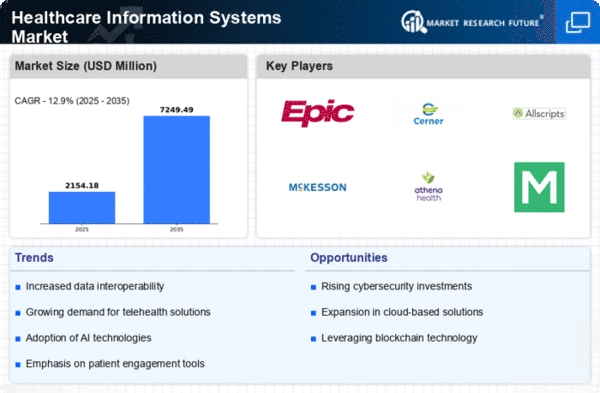
Healthcare Information Systems Market Infographic
Purchase Options

Market Trends

Key Emerging Trends in the Healthcare Information Systems Market

Telehealth is developing as a prevailing pattern in the healthcare information systems market. The expanded interest for distant healthcare administrations, particularly advanced by the Coronavirus pandemic, is driving the incorporation of telehealth stages into healthcare information systems to work with virtual counsels and far off persistent checking. Interoperability stays a vital concentration in the healthcare information systems market. Endeavours to work on the consistent trade of patient information among various healthcare systems and suppliers are building up momentum, improving consideration coordination and patient results. Artificial intelligence is increasingly being incorporated into healthcare information systems. Applications of computer-based intelligence, such as AI calculations for perceptual analysis, normal language processing, and diagnostics, are improving dynamic cycles and focusing on silent consideration. The adoption of healthcare information systems built on the cloud is related to the rise. Cloud computing technology provides cost-effectiveness, flexibility, and adaptability, enabling healthcare organizations to securely store, use, and access vast amounts of patient data. Network security is becoming more and more important in the industry as healthcare data becomes more digitally connected. Healthcare information system providers should fundamentally consider protecting sensitive patient data from online threats and ensuring compliance with information assurance standards. Executives' well-being is becoming increasingly superior as healthcare systems move toward a more preventative and all-encompassing approach. Systems for tracking population health are being integrated into healthcare information systems to analyze data, identify trends, and implement strategies that will improve overall community health. To improve patient engagement and provide favorable access to wellbeing information, portable applications for well-being are being integrated into healthcare information systems. Flexible apps for scheduling, medication updating, and monitoring well-being are turning become essential components of healthcare delivery. Healthcare information systems are increasingly using information examination devices to extract meaningful insights from large datasets. Futuristic analysis and data-driven navigation are enabling healthcare providers to focus on clinical outcomes, optimize asset allocation, and enhance operational competence. Blockchain technology is gaining traction as a means of enhancing data security and integrity in healthcare IT systems. By keeping simple and secure health records, its decentralized and change-safe structure helps to reduce the risk of information breaches. The number of requests for remote patient observation plans is flooding the market. Healthcare information systems are starting to depend heavily on related devices and wearables that enable regular monitoring of patients' vital signs and limits.


Author
Author Profile
Rahul Gotadki
Research Manager

He holds an experience of about 9+ years in Market Research and Business Consulting, working under the spectrum of Life Sciences and Healthcare domains. Rahul conceptualizes and implements a scalable business strategy and provides strategic leadership to the clients. His expertise lies in market estimation, competitive intelligence, pipeline analysis, customer assessment, etc.

Leave a Comment

FAQs

What is the projected market valuation of the Healthcare Information Systems Market by 2035?

<p>The projected market valuation for the Healthcare Information Systems Market by 2035 is 7249.49 USD Million.</p>

What was the market valuation of the Healthcare Information Systems Market in 2024?

<p>The overall market valuation of the Healthcare Information Systems Market was 1908.04 USD Million in 2024.</p>

What is the expected CAGR for the Healthcare Information Systems Market during the forecast period 2025 - 2035?

<p>The expected CAGR for the Healthcare Information Systems Market during the forecast period 2025 - 2035 is 12.9%.</p>

Which companies are considered key players in the Healthcare Information Systems Market?

<p>Key players in the Healthcare Information Systems Market include Epic Systems, Cerner Corporation, Allscripts Healthcare Solutions, and McKesson Corporation.</p>

What are the main application segments of the Healthcare Information Systems Market?

<p>The main application segments include Electronic Health Record, Laboratory Information System, and Radiology Information System.</p>

How does the market valuation for Cloud-Based deployment compare to On-Premise deployment?

<p>The market valuation for Cloud-Based deployment is projected at 3500.0 USD Million, whereas On-Premise deployment is at 2500.0 USD Million.</p>

What is the market size for hospitals as an end user in the Healthcare Information Systems Market?

<p>The market size for hospitals as an end user was 3000.0 USD Million in 2024.</p>

What is the projected market size for the Patient Management System application by 2035?

<p>The projected market size for the Patient Management System application is expected to reach 1949.49 USD Million by 2035.</p>

Which end user segment is expected to have the highest market valuation in 2035?

<p>The hospitals segment is expected to have the highest market valuation, projected at 3000.0 USD Million by 2035.</p>

What is the market valuation for the Pharmacy Information System application in 2024?

<p>The market valuation for the Pharmacy Information System application was 800.0 USD Million in 2024.</p>

Market Summary

As per MRFR analysis, the Healthcare Information Systems Market was estimated at 537.1 USD Billion in 2025. The Healthcare Information Systems industry is projected to grow from 596.7 USD Million in 2026 to 1,538.7 USD Billion by 2035, exhibiting a compound annual growth rate (CAGR) of 11.1% during the forecast period 2026 - 2035.

Key Market Trends & Highlights

The Healthcare Information Systems Market is poised for substantial growth driven by technological advancements and evolving healthcare needs.

  • The integration of Artificial Intelligence is transforming operational efficiencies in healthcare settings across North America. Interoperability remains a critical focus, facilitating seamless data exchange between Electronic Health Records and other systems. Cybersecurity measures are increasingly prioritized as healthcare organizations seek to protect sensitive patient information. Rising demand for telehealth solutions and advancements in data analytics are key drivers propelling growth in the Pharmacy Information Systems segment.

Market Size & Forecast

2025 Market Size 537.1 (USD Billion)
2035 Market Size 596.7 (USD Billion)
CAGR (2026 - 2035) 11.1%
Largest Regional Market Share in 2025 North America

Major Players

Epic Systems Corporation (US), Cerner Corporation (US), Allscripts Healthcare Solutions (US), McKesson Corporation (US), Athenahealth, Inc. (US), MEDITECH (US), NextGen Healthcare (US), GE Healthcare (US), Philips Healthcare (NL)

Market Trends

The Healthcare Information Systems Market is currently experiencing a transformative phase, driven by advancements in technology and an increasing emphasis on patient-centered care. Organizations are increasingly adopting integrated systems that facilitate seamless communication and data sharing among healthcare providers. This shift not only enhances operational efficiency but also improves patient outcomes by enabling timely access to critical information. Furthermore, the growing demand for telehealth services and remote patient monitoring solutions is reshaping the landscape, as stakeholders seek to leverage digital tools to enhance service delivery and patient engagement. In addition, regulatory changes and the push for interoperability are influencing the direction of the Healthcare Information Systems Market. Stakeholders are compelled to adopt systems that comply with evolving standards, ensuring that data can be exchanged across different platforms. This trend is likely to foster collaboration among various healthcare entities, ultimately leading to a more cohesive healthcare ecosystem. As the market continues to evolve, the focus on data security and privacy remains paramount, with organizations investing in robust cybersecurity measures to protect sensitive patient information.

Integration of Artificial Intelligence

The integration of artificial intelligence into healthcare information systems is becoming increasingly prevalent. AI technologies are being utilized to enhance decision-making processes, streamline administrative tasks, and improve diagnostic accuracy. This trend suggests a shift towards more intelligent systems that can learn from data and provide actionable insights, potentially transforming patient care.

Emphasis on Interoperability

There is a growing emphasis on interoperability within the Healthcare Information Systems Market. Organizations are recognizing the importance of systems that can communicate effectively with one another, facilitating the seamless exchange of information. This trend indicates a move towards creating a more connected healthcare environment, where data flows freely among providers.

Focus on Cybersecurity

As the reliance on digital systems increases, the focus on cybersecurity within the Healthcare Information Systems Market is intensifying. Organizations are prioritizing the protection of sensitive patient data against cyber threats. This trend highlights the necessity for robust security measures and protocols to safeguard information, ensuring trust in digital healthcare solutions.

Healthcare Information Systems Market Market Drivers

Market Growth Projections

The Global Healthcare Information Systems Market Industry is projected to experience substantial growth in the coming years. With an estimated market value of 537.1 USD Billion in 2025, the industry is on a trajectory towards reaching 1538.7 USD Billion by 2035. This growth reflects a compound annual growth rate of 11.1% from 2025 to 2035, indicating a robust demand for healthcare information systems. Factors contributing to this growth include technological advancements, increasing healthcare expenditures, and a heightened focus on patient-centric care. As the market evolves, it is expected to adapt to emerging trends and challenges, positioning itself as a critical component of the global healthcare landscape.

Government Initiatives and Funding

Government initiatives play a pivotal role in shaping the Global Healthcare Information Systems Market Industry. Various national health policies emphasize the adoption of advanced healthcare technologies, often accompanied by substantial funding. For instance, initiatives aimed at digitizing health records and enhancing telehealth services are gaining traction globally. Such policies not only facilitate the implementation of healthcare information systems but also encourage public-private partnerships. As governments allocate resources to improve healthcare infrastructure, the market is expected to benefit significantly. This support is likely to propel the market towards an estimated value of 78.1 USD Billion by 2035, underscoring the impact of governmental involvement.

Growing Adoption of Telehealth Services

The Global Healthcare Information Systems Market Industry is witnessing a growing adoption of telehealth services, which has become increasingly vital in modern healthcare delivery. Telehealth platforms facilitate remote consultations, monitoring, and management of patient health, thereby expanding access to care. This trend is particularly beneficial for rural and underserved populations, as it reduces barriers to healthcare access. The rise of telehealth is supported by advancements in communication technologies and a shift in patient preferences towards more convenient care options. As telehealth continues to gain traction, it is expected to significantly influence the market dynamics, further emphasizing the importance of robust healthcare information systems.

Increasing Focus on Patient-Centric Care

The Global Healthcare Information Systems Market Industry is increasingly influenced by a shift towards patient-centric care. Healthcare providers are recognizing the importance of engaging patients in their own care processes, which necessitates the use of advanced information systems. These systems enable personalized treatment plans, real-time health monitoring, and improved communication between patients and providers. As a result, healthcare organizations are investing in technologies that enhance patient experience and satisfaction. This focus on patient-centricity is expected to drive market growth, as it aligns with broader trends in healthcare that prioritize quality and outcomes, further solidifying the role of information systems in the Global Healthcare Information Systems Market Industry.

Technological Advancements in Healthcare IT

Technological advancements are a significant catalyst for growth in the Global Healthcare Information Systems Market Industry. Innovations such as artificial intelligence, machine learning, and big data analytics are transforming how healthcare data is managed and utilized. These technologies enable healthcare providers to analyze vast amounts of data, leading to improved decision-making and operational efficiencies. The integration of advanced analytics into healthcare information systems is likely to enhance predictive capabilities and patient outcomes. As these technologies continue to evolve, they are expected to contribute to the market's projected compound annual growth rate of 11.1% from 2026 to 2035, highlighting their transformative potential in the Global Healthcare Information Systems Market Industry.

Rising Demand for Integrated Healthcare Solutions

The Global Healthcare Information Systems Market Industry experiences a notable surge in demand for integrated healthcare solutions. This trend is driven by the need for seamless data exchange among various healthcare providers, which enhances patient care and operational efficiency. As healthcare systems become increasingly complex, the integration of electronic health records, billing systems, and clinical decision support tools is paramount. In 2025, the market is projected to reach 43.2 USD Billion, reflecting a growing recognition of the importance of interoperability in healthcare. This integration not only improves patient outcomes but also reduces costs, making it a critical driver in the Global Healthcare Information Systems Market Industry.

Market Segment Insights

By Application: Electronic Health Record (Largest) vs. Laboratory Information System (Fastest-Growing)

<p>The Healthcare Information Systems Market is significantly influenced by various application segments. The Electronic Health Record (EHR) system accounts for the largest market share due to its critical role in digitizing patient information, enhancing care coordination, and improving health outcomes. Following EHR, the Laboratory Information System (LIS) is rapidly gaining traction as healthcare facilities increasingly focus on automating laboratory processes, thus improving efficiency and accuracy in test results. Other application systems like Radiology, Pharmacy, and Patient Management also play vital roles, contributing to the overall market complexity and diversity. Looking towards the future, the demand for Electronic Health Records is expected to remain robust, driven by government initiatives promoting digital adoption in healthcare. The Laboratory Information System is emerging as the fastest-growing segment, fueled by rising healthcare spending and the need for improved diagnostics. The continued integration of advanced technologies such as artificial intelligence and machine learning into these systems is expected to further accelerate growth, enhancing their functionality and user experience.</p>

<p>EHR (Dominant) vs. LIS (Emerging)</p>

<p>The Electronic Health Record (EHR) system is a dominant component of healthcare information systems, facilitating seamless access to patient data across various points of care. It is designed to improve the quality of care, promote better health outcomes, and enhance healthcare provider efficiency. EHRs empower healthcare professionals with real-time information, allowing for informed decision-making and comprehensive patient management. Conversely, the Laboratory Information System (LIS) serves as an emerging solution that focuses on managing laboratory processes efficiently. As laboratories are increasingly recognized as vital to diagnostics and treatment, LIS systems are becoming essential for automating workflows, reducing turnaround times, and ensuring accuracy in laboratory results. The increasing demand for LIS reflects a growing recognition of the importance of diagnostic services in comprehensive patient care.</p>

By Deployment Type: Cloud-Based (Largest) vs. On-Premise (Fastest-Growing)

<p>In the Healthcare Information Systems Market, the deployment type segment showcases a notable distribution among On-Premise, Cloud-Based, and Hybrid solutions. Cloud-Based systems dominate this landscape, driven by their scalability and ease of access for healthcare professionals. In contrast, On-Premise systems cater to institutions requiring tighter data control and regulatory compliance, making them a significant portion of the market. Hybrid solutions offer a blend of both, appealing to organizations seeking flexibility amidst evolving healthcare demands.</p>

<p>On-Premise (Dominant) vs. Cloud-Based (Emerging)</p>

<p>On-Premise deployment in the Healthcare Information Systems Market remains dominant due to the stringent regulatory environment surrounding patient data management and security concerns. Healthcare organizations often prefer On-Premise solutions for their control over sensitive health information and customization options, which allow for tailored workflows. In contrast, Cloud-Based deployments are emerging rapidly, with their potential for cost-effectiveness, remote accessibility, and seamless updates. This shift in preference reflects a growing trend towards digital transformation in healthcare, where the agility provided by Cloud solutions is becoming increasingly appealing despite the traditional strengths of On-Premise systems.</p>

By End User: Hospitals (Largest) vs. Clinics (Fastest-Growing)

<p>In the Healthcare Information Systems Market, hospitals represent the largest segment, driven by their comprehensive needs for patient data management, regulatory compliance, and operational efficiency. Clinics, although smaller in share, are emerging rapidly due to the increasing implementation of health information technology to enhance patient care and streamline administrative tasks. This shift highlights a growing trend where outpatient facilities prioritize electronic health records (EHRs) and telehealth systems to meet evolving consumer demands.</p>

<p>Hospitals (Dominant) vs. Clinics (Emerging)</p>

<p>Hospitals remain the dominant players in the Healthcare Information Systems Market, necessitating advanced information systems for managing extensive patient databases and improving care quality. These institutions invest heavily in integrated systems that encompass various functions, from patient registration to billing and clinical decision support. On the other hand, clinics are emerging as significant contributors to market growth, often adopting user-friendly and cost-effective solutions that cater to their specific needs. They are increasingly focusing on interoperability and data portability, allowing for improved communication among healthcare professionals and higher-quality patient engagement. This dynamic showcases the shifting landscape as smaller healthcare providers adopt innovative technology to remain competitive.</p>

By Functionality: Clinical (Largest) vs. Interoperability (Fastest-Growing)

The Healthcare Information Systems Market is predominantly driven by the Clinical functionality segment, which encompasses systems designed to support the clinical workflows of healthcare providers. This segment accounts for the largest market share, driven by the rising demand for efficient patient management systems and electronic health records. In contrast, the Interoperability segment, which focuses on enabling seamless communication and data exchange between different healthcare systems, is witnessing rapid growth as organizations prioritize integrated solutions to enhance care coordination.

Technology: Clinical (Dominant) vs. Interoperability (Emerging)

The Clinical functionality segment is characterized by its robust applications that facilitate patient care and clinical decision-making, making it the dominant player in the market. It includes systems for electronic health records, computerized physician order entry, and clinical decision support. On the other hand, the Interoperability segment is emerging as a critical component in the healthcare landscape, promoting data sharing across various platforms and improving patient outcomes. As healthcare ecosystems continue to evolve, the need for interoperability solutions becomes increasingly vital, driven by regulatory mandates and the pursuit of value-based care.

By Technology: Artificial Intelligence (Largest) vs. Telemedicine (Fastest-Growing)

In the Healthcare Information Systems Market, Artificial Intelligence (AI) has emerged as the largest segment, significantly outpacing competitors like Blockchain and Big Data Analytics in terms of application and integration within healthcare systems. AI technologies have become pivotal in enhancing operational efficiencies, patient outcomes, and decision-making processes, positioning themselves as the backbone of modern healthcare IT solutions. Meanwhile, Telemedicine is carving its niche as the fastest-growing segment, driven primarily by the increasing demand for remote patient monitoring and virtual care options, which have become particularly prominent in the post-pandemic landscape.

AI: Dominant vs. Telemedicine: Emerging

Artificial Intelligence represents a dominant force in the Healthcare Information Systems Market, leveraging machine learning, natural language processing, and predictive analytics to transform patient care and operational efficiencies. Its applications range from diagnostic tools to personalized medicine, proving to be invaluable in optimizing healthcare delivery. In contrast, Telemedicine stands as an emerging player, gaining traction due to its ability to provide accessible care, particularly in rural and underserved communities. The rise in smartphone penetration and internet accessibility significantly fuels the growth of telemedicine, as it enables healthcare providers to reach patients remotely, enhancing convenience and reducing barriers to care.

Get more detailed insights about Healthcare Information Systems Market Research Report – Forecast till 2035

Regional Insights

North America : Market Leader in Healthcare Tech

North America continues to lead the Healthcare Information Systems market, holding a significant share of 1000.0M in 2024. The region's growth is driven by increasing healthcare expenditures, technological advancements, and a strong regulatory framework promoting digital health solutions. The demand for integrated systems that enhance patient care and operational efficiency is on the rise, supported by government initiatives aimed at improving healthcare delivery. The competitive landscape is robust, with key players like Epic Systems Corporation, Cerner Corporation, and McKesson Corporation dominating the market. The U.S. remains the largest contributor, benefiting from a well-established healthcare infrastructure and a high adoption rate of electronic health records (EHR). The presence of innovative companies fosters a dynamic environment, ensuring continuous advancements in healthcare technology.

Europe : Emerging Market with Growth Potential

Europe's Healthcare Information Systems market is valued at 500.0M, reflecting a growing demand for efficient healthcare solutions. Factors such as an aging population, increasing chronic diseases, and the need for cost-effective healthcare delivery are driving this growth. Regulatory bodies are emphasizing the importance of digital transformation in healthcare, which is further catalyzing investments in health IT systems across the region. Leading countries like Germany, France, and the UK are at the forefront of this transformation, with significant investments in healthcare technology. The competitive landscape features major players such as Philips Healthcare and Cerner Corporation, which are actively expanding their presence. The European market is characterized by a mix of established companies and innovative startups, creating a vibrant ecosystem for healthcare solutions.

Asia-Pacific : Rapid Growth in Healthcare Sector

The Asia-Pacific region, with a market size of 300.0M, is witnessing rapid growth in Healthcare Information Systems. Factors such as increasing healthcare investments, a rising population, and the growing prevalence of chronic diseases are driving demand. Governments are implementing policies to enhance healthcare infrastructure, which is further propelling the adoption of digital health solutions across the region. Countries like China, India, and Japan are leading the charge, with significant investments in health IT. The competitive landscape is evolving, with both local and international players vying for market share. Companies like GE Healthcare and Allscripts Healthcare Solutions are expanding their footprint, contributing to a dynamic and competitive environment in the healthcare technology sector.

Middle East and Africa : Emerging Market with Unique Challenges

The Middle East and Africa region, valued at 108.04M, is gradually evolving in the Healthcare Information Systems market. The growth is driven by increasing healthcare investments, a focus on improving healthcare quality, and the need for efficient management systems. Governments are prioritizing healthcare reforms, which are essential for enhancing service delivery and patient outcomes in the region. Countries like the UAE and South Africa are leading the way, with significant investments in health IT infrastructure. The competitive landscape is characterized by a mix of local and international players, with companies like Philips Healthcare making strides in the market. However, challenges such as regulatory hurdles and varying levels of healthcare infrastructure remain, impacting the overall growth trajectory.

Key Players and Competitive Insights

The Healthcare Information Systems Market is characterized by a dynamic competitive landscape, driven by technological advancements, regulatory changes, and an increasing demand for integrated healthcare solutions. Major players such as Epic Systems Corporation (US), Cerner Corporation (US), and McKesson Corporation (US) are at the forefront, each adopting distinct strategies to enhance their market positioning. Epic Systems Corporation (US) focuses on innovation through continuous software updates and user-friendly interfaces, while Cerner Corporation (US) emphasizes partnerships with healthcare providers to expand its reach and improve service delivery. McKesson Corporation (US) is leveraging its extensive distribution network to optimize supply chain efficiencies, thereby enhancing its operational capabilities. Collectively, these strategies contribute to a competitive environment that is increasingly centered around technological integration and patient-centric solutions.In terms of business tactics, companies are increasingly localizing their operations to better serve regional markets, which appears to be a response to the growing demand for customized healthcare solutions. The market structure is moderately fragmented, with a mix of large corporations and smaller niche players. This fragmentation allows for diverse offerings but also intensifies competition among key players, as they strive to differentiate themselves through innovative solutions and superior service delivery.
In November Epic Systems Corporation (US) announced a strategic partnership with a leading telehealth provider to enhance its electronic health record (EHR) capabilities. This collaboration is expected to integrate telehealth services directly into Epic's platform, thereby improving accessibility for patients and streamlining workflows for healthcare providers. The strategic importance of this move lies in its potential to position Epic as a leader in the telehealth integration space, responding to the growing demand for remote healthcare services.
In October Cerner Corporation (US) launched a new AI-driven analytics tool designed to assist healthcare providers in predictive patient care. This tool aims to enhance clinical decision-making by providing actionable insights based on real-time data. The introduction of this technology underscores Cerner's commitment to innovation and its strategic focus on improving patient outcomes through data-driven solutions, which could significantly enhance its competitive edge in the market.
In September McKesson Corporation (US) expanded its cloud-based healthcare management solutions by acquiring a smaller tech firm specializing in data interoperability. This acquisition is likely to bolster McKesson's capabilities in providing seamless data exchange among healthcare systems, which is increasingly critical in today's interconnected healthcare environment. The strategic significance of this acquisition lies in its potential to enhance McKesson's service offerings and strengthen its position as a comprehensive healthcare solutions provider.
As of December the competitive trends in the Healthcare Information Systems Market are heavily influenced by digitalization, sustainability initiatives, and the integration of AI technologies. Strategic alliances are becoming more prevalent, as companies recognize the value of collaboration in enhancing their service offerings and expanding their market reach. Looking ahead, it is anticipated that competitive differentiation will increasingly pivot from price-based strategies to a focus on innovation, technological advancements, and reliable supply chain management. This shift suggests that companies that prioritize these elements will likely emerge as leaders in the evolving landscape.

Key Companies in the Healthcare Information Systems Market include

Industry Developments

The Global Healthcare Information Systems Market has been witnessing significant developments and trends recently. Notably, in October 2023, Oracle Corporation announced the acquisition of Cerner Corporation, enhancing their capabilities in electronic health records and healthcare analytics. Additionally, eClinicalWorks launched a new telehealth solution to strengthen their digital health portfolio amidst growing demand due to the pandemic. In terms of market growth, GE Healthcare reported a revenue increase in their imaging devices and software, contributing to a robust expansion of their healthcare IT offerings in the global market. 

Moreover, Epic Systems continues to expand its market share through strategic partnerships with major healthcare providers to enhance interoperability and clinical workflows. Significant investments in AI and cloud-based plm solutions are reshaping the landscape, with IBM Watson Health focusing on expanding its predictive analytics and population health management tools. Over the past few years, McKesson Corporation has also seen notable growth in its healthcare distribution and technology services, reflecting an overall upward trend in the Global Healthcare Information Systems Market driven by increasing demand for digital transformation in healthcare administration.

Future Outlook

Healthcare Information Systems Market Future Outlook

The Healthcare Information Systems Market is projected to grow at a 11.1% CAGR from 2026 to 2035, driven by technological advancements, regulatory changes, and increasing demand for efficient healthcare delivery.

New opportunities lie in:

  • <p>Integration of AI-driven analytics for predictive healthcare management. Development of telehealth platforms to enhance remote patient monitoring. Implementation of blockchain technology for secure patient data exchange.</p>

By 2035, the market is expected to be robust, driven by innovation and increased adoption of advanced healthcare technologies.

Market Segmentation

Healthcare Information Systems Market End Use Outlook

  • Hospitals
  • Ambulatory Surgical Centers
  • Diagnostic Laboratories
  • Pharmacies
  • Nursing Homes

Healthcare Information Systems Market Technology Outlook

  • Artificial Intelligence
  • Blockchain
  • Big Data Analytics
  • Telemedicine

Healthcare Information Systems Market Application Outlook

  • Electronic Health Records
  • Laboratory Information Systems
  • Radiology Information Systems
  • Pharmacy Information Systems
  • Patient Management Systems

Healthcare Information Systems Market Functionality Outlook

  • Clinical
  • Administrative
  • Financial
  • Interoperability

Healthcare Information Systems Market Deployment Type Outlook

  • On-Premise
  • Cloud-Based
  • Hybrid

Report Scope

MARKET SIZE 2025 537.1(USD Billion)
MARKET SIZE 2026 596.7(USD Billion)
MARKET SIZE 2035 1,538.7(USD Billion)
COMPOUND ANNUAL GROWTH RATE (CAGR) 12.9% (2026 - 2035)
REPORT COVERAGE Revenue Forecast, Competitive Landscape, Growth Factors, and Trends
BASE YEAR 2025
Market Forecast Period 2025 - 2035
Historical Data 2019 - 2024
Market Forecast Units USD Million
Key Companies Profiled Epic Systems Corporation (US), Cerner Corporation (US), Allscripts Healthcare Solutions (US), McKesson Corporation (US), Athenahealth, Inc. (US), MEDITECH (US), NextGen Healthcare (US), GE Healthcare (US), Philips Healthcare (NL)
Segments Covered Application, End Use, Deployment Type, Functionality, Technology
Key Market Opportunities Integration of artificial intelligence and machine learning in Healthcare Information Systems enhances decision-making and operational efficiency.
Key Market Dynamics Rising demand for integrated healthcare information systems drives technological advancements and competitive consolidation in the market.
Countries Covered North America, Europe, APAC, South America, MEA

FAQs

What is the projected market valuation of the Healthcare Information Systems Market by 2035?

<p>The projected market valuation for the Healthcare Information Systems Market by 2035 is 7249.49 USD Million.</p>

What was the market valuation of the Healthcare Information Systems Market in 2024?

<p>The overall market valuation of the Healthcare Information Systems Market was 1908.04 USD Million in 2024.</p>

What is the expected CAGR for the Healthcare Information Systems Market during the forecast period 2025 - 2035?

<p>The expected CAGR for the Healthcare Information Systems Market during the forecast period 2025 - 2035 is 12.9%.</p>

Which companies are considered key players in the Healthcare Information Systems Market?

<p>Key players in the Healthcare Information Systems Market include Epic Systems, Cerner Corporation, Allscripts Healthcare Solutions, and McKesson Corporation.</p>

What are the main application segments of the Healthcare Information Systems Market?

<p>The main application segments include Electronic Health Record, Laboratory Information System, and Radiology Information System.</p>

How does the market valuation for Cloud-Based deployment compare to On-Premise deployment?

<p>The market valuation for Cloud-Based deployment is projected at 3500.0 USD Million, whereas On-Premise deployment is at 2500.0 USD Million.</p>

What is the market size for hospitals as an end user in the Healthcare Information Systems Market?

<p>The market size for hospitals as an end user was 3000.0 USD Million in 2024.</p>

What is the projected market size for the Patient Management System application by 2035?

<p>The projected market size for the Patient Management System application is expected to reach 1949.49 USD Million by 2035.</p>

Which end user segment is expected to have the highest market valuation in 2035?

<p>The hospitals segment is expected to have the highest market valuation, projected at 3000.0 USD Million by 2035.</p>

What is the market valuation for the Pharmacy Information System application in 2024?

<p>The market valuation for the Pharmacy Information System application was 800.0 USD Million in 2024.</p>

  1. SECTION I: EXECUTIVE SUMMARY AND KEY HIGHLIGHTS
    1. | 1.1 EXECUTIVE SUMMARY
    2. | | 1.1.1 Market Overview
    3. | | 1.1.2 Key Findings
    4. | | 1.1.3 Market Segmentation
    5. | | 1.1.4 Competitive Landscape
    6. | | 1.1.5 Challenges and Opportunities
    7. | | 1.1.6 Future Outlook
  2. SECTION II: SCOPING, METHODOLOGY AND MARKET STRUCTURE
    1. | 2.1 MARKET INTRODUCTION
    2. | | 2.1.1 Definition
    3. | | 2.1.2 Scope of the study
    4. | | | 2.1.2.1 Research Objective
    5. | | | 2.1.2.2 Assumption
    6. | | | 2.1.2.3 Limitations
    7. | 2.2 RESEARCH METHODOLOGY
    8. | | 2.2.1 Overview
    9. | | 2.2.2 Data Mining
    10. | | 2.2.3 Secondary Research
    11. | | 2.2.4 Primary Research
    12. | | | 2.2.4.1 Primary Interviews and Information Gathering Process
    13. | | | 2.2.4.2 Breakdown of Primary Respondents
    14. | | 2.2.5 Forecasting Model
    15. | | 2.2.6 Market Size Estimation
    16. | | | 2.2.6.1 Bottom-Up Approach
    17. | | | 2.2.6.2 Top-Down Approach
    18. | | 2.2.7 Data Triangulation
    19. | | 2.2.8 Validation
  3. SECTION III: QUALITATIVE ANALYSIS
    1. | 3.1 MARKET DYNAMICS
    2. | | 3.1.1 Overview
    3. | | 3.1.2 Drivers
    4. | | 3.1.3 Restraints
    5. | | 3.1.4 Opportunities
    6. | 3.2 MARKET FACTOR ANALYSIS
    7. | | 3.2.1 Value chain Analysis
    8. | | 3.2.2 Porter's Five Forces Analysis
    9. | | | 3.2.2.1 Bargaining Power of Suppliers
    10. | | | 3.2.2.2 Bargaining Power of Buyers
    11. | | | 3.2.2.3 Threat of New Entrants
    12. | | | 3.2.2.4 Threat of Substitutes
    13. | | | 3.2.2.5 Intensity of Rivalry
    14. | | 3.2.3 COVID-19 Impact Analysis
    15. | | | 3.2.3.1 Market Impact Analysis
    16. | | | 3.2.3.2 Regional Impact
    17. | | | 3.2.3.3 Opportunity and Threat Analysis
  4. SECTION IV: QUANTITATIVE ANALYSIS
    1. | 4.1 Healthcare, BY Application (USD Million)
    2. | | 4.1.1 Electronic Health Record
    3. | | 4.1.2 Laboratory Information System
    4. | | 4.1.3 Radiology Information System
    5. | | 4.1.4 Pharmacy Information System
    6. | | 4.1.5 Patient Management System
    7. | 4.2 Healthcare, BY Deployment Type (USD Million)
    8. | | 4.2.1 On-Premise
    9. | | 4.2.2 Cloud-Based
    10. | | 4.2.3 Hybrid
    11. | 4.3 Healthcare, BY End User (USD Million)
    12. | | 4.3.1 Hospitals
    13. | | 4.3.2 Clinics
    14. | | 4.3.3 Diagnostic Laboratories
    15. | | 4.3.4 Pharmacies
    16. | | 4.3.5 Healthcare Providers
    17. | 4.4 Healthcare, BY Region (USD Million)
    18. | | 4.4.1 North America
    19. | | | 4.4.1.1 US
    20. | | | 4.4.1.2 Canada
    21. | | 4.4.2 Europe
    22. | | | 4.4.2.1 Germany
    23. | | | 4.4.2.2 UK
    24. | | | 4.4.2.3 France
    25. | | | 4.4.2.4 Russia
    26. | | | 4.4.2.5 Italy
    27. | | | 4.4.2.6 Spain
    28. | | | 4.4.2.7 Rest of Europe
    29. | | 4.4.3 APAC
    30. | | | 4.4.3.1 China
    31. | | | 4.4.3.2 India
    32. | | | 4.4.3.3 Japan
    33. | | | 4.4.3.4 South Korea
    34. | | | 4.4.3.5 Malaysia
    35. | | | 4.4.3.6 Thailand
    36. | | | 4.4.3.7 Indonesia
    37. | | | 4.4.3.8 Rest of APAC
    38. | | 4.4.4 South America
    39. | | | 4.4.4.1 Brazil
    40. | | | 4.4.4.2 Mexico
    41. | | | 4.4.4.3 Argentina
    42. | | | 4.4.4.4 Rest of South America
    43. | | 4.4.5 MEA
    44. | | | 4.4.5.1 GCC Countries
    45. | | | 4.4.5.2 South Africa
    46. | | | 4.4.5.3 Rest of MEA
  5. SECTION V: COMPETITIVE ANALYSIS
    1. | 5.1 Competitive Landscape
    2. | | 5.1.1 Overview
    3. | | 5.1.2 Competitive Analysis
    4. | | 5.1.3 Market share Analysis
    5. | | 5.1.4 Major Growth Strategy in the Healthcare
    6. | | 5.1.5 Competitive Benchmarking
    7. | | 5.1.6 Leading Players in Terms of Number of Developments in the Healthcare
    8. | | 5.1.7 Key developments and growth strategies
    9. | | | 5.1.7.1 New Product Launch/Service Deployment
    10. | | | 5.1.7.2 Merger & Acquisitions
    11. | | | 5.1.7.3 Joint Ventures
    12. | | 5.1.8 Major Players Financial Matrix
    13. | | | 5.1.8.1 Sales and Operating Income
    14. | | | 5.1.8.2 Major Players R&D Expenditure. 2023
    15. | 5.2 Company Profiles
    16. | | 5.2.1 Epic Systems (US)
    17. | | | 5.2.1.1 Financial Overview
    18. | | | 5.2.1.2 Products Offered
    19. | | | 5.2.1.3 Key Developments
    20. | | | 5.2.1.4 SWOT Analysis
    21. | | | 5.2.1.5 Key Strategies
    22. | | 5.2.2 Cerner Corporation (US)
    23. | | | 5.2.2.1 Financial Overview
    24. | | | 5.2.2.2 Products Offered
    25. | | | 5.2.2.3 Key Developments
    26. | | | 5.2.2.4 SWOT Analysis
    27. | | | 5.2.2.5 Key Strategies
    28. | | 5.2.3 Allscripts Healthcare Solutions (US)
    29. | | | 5.2.3.1 Financial Overview
    30. | | | 5.2.3.2 Products Offered
    31. | | | 5.2.3.3 Key Developments
    32. | | | 5.2.3.4 SWOT Analysis
    33. | | | 5.2.3.5 Key Strategies
    34. | | 5.2.4 McKesson Corporation (US)
    35. | | | 5.2.4.1 Financial Overview
    36. | | | 5.2.4.2 Products Offered
    37. | | | 5.2.4.3 Key Developments
    38. | | | 5.2.4.4 SWOT Analysis
    39. | | | 5.2.4.5 Key Strategies
    40. | | 5.2.5 Athenahealth (US)
    41. | | | 5.2.5.1 Financial Overview
    42. | | | 5.2.5.2 Products Offered
    43. | | | 5.2.5.3 Key Developments
    44. | | | 5.2.5.4 SWOT Analysis
    45. | | | 5.2.5.5 Key Strategies
    46. | | 5.2.6 MEDITECH (US)
    47. | | | 5.2.6.1 Financial Overview
    48. | | | 5.2.6.2 Products Offered
    49. | | | 5.2.6.3 Key Developments
    50. | | | 5.2.6.4 SWOT Analysis
    51. | | | 5.2.6.5 Key Strategies
    52. | | 5.2.7 NextGen Healthcare (US)
    53. | | | 5.2.7.1 Financial Overview
    54. | | | 5.2.7.2 Products Offered
    55. | | | 5.2.7.3 Key Developments
    56. | | | 5.2.7.4 SWOT Analysis
    57. | | | 5.2.7.5 Key Strategies
    58. | | 5.2.8 GE Healthcare (US)
    59. | | | 5.2.8.1 Financial Overview
    60. | | | 5.2.8.2 Products Offered
    61. | | | 5.2.8.3 Key Developments
    62. | | | 5.2.8.4 SWOT Analysis
    63. | | | 5.2.8.5 Key Strategies
    64. | | 5.2.9 Philips Healthcare (NL)
    65. | | | 5.2.9.1 Financial Overview
    66. | | | 5.2.9.2 Products Offered
    67. | | | 5.2.9.3 Key Developments
    68. | | | 5.2.9.4 SWOT Analysis
    69. | | | 5.2.9.5 Key Strategies
    70. | 5.3 Appendix
    71. | | 5.3.1 References
    72. | | 5.3.2 Related Reports
  6. LIST OF FIGURES
    1. | 6.1 MARKET SYNOPSIS
    2. | 6.2 NORTH AMERICA MARKET ANALYSIS
    3. | 6.3 US MARKET ANALYSIS BY APPLICATION
    4. | 6.4 US MARKET ANALYSIS BY DEPLOYMENT TYPE
    5. | 6.5 US MARKET ANALYSIS BY END USER
    6. | 6.6 CANADA MARKET ANALYSIS BY APPLICATION
    7. | 6.7 CANADA MARKET ANALYSIS BY DEPLOYMENT TYPE
    8. | 6.8 CANADA MARKET ANALYSIS BY END USER
    9. | 6.9 EUROPE MARKET ANALYSIS
    10. | 6.10 GERMANY MARKET ANALYSIS BY APPLICATION
    11. | 6.11 GERMANY MARKET ANALYSIS BY DEPLOYMENT TYPE
    12. | 6.12 GERMANY MARKET ANALYSIS BY END USER
    13. | 6.13 UK MARKET ANALYSIS BY APPLICATION
    14. | 6.14 UK MARKET ANALYSIS BY DEPLOYMENT TYPE
    15. | 6.15 UK MARKET ANALYSIS BY END USER
    16. | 6.16 FRANCE MARKET ANALYSIS BY APPLICATION
    17. | 6.17 FRANCE MARKET ANALYSIS BY DEPLOYMENT TYPE
    18. | 6.18 FRANCE MARKET ANALYSIS BY END USER
    19. | 6.19 RUSSIA MARKET ANALYSIS BY APPLICATION
    20. | 6.20 RUSSIA MARKET ANALYSIS BY DEPLOYMENT TYPE
    21. | 6.21 RUSSIA MARKET ANALYSIS BY END USER
    22. | 6.22 ITALY MARKET ANALYSIS BY APPLICATION
    23. | 6.23 ITALY MARKET ANALYSIS BY DEPLOYMENT TYPE
    24. | 6.24 ITALY MARKET ANALYSIS BY END USER
    25. | 6.25 SPAIN MARKET ANALYSIS BY APPLICATION
    26. | 6.26 SPAIN MARKET ANALYSIS BY DEPLOYMENT TYPE
    27. | 6.27 SPAIN MARKET ANALYSIS BY END USER
    28. | 6.28 REST OF EUROPE MARKET ANALYSIS BY APPLICATION
    29. | 6.29 REST OF EUROPE MARKET ANALYSIS BY DEPLOYMENT TYPE
    30. | 6.30 REST OF EUROPE MARKET ANALYSIS BY END USER
    31. | 6.31 APAC MARKET ANALYSIS
    32. | 6.32 CHINA MARKET ANALYSIS BY APPLICATION
    33. | 6.33 CHINA MARKET ANALYSIS BY DEPLOYMENT TYPE
    34. | 6.34 CHINA MARKET ANALYSIS BY END USER
    35. | 6.35 INDIA MARKET ANALYSIS BY APPLICATION
    36. | 6.36 INDIA MARKET ANALYSIS BY DEPLOYMENT TYPE
    37. | 6.37 INDIA MARKET ANALYSIS BY END USER
    38. | 6.38 JAPAN MARKET ANALYSIS BY APPLICATION
    39. | 6.39 JAPAN MARKET ANALYSIS BY DEPLOYMENT TYPE
    40. | 6.40 JAPAN MARKET ANALYSIS BY END USER
    41. | 6.41 SOUTH KOREA MARKET ANALYSIS BY APPLICATION
    42. | 6.42 SOUTH KOREA MARKET ANALYSIS BY DEPLOYMENT TYPE
    43. | 6.43 SOUTH KOREA MARKET ANALYSIS BY END USER
    44. | 6.44 MALAYSIA MARKET ANALYSIS BY APPLICATION
    45. | 6.45 MALAYSIA MARKET ANALYSIS BY DEPLOYMENT TYPE
    46. | 6.46 MALAYSIA MARKET ANALYSIS BY END USER
    47. | 6.47 THAILAND MARKET ANALYSIS BY APPLICATION
    48. | 6.48 THAILAND MARKET ANALYSIS BY DEPLOYMENT TYPE
    49. | 6.49 THAILAND MARKET ANALYSIS BY END USER
    50. | 6.50 INDONESIA MARKET ANALYSIS BY APPLICATION
    51. | 6.51 INDONESIA MARKET ANALYSIS BY DEPLOYMENT TYPE
    52. | 6.52 INDONESIA MARKET ANALYSIS BY END USER
    53. | 6.53 REST OF APAC MARKET ANALYSIS BY APPLICATION
    54. | 6.54 REST OF APAC MARKET ANALYSIS BY DEPLOYMENT TYPE
    55. | 6.55 REST OF APAC MARKET ANALYSIS BY END USER
    56. | 6.56 SOUTH AMERICA MARKET ANALYSIS
    57. | 6.57 BRAZIL MARKET ANALYSIS BY APPLICATION
    58. | 6.58 BRAZIL MARKET ANALYSIS BY DEPLOYMENT TYPE
    59. | 6.59 BRAZIL MARKET ANALYSIS BY END USER
    60. | 6.60 MEXICO MARKET ANALYSIS BY APPLICATION
    61. | 6.61 MEXICO MARKET ANALYSIS BY DEPLOYMENT TYPE
    62. | 6.62 MEXICO MARKET ANALYSIS BY END USER
    63. | 6.63 ARGENTINA MARKET ANALYSIS BY APPLICATION
    64. | 6.64 ARGENTINA MARKET ANALYSIS BY DEPLOYMENT TYPE
    65. | 6.65 ARGENTINA MARKET ANALYSIS BY END USER
    66. | 6.66 REST OF SOUTH AMERICA MARKET ANALYSIS BY APPLICATION
    67. | 6.67 REST OF SOUTH AMERICA MARKET ANALYSIS BY DEPLOYMENT TYPE
    68. | 6.68 REST OF SOUTH AMERICA MARKET ANALYSIS BY END USER
    69. | 6.69 MEA MARKET ANALYSIS
    70. | 6.70 GCC COUNTRIES MARKET ANALYSIS BY APPLICATION
    71. | 6.71 GCC COUNTRIES MARKET ANALYSIS BY DEPLOYMENT TYPE
    72. | 6.72 GCC COUNTRIES MARKET ANALYSIS BY END USER
    73. | 6.73 SOUTH AFRICA MARKET ANALYSIS BY APPLICATION
    74. | 6.74 SOUTH AFRICA MARKET ANALYSIS BY DEPLOYMENT TYPE
    75. | 6.75 SOUTH AFRICA MARKET ANALYSIS BY END USER
    76. | 6.76 REST OF MEA MARKET ANALYSIS BY APPLICATION
    77. | 6.77 REST OF MEA MARKET ANALYSIS BY DEPLOYMENT TYPE
    78. | 6.78 REST OF MEA MARKET ANALYSIS BY END USER
    79. | 6.79 KEY BUYING CRITERIA OF HEALTHCARE
    80. | 6.80 RESEARCH PROCESS OF MRFR
    81. | 6.81 DRO ANALYSIS OF HEALTHCARE
    82. | 6.82 DRIVERS IMPACT ANALYSIS: HEALTHCARE
    83. | 6.83 RESTRAINTS IMPACT ANALYSIS: HEALTHCARE
    84. | 6.84 SUPPLY / VALUE CHAIN: HEALTHCARE
    85. | 6.85 HEALTHCARE, BY APPLICATION, 2024 (% SHARE)
    86. | 6.86 HEALTHCARE, BY APPLICATION, 2024 TO 2035 (USD Million)
    87. | 6.87 HEALTHCARE, BY DEPLOYMENT TYPE, 2024 (% SHARE)
    88. | 6.88 HEALTHCARE, BY DEPLOYMENT TYPE, 2024 TO 2035 (USD Million)
    89. | 6.89 HEALTHCARE, BY END USER, 2024 (% SHARE)
    90. | 6.90 HEALTHCARE, BY END USER, 2024 TO 2035 (USD Million)
    91. | 6.91 BENCHMARKING OF MAJOR COMPETITORS
  7. LIST OF TABLES
    1. | 7.1 LIST OF ASSUMPTIONS
    2. | | 7.1.1
    3. | 7.2 North America MARKET SIZE ESTIMATES; FORECAST
    4. | | 7.2.1 BY APPLICATION, 2025-2035 (USD Million)
    5. | | 7.2.2 BY DEPLOYMENT TYPE, 2025-2035 (USD Million)
    6. | | 7.2.3 BY END USER, 2025-2035 (USD Million)
    7. | 7.3 US MARKET SIZE ESTIMATES; FORECAST
    8. | | 7.3.1 BY APPLICATION, 2025-2035 (USD Million)
    9. | | 7.3.2 BY DEPLOYMENT TYPE, 2025-2035 (USD Million)
    10. | | 7.3.3 BY END USER, 2025-2035 (USD Million)
    11. | 7.4 Canada MARKET SIZE ESTIMATES; FORECAST
    12. | | 7.4.1 BY APPLICATION, 2025-2035 (USD Million)
    13. | | 7.4.2 BY DEPLOYMENT TYPE, 2025-2035 (USD Million)
    14. | | 7.4.3 BY END USER, 2025-2035 (USD Million)
    15. | 7.5 Europe MARKET SIZE ESTIMATES; FORECAST
    16. | | 7.5.1 BY APPLICATION, 2025-2035 (USD Million)
    17. | | 7.5.2 BY DEPLOYMENT TYPE, 2025-2035 (USD Million)
    18. | | 7.5.3 BY END USER, 2025-2035 (USD Million)
    19. | 7.6 Germany MARKET SIZE ESTIMATES; FORECAST
    20. | | 7.6.1 BY APPLICATION, 2025-2035 (USD Million)
    21. | | 7.6.2 BY DEPLOYMENT TYPE, 2025-2035 (USD Million)
    22. | | 7.6.3 BY END USER, 2025-2035 (USD Million)
    23. | 7.7 UK MARKET SIZE ESTIMATES; FORECAST
    24. | | 7.7.1 BY APPLICATION, 2025-2035 (USD Million)
    25. | | 7.7.2 BY DEPLOYMENT TYPE, 2025-2035 (USD Million)
    26. | | 7.7.3 BY END USER, 2025-2035 (USD Million)
    27. | 7.8 France MARKET SIZE ESTIMATES; FORECAST
    28. | | 7.8.1 BY APPLICATION, 2025-2035 (USD Million)
    29. | | 7.8.2 BY DEPLOYMENT TYPE, 2025-2035 (USD Million)
    30. | | 7.8.3 BY END USER, 2025-2035 (USD Million)
    31. | 7.9 Russia MARKET SIZE ESTIMATES; FORECAST
    32. | | 7.9.1 BY APPLICATION, 2025-2035 (USD Million)
    33. | | 7.9.2 BY DEPLOYMENT TYPE, 2025-2035 (USD Million)
    34. | | 7.9.3 BY END USER, 2025-2035 (USD Million)
    35. | 7.10 Italy MARKET SIZE ESTIMATES; FORECAST
    36. | | 7.10.1 BY APPLICATION, 2025-2035 (USD Million)
    37. | | 7.10.2 BY DEPLOYMENT TYPE, 2025-2035 (USD Million)
    38. | | 7.10.3 BY END USER, 2025-2035 (USD Million)
    39. | 7.11 Spain MARKET SIZE ESTIMATES; FORECAST
    40. | | 7.11.1 BY APPLICATION, 2025-2035 (USD Million)
    41. | | 7.11.2 BY DEPLOYMENT TYPE, 2025-2035 (USD Million)
    42. | | 7.11.3 BY END USER, 2025-2035 (USD Million)
    43. | 7.12 Rest of Europe MARKET SIZE ESTIMATES; FORECAST
    44. | | 7.12.1 BY APPLICATION, 2025-2035 (USD Million)
    45. | | 7.12.2 BY DEPLOYMENT TYPE, 2025-2035 (USD Million)
    46. | | 7.12.3 BY END USER, 2025-2035 (USD Million)
    47. | 7.13 APAC MARKET SIZE ESTIMATES; FORECAST
    48. | | 7.13.1 BY APPLICATION, 2025-2035 (USD Million)
    49. | | 7.13.2 BY DEPLOYMENT TYPE, 2025-2035 (USD Million)
    50. | | 7.13.3 BY END USER, 2025-2035 (USD Million)
    51. | 7.14 China MARKET SIZE ESTIMATES; FORECAST
    52. | | 7.14.1 BY APPLICATION, 2025-2035 (USD Million)
    53. | | 7.14.2 BY DEPLOYMENT TYPE, 2025-2035 (USD Million)
    54. | | 7.14.3 BY END USER, 2025-2035 (USD Million)
    55. | 7.15 India MARKET SIZE ESTIMATES; FORECAST
    56. | | 7.15.1 BY APPLICATION, 2025-2035 (USD Million)
    57. | | 7.15.2 BY DEPLOYMENT TYPE, 2025-2035 (USD Million)
    58. | | 7.15.3 BY END USER, 2025-2035 (USD Million)
    59. | 7.16 Japan MARKET SIZE ESTIMATES; FORECAST
    60. | | 7.16.1 BY APPLICATION, 2025-2035 (USD Million)
    61. | | 7.16.2 BY DEPLOYMENT TYPE, 2025-2035 (USD Million)
    62. | | 7.16.3 BY END USER, 2025-2035 (USD Million)
    63. | 7.17 South Korea MARKET SIZE ESTIMATES; FORECAST
    64. | | 7.17.1 BY APPLICATION, 2025-2035 (USD Million)
    65. | | 7.17.2 BY DEPLOYMENT TYPE, 2025-2035 (USD Million)
    66. | | 7.17.3 BY END USER, 2025-2035 (USD Million)
    67. | 7.18 Malaysia MARKET SIZE ESTIMATES; FORECAST
    68. | | 7.18.1 BY APPLICATION, 2025-2035 (USD Million)
    69. | | 7.18.2 BY DEPLOYMENT TYPE, 2025-2035 (USD Million)
    70. | | 7.18.3 BY END USER, 2025-2035 (USD Million)
    71. | 7.19 Thailand MARKET SIZE ESTIMATES; FORECAST
    72. | | 7.19.1 BY APPLICATION, 2025-2035 (USD Million)
    73. | | 7.19.2 BY DEPLOYMENT TYPE, 2025-2035 (USD Million)
    74. | | 7.19.3 BY END USER, 2025-2035 (USD Million)
    75. | 7.20 Indonesia MARKET SIZE ESTIMATES; FORECAST
    76. | | 7.20.1 BY APPLICATION, 2025-2035 (USD Million)
    77. | | 7.20.2 BY DEPLOYMENT TYPE, 2025-2035 (USD Million)
    78. | | 7.20.3 BY END USER, 2025-2035 (USD Million)
    79. | 7.21 Rest of APAC MARKET SIZE ESTIMATES; FORECAST
    80. | | 7.21.1 BY APPLICATION, 2025-2035 (USD Million)
    81. | | 7.21.2 BY DEPLOYMENT TYPE, 2025-2035 (USD Million)
    82. | | 7.21.3 BY END USER, 2025-2035 (USD Million)
    83. | 7.22 South America MARKET SIZE ESTIMATES; FORECAST
    84. | | 7.22.1 BY APPLICATION, 2025-2035 (USD Million)
    85. | | 7.22.2 BY DEPLOYMENT TYPE, 2025-2035 (USD Million)
    86. | | 7.22.3 BY END USER, 2025-2035 (USD Million)
    87. | 7.23 Brazil MARKET SIZE ESTIMATES; FORECAST
    88. | | 7.23.1 BY APPLICATION, 2025-2035 (USD Million)
    89. | | 7.23.2 BY DEPLOYMENT TYPE, 2025-2035 (USD Million)
    90. | | 7.23.3 BY END USER, 2025-2035 (USD Million)
    91. | 7.24 Mexico MARKET SIZE ESTIMATES; FORECAST
    92. | | 7.24.1 BY APPLICATION, 2025-2035 (USD Million)
    93. | | 7.24.2 BY DEPLOYMENT TYPE, 2025-2035 (USD Million)
    94. | | 7.24.3 BY END USER, 2025-2035 (USD Million)
    95. | 7.25 Argentina MARKET SIZE ESTIMATES; FORECAST
    96. | | 7.25.1 BY APPLICATION, 2025-2035 (USD Million)
    97. | | 7.25.2 BY DEPLOYMENT TYPE, 2025-2035 (USD Million)
    98. | | 7.25.3 BY END USER, 2025-2035 (USD Million)
    99. | 7.26 Rest of South America MARKET SIZE ESTIMATES; FORECAST
    100. | | 7.26.1 BY APPLICATION, 2025-2035 (USD Million)
    101. | | 7.26.2 BY DEPLOYMENT TYPE, 2025-2035 (USD Million)
    102. | | 7.26.3 BY END USER, 2025-2035 (USD Million)
    103. | 7.27 MEA MARKET SIZE ESTIMATES; FORECAST
    104. | | 7.27.1 BY APPLICATION, 2025-2035 (USD Million)
    105. | | 7.27.2 BY DEPLOYMENT TYPE, 2025-2035 (USD Million)
    106. | | 7.27.3 BY END USER, 2025-2035 (USD Million)
    107. | 7.28 GCC Countries MARKET SIZE ESTIMATES; FORECAST
    108. | | 7.28.1 BY APPLICATION, 2025-2035 (USD Million)
    109. | | 7.28.2 BY DEPLOYMENT TYPE, 2025-2035 (USD Million)
    110. | | 7.28.3 BY END USER, 2025-2035 (USD Million)
    111. | 7.29 South Africa MARKET SIZE ESTIMATES; FORECAST
    112. | | 7.29.1 BY APPLICATION, 2025-2035 (USD Million)
    113. | | 7.29.2 BY DEPLOYMENT TYPE, 2025-2035 (USD Million)
    114. | | 7.29.3 BY END USER, 2025-2035 (USD Million)
    115. | 7.30 Rest of MEA MARKET SIZE ESTIMATES; FORECAST
    116. | | 7.30.1 BY APPLICATION, 2025-2035 (USD Million)
    117. | | 7.30.2 BY DEPLOYMENT TYPE, 2025-2035 (USD Million)
    118. | | 7.30.3 BY END USER, 2025-2035 (USD Million)
    119. | 7.31 PRODUCT LAUNCH/PRODUCT DEVELOPMENT/APPROVAL
    120. | | 7.31.1
    121. | 7.32 ACQUISITION/PARTNERSHIP
    122. | | 7.32.1

Healthcare Market Segmentation

Healthcare By Application (USD Million, 2025-2035)

  • Electronic Health Record
  • Laboratory Information System
  • Radiology Information System
  • Pharmacy Information System
  • Patient Management System

Healthcare By Deployment Type (USD Million, 2025-2035)

  • On-Premise
  • Cloud-Based
  • Hybrid

Healthcare By End User (USD Million, 2025-2035)

  • Hospitals
  • Clinics
  • Diagnostic Laboratories
  • Pharmacies
  • Healthcare Providers
Infographic

Free Sample Request

Kindly complete the form below to receive a free sample of this Report

Get Free Sample

Customer Strories

Compare Licence

×
Features License Type
Single User Multiuser License Enterprise User
Price $4,950 $5,950 $7,250
Maximum User Access Limit 1 User Upto 10 Users Unrestricted Access Throughout the Organization
Free Customization
Direct Access to Analyst
Deliverable Format
Platform Access
Discount on Next Purchase 10% 15% 15%
Printable Versions
%>