Request Free Sample ×

Kindly complete the form below to receive a free sample of this Report

* Please use a valid business email

Leading companies partner with us for data-driven Insights

clients tt-cursor
Hero Background
English
Chinese
French
Japanese
Korean
German
Spanish

Healthcare Human Resources Software Market Size

ID: MRFR/HCIT/0118-HCR
85 Pages
Rahul Gotadki
April 2026

Healthcare Human Resources (HR) Software Market Research Report Information By Deployment (On-Premise and Cloud-Based), By Application (Healthcare, Manufacturing, IT & Telecommunication, Government, and Others), And By Region (North America, Europe, Asia-Pacific, And Rest Of The World) –Market Forecast Till 2035

Share:
Download PDF ×

We do not share your information with anyone. However, we may send you emails based on your report interest from time to time. You may contact us at any time to opt-out.

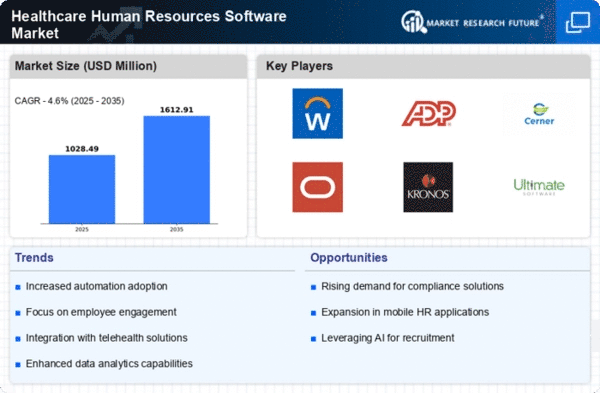
Healthcare Human Resources Software Market Infographic
Purchase Options

Healthcare Human Resources Software Size

Healthcare Human Resources Software Market Growth Projections and Opportunities

The Healthcare Human Resources Software Market is profoundly influenced by the growing demands of the healthcare workforce. As the healthcare industry expands to meet the needs of a growing population, the demand for efficient and streamlined human resources management becomes crucial, driving the adoption of specialized software solutions. The shortage of staff and difficulties in the health care area influence this market. The challenges of recruitment, onboarding and workforce management are the main issue which human resource software seeks to solve; helping healthcare organizations achieve an optimal level in staff allocations while ensuring improved overall efficiency. The demand for compliance with strict healthcare regulations shapes the market. Human resources software includes tools to manage the compliance of healthcare-specific regulations for example, Healthcare Worker Certification and License among others as well adherence to industry standards that ensure legal and regulation adherence. A major driving force of the market is cloud-based solutions adoption. Cloud-based healthcare human resources software provides the necessary scalability, accessibility and integration capability to other systems which are critical given the current industry requirements. The market is driven by the rise in integrated human capital management systems healthcare. Software solutions that consolidate human resources, payroll, time and attendance as well workforce analytics provide operational efficiency improving overall organisation’s effectiveness. In the market, employee engagement and well-being are crucial. The human resources software has functions for tracking employee engagement, managing work schedule and implementing wellness initiatives thus creating a healthy satisfied health care personnel. Telehealth and remote work, that is the market’s shift towards them also affect it. The healthcare human resource software makes provision for the remote workforce management which is very crucial in implementing telehealth initiatives so that wherever health professionals are, they can effectively perform their duties. Market dynamics to a large extent are driven by the data security and privacy concerns. The systems that handle healthcare human resources have to adhere strictly to the data protection legislation in order to protect employees’ private information and maintain the integrity of their workforce related personal details. The market is supported by the attention given to training and development programs for health care professionals. Human resources software has modules for keeping track of training needs, managing career development and enforcing that medical personnel have relevant skills and certifications. One of the market factors is that emerging technologies like AI and analytics have been integrated into it. By means of AI, human resources software is used for predictive analytics in developmental workforce planning and recruitment programs as well as performance management allowing enhancing strategic decision-making. The affordability of cost effective healthcare solutions for small providers affects market availability. Such customized human resources software designed for the small healthcare organizations enable them to enjoy sophisticated HR management functionalities while spending little money, contributing to market expansion.

The competitive landscape among human resources software vendors impacts market dynamics. Intense competition fosters innovation, customization options, and improved user experiences, allowing healthcare organizations to choose solutions that align with their specific needs and preferences.
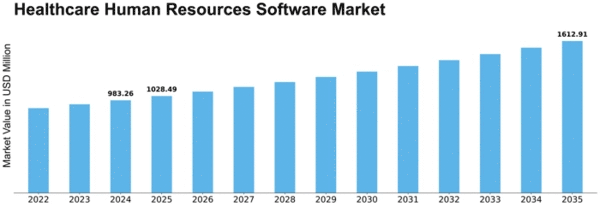
Healthcare Human Resources Software Market Size Graph
Author
Author Profile
Rahul Gotadki
Research Manager

He holds an experience of about 9+ years in Market Research and Business Consulting, working under the spectrum of Life Sciences and Healthcare domains. Rahul conceptualizes and implements a scalable business strategy and provides strategic leadership to the clients. His expertise lies in market estimation, competitive intelligence, pipeline analysis, customer assessment, etc.

Leave a Comment

FAQs

What is the current valuation of the Healthcare Human Resources Software Market?

<p>The market valuation was 983.26 USD Million in 2024.</p>

What is the projected market size for the Healthcare Human Resources Software Market by 2035?

<p>The projected valuation for 2035 is 1612.91 USD Million.</p>

What is the expected CAGR for the Healthcare Human Resources Software Market during the forecast period 2025 - 2035?

<p>The expected CAGR during this period is 4.6%.</p>

Which companies are considered key players in the Healthcare Human Resources Software Market?

<p>Key players include Workday, ADP, Cerner Corporation, Oracle, Kronos, Ultimate Software, SAP, Paycor HCM, and Zenefits.</p>

What are the main application segments in the Healthcare Human Resources Software Market?

<p>The main application segments include Recruitment, Employee Management, Payroll Processing, Performance Management, and Training and Development.</p>

How does the market perform in terms of deployment types?

<p>The market segments by deployment type include On-Premises, Cloud-Based, and Hybrid solutions.</p>

What are the end-user segments in the Healthcare Human Resources Software Market?

End-user segments consist of Hospitals, Clinics, Long-Term Care Facilities, and Home Health Agencies.

What functionalities are prioritized in the Healthcare Human Resources Software Market?

Key functionalities include Talent Acquisition, Workforce Management, Compliance Management, and Employee Self-Service.

How does the market size vary by the size of the organization?

The market segments by organization size into Small, Medium, and Large organizations.

What is the range of valuations for the Training and Development segment?

The Training and Development segment is valued between 233.26 and 412.91 USD Million.

Market Summary

As per MRFR analysis, the Healthcare Human Resources Software Market was estimated at 983.26 USD Million in 2024. The Healthcare Human Resources Software industry is projected to grow from 1028.51 USD Million in 2025 to 1612.91 USD Million by 2035, exhibiting a compound annual growth rate (CAGR) of 4.6% during the forecast period 2025 - 2035.

Key Market Trends & Highlights

The Healthcare Human Resources Software Market is experiencing robust growth driven by technological advancements and evolving workforce needs.

  • North America remains the largest market for healthcare human resources software, driven by a high demand for efficient workforce management.
  • The Asia-Pacific region is emerging as the fastest-growing market, reflecting a surge in healthcare investments and digital transformation.
  • Recruitment continues to be the largest segment, while training and development is witnessing the fastest growth due to an increasing focus on employee engagement.
  • Key market drivers include the rising demand for efficient workforce management and the adoption of cloud-based solutions, which enhance regulatory compliance and risk management.

Market Size & Forecast

2024 Market Size 983.26 (USD Million)
2035 Market Size 1612.91 (USD Million)
CAGR (2025 - 2035) 4.6%
Largest Regional Market Share in 2024 North America

Major Players

Workday (US), ADP (US), Cerner Corporation (US), Oracle (US), Kronos (US), Ultimate Software (US), SAP (DE), Paycor HCM (US), BambooHR (US)

Market Trends

The Healthcare Human Resources Software Market is currently experiencing a transformative phase, driven by the increasing need for efficient workforce management within healthcare organizations. As the sector evolves, the demand for software solutions that streamline recruitment, onboarding, and employee management processes appears to be on the rise. This trend is likely influenced by the growing complexity of healthcare regulations and the necessity for compliance, which necessitates robust HR systems capable of adapting to changing requirements. Furthermore, the integration of advanced technologies such as artificial intelligence and data analytics into HR software solutions is enhancing decision-making capabilities, thereby improving overall operational efficiency. In addition, the emphasis on employee engagement and retention within healthcare settings is becoming more pronounced. Organizations are recognizing that a satisfied workforce is crucial for delivering high-quality patient care. Consequently, software that facilitates performance management, training, and development is gaining traction. The Healthcare Human Resources Software Market seems poised for continued growth as organizations seek to leverage technology to optimize their human capital strategies. This evolution may lead to the emergence of new players in the market, as well as innovative solutions tailored to meet the unique challenges faced by healthcare providers.

Integration of Advanced Technologies

The incorporation of artificial intelligence and machine learning into healthcare HR software is becoming increasingly prevalent. These technologies enhance recruitment processes, automate administrative tasks, and provide predictive analytics for workforce planning.

Focus on Employee Engagement

Healthcare organizations are prioritizing employee satisfaction and retention, recognizing the link between a motivated workforce and quality patient care. Software solutions that support performance management and professional development are gaining importance.

Regulatory Compliance and Adaptability

As healthcare regulations evolve, the need for adaptable HR software that ensures compliance is critical. Organizations are seeking solutions that can quickly adjust to new legal requirements, thereby minimizing risks associated with non-compliance.

Healthcare Human Resources Software Market Market Drivers

Market Growth Projections

The Global Healthcare Human Resources (HR) Software Market Industry is projected to experience substantial growth over the coming years. With a market value of 0.98 USD Billion in 2024, it is anticipated to reach 1.61 USD Billion by 2035. This growth trajectory suggests a compound annual growth rate (CAGR) of 4.62% from 2025 to 2035. Such projections indicate a robust demand for HR software solutions as healthcare organizations increasingly prioritize workforce management and operational efficiency. The market's expansion reflects the ongoing evolution of the healthcare sector and the critical role that effective HR practices play in supporting organizational success.

Integration of Advanced Technologies

The integration of advanced technologies such as artificial intelligence and machine learning is transforming the Global Healthcare Human Resources (HR) Software Market Industry. These technologies enable healthcare organizations to analyze workforce data more effectively, leading to better decision-making and enhanced employee engagement. For instance, AI-driven analytics can identify trends in employee performance and satisfaction, allowing HR departments to implement targeted interventions. This technological advancement is expected to contribute to the market's growth, with projections indicating a market value of 1.61 USD Billion by 2035, reflecting the increasing reliance on data-driven insights in HR management.

Focus on Employee Engagement and Retention

Employee engagement and retention are becoming paramount in the Global Healthcare Human Resources (HR) Software Market Industry. Organizations are recognizing that a satisfied workforce is essential for delivering high-quality patient care. HR software solutions that facilitate employee feedback, performance evaluations, and career development opportunities are gaining traction. By fostering a positive work environment, healthcare organizations can reduce turnover rates and enhance overall productivity. As the market continues to evolve, the emphasis on employee engagement is likely to drive further investments in HR software, contributing to a projected CAGR of 4.62% from 2025 to 2035.

Global Workforce Mobility and Remote Work Trends

The trend towards global workforce mobility and remote work is reshaping the Global Healthcare Human Resources (HR) Software Market Industry. As healthcare organizations adapt to changing work environments, HR software that supports remote workforce management is increasingly in demand. This includes features such as virtual onboarding, remote performance tracking, and telehealth integration. The ability to manage a dispersed workforce effectively is crucial for maintaining operational continuity and ensuring quality patient care. As organizations embrace these trends, the market is poised for growth, reflecting the need for innovative HR solutions that cater to a mobile workforce.

Regulatory Compliance and Reporting Requirements

Regulatory compliance remains a critical driver for the Global Healthcare Human Resources (HR) Software Market Industry. Healthcare organizations must adhere to various regulations, including labor laws and patient privacy standards. HR software solutions are increasingly being utilized to ensure compliance with these regulations, thereby mitigating risks associated with non-compliance. For example, software that automates reporting and tracks employee certifications can significantly reduce the administrative burden on HR departments. As the market evolves, the emphasis on compliance is likely to grow, further propelling the demand for sophisticated HR software solutions.

Increasing Demand for Workforce Management Solutions

The Global Healthcare Human Resources (HR) Software Market Industry experiences a growing demand for effective workforce management solutions. Healthcare organizations are increasingly seeking software that streamlines recruitment, onboarding, and employee management processes. This trend is driven by the need to optimize staffing levels and enhance operational efficiency. For instance, hospitals are adopting HR software to manage their workforce more effectively, which can lead to improved patient care and reduced operational costs. As of 2024, the market is valued at 0.98 USD Billion, indicating a robust growth trajectory as organizations recognize the importance of efficient workforce management.

Market Segment Insights

By Application: Recruitment (Largest) vs. Performance Management (Fastest-Growing)

<p>In the Healthcare Human Resources Software Market, the application segment is primarily dominated by Recruitment, which holds the largest market share. This segment is crucial for healthcare organizations seeking to attract qualified professionals in a highly competitive landscape. Following closely are Employee Management and Payroll Processing, which also hold significant shares due to their integral roles in maintaining a satisfied and compliant workforce. Training and Development, while essential, tend to attract less direct investment compared to these primary applications.</p>

<p>Recruitment: Largest vs. Training and Development: Emerging</p>

<p>Recruitment stands out as the largest segment within the Healthcare Human Resources Software Market, driven by the necessity for healthcare organizations to fill positions rapidly and efficiently to meet patient care demands. This segment utilizes advanced applicant tracking systems and AI technologies to streamline the hiring process, ensuring that the right candidates are sourced in optimal timeframes. On the other hand, Training and Development is emerging as an increasingly important segment, with healthcare organizations recognizing the necessity of continuous education and skills upgrading for their professional staff. This focus on development not only enhances employee satisfaction but also addresses compliance with evolving healthcare regulations and standards. While traditionally seen as less critical, organizations are prioritizing structured training initiatives that align with strategic goals.</p>

By Deployment Type: Cloud-Based (Largest) vs. On-Premises (Fastest-Growing)

<p>The Healthcare Human Resources Software Market is predominantly led by cloud-based deployment types, which have shown significant adoption due to their flexibility and scalability. This deployment approach caters to a diverse range of healthcare organizations by minimizing upfront infrastructure costs while maximizing accessibility and collaboration. As a result, cloud-based solutions hold a considerable share of the market and are favored by users for their ease of integration with existing systems. On the other hand, on-premises solutions are witnessing a resurgence, characterized as the fastest-growing segment in the market. This growth can be attributed to increasing concerns regarding data security and compliance, pushing organizations to prefer more controlled and self-hosted environments. Hybrid models are also gaining traction, offering a balance between the advantages of both cloud-based and on-premises approaches, thereby appealing to various healthcare providers looking for tailored solutions.</p>

<p>Cloud-Based: Dominant vs. On-Premises: Emerging</p>

<p>In the Healthcare Human Resources Software Market, cloud-based deployment remains the dominant choice, primarily due to its cost-effectiveness and operational efficiency. It facilitates seamless updates and maintenance with minimal disruption to operations. Conversely, on-premises solutions are emerging as a compelling option for organizations concerned with data privacy and control over their systems. While traditionally viewed as more rigid, on-premises systems are evolving to incorporate modern functionalities that address the specific needs of healthcare environments. The hybrid model, combining the best aspects of both worlds, is also becoming increasingly appealing, providing flexibility for organizations managing diverse workloads and regulatory requirements. This dynamic landscape highlights a shift towards personalization in deployment strategies.</p>

By End User: Hospitals (Largest) vs. Home Health Agencies (Fastest-Growing)

<p>In the Healthcare Human Resources Software Market, Hospitals represent the largest segment, dominating the market share due to their extensive workforce and complex HR needs. Clinics and Long-Term Care Facilities follow, holding significant but smaller portions of the market share. Home Health Agencies, while currently smaller, are rapidly gaining traction as the demand for home-based healthcare services increases in response to an aging population and the desire for personalized care.</p>

<p>Clinics (Dominant) vs. Long-Term Care Facilities (Emerging)</p>

<p>Clinics are considered the dominant players in the healthcare HR software space as they require efficient staffing and management solutions to handle patients effectively. Their need for flexible software solutions enables them to streamline operations and enhance service delivery. In contrast, Long-Term Care Facilities represent an emerging segment as they adapt to technological advancements and regulatory pressures. These facilities often seek specialized software that can manage both administrative and care-related tasks effectively, indicating a growing awareness of the importance of robust HR systems to ensure compliance and improve patient outcomes.</p>

By Functionality: Talent Acquisition (Largest) vs. Employee Self-Service (Fastest-Growing)

<p>The Healthcare Human Resources Software Market is segmented into four primary functionalities: Talent Acquisition, Workforce Management, Compliance Management, and Employee Self-Service. Talent Acquisition continues to hold the largest share in the market, driven by the increasing demand for skilled healthcare professionals and automated recruitment processes. Following closely, Workforce Management and Compliance Management each contribute significant portions, focusing on optimizing staff utilization and adhering to regulatory requirements, respectively. Employee Self-Service, while smaller currently, is rapidly gaining traction as institutions seek to empower staff with direct access to their HR needs.</p>

<p>Talent Acquisition: Dominant vs. Employee Self-Service: Emerging</p>

<p>Talent Acquisition remains the dominant functionality in the Healthcare Human Resources Software Market, characterized by robust features that streamline the recruitment process, including applicant tracking and integrated onboarding systems tailored for healthcare settings. In contrast, Employee Self-Service is emerging as a vital segment, providing users with direct access to personal information, benefits, and payroll, thereby enhancing employee engagement and satisfaction. As healthcare organizations gradually adopt self-service platforms, expect this segment to experience substantial growth, influenced by the overall shift towards digital solutions that support efficiency and empower employees. The juxtaposition of these functionalities underlines the evolving landscape of healthcare HR solutions, where traditional methods coexist with innovative, user-centric approaches.</p>

By Size of Organization: Small (Largest) vs. Medium (Fastest-Growing)

<p>In the Healthcare Human Resources Software Market, the distribution among various sizes of organizations is quite distinct. Small organizations hold a significant share, benefiting from tailored solutions that cater to their limited human resources needs. This market segment embraces user-friendly interfaces and affordability, making these software systems accessible to smaller healthcare providers. Meanwhile, medium-sized organizations are increasingly adopting HR software as they scale operations, seeking more robust functionality, and have shown a commendable growth trajectory as they expand their workforce and operational complexity.</p>

<p>Small (Dominant) vs. Large (Emerging)</p>

<p>Small organizations remain the dominant users of Healthcare Human Resources Software, primarily due to their focus on cost-effective solutions that meet their essential HR requirements without overwhelming complexity. They prioritize functionalities like basic payroll processing and employee management. Conversely, large organizations are emerging in this market segment, transitioning to advanced HR systems that support extensive employee databases, complex analytics, and multi-location management. This shift is driven by the need for integration across global operations and compliance with diverse regulatory requirements, indicating a gradual move towards comprehensive solutions that can handle the intricacies of larger workforces.</p>

Get more detailed insights about Healthcare Human Resources (HR) Software Market Research Report -Forecast to 2035

Regional Insights

North America : Market Leader in Healthcare Software

North America continues to lead the Healthcare Human Resources Software Market, holding a significant market share of 550.0M in 2024. The region's growth is driven by increasing healthcare expenditures, a rising demand for efficient HR solutions, and stringent regulatory requirements that necessitate advanced software solutions. The integration of AI and data analytics in HR processes is also a key trend, enhancing operational efficiency and compliance. The competitive landscape in North America is robust, featuring major players like Workday, ADP, and Oracle. The U.S. is the primary market, supported by a strong healthcare infrastructure and a high adoption rate of technology in HR practices. Companies are increasingly focusing on employee engagement and retention strategies, further propelling the demand for innovative HR software solutions. The presence of established firms ensures a dynamic market environment, fostering continuous innovation.

Europe : Emerging Market with Growth Potential

Europe's Healthcare Human Resources Software Market is valued at 250.0M, reflecting a growing demand for integrated HR solutions across the healthcare sector. Key growth drivers include the increasing need for compliance with EU regulations, a focus on improving workforce management, and the rising trend of digital transformation in healthcare. Countries are investing in technology to enhance operational efficiency and patient care, which is expected to boost market growth significantly. Leading countries in this region include Germany, the UK, and France, where the presence of key players like SAP and Cerner Corporation is notable. The competitive landscape is characterized by a mix of established firms and emerging startups, all vying for market share. The European market is witnessing a shift towards cloud-based solutions, which offer scalability and flexibility, further enhancing the attractiveness of HR software in the healthcare sector. "The European healthcare sector is undergoing a digital transformation, necessitating advanced HR solutions to meet regulatory and operational demands."

Asia-Pacific : Rapid Growth in Healthcare Sector

The Asia-Pacific region is experiencing a significant surge in the Healthcare Human Resources Software Market, valued at 150.0M. This growth is driven by increasing healthcare investments, a rising population, and the urgent need for efficient HR management systems. Governments are also implementing policies to enhance healthcare services, which is catalyzing the demand for advanced HR software solutions tailored to the healthcare sector. Countries like China, India, and Japan are leading the charge, with a growing number of healthcare facilities adopting technology to streamline HR processes. The competitive landscape is evolving, with both local and international players entering the market. Companies are focusing on developing user-friendly and cost-effective solutions to cater to the diverse needs of healthcare providers in the region. The emphasis on improving employee satisfaction and retention is also shaping the market dynamics.

Middle East and Africa : Emerging Market with Untapped Potential

The Middle East and Africa region, with a market size of 33.26M, presents significant growth opportunities in the Healthcare Human Resources Software Market. The increasing focus on healthcare infrastructure development and the need for efficient HR management systems are key drivers of market growth. Governments are investing in healthcare reforms, which is expected to boost the demand for advanced HR software solutions tailored to the sector. Leading countries in this region include South Africa, the UAE, and Saudi Arabia, where the healthcare sector is rapidly evolving. The competitive landscape is characterized by a mix of local and international players, all aiming to capture market share. The emphasis on improving workforce management and compliance with local regulations is shaping the market dynamics, making it an attractive area for investment and innovation.

Key Players and Competitive Insights

The Healthcare Human Resources Software Market is currently characterized by a dynamic competitive landscape, driven by the increasing demand for efficient workforce management solutions and the ongoing digital transformation within the healthcare sector. Key players such as Workday (US), ADP (US), and Oracle (US) are strategically positioned to leverage their technological capabilities and extensive industry experience. Workday (US) focuses on innovation through continuous product enhancements, while ADP (US) emphasizes its comprehensive payroll and HR solutions tailored for healthcare organizations. Oracle (US) is actively pursuing partnerships to expand its cloud-based offerings, thereby enhancing its competitive edge. Collectively, these strategies contribute to a moderately fragmented market structure, where competition is intensifying as companies seek to differentiate themselves through advanced technology and customer-centric solutions.In terms of business tactics, companies are increasingly localizing their services to better meet regional needs and optimize their supply chains for efficiency. The competitive structure of the market appears to be moderately fragmented, with several key players exerting influence over market dynamics. This fragmentation allows for a diverse range of solutions, catering to various segments within the healthcare industry, while also fostering innovation as companies strive to capture market share.

In November Workday (US) announced a strategic partnership with a leading telehealth provider to integrate its HR software with telehealth platforms. This move is significant as it positions Workday (US) to capitalize on the growing trend of remote healthcare services, enhancing its value proposition to healthcare organizations seeking to streamline their HR processes alongside telehealth operations. The integration is expected to improve workforce management efficiency and employee satisfaction, thereby reinforcing Workday's competitive position.

In October ADP (US) launched a new AI-driven analytics tool designed specifically for healthcare organizations. This tool aims to provide actionable insights into workforce performance and compliance, which is crucial in a highly regulated industry. The introduction of this technology underscores ADP's commitment to innovation and its understanding of the unique challenges faced by healthcare HR departments. By leveraging AI, ADP (US) enhances its service offerings, potentially attracting new clients looking for advanced analytical capabilities.

In September Oracle (US) expanded its cloud-based HR solutions through the acquisition of a niche player specializing in employee engagement software. This acquisition is indicative of Oracle's strategy to enhance its product suite and provide comprehensive solutions that address the evolving needs of healthcare organizations. By integrating employee engagement tools, Oracle (US) aims to foster a more connected and motivated workforce, which is essential for improving patient care and operational efficiency.

As of December the competitive trends within the Healthcare Human Resources Software Market are increasingly defined by digitalization, sustainability, and the integration of AI technologies. Strategic alliances are becoming more prevalent, as companies recognize the importance of collaboration in driving innovation and enhancing service delivery. Looking ahead, it is likely that competitive differentiation will evolve from traditional price-based competition to a focus on technological innovation, reliability in supply chains, and the ability to provide tailored solutions that meet the specific needs of healthcare organizations.

Key Companies in the Healthcare Human Resources Software Market include

Industry Developments

November 2025: Medtronic announced a major strategic initiative to deploy more than 200 “Agentic AI” agents across its global HR function. The deployment aims to automate 80% of routine HR processes – such as candidate screening and employee communications – within three years, Signaling a shift in the market toward autonomous workforce management tools.

February 2025: My Michigan Health has completed the integration of Queda’s provider credentialing solutions. The implementation highlights the growing market demand for a unified platform that combines scheduling and credentialing to reduce "time-to-fill" for critical clinical roles.

December 2024: HR for Health has entered a strategic partnership with Unify to integrate HR compliance automation with technology efficiency tools for dental and medical practices. The collaboration targets the growing class of small to mid-sized practices that require specialized compliance support.

Future Outlook

Healthcare Human Resources Software Market Future Outlook

The Healthcare Human Resources Software Market is projected to grow at a 4.6% CAGR from 2025 to 2035, driven by technological advancements, regulatory changes, and increasing workforce management needs.

New opportunities lie in:

  • Integration of AI-driven recruitment tools for enhanced candidate selection.
  • Development of mobile HR applications for real-time employee engagement.
  • Implementation of data analytics for workforce optimization and retention strategies.

By 2035, the market is expected to be robust, reflecting substantial growth and innovation.

Market Segmentation

Healthcare Human Resources Software Market End User Outlook

  • Hospitals
  • Clinics
  • Long-Term Care Facilities
  • Home Healthcare Providers

Healthcare Human Resources Software Market Application Outlook

  • Recruitment
  • Employee Management
  • Payroll Management
  • Performance Management
  • Training and Development

Healthcare Human Resources Software Market Functionality Outlook

  • Talent Acquisition
  • Workforce Management
  • Compliance Management
  • Employee Self-Service

Healthcare Human Resources Software Market Deployment Type Outlook

  • On-Premise
  • Cloud-Based
  • Hybrid

Healthcare Human Resources Software Market Size of Organization Outlook

  • Small
  • Medium
  • Large

Report Scope

MARKET SIZE 2024 983.26(USD Million)
MARKET SIZE 2025 1028.51(USD Million)
MARKET SIZE 2035 1612.91(USD Million)
COMPOUND ANNUAL GROWTH RATE (CAGR) 4.6% (2025 - 2035)
REPORT COVERAGE Revenue Forecast, Competitive Landscape, Growth Factors, and Trends
BASE YEAR 2024
Market Forecast Period 2025 - 2035
Historical Data 2019 - 2024
Market Forecast Units USD Million
Key Companies Profiled Workday (US), ADP (US), Cerner Corporation (US), Oracle (US), Kronos (US), Ultimate Software (US), SAP (DE), Paycor HCM (US), BambooHR (US)
Segments Covered Application, Deployment Type, End User, Functionality, Size of Organization
Key Market Opportunities Integration of artificial intelligence to enhance recruitment and employee management in the Healthcare Human Resources Software Market.
Key Market Dynamics Rising demand for integrated solutions drives innovation and competition in the Healthcare Human Resources Software market.
Countries Covered North America, Europe, APAC, South America, MEA

FAQs

What is the current valuation of the Healthcare Human Resources Software Market?

<p>The market valuation was 983.26 USD Million in 2024.</p>

What is the projected market size for the Healthcare Human Resources Software Market by 2035?

<p>The projected valuation for 2035 is 1612.91 USD Million.</p>

What is the expected CAGR for the Healthcare Human Resources Software Market during the forecast period 2025 - 2035?

<p>The expected CAGR during this period is 4.6%.</p>

Which companies are considered key players in the Healthcare Human Resources Software Market?

<p>Key players include Workday, ADP, Cerner Corporation, Oracle, Kronos, Ultimate Software, SAP, Paycor HCM, and Zenefits.</p>

What are the main application segments in the Healthcare Human Resources Software Market?

<p>The main application segments include Recruitment, Employee Management, Payroll Processing, Performance Management, and Training and Development.</p>

How does the market perform in terms of deployment types?

<p>The market segments by deployment type include On-Premises, Cloud-Based, and Hybrid solutions.</p>

What are the end-user segments in the Healthcare Human Resources Software Market?

End-user segments consist of Hospitals, Clinics, Long-Term Care Facilities, and Home Health Agencies.

What functionalities are prioritized in the Healthcare Human Resources Software Market?

Key functionalities include Talent Acquisition, Workforce Management, Compliance Management, and Employee Self-Service.

How does the market size vary by the size of the organization?

The market segments by organization size into Small, Medium, and Large organizations.

What is the range of valuations for the Training and Development segment?

The Training and Development segment is valued between 233.26 and 412.91 USD Million.

  1. SECTION I: EXECUTIVE SUMMARY AND KEY HIGHLIGHTS
    1. | 1.1 EXECUTIVE SUMMARY
    2. | | 1.1.1 Market Overview
    3. | | 1.1.2 Key Findings
    4. | | 1.1.3 Market Segmentation
    5. | | 1.1.4 Competitive Landscape
    6. | | 1.1.5 Challenges and Opportunities
    7. | | 1.1.6 Future Outlook
  2. SECTION II: SCOPING, METHODOLOGY AND MARKET STRUCTURE
    1. | 2.1 MARKET INTRODUCTION
    2. | | 2.1.1 Definition
    3. | | 2.1.2 Scope of the study
    4. | | | 2.1.2.1 Research Objective
    5. | | | 2.1.2.2 Assumption
    6. | | | 2.1.2.3 Limitations
    7. | 2.2 RESEARCH METHODOLOGY
    8. | | 2.2.1 Overview
    9. | | 2.2.2 Data Mining
    10. | | 2.2.3 Secondary Research
    11. | | 2.2.4 Primary Research
    12. | | | 2.2.4.1 Primary Interviews and Information Gathering Process
    13. | | | 2.2.4.2 Breakdown of Primary Respondents
    14. | | 2.2.5 Forecasting Model
    15. | | 2.2.6 Market Size Estimation
    16. | | | 2.2.6.1 Bottom-Up Approach
    17. | | | 2.2.6.2 Top-Down Approach
    18. | | 2.2.7 Data Triangulation
    19. | | 2.2.8 Validation
  3. SECTION III: QUALITATIVE ANALYSIS
    1. | 3.1 MARKET DYNAMICS
    2. | | 3.1.1 Overview
    3. | | 3.1.2 Drivers
    4. | | 3.1.3 Restraints
    5. | | 3.1.4 Opportunities
    6. | 3.2 MARKET FACTOR ANALYSIS
    7. | | 3.2.1 Value chain Analysis
    8. | | 3.2.2 Porter's Five Forces Analysis
    9. | | | 3.2.2.1 Bargaining Power of Suppliers
    10. | | | 3.2.2.2 Bargaining Power of Buyers
    11. | | | 3.2.2.3 Threat of New Entrants
    12. | | | 3.2.2.4 Threat of Substitutes
    13. | | | 3.2.2.5 Intensity of Rivalry
    14. | | 3.2.3 COVID-19 Impact Analysis
    15. | | | 3.2.3.1 Market Impact Analysis
    16. | | | 3.2.3.2 Regional Impact
    17. | | | 3.2.3.3 Opportunity and Threat Analysis
  4. SECTION IV: QUANTITATIVE ANALYSIS
    1. | 4.1 Healthcare, BY Application (USD Million)
    2. | | 4.1.1 Recruitment
    3. | | 4.1.2 Employee Management
    4. | | 4.1.3 Payroll Processing
    5. | | 4.1.4 Performance Management
    6. | | 4.1.5 Training and Development
    7. | 4.2 Healthcare, BY Deployment Type (USD Million)
    8. | | 4.2.1 On-Premises
    9. | | 4.2.2 Cloud-Based
    10. | | 4.2.3 Hybrid
    11. | 4.3 Healthcare, BY End User (USD Million)
    12. | | 4.3.1 Hospitals
    13. | | 4.3.2 Clinics
    14. | | 4.3.3 Long-Term Care Facilities
    15. | | 4.3.4 Home Health Agencies
    16. | 4.4 Healthcare, BY Functionality (USD Million)
    17. | | 4.4.1 Talent Acquisition
    18. | | 4.4.2 Workforce Management
    19. | | 4.4.3 Compliance Management
    20. | | 4.4.4 Employee Self-Service
    21. | 4.5 Healthcare, BY Size of Organization (USD Million)
    22. | | 4.5.1 Small
    23. | | 4.5.2 Medium
    24. | | 4.5.3 Large
    25. | 4.6 Healthcare, BY Region (USD Million)
    26. | | 4.6.1 North America
    27. | | | 4.6.1.1 US
    28. | | | 4.6.1.2 Canada
    29. | | 4.6.2 Europe
    30. | | | 4.6.2.1 Germany
    31. | | | 4.6.2.2 UK
    32. | | | 4.6.2.3 France
    33. | | | 4.6.2.4 Russia
    34. | | | 4.6.2.5 Italy
    35. | | | 4.6.2.6 Spain
    36. | | | 4.6.2.7 Rest of Europe
    37. | | 4.6.3 APAC
    38. | | | 4.6.3.1 China
    39. | | | 4.6.3.2 India
    40. | | | 4.6.3.3 Japan
    41. | | | 4.6.3.4 South Korea
    42. | | | 4.6.3.5 Malaysia
    43. | | | 4.6.3.6 Thailand
    44. | | | 4.6.3.7 Indonesia
    45. | | | 4.6.3.8 Rest of APAC
    46. | | 4.6.4 South America
    47. | | | 4.6.4.1 Brazil
    48. | | | 4.6.4.2 Mexico
    49. | | | 4.6.4.3 Argentina
    50. | | | 4.6.4.4 Rest of South America
    51. | | 4.6.5 MEA
    52. | | | 4.6.5.1 GCC Countries
    53. | | | 4.6.5.2 South Africa
    54. | | | 4.6.5.3 Rest of MEA
  5. SECTION V: COMPETITIVE ANALYSIS
    1. | 5.1 Competitive Landscape
    2. | | 5.1.1 Overview
    3. | | 5.1.2 Competitive Analysis
    4. | | 5.1.3 Market share Analysis
    5. | | 5.1.4 Major Growth Strategy in the Healthcare
    6. | | 5.1.5 Competitive Benchmarking
    7. | | 5.1.6 Leading Players in Terms of Number of Developments in the Healthcare
    8. | | 5.1.7 Key developments and growth strategies
    9. | | | 5.1.7.1 New Product Launch/Service Deployment
    10. | | | 5.1.7.2 Merger & Acquisitions
    11. | | | 5.1.7.3 Joint Ventures
    12. | | 5.1.8 Major Players Financial Matrix
    13. | | | 5.1.8.1 Sales and Operating Income
    14. | | | 5.1.8.2 Major Players R&D Expenditure. 2023
    15. | 5.2 Company Profiles
    16. | | 5.2.1 Workday (US)
    17. | | | 5.2.1.1 Financial Overview
    18. | | | 5.2.1.2 Products Offered
    19. | | | 5.2.1.3 Key Developments
    20. | | | 5.2.1.4 SWOT Analysis
    21. | | | 5.2.1.5 Key Strategies
    22. | | 5.2.2 ADP (US)
    23. | | | 5.2.2.1 Financial Overview
    24. | | | 5.2.2.2 Products Offered
    25. | | | 5.2.2.3 Key Developments
    26. | | | 5.2.2.4 SWOT Analysis
    27. | | | 5.2.2.5 Key Strategies
    28. | | 5.2.3 Cerner Corporation (US)
    29. | | | 5.2.3.1 Financial Overview
    30. | | | 5.2.3.2 Products Offered
    31. | | | 5.2.3.3 Key Developments
    32. | | | 5.2.3.4 SWOT Analysis
    33. | | | 5.2.3.5 Key Strategies
    34. | | 5.2.4 Oracle (US)
    35. | | | 5.2.4.1 Financial Overview
    36. | | | 5.2.4.2 Products Offered
    37. | | | 5.2.4.3 Key Developments
    38. | | | 5.2.4.4 SWOT Analysis
    39. | | | 5.2.4.5 Key Strategies
    40. | | 5.2.5 Kronos (US)
    41. | | | 5.2.5.1 Financial Overview
    42. | | | 5.2.5.2 Products Offered
    43. | | | 5.2.5.3 Key Developments
    44. | | | 5.2.5.4 SWOT Analysis
    45. | | | 5.2.5.5 Key Strategies
    46. | | 5.2.6 Ultimate Software (US)
    47. | | | 5.2.6.1 Financial Overview
    48. | | | 5.2.6.2 Products Offered
    49. | | | 5.2.6.3 Key Developments
    50. | | | 5.2.6.4 SWOT Analysis
    51. | | | 5.2.6.5 Key Strategies
    52. | | 5.2.7 SAP (DE)
    53. | | | 5.2.7.1 Financial Overview
    54. | | | 5.2.7.2 Products Offered
    55. | | | 5.2.7.3 Key Developments
    56. | | | 5.2.7.4 SWOT Analysis
    57. | | | 5.2.7.5 Key Strategies
    58. | | 5.2.8 Paycor HCM (US)
    59. | | | 5.2.8.1 Financial Overview
    60. | | | 5.2.8.2 Products Offered
    61. | | | 5.2.8.3 Key Developments
    62. | | | 5.2.8.4 SWOT Analysis
    63. | | | 5.2.8.5 Key Strategies
    64. | | 5.2.9 Zenefits (US)
    65. | | | 5.2.9.1 Financial Overview
    66. | | | 5.2.9.2 Products Offered
    67. | | | 5.2.9.3 Key Developments
    68. | | | 5.2.9.4 SWOT Analysis
    69. | | | 5.2.9.5 Key Strategies
    70. | 5.3 Appendix
    71. | | 5.3.1 References
    72. | | 5.3.2 Related Reports
  6. LIST OF FIGURES
    1. | 6.1 MARKET SYNOPSIS
    2. | 6.2 NORTH AMERICA MARKET ANALYSIS
    3. | 6.3 US MARKET ANALYSIS BY APPLICATION
    4. | 6.4 US MARKET ANALYSIS BY DEPLOYMENT TYPE
    5. | 6.5 US MARKET ANALYSIS BY END USER
    6. | 6.6 US MARKET ANALYSIS BY FUNCTIONALITY
    7. | 6.7 US MARKET ANALYSIS BY SIZE OF ORGANIZATION
    8. | 6.8 CANADA MARKET ANALYSIS BY APPLICATION
    9. | 6.9 CANADA MARKET ANALYSIS BY DEPLOYMENT TYPE
    10. | 6.10 CANADA MARKET ANALYSIS BY END USER
    11. | 6.11 CANADA MARKET ANALYSIS BY FUNCTIONALITY
    12. | 6.12 CANADA MARKET ANALYSIS BY SIZE OF ORGANIZATION
    13. | 6.13 EUROPE MARKET ANALYSIS
    14. | 6.14 GERMANY MARKET ANALYSIS BY APPLICATION
    15. | 6.15 GERMANY MARKET ANALYSIS BY DEPLOYMENT TYPE
    16. | 6.16 GERMANY MARKET ANALYSIS BY END USER
    17. | 6.17 GERMANY MARKET ANALYSIS BY FUNCTIONALITY
    18. | 6.18 GERMANY MARKET ANALYSIS BY SIZE OF ORGANIZATION
    19. | 6.19 UK MARKET ANALYSIS BY APPLICATION
    20. | 6.20 UK MARKET ANALYSIS BY DEPLOYMENT TYPE
    21. | 6.21 UK MARKET ANALYSIS BY END USER
    22. | 6.22 UK MARKET ANALYSIS BY FUNCTIONALITY
    23. | 6.23 UK MARKET ANALYSIS BY SIZE OF ORGANIZATION
    24. | 6.24 FRANCE MARKET ANALYSIS BY APPLICATION
    25. | 6.25 FRANCE MARKET ANALYSIS BY DEPLOYMENT TYPE
    26. | 6.26 FRANCE MARKET ANALYSIS BY END USER
    27. | 6.27 FRANCE MARKET ANALYSIS BY FUNCTIONALITY
    28. | 6.28 FRANCE MARKET ANALYSIS BY SIZE OF ORGANIZATION
    29. | 6.29 RUSSIA MARKET ANALYSIS BY APPLICATION
    30. | 6.30 RUSSIA MARKET ANALYSIS BY DEPLOYMENT TYPE
    31. | 6.31 RUSSIA MARKET ANALYSIS BY END USER
    32. | 6.32 RUSSIA MARKET ANALYSIS BY FUNCTIONALITY
    33. | 6.33 RUSSIA MARKET ANALYSIS BY SIZE OF ORGANIZATION
    34. | 6.34 ITALY MARKET ANALYSIS BY APPLICATION
    35. | 6.35 ITALY MARKET ANALYSIS BY DEPLOYMENT TYPE
    36. | 6.36 ITALY MARKET ANALYSIS BY END USER
    37. | 6.37 ITALY MARKET ANALYSIS BY FUNCTIONALITY
    38. | 6.38 ITALY MARKET ANALYSIS BY SIZE OF ORGANIZATION
    39. | 6.39 SPAIN MARKET ANALYSIS BY APPLICATION
    40. | 6.40 SPAIN MARKET ANALYSIS BY DEPLOYMENT TYPE
    41. | 6.41 SPAIN MARKET ANALYSIS BY END USER
    42. | 6.42 SPAIN MARKET ANALYSIS BY FUNCTIONALITY
    43. | 6.43 SPAIN MARKET ANALYSIS BY SIZE OF ORGANIZATION
    44. | 6.44 REST OF EUROPE MARKET ANALYSIS BY APPLICATION
    45. | 6.45 REST OF EUROPE MARKET ANALYSIS BY DEPLOYMENT TYPE
    46. | 6.46 REST OF EUROPE MARKET ANALYSIS BY END USER
    47. | 6.47 REST OF EUROPE MARKET ANALYSIS BY FUNCTIONALITY
    48. | 6.48 REST OF EUROPE MARKET ANALYSIS BY SIZE OF ORGANIZATION
    49. | 6.49 APAC MARKET ANALYSIS
    50. | 6.50 CHINA MARKET ANALYSIS BY APPLICATION
    51. | 6.51 CHINA MARKET ANALYSIS BY DEPLOYMENT TYPE
    52. | 6.52 CHINA MARKET ANALYSIS BY END USER
    53. | 6.53 CHINA MARKET ANALYSIS BY FUNCTIONALITY
    54. | 6.54 CHINA MARKET ANALYSIS BY SIZE OF ORGANIZATION
    55. | 6.55 INDIA MARKET ANALYSIS BY APPLICATION
    56. | 6.56 INDIA MARKET ANALYSIS BY DEPLOYMENT TYPE
    57. | 6.57 INDIA MARKET ANALYSIS BY END USER
    58. | 6.58 INDIA MARKET ANALYSIS BY FUNCTIONALITY
    59. | 6.59 INDIA MARKET ANALYSIS BY SIZE OF ORGANIZATION
    60. | 6.60 JAPAN MARKET ANALYSIS BY APPLICATION
    61. | 6.61 JAPAN MARKET ANALYSIS BY DEPLOYMENT TYPE
    62. | 6.62 JAPAN MARKET ANALYSIS BY END USER
    63. | 6.63 JAPAN MARKET ANALYSIS BY FUNCTIONALITY
    64. | 6.64 JAPAN MARKET ANALYSIS BY SIZE OF ORGANIZATION
    65. | 6.65 SOUTH KOREA MARKET ANALYSIS BY APPLICATION
    66. | 6.66 SOUTH KOREA MARKET ANALYSIS BY DEPLOYMENT TYPE
    67. | 6.67 SOUTH KOREA MARKET ANALYSIS BY END USER
    68. | 6.68 SOUTH KOREA MARKET ANALYSIS BY FUNCTIONALITY
    69. | 6.69 SOUTH KOREA MARKET ANALYSIS BY SIZE OF ORGANIZATION
    70. | 6.70 MALAYSIA MARKET ANALYSIS BY APPLICATION
    71. | 6.71 MALAYSIA MARKET ANALYSIS BY DEPLOYMENT TYPE
    72. | 6.72 MALAYSIA MARKET ANALYSIS BY END USER
    73. | 6.73 MALAYSIA MARKET ANALYSIS BY FUNCTIONALITY
    74. | 6.74 MALAYSIA MARKET ANALYSIS BY SIZE OF ORGANIZATION
    75. | 6.75 THAILAND MARKET ANALYSIS BY APPLICATION
    76. | 6.76 THAILAND MARKET ANALYSIS BY DEPLOYMENT TYPE
    77. | 6.77 THAILAND MARKET ANALYSIS BY END USER
    78. | 6.78 THAILAND MARKET ANALYSIS BY FUNCTIONALITY
    79. | 6.79 THAILAND MARKET ANALYSIS BY SIZE OF ORGANIZATION
    80. | 6.80 INDONESIA MARKET ANALYSIS BY APPLICATION
    81. | 6.81 INDONESIA MARKET ANALYSIS BY DEPLOYMENT TYPE
    82. | 6.82 INDONESIA MARKET ANALYSIS BY END USER
    83. | 6.83 INDONESIA MARKET ANALYSIS BY FUNCTIONALITY
    84. | 6.84 INDONESIA MARKET ANALYSIS BY SIZE OF ORGANIZATION
    85. | 6.85 REST OF APAC MARKET ANALYSIS BY APPLICATION
    86. | 6.86 REST OF APAC MARKET ANALYSIS BY DEPLOYMENT TYPE
    87. | 6.87 REST OF APAC MARKET ANALYSIS BY END USER
    88. | 6.88 REST OF APAC MARKET ANALYSIS BY FUNCTIONALITY
    89. | 6.89 REST OF APAC MARKET ANALYSIS BY SIZE OF ORGANIZATION
    90. | 6.90 SOUTH AMERICA MARKET ANALYSIS
    91. | 6.91 BRAZIL MARKET ANALYSIS BY APPLICATION
    92. | 6.92 BRAZIL MARKET ANALYSIS BY DEPLOYMENT TYPE
    93. | 6.93 BRAZIL MARKET ANALYSIS BY END USER
    94. | 6.94 BRAZIL MARKET ANALYSIS BY FUNCTIONALITY
    95. | 6.95 BRAZIL MARKET ANALYSIS BY SIZE OF ORGANIZATION
    96. | 6.96 MEXICO MARKET ANALYSIS BY APPLICATION
    97. | 6.97 MEXICO MARKET ANALYSIS BY DEPLOYMENT TYPE
    98. | 6.98 MEXICO MARKET ANALYSIS BY END USER
    99. | 6.99 MEXICO MARKET ANALYSIS BY FUNCTIONALITY
    100. | 6.100 MEXICO MARKET ANALYSIS BY SIZE OF ORGANIZATION
    101. | 6.101 ARGENTINA MARKET ANALYSIS BY APPLICATION
    102. | 6.102 ARGENTINA MARKET ANALYSIS BY DEPLOYMENT TYPE
    103. | 6.103 ARGENTINA MARKET ANALYSIS BY END USER
    104. | 6.104 ARGENTINA MARKET ANALYSIS BY FUNCTIONALITY
    105. | 6.105 ARGENTINA MARKET ANALYSIS BY SIZE OF ORGANIZATION
    106. | 6.106 REST OF SOUTH AMERICA MARKET ANALYSIS BY APPLICATION
    107. | 6.107 REST OF SOUTH AMERICA MARKET ANALYSIS BY DEPLOYMENT TYPE
    108. | 6.108 REST OF SOUTH AMERICA MARKET ANALYSIS BY END USER
    109. | 6.109 REST OF SOUTH AMERICA MARKET ANALYSIS BY FUNCTIONALITY
    110. | 6.110 REST OF SOUTH AMERICA MARKET ANALYSIS BY SIZE OF ORGANIZATION
    111. | 6.111 MEA MARKET ANALYSIS
    112. | 6.112 GCC COUNTRIES MARKET ANALYSIS BY APPLICATION
    113. | 6.113 GCC COUNTRIES MARKET ANALYSIS BY DEPLOYMENT TYPE
    114. | 6.114 GCC COUNTRIES MARKET ANALYSIS BY END USER
    115. | 6.115 GCC COUNTRIES MARKET ANALYSIS BY FUNCTIONALITY
    116. | 6.116 GCC COUNTRIES MARKET ANALYSIS BY SIZE OF ORGANIZATION
    117. | 6.117 SOUTH AFRICA MARKET ANALYSIS BY APPLICATION
    118. | 6.118 SOUTH AFRICA MARKET ANALYSIS BY DEPLOYMENT TYPE
    119. | 6.119 SOUTH AFRICA MARKET ANALYSIS BY END USER
    120. | 6.120 SOUTH AFRICA MARKET ANALYSIS BY FUNCTIONALITY
    121. | 6.121 SOUTH AFRICA MARKET ANALYSIS BY SIZE OF ORGANIZATION
    122. | 6.122 REST OF MEA MARKET ANALYSIS BY APPLICATION
    123. | 6.123 REST OF MEA MARKET ANALYSIS BY DEPLOYMENT TYPE
    124. | 6.124 REST OF MEA MARKET ANALYSIS BY END USER
    125. | 6.125 REST OF MEA MARKET ANALYSIS BY FUNCTIONALITY
    126. | 6.126 REST OF MEA MARKET ANALYSIS BY SIZE OF ORGANIZATION
    127. | 6.127 KEY BUYING CRITERIA OF HEALTHCARE
    128. | 6.128 RESEARCH PROCESS OF MRFR
    129. | 6.129 DRO ANALYSIS OF HEALTHCARE
    130. | 6.130 DRIVERS IMPACT ANALYSIS: HEALTHCARE
    131. | 6.131 RESTRAINTS IMPACT ANALYSIS: HEALTHCARE
    132. | 6.132 SUPPLY / VALUE CHAIN: HEALTHCARE
    133. | 6.133 HEALTHCARE, BY APPLICATION, 2024 (% SHARE)
    134. | 6.134 HEALTHCARE, BY APPLICATION, 2024 TO 2035 (USD Million)
    135. | 6.135 HEALTHCARE, BY DEPLOYMENT TYPE, 2024 (% SHARE)
    136. | 6.136 HEALTHCARE, BY DEPLOYMENT TYPE, 2024 TO 2035 (USD Million)
    137. | 6.137 HEALTHCARE, BY END USER, 2024 (% SHARE)
    138. | 6.138 HEALTHCARE, BY END USER, 2024 TO 2035 (USD Million)
    139. | 6.139 HEALTHCARE, BY FUNCTIONALITY, 2024 (% SHARE)
    140. | 6.140 HEALTHCARE, BY FUNCTIONALITY, 2024 TO 2035 (USD Million)
    141. | 6.141 HEALTHCARE, BY SIZE OF ORGANIZATION, 2024 (% SHARE)
    142. | 6.142 HEALTHCARE, BY SIZE OF ORGANIZATION, 2024 TO 2035 (USD Million)
    143. | 6.143 BENCHMARKING OF MAJOR COMPETITORS
  7. LIST OF TABLES
    1. | 7.1 LIST OF ASSUMPTIONS
    2. | | 7.1.1
    3. | 7.2 North America MARKET SIZE ESTIMATES; FORECAST
    4. | | 7.2.1 BY APPLICATION, 2025-2035 (USD Million)
    5. | | 7.2.2 BY DEPLOYMENT TYPE, 2025-2035 (USD Million)
    6. | | 7.2.3 BY END USER, 2025-2035 (USD Million)
    7. | | 7.2.4 BY FUNCTIONALITY, 2025-2035 (USD Million)
    8. | | 7.2.5 BY SIZE OF ORGANIZATION, 2025-2035 (USD Million)
    9. | 7.3 US MARKET SIZE ESTIMATES; FORECAST
    10. | | 7.3.1 BY APPLICATION, 2025-2035 (USD Million)
    11. | | 7.3.2 BY DEPLOYMENT TYPE, 2025-2035 (USD Million)
    12. | | 7.3.3 BY END USER, 2025-2035 (USD Million)
    13. | | 7.3.4 BY FUNCTIONALITY, 2025-2035 (USD Million)
    14. | | 7.3.5 BY SIZE OF ORGANIZATION, 2025-2035 (USD Million)
    15. | 7.4 Canada MARKET SIZE ESTIMATES; FORECAST
    16. | | 7.4.1 BY APPLICATION, 2025-2035 (USD Million)
    17. | | 7.4.2 BY DEPLOYMENT TYPE, 2025-2035 (USD Million)
    18. | | 7.4.3 BY END USER, 2025-2035 (USD Million)
    19. | | 7.4.4 BY FUNCTIONALITY, 2025-2035 (USD Million)
    20. | | 7.4.5 BY SIZE OF ORGANIZATION, 2025-2035 (USD Million)
    21. | 7.5 Europe MARKET SIZE ESTIMATES; FORECAST
    22. | | 7.5.1 BY APPLICATION, 2025-2035 (USD Million)
    23. | | 7.5.2 BY DEPLOYMENT TYPE, 2025-2035 (USD Million)
    24. | | 7.5.3 BY END USER, 2025-2035 (USD Million)
    25. | | 7.5.4 BY FUNCTIONALITY, 2025-2035 (USD Million)
    26. | | 7.5.5 BY SIZE OF ORGANIZATION, 2025-2035 (USD Million)
    27. | 7.6 Germany MARKET SIZE ESTIMATES; FORECAST
    28. | | 7.6.1 BY APPLICATION, 2025-2035 (USD Million)
    29. | | 7.6.2 BY DEPLOYMENT TYPE, 2025-2035 (USD Million)
    30. | | 7.6.3 BY END USER, 2025-2035 (USD Million)
    31. | | 7.6.4 BY FUNCTIONALITY, 2025-2035 (USD Million)
    32. | | 7.6.5 BY SIZE OF ORGANIZATION, 2025-2035 (USD Million)
    33. | 7.7 UK MARKET SIZE ESTIMATES; FORECAST
    34. | | 7.7.1 BY APPLICATION, 2025-2035 (USD Million)
    35. | | 7.7.2 BY DEPLOYMENT TYPE, 2025-2035 (USD Million)
    36. | | 7.7.3 BY END USER, 2025-2035 (USD Million)
    37. | | 7.7.4 BY FUNCTIONALITY, 2025-2035 (USD Million)
    38. | | 7.7.5 BY SIZE OF ORGANIZATION, 2025-2035 (USD Million)
    39. | 7.8 France MARKET SIZE ESTIMATES; FORECAST
    40. | | 7.8.1 BY APPLICATION, 2025-2035 (USD Million)
    41. | | 7.8.2 BY DEPLOYMENT TYPE, 2025-2035 (USD Million)
    42. | | 7.8.3 BY END USER, 2025-2035 (USD Million)
    43. | | 7.8.4 BY FUNCTIONALITY, 2025-2035 (USD Million)
    44. | | 7.8.5 BY SIZE OF ORGANIZATION, 2025-2035 (USD Million)
    45. | 7.9 Russia MARKET SIZE ESTIMATES; FORECAST
    46. | | 7.9.1 BY APPLICATION, 2025-2035 (USD Million)
    47. | | 7.9.2 BY DEPLOYMENT TYPE, 2025-2035 (USD Million)
    48. | | 7.9.3 BY END USER, 2025-2035 (USD Million)
    49. | | 7.9.4 BY FUNCTIONALITY, 2025-2035 (USD Million)
    50. | | 7.9.5 BY SIZE OF ORGANIZATION, 2025-2035 (USD Million)
    51. | 7.10 Italy MARKET SIZE ESTIMATES; FORECAST
    52. | | 7.10.1 BY APPLICATION, 2025-2035 (USD Million)
    53. | | 7.10.2 BY DEPLOYMENT TYPE, 2025-2035 (USD Million)
    54. | | 7.10.3 BY END USER, 2025-2035 (USD Million)
    55. | | 7.10.4 BY FUNCTIONALITY, 2025-2035 (USD Million)
    56. | | 7.10.5 BY SIZE OF ORGANIZATION, 2025-2035 (USD Million)
    57. | 7.11 Spain MARKET SIZE ESTIMATES; FORECAST
    58. | | 7.11.1 BY APPLICATION, 2025-2035 (USD Million)
    59. | | 7.11.2 BY DEPLOYMENT TYPE, 2025-2035 (USD Million)
    60. | | 7.11.3 BY END USER, 2025-2035 (USD Million)
    61. | | 7.11.4 BY FUNCTIONALITY, 2025-2035 (USD Million)
    62. | | 7.11.5 BY SIZE OF ORGANIZATION, 2025-2035 (USD Million)
    63. | 7.12 Rest of Europe MARKET SIZE ESTIMATES; FORECAST
    64. | | 7.12.1 BY APPLICATION, 2025-2035 (USD Million)
    65. | | 7.12.2 BY DEPLOYMENT TYPE, 2025-2035 (USD Million)
    66. | | 7.12.3 BY END USER, 2025-2035 (USD Million)
    67. | | 7.12.4 BY FUNCTIONALITY, 2025-2035 (USD Million)
    68. | | 7.12.5 BY SIZE OF ORGANIZATION, 2025-2035 (USD Million)
    69. | 7.13 APAC MARKET SIZE ESTIMATES; FORECAST
    70. | | 7.13.1 BY APPLICATION, 2025-2035 (USD Million)
    71. | | 7.13.2 BY DEPLOYMENT TYPE, 2025-2035 (USD Million)
    72. | | 7.13.3 BY END USER, 2025-2035 (USD Million)
    73. | | 7.13.4 BY FUNCTIONALITY, 2025-2035 (USD Million)
    74. | | 7.13.5 BY SIZE OF ORGANIZATION, 2025-2035 (USD Million)
    75. | 7.14 China MARKET SIZE ESTIMATES; FORECAST
    76. | | 7.14.1 BY APPLICATION, 2025-2035 (USD Million)
    77. | | 7.14.2 BY DEPLOYMENT TYPE, 2025-2035 (USD Million)
    78. | | 7.14.3 BY END USER, 2025-2035 (USD Million)
    79. | | 7.14.4 BY FUNCTIONALITY, 2025-2035 (USD Million)
    80. | | 7.14.5 BY SIZE OF ORGANIZATION, 2025-2035 (USD Million)
    81. | 7.15 India MARKET SIZE ESTIMATES; FORECAST
    82. | | 7.15.1 BY APPLICATION, 2025-2035 (USD Million)
    83. | | 7.15.2 BY DEPLOYMENT TYPE, 2025-2035 (USD Million)
    84. | | 7.15.3 BY END USER, 2025-2035 (USD Million)
    85. | | 7.15.4 BY FUNCTIONALITY, 2025-2035 (USD Million)
    86. | | 7.15.5 BY SIZE OF ORGANIZATION, 2025-2035 (USD Million)
    87. | 7.16 Japan MARKET SIZE ESTIMATES; FORECAST
    88. | | 7.16.1 BY APPLICATION, 2025-2035 (USD Million)
    89. | | 7.16.2 BY DEPLOYMENT TYPE, 2025-2035 (USD Million)
    90. | | 7.16.3 BY END USER, 2025-2035 (USD Million)
    91. | | 7.16.4 BY FUNCTIONALITY, 2025-2035 (USD Million)
    92. | | 7.16.5 BY SIZE OF ORGANIZATION, 2025-2035 (USD Million)
    93. | 7.17 South Korea MARKET SIZE ESTIMATES; FORECAST
    94. | | 7.17.1 BY APPLICATION, 2025-2035 (USD Million)
    95. | | 7.17.2 BY DEPLOYMENT TYPE, 2025-2035 (USD Million)
    96. | | 7.17.3 BY END USER, 2025-2035 (USD Million)
    97. | | 7.17.4 BY FUNCTIONALITY, 2025-2035 (USD Million)
    98. | | 7.17.5 BY SIZE OF ORGANIZATION, 2025-2035 (USD Million)
    99. | 7.18 Malaysia MARKET SIZE ESTIMATES; FORECAST
    100. | | 7.18.1 BY APPLICATION, 2025-2035 (USD Million)
    101. | | 7.18.2 BY DEPLOYMENT TYPE, 2025-2035 (USD Million)
    102. | | 7.18.3 BY END USER, 2025-2035 (USD Million)
    103. | | 7.18.4 BY FUNCTIONALITY, 2025-2035 (USD Million)
    104. | | 7.18.5 BY SIZE OF ORGANIZATION, 2025-2035 (USD Million)
    105. | 7.19 Thailand MARKET SIZE ESTIMATES; FORECAST
    106. | | 7.19.1 BY APPLICATION, 2025-2035 (USD Million)
    107. | | 7.19.2 BY DEPLOYMENT TYPE, 2025-2035 (USD Million)
    108. | | 7.19.3 BY END USER, 2025-2035 (USD Million)
    109. | | 7.19.4 BY FUNCTIONALITY, 2025-2035 (USD Million)
    110. | | 7.19.5 BY SIZE OF ORGANIZATION, 2025-2035 (USD Million)
    111. | 7.20 Indonesia MARKET SIZE ESTIMATES; FORECAST
    112. | | 7.20.1 BY APPLICATION, 2025-2035 (USD Million)
    113. | | 7.20.2 BY DEPLOYMENT TYPE, 2025-2035 (USD Million)
    114. | | 7.20.3 BY END USER, 2025-2035 (USD Million)
    115. | | 7.20.4 BY FUNCTIONALITY, 2025-2035 (USD Million)
    116. | | 7.20.5 BY SIZE OF ORGANIZATION, 2025-2035 (USD Million)
    117. | 7.21 Rest of APAC MARKET SIZE ESTIMATES; FORECAST
    118. | | 7.21.1 BY APPLICATION, 2025-2035 (USD Million)
    119. | | 7.21.2 BY DEPLOYMENT TYPE, 2025-2035 (USD Million)
    120. | | 7.21.3 BY END USER, 2025-2035 (USD Million)
    121. | | 7.21.4 BY FUNCTIONALITY, 2025-2035 (USD Million)
    122. | | 7.21.5 BY SIZE OF ORGANIZATION, 2025-2035 (USD Million)
    123. | 7.22 South America MARKET SIZE ESTIMATES; FORECAST
    124. | | 7.22.1 BY APPLICATION, 2025-2035 (USD Million)
    125. | | 7.22.2 BY DEPLOYMENT TYPE, 2025-2035 (USD Million)
    126. | | 7.22.3 BY END USER, 2025-2035 (USD Million)
    127. | | 7.22.4 BY FUNCTIONALITY, 2025-2035 (USD Million)
    128. | | 7.22.5 BY SIZE OF ORGANIZATION, 2025-2035 (USD Million)
    129. | 7.23 Brazil MARKET SIZE ESTIMATES; FORECAST
    130. | | 7.23.1 BY APPLICATION, 2025-2035 (USD Million)
    131. | | 7.23.2 BY DEPLOYMENT TYPE, 2025-2035 (USD Million)
    132. | | 7.23.3 BY END USER, 2025-2035 (USD Million)
    133. | | 7.23.4 BY FUNCTIONALITY, 2025-2035 (USD Million)
    134. | | 7.23.5 BY SIZE OF ORGANIZATION, 2025-2035 (USD Million)
    135. | 7.24 Mexico MARKET SIZE ESTIMATES; FORECAST
    136. | | 7.24.1 BY APPLICATION, 2025-2035 (USD Million)
    137. | | 7.24.2 BY DEPLOYMENT TYPE, 2025-2035 (USD Million)
    138. | | 7.24.3 BY END USER, 2025-2035 (USD Million)
    139. | | 7.24.4 BY FUNCTIONALITY, 2025-2035 (USD Million)
    140. | | 7.24.5 BY SIZE OF ORGANIZATION, 2025-2035 (USD Million)
    141. | 7.25 Argentina MARKET SIZE ESTIMATES; FORECAST
    142. | | 7.25.1 BY APPLICATION, 2025-2035 (USD Million)
    143. | | 7.25.2 BY DEPLOYMENT TYPE, 2025-2035 (USD Million)
    144. | | 7.25.3 BY END USER, 2025-2035 (USD Million)
    145. | | 7.25.4 BY FUNCTIONALITY, 2025-2035 (USD Million)
    146. | | 7.25.5 BY SIZE OF ORGANIZATION, 2025-2035 (USD Million)
    147. | 7.26 Rest of South America MARKET SIZE ESTIMATES; FORECAST
    148. | | 7.26.1 BY APPLICATION, 2025-2035 (USD Million)
    149. | | 7.26.2 BY DEPLOYMENT TYPE, 2025-2035 (USD Million)
    150. | | 7.26.3 BY END USER, 2025-2035 (USD Million)
    151. | | 7.26.4 BY FUNCTIONALITY, 2025-2035 (USD Million)
    152. | | 7.26.5 BY SIZE OF ORGANIZATION, 2025-2035 (USD Million)
    153. | 7.27 MEA MARKET SIZE ESTIMATES; FORECAST
    154. | | 7.27.1 BY APPLICATION, 2025-2035 (USD Million)
    155. | | 7.27.2 BY DEPLOYMENT TYPE, 2025-2035 (USD Million)
    156. | | 7.27.3 BY END USER, 2025-2035 (USD Million)
    157. | | 7.27.4 BY FUNCTIONALITY, 2025-2035 (USD Million)
    158. | | 7.27.5 BY SIZE OF ORGANIZATION, 2025-2035 (USD Million)
    159. | 7.28 GCC Countries MARKET SIZE ESTIMATES; FORECAST
    160. | | 7.28.1 BY APPLICATION, 2025-2035 (USD Million)
    161. | | 7.28.2 BY DEPLOYMENT TYPE, 2025-2035 (USD Million)
    162. | | 7.28.3 BY END USER, 2025-2035 (USD Million)
    163. | | 7.28.4 BY FUNCTIONALITY, 2025-2035 (USD Million)
    164. | | 7.28.5 BY SIZE OF ORGANIZATION, 2025-2035 (USD Million)
    165. | 7.29 South Africa MARKET SIZE ESTIMATES; FORECAST
    166. | | 7.29.1 BY APPLICATION, 2025-2035 (USD Million)
    167. | | 7.29.2 BY DEPLOYMENT TYPE, 2025-2035 (USD Million)
    168. | | 7.29.3 BY END USER, 2025-2035 (USD Million)
    169. | | 7.29.4 BY FUNCTIONALITY, 2025-2035 (USD Million)
    170. | | 7.29.5 BY SIZE OF ORGANIZATION, 2025-2035 (USD Million)
    171. | 7.30 Rest of MEA MARKET SIZE ESTIMATES; FORECAST
    172. | | 7.30.1 BY APPLICATION, 2025-2035 (USD Million)
    173. | | 7.30.2 BY DEPLOYMENT TYPE, 2025-2035 (USD Million)
    174. | | 7.30.3 BY END USER, 2025-2035 (USD Million)
    175. | | 7.30.4 BY FUNCTIONALITY, 2025-2035 (USD Million)
    176. | | 7.30.5 BY SIZE OF ORGANIZATION, 2025-2035 (USD Million)
    177. | 7.31 PRODUCT LAUNCH/PRODUCT DEVELOPMENT/APPROVAL
    178. | | 7.31.1
    179. | 7.32 ACQUISITION/PARTNERSHIP
    180. | | 7.32.1

Healthcare Market Segmentation

Healthcare By Application (USD Million, 2025-2035)

  • Recruitment
  • Employee Management
  • Payroll Processing
  • Performance Management
  • Training and Development

Healthcare By Deployment Type (USD Million, 2025-2035)

  • On-Premises
  • Cloud-Based
  • Hybrid

Healthcare By End User (USD Million, 2025-2035)

  • Hospitals
  • Clinics
  • Long-Term Care Facilities
  • Home Health Agencies

Healthcare By Functionality (USD Million, 2025-2035)

  • Talent Acquisition
  • Workforce Management
  • Compliance Management
  • Employee Self-Service

Healthcare By Size of Organization (USD Million, 2025-2035)

  • Small
  • Medium
  • Large
Infographic

Free Sample Request

Kindly complete the form below to receive a free sample of this Report

Get Free Sample

Customer Strories

Compare Licence

×
Features License Type
Single User Multiuser License Enterprise User
Price $4,950 $5,950 $7,250
Maximum User Access Limit 1 User Upto 10 Users Unrestricted Access Throughout the Organization
Free Customization
Direct Access to Analyst
Deliverable Format
Platform Access
Discount on Next Purchase 10% 15% 15%
Printable Versions
%>