×
Request Free Sample ×

Kindly complete the form below to receive a free sample of this Report

* Please use a valid business email

Leading companies partner with us for data-driven Insights

clients tt-cursor
Hero Background
English
Chinese
French
Japanese
Korean
German
Spanish

Healthcare Chatbots Market Share

ID: MRFR/MED/5014-CR
107 Pages
Rahul Gotadki
January 2018

Healthcare Chatbots Market Research Report: Size, Share, Trend Analysis By Applications (Symptom Checking, Appointment Scheduling, Medication Assistance, Patient Education), By Technology (Artificial Intelligence, Natural Language Processing, Machine Learning, Decision Tree Algorithms), By End Users (Hospitals, Clinics, Pharmaceutical Companies, Insurance Providers), By Deployment Type (On-Premise, Cloud-Based) and By Regional (North America, Europe, South America, Asia Pacific, Middle East and Africa) - Growth Outlook & Industry Forecast 2026 To 2035

Share:
Download PDF ×

We do not share your information with anyone. However, we may send you emails based on your report interest from time to time. You may contact us at any time to opt-out.

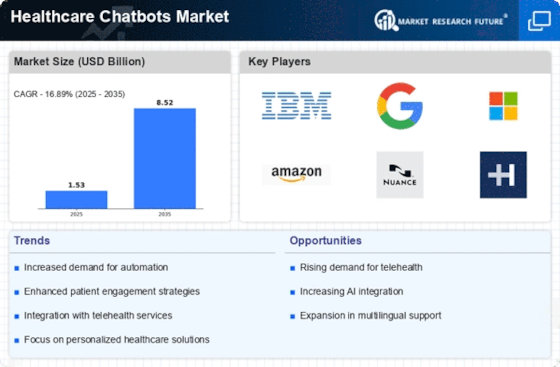
Healthcare Chatbots Market Infographic
Purchase Options

Market Share

Healthcare Chatbots Market Share Analysis

People are learning more about sports injuries, crashes, and their long-term effects, which is drawing more attention to the concussions market. Companies in this market use a variety of market share placement tactics to come up with good tools for diagnosing concussions, cures, and ways to avoid getting them. One of the main goals is to create and spread improved diagnosis tools. Companies put money into research and development to make cutting-edge imaging tools, like more advanced CT scans and MRI methods, that make it possible to diagnose concussions correctly and quickly. Precise tests help with planning successful treatment. Setting up plans to avoid concussions is important for standing in the market. Companies work with sports teams, schools, and healthcare workers to spread information about how to avoid getting concussions. Some examples of this are exercise programs, suggestions for the right gear, and rules for spotting and treating head injuries. Working together with sports groups is a smart way to get goods and services noticed. Businesses work with sports clubs, teams, and associations to get the word out about their concussion diagnosis tools and ways to avoid getting them. This builds a strong brand footprint in the sports community. Market placement needs to have educational programs for players, teachers, and parents. Companies use educational efforts to teach people about the symptoms and signs of concussions, stressing how important it is to get medical help right away. A current way to improve injury treatment is to combine telemedicine and online tracking tools. Companies make digital platforms for online concussion exams. These platforms let doctors keep an eye on their patients' healing and offer support, especially when it's not possible to do an in-person evaluation right away. Innovative ways to treat concussions are driven by ongoing study and development. Companies spend money to look into new ways to treat concussions, such as using drugs, rehabilitative methods, and brain treatments, to help people get better faster. Following the rules and getting safety certifications are important for standing in the market. Companies make sure that their safety and testing tools follow industry rules and meet safety standards. This earns the trust of doctors, players, and sports groups. Offering recovery services for people who have had a concussion is a smart way to provide complete care. Companies could open therapy centers or work with healthcare facilities to provide specialized services for people healing from concussions. This would ensure a more complete approach to managing concussions. Having public-private cooperation for the study of concussions is a way to work together. Companies work together with universities, government agencies, and non-profits to add to ongoing studies on concussions. This helps scientists learn more and makes their positions as market leaders stronger. Using comments and references from athletes is a way to build trust and authority in your marketing. Businesses work with famous players to get them to promote their goods or talk about their own experiences with dealing with concussions. This creates strong stories that appeal to a wide audience.


Author
Rahul Gotadki
Research Manager

He holds an experience of about 9+ years in Market Research and Business Consulting, working under the spectrum of Life Sciences and Healthcare domains. Rahul conceptualizes and implements a scalable business strategy and provides strategic leadership to the clients. His expertise lies in market estimation, competitive intelligence, pipeline analysis, customer assessment, etc.

Leave a Comment

FAQs

What is the projected market valuation of the Healthcare Chatbots Market by 2035?

<p>The Healthcare Chatbots Market is projected to reach a valuation of 8.516 USD Billion by 2035.</p>

What was the market valuation of the Healthcare Chatbots Market in 2024?

<p>In 2024, the Healthcare Chatbots Market had a valuation of 1.53 USD Billion.</p>

What is the expected CAGR for the Healthcare Chatbots Market during the forecast period 2025 - 2035?

<p>The expected CAGR for the Healthcare Chatbots Market during the forecast period 2025 - 2035 is 16.89%.</p>

Which application segments are expected to show significant growth in the Healthcare Chatbots Market?

<p>The application segments of Symptom Checking and Patient Education are expected to grow significantly, with valuations projected at 2.487 USD Billion by 2035.</p>

What technologies are driving the Healthcare Chatbots Market?

<p>Artificial Intelligence and Natural Language Processing are key technologies driving the market, with projected valuations of 2.8 USD Billion and 2.2 USD Billion, respectively, by 2035.</p>

Who are the key players in the Healthcare Chatbots Market?

<p>Key players in the Healthcare Chatbots Market include IBM, Google, Microsoft, Amazon, and Nuance Communications.</p>

What end-user segments are anticipated to contribute to the growth of the Healthcare Chatbots Market?

<p>Hospitals and Pharmaceutical Companies are anticipated to contribute significantly, with projected valuations of 2.5 USD Billion and 2.0 USD Billion, respectively, by 2035.</p>

What deployment types are being utilized in the Healthcare Chatbots Market?

<p>The market is utilizing both On-Premise and Cloud-Based deployment types, with Cloud-Based expected to reach 5.969 USD Billion by 2035.</p>

How does the Healthcare Chatbots Market compare across different end-user segments?

<p>The Healthcare Chatbots Market shows varied growth across end-user segments, with Hospitals leading at a projected valuation of 2.5 USD Billion by 2035.</p>

What role do companies like Babylon Health and HealthTap play in the Healthcare Chatbots Market?

<p>Companies like Babylon Health and HealthTap are pivotal in the Healthcare Chatbots Market, contributing to innovations and expanding service offerings.</p>

Market Summary

As per Market Research Future analysis, the Healthcare Chatbots Market Size was estimated at 0.4 USD Billion in 2025. The Healthcare Chatbots industry is projected to grow from 0.5 USD Billion in 2026 to 2.1 USD Billion by 2035, exhibiting a compound annual growth rate (CAGR) of 17.79% during the forecast period 2026 - 2035

Key Market Trends & Highlights

The Healthcare Chatbots Market is experiencing robust growth driven by technological advancements and increasing demand for patient-centric services.

  • North America remains the largest market for healthcare chatbots, driven by high healthcare expenditure and technological adoption. The Asia-Pacific region is emerging as the fastest-growing market, fueled by increasing smartphone penetration and digital health initiatives. Symptom checking chatbots dominate the market, while appointment scheduling solutions are rapidly gaining traction among users. Key market drivers include the rising demand for 24/7 healthcare access and advancements in natural language processing, enhancing user experience.

Market Size & Forecast

2025 Market Size 0.4 (USD Billion)
2035 Market Size 2.1 (USD Billion)
CAGR (2026 - 2035) 17.79%
Largest Regional Market Share in 2025 North America

Major Players

<a href="https://www.ibm.com/products">IBM </a>(US), Google (US), Microsoft (US), Amazon (US), Nuance Communications (US), HealthTap (US), Babylon Health (GB), Ada Health (DE), Mayo Clinic (US), Buoy Health (US)

Market Trends

The Healthcare Chatbots Market is currently experiencing a transformative phase, driven by advancements in artificial intelligence and natural language processing technologies. These innovations enable chatbots to provide more personalized and efficient interactions with patients, thereby enhancing user experience. As healthcare providers increasingly adopt these digital solutions, the market appears poised for substantial growth. The integration of chatbots into various healthcare settings, including telemedicine and patient management systems, suggests a shift towards more accessible and streamlined healthcare services. Furthermore, the ongoing emphasis on patient engagement and satisfaction indicates that chatbots may play a pivotal role in improving communication between patients and healthcare professionals. In addition to technological advancements, regulatory frameworks are evolving to accommodate the use of chatbots in healthcare. This regulatory support could facilitate wider adoption and integration of these tools into existing healthcare infrastructures. Moreover, the rising demand for cost-effective solutions in healthcare delivery may further propel the Healthcare Chatbots Market. As organizations seek to optimize operational efficiency while maintaining high-quality patient care, chatbots could emerge as a viable solution to address these challenges. Overall, the market landscape appears dynamic, with numerous opportunities for innovation and growth in the coming years.

Increased Adoption in Telehealth Services

The Healthcare Chatbots Market is witnessing a notable rise in the integration of chatbots within telehealth platforms. This trend reflects a growing recognition of the need for efficient patient communication and support in remote healthcare settings. Chatbots are being utilized to assist with appointment scheduling, symptom checking, and providing health information, thereby enhancing the overall telehealth experience.

Focus on Patient Engagement

A significant trend in the Healthcare Chatbots Market is the heightened emphasis on patient engagement strategies. Organizations are increasingly leveraging chatbots to foster better communication with patients, ensuring they remain informed and involved in their healthcare journeys. This focus on engagement is likely to improve patient satisfaction and adherence to treatment plans.

Integration with Wearable Technology

The Healthcare Chatbots Market is also seeing a trend towards the integration of chatbots with wearable health devices. This convergence allows for real-time data collection and analysis, enabling chatbots to provide personalized health insights and recommendations. Such integration may enhance the effectiveness of health monitoring and management, offering users a more comprehensive view of their health.

Healthcare Chatbots Market Market Drivers

Cost Efficiency in Healthcare Delivery

Cost efficiency remains a pivotal driver in the Healthcare Chatbots Market. By automating routine tasks such as appointment scheduling and patient inquiries, chatbots can significantly reduce operational costs for healthcare providers. Studies suggest that implementing chatbots can lead to a reduction in administrative costs by up to 30%. This financial incentive is particularly appealing to healthcare organizations striving to optimize their resources while maintaining high-quality patient care. Furthermore, as healthcare systems face increasing financial pressures, the adoption of chatbots appears to be a strategic move to streamline operations. The potential for cost savings, combined with improved patient satisfaction, positions chatbots as a valuable asset in the evolving landscape of healthcare delivery.

Increased Focus on Mental Health Support

The growing emphasis on mental health support is significantly influencing the Healthcare Chatbots Market. As mental health awareness rises, chatbots are being utilized to provide immediate assistance and resources to individuals seeking help. These digital tools can offer preliminary assessments, coping strategies, and even connect users with licensed professionals. Data indicates that nearly 40% of individuals prefer using chatbots for mental health inquiries due to the anonymity and convenience they provide. This trend reflects a broader societal shift towards destigmatizing mental health issues and increasing access to care. Consequently, the integration of chatbots into mental health services is likely to expand, further driving the growth of the Healthcare Chatbots Market.

Rising Demand for 24/7 Healthcare Access

The Healthcare Chatbots Market is experiencing a notable surge in demand for round-the-clock healthcare access. Patients increasingly seek immediate responses to their inquiries, which chatbots can provide efficiently. This demand is driven by the growing expectation for instant communication in various sectors, including healthcare. According to recent data, approximately 70% of patients prefer using chatbots for basic inquiries, indicating a shift in patient behavior. The ability of chatbots to operate continuously without downtime aligns with the needs of a modern healthcare system, where timely information can significantly impact patient outcomes. As healthcare providers recognize the potential of chatbots to enhance service delivery, investments in this technology are likely to increase, further propelling the Healthcare Chatbots Market.

Advancements in Natural Language Processing

Advancements in Natural Language Processing (NLP) technology are transforming the Healthcare Chatbots Market. Enhanced NLP capabilities enable chatbots to understand and respond to patient inquiries with greater accuracy and relevance. This improvement is crucial, as effective communication is essential for patient engagement and satisfaction. Recent developments indicate that chatbots equipped with advanced NLP can achieve up to 90% accuracy in understanding user intent. As healthcare providers increasingly recognize the importance of effective communication, the integration of sophisticated NLP into chatbots is likely to become a standard practice. This trend not only enhances the user experience but also positions chatbots as essential tools in the healthcare ecosystem, driving further growth in the Healthcare Chatbots Market.

Integration with Healthcare Systems and EHRs

The integration of chatbots with existing healthcare systems and Electronic Health Records (EHRs) is emerging as a critical driver in the Healthcare Chatbots Market. This integration allows chatbots to access patient data, enabling personalized interactions and more efficient service delivery. By connecting with EHRs, chatbots can provide tailored health information, medication reminders, and follow-up care instructions, enhancing the overall patient experience. Recent statistics suggest that healthcare organizations that implement integrated chatbot solutions can improve patient engagement by up to 50%. As interoperability becomes a priority in healthcare, the demand for chatbots that seamlessly integrate with existing systems is expected to rise, further propelling the Healthcare Chatbots Market.

Market Segment Insights

By Application: Symptom Checking (Largest) vs. Appointment Scheduling (Fastest-Growing)

In the Healthcare Chatbots Market, the application segment is witnessing a diverse range of functionalities that cater to varying patient needs. Symptom checking holds the largest market share, reflecting its critical role in patient triage and immediate health assessments. Conversely, appointment scheduling is catching up swiftly as <a href="https://www.marketresearchfuture.com/reports/digital-healthcare-market-7636">digital health</a> needs escalate, showcasing its growing significance among healthcare providers and patients alike. The growth trends within this sector reveal a robust demand for chatbots that enhance patient interaction and streamline processes. Factors such as increased smartphone penetration and the ongoing digital transformation in healthcare are major drivers. Moreover, the COVID-19 pandemic has accelerated the adoption of virtual health solutions, further propelling the need for both symptom checking and appointment scheduling applications in the healthcare landscape.

Symptom Checking (Dominant) vs. Patient Education (Emerging)

Symptom checking emerges as the dominant application in the Healthcare Chatbots Market, distinguished by its ability to provide immediate, evidence-based evaluations of patient symptoms. It serves as a crucial tool for patients seeking preliminary advice and aids in reducing the burden on healthcare systems. In contrast, patient education is an emerging segment gaining momentum as healthcare becomes more patient-centric. This application focuses on informing users about their health conditions, treatment options, and wellness strategies. With increasing investments in patient engagement tools and a growing emphasis on self-management of health, patient education chatbots are poised to enhance the overall healthcare experience, empowering patients with knowledge and support.

By Technology: Artificial Intelligence (Largest) vs. Natural Language Processing (Fastest-Growing)

The Healthcare Chatbots Market is primarily driven by segment values such as Artificial Intelligence, Natural Language Processing, Machine Learning, and Decision Tree Algorithms. Among these, Artificial Intelligence holds the largest market share, leveraging extensive applications in patient interaction and data analysis. Natural Language Processing, on the other hand, is gaining traction rapidly as it enhances user experience by enabling better conversation flows and understanding patient inquiries.

Technology: AI (Dominant) vs. NLP (Emerging)

The AI chatbot in healthcare segment leads in the Healthcare Chatbots Market, where automated health monitoring systems improve patient engagement and streamlining processes. Its vast capabilities in data interpretation and predictive analytics make it essential for modern healthcare solutions. In contrast, Natural Language Processing (NLP) is emerging swiftly, enhancing the empathy and efficiency of chatbots through refined text comprehension. This segment adapts quickly to patient language nuances, driving its popularity. As hospitals and clinics seek more intuitive solutions, NLP's role in enabling seamless communication between patients and healthcare providers solidifies its growing importance.

By End User: Hospitals (Largest) vs. Clinics (Fastest-Growing)

In the Healthcare Chatbots Market, hospitals represent the largest share of end users, driven by their need for improved patient engagement and operational efficiency. Hospitals are increasingly integrating chatbots to streamline communication, handle inquiries, and manage appointment scheduling. Following closely, clinics are emerging as the fastest-growing segment, recognizing the importance of enhancing patient interaction and satisfaction at a smaller scale. This shift is also supported by limited resources that encourage smaller healthcare providers to adopt innovative solutions like chatbots.

Hospitals (Dominant) vs. Clinics (Emerging)

Hospitals are leveraging chatbots to optimize workflow, enhance patient care, and reduce administrative burdens, making them a dominant force in the healthcare chatbots market. They utilize these technologies for a range of functions, from appointment management to patient education. On the other hand, clinics are fast emerging as significant players, motivated by the need to provide personalized care and improve patient experience. Clinics often adopt chatbots to manage patient inquiries and appointment scheduling, allowing staff to focus on more complex tasks. Both segments underscore the growing reliance on technology to improve healthcare delivery.

By Deployment Type: Cloud-Based (Largest) vs. On-Premise (Fastest-Growing)

In the Healthcare Chatbots Market, the deployment type primarily comprises Cloud-Based and On-Premise solutions. Cloud-Based chatbots dominate the market, accounting for a significant share due to their accessibility, lower maintenance costs, and seamless integration with existing systems. Conversely, On-Premise solutions, while holding a smaller market share, are preferred by some healthcare providers who prioritize data security and compliance, thereby creating a balanced distribution between these deployment types.

Deployment Type: Cloud-Based (Dominant) vs. On-Premise (Emerging)

Cloud-Based chatbots represent the dominant deployment type in the Healthcare Chatbots Market, primarily due to their flexibility, scalability, and cost-effectiveness. They enable healthcare providers to deploy chatbots rapidly without the need for extensive infrastructure, keeping operational costs low. In contrast, On-Premise chatbots are seen as an emerging deployment type, gaining traction among organizations that require strict control over their data and operations. Despite being slower to implement, they offer enhanced security measures and customization options, appealing to traditional healthcare providers focused on compliance. As data privacy concerns continue to rise, the On-Premise model is expected to see increased adoption.

Get more detailed insights about Healthcare Chatbots Market Research Report – Forecast to 2035

Regional Insights

The Regional segmentation of the Global Healthcare Chatbots Market reveals significant insights into its emerging landscape. with a dominant North America accounting for 0.75 USD Billion, illustrating its majority holding in this burgeoning industry; by 2035, this valuation is expected to grow to 4.1 USD Billion.

Europe follows closely with valuations of 0.45 USD Billion in 2025 and projected growth to 2.4 USD Billion in 2035, highlighting the region’s commitment to digital healthcare solutions.The Asia-Pacific (APAC) region is witnessing rapid adoption, starting at 0.24 USD Billion and expected to reach 1.8 USD Billion, driven by an increasing focus on healthcare accessibility and technological advancements. 

South America and the Middle East and Africa (MEA), while smaller in valuation at 0.06 USD Billion and 0.03 USD Billion in 2025 respectively, show potential with expected growth to 0.6 USD Billion and 0.4 USD Billion by 2035. The increasing demand for efficient patient interactions and cost-effective healthcare solutions globally drive this growth, particularly in North America, which dominates due to its technological infrastructure and investment in healthcare innovation.

Key Players and Competitive Insights

The Global Healthcare Chatbots Market is rapidly evolving, driven by advancements in AI chatbot in healthcare and a growing demand for enhanced patient engagement and cost-effective healthcare solutions. As healthcare providers increasingly seek innovative ways to streamline operations and improve patient experiences, chatbots have emerged as essential tools for addressing various needs, including appointment scheduling, symptom checking, and medication reminders. Competitive insights within this market highlight the diverse strategies employed by companies seeking to capture market share, with a focus on developing intelligent, user-friendly solutions that integrate seamlessly with existing chatbot technology in healthcare.
Companies are competing not only on the technology front but also on factors such as quality of service, regulatory compliance, and the ability to personalize user interactions based on individual patient needs.PillDrill has established a prominent position within the Global Healthcare Chatbots Market through its unique approach to medication management. The company has developed a comprehensive solution designed to help patients track their medication schedules effectively and improve adherence. PillDrill’s strengths lie in its user-centric design, which enhances the user experience through intuitive interfaces and interactive features.
By actively engaging patients in their medication routines, PillDrill fosters better health outcomes and reduces the burden on healthcare providers.
The firm focuses on integrating feedback mechanisms for continuous improvement, ensuring that its services evolve in line with user preferences. PillDrill's commitment to innovation and patient empowerment solidifies its competitive edge in the landscape of medical chatbots. IBM has made a significant impact in the Global Healthcare Chatbots Market with its advanced AI-driven technologies and extensive portfolio of medical chatbots. The company provides various key products and services, including Watson Health, which leverages AI chatbot in healthcare to offer insightful clinical support and patient interaction capabilities.
IBM's strength lies in its robust technological infrastructure and partnerships with various healthcare institutions, enabling it to deliver scalable chatbot solutions that can address diverse challenges in the healthcare landscape. The company's commitment to innovation is further underscored by its ongoing mergers and acquisitions aimed at enhancing its capabilities in AI chatbot for healthcare and machine learning. Through these strategic moves, IBM continues to reinforce its presence in the global market, positioning itself as a leader in transforming healthcare delivery through smart, conversational interfaces that promote efficiency and patient-centered care.

Key Companies in the Healthcare Chatbots Market include

Industry Developments

In recent developments in the Global Healthcare Chatbots Market, companies like IBM and Google have increased their focus on AI chatbot in healthcare to enhance patient interactions, with IBM’s Watson delivering more personalized healthcare recommendations. Woebot Health is gaining traction with its mental health solutions, while Care Angel has expanded its services to include chronic care management. Notably, an acquisition took place in September 2023 when Microsoft acquired a healthcare chatbot startup to bolster their digital health offerings. In addition, Lemonade Health launched its chatbot to streamline telehealth services in August 2023, reflecting a broader trend toward automation in patient care.

The market valuation has seen substantial growth, estimated to reach over $1.3 billion by 2025, driven by the increasing demand for digital health solutions. Companies like Nuance Communications and Sensely are innovating with voice recognition and empathetic chatbots, respectively. Over the past two to three years, there have been significant advancements, including the integration of comprehensive data analytics by Patientory, which has paved the way for data-driven decision-making in healthcare. The evolving landscape is actively shaping how healthcare providers engage with patients globally.

Future Outlook

Healthcare Chatbots Market Future Outlook

The Healthcare Chatbots Market is projected to grow at a 17.79% CAGR from 2026 to 2035, driven by advancements in AI, increased demand for patient engagement, and cost reduction in healthcare delivery.

New opportunities lie in:

  • <p>Integration of AI-driven predictive analytics for personalized patient interactions. Development of multilingual chatbots to cater to diverse patient populations. Partnerships with telehealth platforms to enhance service offerings and accessibility.</p>

By 2035, the Healthcare Chatbots Market is expected to be a pivotal component of digital health solutions.

Market Segmentation

Healthcare Chatbots Market End User Outlook

  • Hospitals
  • Clinics
  • Pharmaceutical Companies
  • Insurance Providers

Healthcare Chatbots Market Technology Outlook

  • Artificial Intelligence
  • Natural Language Processing
  • Machine Learning
  • Decision Tree Algorithms

Healthcare Chatbots Market Application Outlook

  • Symptom Checking
  • Appointment Scheduling
  • Medication Assistance
  • Patient Education

Healthcare Chatbots Market Deployment Type Outlook

  • On-Premise
  • Cloud-Based

Report Scope

MARKET SIZE 2025 0.4 (USD Billion)
MARKET SIZE 2026 0.5 (USD Billion)
MARKET SIZE 2035 2.1 (USD Billion)
COMPOUND ANNUAL GROWTH RATE (CAGR) 17.79% (2026 - 2035)
REPORT COVERAGE Revenue Forecast, Competitive Landscape, Growth Factors, and Trends
BASE YEAR 2025
Market Forecast Period 2026 - 2035
Historical Data 2019 - 2025
Market Forecast Units USD Billion
Key Companies Profiled IBM (US), Google (US), Microsoft (US), Amazon (US), Nuance Communications (US), HealthTap (US), Babylon Health (GB), Ada Health (DE), Mayo Clinic (US), Buoy Health (US)
Segments Covered Applications, Technology, End Users, Deployment Type, Regional
Key Market Opportunities Integration of artificial intelligence enhances patient engagement in the Healthcare Chatbots Market.
Key Market Dynamics Rising demand for efficient patient engagement drives innovation and competition in the Healthcare Chatbots Market.
Countries Covered North America, Europe, APAC, South America, MEA

FAQs

What is the projected market valuation of the Healthcare Chatbots Market by 2035?

<p>The Healthcare Chatbots Market is projected to reach a valuation of 8.516 USD Billion by 2035.</p>

What was the market valuation of the Healthcare Chatbots Market in 2024?

<p>In 2024, the Healthcare Chatbots Market had a valuation of 1.53 USD Billion.</p>

What is the expected CAGR for the Healthcare Chatbots Market during the forecast period 2025 - 2035?

<p>The expected CAGR for the Healthcare Chatbots Market during the forecast period 2025 - 2035 is 16.89%.</p>

Which application segments are expected to show significant growth in the Healthcare Chatbots Market?

<p>The application segments of Symptom Checking and Patient Education are expected to grow significantly, with valuations projected at 2.487 USD Billion by 2035.</p>

What technologies are driving the Healthcare Chatbots Market?

<p>Artificial Intelligence and Natural Language Processing are key technologies driving the market, with projected valuations of 2.8 USD Billion and 2.2 USD Billion, respectively, by 2035.</p>

Who are the key players in the Healthcare Chatbots Market?

<p>Key players in the Healthcare Chatbots Market include IBM, Google, Microsoft, Amazon, and Nuance Communications.</p>

What end-user segments are anticipated to contribute to the growth of the Healthcare Chatbots Market?

<p>Hospitals and Pharmaceutical Companies are anticipated to contribute significantly, with projected valuations of 2.5 USD Billion and 2.0 USD Billion, respectively, by 2035.</p>

What deployment types are being utilized in the Healthcare Chatbots Market?

<p>The market is utilizing both On-Premise and Cloud-Based deployment types, with Cloud-Based expected to reach 5.969 USD Billion by 2035.</p>

How does the Healthcare Chatbots Market compare across different end-user segments?

<p>The Healthcare Chatbots Market shows varied growth across end-user segments, with Hospitals leading at a projected valuation of 2.5 USD Billion by 2035.</p>

What role do companies like Babylon Health and HealthTap play in the Healthcare Chatbots Market?

<p>Companies like Babylon Health and HealthTap are pivotal in the Healthcare Chatbots Market, contributing to innovations and expanding service offerings.</p>

  1. SECTION I: EXECUTIVE SUMMARY AND KEY HIGHLIGHTS
    1. | 1.1 EXECUTIVE SUMMARY
    2. | | 1.1.1 Market Overview
    3. | | 1.1.2 Key Findings
    4. | | 1.1.3 Market Segmentation
    5. | | 1.1.4 Competitive Landscape
    6. | | 1.1.5 Challenges and Opportunities
    7. | | 1.1.6 Future Outlook
  2. SECTION II: SCOPING, METHODOLOGY AND MARKET STRUCTURE
    1. | 2.1 MARKET INTRODUCTION
    2. | | 2.1.1 Definition
    3. | | 2.1.2 Scope of the study
    4. | | | 2.1.2.1 Research Objective
    5. | | | 2.1.2.2 Assumption
    6. | | | 2.1.2.3 Limitations
    7. | 2.2 RESEARCH METHODOLOGY
    8. | | 2.2.1 Overview
    9. | | 2.2.2 Data Mining
    10. | | 2.2.3 Secondary Research
    11. | | 2.2.4 Primary Research
    12. | | | 2.2.4.1 Primary Interviews and Information Gathering Process
    13. | | | 2.2.4.2 Breakdown of Primary Respondents
    14. | | 2.2.5 Forecasting Model
    15. | | 2.2.6 Market Size Estimation
    16. | | | 2.2.6.1 Bottom-Up Approach
    17. | | | 2.2.6.2 Top-Down Approach
    18. | | 2.2.7 Data Triangulation
    19. | | 2.2.8 Validation
  3. SECTION III: QUALITATIVE ANALYSIS
    1. | 3.1 MARKET DYNAMICS
    2. | | 3.1.1 Overview
    3. | | 3.1.2 Drivers
    4. | | 3.1.3 Restraints
    5. | | 3.1.4 Opportunities
    6. | 3.2 MARKET FACTOR ANALYSIS
    7. | | 3.2.1 Value chain Analysis
    8. | | 3.2.2 Porter's Five Forces Analysis
    9. | | | 3.2.2.1 Bargaining Power of Suppliers
    10. | | | 3.2.2.2 Bargaining Power of Buyers
    11. | | | 3.2.2.3 Threat of New Entrants
    12. | | | 3.2.2.4 Threat of Substitutes
    13. | | | 3.2.2.5 Intensity of Rivalry
    14. | | 3.2.3 COVID-19 Impact Analysis
    15. | | | 3.2.3.1 Market Impact Analysis
    16. | | | 3.2.3.2 Regional Impact
    17. | | | 3.2.3.3 Opportunity and Threat Analysis
  4. SECTION IV: QUANTITATIVE ANALYSIS
    1. | 4.1 Healthcare, BY Application (USD Billion)
    2. | | 4.1.1 Symptom Checking
    3. | | 4.1.2 Appointment Scheduling
    4. | | 4.1.3 Medication Assistance
    5. | | 4.1.4 Patient Education
    6. | 4.2 Healthcare, BY Technology (USD Billion)
    7. | | 4.2.1 Artificial Intelligence
    8. | | 4.2.2 Natural Language Processing
    9. | | 4.2.3 Machine Learning
    10. | | 4.2.4 Decision Tree Algorithms
    11. | 4.3 Healthcare, BY End User (USD Billion)
    12. | | 4.3.1 Hospitals
    13. | | 4.3.2 Clinics
    14. | | 4.3.3 Pharmaceutical Companies
    15. | | 4.3.4 Insurance Providers
    16. | 4.4 Healthcare, BY Deployment Type (USD Billion)
    17. | | 4.4.1 On-Premise
    18. | | 4.4.2 Cloud-Based
    19. | 4.5 Healthcare, BY Region (USD Billion)
    20. | | 4.5.1 North America
    21. | | | 4.5.1.1 US
    22. | | | 4.5.1.2 Canada
    23. | | 4.5.2 Europe
    24. | | | 4.5.2.1 Germany
    25. | | | 4.5.2.2 UK
    26. | | | 4.5.2.3 France
    27. | | | 4.5.2.4 Russia
    28. | | | 4.5.2.5 Italy
    29. | | | 4.5.2.6 Spain
    30. | | | 4.5.2.7 Rest of Europe
    31. | | 4.5.3 APAC
    32. | | | 4.5.3.1 China
    33. | | | 4.5.3.2 India
    34. | | | 4.5.3.3 Japan
    35. | | | 4.5.3.4 South Korea
    36. | | | 4.5.3.5 Malaysia
    37. | | | 4.5.3.6 Thailand
    38. | | | 4.5.3.7 Indonesia
    39. | | | 4.5.3.8 Rest of APAC
    40. | | 4.5.4 South America
    41. | | | 4.5.4.1 Brazil
    42. | | | 4.5.4.2 Mexico
    43. | | | 4.5.4.3 Argentina
    44. | | | 4.5.4.4 Rest of South America
    45. | | 4.5.5 MEA
    46. | | | 4.5.5.1 GCC Countries
    47. | | | 4.5.5.2 South Africa
    48. | | | 4.5.5.3 Rest of MEA
  5. SECTION V: COMPETITIVE ANALYSIS
    1. | 5.1 Competitive Landscape
    2. | | 5.1.1 Overview
    3. | | 5.1.2 Competitive Analysis
    4. | | 5.1.3 Market share Analysis
    5. | | 5.1.4 Major Growth Strategy in the Healthcare
    6. | | 5.1.5 Competitive Benchmarking
    7. | | 5.1.6 Leading Players in Terms of Number of Developments in the Healthcare
    8. | | 5.1.7 Key developments and growth strategies
    9. | | | 5.1.7.1 New Product Launch/Service Deployment
    10. | | | 5.1.7.2 Merger & Acquisitions
    11. | | | 5.1.7.3 Joint Ventures
    12. | | 5.1.8 Major Players Financial Matrix
    13. | | | 5.1.8.1 Sales and Operating Income
    14. | | | 5.1.8.2 Major Players R&D Expenditure. 2023
    15. | 5.2 Company Profiles
    16. | | 5.2.1 IBM (US)
    17. | | | 5.2.1.1 Financial Overview
    18. | | | 5.2.1.2 Products Offered
    19. | | | 5.2.1.3 Key Developments
    20. | | | 5.2.1.4 SWOT Analysis
    21. | | | 5.2.1.5 Key Strategies
    22. | | 5.2.2 Google (US)
    23. | | | 5.2.2.1 Financial Overview
    24. | | | 5.2.2.2 Products Offered
    25. | | | 5.2.2.3 Key Developments
    26. | | | 5.2.2.4 SWOT Analysis
    27. | | | 5.2.2.5 Key Strategies
    28. | | 5.2.3 Microsoft (US)
    29. | | | 5.2.3.1 Financial Overview
    30. | | | 5.2.3.2 Products Offered
    31. | | | 5.2.3.3 Key Developments
    32. | | | 5.2.3.4 SWOT Analysis
    33. | | | 5.2.3.5 Key Strategies
    34. | | 5.2.4 Amazon (US)
    35. | | | 5.2.4.1 Financial Overview
    36. | | | 5.2.4.2 Products Offered
    37. | | | 5.2.4.3 Key Developments
    38. | | | 5.2.4.4 SWOT Analysis
    39. | | | 5.2.4.5 Key Strategies
    40. | | 5.2.5 Nuance Communications (US)
    41. | | | 5.2.5.1 Financial Overview
    42. | | | 5.2.5.2 Products Offered
    43. | | | 5.2.5.3 Key Developments
    44. | | | 5.2.5.4 SWOT Analysis
    45. | | | 5.2.5.5 Key Strategies
    46. | | 5.2.6 HealthTap (US)
    47. | | | 5.2.6.1 Financial Overview
    48. | | | 5.2.6.2 Products Offered
    49. | | | 5.2.6.3 Key Developments
    50. | | | 5.2.6.4 SWOT Analysis
    51. | | | 5.2.6.5 Key Strategies
    52. | | 5.2.7 Babylon Health (GB)
    53. | | | 5.2.7.1 Financial Overview
    54. | | | 5.2.7.2 Products Offered
    55. | | | 5.2.7.3 Key Developments
    56. | | | 5.2.7.4 SWOT Analysis
    57. | | | 5.2.7.5 Key Strategies
    58. | | 5.2.8 Ada Health (DE)
    59. | | | 5.2.8.1 Financial Overview
    60. | | | 5.2.8.2 Products Offered
    61. | | | 5.2.8.3 Key Developments
    62. | | | 5.2.8.4 SWOT Analysis
    63. | | | 5.2.8.5 Key Strategies
    64. | | 5.2.9 Mayo Clinic (US)
    65. | | | 5.2.9.1 Financial Overview
    66. | | | 5.2.9.2 Products Offered
    67. | | | 5.2.9.3 Key Developments
    68. | | | 5.2.9.4 SWOT Analysis
    69. | | | 5.2.9.5 Key Strategies
    70. | | 5.2.10 Buoy Health (US)
    71. | | | 5.2.10.1 Financial Overview
    72. | | | 5.2.10.2 Products Offered
    73. | | | 5.2.10.3 Key Developments
    74. | | | 5.2.10.4 SWOT Analysis
    75. | | | 5.2.10.5 Key Strategies
    76. | 5.3 Appendix
    77. | | 5.3.1 References
    78. | | 5.3.2 Related Reports
  6. LIST OF FIGURES
    1. | 6.1 MARKET SYNOPSIS
    2. | 6.2 NORTH AMERICA MARKET ANALYSIS
    3. | 6.3 US MARKET ANALYSIS BY APPLICATION
    4. | 6.4 US MARKET ANALYSIS BY TECHNOLOGY
    5. | 6.5 US MARKET ANALYSIS BY END USER
    6. | 6.6 US MARKET ANALYSIS BY DEPLOYMENT TYPE
    7. | 6.7 CANADA MARKET ANALYSIS BY APPLICATION
    8. | 6.8 CANADA MARKET ANALYSIS BY TECHNOLOGY
    9. | 6.9 CANADA MARKET ANALYSIS BY END USER
    10. | 6.10 CANADA MARKET ANALYSIS BY DEPLOYMENT TYPE
    11. | 6.11 EUROPE MARKET ANALYSIS
    12. | 6.12 GERMANY MARKET ANALYSIS BY APPLICATION
    13. | 6.13 GERMANY MARKET ANALYSIS BY TECHNOLOGY
    14. | 6.14 GERMANY MARKET ANALYSIS BY END USER
    15. | 6.15 GERMANY MARKET ANALYSIS BY DEPLOYMENT TYPE
    16. | 6.16 UK MARKET ANALYSIS BY APPLICATION
    17. | 6.17 UK MARKET ANALYSIS BY TECHNOLOGY
    18. | 6.18 UK MARKET ANALYSIS BY END USER
    19. | 6.19 UK MARKET ANALYSIS BY DEPLOYMENT TYPE
    20. | 6.20 FRANCE MARKET ANALYSIS BY APPLICATION
    21. | 6.21 FRANCE MARKET ANALYSIS BY TECHNOLOGY
    22. | 6.22 FRANCE MARKET ANALYSIS BY END USER
    23. | 6.23 FRANCE MARKET ANALYSIS BY DEPLOYMENT TYPE
    24. | 6.24 RUSSIA MARKET ANALYSIS BY APPLICATION
    25. | 6.25 RUSSIA MARKET ANALYSIS BY TECHNOLOGY
    26. | 6.26 RUSSIA MARKET ANALYSIS BY END USER
    27. | 6.27 RUSSIA MARKET ANALYSIS BY DEPLOYMENT TYPE
    28. | 6.28 ITALY MARKET ANALYSIS BY APPLICATION
    29. | 6.29 ITALY MARKET ANALYSIS BY TECHNOLOGY
    30. | 6.30 ITALY MARKET ANALYSIS BY END USER
    31. | 6.31 ITALY MARKET ANALYSIS BY DEPLOYMENT TYPE
    32. | 6.32 SPAIN MARKET ANALYSIS BY APPLICATION
    33. | 6.33 SPAIN MARKET ANALYSIS BY TECHNOLOGY
    34. | 6.34 SPAIN MARKET ANALYSIS BY END USER
    35. | 6.35 SPAIN MARKET ANALYSIS BY DEPLOYMENT TYPE
    36. | 6.36 REST OF EUROPE MARKET ANALYSIS BY APPLICATION
    37. | 6.37 REST OF EUROPE MARKET ANALYSIS BY TECHNOLOGY
    38. | 6.38 REST OF EUROPE MARKET ANALYSIS BY END USER
    39. | 6.39 REST OF EUROPE MARKET ANALYSIS BY DEPLOYMENT TYPE
    40. | 6.40 APAC MARKET ANALYSIS
    41. | 6.41 CHINA MARKET ANALYSIS BY APPLICATION
    42. | 6.42 CHINA MARKET ANALYSIS BY TECHNOLOGY
    43. | 6.43 CHINA MARKET ANALYSIS BY END USER
    44. | 6.44 CHINA MARKET ANALYSIS BY DEPLOYMENT TYPE
    45. | 6.45 INDIA MARKET ANALYSIS BY APPLICATION
    46. | 6.46 INDIA MARKET ANALYSIS BY TECHNOLOGY
    47. | 6.47 INDIA MARKET ANALYSIS BY END USER
    48. | 6.48 INDIA MARKET ANALYSIS BY DEPLOYMENT TYPE
    49. | 6.49 JAPAN MARKET ANALYSIS BY APPLICATION
    50. | 6.50 JAPAN MARKET ANALYSIS BY TECHNOLOGY
    51. | 6.51 JAPAN MARKET ANALYSIS BY END USER
    52. | 6.52 JAPAN MARKET ANALYSIS BY DEPLOYMENT TYPE
    53. | 6.53 SOUTH KOREA MARKET ANALYSIS BY APPLICATION
    54. | 6.54 SOUTH KOREA MARKET ANALYSIS BY TECHNOLOGY
    55. | 6.55 SOUTH KOREA MARKET ANALYSIS BY END USER
    56. | 6.56 SOUTH KOREA MARKET ANALYSIS BY DEPLOYMENT TYPE
    57. | 6.57 MALAYSIA MARKET ANALYSIS BY APPLICATION
    58. | 6.58 MALAYSIA MARKET ANALYSIS BY TECHNOLOGY
    59. | 6.59 MALAYSIA MARKET ANALYSIS BY END USER
    60. | 6.60 MALAYSIA MARKET ANALYSIS BY DEPLOYMENT TYPE
    61. | 6.61 THAILAND MARKET ANALYSIS BY APPLICATION
    62. | 6.62 THAILAND MARKET ANALYSIS BY TECHNOLOGY
    63. | 6.63 THAILAND MARKET ANALYSIS BY END USER
    64. | 6.64 THAILAND MARKET ANALYSIS BY DEPLOYMENT TYPE
    65. | 6.65 INDONESIA MARKET ANALYSIS BY APPLICATION
    66. | 6.66 INDONESIA MARKET ANALYSIS BY TECHNOLOGY
    67. | 6.67 INDONESIA MARKET ANALYSIS BY END USER
    68. | 6.68 INDONESIA MARKET ANALYSIS BY DEPLOYMENT TYPE
    69. | 6.69 REST OF APAC MARKET ANALYSIS BY APPLICATION
    70. | 6.70 REST OF APAC MARKET ANALYSIS BY TECHNOLOGY
    71. | 6.71 REST OF APAC MARKET ANALYSIS BY END USER
    72. | 6.72 REST OF APAC MARKET ANALYSIS BY DEPLOYMENT TYPE
    73. | 6.73 SOUTH AMERICA MARKET ANALYSIS
    74. | 6.74 BRAZIL MARKET ANALYSIS BY APPLICATION
    75. | 6.75 BRAZIL MARKET ANALYSIS BY TECHNOLOGY
    76. | 6.76 BRAZIL MARKET ANALYSIS BY END USER
    77. | 6.77 BRAZIL MARKET ANALYSIS BY DEPLOYMENT TYPE
    78. | 6.78 MEXICO MARKET ANALYSIS BY APPLICATION
    79. | 6.79 MEXICO MARKET ANALYSIS BY TECHNOLOGY
    80. | 6.80 MEXICO MARKET ANALYSIS BY END USER
    81. | 6.81 MEXICO MARKET ANALYSIS BY DEPLOYMENT TYPE
    82. | 6.82 ARGENTINA MARKET ANALYSIS BY APPLICATION
    83. | 6.83 ARGENTINA MARKET ANALYSIS BY TECHNOLOGY
    84. | 6.84 ARGENTINA MARKET ANALYSIS BY END USER
    85. | 6.85 ARGENTINA MARKET ANALYSIS BY DEPLOYMENT TYPE
    86. | 6.86 REST OF SOUTH AMERICA MARKET ANALYSIS BY APPLICATION
    87. | 6.87 REST OF SOUTH AMERICA MARKET ANALYSIS BY TECHNOLOGY
    88. | 6.88 REST OF SOUTH AMERICA MARKET ANALYSIS BY END USER
    89. | 6.89 REST OF SOUTH AMERICA MARKET ANALYSIS BY DEPLOYMENT TYPE
    90. | 6.90 MEA MARKET ANALYSIS
    91. | 6.91 GCC COUNTRIES MARKET ANALYSIS BY APPLICATION
    92. | 6.92 GCC COUNTRIES MARKET ANALYSIS BY TECHNOLOGY
    93. | 6.93 GCC COUNTRIES MARKET ANALYSIS BY END USER
    94. | 6.94 GCC COUNTRIES MARKET ANALYSIS BY DEPLOYMENT TYPE
    95. | 6.95 SOUTH AFRICA MARKET ANALYSIS BY APPLICATION
    96. | 6.96 SOUTH AFRICA MARKET ANALYSIS BY TECHNOLOGY
    97. | 6.97 SOUTH AFRICA MARKET ANALYSIS BY END USER
    98. | 6.98 SOUTH AFRICA MARKET ANALYSIS BY DEPLOYMENT TYPE
    99. | 6.99 REST OF MEA MARKET ANALYSIS BY APPLICATION
    100. | 6.100 REST OF MEA MARKET ANALYSIS BY TECHNOLOGY
    101. | 6.101 REST OF MEA MARKET ANALYSIS BY END USER
    102. | 6.102 REST OF MEA MARKET ANALYSIS BY DEPLOYMENT TYPE
    103. | 6.103 KEY BUYING CRITERIA OF HEALTHCARE
    104. | 6.104 RESEARCH PROCESS OF MRFR
    105. | 6.105 DRO ANALYSIS OF HEALTHCARE
    106. | 6.106 DRIVERS IMPACT ANALYSIS: HEALTHCARE
    107. | 6.107 RESTRAINTS IMPACT ANALYSIS: HEALTHCARE
    108. | 6.108 SUPPLY / VALUE CHAIN: HEALTHCARE
    109. | 6.109 HEALTHCARE, BY APPLICATION, 2024 (% SHARE)
    110. | 6.110 HEALTHCARE, BY APPLICATION, 2024 TO 2035 (USD Billion)
    111. | 6.111 HEALTHCARE, BY TECHNOLOGY, 2024 (% SHARE)
    112. | 6.112 HEALTHCARE, BY TECHNOLOGY, 2024 TO 2035 (USD Billion)
    113. | 6.113 HEALTHCARE, BY END USER, 2024 (% SHARE)
    114. | 6.114 HEALTHCARE, BY END USER, 2024 TO 2035 (USD Billion)
    115. | 6.115 HEALTHCARE, BY DEPLOYMENT TYPE, 2024 (% SHARE)
    116. | 6.116 HEALTHCARE, BY DEPLOYMENT TYPE, 2024 TO 2035 (USD Billion)
    117. | 6.117 BENCHMARKING OF MAJOR COMPETITORS
  7. LIST OF TABLES
    1. | 7.1 LIST OF ASSUMPTIONS
    2. | | 7.1.1
    3. | 7.2 North America MARKET SIZE ESTIMATES; FORECAST
    4. | | 7.2.1 BY APPLICATION, 2025-2035 (USD Billion)
    5. | | 7.2.2 BY TECHNOLOGY, 2025-2035 (USD Billion)
    6. | | 7.2.3 BY END USER, 2025-2035 (USD Billion)
    7. | | 7.2.4 BY DEPLOYMENT TYPE, 2025-2035 (USD Billion)
    8. | 7.3 US MARKET SIZE ESTIMATES; FORECAST
    9. | | 7.3.1 BY APPLICATION, 2025-2035 (USD Billion)
    10. | | 7.3.2 BY TECHNOLOGY, 2025-2035 (USD Billion)
    11. | | 7.3.3 BY END USER, 2025-2035 (USD Billion)
    12. | | 7.3.4 BY DEPLOYMENT TYPE, 2025-2035 (USD Billion)
    13. | 7.4 Canada MARKET SIZE ESTIMATES; FORECAST
    14. | | 7.4.1 BY APPLICATION, 2025-2035 (USD Billion)
    15. | | 7.4.2 BY TECHNOLOGY, 2025-2035 (USD Billion)
    16. | | 7.4.3 BY END USER, 2025-2035 (USD Billion)
    17. | | 7.4.4 BY DEPLOYMENT TYPE, 2025-2035 (USD Billion)
    18. | 7.5 Europe MARKET SIZE ESTIMATES; FORECAST
    19. | | 7.5.1 BY APPLICATION, 2025-2035 (USD Billion)
    20. | | 7.5.2 BY TECHNOLOGY, 2025-2035 (USD Billion)
    21. | | 7.5.3 BY END USER, 2025-2035 (USD Billion)
    22. | | 7.5.4 BY DEPLOYMENT TYPE, 2025-2035 (USD Billion)
    23. | 7.6 Germany MARKET SIZE ESTIMATES; FORECAST
    24. | | 7.6.1 BY APPLICATION, 2025-2035 (USD Billion)
    25. | | 7.6.2 BY TECHNOLOGY, 2025-2035 (USD Billion)
    26. | | 7.6.3 BY END USER, 2025-2035 (USD Billion)
    27. | | 7.6.4 BY DEPLOYMENT TYPE, 2025-2035 (USD Billion)
    28. | 7.7 UK MARKET SIZE ESTIMATES; FORECAST
    29. | | 7.7.1 BY APPLICATION, 2025-2035 (USD Billion)
    30. | | 7.7.2 BY TECHNOLOGY, 2025-2035 (USD Billion)
    31. | | 7.7.3 BY END USER, 2025-2035 (USD Billion)
    32. | | 7.7.4 BY DEPLOYMENT TYPE, 2025-2035 (USD Billion)
    33. | 7.8 France MARKET SIZE ESTIMATES; FORECAST
    34. | | 7.8.1 BY APPLICATION, 2025-2035 (USD Billion)
    35. | | 7.8.2 BY TECHNOLOGY, 2025-2035 (USD Billion)
    36. | | 7.8.3 BY END USER, 2025-2035 (USD Billion)
    37. | | 7.8.4 BY DEPLOYMENT TYPE, 2025-2035 (USD Billion)
    38. | 7.9 Russia MARKET SIZE ESTIMATES; FORECAST
    39. | | 7.9.1 BY APPLICATION, 2025-2035 (USD Billion)
    40. | | 7.9.2 BY TECHNOLOGY, 2025-2035 (USD Billion)
    41. | | 7.9.3 BY END USER, 2025-2035 (USD Billion)
    42. | | 7.9.4 BY DEPLOYMENT TYPE, 2025-2035 (USD Billion)
    43. | 7.10 Italy MARKET SIZE ESTIMATES; FORECAST
    44. | | 7.10.1 BY APPLICATION, 2025-2035 (USD Billion)
    45. | | 7.10.2 BY TECHNOLOGY, 2025-2035 (USD Billion)
    46. | | 7.10.3 BY END USER, 2025-2035 (USD Billion)
    47. | | 7.10.4 BY DEPLOYMENT TYPE, 2025-2035 (USD Billion)
    48. | 7.11 Spain MARKET SIZE ESTIMATES; FORECAST
    49. | | 7.11.1 BY APPLICATION, 2025-2035 (USD Billion)
    50. | | 7.11.2 BY TECHNOLOGY, 2025-2035 (USD Billion)
    51. | | 7.11.3 BY END USER, 2025-2035 (USD Billion)
    52. | | 7.11.4 BY DEPLOYMENT TYPE, 2025-2035 (USD Billion)
    53. | 7.12 Rest of Europe MARKET SIZE ESTIMATES; FORECAST
    54. | | 7.12.1 BY APPLICATION, 2025-2035 (USD Billion)
    55. | | 7.12.2 BY TECHNOLOGY, 2025-2035 (USD Billion)
    56. | | 7.12.3 BY END USER, 2025-2035 (USD Billion)
    57. | | 7.12.4 BY DEPLOYMENT TYPE, 2025-2035 (USD Billion)
    58. | 7.13 APAC MARKET SIZE ESTIMATES; FORECAST
    59. | | 7.13.1 BY APPLICATION, 2025-2035 (USD Billion)
    60. | | 7.13.2 BY TECHNOLOGY, 2025-2035 (USD Billion)
    61. | | 7.13.3 BY END USER, 2025-2035 (USD Billion)
    62. | | 7.13.4 BY DEPLOYMENT TYPE, 2025-2035 (USD Billion)
    63. | 7.14 China MARKET SIZE ESTIMATES; FORECAST
    64. | | 7.14.1 BY APPLICATION, 2025-2035 (USD Billion)
    65. | | 7.14.2 BY TECHNOLOGY, 2025-2035 (USD Billion)
    66. | | 7.14.3 BY END USER, 2025-2035 (USD Billion)
    67. | | 7.14.4 BY DEPLOYMENT TYPE, 2025-2035 (USD Billion)
    68. | 7.15 India MARKET SIZE ESTIMATES; FORECAST
    69. | | 7.15.1 BY APPLICATION, 2025-2035 (USD Billion)
    70. | | 7.15.2 BY TECHNOLOGY, 2025-2035 (USD Billion)
    71. | | 7.15.3 BY END USER, 2025-2035 (USD Billion)
    72. | | 7.15.4 BY DEPLOYMENT TYPE, 2025-2035 (USD Billion)
    73. | 7.16 Japan MARKET SIZE ESTIMATES; FORECAST
    74. | | 7.16.1 BY APPLICATION, 2025-2035 (USD Billion)
    75. | | 7.16.2 BY TECHNOLOGY, 2025-2035 (USD Billion)
    76. | | 7.16.3 BY END USER, 2025-2035 (USD Billion)
    77. | | 7.16.4 BY DEPLOYMENT TYPE, 2025-2035 (USD Billion)
    78. | 7.17 South Korea MARKET SIZE ESTIMATES; FORECAST
    79. | | 7.17.1 BY APPLICATION, 2025-2035 (USD Billion)
    80. | | 7.17.2 BY TECHNOLOGY, 2025-2035 (USD Billion)
    81. | | 7.17.3 BY END USER, 2025-2035 (USD Billion)
    82. | | 7.17.4 BY DEPLOYMENT TYPE, 2025-2035 (USD Billion)
    83. | 7.18 Malaysia MARKET SIZE ESTIMATES; FORECAST
    84. | | 7.18.1 BY APPLICATION, 2025-2035 (USD Billion)
    85. | | 7.18.2 BY TECHNOLOGY, 2025-2035 (USD Billion)
    86. | | 7.18.3 BY END USER, 2025-2035 (USD Billion)
    87. | | 7.18.4 BY DEPLOYMENT TYPE, 2025-2035 (USD Billion)
    88. | 7.19 Thailand MARKET SIZE ESTIMATES; FORECAST
    89. | | 7.19.1 BY APPLICATION, 2025-2035 (USD Billion)
    90. | | 7.19.2 BY TECHNOLOGY, 2025-2035 (USD Billion)
    91. | | 7.19.3 BY END USER, 2025-2035 (USD Billion)
    92. | | 7.19.4 BY DEPLOYMENT TYPE, 2025-2035 (USD Billion)
    93. | 7.20 Indonesia MARKET SIZE ESTIMATES; FORECAST
    94. | | 7.20.1 BY APPLICATION, 2025-2035 (USD Billion)
    95. | | 7.20.2 BY TECHNOLOGY, 2025-2035 (USD Billion)
    96. | | 7.20.3 BY END USER, 2025-2035 (USD Billion)
    97. | | 7.20.4 BY DEPLOYMENT TYPE, 2025-2035 (USD Billion)
    98. | 7.21 Rest of APAC MARKET SIZE ESTIMATES; FORECAST
    99. | | 7.21.1 BY APPLICATION, 2025-2035 (USD Billion)
    100. | | 7.21.2 BY TECHNOLOGY, 2025-2035 (USD Billion)
    101. | | 7.21.3 BY END USER, 2025-2035 (USD Billion)
    102. | | 7.21.4 BY DEPLOYMENT TYPE, 2025-2035 (USD Billion)
    103. | 7.22 South America MARKET SIZE ESTIMATES; FORECAST
    104. | | 7.22.1 BY APPLICATION, 2025-2035 (USD Billion)
    105. | | 7.22.2 BY TECHNOLOGY, 2025-2035 (USD Billion)
    106. | | 7.22.3 BY END USER, 2025-2035 (USD Billion)
    107. | | 7.22.4 BY DEPLOYMENT TYPE, 2025-2035 (USD Billion)
    108. | 7.23 Brazil MARKET SIZE ESTIMATES; FORECAST
    109. | | 7.23.1 BY APPLICATION, 2025-2035 (USD Billion)
    110. | | 7.23.2 BY TECHNOLOGY, 2025-2035 (USD Billion)
    111. | | 7.23.3 BY END USER, 2025-2035 (USD Billion)
    112. | | 7.23.4 BY DEPLOYMENT TYPE, 2025-2035 (USD Billion)
    113. | 7.24 Mexico MARKET SIZE ESTIMATES; FORECAST
    114. | | 7.24.1 BY APPLICATION, 2025-2035 (USD Billion)
    115. | | 7.24.2 BY TECHNOLOGY, 2025-2035 (USD Billion)
    116. | | 7.24.3 BY END USER, 2025-2035 (USD Billion)
    117. | | 7.24.4 BY DEPLOYMENT TYPE, 2025-2035 (USD Billion)
    118. | 7.25 Argentina MARKET SIZE ESTIMATES; FORECAST
    119. | | 7.25.1 BY APPLICATION, 2025-2035 (USD Billion)
    120. | | 7.25.2 BY TECHNOLOGY, 2025-2035 (USD Billion)
    121. | | 7.25.3 BY END USER, 2025-2035 (USD Billion)
    122. | | 7.25.4 BY DEPLOYMENT TYPE, 2025-2035 (USD Billion)
    123. | 7.26 Rest of South America MARKET SIZE ESTIMATES; FORECAST
    124. | | 7.26.1 BY APPLICATION, 2025-2035 (USD Billion)
    125. | | 7.26.2 BY TECHNOLOGY, 2025-2035 (USD Billion)
    126. | | 7.26.3 BY END USER, 2025-2035 (USD Billion)
    127. | | 7.26.4 BY DEPLOYMENT TYPE, 2025-2035 (USD Billion)
    128. | 7.27 MEA MARKET SIZE ESTIMATES; FORECAST
    129. | | 7.27.1 BY APPLICATION, 2025-2035 (USD Billion)
    130. | | 7.27.2 BY TECHNOLOGY, 2025-2035 (USD Billion)
    131. | | 7.27.3 BY END USER, 2025-2035 (USD Billion)
    132. | | 7.27.4 BY DEPLOYMENT TYPE, 2025-2035 (USD Billion)
    133. | 7.28 GCC Countries MARKET SIZE ESTIMATES; FORECAST
    134. | | 7.28.1 BY APPLICATION, 2025-2035 (USD Billion)
    135. | | 7.28.2 BY TECHNOLOGY, 2025-2035 (USD Billion)
    136. | | 7.28.3 BY END USER, 2025-2035 (USD Billion)
    137. | | 7.28.4 BY DEPLOYMENT TYPE, 2025-2035 (USD Billion)
    138. | 7.29 South Africa MARKET SIZE ESTIMATES; FORECAST
    139. | | 7.29.1 BY APPLICATION, 2025-2035 (USD Billion)
    140. | | 7.29.2 BY TECHNOLOGY, 2025-2035 (USD Billion)
    141. | | 7.29.3 BY END USER, 2025-2035 (USD Billion)
    142. | | 7.29.4 BY DEPLOYMENT TYPE, 2025-2035 (USD Billion)
    143. | 7.30 Rest of MEA MARKET SIZE ESTIMATES; FORECAST
    144. | | 7.30.1 BY APPLICATION, 2025-2035 (USD Billion)
    145. | | 7.30.2 BY TECHNOLOGY, 2025-2035 (USD Billion)
    146. | | 7.30.3 BY END USER, 2025-2035 (USD Billion)
    147. | | 7.30.4 BY DEPLOYMENT TYPE, 2025-2035 (USD Billion)
    148. | 7.31 PRODUCT LAUNCH/PRODUCT DEVELOPMENT/APPROVAL
    149. | | 7.31.1
    150. | 7.32 ACQUISITION/PARTNERSHIP
    151. | | 7.32.1

Healthcare Market Segmentation

Healthcare By Application (USD Billion, 2025-2035)

  • Symptom Checking
  • Appointment Scheduling
  • Medication Assistance
  • Patient Education

Healthcare By Technology (USD Billion, 2025-2035)

  • Artificial Intelligence
  • Natural Language Processing
  • Machine Learning
  • Decision Tree Algorithms

Healthcare By End User (USD Billion, 2025-2035)

  • Hospitals
  • Clinics
  • Pharmaceutical Companies
  • Insurance Providers

Healthcare By Deployment Type (USD Billion, 2025-2035)

  • On-Premise
  • Cloud-Based
Infographic

Free Sample Request

Kindly complete the form below to receive a free sample of this Report

Get Free Sample

Customer Strories

Compare Licence

×
Features License Type
Single User Multiuser License Enterprise User
Price $4,950 $5,950 $7,250
Maximum User Access Limit 1 User Upto 10 Users Unrestricted Access Throughout the Organization
Free Customization
Direct Access to Analyst
Deliverable Format
Platform Access
Discount on Next Purchase 10% 15% 15%
Printable Versions