×
Request Free Sample ×

Kindly complete the form below to receive a free sample of this Report

* Please use a valid business email

Leading companies partner with us for data-driven Insights

clients tt-cursor
Hero Background
English
Chinese
French
Japanese
Korean
German
Spanish

Healthcare Biometrics Market Trends

ID: MRFR/HS/1817-HCR
90 Pages
Rahul Gotadki
October 2025

Healthcare Biometrics Market Research Report By Technology (Fingerprint Recognition, Iris Recognition, Facial Recognition, Voice Recognition, Vein Recognition), By Application (Patient Identification, Access Control, Billing and Payments, Electronic Health Records, Telemedicine), By End Use (Hospitals, Clinics, Diagnostic Centers, Pharmaceutical Companies, Research Institutions), By Deployment (On-Premise, Cloud-Based, Hybrid) andBy Regional (North America, Europe, South America, Asia Pacific, Middle East and Africa) - Growth & Industry ... read more

Share:
Download PDF ×

We do not share your information with anyone. However, we may send you emails based on your report interest from time to time. You may contact us at any time to opt-out.

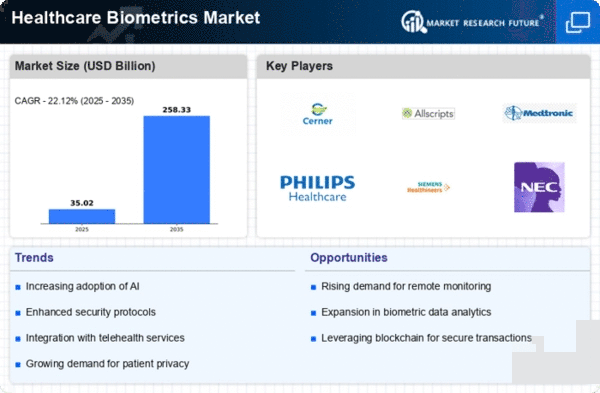
Healthcare Biometrics Market Infographic
×
Healthcare Biometrics Market Infographic Full View
Purchase Options

Market Trends

Key Emerging Trends in the Healthcare Biometrics Market

The Healthcare Biometrics market is experiencing a large increase and transformation fueled by advancements in generation and the increasing demand for stable and efficient healthcare methods. Biometric solutions, together with fingerprint reputation, iris scanning, and facial reputation, are being increasingly incorporated into healthcare systems to enhance patient identity, facts security, and average operational performance. The integration of biometrics with Electronic Health Records (EHR) is a growing trend, facilitating seamless and secure right of entry to patient information. Biometric authentication adds an extra layer of security to EHR systems, stopping unauthorized admission to and capability statistics breaches. This integration streamlines healthcare workflows and enhances data accuracy. The COVID-19 pandemic has multiplied the adoption of contactless biometric solutions in healthcare settings. Contactless techniques, consisting of facial reputation and iris scanning, reduce physical touch and reduce the chance of ailment transmission. This fashion aligns with the broader shift in the direction of touchless technologies in healthcare environments. Healthcare companies are leveraging biometrics to decorate remedy control tactics. Biometric authentication guarantees that the proper medicinal drug is run to the proper affected person, decreasing the hazard of drug mistakes. This fashion is particularly important in improving patient protection and adherence to prescribed treatment plans. The integration of biometric sensors into wearable gadgets is a burgeoning fashion in healthcare. Wearables prepared with biometric talents, consisting of heart fee tracking and biometric identification, enable continuous and faraway patient monitoring. This trend empowers healthcare professionals to collect actual-time information for better-knowledgeable selection-making. Telehealth has seen a large uptick, and biometrics are playing a vital role in ensuring stable and dependable digital healthcare interactions. Biometric authentication provides an extra layer of identity verification at some point during telehealth consultations, shielding affected persons' records and retaining the integrity of far-off healthcare services. Biometrics are being employed more and more in scientific trials and studies settings. Biometric identifiers help preserve the integrity of trial facts, ensure correct issue identity, and stop fraudulent sports. This trend enhances the overall reliability and validity of scientific trial effects. Despite the high-quality developments, demanding situations in biometric implementation persist. Concerns associated with privacy, information security, and the ability to detect gadget vulnerabilities are crucial concerns. Striking a balance between strong security measures and addressing those issues is crucial for the extensive adoption of biometric solutions in healthcare.


Author
Rahul Gotadki
Assistant Manager

He holds an experience of about 7+ years in Market Research and Business Consulting, working under the spectrum of Life Sciences and Healthcare domains. Rahul conceptualizes and implements a scalable business strategy and provides strategic leadership to the clients. His expertise lies in market estimation, competitive intelligence, pipeline analysis, customer assessment, etc. In addition to the above, his other responsibility includes strategic tracking of high growth markets & advising clients on the potential areas of focus they could direct their business initiatives

Leave a Comment

FAQs

What is the projected growth of the Healthcare Biometrics market?

The Healthcare Biometrics market is the expected increase in total market value of 258.33 USD billion over a defined forecast period 2025–2035. It is driven by factors such as demand trends, technological advances, regulatory changes, and geographic expansion.

What is the size of the Healthcare Biometrics market?

Healthcare Biometrics market size was valued at approximately 28.68 billion USD in 2024. This figure will reach 258.33 billion USD covering all regions (America, Europe, Asia, MEA and ROW), focusing its segments / services / distribution channels till 2035.

What is the CAGR of the Healthcare Biometrics market?

Healthcare Biometrics market is expected to grow at a CAGR of 22.12% between 2025 and 2035.

How much will the Healthcare Biometrics market be worth by 2035?

Healthcare Biometrics market is expected to be worth of 258.33 billion USD, reflecting growth driven by usage, technology and global demands by the end of 2035.

How will the Healthcare Biometrics market perform over the next 10 years?

Over the next 10 years the Healthcare Biometrics market is expected to shift from usd billion 28.68 to 258.33 billion USD, led by adoption of advanced tech, demographic trends, regulatory approvals, with potential headwinds from 2025 to 2035.

What is the projected market size for the Global Healthcare Biometrics Market by 2035?

By 2035, the Global Healthcare Biometrics Market is projected to reach a value of 20.4 USD Billion.

Which region is expected to hold the largest market share in the Global Healthcare Biometrics Market in 2024?

North America is expected to hold the largest market share, valued at 4.1 USD Billion in 2024.

What will be the market size of the Healthcare Biometrics Market in Europe by 2035?

The market size in Europe is anticipated to reach 5.2 USD Billion by 2035.

What are the market values for different technologies in the Healthcare Biometrics Market in 2024?

In 2024, Fingerprint Recognition will be valued at 3.45 USD Billion, Iris Recognition at 2.1 USD Billion, Facial Recognition at 2.7 USD Billion, Voice Recognition at 1.5 USD Billion, and Vein Recognition at 0.5 USD Billion.

Who are the major players in the Global Healthcare Biometrics Market?

Key players in the market include IBM, Fujitsu, Thales, Innovatrics, IDEMIA, BioKey International, FaceFirst, Apple, Nuance Communications, NEC, Gemalto, Microsoft, Zebra Technologies, Aware, and SecureAuth.

Market Summary

As per MRFR analysis, the Healthcare Biometrics Market Size was estimated at 28.68 USD Billion in 2024. The Healthcare Biometrics industry is projected to grow from 35.02 USD Billion in 2025 to 258.33 USD Billion by 2035, exhibiting a compound annual growth rate (CAGR) of 22.12 during the forecast period 2025 - 2035.

Key Market Trends & Highlights

The Healthcare Biometrics Market is experiencing robust growth driven by technological advancements and increasing demand for security solutions.

  • The market witnesses increased adoption of biometric authentication across healthcare facilities, particularly in North America.
  • Integration with telehealth services is becoming prevalent, enhancing patient engagement and accessibility in Asia-Pacific.
  • There is a notable shift towards patient-centric solutions, with hospitals leading in patient identification applications.
  • Rising demand for enhanced security and regulatory compliance are key drivers propelling growth in the access control segment.

Market Size & Forecast

2024 Market Size 28.68 (USD Billion)
2035 Market Size 258.33 (USD Billion)
CAGR (2025 - 2035) 22.12%
Largest Regional Market Share in 2024 North America

Major Players

Cerner Corporation (US), Allscripts Healthcare Solutions (US), Medtronic (US), Philips Healthcare (NL), Siemens Healthineers (DE), NEC Corporation (JP), Gemalto (NL), IDEMIA (FR), Fujitsu (JP), M2SYS Technology (US)

Market Trends

The Healthcare Biometrics Market is currently experiencing a transformative phase, driven by advancements in technology and an increasing emphasis on security and patient identification. The integration of biometric systems into healthcare settings appears to enhance the accuracy of patient records and streamline administrative processes. As healthcare providers seek to improve operational efficiency, the adoption of biometric solutions, such as fingerprint recognition and facial recognition, seems to be gaining traction. This trend is likely influenced by the growing need for secure access to sensitive patient information, which is paramount in maintaining confidentiality and trust in healthcare services. Moreover, the Healthcare Biometrics Market is witnessing a shift towards mobile and wearable biometric devices. These innovations may facilitate real-time health monitoring and patient engagement, potentially leading to improved health outcomes. The convergence of biometric technology with telehealth services indicates a promising future, where remote patient identification and authentication become seamless. As the market evolves, stakeholders must remain vigilant to emerging trends and regulatory changes that could impact the deployment of biometric solutions in healthcare environments.

Increased Adoption of Biometric Authentication

Healthcare organizations are increasingly implementing biometric authentication methods to enhance security and streamline patient identification processes. This trend reflects a growing recognition of the need for reliable and efficient access control systems that protect sensitive patient data.

Integration with Telehealth Services

The integration of biometric technology with telehealth platforms is becoming more prevalent. This development suggests a potential for improved patient engagement and monitoring, as biometric solutions facilitate secure remote access to healthcare services.

Focus on Patient-Centric Solutions

There is a noticeable shift towards patient-centric biometric solutions that prioritize user experience. This trend indicates a growing awareness of the importance of making biometric systems intuitive and accessible for patients, thereby enhancing overall satisfaction.

Healthcare Biometrics Market Market Drivers

Rising Demand for Enhanced Security

The Global Healthcare Biometrics Market Industry is witnessing a notable surge in demand for enhanced security measures within healthcare facilities. As patient data breaches become increasingly prevalent, healthcare organizations are compelled to adopt biometric solutions to safeguard sensitive information. For instance, biometric authentication systems, such as fingerprint and facial recognition, provide a robust layer of security that traditional methods cannot match. This heightened focus on security is expected to drive the market's growth, with projections indicating a market value of 9.63 USD Billion in 2024. The emphasis on protecting patient privacy and data integrity is likely to propel further investments in biometric technologies.

Growing Awareness of Patient Privacy

Growing awareness of patient privacy is emerging as a vital driver for the Global Healthcare Biometrics Market Industry. As patients become more informed about their rights regarding personal data, healthcare providers are under increasing pressure to implement robust security measures. Biometric technologies offer a compelling solution to address these concerns, as they provide a secure means of verifying patient identities while minimizing the risk of data breaches. This heightened focus on patient privacy is likely to encourage healthcare organizations to invest in biometric systems, further propelling market growth. The convergence of patient expectations and regulatory requirements is expected to shape the future landscape of the industry.

Government Initiatives and Regulations

Government initiatives and regulations play a crucial role in shaping the Global Healthcare Biometrics Market Industry. Various governments are implementing policies aimed at enhancing patient safety and data security, which often include mandates for biometric identification systems in healthcare settings. For example, initiatives that promote the adoption of electronic health records (EHR) often require robust authentication methods to protect sensitive patient information. Such regulatory frameworks not only encourage healthcare organizations to invest in biometric technologies but also create a conducive environment for market growth. As a result, the market is expected to experience a compound annual growth rate of 7.06% from 2025 to 2035.

Integration of Biometric Technology in Telehealth

The integration of biometric technology into telehealth services is emerging as a pivotal driver for the Global Healthcare Biometrics Market Industry. As telehealth continues to gain traction, especially in remote patient monitoring and virtual consultations, the need for secure and reliable patient identification becomes paramount. Biometric solutions, such as voice recognition and facial recognition, facilitate seamless and secure interactions between healthcare providers and patients. This trend not only enhances patient experience but also ensures compliance with regulatory standards. The anticipated growth in telehealth services is likely to contribute significantly to the market, with projections suggesting a value of 20.4 USD Billion by 2035.

Technological Advancements in Biometric Solutions

Technological advancements in biometric solutions are significantly influencing the Global Healthcare Biometrics Market Industry. Innovations such as artificial intelligence and machine learning are enhancing the accuracy and efficiency of biometric systems, making them more appealing to healthcare providers. For instance, AI-driven facial recognition systems can now identify individuals with remarkable precision, even in challenging conditions. These advancements not only improve security but also streamline patient identification processes, thereby enhancing operational efficiency. As healthcare organizations increasingly recognize the benefits of adopting cutting-edge biometric technologies, the market is poised for substantial growth in the coming years.

Market Segment Insights

By Application: Patient Identification (Largest) vs. Access Control (Fastest-Growing)

In the Healthcare Biometrics Market, the application segments have distinct roles in enhancing operational efficiency and security. Patient Identification holds the largest share, reflecting its critical importance in ensuring proper patient care and minimizing medical errors. In contrast, Access Control is emerging as the fastest-growing application, driven by increased concerns over data security and the necessity for secure environment access, indicating a shift in priorities within healthcare facilities.

Patient Identification (Dominant) vs. Access Control (Emerging)

Patient Identification is established as the dominant force within the Healthcare Biometrics Market, as it directly addresses the need to accurately identify patients to avoid errors in treatment and medication. This segment utilizes various biometric identification methods to streamline patient registration and verification processes, leading to enhanced patient safety. Conversely, Access Control is emerging rapidly to safeguard healthcare data and premises, spurred by the escalating need for secure access pathways in sensitive environments. Technologies such as fingerprint and facial recognition are becoming vital in restricting access to authorized personnel, showcasing a growing emphasis on cybersecurity and the need for stringent access management in healthcare facilities.

By End Use: Hospitals (Largest) vs. Clinics (Fastest-Growing)

In the Healthcare Biometrics Market, hospitals represent the largest segment, accounting for a significant portion of overall market share due to their extensive infrastructure and diverse patient needs. Clinics, while smaller in comparison, are rapidly gaining traction as they increasingly adopt biometric solutions for patient identification, access control, and secure record management, establishing themselves as key players in the market. The growth trends indicate that clinics are emerging as the fastest-growing segment, driven by the need for efficient patient management systems and the rising emphasis on accuracy in patient identification. As technology advances, the integration of biometrics in clinics is becoming essential for streamlining operations, enhancing patient experience, and ensuring compliance with regulations, bolstering their market position and growth potential.

Hospitals: Dominant vs. Clinics: Emerging

The hospitals segment is characterized by extensive investment in biometric technologies aimed at enhancing operational efficiency and patient safety. Hospitals utilize sophisticated biometric systems for patient identification, staff access control, and secure data management, thus reinforcing their dominant position in the Healthcare Biometrics Market. Conversely, clinics, considered the emerging segment, are witnessing a surge in biometric solution adoption as they strive to improve patient management and operational workflows. With a focus on affordability and simplicity, clinics are increasingly opting for user-friendly biometric systems that integrate seamlessly into existing processes. This adaptability enables clinics to enhance security and patient satisfaction while competing effectively with larger healthcare institutions.

By Technology: Fingerprint Recognition (Largest) vs. Facial Recognition (Fastest-Growing)

In the Healthcare Biometrics Market, fingerprint recognition technology currently holds the largest share among various modalities. The widespread adoption of fingerprint systems is attributed to their accuracy, ease of use, and established technology, making it a preferred choice for healthcare providers. Meanwhile, facial recognition has emerged as the fastest-growing segment. Its non-intrusive nature and ability to provide contactless identification have gained traction, particularly in response to the ongoing emphasis on safety and hygiene in healthcare settings.

Technology: Fingerprint Recognition (Dominant) vs. Facial Recognition (Emerging)

Fingerprint recognition stands as the dominant technology in the healthcare biometrics market due to its reliability and user acceptance. It offers significant advantages like speedy authentication and established infrastructure. On the other hand, facial recognition is on the rise as an emerging technology, driven by advancements in AI and imaging technology. Its integration in patient management systems is growing, providing seamless interactions in hospitals and clinics. While fingerprint biometrics remains crucial, facial recognition is gaining momentum, especially in environments where minimal contact is preferred, leading to a transformative shift in how patient identification is approached in healthcare.

Get more detailed insights about Healthcare Biometrics Market Research Report - Forecast To 2035

Regional Insights

North America : Market Leader in Innovation

North America is poised to maintain its leadership in the Healthcare Biometrics Market, holding a significant market share of 14.3 in 2024. The region's growth is driven by increasing demand for secure patient identification, regulatory support for biometric technologies, and advancements in healthcare IT infrastructure. The integration of biometrics in healthcare enhances patient safety and streamlines operations, making it a critical focus area for healthcare providers. The competitive landscape in North America is robust, featuring key players such as Cerner Corporation, Allscripts Healthcare Solutions, and Medtronic. These companies are at the forefront of innovation, developing cutting-edge biometric solutions tailored for healthcare applications. The U.S. remains the leading country, supported by favorable government policies and a strong emphasis on technological advancements in healthcare delivery.

Europe : Emerging Market with Potential

Europe is witnessing a growing interest in the Healthcare Biometrics Market, with a market size of 8.5 in 2024. The region's growth is fueled by increasing healthcare expenditures, a rising focus on patient data security, and regulatory frameworks promoting biometric solutions. Countries are investing in advanced technologies to enhance healthcare delivery, making biometrics a vital component of future healthcare systems. Leading countries in Europe include Germany, France, and the Netherlands, where companies like Philips Healthcare and Siemens Healthineers are making significant strides. The competitive landscape is characterized by a mix of established players and innovative startups, all vying to capture market share. The European market is expected to expand as healthcare providers increasingly adopt biometric technologies to improve patient experiences and operational efficiency.

Asia-Pacific : Rapidly Growing Market

Asia-Pacific is emerging as a rapidly growing market for Healthcare Biometrics, with a market size of 4.8 in 2024. The region's growth is driven by increasing healthcare investments, a surge in the adoption of digital health solutions, and a growing awareness of the importance of patient data security. Governments are actively promoting the use of biometric technologies to streamline healthcare processes and improve patient outcomes. Countries like Japan, China, and India are leading the charge in adopting biometric solutions. Key players such as NEC Corporation and Fujitsu are at the forefront, developing innovative products tailored to the unique needs of the region. The competitive landscape is evolving, with both local and international companies striving to establish a foothold in this burgeoning market, driven by the demand for enhanced healthcare services.

Middle East and Africa : Emerging Market Opportunities

The Middle East and Africa region is gradually emerging in the Healthcare Biometrics Market, with a market size of 1.1 in 2024. The growth is primarily driven by increasing healthcare investments, a rising focus on patient safety, and the need for efficient healthcare delivery systems. Governments are recognizing the potential of biometric technologies to enhance healthcare services, leading to increased adoption across various healthcare facilities. Countries such as South Africa and the UAE are taking the lead in implementing biometric solutions. The competitive landscape is characterized by a mix of local and international players, all aiming to capitalize on the growing demand for secure and efficient healthcare services. As the region continues to develop its healthcare infrastructure, the adoption of biometrics is expected to rise significantly, paving the way for future growth.

Key Players and Competitive Insights

The Healthcare Biometrics Market is currently characterized by a dynamic competitive landscape, driven by technological advancements and an increasing emphasis on patient data security. Key players such as Cerner Corporation (US), Philips Healthcare (Netherlands), and IDEMIA (France) are at the forefront, each adopting distinct strategies to enhance their market positioning. Cerner Corporation (US) focuses on integrating biometric solutions into electronic health records (EHR), thereby streamlining patient identification processes. Meanwhile, Philips Healthcare (NL) emphasizes innovation in biometric imaging technologies, which enhances diagnostic accuracy and patient care. IDEMIA (FR) is leveraging its expertise in identity management to expand its biometric offerings, particularly in secure patient authentication, which is becoming increasingly critical in healthcare settings.The market structure appears moderately fragmented, with a mix of established players and emerging startups. Key business tactics include localizing manufacturing to reduce costs and optimizing supply chains to enhance efficiency. This collective approach allows companies to respond swiftly to market demands while maintaining competitive pricing. The influence of major players is significant, as they set industry standards and drive technological advancements that smaller firms often follow.

In November Cerner Corporation (US) announced a partnership with a leading cloud service provider to enhance its biometric data management capabilities. This strategic move is likely to bolster Cerner's position in the market by improving data security and accessibility, which are paramount in healthcare. The collaboration suggests a shift towards cloud-based solutions, enabling healthcare providers to leverage biometric data more effectively.

In October Philips Healthcare (NL) launched a new biometric imaging system that integrates AI algorithms to improve patient identification accuracy. This innovation not only enhances operational efficiency but also addresses growing concerns regarding patient safety and data integrity. The introduction of such advanced technologies indicates Philips' commitment to maintaining a competitive edge through continuous innovation.

In September IDEMIA (FR) expanded its biometric authentication solutions to include mobile health applications, allowing patients to securely access their health records via smartphones. This strategic expansion reflects a growing trend towards mobile health solutions, catering to the increasing demand for convenient and secure access to personal health information. IDEMIA's move may position it favorably in a market that is rapidly embracing digital health technologies.

As of December the competitive trends in the Healthcare Biometrics Market are increasingly defined by digitalization, sustainability, and the integration of AI technologies. Strategic alliances among key players are shaping the landscape, fostering innovation and enhancing service delivery. The shift from price-based competition to a focus on technological advancement and supply chain reliability is evident, suggesting that future competitive differentiation will hinge on the ability to innovate and adapt to evolving market needs.

Key Companies in the Healthcare Biometrics Market include

Industry Developments

Recent developments in the Global Healthcare Biometrics Market indicate a significant upward trend driven by increasing demand for secure and efficient patient identification systems. Companies like IBM and Thales are enhancing their biometric solutions, focusing on integrating advanced technologies such as AI and machine learning to improve accuracy and speed. In August 2023, Fujitsu announced a strategic partnership with a leading healthcare provider to implement biometric authentication solutions, marking a notable advancement in patient security measures. 

Additionally, the acquisition of Gemalto by Thales in September 2019 has strengthened Thales’s position within the healthcare biometrics space by expanding its digital identity capabilities. In terms of market valuation, companies like Microsoft and Apple reported substantial growth in their biometric application sectors, contributing to a robust increase in market size as healthcare organizations increasingly adopt biometric authentication methods to streamline operations and enhance patient experiences. Overall, the demand for innovative and secure biometric solutions continues to shape the landscape of healthcare, promoting ongoing investments and development across the industry.

Future Outlook

Healthcare Biometrics Market Future Outlook

The Healthcare Biometrics Market is projected to grow at a 22.12% CAGR from 2024 to 2035, driven by technological advancements, increasing security needs, and regulatory compliance.

New opportunities lie in:

  • Integration of biometric authentication in telehealth platforms.
  • Development of portable biometric devices for remote patient monitoring.
  • Partnerships with healthcare providers for biometric data analytics services.

By 2035, the market is expected to be robust, driven by innovation and strategic partnerships.

Market Segmentation

Healthcare Biometrics Market End Use Outlook

  • Hospitals
  • Clinics
  • Pharmacies
  • Research Laboratories
  • Healthcare Insurance

Healthcare Biometrics Market Technology Outlook

  • Fingerprint Recognition
  • Facial Recognition
  • Iris Recognition
  • Voice Recognition
  • Vein Recognition

Healthcare Biometrics Market Application Outlook

  • Patient Identification
  • Access Control
  • Time and Attendance Tracking
  • Data Security
  • Health Records Management

Report Scope

MARKET SIZE 202428.68(USD Billion)
MARKET SIZE 202535.02(USD Billion)
MARKET SIZE 2035258.33(USD Billion)
COMPOUND ANNUAL GROWTH RATE (CAGR)22.12% (2025 - 2035)
REPORT COVERAGERevenue Forecast, Competitive Landscape, Growth Factors, and Trends
BASE YEAR2024
Market Forecast Period2025 - 2035
Historical Data2019 - 2024
Market Forecast UnitsUSD Billion
Key Companies ProfiledCerner Corporation (US), Allscripts Healthcare Solutions (US), Medtronic (US), Philips Healthcare (NL), Siemens Healthineers (DE), NEC Corporation (JP), Gemalto (NL), IDEMIA (FR), Fujitsu (JP), M2SYS Technology (US)
Segments CoveredApplication, End Use, Technology
Key Market OpportunitiesIntegration of advanced biometric technologies enhances patient identification and security in the Healthcare Biometrics Market.
Key Market DynamicsRising demand for secure patient identification drives innovation in Healthcare Biometrics technology and regulatory compliance.
Countries CoveredNorth America, Europe, APAC, South America, MEA

FAQs

What is the projected growth of the Healthcare Biometrics market?

The Healthcare Biometrics market is the expected increase in total market value of 258.33 USD billion over a defined forecast period 2025–2035. It is driven by factors such as demand trends, technological advances, regulatory changes, and geographic expansion.

What is the size of the Healthcare Biometrics market?

Healthcare Biometrics market size was valued at approximately 28.68 billion USD in 2024. This figure will reach 258.33 billion USD covering all regions (America, Europe, Asia, MEA and ROW), focusing its segments / services / distribution channels till 2035.

What is the CAGR of the Healthcare Biometrics market?

Healthcare Biometrics market is expected to grow at a CAGR of 22.12% between 2025 and 2035.

How much will the Healthcare Biometrics market be worth by 2035?

Healthcare Biometrics market is expected to be worth of 258.33 billion USD, reflecting growth driven by usage, technology and global demands by the end of 2035.

How will the Healthcare Biometrics market perform over the next 10 years?

Over the next 10 years the Healthcare Biometrics market is expected to shift from usd billion 28.68 to 258.33 billion USD, led by adoption of advanced tech, demographic trends, regulatory approvals, with potential headwinds from 2025 to 2035.

What is the projected market size for the Global Healthcare Biometrics Market by 2035?

By 2035, the Global Healthcare Biometrics Market is projected to reach a value of 20.4 USD Billion.

Which region is expected to hold the largest market share in the Global Healthcare Biometrics Market in 2024?

North America is expected to hold the largest market share, valued at 4.1 USD Billion in 2024.

What will be the market size of the Healthcare Biometrics Market in Europe by 2035?

The market size in Europe is anticipated to reach 5.2 USD Billion by 2035.

What are the market values for different technologies in the Healthcare Biometrics Market in 2024?

In 2024, Fingerprint Recognition will be valued at 3.45 USD Billion, Iris Recognition at 2.1 USD Billion, Facial Recognition at 2.7 USD Billion, Voice Recognition at 1.5 USD Billion, and Vein Recognition at 0.5 USD Billion.

Who are the major players in the Global Healthcare Biometrics Market?

Key players in the market include IBM, Fujitsu, Thales, Innovatrics, IDEMIA, BioKey International, FaceFirst, Apple, Nuance Communications, NEC, Gemalto, Microsoft, Zebra Technologies, Aware, and SecureAuth.

  1. SECTION I: EXECUTIVE SUMMARY AND KEY HIGHLIGHTS
    1. | 1.1 EXECUTIVE SUMMARY
  2. SECTION II: SCOPING, METHODOLOGY AND MARKET STRUCTURE
    1. | 2.1 MARKET INTRODUCTION
    2. | 2.2 RESEARCH METHODOLOGY
  3. SECTION III: QUALITATIVE ANALYSIS
    1. | 3.1 MARKET DYNAMICS
    2. | 3.2 MARKET FACTOR ANALYSIS
  4. SECTION IV: QUANTITATIVE ANALYSIS
    1. | 4.1 Healthcare, BY Application (USD Billion)
    2. | 4.2 Healthcare, BY End Use (USD Billion)
    3. | 4.3 Healthcare, BY Technology (USD Billion)
    4. | 4.4 Healthcare, BY Region (USD Billion)
  5. SECTION V: COMPETITIVE ANALYSIS
    1. | 5.1 Competitive Landscape
    2. | 5.2 Company Profiles
    3. | 5.3 Appendix

Healthcare Biometrics Market Segmentation

Market Segmentation Overview

  • Detailed segmentation data will be available in the full report
  • Comprehensive analysis by multiple parameters
  • Regional and country-level breakdowns
  • Market size forecasts by segment
Infographic

Free Sample Request

Kindly complete the form below to receive a free sample of this Report

Get Free Sample

Customer Strories

Compare Licence

×
Features License Type
Single User Multiuser License Enterprise User
Price $4,950 $5,950 $7,250
Maximum User Access Limit 1 User Upto 10 Users Unrestricted Access Throughout the Organization
Free Customization
Direct Access to Analyst
Deliverable Format
Platform Access
Discount on Next Purchase 10% 15% 15%
Printable Versions