×
Request Free Sample ×

Kindly complete the form below to receive a free sample of this Report

* Please use a valid business email

Leading companies partner with us for data-driven Insights

clients tt-cursor
Hero Background
English
Chinese
French
Japanese
Korean
German
Spanish

Healthcare Artificial Intelligence Market Trends

ID: MRFR/HS/4226-CR
144 Pages
Kinjoll Dey
February 2021

Healthcare Artificial Intelligence (AI) Market Research Report: Size, Share, Trend Analysis By Applications (Medical Imaging, Predictive Analytics, Robotic Surgery, Clinical Trials, Virtual Health Assistants), By Technology (Machine Learning, Natural Language Processing, Computer Vision, Deep Learning), By End Use (Hospitals, Pharmaceutical Companies, Research Institutions, Diagnostic Centers) - Growth Outlook & Industry Forecast 2025 To 2035

Share:
Download PDF ×

We do not share your information with anyone. However, we may send you emails based on your report interest from time to time. You may contact us at any time to opt-out.

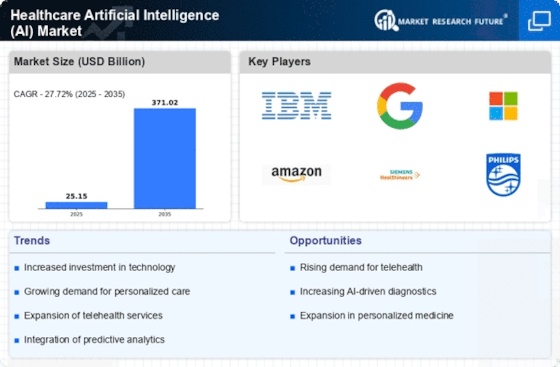
Healthcare Artificial Intelligence Market Infographic
Purchase Options

Market Trends

Key Emerging Trends in the Healthcare Artificial Intelligence Market

The market for AI in healthcare has grown because technology has gotten better and people want faster ways to get medical help. Diagnoses and specific treatment plans are two parts of healthcare that are changing because AI is being used. This is because AI is changing diagnostic pictures and doctors. This is making it faster and more effective to find sicknesses. Doctors can use machine learning to help them figure out what's wrong with a patient and how to treat them by looking at X-rays and MRIs. The biggest change in medical technology is adding AI to x-rays. Predictive analytics with AI are being used more and more to figure out how likely something is to happen and keep people from getting sick. AI systems can use information about patients to figure out which ones are most likely to get a disease. This lets them take steps that are right for them to stay healthy. For this reason, it helps the shift from reactionary treatment to proactive and preventative care. Artificial intelligence (AI) makes it much easier to find and make new drugs. Machine learning programs look at a lot of data to find possible new drugs, guess how well they will work, and speed up the process of research and development. AI is making it faster to make new medicines. With AI, healthcare can be done automatically, and patients can be watched from away. To keep an eye on a patient's health from away, artificial intelligence systems look at data sent in real time from monitors and tools that are implanted. A lot of people have trouble getting medical care and getting good care for long-term illnesses because of this issue. Artificial intelligence (AI) called Natural Language Processing is changing the paperwork used in health care. AI-powered automatic natural language processing (NLP) systems could help healthcare workers make better choices, look at data, and care for patients by finding trends in papers and clinical notes that are all mixed up. With AI, it is now possible to give each person their own health care. AI programs use information about patients to make drug and treatment plans that are unique to each person and take into account their genes, habits, and health conditions. This movement wants a health care system that is centered on the person using it. More and more, AI is being used in healthcare. This makes it more important to keep data safe. In the business world, more and more money is being spent to protect AI systems, keep patient data safe, and make sure that strict privacy rules are followed. These changes are meant to keep people's faith in AI-based health care choices. Electronic health records (EHRs) that use AI are meant to help doctors make better decisions and handle data better. This tech makes it simple for nurses and doctors to get and use patient data. This could help them choose better. Healthcare artificial intelligence (AI) has grown, but there are still problems with data quality, ethics, and being able to connect to other systems. The company wants to make AI systems that are fair and easy to understand while also protecting the rights of its customers.


Author
Kinjoll Dey
Senior Research Analyst

He is an extremely curious individual currently working in Healthcare and Medical Devices Domain. Kinjoll is comfortably versed in data centric research backed by healthcare educational background. He leverages extensive data mining and analytics tools such as Primary and Secondary Research, Statistical Analysis, Machine Learning, Data Modelling. His key role also involves Technical Sales Support, Client Interaction and Project management within the Healthcare team. Lastly, he showcases extensive affinity towards learning new skills and remain fascinated in implementing them.

Leave a Comment

FAQs

What is the projected market valuation of the Healthcare Artificial Intelligence (AI) Market by 2035?

<p>The projected market valuation for the Healthcare Artificial Intelligence (AI) Market by 2035 is 371.02 USD Billion.</p>

What was the overall market valuation of the Healthcare Artificial Intelligence (AI) Market in 2024?

<p>The overall market valuation of the Healthcare Artificial Intelligence (AI) Market in 2024 was 25.15 USD Billion.</p>

What is the expected CAGR for the Healthcare Artificial Intelligence (AI) Market during the forecast period 2025 - 2035?

<p>The expected CAGR for the Healthcare Artificial Intelligence (AI) Market during the forecast period 2025 - 2035 is 27.72%.</p>

Which application segment is projected to have the highest valuation in 2035?

<p>The Virtual Health Assistants application segment is projected to reach 91.02 USD Billion by 2035.</p>

What are the key technologies driving the Healthcare Artificial Intelligence (AI) Market?

<p>Key technologies driving the market include Machine Learning, Natural Language Processing, Computer Vision, and Deep Learning.</p>

Which company is recognized as a leader in the Healthcare Artificial Intelligence (AI) Market?

<p>IBM, Google, Microsoft, and Amazon are recognized as leaders in the Healthcare Artificial Intelligence (AI) Market.</p>

What is the projected valuation of the Machine Learning segment by 2035?

<p>The Machine Learning segment is projected to reach 150.0 USD Billion by 2035.</p>

How does the valuation of the Services component compare to Software and Hardware in 2035?

<p>In 2035, the Services component is projected to be valued at 146.02 USD Billion, closely following Software at 150.0 USD Billion.</p>

What is the expected valuation of the Pharmaceutical Companies end-use segment by 2035?

<p>The Pharmaceutical Companies end-use segment is expected to reach 120.0 USD Billion by 2035.</p>

What is the projected valuation of the Clinical Trials application segment by 2035?

<p>The Clinical Trials application segment is projected to reach 50.0 USD Billion by 2035.</p>

Market Summary

As per analysis, the healthcare artificial intelligence (AI) market is projected to grow from USD 0.642 Billion in 2025 to USD 5.81 Billion by 2035, exhibiting a compound annual growth rate (CAGR) of 24.91% during the forecast period (2025 - 2035).

Key Market Trends & Highlights

The Healthcare Artificial Intelligence Market is poised for substantial growth driven by technological advancements and increasing demand for personalized solutions.

  • The medical imaging segment remains the largest contributor to the healthcare AI market, reflecting a strong reliance on advanced imaging technologies. Clinical decision support systems are emerging as the fastest-growing segment, indicating a shift towards data-driven decision-making in healthcare. Hospitals continue to dominate the market, while diagnostic centers are rapidly expanding, showcasing a diversification in healthcare service delivery. Rising demand for personalized healthcare solutions and government initiatives are key drivers propelling the growth of AI technologies in the region.

Market Size & Forecast

2024 Market Size 0.503 (USD Billion)
2035 Market Size 5.81 (USD Billion)
CAGR (2025 - 2035) 24.91%

Major Players

<a title="Siemens Healthineers" href="https://www.siemens-healthineers.com/ai-healthcare-solutions" target="_blank" rel="noopener">Siemens Healthineers</a> (DE), <a title="IBM" href="https://www.ibm.com/think/topics/artificial-intelligence-medicine" target="_blank" rel="noopener">IBM</a> (US), Philips (NL), GE Healthcare (US), CureMetrix (US), Aidoc (IL), Zebra Medical Vision (IL), CureMetrix (US)

Market Trends

The Healthcare Artificial Intelligence Market is currently experiencing a transformative phase, characterized by the integration of advanced technologies into various healthcare sectors. This evolution appears to be driven by a growing demand for improved patient outcomes, operational efficiency, and cost reduction. Governments in the region are actively promoting the adoption of artificial intelligence in healthcare, recognizing its potential to enhance diagnostic accuracy, streamline administrative processes, and facilitate personalized medicine. As a result, healthcare providers are increasingly investing in AI solutions, which may lead to a more data-driven approach in patient care and management. Moreover, the regulatory landscape is evolving to accommodate the rapid advancements in artificial intelligence technologies. Initiatives aimed at fostering innovation and ensuring patient safety are being implemented, which could further stimulate growth in the Healthcare Artificial Intelligence Market. Collaboration between public and private sectors is also on the rise, suggesting a collective effort to harness the benefits of AI in healthcare. This collaborative environment may pave the way for new partnerships and innovations, ultimately enhancing the quality of healthcare services across the region.

Increased Investment in AI Technologies

Healthcare providers in the region are likely to increase their investments in artificial intelligence technologies. This trend suggests a shift towards adopting AI-driven solutions for diagnostics, treatment planning, and patient management, which may enhance overall healthcare delivery.

Regulatory Framework Development

The development of a robust regulatory framework for artificial intelligence in healthcare appears to be a priority for global governments. This initiative indicates a commitment to ensuring the safe and effective use of AI technologies, which could foster greater trust among healthcare providers and patients.

Focus on Data Security and Privacy

As the Healthcare Artificial Intelligence Market expands, there is a growing emphasis on data security and patient privacy. This trend suggests that stakeholders are increasingly aware of the importance of safeguarding sensitive health information, which may lead to the implementation of stricter data protection measures.

Healthcare Artificial Intelligence Market Market Drivers

Government Initiatives and Funding

Government initiatives play a pivotal role in shaping the healthcare artificial intelligence (ai) market. Various nations have launched strategic plans aimed at integrating AI into healthcare systems. For example, Saudi Arabia's Vision 2030 emphasizes the adoption of advanced technologies, including AI, to enhance healthcare delivery. The government has allocated substantial funding to support research and development in AI applications, which is expected to foster innovation and attract private sector investments. Additionally, the Qatar National Vision 2030 outlines similar objectives, focusing on improving healthcare services through technology. These initiatives not only enhance the infrastructure for AI in healthcare but also create a conducive environment for collaboration between public and private entities, thereby accelerating the growth of the healthcare AI market.

Growing Focus on Operational Efficiency

The healthcare artificial intelligence (ai) market is increasingly focused on enhancing operational efficiency within healthcare organizations. AI technologies are being deployed to streamline administrative tasks, manage patient flow, and optimize resource utilization. For example, hospitals in the UAE are implementing AI-driven scheduling systems that reduce patient wait times and improve overall service delivery. This focus on operational efficiency is expected to result in cost savings and improved patient experiences, which are crucial for the sustainability of healthcare systems in the region. The market for AI solutions aimed at operational efficiency is projected to grow, with estimates suggesting a potential increase of 15% in adoption rates over the next few years. This trend underscores the importance of AI in driving efficiency within the healthcare sector.

Integration of AI in Diagnostic Processes

The integration of AI in diagnostic processes is transforming the healthcare artificial intelligence (ai) market. AI algorithms are increasingly being utilized to analyze medical images, pathology reports, and genetic data, leading to faster and more accurate diagnoses. For instance, hospitals in Bahrain have begun employing AI tools to assist radiologists in identifying anomalies in imaging studies, which has reportedly improved diagnostic accuracy by up to 30%. The market for AI-driven diagnostic tools is expected to expand significantly, with projections indicating a growth rate of approximately 25% annually. This integration not only enhances clinical outcomes but also optimizes resource allocation within healthcare facilities, making it a critical driver for the healthcare AI market.

Advancements in Telemedicine and Remote Monitoring

Advancements in telemedicine and remote monitoring are significantly influencing the healthcare artificial intelligence (ai) market. The rise of AI-powered telehealth platforms enables healthcare providers to offer remote consultations and continuous patient monitoring, thereby improving access to care. Countries like Oman are investing in telemedicine initiatives that leverage AI to enhance patient outcomes, particularly in rural areas. The market for telemedicine solutions in the global market is anticipated to grow at a robust pace, with projections indicating a compound annual growth rate of around 30% over the next five years. This growth is likely to be fueled by the increasing acceptance of digital health solutions among patients and providers alike, further solidifying the role of AI in transforming healthcare delivery across the GCC.

Rising Demand for Personalized Healthcare Solutions

The Healthcare Artificial Intelligence Market is witnessing a notable shift towards personalized healthcare solutions. This trend is driven by an increasing patient expectation for tailored treatments and services. AI technologies enable healthcare providers to analyze vast amounts of patient data, leading to more accurate diagnoses and customized treatment plans. For instance, the UAE has implemented AI-driven platforms that assess individual health profiles, thereby enhancing patient engagement and satisfaction. The market for personalized medicine in the global market is projected to grow significantly, with estimates suggesting a compound annual growth rate of over 20% in the coming years. This rising demand for personalized solutions is likely to propel investments in AI technologies, further solidifying the GCC's position in the global healthcare landscape.

Market Segment Insights

By Application: Medical Imaging (Largest) vs. Predictive Analytics (Fastest-Growing)

<p>The Healthcare Artificial Intelligence (AI) Market showcases a diverse range of applications, with Medical Imaging leading the charge as the largest segment. This segment significantly contributes to enhancing diagnostic accuracy and streamlining workflows within healthcare settings. Following closely is Predictive Analytics, demonstrating a remarkable trajectory in growth due to its ability to harness data for forecasting patient outcomes and optimizing treatment protocols. It is increasingly recognized for its role in preventive care and operational efficiency. The growth trends in the application segment are driven by rapid technological advancements and the increasing need for efficient healthcare solutions. As healthcare organizations continue to embrace digital transformation, the demand for AI applications like Robotic Surgery and Virtual Health Assistants is surging. Additionally, the COVID-19 pandemic has accelerated the adoption of AI in Clinical Trials, emphasizing data-driven decision-making and remote patient management. As AI technology matures, we can expect sustained growth across these applications, reshaping the future of healthcare delivery.</p>

<p>Medical Imaging (Dominant) vs. Robotic Surgery (Emerging)</p>

<p>Medical Imaging stands out as a dominant force within the Healthcare AI landscape, attributed to its vital role in diagnostic imaging such as MRI, CT scans, and X-rays, enhancing interpretation accuracy and efficiency through AI algorithms. The established infrastructure and entrenched usage within medical practices bolster its market share. In contrast, Robotic Surgery represents an emerging segment that leverages AI technology to assist surgeons, ensuring precision and reduced recovery times for patients. Although newer in comparison, the adoption rates of robotic systems are on the rise due to advancements in automation and the growing acceptance of minimally invasive procedures. The synergy between these two segments illustrates a shift towards integrated AI solutions in modern healthcare.</p>

By Technology: Machine Learning (Largest) vs. Natural Language Processing (Fastest-Growing)

<p>The Healthcare Artificial Intelligence market exhibits a strong distribution across its key technology segments, with Machine Learning dominating the share due to its extensive applications in predictive analytics and personalized medicine. Natural Language Processing follows suit, showcasing its vital role in processing and interpreting vast amounts of unstructured medical data, facilitating better decision-making for healthcare professionals.</p>

<p>Technology: Machine Learning (Dominant) vs. Natural Language Processing (Emerging)</p>

<p>Machine Learning is the cornerstone of AI in healthcare, enabling systems to learn from data patterns and improve over time. Its applications range from diagnostics to treatment recommendations, making it a dominant force in the sector. In contrast, Natural Language Processing is an emerging technology that is rapidly gaining traction. It specializes in understanding and analyzing human language, allowing for the extraction of meaningful insights from clinical notes and patient interactions, which enhances patient care and operational efficiency.</p>

By End Use: Hospitals (Largest) vs. Pharmaceutical Companies (Fastest-Growing)

<p>In the Healthcare Artificial Intelligence (AI) Market, hospitals represent the largest segment, primarily leveraging AI for operational efficiency, patient management, and diagnostic support. This segment captures a significant portion of the market share as healthcare institutions increasingly adopt AI solutions to improve patient care and streamline operations. On the other hand, pharmaceutical companies are showing rapid growth in this sector, integrating AI for drug discovery, personalized medicine, and clinical trial optimization, capturing the interest of investors and stakeholders alike.</p>

<p>Hospitals (Dominant) vs. Pharmaceutical Companies (Emerging)</p>

<p>Hospitals dominate the Healthcare AI market by utilizing advanced technologies for efficiency and patient care, making them pivotal in the adoption of AI solutions. Their investments in AI infrastructure enhance operational productivity and patient outcomes. Conversely, pharmaceutical companies are emerging as a significant force through innovative AI applications in R&D and drug development. This segment is rapidly expanding as firms seek to harness AI's potential to expedite drug discovery processes and improve the effectiveness of clinical trials. The adoption of AI enables pharmaceutical firms to personalize treatment plans, reducing time and costs, thereby reshaping their market positioning.</p>

By Component: Software (Largest) vs. Services (Fastest-Growing)

<p>In the Healthcare Artificial Intelligence (AI) Market, the component segment shows a distinct distribution of market share, with software leading significantly. This segment includes AI solutions designed to analyze health data, assist in diagnostics, and enhance decision-making in clinical workflows. Services make up the next significant share, providing vital support and integration services enabling seamless adoption of AI technologies in healthcare settings. Hardware, while crucial, holds a smaller share, encompassing devices and physical infrastructure that support AI applications. Growth trends reveal that software remains the dominant force, driven by increasing adoption of AI applications in healthcare, from predictive analytics to personalized medicine. Moreover, the services segment is the fastest-growing due to the rising demand for implementation, maintenance, and consultation services. This demand stems from healthcare providers seeking to leverage AI for operational efficiency and improved patient care, thus propelling the market forward.</p>

<p>Software (Dominant) vs. Services (Emerging)</p>

<p>Within the Healthcare AI ecosystem, software is the dominant player, characterized by its wide-ranging applications such as clinical decision support, medical image analysis, and patient management systems. These sophisticated software solutions are integral to improving healthcare outcomes and streamlining processes. On the other hand, services have emerged as a significant contributor to market dynamics, focusing on integration, training, and ongoing support, ensuring that healthcare institutions can effectively utilize AI technologies. The growing complexity of AI implementations necessitates expert services, which creates lucrative opportunities for firms specializing in consultation and technology integration. Together, these two segments highlight a robust market framework where software leads in capabilities while services rapidly evolve to meet emerging demands.</p>

By Data Source: Electronic Health Records (Largest) vs. Wearable Devices (Fastest-Growing)

In the healthcare artificial intelligence market, Electronic Health Records (EHRs) dominate, accounting for a significant portion of the data sources utilized. EHRs are critical in aggregating patient information, streamlining clinical workflows, and advancing research capacities. Their established usage and integration into healthcare systems solidify their predominant market share, while wearable devices, once considered supplementary, are experiencing rapid uptake as technological advancements enhance their practicality and accessibility. Wearable devices are emerging as a robust segment, driven by increasing health consciousness and the pursuit of personalized healthcare solutions. Their ability to provide real-time health data and insights fosters patient engagement and compliance with treatment regimens. The momentum of wearable technology, coupled with innovations in AI, signals a profound shift in how healthcare data is sourced and utilized, marking a transformative era in patient care and medical research.

EHRs (Dominant) vs. Wearable Devices (Emerging)

Electronic Health Records (EHRs) are the cornerstone of the healthcare AI market, offering a comprehensive digital record of patient health information that is essential for effective care coordination and clinical decision-making. Their integration into healthcare workflows enables clinicians to access real-time data, leading to improved patient outcomes and operational efficiencies. As the dominant data source, EHRs continue to evolve, incorporating advanced analytics and AI features that enhance predictive insights and support population health management. Conversely, wearable devices represent an emerging data source, driven by innovation and a consumer shift towards proactive health monitoring. These devices, which include smartwatches and fitness trackers, collect a range of biometric data, enabling continuous health tracking and personalized care interventions. As wearables become increasingly sophisticated and integrated with healthcare systems, they are set to play a pivotal role in the future of healthcare delivery, enhancing patient engagement and informing treatment strategies.

Get more detailed insights about Healthcare Artificial Intelligence (AI) Market Research Report - Global Forecast till 2035

Regional Insights

North America : Innovation and Investment Hub

North America is the largest market for Healthcare AI, holding approximately 45% of the global share. The region benefits from significant investments in technology, a robust healthcare infrastructure, and a growing demand for AI-driven solutions to enhance patient care and operational efficiency. Regulatory support from agencies like the FDA further catalyzes innovation, ensuring safety and efficacy in AI applications. The United States dominates this landscape, with key players such as IBM, Google, and Microsoft leading the charge. The competitive environment is characterized by rapid technological advancements and collaborations between tech companies and healthcare providers. This synergy fosters the development of cutting-edge AI solutions, positioning North America as a leader in The Healthcare Artificial Intelligence Market (AI).

Europe : Regulatory Framework and Growth

Europe is the second-largest market for Healthcare AI, accounting for approximately 30% of the global share. The region's growth is driven by increasing healthcare expenditures, a rising aging population, and a strong emphasis on digital transformation in healthcare. Regulatory frameworks, such as the EU's GDPR and the Medical Device Regulation, provide a structured environment for AI innovations, ensuring compliance and patient safety. Leading countries in this region include Germany, the UK, and France, where companies like Siemens Healthineers and Philips are making significant strides. The competitive landscape is marked by a mix of established firms and innovative startups, all vying to leverage AI for improved diagnostics and patient outcomes. This dynamic environment fosters collaboration and investment, propelling the European Healthcare AI market forward.

Asia-Pacific : Emerging Market with Potential

Asia-Pacific is an emerging powerhouse in the Healthcare AI market, holding about 20% of the global share. The region's growth is fueled by increasing healthcare demands, technological advancements, and government initiatives promoting digital health solutions. Countries like China and India are investing heavily in AI technologies to enhance healthcare delivery and accessibility, supported by favorable regulatory environments that encourage innovation. China is leading the charge, with significant contributions from local companies and partnerships with global tech giants. The competitive landscape is evolving, with a mix of established players and startups focusing on AI applications in diagnostics, treatment planning, and patient management. This vibrant ecosystem is set to drive substantial growth in the Healthcare AI sector across Asia-Pacific.

Middle East and Africa : Resource-Rich and Growing Market

The Middle East and Africa region is gradually emerging in the Healthcare AI market, holding around 5% of the global share. Growth is driven by increasing investments in healthcare infrastructure, a rising prevalence of chronic diseases, and government initiatives aimed at enhancing healthcare delivery through technology. Countries like the UAE and South Africa are at the forefront, implementing AI solutions to improve patient outcomes and operational efficiency. The competitive landscape is characterized by a mix of local and international players, with a focus on partnerships and collaborations to leverage AI technologies. The region's unique challenges, such as resource constraints, are being addressed through innovative solutions, making it a promising market for Healthcare AI advancements.

Key Players and Competitive Insights

The healthcare artificial intelligence market is currently characterized by a dynamic competitive landscape, driven by rapid technological advancements and increasing demand for efficient healthcare solutions. Key players such as Siemens Healthineers (DE), IBM (US), and GE Healthcare (US) are strategically positioned to leverage innovation and partnerships to enhance their market presence. Siemens Healthineers (DE) focuses on integrating AI into imaging solutions, while IBM (US) emphasizes its Watson Health platform to provide data-driven insights. GE Healthcare (US) is actively pursuing digital transformation initiatives, enhancing its AI capabilities to improve patient outcomes. Collectively, these strategies foster a competitive environment that prioritizes technological innovation and collaborative efforts.
In terms of business tactics, companies are increasingly localizing manufacturing and optimizing supply chains to enhance operational efficiency. The market structure appears moderately fragmented, with several players vying for market share. However, the influence of major companies is significant, as they set benchmarks for technological advancements and operational standards. This competitive structure encourages smaller firms to innovate and differentiate their offerings, thereby contributing to a vibrant market ecosystem.
In December 2025, Siemens Healthineers (DE) announced a partnership with a leading regional hospital network to implement AI-driven diagnostic tools aimed at improving patient care. This strategic move underscores the company's commitment to enhancing healthcare delivery through advanced technology, potentially positioning it as a leader in AI integration within the region. The collaboration is expected to yield significant improvements in diagnostic accuracy and operational efficiency.
In November 2025, IBM (US) launched an AI-powered analytics platform tailored for healthcare providers in the GCC. This initiative aims to streamline data management and enhance decision-making processes. By harnessing the power of AI, IBM seeks to empower healthcare professionals with actionable insights, thereby improving patient outcomes and operational workflows. This strategic action reflects IBM's focus on leveraging AI to address specific regional healthcare challenges.
In October 2025, GE Healthcare (US) unveiled a new AI-based imaging solution designed to assist radiologists in detecting anomalies more effectively. This innovation is particularly relevant in the GCC, where there is a growing demand for advanced diagnostic tools. By enhancing the capabilities of radiologists, GE Healthcare (US) aims to improve diagnostic accuracy and reduce turnaround times, thereby solidifying its competitive position in the market.
As of January 2026, the competitive trends in the healthcare artificial intelligence market are increasingly defined by digitalization, sustainability, and the integration of AI technologies. Strategic alliances among key players are shaping the landscape, fostering innovation and collaboration. Looking ahead, it is likely that competitive differentiation will evolve, with a shift from price-based competition to a focus on innovation, technological advancements, and supply chain reliability. This transition may redefine market dynamics, emphasizing the importance of strategic partnerships and cutting-edge solutions.

Key Companies in the Healthcare Artificial Intelligence Market include

Industry Developments

DEC 2025 - AI adoption in healthcare is accelerating as hospitals and life-science companies invest heavily in automation, predictive analytics, and clinical decision-support tools. Breakthroughs in imaging AI and workflow automation are driving new regulatory approvals, with governments issuing frameworks to ensure responsible AI deployment. Tech vendors are partnering with hospital networks to develop scalable, cloud-based AI ecosystems. The industry is now shifting from pilot projects to full operational integration, signaling a new era of digital healthcare efficiency.

Recent developments in the Global Healthcare Artificial Intelligence Market (AI) Market have showcased significant advancements and investments. In September 2023, Amazon unveiled its AI-driven healthcare platform aimed at improving patient diagnostics and operational efficiency. IBM has also strengthened its AI capabilities by announcing a partnership with Siemens Healthineers to enhance imaging solutions. In August 2023, NVIDIA expanded its AI healthcare portfolio, focusing on genomics and drug discovery, with substantial investments in Research and Development.

Meanwhile, Cerner and Microsoft solidified their alliance to integrate AI into electronic health record systems, enhancing data analysis and patient management. Growth in market valuation is evident, as Google and Philips reported increased adoption rates of AI technologies, projected to boost efficiency and reduce costs.

Furthermore, in recent months, Medtronic announced its acquisition of a predictive analytics firm, signaling a strategic move toward advanced AI-driven medical devices. Major happenings over the past 2-3 years reflect a surge in AI applications in diagnostics, treatment personalization, and operational efficiencies across the industry, indicating a robust and rapidly evolving landscape for Healthcare AI on a global scale.

Industry News 

Qure.ai : Johnson & Johnson Medtech Partners with Qure.ai to Boost Early Detection of Lung Cancer May 2025

  • This partnership aims to leverage AI for improved early detection of lung conditions.

Sanofi : Digital Transformation and Artificial Intelligence June 2025

  • Sanofi highlights its commitment to building and deploying AI-based solutions across its value chain, from research and development to manufacturing and patient engagement. They categorize their AI use into "Expert AI," "Snackable AI," and "Generative AI" to accelerate discovery, development, and delivery.

Johnson & Johnson : 6 ways Johnson & Johnson is using AI to help advance healthcare Oct 2024

  • J&J details how they are using AI to analyze operating room data for efficiency and learning, improve surgical procedures (e.g., cardiac ablation with CARTO™ 3 System's deep learning), and explore AI for presurgical planning and post-op patient tracking.

care.ai :2024 KLAS Emerging Solutions Top 20 Nov 2024

  • care.ai was recognized in the KLAS Emerging Solutions Top 20 report

Future Outlook

Healthcare Artificial Intelligence Market Future Outlook

The healthcare artificial intelligence market is poised for robust growth at 24.91% CAGR from 2025 to 2035, driven by technological advancements and increasing healthcare demands.

New opportunities lie in:

  • <p>Development of AI-driven telemedicine platforms for remote patient monitoring. Integration of predictive analytics in hospital management systems. Creation of personalized medicine solutions using AI algorithms.</p>

By 2035, the market is expected to be a pivotal component of the healthcare landscape.

Market Segmentation

Healthcare Artificial Intelligence Market End Use Outlook

  • Hospitals
  • Diagnostic Centers
  • Research Institutions
  • Pharmaceutical Companies
  • Home Healthcare

Healthcare Artificial Intelligence Market Technology Outlook

  • Machine Learning
  • Natural Language Processing
  • Computer Vision
  • Deep Learning
  • Expert Systems

Healthcare Artificial Intelligence Market Application Outlook

  • Clinical Decision Support
  • Medical Imaging
  • Robotic Surgery
  • Patient Monitoring
  • Drug Discovery

Healthcare Artificial Intelligence Market Data Source Outlook

  • Electronic Health Records
  • Wearable Devices
  • Clinical Trials
  • Patient Surveys

Healthcare Artificial Intelligence Market Deployment Model Outlook

  • On-Premises
  • Cloud-Based
  • Hybrid

Report Scope

MARKET SIZE 2024 0.503(USD Billion)
MARKET SIZE 2025 0.642(USD Billion)
MARKET SIZE 2035 5.81(USD Billion)
COMPOUND ANNUAL GROWTH RATE (CAGR) 24.91% (2024 - 2035)
REPORT COVERAGE Revenue Forecast, Competitive Landscape, Growth Factors, and Trends
BASE YEAR 2024
Market Forecast Period 2025 - 2035
Historical Data 2019 - 2024
Market Forecast Units USD Billion
Key Companies Profiled Siemens Healthineers (DE), IBM (US), Philips (NL), GE Healthcare (US), CureMetrix (US), Aidoc (IL), Zebra Medical Vision (IL), CureMetrix (US)
Segments Covered Application, End Use, Technology, Deployment Model, Data Source
Key Market Opportunities Integration of predictive analytics in patient management systems enhances efficiency in the Healthcare Artificial Intelligence Market.
Key Market Dynamics Growing adoption of artificial intelligence in healthcare enhances patient outcomes and operational efficiencies amid regulatory advancements.
Countries Covered GCC

FAQs

What is the projected market valuation of the Healthcare Artificial Intelligence (AI) Market by 2035?

<p>The projected market valuation for the Healthcare Artificial Intelligence (AI) Market by 2035 is 371.02 USD Billion.</p>

What was the overall market valuation of the Healthcare Artificial Intelligence (AI) Market in 2024?

<p>The overall market valuation of the Healthcare Artificial Intelligence (AI) Market in 2024 was 25.15 USD Billion.</p>

What is the expected CAGR for the Healthcare Artificial Intelligence (AI) Market during the forecast period 2025 - 2035?

<p>The expected CAGR for the Healthcare Artificial Intelligence (AI) Market during the forecast period 2025 - 2035 is 27.72%.</p>

Which application segment is projected to have the highest valuation in 2035?

<p>The Virtual Health Assistants application segment is projected to reach 91.02 USD Billion by 2035.</p>

What are the key technologies driving the Healthcare Artificial Intelligence (AI) Market?

<p>Key technologies driving the market include Machine Learning, Natural Language Processing, Computer Vision, and Deep Learning.</p>

Which company is recognized as a leader in the Healthcare Artificial Intelligence (AI) Market?

<p>IBM, Google, Microsoft, and Amazon are recognized as leaders in the Healthcare Artificial Intelligence (AI) Market.</p>

What is the projected valuation of the Machine Learning segment by 2035?

<p>The Machine Learning segment is projected to reach 150.0 USD Billion by 2035.</p>

How does the valuation of the Services component compare to Software and Hardware in 2035?

<p>In 2035, the Services component is projected to be valued at 146.02 USD Billion, closely following Software at 150.0 USD Billion.</p>

What is the expected valuation of the Pharmaceutical Companies end-use segment by 2035?

<p>The Pharmaceutical Companies end-use segment is expected to reach 120.0 USD Billion by 2035.</p>

What is the projected valuation of the Clinical Trials application segment by 2035?

<p>The Clinical Trials application segment is projected to reach 50.0 USD Billion by 2035.</p>

  1. SECTION I: EXECUTIVE SUMMARY AND KEY HIGHLIGHTS
    1. | 1.1 EXECUTIVE SUMMARY
    2. | | 1.1.1 Market Overview
    3. | | 1.1.2 Key Findings
    4. | | 1.1.3 Market Segmentation
    5. | | 1.1.4 Competitive Landscape
    6. | | 1.1.5 Challenges and Opportunities
    7. | | 1.1.6 Future Outlook
  2. SECTION II: SCOPING, METHODOLOGY AND MARKET STRUCTURE
    1. | 2.1 MARKET INTRODUCTION
    2. | | 2.1.1 Definition
    3. | | 2.1.2 Scope of the study
    4. | | | 2.1.2.1 Research Objective
    5. | | | 2.1.2.2 Assumption
    6. | | | 2.1.2.3 Limitations
    7. | 2.2 RESEARCH METHODOLOGY
    8. | | 2.2.1 Overview
    9. | | 2.2.2 Data Mining
    10. | | 2.2.3 Secondary Research
    11. | | 2.2.4 Primary Research
    12. | | | 2.2.4.1 Primary Interviews and Information Gathering Process
    13. | | | 2.2.4.2 Breakdown of Primary Respondents
    14. | | 2.2.5 Forecasting Model
    15. | | 2.2.6 Market Size Estimation
    16. | | | 2.2.6.1 Bottom-Up Approach
    17. | | | 2.2.6.2 Top-Down Approach
    18. | | 2.2.7 Data Triangulation
    19. | | 2.2.8 Validation
  3. SECTION III: QUALITATIVE ANALYSIS
    1. | 3.1 MARKET DYNAMICS
    2. | | 3.1.1 Overview
    3. | | 3.1.2 Drivers
    4. | | 3.1.3 Restraints
    5. | | 3.1.4 Opportunities
    6. | 3.2 MARKET FACTOR ANALYSIS
    7. | | 3.2.1 Value chain Analysis
    8. | | 3.2.2 Porter's Five Forces Analysis
    9. | | | 3.2.2.1 Bargaining Power of Suppliers
    10. | | | 3.2.2.2 Bargaining Power of Buyers
    11. | | | 3.2.2.3 Threat of New Entrants
    12. | | | 3.2.2.4 Threat of Substitutes
    13. | | | 3.2.2.5 Intensity of Rivalry
    14. | | 3.2.3 COVID-19 Impact Analysis
    15. | | | 3.2.3.1 Market Impact Analysis
    16. | | | 3.2.3.2 Regional Impact
    17. | | | 3.2.3.3 Opportunity and Threat Analysis
  4. SECTION IV: QUANTITATIVE ANALYSIS
    1. | 4.1 Healthcare, BY Application (USD Billion)
    2. | | 4.1.1 Clinical Decision Support
    3. | | 4.1.2 Medical Imaging
    4. | | 4.1.3 Patient Monitoring
    5. | | 4.1.4 Robotic Surgery
    6. | | 4.1.5 Drug Discovery
    7. | 4.2 Healthcare, BY End Use (USD Billion)
    8. | | 4.2.1 Hospitals
    9. | | 4.2.2 Diagnostic Centers
    10. | | 4.2.3 Research Institutions
    11. | | 4.2.4 Pharmaceutical Companies
    12. | | 4.2.5 Home Healthcare
    13. | 4.3 Healthcare, BY Technology (USD Billion)
    14. | | 4.3.1 Machine Learning
    15. | | 4.3.2 Natural Language Processing
    16. | | 4.3.3 Computer Vision
    17. | | 4.3.4 Expert Systems
    18. | | 4.3.5 Robotics
    19. | 4.4 Healthcare, BY Deployment Model (USD Billion)
    20. | | 4.4.1 On-Premises
    21. | | 4.4.2 Cloud-Based
    22. | | 4.4.3 Hybrid
    23. | 4.5 Healthcare, BY Data Source (USD Billion)
    24. | | 4.5.1 Electronic Health Records
    25. | | 4.5.2 Wearable Devices
    26. | | 4.5.3 Clinical Trials
    27. | | 4.5.4 Genomic Data
    28. | 4.6 Healthcare, BY Region (USD Billion)
    29. | | 4.6.1 North America
    30. | | | 4.6.1.1 US
    31. | | | 4.6.1.2 Canada
    32. | | 4.6.2 Europe
    33. | | | 4.6.2.1 Germany
    34. | | | 4.6.2.2 UK
    35. | | | 4.6.2.3 France
    36. | | | 4.6.2.4 Russia
    37. | | | 4.6.2.5 Italy
    38. | | | 4.6.2.6 Spain
    39. | | | 4.6.2.7 Rest of Europe
    40. | | 4.6.3 APAC
    41. | | | 4.6.3.1 China
    42. | | | 4.6.3.2 India
    43. | | | 4.6.3.3 Japan
    44. | | | 4.6.3.4 South Korea
    45. | | | 4.6.3.5 Malaysia
    46. | | | 4.6.3.6 Thailand
    47. | | | 4.6.3.7 Indonesia
    48. | | | 4.6.3.8 Rest of APAC
    49. | | 4.6.4 South America
    50. | | | 4.6.4.1 Brazil
    51. | | | 4.6.4.2 Mexico
    52. | | | 4.6.4.3 Argentina
    53. | | | 4.6.4.4 Rest of South America
    54. | | 4.6.5 MEA
    55. | | | 4.6.5.1 GCC Countries
    56. | | | 4.6.5.2 South Africa
    57. | | | 4.6.5.3 Rest of MEA
  5. SECTION V: COMPETITIVE ANALYSIS
    1. | 5.1 Competitive Landscape
    2. | | 5.1.1 Overview
    3. | | 5.1.2 Competitive Analysis
    4. | | 5.1.3 Market share Analysis
    5. | | 5.1.4 Major Growth Strategy in the Healthcare
    6. | | 5.1.5 Competitive Benchmarking
    7. | | 5.1.6 Leading Players in Terms of Number of Developments in the Healthcare
    8. | | 5.1.7 Key developments and growth strategies
    9. | | | 5.1.7.1 New Product Launch/Service Deployment
    10. | | | 5.1.7.2 Merger & Acquisitions
    11. | | | 5.1.7.3 Joint Ventures
    12. | | 5.1.8 Major Players Financial Matrix
    13. | | | 5.1.8.1 Sales and Operating Income
    14. | | | 5.1.8.2 Major Players R&D Expenditure. 2023
    15. | 5.2 Company Profiles
    16. | | 5.2.1 IBM (US)
    17. | | | 5.2.1.1 Financial Overview
    18. | | | 5.2.1.2 Products Offered
    19. | | | 5.2.1.3 Key Developments
    20. | | | 5.2.1.4 SWOT Analysis
    21. | | | 5.2.1.5 Key Strategies
    22. | | 5.2.2 Google (US)
    23. | | | 5.2.2.1 Financial Overview
    24. | | | 5.2.2.2 Products Offered
    25. | | | 5.2.2.3 Key Developments
    26. | | | 5.2.2.4 SWOT Analysis
    27. | | | 5.2.2.5 Key Strategies
    28. | | 5.2.3 Microsoft (US)
    29. | | | 5.2.3.1 Financial Overview
    30. | | | 5.2.3.2 Products Offered
    31. | | | 5.2.3.3 Key Developments
    32. | | | 5.2.3.4 SWOT Analysis
    33. | | | 5.2.3.5 Key Strategies
    34. | | 5.2.4 Amazon (US)
    35. | | | 5.2.4.1 Financial Overview
    36. | | | 5.2.4.2 Products Offered
    37. | | | 5.2.4.3 Key Developments
    38. | | | 5.2.4.4 SWOT Analysis
    39. | | | 5.2.4.5 Key Strategies
    40. | | 5.2.5 Siemens Healthineers (DE)
    41. | | | 5.2.5.1 Financial Overview
    42. | | | 5.2.5.2 Products Offered
    43. | | | 5.2.5.3 Key Developments
    44. | | | 5.2.5.4 SWOT Analysis
    45. | | | 5.2.5.5 Key Strategies
    46. | | 5.2.6 Philips (NL)
    47. | | | 5.2.6.1 Financial Overview
    48. | | | 5.2.6.2 Products Offered
    49. | | | 5.2.6.3 Key Developments
    50. | | | 5.2.6.4 SWOT Analysis
    51. | | | 5.2.6.5 Key Strategies
    52. | | 5.2.7 GE Healthcare (US)
    53. | | | 5.2.7.1 Financial Overview
    54. | | | 5.2.7.2 Products Offered
    55. | | | 5.2.7.3 Key Developments
    56. | | | 5.2.7.4 SWOT Analysis
    57. | | | 5.2.7.5 Key Strategies
    58. | | 5.2.8 NVIDIA (US)
    59. | | | 5.2.8.1 Financial Overview
    60. | | | 5.2.8.2 Products Offered
    61. | | | 5.2.8.3 Key Developments
    62. | | | 5.2.8.4 SWOT Analysis
    63. | | | 5.2.8.5 Key Strategies
    64. | | 5.2.9 CureMetrix (US)
    65. | | | 5.2.9.1 Financial Overview
    66. | | | 5.2.9.2 Products Offered
    67. | | | 5.2.9.3 Key Developments
    68. | | | 5.2.9.4 SWOT Analysis
    69. | | | 5.2.9.5 Key Strategies
    70. | | 5.2.10 Aidoc (IL)
    71. | | | 5.2.10.1 Financial Overview
    72. | | | 5.2.10.2 Products Offered
    73. | | | 5.2.10.3 Key Developments
    74. | | | 5.2.10.4 SWOT Analysis
    75. | | | 5.2.10.5 Key Strategies
    76. | 5.3 Appendix
    77. | | 5.3.1 References
    78. | | 5.3.2 Related Reports
  6. LIST OF FIGURES
    1. | 6.1 MARKET SYNOPSIS
    2. | 6.2 NORTH AMERICA MARKET ANALYSIS
    3. | 6.3 US MARKET ANALYSIS BY APPLICATION
    4. | 6.4 US MARKET ANALYSIS BY END USE
    5. | 6.5 US MARKET ANALYSIS BY TECHNOLOGY
    6. | 6.6 US MARKET ANALYSIS BY DEPLOYMENT MODEL
    7. | 6.7 US MARKET ANALYSIS BY DATA SOURCE
    8. | 6.8 CANADA MARKET ANALYSIS BY APPLICATION
    9. | 6.9 CANADA MARKET ANALYSIS BY END USE
    10. | 6.10 CANADA MARKET ANALYSIS BY TECHNOLOGY
    11. | 6.11 CANADA MARKET ANALYSIS BY DEPLOYMENT MODEL
    12. | 6.12 CANADA MARKET ANALYSIS BY DATA SOURCE
    13. | 6.13 EUROPE MARKET ANALYSIS
    14. | 6.14 GERMANY MARKET ANALYSIS BY APPLICATION
    15. | 6.15 GERMANY MARKET ANALYSIS BY END USE
    16. | 6.16 GERMANY MARKET ANALYSIS BY TECHNOLOGY
    17. | 6.17 GERMANY MARKET ANALYSIS BY DEPLOYMENT MODEL
    18. | 6.18 GERMANY MARKET ANALYSIS BY DATA SOURCE
    19. | 6.19 UK MARKET ANALYSIS BY APPLICATION
    20. | 6.20 UK MARKET ANALYSIS BY END USE
    21. | 6.21 UK MARKET ANALYSIS BY TECHNOLOGY
    22. | 6.22 UK MARKET ANALYSIS BY DEPLOYMENT MODEL
    23. | 6.23 UK MARKET ANALYSIS BY DATA SOURCE
    24. | 6.24 FRANCE MARKET ANALYSIS BY APPLICATION
    25. | 6.25 FRANCE MARKET ANALYSIS BY END USE
    26. | 6.26 FRANCE MARKET ANALYSIS BY TECHNOLOGY
    27. | 6.27 FRANCE MARKET ANALYSIS BY DEPLOYMENT MODEL
    28. | 6.28 FRANCE MARKET ANALYSIS BY DATA SOURCE
    29. | 6.29 RUSSIA MARKET ANALYSIS BY APPLICATION
    30. | 6.30 RUSSIA MARKET ANALYSIS BY END USE
    31. | 6.31 RUSSIA MARKET ANALYSIS BY TECHNOLOGY
    32. | 6.32 RUSSIA MARKET ANALYSIS BY DEPLOYMENT MODEL
    33. | 6.33 RUSSIA MARKET ANALYSIS BY DATA SOURCE
    34. | 6.34 ITALY MARKET ANALYSIS BY APPLICATION
    35. | 6.35 ITALY MARKET ANALYSIS BY END USE
    36. | 6.36 ITALY MARKET ANALYSIS BY TECHNOLOGY
    37. | 6.37 ITALY MARKET ANALYSIS BY DEPLOYMENT MODEL
    38. | 6.38 ITALY MARKET ANALYSIS BY DATA SOURCE
    39. | 6.39 SPAIN MARKET ANALYSIS BY APPLICATION
    40. | 6.40 SPAIN MARKET ANALYSIS BY END USE
    41. | 6.41 SPAIN MARKET ANALYSIS BY TECHNOLOGY
    42. | 6.42 SPAIN MARKET ANALYSIS BY DEPLOYMENT MODEL
    43. | 6.43 SPAIN MARKET ANALYSIS BY DATA SOURCE
    44. | 6.44 REST OF EUROPE MARKET ANALYSIS BY APPLICATION
    45. | 6.45 REST OF EUROPE MARKET ANALYSIS BY END USE
    46. | 6.46 REST OF EUROPE MARKET ANALYSIS BY TECHNOLOGY
    47. | 6.47 REST OF EUROPE MARKET ANALYSIS BY DEPLOYMENT MODEL
    48. | 6.48 REST OF EUROPE MARKET ANALYSIS BY DATA SOURCE
    49. | 6.49 APAC MARKET ANALYSIS
    50. | 6.50 CHINA MARKET ANALYSIS BY APPLICATION
    51. | 6.51 CHINA MARKET ANALYSIS BY END USE
    52. | 6.52 CHINA MARKET ANALYSIS BY TECHNOLOGY
    53. | 6.53 CHINA MARKET ANALYSIS BY DEPLOYMENT MODEL
    54. | 6.54 CHINA MARKET ANALYSIS BY DATA SOURCE
    55. | 6.55 INDIA MARKET ANALYSIS BY APPLICATION
    56. | 6.56 INDIA MARKET ANALYSIS BY END USE
    57. | 6.57 INDIA MARKET ANALYSIS BY TECHNOLOGY
    58. | 6.58 INDIA MARKET ANALYSIS BY DEPLOYMENT MODEL
    59. | 6.59 INDIA MARKET ANALYSIS BY DATA SOURCE
    60. | 6.60 JAPAN MARKET ANALYSIS BY APPLICATION
    61. | 6.61 JAPAN MARKET ANALYSIS BY END USE
    62. | 6.62 JAPAN MARKET ANALYSIS BY TECHNOLOGY
    63. | 6.63 JAPAN MARKET ANALYSIS BY DEPLOYMENT MODEL
    64. | 6.64 JAPAN MARKET ANALYSIS BY DATA SOURCE
    65. | 6.65 SOUTH KOREA MARKET ANALYSIS BY APPLICATION
    66. | 6.66 SOUTH KOREA MARKET ANALYSIS BY END USE
    67. | 6.67 SOUTH KOREA MARKET ANALYSIS BY TECHNOLOGY
    68. | 6.68 SOUTH KOREA MARKET ANALYSIS BY DEPLOYMENT MODEL
    69. | 6.69 SOUTH KOREA MARKET ANALYSIS BY DATA SOURCE
    70. | 6.70 MALAYSIA MARKET ANALYSIS BY APPLICATION
    71. | 6.71 MALAYSIA MARKET ANALYSIS BY END USE
    72. | 6.72 MALAYSIA MARKET ANALYSIS BY TECHNOLOGY
    73. | 6.73 MALAYSIA MARKET ANALYSIS BY DEPLOYMENT MODEL
    74. | 6.74 MALAYSIA MARKET ANALYSIS BY DATA SOURCE
    75. | 6.75 THAILAND MARKET ANALYSIS BY APPLICATION
    76. | 6.76 THAILAND MARKET ANALYSIS BY END USE
    77. | 6.77 THAILAND MARKET ANALYSIS BY TECHNOLOGY
    78. | 6.78 THAILAND MARKET ANALYSIS BY DEPLOYMENT MODEL
    79. | 6.79 THAILAND MARKET ANALYSIS BY DATA SOURCE
    80. | 6.80 INDONESIA MARKET ANALYSIS BY APPLICATION
    81. | 6.81 INDONESIA MARKET ANALYSIS BY END USE
    82. | 6.82 INDONESIA MARKET ANALYSIS BY TECHNOLOGY
    83. | 6.83 INDONESIA MARKET ANALYSIS BY DEPLOYMENT MODEL
    84. | 6.84 INDONESIA MARKET ANALYSIS BY DATA SOURCE
    85. | 6.85 REST OF APAC MARKET ANALYSIS BY APPLICATION
    86. | 6.86 REST OF APAC MARKET ANALYSIS BY END USE
    87. | 6.87 REST OF APAC MARKET ANALYSIS BY TECHNOLOGY
    88. | 6.88 REST OF APAC MARKET ANALYSIS BY DEPLOYMENT MODEL
    89. | 6.89 REST OF APAC MARKET ANALYSIS BY DATA SOURCE
    90. | 6.90 SOUTH AMERICA MARKET ANALYSIS
    91. | 6.91 BRAZIL MARKET ANALYSIS BY APPLICATION
    92. | 6.92 BRAZIL MARKET ANALYSIS BY END USE
    93. | 6.93 BRAZIL MARKET ANALYSIS BY TECHNOLOGY
    94. | 6.94 BRAZIL MARKET ANALYSIS BY DEPLOYMENT MODEL
    95. | 6.95 BRAZIL MARKET ANALYSIS BY DATA SOURCE
    96. | 6.96 MEXICO MARKET ANALYSIS BY APPLICATION
    97. | 6.97 MEXICO MARKET ANALYSIS BY END USE
    98. | 6.98 MEXICO MARKET ANALYSIS BY TECHNOLOGY
    99. | 6.99 MEXICO MARKET ANALYSIS BY DEPLOYMENT MODEL
    100. | 6.100 MEXICO MARKET ANALYSIS BY DATA SOURCE
    101. | 6.101 ARGENTINA MARKET ANALYSIS BY APPLICATION
    102. | 6.102 ARGENTINA MARKET ANALYSIS BY END USE
    103. | 6.103 ARGENTINA MARKET ANALYSIS BY TECHNOLOGY
    104. | 6.104 ARGENTINA MARKET ANALYSIS BY DEPLOYMENT MODEL
    105. | 6.105 ARGENTINA MARKET ANALYSIS BY DATA SOURCE
    106. | 6.106 REST OF SOUTH AMERICA MARKET ANALYSIS BY APPLICATION
    107. | 6.107 REST OF SOUTH AMERICA MARKET ANALYSIS BY END USE
    108. | 6.108 REST OF SOUTH AMERICA MARKET ANALYSIS BY TECHNOLOGY
    109. | 6.109 REST OF SOUTH AMERICA MARKET ANALYSIS BY DEPLOYMENT MODEL
    110. | 6.110 REST OF SOUTH AMERICA MARKET ANALYSIS BY DATA SOURCE
    111. | 6.111 MEA MARKET ANALYSIS
    112. | 6.112 GCC COUNTRIES MARKET ANALYSIS BY APPLICATION
    113. | 6.113 GCC COUNTRIES MARKET ANALYSIS BY END USE
    114. | 6.114 GCC COUNTRIES MARKET ANALYSIS BY TECHNOLOGY
    115. | 6.115 GCC COUNTRIES MARKET ANALYSIS BY DEPLOYMENT MODEL
    116. | 6.116 GCC COUNTRIES MARKET ANALYSIS BY DATA SOURCE
    117. | 6.117 SOUTH AFRICA MARKET ANALYSIS BY APPLICATION
    118. | 6.118 SOUTH AFRICA MARKET ANALYSIS BY END USE
    119. | 6.119 SOUTH AFRICA MARKET ANALYSIS BY TECHNOLOGY
    120. | 6.120 SOUTH AFRICA MARKET ANALYSIS BY DEPLOYMENT MODEL
    121. | 6.121 SOUTH AFRICA MARKET ANALYSIS BY DATA SOURCE
    122. | 6.122 REST OF MEA MARKET ANALYSIS BY APPLICATION
    123. | 6.123 REST OF MEA MARKET ANALYSIS BY END USE
    124. | 6.124 REST OF MEA MARKET ANALYSIS BY TECHNOLOGY
    125. | 6.125 REST OF MEA MARKET ANALYSIS BY DEPLOYMENT MODEL
    126. | 6.126 REST OF MEA MARKET ANALYSIS BY DATA SOURCE
    127. | 6.127 KEY BUYING CRITERIA OF HEALTHCARE
    128. | 6.128 RESEARCH PROCESS OF MRFR
    129. | 6.129 DRO ANALYSIS OF HEALTHCARE
    130. | 6.130 DRIVERS IMPACT ANALYSIS: HEALTHCARE
    131. | 6.131 RESTRAINTS IMPACT ANALYSIS: HEALTHCARE
    132. | 6.132 SUPPLY / VALUE CHAIN: HEALTHCARE
    133. | 6.133 HEALTHCARE, BY APPLICATION, 2024 (% SHARE)
    134. | 6.134 HEALTHCARE, BY APPLICATION, 2024 TO 2035 (USD Billion)
    135. | 6.135 HEALTHCARE, BY END USE, 2024 (% SHARE)
    136. | 6.136 HEALTHCARE, BY END USE, 2024 TO 2035 (USD Billion)
    137. | 6.137 HEALTHCARE, BY TECHNOLOGY, 2024 (% SHARE)
    138. | 6.138 HEALTHCARE, BY TECHNOLOGY, 2024 TO 2035 (USD Billion)
    139. | 6.139 HEALTHCARE, BY DEPLOYMENT MODEL, 2024 (% SHARE)
    140. | 6.140 HEALTHCARE, BY DEPLOYMENT MODEL, 2024 TO 2035 (USD Billion)
    141. | 6.141 HEALTHCARE, BY DATA SOURCE, 2024 (% SHARE)
    142. | 6.142 HEALTHCARE, BY DATA SOURCE, 2024 TO 2035 (USD Billion)
    143. | 6.143 BENCHMARKING OF MAJOR COMPETITORS
  7. LIST OF TABLES
    1. | 7.1 LIST OF ASSUMPTIONS
    2. | | 7.1.1
    3. | 7.2 North America MARKET SIZE ESTIMATES; FORECAST
    4. | | 7.2.1 BY APPLICATION, 2025-2035 (USD Billion)
    5. | | 7.2.2 BY END USE, 2025-2035 (USD Billion)
    6. | | 7.2.3 BY TECHNOLOGY, 2025-2035 (USD Billion)
    7. | | 7.2.4 BY DEPLOYMENT MODEL, 2025-2035 (USD Billion)
    8. | | 7.2.5 BY DATA SOURCE, 2025-2035 (USD Billion)
    9. | 7.3 US MARKET SIZE ESTIMATES; FORECAST
    10. | | 7.3.1 BY APPLICATION, 2025-2035 (USD Billion)
    11. | | 7.3.2 BY END USE, 2025-2035 (USD Billion)
    12. | | 7.3.3 BY TECHNOLOGY, 2025-2035 (USD Billion)
    13. | | 7.3.4 BY DEPLOYMENT MODEL, 2025-2035 (USD Billion)
    14. | | 7.3.5 BY DATA SOURCE, 2025-2035 (USD Billion)
    15. | 7.4 Canada MARKET SIZE ESTIMATES; FORECAST
    16. | | 7.4.1 BY APPLICATION, 2025-2035 (USD Billion)
    17. | | 7.4.2 BY END USE, 2025-2035 (USD Billion)
    18. | | 7.4.3 BY TECHNOLOGY, 2025-2035 (USD Billion)
    19. | | 7.4.4 BY DEPLOYMENT MODEL, 2025-2035 (USD Billion)
    20. | | 7.4.5 BY DATA SOURCE, 2025-2035 (USD Billion)
    21. | 7.5 Europe MARKET SIZE ESTIMATES; FORECAST
    22. | | 7.5.1 BY APPLICATION, 2025-2035 (USD Billion)
    23. | | 7.5.2 BY END USE, 2025-2035 (USD Billion)
    24. | | 7.5.3 BY TECHNOLOGY, 2025-2035 (USD Billion)
    25. | | 7.5.4 BY DEPLOYMENT MODEL, 2025-2035 (USD Billion)
    26. | | 7.5.5 BY DATA SOURCE, 2025-2035 (USD Billion)
    27. | 7.6 Germany MARKET SIZE ESTIMATES; FORECAST
    28. | | 7.6.1 BY APPLICATION, 2025-2035 (USD Billion)
    29. | | 7.6.2 BY END USE, 2025-2035 (USD Billion)
    30. | | 7.6.3 BY TECHNOLOGY, 2025-2035 (USD Billion)
    31. | | 7.6.4 BY DEPLOYMENT MODEL, 2025-2035 (USD Billion)
    32. | | 7.6.5 BY DATA SOURCE, 2025-2035 (USD Billion)
    33. | 7.7 UK MARKET SIZE ESTIMATES; FORECAST
    34. | | 7.7.1 BY APPLICATION, 2025-2035 (USD Billion)
    35. | | 7.7.2 BY END USE, 2025-2035 (USD Billion)
    36. | | 7.7.3 BY TECHNOLOGY, 2025-2035 (USD Billion)
    37. | | 7.7.4 BY DEPLOYMENT MODEL, 2025-2035 (USD Billion)
    38. | | 7.7.5 BY DATA SOURCE, 2025-2035 (USD Billion)
    39. | 7.8 France MARKET SIZE ESTIMATES; FORECAST
    40. | | 7.8.1 BY APPLICATION, 2025-2035 (USD Billion)
    41. | | 7.8.2 BY END USE, 2025-2035 (USD Billion)
    42. | | 7.8.3 BY TECHNOLOGY, 2025-2035 (USD Billion)
    43. | | 7.8.4 BY DEPLOYMENT MODEL, 2025-2035 (USD Billion)
    44. | | 7.8.5 BY DATA SOURCE, 2025-2035 (USD Billion)
    45. | 7.9 Russia MARKET SIZE ESTIMATES; FORECAST
    46. | | 7.9.1 BY APPLICATION, 2025-2035 (USD Billion)
    47. | | 7.9.2 BY END USE, 2025-2035 (USD Billion)
    48. | | 7.9.3 BY TECHNOLOGY, 2025-2035 (USD Billion)
    49. | | 7.9.4 BY DEPLOYMENT MODEL, 2025-2035 (USD Billion)
    50. | | 7.9.5 BY DATA SOURCE, 2025-2035 (USD Billion)
    51. | 7.10 Italy MARKET SIZE ESTIMATES; FORECAST
    52. | | 7.10.1 BY APPLICATION, 2025-2035 (USD Billion)
    53. | | 7.10.2 BY END USE, 2025-2035 (USD Billion)
    54. | | 7.10.3 BY TECHNOLOGY, 2025-2035 (USD Billion)
    55. | | 7.10.4 BY DEPLOYMENT MODEL, 2025-2035 (USD Billion)
    56. | | 7.10.5 BY DATA SOURCE, 2025-2035 (USD Billion)
    57. | 7.11 Spain MARKET SIZE ESTIMATES; FORECAST
    58. | | 7.11.1 BY APPLICATION, 2025-2035 (USD Billion)
    59. | | 7.11.2 BY END USE, 2025-2035 (USD Billion)
    60. | | 7.11.3 BY TECHNOLOGY, 2025-2035 (USD Billion)
    61. | | 7.11.4 BY DEPLOYMENT MODEL, 2025-2035 (USD Billion)
    62. | | 7.11.5 BY DATA SOURCE, 2025-2035 (USD Billion)
    63. | 7.12 Rest of Europe MARKET SIZE ESTIMATES; FORECAST
    64. | | 7.12.1 BY APPLICATION, 2025-2035 (USD Billion)
    65. | | 7.12.2 BY END USE, 2025-2035 (USD Billion)
    66. | | 7.12.3 BY TECHNOLOGY, 2025-2035 (USD Billion)
    67. | | 7.12.4 BY DEPLOYMENT MODEL, 2025-2035 (USD Billion)
    68. | | 7.12.5 BY DATA SOURCE, 2025-2035 (USD Billion)
    69. | 7.13 APAC MARKET SIZE ESTIMATES; FORECAST
    70. | | 7.13.1 BY APPLICATION, 2025-2035 (USD Billion)
    71. | | 7.13.2 BY END USE, 2025-2035 (USD Billion)
    72. | | 7.13.3 BY TECHNOLOGY, 2025-2035 (USD Billion)
    73. | | 7.13.4 BY DEPLOYMENT MODEL, 2025-2035 (USD Billion)
    74. | | 7.13.5 BY DATA SOURCE, 2025-2035 (USD Billion)
    75. | 7.14 China MARKET SIZE ESTIMATES; FORECAST
    76. | | 7.14.1 BY APPLICATION, 2025-2035 (USD Billion)
    77. | | 7.14.2 BY END USE, 2025-2035 (USD Billion)
    78. | | 7.14.3 BY TECHNOLOGY, 2025-2035 (USD Billion)
    79. | | 7.14.4 BY DEPLOYMENT MODEL, 2025-2035 (USD Billion)
    80. | | 7.14.5 BY DATA SOURCE, 2025-2035 (USD Billion)
    81. | 7.15 India MARKET SIZE ESTIMATES; FORECAST
    82. | | 7.15.1 BY APPLICATION, 2025-2035 (USD Billion)
    83. | | 7.15.2 BY END USE, 2025-2035 (USD Billion)
    84. | | 7.15.3 BY TECHNOLOGY, 2025-2035 (USD Billion)
    85. | | 7.15.4 BY DEPLOYMENT MODEL, 2025-2035 (USD Billion)
    86. | | 7.15.5 BY DATA SOURCE, 2025-2035 (USD Billion)
    87. | 7.16 Japan MARKET SIZE ESTIMATES; FORECAST
    88. | | 7.16.1 BY APPLICATION, 2025-2035 (USD Billion)
    89. | | 7.16.2 BY END USE, 2025-2035 (USD Billion)
    90. | | 7.16.3 BY TECHNOLOGY, 2025-2035 (USD Billion)
    91. | | 7.16.4 BY DEPLOYMENT MODEL, 2025-2035 (USD Billion)
    92. | | 7.16.5 BY DATA SOURCE, 2025-2035 (USD Billion)
    93. | 7.17 South Korea MARKET SIZE ESTIMATES; FORECAST
    94. | | 7.17.1 BY APPLICATION, 2025-2035 (USD Billion)
    95. | | 7.17.2 BY END USE, 2025-2035 (USD Billion)
    96. | | 7.17.3 BY TECHNOLOGY, 2025-2035 (USD Billion)
    97. | | 7.17.4 BY DEPLOYMENT MODEL, 2025-2035 (USD Billion)
    98. | | 7.17.5 BY DATA SOURCE, 2025-2035 (USD Billion)
    99. | 7.18 Malaysia MARKET SIZE ESTIMATES; FORECAST
    100. | | 7.18.1 BY APPLICATION, 2025-2035 (USD Billion)
    101. | | 7.18.2 BY END USE, 2025-2035 (USD Billion)
    102. | | 7.18.3 BY TECHNOLOGY, 2025-2035 (USD Billion)
    103. | | 7.18.4 BY DEPLOYMENT MODEL, 2025-2035 (USD Billion)
    104. | | 7.18.5 BY DATA SOURCE, 2025-2035 (USD Billion)
    105. | 7.19 Thailand MARKET SIZE ESTIMATES; FORECAST
    106. | | 7.19.1 BY APPLICATION, 2025-2035 (USD Billion)
    107. | | 7.19.2 BY END USE, 2025-2035 (USD Billion)
    108. | | 7.19.3 BY TECHNOLOGY, 2025-2035 (USD Billion)
    109. | | 7.19.4 BY DEPLOYMENT MODEL, 2025-2035 (USD Billion)
    110. | | 7.19.5 BY DATA SOURCE, 2025-2035 (USD Billion)
    111. | 7.20 Indonesia MARKET SIZE ESTIMATES; FORECAST
    112. | | 7.20.1 BY APPLICATION, 2025-2035 (USD Billion)
    113. | | 7.20.2 BY END USE, 2025-2035 (USD Billion)
    114. | | 7.20.3 BY TECHNOLOGY, 2025-2035 (USD Billion)
    115. | | 7.20.4 BY DEPLOYMENT MODEL, 2025-2035 (USD Billion)
    116. | | 7.20.5 BY DATA SOURCE, 2025-2035 (USD Billion)
    117. | 7.21 Rest of APAC MARKET SIZE ESTIMATES; FORECAST
    118. | | 7.21.1 BY APPLICATION, 2025-2035 (USD Billion)
    119. | | 7.21.2 BY END USE, 2025-2035 (USD Billion)
    120. | | 7.21.3 BY TECHNOLOGY, 2025-2035 (USD Billion)
    121. | | 7.21.4 BY DEPLOYMENT MODEL, 2025-2035 (USD Billion)
    122. | | 7.21.5 BY DATA SOURCE, 2025-2035 (USD Billion)
    123. | 7.22 South America MARKET SIZE ESTIMATES; FORECAST
    124. | | 7.22.1 BY APPLICATION, 2025-2035 (USD Billion)
    125. | | 7.22.2 BY END USE, 2025-2035 (USD Billion)
    126. | | 7.22.3 BY TECHNOLOGY, 2025-2035 (USD Billion)
    127. | | 7.22.4 BY DEPLOYMENT MODEL, 2025-2035 (USD Billion)
    128. | | 7.22.5 BY DATA SOURCE, 2025-2035 (USD Billion)
    129. | 7.23 Brazil MARKET SIZE ESTIMATES; FORECAST
    130. | | 7.23.1 BY APPLICATION, 2025-2035 (USD Billion)
    131. | | 7.23.2 BY END USE, 2025-2035 (USD Billion)
    132. | | 7.23.3 BY TECHNOLOGY, 2025-2035 (USD Billion)
    133. | | 7.23.4 BY DEPLOYMENT MODEL, 2025-2035 (USD Billion)
    134. | | 7.23.5 BY DATA SOURCE, 2025-2035 (USD Billion)
    135. | 7.24 Mexico MARKET SIZE ESTIMATES; FORECAST
    136. | | 7.24.1 BY APPLICATION, 2025-2035 (USD Billion)
    137. | | 7.24.2 BY END USE, 2025-2035 (USD Billion)
    138. | | 7.24.3 BY TECHNOLOGY, 2025-2035 (USD Billion)
    139. | | 7.24.4 BY DEPLOYMENT MODEL, 2025-2035 (USD Billion)
    140. | | 7.24.5 BY DATA SOURCE, 2025-2035 (USD Billion)
    141. | 7.25 Argentina MARKET SIZE ESTIMATES; FORECAST
    142. | | 7.25.1 BY APPLICATION, 2025-2035 (USD Billion)
    143. | | 7.25.2 BY END USE, 2025-2035 (USD Billion)
    144. | | 7.25.3 BY TECHNOLOGY, 2025-2035 (USD Billion)
    145. | | 7.25.4 BY DEPLOYMENT MODEL, 2025-2035 (USD Billion)
    146. | | 7.25.5 BY DATA SOURCE, 2025-2035 (USD Billion)
    147. | 7.26 Rest of South America MARKET SIZE ESTIMATES; FORECAST
    148. | | 7.26.1 BY APPLICATION, 2025-2035 (USD Billion)
    149. | | 7.26.2 BY END USE, 2025-2035 (USD Billion)
    150. | | 7.26.3 BY TECHNOLOGY, 2025-2035 (USD Billion)
    151. | | 7.26.4 BY DEPLOYMENT MODEL, 2025-2035 (USD Billion)
    152. | | 7.26.5 BY DATA SOURCE, 2025-2035 (USD Billion)
    153. | 7.27 MEA MARKET SIZE ESTIMATES; FORECAST
    154. | | 7.27.1 BY APPLICATION, 2025-2035 (USD Billion)
    155. | | 7.27.2 BY END USE, 2025-2035 (USD Billion)
    156. | | 7.27.3 BY TECHNOLOGY, 2025-2035 (USD Billion)
    157. | | 7.27.4 BY DEPLOYMENT MODEL, 2025-2035 (USD Billion)
    158. | | 7.27.5 BY DATA SOURCE, 2025-2035 (USD Billion)
    159. | 7.28 GCC Countries MARKET SIZE ESTIMATES; FORECAST
    160. | | 7.28.1 BY APPLICATION, 2025-2035 (USD Billion)
    161. | | 7.28.2 BY END USE, 2025-2035 (USD Billion)
    162. | | 7.28.3 BY TECHNOLOGY, 2025-2035 (USD Billion)
    163. | | 7.28.4 BY DEPLOYMENT MODEL, 2025-2035 (USD Billion)
    164. | | 7.28.5 BY DATA SOURCE, 2025-2035 (USD Billion)
    165. | 7.29 South Africa MARKET SIZE ESTIMATES; FORECAST
    166. | | 7.29.1 BY APPLICATION, 2025-2035 (USD Billion)
    167. | | 7.29.2 BY END USE, 2025-2035 (USD Billion)
    168. | | 7.29.3 BY TECHNOLOGY, 2025-2035 (USD Billion)
    169. | | 7.29.4 BY DEPLOYMENT MODEL, 2025-2035 (USD Billion)
    170. | | 7.29.5 BY DATA SOURCE, 2025-2035 (USD Billion)
    171. | 7.30 Rest of MEA MARKET SIZE ESTIMATES; FORECAST
    172. | | 7.30.1 BY APPLICATION, 2025-2035 (USD Billion)
    173. | | 7.30.2 BY END USE, 2025-2035 (USD Billion)
    174. | | 7.30.3 BY TECHNOLOGY, 2025-2035 (USD Billion)
    175. | | 7.30.4 BY DEPLOYMENT MODEL, 2025-2035 (USD Billion)
    176. | | 7.30.5 BY DATA SOURCE, 2025-2035 (USD Billion)
    177. | 7.31 PRODUCT LAUNCH/PRODUCT DEVELOPMENT/APPROVAL
    178. | | 7.31.1
    179. | 7.32 ACQUISITION/PARTNERSHIP
    180. | | 7.32.1

Healthcare Market Segmentation

Healthcare By Application (USD Billion, 2025-2035)

  • Clinical Decision Support
  • Medical Imaging
  • Patient Monitoring
  • Robotic Surgery
  • Drug Discovery

Healthcare By End Use (USD Billion, 2025-2035)

  • Hospitals
  • Diagnostic Centers
  • Research Institutions
  • Pharmaceutical Companies
  • Home Healthcare

Healthcare By Technology (USD Billion, 2025-2035)

  • Machine Learning
  • Natural Language Processing
  • Computer Vision
  • Expert Systems
  • Robotics

Healthcare By Deployment Model (USD Billion, 2025-2035)

  • On-Premises
  • Cloud-Based
  • Hybrid

Healthcare By Data Source (USD Billion, 2025-2035)

  • Electronic Health Records
  • Wearable Devices
  • Clinical Trials
  • Genomic Data
Infographic

Free Sample Request

Kindly complete the form below to receive a free sample of this Report

Get Free Sample

Customer Strories

Compare Licence

×
Features License Type
Single User Multiuser License Enterprise User
Price $4,950 $5,950 $7,250
Maximum User Access Limit 1 User Upto 10 Users Unrestricted Access Throughout the Organization
Free Customization
Direct Access to Analyst
Deliverable Format
Platform Access
Discount on Next Purchase 10% 15% 15%
Printable Versions