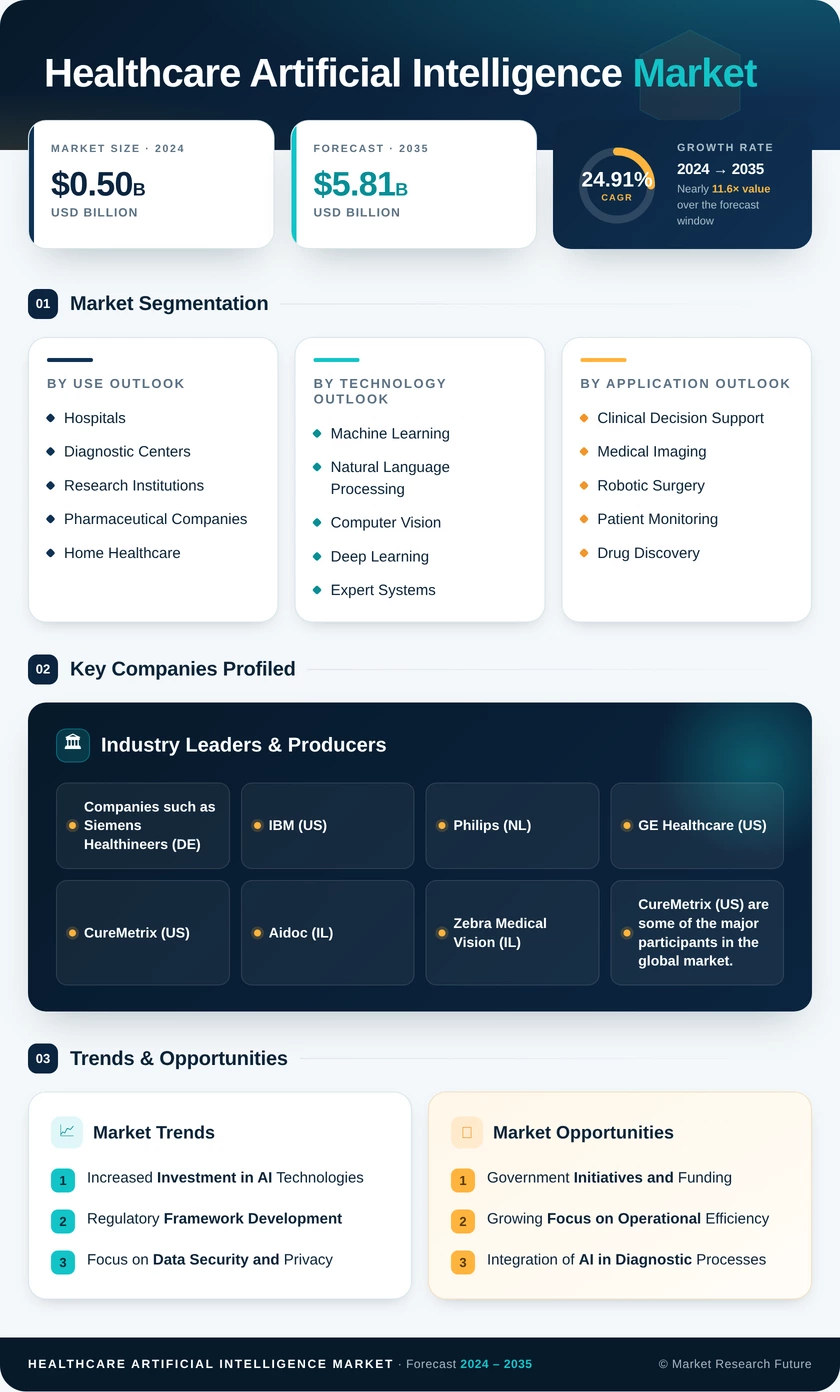
Segmentation Quick Reference
| Dimension | Sub-Segments | Dominant Segment | Fastest Growing Segment |
| By Component | Software Solutions; Hardware; Services | Software Solutions | Services |
| By Technology | Machine Learning; Deep Learning; Natural Language Processing; Computer Vision & Context-Aware Computing | Machine Learning | Computer Vision & Context-Aware Computing |
| By Application | Robot-Assisted Surgery; Automated Image Diagnosis; Clinical Trial Optimisation; Preliminary Diagnosis; Administrative Workflow Assistance; Virtual Nursing Assistants; Dosage Error Reduction; Fraud Detection & Cybersecurity | Robot-Assisted Surgery | Fraud Detection & Cybersecurity |
| By End User | Healthcare Providers; Pharmaceutical & Biotechnology Companies; Healthcare Payers; Patient & Consumer Platforms; Others | Pharmaceutical & Biotechnology Companies | Patient & Consumer Platforms |
| By Geography | North America; Europe; Asia-Pacific; South America; Middle East & Africa | North America | Asia-Pacific |
Market Segmentation Overview
By Component
| Sub-Segment | Key Trend |
| Software Solutions | Migration from perpetual licences to per-covered-life subscriptions |
| Hardware | Edge inference appliances embedded directly into imaging modalities |
| Services | Multi-year validation, retraining and drift-monitoring contracts |
Component economics are inverting. Licence revenue still leads on absolute value, but the recurring engineering obligation attached to every deployment is pushing services toward parity by the mid-2030s.
By Technology
| Sub-Segment | Key Trend |
| Machine Learning | Entrenched in risk stratification, claims analytics and population health |
| Deep Learning | Dominant in imaging interpretation and digital pathology workloads |
| Natural Language Processing | Ambient documentation moving from pilot to enterprise standard |
| Computer Vision & Context-Aware Computing | Sensor fusion in theatres and intensive care driving fastest growth |
Technology preference now tracks data availability more than algorithmic sophistication. Institutions with structured claims histories favour classical approaches; those with rich imaging archives move directly to deep architectures.
By Application
| Sub-Segment | Key Trend |
| Robot-Assisted Surgery | Progression toward supervised task-level autonomy |
| Automated Image Diagnosis | Reimbursement-led scaling across radiology and cardiology |
| Clinical Trial Optimisation | Protocol feasibility and site selection compression |
| Preliminary Diagnosis | Primary-care triage in resource-constrained systems |
| Administrative Workflow Assistance | Prior authorisation and revenue cycle automation |
| Virtual Nursing Assistants | Post-discharge monitoring and readmission avoidance |
| Dosage Error Reduction | Pharmacy verification and infusion safety checks |
| Fraud Detection & Cybersecurity | Payer recovery mandates and ransomware exposure |
Application mix diverges sharply by payer structure. Single-payer systems prioritise triage and screening throughput; multi-payer markets fund administrative and fraud applications first because the return appears within one fiscal cycle.
By End User
| Sub-Segment | Key Trend |
| Healthcare Providers | Adoption accelerating post-2026 as reimbursement codes mature |
| Pharmaceutical & Biotechnology Companies | Discovery and trial productivity as defensive spending |
| Healthcare Payers | Claims adjudication and risk adjustment automation |
| Patient & Consumer Platforms | Remote monitoring and digital front-door expansion |
| Others | Public health agencies and academic research institutes |
Buyer sophistication varies more than budget. Pharmaceutical purchasers evaluate on measurable cycle-time reduction, while provider organisations increasingly outsource evaluation to group purchasing bodies that standardise validation requirements across member institutions.
By Geography
| Sub-Segment | Key Trend |
| North America | Reimbursement maturity and dense compute capacity sustain leadership |
| Europe | AI Act conformity reshaping tender requirements and vendor shortlists |
| Asia-Pacific | National data exchanges and screening programmes drive fastest growth. |
| South America | Centralised teleradiology serving distributed public facilities |
| Middle East & Africa | Greenfield hospital builds enabling deployment without legacy debt. |
Regional divergence is a funding story rather than a technology story. Where payment mechanisms exist, adoption follows within two budget cycles; where they do not, deployment stalls at pilot regardless of clinical performance.


 Noah Malgeri
Co-Founder

 Peter Groot koerkamp
Account and Business Manager

 Younghwan Choi
Senior Retail Manager

 Mark Irwin
Management Consultant

 Akif Moroglu
Strategy & Business Development Director

 Guilherme Gomes Martins
Product Management Director

 Joseph Aguayo
Sales Operations & Pricing Manager

 La Terria Dodd
Program Support Specialist

 Rob Kooiker
Group Product Manager HVAC & Fire Protection GMA