Request Free Sample ×

Kindly complete the form below to receive a free sample of this Report

* Please use a valid business email

Leading companies partner with us for data-driven Insights

clients tt-cursor
Hero Background
English
Chinese
French
Japanese
Korean
German
Spanish

Hard Surface Flooring Market Analysis

ID: MRFR/PCM/3317-HCR
111 Pages
Snehal Singh
Last Updated: April 06, 2026

Hard Surface Flooring Market Research Report Information By Product (Resilient Flooring, Non-resilient Flooring), By Application (Residential, Non-residential), And By Region (North America, Europe, Asia-Pacific, And Rest Of The World) –Market Forecast Till 2035.

Share:
Download PDF ×

We do not share your information with anyone. However, we may send you emails based on your report interest from time to time. You may contact us at any time to opt-out.

Hard Surface Flooring Market Infographic
Purchase Options

Market Analysis

In-depth Analysis of Hard Surface Flooring Market Industry Landscape

The market for hard surface flooring is a vibrant one that is essential to the building and interior design sectors. The dynamics of the market are influenced by a multitude of elements that impact its growth and tendencies. Material choices: The dynamics of the market are significantly influenced by consumer choices for hard surface flooring materials. Options including tile, vinyl, laminate, and hardwood each have unique qualities that influence demand depending on things like maintenance needs, durability, and aesthetics. technology Innovations: The hard surface flooring industry is impacted by ongoing technology developments in manufacturing and design. Technological advancements like click-and-lock installation techniques, embossing for texture, and digital printing for realistic images impact customer preferences and industry trends. Environmental Sustainability: As environmental sustainability becomes more widely recognized, market dynamics are changing. Customers' choice for environmentally friendly flooring options is driving the industry to develop and implement sustainable materials and manufacturing techniques. Residential and Commercial Construction Trends: The market for hard surface flooring is strongly correlated with these trends. The market is growing because there is a growing need for flooring solutions that are both aesthetically beautiful and long-lasting as construction activities expand. Situation of the World Economy: Regional and worldwide economic factors affect the market for hard surface flooring. The market for flooring materials may be impacted by a slowdown in building and renovation projects during economic downturns. Installation and Maintenance Considerations: Consumer choices are influenced by how simple installation and maintenance are. Products with low maintenance requirements and easy installation techniques, such click-and-lock systems, are more likely to succeed in the marketplace. Color and Design Trends: Shifting interior décor trends in terms of color and style have an impact on market dynamics. In order to satisfy customers and maintain their competitiveness in the market, flooring producers must be aware of how color, pattern, and design preferences are changing. Distribution Channels: Market dynamics are influenced by the distribution channels that hard surface flooring products use to reach consumers. Traditional retail channels have been challenged by the rise of online retail and e-commerce platforms, which has changed how producers and merchants connect with their target market.


Author
Author Profile
Snehal Singh
Manager - Research

High acumen in analyzing complex macro & micro markets with more than 6 years of work experience in the field of market research. By implementing her analytical skills in forecasting and estimation into market research reports, she has expertise in Packaging, Construction, and Equipment domains. She handles a team size of 20-25 resources and ensures smooth running of the projects, associated marketing activities, and client servicing.

Leave a Comment

FAQs

What is the projected market valuation of The Global Hard Surface Flooring by 2035?

<p>The projected market valuation for The Global Hard Surface Flooring by 2035 is 59.9 USD Billion.</p>

What was the market valuation of The Global Hard Surface Flooring in 2024?

<p>The market valuation of The Global Hard Surface Flooring in 2024 was 37.02 USD Billion.</p>

What is the expected CAGR for The Global Hard Surface Flooring during the forecast period 2025 - 2035?

<p>The expected CAGR for The Global Hard Surface Flooring during the forecast period 2025 - 2035 is 4.47%.</p>

Which companies are considered key players in The Global Hard Surface Flooring?

<p>Key players in The Global Hard Surface Flooring include Mohawk Industries, Armstrong Flooring, Tarkett, Gerflor, Forbo International, Shaw Industries, Interface, Mannington Mills, and Kahrs Group.</p>

What are the two main types of flooring segments in The Global Hard Surface Flooring?

<p>The two main types of flooring segments in The Global Hard Surface Flooring are Resilient Flooring and Non-resilient Flooring.</p>

What were the market values for Resilient and Non-resilient Flooring in 2024?

<p>In 2024, the market value for Resilient Flooring was 15.0 USD Billion, while Non-resilient Flooring was valued at 22.02 USD Billion.</p>

How does the residential application segment compare to the non-residential segment in terms of market value?

In 2024, the residential application segment was valued at 22.0 USD Billion, compared to 15.02 USD Billion for the non-residential segment.

What is the projected market value for the residential application segment by 2035?

The projected market value for the residential application segment by 2035 is 35.0 USD Billion.

What is the anticipated growth trend for the non-residential application segment from 2024 to 2035?

The anticipated growth trend for the non-residential application segment indicates an increase from 15.02 USD Billion in 2024 to 24.9 USD Billion by 2035.

What factors might influence the growth of The Global Hard Surface Flooring in the coming years?

Factors influencing the growth of The Global Hard Surface Flooring may include advancements in flooring technology, increasing demand for sustainable materials, and rising construction activities.

Market Summary

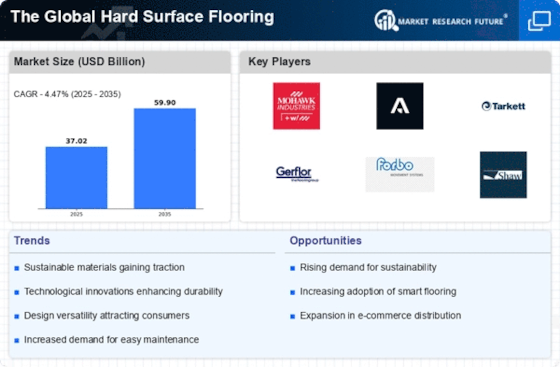
As per Market Research Future analysis, The Global Hard Surface Flooring Market was estimated at 37.02 USD Billion in 2024. The hard surface flooring industry is projected to grow from 38.68 USD Billion in 2025 to 59.9 USD Billion by 2035, exhibiting a compound annual growth rate (CAGR) of 4.47% during the forecast period 2025 - 2035

Key Market Trends & Highlights

The Global Hard Surface Flooring Market is experiencing a dynamic shift towards sustainability and technological advancements.

  • North America remains the largest market for hard surface flooring, driven by robust demand in residential applications. The Asia-Pacific region is emerging as the fastest-growing market, fueled by rapid urbanization and economic development. Resilient flooring continues to dominate the market, while non-resilient flooring is witnessing the fastest growth due to evolving consumer preferences. Key market drivers include a strong focus on sustainability and technological integration, enhancing product durability and maintenance.

Market Size & Forecast

2024 Market Size 37.02 (USD Billion)
2035 Market Size 59.9 (USD Billion)
CAGR (2025 - 2035) 4.47%
Largest Regional Market Share in 2024 North America

Major Players

Mohawk Industries (US), Armstrong Flooring (US), Tarkett (FR), Gerflor (FR), Forbo International (CH), Shaw Industries (US), Interface (US), Mannington Mills (US), Kahrs Group (SE)

Market Trends

The Global Hard Surface Flooring Market is currently experiencing a dynamic evolution, driven by various factors that influence consumer preferences and technological advancements. As sustainability becomes a focal point for many industries, eco-friendly materials are gaining traction within this market. Manufacturers are increasingly focusing on producing flooring options that not only meet aesthetic demands but also adhere to environmental standards. This shift towards sustainable practices is likely to reshape product offerings and influence purchasing decisions across diverse consumer segments. Moreover, the rise of innovative technologies in flooring solutions is transforming the landscape of The Global Hard Surface Flooring Market. Smart flooring systems, which integrate features such as temperature control and energy efficiency, are becoming more prevalent. These advancements suggest a growing consumer interest in multifunctional products that enhance comfort and convenience. As the market continues to evolve, it appears that the interplay between sustainability and technology will play a crucial role in shaping future trends and consumer choices.

Sustainability Focus

There is a noticeable shift towards eco-friendly materials in The Global Hard Surface Flooring Market. Consumers are increasingly prioritizing sustainable options, prompting manufacturers to innovate and offer products that align with environmental standards.

Technological Integration

The incorporation of smart technologies into flooring solutions is on the rise. Features such as energy efficiency and temperature control are becoming more common, reflecting a consumer preference for multifunctional products that enhance living spaces.

Design Versatility

The demand for diverse design options is growing within The Global Hard Surface Flooring Market. Consumers are seeking flooring that not only serves practical purposes but also complements various interior styles, leading to a wider array of aesthetic choices.

Hard Surface Flooring Market Market Drivers

Design Versatility

The versatility in design offered by hard surface flooring is a compelling driver in the market. With a plethora of styles, colors, and textures available, consumers can find flooring solutions that complement various interior designs. This adaptability is particularly appealing to both residential and commercial sectors, as it allows for customization to meet specific aesthetic requirements. The Global Hard Surface Flooring Industry is benefiting from this trend, as designers and architects increasingly incorporate hard surface materials into their projects. The ability to create unique and personalized spaces is likely to continue driving demand, as consumers seek to express their individuality through their flooring choices.

Sustainability Focus

The increasing emphasis on sustainability is a pivotal driver in the hard surface flooring market. Consumers and businesses alike are becoming more environmentally conscious, leading to a demand for eco-friendly materials. This trend is reflected in the rising popularity of flooring options made from recycled materials or sustainably sourced wood. The Global Hard Surface Flooring Industry is witnessing a shift towards products that not only meet aesthetic needs but also align with sustainable practices. As a result, manufacturers are innovating to create flooring solutions that minimize environmental impact while maintaining durability and style. This focus on sustainability is expected to continue influencing purchasing decisions, thereby shaping market dynamics.

Technological Integration

Technological advancements are significantly transforming the hard surface flooring market. Innovations such as digital printing and advanced manufacturing techniques are enabling the production of high-quality, visually appealing flooring options. The integration of smart technologies, such as temperature regulation and moisture detection, is also gaining traction. These developments enhance the functionality and appeal of products within The Global Hard Surface Flooring Industry. Furthermore, the rise of e-commerce platforms is facilitating easier access to a wider range of flooring options, allowing consumers to make informed choices. As technology continues to evolve, it is likely to play a crucial role in shaping consumer preferences and market trends.

Durability and Maintenance

Durability is a key factor influencing consumer choices in the hard surface flooring market. Products that offer long-lasting performance with minimal maintenance are highly sought after. This is particularly relevant in high-traffic areas, where flooring must withstand wear and tear. The Global Hard Surface Flooring Industry is seeing a rise in demand for materials that combine strength with aesthetic appeal. Innovations in surface treatments and finishes are enhancing the durability of flooring options, making them more attractive to consumers. As lifestyles become increasingly busy, the preference for low-maintenance solutions is expected to drive growth in this segment of the market.

Economic Growth and Urbanization

Economic growth and urbanization are significant drivers of the hard surface flooring market. As urban areas expand and populations increase, there is a corresponding rise in construction and renovation activities. This trend is particularly evident in developing regions, where infrastructure development is accelerating. The Global Hard Surface Flooring Industry is poised to benefit from this growth, as new residential and commercial projects require durable and aesthetically pleasing flooring solutions. Additionally, rising disposable incomes are enabling consumers to invest in higher-quality flooring options. This economic momentum is likely to sustain demand for hard surface flooring in the foreseeable future.

Market Segment Insights

By Type: Resilient Flooring (Largest) vs. Non-resilient Flooring (Fastest-Growing)

In The Global Hard Surface Flooring Market, resilient flooring commands the largest share, appealing to a broad range of consumers due to its durability and versatility. This segment includes products such as <a href="https://www.marketresearchfuture.com/reports/vinyl-market-12632">vinyl </a>and laminate, which are favored for residential and commercial applications alike. On the other hand, non-resilient flooring, including options like ceramic and hardwood, is growing rapidly as trends shift towards more sustainable and aesthetic choices that enhance interior design.

Flooring Type: Resilient (Dominant) vs. Non-resilient (Emerging)

Resilient flooring is characterized by its ability to withstand wear and tear while offering comfort and style. The segment is favored for its water-resistant properties and ease of maintenance, making it ideal for high-traffic areas. Conversely, non-resilient flooring is emerging due to rising consumer interest in eco-friendly materials and unique designs. This category is gaining traction as manufacturers innovate with sustainable practices and styles that appeal to modern aesthetics, positioning it as a competitive alternative to traditional resilient flooring.

By Application: Residential (Largest) vs. Non-residential (Fastest-Growing)

The Global Hard Surface Flooring Market is primarily segmented into Residential and Non-residential applications. The Residential sector holds the largest share of the market as homeowners increasingly prefer durable, low-maintenance flooring options that offer aesthetic appeal. Major factors contributing to this dominance include the rise in residential construction activity and the ongoing trend of home renovations, where hard surface flooring is favored for its longevity and ease of cleaning. On the other hand, the Non-residential application segment has emerged as the fastest-growing area within the market. This growth can be attributed to the increasing investments in commercial infrastructure, including offices, retail spaces, and healthcare facilities. Additionally, the emphasis on sustainability and eco-friendly products is driving demand within this segment, as businesses seek flooring solutions that meet modern environmental standards while also providing functionality and durability.

Residential (Dominant) vs. Non-residential (Emerging)

In The Global Hard Surface Flooring Market, the Residential segment stands as the dominant player, characterized by its substantial demand among homeowners who prioritize aesthetics, durability, and maintenance ease. This segment encompasses a variety of flooring choices, including <a href="https://www.marketresearchfuture.com/reports/tile-market-11559">tile</a>, vinyl, and laminate, catering to diverse consumer preferences. Meanwhile, the Non-residential segment is emerging rapidly, propelled by robust investments in commercial spaces. This segment showcases a trend towards high-performance flooring solutions that comply with sustainability standards and are capable of withstanding heavy foot traffic. As businesses increasingly recognize the importance of flooring in creating functional and attractive workspaces, the demand for innovative hard surface solutions is expected to flourish in this sector.

Get more detailed insights about Hard Surface Flooring Market Research Report- Global Forecast to 2035

Regional Insights

The study offers market insights on a regional basis, including North America, Europe, Asia-Pacific, and Rest of the World. The North American hard surface flooring market area will dominate this market, owing to the development of green buildings, where the use of high-performance flooring products with low V.O.C. emissions will boost the market growth in this Region.

Further, the major countries studied in the market report are The U.S., Canada, German, France, the U.K., Italy, Spain, China, Japan, India, Australia, South Korea, and Brazil.

Europe's Hard Surface Flooring Market accounts for the second-largest market share due to the growing need to make office spaces more productive and comfortable for employees has led companies to spend on hard surface floors to boost the market growth in this Region. Further, the German Hard Surface Flooring Market held the largest market share, and the U.K. Hard Surface Flooring Market was the fastest-growing market in the European Region.

The Asia-Pacific Hard Surface Flooring Market is expected to grow at the fastest CAGR from 2023 to 2032. This is due to the rise in the development in the residential sectors, which will further boost the growth of the hard-surface flooring market in the Region. Moreover, China’sHard Surface Flooring Market held the largest market share, and the IndianHard Surface Flooring Market was the fastest-growing market in the Asia-Pacific region.

Key Players and Competitive Insights

Leading market players are investing heavily in research and development to expand their product lines, which will help the Hard Surface Flooring Market grow even more. Market participants in the Hard Surface Flooring industry actively engage in strategic activities to expand their presence. These include new product launches, partnerships, mergers and acquisitions, increased investments, and collaborations with other organizations. To thrive in the increasingly competitive market environment, the industry must focus on offering cost-effective solutions to drive expansion and ensure sustainability.Manufacturing locally to minimize operational costs is one of the key business tactics manufacturers use in the  Hard Surface Flooring industry to benefit clients and increase the market sector. In recent years, the Hard Surface Flooring industry has offered some of the most significant advantages.Major players in the Hard Surface Flooring Market, including Mohawk Industries (U.S.), Armstrong World Industries, Inc. (U.S.), Mannington Mills Inc. (U.S.), Shaw Industries Group (U.S.), Beaulieu International Group (Belgium), Marazzi Group S.r.I (Italy), Berry Floor NV (Italy), Burke Industries (U.S.), Roppe Corporation (U.S.), Surface America (U.S.), Tarkett S.A.S. (France), TOLI Corporation (Japan), and Windmöller Flooring Products W.F.P. GmbH (Germany)., and others, are attempting to increase market demand by investing in research and development operations.Founded in 1985, Mullican Flooring has been dedicated to producing the highest quality wood flooring. The company's commitment to precision milling, advanced kiln-drying techniques, and rigorous inspections has established it as an industry leader. Recently, Mullican Flooring expanded its presence in Missouri, Oklahoma, Illinois, and Nebraska through a partnership with Summit Flooring Supply, a reputable installation and supply company. This collaboration further strengthens Mullican Flooring's position as a prominent manufacturer of hard surface flooring.Established in 1979, Q.E.P. Co., Inc. is a renowned provider of flooring and installation solutions known for their commitment to quality, innovation, and value. As a leading manufacturer and distributor, Q.E.P. Co., Inc. offers a wide range of products, including hardwood flooring, laminate flooring, adhesives, installation tools, and other flooring-related items. Recently, Q.E.P. Co., Inc. expanded its operations by acquiring the hard surface and carpet distribution unit of Krauss in the United States and Canada. This strategic move further strengthens their position in the market and enhances their ability to meet customer demands in the Region.

Key Companies in the Hard Surface Flooring Market include

Industry Developments

July 2017: Hard surface flooring manufacturer, Mullican Flooring, has expanded its reach in Missouri, Oklahoma, Illinois, and Nebraska through a strategic partnership with Summit Flooring Supply, an installation and supply company.

January 2017: Mullican Flooring, a manufacturer of hardwood floors, launched a new collection for easy installation and protected by the company's Alpha AʼLumina Real World Finish.

October 2018: Q.E.P. CO., INC., a manufacturer and distributor of hardwood flooring, laminate flooring, adhesives, installation tools, and flooring-related products, acquired the hard surface and carpet distribution unit of Krauss in the U.S. and Canada.

Future Outlook

Hard Surface Flooring Market Future Outlook

The Global Hard Surface Flooring Market is projected to grow at a 4.47% CAGR from 2025 to 2035, driven by urbanization, sustainability trends, and technological advancements.

New opportunities lie in:

  • Expansion into eco-friendly flooring materials</p><p>Development of smart flooring solutions with IoT integration</p><p>Strategic partnerships with construction firms for large-scale projects

By 2035, the market is expected to achieve robust growth, reflecting evolving consumer preferences and technological innovations.

Market Segmentation

Hard Surface Flooring Market Type Outlook

  • Resilient Flooring
  • Non-resilient Flooring

Hard Surface Flooring Market Application Outlook

  • Residential
  • Non-residential

Report Scope

MARKET SIZE 2024 37.02(USD Billion)
MARKET SIZE 2025 38.68(USD Billion)
MARKET SIZE 2035 59.9(USD Billion)
COMPOUND ANNUAL GROWTH RATE (CAGR) 4.47% (2025 - 2035)
REPORT COVERAGE Revenue Forecast, Competitive Landscape, Growth Factors, and Trends
BASE YEAR 2024
Market Forecast Period 2025 - 2035
Historical Data 2019 - 2024
Market Forecast Units USD Billion
Key Companies Profiled Mohawk Industries (US), Armstrong Flooring (US), Tarkett (FR), Gerflor (FR), Forbo International (CH), Shaw Industries (US), Interface (US), Mannington Mills (US), Kahrs Group (SE)
Segments Covered Product, Application, Region
Key Market Opportunities Integration of sustainable materials and smart technologies in The Global Hard Surface Flooring.
Key Market Dynamics Rising consumer preference for sustainable materials drives innovation and competition in the hard surface flooring sector.
Countries Covered North America, Europe, APAC, South America, MEA

FAQs

What is the projected market valuation of The Global Hard Surface Flooring by 2035?

<p>The projected market valuation for The Global Hard Surface Flooring by 2035 is 59.9 USD Billion.</p>

What was the market valuation of The Global Hard Surface Flooring in 2024?

<p>The market valuation of The Global Hard Surface Flooring in 2024 was 37.02 USD Billion.</p>

What is the expected CAGR for The Global Hard Surface Flooring during the forecast period 2025 - 2035?

<p>The expected CAGR for The Global Hard Surface Flooring during the forecast period 2025 - 2035 is 4.47%.</p>

Which companies are considered key players in The Global Hard Surface Flooring?

<p>Key players in The Global Hard Surface Flooring include Mohawk Industries, Armstrong Flooring, Tarkett, Gerflor, Forbo International, Shaw Industries, Interface, Mannington Mills, and Kahrs Group.</p>

What are the two main types of flooring segments in The Global Hard Surface Flooring?

<p>The two main types of flooring segments in The Global Hard Surface Flooring are Resilient Flooring and Non-resilient Flooring.</p>

What were the market values for Resilient and Non-resilient Flooring in 2024?

<p>In 2024, the market value for Resilient Flooring was 15.0 USD Billion, while Non-resilient Flooring was valued at 22.02 USD Billion.</p>

How does the residential application segment compare to the non-residential segment in terms of market value?

In 2024, the residential application segment was valued at 22.0 USD Billion, compared to 15.02 USD Billion for the non-residential segment.

What is the projected market value for the residential application segment by 2035?

The projected market value for the residential application segment by 2035 is 35.0 USD Billion.

What is the anticipated growth trend for the non-residential application segment from 2024 to 2035?

The anticipated growth trend for the non-residential application segment indicates an increase from 15.02 USD Billion in 2024 to 24.9 USD Billion by 2035.

What factors might influence the growth of The Global Hard Surface Flooring in the coming years?

Factors influencing the growth of The Global Hard Surface Flooring may include advancements in flooring technology, increasing demand for sustainable materials, and rising construction activities.

  1. SECTION I: EXECUTIVE SUMMARY AND KEY HIGHLIGHTS
    1. | 1.1 EXECUTIVE SUMMARY
    2. | | 1.1.1 Market Overview
    3. | | 1.1.2 Key Findings
    4. | | 1.1.3 Market Segmentation
    5. | | 1.1.4 Competitive Landscape
    6. | | 1.1.5 Challenges and Opportunities
    7. | | 1.1.6 Future Outlook
  2. SECTION II: SCOPING, METHODOLOGY AND MARKET STRUCTURE
    1. | 2.1 MARKET INTRODUCTION
    2. | | 2.1.1 Definition
    3. | | 2.1.2 Scope of the study
    4. | | | 2.1.2.1 Research Objective
    5. | | | 2.1.2.2 Assumption
    6. | | | 2.1.2.3 Limitations
    7. | 2.2 RESEARCH METHODOLOGY
    8. | | 2.2.1 Overview
    9. | | 2.2.2 Data Mining
    10. | | 2.2.3 Secondary Research
    11. | | 2.2.4 Primary Research
    12. | | | 2.2.4.1 Primary Interviews and Information Gathering Process
    13. | | | 2.2.4.2 Breakdown of Primary Respondents
    14. | | 2.2.5 Forecasting Model
    15. | | 2.2.6 Market Size Estimation
    16. | | | 2.2.6.1 Bottom-Up Approach
    17. | | | 2.2.6.2 Top-Down Approach
    18. | | 2.2.7 Data Triangulation
    19. | | 2.2.8 Validation
  3. SECTION III: QUALITATIVE ANALYSIS
    1. | 3.1 MARKET DYNAMICS
    2. | | 3.1.1 Overview
    3. | | 3.1.2 Drivers
    4. | | 3.1.3 Restraints
    5. | | 3.1.4 Opportunities
    6. | 3.2 MARKET FACTOR ANALYSIS
    7. | | 3.2.1 Value chain Analysis
    8. | | 3.2.2 Porter's Five Forces Analysis
    9. | | | 3.2.2.1 Bargaining Power of Suppliers
    10. | | | 3.2.2.2 Bargaining Power of Buyers
    11. | | | 3.2.2.3 Threat of New Entrants
    12. | | | 3.2.2.4 Threat of Substitutes
    13. | | | 3.2.2.5 Intensity of Rivalry
    14. | | 3.2.3 COVID-19 Impact Analysis
    15. | | | 3.2.3.1 Market Impact Analysis
    16. | | | 3.2.3.2 Regional Impact
    17. | | | 3.2.3.3 Opportunity and Threat Analysis
  4. SECTION IV: QUANTITATIVE ANALYSIS
    1. | 4.1 Packaging & Transport, BY Type (USD Billion)
    2. | | 4.1.1 Resilient Flooring
    3. | | 4.1.2 Non-resilient Flooring
    4. | 4.2 Packaging & Transport, BY Application (USD Billion)
    5. | | 4.2.1 Residential
    6. | | 4.2.2 Non-residential
    7. | 4.3 Packaging & Transport, BY Region (USD Billion)
    8. | | 4.3.1 North America
    9. | | | 4.3.1.1 US
    10. | | | 4.3.1.2 Canada
    11. | | 4.3.2 Europe
    12. | | | 4.3.2.1 Germany
    13. | | | 4.3.2.2 UK
    14. | | | 4.3.2.3 France
    15. | | | 4.3.2.4 Russia
    16. | | | 4.3.2.5 Italy
    17. | | | 4.3.2.6 Spain
    18. | | | 4.3.2.7 Rest of Europe
    19. | | 4.3.3 APAC
    20. | | | 4.3.3.1 China
    21. | | | 4.3.3.2 India
    22. | | | 4.3.3.3 Japan
    23. | | | 4.3.3.4 South Korea
    24. | | | 4.3.3.5 Malaysia
    25. | | | 4.3.3.6 Thailand
    26. | | | 4.3.3.7 Indonesia
    27. | | | 4.3.3.8 Rest of APAC
    28. | | 4.3.4 South America
    29. | | | 4.3.4.1 Brazil
    30. | | | 4.3.4.2 Mexico
    31. | | | 4.3.4.3 Argentina
    32. | | | 4.3.4.4 Rest of South America
    33. | | 4.3.5 MEA
    34. | | | 4.3.5.1 GCC Countries
    35. | | | 4.3.5.2 South Africa
    36. | | | 4.3.5.3 Rest of MEA
  5. SECTION V: COMPETITIVE ANALYSIS
    1. | 5.1 Competitive Landscape
    2. | | 5.1.1 Overview
    3. | | 5.1.2 Competitive Analysis
    4. | | 5.1.3 Market share Analysis
    5. | | 5.1.4 Major Growth Strategy in the Packaging & Transport
    6. | | 5.1.5 Competitive Benchmarking
    7. | | 5.1.6 Leading Players in Terms of Number of Developments in the Packaging & Transport
    8. | | 5.1.7 Key developments and growth strategies
    9. | | | 5.1.7.1 New Product Launch/Service Deployment
    10. | | | 5.1.7.2 Merger & Acquisitions
    11. | | | 5.1.7.3 Joint Ventures
    12. | | 5.1.8 Major Players Financial Matrix
    13. | | | 5.1.8.1 Sales and Operating Income
    14. | | | 5.1.8.2 Major Players R&D Expenditure. 2023
    15. | 5.2 Company Profiles
    16. | | 5.2.1 Mohawk Industries (US)
    17. | | | 5.2.1.1 Financial Overview
    18. | | | 5.2.1.2 Products Offered
    19. | | | 5.2.1.3 Key Developments
    20. | | | 5.2.1.4 SWOT Analysis
    21. | | | 5.2.1.5 Key Strategies
    22. | | 5.2.2 Armstrong Flooring (US)
    23. | | | 5.2.2.1 Financial Overview
    24. | | | 5.2.2.2 Products Offered
    25. | | | 5.2.2.3 Key Developments
    26. | | | 5.2.2.4 SWOT Analysis
    27. | | | 5.2.2.5 Key Strategies
    28. | | 5.2.3 Tarkett (FR)
    29. | | | 5.2.3.1 Financial Overview
    30. | | | 5.2.3.2 Products Offered
    31. | | | 5.2.3.3 Key Developments
    32. | | | 5.2.3.4 SWOT Analysis
    33. | | | 5.2.3.5 Key Strategies
    34. | | 5.2.4 Gerflor (FR)
    35. | | | 5.2.4.1 Financial Overview
    36. | | | 5.2.4.2 Products Offered
    37. | | | 5.2.4.3 Key Developments
    38. | | | 5.2.4.4 SWOT Analysis
    39. | | | 5.2.4.5 Key Strategies
    40. | | 5.2.5 Forbo International (CH)
    41. | | | 5.2.5.1 Financial Overview
    42. | | | 5.2.5.2 Products Offered
    43. | | | 5.2.5.3 Key Developments
    44. | | | 5.2.5.4 SWOT Analysis
    45. | | | 5.2.5.5 Key Strategies
    46. | | 5.2.6 Shaw Industries (US)
    47. | | | 5.2.6.1 Financial Overview
    48. | | | 5.2.6.2 Products Offered
    49. | | | 5.2.6.3 Key Developments
    50. | | | 5.2.6.4 SWOT Analysis
    51. | | | 5.2.6.5 Key Strategies
    52. | | 5.2.7 Interface (US)
    53. | | | 5.2.7.1 Financial Overview
    54. | | | 5.2.7.2 Products Offered
    55. | | | 5.2.7.3 Key Developments
    56. | | | 5.2.7.4 SWOT Analysis
    57. | | | 5.2.7.5 Key Strategies
    58. | | 5.2.8 Mannington Mills (US)
    59. | | | 5.2.8.1 Financial Overview
    60. | | | 5.2.8.2 Products Offered
    61. | | | 5.2.8.3 Key Developments
    62. | | | 5.2.8.4 SWOT Analysis
    63. | | | 5.2.8.5 Key Strategies
    64. | | 5.2.9 Kahrs Group (SE)
    65. | | | 5.2.9.1 Financial Overview
    66. | | | 5.2.9.2 Products Offered
    67. | | | 5.2.9.3 Key Developments
    68. | | | 5.2.9.4 SWOT Analysis
    69. | | | 5.2.9.5 Key Strategies
    70. | 5.3 Appendix
    71. | | 5.3.1 References
    72. | | 5.3.2 Related Reports
  6. LIST OF FIGURES
    1. | 6.1 MARKET SYNOPSIS
    2. | 6.2 NORTH AMERICA MARKET ANALYSIS
    3. | 6.3 US MARKET ANALYSIS BY TYPE
    4. | 6.4 US MARKET ANALYSIS BY APPLICATION
    5. | 6.5 CANADA MARKET ANALYSIS BY TYPE
    6. | 6.6 CANADA MARKET ANALYSIS BY APPLICATION
    7. | 6.7 EUROPE MARKET ANALYSIS
    8. | 6.8 GERMANY MARKET ANALYSIS BY TYPE
    9. | 6.9 GERMANY MARKET ANALYSIS BY APPLICATION
    10. | 6.10 UK MARKET ANALYSIS BY TYPE
    11. | 6.11 UK MARKET ANALYSIS BY APPLICATION
    12. | 6.12 FRANCE MARKET ANALYSIS BY TYPE
    13. | 6.13 FRANCE MARKET ANALYSIS BY APPLICATION
    14. | 6.14 RUSSIA MARKET ANALYSIS BY TYPE
    15. | 6.15 RUSSIA MARKET ANALYSIS BY APPLICATION
    16. | 6.16 ITALY MARKET ANALYSIS BY TYPE
    17. | 6.17 ITALY MARKET ANALYSIS BY APPLICATION
    18. | 6.18 SPAIN MARKET ANALYSIS BY TYPE
    19. | 6.19 SPAIN MARKET ANALYSIS BY APPLICATION
    20. | 6.20 REST OF EUROPE MARKET ANALYSIS BY TYPE
    21. | 6.21 REST OF EUROPE MARKET ANALYSIS BY APPLICATION
    22. | 6.22 APAC MARKET ANALYSIS
    23. | 6.23 CHINA MARKET ANALYSIS BY TYPE
    24. | 6.24 CHINA MARKET ANALYSIS BY APPLICATION
    25. | 6.25 INDIA MARKET ANALYSIS BY TYPE
    26. | 6.26 INDIA MARKET ANALYSIS BY APPLICATION
    27. | 6.27 JAPAN MARKET ANALYSIS BY TYPE
    28. | 6.28 JAPAN MARKET ANALYSIS BY APPLICATION
    29. | 6.29 SOUTH KOREA MARKET ANALYSIS BY TYPE
    30. | 6.30 SOUTH KOREA MARKET ANALYSIS BY APPLICATION
    31. | 6.31 MALAYSIA MARKET ANALYSIS BY TYPE
    32. | 6.32 MALAYSIA MARKET ANALYSIS BY APPLICATION
    33. | 6.33 THAILAND MARKET ANALYSIS BY TYPE
    34. | 6.34 THAILAND MARKET ANALYSIS BY APPLICATION
    35. | 6.35 INDONESIA MARKET ANALYSIS BY TYPE
    36. | 6.36 INDONESIA MARKET ANALYSIS BY APPLICATION
    37. | 6.37 REST OF APAC MARKET ANALYSIS BY TYPE
    38. | 6.38 REST OF APAC MARKET ANALYSIS BY APPLICATION
    39. | 6.39 SOUTH AMERICA MARKET ANALYSIS
    40. | 6.40 BRAZIL MARKET ANALYSIS BY TYPE
    41. | 6.41 BRAZIL MARKET ANALYSIS BY APPLICATION
    42. | 6.42 MEXICO MARKET ANALYSIS BY TYPE
    43. | 6.43 MEXICO MARKET ANALYSIS BY APPLICATION
    44. | 6.44 ARGENTINA MARKET ANALYSIS BY TYPE
    45. | 6.45 ARGENTINA MARKET ANALYSIS BY APPLICATION
    46. | 6.46 REST OF SOUTH AMERICA MARKET ANALYSIS BY TYPE
    47. | 6.47 REST OF SOUTH AMERICA MARKET ANALYSIS BY APPLICATION
    48. | 6.48 MEA MARKET ANALYSIS
    49. | 6.49 GCC COUNTRIES MARKET ANALYSIS BY TYPE
    50. | 6.50 GCC COUNTRIES MARKET ANALYSIS BY APPLICATION
    51. | 6.51 SOUTH AFRICA MARKET ANALYSIS BY TYPE
    52. | 6.52 SOUTH AFRICA MARKET ANALYSIS BY APPLICATION
    53. | 6.53 REST OF MEA MARKET ANALYSIS BY TYPE
    54. | 6.54 REST OF MEA MARKET ANALYSIS BY APPLICATION
    55. | 6.55 KEY BUYING CRITERIA OF PACKAGING & TRANSPORT
    56. | 6.56 RESEARCH PROCESS OF MRFR
    57. | 6.57 DRO ANALYSIS OF PACKAGING & TRANSPORT
    58. | 6.58 DRIVERS IMPACT ANALYSIS: PACKAGING & TRANSPORT
    59. | 6.59 RESTRAINTS IMPACT ANALYSIS: PACKAGING & TRANSPORT
    60. | 6.60 SUPPLY / VALUE CHAIN: PACKAGING & TRANSPORT
    61. | 6.61 PACKAGING & TRANSPORT, BY TYPE, 2024 (% SHARE)
    62. | 6.62 PACKAGING & TRANSPORT, BY TYPE, 2024 TO 2035 (USD Billion)
    63. | 6.63 PACKAGING & TRANSPORT, BY APPLICATION, 2024 (% SHARE)
    64. | 6.64 PACKAGING & TRANSPORT, BY APPLICATION, 2024 TO 2035 (USD Billion)
    65. | 6.65 BENCHMARKING OF MAJOR COMPETITORS
  7. LIST OF TABLES
    1. | 7.1 LIST OF ASSUMPTIONS
    2. | | 7.1.1
    3. | 7.2 North America MARKET SIZE ESTIMATES; FORECAST
    4. | | 7.2.1 BY TYPE, 2025-2035 (USD Billion)
    5. | | 7.2.2 BY APPLICATION, 2025-2035 (USD Billion)
    6. | 7.3 US MARKET SIZE ESTIMATES; FORECAST
    7. | | 7.3.1 BY TYPE, 2025-2035 (USD Billion)
    8. | | 7.3.2 BY APPLICATION, 2025-2035 (USD Billion)
    9. | 7.4 Canada MARKET SIZE ESTIMATES; FORECAST
    10. | | 7.4.1 BY TYPE, 2025-2035 (USD Billion)
    11. | | 7.4.2 BY APPLICATION, 2025-2035 (USD Billion)
    12. | 7.5 Europe MARKET SIZE ESTIMATES; FORECAST
    13. | | 7.5.1 BY TYPE, 2025-2035 (USD Billion)
    14. | | 7.5.2 BY APPLICATION, 2025-2035 (USD Billion)
    15. | 7.6 Germany MARKET SIZE ESTIMATES; FORECAST
    16. | | 7.6.1 BY TYPE, 2025-2035 (USD Billion)
    17. | | 7.6.2 BY APPLICATION, 2025-2035 (USD Billion)
    18. | 7.7 UK MARKET SIZE ESTIMATES; FORECAST
    19. | | 7.7.1 BY TYPE, 2025-2035 (USD Billion)
    20. | | 7.7.2 BY APPLICATION, 2025-2035 (USD Billion)
    21. | 7.8 France MARKET SIZE ESTIMATES; FORECAST
    22. | | 7.8.1 BY TYPE, 2025-2035 (USD Billion)
    23. | | 7.8.2 BY APPLICATION, 2025-2035 (USD Billion)
    24. | 7.9 Russia MARKET SIZE ESTIMATES; FORECAST
    25. | | 7.9.1 BY TYPE, 2025-2035 (USD Billion)
    26. | | 7.9.2 BY APPLICATION, 2025-2035 (USD Billion)
    27. | 7.10 Italy MARKET SIZE ESTIMATES; FORECAST
    28. | | 7.10.1 BY TYPE, 2025-2035 (USD Billion)
    29. | | 7.10.2 BY APPLICATION, 2025-2035 (USD Billion)
    30. | 7.11 Spain MARKET SIZE ESTIMATES; FORECAST
    31. | | 7.11.1 BY TYPE, 2025-2035 (USD Billion)
    32. | | 7.11.2 BY APPLICATION, 2025-2035 (USD Billion)
    33. | 7.12 Rest of Europe MARKET SIZE ESTIMATES; FORECAST
    34. | | 7.12.1 BY TYPE, 2025-2035 (USD Billion)
    35. | | 7.12.2 BY APPLICATION, 2025-2035 (USD Billion)
    36. | 7.13 APAC MARKET SIZE ESTIMATES; FORECAST
    37. | | 7.13.1 BY TYPE, 2025-2035 (USD Billion)
    38. | | 7.13.2 BY APPLICATION, 2025-2035 (USD Billion)
    39. | 7.14 China MARKET SIZE ESTIMATES; FORECAST
    40. | | 7.14.1 BY TYPE, 2025-2035 (USD Billion)
    41. | | 7.14.2 BY APPLICATION, 2025-2035 (USD Billion)
    42. | 7.15 India MARKET SIZE ESTIMATES; FORECAST
    43. | | 7.15.1 BY TYPE, 2025-2035 (USD Billion)
    44. | | 7.15.2 BY APPLICATION, 2025-2035 (USD Billion)
    45. | 7.16 Japan MARKET SIZE ESTIMATES; FORECAST
    46. | | 7.16.1 BY TYPE, 2025-2035 (USD Billion)
    47. | | 7.16.2 BY APPLICATION, 2025-2035 (USD Billion)
    48. | 7.17 South Korea MARKET SIZE ESTIMATES; FORECAST
    49. | | 7.17.1 BY TYPE, 2025-2035 (USD Billion)
    50. | | 7.17.2 BY APPLICATION, 2025-2035 (USD Billion)
    51. | 7.18 Malaysia MARKET SIZE ESTIMATES; FORECAST
    52. | | 7.18.1 BY TYPE, 2025-2035 (USD Billion)
    53. | | 7.18.2 BY APPLICATION, 2025-2035 (USD Billion)
    54. | 7.19 Thailand MARKET SIZE ESTIMATES; FORECAST
    55. | | 7.19.1 BY TYPE, 2025-2035 (USD Billion)
    56. | | 7.19.2 BY APPLICATION, 2025-2035 (USD Billion)
    57. | 7.20 Indonesia MARKET SIZE ESTIMATES; FORECAST
    58. | | 7.20.1 BY TYPE, 2025-2035 (USD Billion)
    59. | | 7.20.2 BY APPLICATION, 2025-2035 (USD Billion)
    60. | 7.21 Rest of APAC MARKET SIZE ESTIMATES; FORECAST
    61. | | 7.21.1 BY TYPE, 2025-2035 (USD Billion)
    62. | | 7.21.2 BY APPLICATION, 2025-2035 (USD Billion)
    63. | 7.22 South America MARKET SIZE ESTIMATES; FORECAST
    64. | | 7.22.1 BY TYPE, 2025-2035 (USD Billion)
    65. | | 7.22.2 BY APPLICATION, 2025-2035 (USD Billion)
    66. | 7.23 Brazil MARKET SIZE ESTIMATES; FORECAST
    67. | | 7.23.1 BY TYPE, 2025-2035 (USD Billion)
    68. | | 7.23.2 BY APPLICATION, 2025-2035 (USD Billion)
    69. | 7.24 Mexico MARKET SIZE ESTIMATES; FORECAST
    70. | | 7.24.1 BY TYPE, 2025-2035 (USD Billion)
    71. | | 7.24.2 BY APPLICATION, 2025-2035 (USD Billion)
    72. | 7.25 Argentina MARKET SIZE ESTIMATES; FORECAST
    73. | | 7.25.1 BY TYPE, 2025-2035 (USD Billion)
    74. | | 7.25.2 BY APPLICATION, 2025-2035 (USD Billion)
    75. | 7.26 Rest of South America MARKET SIZE ESTIMATES; FORECAST
    76. | | 7.26.1 BY TYPE, 2025-2035 (USD Billion)
    77. | | 7.26.2 BY APPLICATION, 2025-2035 (USD Billion)
    78. | 7.27 MEA MARKET SIZE ESTIMATES; FORECAST
    79. | | 7.27.1 BY TYPE, 2025-2035 (USD Billion)
    80. | | 7.27.2 BY APPLICATION, 2025-2035 (USD Billion)
    81. | 7.28 GCC Countries MARKET SIZE ESTIMATES; FORECAST
    82. | | 7.28.1 BY TYPE, 2025-2035 (USD Billion)
    83. | | 7.28.2 BY APPLICATION, 2025-2035 (USD Billion)
    84. | 7.29 South Africa MARKET SIZE ESTIMATES; FORECAST
    85. | | 7.29.1 BY TYPE, 2025-2035 (USD Billion)
    86. | | 7.29.2 BY APPLICATION, 2025-2035 (USD Billion)
    87. | 7.30 Rest of MEA MARKET SIZE ESTIMATES; FORECAST
    88. | | 7.30.1 BY TYPE, 2025-2035 (USD Billion)
    89. | | 7.30.2 BY APPLICATION, 2025-2035 (USD Billion)
    90. | 7.31 PRODUCT LAUNCH/PRODUCT DEVELOPMENT/APPROVAL
    91. | | 7.31.1
    92. | 7.32 ACQUISITION/PARTNERSHIP
    93. | | 7.32.1

Packaging & Transport Market Segmentation

Packaging & Transport By Type (USD Billion, 2025-2035)

  • Resilient Flooring
  • Non-resilient Flooring

Packaging & Transport By Application (USD Billion, 2025-2035)

  • Residential
  • Non-residential
Infographic

Free Sample Request

Kindly complete the form below to receive a free sample of this Report

Get Free Sample

Customer Strories

Compare Licence

×
Features License Type
Single User Multiuser License Enterprise User
Price $4,950 $5,950 $7,250
Maximum User Access Limit 1 User Upto 10 Users Unrestricted Access Throughout the Organization
Free Customization
Direct Access to Analyst
Deliverable Format
Platform Access
Discount on Next Purchase 10% 15% 15%
Printable Versions