×
Request Free Sample ×

Kindly complete the form below to receive a free sample of this Report

* Please use a valid business email

Leading companies partner with us for data-driven Insights

clients tt-cursor
Hero Background
English
Chinese
French
Japanese
Korean
German
Spanish

Handheld Blower Market Analysis

ID: MRFR/Equip/9910-HCR
128 Pages
Garvit Vyas
February 2026

Handheld Blower Market Research Report Information By Type (Cordless and Corded), By Power Source (Gas, Electrical, Battery), By Application (Residential and Commercial), By Distribution Channel (Online and Offline), And By Region (North America, Europe, Asia-Pacific, And Rest Of The World) - Forecast Till 2035

Share:
Download PDF ×

We do not share your information with anyone. However, we may send you emails based on your report interest from time to time. You may contact us at any time to opt-out.

Handheld Blower Market Infographic
Purchase Options

Market Analysis

In-depth Analysis of Handheld Blower Market Industry Landscape

A vital driver of market elements is the rising awareness of the significance of yard maintenance and finishing among mortgage holders and expert nursery workers. Handheld blowers offer a helpful and compelling answer for errands like clearing leaves, debris, and grass clippings, driving the interest for these convenient and easy to understand instruments. Occasional interest and weather conditions impact the market elements of handheld blowers. The fall season, represented by leaf shedding, sees a surge for blowers as property holders look for proficient devices for yard cleanup. Also, aggressive weather patterns, for example, thunderstorms or weighty breezes can prompt expanded interest for handheld blowers to address quick clean-up prerequisites. The responsiveness of the market to climate related needs adds a powerful component to the business examples of handheld blowers. Inventory network elements, including the procurement of parts and unrefined components, influence the market elements of handheld blowers. The availability and cost of materials like plastics, metals, and motors can impact fabricating expenses and estimating systems. Productive inventory network management is fundamental to guaranteeing a consistent and practical stockpile of handheld blowers to fulfill market need. End-client inclinations and finishing patterns further add to the market elements of handheld blowers. Shoppers progressively focus on cordless and battery-powered choices for the accommodation of mobility and diminished commotion levels. Moreover, increased consciousness of natural worries has prompted an interest for handheld blowers with lower emanations and decreased ecological effect. Finishing experts, then again, may focus on elements, for example, power result and durability in their buying choices.

Author
Garvit Vyas
Analyst

Explore the profile of Garvit Vyas, one of our esteemed authors at Market Research Future, and access their expert research contributions in the field of market research and industry analysis

Leave a Comment

FAQs

What is the projected market valuation of the Handheld Blower Market by 2035?

<p>The Handheld Blower Market is projected to reach a valuation of 3.026 USD Billion by 2035.</p>

What was the market valuation of the Handheld Blower Market in 2024?

<p>In 2024, the Handheld Blower Market was valued at 1.662 USD Billion.</p>

What is the expected CAGR for the Handheld Blower Market during the forecast period 2025 - 2035?

<p>The expected CAGR for the Handheld Blower Market during the forecast period 2025 - 2035 is 5.6%.</p>

Which companies are considered key players in the Handheld Blower Market?

<p>Key players in the Handheld Blower Market include Husqvarna, Stihl, Echo, Makita, Black & Decker, Ryobi, Craftsman, Toro, and Greenworks.</p>

What are the main types of handheld blowers in the market?

<p>The main types of handheld blowers in the market are Cordless and Corded, with valuations of 1.788 USD Billion and 1.238 USD Billion, respectively.</p>

How does the power source segment break down in the Handheld Blower Market?

<p>The power source segment includes Gas, Electrical, and Battery options, with valuations of 0.883 USD Billion, 1.188 USD Billion, and 0.955 USD Billion, respectively.</p>

What applications dominate the Handheld Blower Market?

<p>The applications in the Handheld Blower Market are primarily Residential and Commercial, valued at 1.688 USD Billion and 1.338 USD Billion, respectively.</p>

What distribution channels are utilized in the Handheld Blower Market?

<p>The distribution channels in the Handheld Blower Market are Online and Offline, with valuations of 1.788 USD Billion and 1.238 USD Billion, respectively.</p>

How has the market for cordless handheld blowers evolved recently?

<p>The market for cordless handheld blowers has evolved to a valuation of 1.788 USD Billion, indicating a growing preference for this type.</p>

What trends are influencing the growth of the Handheld Blower Market?

<p>Trends influencing the growth of the Handheld Blower Market include increasing demand for efficient outdoor maintenance tools and advancements in battery technology.</p>

Market Summary

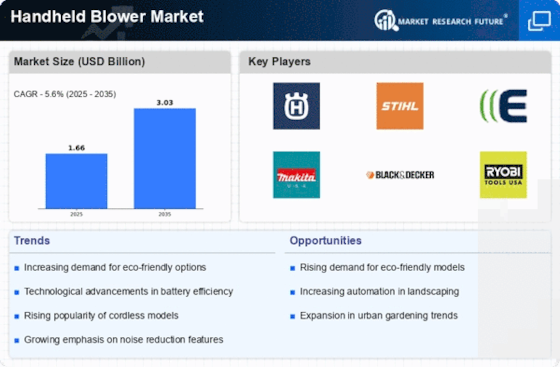
As per Market Research Future analysis, the Handheld Blower Market Size was estimated at 1.662 USD Billion in 2024. The Handheld Blower industry is projected to grow from 1.755 USD Billion in 2025 to 3.026 USD Billion by 2035, exhibiting a compound annual growth rate (CAGR) of 5.6% during the forecast period 2025 - 2035

Key Market Trends & Highlights

The Handheld Blower Market is experiencing a transformative shift towards electric and multifunctional models, driven by technological advancements and changing consumer preferences.

  • The market is witnessing a notable shift towards electric models, particularly in North America, as consumers prioritize sustainability. Multifunctional tools are gaining traction, appealing to users seeking versatility in outdoor maintenance equipment. Battery technology advancements are propelling the growth of cordless blowers, which currently dominate the market. The rising demand for outdoor maintenance equipment and environmental regulations favoring electric models are key drivers of market expansion.

Market Size & Forecast

2024 Market Size 1.662 (USD Billion)
2035 Market Size 3.026 (USD Billion)
CAGR (2025 - 2035) 5.6%
Largest Regional Market Share in 2024 North America

Major Players

<a href="https://www.husqvarna.com/in/leaf-blowers/">Husqvarna </a>(SE), Stihl (DE), Echo (JP), Makita (JP), Black &amp; Decker (US), Ryobi (JP), Craftsman (US), Toro (US), <a href="https://www.greenworkscommercial.com/collections/leaf-blowers">Greenworks </a>(US)

Market Trends

The Handheld Blower Market is currently experiencing a notable transformation, driven by advancements in technology and shifting consumer preferences. As environmental concerns gain prominence, manufacturers are increasingly focusing on developing electric models that offer lower emissions and reduced noise levels. This trend aligns with the growing demand for sustainable gardening and landscaping solutions, as consumers seek tools that are both efficient and eco-friendly. Furthermore, the integration of battery technology has enhanced the portability and convenience of these devices, making them more appealing to a broader audience. In addition to technological innovations, the Handheld Blower Market is witnessing a rise in multifunctional products. Consumers are gravitating towards tools that can perform various tasks, such as blowing, vacuuming, and mulching. This versatility not only maximizes utility but also minimizes the need for multiple devices, thereby saving space and resources. As the market evolves, companies are likely to invest in research and development to create more efficient and user-friendly products that cater to the diverse needs of consumers. Overall, the Handheld Blower Market appears poised for growth, with trends indicating a shift towards sustainability and multifunctionality.

Shift Towards Electric Models

The Handheld Blower Market is increasingly leaning towards electric models, driven by consumer demand for environmentally friendly options. These devices typically produce less noise and emissions compared to their gas-powered counterparts, making them more suitable for residential areas. As awareness of environmental issues rises, manufacturers are responding by prioritizing the development of electric blowers.

Rise of Multifunctional Tools

Consumers are showing a preference for Fans And blowers that offer multiple functionalities, such as vacuuming and mulching. This trend reflects a desire for efficiency and convenience, as users seek to minimize the number of tools required for yard maintenance. Multifunctional devices not only save space but also enhance the overall user experience.

Increased Focus on Battery Technology

Advancements in battery technology are significantly impacting the Handheld Blower Market. Improved battery life and charging capabilities are making electric blowers more practical for consumers. As manufacturers continue to innovate in this area, the appeal of battery-operated models is likely to grow, further driving market expansion.

Handheld Blower Market Market Drivers

Rising Popularity of DIY Projects

The Handheld Blower Market is benefiting from the increasing popularity of do-it-yourself (DIY) projects among consumers. As more individuals take on home improvement and landscaping tasks, the demand for user-friendly and efficient tools is on the rise. This trend is particularly evident in suburban areas, where homeowners are investing in equipment that simplifies outdoor maintenance. Market Research Future indicates that the DIY home improvement market has expanded significantly, with a projected growth rate of around 6% annually. This surge in DIY activities is likely to drive sales of handheld blowers, as consumers seek tools that enhance their ability to complete projects effectively. Consequently, manufacturers in the Handheld Blower Market are expected to tailor their products to cater to this growing segment.

Technological Advancements in Battery Life

The Handheld Blower Market is witnessing rapid advancements in battery technology, which is significantly enhancing the performance of cordless models. Innovations in lithium-ion batteries are leading to longer run times and shorter charging periods, making electric handheld blowers more appealing to consumers. As battery efficiency improves, users can operate these tools for extended periods without interruption, which is a critical factor for both residential and commercial applications. Market data indicates that the demand for battery-operated blowers is expected to rise by approximately 10% over the next five years. This trend suggests that manufacturers in the Handheld Blower Market must prioritize battery technology to remain competitive and meet evolving consumer expectations.

Increased Focus on Ergonomics and User Comfort

The Handheld Blower Market is increasingly prioritizing ergonomics and user comfort in product design. As consumers become more aware of the physical demands associated with outdoor maintenance, manufacturers are responding by developing blowers that are lighter, easier to handle, and equipped with features that reduce strain during use. This focus on ergonomics is likely to enhance user satisfaction and encourage repeat purchases. Data suggests that products designed with user comfort in mind can lead to a 15% increase in customer loyalty. As a result, companies in the Handheld Blower Market are investing in research and development to create innovative designs that not only improve functionality but also enhance the overall user experience.

Growing Demand for Outdoor Maintenance Equipment

The Handheld Blower Market is experiencing a notable increase in demand for outdoor maintenance equipment. This trend is largely driven by the rising interest in landscaping and gardening among homeowners and commercial property managers. As urban areas expand, the need for efficient outdoor maintenance solutions becomes more pronounced. According to recent data, the landscaping services sector has seen a growth rate of approximately 5% annually, which correlates with the rising sales of handheld blowers. This growth is indicative of a broader trend where consumers are investing in tools that enhance the aesthetic appeal of their outdoor spaces. Consequently, manufacturers in the Handheld Blower Market are likely to innovate and diversify their product offerings to meet this growing demand.

Environmental Regulations Favoring Electric Models

The Handheld Blower Market is increasingly influenced by stringent environmental regulations aimed at reducing emissions and noise pollution. Many regions are implementing laws that restrict the use of gas-powered equipment, thereby creating a favorable environment for electric handheld blowers. This shift is not only beneficial for the environment but also aligns with consumer preferences for quieter and cleaner alternatives. Data suggests that electric models are projected to capture a significant share of the market, with estimates indicating a growth rate of around 8% in the next few years. As a result, manufacturers are focusing on developing more efficient and powerful electric blowers, which could further enhance their market presence in the Handheld Blower Market.


Market Segment Insights

By Type: Cordless (Largest) vs. Corded (Fastest-Growing)

<p>In the Handheld Blower Market, the market share distribution reveals that cordless handheld blowers dominate the market, primarily due to their convenience, portability, and user-friendly design. The demand for cordless models is driven by consumers seeking flexibility in outdoor maintenance tasks without being limited by cord lengths or power outlets. On the other hand, corded blowers hold a smaller share but are gaining traction, especially among users who prioritize consistent power for prolonged use.</p>

<p>Type: Cordless (Dominant) vs. Corded (Emerging)</p>

<p>Cordless handheld blowers are characterized by their battery-powered operation, making them ideal for homeowners and professional landscapers who value mobility and ease of use. These blowers often feature advanced battery technology, providing longer run times and faster charging capabilities. Conversely, corded blowers, while less mobile, offer unlimited power without the need for recharging, making them attractive for heavy-duty tasks. As battery technology continues to improve, the corded segment is seeing increased innovation, positioning it as a fast-emerging option for users looking for powerful solutions without the hassle of cords.</p>

By Power Source: Gas (Largest) vs. Battery (Fastest-Growing)

<p>The Handheld Blower Market showcases a dynamic distribution among its power source segments, predominantly led by gas-powered blowers. This segment holds the largest market share due to their efficiency, power output, and preference among professional landscapers and heavy-duty users. Electrical and battery-powered variants follow, catering to residential users seeking convenience and quieter operation, respectively. As preferences evolve, the competition among these segments intensifies, with gas being viewed as traditional and battery-powered options gaining traction especially amid environmental concerns. In recent years, growth trends indicate a significant shift towards battery-operated handheld blowers, driven by technological advancements in battery efficiency and a growing emphasis on sustainability. Consumers are increasingly favoring electric models for their low noise levels and reduced carbon footprints. Moreover, innovations in battery technology have made these devices more robust, enhancing their appeal in both residential and commercial settings. The gas segment, while still dominant, is facing pressure to adapt, which is reshaping the competitive landscape of the Handheld Blower Market.</p>

<p>Power Sources: Gas (Dominant) vs. Battery (Emerging)</p>

<p>Gas-powered handheld blowers remain the dominant choice in the market, offering robust performance for demanding jobs. They provide higher airflow and runtime, making them ideal for large-scale outdoor tasks. However, increasing concerns over emissions are stiffening regulations and consumer preferences toward greener alternatives. Battery-powered handheld blowers, on the other hand, are emerging rapidly, appealing to eco-conscious consumers. These models are increasingly efficient, quieter, and more user-friendly, presenting a compelling option for residential users and businesses committed to reducing their carbon footprint. As battery technology continues to advance, the gap in performance between gas and battery-powered models is narrowing, positioning battery-powered blowers as a serious contender in the market.</p>

By Application: Residential (Largest) vs. Commercial (Fastest-Growing)

<p>In the Handheld Blower Market, the application segment is divided into two primary categories: Residential and Commercial. The Residential segment holds the largest share, driven by the increasing demand for lawn care and gardening tools among homeowners. With more consumers investing time in their properties, residential handheld blowers have become a staple in yard maintenance. In contrast, the Commercial segment, though smaller in size, is rapidly expanding as maintenance service providers and landscapers seek efficient tools for large-scale operations. This trend reflects the rising demand for maintenance in commercial spaces such as parks, resorts, and corporate landscapes. Growth trends in the handheld blower application segment are influenced by evolving consumer preferences and technological advancements. The Residential sector shows robust growth as more individuals prioritize curb appeal and the ease of landscaping tasks, leading to increased sales of lightweight and cordless models. On the other hand, the Commercial segment is experiencing the fastest growth due to the escalating need for professional landscaping services and the adoption of eco-friendly products. Increased awareness regarding noise regulations and environmental considerations is also pushing the commercial market towards innovations that enhance operational efficiency and sustainability.</p>

<p>Application: Residential (Dominant) vs. Commercial (Emerging)</p>

<p>The Residential application segment is characterized by its focus on lightweight, portable, and user-friendly handheld blowers that cater to homeowners' needs for efficient yard maintenance and landscaping. These products are increasingly designed with features such as battery-powered options, which offer convenience and reduced environmental impact. On the other hand, the Commercial application segment is emerging rapidly, driven by the rising demand for professional landscaping services and the need for robust, high-capacity blowers that can handle larger areas. Commercial units often offer higher power and longevity, making them suitable for extensive operating hours. Both segments show a trend towards eco-friendly innovations, with manufacturers responding to the growing environmental concerns by developing quieter and cleaner technologies.</p>

By Distribution Channel: Online (Largest) vs. Offline (Fastest-Growing)

<p>In the Handheld Blower Market, the distribution of sales channels reveals that the online segment holds the largest share. This trend is fueled by the growing preference for e-commerce, allowing consumers to explore a wider variety of handheld blowers and compare prices effortlessly. The convenience of online shopping and the ability to read customer reviews have made this channel increasingly popular among buyers looking for quality and variety. Conversely, the offline segment is emerging as the fastest-growing channel. This growth is driven by consumers wishing to physically inspect products before purchase, particularly for machinery like handheld blowers. Furthermore, retailers are enhancing the in-store experience by offering expert advice and demonstrations, attracting a dedicated consumer base that values personal interactions when making significant purchasing decisions.</p>

<p>Online (Dominant) vs. Offline (Emerging)</p>

<p>In the Handheld Blower Market, the online distribution channel has established itself as a dominant force, capturing the attention of tech-savvy consumers who prioritize ease and efficiency in their shopping experiences. Online platforms provide extensive product information, customer reviews, and competitive pricing. Meanwhile, the offline channel is emerging, particularly among traditional consumers who prefer tactile engagement with the product. While online sales appeal to the convenience factor, the offline segment is capitalizing on personalized service and product familiarity. Retailers are adapting to these preferences by integrating more interactive elements in stores, suggesting that both channels will continue to coexist and thrive, catering to different consumer preferences in the marketplace.</p>

Get more detailed insights about Handheld Blower Market Research Report—Global Forecast till 2035

Regional Insights

North America : Market Leader in Innovation

North America is the largest market for handheld blowers, accounting for approximately 40% of the global market share. The growth is driven by increasing consumer interest in landscaping and gardening, alongside a rise in outdoor activities. Regulatory support for eco-friendly products is also a significant catalyst, encouraging manufacturers to innovate and comply with environmental standards. The United States leads the market, followed by Canada, with key players like Husqvarna, Stihl, and Black & Decker dominating the landscape. The competitive environment is characterized by continuous product innovation and a focus on battery-powered options, reflecting consumer preferences for sustainable solutions. The presence of established brands ensures a robust supply chain and distribution network, further enhancing market growth.

Europe : Sustainable Growth Focus

Europe is witnessing a growing demand for handheld blowers, holding approximately 30% of the global market share. The region's growth is fueled by stringent environmental regulations promoting the use of electric and battery-operated devices. Countries like Germany and France are at the forefront, with increasing consumer awareness regarding sustainability and noise pollution regulations acting as key drivers. Germany is the largest market in Europe, followed by France and the UK. The competitive landscape features major players such as Stihl and Husqvarna, who are adapting their product lines to meet regulatory standards. The emphasis on eco-friendly products is reshaping the market, with manufacturers investing in R&D to develop innovative solutions that align with consumer preferences and regulatory requirements.

Asia-Pacific : Emerging Market Potential

Asia-Pacific is emerging as a significant player in the handheld blower market, accounting for about 20% of the global share. The region's growth is driven by urbanization, increasing disposable incomes, and a rising trend in gardening and landscaping activities. Countries like Japan and Australia are leading the market, supported by favorable climatic conditions and a growing interest in outdoor aesthetics. Japan is the largest market in the region, followed by Australia and China. The competitive landscape is marked by the presence of key players such as Echo and Makita, who are focusing on product innovation and expanding their distribution networks. The demand for lightweight and efficient models is on the rise, reflecting changing consumer preferences towards convenience and performance.

Middle East and Africa : Untapped Market Opportunities

The Middle East and Africa region is gradually emerging in the handheld blower market, holding approximately 10% of the global share. The growth is primarily driven by urbanization and an increasing focus on landscaping in urban areas. Countries like South Africa and the UAE are witnessing a rise in demand for outdoor maintenance equipment, supported by government initiatives promoting green spaces. South Africa is the largest market in the region, followed by the UAE. The competitive landscape is characterized by a mix of local and international players, with brands like Toro and Greenworks gaining traction. The market is still developing, with significant opportunities for growth as consumer awareness and demand for quality outdoor equipment continue to rise.

Key Players and Competitive Insights

Major market players are spending a lot of money on R&D to increase their product lines, which will help the Handheld Blower Market grow even more. Market participants are also taking a range of strategic initiatives to grow their worldwide footprint, including product launches, contractual agreements, mergers and acquisitions, increased investments, and collaboration with other organizations. Competitors in the Handheld Blower industry must offer cost-effective items to expand and survive in an increasingly competitive and rising market environment.
One of the primary business strategies manufacturers adopt in the global Handheld Blower industry to benefit clients and expand the Handheld Blower Market sector is manufacturing locally to reduce operating costs. In recent years, Handheld Blower Market has provided medicine with some of the most significant benefits.
ECHO world famous engines and quality standards that make ECHO tools special, engines to be as efficient as possible, this means low emissions, quiet operation, low vibration, light weight and highly durable without sacrificing the high power renowned for.
In January ECHO tools launched New DPB-2600 cordless blower. The new ECHO tools DPB-2600 hand-help cordless power blower is the latest edition to the 56 eFROCE lineup of 56V products. The blower features several technological innovations that make it truly stand out. Most notable is the way in which the blower draws air equally from both sides.
ECHO is calling this technology TWYND, which is a combination of the words "twin" and "wind".  
Also, EGO is a business built on innovation. The world is changing fast. Society is moving away from fossil fuels and adopting cleaner, greener energy. The company believes it's time for a new, smarter way to power through gardening and landscaping tasks.
In April EGO POWER+ Enhances the Outdoor Power Industry by Bringing Unprecedented Power and Performance to the Leaf Blower Market. The No. 1 rated brand in cordless outdoor power equipment, EGO, is once again raising industry standards with the introduction of its newest 615 CFM Blower, one of its most advanced handheld blowers in the marketplace.  

Key Companies in the Handheld Blower Market include

Industry Developments

April 2019: The No. 1 rated brand in cordless outdoor power equipment, EGO, is once again raising industry standards by introducing its newest 615 CFM Blower, one of its most advanced handheld blowers in the marketplace.

December 2021: FILPOW Ltd. announced the launch of its new B8 Pro Cordless Leaf Blower. Certified by SGS, the world's leading testing, inspection, and certification company.

August 2021: San Mateo. announced the launch of an electric leaf blower rebate program to reduce noise pollution.

Future Outlook

Handheld Blower Market Future Outlook

The Handheld Blower Market is projected to grow at a 5.6% CAGR from 2025 to 2035, driven by technological advancements, increasing landscaping activities, and rising consumer demand for efficient outdoor tools.

New opportunities lie in:

  • <p>Development of battery-powered models for eco-conscious consumers. Integration of smart technology for enhanced user experience. Expansion into emerging markets with tailored product offerings.</p>

By 2035, the Handheld Blower Market is expected to achieve robust growth, reflecting evolving consumer preferences and technological innovations.

Market Segmentation

Handheld Blower Market Type Outlook

  • Cordless
  • Corded

Handheld Blower Market Application Outlook

  • Residential
  • Commercial

Handheld Blower Market Power Source Outlook

  • Gas
  • Electrical
  • Battery

Handheld Blower Market Distribution Channel Outlook

  • Online
  • Offline

Report Scope

MARKET SIZE 2024 1.662(USD Billion)
MARKET SIZE 2025 1.755(USD Billion)
MARKET SIZE 2035 3.026(USD Billion)
COMPOUND ANNUAL GROWTH RATE (CAGR) 5.6% (2025 - 2035)
REPORT COVERAGE Revenue Forecast, Competitive Landscape, Growth Factors, and Trends
BASE YEAR 2024
Market Forecast Period 2025 - 2035
Historical Data 2019 - 2024
Market Forecast Units USD Billion
Key Companies Profiled Husqvarna (SE), Stihl (DE), Echo (JP), Makita (JP), Black & Decker (US), Ryobi (JP), Craftsman (US), Toro (US), Greenworks (US)
Segments Covered Type, Power Source, Application, Distribution Channel, Region
Key Market Opportunities Growing demand for eco-friendly handheld blowers driven by consumer preference for sustainable gardening solutions.
Key Market Dynamics Rising consumer preference for eco-friendly handheld blowers drives innovation and competition among manufacturers.
Countries Covered North America, Europe, APAC, South America, MEA

FAQs

What is the projected market valuation of the Handheld Blower Market by 2035?

<p>The Handheld Blower Market is projected to reach a valuation of 3.026 USD Billion by 2035.</p>

What was the market valuation of the Handheld Blower Market in 2024?

<p>In 2024, the Handheld Blower Market was valued at 1.662 USD Billion.</p>

What is the expected CAGR for the Handheld Blower Market during the forecast period 2025 - 2035?

<p>The expected CAGR for the Handheld Blower Market during the forecast period 2025 - 2035 is 5.6%.</p>

Which companies are considered key players in the Handheld Blower Market?

<p>Key players in the Handheld Blower Market include Husqvarna, Stihl, Echo, Makita, Black & Decker, Ryobi, Craftsman, Toro, and Greenworks.</p>

What are the main types of handheld blowers in the market?

<p>The main types of handheld blowers in the market are Cordless and Corded, with valuations of 1.788 USD Billion and 1.238 USD Billion, respectively.</p>

How does the power source segment break down in the Handheld Blower Market?

<p>The power source segment includes Gas, Electrical, and Battery options, with valuations of 0.883 USD Billion, 1.188 USD Billion, and 0.955 USD Billion, respectively.</p>

What applications dominate the Handheld Blower Market?

<p>The applications in the Handheld Blower Market are primarily Residential and Commercial, valued at 1.688 USD Billion and 1.338 USD Billion, respectively.</p>

What distribution channels are utilized in the Handheld Blower Market?

<p>The distribution channels in the Handheld Blower Market are Online and Offline, with valuations of 1.788 USD Billion and 1.238 USD Billion, respectively.</p>

How has the market for cordless handheld blowers evolved recently?

<p>The market for cordless handheld blowers has evolved to a valuation of 1.788 USD Billion, indicating a growing preference for this type.</p>

What trends are influencing the growth of the Handheld Blower Market?

<p>Trends influencing the growth of the Handheld Blower Market include increasing demand for efficient outdoor maintenance tools and advancements in battery technology.</p>

  1. SECTION I: EXECUTIVE SUMMARY AND KEY HIGHLIGHTS
    1. | 1.1 EXECUTIVE SUMMARY
    2. | | 1.1.1 Market Overview
    3. | | 1.1.2 Key Findings
    4. | | 1.1.3 Market Segmentation
    5. | | 1.1.4 Competitive Landscape
    6. | | 1.1.5 Challenges and Opportunities
    7. | | 1.1.6 Future Outlook
  2. SECTION II: SCOPING, METHODOLOGY AND MARKET STRUCTURE
    1. | 2.1 MARKET INTRODUCTION
    2. | | 2.1.1 Definition
    3. | | 2.1.2 Scope of the study
    4. | | | 2.1.2.1 Research Objective
    5. | | | 2.1.2.2 Assumption
    6. | | | 2.1.2.3 Limitations
    7. | 2.2 RESEARCH METHODOLOGY
    8. | | 2.2.1 Overview
    9. | | 2.2.2 Data Mining
    10. | | 2.2.3 Secondary Research
    11. | | 2.2.4 Primary Research
    12. | | | 2.2.4.1 Primary Interviews and Information Gathering Process
    13. | | | 2.2.4.2 Breakdown of Primary Respondents
    14. | | 2.2.5 Forecasting Model
    15. | | 2.2.6 Market Size Estimation
    16. | | | 2.2.6.1 Bottom-Up Approach
    17. | | | 2.2.6.2 Top-Down Approach
    18. | | 2.2.7 Data Triangulation
    19. | | 2.2.8 Validation
  3. SECTION III: QUALITATIVE ANALYSIS
    1. | 3.1 MARKET DYNAMICS
    2. | | 3.1.1 Overview
    3. | | 3.1.2 Drivers
    4. | | 3.1.3 Restraints
    5. | | 3.1.4 Opportunities
    6. | 3.2 MARKET FACTOR ANALYSIS
    7. | | 3.2.1 Value chain Analysis
    8. | | 3.2.2 Porter's Five Forces Analysis
    9. | | | 3.2.2.1 Bargaining Power of Suppliers
    10. | | | 3.2.2.2 Bargaining Power of Buyers
    11. | | | 3.2.2.3 Threat of New Entrants
    12. | | | 3.2.2.4 Threat of Substitutes
    13. | | | 3.2.2.5 Intensity of Rivalry
    14. | | 3.2.3 COVID-19 Impact Analysis
    15. | | | 3.2.3.1 Market Impact Analysis
    16. | | | 3.2.3.2 Regional Impact
    17. | | | 3.2.3.3 Opportunity and Threat Analysis
  4. SECTION IV: QUANTITATIVE ANALYSIS
    1. | 4.1 Chemicals and Materials, BY Type (USD Billion)
    2. | | 4.1.1 Cordless
    3. | | 4.1.2 Corded
    4. | 4.2 Chemicals and Materials, BY Power Source (USD Billion)
    5. | | 4.2.1 Gas
    6. | | 4.2.2 Electrical
    7. | | 4.2.3 Battery
    8. | 4.3 Chemicals and Materials, BY Application (USD Billion)
    9. | | 4.3.1 Residential
    10. | | 4.3.2 Commercial
    11. | 4.4 Chemicals and Materials, BY Distribution Channel (USD Billion)
    12. | | 4.4.1 Online
    13. | | 4.4.2 Offline
    14. | 4.5 Chemicals and Materials, BY Region (USD Billion)
    15. | | 4.5.1 North America
    16. | | | 4.5.1.1 US
    17. | | | 4.5.1.2 Canada
    18. | | 4.5.2 Europe
    19. | | | 4.5.2.1 Germany
    20. | | | 4.5.2.2 UK
    21. | | | 4.5.2.3 France
    22. | | | 4.5.2.4 Russia
    23. | | | 4.5.2.5 Italy
    24. | | | 4.5.2.6 Spain
    25. | | | 4.5.2.7 Rest of Europe
    26. | | 4.5.3 APAC
    27. | | | 4.5.3.1 China
    28. | | | 4.5.3.2 India
    29. | | | 4.5.3.3 Japan
    30. | | | 4.5.3.4 South Korea
    31. | | | 4.5.3.5 Malaysia
    32. | | | 4.5.3.6 Thailand
    33. | | | 4.5.3.7 Indonesia
    34. | | | 4.5.3.8 Rest of APAC
    35. | | 4.5.4 South America
    36. | | | 4.5.4.1 Brazil
    37. | | | 4.5.4.2 Mexico
    38. | | | 4.5.4.3 Argentina
    39. | | | 4.5.4.4 Rest of South America
    40. | | 4.5.5 MEA
    41. | | | 4.5.5.1 GCC Countries
    42. | | | 4.5.5.2 South Africa
    43. | | | 4.5.5.3 Rest of MEA
  5. SECTION V: COMPETITIVE ANALYSIS
    1. | 5.1 Competitive Landscape
    2. | | 5.1.1 Overview
    3. | | 5.1.2 Competitive Analysis
    4. | | 5.1.3 Market share Analysis
    5. | | 5.1.4 Major Growth Strategy in the Chemicals and Materials
    6. | | 5.1.5 Competitive Benchmarking
    7. | | 5.1.6 Leading Players in Terms of Number of Developments in the Chemicals and Materials
    8. | | 5.1.7 Key developments and growth strategies
    9. | | | 5.1.7.1 New Product Launch/Service Deployment
    10. | | | 5.1.7.2 Merger & Acquisitions
    11. | | | 5.1.7.3 Joint Ventures
    12. | | 5.1.8 Major Players Financial Matrix
    13. | | | 5.1.8.1 Sales and Operating Income
    14. | | | 5.1.8.2 Major Players R&D Expenditure. 2023
    15. | 5.2 Company Profiles
    16. | | 5.2.1 Husqvarna (SE)
    17. | | | 5.2.1.1 Financial Overview
    18. | | | 5.2.1.2 Products Offered
    19. | | | 5.2.1.3 Key Developments
    20. | | | 5.2.1.4 SWOT Analysis
    21. | | | 5.2.1.5 Key Strategies
    22. | | 5.2.2 Stihl (DE)
    23. | | | 5.2.2.1 Financial Overview
    24. | | | 5.2.2.2 Products Offered
    25. | | | 5.2.2.3 Key Developments
    26. | | | 5.2.2.4 SWOT Analysis
    27. | | | 5.2.2.5 Key Strategies
    28. | | 5.2.3 Echo (JP)
    29. | | | 5.2.3.1 Financial Overview
    30. | | | 5.2.3.2 Products Offered
    31. | | | 5.2.3.3 Key Developments
    32. | | | 5.2.3.4 SWOT Analysis
    33. | | | 5.2.3.5 Key Strategies
    34. | | 5.2.4 Makita (JP)
    35. | | | 5.2.4.1 Financial Overview
    36. | | | 5.2.4.2 Products Offered
    37. | | | 5.2.4.3 Key Developments
    38. | | | 5.2.4.4 SWOT Analysis
    39. | | | 5.2.4.5 Key Strategies
    40. | | 5.2.5 Black & Decker (US)
    41. | | | 5.2.5.1 Financial Overview
    42. | | | 5.2.5.2 Products Offered
    43. | | | 5.2.5.3 Key Developments
    44. | | | 5.2.5.4 SWOT Analysis
    45. | | | 5.2.5.5 Key Strategies
    46. | | 5.2.6 Ryobi (JP)
    47. | | | 5.2.6.1 Financial Overview
    48. | | | 5.2.6.2 Products Offered
    49. | | | 5.2.6.3 Key Developments
    50. | | | 5.2.6.4 SWOT Analysis
    51. | | | 5.2.6.5 Key Strategies
    52. | | 5.2.7 Craftsman (US)
    53. | | | 5.2.7.1 Financial Overview
    54. | | | 5.2.7.2 Products Offered
    55. | | | 5.2.7.3 Key Developments
    56. | | | 5.2.7.4 SWOT Analysis
    57. | | | 5.2.7.5 Key Strategies
    58. | | 5.2.8 Toro (US)
    59. | | | 5.2.8.1 Financial Overview
    60. | | | 5.2.8.2 Products Offered
    61. | | | 5.2.8.3 Key Developments
    62. | | | 5.2.8.4 SWOT Analysis
    63. | | | 5.2.8.5 Key Strategies
    64. | | 5.2.9 Greenworks (US)
    65. | | | 5.2.9.1 Financial Overview
    66. | | | 5.2.9.2 Products Offered
    67. | | | 5.2.9.3 Key Developments
    68. | | | 5.2.9.4 SWOT Analysis
    69. | | | 5.2.9.5 Key Strategies
    70. | 5.3 Appendix
    71. | | 5.3.1 References
    72. | | 5.3.2 Related Reports
  6. LIST OF FIGURES
    1. | 6.1 MARKET SYNOPSIS
    2. | 6.2 NORTH AMERICA MARKET ANALYSIS
    3. | 6.3 US MARKET ANALYSIS BY TYPE
    4. | 6.4 US MARKET ANALYSIS BY POWER SOURCE
    5. | 6.5 US MARKET ANALYSIS BY APPLICATION
    6. | 6.6 US MARKET ANALYSIS BY DISTRIBUTION CHANNEL
    7. | 6.7 CANADA MARKET ANALYSIS BY TYPE
    8. | 6.8 CANADA MARKET ANALYSIS BY POWER SOURCE
    9. | 6.9 CANADA MARKET ANALYSIS BY APPLICATION
    10. | 6.10 CANADA MARKET ANALYSIS BY DISTRIBUTION CHANNEL
    11. | 6.11 EUROPE MARKET ANALYSIS
    12. | 6.12 GERMANY MARKET ANALYSIS BY TYPE
    13. | 6.13 GERMANY MARKET ANALYSIS BY POWER SOURCE
    14. | 6.14 GERMANY MARKET ANALYSIS BY APPLICATION
    15. | 6.15 GERMANY MARKET ANALYSIS BY DISTRIBUTION CHANNEL
    16. | 6.16 UK MARKET ANALYSIS BY TYPE
    17. | 6.17 UK MARKET ANALYSIS BY POWER SOURCE
    18. | 6.18 UK MARKET ANALYSIS BY APPLICATION
    19. | 6.19 UK MARKET ANALYSIS BY DISTRIBUTION CHANNEL
    20. | 6.20 FRANCE MARKET ANALYSIS BY TYPE
    21. | 6.21 FRANCE MARKET ANALYSIS BY POWER SOURCE
    22. | 6.22 FRANCE MARKET ANALYSIS BY APPLICATION
    23. | 6.23 FRANCE MARKET ANALYSIS BY DISTRIBUTION CHANNEL
    24. | 6.24 RUSSIA MARKET ANALYSIS BY TYPE
    25. | 6.25 RUSSIA MARKET ANALYSIS BY POWER SOURCE
    26. | 6.26 RUSSIA MARKET ANALYSIS BY APPLICATION
    27. | 6.27 RUSSIA MARKET ANALYSIS BY DISTRIBUTION CHANNEL
    28. | 6.28 ITALY MARKET ANALYSIS BY TYPE
    29. | 6.29 ITALY MARKET ANALYSIS BY POWER SOURCE
    30. | 6.30 ITALY MARKET ANALYSIS BY APPLICATION
    31. | 6.31 ITALY MARKET ANALYSIS BY DISTRIBUTION CHANNEL
    32. | 6.32 SPAIN MARKET ANALYSIS BY TYPE
    33. | 6.33 SPAIN MARKET ANALYSIS BY POWER SOURCE
    34. | 6.34 SPAIN MARKET ANALYSIS BY APPLICATION
    35. | 6.35 SPAIN MARKET ANALYSIS BY DISTRIBUTION CHANNEL
    36. | 6.36 REST OF EUROPE MARKET ANALYSIS BY TYPE
    37. | 6.37 REST OF EUROPE MARKET ANALYSIS BY POWER SOURCE
    38. | 6.38 REST OF EUROPE MARKET ANALYSIS BY APPLICATION
    39. | 6.39 REST OF EUROPE MARKET ANALYSIS BY DISTRIBUTION CHANNEL
    40. | 6.40 APAC MARKET ANALYSIS
    41. | 6.41 CHINA MARKET ANALYSIS BY TYPE
    42. | 6.42 CHINA MARKET ANALYSIS BY POWER SOURCE
    43. | 6.43 CHINA MARKET ANALYSIS BY APPLICATION
    44. | 6.44 CHINA MARKET ANALYSIS BY DISTRIBUTION CHANNEL
    45. | 6.45 INDIA MARKET ANALYSIS BY TYPE
    46. | 6.46 INDIA MARKET ANALYSIS BY POWER SOURCE
    47. | 6.47 INDIA MARKET ANALYSIS BY APPLICATION
    48. | 6.48 INDIA MARKET ANALYSIS BY DISTRIBUTION CHANNEL
    49. | 6.49 JAPAN MARKET ANALYSIS BY TYPE
    50. | 6.50 JAPAN MARKET ANALYSIS BY POWER SOURCE
    51. | 6.51 JAPAN MARKET ANALYSIS BY APPLICATION
    52. | 6.52 JAPAN MARKET ANALYSIS BY DISTRIBUTION CHANNEL
    53. | 6.53 SOUTH KOREA MARKET ANALYSIS BY TYPE
    54. | 6.54 SOUTH KOREA MARKET ANALYSIS BY POWER SOURCE
    55. | 6.55 SOUTH KOREA MARKET ANALYSIS BY APPLICATION
    56. | 6.56 SOUTH KOREA MARKET ANALYSIS BY DISTRIBUTION CHANNEL
    57. | 6.57 MALAYSIA MARKET ANALYSIS BY TYPE
    58. | 6.58 MALAYSIA MARKET ANALYSIS BY POWER SOURCE
    59. | 6.59 MALAYSIA MARKET ANALYSIS BY APPLICATION
    60. | 6.60 MALAYSIA MARKET ANALYSIS BY DISTRIBUTION CHANNEL
    61. | 6.61 THAILAND MARKET ANALYSIS BY TYPE
    62. | 6.62 THAILAND MARKET ANALYSIS BY POWER SOURCE
    63. | 6.63 THAILAND MARKET ANALYSIS BY APPLICATION
    64. | 6.64 THAILAND MARKET ANALYSIS BY DISTRIBUTION CHANNEL
    65. | 6.65 INDONESIA MARKET ANALYSIS BY TYPE
    66. | 6.66 INDONESIA MARKET ANALYSIS BY POWER SOURCE
    67. | 6.67 INDONESIA MARKET ANALYSIS BY APPLICATION
    68. | 6.68 INDONESIA MARKET ANALYSIS BY DISTRIBUTION CHANNEL
    69. | 6.69 REST OF APAC MARKET ANALYSIS BY TYPE
    70. | 6.70 REST OF APAC MARKET ANALYSIS BY POWER SOURCE
    71. | 6.71 REST OF APAC MARKET ANALYSIS BY APPLICATION
    72. | 6.72 REST OF APAC MARKET ANALYSIS BY DISTRIBUTION CHANNEL
    73. | 6.73 SOUTH AMERICA MARKET ANALYSIS
    74. | 6.74 BRAZIL MARKET ANALYSIS BY TYPE
    75. | 6.75 BRAZIL MARKET ANALYSIS BY POWER SOURCE
    76. | 6.76 BRAZIL MARKET ANALYSIS BY APPLICATION
    77. | 6.77 BRAZIL MARKET ANALYSIS BY DISTRIBUTION CHANNEL
    78. | 6.78 MEXICO MARKET ANALYSIS BY TYPE
    79. | 6.79 MEXICO MARKET ANALYSIS BY POWER SOURCE
    80. | 6.80 MEXICO MARKET ANALYSIS BY APPLICATION
    81. | 6.81 MEXICO MARKET ANALYSIS BY DISTRIBUTION CHANNEL
    82. | 6.82 ARGENTINA MARKET ANALYSIS BY TYPE
    83. | 6.83 ARGENTINA MARKET ANALYSIS BY POWER SOURCE
    84. | 6.84 ARGENTINA MARKET ANALYSIS BY APPLICATION
    85. | 6.85 ARGENTINA MARKET ANALYSIS BY DISTRIBUTION CHANNEL
    86. | 6.86 REST OF SOUTH AMERICA MARKET ANALYSIS BY TYPE
    87. | 6.87 REST OF SOUTH AMERICA MARKET ANALYSIS BY POWER SOURCE
    88. | 6.88 REST OF SOUTH AMERICA MARKET ANALYSIS BY APPLICATION
    89. | 6.89 REST OF SOUTH AMERICA MARKET ANALYSIS BY DISTRIBUTION CHANNEL
    90. | 6.90 MEA MARKET ANALYSIS
    91. | 6.91 GCC COUNTRIES MARKET ANALYSIS BY TYPE
    92. | 6.92 GCC COUNTRIES MARKET ANALYSIS BY POWER SOURCE
    93. | 6.93 GCC COUNTRIES MARKET ANALYSIS BY APPLICATION
    94. | 6.94 GCC COUNTRIES MARKET ANALYSIS BY DISTRIBUTION CHANNEL
    95. | 6.95 SOUTH AFRICA MARKET ANALYSIS BY TYPE
    96. | 6.96 SOUTH AFRICA MARKET ANALYSIS BY POWER SOURCE
    97. | 6.97 SOUTH AFRICA MARKET ANALYSIS BY APPLICATION
    98. | 6.98 SOUTH AFRICA MARKET ANALYSIS BY DISTRIBUTION CHANNEL
    99. | 6.99 REST OF MEA MARKET ANALYSIS BY TYPE
    100. | 6.100 REST OF MEA MARKET ANALYSIS BY POWER SOURCE
    101. | 6.101 REST OF MEA MARKET ANALYSIS BY APPLICATION
    102. | 6.102 REST OF MEA MARKET ANALYSIS BY DISTRIBUTION CHANNEL
    103. | 6.103 KEY BUYING CRITERIA OF CHEMICALS AND MATERIALS
    104. | 6.104 RESEARCH PROCESS OF MRFR
    105. | 6.105 DRO ANALYSIS OF CHEMICALS AND MATERIALS
    106. | 6.106 DRIVERS IMPACT ANALYSIS: CHEMICALS AND MATERIALS
    107. | 6.107 RESTRAINTS IMPACT ANALYSIS: CHEMICALS AND MATERIALS
    108. | 6.108 SUPPLY / VALUE CHAIN: CHEMICALS AND MATERIALS
    109. | 6.109 CHEMICALS AND MATERIALS, BY TYPE, 2024 (% SHARE)
    110. | 6.110 CHEMICALS AND MATERIALS, BY TYPE, 2024 TO 2035 (USD Billion)
    111. | 6.111 CHEMICALS AND MATERIALS, BY POWER SOURCE, 2024 (% SHARE)
    112. | 6.112 CHEMICALS AND MATERIALS, BY POWER SOURCE, 2024 TO 2035 (USD Billion)
    113. | 6.113 CHEMICALS AND MATERIALS, BY APPLICATION, 2024 (% SHARE)
    114. | 6.114 CHEMICALS AND MATERIALS, BY APPLICATION, 2024 TO 2035 (USD Billion)
    115. | 6.115 CHEMICALS AND MATERIALS, BY DISTRIBUTION CHANNEL, 2024 (% SHARE)
    116. | 6.116 CHEMICALS AND MATERIALS, BY DISTRIBUTION CHANNEL, 2024 TO 2035 (USD Billion)
    117. | 6.117 BENCHMARKING OF MAJOR COMPETITORS
  7. LIST OF TABLES
    1. | 7.1 LIST OF ASSUMPTIONS
    2. | | 7.1.1
    3. | 7.2 North America MARKET SIZE ESTIMATES; FORECAST
    4. | | 7.2.1 BY TYPE, 2025-2035 (USD Billion)
    5. | | 7.2.2 BY POWER SOURCE, 2025-2035 (USD Billion)
    6. | | 7.2.3 BY APPLICATION, 2025-2035 (USD Billion)
    7. | | 7.2.4 BY DISTRIBUTION CHANNEL, 2025-2035 (USD Billion)
    8. | 7.3 US MARKET SIZE ESTIMATES; FORECAST
    9. | | 7.3.1 BY TYPE, 2025-2035 (USD Billion)
    10. | | 7.3.2 BY POWER SOURCE, 2025-2035 (USD Billion)
    11. | | 7.3.3 BY APPLICATION, 2025-2035 (USD Billion)
    12. | | 7.3.4 BY DISTRIBUTION CHANNEL, 2025-2035 (USD Billion)
    13. | 7.4 Canada MARKET SIZE ESTIMATES; FORECAST
    14. | | 7.4.1 BY TYPE, 2025-2035 (USD Billion)
    15. | | 7.4.2 BY POWER SOURCE, 2025-2035 (USD Billion)
    16. | | 7.4.3 BY APPLICATION, 2025-2035 (USD Billion)
    17. | | 7.4.4 BY DISTRIBUTION CHANNEL, 2025-2035 (USD Billion)
    18. | 7.5 Europe MARKET SIZE ESTIMATES; FORECAST
    19. | | 7.5.1 BY TYPE, 2025-2035 (USD Billion)
    20. | | 7.5.2 BY POWER SOURCE, 2025-2035 (USD Billion)
    21. | | 7.5.3 BY APPLICATION, 2025-2035 (USD Billion)
    22. | | 7.5.4 BY DISTRIBUTION CHANNEL, 2025-2035 (USD Billion)
    23. | 7.6 Germany MARKET SIZE ESTIMATES; FORECAST
    24. | | 7.6.1 BY TYPE, 2025-2035 (USD Billion)
    25. | | 7.6.2 BY POWER SOURCE, 2025-2035 (USD Billion)
    26. | | 7.6.3 BY APPLICATION, 2025-2035 (USD Billion)
    27. | | 7.6.4 BY DISTRIBUTION CHANNEL, 2025-2035 (USD Billion)
    28. | 7.7 UK MARKET SIZE ESTIMATES; FORECAST
    29. | | 7.7.1 BY TYPE, 2025-2035 (USD Billion)
    30. | | 7.7.2 BY POWER SOURCE, 2025-2035 (USD Billion)
    31. | | 7.7.3 BY APPLICATION, 2025-2035 (USD Billion)
    32. | | 7.7.4 BY DISTRIBUTION CHANNEL, 2025-2035 (USD Billion)
    33. | 7.8 France MARKET SIZE ESTIMATES; FORECAST
    34. | | 7.8.1 BY TYPE, 2025-2035 (USD Billion)
    35. | | 7.8.2 BY POWER SOURCE, 2025-2035 (USD Billion)
    36. | | 7.8.3 BY APPLICATION, 2025-2035 (USD Billion)
    37. | | 7.8.4 BY DISTRIBUTION CHANNEL, 2025-2035 (USD Billion)
    38. | 7.9 Russia MARKET SIZE ESTIMATES; FORECAST
    39. | | 7.9.1 BY TYPE, 2025-2035 (USD Billion)
    40. | | 7.9.2 BY POWER SOURCE, 2025-2035 (USD Billion)
    41. | | 7.9.3 BY APPLICATION, 2025-2035 (USD Billion)
    42. | | 7.9.4 BY DISTRIBUTION CHANNEL, 2025-2035 (USD Billion)
    43. | 7.10 Italy MARKET SIZE ESTIMATES; FORECAST
    44. | | 7.10.1 BY TYPE, 2025-2035 (USD Billion)
    45. | | 7.10.2 BY POWER SOURCE, 2025-2035 (USD Billion)
    46. | | 7.10.3 BY APPLICATION, 2025-2035 (USD Billion)
    47. | | 7.10.4 BY DISTRIBUTION CHANNEL, 2025-2035 (USD Billion)
    48. | 7.11 Spain MARKET SIZE ESTIMATES; FORECAST
    49. | | 7.11.1 BY TYPE, 2025-2035 (USD Billion)
    50. | | 7.11.2 BY POWER SOURCE, 2025-2035 (USD Billion)
    51. | | 7.11.3 BY APPLICATION, 2025-2035 (USD Billion)
    52. | | 7.11.4 BY DISTRIBUTION CHANNEL, 2025-2035 (USD Billion)
    53. | 7.12 Rest of Europe MARKET SIZE ESTIMATES; FORECAST
    54. | | 7.12.1 BY TYPE, 2025-2035 (USD Billion)
    55. | | 7.12.2 BY POWER SOURCE, 2025-2035 (USD Billion)
    56. | | 7.12.3 BY APPLICATION, 2025-2035 (USD Billion)
    57. | | 7.12.4 BY DISTRIBUTION CHANNEL, 2025-2035 (USD Billion)
    58. | 7.13 APAC MARKET SIZE ESTIMATES; FORECAST
    59. | | 7.13.1 BY TYPE, 2025-2035 (USD Billion)
    60. | | 7.13.2 BY POWER SOURCE, 2025-2035 (USD Billion)
    61. | | 7.13.3 BY APPLICATION, 2025-2035 (USD Billion)
    62. | | 7.13.4 BY DISTRIBUTION CHANNEL, 2025-2035 (USD Billion)
    63. | 7.14 China MARKET SIZE ESTIMATES; FORECAST
    64. | | 7.14.1 BY TYPE, 2025-2035 (USD Billion)
    65. | | 7.14.2 BY POWER SOURCE, 2025-2035 (USD Billion)
    66. | | 7.14.3 BY APPLICATION, 2025-2035 (USD Billion)
    67. | | 7.14.4 BY DISTRIBUTION CHANNEL, 2025-2035 (USD Billion)
    68. | 7.15 India MARKET SIZE ESTIMATES; FORECAST
    69. | | 7.15.1 BY TYPE, 2025-2035 (USD Billion)
    70. | | 7.15.2 BY POWER SOURCE, 2025-2035 (USD Billion)
    71. | | 7.15.3 BY APPLICATION, 2025-2035 (USD Billion)
    72. | | 7.15.4 BY DISTRIBUTION CHANNEL, 2025-2035 (USD Billion)
    73. | 7.16 Japan MARKET SIZE ESTIMATES; FORECAST
    74. | | 7.16.1 BY TYPE, 2025-2035 (USD Billion)
    75. | | 7.16.2 BY POWER SOURCE, 2025-2035 (USD Billion)
    76. | | 7.16.3 BY APPLICATION, 2025-2035 (USD Billion)
    77. | | 7.16.4 BY DISTRIBUTION CHANNEL, 2025-2035 (USD Billion)
    78. | 7.17 South Korea MARKET SIZE ESTIMATES; FORECAST
    79. | | 7.17.1 BY TYPE, 2025-2035 (USD Billion)
    80. | | 7.17.2 BY POWER SOURCE, 2025-2035 (USD Billion)
    81. | | 7.17.3 BY APPLICATION, 2025-2035 (USD Billion)
    82. | | 7.17.4 BY DISTRIBUTION CHANNEL, 2025-2035 (USD Billion)
    83. | 7.18 Malaysia MARKET SIZE ESTIMATES; FORECAST
    84. | | 7.18.1 BY TYPE, 2025-2035 (USD Billion)
    85. | | 7.18.2 BY POWER SOURCE, 2025-2035 (USD Billion)
    86. | | 7.18.3 BY APPLICATION, 2025-2035 (USD Billion)
    87. | | 7.18.4 BY DISTRIBUTION CHANNEL, 2025-2035 (USD Billion)
    88. | 7.19 Thailand MARKET SIZE ESTIMATES; FORECAST
    89. | | 7.19.1 BY TYPE, 2025-2035 (USD Billion)
    90. | | 7.19.2 BY POWER SOURCE, 2025-2035 (USD Billion)
    91. | | 7.19.3 BY APPLICATION, 2025-2035 (USD Billion)
    92. | | 7.19.4 BY DISTRIBUTION CHANNEL, 2025-2035 (USD Billion)
    93. | 7.20 Indonesia MARKET SIZE ESTIMATES; FORECAST
    94. | | 7.20.1 BY TYPE, 2025-2035 (USD Billion)
    95. | | 7.20.2 BY POWER SOURCE, 2025-2035 (USD Billion)
    96. | | 7.20.3 BY APPLICATION, 2025-2035 (USD Billion)
    97. | | 7.20.4 BY DISTRIBUTION CHANNEL, 2025-2035 (USD Billion)
    98. | 7.21 Rest of APAC MARKET SIZE ESTIMATES; FORECAST
    99. | | 7.21.1 BY TYPE, 2025-2035 (USD Billion)
    100. | | 7.21.2 BY POWER SOURCE, 2025-2035 (USD Billion)
    101. | | 7.21.3 BY APPLICATION, 2025-2035 (USD Billion)
    102. | | 7.21.4 BY DISTRIBUTION CHANNEL, 2025-2035 (USD Billion)
    103. | 7.22 South America MARKET SIZE ESTIMATES; FORECAST
    104. | | 7.22.1 BY TYPE, 2025-2035 (USD Billion)
    105. | | 7.22.2 BY POWER SOURCE, 2025-2035 (USD Billion)
    106. | | 7.22.3 BY APPLICATION, 2025-2035 (USD Billion)
    107. | | 7.22.4 BY DISTRIBUTION CHANNEL, 2025-2035 (USD Billion)
    108. | 7.23 Brazil MARKET SIZE ESTIMATES; FORECAST
    109. | | 7.23.1 BY TYPE, 2025-2035 (USD Billion)
    110. | | 7.23.2 BY POWER SOURCE, 2025-2035 (USD Billion)
    111. | | 7.23.3 BY APPLICATION, 2025-2035 (USD Billion)
    112. | | 7.23.4 BY DISTRIBUTION CHANNEL, 2025-2035 (USD Billion)
    113. | 7.24 Mexico MARKET SIZE ESTIMATES; FORECAST
    114. | | 7.24.1 BY TYPE, 2025-2035 (USD Billion)
    115. | | 7.24.2 BY POWER SOURCE, 2025-2035 (USD Billion)
    116. | | 7.24.3 BY APPLICATION, 2025-2035 (USD Billion)
    117. | | 7.24.4 BY DISTRIBUTION CHANNEL, 2025-2035 (USD Billion)
    118. | 7.25 Argentina MARKET SIZE ESTIMATES; FORECAST
    119. | | 7.25.1 BY TYPE, 2025-2035 (USD Billion)
    120. | | 7.25.2 BY POWER SOURCE, 2025-2035 (USD Billion)
    121. | | 7.25.3 BY APPLICATION, 2025-2035 (USD Billion)
    122. | | 7.25.4 BY DISTRIBUTION CHANNEL, 2025-2035 (USD Billion)
    123. | 7.26 Rest of South America MARKET SIZE ESTIMATES; FORECAST
    124. | | 7.26.1 BY TYPE, 2025-2035 (USD Billion)
    125. | | 7.26.2 BY POWER SOURCE, 2025-2035 (USD Billion)
    126. | | 7.26.3 BY APPLICATION, 2025-2035 (USD Billion)
    127. | | 7.26.4 BY DISTRIBUTION CHANNEL, 2025-2035 (USD Billion)
    128. | 7.27 MEA MARKET SIZE ESTIMATES; FORECAST
    129. | | 7.27.1 BY TYPE, 2025-2035 (USD Billion)
    130. | | 7.27.2 BY POWER SOURCE, 2025-2035 (USD Billion)
    131. | | 7.27.3 BY APPLICATION, 2025-2035 (USD Billion)
    132. | | 7.27.4 BY DISTRIBUTION CHANNEL, 2025-2035 (USD Billion)
    133. | 7.28 GCC Countries MARKET SIZE ESTIMATES; FORECAST
    134. | | 7.28.1 BY TYPE, 2025-2035 (USD Billion)
    135. | | 7.28.2 BY POWER SOURCE, 2025-2035 (USD Billion)
    136. | | 7.28.3 BY APPLICATION, 2025-2035 (USD Billion)
    137. | | 7.28.4 BY DISTRIBUTION CHANNEL, 2025-2035 (USD Billion)
    138. | 7.29 South Africa MARKET SIZE ESTIMATES; FORECAST
    139. | | 7.29.1 BY TYPE, 2025-2035 (USD Billion)
    140. | | 7.29.2 BY POWER SOURCE, 2025-2035 (USD Billion)
    141. | | 7.29.3 BY APPLICATION, 2025-2035 (USD Billion)
    142. | | 7.29.4 BY DISTRIBUTION CHANNEL, 2025-2035 (USD Billion)
    143. | 7.30 Rest of MEA MARKET SIZE ESTIMATES; FORECAST
    144. | | 7.30.1 BY TYPE, 2025-2035 (USD Billion)
    145. | | 7.30.2 BY POWER SOURCE, 2025-2035 (USD Billion)
    146. | | 7.30.3 BY APPLICATION, 2025-2035 (USD Billion)
    147. | | 7.30.4 BY DISTRIBUTION CHANNEL, 2025-2035 (USD Billion)
    148. | 7.31 PRODUCT LAUNCH/PRODUCT DEVELOPMENT/APPROVAL
    149. | | 7.31.1
    150. | 7.32 ACQUISITION/PARTNERSHIP
    151. | | 7.32.1

Chemicals and Materials Market Segmentation

Chemicals and Materials By Type (USD Billion, 2025-2035)

  • Cordless
  • Corded

Chemicals and Materials By Power Source (USD Billion, 2025-2035)

  • Gas
  • Electrical
  • Battery

Chemicals and Materials By Application (USD Billion, 2025-2035)

  • Residential
  • Commercial

Chemicals and Materials By Distribution Channel (USD Billion, 2025-2035)

  • Online
  • Offline
Infographic

Free Sample Request

Kindly complete the form below to receive a free sample of this Report

Get Free Sample

Customer Strories

Compare Licence

×
Features License Type
Single User Multiuser License Enterprise User
Price $4,950 $5,950 $7,250
Maximum User Access Limit 1 User Upto 10 Users Unrestricted Access Throughout the Organization
Free Customization
Direct Access to Analyst
Deliverable Format
Platform Access
Discount on Next Purchase 10% 15% 15%
Printable Versions