×
Hero Background
English
Chinese
French
Japanese
Korean
German
Spanish

Hammertoe Market Analysis

ID: MRFR/MED/2828-CR
104 Pages
Kinjoll Dey
August 2019

Hammertoe Market Research Report Information by Type (Rigid and Flexible), Treatment & Diagnosis (Treatment and Diagnosis), End User (Hospitals & Clinics and Physiotherapy & Orthopedic Centers) and Region (North America, Europe, Asia-Pacific and the Middle East & Africa) - Forecast till 2035

Share:
Download PDF ×

We do not share your information with anyone. However, we may send you emails based on your report interest from time to time. You may contact us at any time to opt-out.

Hammertoe Market Infographic
Purchase Options

Market Analysis

In-depth Analysis of Hammertoe Market Industry Landscape

Surge in Arthritis Cases Boosts Healthcare Industry:

The healthcare sector is experiencing significant growth, mainly due to a rising number of people dealing with arthritis and increased investments in research and development. However, challenges such as the complexities and discomfort linked to surgeries, infection risks during medical procedures and hospital stays, and a general lack of awareness might hinder the market's swift expansion.

Challenges to Market Growth: While the market is on an upward trajectory, challenges persist. Surgical treatments for arthritis, despite their benefits, come with their set of complications and pain, acting as hurdles in the market's growth. The risk of infections during surgical procedures and hospital stays adds another layer of concern. Additionally, a lack of awareness among the public poses a challenge to the widespread adoption of healthcare solutions.

In conclusion, the healthcare industry is witnessing substantial growth due to the surge in arthritis cases and increased investment in research and development. However, challenges like the complexities and pain associated with surgeries, infection risks, and limited public awareness might pose obstacles to the market's continuous expansion.

Projections indicate that by 2040, around 78.4 million individuals aged 18 and above in the United States may be diagnosed with arthritis. This surge in arthritis cases, affecting people of different age groups, plays a pivotal role in propelling the growth of the healthcare industry.

Opportunities:

Research and Development Growth: The increasing prevalence of arthritis has led to higher investments in research and development. This creates opportunities for innovative solutions and treatments.

Awareness Enhancement: Addressing the lack of awareness presents an opportunity for targeted campaigns to educate the public about arthritis prevention, symptoms, and available healthcare solutions.

In conclusion, the healthcare industry's notable growth is fueled by the rising cases of arthritis and increased investments in research and development. While challenges like surgical complexities and infection risks exist, opportunities lie in continuous innovation and heightened public awareness campaigns.

While the healthcare sector is on an upward trajectory, certain challenges and opportunities are apparent.


Author
Kinjoll Dey
Research Analyst Level I

He is an extremely curious individual currently working in Healthcare and Medical Devices Domain. Kinjoll is comfortably versed in data centric research backed by healthcare educational background. He leverages extensive data mining and analytics tools such as Primary and Secondary Research, Statistical Analysis, Machine Learning, Data Modelling. His key role also involves Technical Sales Support, Client Interaction and Project management within the Healthcare team. Lastly, he showcases extensive affinity towards learning new skills and remain fascinated in implementing them.

Leave a Comment

FAQs

What is the current valuation of the Hammertoe Market as of 2024?

The Hammertoe Market was valued at 1.2 USD Billion in 2024.

What is the projected market size for the Hammertoe Market in 2035?

The Hammertoe Market is projected to reach 4.307 USD Billion by 2035.

What is the expected CAGR for the Hammertoe Market during the forecast period 2025 - 2035?

The expected CAGR for the Hammertoe Market during 2025 - 2035 is 12.32%.

Which companies are considered key players in the Hammertoe Market?

Key players in the Hammertoe Market include Stryker, DePuy Synthes, Zimmer Biomet, and Smith & Nephew.

What are the two main types of hammertoe products in the market?

The two main types of hammertoe products are rigid and flexible, with valuations of 2.5 USD Billion and 1.8 USD Billion, respectively.

Market Summary

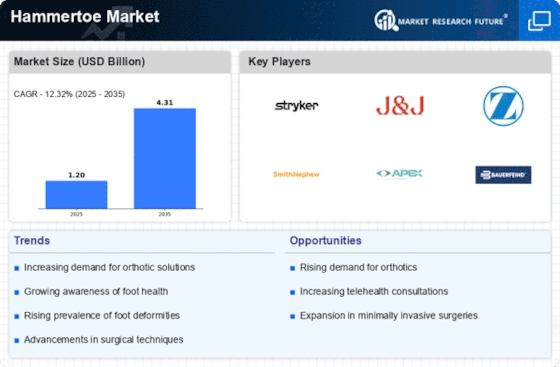
As per MRFR analysis, the Hammertoe Market Size was estimated at 1.2 USD Billion in 2024. The Hammertoe industry is projected to grow from 1.348 USD Billion in 2025 to 4.307 USD Billion by 2035, exhibiting a compound annual growth rate (CAGR) of 12.32 during the forecast period 2025 - 2035.

Key Market Trends & Highlights

The Hammertoe Market is experiencing notable growth driven by increased awareness and advancements in treatment options.

  • North America remains the largest market for hammertoe treatments, reflecting a strong focus on foot health. The Asia-Pacific region is emerging as the fastest-growing market, driven by rising healthcare access and awareness. The rigid treatment segment continues to dominate, while the flexible treatment segment is witnessing rapid growth due to evolving patient preferences. Key market drivers include the increasing prevalence of hammertoe conditions and a rising demand for non-surgical treatment options.

Market Size & Forecast

2024 Market Size 1.2 (USD Billion)
2035 Market Size 4.307 (USD Billion)
CAGR (2025 - 2035) 12.32%
Largest Regional Market Share in 2024 North America

Major Players

<p>Stryker (US), DePuy Synthes (US), Zimmer Biomet (US), Smith &amp; Nephew (GB), Apex Foot Health Industries (US), Bauerfeind (DE), Orthofeet (US), Hanger <a href="https://www.clinique.com/skincare-all">Clinic </a>(US), Breg (US)</p>

Market Trends

The Hammertoe Market is currently experiencing a notable evolution, driven by a combination of increasing awareness regarding foot health and advancements in treatment options. As individuals become more informed about the implications of untreated hammertoe, there appears to be a growing demand for both conservative and surgical interventions. This shift is likely influenced by the aging population, which tends to exhibit a higher prevalence of foot deformities. Furthermore, the rise of telemedicine has facilitated access to consultations, enabling patients to seek professional advice without geographical constraints. In addition, the Hammertoe Market is witnessing a surge in innovative products designed to alleviate discomfort associated with this condition. Orthotic devices, splints, and specialized footwear are gaining traction as they offer non-invasive solutions for managing symptoms. The emphasis on personalized treatment plans, tailored to individual needs, suggests a potential shift towards more patient-centric approaches. As the market continues to evolve, stakeholders must remain vigilant to emerging trends and consumer preferences, ensuring that they adapt their strategies accordingly to meet the demands of this dynamic landscape.

Rising Awareness of Foot Health

There is an increasing recognition of the importance of foot health among the general population. This trend is likely to drive demand for hammertoe treatments as individuals seek to address foot deformities proactively.

Advancements in Treatment Options

Innovations in both surgical and non-surgical treatments are emerging, providing patients with a wider array of choices. This development may enhance patient satisfaction and improve overall outcomes.

Growth of Telemedicine

The expansion of telemedicine services is facilitating easier access to healthcare professionals. This trend could lead to more individuals seeking treatment for hammertoe, as geographical barriers diminish.

Hammertoe Market Market Drivers

Growing Geriatric Population

The expansion of the geriatric population is a significant driver in the Hammertoe Market. As life expectancy increases, the number of older adults susceptible to foot deformities, including hammertoe, is on the rise. This demographic shift necessitates a greater focus on foot health and related treatments. Data suggests that the elderly are more likely to experience complications from hammertoe, leading to increased healthcare utilization. Consequently, healthcare providers are likely to enhance their offerings to cater to this demographic, including specialized services and products designed for older adults. The Hammertoe Market must adapt to these changing needs, ensuring that effective treatment options are accessible to the aging population.

Increased Focus on Preventive Care

The emphasis on preventive care is becoming increasingly prominent within the Hammertoe Market. Healthcare professionals are advocating for early intervention strategies to mitigate the progression of hammertoe conditions. Educational campaigns aimed at raising awareness about foot health and proper footwear choices are gaining traction. This proactive approach not only helps in reducing the incidence of hammertoe but also encourages individuals to seek timely treatment. As a result, the market is witnessing a shift towards preventive measures, which could lead to a decrease in severe cases requiring surgical intervention. The Hammertoe Market stands to benefit from this trend as it aligns with broader healthcare goals of promoting wellness and reducing long-term healthcare costs.

Technological Innovations in Treatment

Technological advancements play a crucial role in shaping the Hammertoe Market. Innovations such as minimally invasive surgical techniques and advanced orthotic devices are transforming treatment options. For instance, the introduction of 3D printing technology allows for the customization of orthotic solutions tailored to individual patient needs. This not only enhances patient comfort but also improves treatment outcomes. Furthermore, the integration of telemedicine facilitates remote consultations, enabling patients to access specialized care without geographical constraints. As these technologies continue to evolve, they are expected to drive growth in the Hammertoe Market, attracting both patients and healthcare providers seeking effective and efficient treatment alternatives.

Increasing Prevalence of Hammertoe Conditions

The rising incidence of hammertoe conditions is a notable driver in the Hammertoe Market. Factors such as aging populations and lifestyle choices contribute to this trend. According to recent data, approximately 20% of adults over the age of 65 experience some form of hammertoe. This demographic shift suggests a growing need for effective treatment options, thereby expanding the market. Additionally, the prevalence of diabetes and obesity, which are known risk factors for foot deformities, further exacerbates the situation. As more individuals seek medical attention for foot-related issues, the demand for specialized products and services within the Hammertoe Market is likely to increase, prompting healthcare providers to focus on innovative solutions.

Rising Demand for Non-Surgical Treatment Options

The increasing preference for non-surgical treatment options is significantly influencing the Hammertoe Market. Many patients are hesitant to undergo surgery due to associated risks and recovery times. Consequently, there is a growing interest in conservative management strategies, such as physical therapy, orthotic devices, and pain management solutions. Market data indicates that non-surgical treatments account for a substantial share of the overall market, reflecting a shift in patient attitudes towards less invasive options. This trend is likely to continue as more individuals seek to manage their hammertoe conditions effectively while minimizing disruption to their daily lives. The Hammertoe Market must adapt to this demand by offering a diverse range of non-invasive solutions.

Market Segment Insights

By Type: Rigid (Largest) vs. Flexible (Fastest-Growing)

<p>In the Hammertoe Market, the Rigid type segment holds the largest share, favored for its effectiveness in stabilizing the toe post-surgery or during conservative treatment. This segment has established dominance due to its ability to provide consistent support, enhancing patient comfort. Conversely, the Flexible segment, while smaller in share, is witnessing rapid growth as patients increasingly seek less invasive options and technologies that offer comfort without compromising mobility. The demand for flexible solutions is becoming more apparent as treatment trends evolve and patient preferences shift.</p>

<p>Hammertoe Market Treatment: Rigid (Dominant) vs. Flexible (Emerging)</p>

<p>Rigid Hammertoe Market treatments are characterized by their structural sturdiness, providing essential toe alignment and stability, making them particularly beneficial for severe cases. They have been the go-to solution for many surgeons due to their longstanding reliability in correcting deformities. In contrast, the Flexible segment is on the rise, appealing to patients who desire a balance between support and mobility, allowing for improved quality of life. These flexible options often integrate advanced materials and designs that cater to individual comfort and activity levels. As non-invasive and customizable solutions gain traction, flexible treatments are positioned to capture a growing percentage of the market, aligning with the increasing trend of personalized patient care.</p>

By Treatment & Diagnosis: Surgical Treatment (Largest) vs. Non-Surgical Management (Fastest-Growing)

<p>In the Hammertoe Market, the Treatment &amp; Diagnosis segment is dominated by surgical treatment options, which have established a significant market share due to the noticeable effectiveness and long-term results they provide. Non-surgical management, including physical therapy and orthotic solutions, is gaining traction as a more appealing option for those seeking less invasive interventions. This dynamic creates a competitive landscape where each method addresses varying patient needs and preferences, broadening the scope of treatment practices available.</p>

<p>Treatment: Surgical (Dominant) vs. Non-Surgical (Emerging)</p>

<p>Surgical treatment techniques for hammertoe remain the dominant choice among healthcare providers, as they often promise effective correction and relief from associated pain. These procedures are preferred by patients with severe deformities or those who have not responded to conservative treatments. On the other hand, non-surgical management is emerging quickly, appealing particularly to patients prioritizing minimal recovery time and invasive procedures. This segment covers a wide range of interventions, including exercises, custom footwear, and orthotics, which have become popular due to increasing awareness of the treatment options available.</p>

By End User: Hospitals & Clinics (Largest) vs. Physiotherapy & Orthopedic Centers (Fastest-Growing)

<p>In the Hammertoe Market, the end-user segment is mainly divided into Hospitals &amp; Clinics and Physiotherapy &amp; Orthopedic Centers. Hospitals &amp; Clinics hold a substantial market share, as they are primarily responsible for surgical interventions and comprehensive treatment plans. They cater to a large patient base with diverse needs, making them the dominant players in this segment. On the other hand, <a href="https://www.marketresearchfuture.com/reports/physiotherapy-equipment-market-43281">Physiotherapy </a>&amp; Orthopedic Centers, while currently smaller in market share, are rapidly expanding due to the increasing emphasis on non-invasive treatments and rehabilitation services.</p>

<p>Hospitals &amp; Clinics (Dominant) vs. Physiotherapy &amp; Orthopedic Centers (Emerging)</p>

<p>Hospitals &amp; Clinics are at the forefront of hammertoe treatment, providing surgical options and post-operative care in a centralized environment. Due to their established infrastructure and reputation, they are preferred by patients seeking immediate and comprehensive care. However, Physiotherapy &amp; Orthopedic Centers are emerging rapidly by offering innovative non-surgical interventions that focus on rehabilitation and patient education. These centers are witnessing higher growth as awareness grows about conservative treatments and preventive measures that can be taken before resorting to surgery. The shift towards outpatient care is also benefiting these centers, allowing them to capture a larger market share in this evolving landscape.</p>

Get more detailed insights about Hammertoe Market Research Report - Global Forecast till 2035

Regional Insights

Key Companies in the Hammertoe Market market include

Industry Developments

Future Outlook

Hammertoe Market Future Outlook

<p>The Hammertoe Market is projected to grow at a 12.32% CAGR from 2024 to 2035, driven by increasing awareness of foot health and advancements in surgical techniques.</p>

New opportunities lie in:

  • <p>Development of minimally invasive surgical tools for hammertoe correction.</p><p>Expansion of telehealth services for pre- and post-operative care.</p><p>Partnerships with orthopedic clinics for integrated treatment solutions.</p>

<p>By 2035, the Hammertoe Market is expected to achieve substantial growth and innovation.</p>

Market Segmentation

Hammertoe Market Type Outlook

  • Rigid
  • Flexible

Hammertoe Market End User Outlook

  • Hospitals & Clinics
  • Physiotherapy & Orthopedic Centers

Hammertoe Market Treatment & Diagnosis Outlook

  • Treatment
  • Diagnosis

Report Scope

MARKET SIZE 20241.2(USD Billion)
MARKET SIZE 20251.348(USD Billion)
MARKET SIZE 20354.307(USD Billion)
COMPOUND ANNUAL GROWTH RATE (CAGR)12.32% (2024 - 2035)
REPORT COVERAGERevenue Forecast, Competitive Landscape, Growth Factors, and Trends
BASE YEAR2024
Market Forecast Period2025 - 2035
Historical Data2019 - 2024
Market Forecast UnitsUSD Billion
Key Companies ProfiledMarket analysis in progress
Segments CoveredMarket segmentation analysis in progress
Key Market OpportunitiesAdvancements in minimally invasive surgical techniques enhance treatment options in the Hammertoe Market.
Key Market DynamicsRising demand for minimally invasive surgical options drives innovation and competition in the Hammertoe treatment market.
Countries CoveredNorth America, Europe, APAC, South America, MEA

FAQs

What is the current valuation of the Hammertoe Market as of 2024?

The Hammertoe Market was valued at 1.2 USD Billion in 2024.

What is the projected market size for the Hammertoe Market in 2035?

The Hammertoe Market is projected to reach 4.307 USD Billion by 2035.

What is the expected CAGR for the Hammertoe Market during the forecast period 2025 - 2035?

The expected CAGR for the Hammertoe Market during 2025 - 2035 is 12.32%.

Which companies are considered key players in the Hammertoe Market?

Key players in the Hammertoe Market include Stryker, DePuy Synthes, Zimmer Biomet, and Smith &amp; Nephew.

What are the two main types of hammertoe products in the market?

The two main types of hammertoe products are rigid and flexible, with valuations of 2.5 USD Billion and 1.8 USD Billion, respectively.

  1. SECTION I: EXECUTIVE SUMMARY AND KEY HIGHLIGHTS
    1. EXECUTIVE SUMMARY
      1. Market Overview
      2. Key Findings
      3. Market Segmentation
      4. Competitive Landscape
      5. Challenges and Opportunities
      6. Future Outlook 2
  2. SECTION II: SCOPING, METHODOLOGY AND MARKET STRUCTURE
    1. MARKET INTRODUCTION
      1. Definition
      2. Scope of the study
    2. RESEARCH METHODOLOGY
      1. Overview
      2. Data Mining
      3. Secondary Research
      4. Primary Research
      5. Forecasting Model
      6. Market Size Estimation
      7. Data Triangulation
      8. Validation 3
  3. SECTION III: QUALITATIVE ANALYSIS
    1. MARKET DYNAMICS
      1. Overview
      2. Drivers
      3. Restraints
      4. Opportunities
    2. MARKET FACTOR ANALYSIS
      1. Value chain Analysis
      2. Porter's Five Forces Analysis
      3. COVID-19 Impact Analysis
  4. SECTION IV: QUANTITATIVE ANALYSIS
    1. Healthcare, BY Type (USD Billion)
      1. Rigid
      2. Flexible
    2. Healthcare, BY Treatment & Diagnosis (USD Billion)
      1. Treatment
      2. Diagnosis
    3. Healthcare, BY End User (USD Billion)
      1. Hospitals & Clinics
      2. Physiotherapy & Orthopedic Centers
    4. Healthcare, BY Region (USD Billion)
      1. North America
      2. Europe
      3. APAC
      4. South America
      5. MEA
  5. SECTION V: COMPETITIVE ANALYSIS
    1. Competitive Landscape
      1. Overview
      2. Competitive Analysis
      3. Market share Analysis
      4. Major Growth Strategy in the Healthcare
      5. Competitive Benchmarking
      6. Leading Players in Terms of Number of Developments in the Healthcare
      7. Key developments and growth strategies
      8. Major Players Financial Matrix
    2. Company Profiles
      1. Stryker (US)
      2. DePuy Synthes (US)
      3. Zimmer Biomet (US)
      4. Smith & Nephew (GB)
      5. Apex Foot Health Industries (US)
      6. Bauerfeind (DE)
      7. Orthofeet (US)
      8. Hanger Clinic (US)
      9. Breg (US)
    3. Appendix
      1. References
      2. Related Reports 6 LIST OF FIGURES
    4. MARKET SYNOPSIS
    5. NORTH AMERICA MARKET ANALYSIS
    6. US MARKET ANALYSIS BY TYPE
    7. US MARKET ANALYSIS BY TREATMENT & DIAGNOSIS
    8. US MARKET ANALYSIS BY END USER
    9. CANADA MARKET ANALYSIS BY TYPE
    10. CANADA MARKET ANALYSIS BY TREATMENT & DIAGNOSIS
    11. CANADA MARKET ANALYSIS BY END USER
    12. EUROPE MARKET ANALYSIS
    13. GERMANY MARKET ANALYSIS BY TYPE
    14. GERMANY MARKET ANALYSIS BY TREATMENT & DIAGNOSIS
    15. GERMANY MARKET ANALYSIS BY END USER
    16. UK MARKET ANALYSIS BY TYPE
    17. UK MARKET ANALYSIS BY TREATMENT & DIAGNOSIS
    18. UK MARKET ANALYSIS BY END USER
    19. FRANCE MARKET ANALYSIS BY TYPE
    20. FRANCE MARKET ANALYSIS BY TREATMENT & DIAGNOSIS
    21. FRANCE MARKET ANALYSIS BY END USER
    22. RUSSIA MARKET ANALYSIS BY TYPE
    23. RUSSIA MARKET ANALYSIS BY TREATMENT & DIAGNOSIS
    24. RUSSIA MARKET ANALYSIS BY END USER
    25. ITALY MARKET ANALYSIS BY TYPE
    26. ITALY MARKET ANALYSIS BY TREATMENT & DIAGNOSIS
    27. ITALY MARKET ANALYSIS BY END USER
    28. SPAIN MARKET ANALYSIS BY TYPE
    29. SPAIN MARKET ANALYSIS BY TREATMENT & DIAGNOSIS
    30. SPAIN MARKET ANALYSIS BY END USER
    31. REST OF EUROPE MARKET ANALYSIS BY TYPE
    32. REST OF EUROPE MARKET ANALYSIS BY TREATMENT & DIAGNOSIS
    33. REST OF EUROPE MARKET ANALYSIS BY END USER
    34. APAC MARKET ANALYSIS
    35. CHINA MARKET ANALYSIS BY TYPE
    36. CHINA MARKET ANALYSIS BY TREATMENT & DIAGNOSIS
    37. CHINA MARKET ANALYSIS BY END USER
    38. INDIA MARKET ANALYSIS BY TYPE
    39. INDIA MARKET ANALYSIS BY TREATMENT & DIAGNOSIS
    40. INDIA MARKET ANALYSIS BY END USER
    41. JAPAN MARKET ANALYSIS BY TYPE
    42. JAPAN MARKET ANALYSIS BY TREATMENT & DIAGNOSIS
    43. JAPAN MARKET ANALYSIS BY END USER
    44. SOUTH KOREA MARKET ANALYSIS BY TYPE
    45. SOUTH KOREA MARKET ANALYSIS BY TREATMENT & DIAGNOSIS
    46. SOUTH KOREA MARKET ANALYSIS BY END USER
    47. MALAYSIA MARKET ANALYSIS BY TYPE
    48. MALAYSIA MARKET ANALYSIS BY TREATMENT & DIAGNOSIS
    49. MALAYSIA MARKET ANALYSIS BY END USER
    50. THAILAND MARKET ANALYSIS BY TYPE
    51. THAILAND MARKET ANALYSIS BY TREATMENT & DIAGNOSIS
    52. THAILAND MARKET ANALYSIS BY END USER
    53. INDONESIA MARKET ANALYSIS BY TYPE
    54. INDONESIA MARKET ANALYSIS BY TREATMENT & DIAGNOSIS
    55. INDONESIA MARKET ANALYSIS BY END USER
    56. REST OF APAC MARKET ANALYSIS BY TYPE
    57. REST OF APAC MARKET ANALYSIS BY TREATMENT & DIAGNOSIS
    58. REST OF APAC MARKET ANALYSIS BY END USER
    59. SOUTH AMERICA MARKET ANALYSIS
    60. BRAZIL MARKET ANALYSIS BY TYPE
    61. BRAZIL MARKET ANALYSIS BY TREATMENT & DIAGNOSIS
    62. BRAZIL MARKET ANALYSIS BY END USER
    63. MEXICO MARKET ANALYSIS BY TYPE
    64. MEXICO MARKET ANALYSIS BY TREATMENT & DIAGNOSIS
    65. MEXICO MARKET ANALYSIS BY END USER
    66. ARGENTINA MARKET ANALYSIS BY TYPE
    67. ARGENTINA MARKET ANALYSIS BY TREATMENT & DIAGNOSIS
    68. ARGENTINA MARKET ANALYSIS BY END USER
    69. REST OF SOUTH AMERICA MARKET ANALYSIS BY TYPE
    70. REST OF SOUTH AMERICA MARKET ANALYSIS BY TREATMENT & DIAGNOSIS
    71. REST OF SOUTH AMERICA MARKET ANALYSIS BY END USER
    72. MEA MARKET ANALYSIS
    73. GCC COUNTRIES MARKET ANALYSIS BY TYPE
    74. GCC COUNTRIES MARKET ANALYSIS BY TREATMENT & DIAGNOSIS
    75. GCC COUNTRIES MARKET ANALYSIS BY END USER
    76. SOUTH AFRICA MARKET ANALYSIS BY TYPE
    77. SOUTH AFRICA MARKET ANALYSIS BY TREATMENT & DIAGNOSIS
    78. SOUTH AFRICA MARKET ANALYSIS BY END USER
    79. REST OF MEA MARKET ANALYSIS BY TYPE
    80. REST OF MEA MARKET ANALYSIS BY TREATMENT & DIAGNOSIS
    81. REST OF MEA MARKET ANALYSIS BY END USER
    82. KEY BUYING CRITERIA OF HEALTHCARE
    83. RESEARCH PROCESS OF MRFR
    84. DRO ANALYSIS OF HEALTHCARE
    85. DRIVERS IMPACT ANALYSIS: HEALTHCARE
    86. RESTRAINTS IMPACT ANALYSIS: HEALTHCARE
    87. SUPPLY / VALUE CHAIN: HEALTHCARE
    88. HEALTHCARE, BY TYPE, 2024 (% SHARE)
    89. HEALTHCARE, BY TYPE, 2024 TO 2035 (USD Billion)
    90. HEALTHCARE, BY TREATMENT & DIAGNOSIS, 2024 (% SHARE)
    91. HEALTHCARE, BY TREATMENT & DIAGNOSIS, 2024 TO 2035 (USD Billion)
    92. HEALTHCARE, BY END USER, 2024 (% SHARE)
    93. HEALTHCARE, BY END USER, 2024 TO 2035 (USD Billion)
    94. BENCHMARKING OF MAJOR COMPETITORS 7 LIST OF TABLES
    95. LIST OF ASSUMPTIONS
    96. North America MARKET SIZE ESTIMATES; FORECAST
      1. BY TYPE, 2025-2035 (USD Billion)
      2. BY TREATMENT & DIAGNOSIS, 2025-2035 (USD Billion)
      3. BY END USER, 2025-2035 (USD Billion)
    97. US MARKET SIZE ESTIMATES; FORECAST
      1. BY TYPE, 2025-2035 (USD Billion)
      2. BY TREATMENT & DIAGNOSIS, 2025-2035 (USD Billion)
      3. BY END USER, 2025-2035 (USD Billion)
    98. Canada MARKET SIZE ESTIMATES; FORECAST
      1. BY TYPE, 2025-2035 (USD Billion)
      2. BY TREATMENT & DIAGNOSIS, 2025-2035 (USD Billion)
      3. BY END USER, 2025-2035 (USD Billion)
    99. Europe MARKET SIZE ESTIMATES; FORECAST
      1. BY TYPE, 2025-2035 (USD Billion)
      2. BY TREATMENT & DIAGNOSIS, 2025-2035 (USD Billion)
      3. BY END USER, 2025-2035 (USD Billion)
    100. Germany MARKET SIZE ESTIMATES; FORECAST
      1. BY TYPE, 2025-2035 (USD Billion)
      2. BY TREATMENT & DIAGNOSIS, 2025-2035 (USD Billion)
      3. BY END USER, 2025-2035 (USD Billion)
    101. UK MARKET SIZE ESTIMATES; FORECAST
      1. BY TYPE, 2025-2035 (USD Billion)
      2. BY TREATMENT & DIAGNOSIS, 2025-2035 (USD Billion)
      3. BY END USER, 2025-2035 (USD Billion)
    102. France MARKET SIZE ESTIMATES; FORECAST
      1. BY TYPE, 2025-2035 (USD Billion)
      2. BY TREATMENT & DIAGNOSIS, 2025-2035 (USD Billion)
      3. BY END USER, 2025-2035 (USD Billion)
    103. Russia MARKET SIZE ESTIMATES; FORECAST
      1. BY TYPE, 2025-2035 (USD Billion)
      2. BY TREATMENT & DIAGNOSIS, 2025-2035 (USD Billion)
      3. BY END USER, 2025-2035 (USD Billion)
    104. Italy MARKET SIZE ESTIMATES; FORECAST
      1. BY TYPE, 2025-2035 (USD Billion)
      2. BY TREATMENT & DIAGNOSIS, 2025-2035 (USD Billion)
      3. BY END USER, 2025-2035 (USD Billion)
    105. Spain MARKET SIZE ESTIMATES; FORECAST
      1. BY TYPE, 2025-2035 (USD Billion)
      2. BY TREATMENT & DIAGNOSIS, 2025-2035 (USD Billion)
      3. BY END USER, 2025-2035 (USD Billion)
    106. Rest of Europe MARKET SIZE ESTIMATES; FORECAST
      1. BY TYPE, 2025-2035 (USD Billion)
      2. BY TREATMENT & DIAGNOSIS, 2025-2035 (USD Billion)
      3. BY END USER, 2025-2035 (USD Billion)
    107. APAC MARKET SIZE ESTIMATES; FORECAST
      1. BY TYPE, 2025-2035 (USD Billion)
      2. BY TREATMENT & DIAGNOSIS, 2025-2035 (USD Billion)
      3. BY END USER, 2025-2035 (USD Billion)
    108. China MARKET SIZE ESTIMATES; FORECAST
      1. BY TYPE, 2025-2035 (USD Billion)
      2. BY TREATMENT & DIAGNOSIS, 2025-2035 (USD Billion)
      3. BY END USER, 2025-2035 (USD Billion)
    109. India MARKET SIZE ESTIMATES; FORECAST
      1. BY TYPE, 2025-2035 (USD Billion)
      2. BY TREATMENT & DIAGNOSIS, 2025-2035 (USD Billion)
      3. BY END USER, 2025-2035 (USD Billion)
    110. Japan MARKET SIZE ESTIMATES; FORECAST
      1. BY TYPE, 2025-2035 (USD Billion)
      2. BY TREATMENT & DIAGNOSIS, 2025-2035 (USD Billion)
      3. BY END USER, 2025-2035 (USD Billion)
    111. South Korea MARKET SIZE ESTIMATES; FORECAST
      1. BY TYPE, 2025-2035 (USD Billion)
      2. BY TREATMENT & DIAGNOSIS, 2025-2035 (USD Billion)
      3. BY END USER, 2025-2035 (USD Billion)
    112. Malaysia MARKET SIZE ESTIMATES; FORECAST
      1. BY TYPE, 2025-2035 (USD Billion)
      2. BY TREATMENT & DIAGNOSIS, 2025-2035 (USD Billion)
      3. BY END USER, 2025-2035 (USD Billion)
    113. Thailand MARKET SIZE ESTIMATES; FORECAST
      1. BY TYPE, 2025-2035 (USD Billion)
      2. BY TREATMENT & DIAGNOSIS, 2025-2035 (USD Billion)
      3. BY END USER, 2025-2035 (USD Billion)
    114. Indonesia MARKET SIZE ESTIMATES; FORECAST
      1. BY TYPE, 2025-2035 (USD Billion)
      2. BY TREATMENT & DIAGNOSIS, 2025-2035 (USD Billion)
      3. BY END USER, 2025-2035 (USD Billion)
    115. Rest of APAC MARKET SIZE ESTIMATES; FORECAST
      1. BY TYPE, 2025-2035 (USD Billion)
      2. BY TREATMENT & DIAGNOSIS, 2025-2035 (USD Billion)
      3. BY END USER, 2025-2035 (USD Billion)
    116. South America MARKET SIZE ESTIMATES; FORECAST
      1. BY TYPE, 2025-2035 (USD Billion)
      2. BY TREATMENT & DIAGNOSIS, 2025-2035 (USD Billion)
      3. BY END USER, 2025-2035 (USD Billion)
    117. Brazil MARKET SIZE ESTIMATES; FORECAST
      1. BY TYPE, 2025-2035 (USD Billion)
      2. BY TREATMENT & DIAGNOSIS, 2025-2035 (USD Billion)
      3. BY END USER, 2025-2035 (USD Billion)
    118. Mexico MARKET SIZE ESTIMATES; FORECAST
      1. BY TYPE, 2025-2035 (USD Billion)
      2. BY TREATMENT & DIAGNOSIS, 2025-2035 (USD Billion)
      3. BY END USER, 2025-2035 (USD Billion)
    119. Argentina MARKET SIZE ESTIMATES; FORECAST
      1. BY TYPE, 2025-2035 (USD Billion)
      2. BY TREATMENT & DIAGNOSIS, 2025-2035 (USD Billion)
      3. BY END USER, 2025-2035 (USD Billion)
    120. Rest of South America MARKET SIZE ESTIMATES; FORECAST
      1. BY TYPE, 2025-2035 (USD Billion)
      2. BY TREATMENT & DIAGNOSIS, 2025-2035 (USD Billion)
      3. BY END USER, 2025-2035 (USD Billion)
    121. MEA MARKET SIZE ESTIMATES; FORECAST
      1. BY TYPE, 2025-2035 (USD Billion)
      2. BY TREATMENT & DIAGNOSIS, 2025-2035 (USD Billion)
      3. BY END USER, 2025-2035 (USD Billion)
    122. GCC Countries MARKET SIZE ESTIMATES; FORECAST
      1. BY TYPE, 2025-2035 (USD Billion)
      2. BY TREATMENT & DIAGNOSIS, 2025-2035 (USD Billion)
      3. BY END USER, 2025-2035 (USD Billion)
    123. South Africa MARKET SIZE ESTIMATES; FORECAST
      1. BY TYPE, 2025-2035 (USD Billion)
      2. BY TREATMENT & DIAGNOSIS, 2025-2035 (USD Billion)
      3. BY END USER, 2025-2035 (USD Billion)
    124. Rest of MEA MARKET SIZE ESTIMATES; FORECAST
      1. BY TYPE, 2025-2035 (USD Billion)
      2. BY TREATMENT & DIAGNOSIS, 2025-2035 (USD Billion)
      3. BY END USER, 2025-2035 (USD Billion)
    125. PRODUCT LAUNCH/PRODUCT DEVELOPMENT/APPROVAL
    126. ACQUISITION/PARTNERSHIP

Hammertoe Market Segmentation

Market Segmentation Overview

  • Detailed segmentation data will be available in the full report
  • Comprehensive analysis by multiple parameters
  • Regional and country-level breakdowns
  • Market size forecasts by segment
Infographic

Free Sample Request

Kindly complete the form below to receive a free sample of this Report

Get Free Sample

Customer Strories

Compare Licence

×
Features License Type
Single User Multiuser License Enterprise User
Price $4,950 $5,950 $7,250
Maximum User Access Limit 1 User Upto 10 Users Unrestricted Access Throughout the Organization
Free Customization
Direct Access to Analyst
Deliverable Format
Platform Access
Discount on Next Purchase 10% 15% 15%
Printable Versions