×
Request Free Sample ×

Kindly complete the form below to receive a free sample of this Report

* Please use a valid business email

Leading companies partner with us for data-driven Insights

clients tt-cursor
Hero Background
English
Chinese
French
Japanese
Korean
German
Spanish

Halogen-Free Flame Retardant Market Share

ID: MRFR/CnM/4604-CR
213 Pages
Chitranshi Jaiswal
August 2019

Halogen-Free Flame Retardants Market Research Report Information By Type (Aluminum Trihydrate, Phosphorous Based, Magnesium Hydroxide, and Others), By Resin (Polyethylene, Polypropylene, Epoxy, Unsaturated Polyesters, Polyvinyl Chloride, Styrenics, Engineered Thermoplastics, Rubber, and Others), By End-User Industry (Building & Construction, Electrical & Electronics, Transportation, Consumer Goods, and Others) And By Region (North America, Europe, Asia-Pacific, And Rest Of The World) –Market Forecast Till 2035

Share:
Download PDF ×

We do not share your information with anyone. However, we may send you emails based on your report interest from time to time. You may contact us at any time to opt-out.

Halogen-Free Flame Retardant Market Infographic
Purchase Options

Market Share

Halogen-Free Flame Retardant Market Share Analysis

This report delves into the global halogen-free flame retardants market, employing segmentation based on type, resin type, end-use industry, and region for a comprehensive analysis. The market types include aluminum trihydrate, phosphorous-based, magnesium hydroxide, and others. Among these, the aluminum trihydrate segment claimed the largest market share, amounting to 45.34% in 2017 and a market value of USD 993.83 million. In terms of volume, this segment measured 984.69 thousand tons in 2017, projecting growth to 1339.02 thousand tons by the close of 2023. The dominance of the aluminum trihydrate segment is expected to persist throughout the forecast period, primarily due to its cost-effectiveness compared to other halogen-free flame retardants.

Considering resin types, the polyethylene segment emerged as the leading contributor, valued at USD 533.99 million in 2017, and is poised to reach USD 775.98 million by the conclusion of 2023. Following closely is the polypropylene segment, which accounted for 20.16% of the total market in 2017, with a value of USD 441.94 million, projected to ascend to USD 629.86 million by the end of 2023.

Geographically, Asia-Pacific is anticipated to lead as both the largest and fastest-growing market, comprising 47.11% of the overall market share in 2017. This regional dominance can be attributed to the robust growth of end-use industries like building and construction, electrical and electronics, transportation, and consumer goods. The market in Asia-Pacific is forecasted to reach USD 1,465.06 million by the culmination of 2023.

Examining the market by type reveals a competitive landscape with diverse options such as aluminum trihydrate, phosphorous-based, magnesium hydroxide, and others. The aluminum trihydrate segment, securing the largest market share in 2017, is characterized by a market value of USD 993.83 million. Its dominance is further emphasized by the substantial volume, reaching 984.69 thousand tons in 2017 and projected growth to 1339.02 thousand tons by the close of 2023. This particular segment's ascendancy is attributed to its cost-effectiveness compared to alternative halogen-free flame retardants. As industries increasingly seek economical solutions without compromising on fire safety standards, the aluminum trihydrate segment is expected to maintain its prominence in the market.

Considering resin types, the polyethylene segment commands a leading position, valued at USD 533.99 million in 2017, and is predicted to reach USD 775.98 million by the end of 2023. Following closely is the polypropylene segment, representing 20.16% of the total market in 2017, with a value of USD 441.94 million and an expected growth to USD 629.86 million by the conclusion of 2023. The significance of these resin types lies in their widespread use across various industries, especially in applications such as plastics, composites, foams, textiles, paints, and coatings. As these materials continue to be pivotal in sectors like building and construction, electrical and electronics, and consumer goods, the demand for halogen-free flame retardants in polyethylene and polypropylene is projected to remain substantial.

In terms of geographical distribution, Asia-Pacific emerges as a key player, both in terms of current market dominance and future growth. Accounting for 47.11% of the overall market share in 2017, the region is characterized by aggressive growth in crucial end-use industries such as building and construction, electrical and electronics, transportation, and consumer goods. The market in Asia-Pacific is on track to reach USD 1,465.06 million by the end of 2023, underscoring its pivotal role in the global halogen-free flame retardants market.
Author
Chitranshi Jaiswal
Team Lead - Research

Chitranshi is a Team Leader in the Chemicals & Materials (CnM) and Energy & Power (EnP) domains, with 6+ years of experience in market research. She leads and mentors teams to deliver cross-domain projects that equip clients with actionable insights and growth strategies. She is skilled in market estimation, forecasting, competitive benchmarking, and both primary & secondary research, enabling her to turn complex data into decision-ready insights. An engineer and MBA professional, she combines technical expertise with strategic acumen to solve dynamic market challenges. Chitranshi has successfully managed projects that support market entry, investment planning, and competitive positioning, while building strong client relationships. Certified in Advanced Excel & Power BI she leverages data-driven approaches to ensure accuracy, clarity, and impactful outcomes.

Leave a Comment

FAQs

What is the projected market valuation for the Halogen-Free Flame Retardants Market in 2035?

<p>The projected market valuation for the Halogen-Free Flame Retardants Market in 2035 is 3.978 USD Billion.</p>

What was the market valuation for Halogen-Free Flame Retardants in 2024?

<p>The market valuation for Halogen-Free Flame Retardants in 2024 was 2.35 USD Billion.</p>

What is the expected CAGR for the Halogen-Free Flame Retardants Market from 2025 to 2035?

<p>The expected CAGR for the Halogen-Free Flame Retardants Market during the forecast period 2025 - 2035 is 4.9%.</p>

Which companies are considered key players in the Halogen-Free Flame Retardants Market?

<p>Key players in the Halogen-Free Flame Retardants Market include BASF SE, Clariant AG, Huntsman Corporation, and others.</p>

What are the main types of Halogen-Free Flame Retardants and their market values?

<p>The main types include Aluminum Trihydrate valued at 1.25 USD Billion and Phosphorous Based at 1.4 USD Billion.</p>

Which end-user industries are driving demand for Halogen-Free Flame Retardants?

<p>The Building & Construction industry is projected to reach 1.4 USD Billion, indicating strong demand.</p>

How does the market for Magnesium Hydroxide compare to other flame retardants?

<p>Magnesium Hydroxide is valued at 0.8 USD Billion, which is lower than Aluminum Trihydrate and Phosphorous Based.</p>

What resin types are utilized in the Halogen-Free Flame Retardants Market?

Resin types include Polyethylene, projected to reach 0.85 USD Billion, and Polypropylene at 0.65 USD Billion.

What is the anticipated growth trend for the Halogen-Free Flame Retardants Market?

The market appears to be on a growth trajectory, with a valuation increase expected from 2.35 USD Billion in 2024 to 3.978 USD Billion by 2035.

How does the performance of the Consumer Goods sector compare to others in this market?

The Consumer Goods sector is projected to reach 0.45 USD Billion, which is lower than sectors like Building &amp; Construction.

Market Summary

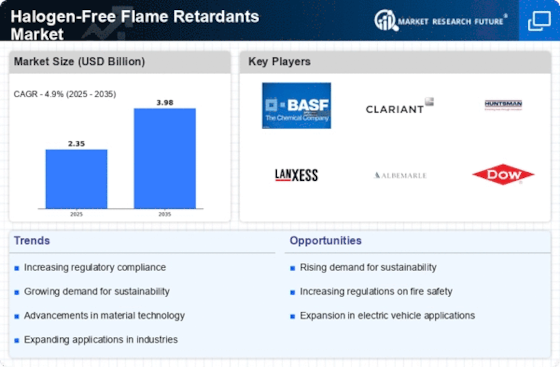
As per Market Research Future analysis, the Halogen-Free Flame Retardants Market Size was estimated at 2.35 USD Billion in 2024. The Halogen-Free Flame Retardants industry is projected to grow from 2.465 billion in 2025 to 3.978 billion by 2035, exhibiting a compound annual growth rate (CAGR) of 4% during the forecast period 2025 - 2035

Key Market Trends & Highlights

The Halogen-Free Flame Retardants Market is poised for growth driven by sustainability and regulatory demands.

  • The market is increasingly influenced by a strong focus on sustainability and eco-friendly products. Technological advancements are enhancing the performance and application of halogen-free flame retardants. North America remains the largest market, while Asia-Pacific is recognized as the fastest-growing region. The rising demand for eco-friendly products and stringent regulatory frameworks are key drivers propelling market expansion.

Market Size & Forecast

2024 Market Size 2.35 (USD Billion)
2035 Market Size 3.978 (USD Billion)
CAGR (2025 - 2035) 4.9%
Largest Regional Market Share in 2024 North America

Major Players

BASF SE (DE), Clariant AG (CH), Huntsman Corporation (US), Lanxess AG (DE), Albemarle Corporation (US), Dow Inc. (US), Solvay SA (BE), Nabaltec AG (DE), ICL Group Ltd. (IL)

Market Trends

The Halogen-Free Flame Retardants Market is currently experiencing a notable shift towards sustainable and environmentally friendly solutions. This transition is largely driven by increasing regulatory pressures and consumer demand for safer materials. Manufacturers are actively seeking alternatives to traditional halogenated flame retardants, which have been associated with various health and environmental concerns. As a result, the market is witnessing a surge in the development and adoption of innovative halogen-free formulations that meet stringent safety standards while maintaining performance. Furthermore, the growing awareness of fire safety in various industries, including construction, electronics, and automotive, is propelling the demand for these flame retardants. In addition to regulatory influences, technological advancements are playing a crucial role in shaping the Halogen-Free Flame Retardants Market. Research and development efforts are focused on enhancing the effectiveness of these materials, ensuring they provide adequate protection without compromising other material properties. The market landscape is becoming increasingly competitive, with numerous players striving to differentiate their offerings through unique formulations and applications. This dynamic environment suggests that the Halogen-Free Flame Retardants Market is poised for continued growth, driven by innovation and a commitment to sustainability.

Sustainability Focus

The Halogen-Free Flame Retardants Market is increasingly aligning with sustainability initiatives. Manufacturers are prioritizing eco-friendly materials that minimize environmental impact, responding to both regulatory demands and consumer preferences for safer products.

Technological Advancements

Ongoing research and development efforts are enhancing the performance of halogen-free flame retardants. Innovations in formulation and application techniques are likely to improve effectiveness, making these materials more appealing across various industries.

Regulatory Compliance

Stricter regulations regarding chemical safety are influencing the Halogen-Free Flame Retardants Market. Companies are adapting to these changes by investing in compliant products, which may lead to a broader acceptance of halogen-free alternatives.

Halogen-Free Flame Retardant Market Market Drivers

Expansion of End-Use Industries

The Halogen-Free Flame Retardants Market is poised for growth due to the expansion of end-use industries such as construction, automotive, and electronics. As these sectors continue to evolve, the need for advanced materials that meet safety and performance standards is becoming increasingly critical. The construction industry, in particular, is adopting halogen-free flame retardants to comply with building codes and enhance fire safety in residential and commercial structures. Similarly, the automotive sector is integrating these materials to improve vehicle safety and meet regulatory requirements. This expansion across various industries is expected to drive the demand for halogen-free flame retardants, with market forecasts indicating a potential increase in market size by several billion dollars in the next few years.

Stringent Regulatory Frameworks

The Halogen-Free Flame Retardants Market is significantly influenced by stringent regulatory frameworks aimed at reducing hazardous substances in consumer products. Governments and regulatory bodies are increasingly implementing regulations that restrict the use of halogenated flame retardants due to their potential environmental and health risks. For instance, the European Union's REACH regulation and similar initiatives in other regions are pushing manufacturers to seek halogen-free alternatives. This regulatory pressure is expected to drive innovation and investment in the development of safer flame retardant solutions, thereby expanding the market. As compliance becomes a necessity, companies are likely to prioritize halogen-free options to meet these evolving standards.

Rising Awareness of Fire Safety Standards

The Halogen-Free Flame Retardants Market is benefiting from a heightened awareness of fire safety standards across various sectors. As incidents of fire-related accidents prompt stricter safety regulations, industries are increasingly adopting flame retardant materials to mitigate risks. This trend is particularly evident in construction, automotive, and electronics, where compliance with fire safety standards is paramount. The growing emphasis on safety is likely to drive the demand for halogen-free flame retardants, as they provide an effective solution without compromising environmental integrity. Market analysts suggest that this awareness could lead to a sustained increase in demand, potentially boosting the market's growth trajectory.

Increasing Demand for Eco-Friendly Products

The Halogen-Free Flame Retardants Market is experiencing a notable shift towards eco-friendly products. As consumers and manufacturers alike become more environmentally conscious, the demand for halogen-free alternatives is rising. This trend is driven by the need to reduce harmful emissions and improve safety standards in various applications, including electronics, textiles, and construction materials. According to recent data, the market for halogen-free flame retardants is projected to grow at a compound annual growth rate (CAGR) of approximately 6% over the next few years. This growth reflects a broader commitment to sustainability and the adoption of safer materials in product design, which is likely to continue shaping the industry landscape.

Technological Innovations in Flame Retardant Materials

The Halogen-Free Flame Retardants Market is witnessing a surge in technological innovations that enhance the performance and applicability of flame retardant materials. Advances in polymer chemistry and material science are leading to the development of new formulations that offer improved fire resistance without the use of halogens. These innovations not only meet safety requirements but also cater to the growing demand for lightweight and high-performance materials in industries such as automotive and aerospace. The introduction of novel halogen-free flame retardants is expected to capture a significant share of the market, with projections indicating a potential increase in market value by over 20% in the coming years.

Market Segment Insights

By Type: Aluminum Trihydrate (Largest) vs. Phosphorous Based (Fastest-Growing)

The Halogen-Free Flame Retardants Market is characterized by a diverse array of segment values, with <a href="https://www.marketresearchfuture.com/reports/aluminum-trihydrate-market-5922">Aluminum Trihydrate</a> leading the market share significantly. This material is widely used due to its effectiveness and eco-friendliness, becoming a preferred choice among manufacturers. On the other hand, <a href="https://www.marketresearchfuture.com/reports/phosphate-market-1921">Phosphorous</a> Based flame retardants are gaining traction due to their superior fire safety performance, which appeals to a growing cohort of industries focusing on safety and sustainability.

Aluminum Trihydrate (Dominant) vs. Phosphorous Based (Emerging)

Aluminum Trihydrate holds a dominant position in the Halogen-Free Flame Retardants Market due to its inert nature and dual functionality as a filler. It is extensively utilized in thermoplastics and rubber applications, making it a staple in various manufacturing processes. Conversely, Phosphorous Based flame retardants are emerging rapidly, driven by innovative formulations that enhance their efficiency. They are favored in sectors like electronics and construction, where regulatory standards for fire safety are stringent. As both segment values evolve, their market dynamics will shift, reflecting advancements in materials science and changing consumer preferences.

By Resin: Polyethylene (Largest) vs. Epoxy (Fastest-Growing)

In the Halogen-Free Flame Retardants Market, the resin segment exhibits a diverse distribution, with <a href="https://www.marketresearchfuture.com/reports/high-density-polyethylene-market-7314">Polyethylene</a> emerging as the largest segment. This segment’s dominance can be attributed to its extensive application across various industries including construction and consumer goods. In contrast, Epoxy is recognized as the fastest-growing segment, spurred by its expanding use in electrical and electronic applications where stringent safety standards are in place. As more companies pivot towards sustainable solutions, the demand for Halogen-Free Flame Retardants is accelerating in resin products. The growth trends in the resin segment highlight a significant shift towards eco-friendly alternatives, with Polypropylene and Engineered Thermoplastics following closely behind in terms of application versatility. As industries aim to mitigate environmental impacts, innovations in resin formulations that align with safety regulations are gaining momentum. The focus on high-performance characteristics and compliance standards is propelling both established and emerging segments within this market, indicating robust future growth across the board.

Polyethylene (Dominant) vs. Rubber (Emerging)

Polyethylene is predominantly utilized in various applications, primarily due to its balance of durability, flexibility, and weight efficiency, which makes it suitable for a range of products in the Halogen-Free Flame Retardants Market. It is especially favored in applications requiring compliance with safety regulations without compromising performance. On the other hand, Rubber, while currently an 'Emerging' segment, is increasingly gaining traction due to its unique properties such as elasticity and resilience, making it ideal for specialized applications in automotive and construction sectors. The shift towards incorporating sustainable materials in rubber formulations is expected to enhance its market position and attractiveness as manufacturers and consumers seek safer, environmentally friendly solutions.

By End-User Industry: Building & Construction (Largest) vs. Electrical & Electronics (Fastest-Growing)

The Halogen-Free Flame Retardants Market showcases a diverse landscape among its end-user industries, with Building &amp; Construction leading the way in market share. This segment enjoys significant demand due to stringent fire safety regulations and a growing emphasis on sustainable construction practices. Following closely behind is the Electrical &amp; Electronics sector, which is experiencing rapid growth as manufacturers seek to enhance safety standards in their products. Together, these segments represent a substantial portion of the market, driven by their unique regulatory landscapes and user demands.

Building &amp; Construction (Dominant) vs. Electrical &amp; Electronics (Emerging)

The Building &amp; Construction segment stands as the dominant player in the Halogen-Free Flame Retardants Market, primarily influenced by the industry's shift towards eco-friendly materials and compliance with safety standards. This segment benefits from large-scale projects that require robust fire safety solutions. Conversely, the Electrical &amp; Electronics sector is emerging rapidly as a crucial market due to the increasing incorporation of flame retardant materials in consumer electronics, cables, and insulation. This segment is driven by technological advances and heightened awareness of safety in electrical devices, which creates a pressing need for effective flame retardants.

Get more detailed insights about Halogen-Free Flame Retardants Market Research Report - Global Forecast till 2035

Regional Insights

By region, the study delivers market insights into North America, Europe, Asia-Pacific and the Rest of the World. The North American halogen-free flame retardants market will dominate, owing to the presence of major automotive manufacturers, coupled with regulations by countries emphasizing the utilization of fire retardants in automotive components will fuel the market growth in this region. Further, the US halogen-free flame retardants market held the largest market share, and the Canada halogen-free flame retardants market was the fastest growing market in the North American region.

Further, the major countries studied in the market report are The US, Canada, German, France, the UK, Italy, Spain, China, Japan, India, Australia, South Korea, and Brazil.

Figure 2:  HALOGEN-FREE FLAME RETARDANTS MARKET SHARE BY REGION 2022 (USD Billion)

Europe's halogen-free flame retardants market accounts for the second-largest market share due to the rise in construction activities in developing countries and increasing industrialization activities. Further, the German halogen-free flame retardants market held the largest market share, and the UK halogen-free flame retardants market was the fastest-growing market in the European region.

The Asia-Pacific halogen-free flame retardants market is expected to expand at the fastest CAGR from 2023 to 2032. This is due to the increasing production of consumer electrical and electronic goods and an increased standard of living. Moreover, China’s halogen-free flame retardants market held the largest market share, and the Indian halogen-free flame retardants market was the fastest-growing market in the Asia-Pacific region.

Key Players and Competitive Insights

Leading market players are financing heavily in research and development to develop their product lines, which will allow the halogen-free flame retardants market to grow even more. Market participants are also undertaking different strategic activities to develop their footprint, with significant market outcomes including new product launches, mergers and acquisitions, higher investments, contractual agreements, and collaboration with other institutions. To expand and survive in a more competitive and growing market climate, the halogen-free flame retardants industry must deliver cost-effective items.Manufacturing locally to decrease operational costs is one of the major business tactics manufacturers use in the halogen-free flame retardants industry to benefit clients and increase the market sector. Major participants in the halogen-free flame retardants market, including Adeka Corporation, Akzo Nobel, Albemarle Corporation, BASF SE, Celanese Corp, Chemtura Corporation Limited, and others, are attempting to expand market demand by investing in research and development operations.Lanxess AG is a specialty chemical manufacturing company. It develops, manufactures, and markets chemical intermediates, additives, specialty chemicals and plastics. The company's products find applications in agrochemicals, automotive, construction, aromas and flavors, pharmaceuticals, tire chemicals, electrical, electronics, leather processing and water treatment, among others. It carries out R&D in alliance with institutes and universities. Some of its major brands include Rhenogran, Aktiplast, Aflux, Vulcuren, Perkalink and Rhenoshape among others. The firm operates via a network of manufacturing facilities across the world.

In December LANXESS, a Germany-based chemical company provider of chemical intermediates, additives, specialty chemicals, and plastics operating in the halogen-free flame retardants market, acquired Emerald Kalama chemical for $1.04 billion. This acquisition will enable LANXESS to expand into new high-margin.BASF SE is a chemical company. It produces, markets, and sells chemicals, plastics, crop protection products, and performance products. Its product line comprises solvents, adhesives, surfactants, fuel additives, pigments, paints, food additives, fungicides, electronic chemicals, and herbicides. The company serves various industries, such as construction, agriculture, electronics and electrical, furniture and wood, paints and coatings, automotive, home care, nutrition, chemicals, etc. BASF carries out R&D in alliance with consumers, scientists and partners. The firm operates via a network of manufacturing facilities across the world.

In July BASF and THOR GmbH declared that they are integrating their knowledge in non-halogenated flame-retardant additives to supply their customers with an exhaustive solution that will fuel the sustainability and performance of specific plastic compounds and keep up with stringent fire safety regulations.

Key Companies in the Halogen-Free Flame Retardant Market include

Industry Developments

May 2022: LG Chem, a chemical manufacturer, developed a novel material for usage in batteries that controls the development of flames in batteries. Polyphenylene oxide (PPO) and polyamide (PA) resins are mixed to make the new fire-resistant plastic.

Future Outlook

Halogen-Free Flame Retardant Market Future Outlook

The Halogen-Free Flame Retardants Market is projected to grow at a 4.9% CAGR from 2025 to 2035, driven by increasing regulatory standards and demand for safer materials.

New opportunities lie in:

  • Development of bio-based flame retardants for sustainable applications.</p><p>Expansion into emerging markets with tailored product offerings.</p><p>Investment in R&amp;D for innovative formulations enhancing performance and safety.

By 2035, the market is expected to solidify its position as a leader in flame retardant solutions.

Market Segmentation

Halogen-Free Flame Retardant Market Type Outlook

  • Aluminum Trihydrate
  • Phosphorous Based
  • Magnesium Hydroxide
  • Others

Halogen-Free Flame Retardant Market Resin Outlook

  • Polyethylene
  • Polypropylene
  • Epoxy
  • Unsaturated Polyesters
  • Polyvinyl Chloride
  • Styrenics
  • Engineered Thermoplastics
  • Rubber
  • Others

Halogen-Free Flame Retardant Market End-User Industry Outlook

  • Building & Construction
  • Electrical & Electronics
  • Transportation
  • Consumer Goods
  • Others

Report Scope

MARKET SIZE 2024 2.35(USD Billion)
MARKET SIZE 2025 2.465(USD Billion)
MARKET SIZE 2035 3.978(USD Billion)
COMPOUND ANNUAL GROWTH RATE (CAGR) 4.9% (2025 - 2035)
REPORT COVERAGE Revenue Forecast, Competitive Landscape, Growth Factors, and Trends
BASE YEAR 2024
Market Forecast Period 2025 - 2035
Historical Data 2019 - 2024
Market Forecast Units USD Billion
Key Companies Profiled BASF SE (DE), Clariant AG (CH), Huntsman Corporation (US), Lanxess AG (DE), Albemarle Corporation (US), Dow Inc. (US), Solvay SA (BE), Nabaltec AG (DE), ICL Group Ltd. (IL)
Segments Covered Type, Resin, End-User Industry, Region
Key Market Opportunities Growing demand for eco-friendly materials drives innovation in the Halogen-Free Flame Retardants Market.
Key Market Dynamics Rising regulatory pressures drive demand for sustainable halogen-free flame retardants across various industries.
Countries Covered North America, Europe, APAC, South America, MEA

FAQs

What is the projected market valuation for the Halogen-Free Flame Retardants Market in 2035?

<p>The projected market valuation for the Halogen-Free Flame Retardants Market in 2035 is 3.978 USD Billion.</p>

What was the market valuation for Halogen-Free Flame Retardants in 2024?

<p>The market valuation for Halogen-Free Flame Retardants in 2024 was 2.35 USD Billion.</p>

What is the expected CAGR for the Halogen-Free Flame Retardants Market from 2025 to 2035?

<p>The expected CAGR for the Halogen-Free Flame Retardants Market during the forecast period 2025 - 2035 is 4.9%.</p>

Which companies are considered key players in the Halogen-Free Flame Retardants Market?

<p>Key players in the Halogen-Free Flame Retardants Market include BASF SE, Clariant AG, Huntsman Corporation, and others.</p>

What are the main types of Halogen-Free Flame Retardants and their market values?

<p>The main types include Aluminum Trihydrate valued at 1.25 USD Billion and Phosphorous Based at 1.4 USD Billion.</p>

Which end-user industries are driving demand for Halogen-Free Flame Retardants?

<p>The Building & Construction industry is projected to reach 1.4 USD Billion, indicating strong demand.</p>

How does the market for Magnesium Hydroxide compare to other flame retardants?

<p>Magnesium Hydroxide is valued at 0.8 USD Billion, which is lower than Aluminum Trihydrate and Phosphorous Based.</p>

What resin types are utilized in the Halogen-Free Flame Retardants Market?

Resin types include Polyethylene, projected to reach 0.85 USD Billion, and Polypropylene at 0.65 USD Billion.

What is the anticipated growth trend for the Halogen-Free Flame Retardants Market?

The market appears to be on a growth trajectory, with a valuation increase expected from 2.35 USD Billion in 2024 to 3.978 USD Billion by 2035.

How does the performance of the Consumer Goods sector compare to others in this market?

The Consumer Goods sector is projected to reach 0.45 USD Billion, which is lower than sectors like Building &amp; Construction.

  1. SECTION I: EXECUTIVE SUMMARY AND KEY HIGHLIGHTS
    1. | 1.1 EXECUTIVE SUMMARY
    2. | | 1.1.1 Market Overview
    3. | | 1.1.2 Key Findings
    4. | | 1.1.3 Market Segmentation
    5. | | 1.1.4 Competitive Landscape
    6. | | 1.1.5 Challenges and Opportunities
    7. | | 1.1.6 Future Outlook
  2. SECTION II: SCOPING, METHODOLOGY AND MARKET STRUCTURE
    1. | 2.1 MARKET INTRODUCTION
    2. | | 2.1.1 Definition
    3. | | 2.1.2 Scope of the study
    4. | | | 2.1.2.1 Research Objective
    5. | | | 2.1.2.2 Assumption
    6. | | | 2.1.2.3 Limitations
    7. | 2.2 RESEARCH METHODOLOGY
    8. | | 2.2.1 Overview
    9. | | 2.2.2 Data Mining
    10. | | 2.2.3 Secondary Research
    11. | | 2.2.4 Primary Research
    12. | | | 2.2.4.1 Primary Interviews and Information Gathering Process
    13. | | | 2.2.4.2 Breakdown of Primary Respondents
    14. | | 2.2.5 Forecasting Model
    15. | | 2.2.6 Market Size Estimation
    16. | | | 2.2.6.1 Bottom-Up Approach
    17. | | | 2.2.6.2 Top-Down Approach
    18. | | 2.2.7 Data Triangulation
    19. | | 2.2.8 Validation
  3. SECTION III: QUALITATIVE ANALYSIS
    1. | 3.1 MARKET DYNAMICS
    2. | | 3.1.1 Overview
    3. | | 3.1.2 Drivers
    4. | | 3.1.3 Restraints
    5. | | 3.1.4 Opportunities
    6. | 3.2 MARKET FACTOR ANALYSIS
    7. | | 3.2.1 Value chain Analysis
    8. | | 3.2.2 Porter's Five Forces Analysis
    9. | | | 3.2.2.1 Bargaining Power of Suppliers
    10. | | | 3.2.2.2 Bargaining Power of Buyers
    11. | | | 3.2.2.3 Threat of New Entrants
    12. | | | 3.2.2.4 Threat of Substitutes
    13. | | | 3.2.2.5 Intensity of Rivalry
    14. | | 3.2.3 COVID-19 Impact Analysis
    15. | | | 3.2.3.1 Market Impact Analysis
    16. | | | 3.2.3.2 Regional Impact
    17. | | | 3.2.3.3 Opportunity and Threat Analysis
  4. SECTION IV: QUANTITATIVE ANALYSIS
    1. | 4.1 Chemicals and Materials, BY Type (USD Billion)
    2. | | 4.1.1 Aluminum Trihydrate
    3. | | 4.1.2 Phosphorous Based
    4. | | 4.1.3 Magnesium Hydroxide
    5. | | 4.1.4 Others
    6. | 4.2 Chemicals and Materials, BY Resin (USD Billion)
    7. | | 4.2.1 Polyethylene
    8. | | 4.2.2 Polypropylene
    9. | | 4.2.3 Epoxy
    10. | | 4.2.4 Unsaturated Polyesters
    11. | | 4.2.5 Polyvinyl Chloride
    12. | | 4.2.6 Styrenics
    13. | | 4.2.7 Engineered Thermoplastics
    14. | | 4.2.8 Rubber
    15. | | 4.2.9 Others
    16. | 4.3 Chemicals and Materials, BY End-User Industry (USD Billion)
    17. | | 4.3.1 Building & Construction
    18. | | 4.3.2 Electrical & Electronics
    19. | | 4.3.3 Transportation
    20. | | 4.3.4 Consumer Goods
    21. | | 4.3.5 Others
    22. | 4.4 Chemicals and Materials, BY Region (USD Billion)
    23. | | 4.4.1 North America
    24. | | | 4.4.1.1 US
    25. | | | 4.4.1.2 Canada
    26. | | 4.4.2 Europe
    27. | | | 4.4.2.1 Germany
    28. | | | 4.4.2.2 UK
    29. | | | 4.4.2.3 France
    30. | | | 4.4.2.4 Russia
    31. | | | 4.4.2.5 Italy
    32. | | | 4.4.2.6 Spain
    33. | | | 4.4.2.7 Rest of Europe
    34. | | 4.4.3 APAC
    35. | | | 4.4.3.1 China
    36. | | | 4.4.3.2 India
    37. | | | 4.4.3.3 Japan
    38. | | | 4.4.3.4 South Korea
    39. | | | 4.4.3.5 Malaysia
    40. | | | 4.4.3.6 Thailand
    41. | | | 4.4.3.7 Indonesia
    42. | | | 4.4.3.8 Rest of APAC
    43. | | 4.4.4 South America
    44. | | | 4.4.4.1 Brazil
    45. | | | 4.4.4.2 Mexico
    46. | | | 4.4.4.3 Argentina
    47. | | | 4.4.4.4 Rest of South America
    48. | | 4.4.5 MEA
    49. | | | 4.4.5.1 GCC Countries
    50. | | | 4.4.5.2 South Africa
    51. | | | 4.4.5.3 Rest of MEA
  5. SECTION V: COMPETITIVE ANALYSIS
    1. | 5.1 Competitive Landscape
    2. | | 5.1.1 Overview
    3. | | 5.1.2 Competitive Analysis
    4. | | 5.1.3 Market share Analysis
    5. | | 5.1.4 Major Growth Strategy in the Chemicals and Materials
    6. | | 5.1.5 Competitive Benchmarking
    7. | | 5.1.6 Leading Players in Terms of Number of Developments in the Chemicals and Materials
    8. | | 5.1.7 Key developments and growth strategies
    9. | | | 5.1.7.1 New Product Launch/Service Deployment
    10. | | | 5.1.7.2 Merger & Acquisitions
    11. | | | 5.1.7.3 Joint Ventures
    12. | | 5.1.8 Major Players Financial Matrix
    13. | | | 5.1.8.1 Sales and Operating Income
    14. | | | 5.1.8.2 Major Players R&D Expenditure. 2023
    15. | 5.2 Company Profiles
    16. | | 5.2.1 BASF SE (DE)
    17. | | | 5.2.1.1 Financial Overview
    18. | | | 5.2.1.2 Products Offered
    19. | | | 5.2.1.3 Key Developments
    20. | | | 5.2.1.4 SWOT Analysis
    21. | | | 5.2.1.5 Key Strategies
    22. | | 5.2.2 Clariant AG (CH)
    23. | | | 5.2.2.1 Financial Overview
    24. | | | 5.2.2.2 Products Offered
    25. | | | 5.2.2.3 Key Developments
    26. | | | 5.2.2.4 SWOT Analysis
    27. | | | 5.2.2.5 Key Strategies
    28. | | 5.2.3 Huntsman Corporation (US)
    29. | | | 5.2.3.1 Financial Overview
    30. | | | 5.2.3.2 Products Offered
    31. | | | 5.2.3.3 Key Developments
    32. | | | 5.2.3.4 SWOT Analysis
    33. | | | 5.2.3.5 Key Strategies
    34. | | 5.2.4 Lanxess AG (DE)
    35. | | | 5.2.4.1 Financial Overview
    36. | | | 5.2.4.2 Products Offered
    37. | | | 5.2.4.3 Key Developments
    38. | | | 5.2.4.4 SWOT Analysis
    39. | | | 5.2.4.5 Key Strategies
    40. | | 5.2.5 Albemarle Corporation (US)
    41. | | | 5.2.5.1 Financial Overview
    42. | | | 5.2.5.2 Products Offered
    43. | | | 5.2.5.3 Key Developments
    44. | | | 5.2.5.4 SWOT Analysis
    45. | | | 5.2.5.5 Key Strategies
    46. | | 5.2.6 Dow Inc. (US)
    47. | | | 5.2.6.1 Financial Overview
    48. | | | 5.2.6.2 Products Offered
    49. | | | 5.2.6.3 Key Developments
    50. | | | 5.2.6.4 SWOT Analysis
    51. | | | 5.2.6.5 Key Strategies
    52. | | 5.2.7 Solvay SA (BE)
    53. | | | 5.2.7.1 Financial Overview
    54. | | | 5.2.7.2 Products Offered
    55. | | | 5.2.7.3 Key Developments
    56. | | | 5.2.7.4 SWOT Analysis
    57. | | | 5.2.7.5 Key Strategies
    58. | | 5.2.8 Nabaltec AG (DE)
    59. | | | 5.2.8.1 Financial Overview
    60. | | | 5.2.8.2 Products Offered
    61. | | | 5.2.8.3 Key Developments
    62. | | | 5.2.8.4 SWOT Analysis
    63. | | | 5.2.8.5 Key Strategies
    64. | | 5.2.9 ICL Group Ltd. (IL)
    65. | | | 5.2.9.1 Financial Overview
    66. | | | 5.2.9.2 Products Offered
    67. | | | 5.2.9.3 Key Developments
    68. | | | 5.2.9.4 SWOT Analysis
    69. | | | 5.2.9.5 Key Strategies
    70. | 5.3 Appendix
    71. | | 5.3.1 References
    72. | | 5.3.2 Related Reports
  6. LIST OF FIGURES
    1. | 6.1 MARKET SYNOPSIS
    2. | 6.2 NORTH AMERICA MARKET ANALYSIS
    3. | 6.3 US MARKET ANALYSIS BY TYPE
    4. | 6.4 US MARKET ANALYSIS BY RESIN
    5. | 6.5 US MARKET ANALYSIS BY END-USER INDUSTRY
    6. | 6.6 CANADA MARKET ANALYSIS BY TYPE
    7. | 6.7 CANADA MARKET ANALYSIS BY RESIN
    8. | 6.8 CANADA MARKET ANALYSIS BY END-USER INDUSTRY
    9. | 6.9 EUROPE MARKET ANALYSIS
    10. | 6.10 GERMANY MARKET ANALYSIS BY TYPE
    11. | 6.11 GERMANY MARKET ANALYSIS BY RESIN
    12. | 6.12 GERMANY MARKET ANALYSIS BY END-USER INDUSTRY
    13. | 6.13 UK MARKET ANALYSIS BY TYPE
    14. | 6.14 UK MARKET ANALYSIS BY RESIN
    15. | 6.15 UK MARKET ANALYSIS BY END-USER INDUSTRY
    16. | 6.16 FRANCE MARKET ANALYSIS BY TYPE
    17. | 6.17 FRANCE MARKET ANALYSIS BY RESIN
    18. | 6.18 FRANCE MARKET ANALYSIS BY END-USER INDUSTRY
    19. | 6.19 RUSSIA MARKET ANALYSIS BY TYPE
    20. | 6.20 RUSSIA MARKET ANALYSIS BY RESIN
    21. | 6.21 RUSSIA MARKET ANALYSIS BY END-USER INDUSTRY
    22. | 6.22 ITALY MARKET ANALYSIS BY TYPE
    23. | 6.23 ITALY MARKET ANALYSIS BY RESIN
    24. | 6.24 ITALY MARKET ANALYSIS BY END-USER INDUSTRY
    25. | 6.25 SPAIN MARKET ANALYSIS BY TYPE
    26. | 6.26 SPAIN MARKET ANALYSIS BY RESIN
    27. | 6.27 SPAIN MARKET ANALYSIS BY END-USER INDUSTRY
    28. | 6.28 REST OF EUROPE MARKET ANALYSIS BY TYPE
    29. | 6.29 REST OF EUROPE MARKET ANALYSIS BY RESIN
    30. | 6.30 REST OF EUROPE MARKET ANALYSIS BY END-USER INDUSTRY
    31. | 6.31 APAC MARKET ANALYSIS
    32. | 6.32 CHINA MARKET ANALYSIS BY TYPE
    33. | 6.33 CHINA MARKET ANALYSIS BY RESIN
    34. | 6.34 CHINA MARKET ANALYSIS BY END-USER INDUSTRY
    35. | 6.35 INDIA MARKET ANALYSIS BY TYPE
    36. | 6.36 INDIA MARKET ANALYSIS BY RESIN
    37. | 6.37 INDIA MARKET ANALYSIS BY END-USER INDUSTRY
    38. | 6.38 JAPAN MARKET ANALYSIS BY TYPE
    39. | 6.39 JAPAN MARKET ANALYSIS BY RESIN
    40. | 6.40 JAPAN MARKET ANALYSIS BY END-USER INDUSTRY
    41. | 6.41 SOUTH KOREA MARKET ANALYSIS BY TYPE
    42. | 6.42 SOUTH KOREA MARKET ANALYSIS BY RESIN
    43. | 6.43 SOUTH KOREA MARKET ANALYSIS BY END-USER INDUSTRY
    44. | 6.44 MALAYSIA MARKET ANALYSIS BY TYPE
    45. | 6.45 MALAYSIA MARKET ANALYSIS BY RESIN
    46. | 6.46 MALAYSIA MARKET ANALYSIS BY END-USER INDUSTRY
    47. | 6.47 THAILAND MARKET ANALYSIS BY TYPE
    48. | 6.48 THAILAND MARKET ANALYSIS BY RESIN
    49. | 6.49 THAILAND MARKET ANALYSIS BY END-USER INDUSTRY
    50. | 6.50 INDONESIA MARKET ANALYSIS BY TYPE
    51. | 6.51 INDONESIA MARKET ANALYSIS BY RESIN
    52. | 6.52 INDONESIA MARKET ANALYSIS BY END-USER INDUSTRY
    53. | 6.53 REST OF APAC MARKET ANALYSIS BY TYPE
    54. | 6.54 REST OF APAC MARKET ANALYSIS BY RESIN
    55. | 6.55 REST OF APAC MARKET ANALYSIS BY END-USER INDUSTRY
    56. | 6.56 SOUTH AMERICA MARKET ANALYSIS
    57. | 6.57 BRAZIL MARKET ANALYSIS BY TYPE
    58. | 6.58 BRAZIL MARKET ANALYSIS BY RESIN
    59. | 6.59 BRAZIL MARKET ANALYSIS BY END-USER INDUSTRY
    60. | 6.60 MEXICO MARKET ANALYSIS BY TYPE
    61. | 6.61 MEXICO MARKET ANALYSIS BY RESIN
    62. | 6.62 MEXICO MARKET ANALYSIS BY END-USER INDUSTRY
    63. | 6.63 ARGENTINA MARKET ANALYSIS BY TYPE
    64. | 6.64 ARGENTINA MARKET ANALYSIS BY RESIN
    65. | 6.65 ARGENTINA MARKET ANALYSIS BY END-USER INDUSTRY
    66. | 6.66 REST OF SOUTH AMERICA MARKET ANALYSIS BY TYPE
    67. | 6.67 REST OF SOUTH AMERICA MARKET ANALYSIS BY RESIN
    68. | 6.68 REST OF SOUTH AMERICA MARKET ANALYSIS BY END-USER INDUSTRY
    69. | 6.69 MEA MARKET ANALYSIS
    70. | 6.70 GCC COUNTRIES MARKET ANALYSIS BY TYPE
    71. | 6.71 GCC COUNTRIES MARKET ANALYSIS BY RESIN
    72. | 6.72 GCC COUNTRIES MARKET ANALYSIS BY END-USER INDUSTRY
    73. | 6.73 SOUTH AFRICA MARKET ANALYSIS BY TYPE
    74. | 6.74 SOUTH AFRICA MARKET ANALYSIS BY RESIN
    75. | 6.75 SOUTH AFRICA MARKET ANALYSIS BY END-USER INDUSTRY
    76. | 6.76 REST OF MEA MARKET ANALYSIS BY TYPE
    77. | 6.77 REST OF MEA MARKET ANALYSIS BY RESIN
    78. | 6.78 REST OF MEA MARKET ANALYSIS BY END-USER INDUSTRY
    79. | 6.79 KEY BUYING CRITERIA OF CHEMICALS AND MATERIALS
    80. | 6.80 RESEARCH PROCESS OF MRFR
    81. | 6.81 DRO ANALYSIS OF CHEMICALS AND MATERIALS
    82. | 6.82 DRIVERS IMPACT ANALYSIS: CHEMICALS AND MATERIALS
    83. | 6.83 RESTRAINTS IMPACT ANALYSIS: CHEMICALS AND MATERIALS
    84. | 6.84 SUPPLY / VALUE CHAIN: CHEMICALS AND MATERIALS
    85. | 6.85 CHEMICALS AND MATERIALS, BY TYPE, 2024 (% SHARE)
    86. | 6.86 CHEMICALS AND MATERIALS, BY TYPE, 2024 TO 2035 (USD Billion)
    87. | 6.87 CHEMICALS AND MATERIALS, BY RESIN, 2024 (% SHARE)
    88. | 6.88 CHEMICALS AND MATERIALS, BY RESIN, 2024 TO 2035 (USD Billion)
    89. | 6.89 CHEMICALS AND MATERIALS, BY END-USER INDUSTRY, 2024 (% SHARE)
    90. | 6.90 CHEMICALS AND MATERIALS, BY END-USER INDUSTRY, 2024 TO 2035 (USD Billion)
    91. | 6.91 BENCHMARKING OF MAJOR COMPETITORS
  7. LIST OF TABLES
    1. | 7.1 LIST OF ASSUMPTIONS
    2. | | 7.1.1
    3. | 7.2 North America MARKET SIZE ESTIMATES; FORECAST
    4. | | 7.2.1 BY TYPE, 2025-2035 (USD Billion)
    5. | | 7.2.2 BY RESIN, 2025-2035 (USD Billion)
    6. | | 7.2.3 BY END-USER INDUSTRY, 2025-2035 (USD Billion)
    7. | 7.3 US MARKET SIZE ESTIMATES; FORECAST
    8. | | 7.3.1 BY TYPE, 2025-2035 (USD Billion)
    9. | | 7.3.2 BY RESIN, 2025-2035 (USD Billion)
    10. | | 7.3.3 BY END-USER INDUSTRY, 2025-2035 (USD Billion)
    11. | 7.4 Canada MARKET SIZE ESTIMATES; FORECAST
    12. | | 7.4.1 BY TYPE, 2025-2035 (USD Billion)
    13. | | 7.4.2 BY RESIN, 2025-2035 (USD Billion)
    14. | | 7.4.3 BY END-USER INDUSTRY, 2025-2035 (USD Billion)
    15. | 7.5 Europe MARKET SIZE ESTIMATES; FORECAST
    16. | | 7.5.1 BY TYPE, 2025-2035 (USD Billion)
    17. | | 7.5.2 BY RESIN, 2025-2035 (USD Billion)
    18. | | 7.5.3 BY END-USER INDUSTRY, 2025-2035 (USD Billion)
    19. | 7.6 Germany MARKET SIZE ESTIMATES; FORECAST
    20. | | 7.6.1 BY TYPE, 2025-2035 (USD Billion)
    21. | | 7.6.2 BY RESIN, 2025-2035 (USD Billion)
    22. | | 7.6.3 BY END-USER INDUSTRY, 2025-2035 (USD Billion)
    23. | 7.7 UK MARKET SIZE ESTIMATES; FORECAST
    24. | | 7.7.1 BY TYPE, 2025-2035 (USD Billion)
    25. | | 7.7.2 BY RESIN, 2025-2035 (USD Billion)
    26. | | 7.7.3 BY END-USER INDUSTRY, 2025-2035 (USD Billion)
    27. | 7.8 France MARKET SIZE ESTIMATES; FORECAST
    28. | | 7.8.1 BY TYPE, 2025-2035 (USD Billion)
    29. | | 7.8.2 BY RESIN, 2025-2035 (USD Billion)
    30. | | 7.8.3 BY END-USER INDUSTRY, 2025-2035 (USD Billion)
    31. | 7.9 Russia MARKET SIZE ESTIMATES; FORECAST
    32. | | 7.9.1 BY TYPE, 2025-2035 (USD Billion)
    33. | | 7.9.2 BY RESIN, 2025-2035 (USD Billion)
    34. | | 7.9.3 BY END-USER INDUSTRY, 2025-2035 (USD Billion)
    35. | 7.10 Italy MARKET SIZE ESTIMATES; FORECAST
    36. | | 7.10.1 BY TYPE, 2025-2035 (USD Billion)
    37. | | 7.10.2 BY RESIN, 2025-2035 (USD Billion)
    38. | | 7.10.3 BY END-USER INDUSTRY, 2025-2035 (USD Billion)
    39. | 7.11 Spain MARKET SIZE ESTIMATES; FORECAST
    40. | | 7.11.1 BY TYPE, 2025-2035 (USD Billion)
    41. | | 7.11.2 BY RESIN, 2025-2035 (USD Billion)
    42. | | 7.11.3 BY END-USER INDUSTRY, 2025-2035 (USD Billion)
    43. | 7.12 Rest of Europe MARKET SIZE ESTIMATES; FORECAST
    44. | | 7.12.1 BY TYPE, 2025-2035 (USD Billion)
    45. | | 7.12.2 BY RESIN, 2025-2035 (USD Billion)
    46. | | 7.12.3 BY END-USER INDUSTRY, 2025-2035 (USD Billion)
    47. | 7.13 APAC MARKET SIZE ESTIMATES; FORECAST
    48. | | 7.13.1 BY TYPE, 2025-2035 (USD Billion)
    49. | | 7.13.2 BY RESIN, 2025-2035 (USD Billion)
    50. | | 7.13.3 BY END-USER INDUSTRY, 2025-2035 (USD Billion)
    51. | 7.14 China MARKET SIZE ESTIMATES; FORECAST
    52. | | 7.14.1 BY TYPE, 2025-2035 (USD Billion)
    53. | | 7.14.2 BY RESIN, 2025-2035 (USD Billion)
    54. | | 7.14.3 BY END-USER INDUSTRY, 2025-2035 (USD Billion)
    55. | 7.15 India MARKET SIZE ESTIMATES; FORECAST
    56. | | 7.15.1 BY TYPE, 2025-2035 (USD Billion)
    57. | | 7.15.2 BY RESIN, 2025-2035 (USD Billion)
    58. | | 7.15.3 BY END-USER INDUSTRY, 2025-2035 (USD Billion)
    59. | 7.16 Japan MARKET SIZE ESTIMATES; FORECAST
    60. | | 7.16.1 BY TYPE, 2025-2035 (USD Billion)
    61. | | 7.16.2 BY RESIN, 2025-2035 (USD Billion)
    62. | | 7.16.3 BY END-USER INDUSTRY, 2025-2035 (USD Billion)
    63. | 7.17 South Korea MARKET SIZE ESTIMATES; FORECAST
    64. | | 7.17.1 BY TYPE, 2025-2035 (USD Billion)
    65. | | 7.17.2 BY RESIN, 2025-2035 (USD Billion)
    66. | | 7.17.3 BY END-USER INDUSTRY, 2025-2035 (USD Billion)
    67. | 7.18 Malaysia MARKET SIZE ESTIMATES; FORECAST
    68. | | 7.18.1 BY TYPE, 2025-2035 (USD Billion)
    69. | | 7.18.2 BY RESIN, 2025-2035 (USD Billion)
    70. | | 7.18.3 BY END-USER INDUSTRY, 2025-2035 (USD Billion)
    71. | 7.19 Thailand MARKET SIZE ESTIMATES; FORECAST
    72. | | 7.19.1 BY TYPE, 2025-2035 (USD Billion)
    73. | | 7.19.2 BY RESIN, 2025-2035 (USD Billion)
    74. | | 7.19.3 BY END-USER INDUSTRY, 2025-2035 (USD Billion)
    75. | 7.20 Indonesia MARKET SIZE ESTIMATES; FORECAST
    76. | | 7.20.1 BY TYPE, 2025-2035 (USD Billion)
    77. | | 7.20.2 BY RESIN, 2025-2035 (USD Billion)
    78. | | 7.20.3 BY END-USER INDUSTRY, 2025-2035 (USD Billion)
    79. | 7.21 Rest of APAC MARKET SIZE ESTIMATES; FORECAST
    80. | | 7.21.1 BY TYPE, 2025-2035 (USD Billion)
    81. | | 7.21.2 BY RESIN, 2025-2035 (USD Billion)
    82. | | 7.21.3 BY END-USER INDUSTRY, 2025-2035 (USD Billion)
    83. | 7.22 South America MARKET SIZE ESTIMATES; FORECAST
    84. | | 7.22.1 BY TYPE, 2025-2035 (USD Billion)
    85. | | 7.22.2 BY RESIN, 2025-2035 (USD Billion)
    86. | | 7.22.3 BY END-USER INDUSTRY, 2025-2035 (USD Billion)
    87. | 7.23 Brazil MARKET SIZE ESTIMATES; FORECAST
    88. | | 7.23.1 BY TYPE, 2025-2035 (USD Billion)
    89. | | 7.23.2 BY RESIN, 2025-2035 (USD Billion)
    90. | | 7.23.3 BY END-USER INDUSTRY, 2025-2035 (USD Billion)
    91. | 7.24 Mexico MARKET SIZE ESTIMATES; FORECAST
    92. | | 7.24.1 BY TYPE, 2025-2035 (USD Billion)
    93. | | 7.24.2 BY RESIN, 2025-2035 (USD Billion)
    94. | | 7.24.3 BY END-USER INDUSTRY, 2025-2035 (USD Billion)
    95. | 7.25 Argentina MARKET SIZE ESTIMATES; FORECAST
    96. | | 7.25.1 BY TYPE, 2025-2035 (USD Billion)
    97. | | 7.25.2 BY RESIN, 2025-2035 (USD Billion)
    98. | | 7.25.3 BY END-USER INDUSTRY, 2025-2035 (USD Billion)
    99. | 7.26 Rest of South America MARKET SIZE ESTIMATES; FORECAST
    100. | | 7.26.1 BY TYPE, 2025-2035 (USD Billion)
    101. | | 7.26.2 BY RESIN, 2025-2035 (USD Billion)
    102. | | 7.26.3 BY END-USER INDUSTRY, 2025-2035 (USD Billion)
    103. | 7.27 MEA MARKET SIZE ESTIMATES; FORECAST
    104. | | 7.27.1 BY TYPE, 2025-2035 (USD Billion)
    105. | | 7.27.2 BY RESIN, 2025-2035 (USD Billion)
    106. | | 7.27.3 BY END-USER INDUSTRY, 2025-2035 (USD Billion)
    107. | 7.28 GCC Countries MARKET SIZE ESTIMATES; FORECAST
    108. | | 7.28.1 BY TYPE, 2025-2035 (USD Billion)
    109. | | 7.28.2 BY RESIN, 2025-2035 (USD Billion)
    110. | | 7.28.3 BY END-USER INDUSTRY, 2025-2035 (USD Billion)
    111. | 7.29 South Africa MARKET SIZE ESTIMATES; FORECAST
    112. | | 7.29.1 BY TYPE, 2025-2035 (USD Billion)
    113. | | 7.29.2 BY RESIN, 2025-2035 (USD Billion)
    114. | | 7.29.3 BY END-USER INDUSTRY, 2025-2035 (USD Billion)
    115. | 7.30 Rest of MEA MARKET SIZE ESTIMATES; FORECAST
    116. | | 7.30.1 BY TYPE, 2025-2035 (USD Billion)
    117. | | 7.30.2 BY RESIN, 2025-2035 (USD Billion)
    118. | | 7.30.3 BY END-USER INDUSTRY, 2025-2035 (USD Billion)
    119. | 7.31 PRODUCT LAUNCH/PRODUCT DEVELOPMENT/APPROVAL
    120. | | 7.31.1
    121. | 7.32 ACQUISITION/PARTNERSHIP
    122. | | 7.32.1

Chemicals and Materials Market Segmentation

Chemicals and Materials By Type (USD Billion, 2025-2035)

  • Aluminum Trihydrate
  • Phosphorous Based
  • Magnesium Hydroxide
  • Others

Chemicals and Materials By Resin (USD Billion, 2025-2035)

  • Polyethylene
  • Polypropylene
  • Epoxy
  • Unsaturated Polyesters
  • Polyvinyl Chloride
  • Styrenics
  • Engineered Thermoplastics
  • Rubber
  • Others

Chemicals and Materials By End-User Industry (USD Billion, 2025-2035)

  • Building & Construction
  • Electrical & Electronics
  • Transportation
  • Consumer Goods
  • Others
Infographic

Free Sample Request

Kindly complete the form below to receive a free sample of this Report

Get Free Sample

Customer Strories

Compare Licence

×
Features License Type
Single User Multiuser License Enterprise User
Price $4,950 $5,950 $7,250
Maximum User Access Limit 1 User Upto 10 Users Unrestricted Access Throughout the Organization
Free Customization
Direct Access to Analyst
Deliverable Format
Platform Access
Discount on Next Purchase 10% 15% 15%
Printable Versions