×
Request Free Sample ×

Kindly complete the form below to receive a free sample of this Report

* Please use a valid business email

Leading companies partner with us for data-driven Insights

clients tt-cursor
Hero Background
English
Chinese
French
Japanese
Korean
German
Spanish

Halitosis Treatment Market Trends

ID: MRFR/Pharma/2493-CR
153 Pages
Kinjoll Dey
August 2017

Halitosis Treatment Market Research Report Information By Indication (Respiratory, Liver, Kidney, Gastrointestinal, Systemic, and Others), By Diagnostic Tests (Halimeter, Gas Chromatography, BANA Test, Β-Galactosidase Activity Assay, and Others), By Drug Treatment (Antacids, Antiseptics, Ranitidine, and Others) And By Region (North America, Europe, Asia-Pacific, And Rest Of The World) - Growth & Industry Forecast 2025 To 2035

Share:
Download PDF ×

We do not share your information with anyone. However, we may send you emails based on your report interest from time to time. You may contact us at any time to opt-out.

Halitosis Treatment Market Infographic
Purchase Options

Market Trends

Key Emerging Trends in the Halitosis Treatment Market

In recent years, there has been a significant change in the approach to healthcare. Instead of solely focusing on treating illnesses after they occur, there is now a greater emphasis on preventing them in the first place. This shift is particularly evident in dentistry, where the focus is not just on fixing dental issues but also on preventing them from arising.

One common concern that brings people to dental clinics is halitosis, or bad breath, which ranks as the third most frequent oral condition. The management of oral health has become more proactive, involving simple yet effective measures. These measures include adopting a healthy diet, maintaining good oral hygiene practices, and using oral health products such as mouthwashes, mouth sprays, and antibacterial toothpastes. Additionally, there is a growing recognition of the importance of education and awareness programs in addressing the social issue of bad breath.

The spotlight on oral health has expanded in recent years, with increased awareness about the causes of various periodontal conditions. This shift from a focus on diagnosis to a more comprehensive approach to oral health reflects a broader trend in healthcare towards preventive care.

A noteworthy development in the field of disease diagnosis comes from the Korea Advanced Institute of Science and Technology (KAIST). Researchers at KAIST have created diagnostic sensors utilizing protein-encapsulated nanocatalysts. These sensors have the capability to diagnose diseases through the analysis of exhaled breath. The technology operates on a breath pattern recognition platform, allowing for the early monitoring of diseases by identifying patterns of biomarker gases in breath.

One of the significant applications of this technology is in the analysis of gaseous compounds related to various health conditions, including halitosis, lung cancer, and type 1 diabetes mellitus. By examining the breath, the sensors can detect specific patterns associated with these conditions, enabling early diagnosis and intervention.

This innovation marks a significant step forward in the field of medical diagnostics. The ability to diagnose diseases through breath analysis offers a non-invasive and potentially more accessible method compared to traditional diagnostic procedures. This is particularly crucial for conditions like lung cancer and diabetes, where early detection can significantly impact treatment outcomes.

In conclusion, the shift from a focus on diagnosis to a more proactive approach in healthcare is evident in the field of dentistry, where preventive measures are gaining prominence. Simultaneously, advancements in diagnostic technology, such as the development of nanosensors for disease diagnosis, showcase the commitment to early detection and intervention. These developments collectively contribute to a healthcare landscape that places a greater emphasis on managing health proactively and preventing diseases before they take hold.

Author
Kinjoll Dey
Senior Research Analyst

He is an extremely curious individual currently working in Healthcare and Medical Devices Domain. Kinjoll is comfortably versed in data centric research backed by healthcare educational background. He leverages extensive data mining and analytics tools such as Primary and Secondary Research, Statistical Analysis, Machine Learning, Data Modelling. His key role also involves Technical Sales Support, Client Interaction and Project management within the Healthcare team. Lastly, he showcases extensive affinity towards learning new skills and remain fascinated in implementing them.

Leave a Comment

FAQs

What is the current valuation of the Halitosis Treatment Market?

<p>The Halitosis Treatment Market was valued at 4.89 USD Billion in 2024.</p>

What is the projected market size for the Halitosis Treatment Market by 2035?

<p>The market is projected to reach 14.7 USD Billion by 2035.</p>

What is the expected CAGR for the Halitosis Treatment Market during the forecast period?

<p>The expected CAGR for the Halitosis Treatment Market from 2025 to 2035 is 10.52%.</p>

Which companies are the key players in the Halitosis Treatment Market?

<p>Key players include Colgate-Palmolive, Procter & Gamble, Unilever, Johnson & Johnson, and GlaxoSmithKline.</p>

What are the major segments of the Halitosis Treatment Market?

<p>Major segments include indication, diagnostic tests, and drug treatment.</p>

How much is the Gastrointestinal segment valued at in 2024?

<p>The Gastrointestinal segment was valued at 1.22 USD Billion in 2024.</p>

What is the projected value of the Halimeter diagnostic test segment by 2035?

The Halimeter segment is projected to reach 2.4 USD Billion by 2035.

What is the valuation of the drug treatment segment in 2024?

The drug treatment segment was valued at 2.39 USD Billion in 2024.

How does the projected growth of the Halitosis Treatment Market compare to its 2024 valuation?

The market is expected to grow significantly from 4.89 USD Billion in 2024 to 14.7 USD Billion by 2035.

What are the expected values for the systemic indication segment by 2035?

The systemic indication segment is projected to reach 2.94 USD Billion by 2035.

Market Summary

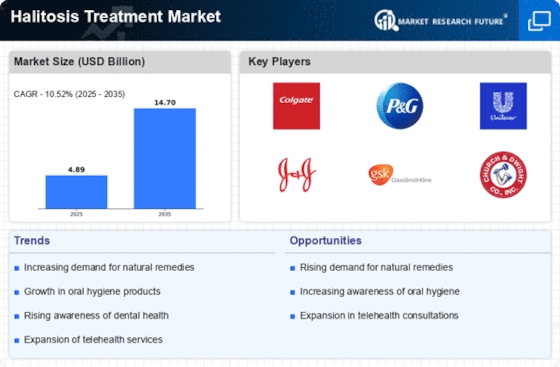
As per Market Research Future analysis, the Halitosis Treatment Market Size was estimated at 4.89 USD Billion in 2024. The Halitosis Treatment industry is projected to grow from 5.405 USD Billion in 2025 to 14.7 USD Billion by 2035, exhibiting a compound annual growth rate (CAGR) of 10.52% during the forecast period 2025 - 2035

Key Market Trends & Highlights

The Halitosis Treatment Market is experiencing a notable shift towards natural and preventive solutions.

  • The market is witnessing a rise in the use of natural ingredients, reflecting consumer preferences for organic products.
  • Digital health integration is becoming increasingly prevalent, enhancing patient engagement and treatment accessibility.
  • Preventive care is gaining traction, as consumers prioritize maintaining oral hygiene to avoid halitosis.
  • The growing awareness of oral hygiene and the rising incidence of halitosis are driving market expansion, particularly in North America and the Asia-Pacific region.

Market Size & Forecast

2024 Market Size 4.89 (USD Billion)
2035 Market Size 14.7 (USD Billion)
CAGR (2025 - 2035) 10.52%
Largest Regional Market Share in 2024 North America

Major Players

Colgate-Palmolive (US), Procter & Gamble (US), Unilever (GB), Johnson & Johnson (US), GlaxoSmithKline (GB), Church & Dwight (US), Henkel (DE), Listerine (US), Oral-B (US)

Market Trends

The Halitosis Treatment Market is currently experiencing a notable evolution, driven by increasing awareness regarding oral hygiene and the rising prevalence of halitosis among various demographics. This condition, often linked to underlying health issues, has prompted consumers to seek effective solutions. As a result, a diverse array of products, including mouthwashes, chewing gums, and specialized dental care items, are gaining traction. Furthermore, the integration of natural ingredients in these treatments appears to resonate well with health-conscious consumers, who are increasingly inclined towards organic and holistic approaches. This shift suggests a potential transformation in product formulations, as manufacturers adapt to meet changing consumer preferences. In addition, the Halitosis Treatment Market is witnessing a surge in digital health solutions, such as mobile applications and telehealth services, which provide personalized recommendations and support for individuals struggling with bad breath. These technological advancements may enhance consumer engagement and facilitate better management of oral health. Moreover, the growing emphasis on preventive care and education regarding oral hygiene practices indicates a broader trend towards proactive health management. As the market continues to evolve, stakeholders must remain vigilant to emerging trends and consumer demands, ensuring that they offer innovative and effective solutions to address halitosis effectively.

Rise of Natural Ingredients

There is a growing trend towards the use of natural ingredients in halitosis treatments. Consumers are increasingly seeking products that incorporate herbal extracts and essential oils, reflecting a preference for organic solutions. This shift may lead manufacturers to reformulate existing products to align with these consumer preferences.

Digital Health Integration

The integration of digital health solutions is becoming more prevalent in the Halitosis Treatment Market. Mobile applications and telehealth services are emerging as valuable tools for consumers, offering personalized advice and tracking capabilities. This trend suggests a potential for enhanced consumer engagement and improved management of oral health.

Focus on Preventive Care

A notable emphasis on preventive care is shaping the Halitosis Treatment Market. Consumers are becoming more aware of the importance of maintaining oral hygiene to prevent bad breath. This trend may drive demand for educational resources and preventive products, encouraging proactive health management.

Halitosis Treatment Market Market Drivers

Rising Incidence of Halitosis

The rising incidence of halitosis is a critical driver for the Halitosis Treatment Market. Factors such as poor dietary habits, smoking, and certain medical conditions have contributed to an increase in the prevalence of bad breath among the population. Research indicates that approximately 25% of adults experience halitosis at some point in their lives, creating a substantial market for treatment options. This growing incidence is prompting consumers to seek effective solutions, thereby driving demand for products such as mouthwashes, chewing gums, and breath sprays. Consequently, the Halitosis Treatment Market is likely to witness robust growth as it responds to the needs of an expanding consumer base.

Expansion of E-commerce Platforms

The expansion of e-commerce platforms is transforming the Halitosis Treatment Market. With the increasing reliance on online shopping, consumers are now able to access a wider range of halitosis treatment products from the comfort of their homes. This shift has been accelerated by the convenience and accessibility that e-commerce offers, allowing consumers to compare products and read reviews before making a purchase. Market data shows that online sales of oral care products have surged by 30% in recent years. As a result, manufacturers are increasingly focusing on their online presence and digital marketing strategies to capture this growing segment of the market, thereby enhancing the overall growth potential of the Halitosis Treatment Market.

Increasing Awareness of Oral Hygiene

The rising awareness regarding oral hygiene is a pivotal driver for the Halitosis Treatment Market. As individuals become more informed about the implications of poor oral health, the demand for effective halitosis treatments is likely to surge. Educational campaigns and initiatives by dental associations have contributed to this heightened awareness, emphasizing the importance of regular dental check-ups and proper oral care. This trend is reflected in market data, which indicates a steady increase in the sales of mouthwashes and breath fresheners, projected to reach USD 2 billion by 2026. Consequently, the Halitosis Treatment Market is expected to benefit from this growing consumer consciousness, leading to an expansion in product offerings and innovations.

Technological Advancements in Dental Care

Technological advancements in dental care are significantly influencing the Halitosis Treatment Market. Innovations such as smart toothbrushes, mobile applications for oral health tracking, and advanced diagnostic tools are enhancing the effectiveness of halitosis treatments. These technologies not only improve the accuracy of diagnosing halitosis but also facilitate personalized treatment plans for patients. Market data suggests that the integration of technology in dental care has led to a 15% increase in the adoption of oral health products. As consumers increasingly seek out technologically advanced solutions, the Halitosis Treatment Market is poised for growth, with manufacturers investing in research and development to create cutting-edge products.

Growing Demand for Natural and Organic Products

The growing demand for natural and organic products is reshaping the Halitosis Treatment Market. Consumers are increasingly gravitating towards products that are free from synthetic chemicals and artificial additives. This trend is driven by a broader movement towards health and wellness, where individuals prioritize natural ingredients for their oral care routines. Market data indicates that the organic oral care segment is expected to grow at a CAGR of 10% over the next five years. As a result, manufacturers are reformulating their products to include natural ingredients such as essential oils and herbal extracts, thereby catering to the evolving preferences of consumers in the Halitosis Treatment Market.

Market Segment Insights

By Indication: Gastrointestinal (Largest) vs. Respiratory (Fastest-Growing)

<p>The Halitosis Treatment Market exhibits a varied distribution of segment values, with the Gastrointestinal segment emerging as the largest contributor. This segment encompasses a wide range of conditions affecting digestion and oral health, strongly influencing breath odor. Following closely, the Respiratory segment is gaining traction, tapping into increasing awareness of conditions related to oral and nasal health that affect halitosis. As consumer understanding of halitosis deepens, the distribution of market shares among these segments continues to evolve. The growth trends in the Indication segment are particularly promising for the Respiratory category, which is recognized as the fastest-growing area in the Halitosis Treatment Market. Factors contributing to this growth include rising incidences of respiratory infections, increased focus on oral hygiene, and advancements in treatment solutions specific to breath-related issues. Meanwhile, the Gastrointestinal segment maintains its position through persistent demand for comprehensive treatment options catering to digestive health and its direct correlation to oral malodor, ensuring steady market relevance for these treatments.</p>

<p>Gastrointestinal (Dominant) vs. Respiratory (Emerging)</p>

<p>The Gastrointestinal segment remains the dominant force within the Halitosis Treatment Market, primarily attributed to the close links between digestive health and oral hygiene. Conditions such as acid reflux and gastrointestinal infections significantly impact halitosis, making treatments focused on this area essential. This segment is characterized by a wide range of treatment options, including dietary supplements, probiotics, and therapeutic medications, catering to varied consumer needs. In contrast, the Respiratory segment is marked as the emerging category, rapidly gaining traction due to the increasing recognition of the implications of respiratory conditions such as sinusitis and allergies on halitosis. Despite being smaller in market share, the emergence of innovative treatment solutions and heightened consumer awareness bolster its growth, positioning it as a significant area for future development.</p>

By Diagnostic Tests: Halimeter (Largest) vs. Gas Chromatography (Fastest-Growing)

<p>The Halitosis Treatment Market is primarily segmented based on various diagnostic tests. Halimeter holds the largest market share as it has become the standard diagnostic device used for measuring sulfur compounds in breath, a key indicator of halitosis. Following Halimeter, Gas Chromatography is rapidly gaining popularity, especially in research settings, due to its extensive accuracy and sensitivity in detecting a broader range of volatile compounds relevant to halitosis. The BANA Test and Β-Galactosidase Activity Assay also contribute to this segment but have not reached the prominence of the former two testing methods. Growth trends in the Diagnostic Tests segment are driven by increasing awareness of oral hygiene and the rising prevalence of halitosis among the population. As technology advances, more precise and user-friendly testing options are emerging, enhancing accessibility for both patients and clinicians. The rising demand for rapid and accurate diagnosis continues to favor Gas Chromatography as the fastest-growing option in the segment, reflecting a broader trend toward sophisticated diagnostic tools in healthcare.</p>

<p>Halimeter (Dominant) vs. BANA Test (Emerging)</p>

<p>Halimeter is recognized as the dominant diagnostic tool in the Halitosis Treatment Market due to its reliability and ease of use. It is widely adopted in clinical settings for its ability to provide immediate results, assisting healthcare professionals in making prompt diagnostic decisions regarding halitosis. On the other hand, the BANA Test, while gaining traction for its specificity in bacterial identification contributing to halitosis, remains an emerging alternative. Its market appeal lies in its straightforward approach and the ability to pinpoint specific bacterial activity, which is critical for targeted treatment. The continued development of these diagnostic methods is instrumental in refining halitosis management and improving patient outcomes.</p>

By Drug Treatment: Antacids (Largest) vs. Antiseptics (Fastest-Growing)

<p>The Halitosis Treatment Market displays a rich diversity of drug treatment options, with antacids holding the largest share among the segments. Their longstanding efficacy in neutralizing stomach acid impacts bad breath positively, making them a preferred choice for many consumers. In comparison, antiseptics have carved a niche as an increasingly popular alternative, driven by their dual action of eliminating oral bacteria and providing fresh breath. Their acceptance is growing as consumers seek more holistic approaches to managing halitosis. Market trends indicate that the use of antiseptics is surging due to rising consumer awareness about oral health and hygiene. Factors such as increased adoption of preventive healthcare practices and innovations in antiseptic formulation are propelling their growth. As consumers become more inclined towards quick and effective solutions for bad breath, this segment's dynamics are swiftly transforming, marking it as a significant player in the market.</p>

<p>Antacids (Dominant) vs. Antiseptics (Emerging)</p>

<p>Antacids have traditionally dominated the Halitosis Treatment Market due to their established role in neutralizing acidity that leads to bad breath. They are well-accepted within households and easily accessible, contributing to their sustained popularity. On the other hand, antiseptics are emerging as formidable competitors in this space, appealing particularly to health-conscious consumers. Their ability to target bacterial growth directly, combined with attractive packaging and marketing strategies, enhances their visibility. The rising trend of integrating natural and organic components into antiseptic formulations further boosts their market potential. This dynamic interplay between the established presence of antacids and the escalating appeal of antiseptics sets a compelling stage for evolution in the halitosis treatment landscape.</p>

Get more detailed insights about Halitosis Treatment Market Research Report- Forecast till 2035

Regional Insights

North America : Market Leader in Halitosis Treatment Market

North America is the largest market for halitosis treatment, accounting for approximately 40% of the global share. The region's growth is driven by increasing awareness of oral hygiene, rising disposable incomes, and a growing aging population. Regulatory support from health organizations promoting oral health initiatives further catalyzes market expansion. The demand for innovative products, including mouthwashes and breath fresheners, is on the rise, reflecting changing consumer preferences. The competitive landscape in North America is robust, with key players like Colgate-Palmolive, Procter & Gamble, and Johnson & Johnson leading the market. These companies invest heavily in research and development to introduce new products that cater to consumer needs. The presence of established brands and a strong distribution network enhances market accessibility, ensuring that consumers have a wide range of options for halitosis treatment.

Europe : Emerging Market with Growth Potential

Europe is witnessing significant growth in the halitosis treatment market, holding approximately 30% of the global share. Factors such as increasing health consciousness, a rise in dental care awareness, and the influence of social media on personal grooming are driving demand. Regulatory bodies in Europe are also emphasizing the importance of oral health, which is expected to further boost market growth. The region's diverse population and varying consumer preferences create opportunities for tailored products. Leading countries in Europe include Germany, the UK, and France, where the presence of major players like Unilever and GlaxoSmithKline is notable. The competitive landscape is characterized by a mix of established brands and emerging companies focusing on innovative solutions. The market is also seeing a trend towards natural and organic products, reflecting changing consumer preferences towards healthier options.

Asia-Pacific : Rapidly Growing Market Segment

Asia-Pacific is rapidly emerging as a significant market for halitosis treatment, accounting for approximately 25% of the global share. The growth is driven by increasing urbanization, rising disposable incomes, and a growing awareness of oral hygiene among consumers. Countries like China and India are witnessing a surge in demand for oral care products, supported by government initiatives promoting dental health. The region's diverse demographics also contribute to varied product preferences, enhancing market potential. Key players in the Asia-Pacific market include Colgate-Palmolive and Procter & Gamble, which are expanding their product lines to cater to local tastes. The competitive landscape is evolving, with both multinational corporations and local brands vying for market share. The increasing penetration of e-commerce platforms is also facilitating access to a wider range of halitosis treatment options for consumers in this region.

Middle East and Africa : Untapped Market with Opportunities

The Middle East and Africa region represents an untapped market for halitosis treatment, holding approximately 5% of the global share. The growth potential is significant, driven by increasing urbanization, rising disposable incomes, and a growing awareness of oral health. Regulatory initiatives aimed at improving healthcare access and promoting oral hygiene are expected to catalyze market growth. The region's diverse cultures and lifestyles also create opportunities for tailored products that meet specific consumer needs. Leading countries in this region include South Africa and the UAE, where the presence of key players like Henkel and Church & Dwight is notable. The competitive landscape is characterized by a mix of local and international brands, with a focus on affordability and accessibility. As awareness of halitosis treatment options increases, the market is poised for substantial growth in the coming years.

Key Players and Competitive Insights

Leading market companies are extensively spending R&D on increasing their product lines, which will help the Halitosis Treatment Market grow even more. Important market developments include new product releases, acquisitions and mergers, contractual agreements, greater investments, and collaboration with other organizations. The Halitosis Treatment industry must produce cost-effective merchandise to flourish and thrive in a more competitive and increasing market climate.
Manufacturing locally to reduce operating costs is an effective business strategy manufacturers use in the worldwide Halitosis Treatment industry to serve clients and expand the market sector. The Halitosis Treatment industry has provided some of the most important benefits recently. Church & Dwight., Colgate-Palmolive, and other major companies in the Halitosis Treatment Market are aiming to enhance market demand by investing in research and development activities
American consumer goods corporation Colgate-Palmolive has its main office on Park Avenue in Midtown Manhattan, New York City. Production, distribution, and provision of domestic, health, personal care, and veterinary items are the company's areas of expertise. The biggest manufacturer of soap and detergent in the world, Procter & Gamble (P&G), has long been a rival of Colgate-Palmolive. Following World War II, P&G launched their Tide laundry detergent, which attracted thousands of customers away from Colgate's soaps. When P&G introduced fluoride to their toothpaste, Colgate lost its top spot in the market (Colgate has subsequently reclaimed the top sales spot).
In May 2021, In the United States, Colgate's Hello Products debuted fresh, natural, and eco-friendly oral care items like a reusable toothbrush, floss flavored with peppermint oil and coconut oil, tablets that freshen breath, and mouthwashes.
The market leader in home and personal care goods is Church & Dwight. ARM & HAMMER, Batiste, OxiClean, Trojan, XTRA, Nair, First Response, Spinbrush, Orajel, vita fusion, Li'l Critters, Water Pik, FLAWLESS, Zicam, and TheraBreath are just a few of our internationally recognized brands. They were established in 1846, operate internationally, and are included in the S&P 500. At Church & Dwight, they fuel people's daily lives by offering high-quality, cost-effective consumer goods. Where impact meets ambition is here. They are proud to be experts in our fields. Their team of highly skilled individuals innovates and concentrates on innovative methods.
In November 2021, Church & Dwight Co., Inc. signed a legally binding contract to buy the TheraBreath name. TheraBreath is the second most popular brand of alcohol-free mouthwash in the US. Therefore, these advancements will probably help the market in North America flourish.

Key Companies in the Halitosis Treatment Market include

Industry Developments

  • Q2 2024: TheraBreath Launches New Oral Rinse Targeting Halitosis TheraBreath announced the launch of a new oral rinse specifically formulated to target halitosis, expanding its product portfolio in the oral care market.
  • Q2 2024: GSK Introduces Sensodyne Fresh Breath Toothpaste for Halitosis Relief GlaxoSmithKline launched Sensodyne Fresh Breath Toothpaste, designed to address halitosis while providing sensitivity relief, marking a new addition to its oral health product line.
  • Q3 2024: Oral Science Announces Partnership with Dental Clinics for Halitosis Treatment Market Program Oral Science entered into a partnership with a network of dental clinics to implement a specialized halitosis treatment program using its proprietary products.
  • Q3 2024: Colgate-Palmolive Expands Manufacturing Facility for Halitosis Treatment Market Products Colgate-Palmolive announced the expansion of its manufacturing facility in New Jersey to increase production capacity for its halitosis treatment product line.
  • Q4 2024: FDA Approves New Prescription Mouthwash for Chronic Halitosis The U.S. FDA approved a new prescription mouthwash developed for chronic halitosis, marking a regulatory milestone for advanced oral care therapeutics.
  • Q4 2024: Johnson & Johnson Acquires BreathRx Brand to Strengthen Halitosis Portfolio Johnson & Johnson completed the acquisition of the BreathRx brand, enhancing its portfolio of products targeting halitosis and oral malodor.
  • Q1 2025: LISTERINE Launches Advanced Formula for Bad Breath in Asia-Pacific LISTERINE introduced an advanced mouthwash formula targeting bad breath in the Asia-Pacific region, aiming to capture growing demand for halitosis solutions.
  • Q1 2025: Oral Care Startup BreathWell Raises $15M Series A to Develop Halitosis Diagnostic Device BreathWell, a health tech startup, secured $15 million in Series A funding to accelerate development of its non-invasive halitosis diagnostic device.
  • Q2 2025: Procter & Gamble Announces Strategic Partnership with Dental Chain for Halitosis Education Procter & Gamble formed a strategic partnership with a major dental chain to launch a halitosis education and treatment initiative across multiple clinics.
  • Q2 2025: FreshBreath Technologies Files for IPO to Fund Halitosis Treatment Market Product Expansion FreshBreath Technologies filed for an initial public offering, aiming to raise capital for expanding its halitosis treatment product line and global distribution.
  • Q3 2025: Dentek Unveils New Tongue Cleaner for Halitosis Prevention Dentek launched a new tongue cleaner designed to help prevent halitosis, broadening its oral hygiene product offerings.
  • Q3 2025: Novartis Receives European Approval for Halitosis Treatment Market Tablet Novartis received regulatory approval in Europe for its new tablet indicated for the treatment of halitosis, expanding its presence in the oral care therapeutics market.

Future Outlook

Halitosis Treatment Market Future Outlook

The Halitosis Treatment Market is projected to grow at a 10.52% CAGR from 2025 to 2035, driven by increasing awareness and innovative treatment options.

New opportunities lie in:

  • Development of personalized oral care products
  • Expansion of telehealth consultations for halitosis
  • Integration of AI-driven diagnostics in dental practices

By 2035, the market is expected to be robust, reflecting substantial growth and innovation.

Market Segmentation

Halitosis Treatment Market Indication Outlook

  • Respiratory
  • Liver
  • Kidney
  • Gastrointestinal
  • Systemic
  • Others

Halitosis Treatment Market Drug Treatment Outlook

  • Antacids
  • Antiseptics
  • Ranitidine
  • Others

Halitosis Treatment Market Diagnostic Tests Outlook

  • Halimeter
  • Gas Chromatography
  • BANA Test
  • Β-Galactosidase Activity Assay
  • Others

Report Scope

MARKET SIZE 2024 4.89(USD Billion)
MARKET SIZE 2025 5.405(USD Billion)
MARKET SIZE 2035 14.7(USD Billion)
COMPOUND ANNUAL GROWTH RATE (CAGR) 10.52% (2025 - 2035)
REPORT COVERAGE Revenue Forecast, Competitive Landscape, Growth Factors, and Trends
BASE YEAR 2024
Market Forecast Period 2025 - 2035
Historical Data 2019 - 2024
Market Forecast Units USD Billion
Key Companies Profiled Colgate-Palmolive (US), Procter & Gamble (US), Unilever (GB), Johnson & Johnson (US), GlaxoSmithKline (GB), Church & Dwight (US), Henkel (DE), Listerine (US), Oral-B (US)
Segments Covered Indication, Diagnostic Tests, Drug Treatment, Region
Key Market Opportunities Emergence of innovative oral care products targeting specific halitosis causes presents growth potential in the Halitosis Treatment Market.
Key Market Dynamics Rising consumer awareness drives demand for innovative halitosis treatments, influencing market competition and product development.
Countries Covered North America, Europe, APAC, South America, MEA

FAQs

What is the current valuation of the Halitosis Treatment Market?

<p>The Halitosis Treatment Market was valued at 4.89 USD Billion in 2024.</p>

What is the projected market size for the Halitosis Treatment Market by 2035?

<p>The market is projected to reach 14.7 USD Billion by 2035.</p>

What is the expected CAGR for the Halitosis Treatment Market during the forecast period?

<p>The expected CAGR for the Halitosis Treatment Market from 2025 to 2035 is 10.52%.</p>

Which companies are the key players in the Halitosis Treatment Market?

<p>Key players include Colgate-Palmolive, Procter & Gamble, Unilever, Johnson & Johnson, and GlaxoSmithKline.</p>

What are the major segments of the Halitosis Treatment Market?

<p>Major segments include indication, diagnostic tests, and drug treatment.</p>

How much is the Gastrointestinal segment valued at in 2024?

<p>The Gastrointestinal segment was valued at 1.22 USD Billion in 2024.</p>

What is the projected value of the Halimeter diagnostic test segment by 2035?

The Halimeter segment is projected to reach 2.4 USD Billion by 2035.

What is the valuation of the drug treatment segment in 2024?

The drug treatment segment was valued at 2.39 USD Billion in 2024.

How does the projected growth of the Halitosis Treatment Market compare to its 2024 valuation?

The market is expected to grow significantly from 4.89 USD Billion in 2024 to 14.7 USD Billion by 2035.

What are the expected values for the systemic indication segment by 2035?

The systemic indication segment is projected to reach 2.94 USD Billion by 2035.

  1. SECTION I: EXECUTIVE SUMMARY AND KEY HIGHLIGHTS
    1. | 1.1 EXECUTIVE SUMMARY
    2. | | 1.1.1 Market Overview
    3. | | 1.1.2 Key Findings
    4. | | 1.1.3 Market Segmentation
    5. | | 1.1.4 Competitive Landscape
    6. | | 1.1.5 Challenges and Opportunities
    7. | | 1.1.6 Future Outlook
  2. SECTION II: SCOPING, METHODOLOGY AND MARKET STRUCTURE
    1. | 2.1 MARKET INTRODUCTION
    2. | | 2.1.1 Definition
    3. | | 2.1.2 Scope of the study
    4. | | | 2.1.2.1 Research Objective
    5. | | | 2.1.2.2 Assumption
    6. | | | 2.1.2.3 Limitations
    7. | 2.2 RESEARCH METHODOLOGY
    8. | | 2.2.1 Overview
    9. | | 2.2.2 Data Mining
    10. | | 2.2.3 Secondary Research
    11. | | 2.2.4 Primary Research
    12. | | | 2.2.4.1 Primary Interviews and Information Gathering Process
    13. | | | 2.2.4.2 Breakdown of Primary Respondents
    14. | | 2.2.5 Forecasting Model
    15. | | 2.2.6 Market Size Estimation
    16. | | | 2.2.6.1 Bottom-Up Approach
    17. | | | 2.2.6.2 Top-Down Approach
    18. | | 2.2.7 Data Triangulation
    19. | | 2.2.8 Validation
  3. SECTION III: QUALITATIVE ANALYSIS
    1. | 3.1 MARKET DYNAMICS
    2. | | 3.1.1 Overview
    3. | | 3.1.2 Drivers
    4. | | 3.1.3 Restraints
    5. | | 3.1.4 Opportunities
    6. | 3.2 MARKET FACTOR ANALYSIS
    7. | | 3.2.1 Value chain Analysis
    8. | | 3.2.2 Porter's Five Forces Analysis
    9. | | | 3.2.2.1 Bargaining Power of Suppliers
    10. | | | 3.2.2.2 Bargaining Power of Buyers
    11. | | | 3.2.2.3 Threat of New Entrants
    12. | | | 3.2.2.4 Threat of Substitutes
    13. | | | 3.2.2.5 Intensity of Rivalry
    14. | | 3.2.3 COVID-19 Impact Analysis
    15. | | | 3.2.3.1 Market Impact Analysis
    16. | | | 3.2.3.2 Regional Impact
    17. | | | 3.2.3.3 Opportunity and Threat Analysis
  4. SECTION IV: QUANTITATIVE ANALYSIS
    1. | 4.1 Healthcare, BY Indication (USD Billion)
    2. | | 4.1.1 Respiratory
    3. | | 4.1.2 Liver
    4. | | 4.1.3 Kidney
    5. | | 4.1.4 Gastrointestinal
    6. | | 4.1.5 Systemic
    7. | | 4.1.6 Others
    8. | 4.2 Healthcare, BY Diagnostic Tests (USD Billion)
    9. | | 4.2.1 Halimeter
    10. | | 4.2.2 Gas Chromatography
    11. | | 4.2.3 BANA Test
    12. | | 4.2.4 Β-Galactosidase Activity Assay
    13. | | 4.2.5 Others
    14. | 4.3 Healthcare, BY Drug Treatment (USD Billion)
    15. | | 4.3.1 Antacids
    16. | | 4.3.2 Antiseptics
    17. | | 4.3.3 Ranitidine
    18. | | 4.3.4 Others
    19. | 4.4 Healthcare, BY Region (USD Billion)
    20. | | 4.4.1 North America
    21. | | | 4.4.1.1 US
    22. | | | 4.4.1.2 Canada
    23. | | 4.4.2 Europe
    24. | | | 4.4.2.1 Germany
    25. | | | 4.4.2.2 UK
    26. | | | 4.4.2.3 France
    27. | | | 4.4.2.4 Russia
    28. | | | 4.4.2.5 Italy
    29. | | | 4.4.2.6 Spain
    30. | | | 4.4.2.7 Rest of Europe
    31. | | 4.4.3 APAC
    32. | | | 4.4.3.1 China
    33. | | | 4.4.3.2 India
    34. | | | 4.4.3.3 Japan
    35. | | | 4.4.3.4 South Korea
    36. | | | 4.4.3.5 Malaysia
    37. | | | 4.4.3.6 Thailand
    38. | | | 4.4.3.7 Indonesia
    39. | | | 4.4.3.8 Rest of APAC
    40. | | 4.4.4 South America
    41. | | | 4.4.4.1 Brazil
    42. | | | 4.4.4.2 Mexico
    43. | | | 4.4.4.3 Argentina
    44. | | | 4.4.4.4 Rest of South America
    45. | | 4.4.5 MEA
    46. | | | 4.4.5.1 GCC Countries
    47. | | | 4.4.5.2 South Africa
    48. | | | 4.4.5.3 Rest of MEA
  5. SECTION V: COMPETITIVE ANALYSIS
    1. | 5.1 Competitive Landscape
    2. | | 5.1.1 Overview
    3. | | 5.1.2 Competitive Analysis
    4. | | 5.1.3 Market share Analysis
    5. | | 5.1.4 Major Growth Strategy in the Healthcare
    6. | | 5.1.5 Competitive Benchmarking
    7. | | 5.1.6 Leading Players in Terms of Number of Developments in the Healthcare
    8. | | 5.1.7 Key developments and growth strategies
    9. | | | 5.1.7.1 New Product Launch/Service Deployment
    10. | | | 5.1.7.2 Merger & Acquisitions
    11. | | | 5.1.7.3 Joint Ventures
    12. | | 5.1.8 Major Players Financial Matrix
    13. | | | 5.1.8.1 Sales and Operating Income
    14. | | | 5.1.8.2 Major Players R&D Expenditure. 2023
    15. | 5.2 Company Profiles
    16. | | 5.2.1 Colgate-Palmolive (US)
    17. | | | 5.2.1.1 Financial Overview
    18. | | | 5.2.1.2 Products Offered
    19. | | | 5.2.1.3 Key Developments
    20. | | | 5.2.1.4 SWOT Analysis
    21. | | | 5.2.1.5 Key Strategies
    22. | | 5.2.2 Procter & Gamble (US)
    23. | | | 5.2.2.1 Financial Overview
    24. | | | 5.2.2.2 Products Offered
    25. | | | 5.2.2.3 Key Developments
    26. | | | 5.2.2.4 SWOT Analysis
    27. | | | 5.2.2.5 Key Strategies
    28. | | 5.2.3 Unilever (GB)
    29. | | | 5.2.3.1 Financial Overview
    30. | | | 5.2.3.2 Products Offered
    31. | | | 5.2.3.3 Key Developments
    32. | | | 5.2.3.4 SWOT Analysis
    33. | | | 5.2.3.5 Key Strategies
    34. | | 5.2.4 Johnson & Johnson (US)
    35. | | | 5.2.4.1 Financial Overview
    36. | | | 5.2.4.2 Products Offered
    37. | | | 5.2.4.3 Key Developments
    38. | | | 5.2.4.4 SWOT Analysis
    39. | | | 5.2.4.5 Key Strategies
    40. | | 5.2.5 GlaxoSmithKline (GB)
    41. | | | 5.2.5.1 Financial Overview
    42. | | | 5.2.5.2 Products Offered
    43. | | | 5.2.5.3 Key Developments
    44. | | | 5.2.5.4 SWOT Analysis
    45. | | | 5.2.5.5 Key Strategies
    46. | | 5.2.6 Church & Dwight (US)
    47. | | | 5.2.6.1 Financial Overview
    48. | | | 5.2.6.2 Products Offered
    49. | | | 5.2.6.3 Key Developments
    50. | | | 5.2.6.4 SWOT Analysis
    51. | | | 5.2.6.5 Key Strategies
    52. | | 5.2.7 Henkel (DE)
    53. | | | 5.2.7.1 Financial Overview
    54. | | | 5.2.7.2 Products Offered
    55. | | | 5.2.7.3 Key Developments
    56. | | | 5.2.7.4 SWOT Analysis
    57. | | | 5.2.7.5 Key Strategies
    58. | | 5.2.8 Listerine (US)
    59. | | | 5.2.8.1 Financial Overview
    60. | | | 5.2.8.2 Products Offered
    61. | | | 5.2.8.3 Key Developments
    62. | | | 5.2.8.4 SWOT Analysis
    63. | | | 5.2.8.5 Key Strategies
    64. | | 5.2.9 Oral-B (US)
    65. | | | 5.2.9.1 Financial Overview
    66. | | | 5.2.9.2 Products Offered
    67. | | | 5.2.9.3 Key Developments
    68. | | | 5.2.9.4 SWOT Analysis
    69. | | | 5.2.9.5 Key Strategies
    70. | 5.3 Appendix
    71. | | 5.3.1 References
    72. | | 5.3.2 Related Reports
  6. LIST OF FIGURES
    1. | 6.1 MARKET SYNOPSIS
    2. | 6.2 NORTH AMERICA MARKET ANALYSIS
    3. | 6.3 US MARKET ANALYSIS BY INDICATION
    4. | 6.4 US MARKET ANALYSIS BY DIAGNOSTIC TESTS
    5. | 6.5 US MARKET ANALYSIS BY DRUG TREATMENT
    6. | 6.6 CANADA MARKET ANALYSIS BY INDICATION
    7. | 6.7 CANADA MARKET ANALYSIS BY DIAGNOSTIC TESTS
    8. | 6.8 CANADA MARKET ANALYSIS BY DRUG TREATMENT
    9. | 6.9 EUROPE MARKET ANALYSIS
    10. | 6.10 GERMANY MARKET ANALYSIS BY INDICATION
    11. | 6.11 GERMANY MARKET ANALYSIS BY DIAGNOSTIC TESTS
    12. | 6.12 GERMANY MARKET ANALYSIS BY DRUG TREATMENT
    13. | 6.13 UK MARKET ANALYSIS BY INDICATION
    14. | 6.14 UK MARKET ANALYSIS BY DIAGNOSTIC TESTS
    15. | 6.15 UK MARKET ANALYSIS BY DRUG TREATMENT
    16. | 6.16 FRANCE MARKET ANALYSIS BY INDICATION
    17. | 6.17 FRANCE MARKET ANALYSIS BY DIAGNOSTIC TESTS
    18. | 6.18 FRANCE MARKET ANALYSIS BY DRUG TREATMENT
    19. | 6.19 RUSSIA MARKET ANALYSIS BY INDICATION
    20. | 6.20 RUSSIA MARKET ANALYSIS BY DIAGNOSTIC TESTS
    21. | 6.21 RUSSIA MARKET ANALYSIS BY DRUG TREATMENT
    22. | 6.22 ITALY MARKET ANALYSIS BY INDICATION
    23. | 6.23 ITALY MARKET ANALYSIS BY DIAGNOSTIC TESTS
    24. | 6.24 ITALY MARKET ANALYSIS BY DRUG TREATMENT
    25. | 6.25 SPAIN MARKET ANALYSIS BY INDICATION
    26. | 6.26 SPAIN MARKET ANALYSIS BY DIAGNOSTIC TESTS
    27. | 6.27 SPAIN MARKET ANALYSIS BY DRUG TREATMENT
    28. | 6.28 REST OF EUROPE MARKET ANALYSIS BY INDICATION
    29. | 6.29 REST OF EUROPE MARKET ANALYSIS BY DIAGNOSTIC TESTS
    30. | 6.30 REST OF EUROPE MARKET ANALYSIS BY DRUG TREATMENT
    31. | 6.31 APAC MARKET ANALYSIS
    32. | 6.32 CHINA MARKET ANALYSIS BY INDICATION
    33. | 6.33 CHINA MARKET ANALYSIS BY DIAGNOSTIC TESTS
    34. | 6.34 CHINA MARKET ANALYSIS BY DRUG TREATMENT
    35. | 6.35 INDIA MARKET ANALYSIS BY INDICATION
    36. | 6.36 INDIA MARKET ANALYSIS BY DIAGNOSTIC TESTS
    37. | 6.37 INDIA MARKET ANALYSIS BY DRUG TREATMENT
    38. | 6.38 JAPAN MARKET ANALYSIS BY INDICATION
    39. | 6.39 JAPAN MARKET ANALYSIS BY DIAGNOSTIC TESTS
    40. | 6.40 JAPAN MARKET ANALYSIS BY DRUG TREATMENT
    41. | 6.41 SOUTH KOREA MARKET ANALYSIS BY INDICATION
    42. | 6.42 SOUTH KOREA MARKET ANALYSIS BY DIAGNOSTIC TESTS
    43. | 6.43 SOUTH KOREA MARKET ANALYSIS BY DRUG TREATMENT
    44. | 6.44 MALAYSIA MARKET ANALYSIS BY INDICATION
    45. | 6.45 MALAYSIA MARKET ANALYSIS BY DIAGNOSTIC TESTS
    46. | 6.46 MALAYSIA MARKET ANALYSIS BY DRUG TREATMENT
    47. | 6.47 THAILAND MARKET ANALYSIS BY INDICATION
    48. | 6.48 THAILAND MARKET ANALYSIS BY DIAGNOSTIC TESTS
    49. | 6.49 THAILAND MARKET ANALYSIS BY DRUG TREATMENT
    50. | 6.50 INDONESIA MARKET ANALYSIS BY INDICATION
    51. | 6.51 INDONESIA MARKET ANALYSIS BY DIAGNOSTIC TESTS
    52. | 6.52 INDONESIA MARKET ANALYSIS BY DRUG TREATMENT
    53. | 6.53 REST OF APAC MARKET ANALYSIS BY INDICATION
    54. | 6.54 REST OF APAC MARKET ANALYSIS BY DIAGNOSTIC TESTS
    55. | 6.55 REST OF APAC MARKET ANALYSIS BY DRUG TREATMENT
    56. | 6.56 SOUTH AMERICA MARKET ANALYSIS
    57. | 6.57 BRAZIL MARKET ANALYSIS BY INDICATION
    58. | 6.58 BRAZIL MARKET ANALYSIS BY DIAGNOSTIC TESTS
    59. | 6.59 BRAZIL MARKET ANALYSIS BY DRUG TREATMENT
    60. | 6.60 MEXICO MARKET ANALYSIS BY INDICATION
    61. | 6.61 MEXICO MARKET ANALYSIS BY DIAGNOSTIC TESTS
    62. | 6.62 MEXICO MARKET ANALYSIS BY DRUG TREATMENT
    63. | 6.63 ARGENTINA MARKET ANALYSIS BY INDICATION
    64. | 6.64 ARGENTINA MARKET ANALYSIS BY DIAGNOSTIC TESTS
    65. | 6.65 ARGENTINA MARKET ANALYSIS BY DRUG TREATMENT
    66. | 6.66 REST OF SOUTH AMERICA MARKET ANALYSIS BY INDICATION
    67. | 6.67 REST OF SOUTH AMERICA MARKET ANALYSIS BY DIAGNOSTIC TESTS
    68. | 6.68 REST OF SOUTH AMERICA MARKET ANALYSIS BY DRUG TREATMENT
    69. | 6.69 MEA MARKET ANALYSIS
    70. | 6.70 GCC COUNTRIES MARKET ANALYSIS BY INDICATION
    71. | 6.71 GCC COUNTRIES MARKET ANALYSIS BY DIAGNOSTIC TESTS
    72. | 6.72 GCC COUNTRIES MARKET ANALYSIS BY DRUG TREATMENT
    73. | 6.73 SOUTH AFRICA MARKET ANALYSIS BY INDICATION
    74. | 6.74 SOUTH AFRICA MARKET ANALYSIS BY DIAGNOSTIC TESTS
    75. | 6.75 SOUTH AFRICA MARKET ANALYSIS BY DRUG TREATMENT
    76. | 6.76 REST OF MEA MARKET ANALYSIS BY INDICATION
    77. | 6.77 REST OF MEA MARKET ANALYSIS BY DIAGNOSTIC TESTS
    78. | 6.78 REST OF MEA MARKET ANALYSIS BY DRUG TREATMENT
    79. | 6.79 KEY BUYING CRITERIA OF HEALTHCARE
    80. | 6.80 RESEARCH PROCESS OF MRFR
    81. | 6.81 DRO ANALYSIS OF HEALTHCARE
    82. | 6.82 DRIVERS IMPACT ANALYSIS: HEALTHCARE
    83. | 6.83 RESTRAINTS IMPACT ANALYSIS: HEALTHCARE
    84. | 6.84 SUPPLY / VALUE CHAIN: HEALTHCARE
    85. | 6.85 HEALTHCARE, BY INDICATION, 2024 (% SHARE)
    86. | 6.86 HEALTHCARE, BY INDICATION, 2024 TO 2035 (USD Billion)
    87. | 6.87 HEALTHCARE, BY DIAGNOSTIC TESTS, 2024 (% SHARE)
    88. | 6.88 HEALTHCARE, BY DIAGNOSTIC TESTS, 2024 TO 2035 (USD Billion)
    89. | 6.89 HEALTHCARE, BY DRUG TREATMENT, 2024 (% SHARE)
    90. | 6.90 HEALTHCARE, BY DRUG TREATMENT, 2024 TO 2035 (USD Billion)
    91. | 6.91 BENCHMARKING OF MAJOR COMPETITORS
  7. LIST OF TABLES
    1. | 7.1 LIST OF ASSUMPTIONS
    2. | | 7.1.1
    3. | 7.2 North America MARKET SIZE ESTIMATES; FORECAST
    4. | | 7.2.1 BY INDICATION, 2025-2035 (USD Billion)
    5. | | 7.2.2 BY DIAGNOSTIC TESTS, 2025-2035 (USD Billion)
    6. | | 7.2.3 BY DRUG TREATMENT, 2025-2035 (USD Billion)
    7. | 7.3 US MARKET SIZE ESTIMATES; FORECAST
    8. | | 7.3.1 BY INDICATION, 2025-2035 (USD Billion)
    9. | | 7.3.2 BY DIAGNOSTIC TESTS, 2025-2035 (USD Billion)
    10. | | 7.3.3 BY DRUG TREATMENT, 2025-2035 (USD Billion)
    11. | 7.4 Canada MARKET SIZE ESTIMATES; FORECAST
    12. | | 7.4.1 BY INDICATION, 2025-2035 (USD Billion)
    13. | | 7.4.2 BY DIAGNOSTIC TESTS, 2025-2035 (USD Billion)
    14. | | 7.4.3 BY DRUG TREATMENT, 2025-2035 (USD Billion)
    15. | 7.5 Europe MARKET SIZE ESTIMATES; FORECAST
    16. | | 7.5.1 BY INDICATION, 2025-2035 (USD Billion)
    17. | | 7.5.2 BY DIAGNOSTIC TESTS, 2025-2035 (USD Billion)
    18. | | 7.5.3 BY DRUG TREATMENT, 2025-2035 (USD Billion)
    19. | 7.6 Germany MARKET SIZE ESTIMATES; FORECAST
    20. | | 7.6.1 BY INDICATION, 2025-2035 (USD Billion)
    21. | | 7.6.2 BY DIAGNOSTIC TESTS, 2025-2035 (USD Billion)
    22. | | 7.6.3 BY DRUG TREATMENT, 2025-2035 (USD Billion)
    23. | 7.7 UK MARKET SIZE ESTIMATES; FORECAST
    24. | | 7.7.1 BY INDICATION, 2025-2035 (USD Billion)
    25. | | 7.7.2 BY DIAGNOSTIC TESTS, 2025-2035 (USD Billion)
    26. | | 7.7.3 BY DRUG TREATMENT, 2025-2035 (USD Billion)
    27. | 7.8 France MARKET SIZE ESTIMATES; FORECAST
    28. | | 7.8.1 BY INDICATION, 2025-2035 (USD Billion)
    29. | | 7.8.2 BY DIAGNOSTIC TESTS, 2025-2035 (USD Billion)
    30. | | 7.8.3 BY DRUG TREATMENT, 2025-2035 (USD Billion)
    31. | 7.9 Russia MARKET SIZE ESTIMATES; FORECAST
    32. | | 7.9.1 BY INDICATION, 2025-2035 (USD Billion)
    33. | | 7.9.2 BY DIAGNOSTIC TESTS, 2025-2035 (USD Billion)
    34. | | 7.9.3 BY DRUG TREATMENT, 2025-2035 (USD Billion)
    35. | 7.10 Italy MARKET SIZE ESTIMATES; FORECAST
    36. | | 7.10.1 BY INDICATION, 2025-2035 (USD Billion)
    37. | | 7.10.2 BY DIAGNOSTIC TESTS, 2025-2035 (USD Billion)
    38. | | 7.10.3 BY DRUG TREATMENT, 2025-2035 (USD Billion)
    39. | 7.11 Spain MARKET SIZE ESTIMATES; FORECAST
    40. | | 7.11.1 BY INDICATION, 2025-2035 (USD Billion)
    41. | | 7.11.2 BY DIAGNOSTIC TESTS, 2025-2035 (USD Billion)
    42. | | 7.11.3 BY DRUG TREATMENT, 2025-2035 (USD Billion)
    43. | 7.12 Rest of Europe MARKET SIZE ESTIMATES; FORECAST
    44. | | 7.12.1 BY INDICATION, 2025-2035 (USD Billion)
    45. | | 7.12.2 BY DIAGNOSTIC TESTS, 2025-2035 (USD Billion)
    46. | | 7.12.3 BY DRUG TREATMENT, 2025-2035 (USD Billion)
    47. | 7.13 APAC MARKET SIZE ESTIMATES; FORECAST
    48. | | 7.13.1 BY INDICATION, 2025-2035 (USD Billion)
    49. | | 7.13.2 BY DIAGNOSTIC TESTS, 2025-2035 (USD Billion)
    50. | | 7.13.3 BY DRUG TREATMENT, 2025-2035 (USD Billion)
    51. | 7.14 China MARKET SIZE ESTIMATES; FORECAST
    52. | | 7.14.1 BY INDICATION, 2025-2035 (USD Billion)
    53. | | 7.14.2 BY DIAGNOSTIC TESTS, 2025-2035 (USD Billion)
    54. | | 7.14.3 BY DRUG TREATMENT, 2025-2035 (USD Billion)
    55. | 7.15 India MARKET SIZE ESTIMATES; FORECAST
    56. | | 7.15.1 BY INDICATION, 2025-2035 (USD Billion)
    57. | | 7.15.2 BY DIAGNOSTIC TESTS, 2025-2035 (USD Billion)
    58. | | 7.15.3 BY DRUG TREATMENT, 2025-2035 (USD Billion)
    59. | 7.16 Japan MARKET SIZE ESTIMATES; FORECAST
    60. | | 7.16.1 BY INDICATION, 2025-2035 (USD Billion)
    61. | | 7.16.2 BY DIAGNOSTIC TESTS, 2025-2035 (USD Billion)
    62. | | 7.16.3 BY DRUG TREATMENT, 2025-2035 (USD Billion)
    63. | 7.17 South Korea MARKET SIZE ESTIMATES; FORECAST
    64. | | 7.17.1 BY INDICATION, 2025-2035 (USD Billion)
    65. | | 7.17.2 BY DIAGNOSTIC TESTS, 2025-2035 (USD Billion)
    66. | | 7.17.3 BY DRUG TREATMENT, 2025-2035 (USD Billion)
    67. | 7.18 Malaysia MARKET SIZE ESTIMATES; FORECAST
    68. | | 7.18.1 BY INDICATION, 2025-2035 (USD Billion)
    69. | | 7.18.2 BY DIAGNOSTIC TESTS, 2025-2035 (USD Billion)
    70. | | 7.18.3 BY DRUG TREATMENT, 2025-2035 (USD Billion)
    71. | 7.19 Thailand MARKET SIZE ESTIMATES; FORECAST
    72. | | 7.19.1 BY INDICATION, 2025-2035 (USD Billion)
    73. | | 7.19.2 BY DIAGNOSTIC TESTS, 2025-2035 (USD Billion)
    74. | | 7.19.3 BY DRUG TREATMENT, 2025-2035 (USD Billion)
    75. | 7.20 Indonesia MARKET SIZE ESTIMATES; FORECAST
    76. | | 7.20.1 BY INDICATION, 2025-2035 (USD Billion)
    77. | | 7.20.2 BY DIAGNOSTIC TESTS, 2025-2035 (USD Billion)
    78. | | 7.20.3 BY DRUG TREATMENT, 2025-2035 (USD Billion)
    79. | 7.21 Rest of APAC MARKET SIZE ESTIMATES; FORECAST
    80. | | 7.21.1 BY INDICATION, 2025-2035 (USD Billion)
    81. | | 7.21.2 BY DIAGNOSTIC TESTS, 2025-2035 (USD Billion)
    82. | | 7.21.3 BY DRUG TREATMENT, 2025-2035 (USD Billion)
    83. | 7.22 South America MARKET SIZE ESTIMATES; FORECAST
    84. | | 7.22.1 BY INDICATION, 2025-2035 (USD Billion)
    85. | | 7.22.2 BY DIAGNOSTIC TESTS, 2025-2035 (USD Billion)
    86. | | 7.22.3 BY DRUG TREATMENT, 2025-2035 (USD Billion)
    87. | 7.23 Brazil MARKET SIZE ESTIMATES; FORECAST
    88. | | 7.23.1 BY INDICATION, 2025-2035 (USD Billion)
    89. | | 7.23.2 BY DIAGNOSTIC TESTS, 2025-2035 (USD Billion)
    90. | | 7.23.3 BY DRUG TREATMENT, 2025-2035 (USD Billion)
    91. | 7.24 Mexico MARKET SIZE ESTIMATES; FORECAST
    92. | | 7.24.1 BY INDICATION, 2025-2035 (USD Billion)
    93. | | 7.24.2 BY DIAGNOSTIC TESTS, 2025-2035 (USD Billion)
    94. | | 7.24.3 BY DRUG TREATMENT, 2025-2035 (USD Billion)
    95. | 7.25 Argentina MARKET SIZE ESTIMATES; FORECAST
    96. | | 7.25.1 BY INDICATION, 2025-2035 (USD Billion)
    97. | | 7.25.2 BY DIAGNOSTIC TESTS, 2025-2035 (USD Billion)
    98. | | 7.25.3 BY DRUG TREATMENT, 2025-2035 (USD Billion)
    99. | 7.26 Rest of South America MARKET SIZE ESTIMATES; FORECAST
    100. | | 7.26.1 BY INDICATION, 2025-2035 (USD Billion)
    101. | | 7.26.2 BY DIAGNOSTIC TESTS, 2025-2035 (USD Billion)
    102. | | 7.26.3 BY DRUG TREATMENT, 2025-2035 (USD Billion)
    103. | 7.27 MEA MARKET SIZE ESTIMATES; FORECAST
    104. | | 7.27.1 BY INDICATION, 2025-2035 (USD Billion)
    105. | | 7.27.2 BY DIAGNOSTIC TESTS, 2025-2035 (USD Billion)
    106. | | 7.27.3 BY DRUG TREATMENT, 2025-2035 (USD Billion)
    107. | 7.28 GCC Countries MARKET SIZE ESTIMATES; FORECAST
    108. | | 7.28.1 BY INDICATION, 2025-2035 (USD Billion)
    109. | | 7.28.2 BY DIAGNOSTIC TESTS, 2025-2035 (USD Billion)
    110. | | 7.28.3 BY DRUG TREATMENT, 2025-2035 (USD Billion)
    111. | 7.29 South Africa MARKET SIZE ESTIMATES; FORECAST
    112. | | 7.29.1 BY INDICATION, 2025-2035 (USD Billion)
    113. | | 7.29.2 BY DIAGNOSTIC TESTS, 2025-2035 (USD Billion)
    114. | | 7.29.3 BY DRUG TREATMENT, 2025-2035 (USD Billion)
    115. | 7.30 Rest of MEA MARKET SIZE ESTIMATES; FORECAST
    116. | | 7.30.1 BY INDICATION, 2025-2035 (USD Billion)
    117. | | 7.30.2 BY DIAGNOSTIC TESTS, 2025-2035 (USD Billion)
    118. | | 7.30.3 BY DRUG TREATMENT, 2025-2035 (USD Billion)
    119. | 7.31 PRODUCT LAUNCH/PRODUCT DEVELOPMENT/APPROVAL
    120. | | 7.31.1
    121. | 7.32 ACQUISITION/PARTNERSHIP
    122. | | 7.32.1

Healthcare Market Segmentation

Healthcare By Indication (USD Billion, 2025-2035)

  • Respiratory
  • Liver
  • Kidney
  • Gastrointestinal
  • Systemic
  • Others

Healthcare By Diagnostic Tests (USD Billion, 2025-2035)

  • Halimeter
  • Gas Chromatography
  • BANA Test
  • Β-Galactosidase Activity Assay
  • Others

Healthcare By Drug Treatment (USD Billion, 2025-2035)

  • Antacids
  • Antiseptics
  • Ranitidine
  • Others
Infographic

Free Sample Request

Kindly complete the form below to receive a free sample of this Report

Get Free Sample

Customer Strories

Compare Licence

×
Features License Type
Single User Multiuser License Enterprise User
Price $4,950 $5,950 $7,250
Maximum User Access Limit 1 User Upto 10 Users Unrestricted Access Throughout the Organization
Free Customization
Direct Access to Analyst
Deliverable Format
Platform Access
Discount on Next Purchase 10% 15% 15%
Printable Versions