×
Request Free Sample ×

Kindly complete the form below to receive a free sample of this Report

* Please use a valid business email

Leading companies partner with us for data-driven Insights

clients tt-cursor
Hero Background
English
Chinese
French
Japanese
Korean
German
Spanish

Green Building Market Trends

ID: MRFR/PCM/3547-CR
111 Pages
Snehal Singh
February 2020

Green Buildings Market Research Report Information By Product (Interiors, Exteriors), Application (Residential, Non-residential), And By Region (North America, Europe, Asia-Pacific, And Rest Of The World) – Market Forecast Till 2035

Share:
Download PDF ×

We do not share your information with anyone. However, we may send you emails based on your report interest from time to time. You may contact us at any time to opt-out.

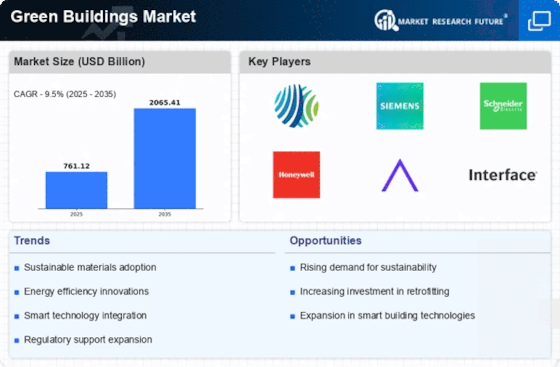
Green Building Market Infographic
Purchase Options

Market Trends

Key Emerging Trends in the Green Building Market

The Green Building market is experiencing massive traits pushed via a growing emphasis on sustainable and environmentally pleasant production practices. These traits replicate the industry's response to environmental issues, regulatory modifications, and the increasing demand for strong and eco-friendly constructing answers. Net-0 electricity homes, designed to produce as much strength as they eat, are gaining prominence within the Green Building market. With advancements in renewable power technology, together with solar panels and electricity-efficient systems, developers are increasingly incorporating those features to obtain net-0 power popularity. This trend aligns with worldwide efforts to lessen carbon emissions and combat weather exchange. The Green Building market is witnessing a shift towards the usage of sustainable and environmentally pleasant materials. Builders and architects are choosing materials with lower environmental impact, which includes recycled steel, bamboo, and reclaimed timber. Additionally, the usage of low-VOC (volatile natural compound) paints and finishes is gaining traction to enhance indoor air satisfaction. Certification packages and Green Building requirements, consisting of LEED (Leadership in Energy and Environmental Design) and BREEAM (Building Research Establishment Environmental Assessment Method), are using the adoption of sustainable practices. Developers are increasingly looking for certification to illustrate their dedication to environmental duty, energy efficiency, and ordinary sustainability. Governments and neighborhood governments are providing incentives and regulatory guides to promote Green Building practices. Tax credits, offers, and streamlined approaches are encouraging builders and developers to spend money on sustainable creation. This trend not only blessings the environment but additionally aligns with broader economic and policy desires. The Green Building marketplace is setting an extra emphasis on occupant health and health. Design concerns encompass features that beautify indoor air, such as high-quality, herbal light and thermal comfort. The integration of biophilic layout concepts, which include nature-stimulated factors, contributes to a healthier and more effective indoor environment, addressing the holistic well-being of constructing occupants. The adoption of circular financial system principles is influencing creation practices inside the Green Building marketplace. Strategies consisting of recycling production waste, repurposing substances, and designing for deconstruction contribute to an extra sustainable method of building. Minimizing waste and maximizing material reuse align with the goal of creating buildings with a reduced environmental footprint.


Author
Snehal Singh
Assistant Manager - Research

High acumen in analyzing complex macro & micro markets with more than 6 years of work experience in the field of market research. By implementing her analytical skills in forecasting and estimation into market research reports, she has expertise in Packaging, Construction, and Equipment domains. She handles a team size of 20-25 resources and ensures smooth running of the projects, associated marketing activities, and client servicing.

Leave a Comment

FAQs

What is the current valuation of the Green Buildings Market as of 2024?

<p>The Green Buildings Market was valued at 761.12 USD Billion in 2024.</p>

What is the projected market valuation for the Green Buildings Market in 2035?

<p>The market is projected to reach 2065.41 USD Billion by 2035.</p>

What is the expected CAGR for the Green Buildings Market during the forecast period 2025 - 2035?

<p>The expected CAGR for the Green Buildings Market during 2025 - 2035 is 9.5%.</p>

Which segments are included in the Green Buildings Market?

<p>The market includes segments such as Product and Application, with specific categories like Interiors and Exteriors.</p>

What were the valuations for the Interiors and Exteriors segments in 2024?

<p>In 2024, the Interiors segment was valued at 304.45 USD Billion, while the Exteriors segment was valued at 456.67 USD Billion.</p>

How do the Residential and Non-residential applications compare in the Green Buildings Market?

<p>In 2024, the Residential application was valued at 304.45 USD Billion, whereas the Non-residential application reached 456.67 USD Billion.</p>

Who are the key players in the Green Buildings Market?

<p>Key players include Johnson Controls, Siemens, Schneider Electric, Honeywell, Trane Technologies, Interface, Kingspan Group, Rockwool International, and Buro Happold.</p>

What is the significance of the projected growth in the Green Buildings Market?

<p>The projected growth indicates a robust demand for sustainable building solutions, reflecting a shift towards environmentally friendly practices.</p>

How might the leadership of companies like Siemens and Schneider Electric influence the market?

<p>The leadership of companies such as Siemens and Schneider Electric may drive innovation and set industry standards, potentially enhancing market growth.</p>

What trends are likely to shape the Green Buildings Market in the coming years?

<p>Trends may include increased investment in energy efficiency, sustainable materials, and smart building technologies, influencing market dynamics through 2035.</p>

Market Summary

As per Market Research Future analysis, the Green Buildings Market Size was estimated at 610.6 USD Billion in 2024. The Green Buildings industry is projected to grow from 669.8 USD Billion in 2025 to 1690.6 USD Billion by 2035, exhibiting a compound annual growth rate (CAGR) of 9.70% during the forecast period 2025 - 2035

Key Market Trends & Highlights

The Green Buildings Market is experiencing robust growth driven by sustainability and technological advancements.

  • The adoption of sustainable materials is becoming increasingly prevalent in the Green Buildings Market, particularly in North America. Smart building technologies are gaining traction, enhancing energy efficiency and user experience across various segments. Regulatory support and incentives are fostering market growth, especially in the residential sector, which remains the largest segment. Rising energy efficiency standards and growing environmental awareness are key drivers propelling the expansion of the fastest-growing non-residential segment in Asia-Pacific.

Market Size & Forecast

2024 Market Size 610.6 (USD Billion)
2035 Market Size 1690.6 (USD Billion)
CAGR (2025 - 2035) 9.70%
Largest Regional Market Share in 2024 Asia Pacific

Major Players

BASF SE, Saint‑Gobain, Kingspan Group, Owens Corning, DuPont de Nemours, Holcim Ltd., Sika AG, PPG Industries, Johnson Controls International, and Siemens AG

Market Trends

The Green Buildings Market is currently experiencing a transformative phase, driven by a growing awareness of environmental sustainability and energy efficiency. Stakeholders across various sectors are increasingly recognizing the benefits of constructing and retrofitting buildings that adhere to green standards. This shift is not merely a trend but appears to be a fundamental change in how the built environment is perceived and developed. As urbanization continues to rise, the demand for sustainable infrastructure is likely to intensify, prompting innovations in materials, technologies, and design practices. Moreover, regulatory frameworks and incentives from governments worldwide are fostering a conducive environment for the proliferation of green buildings. These initiatives seem to encourage investment in sustainable practices, thereby enhancing the market's appeal. The integration of smart technologies into building management systems is also gaining traction, suggesting a future where energy consumption is optimized, and operational costs are minimized. As the Green Buildings Market evolves, it may play a pivotal role in addressing climate change and promoting healthier living spaces for communities.

Sustainable Materials Adoption

The trend towards using sustainable materials in construction is gaining momentum. Builders are increasingly opting for resources that are renewable, recyclable, or have a lower environmental impact. This shift not only reduces the carbon footprint of buildings but also enhances their overall sustainability profile.

Smart Building Technologies

The integration of smart technologies into building systems is becoming more prevalent. These innovations facilitate better energy management, enhance occupant comfort, and improve operational efficiency. As technology advances, the potential for smart buildings to contribute to sustainability goals appears promising.

Regulatory Support and Incentives

Government policies and incentives aimed at promoting green building practices are on the rise. These regulations encourage developers to adopt sustainable practices, thereby fostering a more favorable environment for the Green Buildings Market. This support may lead to increased investment and innovation in the sector.

Green Building Market Market Drivers

Growing Environmental Awareness

There is a notable increase in environmental awareness among consumers and businesses, which serves as a significant driver for the Green Buildings Market. As climate change and environmental degradation become more pressing issues, stakeholders are increasingly prioritizing sustainable practices. Research indicates that 70% of consumers are willing to pay more for eco-friendly products and services. This shift in consumer behavior is prompting developers to invest in green building technologies and materials, thereby enhancing the market's growth. The rising demand for sustainable living spaces is likely to encourage innovation within the Green Buildings Market, leading to the development of more efficient and environmentally friendly building solutions.

Government Incentives and Policies

Government incentives and policies play a crucial role in promoting the Green Buildings Market. Many governments are offering tax credits, grants, and subsidies to encourage the construction of energy-efficient buildings. For instance, the U.S. Department of Energy has launched various programs aimed at supporting green building initiatives, which have resulted in a significant increase in the number of certified green buildings. These incentives not only lower the financial barriers for developers but also stimulate demand for green building technologies. As more governments recognize the importance of sustainable development, the Green Buildings Market is likely to experience accelerated growth driven by supportive policies.

Rising Energy Efficiency Standards

The increasing emphasis on energy efficiency standards is a pivotal driver for the Green Buildings Market. Governments and regulatory bodies are implementing stringent energy codes and standards, compelling builders and developers to adopt energy-efficient practices. For instance, the International Energy Agency has reported that energy-efficient buildings can reduce energy consumption by up to 50%. This trend not only enhances the sustainability of buildings but also lowers operational costs, making green buildings more attractive to investors and occupants alike. As energy efficiency becomes a priority, the demand for green building materials and technologies is expected to surge, further propelling the growth of the Green Buildings Market.

Health and Well-being Considerations

The growing focus on health and well-being in building design is emerging as a key driver for the Green Buildings Market. Research has shown that occupants of green buildings experience improved indoor air quality, natural lighting, and thermal comfort, which contribute to better health outcomes. This has led to an increased demand for buildings that prioritize occupant well-being. The World Green Building Market Council indicates that green buildings can enhance productivity by up to 15%. As awareness of the health benefits associated with green buildings rises, developers are increasingly incorporating wellness features into their designs, thereby fueling the growth of the Green Buildings Market.

Technological Advancements in Construction

Technological advancements in construction methods and materials are transforming the Green Buildings Market. Innovations such as prefabrication, 3D printing, and advanced building information modeling (BIM) are streamlining construction processes and reducing waste. For example, the use of BIM can lead to a 20% reduction in project costs and a 30% decrease in construction time. These technologies not only enhance efficiency but also promote the use of sustainable materials, aligning with the principles of green building. As these technologies become more mainstream, they are expected to drive the growth of the Green Buildings Market by making sustainable construction more accessible and cost-effective.

Market Segment Insights

By Product: Interiors (Largest) vs. Exteriors (Fastest-Growing)

<p>In the Green Buildings Market, the product segment exhibits a noticeable differentiation between interiors and exteriors. Interiors dominate the market, capturing a larger share due to rising demand for sustainable materials and energy-efficient designs that enhance indoor environments. The focus on eco-friendly furnishing and construction materials significantly contributes to its strong market presence. Conversely, exteriors are witnessing rapid growth, attributed to the increasing emphasis on sustainable outdoor solutions. This is reflected in the surge of green roofs, solar facades, and other innovations aimed at reducing carbon footprints while enhancing aesthetic appeal.</p>

<p>Interiors: Dominant vs. Exteriors: Emerging</p>

<p>Interiors in the Green Buildings Market represent the dominant force, characterized by a strong preference for energy-efficient windows, sustainable flooring, and low-VOC paints. This segment benefits from a growing consumer awareness regarding indoor air quality and sustainability, resulting in a shift towards greener alternatives. Meanwhile, Exteriors are emerging rapidly, propelled by technological advancements in green construction, increasing regulations promoting sustainability, and the aesthetic appeal of eco-friendly building exteriors. The rise of vertical gardens, green roofs, and sustainable outdoor materials positions Exteriors as a vital aspect of environmentally responsible construction, attracting investment and renovation projects aimed at reducing energy consumption.</p>

By Application: Residential (Largest) vs. Non-residential (Fastest-Growing)

<p>In the Green Buildings Market, the application segment is primarily divided into residential and non-residential sectors, with residential buildings holding the largest share. This dominance can be attributed to the increasing consumer awareness of sustainable living and the growing number of initiatives promoting energy-efficient home designs. Both new constructions and renovations targeting lower energy consumption are prevalent in the residential sector, making it a cornerstone of the green buildings movement. On the other hand, the non-residential sector is recognized as the fastest-growing segment within this market. Factors contributing to its growth include the rising awareness among businesses regarding sustainability and the need for green certifications to enhance brand image. As corporate social responsibility becomes a priority, investments in green building practices and technologies are on the rise, driving innovation in this segment.</p>

<p>Application: Residential (Dominant) vs. Non-residential (Emerging)</p>

<p>The residential segment of the Green Buildings Market is characterized by a strong demand for eco-friendly construction materials, energy-efficient systems, and sustainable architecture. Homeowners are increasingly prioritizing low-impact living, which is reflected in their choices, from energy-efficient appliances to solar panels. This segment continues to lead due to government incentives and consumer trends favoring sustainability, driving both new developments and retrofitting existing homes. Conversely, the non-residential segment is emerging rapidly, fueled by the trend of businesses incorporating green practices into their operations. Many companies are investing in green technologies to reduce their environmental footprint and comply with stricter regulations. As corporate investments in green infrastructure grow, this segment is gaining traction, showing significant potential for expansion.</p>

Get more detailed insights about Green Building Market Research Report - Forecast To 2035

Regional Insights

North America : Sustainable Innovation Leader

North America is the largest market for green buildings, holding approximately 40% of the global share. The region's growth is driven by stringent regulations, increasing awareness of sustainability, and technological advancements in energy efficiency. The U.S. and Canada are the primary contributors, with policies promoting renewable energy and sustainable construction practices fueling demand for green buildings. The competitive landscape is robust, featuring key players like Johnson Controls, Honeywell, and Trane Technologies. These companies are at the forefront of innovation, offering advanced solutions in energy management and building automation. The presence of strong regulatory frameworks further enhances market growth, as businesses increasingly adopt green building practices to comply with environmental standards.

Europe : Regulatory Framework Pioneer

Europe is the second-largest market for green buildings, accounting for approximately 30% of the global market share. The region's growth is significantly influenced by the European Union's stringent regulations aimed at reducing carbon emissions and promoting energy efficiency. Countries like Germany and France are leading the charge, implementing policies that encourage sustainable building practices and renewable energy use. The competitive landscape in Europe is characterized by a mix of established players and innovative startups. Key companies such as Siemens and Schneider Electric are leveraging advanced technologies to enhance building performance. The focus on sustainability is further supported by initiatives like the EU Green Deal, which aims to make Europe climate-neutral by 2050, driving demand for green building solutions.

Asia-Pacific : Emerging Market Potential

Asia-Pacific is witnessing rapid growth in the green buildings market, holding approximately 20% of the global share. The region's expansion is driven by urbanization, increasing energy demands, and government initiatives promoting sustainable construction. Countries like China and India are at the forefront, implementing policies that encourage energy-efficient buildings and sustainable urban development. The competitive landscape is evolving, with both local and international players vying for market share. Companies such as Interface and Kingspan Group are expanding their presence in the region, offering innovative solutions tailored to local needs. The growing awareness of environmental issues and the push for sustainable development are expected to further accelerate market growth in the coming years.

Middle East and Africa : Resource-Rich Growth Frontier

The Middle East and Africa region is emerging as a significant player in the green buildings market, accounting for approximately 10% of the global share. The growth is driven by increasing investments in infrastructure, urbanization, and government initiatives aimed at promoting sustainability. Countries like the UAE and South Africa are leading the way, implementing regulations that encourage green building practices and energy efficiency. The competitive landscape is diverse, with a mix of local and international companies. Key players such as Rockwool International and Buro Happold are actively involved in the region, providing innovative solutions for sustainable construction. The focus on sustainable development is further supported by initiatives like the UAE Vision 2021, which aims to create a sustainable environment and infrastructure, driving demand for green buildings.

Key Players and Competitive Insights

The Green Buildings Market is currently characterized by a dynamic competitive landscape, driven by increasing regulatory pressures, consumer demand for sustainability, and advancements in technology. Major players such as Johnson Controls (US), Siemens (DE), and Schneider Electric (FR) are strategically positioning themselves through innovation and partnerships. Johnson Controls (US) focuses on integrating smart building technologies to enhance energy efficiency, while Siemens (DE) emphasizes digital transformation in building management systems. Schneider Electric (FR) is leveraging its expertise in energy management to provide comprehensive solutions that align with sustainability goals. Collectively, these strategies not only enhance their market presence but also contribute to a more sustainable built environment.Key business tactics within the Green Buildings Market include localizing manufacturing and optimizing supply chains to meet regional demands. The market appears moderately fragmented, with a mix of established players and emerging companies vying for market share. The influence of key players is substantial, as they set benchmarks for innovation and sustainability practices, thereby shaping the competitive structure of the industry.
In August Johnson Controls (US) announced a partnership with a leading technology firm to develop advanced AI-driven building management systems. This strategic move is likely to enhance their product offerings, allowing for more efficient energy consumption and improved occupant comfort. By integrating AI capabilities, Johnson Controls (US) positions itself at the forefront of smart building solutions, potentially increasing its competitive edge in the market.
In September Siemens (DE) launched a new initiative aimed at retrofitting existing buildings with sustainable technologies. This initiative not only addresses the growing demand for energy-efficient solutions but also aligns with global sustainability targets. The strategic importance of this move lies in Siemens' ability to tap into the vast market of existing structures, which require modernization to meet contemporary environmental standards.
In July Schneider Electric (FR) expanded its operations in Asia by establishing a new manufacturing facility focused on green building technologies. This expansion is indicative of Schneider's commitment to meeting the rising demand for sustainable solutions in emerging markets. By localizing production, Schneider Electric (FR) enhances its supply chain efficiency and reduces its carbon footprint, which is increasingly becoming a critical factor in competitive differentiation.
As of October the Green Buildings Market is witnessing trends such as digitalization, sustainability, and the integration of AI technologies. Strategic alliances among key players are shaping the competitive landscape, fostering innovation and collaboration. The shift from price-based competition to a focus on technological advancement and supply chain reliability is evident. Moving forward, companies that prioritize innovation and sustainability are likely to emerge as leaders in this evolving market.

Key Companies in the Green Building Market include

Industry Developments

• June 2023: Accenture announced the acquisition of Green Domus, the Brazilian sustainability consultancy that assists clients in formulating and implementing various sustainability strategies, in particular the measurable decarbonization efforts. • March 2023: BlocPower, a green building technology startup, obtained almost USD 25 million in equity and USD 130 million in debt funding to undertake retrofitting of hundreds of thousands of homes and other structures with energy-efficient gadgets.• In 2022, Binderholz GmbH, the subsidiary of the Austrian Binderholz Group, has moved a step further in expanding over BSW Timber Ltd.

This move gave Binderholz GmbH the largest sawmill and solid wood processor in Europe and increased its annual manufacturing capacity of sawn timber by more than 1.2 million.• April 2021: Lafarge Egypt, part of LafargeHolcim, launched Ecolabel cement for the first time in Egypt. This new product has the company’s green product and environmentally friendly attributes. • In September 2021, BASF and the leading manufacturer of automobile glass, Fuyao Glass Industry Group Co.

Ltd, entered into a strategic cooperation agreement, which included co-creation of new business development for the automotive in an existing scope of the partnership.In January 2022, which is part of the Austrian Binderholz Group. BSW Timber Limited has an output of more than 1.2 million cubic meters per year of sawn timber. As a result of this acquisition, Binderholz GmbH became the leading company in the sawmill and wood solid processing industry in Europe.

Future Outlook

Green Building Market Future Outlook

The Green Buildings Market is projected to grow at a 9.70% CAGR from 2025 to 2035, driven by sustainability regulations, energy efficiency demands, and technological advancements.

New opportunities lie in:

  • <p>Integration of smart building technologies for energy management Development of sustainable materials for construction Expansion of green certification programs for commercial properties</p>

By 2035, the Green Buildings Market is expected to be a cornerstone of sustainable development globally.

Market Segmentation

Green Building Market Product Outlook

  • Interiors
  • Exteriors

Green Building Market Application Outlook

  • Residential
  • Non-residential

Report Scope

MARKET SIZE 2024 610.6 (USD Billion)
MARKET SIZE 2025 669.8 (USD Billion)
MARKET SIZE 2035 1690.6 (USD Billion)
COMPOUND ANNUAL GROWTH RATE (CAGR) 9.70% (2025 - 2035)
REPORT COVERAGE Revenue Forecast, Competitive Landscape, Growth Factors, and Trends
BASE YEAR 2024
Market Forecast Period 2025 - 2035
Historical Data 2019 - 2024
Market Forecast Units USD Billion
Key Companies Profiled BASF SE, Saint‑Gobain, Kingspan Group, Owens Corning, DuPont de Nemours, Holcim Ltd., Sika AG, PPG Industries, Johnson Controls International, and Siemens AG
Segments Covered Product, Region
Key Market Opportunities Integration of smart technologies enhances energy efficiency in the Green Buildings Market.
Key Market Dynamics Rising regulatory standards and consumer demand drive innovation and competition in the Green Buildings Market.
Countries Covered North America, Europe, APAC, South America, MEA

FAQs

What is the current valuation of the Green Buildings Market as of 2024?

<p>The Green Buildings Market was valued at 761.12 USD Billion in 2024.</p>

What is the projected market valuation for the Green Buildings Market in 2035?

<p>The market is projected to reach 2065.41 USD Billion by 2035.</p>

What is the expected CAGR for the Green Buildings Market during the forecast period 2025 - 2035?

<p>The expected CAGR for the Green Buildings Market during 2025 - 2035 is 9.5%.</p>

Which segments are included in the Green Buildings Market?

<p>The market includes segments such as Product and Application, with specific categories like Interiors and Exteriors.</p>

What were the valuations for the Interiors and Exteriors segments in 2024?

<p>In 2024, the Interiors segment was valued at 304.45 USD Billion, while the Exteriors segment was valued at 456.67 USD Billion.</p>

How do the Residential and Non-residential applications compare in the Green Buildings Market?

<p>In 2024, the Residential application was valued at 304.45 USD Billion, whereas the Non-residential application reached 456.67 USD Billion.</p>

Who are the key players in the Green Buildings Market?

<p>Key players include Johnson Controls, Siemens, Schneider Electric, Honeywell, Trane Technologies, Interface, Kingspan Group, Rockwool International, and Buro Happold.</p>

What is the significance of the projected growth in the Green Buildings Market?

<p>The projected growth indicates a robust demand for sustainable building solutions, reflecting a shift towards environmentally friendly practices.</p>

How might the leadership of companies like Siemens and Schneider Electric influence the market?

<p>The leadership of companies such as Siemens and Schneider Electric may drive innovation and set industry standards, potentially enhancing market growth.</p>

What trends are likely to shape the Green Buildings Market in the coming years?

<p>Trends may include increased investment in energy efficiency, sustainable materials, and smart building technologies, influencing market dynamics through 2035.</p>

  1. SECTION I: EXECUTIVE SUMMARY AND KEY HIGHLIGHTS
    1. | 1.1 EXECUTIVE SUMMARY
    2. | | 1.1.1 Market Overview
    3. | | 1.1.2 Key Findings
    4. | | 1.1.3 Market Segmentation
    5. | | 1.1.4 Competitive Landscape
    6. | | 1.1.5 Challenges and Opportunities
    7. | | 1.1.6 Future Outlook
  2. SECTION II: SCOPING, METHODOLOGY AND MARKET STRUCTURE
    1. | 2.1 MARKET INTRODUCTION
    2. | | 2.1.1 Definition
    3. | | 2.1.2 Scope of the study
    4. | | | 2.1.2.1 Research Objective
    5. | | | 2.1.2.2 Assumption
    6. | | | 2.1.2.3 Limitations
    7. | 2.2 RESEARCH METHODOLOGY
    8. | | 2.2.1 Overview
    9. | | 2.2.2 Data Mining
    10. | | 2.2.3 Secondary Research
    11. | | 2.2.4 Primary Research
    12. | | | 2.2.4.1 Primary Interviews and Information Gathering Process
    13. | | | 2.2.4.2 Breakdown of Primary Respondents
    14. | | 2.2.5 Forecasting Model
    15. | | 2.2.6 Market Size Estimation
    16. | | | 2.2.6.1 Bottom-Up Approach
    17. | | | 2.2.6.2 Top-Down Approach
    18. | | 2.2.7 Data Triangulation
    19. | | 2.2.8 Validation
  3. SECTION III: QUALITATIVE ANALYSIS
    1. | 3.1 MARKET DYNAMICS
    2. | | 3.1.1 Overview
    3. | | 3.1.2 Drivers
    4. | | 3.1.3 Restraints
    5. | | 3.1.4 Opportunities
    6. | 3.2 MARKET FACTOR ANALYSIS
    7. | | 3.2.1 Value chain Analysis
    8. | | 3.2.2 Porter's Five Forces Analysis
    9. | | | 3.2.2.1 Bargaining Power of Suppliers
    10. | | | 3.2.2.2 Bargaining Power of Buyers
    11. | | | 3.2.2.3 Threat of New Entrants
    12. | | | 3.2.2.4 Threat of Substitutes
    13. | | | 3.2.2.5 Intensity of Rivalry
    14. | | 3.2.3 COVID-19 Impact Analysis
    15. | | | 3.2.3.1 Market Impact Analysis
    16. | | | 3.2.3.2 Regional Impact
    17. | | | 3.2.3.3 Opportunity and Threat Analysis
  4. SECTION IV: QUANTITATIVE ANALYSIS
    1. | 4.1 Packaging & Transport, BY Product (USD Billion)
    2. | | 4.1.1 Interiors
    3. | | 4.1.2 Exteriors
    4. | 4.2 Packaging & Transport, BY Application (USD Billion)
    5. | | 4.2.1 Residential
    6. | | 4.2.2 Non-residential
    7. | 4.3 Packaging & Transport, BY Region (USD Billion)
    8. | | 4.3.1 North America
    9. | | | 4.3.1.1 US
    10. | | | 4.3.1.2 Canada
    11. | | 4.3.2 Europe
    12. | | | 4.3.2.1 Germany
    13. | | | 4.3.2.2 UK
    14. | | | 4.3.2.3 France
    15. | | | 4.3.2.4 Russia
    16. | | | 4.3.2.5 Italy
    17. | | | 4.3.2.6 Spain
    18. | | | 4.3.2.7 Rest of Europe
    19. | | 4.3.3 APAC
    20. | | | 4.3.3.1 China
    21. | | | 4.3.3.2 India
    22. | | | 4.3.3.3 Japan
    23. | | | 4.3.3.4 South Korea
    24. | | | 4.3.3.5 Malaysia
    25. | | | 4.3.3.6 Thailand
    26. | | | 4.3.3.7 Indonesia
    27. | | | 4.3.3.8 Rest of APAC
    28. | | 4.3.4 South America
    29. | | | 4.3.4.1 Brazil
    30. | | | 4.3.4.2 Mexico
    31. | | | 4.3.4.3 Argentina
    32. | | | 4.3.4.4 Rest of South America
    33. | | 4.3.5 MEA
    34. | | | 4.3.5.1 GCC Countries
    35. | | | 4.3.5.2 South Africa
    36. | | | 4.3.5.3 Rest of MEA
  5. SECTION V: COMPETITIVE ANALYSIS
    1. | 5.1 Competitive Landscape
    2. | | 5.1.1 Overview
    3. | | 5.1.2 Competitive Analysis
    4. | | 5.1.3 Market share Analysis
    5. | | 5.1.4 Major Growth Strategy in the Packaging & Transport
    6. | | 5.1.5 Competitive Benchmarking
    7. | | 5.1.6 Leading Players in Terms of Number of Developments in the Packaging & Transport
    8. | | 5.1.7 Key developments and growth strategies
    9. | | | 5.1.7.1 New Product Launch/Service Deployment
    10. | | | 5.1.7.2 Merger & Acquisitions
    11. | | | 5.1.7.3 Joint Ventures
    12. | | 5.1.8 Major Players Financial Matrix
    13. | | | 5.1.8.1 Sales and Operating Income
    14. | | | 5.1.8.2 Major Players R&D Expenditure. 2023
    15. | 5.2 Company Profiles
    16. | | 5.2.1 Johnson Controls (US)
    17. | | | 5.2.1.1 Financial Overview
    18. | | | 5.2.1.2 Products Offered
    19. | | | 5.2.1.3 Key Developments
    20. | | | 5.2.1.4 SWOT Analysis
    21. | | | 5.2.1.5 Key Strategies
    22. | | 5.2.2 Siemens (DE)
    23. | | | 5.2.2.1 Financial Overview
    24. | | | 5.2.2.2 Products Offered
    25. | | | 5.2.2.3 Key Developments
    26. | | | 5.2.2.4 SWOT Analysis
    27. | | | 5.2.2.5 Key Strategies
    28. | | 5.2.3 Schneider Electric (FR)
    29. | | | 5.2.3.1 Financial Overview
    30. | | | 5.2.3.2 Products Offered
    31. | | | 5.2.3.3 Key Developments
    32. | | | 5.2.3.4 SWOT Analysis
    33. | | | 5.2.3.5 Key Strategies
    34. | | 5.2.4 Honeywell (US)
    35. | | | 5.2.4.1 Financial Overview
    36. | | | 5.2.4.2 Products Offered
    37. | | | 5.2.4.3 Key Developments
    38. | | | 5.2.4.4 SWOT Analysis
    39. | | | 5.2.4.5 Key Strategies
    40. | | 5.2.5 Trane Technologies (IE)
    41. | | | 5.2.5.1 Financial Overview
    42. | | | 5.2.5.2 Products Offered
    43. | | | 5.2.5.3 Key Developments
    44. | | | 5.2.5.4 SWOT Analysis
    45. | | | 5.2.5.5 Key Strategies
    46. | | 5.2.6 Interface (US)
    47. | | | 5.2.6.1 Financial Overview
    48. | | | 5.2.6.2 Products Offered
    49. | | | 5.2.6.3 Key Developments
    50. | | | 5.2.6.4 SWOT Analysis
    51. | | | 5.2.6.5 Key Strategies
    52. | | 5.2.7 Kingspan Group (IE)
    53. | | | 5.2.7.1 Financial Overview
    54. | | | 5.2.7.2 Products Offered
    55. | | | 5.2.7.3 Key Developments
    56. | | | 5.2.7.4 SWOT Analysis
    57. | | | 5.2.7.5 Key Strategies
    58. | | 5.2.8 Rockwool International (DK)
    59. | | | 5.2.8.1 Financial Overview
    60. | | | 5.2.8.2 Products Offered
    61. | | | 5.2.8.3 Key Developments
    62. | | | 5.2.8.4 SWOT Analysis
    63. | | | 5.2.8.5 Key Strategies
    64. | | 5.2.9 Buro Happold (GB)
    65. | | | 5.2.9.1 Financial Overview
    66. | | | 5.2.9.2 Products Offered
    67. | | | 5.2.9.3 Key Developments
    68. | | | 5.2.9.4 SWOT Analysis
    69. | | | 5.2.9.5 Key Strategies
    70. | 5.3 Appendix
    71. | | 5.3.1 References
    72. | | 5.3.2 Related Reports
  6. LIST OF FIGURES
    1. | 6.1 MARKET SYNOPSIS
    2. | 6.2 NORTH AMERICA MARKET ANALYSIS
    3. | 6.3 US MARKET ANALYSIS BY PRODUCT
    4. | 6.4 US MARKET ANALYSIS BY APPLICATION
    5. | 6.5 CANADA MARKET ANALYSIS BY PRODUCT
    6. | 6.6 CANADA MARKET ANALYSIS BY APPLICATION
    7. | 6.7 EUROPE MARKET ANALYSIS
    8. | 6.8 GERMANY MARKET ANALYSIS BY PRODUCT
    9. | 6.9 GERMANY MARKET ANALYSIS BY APPLICATION
    10. | 6.10 UK MARKET ANALYSIS BY PRODUCT
    11. | 6.11 UK MARKET ANALYSIS BY APPLICATION
    12. | 6.12 FRANCE MARKET ANALYSIS BY PRODUCT
    13. | 6.13 FRANCE MARKET ANALYSIS BY APPLICATION
    14. | 6.14 RUSSIA MARKET ANALYSIS BY PRODUCT
    15. | 6.15 RUSSIA MARKET ANALYSIS BY APPLICATION
    16. | 6.16 ITALY MARKET ANALYSIS BY PRODUCT
    17. | 6.17 ITALY MARKET ANALYSIS BY APPLICATION
    18. | 6.18 SPAIN MARKET ANALYSIS BY PRODUCT
    19. | 6.19 SPAIN MARKET ANALYSIS BY APPLICATION
    20. | 6.20 REST OF EUROPE MARKET ANALYSIS BY PRODUCT
    21. | 6.21 REST OF EUROPE MARKET ANALYSIS BY APPLICATION
    22. | 6.22 APAC MARKET ANALYSIS
    23. | 6.23 CHINA MARKET ANALYSIS BY PRODUCT
    24. | 6.24 CHINA MARKET ANALYSIS BY APPLICATION
    25. | 6.25 INDIA MARKET ANALYSIS BY PRODUCT
    26. | 6.26 INDIA MARKET ANALYSIS BY APPLICATION
    27. | 6.27 JAPAN MARKET ANALYSIS BY PRODUCT
    28. | 6.28 JAPAN MARKET ANALYSIS BY APPLICATION
    29. | 6.29 SOUTH KOREA MARKET ANALYSIS BY PRODUCT
    30. | 6.30 SOUTH KOREA MARKET ANALYSIS BY APPLICATION
    31. | 6.31 MALAYSIA MARKET ANALYSIS BY PRODUCT
    32. | 6.32 MALAYSIA MARKET ANALYSIS BY APPLICATION
    33. | 6.33 THAILAND MARKET ANALYSIS BY PRODUCT
    34. | 6.34 THAILAND MARKET ANALYSIS BY APPLICATION
    35. | 6.35 INDONESIA MARKET ANALYSIS BY PRODUCT
    36. | 6.36 INDONESIA MARKET ANALYSIS BY APPLICATION
    37. | 6.37 REST OF APAC MARKET ANALYSIS BY PRODUCT
    38. | 6.38 REST OF APAC MARKET ANALYSIS BY APPLICATION
    39. | 6.39 SOUTH AMERICA MARKET ANALYSIS
    40. | 6.40 BRAZIL MARKET ANALYSIS BY PRODUCT
    41. | 6.41 BRAZIL MARKET ANALYSIS BY APPLICATION
    42. | 6.42 MEXICO MARKET ANALYSIS BY PRODUCT
    43. | 6.43 MEXICO MARKET ANALYSIS BY APPLICATION
    44. | 6.44 ARGENTINA MARKET ANALYSIS BY PRODUCT
    45. | 6.45 ARGENTINA MARKET ANALYSIS BY APPLICATION
    46. | 6.46 REST OF SOUTH AMERICA MARKET ANALYSIS BY PRODUCT
    47. | 6.47 REST OF SOUTH AMERICA MARKET ANALYSIS BY APPLICATION
    48. | 6.48 MEA MARKET ANALYSIS
    49. | 6.49 GCC COUNTRIES MARKET ANALYSIS BY PRODUCT
    50. | 6.50 GCC COUNTRIES MARKET ANALYSIS BY APPLICATION
    51. | 6.51 SOUTH AFRICA MARKET ANALYSIS BY PRODUCT
    52. | 6.52 SOUTH AFRICA MARKET ANALYSIS BY APPLICATION
    53. | 6.53 REST OF MEA MARKET ANALYSIS BY PRODUCT
    54. | 6.54 REST OF MEA MARKET ANALYSIS BY APPLICATION
    55. | 6.55 KEY BUYING CRITERIA OF PACKAGING & TRANSPORT
    56. | 6.56 RESEARCH PROCESS OF MRFR
    57. | 6.57 DRO ANALYSIS OF PACKAGING & TRANSPORT
    58. | 6.58 DRIVERS IMPACT ANALYSIS: PACKAGING & TRANSPORT
    59. | 6.59 RESTRAINTS IMPACT ANALYSIS: PACKAGING & TRANSPORT
    60. | 6.60 SUPPLY / VALUE CHAIN: PACKAGING & TRANSPORT
    61. | 6.61 PACKAGING & TRANSPORT, BY PRODUCT, 2024 (% SHARE)
    62. | 6.62 PACKAGING & TRANSPORT, BY PRODUCT, 2024 TO 2035 (USD Billion)
    63. | 6.63 PACKAGING & TRANSPORT, BY APPLICATION, 2024 (% SHARE)
    64. | 6.64 PACKAGING & TRANSPORT, BY APPLICATION, 2024 TO 2035 (USD Billion)
    65. | 6.65 BENCHMARKING OF MAJOR COMPETITORS
  7. LIST OF TABLES
    1. | 7.1 LIST OF ASSUMPTIONS
    2. | | 7.1.1
    3. | 7.2 North America MARKET SIZE ESTIMATES; FORECAST
    4. | | 7.2.1 BY PRODUCT, 2025-2035 (USD Billion)
    5. | | 7.2.2 BY APPLICATION, 2025-2035 (USD Billion)
    6. | 7.3 US MARKET SIZE ESTIMATES; FORECAST
    7. | | 7.3.1 BY PRODUCT, 2025-2035 (USD Billion)
    8. | | 7.3.2 BY APPLICATION, 2025-2035 (USD Billion)
    9. | 7.4 Canada MARKET SIZE ESTIMATES; FORECAST
    10. | | 7.4.1 BY PRODUCT, 2025-2035 (USD Billion)
    11. | | 7.4.2 BY APPLICATION, 2025-2035 (USD Billion)
    12. | 7.5 Europe MARKET SIZE ESTIMATES; FORECAST
    13. | | 7.5.1 BY PRODUCT, 2025-2035 (USD Billion)
    14. | | 7.5.2 BY APPLICATION, 2025-2035 (USD Billion)
    15. | 7.6 Germany MARKET SIZE ESTIMATES; FORECAST
    16. | | 7.6.1 BY PRODUCT, 2025-2035 (USD Billion)
    17. | | 7.6.2 BY APPLICATION, 2025-2035 (USD Billion)
    18. | 7.7 UK MARKET SIZE ESTIMATES; FORECAST
    19. | | 7.7.1 BY PRODUCT, 2025-2035 (USD Billion)
    20. | | 7.7.2 BY APPLICATION, 2025-2035 (USD Billion)
    21. | 7.8 France MARKET SIZE ESTIMATES; FORECAST
    22. | | 7.8.1 BY PRODUCT, 2025-2035 (USD Billion)
    23. | | 7.8.2 BY APPLICATION, 2025-2035 (USD Billion)
    24. | 7.9 Russia MARKET SIZE ESTIMATES; FORECAST
    25. | | 7.9.1 BY PRODUCT, 2025-2035 (USD Billion)
    26. | | 7.9.2 BY APPLICATION, 2025-2035 (USD Billion)
    27. | 7.10 Italy MARKET SIZE ESTIMATES; FORECAST
    28. | | 7.10.1 BY PRODUCT, 2025-2035 (USD Billion)
    29. | | 7.10.2 BY APPLICATION, 2025-2035 (USD Billion)
    30. | 7.11 Spain MARKET SIZE ESTIMATES; FORECAST
    31. | | 7.11.1 BY PRODUCT, 2025-2035 (USD Billion)
    32. | | 7.11.2 BY APPLICATION, 2025-2035 (USD Billion)
    33. | 7.12 Rest of Europe MARKET SIZE ESTIMATES; FORECAST
    34. | | 7.12.1 BY PRODUCT, 2025-2035 (USD Billion)
    35. | | 7.12.2 BY APPLICATION, 2025-2035 (USD Billion)
    36. | 7.13 APAC MARKET SIZE ESTIMATES; FORECAST
    37. | | 7.13.1 BY PRODUCT, 2025-2035 (USD Billion)
    38. | | 7.13.2 BY APPLICATION, 2025-2035 (USD Billion)
    39. | 7.14 China MARKET SIZE ESTIMATES; FORECAST
    40. | | 7.14.1 BY PRODUCT, 2025-2035 (USD Billion)
    41. | | 7.14.2 BY APPLICATION, 2025-2035 (USD Billion)
    42. | 7.15 India MARKET SIZE ESTIMATES; FORECAST
    43. | | 7.15.1 BY PRODUCT, 2025-2035 (USD Billion)
    44. | | 7.15.2 BY APPLICATION, 2025-2035 (USD Billion)
    45. | 7.16 Japan MARKET SIZE ESTIMATES; FORECAST
    46. | | 7.16.1 BY PRODUCT, 2025-2035 (USD Billion)
    47. | | 7.16.2 BY APPLICATION, 2025-2035 (USD Billion)
    48. | 7.17 South Korea MARKET SIZE ESTIMATES; FORECAST
    49. | | 7.17.1 BY PRODUCT, 2025-2035 (USD Billion)
    50. | | 7.17.2 BY APPLICATION, 2025-2035 (USD Billion)
    51. | 7.18 Malaysia MARKET SIZE ESTIMATES; FORECAST
    52. | | 7.18.1 BY PRODUCT, 2025-2035 (USD Billion)
    53. | | 7.18.2 BY APPLICATION, 2025-2035 (USD Billion)
    54. | 7.19 Thailand MARKET SIZE ESTIMATES; FORECAST
    55. | | 7.19.1 BY PRODUCT, 2025-2035 (USD Billion)
    56. | | 7.19.2 BY APPLICATION, 2025-2035 (USD Billion)
    57. | 7.20 Indonesia MARKET SIZE ESTIMATES; FORECAST
    58. | | 7.20.1 BY PRODUCT, 2025-2035 (USD Billion)
    59. | | 7.20.2 BY APPLICATION, 2025-2035 (USD Billion)
    60. | 7.21 Rest of APAC MARKET SIZE ESTIMATES; FORECAST
    61. | | 7.21.1 BY PRODUCT, 2025-2035 (USD Billion)
    62. | | 7.21.2 BY APPLICATION, 2025-2035 (USD Billion)
    63. | 7.22 South America MARKET SIZE ESTIMATES; FORECAST
    64. | | 7.22.1 BY PRODUCT, 2025-2035 (USD Billion)
    65. | | 7.22.2 BY APPLICATION, 2025-2035 (USD Billion)
    66. | 7.23 Brazil MARKET SIZE ESTIMATES; FORECAST
    67. | | 7.23.1 BY PRODUCT, 2025-2035 (USD Billion)
    68. | | 7.23.2 BY APPLICATION, 2025-2035 (USD Billion)
    69. | 7.24 Mexico MARKET SIZE ESTIMATES; FORECAST
    70. | | 7.24.1 BY PRODUCT, 2025-2035 (USD Billion)
    71. | | 7.24.2 BY APPLICATION, 2025-2035 (USD Billion)
    72. | 7.25 Argentina MARKET SIZE ESTIMATES; FORECAST
    73. | | 7.25.1 BY PRODUCT, 2025-2035 (USD Billion)
    74. | | 7.25.2 BY APPLICATION, 2025-2035 (USD Billion)
    75. | 7.26 Rest of South America MARKET SIZE ESTIMATES; FORECAST
    76. | | 7.26.1 BY PRODUCT, 2025-2035 (USD Billion)
    77. | | 7.26.2 BY APPLICATION, 2025-2035 (USD Billion)
    78. | 7.27 MEA MARKET SIZE ESTIMATES; FORECAST
    79. | | 7.27.1 BY PRODUCT, 2025-2035 (USD Billion)
    80. | | 7.27.2 BY APPLICATION, 2025-2035 (USD Billion)
    81. | 7.28 GCC Countries MARKET SIZE ESTIMATES; FORECAST
    82. | | 7.28.1 BY PRODUCT, 2025-2035 (USD Billion)
    83. | | 7.28.2 BY APPLICATION, 2025-2035 (USD Billion)
    84. | 7.29 South Africa MARKET SIZE ESTIMATES; FORECAST
    85. | | 7.29.1 BY PRODUCT, 2025-2035 (USD Billion)
    86. | | 7.29.2 BY APPLICATION, 2025-2035 (USD Billion)
    87. | 7.30 Rest of MEA MARKET SIZE ESTIMATES; FORECAST
    88. | | 7.30.1 BY PRODUCT, 2025-2035 (USD Billion)
    89. | | 7.30.2 BY APPLICATION, 2025-2035 (USD Billion)
    90. | 7.31 PRODUCT LAUNCH/PRODUCT DEVELOPMENT/APPROVAL
    91. | | 7.31.1
    92. | 7.32 ACQUISITION/PARTNERSHIP
    93. | | 7.32.1

Packaging & Transport Market Segmentation

Packaging & Transport By Product (USD Billion, 2025-2035)

  • Interiors
  • Exteriors

Packaging & Transport By Application (USD Billion, 2025-2035)

  • Residential
  • Non-residential
Infographic

Free Sample Request

Kindly complete the form below to receive a free sample of this Report

Get Free Sample

Customer Strories

Compare Licence

×
Features License Type
Single User Multiuser License Enterprise User
Price $4,950 $5,950 $7,250
Maximum User Access Limit 1 User Upto 10 Users Unrestricted Access Throughout the Organization
Free Customization
Direct Access to Analyst
Deliverable Format
Platform Access
Discount on Next Purchase 10% 15% 15%
Printable Versions