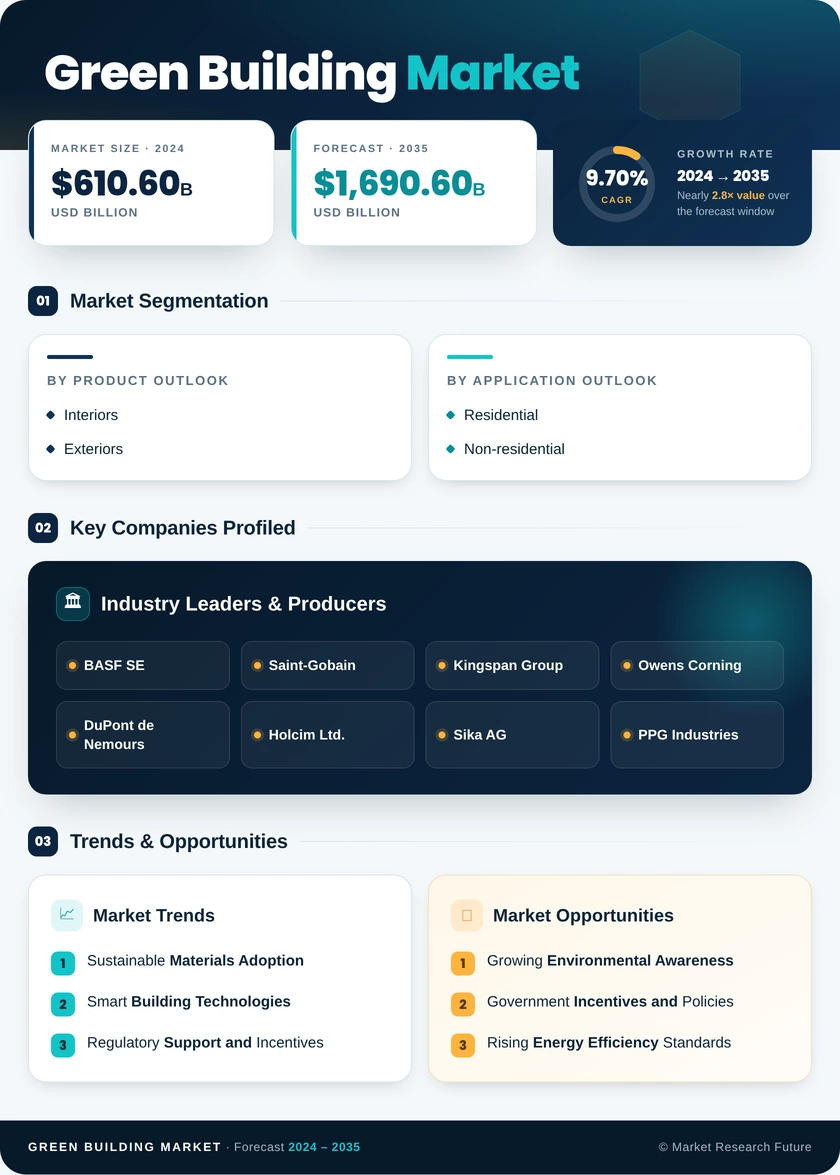
Green Building Market (2026 - 2035)

ID: MRFR/PCM/3547-CR 111 Pages Snehal Singh Last Updated: September 07, 2026
Green Building Market Research Report Information By Product Type (Exterior Products, Interior Products, Building Systems, and Others), By End User (Residential and Commercial), and By Construction Stage (New Construction and Renovation) – Forecast Till 2035
Green Building Market
Market Size
Forecast Period2026-2035
CAGR (2026-2035)11.25%
2025 Market SizeUSD 445.20 Billion
2035 Market SizeUSD 1,232.60 Billion
Key Players
Saint-Gobain
Schneider Electric
Johnson Controls
Kingspan
Owens Corning
Holcim
Opportunities
  • Performance-Data Monetization and Outcome Contracting
  • Emerging-Market Greenfield Specification Capture
  • Retrofit Packaging for Mid-Market Commercial Stock
  1. 1 Market Summary | |
    1. 1.1 Study Assumptions & Market Definition | |
    2. 1.2 Scope of the Study | |
    3. 1.3 Research Methodology | |
  2. 2 Key Report Takeaways | |
    1. 2.1 By Product Type | |
    2. 2.2 By End User | |
    3. 2.3 By Construction Stage | |
    4. 2.4 By Region | |
  3. 3 Market Size and Forecast (2021–2035) | |
    1. 3.1 Historical Market Size (2021–2024) | |
    2. 3.2 Base Year Estimate (2025) | |
    3. 3.3 Forecast Market Size (2026–2035) | |
    4. 3.4 Year-over-Year Growth Analysis | |
  4. 4 Driver Impact Analysis | |
    1. 4.1 Mandatory Carbon-Accounting and Disclosure Regimes | |
    2. 4.2 Sustainability-Linked Debt and Green-Bond Pricing | |
    3. 4.3 Deep-Retrofit Mandates on Worst-Performing Stock | |
    4. 4.4 Heat-Pump and HVAC Electrification Policy | |
    5. 4.5 Embodied-Carbon Procurement Scoring | |
    6. 4.6 Low-Carbon Material Cost-Curve Declines | |
    7. 4.7 Gulf and APAC Sovereign Development Programs | |
  5. 5 Restraints Impact Analysis | |
    1. 5.1 Capital Cost Premium on Certified Construction | |
    2. 5.2 Skilled Retrofit Labour Shortages | |
    3. 5.3 Interest-Rate Sensitivity of Development Finance | |
    4. 5.4 Fragmented Certification and Code Standards | |
    5. 5.5 Split Incentives Between Owners and Tenants | |
  6. 6 Opportunities | |
    1. 6.1 Performance-Data Monetization and Outcome Contracting | |
    2. 6.2 Emerging-Market Greenfield Specification Capture | |
    3. 6.3 Retrofit Packaging for Mid-Market Commercial Stock | |
    4. 6.4 Embodied-Carbon Verification Services | |
    5. 6.5 Industrialized Construction and Mass Timber | |
  7. 7 Regional Market Share and Country-Level Analysis | |
    1. 7.1 North America | | |
      1. 7.1.1 United States | | |
      2. 7.1.2 Canada | | |
      3. 7.1.3 Mexico | |
    2. 7.2 South America | | |
      1. 7.2.1 Brazil | | |
      2. 7.2.2 Argentina | | |
      3. 7.2.3 Chile | | |
      4. 7.2.4 Rest of South America | |
    3. 7.3 Europe | | |
      1. 7.3.1 United Kingdom | | |
      2. 7.3.2 Germany | | |
      3. 7.3.3 France | | |
      4. 7.3.4 Italy | | |
      5. 7.3.5 Spain | | |
      6. 7.3.6 Netherlands | | |
      7. 7.3.7 Rest of Europe | |
    4. 7.4 Middle East and Africa | | |
      1. 7.4.1 Saudi Arabia | | |
      2. 7.4.2 United Arab Emirates | | |
      3. 7.4.3 South Africa | | |
      4. 7.4.4 Nigeria | | |
      5. 7.4.5 Rest of Middle East and Africa | |
    5. 7.5 Asia-Pacific | | |
      1. 7.5.1 China | | |
      2. 7.5.2 India | | |
      3. 7.5.3 Japan | | |
      4. 7.5.4 South Korea | | |
      5. 7.5.5 Australia | | |
      6. 7.5.6 Indonesia | | |
      7. 7.5.7 Rest of Asia-Pacific | |
  8. 8 Future Outlook (2026–2035) | |
    1. 8.1 Autonomous Building Operations | |
    2. 8.2 Performance-Guarantee Business Models | |
    3. 8.3 Electrification and Grid Interaction | |
    4. 8.4 Whole-Life Carbon as the Binding Metric | |
  9. 9 Segmentation Analysis | |
    1. 9.1 By Product Type | | |
      1. 9.1.1 Exterior Products | | |
      2. 9.1.2 Interior Products | | |
      3. 9.1.3 Building Systems | | |
      4. 9.1.4 Others | |
    2. 9.2 By End User | | |
      1. 9.2.1 Residential | | |
      2. 9.2.2 Commercial | |
    3. 9.3 By Construction Stage | | |
      1. 9.3.1 New Construction | | |
      2. 9.3.2 Renovation | |
  10. 10 Competitive Landscape | |
    1. 10.1 Market Concentration Analysis (2026) | |
    2. 10.2 Competitive Benchmarking Matrix | |
    3. 10.3 Company Profiles | | |
      1. 10.3.1 Saint-Gobain | | |
      2. 10.3.2 Schneider Electric | | |
      3. 10.3.3 Johnson Controls | | |
      4. 10.3.4 Kingspan | | |
      5. 10.3.5 Owens Corning | | |
      6. 10.3.6 Holcim | | |
      7. 10.3.7 Honeywell | | |
      8. 10.3.8 Carrier Global | | |
      9. 10.3.9 Interface | | |
      10. 10.3.10 Binderholz | | |
      11. 10.3.11 Sublime Systems | |
  11. 11 Recent News & Developments | |
  12. 12 Report Scope and Methodology | |
    1. 12.1 Study Period & Base Year | |
    2. 12.2 Estimation Approach | |
    3. 12.3 Abbreviations | |
  13. 13 Detailed Sources and Citations | |
  14. 14 Frequently Asked Questions (FAQs) | | LIST OF TABLES | |
  15. TABLE 1 Global Green Building Market Size & Forecast, by Revenue (USD Billion), 2021–2035 | |
  16. TABLE 2 Global Green Building Market – Year-over-Year Growth Analysis, 2021–2035 | |
  17. TABLE 3 Driver Impact Analysis Matrix, 2026–2035 | |
  18. TABLE 4 Restraint Impact Analysis Matrix, 2026–2035 | |
  19. TABLE 5 Global Green Building Market Size, by Region, 2021–2035 (USD Billion) | |
  20. TABLE 6 North America Green Building Market Size, by Country, 2021–2035 (USD Billion) | |
  21. TABLE 7 South America Green Building Market Size, by Country, 2021–2035 (USD Billion) | |
  22. TABLE 8 Europe Green Building Market Size, by Country, 2021–2035 (USD Billion) | |
  23. TABLE 9 Middle East and Africa Green Building Market Size, by Country, 2021–2035 (USD Billion) | |
  24. TABLE 10 Asia-Pacific Green Building Market Size, by Country, 2021–2035 (USD Billion) | |
  25. TABLE 11 Global Green Building Market Size, by Product Type, 2021–2035 (USD Billion) | |
  26. TABLE 12 Global Green Building Market Size, by End User, 2021–2035 (USD Billion) | |
  27. TABLE 13 Global Green Building Market Size, by Construction Stage, 2021–2035 (USD Billion) | |
  28. TABLE 14 North America Green Building Market Size, by Product Type, 2021–2035 (USD Billion) | |
  29. TABLE 15 North America Green Building Market Size, by End User, 2021–2035 (USD Billion) | |
  30. TABLE 16 North America Green Building Market Size, by Construction Stage, 2021–2035 (USD Billion) | |
  31. TABLE 17 Europe Green Building Market Size, by Product Type, 2021–2035 (USD Billion) | |
  32. TABLE 18 Europe Green Building Market Size, by End User, 2021–2035 (USD Billion) | |
  33. TABLE 19 Europe Green Building Market Size, by Construction Stage, 2021–2035 (USD Billion) | |
  34. TABLE 20 Asia-Pacific Green Building Market Size, by Product Type, 2021–2035 (USD Billion) | |
  35. TABLE 21 Asia-Pacific Green Building Market Size, by End User, 2021–2035 (USD Billion) | |
  36. TABLE 22 Asia-Pacific Green Building Market Size, by Construction Stage, 2021–2035 (USD Billion) | |
  37. TABLE 23 South America Green Building Market Size, by Product Type, 2021–2035 (USD Billion) | |
  38. TABLE 24 South America Green Building Market Size, by End User, 2021–2035 (USD Billion) | |
  39. TABLE 25 Middle East and Africa Green Building Market Size, by Product Type, 2021–2035 (USD Billion) | |
  40. TABLE 26 Middle East and Africa Green Building Market Size, by End User, 2021–2035 (USD Billion) | |
  41. TABLE 27 Competitive Benchmarking Matrix – Global Green Building Market, 2026 | |
  42. TABLE 28 Company Profiles – Key Players, Global Green Building Market | |
  43. TABLE 29 Recent Developments & Strategic Announcements, 2023–2025 | |
  44. TABLE 30 Report Scope & Methodology Summary | |
  45. TABLE 31 Detailed Sources and Citations Index | | LIST OF FIGURES | |
  46. FIGURE 1 Global Green Building Market – Market Dynamics Overview (Drivers, Restraints, Opportunities) | |
  47. FIGURE 2 Industry Value Chain Analysis – Green Building Market | |
  48. FIGURE 3 Porter's Five Forces Analysis – Green Building Market | |
  49. FIGURE 4 Global Green Building Market Size Trend, 2021–2035 (USD Billion) | |
  50. FIGURE 5 Year-over-Year Growth Trend, 2022–2035 (%) | |
  51. FIGURE 6 Market Share by Product Type, 2025 vs 2035 (%) | |
  52. FIGURE 7 Market Share by End User, 2025 vs 2035 (%) | |
  53. FIGURE 8 Market Share by Construction Stage, 2025 vs 2035 (%) | |
  54. FIGURE 9 Regional Market Share Distribution, 2025 (%) | |
  55. FIGURE 10 Regional CAGR Comparison, 2026–2035 (%) | |
  56. FIGURE 11 Country-Level Share within Asia-Pacific, 2025 (%) | |
  57. FIGURE 12 Country-Level Share within Europe, 2025 (%) | |
  58. FIGURE 13 Competitive Landscape – Estimated Revenue Share Ranges, 2026 | |
  59. FIGURE 14 Competitive Positioning Matrix – Capability vs Scale | |
  60. FIGURE 15 Driver Impact Contribution Chart, 2026–2035

Segmentation Quick Reference

DimensionSub-SegmentsDominant SegmentFastest Growing Segment
By Product TypeExterior Products; Interior Products; Building Systems; OthersBuilding Systems (45.1% share, 2025)Exterior Products (12.05% CAGR, 2026–2035)
By End UserResidential (Apartments & Condominiums, Villas & Landed Houses); Commercial (Office, Retail, Logistics, Institutional, Others)Commercial (USD 249.30 Billion, 2025)Logistics within Commercial (12.60% CAGR, 2026–2035)
By Construction StageNew Construction; RenovationNew Construction (64.5% share, 2025)Renovation (12.42% CAGR, 2026–2035)


Market Segmentation Overview

By Product Type

Sub-SegmentKey Trend
Exterior ProductsEnvelope codes push high-performance glazing and insulated panels from premium to baseline specification.
Interior ProductsLow-emission paints, adhesives, and recycled flooring gain share through occupant-wellness scoring.
Building SystemsHVAC electrification converges with unified management platforms sold as analytics subscriptions
OthersPhase-change assemblies and electrochromic glazing await cost declines before mainstream scope entry.


Building Systems hold the largest position because they produce the metered evidence that lenders and disclosure regimes now demand, something Exterior Products cannot supply on their own. Exterior Products nonetheless grow fastest as tightening envelope codes make high-performance glazing and insulated panels mandatory rather than optional, narrowing the gap through 2035. Interior Products depend on wellness certification uptake in premium offices, a narrower buyer base. Suppliers in the Others category compete on cost reduction, not performance, since their technical case is already proven.

By End User

Sub-SegmentKey Trend
Residential — Apartments & CondominiumsMinimum energy scores in European and Asian metros drive heat-pump water heating and gray-water systems.
Residential — Villas & Landed HousesLuxury buyers treat certification as positioning; mass-market uptake lags policy incentives.
Commercial — OfficeFlight-to-quality leasing rewards landlords who can document occupier emissions reductions
Commercial — RetailUtility cost defence drives lighting, refrigeration, and controls retrofit under margin pressure.
Commercial — LogisticsWarehouse construction tied to net-zero deadlines adds rooftop generation and efficient cold chain.
Commercial — InstitutionalUniversities and hospitals fund upgrades with long-tenor green bonds matched to savings paybacks.
Commercial — Others (industrial real estate, hospitality real estate, etc.)Export-linked disclosure requirements pull industrial facilities into certification scope.


Commercial leads decisively because tenants audit landlord performance and price it into leasing decisions, with Office and Institutional assets carrying the deepest specification. Logistics grows fastest within Commercial as e-commerce warehouse pipelines are built against corporate net-zero deadlines that make efficient envelopes and rooftop generation standard scope. Residential splits along a clean line: Apartments & Condominiums move because regulation compels minimum energy scores. In contrast, Villas & Landed Houses move on discretionary buyer preference and therefore track economic cycles more closely.

By Construction Stage

Sub-SegmentKey Trend
New ConstructionEmerging-market megaprojects embed green specifications at master-plan stage, lowering unit compliance cost.
RenovationDeep-retrofit mandates and adaptive-reuse economics expand turnkey contractor backlogs above 25% annually.


New Construction retains the dominant share because Asian and Gulf development volume is enormous and specifying green performance during design costs a fraction of remediating it later. Renovation grows faster because compliance deadlines apply to buildings that already exist and cannot be deferred by pausing development, and because land-constrained cities favour adaptive reuse that preserves structural shells along with their embodied carbon. The two stages therefore respond to different signals — one to construction cycles, the other to regulatory calendars.




Download PDF ×

We do not share your information with anyone. However, we may send you emails based on your report interest from time to time. You may contact us at any time to opt-out.