Request Free Sample ×

Kindly complete the form below to receive a free sample of this Report

* Please use a valid business email

Leading companies partner with us for data-driven Insights

clients tt-cursor
Hero Background
English
Chinese
French
Japanese
Korean
German
Spanish

Gold Mining Market Share

ID: MRFR/CnM/14585-CR
128 Pages
Anshula Mandaokar
January 2026

Gold Mining Market Research Report By Process (Placer Mining, Hardrock Mining, Others), By End-Use (Investment, Jewellery, Others), By Regional - Forecast to 2035

Share:
Download PDF ×

We do not share your information with anyone. However, we may send you emails based on your report interest from time to time. You may contact us at any time to opt-out.

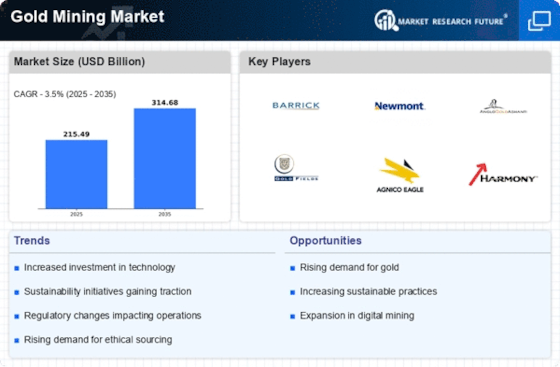
Gold Mining Market Infographic
Purchase Options

Market Share

Gold Mining Market Share Analysis

In the dynamic landscape of the Gold Mining market, companies employ various strategies to establish and fortify their market share positioning. Differentiation is a fundamental approach wherein companies strive to distinguish their gold mining operations from competitors by offering unique extraction methods, environmental sustainability practices, or advanced exploration technologies. This might involve innovations in ore processing for increased efficiency, responsible mining practices, or community engagement initiatives. Through differentiation, companies attract investors and stakeholders seeking socially and environmentally responsible gold mining operations, enabling them to secure a distinctive market share within the Gold Mining industry.

Cost leadership is another prevalent strategy in this market, where companies aim to become the low-cost producers of gold. This involves optimizing mining processes, negotiating favorable terms with suppliers, and implementing cost-effective environmental and safety measures. Cost leadership is effective in appealing to investors and buyers seeking economically viable gold production. However, maintaining high safety standards, minimizing environmental impact, and complying with regulatory requirements are crucial to ensure sustainable gold mining and customer satisfaction in this cost-driven strategy.

Market segmentation is widely adopted in the Gold Mining industry. Companies analyze the diverse needs of their customer base, including jewelers, electronics manufacturers, and investors, and adjust their gold production to meet specific market demands. For instance, they might focus on high-purity gold for jewelry or gold concentrates for industrial applications. By addressing the unique requirements of each segment, companies can establish a robust presence within different markets, contributing to an overall enhanced market share.

Strategic partnerships and collaborations play a pivotal role in the Gold Mining market. Companies often form alliances with technology providers, environmental organizations, or local communities to strengthen their operational capabilities, enhance brand visibility, and address social and environmental concerns. Collaborative efforts can lead to shared resources, access to new exploration technologies, and the development of sustainable mining practices. Through strategic partnerships, companies can navigate industry challenges more effectively, ultimately contributing to a more secure market share position.

Innovation stands as a cornerstone strategy in the Gold Mining market, driven by the continual pursuit of improved extraction methods, environmental sustainability, and exploration technologies. Companies invest in research and development to introduce mining technologies that reduce energy consumption, minimize waste, and enhance overall efficiency. Innovations in responsible mining practices, digital exploration techniques, and water recycling contribute to staying competitive and attracting investors and buyers seeking socially and environmentally conscious gold mining operations. By being at the forefront of innovation, companies position themselves as leaders in the Gold Mining market, securing a significant market share.

Customer-centric strategies are gaining prominence as companies recognize the importance of providing exceptional stakeholder experiences. This involves transparent communication about mining practices, engagement with local communities, and adherence to ethical and sustainable mining standards. Exceptional corporate responsibility contributes to stakeholder satisfaction and loyalty, encouraging investors, buyers, and local communities to choose a particular mining company for their gold needs. By focusing on building strong relationships with stakeholders, companies can solidify their market share and maintain a competitive edge in the Gold Mining industry.

Author
Anshula Mandaokar
Team Lead - Research

Anshula Mandaokar holds an academic degree in Chemical Engineering and has been contributing to the field for more than 5 years. She has expertise in Market Research and Business Consulting and serves as a Team Lead for a reputed Market Research firm under the Chemicals and Materials domain spectrum. She has worked on multiple projects, generating explicit results in a quick turnaround time. Her understanding of data interpretation justifies her role as a leader.

Leave a Comment

FAQs

What is the current valuation of the Gold Mining Market?

<p>As of 2024, the Gold Mining Market was valued at 215.49 USD Billion.</p>

What is the projected market valuation for the Gold Mining Market in 2035?

<p>The Gold Mining Market is projected to reach a valuation of 314.68 USD Billion by 2035.</p>

What is the expected CAGR for the Gold Mining Market from 2025 to 2035?

<p>The expected CAGR for the Gold Mining Market during the forecast period 2025 - 2035 is 3.5%.</p>

Which mining methods are significant in the Gold Mining Market?

<p>The Gold Mining Market includes significant segments such as Placer Mining, valued between 85.0 and 120.0 USD Billion, and Hardrock (Lode) Mining, valued between 130.49 and 194.68 USD Billion.</p>

What are the primary end-user segments in the Gold Mining Market?

<p>Key end-user segments in the Gold Mining Market include Investment, valued between 85.0 and 120.0 USD Billion, and Jewelry, valued between 100.0 and 150.0 USD Billion.</p>

Who are the leading companies in the Gold Mining Market?

<p>Leading companies in the Gold Mining Market include Barrick Gold Corporation, Newmont Corporation, and AngloGold Ashanti Limited, among others.</p>

How does the performance of the Gold Mining Market compare across different segments?

The performance of the Gold Mining Market varies, with Hardrock (Lode) Mining showing higher valuations compared to Placer Mining.

What factors could influence the growth of the Gold Mining Market?

Factors influencing the growth of the Gold Mining Market may include fluctuations in gold prices, technological advancements, and regulatory changes.

What is the significance of jewelry in the Gold Mining Market?

Jewelry represents a crucial segment in the Gold Mining Market, with a valuation projected between 100.0 and 150.0 USD Billion.

How might the market dynamics change by 2035?

By 2035, the Gold Mining Market dynamics may evolve, potentially driven by increased demand for gold in various sectors and investment opportunities.

Market Summary

As per Market Research Future analysis, the Global Gold Mining Market Size Was Valued at USD 249.33 Billion In 2024. The Global Gold Mining Industry Is Projected to grow from USD 255.70 Billion in 2025 to USD 379.41 Billion by 2035, Exhibiting A Compound Annual Growth Rate (CAGR) of 4.0% during the Forecast Period (2025 - 2035).

Key Market Trends & Highlights

The Gold Mining Market is the process of extracting gold from the earth through various methods, including placer mining, hard rock mining, by-product recovery, and refining from ore.

  • The market encompasses a wide range of activities from geological exploration and feasibility studies to drilling, excavation market. Growing focus on preventive processing, and smelting Are Driving the Global Gold Mining Markets. Integration of smart features and eco-friendly designs is gaining traction, with rechargeable models leading the market while manual options remain niche.

Market Size & Forecast

2024 Market Size 249.33 (USD Billion)
2035 Market Size 379.41 (USD Billion)
CAGR (2025 - 2035) 4.0%

Major Players

Gold Fields Limited, Agnico eagle mines ltd, Barrick Mining Corporation, Polyus (PJSC Polyus), Newmont Mining Corporation, Kinross Gold Corporation, AngloGold Ashanti Ltd, Evolution Mining Ltd, Northern Star Resources Ltd, Harmony Gold Mining Company Ltd, And Others.

Market Trends

Untapped Reserves in Developing Regions

Developing regions, especially across Africa, Central Asia, and parts of Latin America, possess vast untapped gold reserves with substantial geological potential. Africa, in particular, continues to emerge as a global hotspot for gold mining, combining high-grade deposits with underexplored terrain. According to 2024 estimates, Africa’s top gold producers are led by Ghana, which remains the continent’s leader with an output of 140.6 tonnes, followed closely by Mali (100 tonnes), South Africa (98.9 tonnes), and Burkina Faso (94.4 tonnes). Other significant contributors include Sudan (73.8 tonnes), Guinea (68 tonnes), Côte d'Ivoire (58 tonnes), Tanzania (51.8 tonnes), Zimbabwe (50.9 tonnes), and the Democratic Republic of the Congo (42.3 tonnes). Even smaller producers such as Niger (33.6 tonnes), Mauritania (21.9 tonnes), Liberia (20.3 tonnes), Madagascar (16.2 tonnes), and Senegal (15.3 tonnes) are showing notable production levels, often driven by recent foreign investments and policy reforms. 

Despite these growing volumes, most of these countries remain geologically underexplored using modern techniques, and the majority of their mineralized zones have not been fully delineated or exploited. For instance, West Africa’s Birimian Greenstone Belt, which spans Ghana, Burkina Faso, Mali, and Côte d’Ivoire, is believed to host over 10,000 tonnes of untapped gold resources, yet exploration intensity is still only a fraction compared to established jurisdictions like Canada or Australia. South Africa, while historically dominant, is facing ore grade depletion and rising costs—its average grades have dropped from 15 grams/tonne in the 1970s to around 1 g/t today. 

Meanwhile, countries like Guinea, Madagascar, and Senegal are gaining attention from junior and major miners alike due to newly discovered mineralized zones supported by advanced satellite imaging and AI-assisted exploration. At the same time, regions in Central Asia (such as Uzbekistan and Kyrgyzstan) and the Andean nations of South America (notably Peru, Ecuador, and Colombia) hold large-scale reserves that remain underdeveloped due to infrastructure and political constraints. However, with global average discovery rates having declined by over 40% since 2010, the mining industry is turning toward these geologically prospective yet commercially underexploited regions. As mature producers struggle with declining reserves and increasing operational costs, the opportunity to access large-scale, high-grade, and low-cost gold deposits in developing regions becomes a critical driver for the future expansion of the global gold mining market.

Gold Mining Market Market Drivers

Central Bank Purchases

Central banks added over 1,000 tonnes to reserves in 2025—the third consecutive year above this threshold—led by emerging markets diversifying from USD assets amid de-dollarization trends. Institutions like those in China, India, Poland, and Turkey drove this, with surveys indicating 95% expect continued buying in 2026. This structural demand, estimated at 750-900 tonnes annually, provides a stable floor for prices and supports mining expansion.
 
Western investors returned strongly in 2025, with gold ETFs seeing record inflows (over 400 tonnes year-to-date). Bar and coin demand exceeded 1,200 tonnes, fueled by "FOMO" (fear of missing out) and portfolio diversification. Momentum trading and hedging against equity volatility amplified this. In 2026, persistent low real yields and potential rate cuts could sustain ETF flows at 250+ tonnes.

Jewellery and Industrial Demand

Despite price sensitivity curbing jewellery consumption in high-price environments, emerging markets like India and China—accounting for over 50% of global jewellery demand—remain resilient due to cultural significance and economic recovery. Technology demand (electronics, AI components, medical devices) is steady, though thrifting offsets some growth. Overall demand hit record quarterly values in 2025 (e.g., $146 billion in Q3), outpacing supply.

Supply Constraints Reinforcing Prices

Global mine production reached near-record ~3,700 tonnes in 2025, but peak gold looms by 2026-2028 due to fewer major discoveries and declining grades. Recycling contributed ~1,000 tonnes but remained flat. Tight supply-demand dynamics propel prices higher, benefiting producers.

Record Gold Prices and Safe-Haven Demand

Gold prices rose over 50% in 2025, driven by global uncertainties including trade tariffs, geopolitical tensions (e.g., ongoing conflicts in the Middle East and Europe), and economic volatility. As a non-yielding asset, gold thrives when real interest rates decline and the US dollar weakens. Forecasts for 2026 suggest averages of $4,500-5,300 per ounce, with upside potential to $6,000 in bullish scenarios from analysts like Yardeni Research. High prices expand margins for miners, with all-in sustaining costs (AISC) around $1,500-1,800/oz yielding substantial profits. This price signal encourages investment in lower-grade deposits and remote projects, directly boosting mining output.

Market Segment Insights

By Mining Method: Placer Mining (Largest) vs. Hardrock (Lode) Mining (Fastest-Growing)

<p>The gold mining market is significantly influenced by two primary mining methods: placer mining and hardrock (lode) mining. Placer mining holds the largest market share, primarily due to its long-standing historical use and simplicity in extracting gold from surface deposits. Meanwhile, hardrock mining, although smaller in terms of current market share, is rapidly gaining attention as technological advancements enable more efficient and environmentally friendly extraction practices. The versatility and sheer volume of gold deposits accessible through hardrock mining contribute to its growing presence in the market. Looking to the future, the gold mining segment is witnessing notable growth trends, driven by increasing global demand for gold in various sectors including investment, electronics, and jewelry. While placer mining remains the dominant player for immediate gold extraction needs, hardrock mining is emerging as a robust alternative, thanks to innovations in mining technology and improving mineral processing techniques. Regulatory support for environmentally sound mining operations is also accelerating the expansion of hardrock mining, ensuring a competitive stance against traditional placer methods.</p>

<p>Mining Method: Placer Mining (Dominant) vs. Hardrock (Lode) Mining (Emerging)</p>

<p>Placer mining is regarded as the dominant method in the gold mining sector, characterized by its ability to efficiently extract gold from alluvial deposits and river sediments. This method leverages gravity separation techniques and is predominantly employed in areas with high concentrations of gold deposits, making it highly effective for artisanal and small-scale miners. On the other hand, hardrock (lode) mining represents an emerging segment that extracts gold from solid rock formations. Although it requires a much higher capital investment and advanced technological input, hardrock mining is increasingly favored for its potential to tap into deeper gold reserves and larger deposits. As mining companies focus on sustainable practices, hardrock mining is projected to evolve rapidly, offering innovative extraction methods that align with environmental standards.</p>

By End-User: Jewelry (Largest) vs. Investment (Fastest-Growing)

<p>In the Gold Mining Market, the end-user segment is primarily composed of three main categories: Jewelry, Investment, and Others. Among these, the Jewelry sector holds the largest market share, as gold continues to be a preferred material for various adornments and luxury items across different cultures. The Investment category, while not as large in share, is gaining traction due to the increasing popularity of gold as a safe-haven asset in times of economic uncertainty, driving significant interest from individual and institutional investors alike. The growth trends for the Gold Mining Market's end-user segment are significantly influenced by global economic conditions and consumer behaviors. The Jewelry sector is expected to remain robust owing to cultural demand and fashion trends, while the Investment segment is projected to witness rapid growth as more people turn to gold for portfolio diversification and wealth preservation. Factors like geopolitical tensions and inflation fears are further propelling the demand for gold as an investment, indicating a promising outlook for the Investment category.</p>

<p>Jewelry (Dominant) vs. Investment (Emerging)</p>

<p>The Jewelry segment in the Gold Mining Market is characterized by its cultural significance and continuous demand, making it a dominant player. This segment benefits from a consistent buyer base across various demographics who view gold not only as a fashion statement but also as a symbol of wealth and tradition. The design innovations and marketing strategies utilized by jewelers further cement the appeal of gold jewelry. On the other hand, the Investment segment, although emerging, is rapidly gaining importance as investors recognize gold's role as a safe asset. This segment includes products like gold bars, coins, and exchange-traded funds, reflecting a shift in investment strategies. The increased accessibility of investment options and growing awareness of gold’s value as a hedge against inflation are driving this segment's growth.</p>

Get more detailed insights about Gold Mining Market Research Report - Forecast Till 2035

Regional Insights

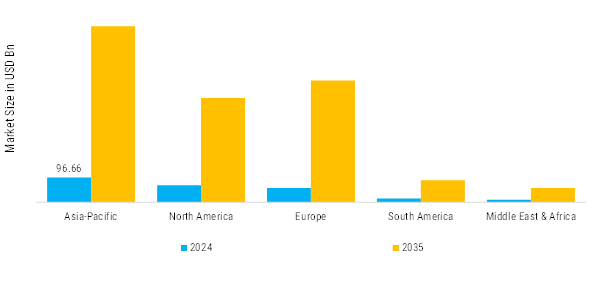
Based on region, the Global Commercial Heat-Treating Market is segmented into North America, Europe, Asia-Pacific, South America and Middle East and Africa.  Asia-Pacific accounted for the largest market share in 2024 and is anticipated to reach USD 96.66 Billion by 2035. Asia-Pacific is projected to grow at the highest CAGR of 5.8% during the forecast period.

Europe: Expanding operation market

This region is the largest contributor to global gold mining, led by giants the world’s largest gold producer since 2007, produced significant amount of gold in 2024, driven by operations in Shandong, Henan, and Inner Mongolia. Major state-affiliated firms like Zijin Mining and China National Gold Group dominate production and continue expanding both domestically and abroad. China also has a vertically integrated gold industry, supporting both mining and massive internal consumption. 

Global Gold Mining Market Regional Insights

North America: Emerging operation Evolution

This region second-largest producer globally, contributes ~320 tonnes annually, with world-class open-pit and underground operations like Cadia, Boddington, Fosterville, and Super Pit (Kalgoorlie). Australian gold mining is led by global players like Newmont, Northern Star Resources, and Evolution Mining. Their operations benefit from rich geology, mature infrastructure, and strong investment environments. 

Europe: Emerging rights & Disputes

These include land rights disputes, environmental degradation, artisanal mining issues, and geopolitical risks in parts of Southeast Asia. However, government incentives, increasing automation, and stronger regulatory oversight are helping formalize and scale operations. 

Asia-pacific: Rising internal Demand

With rising internal demand, ongoing exploration in the Philippines, Vietnam, and Myanmar, and technological advancement, APAC is expected to retain its leadership in both production and consumption in the global gold mining value chain.

Middle-East & Africa: Provide survive products

 Middle-East & Africa is major state-affiliated firms like Zijin Mining and China National Gold Group dominate production and continue expanding both domestically and abroad. The vendors compete based on cost, product quality, reliability, and government regulations. Vendors must provide cost-efficient, high-quality products to survive and succeed in an intensely competitive market. 

Key Players and Competitive Insights

Many global, regional, and local vendors characterize the Gold Mining Market. The market is highly competitive, with all the players competing to gain market share. Intense competition, rapid advances in technology, frequent changes in government policies, and environmental regulations are key factors that confront market growth. The vendors compete based on cost, product quality, reliability, and government regulations. Vendors must provide cost-efficient, high-quality products to survive and succeed in an intensely competitive market.  The major players in the market Include Gold Fields Limited, Agnico eagle mines ltd, Barrick Mining Corporation, Polyus (PJSC Polyus), Newmont Mining Corporation, Kinross Gold Corporation, AngloGold Ashanti Ltd, Evolution Mining Ltd, Northern Star Resources Ltd, Harmony Gold Mining Company Ltd, And Others. The Global Gold Mining Market is a consolidated market due to increasing competition, acquisitions, mergers, and other strategic market developments and decisions to improve operational effectiveness.

Key Companies in the Gold Mining Market include

Industry Developments

December 2025: Agnico eagle mines ltd having advanced key projects including Odyssey underground at Canadian Malartic, Detour Lake exploration ramp, Upper Beaver shaft (planned late 2025), Hope Bay drilling; strong operational performance with record production and free cash flow in quarters; focus on regional consolidation in Abitibi and sustainable growth. 

Future Outlook

Gold Mining Market Future Outlook

The Gold Mining Market is projected to grow at a 4.0% CAGR from 2025 to 2035, driven by increasing demand for high-performance computing and enhanced security features.

New opportunities lie in:

  • <p>Untapped Reserves in Developing Regions. Rising Investment demand.</p>

By 2035, the Global Gold Mining Market is projected to emerge as a cornerstone of advanced <a href="https://www.marketresearchfuture.com/reports/oral-care-market-6526" target="_blank" title="oral care">oral care</a> solutions worldwide.

Market Segmentation

Gold Mining Market by End-Use Outlook

  • Investment
  • Jewellery
  • Others

Gold Mining Market by Process Outlook

  • Placer Mining
  • Hardrock Mining
  • Others

Report Scope

Market Size 2024 1,077.88 (USD Billion)
Market Size 2025 249.33 (USD Billion)
Market Size 2035 379.41 (USD Billion)
Compound Annual Growth Rate (CAGR) 4.0% (2025 - 2035)
Report Coverage Revenue Forecast, Competitive Landscape, Growth Factors, and Trends
Base Year 2024
Market Forecast Period 2025 - 2035
Historical Data 2019 - 2023
Market Forecast Units USD Billion
Key Companies Profiled Gold Fields Limited, Agnico eagle mines ltd, Barrick Mining Corporation, Polyus (PJSC Polyus), Newmont Mining Corporation, Kinross Gold Corporation, AngloGold Ashanti Ltd, Evolution Mining Ltd, Northern Star Resources Ltd, Harmony Gold Mining Company Ltd, Others.
Segments Covered By Process, By End-Use 
Key Market Opportunities Untapped Reserves in Developing Regions.Rising Investment demand.
Key Market Dynamics Rising demand for gold Jewelry. Central Bank Reserves.
Countries Covered North America, Europe, APAC, South America, MEA

FAQs

What is the current valuation of the Gold Mining Market?

<p>As of 2024, the Gold Mining Market was valued at 215.49 USD Billion.</p>

What is the projected market valuation for the Gold Mining Market in 2035?

<p>The Gold Mining Market is projected to reach a valuation of 314.68 USD Billion by 2035.</p>

What is the expected CAGR for the Gold Mining Market from 2025 to 2035?

<p>The expected CAGR for the Gold Mining Market during the forecast period 2025 - 2035 is 3.5%.</p>

Which mining methods are significant in the Gold Mining Market?

<p>The Gold Mining Market includes significant segments such as Placer Mining, valued between 85.0 and 120.0 USD Billion, and Hardrock (Lode) Mining, valued between 130.49 and 194.68 USD Billion.</p>

What are the primary end-user segments in the Gold Mining Market?

<p>Key end-user segments in the Gold Mining Market include Investment, valued between 85.0 and 120.0 USD Billion, and Jewelry, valued between 100.0 and 150.0 USD Billion.</p>

Who are the leading companies in the Gold Mining Market?

<p>Leading companies in the Gold Mining Market include Barrick Gold Corporation, Newmont Corporation, and AngloGold Ashanti Limited, among others.</p>

How does the performance of the Gold Mining Market compare across different segments?

The performance of the Gold Mining Market varies, with Hardrock (Lode) Mining showing higher valuations compared to Placer Mining.

What factors could influence the growth of the Gold Mining Market?

Factors influencing the growth of the Gold Mining Market may include fluctuations in gold prices, technological advancements, and regulatory changes.

What is the significance of jewelry in the Gold Mining Market?

Jewelry represents a crucial segment in the Gold Mining Market, with a valuation projected between 100.0 and 150.0 USD Billion.

How might the market dynamics change by 2035?

By 2035, the Gold Mining Market dynamics may evolve, potentially driven by increased demand for gold in various sectors and investment opportunities.

  1. SECTION I: EXECUTIVE SUMMARY AND KEY HIGHLIGHTS
    1. | 1.1 EXECUTIVE SUMMARY
    2. | | 1.1.1 Market Overview
    3. | | 1.1.2 Key Findings
    4. | | 1.1.3 Market Segmentation
    5. | | 1.1.4 Competitive Landscape
    6. | | 1.1.5 Challenges and Opportunities
    7. | | 1.1.6 Future Outlook
  2. SECTION II: SCOPING, METHODOLOGY AND MARKET STRUCTURE
    1. | 2.1 MARKET INTRODUCTION
    2. | | 2.1.1 Definition
    3. | | 2.1.2 Scope of the study
    4. | | | 2.1.2.1 Research Objective
    5. | | | 2.1.2.2 Assumption
    6. | | | 2.1.2.3 Limitations
    7. | 2.2 RESEARCH METHODOLOGY
    8. | | 2.2.1 Overview
    9. | | 2.2.2 Data Mining
    10. | | 2.2.3 Secondary Research
    11. | | 2.2.4 Primary Research
    12. | | | 2.2.4.1 Primary Interviews and Information Gathering Process
    13. | | | 2.2.4.2 Breakdown of Primary Respondents
    14. | | 2.2.5 Forecasting Model
    15. | | 2.2.6 Market Size Estimation
    16. | | | 2.2.6.1 Bottom-Up Approach
    17. | | | 2.2.6.2 Top-Down Approach
    18. | | 2.2.7 Data Triangulation
    19. | | 2.2.8 Validation
  3. SECTION III: QUALITATIVE ANALYSIS
    1. | 3.1 MARKET DYNAMICS
    2. | | 3.1.1 Overview
    3. | | 3.1.2 Drivers
    4. | | 3.1.3 Restraints
    5. | | 3.1.4 Opportunities
    6. | 3.2 MARKET FACTOR ANALYSIS
    7. | | 3.2.1 Value chain Analysis
    8. | | 3.2.2 Porter's Five Forces Analysis
    9. | | | 3.2.2.1 Bargaining Power of Suppliers
    10. | | | 3.2.2.2 Bargaining Power of Buyers
    11. | | | 3.2.2.3 Threat of New Entrants
    12. | | | 3.2.2.4 Threat of Substitutes
    13. | | | 3.2.2.5 Intensity of Rivalry
    14. | | 3.2.3 COVID-19 Impact Analysis
    15. | | | 3.2.3.1 Market Impact Analysis
    16. | | | 3.2.3.2 Regional Impact
    17. | | | 3.2.3.3 Opportunity and Threat Analysis
  4. SECTION IV: QUANTITATIVE ANALYSIS
    1. | 4.1 Chemicals and Materials, BY Mining Method (USD Billion)
    2. | | 4.1.1 Placer Mining
    3. | | 4.1.2 Hardrock (Lode) Mining
    4. | 4.2 Chemicals and Materials, BY End-User (USD Billion)
    5. | | 4.2.1 Investment
    6. | | 4.2.2 Jewelry
    7. | | 4.2.3 Others
    8. | 4.3 Chemicals and Materials, BY Region (USD Billion)
    9. | | 4.3.1 North America
    10. | | | 4.3.1.1 US
    11. | | | 4.3.1.2 Canada
    12. | | 4.3.2 Europe
    13. | | | 4.3.2.1 Germany
    14. | | | 4.3.2.2 UK
    15. | | | 4.3.2.3 France
    16. | | | 4.3.2.4 Russia
    17. | | | 4.3.2.5 Italy
    18. | | | 4.3.2.6 Spain
    19. | | | 4.3.2.7 Rest of Europe
    20. | | 4.3.3 APAC
    21. | | | 4.3.3.1 China
    22. | | | 4.3.3.2 India
    23. | | | 4.3.3.3 Japan
    24. | | | 4.3.3.4 South Korea
    25. | | | 4.3.3.5 Malaysia
    26. | | | 4.3.3.6 Thailand
    27. | | | 4.3.3.7 Indonesia
    28. | | | 4.3.3.8 Rest of APAC
    29. | | 4.3.4 South America
    30. | | | 4.3.4.1 Brazil
    31. | | | 4.3.4.2 Mexico
    32. | | | 4.3.4.3 Argentina
    33. | | | 4.3.4.4 Rest of South America
    34. | | 4.3.5 MEA
    35. | | | 4.3.5.1 GCC Countries
    36. | | | 4.3.5.2 South Africa
    37. | | | 4.3.5.3 Rest of MEA
  5. SECTION V: COMPETITIVE ANALYSIS
    1. | 5.1 Competitive Landscape
    2. | | 5.1.1 Overview
    3. | | 5.1.2 Competitive Analysis
    4. | | 5.1.3 Market share Analysis
    5. | | 5.1.4 Major Growth Strategy in the Chemicals and Materials
    6. | | 5.1.5 Competitive Benchmarking
    7. | | 5.1.6 Leading Players in Terms of Number of Developments in the Chemicals and Materials
    8. | | 5.1.7 Key developments and growth strategies
    9. | | | 5.1.7.1 New Product Launch/Service Deployment
    10. | | | 5.1.7.2 Merger & Acquisitions
    11. | | | 5.1.7.3 Joint Ventures
    12. | | 5.1.8 Major Players Financial Matrix
    13. | | | 5.1.8.1 Sales and Operating Income
    14. | | | 5.1.8.2 Major Players R&D Expenditure. 2023
    15. | 5.2 Company Profiles
    16. | | 5.2.1 Barrick Gold Corporation (CA)
    17. | | | 5.2.1.1 Financial Overview
    18. | | | 5.2.1.2 Products Offered
    19. | | | 5.2.1.3 Key Developments
    20. | | | 5.2.1.4 SWOT Analysis
    21. | | | 5.2.1.5 Key Strategies
    22. | | 5.2.2 Newmont Corporation (US)
    23. | | | 5.2.2.1 Financial Overview
    24. | | | 5.2.2.2 Products Offered
    25. | | | 5.2.2.3 Key Developments
    26. | | | 5.2.2.4 SWOT Analysis
    27. | | | 5.2.2.5 Key Strategies
    28. | | 5.2.3 AngloGold Ashanti Limited (ZA)
    29. | | | 5.2.3.1 Financial Overview
    30. | | | 5.2.3.2 Products Offered
    31. | | | 5.2.3.3 Key Developments
    32. | | | 5.2.3.4 SWOT Analysis
    33. | | | 5.2.3.5 Key Strategies
    34. | | 5.2.4 Kinross Gold Corporation (CA)
    35. | | | 5.2.4.1 Financial Overview
    36. | | | 5.2.4.2 Products Offered
    37. | | | 5.2.4.3 Key Developments
    38. | | | 5.2.4.4 SWOT Analysis
    39. | | | 5.2.4.5 Key Strategies
    40. | | 5.2.5 Gold Fields Limited (ZA)
    41. | | | 5.2.5.1 Financial Overview
    42. | | | 5.2.5.2 Products Offered
    43. | | | 5.2.5.3 Key Developments
    44. | | | 5.2.5.4 SWOT Analysis
    45. | | | 5.2.5.5 Key Strategies
    46. | | 5.2.6 Agnico Eagle Mines Limited (CA)
    47. | | | 5.2.6.1 Financial Overview
    48. | | | 5.2.6.2 Products Offered
    49. | | | 5.2.6.3 Key Developments
    50. | | | 5.2.6.4 SWOT Analysis
    51. | | | 5.2.6.5 Key Strategies
    52. | | 5.2.7 Harmony Gold Mining Company Limited (ZA)
    53. | | | 5.2.7.1 Financial Overview
    54. | | | 5.2.7.2 Products Offered
    55. | | | 5.2.7.3 Key Developments
    56. | | | 5.2.7.4 SWOT Analysis
    57. | | | 5.2.7.5 Key Strategies
    58. | | 5.2.8 Franco-Nevada Corporation (CA)
    59. | | | 5.2.8.1 Financial Overview
    60. | | | 5.2.8.2 Products Offered
    61. | | | 5.2.8.3 Key Developments
    62. | | | 5.2.8.4 SWOT Analysis
    63. | | | 5.2.8.5 Key Strategies
    64. | 5.3 Appendix
    65. | | 5.3.1 References
    66. | | 5.3.2 Related Reports
  6. LIST OF FIGURES
    1. | 6.1 MARKET SYNOPSIS
    2. | 6.2 NORTH AMERICA MARKET ANALYSIS
    3. | 6.3 US MARKET ANALYSIS BY MINING METHOD
    4. | 6.4 US MARKET ANALYSIS BY END-USER
    5. | 6.5 CANADA MARKET ANALYSIS BY MINING METHOD
    6. | 6.6 CANADA MARKET ANALYSIS BY END-USER
    7. | 6.7 EUROPE MARKET ANALYSIS
    8. | 6.8 GERMANY MARKET ANALYSIS BY MINING METHOD
    9. | 6.9 GERMANY MARKET ANALYSIS BY END-USER
    10. | 6.10 UK MARKET ANALYSIS BY MINING METHOD
    11. | 6.11 UK MARKET ANALYSIS BY END-USER
    12. | 6.12 FRANCE MARKET ANALYSIS BY MINING METHOD
    13. | 6.13 FRANCE MARKET ANALYSIS BY END-USER
    14. | 6.14 RUSSIA MARKET ANALYSIS BY MINING METHOD
    15. | 6.15 RUSSIA MARKET ANALYSIS BY END-USER
    16. | 6.16 ITALY MARKET ANALYSIS BY MINING METHOD
    17. | 6.17 ITALY MARKET ANALYSIS BY END-USER
    18. | 6.18 SPAIN MARKET ANALYSIS BY MINING METHOD
    19. | 6.19 SPAIN MARKET ANALYSIS BY END-USER
    20. | 6.20 REST OF EUROPE MARKET ANALYSIS BY MINING METHOD
    21. | 6.21 REST OF EUROPE MARKET ANALYSIS BY END-USER
    22. | 6.22 APAC MARKET ANALYSIS
    23. | 6.23 CHINA MARKET ANALYSIS BY MINING METHOD
    24. | 6.24 CHINA MARKET ANALYSIS BY END-USER
    25. | 6.25 INDIA MARKET ANALYSIS BY MINING METHOD
    26. | 6.26 INDIA MARKET ANALYSIS BY END-USER
    27. | 6.27 JAPAN MARKET ANALYSIS BY MINING METHOD
    28. | 6.28 JAPAN MARKET ANALYSIS BY END-USER
    29. | 6.29 SOUTH KOREA MARKET ANALYSIS BY MINING METHOD
    30. | 6.30 SOUTH KOREA MARKET ANALYSIS BY END-USER
    31. | 6.31 MALAYSIA MARKET ANALYSIS BY MINING METHOD
    32. | 6.32 MALAYSIA MARKET ANALYSIS BY END-USER
    33. | 6.33 THAILAND MARKET ANALYSIS BY MINING METHOD
    34. | 6.34 THAILAND MARKET ANALYSIS BY END-USER
    35. | 6.35 INDONESIA MARKET ANALYSIS BY MINING METHOD
    36. | 6.36 INDONESIA MARKET ANALYSIS BY END-USER
    37. | 6.37 REST OF APAC MARKET ANALYSIS BY MINING METHOD
    38. | 6.38 REST OF APAC MARKET ANALYSIS BY END-USER
    39. | 6.39 SOUTH AMERICA MARKET ANALYSIS
    40. | 6.40 BRAZIL MARKET ANALYSIS BY MINING METHOD
    41. | 6.41 BRAZIL MARKET ANALYSIS BY END-USER
    42. | 6.42 MEXICO MARKET ANALYSIS BY MINING METHOD
    43. | 6.43 MEXICO MARKET ANALYSIS BY END-USER
    44. | 6.44 ARGENTINA MARKET ANALYSIS BY MINING METHOD
    45. | 6.45 ARGENTINA MARKET ANALYSIS BY END-USER
    46. | 6.46 REST OF SOUTH AMERICA MARKET ANALYSIS BY MINING METHOD
    47. | 6.47 REST OF SOUTH AMERICA MARKET ANALYSIS BY END-USER
    48. | 6.48 MEA MARKET ANALYSIS
    49. | 6.49 GCC COUNTRIES MARKET ANALYSIS BY MINING METHOD
    50. | 6.50 GCC COUNTRIES MARKET ANALYSIS BY END-USER
    51. | 6.51 SOUTH AFRICA MARKET ANALYSIS BY MINING METHOD
    52. | 6.52 SOUTH AFRICA MARKET ANALYSIS BY END-USER
    53. | 6.53 REST OF MEA MARKET ANALYSIS BY MINING METHOD
    54. | 6.54 REST OF MEA MARKET ANALYSIS BY END-USER
    55. | 6.55 KEY BUYING CRITERIA OF CHEMICALS AND MATERIALS
    56. | 6.56 RESEARCH PROCESS OF MRFR
    57. | 6.57 DRO ANALYSIS OF CHEMICALS AND MATERIALS
    58. | 6.58 DRIVERS IMPACT ANALYSIS: CHEMICALS AND MATERIALS
    59. | 6.59 RESTRAINTS IMPACT ANALYSIS: CHEMICALS AND MATERIALS
    60. | 6.60 SUPPLY / VALUE CHAIN: CHEMICALS AND MATERIALS
    61. | 6.61 CHEMICALS AND MATERIALS, BY MINING METHOD, 2024 (% SHARE)
    62. | 6.62 CHEMICALS AND MATERIALS, BY MINING METHOD, 2024 TO 2035 (USD Billion)
    63. | 6.63 CHEMICALS AND MATERIALS, BY END-USER, 2024 (% SHARE)
    64. | 6.64 CHEMICALS AND MATERIALS, BY END-USER, 2024 TO 2035 (USD Billion)
    65. | 6.65 BENCHMARKING OF MAJOR COMPETITORS
  7. LIST OF TABLES
    1. | 7.1 LIST OF ASSUMPTIONS
    2. | | 7.1.1
    3. | 7.2 North America MARKET SIZE ESTIMATES; FORECAST
    4. | | 7.2.1 BY MINING METHOD, 2025-2035 (USD Billion)
    5. | | 7.2.2 BY END-USER, 2025-2035 (USD Billion)
    6. | 7.3 US MARKET SIZE ESTIMATES; FORECAST
    7. | | 7.3.1 BY MINING METHOD, 2025-2035 (USD Billion)
    8. | | 7.3.2 BY END-USER, 2025-2035 (USD Billion)
    9. | 7.4 Canada MARKET SIZE ESTIMATES; FORECAST
    10. | | 7.4.1 BY MINING METHOD, 2025-2035 (USD Billion)
    11. | | 7.4.2 BY END-USER, 2025-2035 (USD Billion)
    12. | 7.5 Europe MARKET SIZE ESTIMATES; FORECAST
    13. | | 7.5.1 BY MINING METHOD, 2025-2035 (USD Billion)
    14. | | 7.5.2 BY END-USER, 2025-2035 (USD Billion)
    15. | 7.6 Germany MARKET SIZE ESTIMATES; FORECAST
    16. | | 7.6.1 BY MINING METHOD, 2025-2035 (USD Billion)
    17. | | 7.6.2 BY END-USER, 2025-2035 (USD Billion)
    18. | 7.7 UK MARKET SIZE ESTIMATES; FORECAST
    19. | | 7.7.1 BY MINING METHOD, 2025-2035 (USD Billion)
    20. | | 7.7.2 BY END-USER, 2025-2035 (USD Billion)
    21. | 7.8 France MARKET SIZE ESTIMATES; FORECAST
    22. | | 7.8.1 BY MINING METHOD, 2025-2035 (USD Billion)
    23. | | 7.8.2 BY END-USER, 2025-2035 (USD Billion)
    24. | 7.9 Russia MARKET SIZE ESTIMATES; FORECAST
    25. | | 7.9.1 BY MINING METHOD, 2025-2035 (USD Billion)
    26. | | 7.9.2 BY END-USER, 2025-2035 (USD Billion)
    27. | 7.10 Italy MARKET SIZE ESTIMATES; FORECAST
    28. | | 7.10.1 BY MINING METHOD, 2025-2035 (USD Billion)
    29. | | 7.10.2 BY END-USER, 2025-2035 (USD Billion)
    30. | 7.11 Spain MARKET SIZE ESTIMATES; FORECAST
    31. | | 7.11.1 BY MINING METHOD, 2025-2035 (USD Billion)
    32. | | 7.11.2 BY END-USER, 2025-2035 (USD Billion)
    33. | 7.12 Rest of Europe MARKET SIZE ESTIMATES; FORECAST
    34. | | 7.12.1 BY MINING METHOD, 2025-2035 (USD Billion)
    35. | | 7.12.2 BY END-USER, 2025-2035 (USD Billion)
    36. | 7.13 APAC MARKET SIZE ESTIMATES; FORECAST
    37. | | 7.13.1 BY MINING METHOD, 2025-2035 (USD Billion)
    38. | | 7.13.2 BY END-USER, 2025-2035 (USD Billion)
    39. | 7.14 China MARKET SIZE ESTIMATES; FORECAST
    40. | | 7.14.1 BY MINING METHOD, 2025-2035 (USD Billion)
    41. | | 7.14.2 BY END-USER, 2025-2035 (USD Billion)
    42. | 7.15 India MARKET SIZE ESTIMATES; FORECAST
    43. | | 7.15.1 BY MINING METHOD, 2025-2035 (USD Billion)
    44. | | 7.15.2 BY END-USER, 2025-2035 (USD Billion)
    45. | 7.16 Japan MARKET SIZE ESTIMATES; FORECAST
    46. | | 7.16.1 BY MINING METHOD, 2025-2035 (USD Billion)
    47. | | 7.16.2 BY END-USER, 2025-2035 (USD Billion)
    48. | 7.17 South Korea MARKET SIZE ESTIMATES; FORECAST
    49. | | 7.17.1 BY MINING METHOD, 2025-2035 (USD Billion)
    50. | | 7.17.2 BY END-USER, 2025-2035 (USD Billion)
    51. | 7.18 Malaysia MARKET SIZE ESTIMATES; FORECAST
    52. | | 7.18.1 BY MINING METHOD, 2025-2035 (USD Billion)
    53. | | 7.18.2 BY END-USER, 2025-2035 (USD Billion)
    54. | 7.19 Thailand MARKET SIZE ESTIMATES; FORECAST
    55. | | 7.19.1 BY MINING METHOD, 2025-2035 (USD Billion)
    56. | | 7.19.2 BY END-USER, 2025-2035 (USD Billion)
    57. | 7.20 Indonesia MARKET SIZE ESTIMATES; FORECAST
    58. | | 7.20.1 BY MINING METHOD, 2025-2035 (USD Billion)
    59. | | 7.20.2 BY END-USER, 2025-2035 (USD Billion)
    60. | 7.21 Rest of APAC MARKET SIZE ESTIMATES; FORECAST
    61. | | 7.21.1 BY MINING METHOD, 2025-2035 (USD Billion)
    62. | | 7.21.2 BY END-USER, 2025-2035 (USD Billion)
    63. | 7.22 South America MARKET SIZE ESTIMATES; FORECAST
    64. | | 7.22.1 BY MINING METHOD, 2025-2035 (USD Billion)
    65. | | 7.22.2 BY END-USER, 2025-2035 (USD Billion)
    66. | 7.23 Brazil MARKET SIZE ESTIMATES; FORECAST
    67. | | 7.23.1 BY MINING METHOD, 2025-2035 (USD Billion)
    68. | | 7.23.2 BY END-USER, 2025-2035 (USD Billion)
    69. | 7.24 Mexico MARKET SIZE ESTIMATES; FORECAST
    70. | | 7.24.1 BY MINING METHOD, 2025-2035 (USD Billion)
    71. | | 7.24.2 BY END-USER, 2025-2035 (USD Billion)
    72. | 7.25 Argentina MARKET SIZE ESTIMATES; FORECAST
    73. | | 7.25.1 BY MINING METHOD, 2025-2035 (USD Billion)
    74. | | 7.25.2 BY END-USER, 2025-2035 (USD Billion)
    75. | 7.26 Rest of South America MARKET SIZE ESTIMATES; FORECAST
    76. | | 7.26.1 BY MINING METHOD, 2025-2035 (USD Billion)
    77. | | 7.26.2 BY END-USER, 2025-2035 (USD Billion)
    78. | 7.27 MEA MARKET SIZE ESTIMATES; FORECAST
    79. | | 7.27.1 BY MINING METHOD, 2025-2035 (USD Billion)
    80. | | 7.27.2 BY END-USER, 2025-2035 (USD Billion)
    81. | 7.28 GCC Countries MARKET SIZE ESTIMATES; FORECAST
    82. | | 7.28.1 BY MINING METHOD, 2025-2035 (USD Billion)
    83. | | 7.28.2 BY END-USER, 2025-2035 (USD Billion)
    84. | 7.29 South Africa MARKET SIZE ESTIMATES; FORECAST
    85. | | 7.29.1 BY MINING METHOD, 2025-2035 (USD Billion)
    86. | | 7.29.2 BY END-USER, 2025-2035 (USD Billion)
    87. | 7.30 Rest of MEA MARKET SIZE ESTIMATES; FORECAST
    88. | | 7.30.1 BY MINING METHOD, 2025-2035 (USD Billion)
    89. | | 7.30.2 BY END-USER, 2025-2035 (USD Billion)
    90. | 7.31 PRODUCT LAUNCH/PRODUCT DEVELOPMENT/APPROVAL
    91. | | 7.31.1
    92. | 7.32 ACQUISITION/PARTNERSHIP
    93. | | 7.32.1

Chemicals and Materials Market Segmentation

Chemicals and Materials By Mining Method (USD Billion, 2025-2035)

  • Placer Mining
  • Hardrock (Lode) Mining

Chemicals and Materials By End-User (USD Billion, 2025-2035)

  • Investment
  • Jewelry
  • Others
Infographic

Free Sample Request

Kindly complete the form below to receive a free sample of this Report

Get Free Sample

Customer Strories

Compare Licence

×
Features License Type
Single User Multiuser License Enterprise User
Price $4,950 $5,950 $7,250
Maximum User Access Limit 1 User Upto 10 Users Unrestricted Access Throughout the Organization
Free Customization
Direct Access to Analyst
Deliverable Format
Platform Access
Discount on Next Purchase 10% 15% 15%
Printable Versions