
×
Request Free Sample ×

Kindly complete the form below to receive a free sample of this Report

* Please use a valid business email

Leading companies partner with us for data-driven Insights

clients tt-cursor
Hero Background
English
Chinese
French
Japanese
Korean
German
Spanish

Global E-Cigarette Vaporizer Market Size

ID: MRFR/CG/0443-CR
110 Pages
Pradeep Nandi
February 2021

E-Cigarettes Vaporizer Market Size, Share, Industry Trend & Analysis Research Report Information by Product Type (Disposable E-Cigarette, Rechargeable E-Cigarette, Ego and Tanks, Personal Vaporizers and Mods and others) and Region (North America, Europe, Asia Pacific and others) - Forecastto 2030

Share:
Download PDF ×

We do not share your information with anyone. However, we may send you emails based on your report interest from time to time. You may contact us at any time to opt-out.

Global E-Cigarette Vaporizer Market Infographic
Purchase Options

Global E Cigarette Vaporizer Size

Global E-Cigarette Vaporizer Market Growth Projections and Opportunities

The E-Cigarettes & Vaporizer Market is influenced by a myriad of factors that collectively contribute to its growth, trends, and overall dynamics. One of the primary drivers is the increasing global concern over traditional tobacco consumption. Despite widespread awareness campaigns and government initiatives highlighting the health risks associated with smoking, consumers addicted to tobacco often struggle to quit. This predicament has created a significant demand for alternatives to traditional tobacco, spurring the growth of the E-Cigarettes and vaporizer market.

In addition to the consumer behavior, the market is driven by the shifting consumer preferences and lifestyles. More and more people place health and well-being on the pedestal. They turn to herbs as safer way of inhaling nicotine. The trendy way of nicotine consumption by e-cigarettes or vaporizers appears as a more mainstream, modern and technologically advanced alternative to traditional smoking.

Global communities are facing a huge task of controlling tobacco consumption, even though many governments are in the race to alert people to the attendant health risks. People who have become addicted to tobacco often come across many difficulties in quitting this addiction and seek alternatives which are effective. Thus, this increasing demand for replacement to conventional tobacco has entrenched as the key driver moderating the growth of the E-Cigarettes and vaporizer market.

Regulatory efforts and government policies represent one of the important factors that have an impact on the grow of the E-Cigarettes & Vaporizer Market. The e-cigarette and vaporizer regulatory environment differs by country and also changes across borders. Changes in laws also affect market dynamics. Despite this, some areas has declared these products as smoking cessation aids whereas the others had strict regulations or an outright ban. Regulatory Issues are to be monitored and adapted to constantly as this is one of the essential factors to be considered by market players in such industry.

Through technological development, the market progresses and develops. The new designs and functionality updates in electronic cigarette and vaporizer devices increase the users' experience satisfaction, thus vaping becomes more interesting to the target consumers. Technological advances too give rise to inventions of new and even improved vaping gadgets, flavors and accessories that in turn fuels demand for such products.

A major attribute of vaping culture's social element and the flavored e-liquids' attraction is what explains the appeal of the market. Under many smokers vaping has become a lifestyle product, and the variety of flavors create a personalized and playful vaping experience.

Market competition together with players create variety and innovations. The companies pursue technological advancement and fashionability as they compete for market share, and they invest in the research and development of such products. Such competitive landscape encourages a consistent roll-out of new products, flavors, and features on the part of the companies, thus a consumer has a wide range of choices to pick from and the market will continually operate in the dynamism.

Economic factors also influence the E-Cigarettes & Vaporizer Market. Affordability, pricing strategies, and accessibility impact consumer choices. The cost-effectiveness of vaping compared to traditional smoking and the availability of various price points contribute to the market's appeal, particularly among budget-conscious consumers.
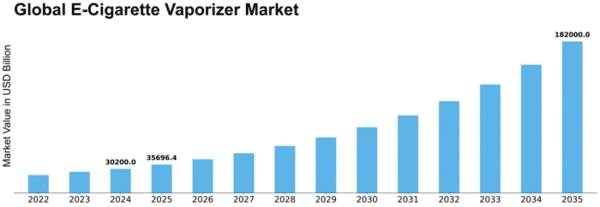

Global E-Cigarette Vaporizer Market Size Graph
Author
Pradeep Nandi
Senior Research Analyst

I have a bachelor's degree in mechanical engineering and an MBA. I have more than two years of expertise in the retail, food, and beverage, chemical, and material industries, and hence have developed a sound cross-domain expertise. A firm believer in lifelong learning and sharing of knowledge. Having a proclivity for hatching ideas and trying to absorb as much information as possible in a short amount of time. Introducing corporates to the data and insight, which enables them to move from probability to possibility, has been my key areas of interest. 

Leave a Comment

FAQs

What is the expected rate of growth for the global e-cigarettes & vaporizer market?

E-cigarettes & vaporizer market is expected to flourish at 29.50% CAGR from 2022 to 2030.

Who are the top players in the market?

Simple Vape Co. London Ltd, Pacific Smoke International, Hubbly Bubbly, Dash Vapes, Liquideu, Vapor Line, Vape Escapes, Nice Vapor, PUFF ECIG, and Smokio are the top players in the global market.

By ‘type’, which segment can dominate the global e-cigarettes & vaporizer market?

In ‘type’, disposable e-cigarettes can dominate the global e-cigarettes & vaporizer market.

Which region can dominate the global e-cigarettes & vaporizer market?

North America can dominate the global e-cigarettes & vaporizer market due to need for smoking cessation.

What are major drivers of the global e-cigarettes & vaporizer market?

Awareness of side-effects of smoking and preference of e-cigarettes over conventional ones are major drivers of the global e-cigarettes & vaporizer market.

Market Summary

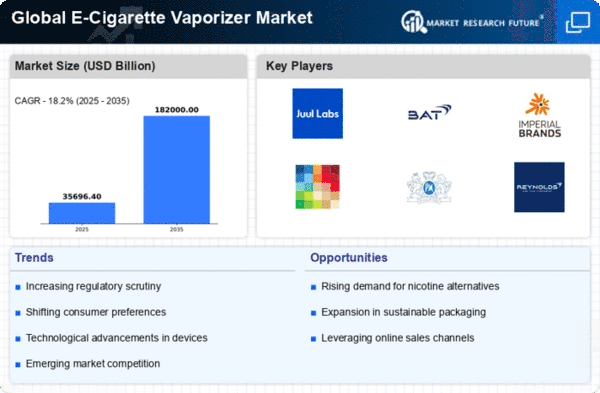
As per MRFR analysis, the Global E-Cigarette Vaporizer Market Size was estimated at 30.20 USD Billion in 2024. The E-Cigarette Vaporizer industry is projected to grow from 35.60 USD Billion in 2025 to 182000.0 USD Billion by 2035, exhibiting a compound annual growth rate (CAGR) of 18.2 during the forecast period 2025 - 2035.

Key Market Trends & Highlights

The Global E-Cigarette Vaporizer Market is experiencing dynamic growth driven by technological innovations and shifting consumer preferences.

  • North America remains the largest market for e-cigarette vaporizers, characterized by a diverse range of product offerings.
  • The Asia-Pacific region is emerging as the fastest-growing market, fueled by increasing health consciousness among consumers.
  • Cigalike devices dominate the market, while pod systems are rapidly gaining traction due to their convenience and user-friendly design.
  • Health consciousness and innovative product offerings are key drivers propelling market expansion in both regions.

Market Size & Forecast

2024 Market Size 30200.0 (USD Billion)
2035 Market Size 182000.0 (USD Billion)
CAGR (2025 - 2035) 18.2%
Largest Regional Market Share in 2024 North America

Major Players

Juul Labs (US), British American Tobacco (GB), Imperial Brands (GB), Altria Group (US), Philip Morris International (US), Reynolds American (US), NJOY (US), Vuse (US), GeekVape (CN), Voopoo (CN)

Market Trends

Cigarette

Global E-Cigarette Vaporizer Market Market Drivers

Diverse Product Offerings

The Global E-Cigarettes and Vaporizer Industry benefits from an extensive range of product offerings that cater to various consumer preferences. From disposable e-cigarettes to advanced vaporizers, the diversity in products allows users to select devices that align with their lifestyle and usage patterns. Additionally, the availability of various flavors and nicotine strengths further enhances consumer choice, attracting a broader audience. This variety not only meets the demands of existing users but also entices new customers exploring alternatives to traditional smoking. As the market continues to diversify, it is expected to maintain robust growth, reinforcing its position in the global landscape.

Market Growth Projections

The Global E-Cigarettes and Vaporizer Industry is poised for remarkable growth, with projections indicating a market value of 37.9 USD Billion in 2024 and an astonishing 666.0 USD Billion by 2035. This growth trajectory suggests a compound annual growth rate (CAGR) of 29.76% from 2025 to 2035. Such figures underscore the increasing consumer demand for e-cigarettes and vaporizers as alternatives to traditional smoking. Factors driving this growth include rising health consciousness, technological advancements, and changing regulatory landscapes. As the market evolves, it is likely to attract significant investment and innovation, further solidifying its position in the global marketplace.

Technological Advancements

Technological innovation plays a pivotal role in shaping the Global E-Cigarettes and Vaporizer Industry. Manufacturers are continually developing advanced devices that enhance user experience, such as temperature control features and customizable settings. These innovations not only improve product performance but also attract tech-savvy consumers. The introduction of smart vaporizers, which can be controlled via mobile applications, exemplifies this trend. As technology evolves, it is anticipated that the market will witness significant growth, potentially reaching a staggering 666.0 USD Billion by 2035. This trajectory suggests that ongoing advancements will be a key driver in the Global E-Cigarettes and Vaporizer Industry.

Increased Social Acceptance

The Global E-Cigarettes and Vaporizer Industry is witnessing a shift in social attitudes towards vaping and e-cigarette use. As these products become more mainstream, social acceptance is growing, particularly among younger demographics. This change is reflected in various cultural contexts, where vaping is increasingly viewed as a lifestyle choice rather than a taboo. Social media platforms and influencer marketing play a crucial role in shaping perceptions, further normalizing e-cigarette use. As acceptance increases, the market is likely to expand, attracting a wider audience and contributing to the overall growth trajectory of the Global E-Cigarettes and Vaporizer Industry.

Rising Health Consciousness

The Global E-Cigarettes and Vaporizer Industry experiences a notable surge in demand as consumers become increasingly health-conscious. Traditional smoking is associated with numerous health risks, prompting smokers to seek alternatives. E-cigarettes and vaporizers are perceived as less harmful options, leading to a shift in consumer preferences. This trend is reflected in the projected market value of 37.9 USD Billion in 2024, indicating a growing acceptance of these products. As awareness of the health implications of smoking continues to rise, the Global E-Cigarettes and Vaporizer Industry is likely to expand, attracting both new users and those looking to transition from conventional tobacco products.

Regulatory Changes Favoring Alternatives

Regulatory frameworks are increasingly adapting to accommodate the Global E-Cigarettes and Vaporizer Industry. Governments worldwide are recognizing the potential of e-cigarettes and vaporizers as harm-reduction tools. This shift in regulatory stance may lead to more favorable policies, such as reduced taxation and clearer guidelines for marketing. For instance, some countries have implemented regulations that differentiate between traditional tobacco products and e-cigarettes, allowing for a more supportive environment for the latter. As these regulations evolve, they are likely to bolster the market, contributing to a projected CAGR of 29.76% from 2025 to 2035, thereby enhancing the appeal of e-cigarettes and vaporizers.

Market Segment Insights

By Product Type: Cigalike (Largest) vs. Pod Systems (Fastest-Growing)

In the Global E-Cigarette Vaporizer Market, the product type segment is primarily dominated by Cigalikes, which appeal to traditional cigarette users transitioning to vaping. This segment offers a familiar experience with a design similar to conventional cigarettes, securing a substantial market share. Following Cigalikes, Vape Pens have gained traction for their portability and ease of use, positioned as a favored choice among novice vapers. While Box Mods comprise a smaller share, they are highly sought after by enthusiasts for their customization options. The growth trends within this segment reveal an increasing shift towards Pod Systems, which are rapidly becoming the preferred choice among consumers due to their user-friendly design and discreet nature. These devices offer convenience and a variety of flavor options, making them especially appealing to younger demographics. As regulations evolve and awareness grows, the demand for innovative vaping solutions continues to shape the development of product types in this market.

Cigalike (Dominant) vs. Box Mods (Emerging)

Cigalikes serve as the foundational product type in the Global E-Cigarette Vaporizer Market, effectively catering to users looking for a smoking alternative due to their familiar aesthetics and simplicity. Their market position is strengthened by their accessibility and widespread availability, making them a dominant force in attracting new vapers transitioning from traditional smoking. Conversely, Box Mods are gaining traction as an emerging product segment among more experienced users who seek to personalize their vaping experience. These devices offer advanced features, such as adjustable wattage and temperature control, appealing to enthusiasts who prioritize performance over convenience. The increasing interest in customization contributes to Box Mods' rising popularity, as they provide users with the ability to tailor their vaping experience, thus creating a unique niche within the market.

By Distribution Channel: Online Retail (Largest) vs. Specialty Stores (Fastest-Growing)

The distribution of the Global E-Cigarette Vaporizer Market through various channels reflects the evolving preferences of consumers. Online retail stands out as the largest segment, driven by convenience and a broader selection. However, specialty stores have emerged as a critical player, capturing the interest of enthusiasts seeking expert guidance and unique products. The ease of online purchases continues to dominate, leading to a significant share of the market.

Online Retail (Dominant) vs. Specialty Stores (Emerging)

Online retail dominates the Global E-Cigarette Vaporizer Market due to its accessibility and expansive product range, making it the go-to choice for many consumers. Customers prioritize the convenience of shopping from home, often seeking a variety of brands and products at competitive prices. Meanwhile, specialty stores are positioning themselves as the emerging segment by focusing on niche markets. They offer tailored experiences with knowledgeable staff that can provide personalized recommendations, thus creating a loyal customer base. These stores also promote community engagement through events and tastings, enhancing their appeal to enthusiasts and driving their rapid growth.

By Consumer Demographics: Age Group (Largest) vs. Lifestyle (Fastest-Growing)

In the Global E-Cigarette Vaporizer Market, the distribution of consumer demographics reveals significant preferences across various age groups. The largest share is held by the 18-24 age bracket, driven by the increasing trend of young adults seeking alternatives to traditional smoking. This demographic is particularly inclined towards vaping due to the perception of e-cigarettes as a less harmful option and their appeal as a trendy lifestyle choice. Additionally, lifestyle choices increasingly influence user profiles, with a notable number of individuals seeking vaping as part of a healthier, smoke-free lifestyle.

Age Group: 18-24 (Dominant) vs. Lifestyle (Emerging)

The 18-24 age group represents the dominant demographic in the e-cigarette vaporizer market, characterized by its tech-savvy nature and inclination towards modern smoking alternatives. This segment values the social aspects and variety of flavors offered by vapor products, creating a specific niche for brands targeting youthful consumers. In contrast, the lifestyle segment is emerging rapidly, attracting those who aim to align vaping with their health-conscious lifestyles. This intersection of vaping and lifestyle choices indicates a shift towards products that emphasize health benefits and social acceptability, reflecting broader consumer trends towards wellness.

By Flavor Type: Tobacco (Largest) vs. Fruity (Fastest-Growing)

In the Global E-Cigarette Vaporizer Market, flavor type segmentation showcases a diverse range of preferences among consumers. Tobacco flavor is currently the dominating choice, capturing the largest share of the market. This is primarily due to the established user base transitioning from traditional cigarettes to e-cigarettes, seeking similar flavors. In contrast, fruity flavors are rapidly gaining popularity, especially among younger users, thanks to their appealing and varied profiles that cater to modern tastes. Growth trends in this segment highlight an evolving landscape, with menthol and dessert flavors also contributing to the market dynamics. As the industry innovates, the introduction of new flavor variants is anticipated to drive further demand. The increasing push for flavor regulations is influencing consumer preferences, driving some towards fruity choices that are perceived as less harmful. This shift is evident as manufacturers respond to consumer feedback, enhancing their flavor offerings to stay competitive.

Tobacco (Dominant) vs. Fruity (Emerging)

Tobacco flavor in the Global E-Cigarette Vaporizer Market serves as the dominant segment, appealing to traditional smokers seeking a familiar experience in their transition to vaping. Its entrenched position is marked by a loyal customer base and brand loyalty from established players, emphasizing the comfort of replicating traditional smoking experiences. In contrast, fruity flavors represent an emerging trend, attracting a new demographic eager to explore diverse and exciting taste profiles. This segment is characterized by creativity and constant innovation, appealing particularly to younger consumers who prioritize variety and experience. The rapid transition towards fruity options signifies a shift in consumer behavior, where personalization and novelty are increasingly becoming key drivers in flavor choices.

By Battery Type: Lithium-Ion (Largest) vs. Nickel Metal Hydride (Fastest-Growing)

In the Global E-Cigarette Vaporizer Market, the battery type segment reveals significant distinctions amongst the available options. Lithium-ion batteries command the largest market share due to their high energy density and efficiency, making them the preferred choice for manufacturers. Meanwhile, Nickel Metal Hydride batteries are rapidly gaining traction, appealing to environmentally conscious consumers and emerging as the fastest-growing segment.

Battery Type: Lithium-Ion (Dominant) vs. Nickel Metal Hydride (Emerging)

Lithium-ion batteries dominate the battery type segment in the Global E-Cigarette Vaporizer Market, thanks to their superior performance attributes and reliability. They offer longer usage times, faster charging, and less weight compared to alternatives, driving their preference among both manufacturers and users. In contrast, Nickel Metal Hydride batteries, although currently less popular, are emerging due to their eco-friendly nature and better recyclability. As the demand for sustainable alternatives grows, they are anticipated to capture a larger portion of the market, particularly among environmentally conscious consumers.

Get more detailed insights about E-Cigarettes & Vaporizer Market Research Report - Forecast to 2035

Regional Insights

North America : Market Leader in E-Cigarettes

North America continues to lead the global e-cigarette vaporizer market, holding a significant market share of $15,100M in 2024. The growth is driven by increasing consumer demand for alternatives to traditional smoking, coupled with favorable regulatory frameworks that support innovation. The region's robust distribution networks and marketing strategies further enhance market penetration, making it a focal point for e-cigarette manufacturers. The United States is the primary market within North America, hosting key players such as Juul Labs, Altria Group, and Reynolds American. These companies are at the forefront of product innovation, catering to diverse consumer preferences. The competitive landscape is characterized by rapid technological advancements and aggressive marketing campaigns, ensuring that North America remains a pivotal region in the global e-cigarette vaporizer market.

Europe : Emerging Market with Regulations

Europe's e-cigarette vaporizer market is projected to reach $9,000M by 2025, driven by a growing acceptance of vaping as a smoking alternative. Regulatory bodies are increasingly focusing on consumer safety and product standards, which is fostering a more structured market environment. The EU Tobacco Products Directive has played a crucial role in shaping the market, ensuring that products meet safety and quality standards, thus enhancing consumer trust. Leading countries in this region include the UK, Germany, and France, where major players like British American Tobacco and Imperial Brands are actively competing. The competitive landscape is marked by innovation and a diverse range of products, catering to various consumer segments. As regulations evolve, companies are adapting their strategies to comply while still appealing to a broad audience, ensuring sustained growth in the European market.

Asia-Pacific : Rapid Growth in Vaping Culture

The Asia-Pacific region is witnessing a burgeoning e-cigarette vaporizer market, projected to reach $5,000M by 2025. This growth is fueled by increasing health awareness and a shift towards vaping as a less harmful alternative to smoking. Countries like China and Japan are leading the charge, with rising disposable incomes and changing consumer preferences driving demand. Regulatory support is also emerging, albeit at varying paces across different nations, which is crucial for market expansion. China stands out as a significant player, with companies like GeekVape and Voopoo leading the market. The competitive landscape is dynamic, with local manufacturers rapidly innovating to capture market share. As the region continues to embrace vaping culture, the presence of international brands is also increasing, further intensifying competition and driving product diversity in the Asia-Pacific market.

Middle East and Africa : Niche Market with Potential

The Middle East and Africa (MEA) region represents a niche market in the global e-cigarette vaporizer landscape, with a market size of $1,100M projected by 2025. The growth is primarily driven by increasing awareness of health risks associated with traditional smoking and a gradual acceptance of vaping. However, regulatory frameworks are still developing, which presents both challenges and opportunities for market players looking to establish a foothold in this region. Countries like South Africa and the UAE are at the forefront of this market, with a growing number of local and international brands entering the space. The competitive landscape is characterized by a mix of established players and emerging startups, all vying for market share. As regulations become clearer and consumer acceptance grows, the MEA region is poised for significant growth in the e-cigarette vaporizer market.

Key Players and Competitive Insights

The Global E-Cigarette Vaporizer Market is characterized by a dynamic competitive landscape, driven by innovation, regulatory changes, and shifting consumer preferences. Key players such as Juul Labs (US), British American Tobacco (GB), and Philip Morris International (US) are at the forefront, each adopting distinct strategies to enhance their market positioning. Juul Labs (US) continues to focus on product innovation, particularly in developing new flavors and nicotine formulations, which appears to resonate well with younger consumers. Meanwhile, British American Tobacco (GB) is pursuing aggressive regional expansion, particularly in emerging markets, to capture a broader consumer base. Philip Morris International (US) emphasizes a transition towards smoke-free products, aligning its operational focus with sustainability and health-conscious trends, which collectively shapes a competitive environment that is increasingly centered on product differentiation and consumer engagement.In terms of business tactics, companies are increasingly localizing manufacturing to reduce costs and enhance supply chain efficiency. The market structure is moderately fragmented, with several players vying for market share, yet a few dominant companies exert considerable influence. This competitive structure allows for a diverse range of products and innovations, fostering a vibrant marketplace where consumer choice is paramount.

In November Juul Labs (US) announced a partnership with a leading technology firm to develop a smart vaping device that integrates AI for personalized user experiences. This strategic move is likely to enhance customer engagement and retention, positioning Juul as a tech-forward brand in a market that increasingly values innovation. The integration of AI could also provide valuable data insights, allowing for more targeted marketing strategies.

In October British American Tobacco (GB) launched a new line of eco-friendly e-cigarettes, utilizing biodegradable materials in their production. This initiative not only addresses growing environmental concerns but also aligns with the company's broader sustainability goals. By prioritizing eco-conscious products, British American Tobacco may attract a segment of consumers who are increasingly aware of their environmental impact, thereby enhancing brand loyalty.

In September Philip Morris International (US) unveiled a comprehensive marketing campaign aimed at promoting its smoke-free alternatives, emphasizing health benefits and lifestyle integration. This campaign is strategically significant as it seeks to reshape public perception and drive consumer adoption of its innovative products. By focusing on health and lifestyle, Philip Morris International is likely to differentiate itself in a crowded market, appealing to health-conscious consumers.

As of December current competitive trends indicate a strong emphasis on digitalization, sustainability, and technological integration within the industry. Strategic alliances are becoming increasingly prevalent, as companies recognize the value of collaboration in enhancing product offerings and market reach. Looking ahead, competitive differentiation is expected to evolve, with a notable shift from price-based competition towards innovation, technology, and supply chain reliability. This transition suggests that companies that prioritize R&D and sustainable practices will likely emerge as leaders in the evolving landscape.

Key Companies in the Global E-Cigarette Vaporizer Market include

Industry Developments

  • Altria Group Inc. (June 2023): Acquired NJOY Holdings Inc., a vaping company. They now market NJOY's e-vapor products through their subsidiary NJOY LLC and distribute them through their Altria Group Distribution Company. 
  • Imperial Brands plc (June 2023): Announced the acquisition of nicotine pouches from TJP Labs to enter the U.S. oral nicotine market. This allows ITG Brands, their U.S. operation, to offer various popular nicotine pouch products.

Regional Coverage

  • North America
    • US
    • Canada
    • Mexico
  • Europe
    • Germany
    • France
    • Italy
    • Spain
    • U.K
    • Rest of Europe
  • Asia– Pacific
    • China
    • India
    • Indonesia
    • Australia
    • Rest of Asia Pacific
  • Rest of the World
    • MENA
    • Latin America

Future Outlook

Global E-Cigarette Vaporizer Market Future Outlook

The Global E-Cigarette Vaporizer Market is projected to grow at an 18.2% CAGR from 2025 to 2035, driven by technological advancements, increasing consumer demand, and regulatory changes.

New opportunities lie in:

  • Expansion into emerging markets with tailored product offerings.
  • Development of subscription-based models for e-liquid supplies.
  • Investment in R&D for innovative vaporizer technologies and features.

By 2035, the market is expected to solidify its position as a leading segment in the global tobacco industry.

Market Segmentation

Global E-Cigarette Vaporizer Market Flavor Type Outlook

  • Tobacco
  • Menthol
  • Fruity
  • Dessert

Global E-Cigarette Vaporizer Market Battery Type Outlook

  • Lithium-ion
  • Nickel Metal Hydride
  • Lead Acid

Global E-Cigarette Vaporizer Market Product Type Outlook

  • Cigalike
  • Vape Pens
  • Pod Systems
  • Box Mods

Global E-Cigarette Vaporizer Market Distribution Channel Outlook

  • Online Retail
  • Specialty Stores
  • Convenience Stores
  • Supermarkets

Global E-Cigarette Vaporizer Market Consumer Demographics Outlook

  • Age Group
  • Gender
  • Income Level
  • Lifestyle

Report Scope

MARKET SIZE 202430200.0(USD Billion)
MARKET SIZE 202535600.0(USD Billion)
MARKET SIZE 2035182000.0(USD Billion)
COMPOUND ANNUAL GROWTH RATE (CAGR)18.2% (2025 - 2035)
REPORT COVERAGERevenue Forecast, Competitive Landscape, Growth Factors, and Trends
BASE YEAR2024
Market Forecast Period2025 - 2035
Historical Data2019 - 2024
Market Forecast UnitsUSD Billion
Key Companies ProfiledJuul Labs (US), British American Tobacco (GB), Imperial Brands (GB), Altria Group (US), Philip Morris International (US), Reynolds American (US), NJOY (US), Vuse (US), GeekVape (CN), Voopoo (CN)
Segments CoveredProduct Type, Distribution Channel, Consumer Demographics, Flavor Type, Battery Type
Key Market OpportunitiesEmergence of advanced nicotine delivery systems enhances consumer appeal in the Global E-Cigarette Vaporizer Market.
Key Market DynamicsRising consumer preference for nicotine alternatives drives innovation and competition in the e-cigarette vaporizer market.
Countries CoveredNorth America, Europe, APAC, South America, MEA

FAQs

What is the expected rate of growth for the global e-cigarettes & vaporizer market?

E-cigarettes & vaporizer market is expected to flourish at 29.50% CAGR from 2022 to 2030.

Who are the top players in the market?

Simple Vape Co. London Ltd, Pacific Smoke International, Hubbly Bubbly, Dash Vapes, Liquideu, Vapor Line, Vape Escapes, Nice Vapor, PUFF ECIG, and Smokio are the top players in the global market.

By ‘type’, which segment can dominate the global e-cigarettes & vaporizer market?

In ‘type’, disposable e-cigarettes can dominate the global e-cigarettes & vaporizer market.

Which region can dominate the global e-cigarettes & vaporizer market?

North America can dominate the global e-cigarettes & vaporizer market due to need for smoking cessation.

What are major drivers of the global e-cigarettes & vaporizer market?

Awareness of side-effects of smoking and preference of e-cigarettes over conventional ones are major drivers of the global e-cigarettes & vaporizer market.

  1. SECTION I: EXECUTIVE SUMMARY AND KEY HIGHLIGHTS
    1. | 1.1 EXECUTIVE SUMMARY
    2. | 1.1.1 Market Overview
    3. | 1.1.2 Key Findings
    4. | 1.1.3 Market Segmentation
    5. | 1.1.4 Competitive Landscape
    6. | 1.1.5 Challenges and Opportunities
    7. | 1.1.6 Future Outlook
  2. SECTION II: SCOPING, METHODOLOGY AND MARKET STRUCTURE
    1. | 2.1 MARKET INTRODUCTION
    2. | 2.1.1 Definition
    3. | 2.1.2 Scope of the study
    4. |-- 2.1.2.1 Research Objective
    5. |-- 2.1.2.2 Assumption
    6. |-- 2.1.2.3 Limitations
    7. | 2.2 RESEARCH METHODOLOGY
    8. | 2.2.1 Overview
    9. | 2.2.2 Data Mining
    10. | 2.2.3 Secondary Research
    11. | 2.2.4 Primary Research
    12. |-- 2.2.4.1 Primary Interviews and Information Gathering Process
    13. |-- 2.2.4.2 Breakdown of Primary Respondents
    14. | 2.2.5 Forecasting Model
    15. | 2.2.6 Market Size Estimation
    16. |-- 2.2.6.1 Bottom-Up Approach
    17. |-- 2.2.6.2 Top-Down Approach
    18. | 2.2.7 Data Triangulation
    19. | 2.2.8 Validation
  3. SECTION III: QUALITATIVE ANALYSIS
    1. | 3.1 MARKET DYNAMICS
    2. | 3.1.1 Overview
    3. | 3.1.2 Drivers
    4. | 3.1.3 Restraints
    5. | 3.1.4 Opportunities
    6. | 3.2 MARKET FACTOR ANALYSIS
    7. | 3.2.1 Value chain Analysis
    8. | 3.2.2 Porter's Five Forces Analysis
    9. |-- 3.2.2.1 Bargaining Power of Suppliers
    10. |-- 3.2.2.2 Bargaining Power of Buyers
    11. |-- 3.2.2.3 Threat of New Entrants
    12. |-- 3.2.2.4 Threat of Substitutes
    13. |-- 3.2.2.5 Intensity of Rivalry
    14. | 3.2.3 COVID-19 Impact Analysis
    15. |-- 3.2.3.1 Market Impact Analysis
    16. |-- 3.2.3.2 Regional Impact
    17. |-- 3.2.3.3 Opportunity and Threat Analysis
  4. SECTION IV: QUANTITATIVE ANALYSIS
    1. | 4.1 Consumer and Retail, BY Product Type (USD Billion)
    2. | 4.1.1 Cigalike
    3. | 4.1.2 Vape Pens
    4. | 4.1.3 Pod Systems
    5. | 4.1.4 Box Mods
    6. | 4.2 Consumer and Retail, BY Distribution Channel (USD Billion)
    7. | 4.2.1 Online Retail
    8. | 4.2.2 Specialty Stores
    9. | 4.2.3 Convenience Stores
    10. | 4.2.4 Supermarkets
    11. | 4.3 Consumer and Retail, BY Consumer Demographics (USD Billion)
    12. | 4.3.1 Age Group
    13. | 4.3.2 Gender
    14. | 4.3.3 Income Level
    15. | 4.3.4 Lifestyle
    16. | 4.4 Consumer and Retail, BY Flavor Type (USD Billion)
    17. | 4.4.1 Tobacco
    18. | 4.4.2 Menthol
    19. | 4.4.3 Fruity
    20. | 4.4.4 Dessert
    21. | 4.5 Consumer and Retail, BY Battery Type (USD Billion)
    22. | 4.5.1 Lithium-ion
    23. | 4.5.2 Nickel Metal Hydride
    24. | 4.5.3 Lead Acid
    25. | 4.6 Consumer and Retail, BY Region (USD Billion)
    26. | 4.6.1 North America
    27. |-- 4.6.1.1 US
    28. |-- 4.6.1.2 Canada
    29. | 4.6.2 Europe
    30. |-- 4.6.2.1 Germany
    31. |-- 4.6.2.2 UK
    32. |-- 4.6.2.3 France
    33. |-- 4.6.2.4 Russia
    34. |-- 4.6.2.5 Italy
    35. |-- 4.6.2.6 Spain
    36. |-- 4.6.2.7 Rest of Europe
    37. | 4.6.3 APAC
    38. |-- 4.6.3.1 China
    39. |-- 4.6.3.2 India
    40. |-- 4.6.3.3 Japan
    41. |-- 4.6.3.4 South Korea
    42. |-- 4.6.3.5 Malaysia
    43. |-- 4.6.3.6 Thailand
    44. |-- 4.6.3.7 Indonesia
    45. |-- 4.6.3.8 Rest of APAC
    46. | 4.6.4 South America
    47. |-- 4.6.4.1 Brazil
    48. |-- 4.6.4.2 Mexico
    49. |-- 4.6.4.3 Argentina
    50. |-- 4.6.4.4 Rest of South America
    51. | 4.6.5 MEA
    52. |-- 4.6.5.1 GCC Countries
    53. |-- 4.6.5.2 South Africa
    54. |-- 4.6.5.3 Rest of MEA
  5. SECTION V: COMPETITIVE ANALYSIS
    1. | 5.1 Competitive Landscape
    2. | 5.1.1 Overview
    3. | 5.1.2 Competitive Analysis
    4. | 5.1.3 Market share Analysis
    5. | 5.1.4 Major Growth Strategy in the Consumer and Retail
    6. | 5.1.5 Competitive Benchmarking
    7. | 5.1.6 Leading Players in Terms of Number of Developments in the Consumer and Retail
    8. | 5.1.7 Key developments and growth strategies
    9. |-- 5.1.7.1 New Product Launch/Service Deployment
    10. |-- 5.1.7.2 Merger & Acquisitions
    11. |-- 5.1.7.3 Joint Ventures
    12. | 5.1.8 Major Players Financial Matrix
    13. |-- 5.1.8.1 Sales and Operating Income
    14. |-- 5.1.8.2 Major Players R&D Expenditure. 2023
    15. | 5.2 Company Profiles
    16. | 5.2.1 Juul Labs (US)
    17. |-- 5.2.1.1 Financial Overview
    18. |-- 5.2.1.2 Products Offered
    19. |-- 5.2.1.3 Key Developments
    20. |-- 5.2.1.4 SWOT Analysis
    21. |-- 5.2.1.5 Key Strategies
    22. | 5.2.2 British American Tobacco (GB)
    23. |-- 5.2.2.1 Financial Overview
    24. |-- 5.2.2.2 Products Offered
    25. |-- 5.2.2.3 Key Developments
    26. |-- 5.2.2.4 SWOT Analysis
    27. |-- 5.2.2.5 Key Strategies
    28. | 5.2.3 Imperial Brands (GB)
    29. |-- 5.2.3.1 Financial Overview
    30. |-- 5.2.3.2 Products Offered
    31. |-- 5.2.3.3 Key Developments
    32. |-- 5.2.3.4 SWOT Analysis
    33. |-- 5.2.3.5 Key Strategies
    34. | 5.2.4 Altria Group (US)
    35. |-- 5.2.4.1 Financial Overview
    36. |-- 5.2.4.2 Products Offered
    37. |-- 5.2.4.3 Key Developments
    38. |-- 5.2.4.4 SWOT Analysis
    39. |-- 5.2.4.5 Key Strategies
    40. | 5.2.5 Philip Morris International (US)
    41. |-- 5.2.5.1 Financial Overview
    42. |-- 5.2.5.2 Products Offered
    43. |-- 5.2.5.3 Key Developments
    44. |-- 5.2.5.4 SWOT Analysis
    45. |-- 5.2.5.5 Key Strategies
    46. | 5.2.6 Reynolds American (US)
    47. |-- 5.2.6.1 Financial Overview
    48. |-- 5.2.6.2 Products Offered
    49. |-- 5.2.6.3 Key Developments
    50. |-- 5.2.6.4 SWOT Analysis
    51. |-- 5.2.6.5 Key Strategies
    52. | 5.2.7 NJOY (US)
    53. |-- 5.2.7.1 Financial Overview
    54. |-- 5.2.7.2 Products Offered
    55. |-- 5.2.7.3 Key Developments
    56. |-- 5.2.7.4 SWOT Analysis
    57. |-- 5.2.7.5 Key Strategies
    58. | 5.2.8 Vuse (US)
    59. |-- 5.2.8.1 Financial Overview
    60. |-- 5.2.8.2 Products Offered
    61. |-- 5.2.8.3 Key Developments
    62. |-- 5.2.8.4 SWOT Analysis
    63. |-- 5.2.8.5 Key Strategies
    64. | 5.2.9 GeekVape (CN)
    65. |-- 5.2.9.1 Financial Overview
    66. |-- 5.2.9.2 Products Offered
    67. |-- 5.2.9.3 Key Developments
    68. |-- 5.2.9.4 SWOT Analysis
    69. |-- 5.2.9.5 Key Strategies
    70. | 5.2.10 Voopoo (CN)
    71. |-- 5.2.10.1 Financial Overview
    72. |-- 5.2.10.2 Products Offered
    73. |-- 5.2.10.3 Key Developments
    74. |-- 5.2.10.4 SWOT Analysis
    75. |-- 5.2.10.5 Key Strategies
    76. | 5.3 Appendix
    77. | 5.3.1 References
    78. | 5.3.2 Related Reports

Consumer and Retail Market Segmentation

Consumer and Retail By Product Type (USD Billion, 2025-2035)

  • Cigalike
  • Vape Pens
  • Pod Systems
  • Box Mods

Consumer and Retail By Distribution Channel (USD Billion, 2025-2035)

  • Online Retail
  • Specialty Stores
  • Convenience Stores
  • Supermarkets

Consumer and Retail By Consumer Demographics (USD Billion, 2025-2035)

  • Age Group
  • Gender
  • Income Level
  • Lifestyle

Consumer and Retail By Flavor Type (USD Billion, 2025-2035)

  • Tobacco
  • Menthol
  • Fruity
  • Dessert

Consumer and Retail By Battery Type (USD Billion, 2025-2035)

  • Lithium-ion
  • Nickel Metal Hydride
  • Lead Acid
Infographic

Free Sample Request

Kindly complete the form below to receive a free sample of this Report

Get Free Sample

Customer Strories

Compare Licence

×
Features License Type
Single User Multiuser License Enterprise User
Price $4,950 $5,950 $7,250
Maximum User Access Limit 1 User Upto 10 Users Unrestricted Access Throughout the Organization
Free Customization
Direct Access to Analyst
Deliverable Format
Platform Access
Discount on Next Purchase 10% 15% 15%
Printable Versions