Request Free Sample ×

Kindly complete the form below to receive a free sample of this Report

* Please use a valid business email

Leading companies partner with us for data-driven Insights

clients tt-cursor
Hero Background
English
Chinese
French
Japanese
Korean
German
Spanish

Global Acrylic Teeth Market Analysis

ID: MRFR/MED/0105-CR
117 Pages
Rahul Gotadki
August 2019

Acrylic Teeth Market Research Report: Size, Share, Trend Analysis By Types (Full Denture, Partial Denture, Immediate Denture, Removable Denture), By Material Composition (Poly(methyl methacrylate), Polyethylene, Composites), By Applications (Orthodontics, Cosmetic Dentistry, Restorative Dentistry), By End Users (Dental Clinics, Hospitals, Home Care) and By Regional (North America, Europe, South America, Asia-Pacific, Middle East and Africa) - Growth Outlook & Industry Forecast 2025 To 2035

Share:
Download PDF ×

We do not share your information with anyone. However, we may send you emails based on your report interest from time to time. You may contact us at any time to opt-out.

Global Acrylic Teeth Market Infographic
Purchase Options

Market Analysis

In-depth Analysis of Global Acrylic Teeth Market Industry Landscape

The elements of the acrylic teeth market are driven by consistent material developments. Progresses in acrylic definitions add to the advancement of teeth that closely imitate normal dentition concerning style, strength, and wear opposition. The market responses the demand for further developed materials that improve the general presentation and life span of acrylic teeth in dental prosthetics. The essential use of acrylic teeth is in prosthodontics, where they are used for the manufacture of complete and intermediate false teeth. The market elements are intently attached to the demand for stylishly satisfying and practical false teeth that reestablish patients' oral wellbeing and work on their personal satisfaction. Prosthodontic practices drive the market as they look for great acrylic teeth for patient fulfilment. The elements of the acrylic teeth market are formed by changing patient inclinations, with a rising emphasis on the feel of dental prosthetics. Patients frequently look for acrylic teeth that give a characteristic appearance, agreeable fit, and ideal capability. Market players answer by offering various shapes, shades, and sizes to measure up to the assorted stylish expectations of patients. The elements of the acrylic teeth market broaden all around the world, with endeavors to address the assorted necessities of various areas. As dental consideration is a general concern, market players intend to give acrylic teeth arrangements that are versatile to different dental practices, social inclinations, and administrative standards around the world. Rationality is a critical variable impacting market elements, particularly considering the significance of dental prosthetics in oral medical services. The market answers the requirement for financially smart arrangements that make acrylic teeth open to a more extensive population. Endeavors to offset reasonableness with quality drive market techniques and item improvement. The elements of the acrylic teeth market are affected by the preparation and training gave to dental experts. Dental schools and proceeding with training programs influence market patterns as they acquaint specialists with new materials, methods, and progressions in prosthodontics. The market answers by adjusting item includes with the abilities and inclinations of the dental labor force.


Author
Author Profile
Rahul Gotadki
Research Manager

He holds an experience of about 9+ years in Market Research and Business Consulting, working under the spectrum of Life Sciences and Healthcare domains. Rahul conceptualizes and implements a scalable business strategy and provides strategic leadership to the clients. His expertise lies in market estimation, competitive intelligence, pipeline analysis, customer assessment, etc.

Leave a Comment

FAQs

What is the current valuation of the Acrylic Teeth Market as of 2024?

<p>The Acrylic Teeth Market was valued at 1.672 USD Billion in 2024.</p>

What is the projected market size for the Acrylic Teeth Market in 2035?

<p>The market is projected to reach 2.908 USD Billion by 2035.</p>

What is the expected CAGR for the Acrylic Teeth Market during the forecast period 2025 - 2035?

<p>The expected CAGR for the Acrylic Teeth Market during 2025 - 2035 is 5.16%.</p>

Which companies are considered key players in the Acrylic Teeth Market?

<p>Key players include Dentsply Sirona, Ivoclar Vivadent, GC Corporation, and others.</p>

What are the main segments of the Acrylic Teeth Market by type?

<p>The main segments by type include Full Denture, Partial Denture, Immediate Denture, and Removable Denture.</p>

What was the market valuation for Full Denture in 2024?

<p>The market valuation for Full Denture was between 0.5 and 0.85 USD Billion in 2024.</p>

How does the market for Poly(methyl methacrylate) compare to other materials?

<p>Poly(methyl methacrylate) had a market valuation between 0.8 and 1.4 USD Billion, indicating strong demand.</p>

What applications are driving growth in the Acrylic Teeth Market?

<p>Key applications driving growth include Orthodontics, Cosmetic Dentistry, and Restorative Dentistry.</p>

What is the expected market size for Dental Clinics as an end user in 2035?

<p>The market size for Dental Clinics is projected to reach between 1.155 and 1.668 USD Billion by 2035.</p>

What trends are influencing the Acrylic Teeth Market's growth?

<p>Trends include advancements in material technology and increasing demand for cosmetic and restorative dental procedures.</p>

Market Summary

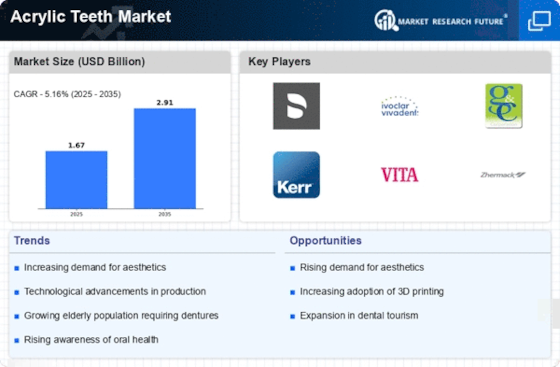
As per Market Research Future analysis, the Acrylic Teeth Market Size was estimated at 1.672 USD Billion in 2024. The Acrylic Teeth industry is projected to grow from 1.758 USD Billion in 2025 to 2.908 USD Billion by 2035, exhibiting a compound annual growth rate (CAGR) of 5.16% during the forecast period 2025 - 2035

Key Market Trends & Highlights

The Acrylic Teeth Market is experiencing robust growth driven by technological advancements and increasing consumer awareness.

  • North America remains the largest market for acrylic teeth, driven by a well-established dental care infrastructure. The Asia-Pacific region is emerging as the fastest-growing market, fueled by rising disposable incomes and dental tourism. Full dentures represent the largest segment, while partial dentures are witnessing the fastest growth due to changing consumer preferences. Technological advancements and rising consumer awareness are key drivers propelling the acrylic teeth market forward.

Market Size & Forecast

2024 Market Size 1.672 (USD Billion)
2035 Market Size 2.908 (USD Billion)
CAGR (2025 - 2035) 5.16%
Largest Regional Market Share in 2024 North America

Major Players

Dentsply Sirona (US), Ivoclar Vivadent (LI), GC Corporation (JP), Kerr Corporation (US), Vita Zahnfabrik (DE), Zhermack (IT), Heraeus Kulzer (DE), 3M (US)

Market Trends

The Acrylic Teeth Market is currently experiencing a notable evolution, driven by advancements in dental technology and increasing consumer awareness regarding oral health. As dental professionals adopt innovative materials and techniques, the demand for high-quality acrylic teeth is likely to rise. This shift appears to be influenced by a growing preference for aesthetic solutions that offer both functionality and visual appeal. Furthermore, the market seems to be benefiting from an expanding demographic that includes not only traditional denture wearers but also younger individuals seeking cosmetic enhancements. In addition, the Acrylic Teeth Market is witnessing a surge in research and development activities aimed at improving the durability and comfort of acrylic products. Manufacturers are exploring new formulations and production methods that could enhance the overall user experience. This trend suggests a potential for increased competition among suppliers, as they strive to meet the evolving needs of dental practitioners and patients alike. Overall, the Acrylic Teeth Market appears poised for growth, with various factors contributing to its dynamic landscape.

Technological Advancements

The Acrylic Teeth Market is increasingly influenced by technological innovations that enhance product quality and performance. New manufacturing techniques and materials are being developed, which may lead to improved durability and aesthetics of acrylic teeth. This trend indicates a shift towards more sophisticated solutions that cater to the specific needs of dental professionals and patients.

Rising Consumer Awareness

There is a growing awareness among consumers regarding the importance of oral health and aesthetics. This heightened consciousness is driving demand for high-quality acrylic teeth that not only serve functional purposes but also enhance the overall appearance. As individuals become more informed, they are likely to seek out products that align with their aesthetic preferences.

Increased Research and Development

The Acrylic Teeth Market is experiencing a notable increase in research and development efforts aimed at creating innovative products. Manufacturers are investing in exploring new materials and techniques that could improve the comfort and longevity of acrylic teeth. This trend suggests a competitive landscape where companies strive to differentiate themselves through enhanced product offerings.

Global Acrylic Teeth Market Market Drivers

Rising Dental Tourism in Acrylic Teeth Market

Dental tourism is emerging as a noteworthy trend impacting the Acrylic Teeth Market. Patients are increasingly traveling to countries known for affordable and high-quality dental care, which includes acrylic teeth solutions. This trend is particularly pronounced in regions where dental services are significantly cheaper than in developed nations. Reports suggest that dental tourism could grow by 20% annually, as patients seek cost-effective alternatives without compromising quality. Consequently, manufacturers are adapting their strategies to cater to this influx of international patients, thereby expanding their market presence and driving growth in the acrylic teeth segment.

Rising Consumer Awareness in Acrylic Teeth Market

Consumer awareness regarding oral health and aesthetics is significantly influencing the Acrylic Teeth Market. As individuals become more informed about the importance of dental aesthetics, the demand for high-quality acrylic teeth is likely to increase. This trend is particularly evident among younger demographics who prioritize both functionality and appearance in dental solutions. Surveys indicate that nearly 70% of consumers consider the aesthetic appeal of dental products when making purchasing decisions. Consequently, manufacturers are focusing on producing aesthetically pleasing and functional acrylic teeth to meet this growing demand. This heightened awareness is expected to drive market growth, as consumers seek products that enhance their overall dental experience.

Technological Advancements in Acrylic Teeth Market

The Acrylic Teeth Market is experiencing a notable transformation due to rapid technological advancements. Innovations in materials and manufacturing processes are enhancing the quality and durability of acrylic teeth. For instance, the introduction of CAD/CAM technology allows for precise customization, which is increasingly demanded by dental professionals. This shift not only improves patient satisfaction but also reduces production time, thereby increasing market efficiency. Furthermore, advancements in 3D printing technology are enabling the creation of highly detailed and personalized dental prosthetics. As a result, the market is projected to grow at a compound annual growth rate of approximately 6.5% over the next five years, reflecting the positive impact of these technological developments.

Growing Geriatric Population in Acrylic Teeth Market

The increasing geriatric population is a crucial driver for the Acrylic Teeth Market. As the global population ages, the demand for dental solutions, including acrylic teeth, is expected to rise significantly. Older adults often face dental issues that necessitate the use of dentures and other prosthetic solutions. According to demographic studies, the population aged 65 and above is projected to reach 1.5 billion by 2050, creating a substantial market for acrylic teeth. This demographic shift is prompting manufacturers to develop products tailored to the specific needs of older adults, thereby expanding their market reach and driving overall industry growth.

Increased Research and Development in Acrylic Teeth Market

The Acrylic Teeth Market is witnessing a surge in research and development activities aimed at improving product offerings. Companies are investing significantly in R&D to explore new materials and techniques that enhance the performance of acrylic teeth. Recent studies have shown that innovative formulations can lead to improved wear resistance and color stability, which are critical factors for consumer satisfaction. Additionally, collaborations between dental professionals and manufacturers are fostering the development of products that better meet clinical needs. This focus on R&D is anticipated to propel market growth, as enhanced products are likely to attract more consumers and dental practitioners alike.

Market Segment Insights

By Type: Full Denture (Largest) vs. Partial Denture (Fastest-Growing)

In the Acrylic Teeth Market, the distribution of segments reveals that Full Denture holds the largest market share, reflecting the enduring demand for complete dental solutions among edentulous patients. Partial Denture, while smaller in share, is witnessing considerable growth as more individuals seek affordable options to restore their smiles, indicating a shift in patient preferences and dental care accessibility.

Full Denture: Dominant vs. Partial Denture: Emerging

Full Denture has established itself as a dominant player due to its comprehensive nature, providing total restoration for those without <a href="https://www.marketresearchfuture.com/reports/teeth-desensitizer-market-36805">teeth</a>. This segment caters to a large demographic, including the elderly and those with significant dental loss. On the other hand, Partial Denture is emerging rapidly in the market, appealing to patients looking for less invasive and cost-effective solutions. This segment is gaining traction due to evolving patient preferences for personalized dental care options that allow for remaining natural teeth. Innovations in materials and design are further enhancing the attractiveness of Partial Denture, positioning it as a noteworthy competitor in the acrylic teeth landscape.

By Material Composition: Poly(methyl methacrylate) (Largest) vs. Composites (Fastest-Growing)

In the Acrylic Teeth Market, Poly(methyl methacrylate) holds the largest market share, thanks to its excellent optical clarity, durability, and ease of processing. This traditional material has been a staple in many dental applications, appealing to both practitioners and patients alike due to its proven performance. In contrast, composites are emerging rapidly, driven by innovations in material science and increasing consumer demand for aesthetic solutions. These materials offer unique benefits such as customizable colors and enhanced flexibility, setting the stage for significant growth in their adoption.

Poly(methyl methacrylate) (Dominant) vs. Composites (Emerging)

Poly(methyl methacrylate) is the dominant player in the Acrylic Teeth Market, known for its reliability and long-standing history in dental applications. Its favorable properties, including excellent wear resistance and minimal thermal expansion, make it a preferred choice for both denture bases and artificial teeth. On the other hand, composites represent the emerging class of materials that are quickly gaining traction. Composites combine different resins to achieve tailored properties, such as improved aesthetics and mechanical strength. As dental technology advances, these materials are becoming appealing for their potential to offer more lifelike appearances while still ensuring durability, attracting increasing interest from both manufacturers and dental practitioners.

By Application: Orthodontics (Largest) vs. Cosmetic Dentistry (Fastest-Growing)

The Acrylic Teeth Market is primarily segmented into Orthodontics, <a href="https://www.marketresearchfuture.com/reports/cosmetic-dentistry-market-6369" target="_blank" title="cosmetic dentistry">Cosmetic Dentistry</a>, and Restorative Dentistry. Among these, Orthodontics holds the largest market share, driven by the rising awareness of dental aesthetics and an increasing population needing orthodontic treatments. The demand for acrylic teeth in orthodontic applications is largely due to their cost-effectiveness, biocompatibility, and versatility, making them a preferred choice among dental professionals.

Orthodontics (Dominant) vs. Cosmetic Dentistry (Emerging)

Orthodontics plays a dominant role in the acrylic teeth market, providing solutions for alignment and correction of dental occlusion. This segment benefits from continual advancements in dental materials and techniques, ensuring a steady influx of patients seeking orthodontic care. Conversely, cosmetic dentistry emerges rapidly as a growing segment, emphasizing aesthetic enhancements. The increasing trend towards smile makeovers drives innovations in acrylic tooth design and product offerings, catering to patient demands for high-quality, aesthetically pleasing solutions. Moreover, social media influences the popularity of cosmetic procedures, increasing consumer awareness and accessibility.

By End User: Dental Clinics (Largest) vs. Home Care (Fastest-Growing)

In the Acrylic Teeth Market, the distribution of market share among the end-user segments reveals that dental clinics dominate significantly due to their high patient footfall and frequent demand for dental prosthetics. Hospitals, while important, account for a smaller proportion of the market as their focus tends to be on broader medical services rather than specialized dental solutions. Meanwhile, the home care segment, driven by increasing consumer awareness and demand for at-home dental care products, is rapidly gaining traction.

Dental Clinics: Dominant vs. Home Care: Emerging

Dental Clinics represent the dominant force in the Acrylic Teeth Market, characterized by their extensive operational networks and ability to provide tailored dental solutions directly to patients. These clinics often leverage advanced technologies and skilled practitioners, ensuring high-quality acrylic teeth products. On the other hand, the Home Care segment is emerging rapidly, reflecting a shift towards personalized dental health. With consumers increasingly preferring convenience, this segment is witnessing growth through the introduction of innovative home dental care kits and products designed for user-friendly application, catering to a more health-conscious market.

Get more detailed insights about Acrylic Teeth Market Research Report - Forecast till 2035

Regional Insights

The Acrylic Teeth Market is poised for substantial growth across various regions. In 2023, North America emerged as a dominant player with a market valuation of 0.7 USD Billion, projected to increase to 1.1 USD Billion by 2035, reflecting its majority holding in the market due to advanced dental practices and high demand for acrylic teeth. Europe closely follows with a valuation of 0.4 USD Billion in 2023, expected to reach 0.7 USD Billion by 2035, showcasing significant growth driven by rising awareness of oral health.

The APAC region accounted for 0.3 USD Billion in 2023, with projections growing to 0.5 USD Billion by 2035, highlighting its developing economies and the increasing adoption of dental restorations.South America and MEA have smaller valuations, with South America at 0.1 USD Billion in 2023 and expanding to 0.15 USD Billion, while MEA is valued at 0.09 USD Billion, decreasing slightly to 0.05 USD Billion. This trend indicates that while MEA holds less significance in the market, evolving dental care practices could present future opportunities.

The Acrylic Teeth Market revenue reflects the dynamic shifts in market demand influenced by regional preferences and healthcare advancements.

Key Players and Competitive Insights

The Acrylic Teeth Market has been witnessing significant advancements and expansions, driven by increasing demand from dental laboratories and clinics for high-quality dental prosthetics. The competition in this market is characterized by a myriad of players that range from established manufacturers to emerging companies focusing on innovative solutions. These companies are strategically investing in research and development to enhance the quality, durability, and aesthetics of acrylic teeth, which are crucial attributes for end-users. The competitive landscape is heavily influenced by factors such as product innovation, distribution channels, and pricing strategies, compelling players to adopt effective marketing techniques and forge partnerships to strengthen their market position.Zirkonzahn has established itself as a notable competitor within the Acrylic Teeth Market by leveraging its strengths in product quality and technological advancement. The company is distinguished by its commitment to innovation, which is reflected in the diverse range of high-performance acrylic teeth it offers. Zirkonzahn focuses on fulfilling the specific needs of dental professionals by ensuring that its products not only meet but exceed industry standards. This dedication to quality, alongside an agile approach to market demands, allows Zirkonzahn to maintain a strong presence and reputation in the competitive landscape. Additionally, the company invests significantly in customer support and education, further adding to its appeal among dental professionals seeking reliable and aesthetically pleasing solutions.Kerr also plays a significant role in the Acrylic Teeth Market, known for its heritage in dental products and a broad portfolio tailored to dental professionals. The company stands out due to its extensive experience and reliability, which builds trust with its customer base. Kerr consistently focuses on innovation and research to develop acrylic teeth that provide superior performance and enhance the overall patient experience. The company emphasizes creating products that are not only durable but also visually appealing, addressing the aesthetic demands of both dental practitioners and patients. With a strong distribution network and a reputation for excellence, Kerr has solidified its position in the market as a go-to provider for high-quality acrylic dental solutions, catering effectively to the evolving needs of the industry.

Key Companies in the Global Acrylic Teeth Market include

Industry Developments

The Acrylic Teeth Market has been witnessing significant developments recently as companies strive to enhance product offerings and expand market reach. Organizations like Zirkonzahn and Dentsply Sirona have been active in introducing innovative acrylic teeth solutions aimed at improving patient satisfaction and clinical outcomes. Current affairs highlight a growing emphasis on sustainability, with companies like Ivoclar Vivadent and GC Corporation investing in eco-friendly production processes.

Additionally, there has been a trend towards digitalization within the sector, with Dental Wings and VOCO enhancing their digital workflows to better cater to dental professionals. On the merger and acquisition front, Dentsply Sirona has recently completed the acquisition of a complementary dental materials company, bolstering its portfolio in acrylic products. Similarly, Kuraray has been involved in strategic partnerships to enhance its market presence. The market valuation for key players such as Heraeus Kulzer and Coltene continues to grow, reflecting a thriving demand for acrylic teeth, driven by advancements in dental technology and rising consumer awareness regarding dental aesthetics.

This uptick in valuation also attracts further investments aimed at expanding production capabilities and enhancing product innovation.

Future Outlook

Global Acrylic Teeth Market Future Outlook

The Acrylic Teeth Market is projected to grow at a 5.16% CAGR from 2025 to 2035, driven by technological advancements, increasing dental health awareness, and rising demand for aesthetic solutions.

New opportunities lie in:

  • <p>Expansion into emerging markets with tailored product offerings. Development of eco-friendly acrylic materials to attract sustainability-focused consumers. Integration of digital technologies for personalized dental solutions and improved patient experiences.</p>

By 2035, the Acrylic Teeth Market is expected to achieve robust growth, reflecting evolving consumer preferences and technological innovations.

Market Segmentation

Global Acrylic Teeth Market Type Outlook

  • Full Denture
  • Partial Denture
  • Immediate Denture
  • Removable Denture

Global Acrylic Teeth Market End User Outlook

  • Dental Clinics
  • Hospitals
  • Home Care

Global Acrylic Teeth Market Application Outlook

  • Orthodontics
  • Cosmetic Dentistry
  • Restorative Dentistry

Global Acrylic Teeth Market Material Composition Outlook

  • Poly(methyl methacrylate)
  • Polyethylene
  • Composites

Report Scope

MARKET SIZE 2024 1.672(USD Billion)
MARKET SIZE 2025 1.758(USD Billion)
MARKET SIZE 2035 2.908(USD Billion)
COMPOUND ANNUAL GROWTH RATE (CAGR) 5.16% (2025 - 2035)
REPORT COVERAGE Revenue Forecast, Competitive Landscape, Growth Factors, and Trends
BASE YEAR 2024
Market Forecast Period 2025 - 2035
Historical Data 2019 - 2024
Market Forecast Units USD Billion
Key Companies Profiled Dentsply Sirona (US), Ivoclar Vivadent (LI), GC Corporation (JP), Kerr Corporation (US), Vita Zahnfabrik (DE), Zhermack (IT), Heraeus Kulzer (DE), 3M (US)
Segments Covered Types, Material Composition, Applications, End Users, Regional
Key Market Opportunities Growing demand for aesthetic dental solutions drives innovation in the Acrylic Teeth Market.
Key Market Dynamics Rising demand for aesthetic dental solutions drives innovation and competition in the acrylic teeth market.
Countries Covered North America, Europe, APAC, South America, MEA

FAQs

What is the current valuation of the Acrylic Teeth Market as of 2024?

<p>The Acrylic Teeth Market was valued at 1.672 USD Billion in 2024.</p>

What is the projected market size for the Acrylic Teeth Market in 2035?

<p>The market is projected to reach 2.908 USD Billion by 2035.</p>

What is the expected CAGR for the Acrylic Teeth Market during the forecast period 2025 - 2035?

<p>The expected CAGR for the Acrylic Teeth Market during 2025 - 2035 is 5.16%.</p>

Which companies are considered key players in the Acrylic Teeth Market?

<p>Key players include Dentsply Sirona, Ivoclar Vivadent, GC Corporation, and others.</p>

What are the main segments of the Acrylic Teeth Market by type?

<p>The main segments by type include Full Denture, Partial Denture, Immediate Denture, and Removable Denture.</p>

What was the market valuation for Full Denture in 2024?

<p>The market valuation for Full Denture was between 0.5 and 0.85 USD Billion in 2024.</p>

How does the market for Poly(methyl methacrylate) compare to other materials?

<p>Poly(methyl methacrylate) had a market valuation between 0.8 and 1.4 USD Billion, indicating strong demand.</p>

What applications are driving growth in the Acrylic Teeth Market?

<p>Key applications driving growth include Orthodontics, Cosmetic Dentistry, and Restorative Dentistry.</p>

What is the expected market size for Dental Clinics as an end user in 2035?

<p>The market size for Dental Clinics is projected to reach between 1.155 and 1.668 USD Billion by 2035.</p>

What trends are influencing the Acrylic Teeth Market's growth?

<p>Trends include advancements in material technology and increasing demand for cosmetic and restorative dental procedures.</p>

  1. SECTION I: EXECUTIVE SUMMARY AND KEY HIGHLIGHTS
    1. | 1.1 EXECUTIVE SUMMARY
    2. | | 1.1.1 Market Overview
    3. | | 1.1.2 Key Findings
    4. | | 1.1.3 Market Segmentation
    5. | | 1.1.4 Competitive Landscape
    6. | | 1.1.5 Challenges and Opportunities
    7. | | 1.1.6 Future Outlook
  2. SECTION II: SCOPING, METHODOLOGY AND MARKET STRUCTURE
    1. | 2.1 MARKET INTRODUCTION
    2. | | 2.1.1 Definition
    3. | | 2.1.2 Scope of the study
    4. | | | 2.1.2.1 Research Objective
    5. | | | 2.1.2.2 Assumption
    6. | | | 2.1.2.3 Limitations
    7. | 2.2 RESEARCH METHODOLOGY
    8. | | 2.2.1 Overview
    9. | | 2.2.2 Data Mining
    10. | | 2.2.3 Secondary Research
    11. | | 2.2.4 Primary Research
    12. | | | 2.2.4.1 Primary Interviews and Information Gathering Process
    13. | | | 2.2.4.2 Breakdown of Primary Respondents
    14. | | 2.2.5 Forecasting Model
    15. | | 2.2.6 Market Size Estimation
    16. | | | 2.2.6.1 Bottom-Up Approach
    17. | | | 2.2.6.2 Top-Down Approach
    18. | | 2.2.7 Data Triangulation
    19. | | 2.2.8 Validation
  3. SECTION III: QUALITATIVE ANALYSIS
    1. | 3.1 MARKET DYNAMICS
    2. | | 3.1.1 Overview
    3. | | 3.1.2 Drivers
    4. | | 3.1.3 Restraints
    5. | | 3.1.4 Opportunities
    6. | 3.2 MARKET FACTOR ANALYSIS
    7. | | 3.2.1 Value chain Analysis
    8. | | 3.2.2 Porter's Five Forces Analysis
    9. | | | 3.2.2.1 Bargaining Power of Suppliers
    10. | | | 3.2.2.2 Bargaining Power of Buyers
    11. | | | 3.2.2.3 Threat of New Entrants
    12. | | | 3.2.2.4 Threat of Substitutes
    13. | | | 3.2.2.5 Intensity of Rivalry
    14. | | 3.2.3 COVID-19 Impact Analysis
    15. | | | 3.2.3.1 Market Impact Analysis
    16. | | | 3.2.3.2 Regional Impact
    17. | | | 3.2.3.3 Opportunity and Threat Analysis
  4. SECTION IV: QUANTITATIVE ANALYSIS
    1. | 4.1 Healthcare, BY Type (USD Billion)
    2. | | 4.1.1 Full Denture
    3. | | 4.1.2 Partial Denture
    4. | | 4.1.3 Immediate Denture
    5. | | 4.1.4 Removable Denture
    6. | 4.2 Healthcare, BY Material Composition (USD Billion)
    7. | | 4.2.1 Poly(methyl methacrylate)
    8. | | 4.2.2 Polyethylene
    9. | | 4.2.3 Composites
    10. | 4.3 Healthcare, BY Application (USD Billion)
    11. | | 4.3.1 Orthodontics
    12. | | 4.3.2 Cosmetic Dentistry
    13. | | 4.3.3 Restorative Dentistry
    14. | 4.4 Healthcare, BY End User (USD Billion)
    15. | | 4.4.1 Dental Clinics
    16. | | 4.4.2 Hospitals
    17. | | 4.4.3 Home Care
    18. | 4.5 Healthcare, BY Region (USD Billion)
    19. | | 4.5.1 North America
    20. | | | 4.5.1.1 US
    21. | | | 4.5.1.2 Canada
    22. | | 4.5.2 Europe
    23. | | | 4.5.2.1 Germany
    24. | | | 4.5.2.2 UK
    25. | | | 4.5.2.3 France
    26. | | | 4.5.2.4 Russia
    27. | | | 4.5.2.5 Italy
    28. | | | 4.5.2.6 Spain
    29. | | | 4.5.2.7 Rest of Europe
    30. | | 4.5.3 APAC
    31. | | | 4.5.3.1 China
    32. | | | 4.5.3.2 India
    33. | | | 4.5.3.3 Japan
    34. | | | 4.5.3.4 South Korea
    35. | | | 4.5.3.5 Malaysia
    36. | | | 4.5.3.6 Thailand
    37. | | | 4.5.3.7 Indonesia
    38. | | | 4.5.3.8 Rest of APAC
    39. | | 4.5.4 South America
    40. | | | 4.5.4.1 Brazil
    41. | | | 4.5.4.2 Mexico
    42. | | | 4.5.4.3 Argentina
    43. | | | 4.5.4.4 Rest of South America
    44. | | 4.5.5 MEA
    45. | | | 4.5.5.1 GCC Countries
    46. | | | 4.5.5.2 South Africa
    47. | | | 4.5.5.3 Rest of MEA
  5. SECTION V: COMPETITIVE ANALYSIS
    1. | 5.1 Competitive Landscape
    2. | | 5.1.1 Overview
    3. | | 5.1.2 Competitive Analysis
    4. | | 5.1.3 Market share Analysis
    5. | | 5.1.4 Major Growth Strategy in the Healthcare
    6. | | 5.1.5 Competitive Benchmarking
    7. | | 5.1.6 Leading Players in Terms of Number of Developments in the Healthcare
    8. | | 5.1.7 Key developments and growth strategies
    9. | | | 5.1.7.1 New Product Launch/Service Deployment
    10. | | | 5.1.7.2 Merger & Acquisitions
    11. | | | 5.1.7.3 Joint Ventures
    12. | | 5.1.8 Major Players Financial Matrix
    13. | | | 5.1.8.1 Sales and Operating Income
    14. | | | 5.1.8.2 Major Players R&D Expenditure. 2023
    15. | 5.2 Company Profiles
    16. | | 5.2.1 Dentsply Sirona (US)
    17. | | | 5.2.1.1 Financial Overview
    18. | | | 5.2.1.2 Products Offered
    19. | | | 5.2.1.3 Key Developments
    20. | | | 5.2.1.4 SWOT Analysis
    21. | | | 5.2.1.5 Key Strategies
    22. | | 5.2.2 Ivoclar Vivadent (LI)
    23. | | | 5.2.2.1 Financial Overview
    24. | | | 5.2.2.2 Products Offered
    25. | | | 5.2.2.3 Key Developments
    26. | | | 5.2.2.4 SWOT Analysis
    27. | | | 5.2.2.5 Key Strategies
    28. | | 5.2.3 GC Corporation (JP)
    29. | | | 5.2.3.1 Financial Overview
    30. | | | 5.2.3.2 Products Offered
    31. | | | 5.2.3.3 Key Developments
    32. | | | 5.2.3.4 SWOT Analysis
    33. | | | 5.2.3.5 Key Strategies
    34. | | 5.2.4 Kerr Corporation (US)
    35. | | | 5.2.4.1 Financial Overview
    36. | | | 5.2.4.2 Products Offered
    37. | | | 5.2.4.3 Key Developments
    38. | | | 5.2.4.4 SWOT Analysis
    39. | | | 5.2.4.5 Key Strategies
    40. | | 5.2.5 Vita Zahnfabrik (DE)
    41. | | | 5.2.5.1 Financial Overview
    42. | | | 5.2.5.2 Products Offered
    43. | | | 5.2.5.3 Key Developments
    44. | | | 5.2.5.4 SWOT Analysis
    45. | | | 5.2.5.5 Key Strategies
    46. | | 5.2.6 Zhermack (IT)
    47. | | | 5.2.6.1 Financial Overview
    48. | | | 5.2.6.2 Products Offered
    49. | | | 5.2.6.3 Key Developments
    50. | | | 5.2.6.4 SWOT Analysis
    51. | | | 5.2.6.5 Key Strategies
    52. | | 5.2.7 Heraeus Kulzer (DE)
    53. | | | 5.2.7.1 Financial Overview
    54. | | | 5.2.7.2 Products Offered
    55. | | | 5.2.7.3 Key Developments
    56. | | | 5.2.7.4 SWOT Analysis
    57. | | | 5.2.7.5 Key Strategies
    58. | | 5.2.8 3M (US)
    59. | | | 5.2.8.1 Financial Overview
    60. | | | 5.2.8.2 Products Offered
    61. | | | 5.2.8.3 Key Developments
    62. | | | 5.2.8.4 SWOT Analysis
    63. | | | 5.2.8.5 Key Strategies
    64. | 5.3 Appendix
    65. | | 5.3.1 References
    66. | | 5.3.2 Related Reports
  6. LIST OF FIGURES
    1. | 6.1 MARKET SYNOPSIS
    2. | 6.2 NORTH AMERICA MARKET ANALYSIS
    3. | 6.3 US MARKET ANALYSIS BY TYPE
    4. | 6.4 US MARKET ANALYSIS BY MATERIAL COMPOSITION
    5. | 6.5 US MARKET ANALYSIS BY APPLICATION
    6. | 6.6 US MARKET ANALYSIS BY END USER
    7. | 6.7 CANADA MARKET ANALYSIS BY TYPE
    8. | 6.8 CANADA MARKET ANALYSIS BY MATERIAL COMPOSITION
    9. | 6.9 CANADA MARKET ANALYSIS BY APPLICATION
    10. | 6.10 CANADA MARKET ANALYSIS BY END USER
    11. | 6.11 EUROPE MARKET ANALYSIS
    12. | 6.12 GERMANY MARKET ANALYSIS BY TYPE
    13. | 6.13 GERMANY MARKET ANALYSIS BY MATERIAL COMPOSITION
    14. | 6.14 GERMANY MARKET ANALYSIS BY APPLICATION
    15. | 6.15 GERMANY MARKET ANALYSIS BY END USER
    16. | 6.16 UK MARKET ANALYSIS BY TYPE
    17. | 6.17 UK MARKET ANALYSIS BY MATERIAL COMPOSITION
    18. | 6.18 UK MARKET ANALYSIS BY APPLICATION
    19. | 6.19 UK MARKET ANALYSIS BY END USER
    20. | 6.20 FRANCE MARKET ANALYSIS BY TYPE
    21. | 6.21 FRANCE MARKET ANALYSIS BY MATERIAL COMPOSITION
    22. | 6.22 FRANCE MARKET ANALYSIS BY APPLICATION
    23. | 6.23 FRANCE MARKET ANALYSIS BY END USER
    24. | 6.24 RUSSIA MARKET ANALYSIS BY TYPE
    25. | 6.25 RUSSIA MARKET ANALYSIS BY MATERIAL COMPOSITION
    26. | 6.26 RUSSIA MARKET ANALYSIS BY APPLICATION
    27. | 6.27 RUSSIA MARKET ANALYSIS BY END USER
    28. | 6.28 ITALY MARKET ANALYSIS BY TYPE
    29. | 6.29 ITALY MARKET ANALYSIS BY MATERIAL COMPOSITION
    30. | 6.30 ITALY MARKET ANALYSIS BY APPLICATION
    31. | 6.31 ITALY MARKET ANALYSIS BY END USER
    32. | 6.32 SPAIN MARKET ANALYSIS BY TYPE
    33. | 6.33 SPAIN MARKET ANALYSIS BY MATERIAL COMPOSITION
    34. | 6.34 SPAIN MARKET ANALYSIS BY APPLICATION
    35. | 6.35 SPAIN MARKET ANALYSIS BY END USER
    36. | 6.36 REST OF EUROPE MARKET ANALYSIS BY TYPE
    37. | 6.37 REST OF EUROPE MARKET ANALYSIS BY MATERIAL COMPOSITION
    38. | 6.38 REST OF EUROPE MARKET ANALYSIS BY APPLICATION
    39. | 6.39 REST OF EUROPE MARKET ANALYSIS BY END USER
    40. | 6.40 APAC MARKET ANALYSIS
    41. | 6.41 CHINA MARKET ANALYSIS BY TYPE
    42. | 6.42 CHINA MARKET ANALYSIS BY MATERIAL COMPOSITION
    43. | 6.43 CHINA MARKET ANALYSIS BY APPLICATION
    44. | 6.44 CHINA MARKET ANALYSIS BY END USER
    45. | 6.45 INDIA MARKET ANALYSIS BY TYPE
    46. | 6.46 INDIA MARKET ANALYSIS BY MATERIAL COMPOSITION
    47. | 6.47 INDIA MARKET ANALYSIS BY APPLICATION
    48. | 6.48 INDIA MARKET ANALYSIS BY END USER
    49. | 6.49 JAPAN MARKET ANALYSIS BY TYPE
    50. | 6.50 JAPAN MARKET ANALYSIS BY MATERIAL COMPOSITION
    51. | 6.51 JAPAN MARKET ANALYSIS BY APPLICATION
    52. | 6.52 JAPAN MARKET ANALYSIS BY END USER
    53. | 6.53 SOUTH KOREA MARKET ANALYSIS BY TYPE
    54. | 6.54 SOUTH KOREA MARKET ANALYSIS BY MATERIAL COMPOSITION
    55. | 6.55 SOUTH KOREA MARKET ANALYSIS BY APPLICATION
    56. | 6.56 SOUTH KOREA MARKET ANALYSIS BY END USER
    57. | 6.57 MALAYSIA MARKET ANALYSIS BY TYPE
    58. | 6.58 MALAYSIA MARKET ANALYSIS BY MATERIAL COMPOSITION
    59. | 6.59 MALAYSIA MARKET ANALYSIS BY APPLICATION
    60. | 6.60 MALAYSIA MARKET ANALYSIS BY END USER
    61. | 6.61 THAILAND MARKET ANALYSIS BY TYPE
    62. | 6.62 THAILAND MARKET ANALYSIS BY MATERIAL COMPOSITION
    63. | 6.63 THAILAND MARKET ANALYSIS BY APPLICATION
    64. | 6.64 THAILAND MARKET ANALYSIS BY END USER
    65. | 6.65 INDONESIA MARKET ANALYSIS BY TYPE
    66. | 6.66 INDONESIA MARKET ANALYSIS BY MATERIAL COMPOSITION
    67. | 6.67 INDONESIA MARKET ANALYSIS BY APPLICATION
    68. | 6.68 INDONESIA MARKET ANALYSIS BY END USER
    69. | 6.69 REST OF APAC MARKET ANALYSIS BY TYPE
    70. | 6.70 REST OF APAC MARKET ANALYSIS BY MATERIAL COMPOSITION
    71. | 6.71 REST OF APAC MARKET ANALYSIS BY APPLICATION
    72. | 6.72 REST OF APAC MARKET ANALYSIS BY END USER
    73. | 6.73 SOUTH AMERICA MARKET ANALYSIS
    74. | 6.74 BRAZIL MARKET ANALYSIS BY TYPE
    75. | 6.75 BRAZIL MARKET ANALYSIS BY MATERIAL COMPOSITION
    76. | 6.76 BRAZIL MARKET ANALYSIS BY APPLICATION
    77. | 6.77 BRAZIL MARKET ANALYSIS BY END USER
    78. | 6.78 MEXICO MARKET ANALYSIS BY TYPE
    79. | 6.79 MEXICO MARKET ANALYSIS BY MATERIAL COMPOSITION
    80. | 6.80 MEXICO MARKET ANALYSIS BY APPLICATION
    81. | 6.81 MEXICO MARKET ANALYSIS BY END USER
    82. | 6.82 ARGENTINA MARKET ANALYSIS BY TYPE
    83. | 6.83 ARGENTINA MARKET ANALYSIS BY MATERIAL COMPOSITION
    84. | 6.84 ARGENTINA MARKET ANALYSIS BY APPLICATION
    85. | 6.85 ARGENTINA MARKET ANALYSIS BY END USER
    86. | 6.86 REST OF SOUTH AMERICA MARKET ANALYSIS BY TYPE
    87. | 6.87 REST OF SOUTH AMERICA MARKET ANALYSIS BY MATERIAL COMPOSITION
    88. | 6.88 REST OF SOUTH AMERICA MARKET ANALYSIS BY APPLICATION
    89. | 6.89 REST OF SOUTH AMERICA MARKET ANALYSIS BY END USER
    90. | 6.90 MEA MARKET ANALYSIS
    91. | 6.91 GCC COUNTRIES MARKET ANALYSIS BY TYPE
    92. | 6.92 GCC COUNTRIES MARKET ANALYSIS BY MATERIAL COMPOSITION
    93. | 6.93 GCC COUNTRIES MARKET ANALYSIS BY APPLICATION
    94. | 6.94 GCC COUNTRIES MARKET ANALYSIS BY END USER
    95. | 6.95 SOUTH AFRICA MARKET ANALYSIS BY TYPE
    96. | 6.96 SOUTH AFRICA MARKET ANALYSIS BY MATERIAL COMPOSITION
    97. | 6.97 SOUTH AFRICA MARKET ANALYSIS BY APPLICATION
    98. | 6.98 SOUTH AFRICA MARKET ANALYSIS BY END USER
    99. | 6.99 REST OF MEA MARKET ANALYSIS BY TYPE
    100. | 6.100 REST OF MEA MARKET ANALYSIS BY MATERIAL COMPOSITION
    101. | 6.101 REST OF MEA MARKET ANALYSIS BY APPLICATION
    102. | 6.102 REST OF MEA MARKET ANALYSIS BY END USER
    103. | 6.103 KEY BUYING CRITERIA OF HEALTHCARE
    104. | 6.104 RESEARCH PROCESS OF MRFR
    105. | 6.105 DRO ANALYSIS OF HEALTHCARE
    106. | 6.106 DRIVERS IMPACT ANALYSIS: HEALTHCARE
    107. | 6.107 RESTRAINTS IMPACT ANALYSIS: HEALTHCARE
    108. | 6.108 SUPPLY / VALUE CHAIN: HEALTHCARE
    109. | 6.109 HEALTHCARE, BY TYPE, 2024 (% SHARE)
    110. | 6.110 HEALTHCARE, BY TYPE, 2024 TO 2035 (USD Billion)
    111. | 6.111 HEALTHCARE, BY MATERIAL COMPOSITION, 2024 (% SHARE)
    112. | 6.112 HEALTHCARE, BY MATERIAL COMPOSITION, 2024 TO 2035 (USD Billion)
    113. | 6.113 HEALTHCARE, BY APPLICATION, 2024 (% SHARE)
    114. | 6.114 HEALTHCARE, BY APPLICATION, 2024 TO 2035 (USD Billion)
    115. | 6.115 HEALTHCARE, BY END USER, 2024 (% SHARE)
    116. | 6.116 HEALTHCARE, BY END USER, 2024 TO 2035 (USD Billion)
    117. | 6.117 BENCHMARKING OF MAJOR COMPETITORS
  7. LIST OF TABLES
    1. | 7.1 LIST OF ASSUMPTIONS
    2. | | 7.1.1
    3. | 7.2 North America MARKET SIZE ESTIMATES; FORECAST
    4. | | 7.2.1 BY TYPE, 2025-2035 (USD Billion)
    5. | | 7.2.2 BY MATERIAL COMPOSITION, 2025-2035 (USD Billion)
    6. | | 7.2.3 BY APPLICATION, 2025-2035 (USD Billion)
    7. | | 7.2.4 BY END USER, 2025-2035 (USD Billion)
    8. | 7.3 US MARKET SIZE ESTIMATES; FORECAST
    9. | | 7.3.1 BY TYPE, 2025-2035 (USD Billion)
    10. | | 7.3.2 BY MATERIAL COMPOSITION, 2025-2035 (USD Billion)
    11. | | 7.3.3 BY APPLICATION, 2025-2035 (USD Billion)
    12. | | 7.3.4 BY END USER, 2025-2035 (USD Billion)
    13. | 7.4 Canada MARKET SIZE ESTIMATES; FORECAST
    14. | | 7.4.1 BY TYPE, 2025-2035 (USD Billion)
    15. | | 7.4.2 BY MATERIAL COMPOSITION, 2025-2035 (USD Billion)
    16. | | 7.4.3 BY APPLICATION, 2025-2035 (USD Billion)
    17. | | 7.4.4 BY END USER, 2025-2035 (USD Billion)
    18. | 7.5 Europe MARKET SIZE ESTIMATES; FORECAST
    19. | | 7.5.1 BY TYPE, 2025-2035 (USD Billion)
    20. | | 7.5.2 BY MATERIAL COMPOSITION, 2025-2035 (USD Billion)
    21. | | 7.5.3 BY APPLICATION, 2025-2035 (USD Billion)
    22. | | 7.5.4 BY END USER, 2025-2035 (USD Billion)
    23. | 7.6 Germany MARKET SIZE ESTIMATES; FORECAST
    24. | | 7.6.1 BY TYPE, 2025-2035 (USD Billion)
    25. | | 7.6.2 BY MATERIAL COMPOSITION, 2025-2035 (USD Billion)
    26. | | 7.6.3 BY APPLICATION, 2025-2035 (USD Billion)
    27. | | 7.6.4 BY END USER, 2025-2035 (USD Billion)
    28. | 7.7 UK MARKET SIZE ESTIMATES; FORECAST
    29. | | 7.7.1 BY TYPE, 2025-2035 (USD Billion)
    30. | | 7.7.2 BY MATERIAL COMPOSITION, 2025-2035 (USD Billion)
    31. | | 7.7.3 BY APPLICATION, 2025-2035 (USD Billion)
    32. | | 7.7.4 BY END USER, 2025-2035 (USD Billion)
    33. | 7.8 France MARKET SIZE ESTIMATES; FORECAST
    34. | | 7.8.1 BY TYPE, 2025-2035 (USD Billion)
    35. | | 7.8.2 BY MATERIAL COMPOSITION, 2025-2035 (USD Billion)
    36. | | 7.8.3 BY APPLICATION, 2025-2035 (USD Billion)
    37. | | 7.8.4 BY END USER, 2025-2035 (USD Billion)
    38. | 7.9 Russia MARKET SIZE ESTIMATES; FORECAST
    39. | | 7.9.1 BY TYPE, 2025-2035 (USD Billion)
    40. | | 7.9.2 BY MATERIAL COMPOSITION, 2025-2035 (USD Billion)
    41. | | 7.9.3 BY APPLICATION, 2025-2035 (USD Billion)
    42. | | 7.9.4 BY END USER, 2025-2035 (USD Billion)
    43. | 7.10 Italy MARKET SIZE ESTIMATES; FORECAST
    44. | | 7.10.1 BY TYPE, 2025-2035 (USD Billion)
    45. | | 7.10.2 BY MATERIAL COMPOSITION, 2025-2035 (USD Billion)
    46. | | 7.10.3 BY APPLICATION, 2025-2035 (USD Billion)
    47. | | 7.10.4 BY END USER, 2025-2035 (USD Billion)
    48. | 7.11 Spain MARKET SIZE ESTIMATES; FORECAST
    49. | | 7.11.1 BY TYPE, 2025-2035 (USD Billion)
    50. | | 7.11.2 BY MATERIAL COMPOSITION, 2025-2035 (USD Billion)
    51. | | 7.11.3 BY APPLICATION, 2025-2035 (USD Billion)
    52. | | 7.11.4 BY END USER, 2025-2035 (USD Billion)
    53. | 7.12 Rest of Europe MARKET SIZE ESTIMATES; FORECAST
    54. | | 7.12.1 BY TYPE, 2025-2035 (USD Billion)
    55. | | 7.12.2 BY MATERIAL COMPOSITION, 2025-2035 (USD Billion)
    56. | | 7.12.3 BY APPLICATION, 2025-2035 (USD Billion)
    57. | | 7.12.4 BY END USER, 2025-2035 (USD Billion)
    58. | 7.13 APAC MARKET SIZE ESTIMATES; FORECAST
    59. | | 7.13.1 BY TYPE, 2025-2035 (USD Billion)
    60. | | 7.13.2 BY MATERIAL COMPOSITION, 2025-2035 (USD Billion)
    61. | | 7.13.3 BY APPLICATION, 2025-2035 (USD Billion)
    62. | | 7.13.4 BY END USER, 2025-2035 (USD Billion)
    63. | 7.14 China MARKET SIZE ESTIMATES; FORECAST
    64. | | 7.14.1 BY TYPE, 2025-2035 (USD Billion)
    65. | | 7.14.2 BY MATERIAL COMPOSITION, 2025-2035 (USD Billion)
    66. | | 7.14.3 BY APPLICATION, 2025-2035 (USD Billion)
    67. | | 7.14.4 BY END USER, 2025-2035 (USD Billion)
    68. | 7.15 India MARKET SIZE ESTIMATES; FORECAST
    69. | | 7.15.1 BY TYPE, 2025-2035 (USD Billion)
    70. | | 7.15.2 BY MATERIAL COMPOSITION, 2025-2035 (USD Billion)
    71. | | 7.15.3 BY APPLICATION, 2025-2035 (USD Billion)
    72. | | 7.15.4 BY END USER, 2025-2035 (USD Billion)
    73. | 7.16 Japan MARKET SIZE ESTIMATES; FORECAST
    74. | | 7.16.1 BY TYPE, 2025-2035 (USD Billion)
    75. | | 7.16.2 BY MATERIAL COMPOSITION, 2025-2035 (USD Billion)
    76. | | 7.16.3 BY APPLICATION, 2025-2035 (USD Billion)
    77. | | 7.16.4 BY END USER, 2025-2035 (USD Billion)
    78. | 7.17 South Korea MARKET SIZE ESTIMATES; FORECAST
    79. | | 7.17.1 BY TYPE, 2025-2035 (USD Billion)
    80. | | 7.17.2 BY MATERIAL COMPOSITION, 2025-2035 (USD Billion)
    81. | | 7.17.3 BY APPLICATION, 2025-2035 (USD Billion)
    82. | | 7.17.4 BY END USER, 2025-2035 (USD Billion)
    83. | 7.18 Malaysia MARKET SIZE ESTIMATES; FORECAST
    84. | | 7.18.1 BY TYPE, 2025-2035 (USD Billion)
    85. | | 7.18.2 BY MATERIAL COMPOSITION, 2025-2035 (USD Billion)
    86. | | 7.18.3 BY APPLICATION, 2025-2035 (USD Billion)
    87. | | 7.18.4 BY END USER, 2025-2035 (USD Billion)
    88. | 7.19 Thailand MARKET SIZE ESTIMATES; FORECAST
    89. | | 7.19.1 BY TYPE, 2025-2035 (USD Billion)
    90. | | 7.19.2 BY MATERIAL COMPOSITION, 2025-2035 (USD Billion)
    91. | | 7.19.3 BY APPLICATION, 2025-2035 (USD Billion)
    92. | | 7.19.4 BY END USER, 2025-2035 (USD Billion)
    93. | 7.20 Indonesia MARKET SIZE ESTIMATES; FORECAST
    94. | | 7.20.1 BY TYPE, 2025-2035 (USD Billion)
    95. | | 7.20.2 BY MATERIAL COMPOSITION, 2025-2035 (USD Billion)
    96. | | 7.20.3 BY APPLICATION, 2025-2035 (USD Billion)
    97. | | 7.20.4 BY END USER, 2025-2035 (USD Billion)
    98. | 7.21 Rest of APAC MARKET SIZE ESTIMATES; FORECAST
    99. | | 7.21.1 BY TYPE, 2025-2035 (USD Billion)
    100. | | 7.21.2 BY MATERIAL COMPOSITION, 2025-2035 (USD Billion)
    101. | | 7.21.3 BY APPLICATION, 2025-2035 (USD Billion)
    102. | | 7.21.4 BY END USER, 2025-2035 (USD Billion)
    103. | 7.22 South America MARKET SIZE ESTIMATES; FORECAST
    104. | | 7.22.1 BY TYPE, 2025-2035 (USD Billion)
    105. | | 7.22.2 BY MATERIAL COMPOSITION, 2025-2035 (USD Billion)
    106. | | 7.22.3 BY APPLICATION, 2025-2035 (USD Billion)
    107. | | 7.22.4 BY END USER, 2025-2035 (USD Billion)
    108. | 7.23 Brazil MARKET SIZE ESTIMATES; FORECAST
    109. | | 7.23.1 BY TYPE, 2025-2035 (USD Billion)
    110. | | 7.23.2 BY MATERIAL COMPOSITION, 2025-2035 (USD Billion)
    111. | | 7.23.3 BY APPLICATION, 2025-2035 (USD Billion)
    112. | | 7.23.4 BY END USER, 2025-2035 (USD Billion)
    113. | 7.24 Mexico MARKET SIZE ESTIMATES; FORECAST
    114. | | 7.24.1 BY TYPE, 2025-2035 (USD Billion)
    115. | | 7.24.2 BY MATERIAL COMPOSITION, 2025-2035 (USD Billion)
    116. | | 7.24.3 BY APPLICATION, 2025-2035 (USD Billion)
    117. | | 7.24.4 BY END USER, 2025-2035 (USD Billion)
    118. | 7.25 Argentina MARKET SIZE ESTIMATES; FORECAST
    119. | | 7.25.1 BY TYPE, 2025-2035 (USD Billion)
    120. | | 7.25.2 BY MATERIAL COMPOSITION, 2025-2035 (USD Billion)
    121. | | 7.25.3 BY APPLICATION, 2025-2035 (USD Billion)
    122. | | 7.25.4 BY END USER, 2025-2035 (USD Billion)
    123. | 7.26 Rest of South America MARKET SIZE ESTIMATES; FORECAST
    124. | | 7.26.1 BY TYPE, 2025-2035 (USD Billion)
    125. | | 7.26.2 BY MATERIAL COMPOSITION, 2025-2035 (USD Billion)
    126. | | 7.26.3 BY APPLICATION, 2025-2035 (USD Billion)
    127. | | 7.26.4 BY END USER, 2025-2035 (USD Billion)
    128. | 7.27 MEA MARKET SIZE ESTIMATES; FORECAST
    129. | | 7.27.1 BY TYPE, 2025-2035 (USD Billion)
    130. | | 7.27.2 BY MATERIAL COMPOSITION, 2025-2035 (USD Billion)
    131. | | 7.27.3 BY APPLICATION, 2025-2035 (USD Billion)
    132. | | 7.27.4 BY END USER, 2025-2035 (USD Billion)
    133. | 7.28 GCC Countries MARKET SIZE ESTIMATES; FORECAST
    134. | | 7.28.1 BY TYPE, 2025-2035 (USD Billion)
    135. | | 7.28.2 BY MATERIAL COMPOSITION, 2025-2035 (USD Billion)
    136. | | 7.28.3 BY APPLICATION, 2025-2035 (USD Billion)
    137. | | 7.28.4 BY END USER, 2025-2035 (USD Billion)
    138. | 7.29 South Africa MARKET SIZE ESTIMATES; FORECAST
    139. | | 7.29.1 BY TYPE, 2025-2035 (USD Billion)
    140. | | 7.29.2 BY MATERIAL COMPOSITION, 2025-2035 (USD Billion)
    141. | | 7.29.3 BY APPLICATION, 2025-2035 (USD Billion)
    142. | | 7.29.4 BY END USER, 2025-2035 (USD Billion)
    143. | 7.30 Rest of MEA MARKET SIZE ESTIMATES; FORECAST
    144. | | 7.30.1 BY TYPE, 2025-2035 (USD Billion)
    145. | | 7.30.2 BY MATERIAL COMPOSITION, 2025-2035 (USD Billion)
    146. | | 7.30.3 BY APPLICATION, 2025-2035 (USD Billion)
    147. | | 7.30.4 BY END USER, 2025-2035 (USD Billion)
    148. | 7.31 PRODUCT LAUNCH/PRODUCT DEVELOPMENT/APPROVAL
    149. | | 7.31.1
    150. | 7.32 ACQUISITION/PARTNERSHIP
    151. | | 7.32.1

Healthcare Market Segmentation

Healthcare By Type (USD Billion, 2025-2035)

  • Full Denture
  • Partial Denture
  • Immediate Denture
  • Removable Denture

Healthcare By Material Composition (USD Billion, 2025-2035)

  • Poly(methyl methacrylate)
  • Polyethylene
  • Composites

Healthcare By Application (USD Billion, 2025-2035)

  • Orthodontics
  • Cosmetic Dentistry
  • Restorative Dentistry

Healthcare By End User (USD Billion, 2025-2035)

  • Dental Clinics
  • Hospitals
  • Home Care
Infographic

Free Sample Request

Kindly complete the form below to receive a free sample of this Report

Get Free Sample

Customer Strories

Compare Licence

×
Features License Type
Single User Multiuser License Enterprise User
Price $4,950 $5,950 $7,250
Maximum User Access Limit 1 User Upto 10 Users Unrestricted Access Throughout the Organization
Free Customization
Direct Access to Analyst
Deliverable Format
Platform Access
Discount on Next Purchase 10% 15% 15%
Printable Versions
%>