
Request Free Sample ×

Kindly complete the form below to receive a free sample of this Report

* Please use a valid business email

Leading companies partner with us for data-driven Insights

clients tt-cursor
Hero Background
English
Chinese
French
Japanese
Korean
German
Spanish

Glass Curtain Wall Market Trends

ID: MRFR/PCM/8732-HCR
128 Pages
Garvit Vyas
March 2026

Glass Curtain Wall Market Research Report Information By Type (Unitized Systems and Stick Systems), By Glazing Application (Exterior Glazed and Interior Glazed), By End User (Commercial, Residential and Public) And By Region (North America, Europe, Asia-Pacific, And Rest Of The World) –Market Forecast Till 2035

Share:
Download PDF ×

We do not share your information with anyone. However, we may send you emails based on your report interest from time to time. You may contact us at any time to opt-out.

Glass Curtain Wall Market Infographic
Purchase Options

Market Trends

Key Emerging Trends in the Glass Curtain Wall Market

The global market for glass curtain walls is undergoing dynamic changes influenced by construction preferences, technological advancements, and sustainability considerations. Sustainability is a key trend in the global market for glass walls, with architects and manufacturers prioritizing energy-efficient design. The combination of energy-efficient glass, low-carbon coatings, and advanced insulation helps buildings earn environmental credentials and reduce operating costs for a long time.

The adoption of smart glass technology is gaining momentum in the market. Smart glass allows for tighter control over transparency, shading, and thermal performance, giving occupants greater control over their environment. This trend coincides with the growing demand for smarter and more efficient construction solutions. Customization is key when architects and designers look for unique and beautiful curtain wall designs. The market is responding with different types of glass, colors, and schemes, creating striking new façades that improve the overall architectural aesthetic of the buildings.

Innovations in glass architectural design are contributing to market trends, enabling larger and stronger curtain walls to be built. Frameless or minimally framed glass curtain walls create a simple, visually stunning exterior, maximizing natural light and providing unobstructed views. Thanks to a glass exterior and an internal ventilation system, the two-skin see-through is popular for its advantages in heat treatment. This angle contributes to energy efficiency by providing natural ventilation, reducing solar heat gain, and increasing indoor comfort.

Biophilic design principles that incorporate natural elements into the built environment are influencing the trend of glass curtain walls. The use of expansive glass allows for seamless connections between indoor and outdoor spaces, enhancing occupant well-being and creating a visually appealing exterior inspired by nature. In addition to glass, there is a trend in the market to incorporate textiles into textile walls permanently. The aluminum and steel systems with high levels of recycled materials, as well as emerging materials such as treated timber, contribute to the overall sustainability goals of the building projects.

Parametric design, driven by digital technology, is influencing the intricate details and geometry of glass curtain walls. Parametric design tools allow architects to create new, geometrically complex facades that address both functional and aesthetic considerations. Pointed glass systems continue to enjoy their contemporary chicken-like look. These designs use fewer frames, rely on fixed areas of glass support, and create a visually appealing fabric wall with an emphasis on transparency and interruption.


Author
Author Profile
Garvit Vyas
Vice President - Operations

Garvit Vyas is a Research Analyst with experience in working across multiple industry domains in the market research sector. Over the past four years, he has been actively involved in analyzing diverse markets, gathering industry insights, and contributing to the development of comprehensive research reports. His work includes studying market trends, evaluating competitive landscapes, and supporting data-driven business insights. In the early phase of his career, Garvit worked on cross-domain research projects, which helped him build a strong foundation in market analysis, data interpretation, and industry intelligence across various sectors. Later, he transitioned into the Quality Control (QC) function, where he focuses on reviewing and refining research reports and marketing collaterals to ensure accuracy, consistency, and high editorial standards. His responsibilities include validating research data, improving report structure, and maintaining the overall quality of published content. Garvit is committed to maintaining strong research integrity and delivering reliable insights that support informed business decision-making.

Leave a Comment

FAQs

What is the current valuation of the Glass Curtain Wall Market as of 2024?

<p>The Glass Curtain Wall Market was valued at 54.8 USD Billion in 2024.</p>

What is the projected market valuation for the Glass Curtain Wall Market in 2035?

<p>The market is projected to reach 118.98 USD Billion by 2035.</p>

What is the expected CAGR for the Glass Curtain Wall Market during the forecast period 2025 - 2035?

<p>The expected CAGR for the Glass Curtain Wall Market during 2025 - 2035 is 7.3%.</p>

Which application segment holds the largest market share in the Glass Curtain Wall Market?

<p>The Commercial Buildings segment is projected to range from 20.0 to 45.0 USD Billion.</p>

How does the Residential Buildings segment perform in the Glass Curtain Wall Market?

<p>The Residential Buildings segment is expected to range from 15.0 to 30.0 USD Billion.</p>

What materials are primarily used in the Glass Curtain Wall Market?

<p>The primary materials include Glass, Aluminum, Steel, and Composite Materials, with Glass projected to range from 20.0 to 45.0 USD Billion.</p>

What are the key players in the Glass Curtain Wall Market?

Key players include Saint-Gobain, Schüco International KG, Kawneer Company, and others.

What is the market performance of the Retrofit installation type in the Glass Curtain Wall Market?

The Retrofit installation type is expected to range from 18.0 to 38.0 USD Billion.

Which end-use segment is expected to show strong growth in the Glass Curtain Wall Market?

The Architectural end-use segment is projected to range from 20.0 to 45.0 USD Billion.

What is the market outlook for Industrial Buildings in the Glass Curtain Wall Market?

The Industrial Buildings segment is expected to range from 9.8 to 18.98 USD Billion.

Market Summary

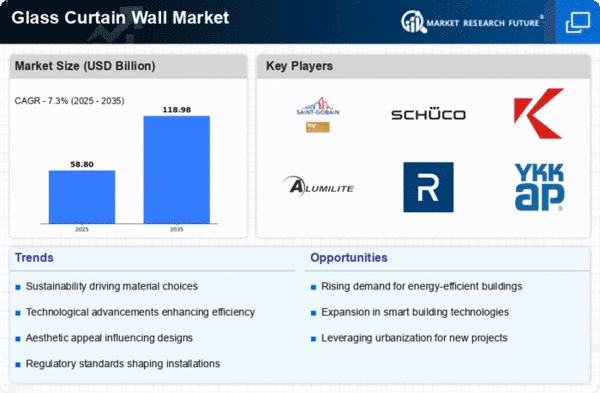
As per MRFR analysis, the Glass Curtain Wall Market Size was estimated at 54.8 USD Billion in 2024. The Glass Curtain Wall industry is projected to grow from 58.8 USD Billion in 2025 to 118.98 USD Billion by 2035, exhibiting a compound annual growth rate (CAGR) of 7.3% during the forecast period 2025 - 2035.

Key Market Trends & Highlights

The Glass Curtain Wall Market is experiencing a robust growth trajectory driven by sustainability and technological advancements.

  • The market is increasingly oriented towards sustainability, with a strong emphasis on eco-friendly materials and practices. Technological advancements are enhancing the performance and aesthetic versatility of glass curtain walls, appealing to modern architectural demands. North America remains the largest market, while the Asia-Pacific region is recognized as the fastest-growing area for glass curtain wall applications. Key market drivers include sustainability initiatives and urbanization trends, which are propelling demand in both commercial and residential segments.

Market Size & Forecast

2024 Market Size 54.8 (USD Billion)
2035 Market Size 118.98 (USD Billion)
CAGR (2025 - 2035) 7.3%
Largest Regional Market Share in 2024 North America

Major Players

Saint-Gobain (FR), Schüco International KG (DE), Kawneer (US), Alumil (GR), Reynaers Aluminium (BE), YKK AP (JP), Sapa Group (NO), Curtain Wall Systems (US), Mitsubishi Plastics (JP)

Market Trends

The Glass Curtain Wall Market is currently experiencing a transformative phase, driven by a confluence of architectural innovation and sustainability imperatives. As urbanization accelerates, the demand for aesthetically pleasing and energy-efficient building facades has surged. This market appears to be characterized by a growing preference for lightweight materials that offer enhanced thermal performance and durability. Furthermore, advancements in glazing technologies are likely to play a pivotal role in shaping the future landscape of this sector, as they enable the integration of smart features that enhance building functionality and occupant comfort. In addition to aesthetic considerations, environmental concerns are increasingly influencing design choices within the Glass Curtain Wall Market. The emphasis on reducing carbon footprints and promoting energy efficiency is prompting architects and builders to adopt materials that align with sustainable practices. This trend suggests a shift towards the use of recycled and eco-friendly materials, which may not only meet regulatory requirements but also appeal to environmentally conscious consumers. As the market evolves, it seems poised to embrace innovations that harmonize form and function, ultimately redefining the standards for modern architecture.

Sustainability Focus

The Glass Curtain Wall Market is witnessing a pronounced shift towards sustainable building practices. This trend emphasizes the use of eco-friendly materials and energy-efficient designs, reflecting a broader commitment to environmental stewardship. Architects and developers are increasingly prioritizing solutions that minimize energy consumption and reduce waste, aligning with global sustainability goals.

Technological Advancements

Technological innovations are reshaping the Glass Curtain Wall Market, particularly through the integration of smart technologies. These advancements enable enhanced energy management, improved insulation, and greater adaptability to environmental conditions. As a result, buildings equipped with intelligent curtain wall systems are likely to offer superior performance and comfort for occupants.

Aesthetic Versatility

The demand for aesthetic versatility in building designs is driving trends within the Glass Curtain Wall Market. Architects are exploring diverse styles and finishes, allowing for greater creativity in facade design. This trend not only enhances the visual appeal of structures but also enables customization to meet specific architectural visions.

Glass Curtain Wall Market Market Drivers

Rising Urbanization

The Global Glass Curtain Wall Market Industry is experiencing substantial growth due to increasing urbanization across the globe. As more people migrate to urban areas, the demand for commercial and residential buildings rises, leading to a greater need for modern architectural solutions. Glass curtain walls are favored for their aesthetic appeal and energy efficiency, making them a popular choice among architects and builders. In 2024, the market is projected to reach 54.8 USD Billion, reflecting the growing trend of high-rise buildings and urban developments. This trend is expected to continue, with the market potentially expanding to 119.0 USD Billion by 2035.

Technological Advancements

Technological advancements in glass manufacturing and installation techniques are significantly influencing the Global Glass Curtain Wall Market Industry. Innovations such as self-cleaning glass, smart glass, and enhanced structural integrity are making glass curtain walls more appealing to builders and architects. These advancements not only improve the aesthetic value of buildings but also contribute to energy savings and sustainability. As the industry embraces these technologies, the market is poised for growth, with projections indicating a potential increase to 119.0 USD Billion by 2035. This evolution in technology is likely to redefine architectural possibilities in urban environments.

Energy Efficiency Regulations

Stringent energy efficiency regulations are driving the Global Glass Curtain Wall Market Industry as governments worldwide implement policies to reduce carbon footprints. These regulations often mandate the use of energy-efficient materials in construction, which includes glass curtain walls that offer superior thermal performance. The integration of advanced technologies, such as low-emissivity coatings and insulated glazing, enhances energy efficiency, making these systems more attractive to developers. As a result, the market is likely to witness a compound annual growth rate of 7.3% from 2025 to 2035, indicating a robust shift towards sustainable building practices.

Increased Investment in Infrastructure

Increased investment in infrastructure development is a key factor propelling the Global Glass Curtain Wall Market Industry. Governments and private entities are allocating substantial funds towards the construction of commercial and residential projects, which often incorporate glass curtain walls for their modern appeal and functionality. This influx of investment is particularly noticeable in emerging economies, where urban development is accelerating. As a result, the market is projected to reach 54.8 USD Billion in 2024, with expectations for continued growth as infrastructure projects expand globally. This trend underscores the importance of glass curtain walls in contemporary construction.

Aesthetic Appeal and Design Flexibility

The aesthetic appeal and design flexibility offered by glass curtain walls are pivotal drivers of the Global Glass Curtain Wall Market Industry. Architects increasingly prefer these systems for their ability to create visually striking facades that enhance the overall appearance of buildings. The transparency and lightness of glass allow for innovative designs that can adapt to various architectural styles. This trend is particularly evident in commercial buildings, where the desire for modern and inviting spaces is paramount. As urbanization continues to rise, the demand for aesthetically pleasing structures is expected to propel the market forward, contributing to its growth trajectory.

Market Segment Insights

By Application: Commercial Buildings (Largest) vs. Residential Buildings (Fastest-Growing)

The Glass Curtain Wall Market is characterized by a diverse application landscape, with commercial buildings holding the largest market share. This segment's prevails due to the high demand for aesthetic appeal, energy efficiency, and natural light integration in office spaces and shopping centers. Conversely, the residential buildings segment is experiencing rapid growth driven by increasing urbanization, evolving residential design trends, and rising consumer preferences for modern housing solutions that offer visual connectivity to the outdoors. In addition to commercial and residential buildings, institutional and industrial buildings are noteworthy contributors to the market. Institutional buildings, including hospitals and schools, demand high-performance glass wall systems that comply with regulatory standards, while industrial applications focus on durability and functionality. As sustainability becomes more important, there is growing adoption of energy-efficient technologies across all segments, spurring further growth in the market.

Commercial Buildings: Dominant vs. Residential Buildings: Emerging

The commercial buildings segment is dominant in the Glass Curtain Wall Market, characterized by extensive use of glass in high-rise structures, corporate offices, and retail spaces. These buildings leverage glass for enhanced aesthetics and energy efficiency, boasting features such as <a href="https://www.marketresearchfuture.com/reports/thermal-insulation-coating-market-4821">thermal insulation</a> and sound attenuation. Emerging as a rapidly growing segment, residential buildings reflect changing consumer preferences towards modern designs. Architects and builders are increasingly incorporating glass curtain walls to maximize light and create seamless indoor-outdoor transitions, appealing to millennials and environmentally conscious buyers. As construction practices evolve, both segments present unique opportunities, with the commercial sector continuing to lead while residential buildings rapidly gain traction amidst rising demand.

By Material Type: Glass (Largest) vs. Aluminum (Fastest-Growing)

In the Glass Curtain Wall Market, the material type segment encompasses several options, including aluminum, glass, steel, and composite materials. Glass holds the largest market share due to its aesthetic appeal and energy efficiency benefits. Following glass, aluminum has a significant presence due to its lightweight and durable properties, while steel and <a href="https://www.marketresearchfuture.com/reports/composite-material-market-33737">composite materials</a> are competing yet hold smaller shares of the market. The market dynamics reflect a strong preference for glass-driven designs in modern architecture, leading to its dominant position.

Aluminum (Dominant) vs. Composite Materials (Emerging)

Aluminum is recognized as a dominant material in the Glass Curtain Wall Market, primarily due to its corrosion resistance, lightweight nature, and structural integrity. It is extensively used for frames and supports due to its ability to withstand various environmental conditions, making it a preferred choice among architects and builders. In contrast, composite materials are seen as emerging within this segment, offering innovative solutions to combine different materials for enhanced performance. While composites are still gaining traction, they are increasingly recognized for their potential in improving thermal efficiency and reducing ecological footprints, which could position them favorably for future growth.

By Installation Type: New Construction (Largest) vs. Retrofit (Fastest-Growing)

<p>In the Glass Curtain Wall Market, the distribution of installation types shows that New Construction holds the largest share due to an increase in urban development projects globally. New Construction projects are prominently driven by rising investments in commercial and residential real estate, emphasizing the aesthetic and performance benefits of glass curtain walls. In contrast, Retrofit projects are gaining traction, marked by an increasing emphasis on energy efficiency and sustainability, allowing existing buildings to enhance their performance through modernization. As the construction industry shifts towards sustainability, Retrofit emerges as the fastest-growing segment, fueled by government regulations and incentives aimed at reducing energy consumption. This surge is further driven by property owners looking to upgrade their structures for better performance and to meet modern health and safety standards. On the other hand, New Construction remains steady, benefiting from innovative designs and materials, ensuring its sustained popularity in the building sector.</p>

<p>Installation Type: New Construction (Dominant) vs. Retrofit (Emerging)</p>

<p>The New Construction segment is characterized by large-scale projects and significant investments in real estate development, particularly in urban areas. This segment leverages modern architectural trends to incorporate extensive glass facades which provide natural lighting and improve aesthetic appeal. It boasts a solid market position owing to continuous developments in the construction sector. Conversely, the Retrofit segment focuses on upgrading existing properties to meet contemporary standards of energy efficiency and design. It is rapidly emerging due to increasing awareness of sustainable construction practices and government incentives for modernization. Property owners are adopting retrofitting as a cost-effective way to enhance building performance while reducing their carbon footprint, thereby appealing to environmentally conscious consumers.</p>

By End Use: Architectural (Largest) vs. Facade (Fastest-Growing)

<p>In the Glass Curtain Wall Market, the segmentation by end use reveals that the architectural segment holds the largest market share. This segment is primarily driven by rising demands in both commercial and residential sectors, where aesthetic appeal and energy efficiency are paramount. Conversely, the facade segment is emerging as the fastest-growing category, fueled by increasing construction activities and a heightened preference for energy-efficient building designs.</p>

<p>Facade (Dominant) vs. Architectural (Emerging)</p>

<p>The facade segment has emerged as a dominant force in the Glass Curtain Wall Market due to its innovative designs that blend functionality with aesthetics. Modern architecture often favors facade solutions that offer energy savings and sustainability features, leading to its rapid growth. On the other hand, the architectural segment, while still significant, is facing competition from this emerging trend. Architects and builders increasingly prioritize facades that not only enhance the visual appeal of buildings but also contribute to their overall environmental performance. This shift is indicative of a broader industry movement towards integrating more dynamic and sustainable building materials.</p>

Get more detailed insights about Glass Curtain Wall Market Research Report- Global Forecast 2035

Regional Insights

North America : Market Leader in Glass Solutions

North America is poised to maintain its leadership in the Glass Curtain Wall Market, holding a significant market share of 27.39% as of 2024. The region's growth is driven by increasing urbanization, a surge in commercial construction, and stringent energy efficiency regulations. The demand for sustainable building materials is also on the rise, further propelling market expansion. Regulatory frameworks promoting green building practices are key catalysts for this growth. The competitive landscape in North America is robust, featuring key players such as Kawneer (US) and Saint-Gobain (FR). The U.S. stands out as the leading country, with a strong focus on innovative glass technologies and energy-efficient solutions. The presence of established companies and ongoing investments in R&D are enhancing the region's market dynamics, ensuring a steady supply of advanced glass curtain wall systems.

Key Players and Competitive Insights

The Glass Curtain Wall Market is currently characterized by a dynamic competitive landscape, driven by factors such as urbanization, sustainability initiatives, and advancements in building technologies. Key players like Saint-Gobain (FR), Schüco International KG (DE), and Kawneer (US) are strategically positioned to leverage these trends. Saint-Gobain (FR) focuses on innovation in energy-efficient solutions, while Schüco International KG (DE) emphasizes sustainable building practices and digital transformation. Kawneer (US) is enhancing its operational capabilities through strategic partnerships and regional expansions, collectively shaping a competitive environment that prioritizes technological advancement and sustainability.In terms of business tactics, companies are increasingly localizing manufacturing to reduce lead times and optimize supply chains. The market structure appears moderately fragmented, with several key players exerting influence over regional markets. This fragmentation allows for a diverse range of products and services, catering to varying customer needs while fostering competition among established and emerging players.
In November Saint-Gobain (FR) announced the launch of a new line of high-performance glass products designed to enhance energy efficiency in commercial buildings. This strategic move underscores the company's commitment to sustainability and positions it favorably in a market increasingly focused on reducing carbon footprints. The introduction of these products is likely to strengthen Saint-Gobain's market share and appeal to environmentally conscious consumers.
In October Schüco International KG (DE) unveiled a digital platform aimed at streamlining the design and installation processes for curtain wall systems. This initiative reflects the company's focus on digital transformation, enabling architects and builders to optimize their workflows. By enhancing user experience and operational efficiency, Schüco is likely to gain a competitive edge in a market that values innovation and technological integration.
In September Kawneer (US) entered into a strategic partnership with a leading technology firm to develop smart curtain wall systems that integrate IoT capabilities. This collaboration is indicative of a broader trend towards the integration of technology in building materials, potentially revolutionizing how curtain walls are designed and utilized. Such advancements may not only enhance building performance but also attract a new segment of tech-savvy clients.
As of December current competitive trends in the Glass Curtain Wall Market are heavily influenced by digitalization, sustainability, and the integration of AI technologies. Strategic alliances are becoming increasingly vital, as companies seek to enhance their product offerings and operational efficiencies. The competitive differentiation is likely to evolve from traditional price-based competition to a focus on innovation, technology, and supply chain reliability, suggesting a transformative shift in how companies position themselves in the market.

Key Companies in the Glass Curtain Wall Market include

Industry Developments

January 2023: AGC Inc. partnered with the Japanese construction company Shimizu Corporation to develop a new type of glass curtain wall that is resistant to earthquakes and typhoons. This partnership is expected to lead to the development of new and innovative glass curtain wall products that can be used in high-risk areas.

March 2023: Saint-Gobain and AGC Inc. announced a partnership to develop and commercialize new glass curtain wall technologies. This partnership will combine the two companies' expertise in glass, adhesives, and other building materials to create innovative new products and solutions.

August 2021: Dynamic Glass acquired Colorado Window Systems, Inc. (CWS), a leading glass and glazing service provider to the greater Denver metropolitan area. This acquisition expanded Dynamic Glass' service capabilities in Colorado and strengthened its position in the US market. December 2023: Schüco International KG, a leading manufacturer of building envelopes, unveils its latest innovation: a self-cleaning glass curtain wall system that utilizes nano-coating technology to repel dirt and water. This technology promises to reduce maintenance costs and improve the long-term durability of the system.

In October 2023, Oldcastle BuildingEnvelope, a Dallas-based company that supplies architectural glass, aluminum, and hardware worldwide, introduced Reliance-TC LT as a new addition to its existing line of curtain wall solutions called Reliance. The product is referred to by the manufacturer as a curtain wall that is high-performance, lightweight, cost-competitive, and well-suited for IECC Zones 4-8. According to OBE, the double-pane curtain wall has a U-factor level of 0.29, which offers excellent thermal insulation against harsh climates in the U.S. and Canada. Additionally, it sets new industry norms in this area.

Reliance-TC LT is designed as an advancement of the Reliance-LT Curtain Wall, allowing installers to utilize their expertise in fabricating and installing that system.

Future Outlook

Glass Curtain Wall Market Future Outlook

The Glass Curtain Wall Market is projected to grow at a 7.3% CAGR from 2025 to 2035, driven by urbanization, energy efficiency demands, and technological advancements.

New opportunities lie in:

  • <p>Integration of smart glass technologies for energy efficiency Expansion into emerging markets with tailored solutions Development of modular curtain wall systems for rapid installation</p>

By 2035, the market is expected to achieve robust growth, reflecting evolving architectural trends and sustainability initiatives.

Market Segmentation

Glass Curtain Wall Market Application Outlook

  • Commercial Buildings
  • Residential Buildings
  • Institutional Buildings
  • Industrial Buildings

Glass Curtain Wall Market Glazing Type Outlook

  • Double Glazing
  • Triple Glazing
  • Low-E Glass
  • Tempered Glass

Glass Curtain Wall Market Material Type Outlook

  • Aluminum
  • Glass
  • Steel
  • Composite Materials

Glass Curtain Wall Market Installation Type Outlook

  • New Construction
  • Renovation
  • Retrofitting

Report Scope

MARKET SIZE 2024 54.8(USD Billion)
MARKET SIZE 2025 58.8(USD Billion)
MARKET SIZE 2035 118.98(USD Billion)
COMPOUND ANNUAL GROWTH RATE (CAGR) 7.3% (2025 - 2035)
REPORT COVERAGE Revenue Forecast, Competitive Landscape, Growth Factors, and Trends
BASE YEAR 2024
Market Forecast Period 2025 - 2035
Historical Data 2019 - 2024
Market Forecast Units USD Billion
Key Companies Profiled Saint-Gobain (FR), Schüco International KG (DE), Kawneer (US), Alumil (GR), Reynaers Aluminium (BE), YKK AP (JP), Sapa Group (NO), Curtain Wall Systems (US), Mitsubishi Plastics (JP)
Segments Covered Application, Material Type, Installation Type, Glazing Type
Key Market Opportunities Integration of smart glass technology enhances energy efficiency in the Glass Curtain Wall Market.
Key Market Dynamics Rising demand for energy-efficient buildings drives innovation in glass curtain wall technologies and sustainable materials.
Countries Covered North America, Europe, APAC, South America, MEA

FAQs

What is the current valuation of the Glass Curtain Wall Market as of 2024?

<p>The Glass Curtain Wall Market was valued at 54.8 USD Billion in 2024.</p>

What is the projected market valuation for the Glass Curtain Wall Market in 2035?

<p>The market is projected to reach 118.98 USD Billion by 2035.</p>

What is the expected CAGR for the Glass Curtain Wall Market during the forecast period 2025 - 2035?

<p>The expected CAGR for the Glass Curtain Wall Market during 2025 - 2035 is 7.3%.</p>

Which application segment holds the largest market share in the Glass Curtain Wall Market?

<p>The Commercial Buildings segment is projected to range from 20.0 to 45.0 USD Billion.</p>

How does the Residential Buildings segment perform in the Glass Curtain Wall Market?

<p>The Residential Buildings segment is expected to range from 15.0 to 30.0 USD Billion.</p>

What materials are primarily used in the Glass Curtain Wall Market?

<p>The primary materials include Glass, Aluminum, Steel, and Composite Materials, with Glass projected to range from 20.0 to 45.0 USD Billion.</p>

What are the key players in the Glass Curtain Wall Market?

Key players include Saint-Gobain, Schüco International KG, Kawneer Company, and others.

What is the market performance of the Retrofit installation type in the Glass Curtain Wall Market?

The Retrofit installation type is expected to range from 18.0 to 38.0 USD Billion.

Which end-use segment is expected to show strong growth in the Glass Curtain Wall Market?

The Architectural end-use segment is projected to range from 20.0 to 45.0 USD Billion.

What is the market outlook for Industrial Buildings in the Glass Curtain Wall Market?

The Industrial Buildings segment is expected to range from 9.8 to 18.98 USD Billion.

  1. SECTION I: EXECUTIVE SUMMARY AND KEY HIGHLIGHTS
    1. | 1.1 EXECUTIVE SUMMARY
    2. | | 1.1.1 Market Overview
    3. | | 1.1.2 Key Findings
    4. | | 1.1.3 Market Segmentation
    5. | | 1.1.4 Competitive Landscape
    6. | | 1.1.5 Challenges and Opportunities
    7. | | 1.1.6 Future Outlook
  2. SECTION II: SCOPING, METHODOLOGY AND MARKET STRUCTURE
    1. | 2.1 MARKET INTRODUCTION
    2. | | 2.1.1 Definition
    3. | | 2.1.2 Scope of the study
    4. | | | 2.1.2.1 Research Objective
    5. | | | 2.1.2.2 Assumption
    6. | | | 2.1.2.3 Limitations
    7. | 2.2 RESEARCH METHODOLOGY
    8. | | 2.2.1 Overview
    9. | | 2.2.2 Data Mining
    10. | | 2.2.3 Secondary Research
    11. | | 2.2.4 Primary Research
    12. | | | 2.2.4.1 Primary Interviews and Information Gathering Process
    13. | | | 2.2.4.2 Breakdown of Primary Respondents
    14. | | 2.2.5 Forecasting Model
    15. | | 2.2.6 Market Size Estimation
    16. | | | 2.2.6.1 Bottom-Up Approach
    17. | | | 2.2.6.2 Top-Down Approach
    18. | | 2.2.7 Data Triangulation
    19. | | 2.2.8 Validation
  3. SECTION III: QUALITATIVE ANALYSIS
    1. | 3.1 MARKET DYNAMICS
    2. | | 3.1.1 Overview
    3. | | 3.1.2 Drivers
    4. | | 3.1.3 Restraints
    5. | | 3.1.4 Opportunities
    6. | 3.2 MARKET FACTOR ANALYSIS
    7. | | 3.2.1 Value chain Analysis
    8. | | 3.2.2 Porter's Five Forces Analysis
    9. | | | 3.2.2.1 Bargaining Power of Suppliers
    10. | | | 3.2.2.2 Bargaining Power of Buyers
    11. | | | 3.2.2.3 Threat of New Entrants
    12. | | | 3.2.2.4 Threat of Substitutes
    13. | | | 3.2.2.5 Intensity of Rivalry
    14. | | 3.2.3 COVID-19 Impact Analysis
    15. | | | 3.2.3.1 Market Impact Analysis
    16. | | | 3.2.3.2 Regional Impact
    17. | | | 3.2.3.3 Opportunity and Threat Analysis
  4. SECTION IV: QUANTITATIVE ANALYSIS
    1. | 4.1 Packaging & Transport, BY Application (USD Billion)
    2. | | 4.1.1 Commercial Buildings
    3. | | 4.1.2 Residential Buildings
    4. | | 4.1.3 Institutional Buildings
    5. | | 4.1.4 Industrial Buildings
    6. | 4.2 Packaging & Transport, BY Material Type (USD Billion)
    7. | | 4.2.1 Aluminum
    8. | | 4.2.2 Glass
    9. | | 4.2.3 Steel
    10. | | 4.2.4 Composite Materials
    11. | 4.3 Packaging & Transport, BY Installation Type (USD Billion)
    12. | | 4.3.1 New Construction
    13. | | 4.3.2 Retrofit
    14. | | 4.3.3 Renovation
    15. | 4.4 Packaging & Transport, BY End Use (USD Billion)
    16. | | 4.4.1 Architectural
    17. | | 4.4.2 Structural
    18. | | 4.4.3 Facade
    19. | 4.5 Packaging & Transport, BY Region (USD Billion)
    20. | | 4.5.1 North America
    21. | | | 4.5.1.1 US
    22. | | | 4.5.1.2 Canada
    23. | | 4.5.2 Europe
    24. | | | 4.5.2.1 Germany
    25. | | | 4.5.2.2 UK
    26. | | | 4.5.2.3 France
    27. | | | 4.5.2.4 Russia
    28. | | | 4.5.2.5 Italy
    29. | | | 4.5.2.6 Spain
    30. | | | 4.5.2.7 Rest of Europe
    31. | | 4.5.3 APAC
    32. | | | 4.5.3.1 China
    33. | | | 4.5.3.2 India
    34. | | | 4.5.3.3 Japan
    35. | | | 4.5.3.4 South Korea
    36. | | | 4.5.3.5 Malaysia
    37. | | | 4.5.3.6 Thailand
    38. | | | 4.5.3.7 Indonesia
    39. | | | 4.5.3.8 Rest of APAC
    40. | | 4.5.4 South America
    41. | | | 4.5.4.1 Brazil
    42. | | | 4.5.4.2 Mexico
    43. | | | 4.5.4.3 Argentina
    44. | | | 4.5.4.4 Rest of South America
    45. | | 4.5.5 MEA
    46. | | | 4.5.5.1 GCC Countries
    47. | | | 4.5.5.2 South Africa
    48. | | | 4.5.5.3 Rest of MEA
  5. SECTION V: COMPETITIVE ANALYSIS
    1. | 5.1 Competitive Landscape
    2. | | 5.1.1 Overview
    3. | | 5.1.2 Competitive Analysis
    4. | | 5.1.3 Market share Analysis
    5. | | 5.1.4 Major Growth Strategy in the Packaging & Transport
    6. | | 5.1.5 Competitive Benchmarking
    7. | | 5.1.6 Leading Players in Terms of Number of Developments in the Packaging & Transport
    8. | | 5.1.7 Key developments and growth strategies
    9. | | | 5.1.7.1 New Product Launch/Service Deployment
    10. | | | 5.1.7.2 Merger & Acquisitions
    11. | | | 5.1.7.3 Joint Ventures
    12. | | 5.1.8 Major Players Financial Matrix
    13. | | | 5.1.8.1 Sales and Operating Income
    14. | | | 5.1.8.2 Major Players R&D Expenditure. 2023
    15. | 5.2 Company Profiles
    16. | | 5.2.1 Saint-Gobain (FR)
    17. | | | 5.2.1.1 Financial Overview
    18. | | | 5.2.1.2 Products Offered
    19. | | | 5.2.1.3 Key Developments
    20. | | | 5.2.1.4 SWOT Analysis
    21. | | | 5.2.1.5 Key Strategies
    22. | | 5.2.2 Schüco International KG (DE)
    23. | | | 5.2.2.1 Financial Overview
    24. | | | 5.2.2.2 Products Offered
    25. | | | 5.2.2.3 Key Developments
    26. | | | 5.2.2.4 SWOT Analysis
    27. | | | 5.2.2.5 Key Strategies
    28. | | 5.2.3 Kawneer Company (US)
    29. | | | 5.2.3.1 Financial Overview
    30. | | | 5.2.3.2 Products Offered
    31. | | | 5.2.3.3 Key Developments
    32. | | | 5.2.3.4 SWOT Analysis
    33. | | | 5.2.3.5 Key Strategies
    34. | | 5.2.4 Alumil (GR)
    35. | | | 5.2.4.1 Financial Overview
    36. | | | 5.2.4.2 Products Offered
    37. | | | 5.2.4.3 Key Developments
    38. | | | 5.2.4.4 SWOT Analysis
    39. | | | 5.2.4.5 Key Strategies
    40. | | 5.2.5 Reynaers Aluminium (BE)
    41. | | | 5.2.5.1 Financial Overview
    42. | | | 5.2.5.2 Products Offered
    43. | | | 5.2.5.3 Key Developments
    44. | | | 5.2.5.4 SWOT Analysis
    45. | | | 5.2.5.5 Key Strategies
    46. | | 5.2.6 YKK AP (JP)
    47. | | | 5.2.6.1 Financial Overview
    48. | | | 5.2.6.2 Products Offered
    49. | | | 5.2.6.3 Key Developments
    50. | | | 5.2.6.4 SWOT Analysis
    51. | | | 5.2.6.5 Key Strategies
    52. | | 5.2.7 Sapa Group (NO)
    53. | | | 5.2.7.1 Financial Overview
    54. | | | 5.2.7.2 Products Offered
    55. | | | 5.2.7.3 Key Developments
    56. | | | 5.2.7.4 SWOT Analysis
    57. | | | 5.2.7.5 Key Strategies
    58. | | 5.2.8 Curtain Wall Systems (US)
    59. | | | 5.2.8.1 Financial Overview
    60. | | | 5.2.8.2 Products Offered
    61. | | | 5.2.8.3 Key Developments
    62. | | | 5.2.8.4 SWOT Analysis
    63. | | | 5.2.8.5 Key Strategies
    64. | | 5.2.9 Mitsubishi Plastics (JP)
    65. | | | 5.2.9.1 Financial Overview
    66. | | | 5.2.9.2 Products Offered
    67. | | | 5.2.9.3 Key Developments
    68. | | | 5.2.9.4 SWOT Analysis
    69. | | | 5.2.9.5 Key Strategies
    70. | 5.3 Appendix
    71. | | 5.3.1 References
    72. | | 5.3.2 Related Reports
  6. LIST OF FIGURES
    1. | 6.1 MARKET SYNOPSIS
    2. | 6.2 NORTH AMERICA MARKET ANALYSIS
    3. | 6.3 US MARKET ANALYSIS BY APPLICATION
    4. | 6.4 US MARKET ANALYSIS BY MATERIAL TYPE
    5. | 6.5 US MARKET ANALYSIS BY INSTALLATION TYPE
    6. | 6.6 US MARKET ANALYSIS BY END USE
    7. | 6.7 CANADA MARKET ANALYSIS BY APPLICATION
    8. | 6.8 CANADA MARKET ANALYSIS BY MATERIAL TYPE
    9. | 6.9 CANADA MARKET ANALYSIS BY INSTALLATION TYPE
    10. | 6.10 CANADA MARKET ANALYSIS BY END USE
    11. | 6.11 EUROPE MARKET ANALYSIS
    12. | 6.12 GERMANY MARKET ANALYSIS BY APPLICATION
    13. | 6.13 GERMANY MARKET ANALYSIS BY MATERIAL TYPE
    14. | 6.14 GERMANY MARKET ANALYSIS BY INSTALLATION TYPE
    15. | 6.15 GERMANY MARKET ANALYSIS BY END USE
    16. | 6.16 UK MARKET ANALYSIS BY APPLICATION
    17. | 6.17 UK MARKET ANALYSIS BY MATERIAL TYPE
    18. | 6.18 UK MARKET ANALYSIS BY INSTALLATION TYPE
    19. | 6.19 UK MARKET ANALYSIS BY END USE
    20. | 6.20 FRANCE MARKET ANALYSIS BY APPLICATION
    21. | 6.21 FRANCE MARKET ANALYSIS BY MATERIAL TYPE
    22. | 6.22 FRANCE MARKET ANALYSIS BY INSTALLATION TYPE
    23. | 6.23 FRANCE MARKET ANALYSIS BY END USE
    24. | 6.24 RUSSIA MARKET ANALYSIS BY APPLICATION
    25. | 6.25 RUSSIA MARKET ANALYSIS BY MATERIAL TYPE
    26. | 6.26 RUSSIA MARKET ANALYSIS BY INSTALLATION TYPE
    27. | 6.27 RUSSIA MARKET ANALYSIS BY END USE
    28. | 6.28 ITALY MARKET ANALYSIS BY APPLICATION
    29. | 6.29 ITALY MARKET ANALYSIS BY MATERIAL TYPE
    30. | 6.30 ITALY MARKET ANALYSIS BY INSTALLATION TYPE
    31. | 6.31 ITALY MARKET ANALYSIS BY END USE
    32. | 6.32 SPAIN MARKET ANALYSIS BY APPLICATION
    33. | 6.33 SPAIN MARKET ANALYSIS BY MATERIAL TYPE
    34. | 6.34 SPAIN MARKET ANALYSIS BY INSTALLATION TYPE
    35. | 6.35 SPAIN MARKET ANALYSIS BY END USE
    36. | 6.36 REST OF EUROPE MARKET ANALYSIS BY APPLICATION
    37. | 6.37 REST OF EUROPE MARKET ANALYSIS BY MATERIAL TYPE
    38. | 6.38 REST OF EUROPE MARKET ANALYSIS BY INSTALLATION TYPE
    39. | 6.39 REST OF EUROPE MARKET ANALYSIS BY END USE
    40. | 6.40 APAC MARKET ANALYSIS
    41. | 6.41 CHINA MARKET ANALYSIS BY APPLICATION
    42. | 6.42 CHINA MARKET ANALYSIS BY MATERIAL TYPE
    43. | 6.43 CHINA MARKET ANALYSIS BY INSTALLATION TYPE
    44. | 6.44 CHINA MARKET ANALYSIS BY END USE
    45. | 6.45 INDIA MARKET ANALYSIS BY APPLICATION
    46. | 6.46 INDIA MARKET ANALYSIS BY MATERIAL TYPE
    47. | 6.47 INDIA MARKET ANALYSIS BY INSTALLATION TYPE
    48. | 6.48 INDIA MARKET ANALYSIS BY END USE
    49. | 6.49 JAPAN MARKET ANALYSIS BY APPLICATION
    50. | 6.50 JAPAN MARKET ANALYSIS BY MATERIAL TYPE
    51. | 6.51 JAPAN MARKET ANALYSIS BY INSTALLATION TYPE
    52. | 6.52 JAPAN MARKET ANALYSIS BY END USE
    53. | 6.53 SOUTH KOREA MARKET ANALYSIS BY APPLICATION
    54. | 6.54 SOUTH KOREA MARKET ANALYSIS BY MATERIAL TYPE
    55. | 6.55 SOUTH KOREA MARKET ANALYSIS BY INSTALLATION TYPE
    56. | 6.56 SOUTH KOREA MARKET ANALYSIS BY END USE
    57. | 6.57 MALAYSIA MARKET ANALYSIS BY APPLICATION
    58. | 6.58 MALAYSIA MARKET ANALYSIS BY MATERIAL TYPE
    59. | 6.59 MALAYSIA MARKET ANALYSIS BY INSTALLATION TYPE
    60. | 6.60 MALAYSIA MARKET ANALYSIS BY END USE
    61. | 6.61 THAILAND MARKET ANALYSIS BY APPLICATION
    62. | 6.62 THAILAND MARKET ANALYSIS BY MATERIAL TYPE
    63. | 6.63 THAILAND MARKET ANALYSIS BY INSTALLATION TYPE
    64. | 6.64 THAILAND MARKET ANALYSIS BY END USE
    65. | 6.65 INDONESIA MARKET ANALYSIS BY APPLICATION
    66. | 6.66 INDONESIA MARKET ANALYSIS BY MATERIAL TYPE
    67. | 6.67 INDONESIA MARKET ANALYSIS BY INSTALLATION TYPE
    68. | 6.68 INDONESIA MARKET ANALYSIS BY END USE
    69. | 6.69 REST OF APAC MARKET ANALYSIS BY APPLICATION
    70. | 6.70 REST OF APAC MARKET ANALYSIS BY MATERIAL TYPE
    71. | 6.71 REST OF APAC MARKET ANALYSIS BY INSTALLATION TYPE
    72. | 6.72 REST OF APAC MARKET ANALYSIS BY END USE
    73. | 6.73 SOUTH AMERICA MARKET ANALYSIS
    74. | 6.74 BRAZIL MARKET ANALYSIS BY APPLICATION
    75. | 6.75 BRAZIL MARKET ANALYSIS BY MATERIAL TYPE
    76. | 6.76 BRAZIL MARKET ANALYSIS BY INSTALLATION TYPE
    77. | 6.77 BRAZIL MARKET ANALYSIS BY END USE
    78. | 6.78 MEXICO MARKET ANALYSIS BY APPLICATION
    79. | 6.79 MEXICO MARKET ANALYSIS BY MATERIAL TYPE
    80. | 6.80 MEXICO MARKET ANALYSIS BY INSTALLATION TYPE
    81. | 6.81 MEXICO MARKET ANALYSIS BY END USE
    82. | 6.82 ARGENTINA MARKET ANALYSIS BY APPLICATION
    83. | 6.83 ARGENTINA MARKET ANALYSIS BY MATERIAL TYPE
    84. | 6.84 ARGENTINA MARKET ANALYSIS BY INSTALLATION TYPE
    85. | 6.85 ARGENTINA MARKET ANALYSIS BY END USE
    86. | 6.86 REST OF SOUTH AMERICA MARKET ANALYSIS BY APPLICATION
    87. | 6.87 REST OF SOUTH AMERICA MARKET ANALYSIS BY MATERIAL TYPE
    88. | 6.88 REST OF SOUTH AMERICA MARKET ANALYSIS BY INSTALLATION TYPE
    89. | 6.89 REST OF SOUTH AMERICA MARKET ANALYSIS BY END USE
    90. | 6.90 MEA MARKET ANALYSIS
    91. | 6.91 GCC COUNTRIES MARKET ANALYSIS BY APPLICATION
    92. | 6.92 GCC COUNTRIES MARKET ANALYSIS BY MATERIAL TYPE
    93. | 6.93 GCC COUNTRIES MARKET ANALYSIS BY INSTALLATION TYPE
    94. | 6.94 GCC COUNTRIES MARKET ANALYSIS BY END USE
    95. | 6.95 SOUTH AFRICA MARKET ANALYSIS BY APPLICATION
    96. | 6.96 SOUTH AFRICA MARKET ANALYSIS BY MATERIAL TYPE
    97. | 6.97 SOUTH AFRICA MARKET ANALYSIS BY INSTALLATION TYPE
    98. | 6.98 SOUTH AFRICA MARKET ANALYSIS BY END USE
    99. | 6.99 REST OF MEA MARKET ANALYSIS BY APPLICATION
    100. | 6.100 REST OF MEA MARKET ANALYSIS BY MATERIAL TYPE
    101. | 6.101 REST OF MEA MARKET ANALYSIS BY INSTALLATION TYPE
    102. | 6.102 REST OF MEA MARKET ANALYSIS BY END USE
    103. | 6.103 KEY BUYING CRITERIA OF PACKAGING & TRANSPORT
    104. | 6.104 RESEARCH PROCESS OF MRFR
    105. | 6.105 DRO ANALYSIS OF PACKAGING & TRANSPORT
    106. | 6.106 DRIVERS IMPACT ANALYSIS: PACKAGING & TRANSPORT
    107. | 6.107 RESTRAINTS IMPACT ANALYSIS: PACKAGING & TRANSPORT
    108. | 6.108 SUPPLY / VALUE CHAIN: PACKAGING & TRANSPORT
    109. | 6.109 PACKAGING & TRANSPORT, BY APPLICATION, 2024 (% SHARE)
    110. | 6.110 PACKAGING & TRANSPORT, BY APPLICATION, 2024 TO 2035 (USD Billion)
    111. | 6.111 PACKAGING & TRANSPORT, BY MATERIAL TYPE, 2024 (% SHARE)
    112. | 6.112 PACKAGING & TRANSPORT, BY MATERIAL TYPE, 2024 TO 2035 (USD Billion)
    113. | 6.113 PACKAGING & TRANSPORT, BY INSTALLATION TYPE, 2024 (% SHARE)
    114. | 6.114 PACKAGING & TRANSPORT, BY INSTALLATION TYPE, 2024 TO 2035 (USD Billion)
    115. | 6.115 PACKAGING & TRANSPORT, BY END USE, 2024 (% SHARE)
    116. | 6.116 PACKAGING & TRANSPORT, BY END USE, 2024 TO 2035 (USD Billion)
    117. | 6.117 BENCHMARKING OF MAJOR COMPETITORS
  7. LIST OF TABLES
    1. | 7.1 LIST OF ASSUMPTIONS
    2. | | 7.1.1
    3. | 7.2 North America MARKET SIZE ESTIMATES; FORECAST
    4. | | 7.2.1 BY APPLICATION, 2025-2035 (USD Billion)
    5. | | 7.2.2 BY MATERIAL TYPE, 2025-2035 (USD Billion)
    6. | | 7.2.3 BY INSTALLATION TYPE, 2025-2035 (USD Billion)
    7. | | 7.2.4 BY END USE, 2025-2035 (USD Billion)
    8. | 7.3 US MARKET SIZE ESTIMATES; FORECAST
    9. | | 7.3.1 BY APPLICATION, 2025-2035 (USD Billion)
    10. | | 7.3.2 BY MATERIAL TYPE, 2025-2035 (USD Billion)
    11. | | 7.3.3 BY INSTALLATION TYPE, 2025-2035 (USD Billion)
    12. | | 7.3.4 BY END USE, 2025-2035 (USD Billion)
    13. | 7.4 Canada MARKET SIZE ESTIMATES; FORECAST
    14. | | 7.4.1 BY APPLICATION, 2025-2035 (USD Billion)
    15. | | 7.4.2 BY MATERIAL TYPE, 2025-2035 (USD Billion)
    16. | | 7.4.3 BY INSTALLATION TYPE, 2025-2035 (USD Billion)
    17. | | 7.4.4 BY END USE, 2025-2035 (USD Billion)
    18. | 7.5 Europe MARKET SIZE ESTIMATES; FORECAST
    19. | | 7.5.1 BY APPLICATION, 2025-2035 (USD Billion)
    20. | | 7.5.2 BY MATERIAL TYPE, 2025-2035 (USD Billion)
    21. | | 7.5.3 BY INSTALLATION TYPE, 2025-2035 (USD Billion)
    22. | | 7.5.4 BY END USE, 2025-2035 (USD Billion)
    23. | 7.6 Germany MARKET SIZE ESTIMATES; FORECAST
    24. | | 7.6.1 BY APPLICATION, 2025-2035 (USD Billion)
    25. | | 7.6.2 BY MATERIAL TYPE, 2025-2035 (USD Billion)
    26. | | 7.6.3 BY INSTALLATION TYPE, 2025-2035 (USD Billion)
    27. | | 7.6.4 BY END USE, 2025-2035 (USD Billion)
    28. | 7.7 UK MARKET SIZE ESTIMATES; FORECAST
    29. | | 7.7.1 BY APPLICATION, 2025-2035 (USD Billion)
    30. | | 7.7.2 BY MATERIAL TYPE, 2025-2035 (USD Billion)
    31. | | 7.7.3 BY INSTALLATION TYPE, 2025-2035 (USD Billion)
    32. | | 7.7.4 BY END USE, 2025-2035 (USD Billion)
    33. | 7.8 France MARKET SIZE ESTIMATES; FORECAST
    34. | | 7.8.1 BY APPLICATION, 2025-2035 (USD Billion)
    35. | | 7.8.2 BY MATERIAL TYPE, 2025-2035 (USD Billion)
    36. | | 7.8.3 BY INSTALLATION TYPE, 2025-2035 (USD Billion)
    37. | | 7.8.4 BY END USE, 2025-2035 (USD Billion)
    38. | 7.9 Russia MARKET SIZE ESTIMATES; FORECAST
    39. | | 7.9.1 BY APPLICATION, 2025-2035 (USD Billion)
    40. | | 7.9.2 BY MATERIAL TYPE, 2025-2035 (USD Billion)
    41. | | 7.9.3 BY INSTALLATION TYPE, 2025-2035 (USD Billion)
    42. | | 7.9.4 BY END USE, 2025-2035 (USD Billion)
    43. | 7.10 Italy MARKET SIZE ESTIMATES; FORECAST
    44. | | 7.10.1 BY APPLICATION, 2025-2035 (USD Billion)
    45. | | 7.10.2 BY MATERIAL TYPE, 2025-2035 (USD Billion)
    46. | | 7.10.3 BY INSTALLATION TYPE, 2025-2035 (USD Billion)
    47. | | 7.10.4 BY END USE, 2025-2035 (USD Billion)
    48. | 7.11 Spain MARKET SIZE ESTIMATES; FORECAST
    49. | | 7.11.1 BY APPLICATION, 2025-2035 (USD Billion)
    50. | | 7.11.2 BY MATERIAL TYPE, 2025-2035 (USD Billion)
    51. | | 7.11.3 BY INSTALLATION TYPE, 2025-2035 (USD Billion)
    52. | | 7.11.4 BY END USE, 2025-2035 (USD Billion)
    53. | 7.12 Rest of Europe MARKET SIZE ESTIMATES; FORECAST
    54. | | 7.12.1 BY APPLICATION, 2025-2035 (USD Billion)
    55. | | 7.12.2 BY MATERIAL TYPE, 2025-2035 (USD Billion)
    56. | | 7.12.3 BY INSTALLATION TYPE, 2025-2035 (USD Billion)
    57. | | 7.12.4 BY END USE, 2025-2035 (USD Billion)
    58. | 7.13 APAC MARKET SIZE ESTIMATES; FORECAST
    59. | | 7.13.1 BY APPLICATION, 2025-2035 (USD Billion)
    60. | | 7.13.2 BY MATERIAL TYPE, 2025-2035 (USD Billion)
    61. | | 7.13.3 BY INSTALLATION TYPE, 2025-2035 (USD Billion)
    62. | | 7.13.4 BY END USE, 2025-2035 (USD Billion)
    63. | 7.14 China MARKET SIZE ESTIMATES; FORECAST
    64. | | 7.14.1 BY APPLICATION, 2025-2035 (USD Billion)
    65. | | 7.14.2 BY MATERIAL TYPE, 2025-2035 (USD Billion)
    66. | | 7.14.3 BY INSTALLATION TYPE, 2025-2035 (USD Billion)
    67. | | 7.14.4 BY END USE, 2025-2035 (USD Billion)
    68. | 7.15 India MARKET SIZE ESTIMATES; FORECAST
    69. | | 7.15.1 BY APPLICATION, 2025-2035 (USD Billion)
    70. | | 7.15.2 BY MATERIAL TYPE, 2025-2035 (USD Billion)
    71. | | 7.15.3 BY INSTALLATION TYPE, 2025-2035 (USD Billion)
    72. | | 7.15.4 BY END USE, 2025-2035 (USD Billion)
    73. | 7.16 Japan MARKET SIZE ESTIMATES; FORECAST
    74. | | 7.16.1 BY APPLICATION, 2025-2035 (USD Billion)
    75. | | 7.16.2 BY MATERIAL TYPE, 2025-2035 (USD Billion)
    76. | | 7.16.3 BY INSTALLATION TYPE, 2025-2035 (USD Billion)
    77. | | 7.16.4 BY END USE, 2025-2035 (USD Billion)
    78. | 7.17 South Korea MARKET SIZE ESTIMATES; FORECAST
    79. | | 7.17.1 BY APPLICATION, 2025-2035 (USD Billion)
    80. | | 7.17.2 BY MATERIAL TYPE, 2025-2035 (USD Billion)
    81. | | 7.17.3 BY INSTALLATION TYPE, 2025-2035 (USD Billion)
    82. | | 7.17.4 BY END USE, 2025-2035 (USD Billion)
    83. | 7.18 Malaysia MARKET SIZE ESTIMATES; FORECAST
    84. | | 7.18.1 BY APPLICATION, 2025-2035 (USD Billion)
    85. | | 7.18.2 BY MATERIAL TYPE, 2025-2035 (USD Billion)
    86. | | 7.18.3 BY INSTALLATION TYPE, 2025-2035 (USD Billion)
    87. | | 7.18.4 BY END USE, 2025-2035 (USD Billion)
    88. | 7.19 Thailand MARKET SIZE ESTIMATES; FORECAST
    89. | | 7.19.1 BY APPLICATION, 2025-2035 (USD Billion)
    90. | | 7.19.2 BY MATERIAL TYPE, 2025-2035 (USD Billion)
    91. | | 7.19.3 BY INSTALLATION TYPE, 2025-2035 (USD Billion)
    92. | | 7.19.4 BY END USE, 2025-2035 (USD Billion)
    93. | 7.20 Indonesia MARKET SIZE ESTIMATES; FORECAST
    94. | | 7.20.1 BY APPLICATION, 2025-2035 (USD Billion)
    95. | | 7.20.2 BY MATERIAL TYPE, 2025-2035 (USD Billion)
    96. | | 7.20.3 BY INSTALLATION TYPE, 2025-2035 (USD Billion)
    97. | | 7.20.4 BY END USE, 2025-2035 (USD Billion)
    98. | 7.21 Rest of APAC MARKET SIZE ESTIMATES; FORECAST
    99. | | 7.21.1 BY APPLICATION, 2025-2035 (USD Billion)
    100. | | 7.21.2 BY MATERIAL TYPE, 2025-2035 (USD Billion)
    101. | | 7.21.3 BY INSTALLATION TYPE, 2025-2035 (USD Billion)
    102. | | 7.21.4 BY END USE, 2025-2035 (USD Billion)
    103. | 7.22 South America MARKET SIZE ESTIMATES; FORECAST
    104. | | 7.22.1 BY APPLICATION, 2025-2035 (USD Billion)
    105. | | 7.22.2 BY MATERIAL TYPE, 2025-2035 (USD Billion)
    106. | | 7.22.3 BY INSTALLATION TYPE, 2025-2035 (USD Billion)
    107. | | 7.22.4 BY END USE, 2025-2035 (USD Billion)
    108. | 7.23 Brazil MARKET SIZE ESTIMATES; FORECAST
    109. | | 7.23.1 BY APPLICATION, 2025-2035 (USD Billion)
    110. | | 7.23.2 BY MATERIAL TYPE, 2025-2035 (USD Billion)
    111. | | 7.23.3 BY INSTALLATION TYPE, 2025-2035 (USD Billion)
    112. | | 7.23.4 BY END USE, 2025-2035 (USD Billion)
    113. | 7.24 Mexico MARKET SIZE ESTIMATES; FORECAST
    114. | | 7.24.1 BY APPLICATION, 2025-2035 (USD Billion)
    115. | | 7.24.2 BY MATERIAL TYPE, 2025-2035 (USD Billion)
    116. | | 7.24.3 BY INSTALLATION TYPE, 2025-2035 (USD Billion)
    117. | | 7.24.4 BY END USE, 2025-2035 (USD Billion)
    118. | 7.25 Argentina MARKET SIZE ESTIMATES; FORECAST
    119. | | 7.25.1 BY APPLICATION, 2025-2035 (USD Billion)
    120. | | 7.25.2 BY MATERIAL TYPE, 2025-2035 (USD Billion)
    121. | | 7.25.3 BY INSTALLATION TYPE, 2025-2035 (USD Billion)
    122. | | 7.25.4 BY END USE, 2025-2035 (USD Billion)
    123. | 7.26 Rest of South America MARKET SIZE ESTIMATES; FORECAST
    124. | | 7.26.1 BY APPLICATION, 2025-2035 (USD Billion)
    125. | | 7.26.2 BY MATERIAL TYPE, 2025-2035 (USD Billion)
    126. | | 7.26.3 BY INSTALLATION TYPE, 2025-2035 (USD Billion)
    127. | | 7.26.4 BY END USE, 2025-2035 (USD Billion)
    128. | 7.27 MEA MARKET SIZE ESTIMATES; FORECAST
    129. | | 7.27.1 BY APPLICATION, 2025-2035 (USD Billion)
    130. | | 7.27.2 BY MATERIAL TYPE, 2025-2035 (USD Billion)
    131. | | 7.27.3 BY INSTALLATION TYPE, 2025-2035 (USD Billion)
    132. | | 7.27.4 BY END USE, 2025-2035 (USD Billion)
    133. | 7.28 GCC Countries MARKET SIZE ESTIMATES; FORECAST
    134. | | 7.28.1 BY APPLICATION, 2025-2035 (USD Billion)
    135. | | 7.28.2 BY MATERIAL TYPE, 2025-2035 (USD Billion)
    136. | | 7.28.3 BY INSTALLATION TYPE, 2025-2035 (USD Billion)
    137. | | 7.28.4 BY END USE, 2025-2035 (USD Billion)
    138. | 7.29 South Africa MARKET SIZE ESTIMATES; FORECAST
    139. | | 7.29.1 BY APPLICATION, 2025-2035 (USD Billion)
    140. | | 7.29.2 BY MATERIAL TYPE, 2025-2035 (USD Billion)
    141. | | 7.29.3 BY INSTALLATION TYPE, 2025-2035 (USD Billion)
    142. | | 7.29.4 BY END USE, 2025-2035 (USD Billion)
    143. | 7.30 Rest of MEA MARKET SIZE ESTIMATES; FORECAST
    144. | | 7.30.1 BY APPLICATION, 2025-2035 (USD Billion)
    145. | | 7.30.2 BY MATERIAL TYPE, 2025-2035 (USD Billion)
    146. | | 7.30.3 BY INSTALLATION TYPE, 2025-2035 (USD Billion)
    147. | | 7.30.4 BY END USE, 2025-2035 (USD Billion)
    148. | 7.31 PRODUCT LAUNCH/PRODUCT DEVELOPMENT/APPROVAL
    149. | | 7.31.1
    150. | 7.32 ACQUISITION/PARTNERSHIP
    151. | | 7.32.1

Packaging & Transport Market Segmentation

Packaging & Transport By Application (USD Billion, 2025-2035)

  • Commercial Buildings
  • Residential Buildings
  • Institutional Buildings
  • Industrial Buildings

Packaging & Transport By Material Type (USD Billion, 2025-2035)

  • Aluminum
  • Glass
  • Steel
  • Composite Materials

Packaging & Transport By Installation Type (USD Billion, 2025-2035)

  • New Construction
  • Retrofit
  • Renovation

Packaging & Transport By End Use (USD Billion, 2025-2035)

  • Architectural
  • Structural
  • Facade
Infographic

Free Sample Request

Kindly complete the form below to receive a free sample of this Report

Get Free Sample

Customer Strories

Compare Licence

×
Features License Type
Single User Multiuser License Enterprise User
Price $4,950 $5,950 $7,250
Maximum User Access Limit 1 User Upto 10 Users Unrestricted Access Throughout the Organization
Free Customization
Direct Access to Analyst
Deliverable Format
Platform Access
Discount on Next Purchase 10% 15% 15%
Printable Versions