×
Request Free Sample ×

Kindly complete the form below to receive a free sample of this Report

* Please use a valid business email

Leading companies partner with us for data-driven Insights

clients tt-cursor
Hero Background
English
Chinese
French
Japanese
Korean
German
Spanish

Glass Bonding Adhesives Market Trends

ID: MRFR/CnM/4614-HCR
100 Pages
Priya Nagrale
October 2025

Glass Bonding Adhesives Market Research Report Information By Type (Polyurethane, Modified Silanes, Silicone, Acrylate, and Others), End-Use Industry (Automotive, Aerospace, Furniture, Construction, Electronics, Medical, and Others), And Region- Forecast Till 2035

Share:
Download PDF ×

We do not share your information with anyone. However, we may send you emails based on your report interest from time to time. You may contact us at any time to opt-out.

Glass Bonding Adhesives Market Infographic
Purchase Options

Market Trends

Key Emerging Trends in the Glass Bonding Adhesives Market

The Glass Bonding Adhesives Market is witnessing significant trends that are reshaping the industry landscape. As industries continue to evolve, the demand for advanced adhesive solutions to bond glass surfaces has surged. One notable trend is the increasing preference for UV-curable glass bonding adhesives. These adhesives offer quick curing times, enhancing efficiency in manufacturing processes. UV-curable adhesives also contribute to environmental sustainability by reducing energy consumption compared to traditional curing methods. This shift towards eco-friendly solutions aligns with the growing emphasis on sustainable practices across industries.

Furthermore, the automotive sector plays a pivotal role in driving the market trends of glass bonding adhesives. With the rising adoption of lightweight materials in automotive manufacturing, there is a growing need for strong and durable bonding solutions for glass components. Glass bonding adhesives offer enhanced structural integrity, contributing to the overall safety and performance of vehicles. The automotive industry's continual pursuit of innovation and safety standards is fueling the demand for advanced bonding technologies, thereby influencing market trends.

In addition to automotive applications, the electronics industry is also contributing to the growth of the glass bonding adhesives market. As electronic devices become more compact and sophisticated, the need for reliable and efficient bonding solutions for glass substrates in displays and touchscreens is on the rise. Glass bonding adhesives provide a seamless and aesthetically pleasing bond, ensuring the durability and longevity of electronic devices. This trend is likely to persist as consumer electronics continue to advance in design and functionality.

Another noteworthy trend is the expansion of the construction industry, especially in emerging economies. As urbanization and infrastructure development accelerate, there is a growing demand for glass bonding adhesives in architectural applications. These adhesives play a crucial role in bonding glass panels for facades, windows, and other structural elements. The construction industry's focus on modern and sustainable building practices further propels the adoption of advanced glass bonding solutions.

Moreover, market players are actively engaged in research and development activities to introduce innovative formulations and product offerings. This trend is driven by the need to address specific challenges in diverse applications, such as extreme temperature resistance, flexibility, and compatibility with various substrates. The continuous pursuit of technological advancements and product differentiation is fostering healthy competition within the glass bonding adhesives market, benefitting end-users with a diverse range of high-performance options.

Globalization and international trade are also influencing market trends in the glass bonding adhesives industry. Manufacturers are expanding their geographical presence to cater to the increasing demand in different regions. This expansion is often accompanied by strategic partnerships and collaborations to leverage local expertise and market insights. As a result, the market is witnessing a shift in regional dynamics, with emerging economies becoming key players in the global supply chain.

Author
Priya Nagrale
Senior Research Analyst

With an experience of over five years in market research industry (Chemicals & Materials domain), I gather and analyze market data from diverse sources to produce results, which are then presented back to a client. Also, provide recommendations based on the findings. As a Senior Research Analyst, I perform quality checks (QC) for market estimations, QC for reports, and handle queries and work extensively on client customizations. Also, handle the responsibilities of client proposals, report planning, report finalization, and execution

Leave a Comment

FAQs

What would drive the glass bonding adhesives market?

Rising adoption of green, non-hazardous, and sustainable adhesives to drive the market ahead.

Who are the glass bonding adhesives market end users?

The end users are electronics, aerospace, automotive, and others.

Which region would helm the glass bonding adhesives market?

The Asia Pacific market would lead.

What triggers the Asia Pacific glass bonding adhesives market growth?

Booming automotive, construction and electronics industries can influence the glass bonding adhesives market growth.

What would drive the North American glass bonding adhesives market growth?

The North American market would benefit from the construction, aerospace, and automotive industries.

Market Summary

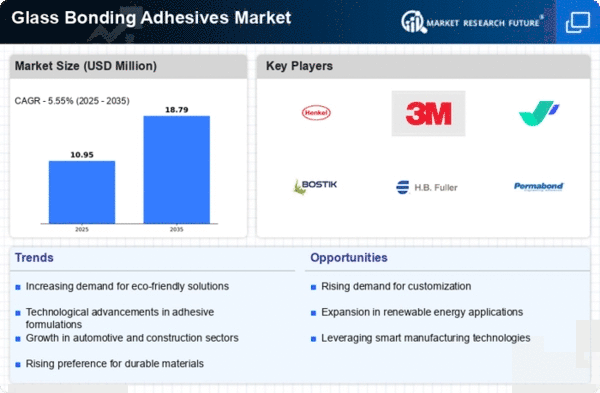
As per MRFR analysis, the Glass Bonding Adhesives Market Size was estimated at 10.37 USD Million in 2024. The Glass Bonding Adhesives industry is projected to grow from 10.94 in 2025 to 18.79 by 2035, exhibiting a compound annual growth rate (CAGR) of 5.55 during the forecast period 2025 - 2035.

Key Market Trends & Highlights

The Glass Bonding Adhesives Market is poised for substantial growth driven by sustainability and technological advancements.

  • North America remains the largest market for glass bonding adhesives, reflecting robust demand across various sectors.
  • The Asia-Pacific region is emerging as the fastest-growing market, fueled by rapid industrialization and urbanization.
  • The automotive segment continues to dominate, while the medical segment is witnessing the highest growth rate due to increasing healthcare needs.
  • Key market drivers include rising demand in the automotive sector and a growing focus on sustainable solutions in adhesive formulations.

Market Size & Forecast

2024 Market Size 10.37 (USD Million)
2035 Market Size 18.79 (USD Million)
CAGR (2025 - 2035) 5.55%
Largest Regional Market Share in 2024 North America

Major Players

<p>Henkel (DE), 3M (US), Sika (CH), Bostik (FR), H.B. Fuller (US), Permabond (GB), Lord Corporation (US), Dow (US), Momentive (US)</p>

Market Trends

The Glass Bonding Adhesives Market is currently experiencing a dynamic evolution, driven by advancements in technology and increasing demand across various sectors. The growing emphasis on sustainable materials and eco-friendly solutions is reshaping product offerings, as manufacturers strive to meet consumer expectations for environmentally responsible options. Additionally, the rise in applications within automotive, construction, and electronics industries is propelling the market forward, as these sectors increasingly rely on high-performance adhesives for enhanced durability and efficiency. As innovation continues to flourish, the market landscape is likely to witness the introduction of novel formulations that cater to specific bonding requirements, thereby expanding the scope of applications. Moreover, the competitive landscape of the Glass Bonding Adhesives Market is becoming more intricate, with numerous players vying for market share. Strategic partnerships and collaborations are emerging as key strategies for companies aiming to enhance their product portfolios and distribution networks. The focus on research and development is paramount, as firms seek to create adhesives that not only meet stringent performance standards but also align with regulatory requirements. This multifaceted approach indicates a robust future for the market, characterized by continuous growth and adaptation to evolving consumer needs and technological advancements.

Sustainability in Adhesive Formulations

There is a noticeable shift towards the development of sustainable adhesive solutions within the Glass Bonding Adhesives Market. Manufacturers are increasingly prioritizing eco-friendly materials and processes, responding to consumer demand for greener products. This trend suggests a potential for growth in bio-based adhesives, which may offer comparable performance while minimizing environmental impact.

Technological Advancements

The integration of advanced technologies in adhesive formulations is becoming a defining characteristic of the Glass Bonding Adhesives Market. Innovations such as nanotechnology and smart adhesives are emerging, enhancing bonding capabilities and performance. This trend indicates a likely increase in the adoption of high-tech solutions across various industries, particularly in automotive and electronics.

Expansion in Application Areas

The Glass Bonding Adhesives Market is witnessing an expansion in application areas, particularly in sectors such as construction, automotive, and electronics. As industries seek to improve product performance and durability, the demand for specialized adhesives is likely to rise. This trend highlights the versatility of glass bonding adhesives and their growing importance in modern manufacturing processes.

Glass Bonding Adhesives Market Market Drivers

Growth in Construction Activities

The Global Glass Bonding Adhesives Market Industry is significantly influenced by the expansion of construction activities worldwide. As urbanization accelerates, the demand for glass in architectural designs rises, leading to a projected market value of 3500 USD Million in 2024. Glass bonding adhesives are essential for ensuring structural integrity and aesthetic appeal in modern buildings. The trend towards energy-efficient structures also promotes the use of glass, which necessitates high-performance adhesives. This growth trajectory is likely to continue, with the market expected to reach 6500 USD Million by 2035, reflecting a robust CAGR of 5.79% from 2025 to 2035.

Rising Demand in Automotive Sector

The Global Glass Bonding Adhesives Market Industry experiences a notable surge in demand driven by the automotive sector. As manufacturers increasingly adopt advanced glass bonding technologies for windshields and windows, the market is projected to reach 3500 USD Million in 2024. This trend is fueled by the need for lightweight materials that enhance fuel efficiency and safety. Furthermore, the integration of glass in vehicle designs is expected to grow, thereby increasing the application of specialized adhesives. The automotive industry's shift towards electric vehicles may further amplify this demand, as manufacturers seek innovative bonding solutions to meet evolving design requirements.

Regulatory Support for Sustainable Materials

The Global Glass Bonding Adhesives Market Industry benefits from increasing regulatory support for sustainable materials and practices. Governments worldwide are implementing policies that encourage the use of eco-friendly adhesives in various applications, including construction and automotive. This regulatory landscape fosters innovation and investment in sustainable adhesive technologies, which are essential for meeting stringent environmental standards. As a result, manufacturers are likely to prioritize the development of adhesives that not only perform well but also minimize environmental impact. This shift may contribute to the market's growth trajectory, aligning with global sustainability initiatives.

Increased Focus on Renewable Energy Solutions

The Global Glass Bonding Adhesives Market Industry is positively impacted by the rising emphasis on renewable energy solutions, particularly in solar energy applications. Glass bonding adhesives play a vital role in the assembly of solar panels, ensuring durability and efficiency. As countries invest in renewable energy infrastructure, the demand for high-performance adhesives is expected to grow. This trend aligns with global efforts to transition towards sustainable energy sources, potentially driving the market value to 6500 USD Million by 2035. The integration of glass in energy-efficient technologies further underscores the importance of reliable bonding solutions in this sector.

Technological Advancements in Adhesive Formulations

Innovations in adhesive formulations are a critical driver for the Global Glass Bonding Adhesives Market Industry. Manufacturers are increasingly developing advanced adhesives that offer superior bonding strength, durability, and resistance to environmental factors. These technological advancements enable the use of glass in diverse applications, from consumer electronics to aerospace. As the industry evolves, the introduction of eco-friendly and sustainable adhesive options is likely to gain traction, aligning with global sustainability goals. This shift not only enhances product performance but also caters to a growing consumer preference for environmentally responsible materials, thereby expanding market opportunities.

Market Segment Insights

By Application: Automotive (Largest) vs. Medical (Fastest-Growing)

<p>The Glass Bonding Adhesives Market showcases a diverse application landscape, with the automotive sector holding the largest share. This segment benefits from a rising demand for lightweight materials and improved fuel efficiency, pushing manufacturers to seek efficient bonding solutions. Construction, electronics, and aerospace follow, reflecting significant but variable market shares. In contrast, the medical application is emerging, driven by innovations and new product formulations focused on healthcare needs.</p>

<p>Automotive: Dominant vs. Medical: Emerging</p>

<p>In the Glass Bonding Adhesives Market, the automotive sector emerges as the dominant force, characterized by its extensive usage in vehicles for bonding glass components such as windshields and side windows. This segment enjoys a strong reputation for reliability and durability, making it a preferred choice among automotive manufacturers. In contrast, the medical application is recognized as an emerging segment, fueled by technological advancements in healthcare. The demand for specialized adhesives, used in medical devices and equipment, is gaining momentum due to the increasing focus on patient care and product safety, positioning it as a vital component in the rapidly evolving healthcare landscape.</p>

By End Use: Residential (Largest) vs. Industrial (Fastest-Growing)

<p>In the Glass Bonding Adhesives Market, the residential segment constitutes the largest share, driven by an increase in home renovations and the demand for energy-efficient solutions. This sector benefits from a growing trend towards energy-saving glass installations, making it a prominent player in the market. Following closely is the industrial segment, which is witnessing rapid expansion due to heightened automation in manufacturing processes and a rising focus on composite materials across various sectors.</p>

<p>Residential (Dominant) vs. Industrial (Emerging)</p>

<p>The residential sector of glass bonding adhesives holds a dominant position, primarily as a result of consistent investment in home improvement and a shift towards sustainable architecture. This segment caters to consumers seeking aesthetic appeal and energy efficiency, utilizing adhesives that enhance insulation and reduce energy consumption. Meanwhile, the industrial segment is emerging as a rapidly expanding area, fueled by increased automation and modernization across manufacturing. This segment leverages advanced adhesive technologies designed for superior bonding in demanding applications, which has led to notable growth opportunities, making it a key area of focus for manufacturers.</p>

By Type: Epoxy (Largest) vs. Polyurethane (Fastest-Growing)

<p>The Glass Bonding Adhesives Market is characterized by a diverse array of adhesive types, with epoxy emerging as the largest segment. This dominance is attributed to its superior bonding strength and versatility across various applications, particularly in industries like construction and automotive. Polyurethane, while smaller in market share, is recognized for its growing significance within the market, especially due to its flexibility and durability in challenging environments. As manufacturers increasingly focus on sustainability and performance, both epoxy and polyurethane are benefiting from enhanced research and development initiatives. The rise of environmentally friendly formulations is further driving the growth of polyurethane adhesives. Additionally, advancements in technology are leading to better product offerings and greater adoption in new applications, positioning polyurethane as the fastest-growing segment within the glass bonding adhesives landscape.</p>

<p>Epoxy (Dominant) vs. Silicone (Emerging)</p>

<p>Epoxy adhesives stand out as the dominant force in the Glass Bonding Adhesives Market. Their unmatched bonding capabilities and resistance to environmental factors make them the preferred choice for demanding applications. In contrast, silicone adhesives represent an emerging category, known for their flexibility and excellent temperature resistance. While epoxy is regarded for its strength in permanent bonds, silicone's advantage lies in its ability to create temporary, yet durable, seals that can withstand movement and thermal expansion. The demand for silicone adhesives is steadily rising, driven by growing applications in industries such as electronics and construction, where flexibility and resistance to moisture are crucial. As both segments evolve, they highlight the diverse needs of end-users seeking specialized adhesive solutions.</p>

By Curing Mechanism: UV Curing (Largest) vs. Thermal Curing (Fastest-Growing)

<p>In the Glass Bonding Adhesives Market, the 'Curing Mechanism' segment demonstrates a well-diversified market share, with UV Curing emerging as the dominant player due to its efficiency and swift bonding capabilities. Following closely, Thermal Curing, Moisture Curing, and Chemical Curing each carve out their niches, catering to specific application needs. UV Curing captures significant attention for its effectiveness in rapid production processes, satisfying both consumer demand and industrial needs.</p>

<p>UV Curing (Dominant) vs. Moisture Curing (Emerging)</p>

<p>UV Curing technology leads the Glass Bonding Adhesives Market, capitalizing on fast-curing times and excellent bonding strength, making it the preferred choice for applications requiring quick turnaround times and reliability. On the other hand, Moisture Curing is emerging as an appealing alternative, particularly for its versatility and ability to perform under diverse environmental conditions. As industries seek more adaptable solutions, Moisture Curing's unique properties attract attention, making it a valuable option in the evolving market landscape. Together, these two segments illustrate the exciting dynamics of innovation and application diversity in adhesive technologies.</p>

By Formulation: Single Component (Largest) vs. Two Component (Fastest-Growing)

<p>In the Glass Bonding Adhesives market, the formulation segment is primarily dominated by Single Component adhesives, which are widely preferred for their ease of use and versatility. This formulation type captures a significant market share due to its ability to provide strong adhesion with minimal preparation. While Single Component adhesives hold the largest share, Two Component adhesives are gaining traction and quickly gaining market share. They are favored for their superior bond strength and resistance to environmental factors, making them appealing for more demanding applications. As the market evolves, the demand for Two Component adhesives is expected to surge, driven by innovations that improve performance and adaptability in various environments. Industries such as automotive and construction are increasingly adopting these adhesives for their robust bonding capabilities. This trend signifies a shift towards more complex formulations, indicating a growing preference for adhesives that offer enhanced durability and performance. The market is witnessing a transition where efficiency and reliability are prioritized, paving the way for the growth of the Two Component segment in the coming years.</p>

<p>Formulation: Single Component (Dominant) vs. Two Component (Emerging)</p>

<p>Single Component adhesives are recognized for their simplicity and vast application range, positioning them as the dominant force in the Glass Bonding Adhesives market. They are typically moisture-cured, allowing them to bond quickly without the need for mixing, making them ideal for high-speed production environments. Their ease of use and reliability have made them the go-to choice in a variety of industries including glass manufacturing and automotive assembly. On the other hand, Two Component adhesives are emerging as a strong competitor in this segment, known for their exceptional bond strength and resistance to environmental stresses, such as temperature fluctuations and moisture. They require mixing, which may add complexity but significantly enhances performance. As technology advances, the Two Component segment is expected to capture a larger market share, offering tailored solutions for more specialized applications.</p>

Get more detailed insights about Glass Bonding Adhesives Market Research Report – Forecast to 2035

Regional Insights

North America : Market Leader in Adhesives

North America is poised to maintain its leadership in the Glass Bonding Adhesives market, holding a significant market share of 4.5 in 2024. The region's growth is driven by robust demand from the automotive and construction sectors, alongside stringent regulations promoting the use of high-performance adhesives. The increasing trend towards lightweight materials in manufacturing further fuels this demand, as companies seek to enhance efficiency and sustainability. The United States stands out as the leading country in this region, with major players like 3M, Dow, and H.B. Fuller driving innovation and competition. The presence of advanced manufacturing facilities and a strong distribution network enhances market accessibility. Additionally, the competitive landscape is characterized by strategic partnerships and acquisitions, enabling companies to expand their product offerings and market reach.

Europe : Growing Demand and Innovation

Europe's Glass Bonding Adhesives market is projected to grow significantly, with a market size of 3.0 in 2025. The region benefits from a strong automotive industry and increasing construction activities, which are key drivers of demand. Regulatory frameworks promoting eco-friendly products and sustainable practices are also catalyzing market growth. The shift towards energy-efficient buildings and vehicles is pushing manufacturers to innovate and adopt advanced adhesive technologies. Germany, France, and the UK are leading countries in this market, with companies like Henkel and Sika at the forefront. The competitive landscape is marked by a focus on R&D and product differentiation, as firms strive to meet evolving consumer needs. The presence of established players and a growing number of startups contribute to a dynamic market environment, fostering innovation and collaboration.

Asia-Pacific : Emerging Market Potential

The Asia-Pacific region is witnessing a burgeoning Glass Bonding Adhesives market, with a size of 2.5 in 2025. This growth is primarily driven by rapid industrialization, urbanization, and increasing investments in infrastructure projects. Countries like China and India are experiencing a surge in demand for high-performance adhesives, particularly in the automotive and electronics sectors. Regulatory support for advanced materials is further enhancing market prospects, as manufacturers seek to comply with safety and environmental standards. China is the dominant player in this region, with a significant presence of both local and international companies. The competitive landscape is characterized by aggressive pricing strategies and a focus on innovation. Key players such as Momentive and Lord Corporation are actively expanding their operations to capture the growing market share, leading to a vibrant and competitive environment.

Middle East and Africa : Untapped Market Opportunities

The Middle East and Africa region presents a nascent yet promising market for Glass Bonding Adhesives, with a market size of 0.37 in 2025. The growth is driven by increasing construction activities and a rising demand for durable and efficient adhesive solutions. Regulatory initiatives aimed at improving product quality and safety standards are also contributing to market development. The region's diverse economic landscape offers unique opportunities for adhesive manufacturers to cater to various industries, including automotive and construction. Countries like the UAE and South Africa are leading the way in adopting advanced adhesive technologies. The competitive landscape is still developing, with both local and international players vying for market share. Companies are focusing on establishing distribution networks and partnerships to enhance their presence in this emerging market, paving the way for future growth.

Key Players and Competitive Insights

The Glass Bonding Adhesives Market is currently characterized by a dynamic competitive landscape, driven by increasing demand across various sectors such as automotive, construction, and electronics. Key players are actively engaging in strategies that emphasize innovation, sustainability, and regional expansion. For instance, Henkel (DE) has positioned itself as a leader through its commitment to developing eco-friendly adhesive solutions, while 3M (US) focuses on technological advancements to enhance product performance. Sika (CH) is leveraging its extensive global footprint to penetrate emerging markets, and Bostik (FR) is enhancing its product portfolio through strategic partnerships, collectively shaping a competitive environment that prioritizes adaptability and responsiveness to market needs.

In terms of business tactics, companies are increasingly localizing manufacturing to reduce lead times and optimize supply chains. The market structure appears moderately fragmented, with several players vying for market share. This fragmentation allows for a diverse range of products and innovations, although the influence of key players remains substantial. The collective strategies of these companies indicate a trend towards collaboration and integration, which may further enhance competitive dynamics.

In November 2025, H.B. Fuller (US) announced the opening of a new manufacturing facility in Brazil, aimed at increasing its production capacity for glass bonding adhesives. This strategic move is significant as it not only enhances local supply capabilities but also aligns with the growing demand in the South American market, potentially positioning H.B. Fuller as a key player in this region. The investment reflects a broader trend of companies seeking to localize operations to better serve regional markets.

In October 2025, Dow (US) launched a new line of sustainable glass bonding adhesives designed to meet the stringent environmental regulations in Europe. This initiative underscores Dow's commitment to sustainability and innovation, as it seeks to differentiate its offerings in a competitive market. The introduction of eco-friendly products is likely to resonate with environmentally conscious consumers and businesses, thereby enhancing Dow's market position.

In September 2025, Momentive (US) entered into a strategic partnership with a leading automotive manufacturer to develop advanced adhesive solutions tailored for electric vehicles. This collaboration is indicative of the growing trend towards electric mobility and the need for specialized bonding solutions that can withstand the unique demands of EV applications. Such partnerships not only enhance Momentive's product offerings but also position the company at the forefront of a rapidly evolving market segment.

As of December 2025, current competitive trends are increasingly defined by digitalization, sustainability, and the integration of AI technologies into product development and manufacturing processes. Strategic alliances are becoming more prevalent, allowing companies to pool resources and expertise to drive innovation. The competitive landscape is shifting from a focus on price-based competition to one that emphasizes technological advancement, product differentiation, and supply chain reliability. This evolution suggests that companies that prioritize innovation and sustainability will likely emerge as leaders in the Glass Bonding Adhesives Market.

Key Companies in the Glass Bonding Adhesives Market include

Industry Developments

Future Outlook

Glass Bonding Adhesives Market Future Outlook

<p>The Glass Bonding Adhesives Market is projected to grow at a 5.55% CAGR from 2024 to 2035, driven by advancements in technology, increasing demand in automotive applications, and sustainable product innovations.</p>

New opportunities lie in:

  • <p>Development of eco-friendly adhesive formulations for green building projects.</p>
  • <p>Expansion into emerging markets with tailored adhesive solutions.</p>
  • <p>Integration of smart adhesive technologies for enhanced performance monitoring.</p>

<p>By 2035, the Glass Bonding Adhesives Market is expected to achieve robust growth and innovation.</p>

Market Segmentation

Glass Bonding Adhesives Market Type Outlook

  • Epoxy
  • Polyurethane
  • Silicone
  • Acrylic

Glass Bonding Adhesives Market End Use Outlook

  • Residential
  • Commercial
  • Industrial
  • Transportation

Glass Bonding Adhesives Market Application Outlook

  • Automotive
  • Construction
  • Electronics
  • Aerospace
  • Medical

Glass Bonding Adhesives Market Formulation Outlook

  • Single Component
  • Two Component
  • Multi Component

Glass Bonding Adhesives Market Curing Mechanism Outlook

  • UV Curing
  • Thermal Curing
  • Moisture Curing
  • Chemical Curing

Report Scope

MARKET SIZE 202410.37(USD Million)
MARKET SIZE 202510.94(USD Million)
MARKET SIZE 203518.79(USD Million)
COMPOUND ANNUAL GROWTH RATE (CAGR)5.55% (2024 - 2035)
REPORT COVERAGERevenue Forecast, Competitive Landscape, Growth Factors, and Trends
BASE YEAR2024
Market Forecast Period2025 - 2035
Historical Data2019 - 2024
Market Forecast UnitsUSD Million
Key Companies ProfiledHenkel (DE), 3M (US), Sika (CH), Bostik (FR), H.B. Fuller (US), Permabond (GB), Lord Corporation (US), Dow (US), Momentive (US)
Segments CoveredApplication, End Use, Type, Curing Mechanism, Formulation
Key Market OpportunitiesAdvancements in eco-friendly formulations drive growth in the Glass Bonding Adhesives Market.
Key Market DynamicsRising demand for eco-friendly formulations drives innovation in the glass bonding adhesives market.
Countries CoveredNorth America, Europe, APAC, South America, MEA

FAQs

What would drive the glass bonding adhesives market?

Rising adoption of green, non-hazardous, and sustainable adhesives to drive the market ahead.

Who are the glass bonding adhesives market end users?

The end users are electronics, aerospace, automotive, and others.

Which region would helm the glass bonding adhesives market?

The Asia Pacific market would lead.

What triggers the Asia Pacific glass bonding adhesives market growth?

Booming automotive, construction and electronics industries can influence the glass bonding adhesives market growth.

What would drive the North American glass bonding adhesives market growth?

The North American market would benefit from the construction, aerospace, and automotive industries.

  1. Executive Summary
  2. Scope of the Report
    1. Market Definition
    2. Scope of the
      1. Research Objectives
      2. Assumptions & Limitations
    3. Study
    4. Markets Structure
    5. Market Research Methodology
    6. Research
    7. Process
    8. Secondary Research
    9. Primary Research
    10. Forecast Model
  3. Market Landscape
    1. Porter’s Five Forces Analysis
      1. Threat of New Entrants
      2. Bargaining Power of Buyers
      3. Threat of Substitutes
      4. Segment Rivalry
    2. Bargaining Power of Suppliers
    3. Value Chain/Supply Chain of Global Glass Bonding Adhesives Market
    4. Industry Overview of Global Glass Bonding Adhesives Market
    5. Introduction
    6. Growth
    7. Drivers
    8. Impact Analysis
    9. Market Challenges
    10. Market Trends
    11. Introduction
    12. Growth Trends
    13. Impact Analysis
  4. Global
    1. Glass Bonding Adhesives Market by Type
    2. Introduction
    3. Polyurethane
      1. Market
      2. Market Estimates & Forecast by
    4. Estimates & Forecast, 2020-2027
    5. Region, 2020-2027
    6. Modified Silanes Adhesives
      1. Market Estimates & Forecast, 2020-2027
      2. Market Estimates
    7. & Forecast by Region, 2020-2027
    8. Silicone Adhesives
      1. Market Estimates & Forecast, 2020-2027
    9. Market Estimates & Forecast by Region, 2020-2027
    10. Acrylate
      1. Market Estimates & Forecast, 2020-2027
      2. Market Estimates & Forecast by Region, 2020-2027
      3. Market Estimates & Forecast,
      4. Market Estimates & Forecast by Region, 2020-2027
      5. Market Estimates &
      6. Market Estimates & Forecast by Region, 2020-2027
    11. Adhesives
    12. Epoxy Adhesives
    13. Cyanoacrylate Adhesives
    14. Forecast, 2020-2027
    15. Polysulfides
      1. Market Estimates
      2. Market Estimates & Forecast by Region,
    16. & Forecast, 2020-2027
    17. UV/ LED Curing
      1. Market Estimates & Forecast
    18. Market Estimates & Forecast, 2020-2027
    19. by Region, 2020-2027
    20. Others
      1. Market Estimates & Forecast
    21. Market Estimates & Forecast, 2020-2027
    22. by Region, 2020-2027
  5. Global Glass Bonding Adhesives
    1. Market by End-Use Industry
    2. Introduction
      1. Market Estimates & Forecast, 2020-2027
    3. Automotive
    4. Market Estimates & Forecast by Region, 2020-2027
    5. Aerospace
      1. Market Estimates & Forecast, 2020-2027
      2. Market Estimates &
    6. Forecast by Region, 2020-2027
    7. Furniture
      1. Market
      2. Market Estimates & Forecast by
    8. Estimates & Forecast, 2020-2027
    9. Region, 2020-2027
    10. Construction
      1. Market Estimates & Forecast
    11. Market Estimates & Forecast, 2020-2027
    12. by Region, 2020-2027
    13. Electronics
      1. Market Estimates & Forecast
    14. Market Estimates & Forecast, 2020-2027
    15. by Region, 2020-2027
    16. Consumer Goods
      1. Market Estimates & Forecast, 2020-2027
      2. Market Estimates
    17. & Forecast by Region, 2020-2027
    18. Medical
      1. Market Estimates & Forecast, 2020-2027
    19. Market Estimates & Forecast by Region, 2020-2027
    20. Others
      1. Market Estimates & Forecast, 2020-2027
    21. Market Estimates & Forecast by Region, 2020-2027
  6. Global
    1. Glass Bonding Adhesives Market by Region
    2. Introduction
    3. North America
      1. Market Estimates & Forecast,
      2. Market Estimates & Forecast by Type, 2020-2027
      3. Canada
    4. Market Estimates & Forecast by End-Use Industry, 2020-2027
    5. US
    6. Estimates & Forecast by Type, 2020-2027
    7. Forecast by End-Use Industry, 2020-2027
    8. Market Estimates & Forecast, 2020-2027
    9. by Type, 2020-2027
    10. Europe
      1. Market Estimates &
      2. Market Estimates & Forecast by Type, 2020-2027
      3. Market Estimates & Forecast by End-Use Industry, 2020-2027
      4. France
      5. Italy
      6. Spain
      7. Russia
      8. Poland
    11. Forecast, 2020-2027
    12. Germany
    13. Market Estimates & Forecast by Type, 2020-2027
    14. & Forecast by End-Use Industry, 2020-2027
    15. & Forecast by Type, 2020-2027
    16. End-Use Industry, 2020-2027
    17. Estimates & Forecast, 2020-2027
    18. by Type, 2020-2027
    19. Forecast, 2020-2027
    20. UK
    21. Estimates & Forecast by Type, 2020-2027
    22. Forecast by End-Use Industry, 2020-2027
    23. Market Estimates & Forecast, 2020-2027
    24. by Type, 2020-2027
    25. Forecast, 2020-2027
    26. Asia Pacific
      1. Market Estimates & Forecast,
      2. Market Estimates & Forecast by Type, 2020-2027
      3. Japan
      4. Australia
      5. New Zealand
      6. Rest of Asia Pacific
    27. Market Estimates & Forecast by End-Use Industry, 2020-2027
    28. China
    29. Market Estimates & Forecast by Type, 2020-2027
    30. & Forecast by End-Use Industry, 2020-2027
    31. India
    32. Market Estimates & Forecast by Type, 2020-2027
    33. & Forecast by End-Use Industry, 2020-2027
    34. & Forecast by Type, 2020-2027
    35. End-Use Industry, 2020-2027
    36. Market Estimates & Forecast, 2020-2027
    37. by Type, 2020-2027
    38. & Forecast, 2020-2027
    39. & Forecast, 2020-2027
    40. The Middle East & Africa
      1. Market
      2. Market Estimates & Forecast by
      3. Market Estimates & Forecast by End-Use Industry,
      4. Turkey
      5. Israel
      6. Rest of Middle
      7. Market Estimates & Forecast, 2020-2027
      8. Market Estimates &
      9. Brazil
      10. Argentina
      11. Mexico
      12. Rest of Latin America
    41. Estimates & Forecast, 2020-2027
    42. Type, 2020-2027
    43. Forecast, 2020-2027
    44. Market Estimates & Forecast by End-Use Industry, 2020-2027
    45. North Africa
    46. Market Estimates & Forecast by End-Use Industry, 2020-2027
    47. GCC
    48. Estimates & Forecast by Type, 2020-2027
    49. Forecast by End-Use Industry, 2020-2027
    50. East & Africa
    51. Estimates & Forecast by End-Use Industry, 2020-2027
    52. Latin America
    53. Market Estimates & Forecast by Type, 2020-2027
    54. Forecast by End-Use Industry, 2020-2027
    55. & Forecast by Type, 2020-2027
    56. End-Use Industry, 2020-2027
    57. Market Estimates & Forecast, 2020-2027
    58. by Type, 2020-2027
    59. & Forecast, 2020-2027
    60. & Forecast, 2020-2027
  7. Company Landscape
  8. Company
    1. Profiles
    2. Henkel AG & Co. KGaA
      1. Company Overview
      2. Type/Business
      3. Financial Updates
    3. Segment Overview
    4. Key Developments
    5. H.B. Fuller Company
      1. Company Overview
      2. Type/Business
      3. Financial Updates
    6. Segment Overview
    7. Key Developments
    8. Sika AG
      1. Type/Business Segment Overview
      2. Financial Updates
      3. Key Developments
    9. Company Overview
    10. Dymax Corporation
      1. Company
      2. Type/Business Segment Overview
      3. Key Developments
      4. Company Overview
      5. Financial Updates
      6. Key Developments
    11. Overview
    12. Financial Updates
    13. 3M
    14. Type/Business Segment Overview
    15. DowDuPont
      1. Company Overview
      2. Type/Business
      3. Financial Updates
    16. Segment Overview
    17. Key Developments
    18. KIWO
      1. Type/Business Segment Overview
      2. Financial Updates
      3. Key Developments
    19. Company Overview
    20. ThreeBond Holdings Co., Ltd.
      1. Company
      2. Type/Business Segment Overview
      3. Key Developments
      4. Company Overview
      5. Financial Updates
      6. Key Developments
    21. Overview
    22. Financial Updates
    23. Bohle AG
    24. Type/Business Segment Overview
    25. Ashland
      1. Company Overview
      2. Type/Business
      3. Financial Updates
    26. Segment Overview
    27. Key Developments
    28. Master Bond Inc.
      1. Type/Business Segment Overview
      2. Financial Updates
      3. Key
    29. Company Overview
    30. Developments
    31. Permabond LLC.
      1. Type/Business Segment Overview
      2. Financial Updates
      3. Key
    32. Company Overview
    33. Developments
  9. Conclusion
  10. LIST OF TABLES
  11. World Population by Major Regions (2020 To 2027)
  12. Global Glass Bonding Adhesives Market: By
    1. Region, 2020-2027
  13. North America Glass Bonding
    1. Adhesives Market: By Country, 2020-2027
  14. Europe
    1. Glass Bonding Adhesives Market: By Country, 2020-2027
    2. Table 5
    3. Asia Pacific Glass Bonding Adhesives Market: By Country, 2020-2027
  15. The Middle East & Africa Glass Bonding Adhesives
    1. Market: By Country, 2020-2027
  16. Latin America
    1. Glass Bonding Adhesives Market: By Country, 2020-2027
    2. Table 8
    3. Global Glass Bonding Adhesives by Types Market: By Regions, 2020-2027
  17. North America Glass Bonding Adhesives by
    1. Types Market: By Country, 2020-2027
  18. Europe
    1. Glass Bonding Adhesives by Types Market: By Country, 2020-2027
    2. Table11 Asia Pacific Glass Bonding Adhesives by Types
    3. Market: By Country, 2020-2027
    4. Table13 The Middle
    5. East & Africa Glass Bonding Adhesives by Types Market: By Country,
    6. Table12 Latin America Glass Bonding Adhesives
    7. by Types Market: By Country, 2020-2027
    8. Table14
    9. North America Glass Bonding Adhesives for End-Use Industry Market: By
    10. Country, 2020-2027
    11. Table13 Europe Glass Bonding Adhesives
    12. for End-Use Industry Market: By Country, 2020-2027
    13. Table14
    14. Asia Pacific Glass Bonding Adhesives for End-Use Industry Market: By
    15. Country, 2020-2027
    16. Table16 The Middle East & Africa
    17. Glass Bonding Adhesives for End-Use Industry Market: By Country, 2020-2027
    18. Table15 Latin America Glass Bonding Adhesives for
    19. End-Use Industry Market: By Country, 2020-2027
    20. Table23 Global
    21. Types Market: By Region, 2020-2027
    22. Table24 Global
    23. End-Use Industry Market: By Region, 2020-2027
    24. Table25 North
  19. America Glass Bonding Adhesives Market, By Country
    1. Table26
  20. North America Glass Bonding Adhesives Market, By Types
    1. Table27
  21. North America Glass Bonding Adhesives Market, By End-Use Industry
  22. Table28 Europe: Glass Bonding Adhesives Market, By Country
  23. Table29 Europe: Glass Bonding Adhesives Market, By Types
  24. Table30 Europe: Glass Bonding Adhesives Market, By End-Use Industry
    1. Table31 Asia Pacific: Glass Bonding Adhesives Market,
    2. By Country
    3. Table32 Asia Pacific: Glass Bonding Adhesives
  25. Market, By Types
    1. Table33 Asia Pacific: Glass
  26. Bonding Adhesives Market, By End-Use Industry
    1. Table36 The
  27. Middle East & Africa: Glass Bonding Adhesives Market, By Country
    1. Table37
  28. The Middle East & Africa Glass Bonding Adhesives Market, By Types
    1. Table33 The Middle East & Africa: Glass Bonding Adhesives
  29. Market, By End-Use Industry
    1. Table34 Latin America:
  30. Glass Bonding Adhesives Market, By Country
    1. Table35 Latin
  31. America Glass Bonding Adhesives Market, By Types
    1. Table33
  32. Latin America: Glass Bonding Adhesives Market, By End-Use Industry
  33. LIST OF FIGURES
  34. Global Glass Bonding Adhesives Market
    1. segmentation
  35. Forecast Methodology
  36. Porter’s
    1. Five Forces Analysis of Global Glass Bonding Adhesives Market
  37. Value
    1. Chain of Global Glass Bonding Adhesives Market
  38. Share of Global
  39. Glass Bonding Adhesives Market in 2020, by country (in %)
  40. Global
    1. Glass Bonding Adhesives Market, 2020-2027,
  41. Sub segments of
    1. Type
  42. Global Glass Bonding Adhesives Market size by Type, 2020
  43. Share of Global Glass Bonding Adhesives Market by Type, 2020 to
  44. Sub segments of End-Use Industry
    1. FIGURE 11
    2. Global Glass Bonding Adhesives Market size by End-Use Industry, 2020
    3. FIGURE
  45. Share of Global Glass Bonding Adhesives Market by End-Use Industry, 2020
    1. to 2027

Glass Bonding Adhesives Market Segmentation

Market Segmentation Overview

  • Detailed segmentation data will be available in the full report
  • Comprehensive analysis by multiple parameters
  • Regional and country-level breakdowns
  • Market size forecasts by segment
Infographic

Free Sample Request

Kindly complete the form below to receive a free sample of this Report

Get Free Sample

Customer Strories

Compare Licence

×
Features License Type
Single User Multiuser License Enterprise User
Price $4,950 $5,950 $7,250
Maximum User Access Limit 1 User Upto 10 Users Unrestricted Access Throughout the Organization
Free Customization
Direct Access to Analyst
Deliverable Format
Platform Access
Discount on Next Purchase 10% 15% 15%
Printable Versions