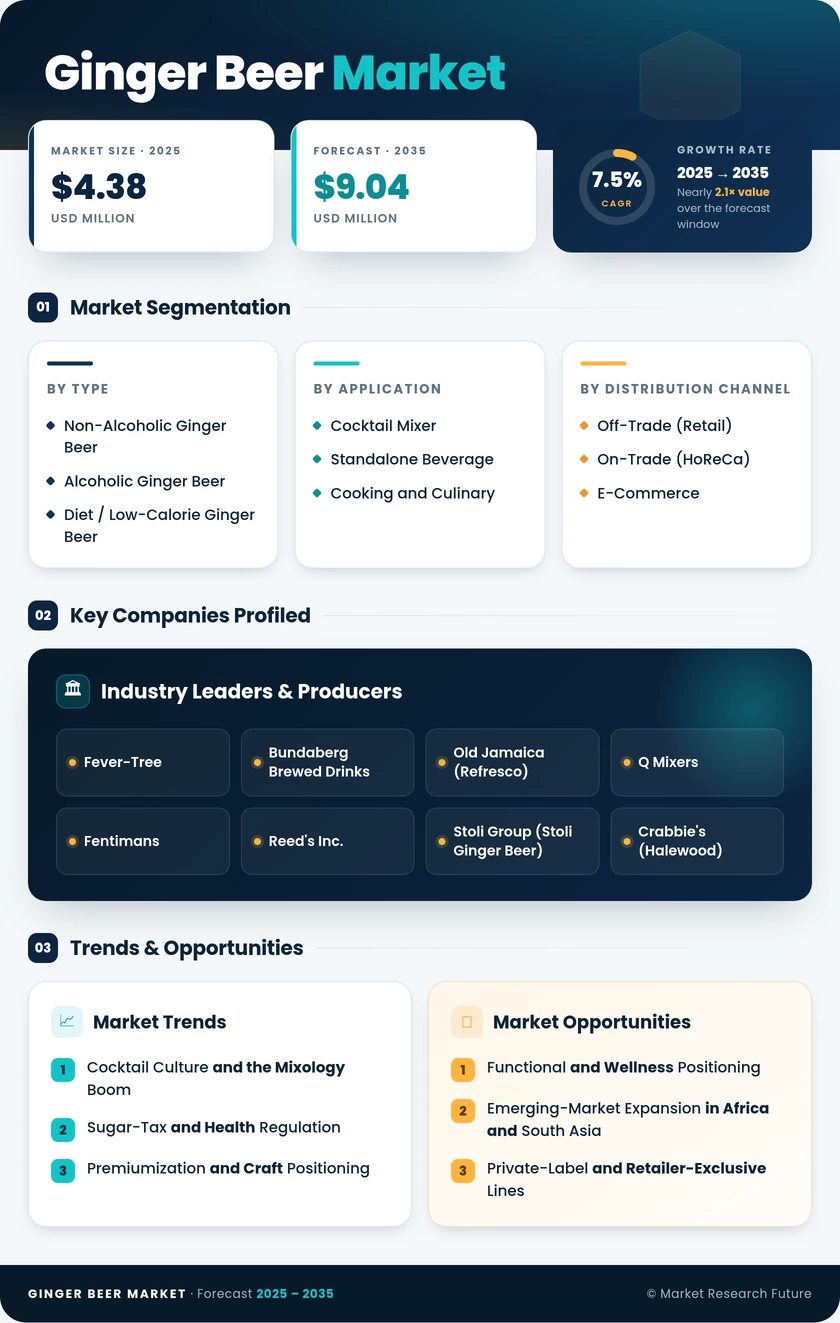
Ginger Beer Market

ID: MRFR/FnB/21423-HCR
100 Pages
Snehal Singh
Last Updated: June 08, 2026
Ginger Beer Market Size, Share, Industry Trend & Analysis Research Report By Product Type (Non-Alcoholic Ginger Beer, Alcoholic Ginger Beer, Diet / Low-Calorie Ginger Beer), By Application (Cocktail Mixer, Standalone Beverage, Cooking and Culinary), By Distribution Channel (Off-Trade (Retail), On-Trade (HoReCa), E-Commerce) - Forecast to 2035
Download PDF ×

We do not share your information with anyone. However, we may send you emails based on your report interest from time to time. You may contact us at any time to opt-out.

  1. 1 Market Overview |
    1. 1.1 Study Assumptions & Market Definition |
    2. 1.2 Scope of the Study |
    3. 1.3 Research Methodology
  2. 2 Market Summary & Key Takeaways
  3. 3 Market Dynamics |
    1. 3.1 Market Drivers Analysis | |
      1. 3.1.1 Cocktail Culture and the Mixology Boom | |
      2. 3.1.2 Sugar-Tax and Health Regulation | |
      3. 3.1.3 Premiumization and Craft Positioning | |
      4. 3.1.4 E-Commerce and Direct-to-Consumer Distribution | |
      5. 3.1.5 Rising Disposable Income in Asia-Pacific | |
      6. 3.1.6 Functional Beverage Convergence | |
      7. 3.1.7 On-Trade Channel Recovery Post-Pandemic |
    2. 3.2 Market Restraints Analysis | |
      1. 3.2.1 Price Sensitivity in Emerging Markets | |
      2. 3.2.2 Ginger-Root Supply Chain Volatility | |
      3. 3.2.3 Competition from Kombucha and Hard Seltzer | |
      4. 3.2.4 Regulatory Fragmentation on Alcohol Labeling | |
      5. 3.2.5 Limited Cold-Chain Infrastructure |
    3. 3.3 Market Opportunity Analysis | |
      1. 3.3.1 Functional and Wellness Positioning | |
      2. 3.3.2 Emerging-Market Expansion in Africa and South Asia | |
      3. 3.3.3 Private-Label and Retailer-Exclusive Lines | |
      4. 3.3.4 Ready-to-Drink Cocktail Integration | |
      5. 3.3.5 Sustainability and Circular Packaging |
    4. 3.4 Industry Value Chain Analysis |
    5. 3.5 Porter's Five Forces Analysis
  4. 4 Global Ginger Beer Market Size & Forecast (2021–2035) |
    1. 4.1 Historical Market Size (2021–2025) |
    2. 4.2 Current & Forecast Market Size (2026–2035) |
    3. 4.3 Market Size by Revenue (USD Billion) |
    4. 4.4 Year-over-Year Growth Analysis
  5. 5 Segmentation Analysis |
    1. 5.1 By Product Type | |
      1. 5.1.1 Non-Alcoholic Ginger Beer | |
      2. 5.1.2 Alcoholic Ginger Beer | |
      3. 5.1.3 Diet / Low-Calorie Ginger Beer |
    2. 5.2 By Application | |
      1. 5.2.1 Cocktail Mixer | |
      2. 5.2.2 Standalone Beverage | |
      3. 5.2.3 Cooking and Culinary |
    3. 5.3 By Distribution Channel | |
      1. 5.3.1 Off-Trade (Retail) | |
      2. 5.3.2 On-Trade (HoReCa) | |
      3. 5.3.3 E-Commerce
  6. 6 Regional Analysis |
    1. 6.1 North America | |
      1. 6.1.1 United States | |
      2. 6.1.2 Canada | |
      3. 6.1.3 Mexico |
    2. 6.2 Europe | |
      1. 6.2.1 United Kingdom | |
      2. 6.2.2 Germany | |
      3. 6.2.3 France | |
      4. 6.2.4 Rest of Europe |
    3. 6.3 Asia-Pacific | |
      1. 6.3.1 Australia | |
      2. 6.3.2 Japan | |
      3. 6.3.3 India | |
      4. 6.3.4 China | |
      5. 6.3.5 Rest of Asia-Pacific |
    4. 6.4 South America | |
      1. 6.4.1 Brazil | |
      2. 6.4.2 Argentina | |
      3. 6.4.3 Rest of South America |
    5. 6.5 Middle East & Africa | |
      1. 6.5.1 South Africa | |
      2. 6.5.2 UAE | |
      3. 6.5.3 Nigeria | |
      4. 6.5.4 Rest of Middle East & Africa
  7. 7 Competitive Landscape |
    1. 7.1 Market Share Analysis (2025) |
    2. 7.2 Competitive Benchmarking Matrix |
    3. 7.3 Company Profiles | |
      1. 7.3.1 Fever-Tree | |
      2. 7.3.2 Bundaberg Brewed Drinks | |
      3. 7.3.3 Old Jamaica (Refresco) | |
      4. 7.3.4 Q Mixers | |
      5. 7.3.5 Fentimans | |
      6. 7.3.6 Reed's Inc. | |
      7. 7.3.7 Stoli Group | |
      8. 7.3.8 Crabbie's (Halewood International) | |
      9. 7.3.9 Gosling's | |
      10. 7.3.10 Maine Root
  8. 8 Future Outlook & Strategic Recommendations (2026–2035) |
    1. 8.1 Functional Convergence and Ingredient Innovation |
    2. 8.2 Sustainable Brewing and Circular Supply Chains |
    3. 8.3 Digital Commerce and Personalization |
    4. 8.4 Premiumization and Category Bifurcation
  9. 9 Recent Developments & News
  10. 10 Frequently Asked Questions (FAQs)
  11. 11 Report Scope & Methodology |
    1. 11.1 Study Period & Base Year |
    2. 11.2 Data Sources & Citations |
    3. 11.3 Abbreviations
  12. 12 LIST OF TABLES |
  13. TABLE 1 Global Ginger Beer Market Size & Forecast, by Revenue (USD Billion), 2021–2035 |
  14. TABLE 2 Global Ginger Beer Market – Year-over-Year Growth Analysis, 2021–2035 |
  15. TABLE 3 Global Ginger Beer Market – Driver Impact Analysis, 2026–2035 |
  16. TABLE 4 Global Ginger Beer Market – Restraint Impact Analysis, 2026–2035 |
  17. TABLE 5 Global Ginger Beer Market Size, by Product Type, 2021–2035 (USD Billion) |
  18. TABLE 6 Global Ginger Beer Market Size, by Application, 2021–2035 (USD Billion) |
  19. TABLE 7 Global Ginger Beer Market Size, by Distribution Channel, 2021–2035 (USD Billion) |
  20. TABLE 8 Global Ginger Beer Market Size, by Region, 2021–2035 (USD Billion) |
  21. TABLE 9 North America Ginger Beer Market Size, by Country, 2021–2035 (USD Billion) |
  22. TABLE 10 Europe Ginger Beer Market Size, by Country, 2021–2035 (USD Billion) |
  23. TABLE 11 Asia-Pacific Ginger Beer Market Size, by Country, 2021–2035 (USD Billion) |
  24. TABLE 12 South America Ginger Beer Market Size, by Country, 2021–2035 (USD Billion) |
  25. TABLE 13 Middle East & Africa Ginger Beer Market Size, by Country, 2021–2035 (USD Billion) |
  26. TABLE 14 North America Ginger Beer Market Size, by Product Type, 2021–2035 (USD Billion) |
  27. TABLE 15 North America Ginger Beer Market Size, by Application, 2021–2035 (USD Billion) |
  28. TABLE 16 North America Ginger Beer Market Size, by Distribution Channel, 2021–2035 (USD Billion) |
  29. TABLE 17 Europe Ginger Beer Market Size, by Product Type, 2021–2035 (USD Billion) |
  30. TABLE 18 Europe Ginger Beer Market Size, by Application, 2021–2035 (USD Billion) |
  31. TABLE 19 Europe Ginger Beer Market Size, by Distribution Channel, 2021–2035 (USD Billion) |
  32. TABLE 20 Asia-Pacific Ginger Beer Market Size, by Product Type, 2021–2035 (USD Billion) |
  33. TABLE 21 Asia-Pacific Ginger Beer Market Size, by Application, 2021–2035 (USD Billion) |
  34. TABLE 22 Asia-Pacific Ginger Beer Market Size, by Distribution Channel, 2021–2035 (USD Billion) |
  35. TABLE 23 South America Ginger Beer Market Size, by Product Type, 2021–2035 (USD Billion) |
  36. TABLE 24 South America Ginger Beer Market Size, by Application, 2021–2035 (USD Billion) |
  37. TABLE 25 South America Ginger Beer Market Size, by Distribution Channel, 2021–2035 (USD Billion) |
  38. TABLE 26 Middle East & Africa Ginger Beer Market Size, by Product Type, 2021–2035 (USD Billion) |
  39. TABLE 27 Middle East & Africa Ginger Beer Market Size, by Application, 2021–2035 (USD Billion) |
  40. TABLE 28 Middle East & Africa Ginger Beer Market Size, by Distribution Channel, 2021–2035 (USD Billion) |
  41. TABLE 29 Competitive Benchmarking Matrix – Global Ginger Beer Market, 2025 |
  42. TABLE 30 Company Profiles – Key Players, Global Ginger Beer Market |
  43. TABLE 31 Recent Developments & Strategic Announcements, 2023–2025 |
  44. TABLE 32 Report Scope & Methodology Summary |
  45. TABLE 33 Detailed Sources and Citations
  46. 13 LIST OF FIGURES |
  47. FIGURE 1 Global Ginger Beer Market Dynamics — Drivers, Restraints, and Opportunities |
  48. FIGURE 2 Industry Value Chain Analysis — Ginger Beer Market |
  49. FIGURE 3 Porter's Five Forces Analysis — Ginger Beer Market |
  50. FIGURE 4 Global Ginger Beer Market Size Trend & Forecast, 2021–2035 (USD Billion) |
  51. FIGURE 5 Global Ginger Beer Market Share, by Product Type, 2025 (%) |
  52. FIGURE 6 Global Ginger Beer Market Share, by Application, 2025 (%) |
  53. FIGURE 7 Global Ginger Beer Market Share, by Distribution Channel, 2025 (%) |
  54. FIGURE 8 Global Ginger Beer Market Share, by Region, 2025 (%) |
  55. FIGURE 9 North America Ginger Beer Market Share, by Country, 2025 (%) |
  56. FIGURE 10 Europe Ginger Beer Market Share, by Country, 2025 (%) |
  57. FIGURE 11 Asia-Pacific Ginger Beer Market Share, by Country, 2025 (%) |
  58. FIGURE 12 South America Ginger Beer Market Share, by Country, 2025 (%) |
  59. FIGURE 13 Middle East & Africa Ginger Beer Market Share, by Country, 2025 (%) |
  60. FIGURE 14 Competitive Landscape — Top 10 Players Revenue Share, 2025 (%) |
  61. FIGURE 15 Market Concentration (HHI) Trend, 2021–2025

Segmentation Quick Reference

DimensionSub-SegmentsDominant SegmentFastest Growing Segment
By Product TypeNon-Alcoholic Ginger Beer, Alcoholic Ginger Beer, Diet / Low-Calorie Ginger BeerNon-Alcoholic Ginger Beer (~62% share)Alcoholic Ginger Beer (8.9% CAGR)
By ApplicationCocktail Mixer, Standalone Beverage, Cooking and CulinaryCocktail Mixer (~38% share)Cocktail Mixer
By Distribution ChannelOff-Trade (Retail), On-Trade (HoReCa), E-CommerceOff-Trade (~58% volume share)On-Trade (8.5% CAGR)


Market Segmentation Overview

By Product Type

Sub-SegmentKey Trend
Non-Alcoholic Ginger BeerMainstream retail dominance; sugar-reduction reformulations accelerating under health levy pressure
Alcoholic Ginger BeerCraft brewing crossover; taproom and pub distribution expanding in UK, US, and Australia
Diet / Low-Calorie Ginger BeerStevia and monk-fruit sweetener adoption; regulatory compliance with tiered sugar taxes


Non-alcoholic ginger beer continues to anchor the global ginger beer market, accounting for the majority of both retail volume and foodservice orders. Alcoholic variants are carving a distinct identity within the craft-beverage movement, while diet formulations address growing regulatory and consumer demand for lower-sugar options.

By Application

Sub-SegmentKey Trend
Cocktail MixerMoscow Mule and Dark 'n' Stormy driving on-premise demand; RTD cocktail integration emerging
Standalone BeverageEveryday refreshment occasion; growth tied to health-positioning and snacking culture
Cooking and CulinaryChef and food-blogger adoption for glazes, marinades, and desserts


The cocktail-mixer application continues to set the pace for category innovation, with bartenders experimenting across spirit pairings. Standalone consumption provides the volume base, and culinary use — while niche — introduces ginger beer to consumers who may not discover it through traditional beverage channels.

By Distribution Channel

Sub-SegmentKey Trend
Off-Trade (Retail)Supermarket and specialty-store assortment expansion; private-label growth
On-Trade (HoReCa)Post-pandemic recovery; premium menu positioning creates brand halo effect
E-CommerceDTC subscriptions and marketplace discovery; critical for craft brands lacking national retail distribution


Off-trade retail remains the volume engine, but on-trade recovery is restoring the brand-building function that bars and restaurants provide. E-commerce is rapidly becoming a third pillar, particularly for craft and artisanal producers who use direct shipping and subscription models to build loyal consumer bases.