×
Request Free Sample ×

Kindly complete the form below to receive a free sample of this Report

* Please use a valid business email

Leading companies partner with us for data-driven Insights

clients tt-cursor
Hero Background

General Anesthesia Drug Market

ID: MRFR/HC/40723-HCR
111 Pages
Rahul Gotadki
October 2025

General Anesthesia Drug Market Research Report: By Drug Type (Inhalation Agents, Intravenous Agents, Adjuncts), By Application (Surgery, Pain Management, Diagnostic Procedures), By End User (Hospitals, Ambulatory Surgical Centers, Specialty Clinics), By Administration Route (Inhalation, Intravenous, Oral) and By Regional (North America, Europe, South America, Asia Pacific, Middle East and Africa) - Forecast to 2035.

Share:
Download PDF ×

We do not share your information with anyone. However, we may send you emails based on your report interest from time to time. You may contact us at any time to opt-out.

General Anesthesia Drug Market Infographic
Purchase Options

General Anesthesia Drug Market Summary

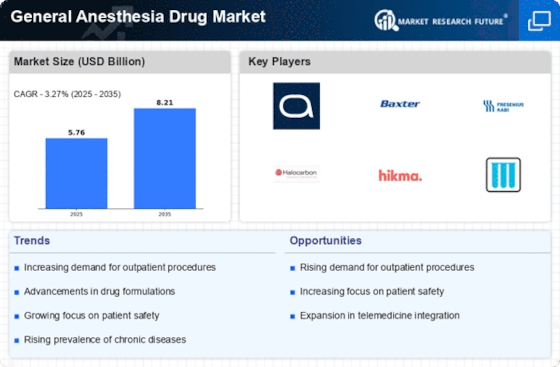
As per MRFR analysis, the General Anesthesia Drug Market Size was estimated at 5.76 USD Billion in 2024. The General Anesthesia Drug industry is projected to grow from 5.948 USD Billion in 2025 to 8.206 USD Billion by 2035, exhibiting a compound annual growth rate (CAGR) of 3.27 during the forecast period 2025 - 2035.

Key Market Trends & Highlights

The General Anesthesia Drug Market is poised for growth driven by technological advancements and increasing surgical procedures.

  • Advancements in drug formulations are enhancing the efficacy and safety of anesthesia delivery.
  • North America remains the largest market, while Asia-Pacific is emerging as the fastest-growing region in this sector.
  • Inhalation agents dominate the market, whereas intravenous agents are witnessing rapid growth due to their convenience.
  • The rising number of surgical procedures and the expansion of ambulatory surgery centers are key drivers propelling market growth.

Market Size & Forecast

2024 Market Size 5.76 (USD Billion)
2035 Market Size 8.206 (USD Billion)
CAGR (2025 - 2035) 3.27%

Major Players

AbbVie (US), Baxter International (US), Fresenius Kabi (DE), Halocarbon Products Corporation (US), Hikma Pharmaceuticals (GB), Mylan (US), Piramal Enterprises (IN), Sedana Medical (SE), Teva Pharmaceutical Industries (IL), Zynerba Pharmaceuticals (US)

General Anesthesia Drug Market Trends

The General Anesthesia Drug Market is currently experiencing a dynamic evolution, driven by advancements in pharmaceutical formulations and an increasing emphasis on patient safety. Innovations in drug delivery systems and the development of new anesthetic agents appear to enhance the efficacy and reduce the side effects associated with traditional anesthetics. Furthermore, the growing prevalence of surgical procedures across various medical specialties is likely to bolster demand for general anesthesia drugs, as healthcare providers seek to optimize patient outcomes and minimize recovery times. This trend suggests a shift towards more personalized anesthesia care, where the selection of anesthetic agents is tailored to individual patient needs and surgical requirements. In addition, the General Anesthesia Drug Market is witnessing a notable rise in the adoption of regional anesthesia techniques, which may complement general anesthesia in certain surgical settings. This integration could lead to improved pain management and reduced opioid consumption post-surgery. Moreover, regulatory bodies are increasingly focusing on the safety profiles of anesthetic agents, which may drive manufacturers to prioritize research and development efforts aimed at producing safer and more effective drugs. Overall, the landscape of the General Anesthesia Drug Market appears poised for growth, with ongoing innovations and a commitment to enhancing patient care shaping its future trajectory.

Advancements in Drug Formulations

Recent innovations in drug formulations are transforming the General Anesthesia Drug Market. New anesthetic agents are being developed to improve efficacy and minimize adverse effects, which may enhance patient safety and satisfaction during surgical procedures.

Integration of Regional Anesthesia

The growing trend towards integrating regional anesthesia techniques alongside general anesthesia is notable. This approach could lead to better pain management and reduced reliance on opioids, potentially improving overall patient recovery experiences.

Regulatory Focus on Safety

Regulatory agencies are increasingly emphasizing the safety profiles of anesthetic drugs. This heightened scrutiny may encourage manufacturers to invest in research and development, aiming to create safer and more effective anesthetic options for diverse surgical applications.

General Anesthesia Drug Market Drivers

Rising Surgical Procedures

The increasing number of surgical procedures worldwide is a primary driver for the General Anesthesia Drug Market. As healthcare systems evolve and expand, the demand for surgical interventions rises, leading to a greater need for effective anesthesia solutions. In recent years, the volume of surgeries has surged, with estimates suggesting that millions of procedures are performed annually. This trend is particularly evident in elective surgeries, which have seen a notable uptick. Consequently, the General Anesthesia Drug Market is poised to benefit from this growth, as healthcare providers seek reliable and efficient anesthetic agents to ensure patient safety and comfort during operations.

Growing Geriatric Population

The increasing geriatric population is a significant factor influencing the General Anesthesia Drug Market. As individuals age, they often require surgical interventions for various health issues, which in turn escalates the demand for anesthesia services. The elderly population is particularly sensitive to anesthesia, necessitating the development of drugs that are tailored to their specific physiological needs. This demographic shift is prompting healthcare providers to seek anesthetic agents that ensure safety and efficacy for older patients. Consequently, the General Anesthesia Drug Market is expected to adapt to these changing demographics, focusing on the creation of specialized anesthetic solutions for the aging population.

Expansion of Ambulatory Surgery Centers

The proliferation of ambulatory surgery centers (ASCs) is reshaping the General Anesthesia Drug Market. ASCs offer a range of surgical procedures that do not require overnight hospitalization, thus increasing the demand for efficient anesthesia solutions that facilitate quick recovery. The convenience and cost-effectiveness of ASCs are attracting more patients, leading to a rise in outpatient surgeries. This trend necessitates the use of general anesthesia drugs that allow for rapid onset and recovery, thereby driving innovation in the market. As ASCs continue to expand, the General Anesthesia Drug Market is likely to experience sustained growth, catering to the unique needs of outpatient surgical procedures.

Increasing Awareness of Anesthesia Safety

Growing awareness regarding the safety and efficacy of anesthesia is a crucial driver for the General Anesthesia Drug Market. Patients and healthcare professionals are increasingly prioritizing safety protocols and the use of anesthetics with favorable risk profiles. This heightened focus on safety has led to the development of new anesthetic agents that minimize side effects and enhance recovery times. Additionally, regulatory bodies are emphasizing the importance of safety in anesthesia practices, which is likely to influence the types of drugs that gain market approval. As a result, the General Anesthesia Drug Market is expected to evolve, with a shift towards safer and more effective anesthetic options.

Technological Innovations in Anesthesia Delivery

Technological advancements in anesthesia delivery systems are significantly influencing the General Anesthesia Drug Market. Innovations such as computerized anesthesia machines and advanced monitoring systems enhance the precision and safety of anesthesia administration. These technologies allow for real-time monitoring of patient vitals, thereby reducing the risk of complications during surgery. Furthermore, the integration of artificial intelligence in anesthesia management is emerging, potentially optimizing drug dosages and improving patient outcomes. As these technologies become more prevalent, they are likely to drive demand for modern anesthetic agents, thereby shaping the landscape of the General Anesthesia Drug Market.


Market Segment Insights

By Type: Inhalation Agents (Largest) vs. Intravenous Agents (Fastest-Growing)

The General Anesthesia Drug Market is predominantly segmented into three categories: Inhalation Agents, Intravenous Agents, and Adjuncts. Among these, Inhalation Agents hold the largest market share due to their long-standing use and favorable properties in providing effective anesthesia. Intravenous Agents, while smaller in share, are quickly gaining traction as they cater to the growing demand for rapid onset of anesthesia, particularly in outpatient and same-day discharge surgeries. Both segments contribute significantly to the overall dynamics of the market.

Inhalation Agents (Dominant) vs. Intravenous Agents (Emerging)

Inhalation Agents are widely regarded as the dominant force in the General Anesthesia Drug Market, known for their efficacy and ease of use. They provide the ability to quickly adjust the depth of anesthesia and counteract potential complications. Conversely, Intravenous Agents are classified as emerging within the market landscape, driven by technological advancements offering improved patient safety and enhanced recovery profiles. Their utilization in cases demanding quick anesthesia induction has positioned them as a preferred option for many surgical procedures. As the shift towards less invasive and outpatient surgeries continues, Intravenous Agents are expected to grow considerably.

By Application: Surgery (Largest) vs. Pain Management (Fastest-Growing)

In the General Anesthesia Drug Market, the application segments divide primarily into Surgery, Pain Management, and Diagnostic Procedures. Surgery holds the largest share, accounting for a critical portion of the market, driven by the high demand for anesthesia during operative procedures. On the other hand, Pain Management, while smaller in share, is gaining traction as a key application area as the focus on pain relief strategies intensifies and more patients seek alternatives to traditional pain management methods.

Surgery: Dominant vs. Pain Management: Emerging

Surgeries remain the dominant application of general anesthesia drugs, utilized extensively in various surgical procedures ranging from elective surgeries to complex operations. The reliance on effective anesthetic agents ensures patient safety and comfort, solidifying its market position. Conversely, Pain Management is emerging rapidly as a significant application area, especially in chronic pain treatment protocols. Innovative approaches to pain relief, coupled with an aging population and an increasing recognition of the importance of pain management in enhancing the quality of life, contribute to its fast-paced growth.

By End User: Hospitals (Largest) vs. Ambulatory Surgical Centers (Fastest-Growing)

In the General Anesthesia Drug Market, hospitals hold the largest market share among end users, benefiting from their expansive infrastructure and higher patient volumes. Ambulatory surgical centers are also significant players, capitalizing on the need for cost-effective procedures and quick patient turnover, but they currently represent a smaller proportion of the overall market.

End User: Hospitals (Dominant) vs. Ambulatory Surgical Centers (Emerging)

Hospitals are the dominant end users of general anesthesia drugs, primarily due to their comprehensive facilities and capacity to manage complex surgeries requiring anesthesia. They utilize a wide range of general anesthesia agents to cater to varied surgical needs, making them integral to the delivery of perioperative care. On the other hand, ambulatory surgical centers represent an emerging segment, driven by increasing patient preference for outpatient procedures and advancements in anesthetic techniques that allow for quicker recoveries. These centers focus on efficiency and cost reduction, making them a crucial part of the evolving healthcare landscape.

By Administration Route: Inhalation (Largest) vs. Intravenous (Fastest-Growing)

In the General Anesthesia Drug Market, the administration routes exhibit distinct characteristics in market share and growth dynamics. Inhalation drugs currently account for the largest portion of the market, primarily due to their widespread acceptance and ease of use in various surgical procedures. Conversely, intravenous administration, while smaller in overall share, is witnessing rapid adoption as healthcare providers seek quicker onset times and greater patient control, making it a competitive player in this segment.

Inhalation (Dominant) vs. Intravenous (Emerging)

Inhalation anesthetics dominate the General Anesthesia Drug Market due to their well-established use in surgeries, demonstrating a robust safety profile and effective delivery methods. These agents have become the preferred choice for many anesthesiologists because they allow for quick adjustments to dosage and easy administration. On the other hand, intravenous anesthetics are emerging as a significant alternative, gaining traction for their rapid onset and minimal side effects. Technological advances in formulation and administration are enhancing their appeal, positioning intravenous drugs as a formidable choice in modern anesthetic practices.

Get more detailed insights about General Anesthesia Drug Market

Regional Insights

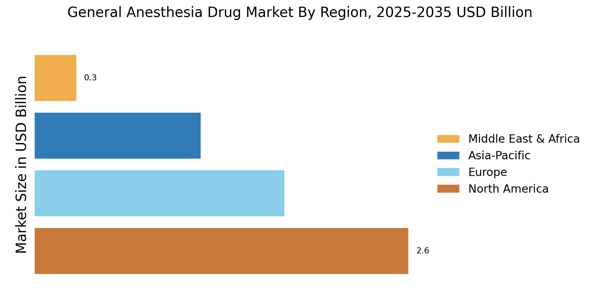
The Global General Anesthesia Drug Market showcases a diverse regional landscape with varying valuations. In 2024, North America leads with a market value of 2.36 USD Billion, anticipated to grow to 3.27 USD Billion by 2035, demonstrating its majority holding in the market due to advanced healthcare infrastructure and high demand for surgical procedures.

Europe follows with a valuation of 1.55 USD Billion in 2024 and is expected to reach 2.19 USD Billion by 2035, reflecting significant growth as European countries invest more in healthcare modernization.The APAC region is valued at 1.32 USD Billion in 2024 and is projected to increase to 1.82 USD Billion by 2035, driven by population growth and rising healthcare investments, showing its importance in the Global General Anesthesia Drug Market segmentation.

South America holds a smaller share, valued at 0.35 USD Billion in 2024, growing to 0.5 USD Billion by 2035, indicating potential for expansion amidst increasing access to healthcare services. Lastly, the Middle East and Africa (MEA) market value stands at 0.18 USD Billion in 2024, with expectations to grow to 0.24 USD Billion by 2035, showing the challenges faced in terms of healthcare access but highlighting opportunities for market growth in emerging economies.Overall, the regional dynamics reflect varied growth drivers and challenges within the Global General Anesthesia Drug Market industry.

General Anesthesia Drug Market Regional Image

Key Players and Competitive Insights

The Global General Anesthesia Drug Market is characterized by a dynamic and competitive landscape driven by innovation, regulatory trends, and the growing demand for surgical procedures worldwide. Various pharmaceutical companies are focusing on developing advanced formulations to enhance patient outcomes during surgical procedures.

The market is influenced by factors such as the rising geriatric population, the increasing prevalence of chronic diseases, and technological advancements in anesthesia delivery systems. Furthermore, partnerships and collaborations among key players are pivotal for expanding product offerings and enhancing market reach. 

The competition is intensifying as companies strive to maintain and increase their market share, leading to significant investments in research and development to introduce novel anesthetic agents.Baxter International has established a strong presence in the Global General Anesthesia Drug Market by offering a diverse range of anesthetics and related products. The company is recognized for its commitment to quality and innovation, allowing it to cater to the changing needs of healthcare providers and patients effectively.

Baxter International's strengths lie in its robust product portfolio that includes both inhalational and intravenous anesthetics, bolstered by a well-established distribution network in multiple regions. The company’s focus on safety and efficacy in its anesthesia products enhances its reputation among healthcare professionals.

Moreover, Baxter International is known for its continuous investment in research and development, enabling the introduction of new solutions that address unmet medical needs and improve patient care within the anesthesia sector.Purdue Pharma has positioned itself strategically in the Global General Anesthesia Drug Market with a focus on the safety and efficacy of its anesthetic products. 

The company is known for its comprehensive approach to anesthesia management, emphasizing the importance of pain control and patient comfort. Purdue Pharma’s strengths include a strong commitment to research and development, which drives innovation in anesthetic formulations.

The company has taken significant steps to ensure compliance with regulatory standards, positioning itself as a dependable partner for healthcare providers. Furthermore, Purdue Pharma's emphasis on education and training for healthcare professionals enhances its market presence, ensuring that its products are used effectively and safely within surgical settings. This focus on quality and education helps to solidify Purdue Pharma's reputation in the competitive landscape of the general anesthesia drug market.

Key Companies in the General Anesthesia Drug Market market include

Industry Developments

  • Q2 2024: FDA Approves New General Anesthetic, Remimazolam, for Use in Surgical Procedures The FDA approved Remimazolam, a new general anesthetic, for use in surgical procedures in the United States, marking a significant addition to the available anesthesia options for clinicians.
  • Q1 2024: Fresenius Kabi Launches Propoven 2% (Propofol) Injectable Emulsion in the U.S. Fresenius Kabi announced the launch of Propoven 2%, a new formulation of propofol injectable emulsion, expanding its portfolio of general anesthesia drugs in the U.S. market.
  • Q2 2024: Hikma Pharmaceuticals receives FDA approval for generic Sevoflurane Hikma Pharmaceuticals received FDA approval for its generic version of Sevoflurane, an inhaled anesthetic, allowing the company to enter the U.S. general anesthesia drug market with this product.
  • Q1 2024: Baxter Announces Opening of New Manufacturing Facility for Anesthesia Products in Indiana Baxter International opened a new manufacturing facility in Indiana dedicated to the production of general anesthesia drugs, aiming to strengthen its supply chain and meet growing demand.
  • Q3 2024: PAION AG Announces European Commission Approval for Byfavo (Remimazolam) for General Anesthesia PAION AG received European Commission approval for Byfavo (Remimazolam) for use in general anesthesia, expanding its regulatory footprint in the European market.
  • Q2 2024: Pfizer Completes Acquisition of Anesthesia Drug Portfolio from Aspen Pharmacare Pfizer completed the acquisition of a portfolio of anesthesia drugs from Aspen Pharmacare, strengthening its position in the global general anesthesia drug market.
  • Q1 2025: Piramal Pharma Launches New Inhalation Anesthetic, Isoflurane, in India Piramal Pharma launched a new inhalation anesthetic, Isoflurane, in the Indian market, expanding its range of general anesthesia products.
  • Q2 2025: AbbVie Announces Partnership with Medtronic to Develop Next-Generation Anesthesia Delivery Systems AbbVie entered into a partnership with Medtronic to co-develop next-generation anesthesia delivery systems, aiming to improve the administration and safety of general anesthesia drugs.
  • Q2 2024: Sagent Pharmaceuticals Launches Dexmedetomidine Hydrochloride Injection in the U.S. Sagent Pharmaceuticals launched Dexmedetomidine Hydrochloride Injection, a sedative and adjunct to general anesthesia, in the U.S. market.
  • Q3 2024: GSK Sells Anesthesia Drug Rights to Chinese Firm for $150 Million GSK sold the rights to a portfolio of anesthesia drugs to a Chinese pharmaceutical company for $150 million, as part of its strategy to streamline its product offerings.
  • Q1 2025: Eagle Pharmaceuticals Receives FDA Approval for New Formulation of Barhemsys (Amisulpride) for Postoperative Nausea and Vomiting Eagle Pharmaceuticals received FDA approval for a new formulation of Barhemsys (Amisulpride), which is used as an adjunct in general anesthesia to prevent postoperative nausea and vomiting.
  • Q2 2025: Dr. Reddy’s Laboratories Launches Generic Propofol Injectable Emulsion in the U.S. Dr. Reddy’s Laboratories launched a generic version of Propofol Injectable Emulsion in the U.S., increasing competition and availability in the general anesthesia drug market.

Future Outlook

General Anesthesia Drug Market Future Outlook

The General Anesthesia Drug Market is projected to grow at a 3.27% CAGR from 2024 to 2035, driven by technological advancements, increasing surgical procedures, and rising healthcare expenditures.

New opportunities lie in:

  • Development of personalized anesthesia protocols for enhanced patient outcomes.
  • Expansion into emerging markets with tailored product offerings.
  • Investment in digital health solutions for anesthesia management and monitoring.

By 2035, the market is expected to achieve robust growth, reflecting evolving healthcare demands.

Market Segmentation

General Anesthesia Drug Market Type Outlook

  • Inhalation Agents
  • Intravenous Agents
  • Adjuncts

General Anesthesia Drug Market End User Outlook

  • Hospitals
  • Ambulatory Surgical Centers
  • Specialty Clinics

General Anesthesia Drug Market Application Outlook

  • Surgery
  • Pain Management
  • Diagnostic Procedures

General Anesthesia Drug Market Administration Route Outlook

  • Inhalation
  • Intravenous
  • Oral

Report Scope

MARKET SIZE 2024 5.76(USD Billion)
MARKET SIZE 2025 5.948(USD Billion)
MARKET SIZE 2035 8.206(USD Billion)
COMPOUND ANNUAL GROWTH RATE (CAGR) 3.27% (2024 - 2035)
REPORT COVERAGE Revenue Forecast, Competitive Landscape, Growth Factors, and Trends
BASE YEAR 2024
Market Forecast Period 2025 - 2035
Historical Data 2019 - 2024
Market Forecast Units USD Billion
Key Companies Profiled Market analysis in progress
Segments Covered Market segmentation analysis in progress
Key Market Opportunities Advancements in drug delivery systems enhance patient safety and efficacy in the General Anesthesia Drug Market.
Key Market Dynamics Rising demand for safer anesthetic agents drives innovation and regulatory scrutiny in the General Anesthesia Drug Market.

Countries Covered North America, Europe, APAC, South America, MEA

Leave a Comment

FAQs

What is the projected market valuation of the General Anesthesia Drug Market by 2035?

The projected market valuation for the General Anesthesia Drug Market is 8.206 USD Billion by 2035.

What was the market valuation of the General Anesthesia Drug Market in 2024?

The overall market valuation was 5.76 USD Billion in 2024.

What is the expected CAGR for the General Anesthesia Drug Market during the forecast period 2025 - 2035?

The expected CAGR for the General Anesthesia Drug Market during the forecast period 2025 - 2035 is 3.27%.

Which segment is projected to have the highest valuation in the General Anesthesia Drug Market by 2035?

The Inhalation Agents segment is projected to reach 4.1 USD Billion by 2035.

How does the valuation of Intravenous Agents change from 2024 to 2035?

The valuation of Intravenous Agents is expected to increase from 1.44 USD Billion in 2024 to 2.1 USD Billion by 2035.

What are the key applications driving the General Anesthesia Drug Market?

Key applications include Surgery, Pain Management, and Diagnostic Procedures, with Surgery projected to reach 4.1 USD Billion by 2035.

Which end-user segment is anticipated to grow the most by 2035?

The Specialty Clinics segment is anticipated to grow from 1.73 USD Billion in 2024 to 2.64 USD Billion by 2035.

What is the expected growth in the Oral administration route segment by 2035?

The Oral administration route segment is expected to grow from 0.72 USD Billion in 2024 to 1.18 USD Billion by 2035.

Who are the key players in the General Anesthesia Drug Market?

Key players include AbbVie, Baxter International, Fresenius Kabi, and others.

What is the projected valuation for Ambulatory Surgical Centers in 2035?

The projected valuation for Ambulatory Surgical Centers is expected to reach 1.6 USD Billion by 2035.

What is the anticipated market value for the Global General Anesthesia Drug Market by 2035?

By 2035, the Global General Anesthesia Drug Market is projected to reach a value of 11.0 USD Billion.

Which region is projected to hold the largest market share in the Global General Anesthesia Drug Market in 2024?

North America is projected to hold the largest market share, valued at 3.25 USD Billion in 2024.

What will be the market value of Intravenous Anesthetics in 2035?

The market value for Intravenous Anesthetics is expected to be 3.1 USD Billion by 2035.

Who are the key players in the Global General Anesthesia Drug Market?

Key players in the market include Baxter International, Mylan, Fresenius Kabi, and Johnson & Johnson, among others.

What is the market value of Volatile Anesthetics in 2024?

Volatile Anesthetics are valued at 2.5 USD Billion in the Global General Anesthesia Drug Market in 2024.

What growth is expected for the Asia-Pacific (APAC) region in the Global General Anesthesia Drug Market by 2035?

The APAC region is expected to grow to a market value of 2.5 USD Billion by 2035.

What challenges could impact the Global General Anesthesia Drug Market growth?

Challenges may include regulatory changes, competition, and supply chain disruptions affecting growth.

What will the market value of Combination Agents be in 2035?

The market value for Combination Agents is projected to reach 2.3 USD Billion by 2035.

Download Free Sample

Kindly complete the form below to receive a free sample of this Report

Compare Licence

×
Features License Type
Single User Multiuser License Enterprise User
Price $4,950 $5,950 $7,250
Maximum User Access Limit 1 User Upto 10 Users Unrestricted Access Throughout the Organization
Free Customization
Direct Access to Analyst
Deliverable Format
Platform Access
Discount on Next Purchase 10% 15% 15%
Printable Versions