×
Request Free Sample ×

Kindly complete the form below to receive a free sample of this Report

* Please use a valid business email

Leading companies partner with us for data-driven Insights

clients tt-cursor
Hero Background
English
Chinese
French
Japanese
Korean
German
Spanish

Gas Treatment Market Share

ID: MRFR/CnM/5227-HCR
111 Pages
Chitranshi Jaiswal
October 2025

Gas Treatment Market Research Report Information by Type (Amines, Non-Amines, and Others), Application (Power Plants, Refineries, Pulp & Paper, Metal & Mining, Food & Beverages, Oil & Gas, Sugar), And By Region (North America, Europe, Asia-Pacific, And Rest Of The World) –Market Forecast Till 2035

Share:
Download PDF ×

We do not share your information with anyone. However, we may send you emails based on your report interest from time to time. You may contact us at any time to opt-out.

Gas Treatment Market Infographic
×
Gas Treatment Market Infographic Full View
Purchase Options

Market Share

Gas Treatment Market Share Analysis

In the dynamic landscape of the Gas Treatment Market, companies employ various market share positioning strategies to gain a competitive edge and establish themselves as industry leaders. One prevalent approach is differentiation, where companies focus on offering unique and innovative gas treatment solutions. This strategy aims to create a distinctive product or service that stands out from competitors, attracting customers seeking advanced technologies or specialized applications. By investing in research and development, companies can enhance their offerings, providing tailored solutions that cater to specific customer needs, thereby solidifying their market share.

Another pivotal strategy involves cost leadership, where companies strive to become the low-cost producers in the Gas Treatment Market. This approach emphasizes efficiency in production processes, economies of scale, and cost-effective sourcing of raw materials. By offering competitive pricing, cost leaders aim to attract price-sensitive customers and gain a substantial market share. This strategy requires meticulous cost management and operational excellence, allowing companies to maintain profitability even with lower prices than competitors.

Strategic alliances and partnerships represent yet another significant market share positioning strategy in the Gas Treatment Market. Collaboration with key stakeholders, such as suppliers, distributors, or research institutions, can provide companies with access to essential resources, technologies, and distribution channels. Through strategic partnerships, companies can expand their market reach, capitalize on shared expertise, and create synergies that enhance their competitive position. This collaborative approach fosters innovation, accelerates market penetration, and contributes to a more robust market presence.

Geographical expansion is a critical strategy for companies aiming to increase their market share in the Gas Treatment Market. This involves identifying and entering new markets or expanding existing operations globally. By tapping into emerging markets with growing demand for gas treatment solutions, companies can diversify their customer base and reduce dependency on specific regions. Adapting products and services to meet the unique needs of different markets is crucial in successfully executing a geographical expansion strategy.

Moreover, a customer-centric approach is indispensable in gaining and maintaining market share in the Gas Treatment Market. Understanding customer preferences, needs, and pain points enables companies to tailor their offerings accordingly. Providing excellent customer service, conducting regular feedback surveys, and addressing customer concerns contribute to building strong customer relationships. Companies that prioritize customer satisfaction often benefit from customer loyalty, positive word-of-mouth marketing, and repeat business, ultimately solidifying their market share.

The gas industry's growth is predicted to open up new market opportunities worldwide. The method of gas treatment improves the performance of liquified petroleum gas. Therefore, it is anticipated that large corporations' rising investment will stimulate the market. For example, the Canadian Association of Petroleum Producers (CAPP) estimates that Canadian oil and gas businesses will spend USD 27.3 billion in 2021. Additionally, it is anticipated that investment in Alberta's oil sands will increase from U.S. $6.7 billion in 2020 to U.S. $7.3 billion in 2021. As a result, these expenditures are anticipated to accelerate market expansion ly. During this period, the gas treatment market is anticipated to increase due to governments worldwide investing in the natural gas sector.


Author
Chitranshi Jaiswal
Research Analyst Level I

In her 3 years of experience in the market research field, she has handled critical cross-domain projects. She has an in-depth knowledge of market estimation & analysis, problem-solving, primary as well as secondary research, and team management.She holds an engineering degree and is an MBA professional from a well-known university, capable of evaluating the market and competitive conditions. An exceptional strategist with excellent communication skills and a passion for delivering cutting-edge & practical insights for the market. Proficient in multi-tasking, and can successfully deal with competing demands, while maintaining complete confidentiality. Generated business through active client and project development, networking, and high-quality responses. Her knowledge and skills have helped in making solid business decisions, securing funding from investors, and avoiding business failures.

Leave a Comment

FAQs

What is the current valuation of the Gas Treatment Market?

As of 2024, the Gas Treatment Market was valued at 4.68 USD Billion.

What is the projected market size for the Gas Treatment Market by 2035?

The Gas Treatment Market is projected to reach 7.989 USD Billion by 2035.

What is the expected CAGR for the Gas Treatment Market during the forecast period 2025 - 2035?

The expected CAGR for the Gas Treatment Market from 2025 to 2035 is 4.98%.

Which segments are included in the Gas Treatment Market analysis?

The Gas Treatment Market analysis includes segments such as Amines, Non-Amines, and Others.

What are the projected valuations for the Amines segment by 2035?

The Amines segment is projected to grow from 1.5 USD Billion in 2024 to 2.5 USD Billion by 2035.

How does the Oil & Gas application segment perform in the Gas Treatment Market?

The Oil & Gas application segment is expected to increase from 1.36 USD Billion in 2024 to 2.27 USD Billion by 2035.

Market Summary

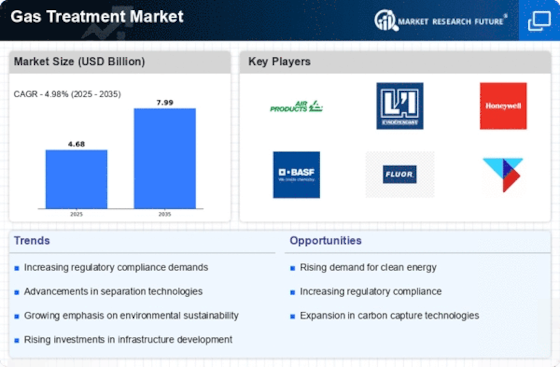
As per Market Research Future analysis, the Gas Treatment Market Size was estimated at 4.68 USD Billion in 2024. The Gas Treatment industry is projected to grow from 4.913 USD Billion in 2025 to 7.989 USD Billion by 2035, exhibiting a compound annual growth rate (CAGR) of 4.98% during the forecast period 2025 - 2035

Key Market Trends & Highlights

The Gas Treatment Market is poised for substantial growth driven by technological advancements and regulatory pressures.

  • Technological advancements are enhancing the efficiency of gas treatment processes, particularly in North America. Regulatory pressures are compelling industries to adopt cleaner technologies, significantly impacting the market dynamics in the Asia-Pacific region. The amines segment remains the largest, while non-amines are emerging as the fastest-growing segment due to their versatility. Increasing demand for natural gas and stringent environmental regulations are key drivers propelling market expansion.

Market Size & Forecast

2024 Market Size 4.68 (USD Billion)
2035 Market Size 7.989 (USD Billion)
CAGR (2025 - 2035) 4.98%
Largest Regional Market Share in 2024 North America

Major Players

Air Products and Chemicals (US), Linde (DE), Honeywell (US), BASF (DE), Fluor Corporation (US), TechnipFMC (GB), SABIC (SA), ExxonMobil (US), Shell (GB), TotalEnergies (FR)

Market Trends

The Gas Treatment Market is currently experiencing a dynamic evolution, driven by the increasing demand for cleaner energy solutions and stringent environmental regulations. As industries strive to reduce their carbon footprint, the focus on gas treatment technologies has intensified. This market encompasses various processes aimed at removing impurities from natural gas, ensuring compliance with environmental standards, and enhancing the overall quality of gas. The integration of advanced technologies, such as membrane separation and adsorption, appears to be reshaping the landscape, offering more efficient and cost-effective solutions for gas purification. Moreover, the Gas Treatment Market is likely to witness a surge in investments as companies seek to innovate and improve their operational efficiencies. The growing emphasis on sustainable practices and the transition towards renewable energy sources may further propel the demand for gas treatment solutions. Additionally, the rise of unconventional gas resources, such as shale gas, suggests a potential shift in treatment methodologies, necessitating the development of specialized technologies. Overall, the Gas Treatment Market seems poised for substantial growth, driven by technological advancements and evolving regulatory frameworks.

Technological Advancements

The Gas Treatment Market is increasingly influenced by technological innovations that enhance efficiency and effectiveness. New methods, such as advanced membrane technologies and hybrid systems, are emerging, allowing for better separation and purification processes. These advancements not only improve operational performance but also reduce energy consumption, aligning with global sustainability goals.

Regulatory Pressures

Stringent environmental regulations are shaping the Gas Treatment Market, compelling industries to adopt cleaner technologies. Governments worldwide are implementing policies aimed at reducing emissions and promoting cleaner energy sources. This regulatory landscape is likely to drive demand for gas treatment solutions that meet compliance requirements, fostering market growth.

Shift Towards Renewable Energy

The transition towards renewable energy sources is impacting the Gas Treatment Market, as industries seek to integrate cleaner alternatives. This shift may lead to increased investments in gas treatment technologies that support the utilization of biogas and other renewable gases. Consequently, the market could experience a transformation, adapting to the evolving energy landscape.

Gas Treatment Market Market Drivers

Increasing Demand for Natural Gas

The rising demand for natural gas as a cleaner alternative to coal and oil is a primary driver in the Gas Treatment Market. As countries strive to reduce carbon emissions, natural gas is increasingly viewed as a transitional fuel. According to recent data, the consumption of natural gas is projected to grow by approximately 1.5% annually, leading to a heightened need for effective gas treatment solutions. This trend is particularly evident in regions where natural gas is being integrated into energy systems, necessitating advanced treatment technologies to ensure compliance with environmental standards. The Gas Treatment Market is thus positioned to benefit from this shift, as companies seek to enhance the quality of natural gas and meet regulatory requirements.

Stringent Environmental Regulations

The implementation of stringent environmental regulations is significantly influencing the Gas Treatment Market. Governments worldwide are enacting policies aimed at reducing greenhouse gas emissions and improving air quality. For instance, regulations concerning sulfur content in natural gas have become more rigorous, compelling producers to invest in advanced gas treatment technologies. The market is expected to witness a surge in demand for desulfurization and carbon capture technologies, as companies strive to comply with these regulations. This regulatory landscape not only drives innovation within the Gas Treatment Market but also creates opportunities for companies that specialize in developing environmentally friendly treatment solutions.

Growth of the Petrochemical Industry

The expansion of the petrochemical industry is a crucial driver for the Gas Treatment Market. As the demand for petrochemical products continues to rise, the need for high-quality feedstock becomes paramount. Gas treatment processes are essential for ensuring that the natural gas used in petrochemical production meets the required specifications. The petrochemical sector is projected to grow at a compound annual growth rate of around 4% over the next few years, further increasing the demand for gas treatment solutions. This growth presents opportunities for companies within the Gas Treatment Market to develop specialized treatment technologies tailored to the needs of petrochemical producers.

Technological Innovations in Gas Treatment

Technological innovations are reshaping the Gas Treatment Market, leading to more efficient and cost-effective solutions. Recent advancements in membrane technology and adsorption processes have enhanced the ability to remove impurities from natural gas. For example, the introduction of new materials for membranes has improved separation efficiency, allowing for better recovery of valuable components. The market is witnessing a trend towards automation and digitalization, which streamlines operations and reduces costs. As these technologies continue to evolve, they are likely to attract investments and drive growth within the Gas Treatment Market, as companies seek to optimize their processes and improve product quality.

Rising Investments in Infrastructure Development

Rising investments in infrastructure development are significantly impacting the Gas Treatment Market. As countries invest in expanding their energy infrastructure, the demand for gas treatment facilities is expected to increase. This trend is particularly evident in emerging economies, where the need for reliable energy sources is driving the construction of new pipelines and processing plants. According to industry forecasts, investments in gas infrastructure are anticipated to reach several billion dollars in the coming years. This influx of capital is likely to stimulate growth in the Gas Treatment Market, as companies seek to establish new facilities and upgrade existing ones to meet the growing demand for treated natural gas.

Market Segment Insights

By Type: Amines (Largest) vs. Non-Amines (Fastest-Growing)

In the Gas Treatment Market, the segment of Amines holds a substantial share, primarily due to their extensive applications in gas purification processes. This compound has been widely preferred for capturing acidic gases like <a href="https://www.marketresearchfuture.com/reports/carbon-dioxide-market-20689">CO2</a> and H2S, making it a critical component in both industrial and environmental settings. Non-Amines, on the other hand, while not as predominant, are quickly gaining traction due to increasing environmental regulations and the push for cleaner technologies, indicating a robust shift in consumer preferences towards alternative gas treatment solutions.

Amines (Dominant) vs. Non-Amines (Emerging)

<a href="https://www.marketresearchfuture.com/reports/amines-market-1991">Amines</a> are recognized as the dominant force in the Gas Treatment Market, known for their efficiency in removing harmful gases and their versatility across various industries, from oil and gas to power generation. Their capacity to operate effectively under a range of conditions secures their leading position. Conversely, Non-Amines are emerging as a noteworthy alternative, driven by innovations aimed at reducing operational costs and enhancing environmental sustainability. These compounds often use physical absorption processes, appealing to firms looking for eco-friendly solutions. The growing adoption of Non-Amines is indicative of a broader trend towards sustainable practices in gas treatment.

By Application: Power Plants (Largest) vs. Oil & Gas (Fastest-Growing)

The Gas Treatment Market showcases a diverse distribution of applications, with Power Plants leading the segment due to their significant reliance on gas treatment solutions to ensure compliance with environmental regulations. Following Power Plants, Refineries and Oil &amp; Gas applications are major contributors, each utilizing gas treatment for refining processes and emission control, while sectors like Food &amp; Beverages and Pulp &amp; Paper hold smaller shares yet play pivotal roles in their respective industries. As global energy demands evolve, the Oil &amp; Gas segment is emerging as the fastest-growing application area, driven by advancements in extraction techniques and the increasing need for efficient gas processing. Enhanced regulations concerning emissions drive demand across various industries, enabling sectors like Metal &amp; Mining and Sugar to adopt gas treatment technologies actively, further stimulating market growth as sustainability becomes a core focus across all applications.

Power Plants (Dominant) vs. Oil &amp; Gas (Emerging)

Power Plants represent the dominant application in the Gas Treatment Market, characterized by their extensive use of gas treatment systems to minimize environmental impact and enhance operational efficiency. These facilities invest heavily in technologies that reduce emissions, leading to a strong market position. In contrast, the Oil &amp; Gas sector is classified as an emerging area, experiencing rapid growth due to increasing investments in cleaner extraction and processing technologies. This sector's focus on reducing environmental footprints has intensified, leading to the adoption of innovative gas treatment solutions that facilitate compliance with stringent regulations. As both segments strive for sustainability, their interplay presents opportunities for technological advancements and market expansion.

Get more detailed insights about Gas Treatment Market Research Report - Global Forecast to 2035

Regional Insights

North America : Innovation and Demand Surge

North America is the largest market for gas treatment, holding approximately 40% of the global share. The region's growth is driven by increasing natural gas production, stringent environmental regulations, and a shift towards cleaner energy sources. The demand for advanced gas treatment technologies is further fueled by the need for compliance with regulations such as the Clean Air Act, which promotes the reduction of emissions from industrial processes. The United States and Canada are the leading countries in this market, with major players like Air Products and Chemicals, ExxonMobil, and Honeywell dominating the landscape. The competitive environment is characterized by continuous innovation and strategic partnerships aimed at enhancing operational efficiency and sustainability. The presence of established companies ensures a robust supply chain and technological advancements in gas treatment solutions.

Europe : Regulatory-Driven Market Growth

Europe is the second-largest market for gas treatment, accounting for around 30% of the global market share. The region's growth is significantly influenced by stringent environmental regulations and a strong commitment to reducing greenhouse gas emissions. Initiatives such as the European Green Deal and various national policies are driving investments in cleaner gas treatment technologies, enhancing market demand and innovation. Germany, France, and the UK are the leading countries in this sector, with key players like BASF and Linde playing pivotal roles. The competitive landscape is marked by a focus on sustainability and technological advancements, with companies investing heavily in R&D to develop efficient gas treatment solutions. The presence of regulatory bodies ensures that the market remains aligned with environmental goals, fostering a culture of innovation and compliance.

Asia-Pacific : Emerging Market Potential

Asia-Pacific is witnessing rapid growth in the gas treatment market, driven by increasing industrialization and urbanization. The region holds approximately 25% of the global market share, with countries like China and India leading the demand for gas treatment solutions. The growing focus on energy security and environmental sustainability is prompting investments in advanced gas treatment technologies, making it a key area for market expansion. China is the largest market in the region, with significant contributions from companies like TechnipFMC and SABIC. The competitive landscape is evolving, with local players emerging alongside established international firms. The region's diverse energy needs and regulatory frameworks are shaping the market dynamics, encouraging innovation and collaboration among key stakeholders to meet the rising demand for cleaner energy solutions.

Middle East and Africa : Resource-Rich Market Dynamics

The Middle East and Africa region is characterized by its rich natural gas resources, holding about 5% of The Gas Treatment Market. The growth in this region is driven by increasing investments in infrastructure and a rising demand for cleaner energy solutions. Countries like Saudi Arabia and the UAE are leading the market, focusing on enhancing gas processing capabilities to meet both domestic and international energy needs. Saudi Arabia is a key player, with companies like SABIC and ExxonMobil actively involved in gas treatment projects. The competitive landscape is shaped by partnerships and collaborations aimed at improving technology and efficiency. The region's strategic location and resource availability position it as a vital player in The Gas Treatment Market, attracting investments and fostering innovation in gas processing technologies.

Key Players and Competitive Insights

The Gas Treatment Market is currently characterized by a dynamic competitive landscape, driven by increasing environmental regulations and the growing demand for cleaner energy solutions. Major players are actively pursuing strategies that emphasize innovation, sustainability, and regional expansion. Companies such as Air Products and Chemicals (US), Linde (DE), and Honeywell (US) are at the forefront, leveraging their technological expertise to enhance operational efficiencies and reduce emissions. Their collective focus on developing advanced gas treatment technologies not only positions them competitively but also shapes the market's trajectory towards more sustainable practices.
In terms of business tactics, key players are increasingly localizing manufacturing and optimizing supply chains to enhance responsiveness to regional demands. The Gas Treatment Market appears moderately fragmented, with a mix of established corporations and emerging players. This structure allows for a diverse range of solutions, although the influence of major companies remains substantial, as they set benchmarks for innovation and operational excellence.
In August 2025, Linde (DE) announced a strategic partnership with a leading renewable energy firm to develop integrated carbon capture and storage solutions. This collaboration is poised to enhance Linde's capabilities in providing sustainable gas treatment solutions, aligning with global decarbonization goals. The strategic importance of this partnership lies in its potential to position Linde as a leader in the transition towards a low-carbon economy, thereby reinforcing its competitive edge in the market.
In September 2025, Air Products and Chemicals (US) unveiled a new facility dedicated to hydrogen production and gas treatment in the Gulf Coast region. This facility is expected to significantly increase the company’s production capacity while also reducing operational costs through advanced technologies. The establishment of this facility underscores Air Products' commitment to expanding its footprint in the hydrogen market, which is increasingly seen as a critical component of the energy transition.
In October 2025, Honeywell (US) launched a new digital platform aimed at optimizing gas treatment processes through AI and machine learning. This platform is designed to enhance operational efficiency and reduce downtime, thereby providing clients with a competitive advantage. The introduction of this technology reflects Honeywell's strategic focus on digital transformation, which is becoming increasingly vital in the gas treatment sector as companies seek to leverage data for improved decision-making.
As of October 2025, the Gas Treatment Market is witnessing a pronounced shift towards digitalization, sustainability, and the integration of advanced technologies such as AI. Strategic alliances are becoming more prevalent, as companies recognize the need to collaborate in order to innovate and meet evolving regulatory standards. Looking ahead, competitive differentiation is likely to evolve from traditional price-based competition to a focus on innovation, technological advancements, and the reliability of supply chains. This shift suggests that companies that prioritize these aspects will be better positioned to thrive in an increasingly complex market.

Key Companies in the Gas Treatment Market include

Industry Developments

November 24: Clariant started a significant endeavour to reduce nitrous oxide's (N2O) contribution to climate change. The EnviCat N2O-S catalyst, developed employing decades of catalytic research knowledge, has been shown to be capable of removing up to 95% of the N2O produced as a byproduct of nitric acid synthesis. Clariant will provide ten nitric acid generators without N2O off-gas treatment with a complimentary EnviCat N2O-S. The corporation thinks taking part in the project will contribute to lowering its yearly greenhouse gas emissions of several million tonnes of CO2.

Future Outlook

Gas Treatment Market Future Outlook

The Gas Treatment Market is projected to grow at a 4.98% CAGR from 2025 to 2035, driven by increasing environmental regulations, technological advancements, and rising demand for cleaner energy solutions.

New opportunities lie in:

  • Development of advanced membrane separation technologies for gas purification.
  • Expansion of carbon capture and storage solutions in industrial applications.
  • Integration of AI-driven monitoring systems for real-time gas treatment optimization.

By 2035, the Gas Treatment Market is expected to achieve substantial growth, driven by innovation and regulatory support.

Market Segmentation

Gas Treatment Market Type Outlook

  • Amines
  • Non-Amines
  • Others

Gas Treatment Market Application Outlook

  • Power Plants
  • Refineries
  • Pulp & Paper
  • Metal & Mining
  • Food & Beverages
  • Oil & Gas
  • Sugar

Report Scope

MARKET SIZE 2024 4.68(USD Billion)
MARKET SIZE 2025 4.913(USD Billion)
MARKET SIZE 2035 7.989(USD Billion)
COMPOUND ANNUAL GROWTH RATE (CAGR) 4.98% (2025 - 2035)
REPORT COVERAGE Revenue Forecast, Competitive Landscape, Growth Factors, and Trends
BASE YEAR 2024
Market Forecast Period 2025 - 2035
Historical Data 2019 - 2024
Market Forecast Units USD Billion
Key Companies Profiled Air Products and Chemicals (US), Linde (DE), Honeywell (US), BASF (DE), Fluor Corporation (US), TechnipFMC (GB), SABIC (SA), ExxonMobil (US), Shell (GB), TotalEnergies (FR)
Segments Covered Type, Region
Key Market Opportunities Integration of advanced membrane technologies for enhanced gas separation and purification in the Gas Treatment Market.
Key Market Dynamics Rising demand for advanced gas treatment technologies driven by stringent environmental regulations and shifting consumer preferences.
Countries Covered North America, Europe, APAC, South America, MEA

FAQs

What is the current valuation of the Gas Treatment Market?

As of 2024, the Gas Treatment Market was valued at 4.68 USD Billion.

What is the projected market size for the Gas Treatment Market by 2035?

The Gas Treatment Market is projected to reach 7.989 USD Billion by 2035.

What is the expected CAGR for the Gas Treatment Market during the forecast period 2025 - 2035?

The expected CAGR for the Gas Treatment Market from 2025 to 2035 is 4.98%.

Which segments are included in the Gas Treatment Market analysis?

The Gas Treatment Market analysis includes segments such as Amines, Non-Amines, and Others.

What are the projected valuations for the Amines segment by 2035?

The Amines segment is projected to grow from 1.5 USD Billion in 2024 to 2.5 USD Billion by 2035.

How does the Oil & Gas application segment perform in the Gas Treatment Market?

The Oil &amp; Gas application segment is expected to increase from 1.36 USD Billion in 2024 to 2.27 USD Billion by 2035.

  1. SECTION I: EXECUTIVE SUMMARY AND KEY HIGHLIGHTS
    1. EXECUTIVE SUMMARY
      1. Market Overview
      2. Key Findings
      3. Market Segmentation
      4. Competitive Landscape
      5. Challenges and Opportunities
      6. Future Outlook 2
  2. SECTION II: SCOPING, METHODOLOGY AND MARKET STRUCTURE
    1. MARKET INTRODUCTION
      1. Definition
      2. Scope of the study
    2. RESEARCH METHODOLOGY
      1. Overview
      2. Data Mining
      3. Secondary Research
      4. Primary Research
      5. Forecasting Model
      6. Market Size Estimation
      7. Data Triangulation
      8. Validation 3
  3. SECTION III: QUALITATIVE ANALYSIS
    1. MARKET DYNAMICS
      1. Overview
      2. Drivers
      3. Restraints
      4. Opportunities
    2. MARKET FACTOR ANALYSIS
      1. Value chain Analysis
      2. Porter's Five Forces Analysis
      3. COVID-19 Impact Analysis
  4. SECTION IV: QUANTITATIVE ANALYSIS
    1. Chemicals and Materials, BY Type (USD Billion)
      1. Amines
      2. Non-Amines
      3. Others
    2. Chemicals and Materials, BY Application (USD Billion)
      1. Power Plants
      2. Refineries
      3. Pulp & Paper
      4. Metal & Mining
      5. Food & Beverages
      6. Oil & Gas
      7. Sugar
    3. Chemicals and Materials, BY Region (USD Billion)
      1. North America
      2. Europe
      3. APAC
      4. South America
      5. MEA
  5. SECTION V: COMPETITIVE ANALYSIS
    1. Competitive Landscape
      1. Overview
      2. Competitive Analysis
      3. Market share Analysis
      4. Major Growth Strategy in the Chemicals and Materials
      5. Competitive Benchmarking
      6. Leading Players in Terms of Number of Developments in the Chemicals and Materials
      7. Key developments and growth strategies
      8. Major Players Financial Matrix
    2. Company Profiles
      1. Air Products and Chemicals (US)
      2. Linde (DE)
      3. Honeywell (US)
      4. BASF (DE)
      5. Fluor Corporation (US)
      6. TechnipFMC (GB)
      7. SABIC (SA)
      8. ExxonMobil (US)
      9. Shell (GB)
      10. TotalEnergies (FR)
    3. Appendix
      1. References
      2. Related Reports 6 LIST OF FIGURES
    4. MARKET SYNOPSIS
    5. NORTH AMERICA MARKET ANALYSIS
    6. US MARKET ANALYSIS BY TYPE
    7. US MARKET ANALYSIS BY APPLICATION
    8. CANADA MARKET ANALYSIS BY TYPE
    9. CANADA MARKET ANALYSIS BY APPLICATION
    10. EUROPE MARKET ANALYSIS
    11. GERMANY MARKET ANALYSIS BY TYPE
    12. GERMANY MARKET ANALYSIS BY APPLICATION
    13. UK MARKET ANALYSIS BY TYPE
    14. UK MARKET ANALYSIS BY APPLICATION
    15. FRANCE MARKET ANALYSIS BY TYPE
    16. FRANCE MARKET ANALYSIS BY APPLICATION
    17. RUSSIA MARKET ANALYSIS BY TYPE
    18. RUSSIA MARKET ANALYSIS BY APPLICATION
    19. ITALY MARKET ANALYSIS BY TYPE
    20. ITALY MARKET ANALYSIS BY APPLICATION
    21. SPAIN MARKET ANALYSIS BY TYPE
    22. SPAIN MARKET ANALYSIS BY APPLICATION
    23. REST OF EUROPE MARKET ANALYSIS BY TYPE
    24. REST OF EUROPE MARKET ANALYSIS BY APPLICATION
    25. APAC MARKET ANALYSIS
    26. CHINA MARKET ANALYSIS BY TYPE
    27. CHINA MARKET ANALYSIS BY APPLICATION
    28. INDIA MARKET ANALYSIS BY TYPE
    29. INDIA MARKET ANALYSIS BY APPLICATION
    30. JAPAN MARKET ANALYSIS BY TYPE
    31. JAPAN MARKET ANALYSIS BY APPLICATION
    32. SOUTH KOREA MARKET ANALYSIS BY TYPE
    33. SOUTH KOREA MARKET ANALYSIS BY APPLICATION
    34. MALAYSIA MARKET ANALYSIS BY TYPE
    35. MALAYSIA MARKET ANALYSIS BY APPLICATION
    36. THAILAND MARKET ANALYSIS BY TYPE
    37. THAILAND MARKET ANALYSIS BY APPLICATION
    38. INDONESIA MARKET ANALYSIS BY TYPE
    39. INDONESIA MARKET ANALYSIS BY APPLICATION
    40. REST OF APAC MARKET ANALYSIS BY TYPE
    41. REST OF APAC MARKET ANALYSIS BY APPLICATION
    42. SOUTH AMERICA MARKET ANALYSIS
    43. BRAZIL MARKET ANALYSIS BY TYPE
    44. BRAZIL MARKET ANALYSIS BY APPLICATION
    45. MEXICO MARKET ANALYSIS BY TYPE
    46. MEXICO MARKET ANALYSIS BY APPLICATION
    47. ARGENTINA MARKET ANALYSIS BY TYPE
    48. ARGENTINA MARKET ANALYSIS BY APPLICATION
    49. REST OF SOUTH AMERICA MARKET ANALYSIS BY TYPE
    50. REST OF SOUTH AMERICA MARKET ANALYSIS BY APPLICATION
    51. MEA MARKET ANALYSIS
    52. GCC COUNTRIES MARKET ANALYSIS BY TYPE
    53. GCC COUNTRIES MARKET ANALYSIS BY APPLICATION
    54. SOUTH AFRICA MARKET ANALYSIS BY TYPE
    55. SOUTH AFRICA MARKET ANALYSIS BY APPLICATION
    56. REST OF MEA MARKET ANALYSIS BY TYPE
    57. REST OF MEA MARKET ANALYSIS BY APPLICATION
    58. KEY BUYING CRITERIA OF CHEMICALS AND MATERIALS
    59. RESEARCH PROCESS OF MRFR
    60. DRO ANALYSIS OF CHEMICALS AND MATERIALS
    61. DRIVERS IMPACT ANALYSIS: CHEMICALS AND MATERIALS
    62. RESTRAINTS IMPACT ANALYSIS: CHEMICALS AND MATERIALS
    63. SUPPLY / VALUE CHAIN: CHEMICALS AND MATERIALS
    64. CHEMICALS AND MATERIALS, BY TYPE, 2024 (% SHARE)
    65. CHEMICALS AND MATERIALS, BY TYPE, 2024 TO 2035 (USD Billion)
    66. CHEMICALS AND MATERIALS, BY APPLICATION, 2024 (% SHARE)
    67. CHEMICALS AND MATERIALS, BY APPLICATION, 2024 TO 2035 (USD Billion)
    68. BENCHMARKING OF MAJOR COMPETITORS 7 LIST OF TABLES
    69. LIST OF ASSUMPTIONS
    70. North America MARKET SIZE ESTIMATES; FORECAST
      1. BY TYPE, 2025-2035 (USD Billion)
      2. BY APPLICATION, 2025-2035 (USD Billion)
    71. US MARKET SIZE ESTIMATES; FORECAST
      1. BY TYPE, 2025-2035 (USD Billion)
      2. BY APPLICATION, 2025-2035 (USD Billion)
    72. Canada MARKET SIZE ESTIMATES; FORECAST
      1. BY TYPE, 2025-2035 (USD Billion)
      2. BY APPLICATION, 2025-2035 (USD Billion)
    73. Europe MARKET SIZE ESTIMATES; FORECAST
      1. BY TYPE, 2025-2035 (USD Billion)
      2. BY APPLICATION, 2025-2035 (USD Billion)
    74. Germany MARKET SIZE ESTIMATES; FORECAST
      1. BY TYPE, 2025-2035 (USD Billion)
      2. BY APPLICATION, 2025-2035 (USD Billion)
    75. UK MARKET SIZE ESTIMATES; FORECAST
      1. BY TYPE, 2025-2035 (USD Billion)
      2. BY APPLICATION, 2025-2035 (USD Billion)
    76. France MARKET SIZE ESTIMATES; FORECAST
      1. BY TYPE, 2025-2035 (USD Billion)
      2. BY APPLICATION, 2025-2035 (USD Billion)
    77. Russia MARKET SIZE ESTIMATES; FORECAST
      1. BY TYPE, 2025-2035 (USD Billion)
      2. BY APPLICATION, 2025-2035 (USD Billion)
    78. Italy MARKET SIZE ESTIMATES; FORECAST
      1. BY TYPE, 2025-2035 (USD Billion)
      2. BY APPLICATION, 2025-2035 (USD Billion)
    79. Spain MARKET SIZE ESTIMATES; FORECAST
      1. BY TYPE, 2025-2035 (USD Billion)
      2. BY APPLICATION, 2025-2035 (USD Billion)
    80. Rest of Europe MARKET SIZE ESTIMATES; FORECAST
      1. BY TYPE, 2025-2035 (USD Billion)
      2. BY APPLICATION, 2025-2035 (USD Billion)
    81. APAC MARKET SIZE ESTIMATES; FORECAST
      1. BY TYPE, 2025-2035 (USD Billion)
      2. BY APPLICATION, 2025-2035 (USD Billion)
    82. China MARKET SIZE ESTIMATES; FORECAST
      1. BY TYPE, 2025-2035 (USD Billion)
      2. BY APPLICATION, 2025-2035 (USD Billion)
    83. India MARKET SIZE ESTIMATES; FORECAST
      1. BY TYPE, 2025-2035 (USD Billion)
      2. BY APPLICATION, 2025-2035 (USD Billion)
    84. Japan MARKET SIZE ESTIMATES; FORECAST
      1. BY TYPE, 2025-2035 (USD Billion)
      2. BY APPLICATION, 2025-2035 (USD Billion)
    85. South Korea MARKET SIZE ESTIMATES; FORECAST
      1. BY TYPE, 2025-2035 (USD Billion)
      2. BY APPLICATION, 2025-2035 (USD Billion)
    86. Malaysia MARKET SIZE ESTIMATES; FORECAST
      1. BY TYPE, 2025-2035 (USD Billion)
      2. BY APPLICATION, 2025-2035 (USD Billion)
    87. Thailand MARKET SIZE ESTIMATES; FORECAST
      1. BY TYPE, 2025-2035 (USD Billion)
      2. BY APPLICATION, 2025-2035 (USD Billion)
    88. Indonesia MARKET SIZE ESTIMATES; FORECAST
      1. BY TYPE, 2025-2035 (USD Billion)
      2. BY APPLICATION, 2025-2035 (USD Billion)
    89. Rest of APAC MARKET SIZE ESTIMATES; FORECAST
      1. BY TYPE, 2025-2035 (USD Billion)
      2. BY APPLICATION, 2025-2035 (USD Billion)
    90. South America MARKET SIZE ESTIMATES; FORECAST
      1. BY TYPE, 2025-2035 (USD Billion)
      2. BY APPLICATION, 2025-2035 (USD Billion)
    91. Brazil MARKET SIZE ESTIMATES; FORECAST
      1. BY TYPE, 2025-2035 (USD Billion)
      2. BY APPLICATION, 2025-2035 (USD Billion)
    92. Mexico MARKET SIZE ESTIMATES; FORECAST
      1. BY TYPE, 2025-2035 (USD Billion)
      2. BY APPLICATION, 2025-2035 (USD Billion)
    93. Argentina MARKET SIZE ESTIMATES; FORECAST
      1. BY TYPE, 2025-2035 (USD Billion)
      2. BY APPLICATION, 2025-2035 (USD Billion)
    94. Rest of South America MARKET SIZE ESTIMATES; FORECAST
      1. BY TYPE, 2025-2035 (USD Billion)
      2. BY APPLICATION, 2025-2035 (USD Billion)
    95. MEA MARKET SIZE ESTIMATES; FORECAST
      1. BY TYPE, 2025-2035 (USD Billion)
      2. BY APPLICATION, 2025-2035 (USD Billion)
    96. GCC Countries MARKET SIZE ESTIMATES; FORECAST
      1. BY TYPE, 2025-2035 (USD Billion)
      2. BY APPLICATION, 2025-2035 (USD Billion)
    97. South Africa MARKET SIZE ESTIMATES; FORECAST
      1. BY TYPE, 2025-2035 (USD Billion)
      2. BY APPLICATION, 2025-2035 (USD Billion)
    98. Rest of MEA MARKET SIZE ESTIMATES; FORECAST
      1. BY TYPE, 2025-2035 (USD Billion)
      2. BY APPLICATION, 2025-2035 (USD Billion)
    99. PRODUCT LAUNCH/PRODUCT DEVELOPMENT/APPROVAL
    100. ACQUISITION/PARTNERSHIP

Gas Treatment Market Type Outlook (USD Billion, 2018-2032)

Amines

Non-Amines

Others

Gas Treatment Market Application Outlook (USD Billion, 2018-2032)

Power Plants

Refineries

Pulp & Paper

Metal & Mining

Food & Beverages

Oil & Gas

Sugar

Gas Treatment Market Regional Outlook (USD Billion, 2018-2032)

North America Outlook (USD Billion, 2018-2032)

Gas Treatment Market by Type

Amines

Non-Amines

Others

Gas Treatment Market by Application

Power Plants

Refineries

Pulp & Paper

Metal & Mining

Food & Beverages

Oil & Gas

Sugar

US Outlook (USD Billion, 2018-2032)

Gas Treatment Market by Type

Amines

Non-Amines

Others

Gas Treatment Market by Application

Power Plants

Refineries

Pulp & Paper

Metal & Mining

Food & Beverages

Oil & Gas

Sugar

Canada Outlook (USD Billion, 2018-2032)

Gas Treatment Market by Type

Amines

Non-Amines

Others

Gas Treatment Market by Application

Power Plants

Refineries

Pulp & Paper

Metal & Mining

Food & Beverages

Oil & Gas

Sugar

Europe Outlook (USD Billion, 2018-2032)

Gas Treatment Market by Type

Amines

Non-Amines

Others

Gas Treatment Market by Application

Power Plants

Refineries

Pulp & Paper

Metal & Mining

Food & Beverages

Oil & Gas

Sugar

Germany Outlook (USD Billion, 2018-2032)

Gas Treatment Market by Type

Amines

Non-Amines

Others

Gas Treatment Market by Application

Power Plants

Refineries

Pulp & Paper

Metal & Mining

Food & Beverages

Oil & Gas

Sugar

France Outlook (USD Billion, 2018-2032)

Gas Treatment Market by Type

Amines

Non-Amines

Others

Gas Treatment Market by Application

Power Plants

Refineries

Pulp & Paper

Metal & Mining

Food & Beverages

Oil & Gas

Sugar

UK Outlook (USD Billion, 2018-2032)

Gas Treatment Market by Type

Amines

Non-Amines

Others

Gas Treatment Market by Application

Power Plants

Refineries

Pulp & Paper

Metal & Mining

Food & Beverages

Oil & Gas

Sugar

Italy Outlook (USD Billion, 2018-2032)

Gas Treatment Market by Type

Amines

Non-Amines

Others

Gas Treatment Market by Application

Power Plants

Refineries

Pulp & Paper

Metal & Mining

Food & Beverages

Oil & Gas

Sugar

Spain Outlook (USD Billion, 2018-2032)

Gas Treatment Market by Type

Amines

Non-Amines

Others

Gas Treatment Market by Application

Power Plants

Refineries

Pulp & Paper

Metal & Mining

Food & Beverages

Oil & Gas

Sugar

Rest Of Europe Outlook (USD Billion, 2018-2032)

Gas Treatment Market by Type

Amines

Non-Amines

Others

Gas Treatment Market by Application

Power Plants

Refineries

Pulp & Paper

Metal & Mining

Food & Beverages

Oil & Gas

Sugar

Asia-Pacific Outlook (USD Billion, 2018-2032)

Gas Treatment Market by Type

Amines

Non-Amines

Others

Gas Treatment Market by Application

Power Plants

Refineries

Pulp & Paper

Metal & Mining

Food & Beverages

Oil & Gas

Sugar

China Outlook (USD Billion, 2018-2032)

Gas Treatment Market by Type

Amines

Non-Amines

Others

Gas Treatment Market by Application

Power Plants

Refineries

Pulp & Paper

Metal & Mining

Food & Beverages

Oil & Gas

Sugar

Japan Outlook (USD Billion, 2018-2032)

Gas Treatment Market by Type

Amines

Non-Amines

Others

Gas Treatment Market by Application

Power Plants

Refineries

Pulp & Paper

Metal & Mining

Food & Beverages

Oil & Gas

Sugar

India Outlook (USD Billion, 2018-2032)

Gas Treatment Market by Type

Amines

Non-Amines

Others

Gas Treatment Market by Application

Power Plants

Refineries

Pulp & Paper

Metal & Mining

Food & Beverages

Oil & Gas

Sugar

Australia Outlook (USD Billion, 2018-2032)

Gas Treatment Market by Type

Amines

Non-Amines

Others

Gas Treatment Market by Application

Power Plants

Refineries

Pulp & Paper

Metal & Mining

Food & Beverages

Oil & Gas

Sugar

Rest of Asia-Pacific Outlook (USD Billion, 2018-2032)

Gas Treatment Market by Type

Amines

Non-Amines

Others

Gas Treatment Market by Application

Power Plants

Refineries

Pulp & Paper

Metal & Mining

Food & Beverages

Oil & Gas

Sugar

Rest of the World Outlook (USD Billion, 2018-2032)

Gas Treatment Market by Type

Amines

Non-Amines

Others

Gas Treatment Market by Application

Power Plants

Refineries

Pulp & Paper

Metal & Mining

Food & Beverages

Oil & Gas

Sugar

Middle East Outlook (USD Billion, 2018-2032)

Gas Treatment Market by Type

Amines

Non-Amines

Others

Gas Treatment Market by Application

Power Plants

Refineries

Pulp & Paper

Metal & Mining

Food & Beverages

Oil & Gas

Sugar

Africa Outlook (USD Billion, 2018-2032)

Gas Treatment Market by Type

Amines

Non-Amines

Others

Gas Treatment Market by Application

Power Plants

Refineries

Pulp & Paper

Metal & Mining

Food & Beverages

Oil & Gas

Sugar

Latin America Outlook (USD Billion, 2018-2032)

Gas Treatment Market by Type

Amines

Non-Amines

Others

Gas Treatment Market by Application

Power Plants

Refineries

Pulp & Paper

Metal & Mining

Food & Beverages

Oil & Gas

Sugar


Infographic

Free Sample Request

Kindly complete the form below to receive a free sample of this Report

Get Free Sample

Customer Strories

Compare Licence

×
Features License Type
Single User Multiuser License Enterprise User
Price $4,950 $5,950 $7,250
Maximum User Access Limit 1 User Upto 10 Users Unrestricted Access Throughout the Organization
Free Customization
Direct Access to Analyst
Deliverable Format
Platform Access
Discount on Next Purchase 10% 15% 15%
Printable Versions