×
Request Free Sample ×

Kindly complete the form below to receive a free sample of this Report

* Please use a valid business email

Leading companies partner with us for data-driven Insights

clients tt-cursor
Hero Background

Private 5G as a Service Market

ID: MRFR/SEM/10823-HCR
128 Pages
Aarti Dhapte
October 2025

Private 5G as a Service Market Research Report Information By Component (Hardware, Software and Service), By Frequency Band (Sub-6 GHz and mmWave), By Deployment Model (Standalone (SA) and Non-standalone (NSA)), By Industry Vertical (Office Buildings, BFSI, Manufacturing, Transportation and Logistics, Healthcare, Media and Entertainment and Others), By Spectrum (Licensed and Unlicensed/Shared) And By Region (North America, Europe, Asia-Pacific, And Rest Of The World) –Industry Size, Share and Forecast Till 2035

Share:
Download PDF ×

We do not share your information with anyone. However, we may send you emails based on your report interest from time to time. You may contact us at any time to opt-out.

Private 5G as a Service Market Infographic
Purchase Options

Private 5G as a Service Market Summary

As per MRFR analysis, the Private 5G as a Service Market Size was estimated at 3562.05 USD Million in 2024. The Private 5G as a Service industry is projected to grow from 4880.08 in 2025 to 113683.42 by 2035, exhibiting a compound annual growth rate (CAGR) of 37.0 during the forecast period 2025 - 2035.

Key Market Trends & Highlights

The Private 5G as a Service Market is poised for substantial growth driven by technological advancements and evolving user needs.

  • North America remains the largest market for Private 5G as a Service, reflecting a robust demand for enhanced connectivity.
  • The Asia-Pacific region is emerging as the fastest-growing market, fueled by rapid urbanization and digital transformation initiatives.
  • Industrial Automation continues to dominate the market, while Smart Cities are recognized as the fastest-growing segment.
  • Key market drivers include the growing demand for enhanced connectivity and increased focus on data security, which are shaping service offerings.

Market Size & Forecast

2024 Market Size 3562.05 (USD Million)
2035 Market Size 113683.42 (USD Million)
CAGR (2025 - 2035) 37.0%

Major Players

Ericsson (SE), Nokia (FI), Huawei (CN), Cisco (US), Samsung (KR), NEC (JP), Mavenir (US), ZTE (CN), Ciena (US)

Private 5G as a Service Market Trends

The Private 5G as a Service Market is currently experiencing a notable transformation, driven by the increasing demand for enhanced connectivity and the need for secure, reliable communication networks. Organizations across various sectors are recognizing the potential of private 5G networks to provide tailored solutions that meet specific operational requirements. This shift is largely influenced by the growing adoption of Internet of Things (IoT) devices, which necessitate robust and low-latency connectivity. As businesses seek to optimize their operations, the flexibility and scalability offered by private 5G solutions appear to be appealing, allowing for customized deployments that align with unique business needs. Moreover, the competitive landscape of the Private 5G as a Service Market is evolving, with numerous technology providers entering the fray to offer innovative solutions. This influx of players is likely to foster collaboration and partnerships, enhancing the overall ecosystem. Additionally, regulatory frameworks are gradually adapting to accommodate the deployment of private networks, which may further stimulate market growth. As organizations continue to explore the benefits of private 5G, the market is poised for substantial advancements, potentially reshaping the future of connectivity in various industries.

Increased Adoption of IoT Solutions

The rise of Internet of Things devices is driving the demand for private 5G networks. Organizations are increasingly seeking reliable and low-latency connectivity to support their IoT applications, which require seamless communication between devices.

Customization and Flexibility

Businesses are gravitating towards private 5G solutions that offer tailored deployments. This trend indicates a preference for networks that can be customized to meet specific operational needs, enhancing overall efficiency.

Collaborative Ecosystem Development

The competitive landscape is witnessing a surge in partnerships and collaborations among technology providers. This trend suggests a collective effort to innovate and enhance the offerings within the Private 5G as a Service Market.

Private 5G as a Service Market Drivers

Market Growth Projections

The Global Private 5G as a Service Market Industry is poised for remarkable growth, with projections indicating a market value of 3.56 USD Billion in 2024 and a staggering 113.7 USD Billion by 2035. This growth trajectory reflects a compound annual growth rate (CAGR) of 37.01% from 2025 to 2035, driven by increasing demand for secure, high-speed connectivity across various sectors. The market's expansion is likely to be fueled by advancements in technology, regulatory support, and the rising adoption of digital transformation initiatives across industries.

Rise of Industry 4.0 and Automation

The advent of Industry 4.0 is reshaping manufacturing and industrial sectors, creating a fertile ground for the Global Private 5G as a Service Market Industry. As companies adopt automation and smart technologies, the need for reliable and high-speed connectivity becomes paramount. Private 5G networks enable real-time data exchange between machines and systems, facilitating predictive maintenance and operational optimization. This shift towards automation is anticipated to propel market growth, with projections indicating a compound annual growth rate (CAGR) of 37.01% from 2025 to 2035, underscoring the transformative potential of private 5G.

Emergence of Edge Computing Solutions

The integration of edge computing with private 5G networks is becoming increasingly relevant in the Global Private 5G as a Service Market Industry. Edge computing allows data processing to occur closer to the source, reducing latency and improving response times for critical applications. This synergy enables industries to harness real-time analytics and decision-making capabilities, particularly in sectors such as healthcare and autonomous vehicles. As organizations seek to enhance their operational efficiency and responsiveness, the adoption of edge computing in conjunction with private 5G is expected to drive substantial market growth.

Regulatory Support and Standardization

Regulatory bodies worldwide are increasingly recognizing the importance of private 5G networks, leading to supportive policies and standardization efforts. The Global Private 5G as a Service Market Industry benefits from initiatives aimed at facilitating spectrum allocation and reducing barriers to entry for private network deployments. For example, governments are exploring frameworks that allow enterprises to utilize dedicated spectrum for private 5G, enhancing network performance and reliability. This regulatory support is expected to drive adoption rates, fostering a conducive environment for market growth and innovation.

Growing Demand for Enhanced Connectivity

The Global Private 5G as a Service Market Industry is experiencing a surge in demand for enhanced connectivity solutions across various sectors. Industries such as manufacturing, healthcare, and logistics are increasingly adopting private 5G networks to support critical applications that require low latency and high reliability. For instance, smart factories leverage private 5G to enable real-time monitoring and automation, thereby improving operational efficiency. This growing demand is projected to contribute to the market's expansion, with an estimated value of 3.56 USD Billion in 2024, indicating a robust interest in private network solutions.

Increased Investment in Digital Transformation

As organizations globally prioritize digital transformation initiatives, the Global Private 5G as a Service Market Industry stands to benefit significantly. Enterprises are investing in advanced technologies such as IoT, AI, and big data analytics, which necessitate robust and secure connectivity. Private 5G networks provide the necessary infrastructure to support these technologies, ensuring seamless data transmission and enhanced security. This trend is likely to accelerate market growth, as businesses recognize the value of integrating private 5G into their digital strategies, potentially leading to a market valuation of 113.7 USD Billion by 2035.


Market Segment Insights

By Application: Industrial Automation (Largest) vs. Smart Cities (Fastest-Growing)

In the Private 5G as a Service Market, Industrial Automation holds a substantial market share as it caters to the unique and demanding communication needs of manufacturing sectors. Smart Cities, characterized by their innovative infrastructure leveraging IoT technologies, follow closely, capturing a rapidly growing share among city planners and technology providers due to their potential to enhance urban living. While Industrial Automation remains the dominant application, Smart Cities are accelerating in adoption, reflecting shifting demands towards smarter urban solutions.

Industrial Automation (Dominant) vs. Smart Cities (Emerging)

Industrial Automation is currently seen as the dominant application within the Private 5G as a Service Market, primarily due to its critical role in streamlining operations, ensuring safety, and increasing efficiency in manufacturing processes. The integration of advanced technologies, such as AI and IoT, has solidified its position, making it an essential player in the industry. In contrast, Smart Cities represent an emerging segment, driven by urbanization and the necessity for improved connectivity in public services and infrastructure management. They focus on creating integrated, tech-driven environments that facilitate real-time data sharing, efficiency, and enhanced quality of life for citizens.

By End Use: Manufacturing (Largest) vs. Healthcare (Fastest-Growing)

In the Private 5G as a Service Market, the manufacturing sector holds the largest market share, driven by the increasing automation and digitization processes within industrial operations. The demand for reliable, high-speed connectivity enables manufacturers to connect machines and optimize their production lines efficiently. Conversely, the healthcare sector is emerging rapidly, leveraging private 5G networks to support telemedicine, remote monitoring, and advanced data analytics for better patient care. As both sectors adopt cutting-edge technology, their collective influence shapes the market dynamics significantly.

Manufacturing: Dominant vs. Healthcare: Emerging

The manufacturing sector represents a dominant force in the Private 5G as a Service Market, characterized by its need for real-time data transmission and automation technology. Private 5G networks facilitate seamless connectivity between devices on the shop floor, enhancing operational efficiency and productivity. Meanwhile, the healthcare sector is marked as an emerging player, utilizing private 5G to enhance telehealth services, remote consultations, and rapid data sharing among healthcare providers. This segment is experiencing accelerated growth as hospitals and clinics seek reliable, low-latency connections that improve treatment outcomes, making it a critical area of focus in the evolving landscape of private 5G services.

By Deployment Model: Cloud-Based (Largest) vs. On-Premises (Fastest-Growing)

The Private 5G as a Service Market exhibits a dynamic market share distribution across its deployment models. Cloud-Based deployment is currently the largest segment due to its scalability and flexibility, attracting businesses seeking cost-effective solutions for their connectivity needs. In contrast, On-Premises deployment has gained significant attention as organizations prioritize data security and compliance, leading to an increasing share in the market.

On-Premises (Dominant) vs. Hybrid (Emerging)

On-Premises deployment remains dominant in the Private 5G as a Service Market, appealing primarily to industries that require stringent data control, such as healthcare and finance. This model allows for extensive customization, better security, and latency improvements, making it a preferred choice for businesses with high-performance demands. On the other hand, Hybrid deployment is emerging as organizations seek to balance both on-premises control and cloud flexibility. This model promotes versatility, allowing companies to optimize operations while leveraging cloud innovations and services, marking it as an attractive option for future investments.

By Network Type: Private Network (Largest) vs. Hybrid Network (Fastest-Growing)

In the Private 5G as a Service Market, the distribution of network types reveals that the majority of organizations are adopting Private Networks due to their enhanced security and performance capabilities. These networks cater primarily to industries requiring dedicated connectivity, leading to a significant market share. In contrast, Hybrid Networks, which integrate both private and public elements, are rapidly gaining traction as businesses seek flexible options to balance security and cost-effectiveness. Public Networks, while essential for broader reach, dominate a smaller portion of the overall market as enterprises prioritize secure private solutions.

Network Type: Private Network (Dominant) vs. Hybrid Network (Emerging)

Private Networks are primarily utilized by organizations needing secure and dedicated connectivity, positioned as the dominant solution in the market. These networks provide robust performance, low latency, and enhanced control, making them ideal for sensitive applications within sectors like manufacturing and healthcare. On the other hand, Hybrid Networks are emerging as an attractive option for companies seeking flexibility. By combining public and private elements, these networks allow more varied use cases, enabling organizations to adapt their connectivity strategies according to their evolving needs. This adaptability facilitates the rapid growth and acceptance of hybrid solutions in the current market landscape.

By Service Type: Managed Services (Largest) vs. Professional Services (Fastest-Growing)

In the Private 5G as a Service market, the distribution of service type offerings reveals that Managed Services occupies the largest share, reflecting its established role in delivering robust network management and optimization capabilities. Professional Services follows closely, demonstrating significant potential and emerging competitiveness as organizations seek personalized solutions to integrate Private 5G networks into existing infrastructures, thus enhancing operational efficiency and connectivity. Growth trends indicate that the demand for Professional Services is driven by the rapid evolution of technologies and an increasing focus on customization. Companies are investing in Consulting Services, recognizing the need for strategic guidance on deployment and use cases to leverage the benefits of Private 5G. This shift underscores the importance of adaptability and expertise in navigating the complexities of network integration, contributing to the accelerated growth trajectory of Professional Services.

Managed Services (Dominant) vs. Consulting Services (Emerging)

Managed Services hold a dominant position within the Private 5G as a Service market due to their comprehensive offerings that ensure seamless network management, security, and operational continuity. This segment addresses the essential requirements of businesses seeking reliable solutions to manage private networks. Conversely, Consulting Services emerge as a critical player in helping organizations tailor their Private 5G implementation to meet specific needs. These services offer strategic insights and expertise, guiding companies in making informed decisions on technology adoption, compliance, and integration, ultimately enhancing the overall effectiveness and ROI of private network deployments.

Get more detailed insights about Private 5G as a Service Market

Regional Insights

North America : Innovation Hub for 5G Services

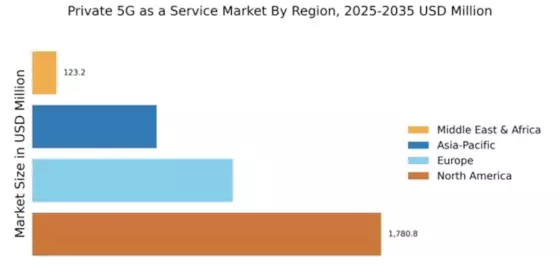
North America is poised to dominate the Private 5G as a Service market, holding a significant share of 1780.82M in 2025. The region's growth is driven by increasing demand for high-speed connectivity, advancements in IoT, and supportive regulatory frameworks. Government initiatives promoting digital transformation and smart city projects further catalyze market expansion, making it a key player in the global landscape. The competitive landscape is robust, with the U.S. leading in adoption. Major players like Ericsson, Cisco, and Nokia are actively investing in R&D to enhance service offerings. The presence of tech giants and a strong startup ecosystem fosters innovation, ensuring that North America remains at the forefront of Private 5G solutions. The region's focus on cybersecurity and data privacy also enhances its attractiveness for businesses seeking reliable connectivity solutions.

Europe : Emerging Powerhouse in Connectivity

Europe is rapidly evolving as a significant player in the Private 5G as a Service market, with a projected market size of 1023.12M by 2025. The region benefits from strong regulatory support aimed at enhancing digital infrastructure and fostering innovation. Initiatives like the European Commission's Digital Strategy are pivotal in driving demand for private networks, particularly in manufacturing and logistics sectors, where low-latency connectivity is crucial. Leading countries such as Germany, France, and the UK are at the forefront of this transformation, with substantial investments in 5G technology. Key players like Nokia and Ericsson are leveraging their expertise to provide tailored solutions for various industries. The competitive landscape is characterized by collaborations between telecom operators and enterprises, ensuring that Europe remains a vital hub for Private 5G services.

Asia-Pacific : Growing Demand for Connectivity Solutions

Asia-Pacific is witnessing a surge in demand for Private 5G as a Service, with a market size of 634.91M anticipated by 2025. The region's growth is fueled by rapid industrialization, increasing adoption of IoT, and government initiatives aimed at enhancing digital infrastructure. Countries like China and Japan are leading the charge, with significant investments in 5G technology to support smart manufacturing and urban development projects. The competitive landscape is diverse, featuring key players such as Huawei and NEC, who are actively developing innovative solutions tailored to local market needs. The presence of a large number of startups and tech companies further enriches the ecosystem, driving competition and fostering advancements in Private 5G services. As the region continues to embrace digital transformation, the demand for reliable and high-speed connectivity is expected to grow exponentially.

Middle East and Africa : Resource-Rich Frontier for 5G

The Middle East and Africa region is gradually emerging as a frontier for Private 5G as a Service, with a market size of 123.2M projected for 2025. The growth is driven by increasing investments in telecommunications infrastructure and a rising demand for enhanced connectivity solutions across various sectors, including healthcare and education. Government initiatives aimed at digital transformation are also playing a crucial role in fostering market development. Countries like the UAE and South Africa are leading the way, with significant projects aimed at deploying 5G networks. The competitive landscape includes both global players and local telecom operators, creating a dynamic environment for innovation. As the region continues to develop its digital capabilities, the demand for Private 5G services is expected to rise, presenting numerous opportunities for growth.

Key Players and Competitive Insights

The Private 5G as a Service Market is currently characterized by a dynamic competitive landscape, driven by the increasing demand for enhanced connectivity and the proliferation of IoT applications. Major players such as Ericsson (SE), Nokia (FI), and Huawei (CN) are strategically positioning themselves through innovation and partnerships, thereby shaping the competitive environment. Ericsson (SE) focuses on leveraging its extensive R&D capabilities to enhance its service offerings, while Nokia (FI) emphasizes its commitment to sustainability and energy-efficient solutions. Huawei (CN), on the other hand, appears to be expanding its global footprint through strategic alliances, particularly in emerging markets, which may enhance its competitive edge.

In terms of business tactics, companies are increasingly localizing manufacturing and optimizing supply chains to mitigate risks and enhance responsiveness to market demands. The market structure is moderately fragmented, with several key players exerting considerable influence. This fragmentation allows for a diverse range of solutions, catering to various industry needs, while also fostering competition among established and emerging players.

In November 2025, Nokia (FI) announced a partnership with a leading automotive manufacturer to develop a private 5G network aimed at enhancing vehicle-to-everything (V2X) communication. This strategic move is significant as it not only showcases Nokia's commitment to innovation in the automotive sector but also positions the company as a key player in the rapidly evolving smart transportation ecosystem. Such initiatives are likely to bolster Nokia's market presence and drive further adoption of private 5G solutions.

In October 2025, Ericsson (SE) launched a new suite of private 5G solutions tailored for the manufacturing sector, emphasizing automation and real-time data analytics. This initiative is crucial as it aligns with the industry's shift towards Industry 4.0, where connectivity and data-driven decision-making are paramount. By addressing the specific needs of manufacturers, Ericsson is likely to enhance its competitive positioning and attract new clients seeking to modernize their operations.

In December 2025, Huawei (CN) unveiled its latest private 5G offering, which integrates AI capabilities to optimize network performance and security. This development is particularly noteworthy as it reflects the growing trend of AI integration within telecommunications, potentially providing Huawei with a competitive advantage in delivering smarter, more efficient networks. The incorporation of AI may also appeal to enterprises looking for advanced solutions to manage their connectivity needs.

As of December 2025, the competitive trends within the Private 5G as a Service Market are increasingly defined by digitalization, sustainability, and the integration of AI technologies. Strategic alliances are playing a pivotal role in shaping the current landscape, enabling companies to pool resources and expertise. Looking ahead, competitive differentiation is likely to evolve from traditional price-based competition towards a focus on innovation, technological advancements, and supply chain reliability. This shift may redefine how companies approach market entry and customer engagement, emphasizing the importance of delivering unique value propositions.

Key Companies in the Private 5G as a Service Market market include

Industry Developments

February 2023: In order to help its enterprise customers grow their businesses, Infosys has announced the availability of private 5G. In a filing with the exchange, the company asserts that its private 5G-as-a-service gives clients a "simple and flexible" pay-as-you-go option. Infosys claims that it will offer wireless 5G proficiency and that its private network management solution will ensure that organizations have a reliable, high-bandwidth wireless connection with minimum latency.

Future Outlook

Private 5G as a Service Market Future Outlook

The Private 5G as a Service Market is projected to grow at a 37.0% CAGR from 2024 to 2035, driven by increasing demand for enhanced connectivity and automation.

New opportunities lie in:

  • Development of tailored private network solutions for manufacturing sectors.
  • Integration of AI-driven analytics for network optimization.
  • Expansion into remote healthcare services through dedicated 5G networks.

By 2035, the market is expected to be a cornerstone of digital transformation across various industries.

Market Segmentation

Private 5G as a Service Market End Use Outlook

  • Manufacturing
  • Energy and Utilities
  • Transportation and Logistics
  • Healthcare
  • Public Safety

Private 5G as a Service Market Application Outlook

  • Industrial Automation
  • Smart Cities
  • Healthcare
  • Transportation
  • Retail

Private 5G as a Service Market Network Type Outlook

  • Private Network
  • Public Network
  • Hybrid Network

Private 5G as a Service Market Service Type Outlook

  • Managed Services
  • Professional Services
  • Consulting Services

Private 5G as a Service Market Deployment Model Outlook

  • On-Premises
  • Cloud-Based
  • Hybrid

Report Scope

MARKET SIZE 20243562.05(USD Million)
MARKET SIZE 20254880.08(USD Million)
MARKET SIZE 2035113683.42(USD Million)
COMPOUND ANNUAL GROWTH RATE (CAGR)37.0% (2024 - 2035)
REPORT COVERAGERevenue Forecast, Competitive Landscape, Growth Factors, and Trends
BASE YEAR2024
Market Forecast Period2025 - 2035
Historical Data2019 - 2024
Market Forecast UnitsUSD Million
Key Companies ProfiledEricsson (SE), Nokia (FI), Huawei (CN), Cisco (US), Samsung (KR), NEC (JP), Mavenir (US), ZTE (CN), Ciena (US)
Segments CoveredApplication, End Use, Deployment Model, Network Type, Service Type
Key Market OpportunitiesGrowing demand for secure, high-speed connectivity in industrial automation drives Private 5G as a Service Market expansion.
Key Market DynamicsRising demand for secure, high-speed connectivity drives competition and innovation in the Private 5G as a Service Market.
Countries CoveredNorth America, Europe, APAC, South America, MEA

Market Highlights

Author
Aarti Dhapte
Team Lead - Research

She holds an experience of about 6+ years in Market Research and Business Consulting, working under the spectrum of Information Communication Technology, Telecommunications and Semiconductor domains. Aarti conceptualizes and implements a scalable business strategy and provides strategic leadership to the clients. Her expertise lies in market estimation, competitive intelligence, pipeline analysis, customer assessment, etc.

Leave a Comment

FAQs

How much is the private 5G as a service market?

The Private 5G as a Service Market size was valued at USD 3.56 billion in 2024.

What is the growth rate of the private 5G as a service market?

The global market is projected to grow at a CAGR of 37.00% during the forecast period, 2025 to 2035.

Which region held the largest market share in the private 5G as a service market?

North America had the largest share in the global market

Who are the key players in the private 5G as a service market?

The key players in the market are Amazon Web Services, Inc., Verizon, AT and T Intellectual Property, Anterix Inc., Nokia, Mavenir, Kyndryl Inc., Cisco Systems, Inc., Ericsson, and Infosys Limited.

Which component led the private 5G as a service market?

The hardware category dominated the market in 2022.

Which spectrum had the largest market share in the private 5G as a service market?

The unlicensed/shared category had the largest share in the global market.

Download Free Sample

Kindly complete the form below to receive a free sample of this Report

Compare Licence

×
Features License Type
Single User Multiuser License Enterprise User
Price $4,950 $5,950 $7,250
Maximum User Access Limit 1 User Upto 10 Users Unrestricted Access Throughout the Organization
Free Customization
Direct Access to Analyst
Deliverable Format
Platform Access
Discount on Next Purchase 10% 15% 15%
Printable Versions