×
Request Free Sample ×

Kindly complete the form below to receive a free sample of this Report

Leading companies partner with us for data-driven Insights

clients tt-cursor
Hero Background

Automated 3D Printing Market

ID: MRFR/SEM/5809-HCR
100 Pages
Shubham Munde
October 2025

Automated 3D Printing Market Research Report By Technology (Fused Deposition Modeling, Stereolithography, Selective Laser Sintering, Digital Light Processing), By Material Type (Thermoplastics, Metals, Ceramics, Composites), By End User Industry (Aerospace, Automotive, Healthcare, Consumer Goods), By Application (Prototyping, Tooling, Production Parts, Customized Products) and By Regional (North America, Europe, South America, Asia Pacific, Middle East and Africa) - Forecast to 2035

Share:
Download PDF ×

We do not share your information with anyone. However, we may send you emails based on your report interest from time to time. You may contact us at any time to opt-out.

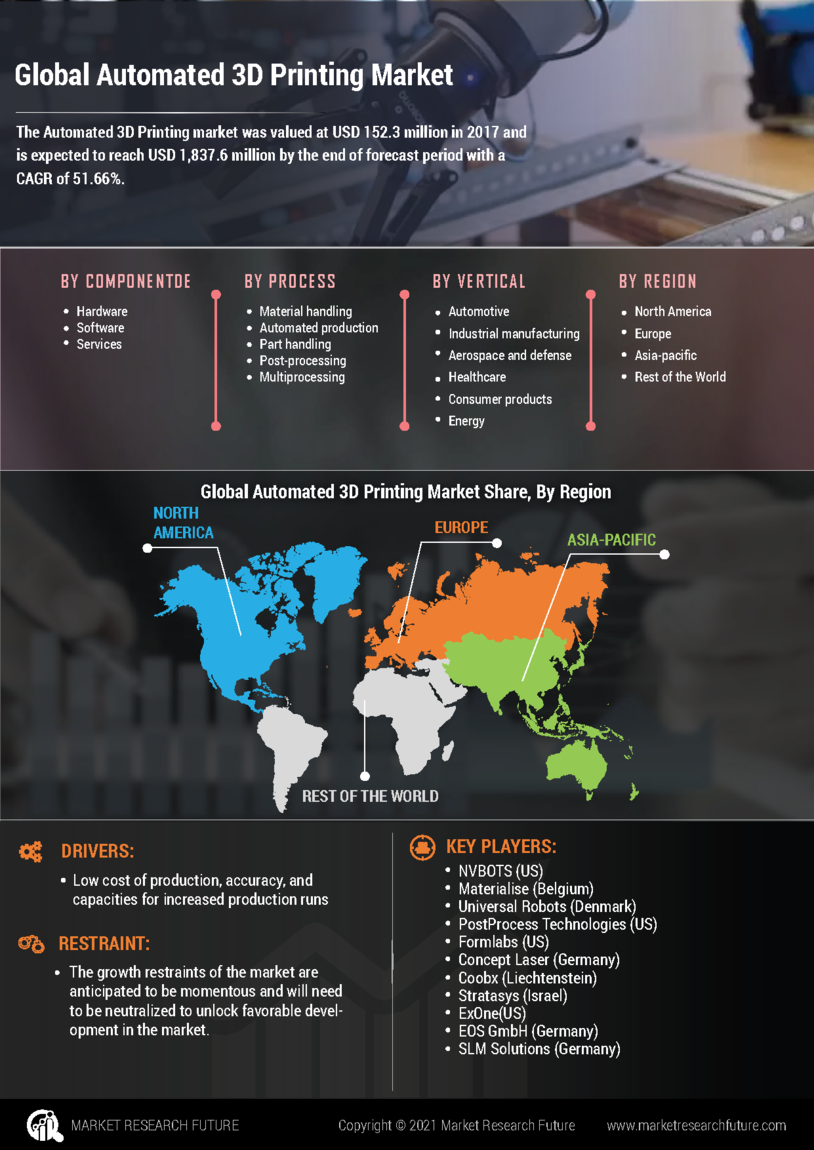
Automated 3D Printing Market Infographic
Purchase Options

Automated 3D Printing Market Summary

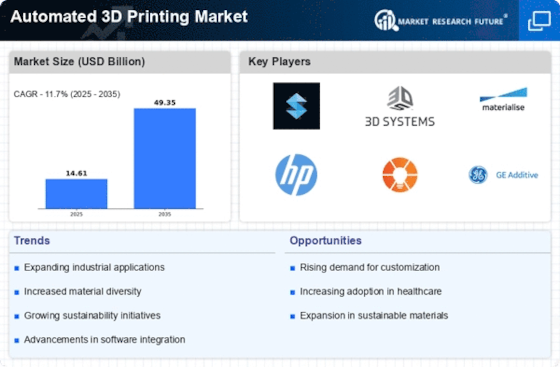
As per MRFR analysis, the Automated 3D Printing Market Size was estimated at 14.61 USD Billion in 2024. The Automated 3D Printing industry is projected to grow from 16.32 USD Billion in 2025 to 49.35 USD Billion by 2035, exhibiting a compound annual growth rate (CAGR) of 11.7 during the forecast period 2025 - 2035.

Key Market Trends & Highlights

The Automated 3D Printing Market is experiencing robust growth driven by technological advancements and increasing customization demands.

  • Customization and personalization are becoming pivotal in the Automated 3D Printing Market, allowing for tailored solutions across various industries.
  • The integration of advanced technologies, such as AI and IoT, is enhancing the efficiency and capabilities of 3D printing processes.
  • Sustainability initiatives are gaining traction, with companies focusing on eco-friendly materials and practices to reduce environmental impact.
  • Increased demand for prototyping and advancements in material science are key drivers propelling the market, particularly in North America and the Asia-Pacific region, with Fused Deposition Modeling and thermoplastics leading the segments.

Market Size & Forecast

2024 Market Size 14.61 (USD Billion)
2035 Market Size 49.35 (USD Billion)
CAGR (2025 - 2035) 11.7%

Major Players

Stratasys (US), 3D Systems (US), Materialise (BE), HP (US), EOS (DE), GE Additive (US), Siemens (DE), Formlabs (US), Carbon (US)

Automated 3D Printing Market Trends

The Automated 3D Printing Market is currently experiencing a transformative phase, characterized by rapid advancements in technology and increasing adoption across various industries. This market appears to be driven by the growing demand for customized products, which traditional manufacturing methods struggle to meet. As organizations seek to enhance efficiency and reduce production costs, automated 3D printing solutions are becoming more appealing. Furthermore, the integration of artificial intelligence and machine learning into the printing process seems to enhance precision and speed, potentially revolutionizing production capabilities. In addition, sustainability concerns are influencing the Automated 3D Printing Market. Companies are increasingly focusing on eco-friendly materials and processes, which may lead to a shift in consumer preferences. The ability to produce less waste and utilize recyclable materials aligns with global sustainability goals. As a result, the market is likely to witness a surge in innovations aimed at reducing environmental impact while maintaining high-quality output. Overall, the Automated 3D Printing Market is poised for significant growth, driven by technological advancements and a shift towards sustainable practices.

Customization and Personalization

The demand for tailored products is rising, prompting industries to adopt automated 3D printing solutions. This trend allows for the creation of unique items that meet specific customer needs, enhancing user satisfaction and engagement.

Integration of Advanced Technologies

The incorporation of artificial intelligence and machine learning into automated 3D printing processes is becoming more prevalent. These technologies improve efficiency, accuracy, and speed, potentially transforming production methodologies.

Sustainability Initiatives

A growing emphasis on environmental responsibility is shaping the Automated 3D Printing Market. Companies are exploring eco-friendly materials and practices, which may lead to reduced waste and a more sustainable manufacturing approach.

Automated 3D Printing Market Drivers

Growing Adoption in Healthcare

The healthcare sector is increasingly recognizing the potential of the Automated 3D Printing Market, particularly in the production of customized medical devices and implants. The ability to create patient-specific solutions, such as prosthetics and surgical models, is transforming the way healthcare providers approach treatment. This trend is supported by data indicating that the medical segment of the 3D printing market is expected to grow significantly, driven by technological advancements and regulatory approvals. As healthcare professionals continue to explore the benefits of personalized medicine, the demand for automated 3D printing solutions is likely to expand, fostering innovation and improving patient outcomes.

Advancements in Material Science

The evolution of material science is a crucial factor propelling the Automated 3D Printing Market forward. Innovations in materials, including high-performance polymers, metals, and composites, are expanding the capabilities of 3D printing technologies. These advancements enable the production of parts that meet stringent performance criteria, which is essential for industries such as aerospace and medical devices. The introduction of new materials not only enhances the mechanical properties of printed components but also broadens the application scope of 3D printing. As research continues to yield novel materials, the market is likely to witness an increase in adoption rates, as manufacturers seek to leverage these advancements for competitive advantage.

Increased Demand for Prototyping

The Automated 3D Printing Market is experiencing a surge in demand for rapid prototyping across various sectors. Industries such as automotive, aerospace, and consumer goods are increasingly adopting 3D printing technologies to accelerate product development cycles. This shift is driven by the need for faster time-to-market and the ability to create complex geometries that traditional manufacturing methods cannot achieve. According to recent data, the prototyping segment is projected to account for a substantial share of the market, indicating a robust growth trajectory. As companies seek to innovate and reduce costs, the reliance on automated 3D printing for prototyping is likely to intensify, further solidifying its position in the market.

Cost Efficiency and Waste Reduction

Cost efficiency remains a pivotal driver in the Automated 3D Printing Market. The technology allows for the production of parts with minimal material waste, which is particularly appealing in industries where raw material costs are significant. By utilizing additive manufacturing techniques, companies can produce components layer by layer, thereby reducing excess material and energy consumption. This efficiency not only lowers production costs but also aligns with sustainability goals, as companies strive to minimize their environmental footprint. Market analysis suggests that businesses adopting automated 3D printing can achieve cost savings of up to 30% compared to traditional manufacturing methods, making it an attractive option for manufacturers seeking to optimize their operations.

Integration of Industry 4.0 Technologies

The integration of Industry 4.0 technologies is reshaping the landscape of the Automated 3D Printing Market. The convergence of the Internet of Things (IoT), artificial intelligence, and big data analytics with 3D printing is enhancing operational efficiency and enabling smarter manufacturing processes. This technological synergy allows for real-time monitoring and optimization of production workflows, which can lead to reduced downtime and improved quality control. As manufacturers increasingly adopt these advanced technologies, the market for automated 3D printing is expected to grow, driven by the need for more agile and responsive production systems. The potential for increased productivity and innovation positions automated 3D printing as a key player in the future of manufacturing.

Market Segment Insights

By Technology: Fused Deposition Modeling (Largest) vs. Stereolithography (Fastest-Growing)

The Automated 3D Printing Market is primarily segmented into Fused Deposition Modeling (FDM), Stereolithography (SLA), Selective Laser Sintering (SLS), and Digital Light Processing (DLP). Among these, FDM stands out as the largest segment, widely adopted for its cost-effectiveness and versatility. It captures a significant share of the market, appealing to both hobbyists and professionals. Meanwhile, SLA, known for producing high-resolution parts, is currently the fastest-growing segment driven by its increasing application in industries such as medical and dental technology, where precision is crucial. In terms of growth trends, FDM is gaining traction due to enhancements in filament quality and printer technology, making it a go-to choice for prototyping. SLA's growth is propelled by advancements in UV resin formulations and increasing consumer demand for intricate designs. Both technologies are experiencing innovation, yet SLA's rapid development in niche markets positions it as a key player in the future landscape of automated 3D printing.

Technology: FDM (Dominant) vs. SLA (Emerging)

Fused Deposition Modeling (FDM) remains the dominant technology in the Automated 3D Printing Market, primarily due to its user-friendly nature and extensive material compatibility. This method utilizes thermoplastic filaments to build parts layer by layer, making it appealing for prototyping and end-use applications across various industries. On the other hand, Stereolithography (SLA) is emerging as a critical technology, particularly due to its ability to produce highly detailed and intricate parts that FDM struggles to achieve. SLA utilizes a light source to cure liquid resin, catering to sectors that demand high fidelity and smooth finishes, such as the medical and dental industries. Together, FDM and SLA illustrate the diverse capabilities within the automated 3D printing landscape.

By Material Type: Thermoplastics (Largest) vs. Metals (Fastest-Growing)

In the Automated 3D Printing Market, thermoplastics hold the largest market share, being favored for their versatility, ease of use, and wide range of applications. Their ability to be reprocessed and recycled makes them an attractive choice for sustainable manufacturing practices. Metals, on the other hand, are emerging as a fast-growing segment due to their increasing use in aerospace, automotive, and medical sectors, where strength and durability are paramount.

Thermoplastics (Dominant) vs. Metals (Emerging)

Thermoplastics dominate the Automated 3D Printing Market thanks to their excellent thermal properties and ease of processing. They are commonly used for prototyping and producing functional parts in various industries. Their adaptability allows for intricate designs and complex geometries, leading to innovative product solutions. In contrast, metals are rapidly gaining traction as an emerging material in additive manufacturing. They are increasingly being utilized for high-performance applications requiring structural integrity and precision. The advancements in metal 3D printing technologies, such as DMLS and EBM, are fueling their adoption, appealing to industries that demand high-quality, durable components.

By End User Industry: Aerospace (Largest) vs. Healthcare (Fastest-Growing)

Among the various end user industries in the Automated 3D Printing Market, aerospace dominates the share with significant adoption due to its demand for lightweight components and complex geometries. The automotive sector also plays a vital role, leveraging 3D printing for rapid prototyping and production of intricate parts. Healthcare has emerged as a substantial segment as well, increasingly implementing 3D printing for custom medical devices and anatomical models, reflecting shifting priorities towards personalized medicine.

Aerospace: Dominant vs. Healthcare: Emerging

The aerospace industry stands as the dominant force in the Automated 3D Printing Market, characterized by its long-standing investments in advanced manufacturing technologies. This sector relies heavily on 3D printing to produce lightweight, high-performance components that meet stringent regulatory standards. Conversely, healthcare is emerging rapidly, driven by technological advancements and an increasing focus on personalized patient care. This segment's growth is supported by the ability to create customized implants, prosthetics, and surgical tools that cater to individual patient anatomy, marking a transformative shift in medical practices.

By Application: Prototyping (Largest) vs. Customized Products (Fastest-Growing)

In the Automated 3D Printing Market, the application segment is diversified across four primary categories: prototyping, tooling, production parts, and customized products. Prototyping holds the largest share, capitalizing on its essential role in product development processes across various industries. This segment is heavily relied upon by design teams for rapid iteration and testing, making it a cornerstone in the market. Meanwhile, customized products have emerged as a significant contender, gaining traction due to the increasing demand for tailored solutions that meet specific consumer needs.

Prototyping (Dominant) vs. Customized Products (Emerging)

Prototyping, as the dominant force in the Automated 3D Printing Market, is characterized by its extensive application in the initial stages of product development. It enables rapid prototyping and testing, significantly shortening the time-to-market for new products. On the other hand, customized products represent an emerging segment driven by advancements in technology that allow for more personalized manufacturing solutions. Consumers today are seeking unique products tailored to their preferences, leading to rapid growth in this category. This shift signifies a trend towards greater personalization in the 3D printing landscape, positioning customized products as a vital focus area for future innovations.

Get more detailed insights about Automated 3D Printing Market

Regional Insights

North America : Innovation and Leadership Hub

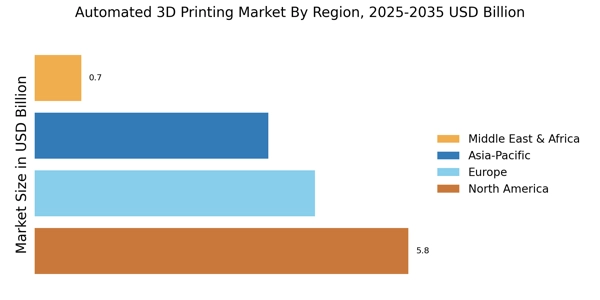
North America is the largest market for automated 3D printing, holding approximately 40% of the global market share. The region's growth is driven by advancements in technology, increasing demand for customized manufacturing, and supportive government regulations. The presence of major players like Stratasys and 3D Systems further fuels market expansion, alongside investments in research and development initiatives. The United States leads the North American market, followed by Canada, which is rapidly adopting 3D printing technologies across various sectors, including aerospace and healthcare. The competitive landscape is characterized by a mix of established companies and innovative startups, all vying for market share. Key players are focusing on enhancing their product offerings and expanding their service capabilities to meet the growing demand.

Europe : Emerging Market with Potential

Europe is the second-largest market for automated 3D printing, accounting for around 30% of the global market share. The region's growth is propelled by a strong emphasis on sustainability, regulatory support for innovative manufacturing processes, and increasing investments in additive manufacturing technologies. Countries like Germany and the UK are at the forefront, driving demand through initiatives aimed at reducing waste and enhancing production efficiency. Germany is the leading country in Europe, with a robust industrial base that leverages 3D printing for various applications, including automotive and healthcare. The competitive landscape features a mix of established firms like EOS and emerging players, all focusing on innovation and collaboration. The European market is characterized by a strong regulatory framework that encourages the adoption of advanced manufacturing technologies.

Asia-Pacific : Rapid Growth and Adoption

Asia-Pacific is witnessing rapid growth in the automated 3D printing market, holding approximately 25% of the global market share. The region's expansion is driven by increasing industrialization, a growing middle class, and rising demand for customized products. Countries like China and Japan are leading the charge, supported by government initiatives aimed at fostering innovation and technological advancement in manufacturing. China is the largest market in the region, with significant investments in 3D printing technologies across various sectors, including aerospace, automotive, and healthcare. The competitive landscape is evolving, with both local and international players vying for market share. Companies are focusing on enhancing their technological capabilities and expanding their product offerings to cater to the diverse needs of the market.

Middle East and Africa : Emerging Market with Challenges

The Middle East and Africa region is gradually emerging in the automated 3D printing market, holding about 5% of the global market share. Growth is driven by increasing investments in technology and a rising interest in additive manufacturing across various sectors. Countries like the UAE and South Africa are beginning to adopt 3D printing technologies, supported by government initiatives aimed at diversifying their economies and enhancing manufacturing capabilities. The competitive landscape is still developing, with a mix of local startups and international companies entering the market. The presence of key players is limited, but there is a growing interest in establishing partnerships and collaborations to drive innovation. As the region continues to invest in technology and infrastructure, the potential for growth in the 3D printing market is significant.

Automated 3D Printing Market Regional Image

Key Players and Competitive Insights

The Automated 3D Printing Market is witnessing robust growth driven by advancements in technology and increasing applications across various industries, including aerospace, automotive, healthcare and consumer goods. This market is characterized by a dynamic competitive landscape where numerous players are vying for market share through innovation, strategic partnerships, and enhancements in production efficiency. As automated 3D printing technologies continue to evolve, companies are focusing on creating more integrated systems that not only enhance the speed and quality of printing but also reduce operational costs.

The competitive insights reveal an environment where agility, scalability, and sustainability are becoming key differentiators for businesses intending to maintain their competitive edge in this rapidly changing industry.

Zortrax has positioned itself as a significant player within the Automated 3D Printing Market due to its commitment to developing user-friendly and reliable 3D printing solutions. The company's strength lies in its innovative technology that allows for high precision and high-quality output across a variety of materials. Zortrax has specialized in creating a range of printers that cater to professional and industrial needs, ensuring that they meet the production demands of various sectors. Its focus on customer-centric solutions has strengthened its market presence, enabling Zortrax to build a loyal customer base.

By continuously investing in research and development, Zortrax is well-positioned to capitalize on the emerging trends in automated 3D printing and remains competitive by enhancing its existing product line and services.HP, on the other hand, showcases its extensive expertise in the Automated 3D Printing Market through innovative applications in industrial manufacturing processes. With its groundbreaking Multi Jet Fusion technology, HP has established itself as a frontrunner in delivering high-speed and high-quality 3D printing solutions designed for mass production.

The company's strengths include its established supply chain and vast distribution network, which enable it to reach a broad customer base across different regions and industries. HP's emphasis on sustainability and eco-friendly production further enhances its market attractiveness, appealing to customers who prioritize environmental responsibility. The ability to provide scalable solutions that fit both short-run and long-run production needs positions HP uniquely within the market landscape, reinforcing its role as a key player in the evolution of automated 3D printing technologies.

Key Companies in the Automated 3D Printing Market market include

Industry Developments

In the Automated 3D Printing Market, notable developments include HP's ongoing advancements in multi-jet fusion technologies, which aim to enhance production speed and material versatility. Zortrax has recently launched new printing materials designed for both professionalism and creative applications, catering to diverse industry needs. Meanwhile, Carbon continues to expand its Resin 3D printer lineup, focusing on rigorous quality controls to attract the automotive and healthcare sectors.

On the merger and acquisition front, Stratasys and Desktop Metal have announced strategic collaborations aimed at enhancing additive manufacturing capabilities, indicating a consolidation trend in the industry that seeks to streamline operations and expand service offerings.

Similarly, GE Additive's recent acquisition strategy emphasizes bolstering its position as a leader in metal 3D printing technology. The growth in market valuation for companies like Materialise and EOS reflects increased investor confidence, driven by the rising demand for customized manufacturing solutions across various sectors, including aerospace and medical devices. This evolving landscape is significantly impacting operational efficiencies and product innovations within the Automated 3D Printing Market.

Future Outlook

Automated 3D Printing Market Future Outlook

The Automated 3D Printing Market is projected to grow at 11.7% CAGR from 2024 to 2035, driven by advancements in materials, automation technologies, and increasing demand for customized solutions.

New opportunities lie in:

  • Development of automated production lines for mass customization
  • Integration of AI for predictive maintenance in 3D printers
  • Expansion into sustainable materials for eco-friendly printing solutions

By 2035, the market is expected to be robust, driven by innovation and diverse applications.

Market Segmentation

Automated 3D Printing Market Technology Outlook

  • Fused Deposition Modeling
  • Stereolithography
  • Selective Laser Sintering
  • Digital Light Processing

Automated 3D Printing Market Application Outlook

  • Prototyping
  • Tooling
  • Production Parts
  • Customized Products

Automated 3D Printing Market Material Type Outlook

  • Thermoplastics
  • Metals
  • Ceramics
  • Composites

Automated 3D Printing Market End User Industry Outlook

  • Aerospace
  • Automotive
  • Healthcare
  • Consumer Goods

Report Scope

MARKET SIZE 2024 14.61(USD Billion)
MARKET SIZE 2025 16.32(USD Billion)
MARKET SIZE 2035 49.35(USD Billion)
COMPOUND ANNUAL GROWTH RATE (CAGR) 11.7% (2024 - 2035)
REPORT COVERAGE Revenue Forecast, Competitive Landscape, Growth Factors, and Trends
BASE YEAR 2024
Market Forecast Period 2025 - 2035
Historical Data 2019 - 2024
Market Forecast Units USD Billion
Key Companies Profiled Market analysis in progress
Segments Covered Market segmentation analysis in progress
Key Market Opportunities Integration of artificial intelligence enhances efficiency and customization in the Automated 3D Printing Market.
Key Market Dynamics Technological advancements and regulatory changes drive competitive dynamics in the Automated 3D Printing Market.
Countries Covered North America, Europe, APAC, South America, MEA

Market Highlights

Author
Shubham Munde
Research Analyst Level II

With a technical background in information technology & semiconductors, Shubham has 4.5+ years of experience in market research and analytics with the tasks of data mining, analysis, and project execution. He is the POC for our clients, for their consulting projects running under the ICT/Semiconductor domain. Shubham holds a Bachelor’s in Information and Technology and a Master of Business Administration (MBA). Shubham has executed over 150 research projects for our clients under the brand name Market Research Future in the last 2 years. His core skill is building the research respondent relation for gathering the primary information from industry and market estimation for niche markets. He is having expertise in conducting secondary & primary research, market estimations, market projections, competitive analysis, analysing current market trends and market dynamics, deep-dive analysis on market scenarios, consumer behaviour, technological impact analysis, consulting, analytics, etc. He has worked on fortune 500 companies' syndicate and consulting projects along with several government projects. He has worked on the projects of top tech brands such as IBM, Google, Microsoft, AWS, Meta, Oracle, Cisco Systems, Samsung, Accenture, VMware, Schneider Electric, Dell, HP, Ericsson, and so many others. He has worked on Metaverse, Web 3.0, Zero-Trust security, cyber-security, blockchain, quantum computing, robotics, 5G technology, High-Performance computing, data centers, AI, automation, IT equipment, sensors, semiconductors, consumer electronics and so many tech domain projects.

Leave a Comment

FAQs

What is the projected market valuation of the Automated 3D Printing Market by 2035?

The Automated 3D Printing Market is projected to reach a valuation of 49.35 USD Billion by 2035.

What was the market valuation of the Automated 3D Printing Market in 2024?

In 2024, the market valuation of the Automated 3D Printing Market was 14.61 USD Billion.

What is the expected CAGR for the Automated 3D Printing Market during the forecast period 2025 - 2035?

The expected CAGR for the Automated 3D Printing Market during the forecast period 2025 - 2035 is 11.7%.

Which technology segment is projected to have the highest valuation by 2035?

The Digital Light Processing technology segment is projected to reach a valuation of 16.35 USD Billion by 2035.

What are the key materials used in the Automated 3D Printing Market?

Key materials include Thermoplastics, Metals, Ceramics, and Composites, with Thermoplastics projected to reach 17.0 USD Billion by 2035.

Which end-user industry is expected to drive the most growth in the Automated 3D Printing Market?

The Healthcare industry is expected to drive significant growth, with a projected valuation of 15.23 USD Billion by 2035.

Who are the leading companies in the Automated 3D Printing Market?

Leading companies include Stratasys, 3D Systems, Materialise, HP, and GE Additive.

What application segment is anticipated to have the highest valuation by 2035?

The Customized Products application segment is anticipated to reach a valuation of 16.35 USD Billion by 2035.

How does the performance of the Selective Laser Sintering technology segment compare to others?

The Selective Laser Sintering technology segment is projected to reach 11.0 USD Billion by 2035, indicating robust growth.

What was the valuation of the Automotive end-user industry in 2024?

In 2024, the valuation of the Automotive end-user industry was 3.67 USD Billion.

Download Free Sample

Kindly complete the form below to receive a free sample of this Report

Compare Licence

×
Features License Type
Single User Multiuser License Enterprise User
Price $4,950 $5,950 $7,250
Maximum User Access Limit 1 User Upto 10 Users Unrestricted Access Throughout the Organization
Free Customization
Direct Access to Analyst
Deliverable Format
Platform Access
Discount on Next Purchase 10% 15% 15%
Printable Versions