×
Request Free Sample ×

Kindly complete the form below to receive a free sample of this Report

* Please use a valid business email

Leading companies partner with us for data-driven Insights

clients tt-cursor
Hero Background
English
Chinese
French
Japanese
Korean
German
Spanish

Functional Composites Market Size

ID: MRFR/CnM/0364-HCR
111 Pages
Chitranshi Jaiswal
October 2025

Functional Composites Market Research Report by Type (Metal Matrix Composites, Polymer Matrix Composites) by Function (Thermally Conductive, Electrically Conductive) by End-user (electrical and electronics, automotive) - Forecast till 2035

Share:
Download PDF ×

We do not share your information with anyone. However, we may send you emails based on your report interest from time to time. You may contact us at any time to opt-out.

Functional Composites Market Infographic
×
Functional Composites Market Infographic Full View
Purchase Options

Functional Composites Size

Functional Composites Market Growth Projections and Opportunities

The functional composites market is influenced by a myriad of factors, both internal and external, which collectively shape its dynamics. Market demand is a key driver, propelled by industries seeking lightweight, durable, and high-performance materials. Automotive, aerospace, construction, and electronics sectors are major consumers of functional composites, each with distinct requirements dictating market trends. Technological advancements play a crucial role, driving innovation and expanding the application spectrum of composites. As research yields new formulations and manufacturing techniques, functional composites become more accessible and versatile, further fueling market growth.

Functional Composites Market are compounds that possess special electrical, optical, and magnetic properties. The advantages of functional composites such as enhanced stiffness, high tensile strength, and high durability among others pave their way into many end-user industries.

Supply chain factors heavily impact the functional composites market. Availability of raw materials, particularly fibers and resins, influences production costs and product availability. The market's dependence on petroleum-based resins, for instance, subjects it to price fluctuations and supply chain disruptions. Additionally, the geographical distribution of manufacturing facilities affects market dynamics, with regions boasting robust infrastructure and skilled labor often dominating production and export markets.

Regulatory frameworks also exert significant influence on the functional composites market. Environmental regulations, in particular, are driving the shift towards sustainable and eco-friendly materials. As governments worldwide implement stricter emissions standards and waste management policies, industries are compelled to adopt greener alternatives, thereby shaping the demand for bio-based resins and recyclable fibers. Compliance with safety and quality standards is another regulatory aspect shaping market dynamics, as manufacturers strive to meet industry requirements and consumer expectations.

Global economic conditions are critical determinants of the functional composites market's trajectory. Economic growth fuels demand across end-user industries, driving investment in infrastructure and transportation, which in turn boosts the consumption of composites. Conversely, economic downturns can lead to decreased consumer spending and investment, impacting market demand and pricing. Currency fluctuations and trade policies also influence market dynamics, affecting the competitiveness of manufacturers in the global arena.

Consumer preferences and market trends play a pivotal role in shaping product development and marketing strategies within the functional composites market. With growing awareness of environmental issues and sustainability concerns, there is a rising demand for eco-friendly products and materials. Functional composites offering lightweight properties and enhanced performance characteristics are increasingly favored across various applications, driving innovation in product design and manufacturing processes. Additionally, aesthetic considerations such as color, texture, and finish are becoming increasingly important, particularly in consumer-facing industries like automotive and consumer electronics.

Technological advancements continue to revolutionize the functional composites market, enabling the development of novel materials and manufacturing techniques. Breakthroughs in nanotechnology, for example, are facilitating the production of composites with superior mechanical properties and enhanced functionality. Additive manufacturing processes are also revolutionizing the production of complex composite structures, offering greater design flexibility and cost-effectiveness. As these technologies mature and become more widely adopted, they will further drive market growth and diversification.
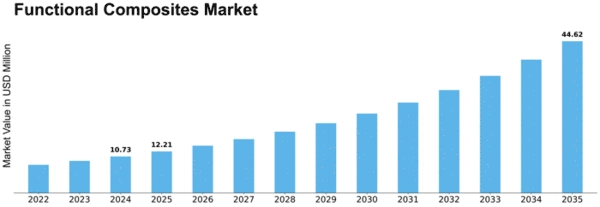

Functional Composites Market Size Graph
Author
Chitranshi Jaiswal
Research Analyst Level I

In her 3 years of experience in the market research field, she has handled critical cross-domain projects. She has an in-depth knowledge of market estimation & analysis, problem-solving, primary as well as secondary research, and team management.She holds an engineering degree and is an MBA professional from a well-known university, capable of evaluating the market and competitive conditions. An exceptional strategist with excellent communication skills and a passion for delivering cutting-edge & practical insights for the market. Proficient in multi-tasking, and can successfully deal with competing demands, while maintaining complete confidentiality. Generated business through active client and project development, networking, and high-quality responses. Her knowledge and skills have helped in making solid business decisions, securing funding from investors, and avoiding business failures.

Leave a Comment

FAQs

What are the major advantages of functional composites over alternatives?

The enhanced stiffness, high tensile strength, and high durability of functional polymers are the major advantages of functional polymers over alternatives.

What are the major drivers for the functional composite market?

The growing demand for functional composites from industries such as construction, automotive, aerospace and defense, and consumer goods is the major driver for the functional composites market.

What is the leading product type?

Polymer matrix composites hold the largest share in the global functional composites market, followed by metal matrix composites.

What are the various types of functions in which functional composites are used?

Major functions of functional composites include thermal conductive, electrical conductive, magnetic, barrier, and optic.

Which is the leading regional market for functional composites?

Asia Pacific is the largest regional market for functional composites due to the growing automotive, consumer goods, and aerospace industries in the region.

Market Summary

As per MRFR analysis, the Functional Composites Market Size was estimated at 10.73 USD Million in 2024. The Functional Composites industry is projected to grow from 12.21 USD Million in 2025 to 44.62 USD Million by 2035, exhibiting a compound annual growth rate (CAGR) of 13.83 during the forecast period 2025 - 2035.

Key Market Trends & Highlights

The Functional Composites Market is poised for substantial growth driven by sustainability and technological advancements.

  • The market is experiencing a pronounced shift towards sustainability, influencing product development and consumer preferences. Technological advancements are facilitating the creation of innovative composite materials, enhancing performance and application scope. North America remains the largest market, while the Asia-Pacific region is emerging as the fastest-growing area for functional composites. Key market drivers include rising demand in the automotive sector and significant growth in aerospace applications, reflecting broader sustainability initiatives.

Market Size & Forecast

2024 Market Size 10.73 (USD Million)
2035 Market Size 44.62 (USD Million)
CAGR (2025 - 2035) 13.83%
Largest Regional Market Share in 2024 North America

Major Players

<p>Toray Industries (JP), Hexcel Corporation (US), SABIC (SA), BASF SE (DE), 3M Company (US), Solvay SA (BE), Teijin Limited (JP), Mitsubishi Chemical Corporation (JP), Hexion Inc. (US)</p>

Market Trends

The Functional Composites Market is currently experiencing a dynamic evolution, driven by advancements in material science and increasing demand across various industries. This market encompasses a diverse range of composite materials that combine different substances to achieve superior properties, such as enhanced strength, lightweight characteristics, and improved durability. Industries such as aerospace, automotive, and construction are increasingly adopting these materials due to their ability to meet stringent performance requirements while also contributing to sustainability goals. As environmental concerns continue to rise, the shift towards eco-friendly composites is becoming more pronounced, indicating a potential transformation in manufacturing practices. In addition to sustainability, technological innovations play a crucial role in shaping the Functional Composites Market. The integration of smart materials, which can respond to environmental changes, is gaining traction. This trend suggests a future where composites not only serve structural purposes but also incorporate functionalities such as self-healing and energy harvesting. Furthermore, the globalization of supply chains and the rise of emerging markets are likely to influence the competitive landscape, creating opportunities for new entrants and established players alike. Overall, the Functional Composites Market appears poised for substantial growth, driven by a confluence of technological advancements and evolving consumer preferences.

Sustainability Focus

The emphasis on sustainable materials is increasingly shaping the Functional Composites Market. Manufacturers are exploring bio-based composites and recyclable materials to reduce environmental impact. This trend reflects a broader commitment to sustainability, as industries seek to align with global environmental standards.

Technological Advancements

Innovations in material science are propelling the Functional Composites Market forward. The development of smart composites, which can adapt to their environment, is gaining attention. These materials may offer enhanced performance and new functionalities, potentially revolutionizing applications across various sectors.

Emerging Market Opportunities

The globalization of supply chains is creating new opportunities within the Functional Composites Market. Emerging economies are increasingly adopting advanced composite materials, driven by industrial growth and infrastructure development. This trend suggests a shift in market dynamics, with new players entering the landscape.

Functional Composites Market Market Drivers

Rising Demand for Lightweight Materials

The Global Functional Composites Market Industry experiences a notable surge in demand for lightweight materials, particularly in the automotive and aerospace sectors. Manufacturers are increasingly adopting composite materials to enhance fuel efficiency and reduce emissions. For instance, the integration of carbon fiber composites in vehicle structures has been shown to decrease weight by up to 50% compared to traditional materials. This shift not only contributes to environmental sustainability but also aligns with regulatory standards aimed at reducing carbon footprints. As a result, the market is projected to reach 235.94 USD Billion in 2024, reflecting a growing trend towards lightweight solutions.

Growing Applications in Renewable Energy

The Global Functional Composites Market Industry is witnessing an expansion in applications within the renewable energy sector. Composites are increasingly utilized in wind turbine blades and solar panel structures due to their superior strength-to-weight ratios and corrosion resistance. For instance, the use of glass fiber composites in wind energy applications has been instrumental in enhancing the durability and efficiency of turbine blades. This trend aligns with global efforts to transition towards sustainable energy sources, thereby driving market growth. The market is expected to reach 541.32 USD Billion by 2035, underscoring the potential of composites in renewable energy solutions.

Enhanced Performance Characteristics of Composites

The Global Functional Composites Market Industry is propelled by the enhanced performance characteristics of composite materials, which offer superior mechanical properties, thermal stability, and resistance to environmental degradation. These attributes make composites an attractive choice for a variety of applications, including automotive, aerospace, and construction. For instance, the ability of composites to withstand extreme temperatures and corrosive environments positions them favorably in industries requiring high-performance materials. As industries increasingly recognize the benefits of composites, the demand is expected to rise, further solidifying the market's growth trajectory.

Increased Investment in Infrastructure Development

The Global Functional Composites Market Industry benefits from heightened investment in infrastructure development across various regions. Governments are prioritizing the construction of resilient and sustainable infrastructure, leading to increased demand for composite materials in applications such as bridges, roads, and buildings. For example, the use of fiber-reinforced polymers in bridge construction has demonstrated enhanced durability and reduced maintenance costs. This trend is particularly evident in emerging economies, where infrastructure projects are on the rise. As a result, the market is poised for substantial growth, driven by the need for innovative materials in modern infrastructure.

Technological Advancements in Composite Manufacturing

Technological innovations play a pivotal role in shaping the Global Functional Composites Market Industry. Advanced manufacturing techniques, such as 3D printing and automated fiber placement, are revolutionizing the production of composites. These methods enhance precision, reduce waste, and lower production costs, making composites more accessible to various industries. For example, the aerospace sector is leveraging these advancements to create complex geometries that were previously unattainable. As these technologies continue to evolve, they are expected to drive market growth, contributing to an anticipated CAGR of 7.84% from 2025 to 2035.

Market Segment Insights

By Application: Aerospace (Largest) vs. Automotive (Fastest-Growing)

<p>In the Functional Composites Market, the application segment showcases diverse areas such as Aerospace, Automotive, Construction, Electronics, and Marine. Among these, the Aerospace sector commands the largest market share, driven by significant investments in aircraft manufacturing and the growing demand for lightweight materials that enhance fuel efficiency. Meanwhile, the Automotive sector, while currently trailing behind, is rapidly gaining traction due to the push for electric vehicles and the increasing focus on sustainable materials, contributing to its fast growth rate in recent years.</p>

<p>Aerospace (Dominant) vs. Automotive (Emerging)</p>

<p>The Aerospace sector stands out as the dominant player in the Functional Composites Market, largely owing to its stringent requirements for performance, durability, and weight reduction. <a href="https://www.marketresearchfuture.com/reports/composites-market-5399">Composites</a> used in this sector often meet high standards, enabling advancements in aircraft design and efficiency. In contrast, the Automotive sector is emerging vigorously, propelled by innovations in electric vehicle technology and an eco-conscious shift towards lighter materials. As manufacturers seek to reduce emissions and enhance vehicle performance, composites are poised to become integral, making this segment not only crucial but also highly competitive in the evolving landscape.</p>

By End Use: Consumer Goods (Largest) vs. Industrial Equipment (Fastest-Growing)

<p>The Functional Composites Market is witnessing a varied distribution of market share across several end-use segments. The Consumer Goods segment holds the largest share, driven by the increasing demand for lightweight, durable materials in everyday products. On the other hand, the Medical Devices and Transportation segments are also significant but are overshadowed by the steady advancement in Consumer Goods. Industrial Equipment, while currently smaller in share, is rapidly emerging as a major contender as industries adopt composites for enhanced performance and efficiency. In terms of growth trends, the market for Functional Composites is being propelled by innovations in material technologies and rising applications across diverse industries. The health and wellness trend is significantly boosting Medical Devices, while the push for sustainable and efficient transport solutions is driving growth in the Transportation segment. Meanwhile, Industrial Equipment is seeing a surge in demand due to the need for more resilient and lightweight components. Collectively, these trends are fostering a transformative environment for the Functional Composites Market.</p>

<p>Consumer Goods (Dominant) vs. Industrial Equipment (Emerging)</p>

<p>The Consumer Goods segment stands as the dominant player in the Functional Composites Market, characterized by its widespread adoption in everyday items like packaged goods, personal care products, and household items. This segment benefits from consumer preferences for lightweight, durable, and sustainable materials, leading manufacturers to innovate continuously. On the contrary, the Industrial Equipment segment is emerging as a vital area of growth, driven by advancements in manufacturing processes and the demand for high-performance materials. This segment focuses on creating stronger, lighter components that can withstand harsh conditions typical in industrial applications. The convergence of these market dynamics presents unique opportunities and challenges for stakeholders within the Functional Composites Market.</p>

By Material Type: Carbon Fiber (Largest) vs. Glass Fiber (Fastest-Growing)

<p>In the Functional Composites Market, Carbon Fiber holds the largest share among material types, celebrated for its exceptional strength-to-weight ratio and durability. Glass Fiber follows as a popular alternative due to its lower cost and considerable flexibility. Together, these fibers dominate the market landscape, showcasing significant market share characterized by varying end-use applications in industries such as aerospace, automotive, and sports equipment. Meanwhile, Aramid Fiber, Natural Fiber, and Metal Matrix composites represent smaller portions of the market, yet they play crucial roles in niche applications with distinct performance characteristics.</p>

<p>Carbon Fiber (Dominant) vs. Glass Fiber (Emerging)</p>

<p>Carbon Fiber's dominance is attributed to its unparalleled strength, lightweight nature, and resistance to extreme temperatures, making it a preferred choice for high-performance applications in aerospace and automotive sectors. In contrast, Glass Fiber is considered an emerging material due to its growing adoption in mass-market applications, largely driven by its cost-effectiveness and versatility. While Carbon Fiber is indispensable in applications that require premium performance, Glass Fiber offers a competitive advantage for companies seeking economical solutions without significantly compromising on quality. The shift towards sustainability is also favoring Natural Fibers, which are gradually gaining attention but currently remain overshadowed by the superior properties of Carbon and Glass Fibers.</p>

By Manufacturing Process: Layup (Largest) vs. Filament Winding (Fastest-Growing)

<p>In the Functional Composites Market, the manufacturing processes exhibit varied market share distributions. Layup stands out as the largest segment, benefitting from its widespread use in high-performance applications that require customization. In contrast, Filament Winding is quickly gaining traction, especially in industries that demand lightweight components, showcasing a dynamic shift in preference among manufacturers.</p>

<p>Layup (Dominant) vs. Injection Molding (Emerging)</p>

<p>The Layup manufacturing process is characterized by its flexibility and ability to create complex shapes, making it dominant in producing custom components for aircraft and automotive applications. On the other hand, Injection Molding is emerging rapidly due to its efficiency in high-volume production of intricate designs. As manufacturers look to optimize production costs and enhance design capabilities, the adaptability and scalability of Injection Molding are becoming increasingly appealing, positioning it as a strong contender in the market.</p>

By Reinforcement Type: Continuous Fiber (Largest) vs. Hybrid Fiber (Fastest-Growing)

<p>In the Functional Composites Market, the reinforcement segment is categorized into five main types: Continuous Fiber, Short Fiber, Hybrid Fiber, Nanocomposites, and Textile Reinforced. Among these, Continuous Fiber holds the largest market share due to its superior strength-to-weight ratio and widespread applications across various industries. The established infrastructure and prevalent use of Continuous Fiber in high-performance applications solidify its leading position.</p>

<p>Continuous Fiber (Dominant) vs. Hybrid Fiber (Emerging)</p>

<p>Continuous Fiber is recognized for its outstanding mechanical properties and durability, making it the dominant choice in sectors such as aerospace, automotive, and construction. Its ability to provide structural integrity while remaining lightweight is highly prioritized. On the other hand, Hybrid Fiber is gaining momentum as an emerging player, combining different types of fibers to optimize performance and cost-efficiency. This combination allows manufacturers to tailor composite materials for specific applications, thus catering to diverse market needs and contributing to its rapid growth in adoption.</p>

Get more detailed insights about Functional Composites Market Research Report - Forecast to 2035

Regional Insights

North America : Market Leader in Composites

North America is poised to maintain its leadership in the Functional Composites Market, holding a significant market share of 4.3 in 2024. The region's growth is driven by robust demand from aerospace, automotive, and construction sectors, alongside favorable regulatory frameworks promoting advanced materials. Innovations in lightweight and high-strength composites are further propelling market expansion, supported by investments in R&D and sustainability initiatives. The United States stands as the primary contributor, with key players like Hexcel Corporation and 3M Company leading the charge. The competitive landscape is characterized by strategic partnerships and mergers aimed at enhancing product offerings. Additionally, the presence of major manufacturers such as Toray Industries and BASF SE underscores the region's pivotal role in the global market, ensuring a steady supply of advanced composite materials.

Europe : Emerging Hub for Innovation

Europe is emerging as a significant player in the Functional Composites Market, with a market size of 3.2. The region benefits from stringent regulations promoting sustainability and innovation, driving demand for advanced composite materials in industries like automotive and aerospace. The European Union's Green Deal and various funding initiatives are catalyzing investments in eco-friendly composite solutions, enhancing market growth prospects. Leading countries such as Germany, France, and the UK are at the forefront of this transformation, with companies like BASF SE and Solvay SA spearheading innovation. The competitive landscape is marked by a focus on research and development, with numerous collaborations between academia and industry. This synergy is crucial for developing next-generation composites that meet evolving market needs, ensuring Europe's competitive edge in the global arena.

Asia-Pacific : Rapidly Growing Market

Asia-Pacific is witnessing rapid growth in the Functional Composites Market, with a market size of 2.8. The region's expansion is fueled by increasing industrialization, urbanization, and a rising demand for lightweight materials in automotive and construction sectors. Government initiatives aimed at enhancing manufacturing capabilities and promoting advanced materials are also contributing to market growth, creating a favorable environment for investment. Countries like China, Japan, and India are leading the charge, with major players such as Toray Industries and Mitsubishi Chemical Corporation driving innovation. The competitive landscape is characterized by a mix of local and international companies, fostering a dynamic market environment. As the region continues to invest in R&D and infrastructure, it is well-positioned to capture a larger share of the global market for functional composites.

Middle East and Africa : Emerging Market Potential

The Middle East and Africa represent an emerging market for Functional Composites, with a market size of 0.43. The region is gradually recognizing the potential of advanced composite materials, driven by increasing investments in infrastructure and construction projects. Government initiatives aimed at diversifying economies and promoting manufacturing are creating opportunities for growth in this sector, particularly in the UAE and South Africa. Countries like the UAE and Saudi Arabia are focusing on developing their manufacturing capabilities, with local companies beginning to explore the benefits of functional composites. The competitive landscape is still developing, with a few key players starting to establish a presence. As awareness of the advantages of composites grows, the region is expected to see significant advancements in the adoption of these materials across various industries.

Key Players and Competitive Insights

The Functional Composites Market is currently characterized by a dynamic competitive landscape, driven by innovation, sustainability, and strategic partnerships. Key players such as Toray Industries (Japan), Hexcel Corporation (US), and BASF SE (Germany) are actively shaping the market through their distinct operational focuses. Toray Industries (Japan) emphasizes advanced material development, particularly in carbon fiber composites, which are increasingly utilized in aerospace and automotive applications. Meanwhile, Hexcel Corporation (US) has positioned itself as a leader in lightweight composite materials, focusing on expanding its production capabilities to meet the growing demand in the aerospace sector. BASF SE (Germany) is leveraging its extensive chemical expertise to innovate in functional composites, particularly in the realm of sustainable materials, thereby enhancing its competitive edge. The business tactics employed by these companies reflect a concerted effort to optimize supply chains and localize manufacturing. The market structure appears moderately fragmented, with several players vying for market share while also collaborating through strategic alliances. This collective influence of key players fosters a competitive environment where innovation and operational efficiency are paramount. In November 2025, Toray Industries (Japan) announced a partnership with a leading automotive manufacturer to develop next-generation carbon fiber composites aimed at reducing vehicle weight and enhancing fuel efficiency. This strategic move underscores Toray's commitment to sustainability and positions it favorably within the automotive sector, where lightweight materials are increasingly sought after. In October 2025, Hexcel Corporation (US) unveiled a new production facility dedicated to advanced composite materials in the Midwest, aimed at bolstering its supply chain capabilities. This expansion is significant as it not only enhances Hexcel's production capacity but also aligns with the growing demand for lightweight materials in various industries, particularly aerospace and defense. In September 2025, BASF SE (Germany) launched a new line of bio-based functional composites, marking a pivotal shift towards sustainable materials in the industry. This initiative reflects BASF's strategic focus on sustainability and innovation, potentially setting a new standard for eco-friendly composites in the market. As of December 2025, the competitive trends within the Functional Composites Market are increasingly defined by digitalization, sustainability, and the integration of AI technologies. Strategic alliances are becoming more prevalent, enabling companies to leverage shared resources and expertise. Looking ahead, the competitive differentiation is likely to evolve from traditional price-based competition to a focus on innovation, technological advancements, and supply chain reliability, as companies strive to meet the demands of a rapidly changing market.

Key Companies in the Functional Composites Market include

Industry Developments

Future Outlook

Functional Composites Market Future Outlook

<p>The Functional Composites Market is projected to grow at a 13.83% CAGR from 2025 to 2035, driven by advancements in material science, increasing demand in aerospace, and automotive sectors.</p>

New opportunities lie in:

  • <p>Development of bio-based functional composites for sustainable applications. Integration of smart materials in construction for enhanced performance. Expansion into emerging markets with tailored composite solutions.</p>

<p>By 2035, the Functional Composites Market is expected to achieve substantial growth and innovation.</p>

Market Segmentation

Functional Composites Market End Use Outlook

  • Consumer Goods
  • Industrial Equipment
  • Medical Devices
  • Sports Equipment
  • Transportation

Functional Composites Market Application Outlook

  • Aerospace
  • Automotive
  • Construction
  • Electronics
  • Marine

Functional Composites Market Material Type Outlook

  • Carbon Fiber
  • Glass Fiber
  • Aramid Fiber
  • Natural Fiber
  • Metal Matrix

Functional Composites Market Reinforcement Type Outlook

  • Continuous Fiber
  • Short Fiber
  • Hybrid Fiber
  • Nanocomposites
  • Textile Reinforced

Functional Composites Market Manufacturing Process Outlook

  • Layup
  • Filament Winding
  • Pultrusion
  • Resin Transfer Molding
  • Injection Molding

Report Scope

MARKET SIZE 2024 10.73(USD Million)
MARKET SIZE 2025 12.21(USD Million)
MARKET SIZE 2035 44.62(USD Million)
COMPOUND ANNUAL GROWTH RATE (CAGR) 13.83% (2025 - 2035)
REPORT COVERAGE Revenue Forecast, Competitive Landscape, Growth Factors, and Trends
BASE YEAR 2024
Market Forecast Period 2025 - 2035
Historical Data 2019 - 2024
Market Forecast Units USD Million
Key Companies Profiled Toray Industries (JP), Hexcel Corporation (US), SABIC (SA), BASF SE (DE), 3M Company (US), Solvay SA (BE), Teijin Limited (JP), Mitsubishi Chemical Corporation (JP), Hexion Inc. (US)
Segments Covered Application, End Use, Material Type, Manufacturing Process, Reinforcement Type
Key Market Opportunities Integration of advanced materials in aerospace and automotive applications drives growth in the Functional Composites Market.
Key Market Dynamics Rising demand for lightweight materials drives innovation and competition in the Functional Composites Market.
Countries Covered North America, Europe, APAC, South America, MEA

FAQs

What are the major advantages of functional composites over alternatives?

The enhanced stiffness, high tensile strength, and high durability of functional polymers are the major advantages of functional polymers over alternatives.

What are the major drivers for the functional composite market?

The growing demand for functional composites from industries such as construction, automotive, aerospace and defense, and consumer goods is the major driver for the functional composites market.

What is the leading product type?

Polymer matrix composites hold the largest share in the global functional composites market, followed by metal matrix composites.

What are the various types of functions in which functional composites are used?

Major functions of functional composites include thermal conductive, electrical conductive, magnetic, barrier, and optic.

Which is the leading regional market for functional composites?

Asia Pacific is the largest regional market for functional composites due to the growing automotive, consumer goods, and aerospace industries in the region.

  1. SECTION I: EXECUTIVE SUMMARY AND KEY HIGHLIGHTS
    1. | 1.1 EXECUTIVE SUMMARY
    2. | 1.1.1 Market Overview
    3. | 1.1.2 Key Findings
    4. | 1.1.3 Market Segmentation
    5. | 1.1.4 Competitive Landscape
    6. | 1.1.5 Challenges and Opportunities
    7. | 1.1.6 Future Outlook
  2. SECTION II: SCOPING, METHODOLOGY AND MARKET STRUCTURE
    1. | 2.1 MARKET INTRODUCTION
    2. | 2.1.1 Definition
    3. | 2.1.2 Scope of the study
    4. |-- 2.1.2.1 Research Objective
    5. |-- 2.1.2.2 Assumption
    6. |-- 2.1.2.3 Limitations
    7. | 2.2 RESEARCH METHODOLOGY
    8. | 2.2.1 Overview
    9. | 2.2.2 Data Mining
    10. | 2.2.3 Secondary Research
    11. | 2.2.4 Primary Research
    12. |-- 2.2.4.1 Primary Interviews and Information Gathering Process
    13. |-- 2.2.4.2 Breakdown of Primary Respondents
    14. | 2.2.5 Forecasting Model
    15. | 2.2.6 Market Size Estimation
    16. |-- 2.2.6.1 Bottom-Up Approach
    17. |-- 2.2.6.2 Top-Down Approach
    18. | 2.2.7 Data Triangulation
    19. | 2.2.8 Validation
  3. SECTION III: QUALITATIVE ANALYSIS
    1. | 3.1 MARKET DYNAMICS
    2. | 3.1.1 Overview
    3. | 3.1.2 Drivers
    4. | 3.1.3 Restraints
    5. | 3.1.4 Opportunities
    6. | 3.2 MARKET FACTOR ANALYSIS
    7. | 3.2.1 Value chain Analysis
    8. | 3.2.2 Porter's Five Forces Analysis
    9. |-- 3.2.2.1 Bargaining Power of Suppliers
    10. |-- 3.2.2.2 Bargaining Power of Buyers
    11. |-- 3.2.2.3 Threat of New Entrants
    12. |-- 3.2.2.4 Threat of Substitutes
    13. |-- 3.2.2.5 Intensity of Rivalry
    14. | 3.2.3 COVID-19 Impact Analysis
    15. |-- 3.2.3.1 Market Impact Analysis
    16. |-- 3.2.3.2 Regional Impact
    17. |-- 3.2.3.3 Opportunity and Threat Analysis
  4. SECTION IV: QUANTITATIVE ANALYSIS
    1. | 4.1 Chemicals and Materials, BY Application (USD Million)
    2. | 4.1.1 Aerospace
    3. | 4.1.2 Automotive
    4. | 4.1.3 Construction
    5. | 4.1.4 Electronics
    6. | 4.1.5 Marine
    7. | 4.2 Chemicals and Materials, BY End Use (USD Million)
    8. | 4.2.1 Consumer Goods
    9. | 4.2.2 Industrial Equipment
    10. | 4.2.3 Medical Devices
    11. | 4.2.4 Sports Equipment
    12. | 4.2.5 Transportation
    13. | 4.3 Chemicals and Materials, BY Material Type (USD Million)
    14. | 4.3.1 Carbon Fiber
    15. | 4.3.2 Glass Fiber
    16. | 4.3.3 Aramid Fiber
    17. | 4.3.4 Natural Fiber
    18. | 4.3.5 Metal Matrix
    19. | 4.4 Chemicals and Materials, BY Manufacturing Process (USD Million)
    20. | 4.4.1 Layup
    21. | 4.4.2 Filament Winding
    22. | 4.4.3 Pultrusion
    23. | 4.4.4 Resin Transfer Molding
    24. | 4.4.5 Injection Molding
    25. | 4.5 Chemicals and Materials, BY Reinforcement Type (USD Million)
    26. | 4.5.1 Continuous Fiber
    27. | 4.5.2 Short Fiber
    28. | 4.5.3 Hybrid Fiber
    29. | 4.5.4 Nanocomposites
    30. | 4.5.5 Textile Reinforced
    31. | 4.6 Chemicals and Materials, BY Region (USD Million)
    32. | 4.6.1 North America
    33. |-- 4.6.1.1 US
    34. |-- 4.6.1.2 Canada
    35. | 4.6.2 Europe
    36. |-- 4.6.2.1 Germany
    37. |-- 4.6.2.2 UK
    38. |-- 4.6.2.3 France
    39. |-- 4.6.2.4 Russia
    40. |-- 4.6.2.5 Italy
    41. |-- 4.6.2.6 Spain
    42. |-- 4.6.2.7 Rest of Europe
    43. | 4.6.3 APAC
    44. |-- 4.6.3.1 China
    45. |-- 4.6.3.2 India
    46. |-- 4.6.3.3 Japan
    47. |-- 4.6.3.4 South Korea
    48. |-- 4.6.3.5 Malaysia
    49. |-- 4.6.3.6 Thailand
    50. |-- 4.6.3.7 Indonesia
    51. |-- 4.6.3.8 Rest of APAC
    52. | 4.6.4 South America
    53. |-- 4.6.4.1 Brazil
    54. |-- 4.6.4.2 Mexico
    55. |-- 4.6.4.3 Argentina
    56. |-- 4.6.4.4 Rest of South America
    57. | 4.6.5 MEA
    58. |-- 4.6.5.1 GCC Countries
    59. |-- 4.6.5.2 South Africa
    60. |-- 4.6.5.3 Rest of MEA
  5. SECTION V: COMPETITIVE ANALYSIS
    1. | 5.1 Competitive Landscape
    2. | 5.1.1 Overview
    3. | 5.1.2 Competitive Analysis
    4. | 5.1.3 Market share Analysis
    5. | 5.1.4 Major Growth Strategy in the Chemicals and Materials
    6. | 5.1.5 Competitive Benchmarking
    7. | 5.1.6 Leading Players in Terms of Number of Developments in the Chemicals and Materials
    8. | 5.1.7 Key developments and growth strategies
    9. |-- 5.1.7.1 New Product Launch/Service Deployment
    10. |-- 5.1.7.2 Merger & Acquisitions
    11. |-- 5.1.7.3 Joint Ventures
    12. | 5.1.8 Major Players Financial Matrix
    13. |-- 5.1.8.1 Sales and Operating Income
    14. |-- 5.1.8.2 Major Players R&D Expenditure. 2023
    15. | 5.2 Company Profiles
    16. | 5.2.1 Toray Industries (JP)
    17. |-- 5.2.1.1 Financial Overview
    18. |-- 5.2.1.2 Products Offered
    19. |-- 5.2.1.3 Key Developments
    20. |-- 5.2.1.4 SWOT Analysis
    21. |-- 5.2.1.5 Key Strategies
    22. | 5.2.2 Hexcel Corporation (US)
    23. |-- 5.2.2.1 Financial Overview
    24. |-- 5.2.2.2 Products Offered
    25. |-- 5.2.2.3 Key Developments
    26. |-- 5.2.2.4 SWOT Analysis
    27. |-- 5.2.2.5 Key Strategies
    28. | 5.2.3 SABIC (SA)
    29. |-- 5.2.3.1 Financial Overview
    30. |-- 5.2.3.2 Products Offered
    31. |-- 5.2.3.3 Key Developments
    32. |-- 5.2.3.4 SWOT Analysis
    33. |-- 5.2.3.5 Key Strategies
    34. | 5.2.4 BASF SE (DE)
    35. |-- 5.2.4.1 Financial Overview
    36. |-- 5.2.4.2 Products Offered
    37. |-- 5.2.4.3 Key Developments
    38. |-- 5.2.4.4 SWOT Analysis
    39. |-- 5.2.4.5 Key Strategies
    40. | 5.2.5 3M Company (US)
    41. |-- 5.2.5.1 Financial Overview
    42. |-- 5.2.5.2 Products Offered
    43. |-- 5.2.5.3 Key Developments
    44. |-- 5.2.5.4 SWOT Analysis
    45. |-- 5.2.5.5 Key Strategies
    46. | 5.2.6 Solvay SA (BE)
    47. |-- 5.2.6.1 Financial Overview
    48. |-- 5.2.6.2 Products Offered
    49. |-- 5.2.6.3 Key Developments
    50. |-- 5.2.6.4 SWOT Analysis
    51. |-- 5.2.6.5 Key Strategies
    52. | 5.2.7 Teijin Limited (JP)
    53. |-- 5.2.7.1 Financial Overview
    54. |-- 5.2.7.2 Products Offered
    55. |-- 5.2.7.3 Key Developments
    56. |-- 5.2.7.4 SWOT Analysis
    57. |-- 5.2.7.5 Key Strategies
    58. | 5.2.8 Mitsubishi Chemical Corporation (JP)
    59. |-- 5.2.8.1 Financial Overview
    60. |-- 5.2.8.2 Products Offered
    61. |-- 5.2.8.3 Key Developments
    62. |-- 5.2.8.4 SWOT Analysis
    63. |-- 5.2.8.5 Key Strategies
    64. | 5.2.9 Hexion Inc. (US)
    65. |-- 5.2.9.1 Financial Overview
    66. |-- 5.2.9.2 Products Offered
    67. |-- 5.2.9.3 Key Developments
    68. |-- 5.2.9.4 SWOT Analysis
    69. |-- 5.2.9.5 Key Strategies
    70. | 5.3 Appendix
    71. | 5.3.1 References
    72. | 5.3.2 Related Reports

Chemicals and Materials Market Segmentation

Chemicals and Materials By Application (USD Million, 2025-2035)

  • Aerospace
  • Automotive
  • Construction
  • Electronics
  • Marine

Chemicals and Materials By End Use (USD Million, 2025-2035)

  • Consumer Goods
  • Industrial Equipment
  • Medical Devices
  • Sports Equipment
  • Transportation

Chemicals and Materials By Material Type (USD Million, 2025-2035)

  • Carbon Fiber
  • Glass Fiber
  • Aramid Fiber
  • Natural Fiber
  • Metal Matrix

Chemicals and Materials By Manufacturing Process (USD Million, 2025-2035)

  • Layup
  • Filament Winding
  • Pultrusion
  • Resin Transfer Molding
  • Injection Molding

Chemicals and Materials By Reinforcement Type (USD Million, 2025-2035)

  • Continuous Fiber
  • Short Fiber
  • Hybrid Fiber
  • Nanocomposites
  • Textile Reinforced
Infographic

Free Sample Request

Kindly complete the form below to receive a free sample of this Report

Get Free Sample

Customer Strories

Compare Licence

×
Features License Type
Single User Multiuser License Enterprise User
Price $4,950 $5,950 $7,250
Maximum User Access Limit 1 User Upto 10 Users Unrestricted Access Throughout the Organization
Free Customization
Direct Access to Analyst
Deliverable Format
Platform Access
Discount on Next Purchase 10% 15% 15%
Printable Versions