
×
Hero Background
English
Chinese
French
Japanese
Korean
German
Spanish

Fuel Pumps Market Analysis

ID: MRFR/AT/10738-HCR
128 Pages
Shubham Munde
October 2025

Fuel Pumps Market Research Report Information By Technology (Mechanical, Electric), By Application (Passenger Cars, Light Commercial Vehicles, Heavy Commercial Vehicles, Off High-Way Vehicles) And By Region (North America, Europe, Asia-Pacific, And Rest Of The World) –Market Forecast Till 2035

Share:
Download PDF ×

We do not share your information with anyone. However, we may send you emails based on your report interest from time to time. You may contact us at any time to opt-out.

Fuel Pumps Market Infographic
Purchase Options

Market Analysis

In-depth Analysis of Fuel Pumps Market Industry Landscape

Many market aspects shape the fuel pumps market. World car demand is a major factor. The automobile sector grows, requiring more gasoline pumps. This is especially true in emerging economies where discretionary wealth has increased automobile ownership. Specialized gasoline pumps are also needed as automobile technology like fuel-efficient and electric vehicles evolve.

Government rules and environmental policies also affect the market. Governments worldwide are enforcing strict fuel economy and emission rules to reduce emissions and promote sustainability. These rules frequently need fuel pump technology improvements to fulfill efficiency and pollution standards. For compliance and market competitiveness, fuel pump manufacturers must adapt to shifting regulatory environments.Fuel pumps market are directly impacted by raw material prices. Industry companies must proactively manage their supply chains and find cost-effective solutions to offset such swings.

Technological advances influence the fuel pumps marke. Smart technology like sensors and computerized controllers improve fuel pump efficiency. Fuel delivery system improvements like direct injection and electric fuel pumps boost market development. Companies must engage in R&D to remain ahead of the curve and offer solutions that match automotive technology trends.

Consumer preferences and awareness also affect the fuel pumps marke. As consumers become more environmentally concerned, they want eco-friendly and energy-efficient cars. Consumer preferences for greener technology affect gasoline pump choices. Manufacturers must adapt to these shifting desires and produce environmentally friendly, high-performing goods.

Fuel pump manufacturers' strategies are constantly influenced by market rivalry. Companies use aggressive marketing, product differentiation, and price to acquire market share from competitors. Strategic partnerships and collaborations are frequent as organizations exploit each other's capabilities to grow their markets. The fuel pumps marke is crowded, therefore producers must innovate and improve.

The global automotive trends, regulatory frameworks, technical advances, and customer preferences all affect the fuel pumps industry. Fuel pump manufacturers must adapt to these market conditions to be relevant, competitive, and responsive to automotive industry and environmentally concerned customer requirements.


Author
Shubham Munde
Research Analyst Level II

With a technical background in information technology & semiconductors, Shubham has 4.5+ years of experience in market research and analytics with the tasks of data mining, analysis, and project execution. He is the POC for our clients, for their consulting projects running under the ICT/Semiconductor domain. Shubham holds a Bachelor’s in Information and Technology and a Master of Business Administration (MBA). Shubham has executed over 150 research projects for our clients under the brand name Market Research Future in the last 2 years. His core skill is building the research respondent relation for gathering the primary information from industry and market estimation for niche markets. He is having expertise in conducting secondary & primary research, market estimations, market projections, competitive analysis, analysing current market trends and market dynamics, deep-dive analysis on market scenarios, consumer behaviour, technological impact analysis, consulting, analytics, etc. He has worked on fortune 500 companies' syndicate and consulting projects along with several government projects. He has worked on the projects of top tech brands such as IBM, Google, Microsoft, AWS, Meta, Oracle, Cisco Systems, Samsung, Accenture, VMware, Schneider Electric, Dell, HP, Ericsson, and so many others. He has worked on Metaverse, Web 3.0, Zero-Trust security, cyber-security, blockchain, quantum computing, robotics, 5G technology, High-Performance computing, data centers, AI, automation, IT equipment, sensors, semiconductors, consumer electronics and so many tech domain projects.

Leave a Comment

FAQs

What is the current valuation of the Fuel Pumps Market as of 2024?

The Fuel Pumps Market was valued at 8.242 USD Billion in 2024.

What is the projected market size for the Fuel Pumps Market in 2035?

The market is projected to reach 12.96 USD Billion by 2035.

What is the expected CAGR for the Fuel Pumps Market during the forecast period 2025 - 2035?

The expected CAGR for the Fuel Pumps Market during 2025 - 2035 is 4.2%.

Which technology segments are included in the Fuel Pumps Market?

The Fuel Pumps Market includes Mechanical and Electric technology segments, valued at 5.5 USD Billion and 7.46 USD Billion respectively by 2035.

What are the key applications of fuel pumps in the market?

Key applications include Passenger Cars, Light Commercial Vehicles, Heavy Commercial Vehicles, and Off High-Way Vehicles, with projected values of 5.5 USD Billion, 3.0 USD Billion, 2.5 USD Billion, and 1.96 USD Billion respectively by 2035.

Who are the leading players in the Fuel Pumps Market?

Key players in the Fuel Pumps Market include Parker Hannifin, Danfoss, GPI, Continental, Tuthill Corporation, KSB, Cim-Tek Filtration, Ametek, and Husky Corporation.

Market Summary

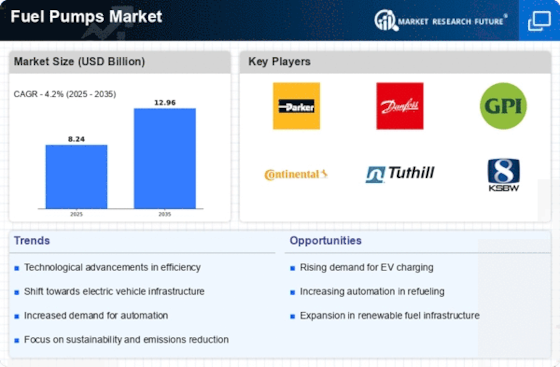
As per MRFR analysis, the Fuel Pumps Market Size was estimated at 8.242 USD Billion in 2024. The Fuel Pumps industry is projected to grow from 8.589 USD Billion in 2025 to 12.96 USD Billion by 2035, exhibiting a compound annual growth rate (CAGR) of 4.2 during the forecast period 2025 - 2035.

Key Market Trends & Highlights

The Fuel Pumps Market is experiencing a dynamic shift driven by technological advancements and sustainability initiatives.

  • North America remains the largest market for fuel pumps, driven by robust automotive demand and infrastructure. Asia-Pacific is the fastest-growing region, reflecting increasing investments in fuel efficiency and electric vehicle integration. The electric fuel pump segment dominates the market, while mechanical fuel pumps are witnessing rapid growth due to evolving automotive technologies. Key market drivers include rising demand for fuel efficiency and the expansion of fuel infrastructure, which are shaping industry dynamics.

Market Size & Forecast

2024 Market Size 8.242 (USD Billion)
2035 Market Size 12.96 (USD Billion)
CAGR (2025 - 2035) 4.2%
Largest Regional Market Share in 2024 North America

Major Players

<p>Parker Hannifin (US), Danfoss (DK), GPI (US), Continental (DE), Tuthill Corporation (US), KSB (DE), Cim-Tek Filtration (US), Ametek (US), Husky Corporation (US)</p>

Market Trends

The Fuel Pumps Market is currently experiencing a dynamic evolution, driven by various factors that influence both demand and supply. The increasing focus on energy efficiency and environmental sustainability appears to be reshaping consumer preferences, leading to a growing inclination towards advanced fuel pump technologies. Additionally, the rise in electric vehicles may be altering traditional fuel distribution channels, prompting manufacturers to innovate and adapt their offerings. This shift suggests a potential transformation in the market landscape, as stakeholders seek to align with emerging trends and regulatory frameworks. Moreover, the Fuel Pumps Market is likely to witness heightened competition as new entrants emerge alongside established players. This competitive environment may foster innovation, resulting in the development of more efficient and reliable fuel pumps. Furthermore, the integration of smart technologies into fuel pump systems could enhance operational efficiency and user experience. As the market continues to evolve, it is essential for industry participants to remain vigilant and responsive to changing consumer demands and technological advancements, ensuring they maintain a competitive edge in this rapidly changing sector.

Technological Advancements

The Fuel Pumps Market is increasingly influenced by technological innovations that enhance performance and efficiency. Manufacturers are investing in research and development to create advanced fuel pump systems that offer improved reliability and reduced energy consumption. This trend indicates a shift towards more sophisticated solutions that cater to the evolving needs of consumers and businesses alike.

Sustainability Initiatives

There is a growing emphasis on sustainability within the Fuel Pumps Market, as stakeholders seek to minimize environmental impact. This trend is characterized by the adoption of eco-friendly materials and practices in the production of fuel pumps. Companies are likely to prioritize sustainable solutions, aligning their operations with global environmental goals.

Electric Vehicle Integration

The rise of electric vehicles is reshaping the Fuel Pumps Market, prompting a reevaluation of traditional fuel distribution methods. As electric vehicle adoption increases, manufacturers may explore new opportunities in developing charging infrastructure and hybrid fuel systems. This trend suggests a potential shift in market dynamics, as the industry adapts to the changing landscape of transportation.

Fuel Pumps Market Market Drivers

Growth of the Automotive Sector

The growth of the automotive sector is a crucial driver for the Fuel Pumps Market. As vehicle production and sales continue to rise, the demand for fuel pumps is expected to follow suit. Recent data indicates that the automotive industry is experiencing a resurgence, with increased consumer spending and a shift towards more fuel-efficient vehicles. This growth is not only limited to traditional internal combustion engine vehicles but also extends to hybrid and electric vehicles, which require specialized fuel pump systems. Consequently, the Fuel Pumps Market is poised for expansion as manufacturers adapt to the evolving landscape of the automotive sector, ensuring that they meet the diverse requirements of modern vehicles.

Expansion of Fuel Infrastructure

The expansion of fuel infrastructure is a significant driver for the Fuel Pumps Market. As urbanization continues to accelerate, the need for more fuel stations and distribution networks becomes increasingly apparent. This expansion is not limited to traditional fuel sources; it also encompasses alternative fuels, which require specialized fuel pumps. Recent statistics indicate that the number of fuel stations has increased steadily, with a notable rise in stations offering alternative fuels. This trend suggests a robust growth trajectory for the Fuel Pumps Market, as new installations and upgrades to existing infrastructure necessitate the adoption of advanced fuel pump technologies to meet diverse consumer needs.

Rising Demand for Fuel Efficiency

The increasing emphasis on fuel efficiency is a primary driver for the Fuel Pumps Market. As consumers and businesses seek to reduce fuel costs, the demand for advanced fuel pumps that optimize fuel delivery and minimize wastage is on the rise. This trend is particularly evident in the automotive sector, where manufacturers are integrating more efficient fuel pump technologies into their vehicles. According to recent data, the fuel efficiency of vehicles has improved significantly over the past decade, leading to a corresponding increase in the demand for high-performance fuel pumps. This shift not only enhances vehicle performance but also aligns with broader environmental goals, making it a crucial factor in the growth of the Fuel Pumps Market.

Regulatory Compliance and Standards

Regulatory compliance and standards play a pivotal role in shaping the Fuel Pumps Market. Governments worldwide are implementing stringent regulations aimed at reducing emissions and enhancing fuel quality. These regulations often require the adoption of advanced fuel pump technologies that can meet new performance and environmental standards. For instance, the introduction of stricter emissions standards has led to an increased demand for fuel pumps that can effectively manage fuel delivery while minimizing environmental impact. This regulatory landscape not only drives innovation within the Fuel Pumps Market but also compels manufacturers to invest in research and development to ensure compliance with evolving standards.

Technological Innovations in Fuel Pump Design

Technological innovations in fuel pump design are transforming the Fuel Pumps Market. The advent of smart fuel pumps equipped with advanced sensors and connectivity features is enhancing operational efficiency and user experience. These innovations allow for real-time monitoring of fuel levels and performance, enabling proactive maintenance and reducing downtime. Furthermore, the integration of digital technologies is facilitating the development of fuel pumps that can adapt to various fuel types, including biofuels and alternative energy sources. As these technologies continue to evolve, they are likely to drive significant growth in the Fuel Pumps Market, catering to the diverse needs of consumers and businesses alike.

Market Segment Insights

By Technology: Electric (Largest) vs. Mechanical (Fastest-Growing)

<p>In the Fuel Pumps Market, the distribution of market share between Electric and Mechanical technologies reveals a significant trend. Electric fuel pumps dominate the market due to their efficiency and performance benefits, making up a large portion of the overall sales. Meanwhile, Mechanical fuel pumps are gaining traction, leading the way as the fastest-growing segment. Their reliability and simplicity give them an edge in certain applications, prompting increased demand.</p>

<p>Technology: Electric (Dominant) vs. Mechanical (Emerging)</p>

<p>Electric fuel pumps are recognized as the dominant technology in the Fuel Pumps Market owing to their advancements in design and efficiency. They provide quick fuel delivery and are tailored for modern vehicles, which often demand higher performance levels. Conversely, Mechanical fuel pumps, while considered less sophisticated, are experiencing a resurgence due to their robust nature and lower cost of production. This emerging segment appeals to various industrial applications where cost-efficiency and simplicity are paramount, creating a unique competitive landscape where both technologies can thrive.</p>

By Application: Passenger Cars (Largest) vs. Heavy Commercial Vehicles (Fastest-Growing)

<p>In the Fuel Pumps Market, the application segment is predominantly led by passenger cars, which account for the largest share. This dominance is attributed to the high volume of passenger vehicle sales and the steady growth in urbanization, resulting in an increased demand for personal transportation. Conversely, <a href="https://www.marketresearchfuture.com/reports/heavy-commercial-vehicle-tpm-market-35409">heavy commercial vehicles </a>are rapidly gaining traction, driven by the growing shipping and logistics sector, which relies on these vehicles for transport. Their share in the market has been increasing steadily as e-commerce and freight demand continue to rise.</p>

<p>Passenger Cars (Dominant) vs. Heavy Commercial Vehicles (Emerging)</p>

<p>Passenger cars remain the dominant application in the Fuel Pumps Market due to their vast presence and the continuous need for fuel efficiency in personal vehicles. Innovations in fuel pump technology enhance performance and reduce emissions, making them attractive for consumers who prioritize sustainability. On the other hand, heavy commercial vehicles are emerging as a crucial segment, propelled by the rise of e-commerce and global trade. These vehicles necessitate more robust fuel pumps capable of handling higher capacities and pressures, indicating potential for growth and investment in advanced fuel delivery systems. The interplay between regulatory standards and industry demands further shapes the characteristics of both segments.</p>

Get more detailed insights about Fuel Pumps Market Research Report – Forecast till 2035

Regional Insights

North America : Market Leader in Fuel Pumps Market

North America is the largest market for fuel pumps, accounting for approximately 40% of the global share. The region's growth is driven by increasing demand for fuel-efficient vehicles, stringent environmental regulations, and advancements in fuel pump technology. The U.S. leads the market, followed by Canada, as both countries invest heavily in infrastructure and innovation to meet rising energy demands. The competitive landscape in North America is robust, featuring key players such as Parker Hannifin, GPI, and Tuthill Corporation. These companies are focusing on technological advancements and strategic partnerships to enhance their market presence. The region's regulatory framework supports innovation, ensuring that manufacturers comply with environmental standards while meeting consumer needs.

Europe : Innovative Solutions and Sustainability

Europe is witnessing significant growth in the fuel pumps market, holding approximately 30% of the global share. The region's demand is driven by the transition towards sustainable energy solutions and the increasing adoption of electric vehicles. Countries like Germany and France are at the forefront, implementing regulations that promote energy efficiency and reduce carbon emissions, thus catalyzing market growth. The competitive landscape in Europe is characterized by the presence of major players such as Danfoss and Continental. These companies are investing in research and development to innovate fuel pump technologies that align with the EU's sustainability goals. The market is also supported by various government initiatives aimed at enhancing fuel efficiency and reducing environmental impact, fostering a conducive environment for growth.

Asia-Pacific : Emerging Markets and Rapid Growth

Asia-Pacific is rapidly emerging as a significant player in the fuel pumps market, accounting for around 25% of the global share. The region's growth is fueled by increasing vehicle production, urbanization, and rising disposable incomes. Countries like China and India are leading the charge, with government initiatives aimed at enhancing transportation infrastructure and promoting fuel efficiency, driving demand for advanced fuel pump solutions. The competitive landscape in Asia-Pacific is diverse, with both local and international players vying for market share. Key companies such as KSB and Ametek are expanding their operations in the region, focusing on innovation and cost-effective solutions. The presence of a large consumer base and growing automotive industry further enhances the market potential, making it a hotspot for investment and development in fuel pump technologies.

Middle East and Africa : Resource-Rich and Growing Demand

The Middle East and Africa region is witnessing a growing demand for fuel pumps, holding approximately 5% of the global market share. The growth is primarily driven by the increasing oil and gas exploration activities and the rising automotive sector in countries like Saudi Arabia and South Africa. Government investments in infrastructure and energy projects are also acting as catalysts for market expansion. The competitive landscape in the Middle East and Africa is evolving, with both regional and international players establishing a presence. Companies are focusing on adapting their products to meet local needs and regulatory requirements. The region's unique market dynamics, characterized by a mix of traditional and modern fuel pump technologies, present opportunities for innovation and growth in the fuel pumps sector.

Key Players and Competitive Insights

The Fuel Pumps Market is currently characterized by a dynamic competitive landscape, driven by technological advancements and increasing demand for efficient fuel delivery systems. Key players such as Parker Hannifin (US), Danfoss (DK), and GPI (US) are strategically positioning themselves through innovation and regional expansion. Parker Hannifin (US) focuses on enhancing its product offerings with advanced materials and smart technologies, while Danfoss (DK) emphasizes sustainability in its operations, aiming to reduce carbon footprints across its product lines. GPI (US) is leveraging partnerships to enhance its distribution networks, thereby increasing its market reach. Collectively, these strategies contribute to a competitive environment that is increasingly focused on technological differentiation and sustainability.

In terms of business tactics, companies are localizing manufacturing to reduce costs and optimize supply chains, which appears to be a response to fluctuating global trade dynamics. The market structure is moderately fragmented, with several players vying for market share, yet the influence of major companies is palpable. This fragmentation allows for niche players to emerge, but the collective strength of key players like Continental (DE) and Tuthill Corporation (US) shapes market trends significantly.

In August 2025, Continental (DE) announced a strategic partnership with a leading electric vehicle manufacturer to develop integrated fuel pump solutions tailored for hybrid systems. This move is indicative of Continental's commitment to innovation and its recognition of the growing hybrid vehicle market. By aligning with a prominent player in the electric vehicle sector, Continental not only diversifies its product portfolio but also positions itself at the forefront of the transition towards more sustainable fuel solutions.

In September 2025, Tuthill Corporation (US) launched a new line of fuel pumps designed specifically for biofuels, reflecting a growing trend towards renewable energy sources. This initiative underscores Tuthill's strategic focus on sustainability and its adaptability to changing market demands. By investing in biofuel technology, Tuthill is likely to capture a segment of the market that is increasingly prioritizing environmentally friendly solutions, thereby enhancing its competitive edge.

In October 2025, GPI (US) expanded its manufacturing capabilities by opening a new facility in Mexico, aimed at increasing production efficiency and reducing lead times. This expansion is a strategic response to the rising demand for fuel pumps in North America and demonstrates GPI's commitment to optimizing its supply chain. By localizing production, GPI not only enhances its operational efficiency but also positions itself to better serve its customers in the region, potentially leading to increased market share.

As of October 2025, the Fuel Pumps Market is witnessing trends such as digitalization and AI integration, which are reshaping competitive dynamics. Companies are increasingly forming strategic alliances to leverage technological advancements and enhance product offerings. The shift from price-based competition to a focus on innovation and supply chain reliability is becoming evident, suggesting that future competitive differentiation will hinge on the ability to adapt to technological changes and meet evolving consumer demands.

Key Companies in the Fuel Pumps Market market include

Industry Developments

November 2019: Delphi Technologies unveiled a revamped fuel pump module and disclosed a significant expansion of its product line.

Future Outlook

Fuel Pumps Market Future Outlook

<p>The Fuel Pumps Market is projected to grow at a 4.2% CAGR from 2024 to 2035, driven by technological advancements, increasing fuel demand, and environmental regulations.</p>

New opportunities lie in:

  • <p>Expansion of electric vehicle charging stations</p><p>Integration of IoT for predictive maintenance</p><p>Development of biofuel-compatible pump systems</p>

<p>By 2035, the market is expected to achieve robust growth, adapting to evolving energy needs.</p>

Market Segmentation

Fuel Pumps Market Technology Outlook

  • Mechanical
  • Electric

Fuel Pumps Market Application Outlook

  • Passenger Cars
  • Light Commercial Vehicles
  • Heavy Commercial Vehicles
  • Off High-Way Vehicles

Report Scope

MARKET SIZE 20248.242(USD Billion)
MARKET SIZE 20258.589(USD Billion)
MARKET SIZE 203512.96(USD Billion)
COMPOUND ANNUAL GROWTH RATE (CAGR)4.2% (2024 - 2035)
REPORT COVERAGERevenue Forecast, Competitive Landscape, Growth Factors, and Trends
BASE YEAR2024
Market Forecast Period2025 - 2035
Historical Data2019 - 2024
Market Forecast UnitsUSD Billion
Key Companies ProfiledMarket analysis in progress
Segments CoveredMarket segmentation analysis in progress
Key Market OpportunitiesIntegration of advanced digital technologies enhances efficiency in the Fuel Pumps Market.
Key Market DynamicsTechnological advancements in fuel pump efficiency drive competitive dynamics and influence consumer preferences in the market.
Countries CoveredNorth America, Europe, APAC, South America, MEA

FAQs

What is the current valuation of the Fuel Pumps Market as of 2024?

The Fuel Pumps Market was valued at 8.242 USD Billion in 2024.

What is the projected market size for the Fuel Pumps Market in 2035?

The market is projected to reach 12.96 USD Billion by 2035.

What is the expected CAGR for the Fuel Pumps Market during the forecast period 2025 - 2035?

The expected CAGR for the Fuel Pumps Market during 2025 - 2035 is 4.2%.

Which technology segments are included in the Fuel Pumps Market?

The Fuel Pumps Market includes Mechanical and Electric technology segments, valued at 5.5 USD Billion and 7.46 USD Billion respectively by 2035.

What are the key applications of fuel pumps in the market?

Key applications include Passenger Cars, Light Commercial Vehicles, Heavy Commercial Vehicles, and Off High-Way Vehicles, with projected values of 5.5 USD Billion, 3.0 USD Billion, 2.5 USD Billion, and 1.96 USD Billion respectively by 2035.

Who are the leading players in the Fuel Pumps Market?

Key players in the Fuel Pumps Market include Parker Hannifin, Danfoss, GPI, Continental, Tuthill Corporation, KSB, Cim-Tek Filtration, Ametek, and Husky Corporation.

  1. SECTION I: EXECUTIVE SUMMARY AND KEY HIGHLIGHTS
    1. EXECUTIVE SUMMARY
      1. Market Overview
      2. Key Findings
      3. Market Segmentation
      4. Competitive Landscape
      5. Challenges and Opportunities
      6. Future Outlook 2 SECTION II: SCOPING, METHODOLOGY AND MARKET STRUCTURE
    2. MARKET INTRODUCTION
      1. Definition
      2. Scope of the study
    3. RESEARCH METHODOLOGY
      1. Overview
      2. Data Mining
      3. Secondary Research
      4. Primary Research
      5. Forecasting Model
      6. Market Size Estimation
      7. Data Triangulation
      8. Validation 3 SECTION III: QUALITATIVE ANALYSIS
    4. MARKET DYNAMICS
      1. Overview
      2. Drivers
      3. Restraints
      4. Opportunities
    5. MARKET FACTOR ANALYSIS
      1. Value chain Analysis
      2. Porter's Five Forces Analysis
      3. COVID-19 Impact Analysis
    6. Automobile, BY Technology (USD Billion)
      1. Mechanical
      2. Electric
    7. Automobile, BY Application (USD Billion)
      1. Passenger Cars
      2. Light Commercial Vehicles
      3. Heavy Commercial Vehicles
      4. Off High-Way Vehicles
    8. Automobile, BY Region (USD Billion)
      1. North America
      2. Europe
      3. APAC
      4. South America
      5. MEA
    9. Competitive Landscape
      1. Overview
      2. Competitive Analysis
      3. Market share Analysis
      4. Major Growth Strategy in the Automobile
      5. Competitive Benchmarking
      6. Leading Players in Terms of Number of Developments in the Automobile
      7. Key developments and growth strategies
      8. Major Players Financial Matrix
    10. Company Profiles
      1. Parker Hannifin (US)
      2. Danfoss (DK)
      3. GPI (US)
      4. Continental (DE)
      5. Tuthill Corporation (US)
      6. KSB (DE)
      7. Cim-Tek Filtration (US)
      8. Ametek (US)
      9. Husky Corporation (US)
    11. Appendix
      1. References
      2. Related Reports 6 LIST OF FIGURES
    12. MARKET SYNOPSIS
    13. NORTH AMERICA MARKET ANALYSIS
    14. US MARKET ANALYSIS BY TECHNOLOGY
    15. US MARKET ANALYSIS BY APPLICATION
    16. CANADA MARKET ANALYSIS BY TECHNOLOGY
    17. CANADA MARKET ANALYSIS BY APPLICATION
    18. EUROPE MARKET ANALYSIS
    19. GERMANY MARKET ANALYSIS BY TECHNOLOGY
    20. GERMANY MARKET ANALYSIS BY APPLICATION
    21. UK MARKET ANALYSIS BY TECHNOLOGY
    22. UK MARKET ANALYSIS BY APPLICATION
    23. FRANCE MARKET ANALYSIS BY TECHNOLOGY
    24. FRANCE MARKET ANALYSIS BY APPLICATION
    25. RUSSIA MARKET ANALYSIS BY TECHNOLOGY
    26. RUSSIA MARKET ANALYSIS BY APPLICATION
    27. ITALY MARKET ANALYSIS BY TECHNOLOGY
    28. ITALY MARKET ANALYSIS BY APPLICATION
    29. SPAIN MARKET ANALYSIS BY TECHNOLOGY
    30. SPAIN MARKET ANALYSIS BY APPLICATION
    31. REST OF EUROPE MARKET ANALYSIS BY TECHNOLOGY
    32. REST OF EUROPE MARKET ANALYSIS BY APPLICATION
    33. APAC MARKET ANALYSIS
    34. CHINA MARKET ANALYSIS BY TECHNOLOGY
    35. CHINA MARKET ANALYSIS BY APPLICATION
    36. INDIA MARKET ANALYSIS BY TECHNOLOGY
    37. INDIA MARKET ANALYSIS BY APPLICATION
    38. JAPAN MARKET ANALYSIS BY TECHNOLOGY
    39. JAPAN MARKET ANALYSIS BY APPLICATION
    40. SOUTH KOREA MARKET ANALYSIS BY TECHNOLOGY
    41. SOUTH KOREA MARKET ANALYSIS BY APPLICATION
    42. MALAYSIA MARKET ANALYSIS BY TECHNOLOGY
    43. MALAYSIA MARKET ANALYSIS BY APPLICATION
    44. THAILAND MARKET ANALYSIS BY TECHNOLOGY
    45. THAILAND MARKET ANALYSIS BY APPLICATION
    46. INDONESIA MARKET ANALYSIS BY TECHNOLOGY
    47. INDONESIA MARKET ANALYSIS BY APPLICATION
    48. REST OF APAC MARKET ANALYSIS BY TECHNOLOGY
    49. REST OF APAC MARKET ANALYSIS BY APPLICATION
    50. SOUTH AMERICA MARKET ANALYSIS
    51. BRAZIL MARKET ANALYSIS BY TECHNOLOGY
    52. BRAZIL MARKET ANALYSIS BY APPLICATION
    53. MEXICO MARKET ANALYSIS BY TECHNOLOGY
    54. MEXICO MARKET ANALYSIS BY APPLICATION
    55. ARGENTINA MARKET ANALYSIS BY TECHNOLOGY
    56. ARGENTINA MARKET ANALYSIS BY APPLICATION
    57. REST OF SOUTH AMERICA MARKET ANALYSIS BY TECHNOLOGY
    58. REST OF SOUTH AMERICA MARKET ANALYSIS BY APPLICATION
    59. MEA MARKET ANALYSIS
    60. GCC COUNTRIES MARKET ANALYSIS BY TECHNOLOGY
    61. GCC COUNTRIES MARKET ANALYSIS BY APPLICATION
    62. SOUTH AFRICA MARKET ANALYSIS BY TECHNOLOGY
    63. SOUTH AFRICA MARKET ANALYSIS BY APPLICATION
    64. REST OF MEA MARKET ANALYSIS BY TECHNOLOGY
    65. REST OF MEA MARKET ANALYSIS BY APPLICATION
    66. KEY BUYING CRITERIA OF AUTOMOBILE
    67. RESEARCH PROCESS OF MRFR
    68. DRO ANALYSIS OF AUTOMOBILE
    69. DRIVERS IMPACT ANALYSIS: AUTOMOBILE
    70. RESTRAINTS IMPACT ANALYSIS: AUTOMOBILE
    71. SUPPLY / VALUE CHAIN: AUTOMOBILE
    72. AUTOMOBILE, BY TECHNOLOGY, 2024 (% SHARE)
    73. AUTOMOBILE, BY TECHNOLOGY, 2024 TO 2035 (USD Billion)
    74. AUTOMOBILE, BY APPLICATION, 2024 (% SHARE)
    75. AUTOMOBILE, BY APPLICATION, 2024 TO 2035 (USD Billion)
    76. BENCHMARKING OF MAJOR COMPETITORS 7 LIST OF TABLES
    77. LIST OF ASSUMPTIONS
    78. North America MARKET SIZE ESTIMATES; FORECAST
      1. BY TECHNOLOGY, 2025-2035 (USD Billion)
      2. BY APPLICATION, 2025-2035 (USD Billion)
    79. US MARKET SIZE ESTIMATES; FORECAST
      1. BY TECHNOLOGY, 2025-2035 (USD Billion)
      2. BY APPLICATION, 2025-2035 (USD Billion)
    80. Canada MARKET SIZE ESTIMATES; FORECAST
      1. BY TECHNOLOGY, 2025-2035 (USD Billion)
      2. BY APPLICATION, 2025-2035 (USD Billion)
    81. Europe MARKET SIZE ESTIMATES; FORECAST
      1. BY TECHNOLOGY, 2025-2035 (USD Billion)
      2. BY APPLICATION, 2025-2035 (USD Billion)
    82. Germany MARKET SIZE ESTIMATES; FORECAST
      1. BY TECHNOLOGY, 2025-2035 (USD Billion)
      2. BY APPLICATION, 2025-2035 (USD Billion)
    83. UK MARKET SIZE ESTIMATES; FORECAST
      1. BY TECHNOLOGY, 2025-2035 (USD Billion)
      2. BY APPLICATION, 2025-2035 (USD Billion)
    84. France MARKET SIZE ESTIMATES; FORECAST
      1. BY TECHNOLOGY, 2025-2035 (USD Billion)
      2. BY APPLICATION, 2025-2035 (USD Billion)
    85. Russia MARKET SIZE ESTIMATES; FORECAST
      1. BY TECHNOLOGY, 2025-2035 (USD Billion)
      2. BY APPLICATION, 2025-2035 (USD Billion)
    86. Italy MARKET SIZE ESTIMATES; FORECAST
      1. BY TECHNOLOGY, 2025-2035 (USD Billion)
      2. BY APPLICATION, 2025-2035 (USD Billion)
    87. Spain MARKET SIZE ESTIMATES; FORECAST
      1. BY TECHNOLOGY, 2025-2035 (USD Billion)
      2. BY APPLICATION, 2025-2035 (USD Billion)
    88. Rest of Europe MARKET SIZE ESTIMATES; FORECAST
      1. BY TECHNOLOGY, 2025-2035 (USD Billion)
      2. BY APPLICATION, 2025-2035 (USD Billion)
    89. APAC MARKET SIZE ESTIMATES; FORECAST
      1. BY TECHNOLOGY, 2025-2035 (USD Billion)
      2. BY APPLICATION, 2025-2035 (USD Billion)
    90. China MARKET SIZE ESTIMATES; FORECAST
      1. BY TECHNOLOGY, 2025-2035 (USD Billion)
      2. BY APPLICATION, 2025-2035 (USD Billion)
    91. India MARKET SIZE ESTIMATES; FORECAST
      1. BY TECHNOLOGY, 2025-2035 (USD Billion)
      2. BY APPLICATION, 2025-2035 (USD Billion)
    92. Japan MARKET SIZE ESTIMATES; FORECAST
      1. BY TECHNOLOGY, 2025-2035 (USD Billion)
      2. BY APPLICATION, 2025-2035 (USD Billion)
    93. South Korea MARKET SIZE ESTIMATES; FORECAST
      1. BY TECHNOLOGY, 2025-2035 (USD Billion)
      2. BY APPLICATION, 2025-2035 (USD Billion)
    94. Malaysia MARKET SIZE ESTIMATES; FORECAST
      1. BY TECHNOLOGY, 2025-2035 (USD Billion)
      2. BY APPLICATION, 2025-2035 (USD Billion)
    95. Thailand MARKET SIZE ESTIMATES; FORECAST
      1. BY TECHNOLOGY, 2025-2035 (USD Billion)
      2. BY APPLICATION, 2025-2035 (USD Billion)
    96. Indonesia MARKET SIZE ESTIMATES; FORECAST
      1. BY TECHNOLOGY, 2025-2035 (USD Billion)
      2. BY APPLICATION, 2025-2035 (USD Billion)
    97. Rest of APAC MARKET SIZE ESTIMATES; FORECAST
      1. BY TECHNOLOGY, 2025-2035 (USD Billion)
      2. BY APPLICATION, 2025-2035 (USD Billion)
    98. South America MARKET SIZE ESTIMATES; FORECAST
      1. BY TECHNOLOGY, 2025-2035 (USD Billion)
      2. BY APPLICATION, 2025-2035 (USD Billion)
    99. Brazil MARKET SIZE ESTIMATES; FORECAST
      1. BY TECHNOLOGY, 2025-2035 (USD Billion)
      2. BY APPLICATION, 2025-2035 (USD Billion)
    100. Mexico MARKET SIZE ESTIMATES; FORECAST
      1. BY TECHNOLOGY, 2025-2035 (USD Billion)
      2. BY APPLICATION, 2025-2035 (USD Billion)
    101. Argentina MARKET SIZE ESTIMATES; FORECAST
      1. BY TECHNOLOGY, 2025-2035 (USD Billion)
      2. BY APPLICATION, 2025-2035 (USD Billion)
    102. Rest of South America MARKET SIZE ESTIMATES; FORECAST
      1. BY TECHNOLOGY, 2025-2035 (USD Billion)
      2. BY APPLICATION, 2025-2035 (USD Billion)
    103. MEA MARKET SIZE ESTIMATES; FORECAST
      1. BY TECHNOLOGY, 2025-2035 (USD Billion)
      2. BY APPLICATION, 2025-2035 (USD Billion)
    104. GCC Countries MARKET SIZE ESTIMATES; FORECAST
      1. BY TECHNOLOGY, 2025-2035 (USD Billion)
      2. BY APPLICATION, 2025-2035 (USD Billion)
    105. South Africa MARKET SIZE ESTIMATES; FORECAST
      1. BY TECHNOLOGY, 2025-2035 (USD Billion)
      2. BY APPLICATION, 2025-2035 (USD Billion)
    106. Rest of MEA MARKET SIZE ESTIMATES; FORECAST
      1. BY TECHNOLOGY, 2025-2035 (USD Billion)
      2. BY APPLICATION, 2025-2035 (USD Billion)
    107. PRODUCT LAUNCH/PRODUCT DEVELOPMENT/APPROVAL
    108. ACQUISITION/PARTNERSHIP

Market Segmentation

Fuel Pumps Market Technology Outlook (USD Billion, 2018-2032)

Mechanical

Electric

Fuel Pumps Market Application Outlook (USD Billion, 2018-2032)

Passenger Cars

Light Commercial Vehicles

Heavy Commercial Vehicles

Off High-Way Vehicles

Fuel Pumps Market Regional Outlook (USD Billion, 2018-2032)

North America Outlook (USD Billion, 2018-2032)

Fuel Pumps Market by Technology

Mechanical

Electric

Fuel Pumps Market by Application

Passenger Cars

Light Commercial Vehicles

Heavy Commercial Vehicles

Off High-Way Vehicles

US Outlook (USD Billion, 2018-2032)

Fuel Pumps Market by Technology

Mechanical

Electric

Fuel Pumps Market by Application

Passenger Cars

Light Commercial Vehicles

Heavy Commercial Vehicles

Off High-Way Vehicles

Canada Outlook (USD Billion, 2018-2032)

Fuel Pumps Market by Technology

Mechanical

Electric

Fuel Pumps Market by Application

Passenger Cars

Light Commercial Vehicles

Heavy Commercial Vehicles

Off High-Way Vehicles

Europe Outlook (USD Billion, 2018-2032)

Fuel Pumps Market by Technology

Mechanical

Electric

Fuel Pumps Market by Application

Passenger Cars

Light Commercial Vehicles

Heavy Commercial Vehicles

Off High-Way Vehicles

Germany Outlook (USD Billion, 2018-2032)

Fuel Pumps Market by Technology

Mechanical

Electric

Fuel Pumps Market by Application

Passenger Cars

Light Commercial Vehicles

Heavy Commercial Vehicles

Off High-Way Vehicles

France Outlook (USD Billion, 2018-2032)

Fuel Pumps Market by Technology

Mechanical

Electric

Fuel Pumps Market by Application

Passenger Cars

Light Commercial Vehicles

Heavy Commercial Vehicles

Off High-Way Vehicles

UK Outlook (USD Billion, 2018-2032)

Fuel Pumps Market by Technology

Mechanical

Electric

Fuel Pumps Market by Application

Passenger Cars

Light Commercial Vehicles

Heavy Commercial Vehicles

Off High-Way Vehicles

Italy Outlook (USD Billion, 2018-2032)

Fuel Pumps Market by Technology

Mechanical

Electric

Fuel Pumps Market by Application

Passenger Cars

Light Commercial Vehicles

Heavy Commercial Vehicles

Off High-Way Vehicles

Spain Outlook (USD Billion, 2018-2032)

Fuel Pumps Market by Technology

Mechanical

Electric

Fuel Pumps Market by Application

Passenger Cars

Light Commercial Vehicles

Heavy Commercial Vehicles

Off High-Way Vehicles

Rest Of Europe Outlook (USD Billion, 2018-2032)

Fuel Pumps Market by Technology

Mechanical

Electric

Fuel Pumps Market by Application

Passenger Cars

Light Commercial Vehicles

Heavy Commercial Vehicles

Off High-Way Vehicles

Asia-Pacific Outlook (USD Billion, 2018-2032)

Fuel Pumps Market by Technology

Mechanical

Electric

Fuel Pumps Market by Application

Passenger Cars

Light Commercial Vehicles

Heavy Commercial Vehicles

Off High-Way Vehicles

China Outlook (USD Billion, 2018-2032)

Fuel Pumps Market by Technology

Mechanical

Electric

Fuel Pumps Market by Application

Passenger Cars

Light Commercial Vehicles

Heavy Commercial Vehicles

Off High-Way Vehicles

Japan Outlook (USD Billion, 2018-2032)

Fuel Pumps Market by Technology

Mechanical

Electric

Fuel Pumps Market by Application

Passenger Cars

Light Commercial Vehicles

Heavy Commercial Vehicles

Off High-Way Vehicles

India Outlook (USD Billion, 2018-2032)

Fuel Pumps Market by Technology

Mechanical

Electric

Fuel Pumps Market by Application

Passenger Cars

Light Commercial Vehicles

Heavy Commercial Vehicles

Off High-Way Vehicles

Australia Outlook (USD Billion, 2018-2032)

Fuel Pumps Market by Technology

Mechanical

Electric

Fuel Pumps Market by Application

Passenger Cars

Light Commercial Vehicles

Heavy Commercial Vehicles

Off High-Way Vehicles

Rest of Asia-Pacific Outlook (USD Billion, 2018-2032)

Fuel Pumps Market by Technology

Mechanical

Electric

Fuel Pumps Market by Application

Passenger Cars

Light Commercial Vehicles

Heavy Commercial Vehicles

Off High-Way Vehicles

Rest of the World Outlook (USD Billion, 2018-2032)

Fuel Pumps Market by Technology

Mechanical

Electric

Fuel Pumps Market by Application

Passenger Cars

Light Commercial Vehicles

Heavy Commercial Vehicles

Off High-Way Vehicles

Middle East Outlook (USD Billion, 2018-2032)

Fuel Pumps Market by Technology

Mechanical

Electric

Fuel Pumps Market by Application

Passenger Cars

Light Commercial Vehicles

Heavy Commercial Vehicles

Off High-Way Vehicles

Africa Outlook (USD Billion, 2018-2032)

Fuel Pumps Market by Technology

Mechanical

Electric

Fuel Pumps Market by Application

Passenger Cars

Light Commercial Vehicles

Heavy Commercial Vehicles

Off High-Way Vehicles

Latin America Outlook (USD Billion, 2018-2032)

Fuel Pumps Market by Technology

Mechanical

Electric

Fuel Pumps Market by Application

Passenger Cars

Light Commercial Vehicles

Heavy Commercial Vehicles

Off High-Way Vehicles

Infographic

Free Sample Request

Kindly complete the form below to receive a free sample of this Report

Get Free Sample

Customer Strories

Compare Licence

×
Features License Type
Single User Multiuser License Enterprise User
Price $4,950 $5,950 $7,250
Maximum User Access Limit 1 User Upto 10 Users Unrestricted Access Throughout the Organization
Free Customization
Direct Access to Analyst
Deliverable Format
Platform Access
Discount on Next Purchase 10% 15% 15%
Printable Versions