×
Hero Background
English
Chinese
French
Japanese
Korean
German
Spanish

Fructose Market Share

ID: MRFR/FnB/10198-CR
128 Pages
Snehal Singh
August 2023

Fructose Market Research Report Information By Source (Sugarcane, Sugar Beet, Corn, and Others), By Product (High Fructose Corn Syrup, Fructose Syrup, and Fructose Solid), Form (Powder, and, Liquid), By Application (Food & Beverages, Pharmaceutical, Cosmetic & Personal Care, and Others), By Distribution Channel (Online and Offline), And By Region (North America, Europe, Asia-Pacific, And Rest Of The World) - Forecast Till 2035

Share:
Download PDF ×

We do not share your information with anyone. However, we may send you emails based on your report interest from time to time. You may contact us at any time to opt-out.

Fructose Market Infographic
Purchase Options

Market Share

Fructose Market Share Analysis

The Fructose market, a significant segment within the sweeteners industry, has experienced notable growth, leading companies to employ various market share positioning strategies to establish a competitive edge.

One primary strategy in the Fructose market is product differentiation. Companies aim to distinguish their fructose offerings by focusing on specific attributes such as purity levels, crystal size, or sourcing methods. By providing unique features, these companies seek to appeal to diverse customer preferences and requirements, ultimately capturing a larger market share. Differentiated products can find favor among various industries, from food and beverages to pharmaceuticals, where specific fructose characteristics are crucial.

Pricing strategies play a pivotal role in market share positioning within the Fructose market. Some companies position their products as premium offerings, emphasizing high-quality sourcing or advanced processing methods. This premium positioning targets industries that prioritize premium ingredients for their products. Conversely, other companies adopt a more cost-effective pricing strategy to attract a wider range of customers, especially in industries where cost considerations heavily influence purchasing decisions.

Brand image and marketing are fundamental components of market share positioning. Establishing a strong and reliable brand image is essential for gaining the trust of customers and industries that rely on fructose. Companies invest in marketing campaigns that emphasize the quality, reliability, and versatility of their fructose products. Positive brand associations not only attract existing customers but also contribute to market share growth as the brand becomes synonymous with excellence in the eyes of consumers.

Distribution channels are another critical aspect of market share positioning. Companies strategically select distribution partners and channels to ensure their fructose products are readily available to a broad customer base. Collaborations with distributors, wholesalers, and retailers help optimize product accessibility. An effective online presence, including e-commerce platforms, further enhances market reach, particularly in the digital age where online purchasing is prevalent.

Innovation is a driving force in the Fructose market. Companies invest in research and development to explore new applications for fructose or to enhance existing processes. This innovation not only enables companies to stay ahead of the competition but also opens opportunities for diversification. For example, the development of fructose-based ingredients for healthier food and beverage options can contribute to market share growth by aligning with evolving consumer trends.

Collaborations and partnerships are increasingly common in the Fructose market. By forming alliances with other companies in the food and beverage industry, healthcare, or research and development, fructose producers can expand their market reach. Collaborative initiatives may involve joint ventures, co-branding efforts, or strategic partnerships that leverage the strengths of multiple companies to collectively gain a larger share of the market.


Author
Snehal Singh
Assistant Manager - Research

High acumen in analyzing complex macro & micro markets with more than 6 years of work experience in the field of market research. By implementing her analytical skills in forecasting and estimation into market research reports, she has expertise in Packaging, Construction, and Equipment domains. She handles a team size of 20-25 resources and ensures smooth running of the projects, associated marketing activities, and client servicing.

Leave a Comment

FAQs

How much is the Fructose market?

The Fructose market accounted for USD 8.54 billion.

What is the key driving factor for the Fructose market?

Increasing Awareness Of Sugar Substitutes Among Consumers, and wider application areas to enhance the market growth is the key driving factor for the Fructose market

Wat is the growth rate of the Fructose market?

The growth rate of the Fructose market is 3.46% CAGR.

Which region held the largest market share in the Fructose market?

The Asia-Pacific region held the largest market share in the Fructose market.

Who are the key players in the Fructose market?

Cargill, Incorporated (US), Ingredion Inc. (US), Tate and Lyle (UK), Archer Daniels Midland Company (ADM) (US), Südzucker AG (Germany), Global Sweeteners Holdings Limited (Hong Kong), Roquette Freres (France), Galam Ltd (Israel), Shijiazhuang Huaxu Pharmaceutical Co., Ltd (China), and NOW Foods (US) are the key players in the Fructose market.

Which Form led the Fructose market?

Liquid form led the Fructose market.

Which distribution channel had the largest market share in the Fructose market?

The Offline had the largest market share in the Fructose market.

Market Summary

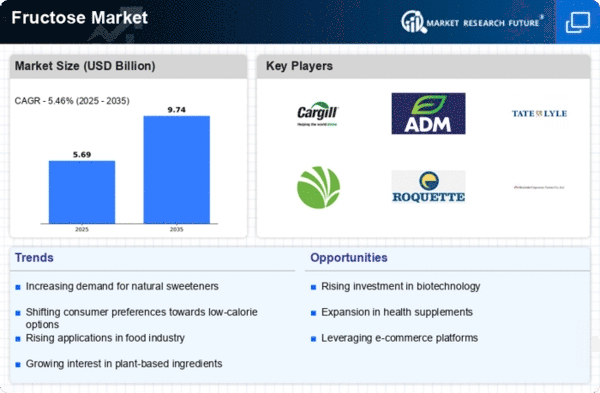
As per Market Research Future analysis, the Fructose Market Size was estimated at 5.4 USD Billion in 2024. The Fructose industry is projected to grow from 5.76 USD Billion in 2025 to 9.74 USD Billion by 2035, exhibiting a compound annual growth rate (CAGR) of 5.46% during the forecast period 2025 - 2035.

Key Market Trends & Highlights

The Fructose Market is experiencing robust growth driven by health trends and innovation.

  • Health consciousness is significantly driving demand for fructose as consumers seek healthier sweetening options.
  • The clean label movement is influencing manufacturers to adopt natural sweeteners, enhancing the appeal of fructose in various products.
  • North America remains the largest market for fructose, while the Asia-Pacific region is emerging as the fastest-growing market due to rising consumer awareness.
  • The increasing demand for natural sweeteners and the expansion of the beverage industry are key drivers propelling the fructose market forward.

Market Size & Forecast

2024 Market Size 5.4 (USD Billion)
2035 Market Size 9.74 (USD Billion)
CAGR (2025 - 2035) 5.46%
Largest Regional Market Share in 2024 North America

Major Players

<p>Cargill (US), Archer Daniels Midland (US), Tate & Lyle (GB), Ingredion (US), Roquette Freres (FR), Mitsubishi Corporation (JP), Sweetener Supply Corporation (US), Nippon Sugar Manufacturing (JP)</p>

Market Trends

The Fructose Market is currently experiencing a dynamic evolution, driven by various factors that influence consumer preferences and industry practices. The increasing awareness of health and wellness among consumers appears to be steering demand towards natural sweeteners, with fructose being perceived as a healthier alternative to traditional sugars. This shift is likely to encourage manufacturers to innovate and diversify their product offerings, potentially leading to a broader range of fructose-based products in the marketplace. Furthermore, the growing trend of clean label products suggests that consumers are seeking transparency in ingredient sourcing, which may further bolster the appeal of fructose derived from natural sources. In addition, the Fructose Market seems to be influenced by the rising popularity of plant-based diets and the corresponding demand for natural sweeteners. As more individuals adopt these dietary preferences, the need for versatile sweetening agents that align with such lifestyles becomes increasingly apparent. This trend may prompt food and beverage companies to explore new applications for fructose, thereby expanding its usage across various sectors. Overall, the Fructose Market is poised for growth, with evolving consumer demands and industry innovations shaping its trajectory in the coming years.

Health Consciousness Driving Demand

The growing awareness of health issues among consumers is likely to increase the demand for natural sweeteners, including fructose. As individuals seek alternatives to refined sugars, fructose is perceived as a healthier option, potentially leading to its wider adoption in various food products.

Clean Label Movement

The clean label trend indicates that consumers are increasingly interested in the transparency of ingredients. This movement may enhance the appeal of fructose, particularly when sourced from natural origins, as consumers prioritize products that align with their values regarding health and sustainability.

Rise of Plant-Based Diets

The increasing popularity of plant-based diets suggests a growing need for natural sweeteners that complement these lifestyles. Fructose may find expanded applications in food and beverage products tailored to this demographic, potentially driving innovation and market growth.

Fructose Market Market Drivers

Market Growth Projections

The Global Fructose Market Industry is projected to witness substantial growth in the coming years. With an estimated market value of 9.38 USD Billion in 2024, the industry is on a trajectory towards reaching 13.7 USD Billion by 2035. This growth is indicative of the increasing adoption of fructose across various sectors, including food and beverages, pharmaceuticals, and personal care products. The anticipated compound annual growth rate (CAGR) of 3.49% from 2025 to 2035 further underscores the potential for expansion within the market. These projections highlight the evolving landscape of the Global Fructose Market Industry and its capacity to adapt to changing consumer demands.

Health Benefits of Fructose

The Global Fructose Market Industry is propelled by the health benefits associated with fructose consumption. Research suggests that fructose may offer advantages over other sugars, such as a lower glycemic response, making it a preferred choice for individuals managing blood sugar levels. This perception is particularly relevant in the context of rising diabetes rates globally. As health-conscious consumers increasingly seek alternatives to traditional sugars, fructose's favorable attributes position it as a viable option. The ongoing emphasis on health and wellness is likely to sustain the growth of the Global Fructose Market Industry in the coming years.

Rising Demand for Natural Sweeteners

The Global Fructose Market Industry is experiencing a notable increase in demand for natural sweeteners as consumers become more health-conscious. This shift is largely driven by a growing awareness of the adverse effects of artificial sweeteners and high-calorie sugars. Fructose Market, derived from fruits and plants, is perceived as a healthier alternative, appealing to a broad demographic. In 2024, the market is projected to reach 9.38 USD Billion, reflecting this trend. As consumers seek products with lower glycemic indices, fructose's popularity is likely to continue rising, contributing to the overall growth of the Global Fructose Market Industry.

Technological Advancements in Production

Technological advancements in the production of fructose are enhancing efficiency and reducing costs within the Global Fructose Market Industry. Innovations in extraction and purification processes allow for higher yields and improved product quality. These advancements not only make fructose more accessible but also enable manufacturers to meet the growing demand for natural sweeteners. As production techniques evolve, the market is expected to witness a compound annual growth rate (CAGR) of 3.49% from 2025 to 2035. This growth is indicative of the industry's adaptability and responsiveness to consumer preferences, further solidifying fructose's role in the Global Fructose Market Industry.

Expansion of the Food and Beverage Sector

The Global Fructose Market Industry benefits significantly from the expansion of the food and beverage sector. As this sector grows, the demand for sweeteners, including fructose, increases correspondingly. Fructose Market is widely used in various applications, from soft drinks to baked goods, due to its sweetness and functional properties. The market's growth trajectory is further supported by innovations in product formulations that incorporate fructose to enhance flavor profiles. With projections indicating a market value of 13.7 USD Billion by 2035, the food and beverage industry's expansion is a critical driver of the Global Fructose Market Industry.

Regulatory Support for Natural Ingredients

Regulatory support for natural ingredients is fostering growth within the Global Fructose Market Industry. Governments worldwide are increasingly promoting the use of natural sweeteners as part of public health initiatives aimed at reducing sugar consumption. This regulatory environment encourages food manufacturers to reformulate products using fructose, aligning with consumer preferences for healthier options. As regulations evolve to favor natural ingredients, the demand for fructose is likely to rise, contributing to the market's expansion. The Global Fructose Market Industry stands to benefit from these supportive policies, which may enhance the overall perception and acceptance of fructose as a sweetening agent.

Market Segment Insights

By Application: Food and Beverage (Largest) vs. Pharmaceuticals (Fastest-Growing)

<p>The Fructose Market is primarily driven by the food and beverage sector, which holds the largest share among all application areas. Fructose is extensively utilized in soft drinks, fruit juices, and other processed foods due to its sweetness and functional properties. The demand from this sector dominates the market landscape and significantly influences fructose production trends. In contrast, the pharmaceutical sector, while smaller in market share, is recognized as the fastest-growing segment. The rising need for pharmaceuticals to be formulated with sweeteners that provide low-caloric options is a key driver behind this growth. As consumer preferences shift towards healthier food and beverage options, fructose’s role becomes increasingly pivotal. Additionally, innovations in the pharmaceutical sector are leading to the development of new drug formulations that incorporate fructose, further enhancing its application. Furthermore, the cosmetics industry is gradually recognizing the benefits of fructose for skin health, though it is lagging behind food and pharmaceuticals in mass adoption. The convergence of these trends is expected to shape the future landscape of the Fructose Market, with ongoing research and development paving the way for new application opportunities.</p>

<p>Food and Beverage: Dominant vs. Pharmaceuticals: Emerging</p>

<p>In the Fructose Market, the Food and Beverage application stands as the dominant force, fueled by the high demand for sweeteners in a wide array of products, including beverages and snacks. This segment leverages fructose's unique benefits, such as enhanced sweetness and lower caloric content, making it a preferred choice for manufacturers aiming to cater to health-conscious consumers. Moreover, the blend of taste enhancement and functional advantages gives this sector a solid competitive edge. Conversely, the Pharmaceuticals sector is emerging as a promising area for fructose application. With the growing emphasis on low-calorie ingredients in drug formulations, it presents new opportunities for companies to innovate. Fructose not only enhances the palatability of medications but also serves crucial functions as a binding agent and stabilizer. As health trends continue to evolve, the pressure on pharmaceutical manufacturers to include such ingredients is likely to drive rapid growth in this segment.</p>

By Type: High Fructose Corn Syrup (Largest) vs. Liquid Fructose (Fastest-Growing)

<p>The Fructose Market displays a diverse range of products, with High Fructose <a href="https://www.marketresearchfuture.com/reports/corn-syrup-market-24323" target="_blank">corn syrup</a> (HFCS) holding the largest market share due to its extensive use in the food and beverage industry. In contrast, Liquid Fructose, while not as dominant, is witnessing significant growth attributed to increasing consumer demand for healthier alternatives to sugar. The various applications of fructose across different sectors contribute to the overall market dynamics, shaping consumer preferences and industry strategies. Growth trends indicate a shift towards more natural and minimally processed ingredients, with Liquid Fructose leading as a fast-growing option amidst rising health awareness and the clean label trend. As manufacturers continue to innovate, the Fructose Market is expected to evolve, with emphasis on sustainable sourcing and the development of functional products that meet changing consumer needs.</p>

<p>Liquid Fructose (Dominant) vs. Crystalline Fructose (Emerging)</p>

<p>Liquid Fructose remains a dominant player in the Fructose Market, favored for its versatility in applications ranging from beverages to baked goods. This segment is characterized by its ease of use and ability to blend seamlessly into various formulations, which enhances its appeal in the food industry. On the other hand, Crystalline Fructose is emerging as a popular choice due to its low glycemic index and high purity, positioning it as an alternative for health-conscious consumers. The synergy between these two types demonstrates the evolving consumer landscape where demand for products that align with health trends continues to rise, thereby influencing market positioning and growth opportunities.</p>

By Source: Corn (Largest) vs. Fruits (Fastest-Growing)

<p>In the Fructose Market, the primary source of fructose is corn, which holds the largest market share due to its efficient conversion processes and abundant supply. Corn-derived fructose is widely used in various food and beverage applications, contributing significantly to its dominance. Fruits are emerging as a crucial source, leveraging health trends that favor natural sweeteners over artificial ones, thereby gaining traction among health-conscious consumers.</p>

<p>Fruits: Fastest-Growing vs. Corn: Dominant</p>

<p>Fruits serve as the fastest-growing source of fructose in the market, driven by the rising consumer preference for natural and less processed ingredients. The increasing demand for healthier food options has prompted manufacturers to turn to fruit-based sugars, which are perceived as more wholesome. Corn, on the other hand, remains the dominant source due to its cost-effectiveness and availability, making it the standard choice for many commercial applications. Both sources offer distinct advantages, with fruits appealing to niche markets focused on health benefits and corn maintaining widespread industrial utility.</p>

By Form: Powder (Largest) vs. Liquid (Fastest-Growing)

<p>In the Fructose Market, the form segment is predominantly driven by the powdered form, which dominates market share due to its versatility in various applications including food and beverages. Following closely is the liquid form, which is gaining traction among consumers seeking convenience and ease of use in formulations. The granular form remains a segment but is comparatively smaller in market share, appealing mainly to niche applications and specific user preferences. Growth trends indicate a significant shift towards liquid fructose, largely driven by increased demand for ready-to-use food products. The rising health consciousness among consumers is fostering interest in natural sweeteners, enhancing the appeal of both liquid and powdered forms. Furthermore, changes in regulations promoting clean label products are encouraging manufacturers to optimize their offerings in these segments.</p>

<p>Powder (Dominant) vs. Liquid (Emerging)</p>

<p>The powdered form of fructose plays a pivotal role in the food and beverage industry, known for its ease of transportation and extended shelf life, making it a preferred choice among manufacturers. Its versatile application ranges from baking to beverage production, allowing for enhanced sweetness without compromising on the product's texture. Meanwhile, the liquid form of fructose represents an emerging trend, characterized by its quick solubility and convenience in product formulations. This form is increasingly favored in the market, especially for ready-to-drink beverages and other convenience foods, as it offers immediate sweetness without additional processing. The growing trend toward liquid fructose is indicative of changing consumer behavior, where convenience and natural ingredients are at the forefront.</p>

By End Use: Beverages (Largest) vs. Confectionery (Fastest-Growing)

<p>The Fructose Market exhibits a diverse segmentation by end use, prominently featuring beverages, bakery products, dairy products, and <a href="https://www.marketresearchfuture.com/reports/confectionery-market-16095" target="_blank">confectionery</a>. Beverages hold the largest share, largely due to the increasing demand for natural sweeteners in soft drinks, juices, and functional beverages. Following beverages, bakery and dairy products capture substantial market shares, leveraging the versatile properties of fructose for improved texture and extended shelf life.</p>

<p>Beverages: Dominant vs. <a href="https://www.marketresearchfuture.com/reports/confectionery-market-16095" target="_blank">confectionery</a>: Emerging</p>

<p>Beverages remain the dominant segment in the Fructose Market, driven by a shift toward healthier drinking options that leverage fructose's low glycemic index and flavor enhancement properties. Beverage manufacturers increasingly prefer fructose for formulating reduced-sugar drinks, catering to health-conscious consumers. Conversely, the <a href="https://www.marketresearchfuture.com/reports/confectionery-market-16095" target="_blank">confectionery</a> segment is emerging rapidly, fueled by innovative product development and a growing preference for natural sweeteners in candies and gummies. As consumer preferences shift towards cleaner labels, the confectionery segment is pivoting towards fructose for its sweetness and ability to mask flavors, positioning it as a key player for growth within the market.</p>

Get more detailed insights about Fructose Market Research Report—Global Forecast till 2035

Regional Insights

North America : Market Leader in Fructose

North America is poised to maintain its leadership in the fructose market, holding a significant share of 2.7 million metric tons in 2025. The region's growth is driven by increasing demand for natural sweeteners in food and beverage applications, alongside a shift towards healthier alternatives. Regulatory support for low-calorie sweeteners further enhances market potential, as consumers increasingly seek products with reduced sugar content. The United States stands out as the primary contributor, with major players like Cargill and Archer Daniels Midland leading the charge. The competitive landscape is characterized by innovation and strategic partnerships, enabling companies to expand their product offerings. The presence of established firms ensures a robust supply chain, catering to diverse consumer preferences and driving market growth.

Europe : Emerging Market Dynamics

Europe's fructose market is evolving, with a size of 1.5 million metric tons projected for 2025. The region is witnessing a surge in health-conscious consumers, driving demand for natural sweeteners. Regulatory frameworks promoting clean label products and transparency in ingredient sourcing are pivotal in shaping market dynamics. The increasing prevalence of obesity and diabetes has led to a shift towards low-calorie alternatives, further propelling market growth. Leading countries such as Germany, France, and the UK are at the forefront of this transformation, with key players like Tate & Lyle and Roquette Freres actively participating. The competitive landscape is marked by innovation in product formulations and strategic collaborations. As companies adapt to changing consumer preferences, the market is expected to flourish, supported by a strong regulatory environment.

Asia-Pacific : Rapid Growth and Innovation

The Asia-Pacific region is experiencing rapid growth in the fructose market, with a projected size of 1.8 million metric tons by 2025. This growth is fueled by increasing urbanization, rising disposable incomes, and a growing preference for processed foods. Regulatory initiatives aimed at reducing sugar consumption are also influencing market dynamics, as consumers seek healthier alternatives to traditional sweeteners. Countries like Japan and China are leading the charge, with significant contributions from companies such as Mitsubishi Corporation and Nippon Sugar Manufacturing. The competitive landscape is characterized by a mix of local and international players, fostering innovation and product diversification. As the market matures, the focus on sustainability and health will drive further growth in the region.

Middle East and Africa : Untapped Market Potential

The Middle East and Africa region presents untapped potential in the fructose market, with a size of 0.4 million metric tons anticipated by 2025. The growth is driven by increasing demand for sweeteners in the food and beverage sector, alongside a rising awareness of health and wellness. Regulatory frameworks are gradually evolving to support the use of alternative sweeteners, which is expected to catalyze market expansion. Countries like South Africa and the UAE are emerging as key players in this market, with local manufacturers beginning to explore fructose production. The competitive landscape is still developing, with opportunities for both local and international companies to establish a foothold. As consumer preferences shift towards healthier options, the fructose market in this region is set for significant growth.

Key Players and Competitive Insights

The Fructose Market is currently characterized by a dynamic competitive landscape, driven by increasing consumer demand for natural sweeteners and the growing trend towards healthier food options. Major players such as Cargill (US), Archer Daniels Midland (US), and Tate & Lyle (GB) are strategically positioned to leverage their extensive supply chains and innovative product offerings. Cargill (US) focuses on expanding its portfolio of high-fructose corn syrup (HFCS) products, while Archer Daniels Midland (US) emphasizes sustainability in its production processes. Tate & Lyle (GB) is investing in research and development to enhance the functionality of its fructose products, thereby shaping a competitive environment that prioritizes innovation and sustainability.

Key business tactics within the Fructose Market include localizing manufacturing and optimizing supply chains to enhance efficiency and reduce costs. The market structure appears moderately fragmented, with several key players exerting influence over pricing and product availability. This fragmentation allows for niche players to emerge, yet the collective strength of major companies ensures a competitive balance that drives continuous improvement and innovation.

In November 2025, Cargill (US) announced a partnership with a leading biotechnology firm to develop a new line of fructose-based sweeteners derived from sustainable sources. This strategic move is likely to enhance Cargill's market position by aligning with consumer preferences for environmentally friendly products, thereby potentially increasing its market share in the natural sweetener segment.

In October 2025, Archer Daniels Midland (US) launched a new initiative aimed at reducing the carbon footprint of its fructose production facilities. This initiative underscores the company's commitment to sustainability and may serve to attract environmentally conscious consumers, positioning ADM as a leader in responsible sourcing and production practices.

In September 2025, Tate & Lyle (GB) expanded its operations in Asia by opening a new manufacturing facility dedicated to producing high-quality fructose products. This expansion not only enhances Tate & Lyle's production capacity but also allows the company to better serve the growing demand in the Asian market, indicating a strategic focus on regional growth and market penetration.

As of December 2025, current competitive trends in the Fructose Market are increasingly defined by digitalization, sustainability, and the integration of artificial intelligence in production processes. Strategic alliances among key players are shaping the landscape, fostering innovation and collaboration. The shift from price-based competition to a focus on technological advancement and supply chain reliability is evident, suggesting that future competitive differentiation will hinge on the ability to innovate and respond to evolving consumer preferences.

Key Companies in the Fructose Market market include

Industry Developments

  • Q1 2024: Cargill opens new $100 million sweetener production facility in Indonesia Cargill inaugurated a new $100 million facility in Pandaan, Indonesia, to produce sweeteners including fructose, aiming to meet growing demand from food and beverage manufacturers in Southeast Asia.
  • Q2 2024: Ingredion launches new fructose syrup line for beverage industry Ingredion announced the launch of a new line of fructose syrups designed for beverage manufacturers, targeting the Asia-Pacific market with improved solubility and sweetness profiles.
  • Q2 2024: Tate & Lyle completes acquisition of Sweet Green Fields Tate & Lyle completed its acquisition of Sweet Green Fields, expanding its portfolio of sweeteners including fructose-based solutions for global food and beverage customers.
  • Q3 2024: ADM announces partnership with PepsiCo to supply sustainable fructose ADM entered a multi-year partnership with PepsiCo to supply sustainably sourced fructose for use in beverages and snacks, supporting PepsiCo’s sustainability goals.
  • Q3 2024: Cosun Beet Company opens new fructose production line in the Netherlands Cosun Beet Company inaugurated a new production line dedicated to fructose at its facility in the Netherlands, increasing capacity to serve European food and beverage manufacturers.
  • Q4 2024: Roquette launches organic fructose ingredient for clean-label foods Roquette introduced an organic fructose ingredient aimed at clean-label food producers, responding to rising demand for natural and organic sweeteners in Europe and North America.
  • Q4 2024: Ingredion appoints new Vice President of Sweeteners Business Ingredion announced the appointment of a new Vice President to lead its global sweeteners business, including fructose product lines, as part of its growth strategy.
  • Q1 2025: Tate & Lyle secures regulatory approval for new fructose syrup in Japan Tate & Lyle received regulatory approval in Japan for its latest fructose syrup, enabling expanded sales to Japanese beverage and food manufacturers.
  • Q1 2025: Cargill invests $50 million to expand fructose production in Brazil Cargill announced a $50 million investment to expand its fructose production capacity at its Uberlândia facility in Brazil, targeting increased demand in South America.
  • Q2 2025: ADM launches non-GMO fructose for North American market ADM introduced a new non-GMO fructose ingredient for the North American food and beverage industry, addressing consumer demand for non-GMO sweetener options.
  • Q2 2025: Tate & Lyle partners with Danone to develop low-calorie fructose beverages Tate & Lyle entered a partnership with Danone to co-develop a range of low-calorie beverages using innovative fructose blends, targeting health-conscious consumers in Europe.
  • Q3 2025: Ingredion opens new R&D center focused on sweetener innovation Ingredion opened a new research and development center dedicated to sweetener innovation, including fructose, to accelerate product development for global clients.

Future Outlook

Fructose Market Future Outlook

<p>The Fructose Market is projected to grow at a 5.46% CAGR from 2024 to 2035, driven by rising health consciousness, demand for natural sweeteners, and expanding applications in food and beverages.</p>

New opportunities lie in:

  • <p>Development of low-calorie fructose products for health-conscious consumers.</p>
  • <p>Expansion into emerging markets with tailored fructose solutions.</p>
  • <p>Investment in innovative extraction technologies to enhance production efficiency.</p>

<p>By 2035, the Fructose Market is expected to solidify its position as a key player in the global sweetener industry.</p>

Market Segmentation

Fructose Market Form Outlook

  • Powder
  • Liquid
  • Granular

Fructose Market Type Outlook

  • Crystalline Fructose
  • Liquid Fructose
  • High Fructose Corn Syrup
  • Fructose Syrup

Fructose Market Source Outlook

  • Fruits
  • Vegetables
  • Corn
  • Sugarcane

Fructose Market End Use Outlook

  • Bakery Products
  • Dairy Products
  • Confectionery
  • Beverages

Fructose Market Application Outlook

  • Food and Beverage
  • Pharmaceuticals
  • Cosmetics
  • Animal Feed

Report Scope

MARKET SIZE 20245.4(USD Billion)
MARKET SIZE 20255.76(USD Billion)
MARKET SIZE 20359.74(USD Billion)
COMPOUND ANNUAL GROWTH RATE (CAGR)5.46% (2024 - 2035)
REPORT COVERAGERevenue Forecast, Competitive Landscape, Growth Factors, and Trends
BASE YEAR2024
Market Forecast Period2025 - 2035
Historical Data2019 - 2024
Market Forecast UnitsUSD Billion
Key Companies ProfiledCargill (US), Archer Daniels Midland (US), Tate & Lyle (GB), Ingredion (US), Roquette Freres (FR), Mitsubishi Corporation (JP), Sweetener Supply Corporation (US), Nippon Sugar Manufacturing (JP)
Segments CoveredApplication, Type, Source, Form, End Use
Key Market OpportunitiesGrowing demand for natural sweeteners drives innovation in the Fructose Market.
Key Market DynamicsRising consumer preference for natural sweeteners drives innovation and competition in the fructose market.
Countries CoveredNorth America, Europe, APAC, South America, MEA

FAQs

How much is the Fructose market?

The Fructose market accounted for USD 8.54 billion.

What is the key driving factor for the Fructose market?

Increasing Awareness Of Sugar Substitutes Among Consumers, and wider application areas to enhance the market growth is the key driving factor for the Fructose market

Wat is the growth rate of the Fructose market?

The growth rate of the Fructose market is 3.46% CAGR.

Which region held the largest market share in the Fructose market?

The Asia-Pacific region held the largest market share in the Fructose market.

Who are the key players in the Fructose market?

Cargill, Incorporated (US), Ingredion Inc. (US), Tate and Lyle (UK), Archer Daniels Midland Company (ADM) (US), Südzucker AG (Germany), Global Sweeteners Holdings Limited (Hong Kong), Roquette Freres (France), Galam Ltd (Israel), Shijiazhuang Huaxu Pharmaceutical Co., Ltd (China), and NOW Foods (US) are the key players in the Fructose market.

Which Form led the Fructose market?

Liquid form led the Fructose market.

Which distribution channel had the largest market share in the Fructose market?

The Offline had the largest market share in the Fructose market.

  1. MARKET ATTRACTIVE ANALYSIS, BY REGION 23
    1. GLOBAL FRUCTOSE MARKET, BY SOURCE 24
    2. GLOBAL FRUCTOSE MARKET, BY
    3. PRODUCT 25
  2. GLOBAL FRUCTOSE MARKET, BY FORM 26
    1. GLOBAL FRUCTOSE MARKET, BY APPLICATION 27
    2. GLOBAL FRUCTOSE MARKET,
    3. BY DISTRIBUTION CHANNEL 28
    4. GLOBAL FRUCTOSE MARKET, BY REGION 29
  3. MARKET INTRODUCTION 30
    1. DEFINITION 30
    2. SCOPE OF THE STUDY 30
    3. RESEARCH OBJECTIVE 30
    4. MARKET STRUCTURE 31
  4. RESEARCH METHODOLOGY 32
    1. RESEARCH PROCESS 32
    2. PRIMARY RESEARCH 33
    3. SECONDARY RESEARCH 34
    4. MARKET SIZE ESTIMATION 35
    5. FORECAST MODEL 36
    6. LIST OF ASSUMPTIONS & LIMITATIONS 37
  5. MARKET DYNAMICS 38
    1. OF CONSUMERS TOWARD SUGAR SUBSTITUTE 39
    2. CONSUMPTION OF FRUCTOSE MAY LEAD TO HEALTH ISSUES 41
    3. SECTOR 42
    4. CHALLENGES 43
    5. HIGH COST ASSOCIATED WITH THE MANUFACTURING OF FRUCTOSE 43
  6. INTRODUCTION 38
    1. DRIVERS 39
      1. INCREASED AWARENESS
      2. WIDER APPLICATION AREAS TO ENHANCE THE MARKET GROWTH
    2. RESTRAINTS
      1. EXCESS
    3. OPPORTUNITIES 42
      1. GROWING TECHNICAL INNOVATION IN THE FOOD PROCESSING
  7. MARKET FACTOR ANALYSIS 44
    1. VALUE CHAIN ANALYSIS 44
      1. RAW MATERIAL 44
      2. PROCESSING 45
      3. ENZYMATIC REACTION 45
      4. BLENDING 45
      5. PACKAGING 45
    2. SUPPLY CHAIN ANALYSIS 46
    3. PORTER''S FIVE FORCES MODEL 47
      1. THREAT OF NEW ENTRANTS
      2. BARGAINING
      3. THREAT OF SUBSTITUTES 48
      4. INTENSITY OF RIVALRY 48
    4. POWER OF SUPPLIERS 48
    5. BARGAINING POWER OF BUYERS 48
    6. IMPACT OF THE COVID-19 OUTBREAK ON THE GLOBAL
      1. IMPACT ON SUPPLY CHAIN 49
      2. IMPACT ON PRICING 49
    7. FRUCTOSE MARKET 49
    8. OVERVIEW 49
    9. IMPACT ON PRODUCTION 49
  8. CATEGORY INSIGHTS 50
    1. SUPPLY-DEMAND OUTLOOK 50
    2. MARKET OVERVIEW 50
    3. SUPPLY-DEMAND ANALYSIS 51
      1. DEMAND ANALYSIS 51
      2. SUPPLY ANALYSIS 52
      3. CATEGORY TRENDS 52
      4. PHARMACEUTICAL INDUSTRY: 52
      5. COSMETICS: 53
      6. FOOD AND BEVERAGE:
      7. MRFR
      8. RUSSIA- UKRAINE WAR INSIGHTS 55
    4. INDUSTRIES TO ENHANCE THE MARKET GROWTH 52
    5. POINT-OF-VIEW 53
    6. COST STRUCTURE ANALYSIS 53
    7. FACTORS AFFECTING THE COST OF RAW MATERIAL 54
  9. GLOBAL FRUCTOSE MARKET, BY
    1. SOURCE 56
    2. OVERVIEW 56
  10. GLOBAL FRUCTOSE MARKET ESTIMATES & FORECAST, BY SOURCE, 2020–2030 57
    1. SUGARCANE 58
      1. SUGARCANE: MARKET
      2. SUGARCANE: MARKET ESTIMATES & FORECAST,
    2. ESTIMATES & FORECAST, BY REGION, 2020–2030 58
    3. BY REGION, 2020–2030 58
    4. SUGAR BEET 59
      1. SUGAR BEET: MARKET ESTIMATES & FORECAST, BY REGION, 2020–2030
    5. CORN
      1. CORN:
  11. MARKET ESTIMATES & FORECAST, BY REGION, 2020–2030 60
    1. OTHERS 61
      1. OTHERS: MARKET ESTIMATES
    2. & FORECAST, BY REGION, 2020–2030 61
  12. GLOBAL FRUCTOSE MARKET, BY PRODUCT 62
    1. OVERVIEW 62
      1. GLOBAL FRUCTOSE
  13. MARKET ESTIMATES & FORECAST, BY PRODUCT, 2020–2030 63
    1. HIGH FRUCTOSE CORN SYRUP
      1. HIGH
  14. FRUCTOSE CORN SYRUP: MARKET ESTIMATES & FORECAST, BY REGION, 2020–2030
    1. FRUCTOSE
    2. SYRUP 65
  15. FRUCTOSE SYRUP: MARKET ESTIMATES & FORECAST, BY REGION, 2020–2030 65
    1. FRUCTOSE SOLID 66
      1. FRUCTOSE SOLID:
  16. MARKET ESTIMATES & FORECAST, BY REGION, 2020–2030 66
  17. GLOBAL FRUCTOSE MARKET, BY
    1. FORM 67
    2. OVERVIEW 67
  18. GLOBAL FRUCTOSE MARKET ESTIMATES & FORECAST, BY FORM, 2020–2030 68
    1. POWDER 69
      1. POWDER: MARKET
    2. ESTIMATES & FORECAST, BY REGION, 2020–2030 69
    3. LIQUID 70
      1. LIQUID: MARKET ESTIMATES & FORECAST, BY
    4. REGION, 2020–2030 70
  19. GLOBAL FRUCTOSE MARKET, BY APPLICATION 71
    1. OVERVIEW 71
      1. GLOBAL FRUCTOSE MARKET ESTIMATES & FORECAST,
    2. BY APPLICATION, 2020–2030 72
    3. FOOD & BEVERAGE 73
      1. FOOD & BEVERAGE: MARKET ESTIMATES &
    4. FORECAST, BY REGION, 2020–2030 73
    5. PHARMACEUTICALS 74
      1. PHARMACEUTICALS: MARKET ESTIMATES & FORECAST,
    6. BY REGION, 2020–2030 74
    7. COSMETICS & PERSONAL CARE 75
      1. COSMETICS & PERSONAL CARE: MARKET ESTIMATES
    8. & FORECAST, BY REGION, 2020–2030 75
    9. OTHERS 76
      1. OTHERS: MARKET ESTIMATES & FORECAST, BY
    10. REGION, 2020–2030 76
  20. GLOBAL FRUCTOSE MARKET, BY DISTRIBUTION CHANNEL 77
    1. OVERVIEW 77
      1. GLOBAL FRUCTOSE MARKET
    2. ESTIMATES & FORECAST, BY DISTRIBUTION CHANNEL, 2020–2030 78
    3. ONLINE 79
      1. ONLINE: MARKET
    4. ESTIMATES & FORECAST, BY REGION, 2020–2030 79
    5. OFFLINE 80
      1. OFFLINE: MARKET ESTIMATES & FORECAST,
    6. BY REGION, 2020–2030 80
  21. GLOBAL FRUCTOSE MARKET, BY REGION 81
    1. OVERVIEW 81
      1. GLOBAL FRUCTOSE MARKET ESTIMATES & FORECAST,
    2. BY REGION, 2020–2030 82
    3. NORTH AMERICA 83
      1. NORTH AMERICA FRUCTOSE MARKET ESTIMATES & FORECAST,
      2. NORTH AMERICA FRUCTOSE MARKET ESTIMATES & FORECAST, BY SOURCE,
    4. BY COUNTRY, 2020–2030 84
  22. NORTH AMERICA FRUCTOSE MARKET ESTIMATES & FORECAST, BY PRODUCT, 2020–2030
  23. NORTH
  24. AMERICA FRUCTOSE MARKET ESTIMATES & FORECAST, BY FORM, 2020–2030 85
  25. NORTH AMERICA
  26. FRUCTOSE MARKET ESTIMATES & FORECAST, BY APPLICATION, 2020–2030 86
  27. NORTH AMERICA
  28. FRUCTOSE MARKET ESTIMATES & FORECAST, BY DISTRIBUTION CHANNEL, 2020–2030
  29. US
  30. MEXICO
  31. CANADA
    1. EUROPE
      1. EUROPE
  32. FRUCTOSE MARKET ESTIMATES & FORECAST, BY COUNTRY, 2020–2030 96
  33. EUROPE FRUCTOSE
  34. MARKET ESTIMATES & FORECAST, BY SOURCE, 2020–2030 97
    1. ESTIMATES & FORECAST, BY PRODUCT, 2020–2030 97
    2. BY FORM, 2020–2030 98
  35. EUROPE FRUCTOSE MARKET
  36. EUROPE FRUCTOSE MARKET ESTIMATES & FORECAST,
  37. EUROPE FRUCTOSE MARKET ESTIMATES & FORECAST, BY APPLICATION,
  38. EUROPE FRUCTOSE MARKET ESTIMATES & FORECAST, BY DISTRIBUTION CHANNEL, 2020–2030
    1. ITALY 104
    2. SPAIN AND PORTUGAL 107
    3. AUSTRIA AND SWITZERLAND 109
  39. FRANCE
  40. GERMANY
  41. UK AND IRELAND 112
  42. BENELUX 114
  43. NORDICS 117
  44. CENTRAL AND EASTERN EUROPE 119
  45. SOUTHERN EUROPE
    1. ASIA-PACIFIC
  46. ASIA-PACIFIC FRUCTOSE MARKET ESTIMATES & FORECAST, BY COUNTRY, 2020–2030
  47. ASIA-PACIFIC FRUCTOSE MARKET ESTIMATES & FORECAST, BY SOURCE, 2020–2030
  48. ASIA-PACIFIC FRUCTOSE MARKET ESTIMATES & FORECAST, BY PRODUCT, 2020–2030
  49. ASIA-PACIFIC FRUCTOSE MARKET ESTIMATES & FORECAST, BY FORM, 2020–2030
  50. ASIA-PACIFIC FRUCTOSE MARKET ESTIMATES & FORECAST, BY APPLICATION, 2020–2030
  51. ASIA-PACIFIC FRUCTOSE MARKET ESTIMATES & FORECAST, BY DISTRIBUTION CHANNEL,
    1. JAPAN 129
    2. CHINA 131
    3. INDIA 134
    4. AUSTRALIA AND NEW ZEALAND 136
    5. & FORECAST, BY COUNTRY, 2020–2030 142
    6. & FORECAST, BY SOURCE, 2020–2030 143
    7. & FORECAST, BY PRODUCT, 2020–2030 143
    8. & FORECAST, BY FORM, 2020–2030 144
    9. & FORECAST, BY APPLICATION, 2020–2030 144
    10. & FORECAST, BY DISTRIBUTION CHANNEL, 2020–2030 145
  52. REST OF ASIA-PACIFIC 139
    1. REST OF THE WORLD 142
      1. REST OF THE WORLD FRUCTOSE MARKET ESTIMATES
      2. REST OF THE WORLD FRUCTOSE MARKET ESTIMATES
      3. REST OF THE WORLD FRUCTOSE MARKET ESTIMATES
      4. REST OF THE WORLD FRUCTOSE MARKET ESTIMATES
      5. REST OF THE WORLD FRUCTOSE MARKET ESTIMATES
      6. REST OF THE WORLD FRUCTOSE MARKET ESTIMATES
      7. SOUTH AMERICA 145
      8. MIDDLE EAST 148
      9. AFRICA 150
  53. COMPETITIVE LANDSCAPE 154
    1. INTRODUCTION 154
      1. MARKET STRATEGY ANALYSIS 154
    2. COMPETITIVE BENCHMARKING
    3. KEY
      1. INVESTMENT 156
      2. EXPANSION 156
    4. DEVELOPMENTS & GROWTH STRATEGIES 156
  54. COMPANY PROFILES 158
    1. CARGILL INCORPORATED 158
      1. COMPANY OVERVIEW 158
      2. FINANCIAL OVERVIEW 159
      3. PRODUCTS OFFERED 159
      4. KEY DEVELOPMENTS 160
      5. SWOT ANALYSIS 160
      6. KEY STRATEGIES 160
    2. INGREDION INCORPORATED 161
      1. COMPANY OVERVIEW 161
      2. FINANCIAL OVERVIEW
      3. COMPANY OVERVIEW 167
      4. FINANCIAL OVERVIEW 168
      5. PRODUCTS OFFERED 168
      6. KEY DEVELOPMENTS 169
      7. SWOT ANALYSIS 169
      8. KEY STRATEGIES 170
    3. PRODUCTS OFFERED 162
    4. KEY DEVELOPMENTS 163
    5. SWOT ANALYSIS 163
    6. KEY STRATEGIES 163
    7. TATE & LYLE 164
    8. COMPANY OVERVIEW 164
    9. FINANCIAL OVERVIEW 165
    10. PRODUCTS OFFERED 165
    11. KEY DEVELOPMENTS 166
    12. SWOT ANALYSIS 166
    13. KEY STRATEGIES 166
    14. ARCHER-DANIELS-MIDLAND COMPANY (ADM) 167
    15. SÜDZUCKER AG 171
      1. COMPANY OVERVIEW 171
      2. FINANCIAL OVERVIEW 172
      3. PRODUCTS OFFERED 172
      4. KEY DEVELOPMENTS 172
      5. SWOT ANALYSIS 173
      6. KEY STRATEGIES 173
    16. GLOBAL SWEETENERS HOLDINGS LIMITED 174
      1. COMPANY OVERVIEW
      2. COMPANY OVERVIEW 177
      3. FINANCIAL OVERVIEW 177
      4. PRODUCTS OFFERED 177
      5. KEY DEVELOPMENTS 177
      6. KEY STRATEGIES 178
    17. FINANCIAL OVERVIEW 175
    18. PRODUCTS OFFERED 175
    19. KEY DEVELOPMENTS 175
    20. KEY STRATEGIES 176
    21. ROQUETTE FRÈRES SA. 177
    22. GALAM LTD 179
      1. COMPANY OVERVIEW 179
      2. FINANCIAL OVERVIEW 179
      3. PRODUCTS OFFERED 179
      4. KEY DEVELOPMENTS 180
      5. KEY STRATEGIES 180
    23. SHIJIAZHUANG HUAXU PHARMACEUTICAL CO., LTD 181
      1. COMPANY OVERVIEW
      2. KEY DEVELOPMENTS 181
      3. KEY STRATEGIES 181
    24. FINANCIAL OVERVIEW 181
    25. PRODUCTS/SERVICES OFFERED 181
    26. NOW FOODS 182
      1. COMPANY OVERVIEW 182
      2. FINANCIAL OVERVIEW 182
      3. PRODUCTS OFFERED 182
      4. KEY DEVELOPMENTS
    27. KEY STRATEGIES 182
    28. APPENDIX 183
    29. REFERENCES 183
    30. RELATED REPORTS 184

Fructose Market Segmentation

Fructose Source Outlook (USD Million, 2018-2030)

  • Sugarcane

  • Sugar beet

  • Corn

  • Others

Fructose Product Outlook (USD Million, 2018-2030)

  • High Fructose Corn Syrup

  • Fructose Syrup

  • Fructose Solid

Fructose Form Outlook (USD Million, 2018-2030)

  • Powder

  • Liquid

Fructose Application Outlook (USD Million, 2018-2030)

  • Food and Others

  • Pharmaceutical

  • Cosmetic & Personal Care

  • Others

Fructose Distribution Channel Outlook (USD Million, 2018-2030)

  • Online

  • Offline

Fructose Regional Outlook (USD Million, 2018-2030)

  • North America Outlook (USD Million, 2018-2030)

    • North America Fructose by Source

      • Sugarcane

      • Sugar beet

      • Corn

      • Others

    • North America Fructose by Product

      • High Fructose Corn Syrup

      • Fructose Syrup

      • Fructose Solid

    • North America Fructose by Form

      • Powder

      • Liquid

    • North America Fructose by Application

      • Food and Others

      • Pharmaceutical

      • Cosmetic & Personal Care

      • Others

    • North America Fructose by Distribution Channel

      • Online

      • Offline

    • US Outlook (USD Million, 2018-2030)

    • US Fructose by Source

      • Sugarcane

      • Sugar beet

      • Corn

      • Others

    • US Fructose by Product

      • High Fructose Corn Syrup

      • Fructose Syrup

      • Fructose Solid

    • US Fructose by Form

      • Powder

      • Liquid

    • US Fructose by Application

      • Food and Others

      • Pharmaceutical

      • Cosmetic & Personal Care

      • Others

    • US Fructose by Distribution Channel

      • Online

      • Offline

    • CANADA Outlook (USD Million, 2018-2030)

    • CANADA Fructose by Source

      • Sugarcane

      • Sugar beet

      • Corn

      • Others

    • CANADA Fructose by Product

      • High Fructose Corn Syrup

      • Fructose Syrup

      • Fructose Solid

    • Canada Fructose by Form

      • Powder

      • Liquid

    • CANADA Fructose by Application

      • Food and Others

      • Pharmaceutical

      • Cosmetic & Personal Care

      • Others

    • CANADA Fructose by Distribution Channel

      • Online

      • Offline

  • Europe Outlook (USD Million, 2018-2030)

    • Europe Fructose by Source

      • Sugarcane

      • Sugar beet

      • Corn

      • Others

    • Europe Fructose by Product

      • High Fructose Corn Syrup

      • Fructose Syrup

      • Fructose Solid

    • Europe Fructose by Form

      • Powder

      • Liquid

    • Europe Fructose by Application

      • Food and Others

      • Pharmaceutical

      • Cosmetic & Personal Care

      • Others

    • Europe Fructose by Distribution Channel

      • Online

      • Offline

    • Germany Outlook (USD Million, 2018-2030)

    • Germany Fructose by Source

      • Sugarcane

      • Sugar beet

      • Corn

      • Others

    • Germany Fructose by Product

      • High Fructose Corn Syrup

      • Fructose Syrup

      • Fructose Solid

    • Germany Fructose by Form

      • Powder

      • Liquid

    • Germany Fructose by Application

      • Food and Others

      • Pharmaceutical

      • Cosmetic & Personal Care

      • Others

    • Germany Fructose by Distribution Channel

      • Online

      • Offline

    • France Outlook (USD Million, 2018-2030)

    • France Fructose by Source

      • Sugarcane

      • Sugar beet

      • Corn

      • Others

    • France Fructose by Product

      • High Fructose Corn Syrup

      • Fructose Syrup

      • Fructose Solid

    • France Fructose by Form

      • Powder

      • Liquid

    • France Fructose by Application

      • Food and Others

      • Pharmaceutical

      • Cosmetic & Personal Care

      • Others

    • France Fructose by Distribution Channel

      • Online

      • Offline

    • UK Outlook (USD Million, 2018-2030)

    • UK Fructose by Source

      • Sugarcane

      • Sugar beet

      • Corn

      • Others

    • UK Fructose by Product

      • High Fructose Corn Syrup

      • Fructose Syrup

      • Fructose Solid

    • UK Fructose by Form

      • Powder

      • Liquid

    • UK Fructose by Application

      • Food and Others

      • Pharmaceutical

      • Cosmetic & Personal Care

      • Others

    • UK Fructose by Distribution Channel

      • Online

      • Offline

    • ITALY Outlook (USD Million, 2018-2030)

    • ITALY Fructose by Source

      • Sugarcane

      • Sugar beet

      • Corn

      • Others

    • ITALY Fructose by Product

      • High Fructose Corn Syrup

      • Fructose Syrup

      • Fructose Solid

    • Italy Fructose by Form

      • Powder

      • Liquid

    • ITALY Fructose by Application

      • Food and Others

      • Pharmaceutical

      • Cosmetic & Personal Care

      • Others

    • ITALY Fructose by Distribution Channel

      • Online

      • Offline

    • SPAIN Outlook (USD Million, 2018-2030)

    • Spain Fructose by Source

      • Sugarcane

      • Sugar beet

      • Corn

      • Others

    • Spain Fructose by Product

      • High Fructose Corn Syrup

      • Fructose Syrup

      • Fructose Solid

    • Spain Fructose by Form

      • Powder

      • Liquid

    • Spain Fructose by Application

      • Food and Others

      • Pharmaceutical

      • Cosmetic & Personal Care

      • Others

    • Spain Fructose by Distribution Channel

      • Online

      • Offline

    • Rest Of Europe Outlook (USD Million, 2018-2030)

    • REST OF EUROPE Fructose by Source

      • Sugarcane

      • Sugar beet

      • Corn

      • Others

    • Rest Of Europe Fructose by Product

      • High Fructose Corn Syrup

      • Fructose Syrup

      • Fructose Solid

    • Rest of Europe Fructose by Form

      • Powder

      • Liquid

    • REST OF EUROPE Fructose by Application

      • Food and Others

      • Pharmaceutical

      • Cosmetic & Personal Care

      • Others

    • REST OF EUROPE Fructose by Distribution Channel

      • Online

      • Offline

  • Asia-Pacific Outlook (USD Million, 2018-2030)

    • Asia-Pacific Fructose by Source

      • Sugarcane

      • Sugar beet

      • Corn

      • Others

    • Asia-Pacific Fructose by Product

      • High Fructose Corn Syrup

      • Fructose Syrup

      • Fructose Solid

    • Asia-Pacific Fructose by Form

      • Powder

      • Liquid

    • Asia-Pacific Fructose by Application

      • Food and Others

      • Pharmaceutical

      • Cosmetic & Personal Care

      • Others

    • Asia-Pacific Fructose by Distribution Channel

      • Online

      • Offline

    • China Outlook (USD Million, 2018-2030)

    • China Fructose by Source

      • Sugarcane

      • Sugar beet

      • Corn

      • Others

    • China Fructose by Product

      • High Fructose Corn Syrup

      • Fructose Syrup

      • Fructose Solid

    • China Fructose by Form

      • Powder

      • Liquid

    • China Fructose by Application

      • Food and Others

      • Pharmaceutical

      • Cosmetic & Personal Care

      • Others

    • China Fructose by Distribution Channel

      • Online

      • Offline

    • Japan Outlook (USD Million, 2018-2030)

    • Japan Fructose by Source

      • Sugarcane

      • Sugar beet

      • Corn

      • Others

    • Japan Fructose by Product

      • High Fructose Corn Syrup

      • Fructose Syrup

      • Fructose Solid

    • Japan Fructose by Form

      • Powder

      • Liquid

    • Japan Fructose by Application

      • Food and Others

      • Pharmaceutical

      • Cosmetic & Personal Care

      • Others

    • Japan Fructose by Distribution Channel

      • Online

      • Offline

    • India Outlook (USD Million, 2018-2030)

    • India Fructose by Source

      • Sugarcane

      • Sugar beet

      • Corn

      • Others

    • India Fructose by Product

      • High Fructose Corn Syrup

      • Fructose Syrup

      • Fructose Solid

    • India Fructose by Form

      • Powder

      • Liquid

    • India Fructose by Application

      • Food and Others

      • Pharmaceutical

      • Cosmetic & Personal Care

      • Others

    • India Fructose by Distribution Channel

      • Online

      • Offline

    • Australia Outlook (USD Million, 2018-2030)

    • Australia Fructose by Source

      • Sugarcane

      • Sugar beet

      • Corn

      • Others

    • Australia Fructose by Product

      • High Fructose Corn Syrup

      • Fructose Syrup

      • Fructose Solid

    • Australia Fructose by Form

      • Powder

      • Liquid

    • Australia Fructose by Application

      • Food and Others

      • Pharmaceutical

      • Cosmetic & Personal Care

      • Others

    • Australia Fructose by Distribution Channel

      • Online

      • Offline

    • Rest of Asia-Pacific Outlook (USD Million, 2018-2030)

    • Rest of Asia-Pacific Fructose by Source

      • Sugarcane

      • Sugar beet

      • Corn

      • Others

    • Rest of Asia-Pacific Fructose by Product

      • High Fructose Corn Syrup

      • Fructose Syrup

      • Fructose Solid

    • Rest of the Asia-Pacific Fructose by Form

      • Powder

      • Liquid

    • Rest of Asia-Pacific Fructose by Application

      • Food and Others

      • Pharmaceutical

      • Cosmetic & Personal Care

      • Others

    • Rest of Asia-Pacific Fructose by Distribution Channel

      • Online

      • Offline

  • Rest of the World Outlook (USD Million, 2018-2030)

    • Rest of the World Fructose by Source

      • Sugarcane

      • Sugar beet

      • Corn

      • Others

    • Rest of the World Fructose by Product

      • High Fructose Corn Syrup

      • Fructose Syrup

      • Fructose Solid

    • Rest of the World Fructose by Form

      • Powder

      • Liquid

    • Rest of the World Fructose by Application

      • Food and Others

      • Pharmaceutical

      • Cosmetic & Personal Care

      • Others

    • Rest of the World Fructose by Distribution Channel

      • Online

      • Offline

    • Middle East Outlook (USD Million, 2018-2030)

    • Middle East Fructose by Source

      • Sugarcane

      • Sugar beet

      • Corn

      • Others

    • Middle East Fructose by Product

      • High Fructose Corn Syrup

      • Fructose Syrup

      • Fructose Solid

    • Middle East Fructose by Form

      • Powder

      • Liquid

    • Middle East Fructose by Application

      • Food and Others

      • Pharmaceutical

      • Cosmetic & Personal Care

      • Others

    • Middle East Fructose by Distribution Channel

      • Online

      • Offline

    • Africa Outlook (USD Million, 2018-2030)

    • Africa Fructose by Source

      • Sugarcane

      • Sugar beet

      • Corn

      • Others

    • Africa Fructose by Product

      • High Fructose Corn Syrup

      • Fructose Syrup

      • Fructose Solid

    • Africa Fructose by Form

      • Powder

      • Liquid

    • Africa Fructose by Application

      • Food and Others

      • Pharmaceutical

      • Cosmetic & Personal Care

      • Others

    • Africa Fructose by Distribution Channel

      • Online

      • Offline

    • Latin America Outlook (USD Million, 2018-2030)

    • Latin America Fructose by Source

      • Sugarcane

      • Sugar beet

      • Corn

      • Others

    • Latin America Fructose by Product

      • High Fructose Corn Syrup

      • Fructose Syrup

      • Fructose Solid

    • Latin America Fructose by Form

      • Powder

      • Liquid

    • Latin America Fructose by Application

      • Food and Others

      • Pharmaceutical

      • Cosmetic & Personal Care

      • Others

    • Latin America Fructose by Distribution Channel

      • Online

      • Offline

Infographic

Free Sample Request

Kindly complete the form below to receive a free sample of this Report

Get Free Sample

Customer Strories

Compare Licence

×
Features License Type
Single User Multiuser License Enterprise User
Price $4,950 $5,950 $7,250
Maximum User Access Limit 1 User Upto 10 Users Unrestricted Access Throughout the Organization
Free Customization
Direct Access to Analyst
Deliverable Format
Platform Access
Discount on Next Purchase 10% 15% 15%
Printable Versions