Request Free Sample ×

Kindly complete the form below to receive a free sample of this Report

* Please use a valid business email

Leading companies partner with us for data-driven Insights

clients tt-cursor
Hero Background
English
Chinese
French
Japanese
Korean
German
Spanish

Frozen Fruits Vegetables Market Share

ID: MRFR/FnB/0257-CR
128 Pages
Pradeep Nandi
October 2024

Frozen Fruits and Vegetables Market Size, Share, Industry Trend & Analysis Research Report Information By Type (Fruits, Vegetables), by Category (Organic, and Conventional), by Form (Whole, Sliced, and Cubed), by Distribution Channel (Supermarkets & Hypermarkets, Convenience Stores, Specialty Stores, Online, and Others), and by Region (North America, Europe, Asia-Pacific, Rest of the World)- Forecast Till 2035

Share:
Download PDF ×

We do not share your information with anyone. However, we may send you emails based on your report interest from time to time. You may contact us at any time to opt-out.

Frozen Fruits Vegetables Market Infographic
Purchase Options

Market Share

Frozen Fruits Vegetables Market Share Analysis

In the competitive panorama of the Frozen fruits and vegetables market, market proportion positioning techniques play a pivotal role in determining the success of groups within this section. Companies running in this space rent numerous tactics to establish and enhance their market share, making sure they stay competitive and meet the evolving choices of clients. One common strategy includes product differentiation, where organizations' attention is on supplying a unique variety of frozen fruits and vegetables to stand out in a crowded marketplace. This might also encompass introducing innovative blends, exceptional sorts, or packaging improvements that enchant fitness-aware purchasers in search of convenience without compromising dietary costs. By constantly innovating their product services, corporations can appeal to a broader customer base and capture a bigger marketplace percentage. Distribution channels additionally play a great role in marketplace percentage positioning inside the Frozen fruits and vegetables market. Companies often strive to set up sturdy relationships with stores, supermarkets, and online platforms to ensure the availability of their products. Effective distribution strategies can help businesses reach new markets, grow their visibility, and, in the end, increase their marketplace share. Marketing and branding are quintessential components of market percentage positioning, as client perceptions closely influence buying choices. Companies invest in strategic advertising campaigns to build emblem recognition, promote the benefits of their frozen fruits and vegetables, and differentiate themselves from competitors. Emphasizing factors including freshness, nutritional value, and comfort can create a wonderful emblem image and contribute to a market percentage boom. Social media, influencers, and different virtual marketing channels are often leveraged to connect to a much broader target audience. Maintaining strong attention to quality and meal safety is paramount within the Frozen fruits and Vegetables Market. Companies that prioritize stringent nice manage measures and adhere to meal safety standards are more likely to build consideration among purchasers. The marketplace proportion positioning within the Frozen fruits and vegetables market requires a multifaceted technique that integrates product differentiation, pricing strategies, distribution channels, marketing, and a dedication to fine. Companies that correctly navigate those factors can carve out an enormous presence inside the market, catering to the numerous desires of customers and adapting to changing enterprise traits. As the marketplace keeps adapting, agility and innovation could be key factors for organizations looking to gain no longer only but additionally sustain an aggressive advantage and a larger percentage of the frozen grocery store.


Author
Author Profile
Pradeep Nandi
Senior Research Analyst

I have a bachelor's degree in mechanical engineering and an MBA. I have more than two years of expertise in the retail, food, and beverage, chemical, and material industries, and hence have developed a sound cross-domain expertise. A firm believer in lifelong learning and sharing of knowledge. Having a proclivity for hatching ideas and trying to absorb as much information as possible in a short amount of time. Introducing corporates to the data and insight, which enables them to move from probability to possibility, has been my key areas of interest. 

Leave a Comment

FAQs

What is the current valuation of the Frozen Fruits Vegetables Market?

<p>The Frozen Fruits Vegetables Market was valued at approximately 30172.59 USD Million in 2024.</p>

What is the projected market valuation for the Frozen Fruits Vegetables Market by 2035?

<p>The market is projected to reach approximately 58476.62 USD Million by 2035.</p>

What is the expected CAGR for the Frozen Fruits Vegetables Market during the forecast period?

<p>The expected CAGR for the Frozen Fruits Vegetables Market from 2025 to 2035 is 6.2%.</p>

Which companies are considered key players in the Frozen Fruits Vegetables Market?

<p>Key players in the market include Dole Food Company, Green Giant, Birds Eye, McCain Foods, and Del Monte Foods.</p>

How are the Frozen Fruits Vegetables segmented by application?

<p>The market segments by application include Food Service, Retail, Household, Industrial, and Catering.</p>

What are the projected values for Frozen Fruits and Frozen Vegetables by 2035?

<p>By 2035, Frozen Fruits are projected to reach 12000 USD Million, while Frozen Vegetables may reach 24000 USD Million.</p>

What distribution channels are utilized in the Frozen Fruits Vegetables Market?

<p>Distribution channels include Online, Supermarkets, Hypermarkets, Convenience Stores, and Specialty Stores.</p>

What is the expected performance of the Household Consumption segment by 2035?

<p>The Household Consumption segment is projected to reach approximately 14000 USD Million by 2035.</p>

How does the market for Frozen Mixed Vegetables compare to Frozen Snacks?

<p>Frozen Mixed Vegetables are projected to reach 16000 USD Million, whereas Frozen Snacks may reach around 8476.62 USD Million by 2035.</p>

What is the significance of the Food Processing segment in the market?

<p>The Food Processing segment is expected to reach approximately 12000 USD Million by 2035, indicating its vital role in the market.</p>

Market Summary

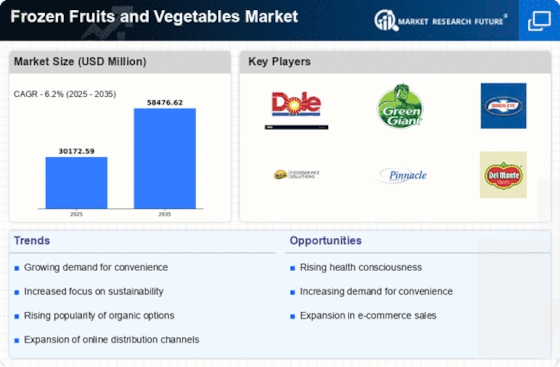
As per MRFR analysis, the Frozen Fruits Vegetables Market Size was estimated at 30172.59 USD Million in 2024. The Frozen Fruits Vegetables industry is projected to grow from 32043.29 in 2025 to 58476.62 by 2035, exhibiting a compound annual growth rate (CAGR) of 6.2% during the forecast period 2025 - 2035.

Key Market Trends & Highlights

The Frozen Fruits and Vegetables Market is experiencing robust growth driven by health consciousness and convenience.

  • The market is witnessing a pronounced shift towards health and wellness, with consumers increasingly prioritizing nutritious options.
  • Sustainability initiatives are gaining traction, as brands adopt eco-friendly practices in sourcing and packaging.
  • Technological advancements in freezing methods are enhancing product quality and extending shelf life, appealing to a broader consumer base.
  • Rising demand for convenience foods and increased awareness of nutritional benefits are key drivers propelling market expansion in North America and Asia-Pacific.

Market Size & Forecast

2024 Market Size 30172.59 (USD Million)
2035 Market Size 58476.62 (USD Million)
CAGR (2025 - 2035) 6.2%
Largest Regional Market Share in 2024 North America

Major Players

<p>Dole Food Company (US), Green Giant (US), Birds Eye (US), McCain Foods (CA), Pinnacle Foods (US), Ardo (BE), Bonduelle (FR), Del Monte Foods (US), ConAgra Foods (US)</p>

Market Trends

The Frozen Fruits Vegetables Market is currently experiencing a notable transformation, driven by evolving consumer preferences and increasing awareness regarding health and nutrition. As individuals become more health-conscious, the demand for frozen fruits and vegetables is on the rise, as these products offer convenience without compromising nutritional value. The market appears to be benefiting from a growing inclination towards plant-based diets, which further propels the consumption of frozen produce. Additionally, the expansion of retail channels, including online platforms, is likely enhancing accessibility for consumers, thereby fostering market growth. Moreover, innovations in freezing technology and packaging are contributing to the appeal of frozen fruits and vegetables. Enhanced preservation methods are ensuring that the quality and taste of these products remain intact, which may encourage more consumers to incorporate them into their diets. The Frozen Fruits Vegetables Market seems poised for continued expansion, as manufacturers adapt to changing consumer demands and preferences. This dynamic landscape suggests that stakeholders must remain vigilant and responsive to emerging trends to capitalize on potential opportunities in this sector.

Health and Wellness Focus

There is a growing emphasis on health and wellness among consumers, leading to increased interest in frozen fruits and vegetables. These products are perceived as nutritious options that align with healthier eating habits.

Sustainability Initiatives

Sustainability is becoming a key consideration for consumers, prompting manufacturers to adopt eco-friendly practices. This trend includes sourcing ingredients responsibly and utilizing sustainable packaging solutions.

Technological Advancements

Innovations in freezing and preservation technologies are enhancing the quality and shelf life of frozen fruits and vegetables. These advancements are likely to attract more consumers seeking fresh-tasting options.

Frozen Fruits Vegetables Market Market Drivers

Expansion of Retail Channels

The Frozen Fruits Vegetables Market is witnessing an expansion of retail channels, which is facilitating greater accessibility for consumers. Supermarkets, convenience stores, and online platforms are increasingly stocking a diverse range of frozen fruits and vegetables. This proliferation of retail options is crucial, as it allows consumers to easily find and purchase frozen products. Recent statistics indicate that online grocery sales have surged, with frozen food categories experiencing significant growth. This trend is expected to continue, further enhancing the Frozen Fruits Vegetables Market by providing consumers with more opportunities to access frozen produce.

Innovations in Freezing Technology

The Frozen Fruits Vegetables Market is being propelled by innovations in freezing technology. Advances in flash freezing and cryogenic freezing methods are enhancing the quality and shelf life of frozen products. These technologies help preserve the taste, texture, and nutritional content of fruits and vegetables, making them more appealing to consumers. As manufacturers adopt these cutting-edge techniques, the Frozen Fruits Vegetables Market is likely to benefit from increased consumer confidence in the quality of frozen produce. This could lead to a rise in sales as consumers become more aware of the advancements in freezing technology.

Rising Demand for Convenience Foods

The Frozen Fruits Vegetables Market is experiencing a notable increase in demand for convenience foods. As lifestyles become busier, consumers are seeking quick and easy meal solutions. Frozen fruits and vegetables offer a practical alternative, allowing for minimal preparation time while retaining nutritional value. According to recent data, the convenience food sector is projected to grow at a compound annual growth rate of approximately 4.5% over the next five years. This trend is likely to drive the Frozen Fruits Vegetables Market, as more consumers opt for frozen options that can be easily incorporated into meals without sacrificing quality or taste.

Growing Popularity of Plant-Based Diets

The Frozen Fruits Vegetables Market is experiencing a surge in demand due to the growing popularity of plant-based diets. As more individuals adopt vegetarian and vegan lifestyles, the need for frozen fruits and vegetables as convenient meal components is increasing. This trend is supported by data indicating that plant-based food sales have risen significantly, with frozen options becoming a staple in many households. The Frozen Fruits Vegetables Market is likely to thrive as consumers seek out frozen produce to complement their dietary choices, reflecting a broader shift towards plant-based eating.

Increased Awareness of Nutritional Benefits

The Frozen Fruits Vegetables Market is benefiting from a growing awareness of the nutritional advantages associated with frozen produce. Research indicates that frozen fruits and vegetables can retain their vitamins and minerals, making them a viable option for health-conscious consumers. As individuals become more informed about the importance of a balanced diet, the demand for frozen options is expected to rise. In fact, studies suggest that the consumption of frozen fruits and vegetables has increased by approximately 15% in recent years, reflecting a shift towards healthier eating habits. This trend is likely to bolster the Frozen Fruits Vegetables Market as consumers prioritize nutrition.

Market Segment Insights

By Application: Food Service (Largest) vs. Retail (Fastest-Growing)

<p>In the Frozen Fruits and Vegetables Market, the application segment is primarily dominated by the Food Service category, which holds a significant share due to its critical role in restaurants and catering businesses. Retail also plays a vital role but is emerging rapidly as consumers shift towards convenience and ready-to-eat meal options. This increasing consumer preference contributes to the growing market presence of retail channels, especially convenience stores and supermarkets, fostering higher sales of frozen fruits and vegetables. The growth trends within the Frozen Fruits and Vegetables Market application segment indicate a robust expansion trajectory for retail over the forecast period. Key drivers include a rise in health-conscious eating habits, demand for frozen produce with extended shelf life, and innovative product introductions. Additionally, increasing partnerships between manufacturers and retailers are further stimulating growth, leading to an enhanced consumer reach that supports the retail segment's position as the fastest-growing application area.</p>

<p>Food Service (Dominant) vs. Household (Emerging)</p>

<p>The Food Service segment stands out as the dominant player in the Frozen Fruits and Vegetables Market due to its extensive utilization in restaurants, cafes, and catering services. This segment attracts high volume sales as food service operators prefer frozen products for their convenience and reduced waste, ensuring consistent ingredient quality. On the other hand, the Household segment is emerging rapidly as families increasingly opt for frozen fruits and vegetables for easier meal preparation and longer shelf life. The rising trend of at-home cooking, driven by factors such as increased cooking during the pandemic, has bolstered household purchases, positioning it as an essential growing segment. Both segments showcase distinct yet complementary characteristics, catering to varying consumer needs.</p>

By Product Type: Frozen Fruits (Largest) vs. Frozen Purees (Fastest-Growing)

<p>The Frozen Fruits Vegetables Market is diversifying into several product types, with the largest share led by Frozen Fruits, reflecting evolving consumer preferences favoring convenience and healthy eating. Frozen Vegetables also maintain a strong position, appealing to health-conscious consumers. Frozen Mixed Vegetables and Frozen Snacks showcase a growing trend in meal versatility, catering to various meal occasions and preferences. Frozen Purees, although smaller in share, are gaining traction due to their use in food processing and innovation in recipes.</p>

<p>Frozen Fruits (Dominant) vs. Frozen Purees (Emerging)</p>

<p>Frozen Fruits hold the dominant position in the Frozen Fruits Vegetables Market, driven by their popularity as convenient, nutritious snacks and ingredients in various beverages and desserts. They appeal primarily to health-conscious consumers and families seeking quick meal solutions. Meanwhile, Frozen Purees are emerging with increasing growth as food manufacturers adopt them for their versatility in formulating a range of products, including sauces, soups, and infant food. This shift highlights a trend toward value-added products in the market, with Frozen Purees being a sought-after ingredient for innovative culinary applications, thus carving out their niche.</p>

By Distribution Channel: Supermarkets (Largest) vs. Online (Fastest-Growing)

<p>In the Frozen Fruits Vegetables Market, supermarkets hold the largest share among distribution channels, serving as the primary shopping destination for consumers. They benefit from a wide variety of products and promotional offers, making them a popular choice for frozen fruits and vegetables. Other notable channels include hypermarkets and convenience stores, which capture a significant portion of the market, yet supermarkets remain dominant in attracting foot traffic and repeat purchases.</p>

<p>Supermarkets (Dominant) vs. Online (Emerging)</p>

<p>Supermarkets remain a dominant player in the distribution of frozen fruits and vegetables, leveraging their extensive shelf space and customer loyalty to offer a diverse array of products. They often engage in strategic partnerships with brands and use promotional strategies to enhance visibility. Conversely, online shopping is emerging as a fast-growing channel, driven by the increasing preference for convenience and the expansion of e-commerce platforms. The variety and ease of shopping online attract tech-savvy consumers who are keen on accessing a broader range of frozen options without the need to visit physical stores.</p>

By End Use: Food Processing (Largest) vs. Food Retailing (Fastest-Growing)

<p>In the Frozen Fruits Vegetables Market, the end use segment showcases a diverse distribution of market shares. Food Processing holds the largest share, driven by the increasing adoption of frozen produce among manufacturers looking to enhance product quality and reduce waste. Food Retailing, while smaller in share, is rapidly expanding as consumers seek convenient, ready-to-cook solutions for their meals, signaling a shift in purchasing patterns.</p>

<p>Food Processing (Dominant) vs. Household Consumption (Emerging)</p>

<p>Food Processing is characterized by its robust demand for high-quality frozen fruits and vegetables, supported by the growing trend of product innovation and the need for year-round availability. It plays a crucial role in ingredient sourcing for various food products, ensuring that manufacturers can maintain consistent quality. In contrast, Household Consumption is an emerging segment that is gaining traction as more families prioritize quick and healthy meal options. This segment is increasingly influenced by consumer preferences for convenience and the nutritional value of frozen options, leading to an uptick in demand for frozen fruits and vegetables in home cooking.</p>

Get more detailed insights about Frozen Fruits and Vegetables Market Research Report - Forecast till 2035

Regional Insights

North America : Market Leader in Frozen Produce

North America continues to lead the Frozen Fruits and Vegetables market, holding a significant share of 15000.0 in 2024. The growth is driven by increasing consumer demand for convenient, healthy food options and a rising trend towards plant-based diets. Regulatory support for food safety and quality standards further enhances market stability, encouraging innovation and investment in the sector. The competitive landscape is robust, with key players like Dole Food Company, Green Giant, and Birds Eye dominating the market. The U.S. remains the largest contributor, supported by a well-established distribution network and strong retail presence. Canada also plays a vital role, with companies like McCain Foods leading in frozen vegetable production. The market is characterized by continuous product innovation and strategic partnerships among leading firms.

Europe : Emerging Market with Growth Potential

Europe's Frozen Fruits and Vegetables market is valued at 9000.0, reflecting a growing consumer preference for frozen products due to their convenience and nutritional value. The market is bolstered by stringent food safety regulations and sustainability initiatives, which encourage the use of eco-friendly packaging and production methods. The increasing focus on health and wellness among consumers is also a significant driver of market growth. Leading countries in this region include Germany, France, and the UK, where major players like Bonduelle and Ardo are making significant strides. The competitive landscape is marked by a mix of local and international brands, with a strong emphasis on quality and innovation. The European market is expected to witness further growth as consumers increasingly seek out frozen options that align with their health-conscious lifestyles.

Asia-Pacific : Rapid Growth in Frozen Sector

The Asia-Pacific region, with a market size of 5000.0, is experiencing rapid growth in the Frozen Fruits and Vegetables sector. This growth is fueled by urbanization, rising disposable incomes, and changing dietary preferences towards healthier food options. Additionally, the increasing availability of frozen products in retail outlets is enhancing consumer access and driving demand. Regulatory frameworks are also evolving to support food safety and quality standards, further boosting market confidence. Countries like China, Japan, and India are leading the charge, with significant investments from key players such as McCain Foods and local brands. The competitive landscape is becoming increasingly dynamic, with a focus on product innovation and expanding distribution channels. As consumers become more health-conscious, the demand for frozen fruits and vegetables is expected to continue its upward trajectory in this region.

Middle East and Africa : Emerging Market with Unique Challenges

The Middle East and Africa region, with a market size of 2172.59, is gradually emerging in the Frozen Fruits and Vegetables market. The growth is driven by increasing urbanization, changing consumer lifestyles, and a growing awareness of the nutritional benefits of frozen produce. However, challenges such as supply chain inefficiencies and varying regulatory standards can hinder market expansion. Leading countries in this region include South Africa and the UAE, where local and international players are vying for market share. Companies like Del Monte Foods and ConAgra Foods are establishing a presence, focusing on product quality and distribution efficiency. The competitive landscape is evolving, with a growing emphasis on meeting consumer demands for convenience and health, paving the way for future growth in the sector.

Key Players and Competitive Insights

The Frozen Fruits Vegetables Market is currently characterized by a dynamic competitive landscape, driven by increasing consumer demand for convenient and healthy food options. Key players such as Dole Food Company (US), Green Giant (US), and McCain Foods (CA) are strategically positioning themselves through innovation and regional expansion. Dole Food Company (US) emphasizes sustainability in its operations, focusing on eco-friendly packaging and sourcing practices, which resonates with environmentally conscious consumers. Meanwhile, Green Giant (US) leverages its strong brand heritage to introduce new product lines that cater to health trends, thereby enhancing its market presence. McCain Foods (CA) is actively pursuing digital transformation initiatives to optimize its supply chain and improve customer engagement, which collectively shapes a competitive environment that prioritizes adaptability and consumer-centric strategies.

In terms of business tactics, companies are increasingly localizing manufacturing to reduce transportation costs and enhance supply chain efficiency. The market structure appears moderately fragmented, with several key players exerting influence while also allowing for niche brands to thrive. This fragmentation fosters a competitive atmosphere where innovation and responsiveness to consumer preferences are paramount.

In January 2026, Dole Food Company (US) announced a partnership with a leading technology firm to develop a blockchain-based supply chain management system. This strategic move is likely to enhance transparency and traceability in their operations, addressing growing consumer concerns regarding food safety and sustainability. By integrating advanced technology, Dole aims to strengthen its competitive edge in the market.

In December 2025, McCain Foods (CA) launched a new line of frozen vegetable products that are specifically tailored for plant-based diets. This initiative not only aligns with the rising trend of plant-based eating but also positions McCain as a forward-thinking player in the market. The introduction of these products could potentially attract a broader consumer base, thereby increasing market share.

In November 2025, Green Giant (US) expanded its product offerings by introducing a range of frozen fruit blends aimed at health-conscious consumers. This expansion reflects the company's commitment to innovation and responsiveness to market trends, suggesting that Green Giant is keen on capturing the growing segment of health-oriented consumers. Such strategic actions may enhance brand loyalty and drive sales growth.

As of February 2026, the competitive trends in the Frozen Fruits Vegetables Market are increasingly defined by digitalization, sustainability, and the integration of artificial intelligence in operations. Strategic alliances are becoming more prevalent, as companies recognize the value of collaboration in enhancing their market positions. Looking ahead, competitive differentiation is likely to evolve from traditional price-based competition to a focus on innovation, technology, and supply chain reliability. This shift indicates a market that is not only responsive to consumer demands but also proactive in addressing future challenges.

Key Companies in the Frozen Fruits Vegetables Market include

Industry Developments

On March 18, 2024, Green Giant, one of the major players in the frozen vegetable market, made an announcement regarding their increase in frozen fruit and vegetable products in the plants in North America. The brand also brought about new frozen blended vegetables including vegetarian options to cater for the increasing preference for fast and healthy meals. The new products are expected to be ideal for especially busy clients who have limited time to do food prep.

In January 2024, McCain Foods, a major player in frozen foods, revealed an engagement with a leading retail partner to increase the penetration of its frozen vegetables and fruits in the Asia Pacific market. The strategy is directed at the growing demand for frozen vegetables and fruits in China and India which have a consumer shift towards quick and healthy food.

In December 2023, another frozen food brand named Birds Eye launched its line of frozen vegetables which is directed towards the plant-based food market. This new product range includes frozen snacks and ready meals made with vegetables catering to the ever-increasing consumers who prefer to switch over to plant based diet. This is in line with the company’s strategy of expanding its portfolio as well as ensuring that there is growing demand for plant-based convenience food.

On 15 November 2023, The European Union stated that it has passed new laws to enhance the quality and traceability of frozen fruits and vegetables brought into the region. The regulations are designed to ensure that products have a better-quality maintenance and more rigorous compliance with nutrition and safety standards during vetting and warehousing processes.

In October 2023, Agro Products & Agencies which is a company based in India, announced the launch of organic frozen peas, carrots, and beans. The new products are suppressing the growing demand for frozen organic and healthy food products across both local and overseas markets. The company will adjust its target markets for intended growth in production and export capacity as the consumer demand for organic food alternatives continues to grow.

Future Outlook

Frozen Fruits Vegetables Market Future Outlook

The Frozen Fruits Vegetables Market is projected to grow at a 6.2% CAGR from 2024 to 2035, driven by increasing health consciousness, convenience, and demand for plant-based diets.

New opportunities lie in:

  • Expansion of e-commerce platforms for frozen products
  • Development of innovative packaging solutions to enhance shelf life
  • Strategic partnerships with food service providers for bulk supply

By 2035, the market is expected to solidify its position as a key player in the global food industry.

Market Segmentation

Frozen Fruits Vegetables Market End Use Outlook

  • Food Processing
  • Food Retailing
  • Catering Services
  • Household Consumption
  • Institutional Use

Frozen Fruits Vegetables Market Application Outlook

  • Food Service
  • Retail
  • Household
  • Industrial
  • Catering

Frozen Fruits Vegetables Market Product Type Outlook

  • Frozen Fruits
  • Frozen Vegetables
  • Frozen Mixed Vegetables
  • Frozen Purees
  • Frozen Snacks

Frozen Fruits Vegetables Market Distribution Channel Outlook

  • Online
  • Supermarkets
  • Hypermarkets
  • Convenience Stores
  • Specialty Stores

Report Scope

MARKET SIZE 2024 30172.59(USD Million)
MARKET SIZE 2025 32043.29(USD Million)
MARKET SIZE 2035 58476.62(USD Million)
COMPOUND ANNUAL GROWTH RATE (CAGR) 6.2% (2024 - 2035)
REPORT COVERAGE Revenue Forecast, Competitive Landscape, Growth Factors, and Trends
BASE YEAR 2024
Market Forecast Period 2025 - 2035
Historical Data 2019 - 2024
Market Forecast Units USD Million
Key Companies Profiled Dole Food Company (US), Green Giant (US), Birds Eye (US), McCain Foods (CA), Pinnacle Foods (US), Ardo (BE), Bonduelle (FR), Del Monte Foods (US), ConAgra Foods (US)
Segments Covered Application, Product Type, Distribution Channel, End Use
Key Market Opportunities Growing consumer demand for convenient, healthy meal options drives innovation in the Frozen Fruits Vegetables Market.
Key Market Dynamics Rising consumer demand for convenient, healthy options drives innovation and competition in the frozen fruits and vegetables market.
Countries Covered North America, Europe, APAC, South America, MEA

FAQs

What is the current valuation of the Frozen Fruits Vegetables Market?

<p>The Frozen Fruits Vegetables Market was valued at approximately 30172.59 USD Million in 2024.</p>

What is the projected market valuation for the Frozen Fruits Vegetables Market by 2035?

<p>The market is projected to reach approximately 58476.62 USD Million by 2035.</p>

What is the expected CAGR for the Frozen Fruits Vegetables Market during the forecast period?

<p>The expected CAGR for the Frozen Fruits Vegetables Market from 2025 to 2035 is 6.2%.</p>

Which companies are considered key players in the Frozen Fruits Vegetables Market?

<p>Key players in the market include Dole Food Company, Green Giant, Birds Eye, McCain Foods, and Del Monte Foods.</p>

How are the Frozen Fruits Vegetables segmented by application?

<p>The market segments by application include Food Service, Retail, Household, Industrial, and Catering.</p>

What are the projected values for Frozen Fruits and Frozen Vegetables by 2035?

<p>By 2035, Frozen Fruits are projected to reach 12000 USD Million, while Frozen Vegetables may reach 24000 USD Million.</p>

What distribution channels are utilized in the Frozen Fruits Vegetables Market?

<p>Distribution channels include Online, Supermarkets, Hypermarkets, Convenience Stores, and Specialty Stores.</p>

What is the expected performance of the Household Consumption segment by 2035?

<p>The Household Consumption segment is projected to reach approximately 14000 USD Million by 2035.</p>

How does the market for Frozen Mixed Vegetables compare to Frozen Snacks?

<p>Frozen Mixed Vegetables are projected to reach 16000 USD Million, whereas Frozen Snacks may reach around 8476.62 USD Million by 2035.</p>

What is the significance of the Food Processing segment in the market?

<p>The Food Processing segment is expected to reach approximately 12000 USD Million by 2035, indicating its vital role in the market.</p>

  1. SECTION I: EXECUTIVE SUMMARY AND KEY HIGHLIGHTS
    1. | 1.1 EXECUTIVE SUMMARY
    2. | | 1.1.1 Market Overview
    3. | | 1.1.2 Key Findings
    4. | | 1.1.3 Market Segmentation
    5. | | 1.1.4 Competitive Landscape
    6. | | 1.1.5 Challenges and Opportunities
    7. | | 1.1.6 Future Outlook
  2. SECTION II: SCOPING, METHODOLOGY AND MARKET STRUCTURE
    1. | 2.1 MARKET INTRODUCTION
    2. | | 2.1.1 Definition
    3. | | 2.1.2 Scope of the study
    4. | | | 2.1.2.1 Research Objective
    5. | | | 2.1.2.2 Assumption
    6. | | | 2.1.2.3 Limitations
    7. | 2.2 RESEARCH METHODOLOGY
    8. | | 2.2.1 Overview
    9. | | 2.2.2 Data Mining
    10. | | 2.2.3 Secondary Research
    11. | | 2.2.4 Primary Research
    12. | | | 2.2.4.1 Primary Interviews and Information Gathering Process
    13. | | | 2.2.4.2 Breakdown of Primary Respondents
    14. | | 2.2.5 Forecasting Model
    15. | | 2.2.6 Market Size Estimation
    16. | | | 2.2.6.1 Bottom-Up Approach
    17. | | | 2.2.6.2 Top-Down Approach
    18. | | 2.2.7 Data Triangulation
    19. | | 2.2.8 Validation
  3. SECTION III: QUALITATIVE ANALYSIS
    1. | 3.1 MARKET DYNAMICS
    2. | | 3.1.1 Overview
    3. | | 3.1.2 Drivers
    4. | | 3.1.3 Restraints
    5. | | 3.1.4 Opportunities
    6. | 3.2 MARKET FACTOR ANALYSIS
    7. | | 3.2.1 Value chain Analysis
    8. | | 3.2.2 Porter's Five Forces Analysis
    9. | | | 3.2.2.1 Bargaining Power of Suppliers
    10. | | | 3.2.2.2 Bargaining Power of Buyers
    11. | | | 3.2.2.3 Threat of New Entrants
    12. | | | 3.2.2.4 Threat of Substitutes
    13. | | | 3.2.2.5 Intensity of Rivalry
    14. | | 3.2.3 COVID-19 Impact Analysis
    15. | | | 3.2.3.1 Market Impact Analysis
    16. | | | 3.2.3.2 Regional Impact
    17. | | | 3.2.3.3 Opportunity and Threat Analysis
  4. SECTION IV: QUANTITATIVE ANALYSIS
    1. | 4.1 Food, Beverages & Nutrition, BY Application (USD Million)
    2. | | 4.1.1 Food Service
    3. | | 4.1.2 Retail
    4. | | 4.1.3 Household
    5. | | 4.1.4 Industrial
    6. | | 4.1.5 Catering
    7. | 4.2 Food, Beverages & Nutrition, BY Product Type (USD Million)
    8. | | 4.2.1 Frozen Fruits
    9. | | 4.2.2 Frozen Vegetables
    10. | | 4.2.3 Frozen Mixed Vegetables
    11. | | 4.2.4 Frozen Purees
    12. | | 4.2.5 Frozen Snacks
    13. | 4.3 Food, Beverages & Nutrition, BY Distribution Channel (USD Million)
    14. | | 4.3.1 Online
    15. | | 4.3.2 Supermarkets
    16. | | 4.3.3 Hypermarkets
    17. | | 4.3.4 Convenience Stores
    18. | | 4.3.5 Specialty Stores
    19. | 4.4 Food, Beverages & Nutrition, BY End Use (USD Million)
    20. | | 4.4.1 Food Processing
    21. | | 4.4.2 Food Retailing
    22. | | 4.4.3 Catering Services
    23. | | 4.4.4 Household Consumption
    24. | | 4.4.5 Institutional Use
    25. | 4.5 Food, Beverages & Nutrition, BY Region (USD Million)
    26. | | 4.5.1 North America
    27. | | | 4.5.1.1 US
    28. | | | 4.5.1.2 Canada
    29. | | 4.5.2 Europe
    30. | | | 4.5.2.1 Germany
    31. | | | 4.5.2.2 UK
    32. | | | 4.5.2.3 France
    33. | | | 4.5.2.4 Russia
    34. | | | 4.5.2.5 Italy
    35. | | | 4.5.2.6 Spain
    36. | | | 4.5.2.7 Rest of Europe
    37. | | 4.5.3 APAC
    38. | | | 4.5.3.1 China
    39. | | | 4.5.3.2 India
    40. | | | 4.5.3.3 Japan
    41. | | | 4.5.3.4 South Korea
    42. | | | 4.5.3.5 Malaysia
    43. | | | 4.5.3.6 Thailand
    44. | | | 4.5.3.7 Indonesia
    45. | | | 4.5.3.8 Rest of APAC
    46. | | 4.5.4 South America
    47. | | | 4.5.4.1 Brazil
    48. | | | 4.5.4.2 Mexico
    49. | | | 4.5.4.3 Argentina
    50. | | | 4.5.4.4 Rest of South America
    51. | | 4.5.5 MEA
    52. | | | 4.5.5.1 GCC Countries
    53. | | | 4.5.5.2 South Africa
    54. | | | 4.5.5.3 Rest of MEA
  5. SECTION V: COMPETITIVE ANALYSIS
    1. | 5.1 Competitive Landscape
    2. | | 5.1.1 Overview
    3. | | 5.1.2 Competitive Analysis
    4. | | 5.1.3 Market share Analysis
    5. | | 5.1.4 Major Growth Strategy in the Food, Beverages & Nutrition
    6. | | 5.1.5 Competitive Benchmarking
    7. | | 5.1.6 Leading Players in Terms of Number of Developments in the Food, Beverages & Nutrition
    8. | | 5.1.7 Key developments and growth strategies
    9. | | | 5.1.7.1 New Product Launch/Service Deployment
    10. | | | 5.1.7.2 Merger & Acquisitions
    11. | | | 5.1.7.3 Joint Ventures
    12. | | 5.1.8 Major Players Financial Matrix
    13. | | | 5.1.8.1 Sales and Operating Income
    14. | | | 5.1.8.2 Major Players R&D Expenditure. 2023
    15. | 5.2 Company Profiles
    16. | | 5.2.1 Dole Food Company (US)
    17. | | | 5.2.1.1 Financial Overview
    18. | | | 5.2.1.2 Products Offered
    19. | | | 5.2.1.3 Key Developments
    20. | | | 5.2.1.4 SWOT Analysis
    21. | | | 5.2.1.5 Key Strategies
    22. | | 5.2.2 Green Giant (US)
    23. | | | 5.2.2.1 Financial Overview
    24. | | | 5.2.2.2 Products Offered
    25. | | | 5.2.2.3 Key Developments
    26. | | | 5.2.2.4 SWOT Analysis
    27. | | | 5.2.2.5 Key Strategies
    28. | | 5.2.3 Birds Eye (US)
    29. | | | 5.2.3.1 Financial Overview
    30. | | | 5.2.3.2 Products Offered
    31. | | | 5.2.3.3 Key Developments
    32. | | | 5.2.3.4 SWOT Analysis
    33. | | | 5.2.3.5 Key Strategies
    34. | | 5.2.4 McCain Foods (CA)
    35. | | | 5.2.4.1 Financial Overview
    36. | | | 5.2.4.2 Products Offered
    37. | | | 5.2.4.3 Key Developments
    38. | | | 5.2.4.4 SWOT Analysis
    39. | | | 5.2.4.5 Key Strategies
    40. | | 5.2.5 Pinnacle Foods (US)
    41. | | | 5.2.5.1 Financial Overview
    42. | | | 5.2.5.2 Products Offered
    43. | | | 5.2.5.3 Key Developments
    44. | | | 5.2.5.4 SWOT Analysis
    45. | | | 5.2.5.5 Key Strategies
    46. | | 5.2.6 Ardo (BE)
    47. | | | 5.2.6.1 Financial Overview
    48. | | | 5.2.6.2 Products Offered
    49. | | | 5.2.6.3 Key Developments
    50. | | | 5.2.6.4 SWOT Analysis
    51. | | | 5.2.6.5 Key Strategies
    52. | | 5.2.7 Bonduelle (FR)
    53. | | | 5.2.7.1 Financial Overview
    54. | | | 5.2.7.2 Products Offered
    55. | | | 5.2.7.3 Key Developments
    56. | | | 5.2.7.4 SWOT Analysis
    57. | | | 5.2.7.5 Key Strategies
    58. | | 5.2.8 Del Monte Foods (US)
    59. | | | 5.2.8.1 Financial Overview
    60. | | | 5.2.8.2 Products Offered
    61. | | | 5.2.8.3 Key Developments
    62. | | | 5.2.8.4 SWOT Analysis
    63. | | | 5.2.8.5 Key Strategies
    64. | | 5.2.9 ConAgra Foods (US)
    65. | | | 5.2.9.1 Financial Overview
    66. | | | 5.2.9.2 Products Offered
    67. | | | 5.2.9.3 Key Developments
    68. | | | 5.2.9.4 SWOT Analysis
    69. | | | 5.2.9.5 Key Strategies
    70. | 5.3 Appendix
    71. | | 5.3.1 References
    72. | | 5.3.2 Related Reports
  6. LIST OF FIGURES
    1. | 6.1 MARKET SYNOPSIS
    2. | 6.2 NORTH AMERICA MARKET ANALYSIS
    3. | 6.3 US MARKET ANALYSIS BY APPLICATION
    4. | 6.4 US MARKET ANALYSIS BY PRODUCT TYPE
    5. | 6.5 US MARKET ANALYSIS BY DISTRIBUTION CHANNEL
    6. | 6.6 US MARKET ANALYSIS BY END USE
    7. | 6.7 CANADA MARKET ANALYSIS BY APPLICATION
    8. | 6.8 CANADA MARKET ANALYSIS BY PRODUCT TYPE
    9. | 6.9 CANADA MARKET ANALYSIS BY DISTRIBUTION CHANNEL
    10. | 6.10 CANADA MARKET ANALYSIS BY END USE
    11. | 6.11 EUROPE MARKET ANALYSIS
    12. | 6.12 GERMANY MARKET ANALYSIS BY APPLICATION
    13. | 6.13 GERMANY MARKET ANALYSIS BY PRODUCT TYPE
    14. | 6.14 GERMANY MARKET ANALYSIS BY DISTRIBUTION CHANNEL
    15. | 6.15 GERMANY MARKET ANALYSIS BY END USE
    16. | 6.16 UK MARKET ANALYSIS BY APPLICATION
    17. | 6.17 UK MARKET ANALYSIS BY PRODUCT TYPE
    18. | 6.18 UK MARKET ANALYSIS BY DISTRIBUTION CHANNEL
    19. | 6.19 UK MARKET ANALYSIS BY END USE
    20. | 6.20 FRANCE MARKET ANALYSIS BY APPLICATION
    21. | 6.21 FRANCE MARKET ANALYSIS BY PRODUCT TYPE
    22. | 6.22 FRANCE MARKET ANALYSIS BY DISTRIBUTION CHANNEL
    23. | 6.23 FRANCE MARKET ANALYSIS BY END USE
    24. | 6.24 RUSSIA MARKET ANALYSIS BY APPLICATION
    25. | 6.25 RUSSIA MARKET ANALYSIS BY PRODUCT TYPE
    26. | 6.26 RUSSIA MARKET ANALYSIS BY DISTRIBUTION CHANNEL
    27. | 6.27 RUSSIA MARKET ANALYSIS BY END USE
    28. | 6.28 ITALY MARKET ANALYSIS BY APPLICATION
    29. | 6.29 ITALY MARKET ANALYSIS BY PRODUCT TYPE
    30. | 6.30 ITALY MARKET ANALYSIS BY DISTRIBUTION CHANNEL
    31. | 6.31 ITALY MARKET ANALYSIS BY END USE
    32. | 6.32 SPAIN MARKET ANALYSIS BY APPLICATION
    33. | 6.33 SPAIN MARKET ANALYSIS BY PRODUCT TYPE
    34. | 6.34 SPAIN MARKET ANALYSIS BY DISTRIBUTION CHANNEL
    35. | 6.35 SPAIN MARKET ANALYSIS BY END USE
    36. | 6.36 REST OF EUROPE MARKET ANALYSIS BY APPLICATION
    37. | 6.37 REST OF EUROPE MARKET ANALYSIS BY PRODUCT TYPE
    38. | 6.38 REST OF EUROPE MARKET ANALYSIS BY DISTRIBUTION CHANNEL
    39. | 6.39 REST OF EUROPE MARKET ANALYSIS BY END USE
    40. | 6.40 APAC MARKET ANALYSIS
    41. | 6.41 CHINA MARKET ANALYSIS BY APPLICATION
    42. | 6.42 CHINA MARKET ANALYSIS BY PRODUCT TYPE
    43. | 6.43 CHINA MARKET ANALYSIS BY DISTRIBUTION CHANNEL
    44. | 6.44 CHINA MARKET ANALYSIS BY END USE
    45. | 6.45 INDIA MARKET ANALYSIS BY APPLICATION
    46. | 6.46 INDIA MARKET ANALYSIS BY PRODUCT TYPE
    47. | 6.47 INDIA MARKET ANALYSIS BY DISTRIBUTION CHANNEL
    48. | 6.48 INDIA MARKET ANALYSIS BY END USE
    49. | 6.49 JAPAN MARKET ANALYSIS BY APPLICATION
    50. | 6.50 JAPAN MARKET ANALYSIS BY PRODUCT TYPE
    51. | 6.51 JAPAN MARKET ANALYSIS BY DISTRIBUTION CHANNEL
    52. | 6.52 JAPAN MARKET ANALYSIS BY END USE
    53. | 6.53 SOUTH KOREA MARKET ANALYSIS BY APPLICATION
    54. | 6.54 SOUTH KOREA MARKET ANALYSIS BY PRODUCT TYPE
    55. | 6.55 SOUTH KOREA MARKET ANALYSIS BY DISTRIBUTION CHANNEL
    56. | 6.56 SOUTH KOREA MARKET ANALYSIS BY END USE
    57. | 6.57 MALAYSIA MARKET ANALYSIS BY APPLICATION
    58. | 6.58 MALAYSIA MARKET ANALYSIS BY PRODUCT TYPE
    59. | 6.59 MALAYSIA MARKET ANALYSIS BY DISTRIBUTION CHANNEL
    60. | 6.60 MALAYSIA MARKET ANALYSIS BY END USE
    61. | 6.61 THAILAND MARKET ANALYSIS BY APPLICATION
    62. | 6.62 THAILAND MARKET ANALYSIS BY PRODUCT TYPE
    63. | 6.63 THAILAND MARKET ANALYSIS BY DISTRIBUTION CHANNEL
    64. | 6.64 THAILAND MARKET ANALYSIS BY END USE
    65. | 6.65 INDONESIA MARKET ANALYSIS BY APPLICATION
    66. | 6.66 INDONESIA MARKET ANALYSIS BY PRODUCT TYPE
    67. | 6.67 INDONESIA MARKET ANALYSIS BY DISTRIBUTION CHANNEL
    68. | 6.68 INDONESIA MARKET ANALYSIS BY END USE
    69. | 6.69 REST OF APAC MARKET ANALYSIS BY APPLICATION
    70. | 6.70 REST OF APAC MARKET ANALYSIS BY PRODUCT TYPE
    71. | 6.71 REST OF APAC MARKET ANALYSIS BY DISTRIBUTION CHANNEL
    72. | 6.72 REST OF APAC MARKET ANALYSIS BY END USE
    73. | 6.73 SOUTH AMERICA MARKET ANALYSIS
    74. | 6.74 BRAZIL MARKET ANALYSIS BY APPLICATION
    75. | 6.75 BRAZIL MARKET ANALYSIS BY PRODUCT TYPE
    76. | 6.76 BRAZIL MARKET ANALYSIS BY DISTRIBUTION CHANNEL
    77. | 6.77 BRAZIL MARKET ANALYSIS BY END USE
    78. | 6.78 MEXICO MARKET ANALYSIS BY APPLICATION
    79. | 6.79 MEXICO MARKET ANALYSIS BY PRODUCT TYPE
    80. | 6.80 MEXICO MARKET ANALYSIS BY DISTRIBUTION CHANNEL
    81. | 6.81 MEXICO MARKET ANALYSIS BY END USE
    82. | 6.82 ARGENTINA MARKET ANALYSIS BY APPLICATION
    83. | 6.83 ARGENTINA MARKET ANALYSIS BY PRODUCT TYPE
    84. | 6.84 ARGENTINA MARKET ANALYSIS BY DISTRIBUTION CHANNEL
    85. | 6.85 ARGENTINA MARKET ANALYSIS BY END USE
    86. | 6.86 REST OF SOUTH AMERICA MARKET ANALYSIS BY APPLICATION
    87. | 6.87 REST OF SOUTH AMERICA MARKET ANALYSIS BY PRODUCT TYPE
    88. | 6.88 REST OF SOUTH AMERICA MARKET ANALYSIS BY DISTRIBUTION CHANNEL
    89. | 6.89 REST OF SOUTH AMERICA MARKET ANALYSIS BY END USE
    90. | 6.90 MEA MARKET ANALYSIS
    91. | 6.91 GCC COUNTRIES MARKET ANALYSIS BY APPLICATION
    92. | 6.92 GCC COUNTRIES MARKET ANALYSIS BY PRODUCT TYPE
    93. | 6.93 GCC COUNTRIES MARKET ANALYSIS BY DISTRIBUTION CHANNEL
    94. | 6.94 GCC COUNTRIES MARKET ANALYSIS BY END USE
    95. | 6.95 SOUTH AFRICA MARKET ANALYSIS BY APPLICATION
    96. | 6.96 SOUTH AFRICA MARKET ANALYSIS BY PRODUCT TYPE
    97. | 6.97 SOUTH AFRICA MARKET ANALYSIS BY DISTRIBUTION CHANNEL
    98. | 6.98 SOUTH AFRICA MARKET ANALYSIS BY END USE
    99. | 6.99 REST OF MEA MARKET ANALYSIS BY APPLICATION
    100. | 6.100 REST OF MEA MARKET ANALYSIS BY PRODUCT TYPE
    101. | 6.101 REST OF MEA MARKET ANALYSIS BY DISTRIBUTION CHANNEL
    102. | 6.102 REST OF MEA MARKET ANALYSIS BY END USE
    103. | 6.103 KEY BUYING CRITERIA OF FOOD, BEVERAGES & NUTRITION
    104. | 6.104 RESEARCH PROCESS OF MRFR
    105. | 6.105 DRO ANALYSIS OF FOOD, BEVERAGES & NUTRITION
    106. | 6.106 DRIVERS IMPACT ANALYSIS: FOOD, BEVERAGES & NUTRITION
    107. | 6.107 RESTRAINTS IMPACT ANALYSIS: FOOD, BEVERAGES & NUTRITION
    108. | 6.108 SUPPLY / VALUE CHAIN: FOOD, BEVERAGES & NUTRITION
    109. | 6.109 FOOD, BEVERAGES & NUTRITION, BY APPLICATION, 2024 (% SHARE)
    110. | 6.110 FOOD, BEVERAGES & NUTRITION, BY APPLICATION, 2024 TO 2035 (USD Million)
    111. | 6.111 FOOD, BEVERAGES & NUTRITION, BY PRODUCT TYPE, 2024 (% SHARE)
    112. | 6.112 FOOD, BEVERAGES & NUTRITION, BY PRODUCT TYPE, 2024 TO 2035 (USD Million)
    113. | 6.113 FOOD, BEVERAGES & NUTRITION, BY DISTRIBUTION CHANNEL, 2024 (% SHARE)
    114. | 6.114 FOOD, BEVERAGES & NUTRITION, BY DISTRIBUTION CHANNEL, 2024 TO 2035 (USD Million)
    115. | 6.115 FOOD, BEVERAGES & NUTRITION, BY END USE, 2024 (% SHARE)
    116. | 6.116 FOOD, BEVERAGES & NUTRITION, BY END USE, 2024 TO 2035 (USD Million)
    117. | 6.117 BENCHMARKING OF MAJOR COMPETITORS
  7. LIST OF TABLES
    1. | 7.1 LIST OF ASSUMPTIONS
    2. | | 7.1.1
    3. | 7.2 North America MARKET SIZE ESTIMATES; FORECAST
    4. | | 7.2.1 BY APPLICATION, 2026-2035 (USD Million)
    5. | | 7.2.2 BY PRODUCT TYPE, 2026-2035 (USD Million)
    6. | | 7.2.3 BY DISTRIBUTION CHANNEL, 2026-2035 (USD Million)
    7. | | 7.2.4 BY END USE, 2026-2035 (USD Million)
    8. | 7.3 US MARKET SIZE ESTIMATES; FORECAST
    9. | | 7.3.1 BY APPLICATION, 2026-2035 (USD Million)
    10. | | 7.3.2 BY PRODUCT TYPE, 2026-2035 (USD Million)
    11. | | 7.3.3 BY DISTRIBUTION CHANNEL, 2026-2035 (USD Million)
    12. | | 7.3.4 BY END USE, 2026-2035 (USD Million)
    13. | 7.4 Canada MARKET SIZE ESTIMATES; FORECAST
    14. | | 7.4.1 BY APPLICATION, 2026-2035 (USD Million)
    15. | | 7.4.2 BY PRODUCT TYPE, 2026-2035 (USD Million)
    16. | | 7.4.3 BY DISTRIBUTION CHANNEL, 2026-2035 (USD Million)
    17. | | 7.4.4 BY END USE, 2026-2035 (USD Million)
    18. | 7.5 Europe MARKET SIZE ESTIMATES; FORECAST
    19. | | 7.5.1 BY APPLICATION, 2026-2035 (USD Million)
    20. | | 7.5.2 BY PRODUCT TYPE, 2026-2035 (USD Million)
    21. | | 7.5.3 BY DISTRIBUTION CHANNEL, 2026-2035 (USD Million)
    22. | | 7.5.4 BY END USE, 2026-2035 (USD Million)
    23. | 7.6 Germany MARKET SIZE ESTIMATES; FORECAST
    24. | | 7.6.1 BY APPLICATION, 2026-2035 (USD Million)
    25. | | 7.6.2 BY PRODUCT TYPE, 2026-2035 (USD Million)
    26. | | 7.6.3 BY DISTRIBUTION CHANNEL, 2026-2035 (USD Million)
    27. | | 7.6.4 BY END USE, 2026-2035 (USD Million)
    28. | 7.7 UK MARKET SIZE ESTIMATES; FORECAST
    29. | | 7.7.1 BY APPLICATION, 2026-2035 (USD Million)
    30. | | 7.7.2 BY PRODUCT TYPE, 2026-2035 (USD Million)
    31. | | 7.7.3 BY DISTRIBUTION CHANNEL, 2026-2035 (USD Million)
    32. | | 7.7.4 BY END USE, 2026-2035 (USD Million)
    33. | 7.8 France MARKET SIZE ESTIMATES; FORECAST
    34. | | 7.8.1 BY APPLICATION, 2026-2035 (USD Million)
    35. | | 7.8.2 BY PRODUCT TYPE, 2026-2035 (USD Million)
    36. | | 7.8.3 BY DISTRIBUTION CHANNEL, 2026-2035 (USD Million)
    37. | | 7.8.4 BY END USE, 2026-2035 (USD Million)
    38. | 7.9 Russia MARKET SIZE ESTIMATES; FORECAST
    39. | | 7.9.1 BY APPLICATION, 2026-2035 (USD Million)
    40. | | 7.9.2 BY PRODUCT TYPE, 2026-2035 (USD Million)
    41. | | 7.9.3 BY DISTRIBUTION CHANNEL, 2026-2035 (USD Million)
    42. | | 7.9.4 BY END USE, 2026-2035 (USD Million)
    43. | 7.10 Italy MARKET SIZE ESTIMATES; FORECAST
    44. | | 7.10.1 BY APPLICATION, 2026-2035 (USD Million)
    45. | | 7.10.2 BY PRODUCT TYPE, 2026-2035 (USD Million)
    46. | | 7.10.3 BY DISTRIBUTION CHANNEL, 2026-2035 (USD Million)
    47. | | 7.10.4 BY END USE, 2026-2035 (USD Million)
    48. | 7.11 Spain MARKET SIZE ESTIMATES; FORECAST
    49. | | 7.11.1 BY APPLICATION, 2026-2035 (USD Million)
    50. | | 7.11.2 BY PRODUCT TYPE, 2026-2035 (USD Million)
    51. | | 7.11.3 BY DISTRIBUTION CHANNEL, 2026-2035 (USD Million)
    52. | | 7.11.4 BY END USE, 2026-2035 (USD Million)
    53. | 7.12 Rest of Europe MARKET SIZE ESTIMATES; FORECAST
    54. | | 7.12.1 BY APPLICATION, 2026-2035 (USD Million)
    55. | | 7.12.2 BY PRODUCT TYPE, 2026-2035 (USD Million)
    56. | | 7.12.3 BY DISTRIBUTION CHANNEL, 2026-2035 (USD Million)
    57. | | 7.12.4 BY END USE, 2026-2035 (USD Million)
    58. | 7.13 APAC MARKET SIZE ESTIMATES; FORECAST
    59. | | 7.13.1 BY APPLICATION, 2026-2035 (USD Million)
    60. | | 7.13.2 BY PRODUCT TYPE, 2026-2035 (USD Million)
    61. | | 7.13.3 BY DISTRIBUTION CHANNEL, 2026-2035 (USD Million)
    62. | | 7.13.4 BY END USE, 2026-2035 (USD Million)
    63. | 7.14 China MARKET SIZE ESTIMATES; FORECAST
    64. | | 7.14.1 BY APPLICATION, 2026-2035 (USD Million)
    65. | | 7.14.2 BY PRODUCT TYPE, 2026-2035 (USD Million)
    66. | | 7.14.3 BY DISTRIBUTION CHANNEL, 2026-2035 (USD Million)
    67. | | 7.14.4 BY END USE, 2026-2035 (USD Million)
    68. | 7.15 India MARKET SIZE ESTIMATES; FORECAST
    69. | | 7.15.1 BY APPLICATION, 2026-2035 (USD Million)
    70. | | 7.15.2 BY PRODUCT TYPE, 2026-2035 (USD Million)
    71. | | 7.15.3 BY DISTRIBUTION CHANNEL, 2026-2035 (USD Million)
    72. | | 7.15.4 BY END USE, 2026-2035 (USD Million)
    73. | 7.16 Japan MARKET SIZE ESTIMATES; FORECAST
    74. | | 7.16.1 BY APPLICATION, 2026-2035 (USD Million)
    75. | | 7.16.2 BY PRODUCT TYPE, 2026-2035 (USD Million)
    76. | | 7.16.3 BY DISTRIBUTION CHANNEL, 2026-2035 (USD Million)
    77. | | 7.16.4 BY END USE, 2026-2035 (USD Million)
    78. | 7.17 South Korea MARKET SIZE ESTIMATES; FORECAST
    79. | | 7.17.1 BY APPLICATION, 2026-2035 (USD Million)
    80. | | 7.17.2 BY PRODUCT TYPE, 2026-2035 (USD Million)
    81. | | 7.17.3 BY DISTRIBUTION CHANNEL, 2026-2035 (USD Million)
    82. | | 7.17.4 BY END USE, 2026-2035 (USD Million)
    83. | 7.18 Malaysia MARKET SIZE ESTIMATES; FORECAST
    84. | | 7.18.1 BY APPLICATION, 2026-2035 (USD Million)
    85. | | 7.18.2 BY PRODUCT TYPE, 2026-2035 (USD Million)
    86. | | 7.18.3 BY DISTRIBUTION CHANNEL, 2026-2035 (USD Million)
    87. | | 7.18.4 BY END USE, 2026-2035 (USD Million)
    88. | 7.19 Thailand MARKET SIZE ESTIMATES; FORECAST
    89. | | 7.19.1 BY APPLICATION, 2026-2035 (USD Million)
    90. | | 7.19.2 BY PRODUCT TYPE, 2026-2035 (USD Million)
    91. | | 7.19.3 BY DISTRIBUTION CHANNEL, 2026-2035 (USD Million)
    92. | | 7.19.4 BY END USE, 2026-2035 (USD Million)
    93. | 7.20 Indonesia MARKET SIZE ESTIMATES; FORECAST
    94. | | 7.20.1 BY APPLICATION, 2026-2035 (USD Million)
    95. | | 7.20.2 BY PRODUCT TYPE, 2026-2035 (USD Million)
    96. | | 7.20.3 BY DISTRIBUTION CHANNEL, 2026-2035 (USD Million)
    97. | | 7.20.4 BY END USE, 2026-2035 (USD Million)
    98. | 7.21 Rest of APAC MARKET SIZE ESTIMATES; FORECAST
    99. | | 7.21.1 BY APPLICATION, 2026-2035 (USD Million)
    100. | | 7.21.2 BY PRODUCT TYPE, 2026-2035 (USD Million)
    101. | | 7.21.3 BY DISTRIBUTION CHANNEL, 2026-2035 (USD Million)
    102. | | 7.21.4 BY END USE, 2026-2035 (USD Million)
    103. | 7.22 South America MARKET SIZE ESTIMATES; FORECAST
    104. | | 7.22.1 BY APPLICATION, 2026-2035 (USD Million)
    105. | | 7.22.2 BY PRODUCT TYPE, 2026-2035 (USD Million)
    106. | | 7.22.3 BY DISTRIBUTION CHANNEL, 2026-2035 (USD Million)
    107. | | 7.22.4 BY END USE, 2026-2035 (USD Million)
    108. | 7.23 Brazil MARKET SIZE ESTIMATES; FORECAST
    109. | | 7.23.1 BY APPLICATION, 2026-2035 (USD Million)
    110. | | 7.23.2 BY PRODUCT TYPE, 2026-2035 (USD Million)
    111. | | 7.23.3 BY DISTRIBUTION CHANNEL, 2026-2035 (USD Million)
    112. | | 7.23.4 BY END USE, 2026-2035 (USD Million)
    113. | 7.24 Mexico MARKET SIZE ESTIMATES; FORECAST
    114. | | 7.24.1 BY APPLICATION, 2026-2035 (USD Million)
    115. | | 7.24.2 BY PRODUCT TYPE, 2026-2035 (USD Million)
    116. | | 7.24.3 BY DISTRIBUTION CHANNEL, 2026-2035 (USD Million)
    117. | | 7.24.4 BY END USE, 2026-2035 (USD Million)
    118. | 7.25 Argentina MARKET SIZE ESTIMATES; FORECAST
    119. | | 7.25.1 BY APPLICATION, 2026-2035 (USD Million)
    120. | | 7.25.2 BY PRODUCT TYPE, 2026-2035 (USD Million)
    121. | | 7.25.3 BY DISTRIBUTION CHANNEL, 2026-2035 (USD Million)
    122. | | 7.25.4 BY END USE, 2026-2035 (USD Million)
    123. | 7.26 Rest of South America MARKET SIZE ESTIMATES; FORECAST
    124. | | 7.26.1 BY APPLICATION, 2026-2035 (USD Million)
    125. | | 7.26.2 BY PRODUCT TYPE, 2026-2035 (USD Million)
    126. | | 7.26.3 BY DISTRIBUTION CHANNEL, 2026-2035 (USD Million)
    127. | | 7.26.4 BY END USE, 2026-2035 (USD Million)
    128. | 7.27 MEA MARKET SIZE ESTIMATES; FORECAST
    129. | | 7.27.1 BY APPLICATION, 2026-2035 (USD Million)
    130. | | 7.27.2 BY PRODUCT TYPE, 2026-2035 (USD Million)
    131. | | 7.27.3 BY DISTRIBUTION CHANNEL, 2026-2035 (USD Million)
    132. | | 7.27.4 BY END USE, 2026-2035 (USD Million)
    133. | 7.28 GCC Countries MARKET SIZE ESTIMATES; FORECAST
    134. | | 7.28.1 BY APPLICATION, 2026-2035 (USD Million)
    135. | | 7.28.2 BY PRODUCT TYPE, 2026-2035 (USD Million)
    136. | | 7.28.3 BY DISTRIBUTION CHANNEL, 2026-2035 (USD Million)
    137. | | 7.28.4 BY END USE, 2026-2035 (USD Million)
    138. | 7.29 South Africa MARKET SIZE ESTIMATES; FORECAST
    139. | | 7.29.1 BY APPLICATION, 2026-2035 (USD Million)
    140. | | 7.29.2 BY PRODUCT TYPE, 2026-2035 (USD Million)
    141. | | 7.29.3 BY DISTRIBUTION CHANNEL, 2026-2035 (USD Million)
    142. | | 7.29.4 BY END USE, 2026-2035 (USD Million)
    143. | 7.30 Rest of MEA MARKET SIZE ESTIMATES; FORECAST
    144. | | 7.30.1 BY APPLICATION, 2026-2035 (USD Million)
    145. | | 7.30.2 BY PRODUCT TYPE, 2026-2035 (USD Million)
    146. | | 7.30.3 BY DISTRIBUTION CHANNEL, 2026-2035 (USD Million)
    147. | | 7.30.4 BY END USE, 2026-2035 (USD Million)
    148. | 7.31 PRODUCT LAUNCH/PRODUCT DEVELOPMENT/APPROVAL
    149. | | 7.31.1
    150. | 7.32 ACQUISITION/PARTNERSHIP
    151. | | 7.32.1

Food, Beverages & Nutrition Market Segmentation

Food, Beverages & Nutrition By Application (USD Million, 2022-2035)

  • Food Service
  • Retail
  • Household
  • Industrial
  • Catering

Food, Beverages & Nutrition By Product Type (USD Million, 2022-2035)

  • Frozen Fruits
  • Frozen Vegetables
  • Frozen Mixed Vegetables
  • Frozen Purees
  • Frozen Snacks

Food, Beverages & Nutrition By Distribution Channel (USD Million, 2022-2035)

  • Online
  • Supermarkets
  • Hypermarkets
  • Convenience Stores
  • Specialty Stores

Food, Beverages & Nutrition By End Use (USD Million, 2022-2035)

  • Food Processing
  • Food Retailing
  • Catering Services
  • Household Consumption
  • Institutional Use
Infographic

Free Sample Request

Kindly complete the form below to receive a free sample of this Report

Get Free Sample

Customer Strories

Compare Licence

×
Features License Type
Single User Multiuser License Enterprise User
Price $4,950 $5,950 $7,250
Maximum User Access Limit 1 User Upto 10 Users Unrestricted Access Throughout the Organization
Free Customization
Direct Access to Analyst
Deliverable Format
Platform Access
Discount on Next Purchase 10% 15% 15%
Printable Versions