Request Free Sample ×

Kindly complete the form below to receive a free sample of this Report

* Please use a valid business email

Leading companies partner with us for data-driven Insights

clients tt-cursor
Hero Background
English
Chinese
French
Japanese
Korean
German
Spanish

Fresh Vegetables Market Trends

ID: MRFR/FnB/10867-CR
128 Pages
Pradeep Nandi
April 2025

Fresh Vegetables Market Size, Share, Industry Trend & Analysis Research Report By Type (Leafy Greens, Root Vegetables, Fruiting Vegetables, Cruciferous Vegetables, Legumes), By Distribution Channel (Supermarkets, Online Retail, Farmers Markets, Specialty Stores), By Organic Certification (Organic, Conventional), By Packaging Type (Loose, Bags, Containers, Pre-packaged) and By Regional (North America, Europe, South America, Asia Pacific, Middle East and Africa)- Forecast to 2035

Share:
Download PDF ×

We do not share your information with anyone. However, we may send you emails based on your report interest from time to time. You may contact us at any time to opt-out.

Fresh Vegetables Market Infographic
Purchase Options

Market Trends

Key Emerging Trends in the Fresh Vegetables Market

The vegetables market is currently showing notable developments which reflect changes in customer preference, increased health awareness and a greater focus on sustainable as well as locally sourced food. One key trend observed in this market is the increasing demand for organic vegetables. Health-conscious customers are increasingly opting for natural vegetables grown without application of synthetic pesticides and fertilizers thereby contributing to the growth of organic vegetable segment. This trend goes along with the broader movement towards eating clean and green.

Market trends in fresh vegetables industry are changing due to local sourcing initiatives and farm-to-table programs. Commonly, consumers prefer vegetables from local farmers because they appreciate regional agriculture support thus reducing carbon footprint occasioned by long distance transportation. As such, there has been increased emphasis on the freshness, quality and traceability of locally grown vegetables. This trend fits perfectly into consumer’s desire to feel connected with what they eat.

The convenience factor plays a big part in shaping market trends within the fresh vegetables market. Thus, with more people leading busy lifestyles; eating on-the-go becomes more common hence looking for time-saving options so that they can still have their favorite meal away from home without any difficulties at all. Such a development has led to an increase in packaged ready-to-use fresh produce which can be eaten without requiring customers to go through rigorous cooking processes first before meals could be served thus addressing consumers’ needs for fast cooking convenience foods especially during breakfast or lunch hours when time is restricted. It also speaks a lot about customers who do not want to spend much time cooking their meals.

Sustainability concerns are influencing packaging decisions among producers within the fresh veggie segment. Consequently, there is growing interest across various markets worldwide for sustainable packaging options as companies seek ways of reducing plastic waste while considering environment conservation as their top priority issue. For instance, some companies and retailers have embraced eco-friendly packaging alternatives like compostable materials or reusable packages which contribute towards having sustainability oriented FV markets currently available. This need for sustainability is in line with the values of eco-friendly customers.

The surge of plant-based diets has impacted on fresh vegetable markets as consumers attempt to include more vegetables in their meals and reduce animal product consumption. Vegetables are now being recognized not only for their nutritional content but also for their use as versatile ingredients in plant-based recipes. This trend corresponds with the growing understanding of the health and environmental benefits associated with plant-based eating that tends to dictate what shall be purchased or consumed as far as fresh vegetables are concerned.

One notable trend within this area is innovation in vegetable varieties whereby consumers are trying out new unique and exotic alternatives besides conventional ones. Diverse, colorful and hybrid varieties of vegetables such as heirloom, new hybrids have gained popularity among buyers seeking variety and aesthetics. This trend reflects a broader shift towards gastronomic exploration and diverse flavors, textures, colors.

The global pandemic has further underscored the significance of food safety and hygiene standards thereby shaping market trends within the fresh vegetables segment. Another factor that makes people interested in locally-sourced products is the corona virus outbreak which heightened fears regarding food safety prompting individuals to seek local grown vegetables instead of imported ones. A desire for greater food security and safety lies behind moving toward support for local agriculture since it minimizes dependency on international supply chains.

E-commerce and online grocery shopping are reshaping how fresh vegetables are being marketed and sold. Through the internet, consumers have access to numerous kinds of fresh produce including exotic vegetables that are not usually found in local supermarkets. This shift into digital technology has led to farmers, retailers and distributors needing to improve their online presence, engage in e-commerce partnerships or use other innovative ways in order to reach consumers directly using digital channels.

Growing demand for functional foods is driving the development of fresh vegetable products with added health benefits. Fresh vegetables ranging from vitamin-rich leafy greens for a healthy dose of micronutrients to nutrient-dense microgreens are increasingly being evaluated based on their nutritional content. Some products have been promoted as superfoods because they offer specific health advantages as part of the broader functional/health food trend.

Author
Author Profile
Pradeep Nandi
Senior Research Analyst

I have a bachelor's degree in mechanical engineering and an MBA. I have more than two years of expertise in the retail, food, and beverage, chemical, and material industries, and hence have developed a sound cross-domain expertise. A firm believer in lifelong learning and sharing of knowledge. Having a proclivity for hatching ideas and trying to absorb as much information as possible in a short amount of time. Introducing corporates to the data and insight, which enables them to move from probability to possibility, has been my key areas of interest. 

Leave a Comment

FAQs

What is the projected market valuation of The Global Fresh Vegetables by 2035?

<p>The projected market valuation for The Global Fresh Vegetables is 966.16 USD Billion by 2035.</p>

What was the overall market valuation of The Global Fresh Vegetables in 2024?

The overall market valuation of The Global Fresh Vegetables was 683.09 USD Billion in 2024.

What is the expected CAGR for The Global Fresh Vegetables during the forecast period 2025 - 2035?

The expected CAGR for The Global Fresh Vegetables during the forecast period 2025 - 2035 is 3.2%.

Which segment of fresh vegetables had the highest valuation in 2024?

Fruiting vegetables had the highest valuation at 200.0 USD Billion in 2024.

What are the projected valuations for leafy greens by 2035?

The projected valuation for leafy greens is expected to reach 210.0 USD Billion by 2035.

How do supermarkets compare to online retail in terms of market valuation in 2024?

In 2024, supermarkets had a market valuation of 300.0 USD Billion, significantly higher than online retail's 100.0 USD Billion.

What is the market valuation for organic fresh vegetables in 2024?

The market valuation for organic fresh vegetables was 150.0 USD Billion in 2024.

Which packaging type is projected to have the highest valuation by 2035?

Pre-packaged vegetables are projected to have the highest valuation at 336.16 USD Billion by 2035.

Who are the key players in The Global Fresh Vegetables?

Key players in the market include Dole Food Company, Fresh Del Monte Produce Inc., and Bonduelle, among others.

What is the projected valuation for root vegetables by 2035?

The projected valuation for root vegetables is expected to reach 170.0 USD Billion by 2035.

Market Summary

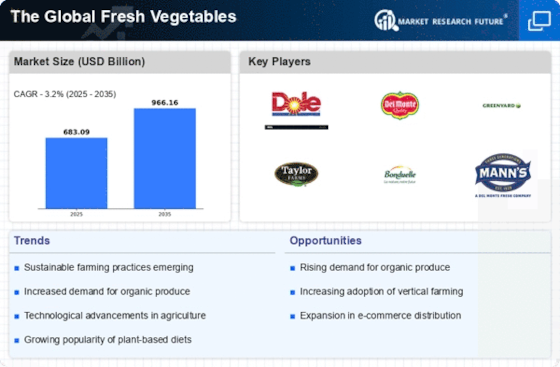
As per Market Research Future analysis, The Global Fresh Vegetables Market was estimated at 683.09 USD Billion in 2024. The fresh vegetables industry is projected to grow from 704.97 USD Billion in 2025 to 966.16 USD Billion by 2035, exhibiting a compound annual growth rate (CAGR) of 3.2% during the forecast period 2025 - 2035

Key Market Trends & Highlights

The Global Fresh Vegetables Market is experiencing robust growth driven by health consciousness and sustainability initiatives.

  • Health consciousness is propelling demand for fresh vegetables, particularly leafy greens, in North America. The Asia-Pacific region is emerging as the fastest-growing market, with increasing urbanization influencing vegetable consumption patterns. Diverse product offerings are becoming essential as consumers seek variety and convenience, especially through online retail channels. Rising health awareness and sustainability initiatives are key drivers, fostering growth in both organic farming and the root vegetables segment.

Market Size & Forecast

2024 Market Size 683.09 (USD Billion)
2035 Market Size 966.16 (USD Billion)
CAGR (2025 - 2035) 3.2%
Largest Regional Market Share in 2024 Asia Pacific

Major Players

Dole Food Company (US), Fresh Del Monte Produce Inc. (US), Greenyard (BE), Taylor Farms (US), Bonduelle (FR), Ceres Global Ag Corp (CA), Mann Packing Company (US), Loblaw Companies Limited (CA), AgroFresh Solutions, Inc. (US)

Market Trends

The Global fresh vegetables Market is currently experiencing a dynamic evolution, driven by shifting consumer preferences and increasing awareness of health benefits associated with fresh produce. As individuals become more health-conscious, there is a noticeable rise in demand for fresh vegetables, which are perceived as essential components of a balanced diet. This trend is further fueled by the growing popularity of plant-based diets, which emphasize the consumption of fresh produce over processed foods. Retailers and suppliers are adapting to these changes by enhancing their product offerings and improving supply chain efficiencies to meet consumer expectations across the expanding fresh fruit and vegetable market.

Moreover, sustainability concerns are influencing purchasing decisions within The Global Fresh Vegetables Market. Consumers are increasingly inclined to support brands that prioritize environmentally friendly practices, such as organic farming and reduced packaging waste. This shift towards sustainability is prompting producers to adopt innovative agricultural techniques that minimize environmental impact while maximizing yield. As the market continues to evolve, it appears that the focus on health and sustainability will remain pivotal in shaping the future landscape of fresh vegetable consumption within the broader fresh fruits & vegetables market.

Health Consciousness

The rising awareness of health benefits associated with fresh vegetables is driving consumer demand. Individuals are increasingly prioritizing their diets, leading to a greater emphasis on incorporating fresh produce into daily meals commonly sourced from organized retail channels and fresh vegetables farmers market environments.

Sustainability Initiatives

There is a growing trend towards sustainability within The Global Fresh Vegetables Market. Consumers are favoring brands that adopt environmentally friendly practices, prompting producers to implement sustainable agricultural methods that support the growth of the fresh fruit vegetable market ecosystem globally.

Diverse Product Offerings

Retailers are expanding their product ranges to cater to the evolving preferences of consumers. This includes introducing exotic varieties and organic options, reflecting the increasing interest in diverse and high-quality fresh vegetables commonly available in modern fresh fruits & vegetables market environments.

Fresh Vegetables Market Market Drivers

Rising Health Awareness

The increasing awareness regarding health and nutrition among consumers appears to be a pivotal driver for The Global fresh vegetables Industry. As individuals become more conscious of their dietary choices, the demand for fresh vegetables is likely to surge. Reports indicate that the consumption of fresh vegetables has risen by approximately 20% over the past five years, reflecting a shift towards healthier eating habits. This trend is further supported by various health organizations advocating for a diet rich in vegetables, which is perceived as essential for preventing chronic diseases. Consequently, The Global Fresh Vegetables Industry is experiencing a transformation, with consumers prioritizing fresh produce over processed foods, thereby enhancing market growth.

Sustainability and Organic Farming

Sustainability initiatives are increasingly influencing consumer preferences, thereby driving The Global Fresh Vegetables Industry. The shift towards organic farming practices is notable, as consumers express a preference for sustainably sourced products. Data suggests that organic vegetable sales have grown by over 30% in recent years, indicating a robust market for organic produce. This trend is not merely a passing phase; it reflects a broader societal commitment to environmental stewardship and sustainable agriculture. As more farmers adopt eco-friendly practices, The Global Fresh Vegetables Industry is likely to benefit from a growing segment of environmentally conscious consumers who are willing to pay a premium for organic and sustainably grown vegetables.

Urbanization and Changing Lifestyles

Urbanization is a significant factor influencing The Global Fresh Vegetables Industry. As more people migrate to urban areas, the demand for fresh vegetables is likely to increase due to changing lifestyles and dietary preferences. Urban consumers often seek convenience and quality, leading to a rise in the consumption of fresh produce. Market data indicates that urban areas account for over 70% of vegetable consumption, highlighting the importance of this demographic. Additionally, the trend towards meal kits and ready-to-eat fresh vegetable options is gaining traction in urban settings. This shift is expected to further propel The Global Fresh Vegetables Industry, as suppliers adapt to meet the needs of urban consumers.

Global Trade and Export Opportunities

The expansion of The Global Fresh Vegetables Industry. As countries seek to diversify their agricultural exports, fresh vegetables are becoming a key component of international trade. Data shows that exports of fresh vegetables have increased by approximately 15% in the last year, driven by demand from emerging markets. This trend is likely to continue as countries invest in improving their agricultural infrastructure and logistics. Furthermore, trade agreements and partnerships are facilitating easier access to international markets, allowing producers to reach a broader consumer base. As a result, The Global Fresh Vegetables Industry is poised for growth, benefiting from enhanced export opportunities and increased global demand.

Technological Advancements in Agriculture

Technological advancements in agriculture are reshaping the landscape of The Global Fresh Vegetables Industry. Innovations such as precision farming, hydroponics, and vertical farming are enhancing productivity and efficiency in vegetable production. These technologies enable farmers to optimize resource use, reduce waste, and increase yield per acre. For instance, hydroponic systems can produce vegetables with up to 90% less water than traditional farming methods. As these technologies become more accessible, they are expected to drive down costs and improve the quality of fresh vegetables available in the market. Consequently, The Global Fresh Vegetables Industry stands to gain from increased supply and improved product offerings, catering to the evolving demands of consumers.

Market Segment Insights

By Type: Leafy Greens (Largest) vs. Root Vegetables (Fastest-Growing)

In The Global Fresh Vegetables Market, the segment distribution reveals Leafy Greens as the dominant category, capturing the largest market share due to their widespread consumption and nutritional benefits. Root Vegetables, while holding a robust position, are identified as the fastest-growing segment, primarily driven by increasing health consciousness and the popularity of plant-based diets among consumers.

Leafy Greens (Dominant) vs. Root Vegetables (Emerging)

Leafy Greens, encompassing varieties like spinach, kale, and lettuce, are praised for their rich nutrient profiles and versatility in culinary applications, making them a staple in households worldwide. Their dominance is bolstered by rising awareness of health benefits and demand for fresh produce. In contrast, Root Vegetables, including carrots, radishes, and beets, are witnessing a surge in popularity as consumers increasingly explore their unique flavors and health advantages. This segment's growth is fueled by trends toward root-to-stem cooking practices and innovative recipes featuring these vegetables.

By Distribution Channel: Supermarkets (Largest) vs. Online Retail (Fastest-Growing)

In The Global Fresh Vegetables Market, supermarkets represent the largest distribution channel, capturing a significant market share due to their widespread presence and established customer base. They provide an extensive variety of fresh vegetables, catering to consumers' convenience and preferences. Following supermarkets, online retail is gaining traction as a growing segment, driven by shifts in consumer shopping habits, particularly enhanced by the convenience of home delivery and the ongoing digital transformation in retail.

Distribution Channels: Supermarkets (Dominant) vs. Online Retail (Emerging)

Supermarkets dominate the distribution of fresh vegetables, benefiting from their extensive supply chains, strategic locations, and broad marketing capabilities. They offer a diverse range of fresh produce, making them a one-stop shopping destination for many consumers. In contrast, online retail emerges as a key player, appealing to tech-savvy consumers who prefer the convenience of ordering from home. Factors such as the growth of e-commerce platforms and increased consumer trust in online grocery shopping are fostering the rise of this segment. Despite being in a developing stage compared to supermarkets, online retail is rapidly innovating, introducing subscription models and personalized shopping experiences.

By Organic Certification: Organic (Largest) vs. Conventional (Fastest-Growing)

In The Global Fresh Vegetables Market, the organic certification segment holds a substantial market share, significantly outpacing its conventional counterpart. This dominance can be attributed to rising consumer preferences for organic produce, driven by health-conscious choices and growing awareness regarding chemical pesticide usage. Consumers are increasingly drawn to organic options, which are perceived as safer and more nutritious, reflecting a broader trend toward sustainable eating practices. On the other hand, conventional vegetables are experiencing rapid growth as well, primarily due to their affordability and wider availability. Emerging markets are seeing a surge in demand for conventional vegetables as urbanization and population growth drive changes in dietary patterns. With price sensitivity still prevalent among many consumers, the conventional segment is expected to continue expanding, appealing particularly to cost-conscious buyers.

Organic (Dominant) vs. Conventional (Emerging)

The organic segment of the fresh vegetables market is characterized by premium pricing and increasing consumer demand, particularly in developed regions. Organic vegetables are cultivated without synthetic fertilizers and pesticides, appealing to health-conscious consumers and those promoting sustainable agricultural practices. Conversely, the conventional segment typically offers lower cost alternatives, thereby penetrating markets with budget-sensitive consumers. Conventional vegetables, while adopting some sustainable practices, still rely on chemical inputs, making them more accessible to the general public. As awareness of health and environmental concerns rises, the traditional divide between these segments may blur, giving rise to more hybrid products, but currently, organic remains the dominant choice among health enthusiasts, while conventional is emerging rapidly in price-sensitive demographics.

By Packaging Type: Bags (Largest) vs. Loose (Fastest-Growing)

In The Global Fresh Vegetables Market, the packaging type plays a pivotal role in the distribution and sales of fresh produce. Among the various packaging types, bags have emerged as the largest segment, owing to their convenience and cost-effectiveness. They offer a practical solution for consumers who prefer bulk purchases while ensuring the freshness of the vegetables. Loose packaging, while currently a smaller segment, is gaining traction among health-conscious consumers and eco-friendly advocates.

Bags (Dominant) vs. Loose (Emerging)

Bags are recognized as the dominant packaging type in the fresh vegetables market, providing a balance between usability and consumer appeal. Their design allows for easy handling and transportation, making them a preferred choice for retailers. In contrast, loose packaging is viewed as an emerging trend, appealing particularly to segments that prioritize sustainability and freshness over pre-packaged options. This shift is largely driven by consumer preferences for organic and locally-sourced vegetables, which often utilize loose packaging methods to enhance visibility and perceived freshness.

Get more detailed insights about Fresh Vegetables Market Research Report – Forecast till 2035

Regional Insights

The Global Fresh Vegetables Market is experiencing notable growth across various regions, reflecting significant consumer demand for fresh produce. In 2024, the North America segment valued at 65.0 USD Billion, demonstrating its leading role within the market, primarily driven by health-conscious consumers seeking organic and fresh vegetable options. Europe follow closely with a valuation of 55.0 USD Billion, where increasing awareness about nutrition and sustainable agriculture bolsters market growth.

Meanwhile, the APAC regionvalued at 80.0 USD Billion is projected to dominate by 2035, benefiting from rising urbanization and a growing population inclined towards fresh dietary habits.South America hld a valuation of 30.0 USD Billion, indicating its potential for future expansion due to improved agricultural practices and export opportunities. Lastly, the MEA segment, at 16.53 USD Billion, continues to grow, albeit at a slower pace, as local producers strive to enhance their supply chains amidst increasing regional demand.

The diverse dynamics of each region illustrate varying challenges and opportunities, propelling the Global Fresh Vegetables Market forward while highlighting the importance of locational factors in shaping market trends and consumer preferences.

Key Players and Competitive Insights

The Global Fresh Vegetables Market is characterized by an increasing demand for healthy and organic produce as consumers become more health-conscious and environmentally aware. This sector has experienced significant growth due to shifts towards plant-based diets and sustainable agricultural practices. Key drivers include the population surge, augmented food safety regulations, and advancements in agricultural technologies that enhance productivity. Furthermore, with the rising trend of convenience food, fresh vegetables are gaining traction as essential ingredients in the prepared meals segment. Competition in the market is dynamic, with numerous players vying for market share, often leading to innovation in product offerings and practices that enhance freshness and extend shelf life.Hormel Foods has strategically positioned itself within the Global Fresh Vegetables Market by focusing on quality and sustainability. The company's commitment to sourcing locally and forming strong relationships with farmers has enabled it to provide fresh and high-quality products. Hormel Foods benefits from an established distribution network that spans various channels, allowing for greater market reach and effective penetration. The company’s strength lies in its emphasis on innovation, with continuous investments in product development to meet consumer preferences for nutritious and convenient solutions. Such initiatives have enhanced its brand reputation and loyalty among customers who prioritize fresh produce in their diets.Kraft Heinz, operating within the Global Fresh Vegetables Market, emphasizes its portfolio of key products that cater to diverse consumer needs. The company has made significant inroads through its innovative offerings that prioritize quality, taste, and nutritional value. Kraft Heinz maintains a strong market presence by leveraging strategic partnerships and collaborations to enhance its distribution capabilities. The company’s strengths include its ability to adapt to evolving consumer trends, a robust supply chain, and sustained investments in mergers and acquisitions that bolster its position in the fresh produce segment. With a focus on expanding its organic and health-oriented product lines, Kraft Heinz is ideally positioned to capture a larger share of the growing market for fresh vegetables globally.

Key Companies in the Fresh Vegetables Market include

Industry Developments

Recent developments in the Global Fresh Vegetables Market have seen significant activity, particularly in the landscape of mergers and acquisitions. Notably, in July 2023, Hormel Foods announced its acquisition of a significant stake in a fresh vegetable producer, further expanding its portfolio. Kraft Heinz has been actively enhancing its vegetable offerings to meet rising consumer demand for healthier options. Calavo Growers is focusing on expanding its distribution networks to capitalize on the growing preference for fresh produce. Additionally, the Dole Food Company has launched a new line of value-added fresh vegetable products aimed at increasing market share amidst rising competition.

In recent years, Bakkavor Group has reported notable growth, benefiting from the shift towards fresh, convenient meals, while innovations from Green Giant and Fresh Del Monte Produce have boosted their product visibility in the market. Nestle and Bonduelle have also been adapting their strategies to enhance sustainability in vegetable sourcing. These movements underscore evolving consumer preferences toward fresh, sustainable produce and highlight the competitive dynamics shaping the Global Fresh Vegetables Market. The market continues to witness substantial growth driven by health trends and sustainability initiatives, positioning these companies at the forefront of an increasingly vital industry.

Future Outlook

Fresh Vegetables Market Future Outlook

The Global fresh vegetables Market is projected to grow at a 3.2% CAGR from 2025 to 2035, driven by increasing health consciousness, urbanization, and technological advancements in agriculture.

New opportunities lie in:

  • <p>Expansion of vertical farming technologies in urban areas. Development of subscription-based fresh vegetable delivery services. Investment in precision agriculture tools for yield optimization.</p>

By 2035, the market is expected to achieve robust growth, reflecting evolving consumer preferences and innovative agricultural practices.

Market Segmentation

Fresh Vegetables Market Type Outlook

  • Leafy Greens
  • Root Vegetables
  • Fruiting Vegetables
  • Cruciferous Vegetables
  • Legumes

Fresh Vegetables Market Packaging Type Outlook

  • Loose
  • Bags
  • Containers
  • Pre-packaged

Fresh Vegetables Market Distribution Channel Outlook

  • Supermarkets
  • Online Retail
  • Farmers Markets
  • Specialty Stores

Fresh Vegetables Market Organic Certification Outlook

  • Organic
  • Conventional

Report Scope

MARKET SIZE 2024 683.09(USD Billion)
MARKET SIZE 2025 704.97(USD Billion)
MARKET SIZE 2035 966.16(USD Billion)
COMPOUND ANNUAL GROWTH RATE (CAGR) 3.2% (2025 - 2035)
REPORT COVERAGE Revenue Forecast, Competitive Landscape, Growth Factors, and Trends
BASE YEAR 2024
Market Forecast Period 2025 - 2035
Historical Data 2019 - 2024
Market Forecast Units USD Billion
Key Companies Profiled Dole Food Company (US), Fresh Del Monte Produce Inc. (US), Greenyard (BE), Taylor Farms (US), Bonduelle (FR), Ceres Global Ag Corp (CA), Mann Packing Company (US), Loblaw Companies Limited (CA), AgroFresh Solutions, Inc. (US)
Segments Covered Type, Distribution Channel, Organic Certification, Packaging Type, Regional
Key Market Opportunities Growing consumer demand for organic produce drives innovation in The Global Fresh Vegetables.
Key Market Dynamics Rising consumer demand for organic produce drives innovation and competition in the fresh vegetables market.
Countries Covered North America, Europe, APAC, South America, MEA

FAQs

What is the projected market valuation of The Global Fresh Vegetables by 2035?

<p>The projected market valuation for The Global Fresh Vegetables is 966.16 USD Billion by 2035.</p>

What was the overall market valuation of The Global Fresh Vegetables in 2024?

The overall market valuation of The Global Fresh Vegetables was 683.09 USD Billion in 2024.

What is the expected CAGR for The Global Fresh Vegetables during the forecast period 2025 - 2035?

The expected CAGR for The Global Fresh Vegetables during the forecast period 2025 - 2035 is 3.2%.

Which segment of fresh vegetables had the highest valuation in 2024?

Fruiting vegetables had the highest valuation at 200.0 USD Billion in 2024.

What are the projected valuations for leafy greens by 2035?

The projected valuation for leafy greens is expected to reach 210.0 USD Billion by 2035.

How do supermarkets compare to online retail in terms of market valuation in 2024?

In 2024, supermarkets had a market valuation of 300.0 USD Billion, significantly higher than online retail's 100.0 USD Billion.

What is the market valuation for organic fresh vegetables in 2024?

The market valuation for organic fresh vegetables was 150.0 USD Billion in 2024.

Which packaging type is projected to have the highest valuation by 2035?

Pre-packaged vegetables are projected to have the highest valuation at 336.16 USD Billion by 2035.

Who are the key players in The Global Fresh Vegetables?

Key players in the market include Dole Food Company, Fresh Del Monte Produce Inc., and Bonduelle, among others.

What is the projected valuation for root vegetables by 2035?

The projected valuation for root vegetables is expected to reach 170.0 USD Billion by 2035.

  1. SECTION I: EXECUTIVE SUMMARY AND KEY HIGHLIGHTS |
    1. EXECUTIVE SUMMARY | |
      1. Market Overview | |
      2. Key Findings | |
      3. Market Segmentation | |
      4. Competitive Landscape | |
      5. Challenges and Opportunities | |
      6. Future Outlook 2
  2. SECTION II: SCOPING, METHODOLOGY AND MARKET STRUCTURE |
    1. MARKET INTRODUCTION | |
      1. Definition | |
      2. Scope of the study | | |
    2. RESEARCH METHODOLOGY | |
      1. Overview | |
      2. Data Mining | |
      3. Secondary Research | |
      4. Primary Research | | |
      5. Forecasting Model | |
      6. Market Size Estimation | | |
      7. Data Triangulation | |
      8. Validation 3
  3. SECTION III: QUALITATIVE ANALYSIS |
    1. MARKET DYNAMICS | |
      1. Overview | |
      2. Drivers | |
      3. Restraints | |
      4. Opportunities |
    2. MARKET FACTOR ANALYSIS | |
      1. Value chain Analysis | |
      2. Porter's Five Forces Analysis | | |
      3. COVID-19 Impact Analysis | | |
  4. SECTION IV: QUANTITATIVE ANALYSIS |
    1. Food, Beverages & Nutrition, BY Type (USD Billion) | |
      1. Leafy Greens | |
      2. Root Vegetables | |
      3. Fruiting Vegetables | |
      4. Cruciferous Vegetables | |
      5. Legumes |
    2. Food, Beverages & Nutrition, BY Distribution Channel (USD Billion) | |
      1. Supermarkets | |
      2. Online Retail | |
      3. Farmers Markets | |
      4. Specialty Stores |
    3. Food, Beverages & Nutrition, BY Organic Certification (USD Billion) | |
      1. Organic | |
      2. Conventional |
    4. Food, Beverages & Nutrition, BY Packaging Type (USD Billion) | |
      1. Loose | |
      2. Bags | |
      3. Containers | |
      4. Pre-packaged |
    5. Food, Beverages & Nutrition, BY Region (USD Billion) | |
      1. North America | | |
      2. Europe | | |
      3. APAC | | |
      4. South America | | |
      5. MEA | | |
  5. SECTION V: COMPETITIVE ANALYSIS |
    1. Competitive Landscape | |
      1. Overview | |
      2. Competitive Analysis | |
      3. Market share Analysis | |
      4. Major Growth Strategy in the Food, Beverages & Nutrition | |
      5. Competitive Benchmarking | |
      6. Leading Players in Terms of Number of Developments in the Food, Beverages & Nutrition | |
      7. Key developments and growth strategies | | |
      8. Major Players Financial Matrix | | |
    2. Company Profiles | |
      1. Dole Food Company (US) | | |
      2. Fresh Del Monte Produce Inc. (US) | | |
      3. Greenyard (BE) | | |
      4. Taylor Farms (US) | | |
      5. Bonduelle (FR) | | |
      6. Ceres Global Ag Corp (CA) | | |
      7. Mann Packing Company (US) | | |
      8. Loblaw Companies Limited (CA) | | |
      9. AgroFresh Solutions, Inc. (US) | | |
    3. Appendix | |
      1. References | |
      2. Related Reports 6 LIST OF FIGURES |
    4. MARKET SYNOPSIS |
    5. NORTH AMERICA MARKET ANALYSIS |
    6. US MARKET ANALYSIS BY TYPE |
    7. US MARKET ANALYSIS BY DISTRIBUTION CHANNEL |
    8. US MARKET ANALYSIS BY ORGANIC CERTIFICATION |
    9. US MARKET ANALYSIS BY PACKAGING TYPE |
    10. CANADA MARKET ANALYSIS BY TYPE |
    11. CANADA MARKET ANALYSIS BY DISTRIBUTION CHANNEL |
    12. CANADA MARKET ANALYSIS BY ORGANIC CERTIFICATION |
    13. CANADA MARKET ANALYSIS BY PACKAGING TYPE |
    14. EUROPE MARKET ANALYSIS |
    15. GERMANY MARKET ANALYSIS BY TYPE |
    16. GERMANY MARKET ANALYSIS BY DISTRIBUTION CHANNEL |
    17. GERMANY MARKET ANALYSIS BY ORGANIC CERTIFICATION |
    18. GERMANY MARKET ANALYSIS BY PACKAGING TYPE |
    19. UK MARKET ANALYSIS BY TYPE |
    20. UK MARKET ANALYSIS BY DISTRIBUTION CHANNEL |
    21. UK MARKET ANALYSIS BY ORGANIC CERTIFICATION |
    22. UK MARKET ANALYSIS BY PACKAGING TYPE |
    23. FRANCE MARKET ANALYSIS BY TYPE |
    24. FRANCE MARKET ANALYSIS BY DISTRIBUTION CHANNEL |
    25. FRANCE MARKET ANALYSIS BY ORGANIC CERTIFICATION |
    26. FRANCE MARKET ANALYSIS BY PACKAGING TYPE |
    27. RUSSIA MARKET ANALYSIS BY TYPE |
    28. RUSSIA MARKET ANALYSIS BY DISTRIBUTION CHANNEL |
    29. RUSSIA MARKET ANALYSIS BY ORGANIC CERTIFICATION |
    30. RUSSIA MARKET ANALYSIS BY PACKAGING TYPE |
    31. ITALY MARKET ANALYSIS BY TYPE |
    32. ITALY MARKET ANALYSIS BY DISTRIBUTION CHANNEL |
    33. ITALY MARKET ANALYSIS BY ORGANIC CERTIFICATION |
    34. ITALY MARKET ANALYSIS BY PACKAGING TYPE |
    35. SPAIN MARKET ANALYSIS BY TYPE |
    36. SPAIN MARKET ANALYSIS BY DISTRIBUTION CHANNEL |
    37. SPAIN MARKET ANALYSIS BY ORGANIC CERTIFICATION |
    38. SPAIN MARKET ANALYSIS BY PACKAGING TYPE |
    39. REST OF EUROPE MARKET ANALYSIS BY TYPE |
    40. REST OF EUROPE MARKET ANALYSIS BY DISTRIBUTION CHANNEL |
    41. REST OF EUROPE MARKET ANALYSIS BY ORGANIC CERTIFICATION |
    42. REST OF EUROPE MARKET ANALYSIS BY PACKAGING TYPE |
    43. APAC MARKET ANALYSIS |
    44. CHINA MARKET ANALYSIS BY TYPE |
    45. CHINA MARKET ANALYSIS BY DISTRIBUTION CHANNEL |
    46. CHINA MARKET ANALYSIS BY ORGANIC CERTIFICATION |
    47. CHINA MARKET ANALYSIS BY PACKAGING TYPE |
    48. INDIA MARKET ANALYSIS BY TYPE |
    49. INDIA MARKET ANALYSIS BY DISTRIBUTION CHANNEL |
    50. INDIA MARKET ANALYSIS BY ORGANIC CERTIFICATION |
    51. INDIA MARKET ANALYSIS BY PACKAGING TYPE |
    52. JAPAN MARKET ANALYSIS BY TYPE |
    53. JAPAN MARKET ANALYSIS BY DISTRIBUTION CHANNEL |
    54. JAPAN MARKET ANALYSIS BY ORGANIC CERTIFICATION |
    55. JAPAN MARKET ANALYSIS BY PACKAGING TYPE |
    56. SOUTH KOREA MARKET ANALYSIS BY TYPE |
    57. SOUTH KOREA MARKET ANALYSIS BY DISTRIBUTION CHANNEL |
    58. SOUTH KOREA MARKET ANALYSIS BY ORGANIC CERTIFICATION |
    59. SOUTH KOREA MARKET ANALYSIS BY PACKAGING TYPE |
    60. MALAYSIA MARKET ANALYSIS BY TYPE |
    61. MALAYSIA MARKET ANALYSIS BY DISTRIBUTION CHANNEL |
    62. MALAYSIA MARKET ANALYSIS BY ORGANIC CERTIFICATION |
    63. MALAYSIA MARKET ANALYSIS BY PACKAGING TYPE |
    64. THAILAND MARKET ANALYSIS BY TYPE |
    65. THAILAND MARKET ANALYSIS BY DISTRIBUTION CHANNEL |
    66. THAILAND MARKET ANALYSIS BY ORGANIC CERTIFICATION |
    67. THAILAND MARKET ANALYSIS BY PACKAGING TYPE |
    68. INDONESIA MARKET ANALYSIS BY TYPE |
    69. INDONESIA MARKET ANALYSIS BY DISTRIBUTION CHANNEL |
    70. INDONESIA MARKET ANALYSIS BY ORGANIC CERTIFICATION |
    71. INDONESIA MARKET ANALYSIS BY PACKAGING TYPE |
    72. REST OF APAC MARKET ANALYSIS BY TYPE |
    73. REST OF APAC MARKET ANALYSIS BY DISTRIBUTION CHANNEL |
    74. REST OF APAC MARKET ANALYSIS BY ORGANIC CERTIFICATION |
    75. REST OF APAC MARKET ANALYSIS BY PACKAGING TYPE |
    76. SOUTH AMERICA MARKET ANALYSIS |
    77. BRAZIL MARKET ANALYSIS BY TYPE |
    78. BRAZIL MARKET ANALYSIS BY DISTRIBUTION CHANNEL |
    79. BRAZIL MARKET ANALYSIS BY ORGANIC CERTIFICATION |
    80. BRAZIL MARKET ANALYSIS BY PACKAGING TYPE |
    81. MEXICO MARKET ANALYSIS BY TYPE |
    82. MEXICO MARKET ANALYSIS BY DISTRIBUTION CHANNEL |
    83. MEXICO MARKET ANALYSIS BY ORGANIC CERTIFICATION |
    84. MEXICO MARKET ANALYSIS BY PACKAGING TYPE |
    85. ARGENTINA MARKET ANALYSIS BY TYPE |
    86. ARGENTINA MARKET ANALYSIS BY DISTRIBUTION CHANNEL |
    87. ARGENTINA MARKET ANALYSIS BY ORGANIC CERTIFICATION |
    88. ARGENTINA MARKET ANALYSIS BY PACKAGING TYPE |
    89. REST OF SOUTH AMERICA MARKET ANALYSIS BY TYPE |
    90. REST OF SOUTH AMERICA MARKET ANALYSIS BY DISTRIBUTION CHANNEL |
    91. REST OF SOUTH AMERICA MARKET ANALYSIS BY ORGANIC CERTIFICATION |
    92. REST OF SOUTH AMERICA MARKET ANALYSIS BY PACKAGING TYPE |
    93. MEA MARKET ANALYSIS |
    94. GCC COUNTRIES MARKET ANALYSIS BY TYPE |
    95. GCC COUNTRIES MARKET ANALYSIS BY DISTRIBUTION CHANNEL |
    96. GCC COUNTRIES MARKET ANALYSIS BY ORGANIC CERTIFICATION |
    97. GCC COUNTRIES MARKET ANALYSIS BY PACKAGING TYPE |
    98. SOUTH AFRICA MARKET ANALYSIS BY TYPE |
    99. SOUTH AFRICA MARKET ANALYSIS BY DISTRIBUTION CHANNEL |
    100. SOUTH AFRICA MARKET ANALYSIS BY ORGANIC CERTIFICATION |
    101. SOUTH AFRICA MARKET ANALYSIS BY PACKAGING TYPE |
    102. REST OF MEA MARKET ANALYSIS BY TYPE |
    103. REST OF MEA MARKET ANALYSIS BY DISTRIBUTION CHANNEL |
    104. REST OF MEA MARKET ANALYSIS BY ORGANIC CERTIFICATION |
    105. REST OF MEA MARKET ANALYSIS BY PACKAGING TYPE |
    106. KEY BUYING CRITERIA OF FOOD, BEVERAGES & NUTRITION |
    107. RESEARCH PROCESS OF MRFR |
    108. DRO ANALYSIS OF FOOD, BEVERAGES & NUTRITION |
    109. DRIVERS IMPACT ANALYSIS: FOOD, BEVERAGES & NUTRITION |
    110. RESTRAINTS IMPACT ANALYSIS: FOOD, BEVERAGES & NUTRITION |
    111. SUPPLY / VALUE CHAIN: FOOD, BEVERAGES & NUTRITION |
    112. FOOD, BEVERAGES & NUTRITION, BY TYPE, 2024 (% SHARE) |
    113. FOOD, BEVERAGES & NUTRITION, BY TYPE, 2024 TO 2035 (USD Billion) |
    114. FOOD, BEVERAGES & NUTRITION, BY DISTRIBUTION CHANNEL, 2024 (% SHARE) |
    115. FOOD, BEVERAGES & NUTRITION, BY DISTRIBUTION CHANNEL, 2024 TO 2035 (USD Billion) |
    116. FOOD, BEVERAGES & NUTRITION, BY ORGANIC CERTIFICATION, 2024 (% SHARE) |
    117. FOOD, BEVERAGES & NUTRITION, BY ORGANIC CERTIFICATION, 2024 TO 2035 (USD Billion) |
    118. FOOD, BEVERAGES & NUTRITION, BY PACKAGING TYPE, 2024 (% SHARE) |
    119. FOOD, BEVERAGES & NUTRITION, BY PACKAGING TYPE, 2024 TO 2035 (USD Billion) |
    120. BENCHMARKING OF MAJOR COMPETITORS 7 LIST OF TABLES |
    121. LIST OF ASSUMPTIONS | |
      1. |
    122. North America MARKET SIZE ESTIMATES; FORECAST | |
      1. BY TYPE, 2025-2035 (USD Billion) | |
      2. BY DISTRIBUTION CHANNEL, 2025-2035 (USD Billion) | |
      3. BY ORGANIC CERTIFICATION, 2025-2035 (USD Billion) | |
      4. BY PACKAGING TYPE, 2025-2035 (USD Billion) |
    123. US MARKET SIZE ESTIMATES; FORECAST | |
      1. BY TYPE, 2025-2035 (USD Billion) | |
      2. BY DISTRIBUTION CHANNEL, 2025-2035 (USD Billion) | |
      3. BY ORGANIC CERTIFICATION, 2025-2035 (USD Billion) | |
      4. BY PACKAGING TYPE, 2025-2035 (USD Billion) |
    124. Canada MARKET SIZE ESTIMATES; FORECAST | |
      1. BY TYPE, 2025-2035 (USD Billion) | |
      2. BY DISTRIBUTION CHANNEL, 2025-2035 (USD Billion) | |
      3. BY ORGANIC CERTIFICATION, 2025-2035 (USD Billion) | |
      4. BY PACKAGING TYPE, 2025-2035 (USD Billion) |
    125. Europe MARKET SIZE ESTIMATES; FORECAST | |
      1. BY TYPE, 2025-2035 (USD Billion) | |
      2. BY DISTRIBUTION CHANNEL, 2025-2035 (USD Billion) | |
      3. BY ORGANIC CERTIFICATION, 2025-2035 (USD Billion) | |
      4. BY PACKAGING TYPE, 2025-2035 (USD Billion) |
    126. Germany MARKET SIZE ESTIMATES; FORECAST | |
      1. BY TYPE, 2025-2035 (USD Billion) | |
      2. BY DISTRIBUTION CHANNEL, 2025-2035 (USD Billion) | |
      3. BY ORGANIC CERTIFICATION, 2025-2035 (USD Billion) | |
      4. BY PACKAGING TYPE, 2025-2035 (USD Billion) |
    127. UK MARKET SIZE ESTIMATES; FORECAST | |
      1. BY TYPE, 2025-2035 (USD Billion) | |
      2. BY DISTRIBUTION CHANNEL, 2025-2035 (USD Billion) | |
      3. BY ORGANIC CERTIFICATION, 2025-2035 (USD Billion) | |
      4. BY PACKAGING TYPE, 2025-2035 (USD Billion) |
    128. France MARKET SIZE ESTIMATES; FORECAST | |
      1. BY TYPE, 2025-2035 (USD Billion) | |
      2. BY DISTRIBUTION CHANNEL, 2025-2035 (USD Billion) | |
      3. BY ORGANIC CERTIFICATION, 2025-2035 (USD Billion) | |
      4. BY PACKAGING TYPE, 2025-2035 (USD Billion) |
    129. Russia MARKET SIZE ESTIMATES; FORECAST | |
      1. BY TYPE, 2025-2035 (USD Billion) | |
      2. BY DISTRIBUTION CHANNEL, 2025-2035 (USD Billion) | |
      3. BY ORGANIC CERTIFICATION, 2025-2035 (USD Billion) | |
      4. BY PACKAGING TYPE, 2025-2035 (USD Billion) |
    130. Italy MARKET SIZE ESTIMATES; FORECAST | |
      1. BY TYPE, 2025-2035 (USD Billion) | |
      2. BY DISTRIBUTION CHANNEL, 2025-2035 (USD Billion) | |
      3. BY ORGANIC CERTIFICATION, 2025-2035 (USD Billion) | |
      4. BY PACKAGING TYPE, 2025-2035 (USD Billion) |
    131. Spain MARKET SIZE ESTIMATES; FORECAST | |
      1. BY TYPE, 2025-2035 (USD Billion) | |
      2. BY DISTRIBUTION CHANNEL, 2025-2035 (USD Billion) | |
      3. BY ORGANIC CERTIFICATION, 2025-2035 (USD Billion) | |
      4. BY PACKAGING TYPE, 2025-2035 (USD Billion) |
    132. Rest of Europe MARKET SIZE ESTIMATES; FORECAST | |
      1. BY TYPE, 2025-2035 (USD Billion) | |
      2. BY DISTRIBUTION CHANNEL, 2025-2035 (USD Billion) | |
      3. BY ORGANIC CERTIFICATION, 2025-2035 (USD Billion) | |
      4. BY PACKAGING TYPE, 2025-2035 (USD Billion) |
    133. APAC MARKET SIZE ESTIMATES; FORECAST | |
      1. BY TYPE, 2025-2035 (USD Billion) | |
      2. BY DISTRIBUTION CHANNEL, 2025-2035 (USD Billion) | |
      3. BY ORGANIC CERTIFICATION, 2025-2035 (USD Billion) | |
      4. BY PACKAGING TYPE, 2025-2035 (USD Billion) |
    134. China MARKET SIZE ESTIMATES; FORECAST | |
      1. BY TYPE, 2025-2035 (USD Billion) | |
      2. BY DISTRIBUTION CHANNEL, 2025-2035 (USD Billion) | |
      3. BY ORGANIC CERTIFICATION, 2025-2035 (USD Billion) | |
      4. BY PACKAGING TYPE, 2025-2035 (USD Billion) |
    135. India MARKET SIZE ESTIMATES; FORECAST | |
      1. BY TYPE, 2025-2035 (USD Billion) | |
      2. BY DISTRIBUTION CHANNEL, 2025-2035 (USD Billion) | |
      3. BY ORGANIC CERTIFICATION, 2025-2035 (USD Billion) | |
      4. BY PACKAGING TYPE, 2025-2035 (USD Billion) |
    136. Japan MARKET SIZE ESTIMATES; FORECAST | |
      1. BY TYPE, 2025-2035 (USD Billion) | |
      2. BY DISTRIBUTION CHANNEL, 2025-2035 (USD Billion) | |
      3. BY ORGANIC CERTIFICATION, 2025-2035 (USD Billion) | |
      4. BY PACKAGING TYPE, 2025-2035 (USD Billion) |
    137. South Korea MARKET SIZE ESTIMATES; FORECAST | |
      1. BY TYPE, 2025-2035 (USD Billion) | |
      2. BY DISTRIBUTION CHANNEL, 2025-2035 (USD Billion) | |
      3. BY ORGANIC CERTIFICATION, 2025-2035 (USD Billion) | |
      4. BY PACKAGING TYPE, 2025-2035 (USD Billion) |
    138. Malaysia MARKET SIZE ESTIMATES; FORECAST | |
      1. BY TYPE, 2025-2035 (USD Billion) | |
      2. BY DISTRIBUTION CHANNEL, 2025-2035 (USD Billion) | |
      3. BY ORGANIC CERTIFICATION, 2025-2035 (USD Billion) | |
      4. BY PACKAGING TYPE, 2025-2035 (USD Billion) |
    139. Thailand MARKET SIZE ESTIMATES; FORECAST | |
      1. BY TYPE, 2025-2035 (USD Billion) | |
      2. BY DISTRIBUTION CHANNEL, 2025-2035 (USD Billion) | |
      3. BY ORGANIC CERTIFICATION, 2025-2035 (USD Billion) | |
      4. BY PACKAGING TYPE, 2025-2035 (USD Billion) |
    140. Indonesia MARKET SIZE ESTIMATES; FORECAST | |
      1. BY TYPE, 2025-2035 (USD Billion) | |
      2. BY DISTRIBUTION CHANNEL, 2025-2035 (USD Billion) | |
      3. BY ORGANIC CERTIFICATION, 2025-2035 (USD Billion) | |
      4. BY PACKAGING TYPE, 2025-2035 (USD Billion) |
    141. Rest of APAC MARKET SIZE ESTIMATES; FORECAST | |
      1. BY TYPE, 2025-2035 (USD Billion) | |
      2. BY DISTRIBUTION CHANNEL, 2025-2035 (USD Billion) | |
      3. BY ORGANIC CERTIFICATION, 2025-2035 (USD Billion) | |
      4. BY PACKAGING TYPE, 2025-2035 (USD Billion) |
    142. South America MARKET SIZE ESTIMATES; FORECAST | |
      1. BY TYPE, 2025-2035 (USD Billion) | |
      2. BY DISTRIBUTION CHANNEL, 2025-2035 (USD Billion) | |
      3. BY ORGANIC CERTIFICATION, 2025-2035 (USD Billion) | |
      4. BY PACKAGING TYPE, 2025-2035 (USD Billion) |
    143. Brazil MARKET SIZE ESTIMATES; FORECAST | |
      1. BY TYPE, 2025-2035 (USD Billion) | |
      2. BY DISTRIBUTION CHANNEL, 2025-2035 (USD Billion) | |
      3. BY ORGANIC CERTIFICATION, 2025-2035 (USD Billion) | |
      4. BY PACKAGING TYPE, 2025-2035 (USD Billion) |
    144. Mexico MARKET SIZE ESTIMATES; FORECAST | |
      1. BY TYPE, 2025-2035 (USD Billion) | |
      2. BY DISTRIBUTION CHANNEL, 2025-2035 (USD Billion) | |
      3. BY ORGANIC CERTIFICATION, 2025-2035 (USD Billion) | |
      4. BY PACKAGING TYPE, 2025-2035 (USD Billion) |
    145. Argentina MARKET SIZE ESTIMATES; FORECAST | |
      1. BY TYPE, 2025-2035 (USD Billion) | |
      2. BY DISTRIBUTION CHANNEL, 2025-2035 (USD Billion) | |
      3. BY ORGANIC CERTIFICATION, 2025-2035 (USD Billion) | |
      4. BY PACKAGING TYPE, 2025-2035 (USD Billion) |
    146. Rest of South America MARKET SIZE ESTIMATES; FORECAST | |
      1. BY TYPE, 2025-2035 (USD Billion) | |
      2. BY DISTRIBUTION CHANNEL, 2025-2035 (USD Billion) | |
      3. BY ORGANIC CERTIFICATION, 2025-2035 (USD Billion) | |
      4. BY PACKAGING TYPE, 2025-2035 (USD Billion) |
    147. MEA MARKET SIZE ESTIMATES; FORECAST | |
      1. BY TYPE, 2025-2035 (USD Billion) | |
      2. BY DISTRIBUTION CHANNEL, 2025-2035 (USD Billion) | |
      3. BY ORGANIC CERTIFICATION, 2025-2035 (USD Billion) | |
      4. BY PACKAGING TYPE, 2025-2035 (USD Billion) |
    148. GCC Countries MARKET SIZE ESTIMATES; FORECAST | |
      1. BY TYPE, 2025-2035 (USD Billion) | |
      2. BY DISTRIBUTION CHANNEL, 2025-2035 (USD Billion) | |
      3. BY ORGANIC CERTIFICATION, 2025-2035 (USD Billion) | |
      4. BY PACKAGING TYPE, 2025-2035 (USD Billion) |
    149. South Africa MARKET SIZE ESTIMATES; FORECAST | |
      1. BY TYPE, 2025-2035 (USD Billion) | |
      2. BY DISTRIBUTION CHANNEL, 2025-2035 (USD Billion) | |
      3. BY ORGANIC CERTIFICATION, 2025-2035 (USD Billion) | |
      4. BY PACKAGING TYPE, 2025-2035 (USD Billion) |
    150. Rest of MEA MARKET SIZE ESTIMATES; FORECAST | |
      1. BY TYPE, 2025-2035 (USD Billion) | |
      2. BY DISTRIBUTION CHANNEL, 2025-2035 (USD Billion) | |
      3. BY ORGANIC CERTIFICATION, 2025-2035 (USD Billion) | |
      4. BY PACKAGING TYPE, 2025-2035 (USD Billion) |
    151. PRODUCT LAUNCH/PRODUCT DEVELOPMENT/APPROVAL | |
      1. |
    152. ACQUISITION/PARTNERSHIP | |

Food, Beverages & Nutrition Market Segmentation

Food, Beverages & Nutrition By Type (USD Billion, 2025-2035)

  • Leafy Greens
  • Root Vegetables
  • Fruiting Vegetables
  • Cruciferous Vegetables
  • Legumes

Food, Beverages & Nutrition By Distribution Channel (USD Billion, 2025-2035)

  • Supermarkets
  • Online Retail
  • Farmers Markets
  • Specialty Stores

Food, Beverages & Nutrition By Organic Certification (USD Billion, 2025-2035)

  • Organic
  • Conventional

Food, Beverages & Nutrition By Packaging Type (USD Billion, 2025-2035)

  • Loose
  • Bags
  • Containers
  • Pre-packaged
Infographic

Free Sample Request

Kindly complete the form below to receive a free sample of this Report

Get Free Sample

Customer Strories

Compare Licence

×
Features License Type
Single User Multiuser License Enterprise User
Price $4,950 $5,950 $7,250
Maximum User Access Limit 1 User Upto 10 Users Unrestricted Access Throughout the Organization
Free Customization
Direct Access to Analyst
Deliverable Format
Platform Access
Discount on Next Purchase 10% 15% 15%
Printable Versions