
Request Free Sample ×

Kindly complete the form below to receive a free sample of this Report

* Please use a valid business email

Leading companies partner with us for data-driven Insights

clients tt-cursor
Hero Background
English
Chinese
French
Japanese
Korean
German
Spanish

FRAM Market Trends

ID: MRFR/SEM/7046-CR
200 Pages
Shubham Munde
July 2025

FRAM Market Size, Share and Research Report By Technology (Ferroelectric RAM, Embedded FRAM, Standalone FRAM, Multi-bit FRAM), By End Use Application (Consumer Electronics, Automotive, Industrial, Telecommunication), By Storage Capacity (128 Kbit, 256 Kbit, 1 Mbit, 4 Mbit), By Product Type (Non-volatile FRAM, Volatile FRAM) and By Regional (North America, Europe, South America, Asia Pacific, Middle East and Africa) - Industry Forecast Till 2035

Share:
Download PDF ×

We do not share your information with anyone. However, we may send you emails based on your report interest from time to time. You may contact us at any time to opt-out.

FRAM Market Infographic
Purchase Options

Market Trends

Key Emerging Trends in the FRAM Market

The rising demand for FRAM (ferroelectric random-access memory) in the automotive industry is a result of rapid advancements in mobile communication and the increasing significance of computer technology. These developments have paved the way for improved in-vehicle displays, incorporating features such as virtual dashboards, 3D navigation maps, and sophisticated infotainment systems. FRAM emerges as a pivotal solution to address the evolving needs of the automotive sector, providing enhanced memory capabilities. Notably, FRAM exhibits rapid write and access speeds, outperforming alternatives like EEPROMs and NOR flash memory. Its popularity in automotive applications is attributed to its high performance, energy efficiency, data integrity, and robust thermal endurance. FRAM finds diverse applications in the automotive sector, including airbag data storage, data event recorders (DER), battery management systems (BMS), advanced driver assistance systems (ADAS), and navigation and infotainment systems. Its versatility and reliability make it a preferred choice for critical functions within modern vehicles. The escalating demand for FRAM solutions from automotive market players is expected to be a driving force for the FRAM market in the forecast period. Major companies like Samsung Electronics and SK Hynix are strategically expanding their product portfolios to offer premium FRAM solutions tailored for automotive applications. These solutions cater to the specific needs of advanced driver assistance systems, central controllers for self-driving cars, and infotainment and gateway devices. In response to the increasing market demand, other industry players are likely to adopt similar organic strategies. This trend involves the expansion and enhancement of product offerings in the domain of automobile-based FRAM. The collective efforts of key players to meet the evolving requirements of the automotive industry contribute to the positive trajectory of the FRAM market. As FRAM continues to play a crucial role in advancing automotive technology, its integration into various vehicle systems is expected to drive sustained market growth. The focus on enhancing memory solutions for automotive applications aligns with the broader trend of technological innovation in the automotive sector, emphasizing efficiency, performance, and reliability. The growing importance of FRAM in automobiles positions it as a key component in shaping the future of in-vehicle electronics and data management.
Author
Shubham Munde
Team Lead - Research

Shubham brings over 7 years of expertise in Market Intelligence and Strategic Consulting, with a strong focus on the Automotive, Aerospace, and Defense sectors. Backed by a solid foundation in semiconductors, electronics, and software, he has successfully delivered high-impact syndicated and custom research on a global scale. His core strengths include market sizing, forecasting, competitive intelligence, consumer insights, and supply chain mapping. Widely recognized for developing scalable growth strategies, Shubham empowers clients to navigate complex markets and achieve a lasting competitive edge. Trusted by start-ups and Fortune 500 companies alike, he consistently converts challenges into strategic opportunities that drive sustainable growth.

Leave a Comment

FAQs

What is the projected market valuation of the FRAM market by 2035?

<p>The FRAM market is projected to reach a valuation of 1.491 USD Billion by 2035.</p>

What was the market valuation of the FRAM market in 2024?

<p>In 2024, the FRAM market had a valuation of 0.4973 USD Billion.</p>

What is the expected CAGR for the FRAM market during the forecast period 2025 - 2035?

<p>The expected CAGR for the FRAM market during the forecast period 2025 - 2035 is 10.5%.</p>

Which companies are considered key players in the FRAM market?

<p>Key players in the FRAM market include Texas Instruments, Cypress Semiconductor, Infineon Technologies, and others.</p>

What are the main technology segments within the FRAM market?

<p>The main technology segments within the FRAM market include Ferroelectric RAM, Embedded FRAM, Standalone FRAM, and Multi-bit FRAM.</p>

How does the consumer electronics segment perform in the FRAM market?

<p>The consumer electronics segment was valued at 0.1493 USD Billion in 2024 and is expected to grow significantly.</p>

What is the valuation of the automotive segment in the FRAM market?

<p>The automotive segment was valued at 0.1242 USD Billion in 2024, indicating its relevance in the market.</p>

What storage capacities are available in the FRAM market?

<p>Available storage capacities in the FRAM market include 128 Kbit, 256 Kbit, 1 Mbit, and 4 Mbit.</p>

What types of FRAM products are present in the market?

<p>The FRAM market includes non-volatile FRAM and volatile FRAM as its primary product types.</p>

How does the industrial segment contribute to the FRAM market?

<p>The industrial segment was valued at 0.1035 USD Billion in 2024, showcasing its contribution to the overall market.</p>

Market Summary

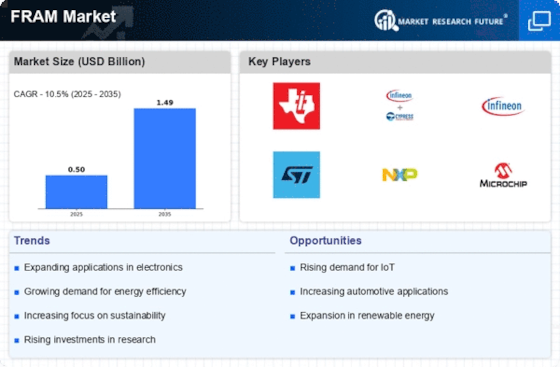
As per Market Research Future analysis, the FRAM Market Size was estimated at 0.4973 USD Billion in 2024. The FRAM industry is projected to grow from USD 0.5495 Billion in 2025 to USD 1.491 Billion by 2035, exhibiting a compound annual growth rate (CAGR) of 10.5% during the forecast period 2025 - 2035

Key Market Trends & Highlights

The FRAM Market is poised for substantial growth driven by technological advancements and increasing demand across various applications.

  • North America remains the largest market for FRAM Market, driven by robust technological innovations. Asia-Pacific is emerging as the fastest-growing region, fueled by rising adoption of smart devices and IoT applications. Embedded FRAM Market continues to dominate the market, while standalone FRAM Market is experiencing rapid growth due to its unique advantages. Key market drivers include technological advancements and the growing demand in automotive electronics, which are shaping the future of the FRAM industry.

Market Size & Forecast

2024 Market Size 0.4973 (USD Billion)
2035 Market Size 1.491 (USD Billion)
CAGR (2025 - 2035) 10.5%
Largest Regional Market Share in 2024 North America

Major Players

Texas Instruments (US), Cypress Semiconductor (US), Infineon Technologies (DE), STMicroelectronics (FR), NXP Semiconductors (NL), Microchip Technology (US), ON Semiconductor (US), Renesas Electronics (JP), Analog Devices (US)

Market Trends

The FRAM Market is currently experiencing a dynamic evolution, driven by advancements in technology and increasing demand for energy-efficient solutions. This sector, which encompasses ferroelectric random access memory, is gaining traction due to its unique attributes such as low power consumption and high endurance. As industries seek to enhance performance while minimizing energy usage, the appeal of FRAM Market technology becomes more pronounced. Furthermore, the integration of FRAM Market in various applications, including automotive, consumer electronics, and industrial automation, suggests a broadening scope of utilization. In addition, the growing emphasis on smart devices and the Internet of Things (IoT) is likely to propel the FRAM Market forward. The need for reliable memory solutions that can withstand harsh conditions and provide quick access to data is becoming increasingly critical. As manufacturers continue to innovate and develop new products, the FRAM Market appears poised for substantial growth. The interplay between technological advancements and market demands indicates a promising future for this sector, with potential opportunities for expansion and diversification.

Technological Advancements

The FRAM Market is witnessing rapid technological innovations that enhance memory performance and efficiency. These advancements are likely to improve data retention and speed, making FRAM Market a preferred choice for various applications.

Growing Demand in IoT Applications

The rise of the Internet of Things is driving the need for reliable and energy-efficient memory solutions. FRAM Market's unique characteristics make it suitable for IoT devices, which require quick data access and low power consumption.

Sustainability Focus

As industries increasingly prioritize sustainability, the FRAM Market is benefiting from the demand for eco-friendly memory solutions. The low energy consumption of FRAM Market technology aligns well with global efforts to reduce carbon footprints.

FRAM Market Market Drivers

Sustainability Focus in FRAM Market

Sustainability has emerged as a pivotal driver in the FRAM Market, as manufacturers and consumers alike prioritize environmentally friendly solutions. The production of FRAM Market devices typically involves fewer hazardous materials compared to traditional memory technologies, aligning with global sustainability goals. Furthermore, the energy efficiency of FRAM Market contributes to reduced carbon footprints in electronic devices. Market analysis indicates that companies emphasizing sustainable practices are likely to capture a larger share of the FRAM Market, as consumers increasingly favor eco-friendly products. This focus on sustainability is expected to shape the future landscape of the FRAM Market.

Technological Advancements in FRAM Market

The FRAM Market is currently experiencing a surge in technological advancements that enhance the performance and efficiency of ferroelectric random access memory (FRAM Market) devices. Innovations in manufacturing processes and materials are leading to improved data retention and faster access times. For instance, the integration of advanced semiconductor technologies is enabling the production of smaller, more efficient FRAM Market chips. This trend is reflected in the increasing adoption of FRAM Market in various applications, including automotive electronics and smart devices. As a result, the market is projected to grow at a compound annual growth rate (CAGR) of approximately 10% over the next five years, driven by these technological improvements.

Rising Adoption of Smart Devices in FRAM Market

The surge in smart device adoption is significantly impacting the FRAM Market. As consumers increasingly embrace smart home technologies, wearables, and other connected devices, the demand for efficient memory solutions is on the rise. FRAM Market's ability to retain data without power and its fast write speeds make it an attractive option for manufacturers of smart devices. Market projections indicate that the smart device segment will contribute substantially to the overall growth of the FRAM Market, with an expected increase in demand of around 12% annually over the next few years.

Expansion of Automotive Electronics in FRAM Market

The automotive sector is undergoing a transformation, with an increasing reliance on advanced electronics for safety, navigation, and entertainment systems. This shift is propelling the demand for FRAM Market in the automotive industry, where its durability and reliability are paramount. Recent statistics suggest that the automotive segment could account for nearly 30% of the total FRAM Market by 2026. As vehicles become more connected and autonomous, the need for robust memory solutions like FRAM Market is likely to intensify, driving further growth in this segment.

Growing Demand in IoT Applications within FRAM Market

The proliferation of Internet of Things (IoT) devices is significantly influencing the FRAM Market. As more devices become interconnected, the need for reliable and efficient memory solutions has escalated. FRAM Market's unique characteristics, such as low power consumption and high endurance, make it particularly suitable for IoT applications. According to recent data, the demand for FRAM Market in IoT devices is expected to increase by over 15% annually, as manufacturers seek to enhance device performance while minimizing energy usage. This growing trend underscores the importance of FRAM Market technology in supporting the expanding IoT ecosystem.

Market Segment Insights

By Technology: Embedded FRAM (Largest) vs. Standalone FRAM (Fastest-Growing)

<p>The FRAM market exhibits a diverse range of technologies, with Embedded FRAM currently holding the largest share. This segment has been widely adopted in various applications due to its low power consumption and high reliability. Standalone FRAM, on the other hand, is emerging as the fastest-growing segment, driven by the increasing demand for non-volatile memory solutions in consumer electronics and automotive applications. Both segments showcase unique characteristics that cater to the specific needs of modern technology.</p>

<p>Technology: Embedded FRAM (Dominant) vs. Standalone FRAM (Emerging)</p>

<p>Embedded FRAM is characterized by its integration into microcontrollers and other semiconductor devices, enhancing performance alongside efficiency. This dominant position is attributed to its ability to provide fast read/write cycles while consuming minimal power, making it ideal for battery-operated devices. In contrast, Standalone FRAM is gaining traction due to its flexibility and ease of integration into various systems without the constraints of embedded solutions. The emerging demand for data persistence and system performance in industries such as IoT, automotive, and wearables positions Standalone FRAM as a significant growth driver.</p>

By End Use Application: Consumer Electronics (Largest) vs. Automotive (Fastest-Growing)

The FRAM Market is characterized by its diverse applications, with Consumer Electronics dominating the landscape. This segment holds significant market share due to the widespread use of FRAM Market in devices such as smartphones, tablets, and wearable technologies. Followed closely by the Automotive sector, FRAM Market usage in vehicles is increasingly prevalent, particularly in smart and connected cars that benefit from the quick access to data and efficient power management provided by FRAM Market technology. Growth trends indicate that while Consumer Electronics remains the largest segment, Automotive is poised to experience the fastest growth. This is driven by the rising adoption of advanced driver-assistance systems (ADAS) and autonomous vehicles, which require reliable, high-speed memory solutions. Additionally, the push towards electric vehicles, which utilize advanced electronic systems, is further propelling the demand for FRAM Market in the automotive sector.

Consumer Electronics (Dominant) vs. Telecommunication (Emerging)

The Consumer Electronics segment showcases a robust demand for FRAM Market, driven by the continuous innovation in personal and portable devices. This dominant position is attributed to the technology's ability to provide high-speed data access while consuming less power, making it ideal for battery-operated devices. As devices become increasingly sophisticated, the need for more efficient memory solutions continues to grow. In contrast, the Telecommunication segment, though currently categorized as emerging, is witnessing significant developments with the advent of 5G technology. Telecommunication infrastructures require fast and reliable memory for data processing, and as the industry evolves, the integration of FRAM Market in communication devices is expected to rise, positioning this segment for future growth and increased market presence.

By Storage Capacity: 1 Mbit (Largest) vs. 256 Kbit (Fastest-Growing)

In the FRAM Market, the 1 Mbit storage capacity segment holds the largest share, dominating the landscape with its widespread adoption across various applications. This segment is favored for its balance of performance and capacity, making it suitable for a range of memory-intensive products. On the other hand, the 256 Kbit segment, while smaller in market share, is emerging quickly, tapping into niche markets that require more specific memory solutions. Understanding the dynamics between these segments illuminates the competitive nature of the FRAM Market.

1 Mbit (Dominant) vs. 256 Kbit (Emerging)

The 1 Mbit FRAM Market segment stands out as the dominant player, driven by its versatile applications in automotive and consumer electronics. Its larger capacity allows for greater data retention and faster processing speeds, appealing to manufacturers looking for reliable memory solutions. Conversely, the 256 Kbit segment is gaining traction as an emerging force, primarily in low-power applications and IoT devices, where smaller memory sizes are pivotal. This growth is bolstered by the increasing demand for energy-efficient memory solutions, making the 256 Kbit FRAM Market a critical component for modern technology.

By Product Type: Non-volatile FRAM (Largest) vs. Volatile FRAM (Fastest-Growing)

<p>In the FRAM market, the distribution of market share between product types reveals a significant preference for non-volatile FRAM, which holds the largest share. This popularity is due to its excellent data retention capabilities and low power consumption, making it ideal for various applications in consumer electronics and automotive sectors. Conversely, volatile FRAM, while smaller in market share, is attracting attention quickly as industries seek faster and more efficient memory solutions.</p>

<p>FRAM Types: Non-volatile (Dominant) vs. Volatile (Emerging)</p>

<p>Non-volatile FRAM is the dominant force in the market, characterized by its ability to retain data without power, resulting in enhanced reliability and energy efficiency. This type is extensively used in applications that require long-term data storage, such as smart devices and industrial automation. On the other hand, volatile FRAM is emerging rapidly, favored for its speed and efficiency in environments where quick data access is paramount. This segment is witnessing demand from high-performance computing and real-time applications, driving innovation and rapid developments in technology.</p>

Get more detailed insights about FRAM Market Research Report - Global Forecast till 2035

Regional Insights

The FRAM Market is poised for steady growth with varying contributions from its regional segments. In 2024, North America led with a valuation of 0.15 USD Billion, reflecting its robust technological advancements and high demand across various applications.

Europe follows closely with an expected valuation of 0.13 USD Billion, driven by increasing investments in Research and Development and a growing focus on smart technologies. Asia Pacific is projected at 0.12 USD Billion, benefiting from rapid industrialization and increasing electronics demand.

South America and the Middle East and Africa contribute more modestly, with valuations of 0.05 USD Billion each in 2024, reflecting emerging market potential. As the FRAM Market grows, the majority holding in North America signifies its dominant position, attributed to a strong consumer base and high adoption rates of innovative solutions.

Additionally, the expansion of the automotive and consumer electronics sectors further enhances market growth opportunities across all regions. Understanding these dynamics is crucial for industry stakeholders to align their strategies with the evolving market landscape and capture emerging trends.

Key Players and Competitive Insights

The FRAM Market is characterized by intense competition, driven by the growing demand for non-volatile memory solutions across various applications such as automotive, consumer electronics, and industrial sectors. Companies within this market are consistently innovating and improving their offerings to capture market share and meet the evolving needs of end-users.As the market expands, organizations are leveraging advanced technologies to enhance performance, reduce power consumption, and increase data retention capabilities. The competitive landscape is marked by both established players and new entrants striving to differentiate their products through unique value propositions. Strategic alliances, mergers, and acquisitions have become key tactics employed by companies to bolster their market presence and broaden their product portfolios.Nippon Electric Glass has established a solid foothold in the FRAM Market through its commitment to innovation and product quality.The company’s strength lies in its extensive expertise in glass materials and manufacturing processes, which has enabled it to produce high-performance FRAM Market products that meet stringent industry standards.Nippon Electric Glass focuses on delivering reliable memory solutions suitable for a range of applications, from automotive to industrial uses. The company’s dedication to research and development has led to the development of next-generation memory technologies, enhancing its competitive edge. Additionally, Nippon Electric Glass benefits from strong partnerships with other technology firms, facilitating the integration of its products into diverse electronic systems.Rohm Semiconductor is another prominent player in the FRAM Market, recognized for its innovative approach and diversified product offerings.The company specializes in a wide array of components, including memory solutions that cater to various sectors such as automotive, telecommunications, and consumer electronics. Rohm Semiconductor boasts significant capabilities in manufacturing high-capacity FRAM Market products, which are particularly geared towards applications requiring fast data processing and low power consumption.The company's strengths lie in its robust R&D efforts, enabling it to introduce cutting-edge FRAM Market technologies that meet global market demands. Rohm Semiconductor has also engaged in strategic mergers and acquisitions to enhance its technological capabilities and market presence, allowing for a more comprehensive range of products and services to clients in the global arena.

Key Companies in the FRAM Market include

Industry Developments

Recent developments in the FRAM Market indicate a growing emphasis on high-performance and energy-efficient memory solutions, driven by advancements in IoT applications, automotive technology, and consumer electronics. Rohm Semiconductor is acknowledged as a significant participant in the field of non-volatile memories, which includes FRAM Market.

The company is currently conducting research and development in low-power, automotive-grade FRAM Market solutions. Infineon Technologies and NXP Semiconductors both reported substantial revenue growth, which was partially fueled by the demand for industrial and automotive electronic solutions. Their financials demonstrate a positive trajectory; however, the specifics do not correspond to FRAM Market-specific valuations.

Future Outlook

FRAM Market Future Outlook

The FRAM Market is projected to grow at a 10.5% CAGR from 2025 to 2035, driven by advancements in technology, increasing demand for energy efficiency, and expanding applications in various industries.

New opportunities lie in:

  • Development of smart FRAM Market devices for IoT applications.</p><p>Expansion into renewable energy sectors with tailored FRAM Market solutions.</p><p>Partnerships with automotive manufacturers for advanced vehicle systems.

By 2035, the FRAM Market is expected to achieve substantial growth, solidifying its position as a key technology.

Market Segmentation

FRAM Market Technology Outlook

  • Ferroelectric RAM
  • Embedded FRAM
  • Standalone FRAM
  • Multi-bit FRAM

FRAM Market Product Type Outlook

  • Non-volatile FRAM
  • Volatile FRAM

FRAM Market Storage Capacity Outlook

  • 128 Kbit
  • 256 Kbit
  • 1 Mbit
  • 4 Mbit

FRAM Market End Use Application Outlook

  • Consumer Electronics
  • Automotive
  • Industrial
  • Telecommunication

Report Scope

MARKET SIZE 2024 0.4973(USD Billion)
MARKET SIZE 2025 0.5495(USD Billion)
MARKET SIZE 2035 1.491(USD Billion)
COMPOUND ANNUAL GROWTH RATE (CAGR) 10.5% (2025 - 2035)
REPORT COVERAGE Revenue Forecast, Competitive Landscape, Growth Factors, and Trends
BASE YEAR 2024
Market Forecast Period 2025 - 2035
Historical Data 2019 - 2024
Market Forecast Units USD Billion
Key Companies Profiled Texas Instruments (US), Cypress Semiconductor (US), Infineon Technologies (DE), STMicroelectronics (FR), NXP Semiconductors (NL), Microchip Technology (US), ON Semiconductor (US), Renesas Electronics (JP), Analog Devices (US)
Segments Covered Technology, End Use Application, Storage Capacity, Product Type, Regional
Key Market Opportunities Integration of advanced sensor technologies enhances data processing capabilities in the FRAM Market.
Key Market Dynamics Rising demand for energy-efficient solutions drives innovation and competition in the FRAM market.
Countries Covered North America, Europe, APAC, South America, MEA

FAQs

What is the projected market valuation of the FRAM market by 2035?

<p>The FRAM market is projected to reach a valuation of 1.491 USD Billion by 2035.</p>

What was the market valuation of the FRAM market in 2024?

<p>In 2024, the FRAM market had a valuation of 0.4973 USD Billion.</p>

What is the expected CAGR for the FRAM market during the forecast period 2025 - 2035?

<p>The expected CAGR for the FRAM market during the forecast period 2025 - 2035 is 10.5%.</p>

Which companies are considered key players in the FRAM market?

<p>Key players in the FRAM market include Texas Instruments, Cypress Semiconductor, Infineon Technologies, and others.</p>

What are the main technology segments within the FRAM market?

<p>The main technology segments within the FRAM market include Ferroelectric RAM, Embedded FRAM, Standalone FRAM, and Multi-bit FRAM.</p>

How does the consumer electronics segment perform in the FRAM market?

<p>The consumer electronics segment was valued at 0.1493 USD Billion in 2024 and is expected to grow significantly.</p>

What is the valuation of the automotive segment in the FRAM market?

<p>The automotive segment was valued at 0.1242 USD Billion in 2024, indicating its relevance in the market.</p>

What storage capacities are available in the FRAM market?

<p>Available storage capacities in the FRAM market include 128 Kbit, 256 Kbit, 1 Mbit, and 4 Mbit.</p>

What types of FRAM products are present in the market?

<p>The FRAM market includes non-volatile FRAM and volatile FRAM as its primary product types.</p>

How does the industrial segment contribute to the FRAM market?

<p>The industrial segment was valued at 0.1035 USD Billion in 2024, showcasing its contribution to the overall market.</p>

  1. SECTION I: EXECUTIVE SUMMARY AND KEY HIGHLIGHTS
    1. | 1.1 EXECUTIVE SUMMARY
    2. | | 1.1.1 Market Overview
    3. | | 1.1.2 Key Findings
    4. | | 1.1.3 Market Segmentation
    5. | | 1.1.4 Competitive Landscape
    6. | | 1.1.5 Challenges and Opportunities
    7. | | 1.1.6 Future Outlook
  2. SECTION II: SCOPING, METHODOLOGY AND MARKET STRUCTURE
    1. | 2.1 MARKET INTRODUCTION
    2. | | 2.1.1 Definition
    3. | | 2.1.2 Scope of the study
    4. | | | 2.1.2.1 Research Objective
    5. | | | 2.1.2.2 Assumption
    6. | | | 2.1.2.3 Limitations
    7. | 2.2 RESEARCH METHODOLOGY
    8. | | 2.2.1 Overview
    9. | | 2.2.2 Data Mining
    10. | | 2.2.3 Secondary Research
    11. | | 2.2.4 Primary Research
    12. | | | 2.2.4.1 Primary Interviews and Information Gathering Process
    13. | | | 2.2.4.2 Breakdown of Primary Respondents
    14. | | 2.2.5 Forecasting Model
    15. | | 2.2.6 Market Size Estimation
    16. | | | 2.2.6.1 Bottom-Up Approach
    17. | | | 2.2.6.2 Top-Down Approach
    18. | | 2.2.7 Data Triangulation
    19. | | 2.2.8 Validation
  3. SECTION III: QUALITATIVE ANALYSIS
    1. | 3.1 MARKET DYNAMICS
    2. | | 3.1.1 Overview
    3. | | 3.1.2 Drivers
    4. | | 3.1.3 Restraints
    5. | | 3.1.4 Opportunities
    6. | 3.2 MARKET FACTOR ANALYSIS
    7. | | 3.2.1 Value chain Analysis
    8. | | 3.2.2 Porter's Five Forces Analysis
    9. | | | 3.2.2.1 Bargaining Power of Suppliers
    10. | | | 3.2.2.2 Bargaining Power of Buyers
    11. | | | 3.2.2.3 Threat of New Entrants
    12. | | | 3.2.2.4 Threat of Substitutes
    13. | | | 3.2.2.5 Intensity of Rivalry
    14. | | 3.2.3 COVID-19 Impact Analysis
    15. | | | 3.2.3.1 Market Impact Analysis
    16. | | | 3.2.3.2 Regional Impact
    17. | | | 3.2.3.3 Opportunity and Threat Analysis
  4. SECTION IV: QUANTITATIVE ANALYSIS
    1. | 4.1 Semiconductor & Electronics, BY Technology (USD Billion)
    2. | | 4.1.1 Ferroelectric RAM
    3. | | 4.1.2 Embedded FRAM
    4. | | 4.1.3 Standalone FRAM
    5. | | 4.1.4 Multi-bit FRAM
    6. | 4.2 Semiconductor & Electronics, BY End Use Application (USD Billion)
    7. | | 4.2.1 Consumer Electronics
    8. | | 4.2.2 Automotive
    9. | | 4.2.3 Industrial
    10. | | 4.2.4 Telecommunication
    11. | 4.3 Semiconductor & Electronics, BY Storage Capacity (USD Billion)
    12. | | 4.3.1 128 Kbit
    13. | | 4.3.2 256 Kbit
    14. | | 4.3.3 1 Mbit
    15. | | 4.3.4 4 Mbit
    16. | 4.4 Semiconductor & Electronics, BY Product Type (USD Billion)
    17. | | 4.4.1 Non-volatile FRAM
    18. | | 4.4.2 Volatile FRAM
    19. | 4.5 Semiconductor & Electronics, BY Region (USD Billion)
    20. | | 4.5.1 North America
    21. | | | 4.5.1.1 US
    22. | | | 4.5.1.2 Canada
    23. | | 4.5.2 Europe
    24. | | | 4.5.2.1 Germany
    25. | | | 4.5.2.2 UK
    26. | | | 4.5.2.3 France
    27. | | | 4.5.2.4 Russia
    28. | | | 4.5.2.5 Italy
    29. | | | 4.5.2.6 Spain
    30. | | | 4.5.2.7 Rest of Europe
    31. | | 4.5.3 APAC
    32. | | | 4.5.3.1 China
    33. | | | 4.5.3.2 India
    34. | | | 4.5.3.3 Japan
    35. | | | 4.5.3.4 South Korea
    36. | | | 4.5.3.5 Malaysia
    37. | | | 4.5.3.6 Thailand
    38. | | | 4.5.3.7 Indonesia
    39. | | | 4.5.3.8 Rest of APAC
    40. | | 4.5.4 South America
    41. | | | 4.5.4.1 Brazil
    42. | | | 4.5.4.2 Mexico
    43. | | | 4.5.4.3 Argentina
    44. | | | 4.5.4.4 Rest of South America
    45. | | 4.5.5 MEA
    46. | | | 4.5.5.1 GCC Countries
    47. | | | 4.5.5.2 South Africa
    48. | | | 4.5.5.3 Rest of MEA
  5. SECTION V: COMPETITIVE ANALYSIS
    1. | 5.1 Competitive Landscape
    2. | | 5.1.1 Overview
    3. | | 5.1.2 Competitive Analysis
    4. | | 5.1.3 Market share Analysis
    5. | | 5.1.4 Major Growth Strategy in the Semiconductor & Electronics
    6. | | 5.1.5 Competitive Benchmarking
    7. | | 5.1.6 Leading Players in Terms of Number of Developments in the Semiconductor & Electronics
    8. | | 5.1.7 Key developments and growth strategies
    9. | | | 5.1.7.1 New Product Launch/Service Deployment
    10. | | | 5.1.7.2 Merger & Acquisitions
    11. | | | 5.1.7.3 Joint Ventures
    12. | | 5.1.8 Major Players Financial Matrix
    13. | | | 5.1.8.1 Sales and Operating Income
    14. | | | 5.1.8.2 Major Players R&D Expenditure. 2023
    15. | 5.2 Company Profiles
    16. | | 5.2.1 Texas Instruments (US)
    17. | | | 5.2.1.1 Financial Overview
    18. | | | 5.2.1.2 Products Offered
    19. | | | 5.2.1.3 Key Developments
    20. | | | 5.2.1.4 SWOT Analysis
    21. | | | 5.2.1.5 Key Strategies
    22. | | 5.2.2 Cypress Semiconductor (US)
    23. | | | 5.2.2.1 Financial Overview
    24. | | | 5.2.2.2 Products Offered
    25. | | | 5.2.2.3 Key Developments
    26. | | | 5.2.2.4 SWOT Analysis
    27. | | | 5.2.2.5 Key Strategies
    28. | | 5.2.3 Infineon Technologies (DE)
    29. | | | 5.2.3.1 Financial Overview
    30. | | | 5.2.3.2 Products Offered
    31. | | | 5.2.3.3 Key Developments
    32. | | | 5.2.3.4 SWOT Analysis
    33. | | | 5.2.3.5 Key Strategies
    34. | | 5.2.4 STMicroelectronics (FR)
    35. | | | 5.2.4.1 Financial Overview
    36. | | | 5.2.4.2 Products Offered
    37. | | | 5.2.4.3 Key Developments
    38. | | | 5.2.4.4 SWOT Analysis
    39. | | | 5.2.4.5 Key Strategies
    40. | | 5.2.5 NXP Semiconductors (NL)
    41. | | | 5.2.5.1 Financial Overview
    42. | | | 5.2.5.2 Products Offered
    43. | | | 5.2.5.3 Key Developments
    44. | | | 5.2.5.4 SWOT Analysis
    45. | | | 5.2.5.5 Key Strategies
    46. | | 5.2.6 Microchip Technology (US)
    47. | | | 5.2.6.1 Financial Overview
    48. | | | 5.2.6.2 Products Offered
    49. | | | 5.2.6.3 Key Developments
    50. | | | 5.2.6.4 SWOT Analysis
    51. | | | 5.2.6.5 Key Strategies
    52. | | 5.2.7 ON Semiconductor (US)
    53. | | | 5.2.7.1 Financial Overview
    54. | | | 5.2.7.2 Products Offered
    55. | | | 5.2.7.3 Key Developments
    56. | | | 5.2.7.4 SWOT Analysis
    57. | | | 5.2.7.5 Key Strategies
    58. | | 5.2.8 Renesas Electronics (JP)
    59. | | | 5.2.8.1 Financial Overview
    60. | | | 5.2.8.2 Products Offered
    61. | | | 5.2.8.3 Key Developments
    62. | | | 5.2.8.4 SWOT Analysis
    63. | | | 5.2.8.5 Key Strategies
    64. | | 5.2.9 Analog Devices (US)
    65. | | | 5.2.9.1 Financial Overview
    66. | | | 5.2.9.2 Products Offered
    67. | | | 5.2.9.3 Key Developments
    68. | | | 5.2.9.4 SWOT Analysis
    69. | | | 5.2.9.5 Key Strategies
    70. | 5.3 Appendix
    71. | | 5.3.1 References
    72. | | 5.3.2 Related Reports
  6. LIST OF FIGURES
    1. | 6.1 MARKET SYNOPSIS
    2. | 6.2 NORTH AMERICA MARKET ANALYSIS
    3. | 6.3 US MARKET ANALYSIS BY TECHNOLOGY
    4. | 6.4 US MARKET ANALYSIS BY END USE APPLICATION
    5. | 6.5 US MARKET ANALYSIS BY STORAGE CAPACITY
    6. | 6.6 US MARKET ANALYSIS BY PRODUCT TYPE
    7. | 6.7 CANADA MARKET ANALYSIS BY TECHNOLOGY
    8. | 6.8 CANADA MARKET ANALYSIS BY END USE APPLICATION
    9. | 6.9 CANADA MARKET ANALYSIS BY STORAGE CAPACITY
    10. | 6.10 CANADA MARKET ANALYSIS BY PRODUCT TYPE
    11. | 6.11 EUROPE MARKET ANALYSIS
    12. | 6.12 GERMANY MARKET ANALYSIS BY TECHNOLOGY
    13. | 6.13 GERMANY MARKET ANALYSIS BY END USE APPLICATION
    14. | 6.14 GERMANY MARKET ANALYSIS BY STORAGE CAPACITY
    15. | 6.15 GERMANY MARKET ANALYSIS BY PRODUCT TYPE
    16. | 6.16 UK MARKET ANALYSIS BY TECHNOLOGY
    17. | 6.17 UK MARKET ANALYSIS BY END USE APPLICATION
    18. | 6.18 UK MARKET ANALYSIS BY STORAGE CAPACITY
    19. | 6.19 UK MARKET ANALYSIS BY PRODUCT TYPE
    20. | 6.20 FRANCE MARKET ANALYSIS BY TECHNOLOGY
    21. | 6.21 FRANCE MARKET ANALYSIS BY END USE APPLICATION
    22. | 6.22 FRANCE MARKET ANALYSIS BY STORAGE CAPACITY
    23. | 6.23 FRANCE MARKET ANALYSIS BY PRODUCT TYPE
    24. | 6.24 RUSSIA MARKET ANALYSIS BY TECHNOLOGY
    25. | 6.25 RUSSIA MARKET ANALYSIS BY END USE APPLICATION
    26. | 6.26 RUSSIA MARKET ANALYSIS BY STORAGE CAPACITY
    27. | 6.27 RUSSIA MARKET ANALYSIS BY PRODUCT TYPE
    28. | 6.28 ITALY MARKET ANALYSIS BY TECHNOLOGY
    29. | 6.29 ITALY MARKET ANALYSIS BY END USE APPLICATION
    30. | 6.30 ITALY MARKET ANALYSIS BY STORAGE CAPACITY
    31. | 6.31 ITALY MARKET ANALYSIS BY PRODUCT TYPE
    32. | 6.32 SPAIN MARKET ANALYSIS BY TECHNOLOGY
    33. | 6.33 SPAIN MARKET ANALYSIS BY END USE APPLICATION
    34. | 6.34 SPAIN MARKET ANALYSIS BY STORAGE CAPACITY
    35. | 6.35 SPAIN MARKET ANALYSIS BY PRODUCT TYPE
    36. | 6.36 REST OF EUROPE MARKET ANALYSIS BY TECHNOLOGY
    37. | 6.37 REST OF EUROPE MARKET ANALYSIS BY END USE APPLICATION
    38. | 6.38 REST OF EUROPE MARKET ANALYSIS BY STORAGE CAPACITY
    39. | 6.39 REST OF EUROPE MARKET ANALYSIS BY PRODUCT TYPE
    40. | 6.40 APAC MARKET ANALYSIS
    41. | 6.41 CHINA MARKET ANALYSIS BY TECHNOLOGY
    42. | 6.42 CHINA MARKET ANALYSIS BY END USE APPLICATION
    43. | 6.43 CHINA MARKET ANALYSIS BY STORAGE CAPACITY
    44. | 6.44 CHINA MARKET ANALYSIS BY PRODUCT TYPE
    45. | 6.45 INDIA MARKET ANALYSIS BY TECHNOLOGY
    46. | 6.46 INDIA MARKET ANALYSIS BY END USE APPLICATION
    47. | 6.47 INDIA MARKET ANALYSIS BY STORAGE CAPACITY
    48. | 6.48 INDIA MARKET ANALYSIS BY PRODUCT TYPE
    49. | 6.49 JAPAN MARKET ANALYSIS BY TECHNOLOGY
    50. | 6.50 JAPAN MARKET ANALYSIS BY END USE APPLICATION
    51. | 6.51 JAPAN MARKET ANALYSIS BY STORAGE CAPACITY
    52. | 6.52 JAPAN MARKET ANALYSIS BY PRODUCT TYPE
    53. | 6.53 SOUTH KOREA MARKET ANALYSIS BY TECHNOLOGY
    54. | 6.54 SOUTH KOREA MARKET ANALYSIS BY END USE APPLICATION
    55. | 6.55 SOUTH KOREA MARKET ANALYSIS BY STORAGE CAPACITY
    56. | 6.56 SOUTH KOREA MARKET ANALYSIS BY PRODUCT TYPE
    57. | 6.57 MALAYSIA MARKET ANALYSIS BY TECHNOLOGY
    58. | 6.58 MALAYSIA MARKET ANALYSIS BY END USE APPLICATION
    59. | 6.59 MALAYSIA MARKET ANALYSIS BY STORAGE CAPACITY
    60. | 6.60 MALAYSIA MARKET ANALYSIS BY PRODUCT TYPE
    61. | 6.61 THAILAND MARKET ANALYSIS BY TECHNOLOGY
    62. | 6.62 THAILAND MARKET ANALYSIS BY END USE APPLICATION
    63. | 6.63 THAILAND MARKET ANALYSIS BY STORAGE CAPACITY
    64. | 6.64 THAILAND MARKET ANALYSIS BY PRODUCT TYPE
    65. | 6.65 INDONESIA MARKET ANALYSIS BY TECHNOLOGY
    66. | 6.66 INDONESIA MARKET ANALYSIS BY END USE APPLICATION
    67. | 6.67 INDONESIA MARKET ANALYSIS BY STORAGE CAPACITY
    68. | 6.68 INDONESIA MARKET ANALYSIS BY PRODUCT TYPE
    69. | 6.69 REST OF APAC MARKET ANALYSIS BY TECHNOLOGY
    70. | 6.70 REST OF APAC MARKET ANALYSIS BY END USE APPLICATION
    71. | 6.71 REST OF APAC MARKET ANALYSIS BY STORAGE CAPACITY
    72. | 6.72 REST OF APAC MARKET ANALYSIS BY PRODUCT TYPE
    73. | 6.73 SOUTH AMERICA MARKET ANALYSIS
    74. | 6.74 BRAZIL MARKET ANALYSIS BY TECHNOLOGY
    75. | 6.75 BRAZIL MARKET ANALYSIS BY END USE APPLICATION
    76. | 6.76 BRAZIL MARKET ANALYSIS BY STORAGE CAPACITY
    77. | 6.77 BRAZIL MARKET ANALYSIS BY PRODUCT TYPE
    78. | 6.78 MEXICO MARKET ANALYSIS BY TECHNOLOGY
    79. | 6.79 MEXICO MARKET ANALYSIS BY END USE APPLICATION
    80. | 6.80 MEXICO MARKET ANALYSIS BY STORAGE CAPACITY
    81. | 6.81 MEXICO MARKET ANALYSIS BY PRODUCT TYPE
    82. | 6.82 ARGENTINA MARKET ANALYSIS BY TECHNOLOGY
    83. | 6.83 ARGENTINA MARKET ANALYSIS BY END USE APPLICATION
    84. | 6.84 ARGENTINA MARKET ANALYSIS BY STORAGE CAPACITY
    85. | 6.85 ARGENTINA MARKET ANALYSIS BY PRODUCT TYPE
    86. | 6.86 REST OF SOUTH AMERICA MARKET ANALYSIS BY TECHNOLOGY
    87. | 6.87 REST OF SOUTH AMERICA MARKET ANALYSIS BY END USE APPLICATION
    88. | 6.88 REST OF SOUTH AMERICA MARKET ANALYSIS BY STORAGE CAPACITY
    89. | 6.89 REST OF SOUTH AMERICA MARKET ANALYSIS BY PRODUCT TYPE
    90. | 6.90 MEA MARKET ANALYSIS
    91. | 6.91 GCC COUNTRIES MARKET ANALYSIS BY TECHNOLOGY
    92. | 6.92 GCC COUNTRIES MARKET ANALYSIS BY END USE APPLICATION
    93. | 6.93 GCC COUNTRIES MARKET ANALYSIS BY STORAGE CAPACITY
    94. | 6.94 GCC COUNTRIES MARKET ANALYSIS BY PRODUCT TYPE
    95. | 6.95 SOUTH AFRICA MARKET ANALYSIS BY TECHNOLOGY
    96. | 6.96 SOUTH AFRICA MARKET ANALYSIS BY END USE APPLICATION
    97. | 6.97 SOUTH AFRICA MARKET ANALYSIS BY STORAGE CAPACITY
    98. | 6.98 SOUTH AFRICA MARKET ANALYSIS BY PRODUCT TYPE
    99. | 6.99 REST OF MEA MARKET ANALYSIS BY TECHNOLOGY
    100. | 6.100 REST OF MEA MARKET ANALYSIS BY END USE APPLICATION
    101. | 6.101 REST OF MEA MARKET ANALYSIS BY STORAGE CAPACITY
    102. | 6.102 REST OF MEA MARKET ANALYSIS BY PRODUCT TYPE
    103. | 6.103 KEY BUYING CRITERIA OF SEMICONDUCTOR & ELECTRONICS
    104. | 6.104 RESEARCH PROCESS OF MRFR
    105. | 6.105 DRO ANALYSIS OF SEMICONDUCTOR & ELECTRONICS
    106. | 6.106 DRIVERS IMPACT ANALYSIS: SEMICONDUCTOR & ELECTRONICS
    107. | 6.107 RESTRAINTS IMPACT ANALYSIS: SEMICONDUCTOR & ELECTRONICS
    108. | 6.108 SUPPLY / VALUE CHAIN: SEMICONDUCTOR & ELECTRONICS
    109. | 6.109 SEMICONDUCTOR & ELECTRONICS, BY TECHNOLOGY, 2024 (% SHARE)
    110. | 6.110 SEMICONDUCTOR & ELECTRONICS, BY TECHNOLOGY, 2024 TO 2035 (USD Billion)
    111. | 6.111 SEMICONDUCTOR & ELECTRONICS, BY END USE APPLICATION, 2024 (% SHARE)
    112. | 6.112 SEMICONDUCTOR & ELECTRONICS, BY END USE APPLICATION, 2024 TO 2035 (USD Billion)
    113. | 6.113 SEMICONDUCTOR & ELECTRONICS, BY STORAGE CAPACITY, 2024 (% SHARE)
    114. | 6.114 SEMICONDUCTOR & ELECTRONICS, BY STORAGE CAPACITY, 2024 TO 2035 (USD Billion)
    115. | 6.115 SEMICONDUCTOR & ELECTRONICS, BY PRODUCT TYPE, 2024 (% SHARE)
    116. | 6.116 SEMICONDUCTOR & ELECTRONICS, BY PRODUCT TYPE, 2024 TO 2035 (USD Billion)
    117. | 6.117 BENCHMARKING OF MAJOR COMPETITORS
  7. LIST OF TABLES
    1. | 7.1 LIST OF ASSUMPTIONS
    2. | | 7.1.1
    3. | 7.2 North America MARKET SIZE ESTIMATES; FORECAST
    4. | | 7.2.1 BY TECHNOLOGY, 2025-2035 (USD Billion)
    5. | | 7.2.2 BY END USE APPLICATION, 2025-2035 (USD Billion)
    6. | | 7.2.3 BY STORAGE CAPACITY, 2025-2035 (USD Billion)
    7. | | 7.2.4 BY PRODUCT TYPE, 2025-2035 (USD Billion)
    8. | 7.3 US MARKET SIZE ESTIMATES; FORECAST
    9. | | 7.3.1 BY TECHNOLOGY, 2025-2035 (USD Billion)
    10. | | 7.3.2 BY END USE APPLICATION, 2025-2035 (USD Billion)
    11. | | 7.3.3 BY STORAGE CAPACITY, 2025-2035 (USD Billion)
    12. | | 7.3.4 BY PRODUCT TYPE, 2025-2035 (USD Billion)
    13. | 7.4 Canada MARKET SIZE ESTIMATES; FORECAST
    14. | | 7.4.1 BY TECHNOLOGY, 2025-2035 (USD Billion)
    15. | | 7.4.2 BY END USE APPLICATION, 2025-2035 (USD Billion)
    16. | | 7.4.3 BY STORAGE CAPACITY, 2025-2035 (USD Billion)
    17. | | 7.4.4 BY PRODUCT TYPE, 2025-2035 (USD Billion)
    18. | 7.5 Europe MARKET SIZE ESTIMATES; FORECAST
    19. | | 7.5.1 BY TECHNOLOGY, 2025-2035 (USD Billion)
    20. | | 7.5.2 BY END USE APPLICATION, 2025-2035 (USD Billion)
    21. | | 7.5.3 BY STORAGE CAPACITY, 2025-2035 (USD Billion)
    22. | | 7.5.4 BY PRODUCT TYPE, 2025-2035 (USD Billion)
    23. | 7.6 Germany MARKET SIZE ESTIMATES; FORECAST
    24. | | 7.6.1 BY TECHNOLOGY, 2025-2035 (USD Billion)
    25. | | 7.6.2 BY END USE APPLICATION, 2025-2035 (USD Billion)
    26. | | 7.6.3 BY STORAGE CAPACITY, 2025-2035 (USD Billion)
    27. | | 7.6.4 BY PRODUCT TYPE, 2025-2035 (USD Billion)
    28. | 7.7 UK MARKET SIZE ESTIMATES; FORECAST
    29. | | 7.7.1 BY TECHNOLOGY, 2025-2035 (USD Billion)
    30. | | 7.7.2 BY END USE APPLICATION, 2025-2035 (USD Billion)
    31. | | 7.7.3 BY STORAGE CAPACITY, 2025-2035 (USD Billion)
    32. | | 7.7.4 BY PRODUCT TYPE, 2025-2035 (USD Billion)
    33. | 7.8 France MARKET SIZE ESTIMATES; FORECAST
    34. | | 7.8.1 BY TECHNOLOGY, 2025-2035 (USD Billion)
    35. | | 7.8.2 BY END USE APPLICATION, 2025-2035 (USD Billion)
    36. | | 7.8.3 BY STORAGE CAPACITY, 2025-2035 (USD Billion)
    37. | | 7.8.4 BY PRODUCT TYPE, 2025-2035 (USD Billion)
    38. | 7.9 Russia MARKET SIZE ESTIMATES; FORECAST
    39. | | 7.9.1 BY TECHNOLOGY, 2025-2035 (USD Billion)
    40. | | 7.9.2 BY END USE APPLICATION, 2025-2035 (USD Billion)
    41. | | 7.9.3 BY STORAGE CAPACITY, 2025-2035 (USD Billion)
    42. | | 7.9.4 BY PRODUCT TYPE, 2025-2035 (USD Billion)
    43. | 7.10 Italy MARKET SIZE ESTIMATES; FORECAST
    44. | | 7.10.1 BY TECHNOLOGY, 2025-2035 (USD Billion)
    45. | | 7.10.2 BY END USE APPLICATION, 2025-2035 (USD Billion)
    46. | | 7.10.3 BY STORAGE CAPACITY, 2025-2035 (USD Billion)
    47. | | 7.10.4 BY PRODUCT TYPE, 2025-2035 (USD Billion)
    48. | 7.11 Spain MARKET SIZE ESTIMATES; FORECAST
    49. | | 7.11.1 BY TECHNOLOGY, 2025-2035 (USD Billion)
    50. | | 7.11.2 BY END USE APPLICATION, 2025-2035 (USD Billion)
    51. | | 7.11.3 BY STORAGE CAPACITY, 2025-2035 (USD Billion)
    52. | | 7.11.4 BY PRODUCT TYPE, 2025-2035 (USD Billion)
    53. | 7.12 Rest of Europe MARKET SIZE ESTIMATES; FORECAST
    54. | | 7.12.1 BY TECHNOLOGY, 2025-2035 (USD Billion)
    55. | | 7.12.2 BY END USE APPLICATION, 2025-2035 (USD Billion)
    56. | | 7.12.3 BY STORAGE CAPACITY, 2025-2035 (USD Billion)
    57. | | 7.12.4 BY PRODUCT TYPE, 2025-2035 (USD Billion)
    58. | 7.13 APAC MARKET SIZE ESTIMATES; FORECAST
    59. | | 7.13.1 BY TECHNOLOGY, 2025-2035 (USD Billion)
    60. | | 7.13.2 BY END USE APPLICATION, 2025-2035 (USD Billion)
    61. | | 7.13.3 BY STORAGE CAPACITY, 2025-2035 (USD Billion)
    62. | | 7.13.4 BY PRODUCT TYPE, 2025-2035 (USD Billion)
    63. | 7.14 China MARKET SIZE ESTIMATES; FORECAST
    64. | | 7.14.1 BY TECHNOLOGY, 2025-2035 (USD Billion)
    65. | | 7.14.2 BY END USE APPLICATION, 2025-2035 (USD Billion)
    66. | | 7.14.3 BY STORAGE CAPACITY, 2025-2035 (USD Billion)
    67. | | 7.14.4 BY PRODUCT TYPE, 2025-2035 (USD Billion)
    68. | 7.15 India MARKET SIZE ESTIMATES; FORECAST
    69. | | 7.15.1 BY TECHNOLOGY, 2025-2035 (USD Billion)
    70. | | 7.15.2 BY END USE APPLICATION, 2025-2035 (USD Billion)
    71. | | 7.15.3 BY STORAGE CAPACITY, 2025-2035 (USD Billion)
    72. | | 7.15.4 BY PRODUCT TYPE, 2025-2035 (USD Billion)
    73. | 7.16 Japan MARKET SIZE ESTIMATES; FORECAST
    74. | | 7.16.1 BY TECHNOLOGY, 2025-2035 (USD Billion)
    75. | | 7.16.2 BY END USE APPLICATION, 2025-2035 (USD Billion)
    76. | | 7.16.3 BY STORAGE CAPACITY, 2025-2035 (USD Billion)
    77. | | 7.16.4 BY PRODUCT TYPE, 2025-2035 (USD Billion)
    78. | 7.17 South Korea MARKET SIZE ESTIMATES; FORECAST
    79. | | 7.17.1 BY TECHNOLOGY, 2025-2035 (USD Billion)
    80. | | 7.17.2 BY END USE APPLICATION, 2025-2035 (USD Billion)
    81. | | 7.17.3 BY STORAGE CAPACITY, 2025-2035 (USD Billion)
    82. | | 7.17.4 BY PRODUCT TYPE, 2025-2035 (USD Billion)
    83. | 7.18 Malaysia MARKET SIZE ESTIMATES; FORECAST
    84. | | 7.18.1 BY TECHNOLOGY, 2025-2035 (USD Billion)
    85. | | 7.18.2 BY END USE APPLICATION, 2025-2035 (USD Billion)
    86. | | 7.18.3 BY STORAGE CAPACITY, 2025-2035 (USD Billion)
    87. | | 7.18.4 BY PRODUCT TYPE, 2025-2035 (USD Billion)
    88. | 7.19 Thailand MARKET SIZE ESTIMATES; FORECAST
    89. | | 7.19.1 BY TECHNOLOGY, 2025-2035 (USD Billion)
    90. | | 7.19.2 BY END USE APPLICATION, 2025-2035 (USD Billion)
    91. | | 7.19.3 BY STORAGE CAPACITY, 2025-2035 (USD Billion)
    92. | | 7.19.4 BY PRODUCT TYPE, 2025-2035 (USD Billion)
    93. | 7.20 Indonesia MARKET SIZE ESTIMATES; FORECAST
    94. | | 7.20.1 BY TECHNOLOGY, 2025-2035 (USD Billion)
    95. | | 7.20.2 BY END USE APPLICATION, 2025-2035 (USD Billion)
    96. | | 7.20.3 BY STORAGE CAPACITY, 2025-2035 (USD Billion)
    97. | | 7.20.4 BY PRODUCT TYPE, 2025-2035 (USD Billion)
    98. | 7.21 Rest of APAC MARKET SIZE ESTIMATES; FORECAST
    99. | | 7.21.1 BY TECHNOLOGY, 2025-2035 (USD Billion)
    100. | | 7.21.2 BY END USE APPLICATION, 2025-2035 (USD Billion)
    101. | | 7.21.3 BY STORAGE CAPACITY, 2025-2035 (USD Billion)
    102. | | 7.21.4 BY PRODUCT TYPE, 2025-2035 (USD Billion)
    103. | 7.22 South America MARKET SIZE ESTIMATES; FORECAST
    104. | | 7.22.1 BY TECHNOLOGY, 2025-2035 (USD Billion)
    105. | | 7.22.2 BY END USE APPLICATION, 2025-2035 (USD Billion)
    106. | | 7.22.3 BY STORAGE CAPACITY, 2025-2035 (USD Billion)
    107. | | 7.22.4 BY PRODUCT TYPE, 2025-2035 (USD Billion)
    108. | 7.23 Brazil MARKET SIZE ESTIMATES; FORECAST
    109. | | 7.23.1 BY TECHNOLOGY, 2025-2035 (USD Billion)
    110. | | 7.23.2 BY END USE APPLICATION, 2025-2035 (USD Billion)
    111. | | 7.23.3 BY STORAGE CAPACITY, 2025-2035 (USD Billion)
    112. | | 7.23.4 BY PRODUCT TYPE, 2025-2035 (USD Billion)
    113. | 7.24 Mexico MARKET SIZE ESTIMATES; FORECAST
    114. | | 7.24.1 BY TECHNOLOGY, 2025-2035 (USD Billion)
    115. | | 7.24.2 BY END USE APPLICATION, 2025-2035 (USD Billion)
    116. | | 7.24.3 BY STORAGE CAPACITY, 2025-2035 (USD Billion)
    117. | | 7.24.4 BY PRODUCT TYPE, 2025-2035 (USD Billion)
    118. | 7.25 Argentina MARKET SIZE ESTIMATES; FORECAST
    119. | | 7.25.1 BY TECHNOLOGY, 2025-2035 (USD Billion)
    120. | | 7.25.2 BY END USE APPLICATION, 2025-2035 (USD Billion)
    121. | | 7.25.3 BY STORAGE CAPACITY, 2025-2035 (USD Billion)
    122. | | 7.25.4 BY PRODUCT TYPE, 2025-2035 (USD Billion)
    123. | 7.26 Rest of South America MARKET SIZE ESTIMATES; FORECAST
    124. | | 7.26.1 BY TECHNOLOGY, 2025-2035 (USD Billion)
    125. | | 7.26.2 BY END USE APPLICATION, 2025-2035 (USD Billion)
    126. | | 7.26.3 BY STORAGE CAPACITY, 2025-2035 (USD Billion)
    127. | | 7.26.4 BY PRODUCT TYPE, 2025-2035 (USD Billion)
    128. | 7.27 MEA MARKET SIZE ESTIMATES; FORECAST
    129. | | 7.27.1 BY TECHNOLOGY, 2025-2035 (USD Billion)
    130. | | 7.27.2 BY END USE APPLICATION, 2025-2035 (USD Billion)
    131. | | 7.27.3 BY STORAGE CAPACITY, 2025-2035 (USD Billion)
    132. | | 7.27.4 BY PRODUCT TYPE, 2025-2035 (USD Billion)
    133. | 7.28 GCC Countries MARKET SIZE ESTIMATES; FORECAST
    134. | | 7.28.1 BY TECHNOLOGY, 2025-2035 (USD Billion)
    135. | | 7.28.2 BY END USE APPLICATION, 2025-2035 (USD Billion)
    136. | | 7.28.3 BY STORAGE CAPACITY, 2025-2035 (USD Billion)
    137. | | 7.28.4 BY PRODUCT TYPE, 2025-2035 (USD Billion)
    138. | 7.29 South Africa MARKET SIZE ESTIMATES; FORECAST
    139. | | 7.29.1 BY TECHNOLOGY, 2025-2035 (USD Billion)
    140. | | 7.29.2 BY END USE APPLICATION, 2025-2035 (USD Billion)
    141. | | 7.29.3 BY STORAGE CAPACITY, 2025-2035 (USD Billion)
    142. | | 7.29.4 BY PRODUCT TYPE, 2025-2035 (USD Billion)
    143. | 7.30 Rest of MEA MARKET SIZE ESTIMATES; FORECAST
    144. | | 7.30.1 BY TECHNOLOGY, 2025-2035 (USD Billion)
    145. | | 7.30.2 BY END USE APPLICATION, 2025-2035 (USD Billion)
    146. | | 7.30.3 BY STORAGE CAPACITY, 2025-2035 (USD Billion)
    147. | | 7.30.4 BY PRODUCT TYPE, 2025-2035 (USD Billion)
    148. | 7.31 PRODUCT LAUNCH/PRODUCT DEVELOPMENT/APPROVAL
    149. | | 7.31.1
    150. | 7.32 ACQUISITION/PARTNERSHIP
    151. | | 7.32.1

Semiconductor & Electronics Market Segmentation

Semiconductor & Electronics By Technology (USD Billion, 2025-2035)

  • Ferroelectric RAM
  • Embedded FRAM
  • Standalone FRAM
  • Multi-bit FRAM

Semiconductor & Electronics By End Use Application (USD Billion, 2025-2035)

  • Consumer Electronics
  • Automotive
  • Industrial
  • Telecommunication

Semiconductor & Electronics By Storage Capacity (USD Billion, 2025-2035)

  • 128 Kbit
  • 256 Kbit
  • 1 Mbit
  • 4 Mbit

Semiconductor & Electronics By Product Type (USD Billion, 2025-2035)

  • Non-volatile FRAM
  • Volatile FRAM
Infographic

Free Sample Request

Kindly complete the form below to receive a free sample of this Report

Get Free Sample

Customer Strories

Compare Licence

×
Features License Type
Single User Multiuser License Enterprise User
Price $4,950 $5,950 $7,250
Maximum User Access Limit 1 User Upto 10 Users Unrestricted Access Throughout the Organization
Free Customization
Direct Access to Analyst
Deliverable Format
Platform Access
Discount on Next Purchase 10% 15% 15%
Printable Versions