×
Request Free Sample ×

Kindly complete the form below to receive a free sample of this Report

* Please use a valid business email

Leading companies partner with us for data-driven Insights

clients tt-cursor
Hero Background
English
Chinese
French
Japanese
Korean
German
Spanish

Fracking Chemicals Market Analysis

ID: MRFR/CnM/4613-HCR
100 Pages
Chitranshi Jaiswal
October 2025

Global Fracking Chemicals Market Research Report  By Type (Gelling Agent, Friction Reducer, Corrosion Inhibitor, Biocide, Surfactant, Scale Inhibitor, Clay Stabilizer, Cross-Linkers, Ph Adjusting Agent, Iron Control Agent, and Others), Fluid Type (Water-Based, Oil-Based, and Foam-Based), And Region (Asia-Pacific, North America, Europe, Latin America, and the Middle East and Africa)—Forecast till 2035

Share:
Download PDF ×

We do not share your information with anyone. However, we may send you emails based on your report interest from time to time. You may contact us at any time to opt-out.

Fracking Chemicals Market Infographic
×
Fracking Chemicals Market Infographic Full View
Purchase Options

Market Analysis

In-depth Analysis of Fracking Chemicals Market Industry Landscape

The market dynamics of the fracking chemicals industry are characterized by a complex interplay of various factors that influence supply, demand, and overall market trends. Fracking, short for hydraulic fracturing, has become a widely used method for extracting oil and natural gas from unconventional reservoirs. As a result, the demand for fracking chemicals has surged, creating a dynamic market environment. One of the key drivers of this market is the global energy demand, which continues to rise, compelling the oil and gas industry to explore and exploit unconventional resources. The increasing adoption of fracking as a viable extraction method has significantly contributed to the growth of the fracking chemicals market.

Moreover, regulatory frameworks play a crucial role in shaping the market dynamics. Governments around the world are grappling with the environmental concerns associated with fracking, leading to the implementation of stringent regulations. This has a direct impact on the type and quantity of chemicals used in the process. Market players in the fracking chemicals industry need to stay abreast of evolving regulations to ensure compliance and adapt their product offerings accordingly. The continuous evolution of environmental policies and the public's increasing awareness of environmental issues further contribute to the volatility of the market.

In addition to regulatory factors, the economic landscape plays a pivotal role in shaping market dynamics. The oil and gas industry is inherently cyclical, influenced by factors such as geopolitical events, global economic conditions, and oil price fluctuations. These variables directly impact investment decisions and exploration activities, consequently affecting the demand for fracking chemicals. Economic downturns can lead to a reduction in exploration budgets, impacting the overall market for fracking chemicals.

Technological advancements also significantly influence the fracking chemicals market. Ongoing research and development efforts aim to enhance the efficiency and environmental sustainability of fracking operations. Innovations in chemical formulations that reduce environmental impact, water usage, and overall operational costs gain traction in the market. Market participants need to invest in research and development to stay competitive and meet the evolving needs of the industry.

Furthermore, the market dynamics are shaped by the competitive landscape. The fracking chemicals market is characterized by the presence of several key players, each vying for market share. Mergers, acquisitions, and strategic partnerships are common strategies employed by companies to strengthen their position in the market. Additionally, the emergence of new entrants and the potential for disruptive technologies further intensify competition.

Geographical factors also contribute to the market dynamics, as the demand for fracking chemicals varies across regions. Regions with abundant shale resources and favorable economic conditions witness higher demand for fracking chemicals. The availability and cost of raw materials also play a role in determining the market dynamics in different regions.

Author
Chitranshi Jaiswal
Research Analyst Level I

In her 3 years of experience in the market research field, she has handled critical cross-domain projects. She has an in-depth knowledge of market estimation & analysis, problem-solving, primary as well as secondary research, and team management.She holds an engineering degree and is an MBA professional from a well-known university, capable of evaluating the market and competitive conditions. An exceptional strategist with excellent communication skills and a passion for delivering cutting-edge & practical insights for the market. Proficient in multi-tasking, and can successfully deal with competing demands, while maintaining complete confidentiality. Generated business through active client and project development, networking, and high-quality responses. Her knowledge and skills have helped in making solid business decisions, securing funding from investors, and avoiding business failures.

Leave a Comment

FAQs

What are fracking chemicals?

Fracking chemicals are a wide range of chemicals used in oil and gas drilling operations to make the extraction of hydrocarbons an easier process.

What is the CAGR of the market?

The market is expected to exhibit a strong 6.54% CAGR over the forecast period from 2025-2035.

What is the major driver for the market?

The growing demand for fracking is the major driver for the fracking chemicals market.

Which is the leading regional market?

North America is the major regional market for fracking chemicals due to the growing preference for fracking in the region.

What are the leading market players?

Leading players in the fracking chemicals market include AkzoNobel, BASF, and Ashland, among others.

Market Summary

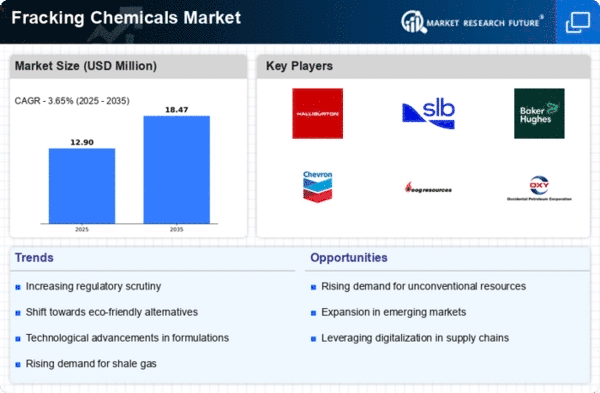
As per MRFR analysis, the Fracking Chemicals Market Size was estimated at 12.45 USD Million in 2024. The Fracking Chemicals industry is projected to grow from 12.9 in 2025 to 18.47 by 2035, exhibiting a compound annual growth rate (CAGR) of 3.65 during the forecast period 2025 - 2035.

Key Market Trends & Highlights

The Fracking Chemicals Market is poised for growth driven by technological advancements and sustainability initiatives.

  • North America remains the largest market for fracking chemicals, driven by robust oil and gas exploration activities.
  • The Asia-Pacific region is emerging as the fastest-growing market, reflecting increasing energy demands and investment in infrastructure.
  • Well stimulation continues to dominate the market, while acidizing is recognized as the fastest-growing segment due to its efficiency in enhancing production.
  • Key market drivers include rising energy demand and stringent environmental regulations, which are shaping the industry's future.

Market Size & Forecast

2024 Market Size 12.45 (USD Million)
2035 Market Size 18.47 (USD Million)
CAGR (2025 - 2035) 3.65%
Largest Regional Market Share in 2024 North America

Major Players

<p>Halliburton (US), Schlumberger (US), Baker Hughes (US), Chevron (US), EOG Resources (US), Occidental Petroleum (US), Pioneer Natural Resources (US), National Oilwell Varco (US), Weatherford International (US)</p>

Market Trends

The Fracking Chemicals Market is currently experiencing a dynamic evolution, driven by the increasing demand for energy and the need for efficient extraction methods. As the global energy landscape shifts, the utilization of hydraulic fracturing has gained traction, leading to a surge in the application of specialized chemicals designed to enhance the extraction process. These chemicals play a crucial role in optimizing well performance, reducing operational costs, and ensuring environmental compliance. Stakeholders in the energy sector are increasingly focusing on the development of innovative formulations that not only improve efficiency but also address environmental concerns associated with fracking operations. Moreover, regulatory frameworks are becoming more stringent, prompting companies to invest in research and development to create safer and more sustainable fracking chemicals. This trend indicates a growing awareness of the environmental impact of hydraulic fracturing, leading to a potential shift towards greener alternatives. As the Fracking Chemicals Market continues to evolve, it appears that collaboration between industry players, regulatory bodies, and environmental organizations will be essential in shaping the future of this sector. The interplay of technological advancements and regulatory pressures may ultimately redefine the landscape of fracking chemicals, fostering a more sustainable approach to energy extraction.

Sustainability Initiatives

The Fracking Chemicals Market is witnessing a notable shift towards sustainability, as companies increasingly prioritize environmentally friendly practices. This trend is characterized by the development of biodegradable and non-toxic chemical formulations that minimize ecological impact. Stakeholders are recognizing the importance of aligning with environmental regulations and public sentiment, which may lead to a more responsible approach to hydraulic fracturing.

Technological Advancements

Innovations in chemical formulations and application techniques are transforming the Fracking Chemicals Market. Enhanced technologies are enabling the creation of more effective and efficient fracking fluids, which can improve extraction rates while reducing water usage. This trend suggests that ongoing research and development efforts will play a pivotal role in shaping the future of fracking chemicals.

Regulatory Compliance

As environmental regulations become increasingly stringent, the Fracking Chemicals Market is adapting to meet these challenges. Companies are investing in compliance measures and developing products that adhere to new standards. This trend indicates a proactive approach to regulatory changes, which may enhance the industry's reputation and foster greater acceptance among stakeholders.

Fracking Chemicals Market Market Drivers

Rising Energy Prices

The Global Fracking Chemicals Market Industry is also influenced by the fluctuations in energy prices. As oil and gas prices rise, the economic viability of fracking becomes more attractive, prompting increased exploration and production activities. Higher energy prices incentivize operators to invest in fracking technologies and the associated chemicals necessary for extraction. This dynamic is particularly evident in regions where conventional oil production is declining, making fracking a more appealing option. Consequently, as energy prices continue to fluctuate, the demand for fracking chemicals is likely to experience corresponding increases, further propelling market growth.

Market Growth Projections

The Global Fracking Chemicals Market Industry is projected to witness substantial growth over the next decade. With a market value of 30.5 USD Billion in 2024 and an anticipated increase to 50.2 USD Billion by 2035, the industry is poised for a robust expansion. This growth is underpinned by a CAGR of 4.63% from 2025 to 2035, reflecting the increasing reliance on fracking as a method of oil and gas extraction. The market dynamics are influenced by various factors, including technological advancements, regulatory support, and the ongoing demand for energy. These projections suggest a promising future for the fracking chemicals sector.

Regulatory Support for Fracking

Regulatory frameworks are evolving to support the Global Fracking Chemicals Market Industry, as governments recognize the economic benefits of domestic energy production. In many regions, policies are being implemented to streamline the permitting process for fracking operations, thereby encouraging investment. This regulatory support is crucial in regions like the United States, where fracking has significantly boosted local economies and job creation. As regulatory environments become more favorable, the demand for fracking chemicals is expected to rise, facilitating the growth of the market. This trend indicates a potential for increased production and consumption of fracking chemicals in the coming years.

Increasing Demand for Natural Gas

The Global Fracking Chemicals Market Industry is experiencing a surge in demand for natural gas, driven by its role as a cleaner alternative to coal and oil. As countries strive to reduce carbon emissions, natural gas is increasingly viewed as a transitional fuel. In 2024, the market is projected to reach 30.5 USD Billion, reflecting this growing preference. The shift towards natural gas is particularly evident in regions such as North America and Europe, where regulatory frameworks are evolving to support its use. This trend is likely to bolster the fracking chemicals market, as enhanced extraction techniques require specialized chemical formulations.

Global Energy Transition Initiatives

The Global Fracking Chemicals Market Industry is being shaped by global energy transition initiatives aimed at reducing reliance on fossil fuels. While there is a push towards renewable energy sources, natural gas remains a key component of the energy mix during this transition. Governments and organizations are recognizing the role of fracking in providing a stable energy supply while renewable technologies are being developed. This dual approach is likely to sustain the demand for fracking chemicals as countries balance their energy portfolios. The market is expected to adapt to these changes, ensuring that fracking remains a viable option in the evolving energy landscape.

Technological Advancements in Fracking

Technological innovations are significantly influencing the Global Fracking Chemicals Market Industry. Enhanced oil recovery techniques and advanced fracking methods, such as horizontal drilling and multi-stage fracturing, are improving extraction efficiency. These advancements not only increase production rates but also reduce environmental impacts, making fracking more sustainable. As a result, the market is expected to grow at a CAGR of 4.63% from 2025 to 2035, reaching an estimated 50.2 USD Billion by 2035. Companies are investing in research and development to create more effective and environmentally friendly fracking chemicals, which is likely to further drive market growth.

Market Segment Insights

By Application: Well Stimulation (Largest) vs. Acidizing (Fastest-Growing)

<p>The Fracking Chemicals Market is segmented into several key applications, including Well Stimulation, Acidizing, Drilling, Completion, and Production. Well Stimulation holds a significant share within this segment, driven by its crucial role in enhancing oil extraction efficiency. Acidizing, while smaller in market share, exhibits remarkable growth as an essential technique to remove blockages in wellbores and boost productivity. Together, these applications represent vital components of the overall fracking landscape.</p>

<p>Well Stimulation (Dominant) vs. Acidizing (Emerging)</p>

<p>Well Stimulation stands out as the dominant application in the Fracking Chemicals Market, primarily due to its effectiveness in increasing hydrocarbon flow rates by injecting high-pressure fluids into the well. This method enhances reservoir performance and significantly reduces production downtime. On the other hand, Acidizing is emerging as a key growth area, driven by the increasing need for enhanced oil recovery (EOR) techniques. It involves injecting acid to dissolve limestone or sandstone formations, thereby improving well productivity. Both applications are critical for optimizing drilling operations and ensuring economic viability, further underscoring their importance in modern fracking operations.</p>

By Chemical Type: Friction Reducers (Largest) vs. Corrosion Inhibitors (Fastest-Growing)

<p>The Fracking Chemicals Market exhibits a diverse range of chemical types, with Friction Reducers dominating the segment due to their crucial role in enhancing the efficiency of hydraulic fracturing. Following Friction Reducers, Biocides and Acids hold significant market shares, contributing to the overall performance of fracking operations. Corrosion Inhibitors, while smaller in share, are gaining traction, particularly as environmental concerns drive demand for more sustainable fracking solutions.</p>

<p>Friction Reducers (Dominant) vs. Corrosion Inhibitors (Emerging)</p>

<p>Friction Reducers play a vital role in reducing resistance during the fracking process, leading to increased efficiency and higher yields. Their established presence in the market is bolstered by advancements in formulations that enhance performance while minimizing environmental impacts. On the other hand, Corrosion Inhibitors are experiencing rapid growth as operators seek to protect equipment from chemical degradation. This segment's emergence is driven by heightened awareness of operational sustainability and regulatory requirements, making Corrosion Inhibitors a strategic focus for future innovation within the fracking sector.</p>

By End Use: Oil Extraction (Largest) vs. Natural Gas Extraction (Fastest-Growing)

<p>The Fracking Chemicals Market is primarily segmented by end use, with oil extraction holding the largest share among the various applications. This dominance can be attributed to the ongoing global demand for oil and the advanced extraction techniques that enhance efficiency. Natural gas extraction is also significant, as it captures a vital portion of the market, benefitting from shifts towards cleaner energy solutions and increasing investments in shale gas plays across multiple regions. In terms of growth trends, natural gas extraction is emerging as the fastest-growing segment, driven by the rapid acceleration towards energy transitions and sustainability. Factors such as innovative fracking technologies, regulatory support, and the rising need for energy security are propelling the adoption of fracking chemicals in natural gas extraction, signaling a potential shift in market dynamics over the coming years.</p>

<p>Oil Extraction: Dominant vs. Tight Gas: Emerging</p>

<p>Oil extraction and tight gas segment represent contrasting positions within the Fracking Chemicals Market. Oil extraction is characterized by well-established extraction practices and significant investment, making it the dominant force in the market. This segment relies heavily on advanced fracking chemicals that improve production efficiency and reduce environmental impact. In comparison, tight gas is emerging as a vital segment due to its potential in meeting the insatiable global energy demand. While it may have a smaller current footprint, advances in extraction technologies and growing investments are positioning tight gas to become a critical player in the energy landscape and enhance energy supply sustainability.</p>

Get more detailed insights about Fracking Chemicals Market Research Report - Global Forecast till 2035

Regional Insights

North America : Dominant Market Leader

North America continues to dominate the fracking chemicals market, holding a significant share of 7.8 billion in 2024. The region's growth is driven by increasing shale gas production, technological advancements, and favorable regulatory frameworks. The demand for efficient and environmentally friendly fracking solutions is also on the rise, supported by government initiatives aimed at boosting energy independence and sustainability. The United States is the leading country in this sector, with major players like Halliburton, Schlumberger, and Baker Hughes driving innovation and competition. The competitive landscape is characterized by strategic partnerships and mergers, enhancing service offerings and market reach. As the region invests in research and development, the presence of key players ensures a robust supply chain and continuous improvement in fracking technologies.

Europe : Emerging Market Potential

Europe's fracking chemicals market is gradually evolving, with a market size of 2.5 billion in 2024. The region is witnessing a shift towards unconventional gas extraction, driven by energy security concerns and the need for diversification of energy sources. Regulatory frameworks are becoming more favorable, encouraging investment in fracking technologies while addressing environmental concerns, thus paving the way for growth in this sector. Countries like the UK and Poland are at the forefront of this market, with significant investments in shale gas exploration. The competitive landscape includes both local and international players, fostering innovation and collaboration. As European nations seek to reduce dependency on imported energy, the presence of key players like Chevron and Baker Hughes is crucial in shaping the market dynamics and ensuring sustainable practices.

Asia-Pacific : Growing Demand for Energy

The Asia-Pacific region is emerging as a potential player in the fracking chemicals market, with a market size of 1.8 billion in 2024. The increasing demand for energy, coupled with the need for cleaner alternatives, is driving interest in shale gas exploration. Countries are beginning to adopt regulatory frameworks that support fracking, although challenges remain in terms of public acceptance and environmental concerns. Leading countries in this region include Australia and China, where investments in fracking technologies are gaining momentum. The competitive landscape is characterized by a mix of local and international companies, including Weatherford International and National Oilwell Varco. As the region continues to explore its shale gas potential, the presence of key players will be vital in overcoming regulatory hurdles and ensuring sustainable practices in fracking operations.

Middle East and Africa : Resource-Rich Opportunities

The Middle East and Africa region presents a nascent market for fracking chemicals, with a market size of 0.35 billion in 2024. The region's rich natural resources and growing energy demands are driving interest in unconventional oil and gas extraction methods. However, regulatory challenges and environmental concerns are significant barriers to widespread adoption of fracking technologies, necessitating careful navigation of local regulations. Countries like South Africa and Algeria are exploring their shale gas potential, albeit at a slower pace compared to other regions. The competitive landscape is still developing, with a few key players beginning to establish a foothold. As the region seeks to diversify its energy portfolio, the involvement of international companies will be crucial in shaping the future of fracking in this resource-rich area.

Key Players and Competitive Insights

The Fracking Chemicals Market is characterized by a competitive landscape that is increasingly shaped by innovation, sustainability, and strategic partnerships. Key players such as Halliburton (US), Schlumberger (US), and Baker Hughes (US) are actively pursuing strategies that emphasize technological advancements and operational efficiencies. Halliburton (US) has focused on enhancing its digital capabilities, which appears to be a response to the growing demand for data-driven solutions in the fracking sector. Meanwhile, Schlumberger (US) has been investing in sustainable practices, indicating a shift towards environmentally friendly fracking chemicals, which may resonate well with regulatory trends and public sentiment. Baker Hughes (US) is also positioning itself as a leader in the market by leveraging its extensive research and development capabilities to innovate new chemical formulations that improve extraction efficiency.

The business tactics employed by these companies include localizing manufacturing and optimizing supply chains to enhance responsiveness to market demands. The competitive structure of the Fracking Chemicals Market is moderately fragmented, with a few dominant players exerting considerable influence. This fragmentation allows for niche players to emerge, yet the collective strength of the major companies shapes pricing strategies and market dynamics significantly.

In November 2025, Halliburton (US) announced a partnership with a leading technology firm to develop AI-driven fracking solutions aimed at optimizing chemical usage and reducing environmental impact. This strategic move underscores Halliburton's commitment to integrating advanced technologies into its operations, potentially setting a new standard for efficiency in the industry. The collaboration may enhance Halliburton's competitive edge by enabling more precise chemical application, thereby reducing waste and improving overall performance.

In October 2025, Schlumberger (US) launched a new line of eco-friendly fracking chemicals designed to minimize water usage and reduce the carbon footprint of hydraulic fracturing operations. This initiative not only aligns with global sustainability goals but also positions Schlumberger as a forward-thinking leader in the market. The introduction of these products could attract environmentally conscious clients and enhance the company's reputation in an increasingly competitive landscape.

In September 2025, Baker Hughes (US) expanded its research facilities to focus on the development of biodegradable fracking fluids. This expansion reflects a strategic pivot towards sustainability, which is becoming a critical factor in the industry. By investing in biodegradable solutions, Baker Hughes may not only comply with evolving regulations but also appeal to a broader customer base that prioritizes environmental responsibility.

As of December 2025, the Fracking Chemicals Market is witnessing trends that emphasize digitalization, sustainability, and the integration of AI technologies. Strategic alliances among key players are shaping the competitive landscape, fostering innovation and enhancing operational efficiencies. The shift from price-based competition to a focus on technological advancements and supply chain reliability is evident. Companies that prioritize innovation and sustainability are likely to differentiate themselves in this evolving market, suggesting a future where competitive advantage hinges on the ability to adapt to changing consumer preferences and regulatory landscapes.

Key Companies in the Fracking Chemicals Market include

Industry Developments

October 2021

- Liberty Oilfield Services Inc., a Denver-based company, has announced the completion of acquiring a prominent supplier of proppant delivery equipment, software, and logistics solutions, PropX. The company reported a 12% in third-quarter revenue this year. Liberty becomes the send-largest provider of natural gas & oil producers with fracking and well-completion services, with this deal worth USD90 million. The deal comprised of USD5 million in cash and the other 5.8 million shares of Liberty’s common stock having net valued of over USD76.5 million based on a 30-day average closing share price of USD13.08.

PropX, established in 2016, is a prominent supplier of last-mile proppant delivery solutions, including logistics software and proppant handling equipment across the North American region. The company offers advanced eco-friendly technology coupled with benefits such as canceling out emissions, reducing noise, driving logistics efficiency, wellsite proppant handling equipment, and better dry and wet sand containers.

April 2021

- California is set to ban new oil fracking by 2024 under an executive order that Gov. Gavin Newsom, announced that with small fanfare following months of confusing mixed messages.The order came as a shock to the oil firms in the state but a narrow victory for environmentalists, who have been forcing Newsom to do more to combat fossil fuels, pollutions, and climate change pollution in disadvantaged communities.

Intended Audience
    • Fracking chemicals manufacturers
    • Traders and distributors of fracking chemicals
    • Research and development institutes
    • Potential investors
    • Raw material suppliers
    • Nationalized laboratory

Future Outlook

Fracking Chemicals Market Future Outlook

<p>The Fracking Chemicals Market is projected to grow at a 3.65% CAGR from 2024 to 2035, driven by technological advancements, increasing energy demand, and regulatory support.</p>

New opportunities lie in:

  • <p>Development of biodegradable fracking fluids to meet environmental regulations.</p>
  • <p>Investment in advanced chemical formulations for enhanced oil recovery.</p>
  • <p>Expansion of digital monitoring systems for real-time fracking chemical management.</p>

<p>By 2035, the Fracking Chemicals Market is expected to achieve robust growth, reflecting evolving industry dynamics.</p>

Market Segmentation

Fracking Chemicals Market End Use Outlook

  • Oil Extraction
  • Natural Gas Extraction
  • Geothermal Energy
  • Coal Bed Methane
  • Tight Gas

Fracking Chemicals Market Application Outlook

  • Well Stimulation
  • Acidizing
  • Drilling
  • Completion
  • Production

Fracking Chemicals Market Chemical Type Outlook

  • Acids
  • Biocides
  • Corrosion Inhibitors
  • Friction Reducers
  • Surfactants

Report Scope

MARKET SIZE 202412.45(USD Million)
MARKET SIZE 202512.9(USD Million)
MARKET SIZE 203518.47(USD Million)
COMPOUND ANNUAL GROWTH RATE (CAGR)3.65% (2024 - 2035)
REPORT COVERAGERevenue Forecast, Competitive Landscape, Growth Factors, and Trends
BASE YEAR2024
Market Forecast Period2025 - 2035
Historical Data2019 - 2024
Market Forecast UnitsUSD Million
Key Companies ProfiledHalliburton (US), Schlumberger (US), Baker Hughes (US), Chevron (US), EOG Resources (US), Occidental Petroleum (US), Pioneer Natural Resources (US), National Oilwell Varco (US), Weatherford International (US)
Segments CoveredApplication, Chemical Type, End Use
Key Market OpportunitiesAdvancements in environmentally friendly fracking chemicals enhance market potential amid regulatory shifts.
Key Market DynamicsRegulatory changes and technological advancements are reshaping competitive dynamics in the fracking chemicals market.
Countries CoveredNorth America, Europe, APAC, South America, MEA

FAQs

What are fracking chemicals?

Fracking chemicals are a wide range of chemicals used in oil and gas drilling operations to make the extraction of hydrocarbons an easier process.

What is the CAGR of the market?

The market is expected to exhibit a strong 6.54% CAGR over the forecast period from 2025-2035.

What is the major driver for the market?

The growing demand for fracking is the major driver for the fracking chemicals market.

Which is the leading regional market?

North America is the major regional market for fracking chemicals due to the growing preference for fracking in the region.

What are the leading market players?

Leading players in the fracking chemicals market include AkzoNobel, BASF, and Ashland, among others.

  1. SECTION I: EXECUTIVE SUMMARY AND KEY HIGHLIGHTS
    1. | 1.1 EXECUTIVE SUMMARY
  2. SECTION II: SCOPING, METHODOLOGY AND MARKET STRUCTURE
    1. | 2.1 MARKET INTRODUCTION
    2. | 2.2 RESEARCH METHODOLOGY
  3. SECTION III: QUALITATIVE ANALYSIS
    1. | 3.1 MARKET DYNAMICS
    2. | 3.2 MARKET FACTOR ANALYSIS
  4. SECTION IV: QUANTITATIVE ANALYSIS
    1. | 4.1 Chemicals and Materials, BY Application (USD Million)
    2. | 4.2 Chemicals and Materials, BY Chemical Type (USD Million)
    3. | 4.3 Chemicals and Materials, BY End Use (USD Million)
    4. | 4.4 Chemicals and Materials, BY Region (USD Million)
  5. SECTION V: COMPETITIVE ANALYSIS
    1. | 5.1 Competitive Landscape
    2. | 5.2 Company Profiles
    3. | 5.3 Appendix

Fracking Chemicals Market Segmentation

Market Segmentation Overview

  • Detailed segmentation data will be available in the full report
  • Comprehensive analysis by multiple parameters
  • Regional and country-level breakdowns
  • Market size forecasts by segment
Infographic

Free Sample Request

Kindly complete the form below to receive a free sample of this Report

Get Free Sample

Customer Strories

Compare Licence

×
Features License Type
Single User Multiuser License Enterprise User
Price $4,950 $5,950 $7,250
Maximum User Access Limit 1 User Upto 10 Users Unrestricted Access Throughout the Organization
Free Customization
Direct Access to Analyst
Deliverable Format
Platform Access
Discount on Next Purchase 10% 15% 15%
Printable Versions