×
Request Free Sample ×

Kindly complete the form below to receive a free sample of this Report

* Please use a valid business email

Leading companies partner with us for data-driven Insights

clients tt-cursor
Hero Background
English
Chinese
French
Japanese
Korean
German
Spanish

Formic Acid Market Trends

ID: MRFR/CnM/0626-CR
109 Pages
Chitranshi Jaiswal
February 2021

Formic Acid Market Research Report Information By Production Method (Oxalic Acid, Carbonylation of Methanol), By Application (Rubber, Leather Production, Cleaning Agent, Finishing Textile, Preservatives, Dyeing, Animal Feed, Others), And By Region (North America, Europe, Asia-Pacific, And Rest Of The World) – Market Forecast Till 2035

Share:
Download PDF ×

We do not share your information with anyone. However, we may send you emails based on your report interest from time to time. You may contact us at any time to opt-out.

Formic Acid Market Infographic
Purchase Options

Market Trends

Key Emerging Trends in the Formic Acid Market

Formic acid plays a crucial role in preserving silage and enhancing animal feed by reducing bacteria and maintaining nutritional value. As the global population increases, there's a rising demand for high-quality food products, leading to a surge in the use of organic acids like formic acid in feed preservation. Many countries, including Europe, have banned the use of antibiotics in food preservation due to health and safety concerns. In response to consumer preferences shifting towards organic alternatives, North America is gradually moving towards banning antibiotics in animal feed.

Ensuring the quality of animal feed is essential for optimal animal performance. Silage with less than 30% dry matter is challenging to ensile, and formic acid is used as an additive in such conditions. Formic acid helps rapidly decrease the pH in silage, inhibiting fermentation bacteria. Products like Amasil, a buffered acid product, are used to achieve this. Companies like BASF produce 'Lupro-Mix,' an ensiling additive based on propionic and formic acid, designed to produce high-quality silage even in difficult conditions.

In the rubber industry, formic acid is a preferred choice for coagulating latex during the production of dry rubber. It is cost-effective, environmentally friendly, and offers superior performance. The acid concentration in formic acid is ideal for homogeneous coagulation, ensuring efficient rubber production. Its characteristics, such as easy color formation on rubber sheets, no impact on rubber elasticity, no residue, and low chemical oxygen content (COD), make formic acid an ideal choice for the rubber and textile industry.

The automotive sector's growth is driving demand for tire manufacturing, leading to an increased need for natural rubber latex coagulation using formic acid. The demand for rubber in the automotive and textile industries is substantial, making formic acid a critical component in addressing this growing demand.

In conclusion, formic acid plays a vital role in feed preservation and rubber production, meeting the demands of a growing global population and industries like automotive and textiles. Its characteristics make it an ideal choice for various applications, contributing to the shift towards organic alternatives and environmentally friendly practices.

Author
Chitranshi Jaiswal
Team Lead - Research

Chitranshi is a Team Leader in the Chemicals & Materials (CnM) and Energy & Power (EnP) domains, with 6+ years of experience in market research. She leads and mentors teams to deliver cross-domain projects that equip clients with actionable insights and growth strategies. She is skilled in market estimation, forecasting, competitive benchmarking, and both primary & secondary research, enabling her to turn complex data into decision-ready insights. An engineer and MBA professional, she combines technical expertise with strategic acumen to solve dynamic market challenges. Chitranshi has successfully managed projects that support market entry, investment planning, and competitive positioning, while building strong client relationships. Certified in Advanced Excel & Power BI she leverages data-driven approaches to ensure accuracy, clarity, and impactful outcomes.

Leave a Comment

FAQs

What is the projected market valuation of the Formic Acid Market by 2035?

<p>The Formic Acid Market is projected to reach a valuation of 6.234 USD Billion by 2035.</p>

What was the market valuation of the Formic Acid Market in 2024?

<p>In 2024, the overall market valuation of the Formic Acid Market was 2.29 USD Billion.</p>

What is the expected CAGR for the Formic Acid Market during the forecast period 2025 - 2035?

<p>The expected CAGR for the Formic Acid Market during the forecast period 2025 - 2035 is 9.53%.</p>

Which companies are considered key players in the Formic Acid Market?

<p>Key players in the Formic Acid Market include BASF SE, Eastman Chemical Company, HCO Chemical, Perstorp Holding AB, Merck KGaA, Taminco, Shandong Jinling Chemical, and Ferro Corporation.</p>

What are the primary applications of formic acid in the market?

<p>Primary applications of formic acid include rubber production, leather production, cleaning agents, textile finishing, preservatives, dyeing, and animal feed.</p>

What was the market size for rubber applications of formic acid in 2024?

<p>In 2024, the market size for rubber applications of formic acid was 0.5 USD Billion.</p>

How much is the market for cleaning agents projected to grow by 2035?

<p>The market for cleaning agents is projected to grow from 0.3 USD Billion in 2024 to 0.9 USD Billion by 2035.</p>

What production methods are utilized in the Formic Acid Market?

<p>Production methods in the Formic Acid Market include oxalic acid production and carbonylation of methanol.</p>

What was the market valuation for oxalic acid production in 2024?

<p>The market valuation for oxalic acid production in 2024 was 0.915 USD Billion.</p>

What is the projected market size for leather production applications by 2035?

<p>The projected market size for leather production applications is expected to increase from 0.4 USD Billion in 2024 to 1.1 USD Billion by 2035.</p>

Market Summary

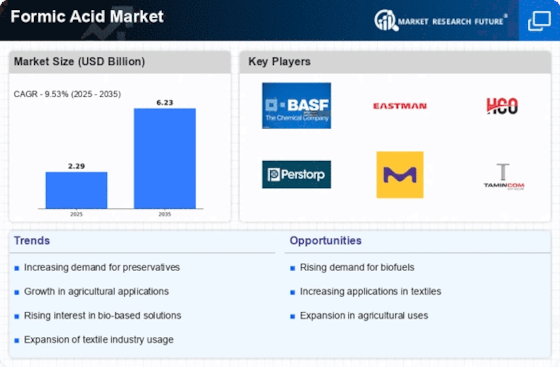
As per Market Research Future analysis, the Formic Acid Market Size was estimated at 2.29 USD Billion in 2024. The Formic Acid industry is projected to grow from 2.508 USD Billion in 2025 to 6.234 USD Billion by 2035, exhibiting a compound annual growth rate (CAGR) of 9.53% during the forecast period 2025 - 2035

Key Market Trends & Highlights

The Formic Acid Market is currently experiencing a dynamic shift towards sustainability and technological innovation.

  • North America remains the largest market for formic acid, driven by its extensive industrial applications. The Asia-Pacific region is emerging as the fastest-growing market, fueled by rapid economic development and increasing demand. In the rubber segment, formic acid continues to dominate, while the cleaning agent segment is witnessing the fastest growth. Rising demand in agriculture and stringent environmental regulations are key drivers propelling market expansion.

Market Size & Forecast

2024 Market Size 2.29 (USD Billion)
2035 Market Size 6.234 (USD Billion)
CAGR (2025 - 2035) 9.53%
Largest Regional Market Share in 2024 Asia Pacific

Major Players

BASF SE (DE), Eastman Chemical Company (US), HCO (Hubei) Chemical Co., Ltd. (CN), Perstorp Holding AB (SE), Merck KGaA (DE), Taminco (BE), Shandong Jinling Chemical Co., Ltd. (CN), Ferro Corporation (US)

Market Trends

The Formic Acid Market is currently experiencing a dynamic phase characterized by evolving applications and increasing demand across various sectors. This organic compound, known for its versatility, is utilized in agriculture, textiles, and chemical synthesis, among other industries. The growing emphasis on sustainable practices appears to drive interest in formic acid, particularly as a potential alternative to conventional chemicals. Furthermore, the market seems to benefit from advancements in production technologies, which may enhance efficiency and reduce costs, thereby attracting new entrants and fostering competition.

In addition, the formic acid market  is likely to witness shifts in consumer preferences, with a notable inclination towards eco-friendly products. This trend suggests that manufacturers may need to adapt their strategies to align with environmental considerations. The regulatory landscape also plays a crucial role, as governments worldwide implement stricter guidelines regarding chemical usage. Overall, the formic acid market appears poised for growth, driven by innovation, sustainability, and regulatory influences that shape its future trajectory.

Sustainable Practices in Agriculture

The increasing focus on sustainable agriculture is propelling the demand for formic acid as a natural pesticide and preservative. This trend indicates a shift towards organic farming methods, where formic acid serves as an eco-friendly alternative to synthetic chemicals.

Technological Advancements in Production

Innovations in production processes are enhancing the efficiency of formic acid manufacturing. These advancements may lead to reduced operational costs and improved product quality, thereby attracting more players to the market.

Regulatory Influences on Chemical Usage

Stricter regulations regarding chemical safety and environmental impact are shaping the Formic Acid Market. This trend suggests that compliance with new standards may drive manufacturers to develop safer and more sustainable formulations.

Formic Acid Market Market Drivers

Rising Demand in Agriculture

The Formic Acid Market is experiencing a notable increase in demand due to its applications in agriculture, particularly as a preservative and feed additive. Formic acid is utilized in silage production, enhancing the nutritional value of animal feed. The market for agricultural chemicals, including formic acid, is projected to grow at a compound annual growth rate of approximately 5.5% over the next few years. This growth is driven by the need for sustainable farming practices and the rising global population, which necessitates increased food production. As farmers seek effective solutions to improve crop yields and livestock health, the Formic Acid Market is likely to benefit significantly from this trend.

Growth in the Textile Industry

The textile industry is a significant contributor to the demand for formic acid, which is used in dyeing and finishing processes. As the textile market expands, particularly in developing regions, the Formic Acid Market is expected to see substantial growth. The increasing consumer preference for high-quality textiles and sustainable production methods is driving manufacturers to seek effective chemical solutions. The textile chemicals market is projected to grow at a rate of around 4% annually, which bodes well for the formic acid sector. This growth indicates a promising future for the Formic Acid Market as it aligns with the evolving needs of the textile sector.

Industrial Applications and Versatility

The versatility of formic acid in various industrial applications is a key driver for the Formic Acid Market. It is widely used in the production of leather, textiles, and rubber, as well as in the manufacturing of chemicals and pharmaceuticals. The increasing demand for leather goods and textiles, particularly in emerging economies, is expected to bolster the market. Additionally, formic acid serves as a reducing agent in chemical reactions, further expanding its utility across different sectors. The industrial chemicals market is anticipated to grow, and with it, the Formic Acid Market is poised to capitalize on this expanding demand.

Environmental Regulations and Compliance

The Formic Acid Market is influenced by stringent environmental regulations aimed at reducing harmful emissions and promoting safer chemical alternatives. Governments are increasingly enforcing regulations that encourage the use of less toxic substances in various applications. Formic acid, being a relatively eco-friendly option, is gaining traction as industries seek to comply with these regulations. The market for green chemicals is projected to grow, and formic acid's profile as a sustainable chemical solution positions it favorably. This regulatory landscape is likely to drive innovation and adoption within the Formic Acid Market.

Emerging Markets and Economic Development

Emerging markets are becoming increasingly important for the Formic Acid Market, as economic development leads to higher industrial activity and demand for chemicals. Countries in Asia and Latin America are witnessing rapid industrialization, which is driving the need for various chemical products, including formic acid. The growth of industries such as agriculture, textiles, and pharmaceuticals in these regions is expected to create new opportunities for market players. As these economies continue to develop, the Formic Acid Market is likely to experience a surge in demand, reflecting the broader trends of economic growth and industrial expansion.

Market Segment Insights

By Production Method: Oxalic Acid (Largest) vs. Carbonylation of Methanol (Fastest-Growing)

In the Formic Acid Market, the production methods reveal a competitive landscape characterized by two prominent segments: <a href="https://www.marketresearchfuture.com/reports/oxalic-acid-market-18886" target="_blank" title="oxalic acid">Oxalic Acid</a> and Carbonylation of <a href="https://www.marketresearchfuture.com/reports/methanol-market-1764" target="_blank" title="methanol">Methanol</a>. The Oxalic Acid production method holds a substantial share, leading in market presence due to established processes and existing industrial applications. On the other hand, Carbonylation of Methanol, while currently smaller in market share, is emerging as a valuable alternative thanks to its efficiency and potential for scalability, signaling a shift in production preferences. The growth dynamics within this segment indicate a strong demand for more sustainable and efficient production methods. As environmental concerns intensify, Carbonylation of Methanol is gaining traction, driven by technological advancements and regulatory support for greener processes. This transition is expected to facilitate a rapid expansion in its market share, as industries look for innovative ways to reduce carbon footprints and enhance productivity. Thus, while Oxalic Acid remains dominant, Carbonylation of Methanol is poised to capture increasing interest in the future.

Production Method: Oxalic Acid (Dominant) vs. Carbonylation of Methanol (Emerging)

Oxalic Acid is traditionally recognized as the dominant production method in the Formic Acid Market, with a well-established supply chain and robust applications across various industries. Its conventional processes have proven effective, ensuring a consistent output that caters to diverse industrial needs. In contrast, Carbonylation of Methanol represents an emerging alternative that leverages modern technologies to offer improved efficiencies and sustainability. This method is gaining favor as it aligns with contemporary environmental standards and regulations. The adaptability of Carbonylation positions it well for growth, as more players in the market seek out innovative methods that can meet both productivity requirements and sustainability goals.

By Application: Rubber (Largest) vs. Cleaning Agent (Fastest-Growing)

In the Formic Acid Market, applications are diverse, with each playing a significant role. The rubber industry holds the largest share, leveraging formic acid for its properties that enhance elasticity and durability in rubber products. Following closely, leather production and cleaning agents are substantial applications as well, with cleaning agents showing a noted rise in usage due to increased demand for eco-friendly and effective cleaning solutions. Other applications such as preservatives, dyeing, and animal feed contribute to a well-rounded market segment, showcasing the versatility of formic acid.

Rubber: Dominant vs. Cleaning Agent: Emerging

The rubber application of formic acid is dominant due to its extensive use in the manufacturing of tires and various rubber goods, where it serves as a coagulant and accelerant. This application not only benefits from the underlying demand for rubber products but also drives innovations in formulations that enhance performance. Conversely, the cleaning agent segment is emerging rapidly as consumers turn towards more sustainable cleaning solutions. Formic acid's effectiveness in various cleaning tasks positions it as a revolutionary component, leveraging the trend towards biodegradable and environmentally safe chemicals, thereby witnessing accelerated growth.

Get more detailed insights about Formic Acid Market Research Report- Forecast to 2035

Regional Insights

North America : Innovation and Demand Growth

The North American formic acid market is driven by increasing demand in agriculture, textiles, and leather industries. The region holds approximately 30% of the global market share, with the United States being the largest contributor, followed by Canada. Regulatory support for sustainable agricultural practices is further propelling market growth, as formic acid is recognized for its eco-friendly properties. Key players such as Eastman Chemical Company and Ferro Corporation dominate the landscape, focusing on innovation and sustainability. The competitive environment is characterized by strategic partnerships and investments in R&D to enhance product offerings. The presence of established companies ensures a robust supply chain, catering to diverse industrial applications.

Europe : Sustainability and Regulation Focus

Europe is a significant player in the formic acid market, accounting for around 25% of the global share. The region's growth is driven by stringent environmental regulations and a shift towards sustainable chemical solutions. Countries like Germany and France lead the market, supported by government initiatives promoting green chemistry and reducing carbon footprints. The Europe formic acid market continues to gain momentum due to rising demand in agriculture, rubber processing, and food preservation applications. The competitive landscape features major companies such as BASF SE and Merck KGaA, which are investing heavily in sustainable production methods. The European market is characterized by innovation in applications, particularly in agriculture and food preservation. The regulatory framework encourages the use of formic acid as a biodegradable alternative, enhancing its market appeal.

Asia-Pacific : Emerging Markets and Growth Potential

The Asia-Pacific region is witnessing rapid growth in the formic acid market, holding approximately 35% of the global share, with China and India as the largest contributors. The increasing demand for formic acid in agriculture, particularly as a feed additive, is a key growth driver. Additionally, the region benefits from a growing industrial base and rising investments in chemical manufacturing, positioning the APAC formic acid market as a dominant force globally. The China formic acid market plays a crucial role in regional expansion, supported by large-scale production capacities and strong export activities. China's HCO (Hubei) Chemical Co., Ltd. and Shandong Jinling Chemical Co., Ltd. are prominent players, focusing on expanding production capacities. The competitive landscape is evolving, with local manufacturers gaining traction through cost-effective solutions. The region's growth is further supported by favorable government policies aimed at boosting the chemical sector.

Middle East and Africa : Resource-Rich and Emerging Markets

The Middle East and Africa region is gradually emerging in the formic acid market, currently holding about 10% of the global share. The growth is primarily driven by increasing industrialization and agricultural activities, particularly in countries like South Africa and the UAE. The region's rich natural resources provide a foundation for chemical production, while government initiatives aim to diversify economies away from oil dependency. The competitive landscape is still developing, with local players beginning to establish their presence. Companies are focusing on leveraging regional resources to produce formic acid competitively. As infrastructure improves and regulatory frameworks evolve, the market is expected to expand, attracting foreign investments and partnerships.

Key Players and Competitive Insights

The Formic Acid Market is currently characterized by a dynamic competitive landscape, driven by increasing demand across various applications such as agriculture, textiles, and pharmaceuticals. Key players are actively engaging in strategic initiatives to enhance their market positioning and operational efficiency. Notably, companies like BASF SE (DE), Eastman Chemical Company (US), and HCO (Hubei) Chemical Co., Ltd. (CN) are focusing on innovation and regional expansion to capture emerging opportunities. Their collective strategies not only shape the competitive environment but also indicate a trend towards more sustainable and efficient production methods, which are becoming essential in today’s market.
In terms of business tactics, localizing manufacturing and optimizing supply chains are pivotal for these companies. The Formic Acid Market appears moderately fragmented, with several players vying for market share. However, the influence of major companies is significant, as they leverage their resources to streamline operations and enhance product offerings. This competitive structure suggests that while there is room for smaller players, the dominance of established firms is likely to shape market dynamics in the foreseeable future.
In August 2025, BASF SE (DE) announced the launch of a new production facility in Asia aimed at increasing its output of formic acid. This strategic move is expected to bolster its supply chain capabilities and meet the rising demand in the region. The establishment of this facility not only enhances BASF's operational footprint but also aligns with its commitment to sustainability by utilizing advanced technologies to minimize environmental impact.
Similarly, in July 2025, Eastman Chemical Company (US) unveiled a partnership with a leading agricultural firm to develop innovative applications for formic acid in crop protection. This collaboration is indicative of Eastman’s strategy to diversify its product applications and tap into the growing agricultural sector. By leveraging its expertise in chemical solutions, Eastman is likely to enhance its competitive edge and drive growth in this niche market.
Moreover, in September 2025, HCO (Hubei) Chemical Co., Ltd. (CN) expanded its production capacity through a significant investment in new technology aimed at improving efficiency and reducing costs. This investment reflects HCO's focus on maintaining competitiveness in a price-sensitive market while also addressing sustainability concerns. Such advancements may position HCO favorably against its competitors, particularly in the context of rising raw material costs.
As of October 2025, the competitive trends in the Formic Acid Market are increasingly influenced by digitalization, sustainability initiatives, and the integration of artificial intelligence in production processes. Strategic alliances are becoming more prevalent, as companies recognize the value of collaboration in enhancing innovation and market reach. Looking ahead, it is anticipated that competitive differentiation will evolve, shifting from traditional price-based competition to a focus on technological advancements, sustainable practices, and reliable supply chains. This transition underscores the importance of innovation as a key driver of success in the Formic Acid Market.

Key Companies in the Formic Acid Market include

Industry Developments

In May 2023, scientists at the Indian Institute of Technology (IIT) Guwahati, innovated a catalyst that can produce hydrogen gas for wood alcohol, without the production of carbon dioxide. With the environmentally safe process, it also produces formic acid which can be useful for various end users in industrial chemicals.

In July 2022, biotechnology company Ingenza stated that the company has formed a strategic partnership with Johnson Matthey to form a formic acid from the various industrial carbon dioxide emission for the use of several industries like pharmaceuticals and agriculture and as future prospects for the feedstock for bioprocess.

March 2021: BASF SE announced an increase in formic acid prices in North America for all grades, which would be USD 0.05 per pound.

Future Outlook

Formic Acid Market Future Outlook

The Formic Acid Market is projected to grow at a 9.53% CAGR from 2024 to 2035, driven by increasing demand in agriculture, textiles, and chemical industries.

New opportunities lie in:

  • <p>Development of biodegradable formic acid-based products Expansion into emerging markets with tailored formulations Investment in advanced production technologies for cost efficiency</p>

By 2035, the Formic Acid Market is expected to achieve robust growth, solidifying its global presence.

Market Segmentation

Formic Acid Market Application Outlook

  • Rubber
  • Leather Production
  • Cleaning Agent
  • Finishing Textile
  • Preservatives
  • Dyeing
  • Animal Feed
  • Others

Formic Acid Market Production Method Outlook

  • Oxalic Acid
  • Carbonylation of Methanol

Report Scope

MARKET SIZE 2024 2.29(USD Billion)
MARKET SIZE 2025 2.508(USD Billion)
MARKET SIZE 2035 6.234(USD Billion)
COMPOUND ANNUAL GROWTH RATE (CAGR) 9.53% (2024 - 2035)
REPORT COVERAGE Revenue Forecast, Competitive Landscape, Growth Factors, and Trends
BASE YEAR 2024
Market Forecast Period 2025 - 2035
Historical Data 2019 - 2024
Market Forecast Units USD Billion
Key Companies Profiled Market analysis in progress
Segments Covered Market segmentation analysis in progress
Key Market Opportunities Growing demand for sustainable agricultural practices enhances opportunities in the Formic Acid Market.
Key Market Dynamics Rising demand for sustainable agriculture drives growth in the Formic Acid Market, influencing production and supply dynamics.
Countries Covered North America, Europe, APAC, South America, MEA

FAQs

What is the projected market valuation of the Formic Acid Market by 2035?

<p>The Formic Acid Market is projected to reach a valuation of 6.234 USD Billion by 2035.</p>

What was the market valuation of the Formic Acid Market in 2024?

<p>In 2024, the overall market valuation of the Formic Acid Market was 2.29 USD Billion.</p>

What is the expected CAGR for the Formic Acid Market during the forecast period 2025 - 2035?

<p>The expected CAGR for the Formic Acid Market during the forecast period 2025 - 2035 is 9.53%.</p>

Which companies are considered key players in the Formic Acid Market?

<p>Key players in the Formic Acid Market include BASF SE, Eastman Chemical Company, HCO Chemical, Perstorp Holding AB, Merck KGaA, Taminco, Shandong Jinling Chemical, and Ferro Corporation.</p>

What are the primary applications of formic acid in the market?

<p>Primary applications of formic acid include rubber production, leather production, cleaning agents, textile finishing, preservatives, dyeing, and animal feed.</p>

What was the market size for rubber applications of formic acid in 2024?

<p>In 2024, the market size for rubber applications of formic acid was 0.5 USD Billion.</p>

How much is the market for cleaning agents projected to grow by 2035?

<p>The market for cleaning agents is projected to grow from 0.3 USD Billion in 2024 to 0.9 USD Billion by 2035.</p>

What production methods are utilized in the Formic Acid Market?

<p>Production methods in the Formic Acid Market include oxalic acid production and carbonylation of methanol.</p>

What was the market valuation for oxalic acid production in 2024?

<p>The market valuation for oxalic acid production in 2024 was 0.915 USD Billion.</p>

What is the projected market size for leather production applications by 2035?

<p>The projected market size for leather production applications is expected to increase from 0.4 USD Billion in 2024 to 1.1 USD Billion by 2035.</p>

No Data Available

Oxalic Acid, Carbonylation of Methanol, Rubber, Leather Production, Cleaning Agent, Finishing Textile, Preservatives, Dyeing, Animal Feed, Others
Infographic

Free Sample Request

Kindly complete the form below to receive a free sample of this Report

Get Free Sample

Customer Strories

Compare Licence

×
Features License Type
Single User Multiuser License Enterprise User
Price $4,950 $5,950 $7,250
Maximum User Access Limit 1 User Upto 10 Users Unrestricted Access Throughout the Organization
Free Customization
Direct Access to Analyst
Deliverable Format
Platform Access
Discount on Next Purchase 10% 15% 15%
Printable Versions