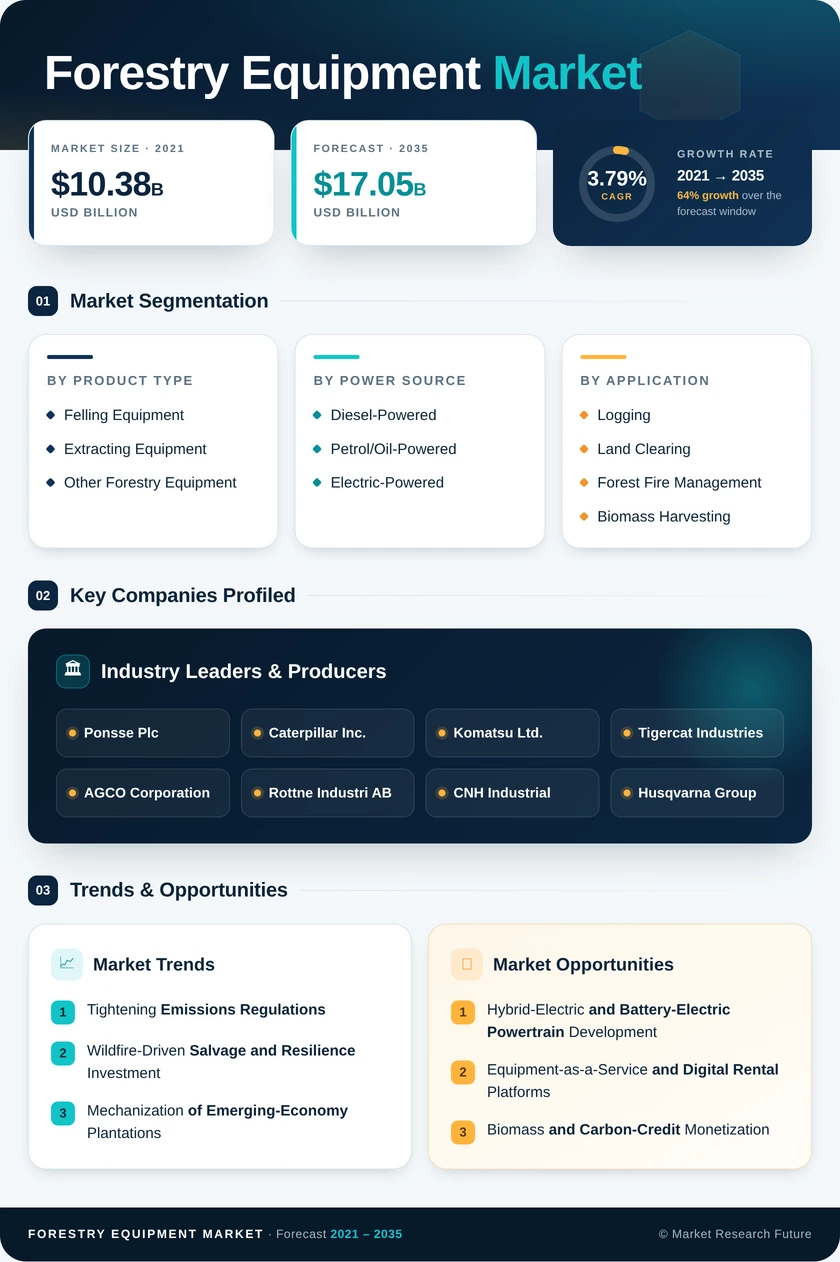
Forestry Equipment Market

ID: MRFR/Equip/24451-HCR
111 Pages
Chitranshi Jaiswal
Last Updated: June 23, 2026
Forestry Equipment Market Research Report By Product Type (Felling Equipment, Extracting Equipment, Other Forestry Equipment), By Power Source (Diesel-Powered, Petrol/Oil-Powered, Electric-Powered), By Application (Logging, Land Clearing, Forest Fire Management, Biomass Harvesting), By End-User (Commercial Logging Companies, Government Forestry Agencies, Rental Service Providers) and By Regional (North America, Europe, South America, Asia Pacific, Middle East and Africa) - Industry Forecast to 2035
Download PDF ×

We do not share your information with anyone. However, we may send you emails based on your report interest from time to time. You may contact us at any time to opt-out.

  1. 1 Market Overview |
    1. 1.1 Study Assumptions & Market Definition |
    2. 1.2 Scope of the Study |
    3. 1.3 Research Methodology
  2. 2 Market Summary & Key Takeaways
  3. 3 Market Dynamics |
    1. 3.1 Market Drivers Analysis | |
      1. 3.1.1 Tightening Emissions Regulations (EU Stage VI, EPA Tier 4F) | |
      2. 3.1.2 Wildfire-Driven Salvage and Resilience Investment | |
      3. 3.1.3 Mechanization of Emerging-Economy Plantations | |
      4. 3.1.4 Telematics and Predictive-Maintenance Adoption | |
      5. 3.1.5 Biomass and Wood-Pellet Energy Demand Growth | |
      6. 3.1.6 Rental and Equipment-as-a-Service Fleet Expansion | |
      7. 3.1.7 Government Reforestation and Carbon-Offset Programs |
    2. 3.2 Market Restraints Analysis | |
      1. 3.2.1 High Capital Cost and Long Payback Periods | |
      2. 3.2.2 Skilled-Operator Shortage | |
      3. 3.2.3 Seasonal and Weather-Dependent Utilization | |
      4. 3.2.4 Environmental Restrictions on Old-Growth Harvesting | |
      5. 3.2.5 Volatile Diesel-Fuel and Steel-Input Costs |
    3. 3.3 Market Opportunity Analysis | |
      1. 3.3.1 Hybrid-Electric and Battery-Electric Powertrain Development | |
      2. 3.3.2 Equipment-as-a-Service and Digital Rental Platforms | |
      3. 3.3.3 Biomass and Carbon-Credit Monetization | |
      4. 3.3.4 Emerging-Market Plantation Mechanization | |
      5. 3.3.5 Autonomous and Remote-Operated Harvesting |
    4. 3.4 Industry Value Chain Analysis |
    5. 3.5 Porter's Five Forces Analysis
  4. 4 Global Forestry Equipment Market Size & Forecast (2021–2035) |
    1. 4.1 Historical Market Size (2021–2025) |
    2. 4.2 Current & Forecast Market Size (2026–2035) |
    3. 4.3 Market Size by Revenue (USD Billion) |
    4. 4.4 Year-over-Year Growth Analysis
  5. 5 Segmentation Analysis |
    1. 5.1 By Product Type | |
      1. 5.1.1 Felling Equipment | |
      2. 5.1.2 Extracting Equipment | |
      3. 5.1.3 Other Forestry Equipment |
    2. 5.2 By Power Source | |
      1. 5.2.1 Diesel-Powered | |
      2. 5.2.2 Petrol/Oil-Powered | |
      3. 5.2.3 Electric-Powered |
    3. 5.3 By Application | |
      1. 5.3.1 Logging | |
      2. 5.3.2 Land Clearing | |
      3. 5.3.3 Forest Fire Management | |
      4. 5.3.4 Biomass Harvesting |
    4. 5.4 By End-User | |
      1. 5.4.1 Commercial Logging Companies | |
      2. 5.4.2 Government Forestry Agencies | |
      3. 5.4.3 Rental Service Providers
  6. 6 Regional Analysis |
    1. 6.1 North America | |
      1. 6.1.1 United States | |
      2. 6.1.2 Canada | |
      3. 6.1.3 Mexico |
    2. 6.2 Europe | |
      1. 6.2.1 Germany | |
      2. 6.2.2 United Kingdom | |
      3. 6.2.3 France | |
      4. 6.2.4 Italy | |
      5. 6.2.5 Spain | |
      6. 6.2.6 Nordic Countries | |
      7. 6.2.7 Russia | |
      8. 6.2.8 Rest of Europe |
    3. 6.3 Asia-Pacific | |
      1. 6.3.1 China | |
      2. 6.3.2 India | |
      3. 6.3.3 Japan | |
      4. 6.3.4 South Korea | |
      5. 6.3.5 ASEAN | |
      6. 6.3.6 Rest of Asia-Pacific |
    4. 6.4 South America | |
      1. 6.4.1 Brazil | |
      2. 6.4.2 Argentina | |
      3. 6.4.3 Rest of South America |
    5. 6.5 Middle East & Africa | |
      1. 6.5.1 Saudi Arabia | |
      2. 6.5.2 UAE | |
      3. 6.5.3 South Africa | |
      4. 6.5.4 Egypt | |
      5. 6.5.5 Rest of MEA
  7. 7 Competitive Landscape |
    1. 7.1 Market Share Analysis (2025) |
    2. 7.2 Competitive Benchmarking Matrix |
    3. 7.3 Company Profiles | |
      1. 7.3.1 Deere & Company | |
      2. 7.3.2 Ponsse Plc | |
      3. 7.3.3 Caterpillar Inc. | |
      4. 7.3.4 Komatsu Ltd. | |
      5. 7.3.5 Tigercat Industries | |
      6. 7.3.6 AGCO Corporation | |
      7. 7.3.7 Rottne Industri AB | |
      8. 7.3.8 CNH Industrial | |
      9. 7.3.9 Husqvarna Group | |
      10. 7.3.10 Stihl AG
  8. 8 Future Outlook & Strategic Recommendations (2026–2035) |
    1. 8.1 Electrification and Hybrid Drivetrains |
    2. 8.2 Autonomous and Remote-Operated Platforms |
    3. 8.3 Data Monetization and Platform Economics |
    4. 8.4 ESG Reporting and Sustainable-Forestry Certification
  9. 9 Recent Developments & News
  10. 10 Frequently Asked Questions (FAQs)
  11. 11 Report Scope & Methodology |
    1. 11.1 Study Period & Base Year |
    2. 11.2 Data Sources & Citations |
    3. 11.3 Abbreviations
  12. 12 LIST OF TABLES |
  13. TABLE 1 Global Forestry Equipment Market Size & Forecast, by Revenue (USD Billion), 2021–2035 |
  14. TABLE 2 Global Forestry Equipment Market — Year-over-Year Growth Analysis, 2021–2035 |
  15. TABLE 3 Global Forestry Equipment Market — Driver Impact Analysis |
  16. TABLE 4 Global Forestry Equipment Market — Restraint Impact Analysis |
  17. TABLE 5 Global Forestry Equipment Market Size, by Product Type, 2021–2035 (USD Billion) |
  18. TABLE 6 Global Forestry Equipment Market Size, by Power Source, 2021–2035 (USD Billion) |
  19. TABLE 7 Global Forestry Equipment Market Size, by Application, 2021–2035 (USD Billion) |
  20. TABLE 8 Global Forestry Equipment Market Size, by End-User, 2021–2035 (USD Billion) |
  21. TABLE 9 Global Forestry Equipment Market Size, by Region, 2021–2035 (USD Billion) |
  22. TABLE 10 North America Forestry Equipment Market Size, by Country, 2021–2035 (USD Billion) |
  23. TABLE 11 Europe Forestry Equipment Market Size, by Country, 2021–2035 (USD Billion) |
  24. TABLE 12 Asia-Pacific Forestry Equipment Market Size, by Country, 2021–2035 (USD Billion) |
  25. TABLE 13 South America Forestry Equipment Market Size, by Country, 2021–2035 (USD Billion) |
  26. TABLE 14 Middle East & Africa Forestry Equipment Market Size, by Country, 2021–2035 (USD Billion) |
  27. TABLE 15 Competitive Benchmarking Matrix — Global Forestry Equipment Market, 2025 |
  28. TABLE 16 Company Profiles — Key Players, Global Forestry Equipment Market |
  29. TABLE 17 Recent Developments & Strategic Announcements, 2023–2025 |
  30. TABLE 18 Report Scope & Methodology Summary |
  31. TABLE 19 Detailed Sources and Citations
  32. 13 LIST OF FIGURES |
  33. FIGURE 1 Forestry Equipment Market Dynamics — Drivers, Restraints, and Opportunities |
  34. FIGURE 2 Industry Value Chain Analysis — Forestry Equipment Market |
  35. FIGURE 3 Porter's Five Forces Analysis — Forestry Equipment Market |
  36. FIGURE 4 Global Forestry Equipment Market Size Trend (USD Billion), 2021–2035 |
  37. FIGURE 5 Forestry Equipment Market Share, by Product Type (%), 2025 |
  38. FIGURE 6 Forestry Equipment Market Share, by Power Source (%), 2025 |
  39. FIGURE 7 Forestry Equipment Market Share, by Application (%), 2025 |
  40. FIGURE 8 Forestry Equipment Market Share, by End-User (%), 2025 |
  41. FIGURE 9 Forestry Equipment Market Share, by Region (%), 2025 |
  42. FIGURE 10 North America Forestry Equipment Market — Country-Level Breakdown |
  43. FIGURE 11 Europe Forestry Equipment Market — Country-Level Breakdown |
  44. FIGURE 12 Asia-Pacific Forestry Equipment Market — Country-Level Breakdown |
  45. FIGURE 13 South America Forestry Equipment Market — Country-Level Breakdown |
  46. FIGURE 14 Middle East & Africa Forestry Equipment Market — Country-Level Breakdown |
  47. FIGURE 15 Competitive Landscape — Market Share Distribution, 2025

Segmentation Quick Reference

DimensionSub-SegmentsDominant SegmentFastest Growing Segment
Product TypeFelling Equipment, Extracting Equipment, Other Forestry EquipmentFelling Equipment (30.5% share)Other Forestry Equipment (4.65% CAGR)
Power SourceDiesel-Powered, Petrol/Oil-Powered, Electric-PoweredDiesel-Powered (57.7% share)Electric-Powered (4.88% CAGR)
ApplicationLogging, Land Clearing, Forest Fire Management, Biomass HarvestingLogging (44.1% share)Biomass Harvesting (5.08% CAGR)
End-UserCommercial Logging Companies, Government Forestry Agencies, Rental Service ProvidersCommercial Logging Companies (49.0% share)Rental Service Providers (4.85% CAGR)
GeographyNorth America, Europe, Asia-Pacific, South America, Middle East & AfricaNorth America (42.1% share)Asia-Pacific (4.93% CAGR)


Market Segmentation Overview

By Product Type

Sub-SegmentKey Trend
Felling EquipmentTransition from open-cab feller bunchers to enclosed, GPS-guided harvester heads with automated delimbing
Extracting EquipmentShift from cable-yarding and skidder systems to rubber-tracked forwarders that minimize soil compaction
Other Forestry EquipmentGrowing demand for loader cranes, mulching attachments, and biomass chippers driven by land-clearing and bioenergy programs


Felling equipment remains the capital-intensive core of the Forestry Equipment Market, with harvester-head technology evolving toward sensor-integrated systems that measure stem diameter, taper, and wood density in real time. Extracting and auxiliary equipment categories are growing as operators invest in downstream handling capacity to match increased harvesting throughput.

By Power Source

Sub-SegmentKey Trend
Diesel-PoweredContinued dominance for heavy-duty applications; fleet upgrades driven by Stage V/VI emission compliance
Petrol/Oil-PoweredStable share in handheld professional tools; incremental erosion from battery-electric chainsaws
Electric-PoweredRapid prototyping of hybrid forwarders and battery-electric compact carriers for low-emission zones


Diesel remains the workhorse powertrain for full-size harvesters and forwarders, but electrification is advancing quickly in the compact and handheld segments. OEMs are positioning hybrid platforms as a bridge technology that maintains torque output while reducing fuel consumption and noise.

By Application

Sub-SegmentKey Trend
LoggingMechanized cut-to-length adoption expanding from Scandinavia into North America and APAC
Land ClearingInfrastructure and agricultural expansion driving demand for mulchers and root rakes
Forest Fire ManagementGovernment wildfire-prevention budgets sustaining demand for mastication and fuel-reduction equipment
Biomass HarvestingRenewable-energy mandates and wood-pellet export growth creating a dedicated equipment channel


Logging dominates application-level demand, but biomass harvesting is emerging as the highest-growth vertical as power utilities in Europe, Japan, and South Korea ramp wood-pellet co-firing under national renewable-energy targets.

By End-User

Sub-SegmentKey Trend
Commercial Logging CompaniesFleet-scale procurement with lifecycle-cost optimization and integrated telematics
Government Forestry AgenciesCompetitive-bid contracts requiring latest-emission-standard compliance
Rental Service ProvidersSubscription and short-term rental models lowering barrier to mechanization for small contractors


Commercial logging companies continue to anchor demand, but the rental channel's rapid growth signals a structural shift in how equipment capacity is consumed across the Forestry Equipment Market.