×
Request Free Sample ×

Kindly complete the form below to receive a free sample of this Report

* Please use a valid business email

Leading companies partner with us for data-driven Insights

clients tt-cursor
Hero Background
English
Chinese
French
Japanese
Korean
German
Spanish

Forensic Swab Market Trends

ID: MRFR/HC/5464-CR
97 Pages
Kinjoll Dey
August 2019

Forensic Swab Market Research Report Information By Type (Foam, Flocked And Cotton), By Type of Swab Shaft (Wood-stick Shaft And Polystyrene Shaft), By End-User (Forensic Science, Laboratories and Hospitals) And By Region (North America, Europe, Asia-Pacific, And Rest Of The World) –Market Forecast Till 2035

Share:
Download PDF ×

We do not share your information with anyone. However, we may send you emails based on your report interest from time to time. You may contact us at any time to opt-out.

Forensic Swab Market Infographic
Purchase Options

Market Trends

Key Emerging Trends in the Forensic Swab Market

DNA forensics is a part of solving crimes that uses genetic material (DNA). Since the late 1980s, analyzing DNA has been crucial in investigating many crimes. According to a study in 2015, laws about collecting DNA have expanded in the past 15 years, allowing more samples to be tested. In the United States, around 1.5 million DNA samples are processed each year. This suggests that the use of tools like DNA-collecting swabs is likely to increase. As more people use DNA-based forensics, the market for these tools is expected to grow.

Forensics is important for finding and solving crimes. In recent years, it has become a crucial part of delivering justice by providing important information about evidence found at crime scenes. Forensic biotechnology has become a significant aspect of this field. Scientists use biotechnology techniques like polymerase chain reaction (PCR) to determine the relationship between two specimens. This field has seen continuous advancements and is gaining popularity. Forensic scientists use tools like forensic swabs to collect samples from crime scenes. The growing forensic biotechnology field is expected to contribute to the market's growth in the future.

Additionally, forensic biotechnology has revolutionized crime investigations by utilizing advanced techniques like polymerase chain reaction (PCR). This method, widely employed by forensic scientists, helps establish relationships between different specimens, providing critical insights into criminal cases. Over the years, forensic analysis using biotechnology methods has gained significant traction, contributing to breakthroughs in solving complex crimes.

Forensic swabs play a crucial role in this investigative process. These swabs are used to collect biological samples from crime scenes, allowing scientists to analyze DNA and other genetic materials. The accuracy and reliability of forensic swabs are paramount in ensuring the integrity of collected samples, and advancements in swab technology have further enhanced the precision of forensic investigations.

As the forensic biotechnology sector continues to grow, the demand for specialized tools, including high-quality forensic swabs, is on the rise. These tools not only aid in the collection of crucial evidence but also facilitate the accuracy of DNA analysis, contributing to the successful resolution of criminal cases. The increasing reliance on forensic biotechnology underscores the importance of reliable and efficient sample collection methods, making forensic swabs indispensable in crime scene investigations.
Author
Kinjoll Dey
Senior Research Analyst

He is an extremely curious individual currently working in Healthcare and Medical Devices Domain. Kinjoll is comfortably versed in data centric research backed by healthcare educational background. He leverages extensive data mining and analytics tools such as Primary and Secondary Research, Statistical Analysis, Machine Learning, Data Modelling. His key role also involves Technical Sales Support, Client Interaction and Project management within the Healthcare team. Lastly, he showcases extensive affinity towards learning new skills and remain fascinated in implementing them.

Leave a Comment

FAQs

What is the current valuation of the Forensic Swab Market as of 2024?

<p>The Forensic Swab Market was valued at 4.968 USD Billion in 2024.</p>

What is the projected market valuation for the Forensic Swab Market in 2035?

<p>The market is projected to reach 9.141 USD Billion by 2035.</p>

What is the expected CAGR for the Forensic Swab Market during the forecast period 2025 - 2035?

<p>The expected CAGR for the Forensic Swab Market during 2025 - 2035 is 5.7%.</p>

Which companies are considered key players in the Forensic Swab Market?

<p>Key players include Thermo Fisher Scientific, Merck KGaA, Becton Dickinson and Company, and Qiagen N.V.</p>

What are the different types of swabs available in the Forensic Swab Market?

<p>The market includes Foam, Flocked, and Cotton swabs, with varying valuations.</p>

How do the valuations of Foam, Flocked, and Cotton swabs compare?

<p>Foam swabs were valued at 1.5 to 2.7 USD Billion, Flocked swabs at 2.0 to 3.5 USD Billion, and Cotton swabs at 1.468 to 2.941 USD Billion.</p>

What types of swab shafts are utilized in the Forensic Swab Market?

<p>The market features Wood-stick and Polystyrene shafts, each with specific valuation ranges.</p>

What is the valuation range for Wood-stick and Polystyrene shafts?

<p>Wood-stick shafts were valued at 2.484 to 4.57 USD Billion, while Polystyrene shafts had a similar valuation range.</p>

Which end-users are driving demand in the Forensic Swab Market?

<p>End-users include Forensic Science, Laboratories, and Hospitals, each contributing to market growth.</p>

What are the valuation ranges for the end-user segments in the Forensic Swab Market?

<p>Forensic Science and Laboratories were valued at 1.4904 to 2.6885 USD Billion, while Hospitals ranged from 1.9872 to 3.7645 USD Billion.</p>

Market Summary

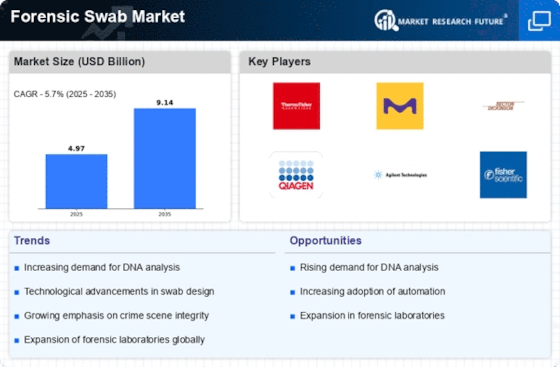
As per Market Research Future analysis, the Forensic Swab Market Size was estimated at 4.968 USD Billion in 2024. The Forensic Swab industry is projected to grow from 5.251 USD Billion in 2025 to 9.141 USD Billion by 2035, exhibiting a compound annual growth rate (CAGR) of 5.7% during the forecast period 2025 - 2035

Key Market Trends & Highlights

The Forensic Swab Market is experiencing robust growth driven by technological advancements and increasing crime rates.

  • North America remains the largest market for forensic swabs, driven by high demand from law enforcement agencies.
  • The Asia-Pacific region is emerging as the fastest-growing market, fueled by rising public awareness and investment in forensic technologies.
  • Flocked swabs dominate the market share, while foam swabs are rapidly gaining traction due to their effectiveness in sample collection.
  • Technological advancements and increased crime rates are key drivers propelling the growth of the forensic swab market.

Market Size & Forecast

2024 Market Size 4.968 (USD Billion)
2035 Market Size 9.141 (USD Billion)
CAGR (2025 - 2035) 5.7%
Largest Regional Market Share in 2024 North America

Major Players

Thermo Fisher Scientific (US), Merck KGaA (DE), Becton Dickinson and Company (US), Qiagen N.V. (NL), Agilent Technologies, Inc. (US), Fisher Scientific (US), Promega Corporation (US), Roche Diagnostics (CH), Bio-Rad Laboratories, Inc. (US)

Market Trends

The Forensic Swab Market is currently experiencing notable growth, driven by increasing demand for accurate and reliable forensic analysis in criminal investigations. The rise in crime rates and the subsequent need for effective evidence collection methods have propelled the adoption of forensic swabs across various law enforcement agencies. Furthermore, advancements in technology are enhancing the efficiency and effectiveness of these swabs, making them indispensable tools in modern forensic science. As the market evolves, there is a growing emphasis on the development of specialized swabs designed for specific applications, which may further expand their utility in diverse forensic scenarios. In addition to technological advancements, the Forensic Swab Market is influenced by heightened public awareness regarding crime scene investigation processes. This awareness has led to increased funding for forensic laboratories and training programs, thereby fostering a more robust infrastructure for evidence collection. Moreover, collaborations between law enforcement agencies and forensic service providers are likely to enhance the overall quality of forensic investigations. As the market continues to mature, it appears poised for sustained growth, with potential opportunities emerging in various sectors, including healthcare and environmental monitoring.

Technological Advancements

The Forensic Swab Market is witnessing a surge in innovation, with new materials and designs being developed to improve the efficacy of evidence collection. Enhanced swab technologies are being introduced, which may allow for better sample recovery and preservation, thus increasing the reliability of forensic results.

Increased Crime Rates

The persistent rise in crime rates globally is driving demand for forensic swabs. Law enforcement agencies are increasingly relying on these tools to gather critical evidence, which suggests a growing recognition of the importance of forensic science in solving crimes.

Public Awareness and Funding

There is a noticeable increase in public awareness regarding forensic science, which is leading to greater funding for forensic laboratories. This trend indicates a commitment to improving investigative processes and ensuring that law enforcement agencies are equipped with the necessary tools for effective crime scene analysis.

Forensic Swab Market Market Drivers

Increased Crime Rates

The Forensic Swab Market is significantly influenced by the rising crime rates observed in various regions. As criminal activities escalate, law enforcement agencies are compelled to enhance their investigative capabilities. This has led to a heightened demand for forensic swabs, which are essential for collecting biological evidence at crime scenes. According to recent statistics, certain areas have reported a surge in violent crimes, necessitating the use of advanced forensic techniques. Consequently, the market for forensic swabs is expected to expand as police departments and forensic laboratories seek to improve their evidence collection methods. This trend indicates a direct correlation between crime rates and the growth of the Forensic Swab Market, as agencies strive to ensure justice through effective forensic analysis.

Public Awareness and Funding

The Forensic Swab Market is benefiting from increased public awareness regarding the importance of forensic science in criminal justice. As communities become more informed about the role of forensic evidence in solving crimes, there is a growing demand for improved forensic services. This heightened awareness often translates into increased funding for law enforcement agencies and forensic laboratories. Governments and private organizations are recognizing the necessity of investing in advanced forensic technologies, including high-quality swabs. This influx of funding is likely to enhance the capabilities of forensic teams, leading to more efficient crime scene investigations. As a result, the Forensic Swab Market is poised for growth, driven by both public interest and financial support for forensic advancements.

Regulatory Standards and Compliance

The Forensic Swab Market is also shaped by stringent regulatory standards and compliance requirements. Various jurisdictions are implementing guidelines that mandate the use of specific types of forensic swabs to ensure the integrity of evidence collection. These regulations are designed to uphold the quality and reliability of forensic investigations, thereby influencing the purchasing decisions of law enforcement agencies. As compliance becomes increasingly critical, manufacturers of forensic swabs are compelled to innovate and meet these standards. This trend is likely to drive the market forward, as agencies seek to procure swabs that adhere to regulatory requirements. Consequently, the Forensic Swab Market is expected to witness growth as compliance with these standards becomes a priority for forensic professionals.

Emerging Markets and Global Expansion

The Forensic Swab Market is witnessing growth opportunities in emerging markets, where the demand for forensic services is on the rise. As countries develop their law enforcement capabilities, there is an increasing recognition of the importance of forensic science in criminal investigations. This trend is particularly evident in regions where crime rates are escalating, prompting governments to invest in forensic technologies. The expansion of forensic laboratories and training programs is likely to enhance the overall effectiveness of crime scene investigations. Additionally, as international collaborations in forensic science increase, the market for forensic swabs is expected to grow. This The Forensic Swab Industry, as new players enter the market and existing companies seek to establish a presence in these developing regions.

Technological Advancements in Forensic Swab Market

The Forensic Swab Market is experiencing a notable transformation due to rapid technological advancements. Innovations in materials and design are enhancing the efficacy of swabs used in forensic investigations. For instance, the introduction of specialized swabs that can capture minute biological samples is becoming increasingly prevalent. This is particularly relevant as the demand for accurate and reliable forensic evidence continues to rise. Furthermore, advancements in automation and robotics are streamlining the collection and analysis processes, thereby increasing efficiency. The market is projected to grow at a compound annual growth rate of approximately 6.5% over the next five years, driven by these technological improvements. As a result, law enforcement agencies are likely to invest more in advanced forensic tools, further propelling the growth of the Forensic Swab Market.

Market Segment Insights

By Type: Flocked (Largest) vs. Foam (Fastest-Growing)

<p>In the Forensic Swab Market, the distribution of market share among different swab types reveals that flocked swabs dominate due to their superior collection efficiencies and versatility in various applications. Foam swabs follow closely, gaining traction for their gentler touch and compatibility with sensitive forensic samples. Cotton swabs, while still used, hold a minor share as they struggle to compete with newer materials that provide enhanced performance in forensic investigations.</p>

<p>Flocked (Dominant) vs. Foam (Emerging)</p>

<p>Flocked swabs are recognized as the dominant player in the forensic swab market, attributed to their unique fiber structure that optimizes the collection of both liquid and solid samples. Their rapid absorption and release capabilities make them ideal for capturing cellular material and other forensic evidence, thus ensuring higher accuracy in analysis. Conversely, foam swabs are emerging as a favorable option for specific applications, particularly in delicate circumstances that require a more gentle touch. Their growing popularity stems from advancements in foam technology, which enhance flexibility while maintaining sample integrity, positioning them as a rising choice among forensic professionals.</p>

By Type of Swab Shaft: Wood-stick Shaft (Largest) vs. Polystyrene Shaft (Fastest-Growing)

<p>In the forensic swab market, the wood-stick shaft segment currently holds the largest market share, attributed to its traditional use in sample collection and its effectiveness in various forensic applications. The polystyrene shaft segment, while not as dominant, has captured a significant interest due to its cost-effectiveness and adaptability in modern forensic practices, providing a competitive edge in niche markets.</p>

<p>Wood-stick Shaft (Dominant) vs. Polystyrene Shaft (Emerging)</p>

<p>The wood-stick shaft is the dominant choice in the forensic swab market due to its long-established reputation, reliable performance, and versatility in various environmental conditions. It is typically preferred for handling biological samples where precision is critical. In contrast, the polystyrene shaft is seen as an emerging alternative, increasingly favored for its lightweight, flexible properties, and affordability. This shift to polystyrene is driven by advancements in manufacturing and a growing recognition of its effectiveness for certain types of evidence collection, establishing its foothold in sectors looking for efficient and budget-friendly solutions.</p>

By End-User: Forensic Science (Largest) vs. Laboratories (Fastest-Growing)

<p>The forensic swab market is primarily driven by the end-user distribution among forensic science, laboratories, and hospitals. The forensic science sector holds the largest share, as it integrates swab technology into crime scene investigations, aiding law enforcement agencies and forensic experts. Conversely, laboratories are witnessing rapid growth and adoption of forensic swabs due to the increasing number of criminal cases and the need for efficient sample collection and analysis methods in forensic applications.</p>

<p>Forensic Science (Dominant) vs. Laboratories (Emerging)</p>

<p>The forensic science sector remains the dominant end-user of forensic swabs, characterized by extensive usage in criminal investigations and evidence collection. This segment is crucial for law enforcement agencies, ensuring that collected samples are handled with precision to avoid contamination and preserve integrity. In contrast, laboratories, identified as the emerging segment, are experiencing remarkable growth as they expand capabilities for forensic analysis. These facilities are integrating advanced technologies for sample processing, contributing to enhanced accuracy and efficiency in result generation. As criminal cases rise, the demand for swabs in laboratories is expected to soar, positioning them as a vital support system for the forensic science community.</p>

Get more detailed insights about Forensic Swab Market Research Report - Forecast to 2035

Regional Insights

North America : Forensic Innovation Leader

North America is the largest market for forensic swabs, holding approximately 45% of the global share. The region's growth is driven by increasing crime rates, advancements in forensic technologies, and stringent regulations mandating the use of forensic evidence in legal proceedings. The U.S. leads this market, followed closely by Canada, which contributes around 15% to the overall market share. Regulatory support from agencies like the FBI enhances the demand for forensic swabs. The competitive landscape in North America is robust, featuring key players such as Thermo Fisher Scientific, Becton Dickinson, and Promega Corporation. These companies are investing in R&D to innovate and improve product offerings. The presence of advanced laboratories and a strong focus on forensic science education further bolster the market. The region's commitment to enhancing public safety through forensic advancements positions it as a leader in the global market.

Europe : Emerging Forensic Market

Europe is witnessing significant growth in the forensic swab market, accounting for approximately 30% of the global share. The demand is fueled by increasing criminal investigations and the adoption of advanced forensic technologies. Countries like Germany and the UK are the largest contributors, with Germany holding about 12% of the market. Regulatory frameworks, such as the European Union's guidelines on forensic evidence, are catalyzing this growth by ensuring standardized practices across member states. The competitive landscape in Europe is characterized by the presence of major players like Merck KGaA and Qiagen N.V. These companies are focusing on strategic partnerships and collaborations to enhance their market presence. The region is also home to numerous research institutions that are advancing forensic science, thereby increasing the demand for innovative forensic swabs. The emphasis on quality and compliance with regulations further strengthens the market position in Europe.

Asia-Pacific : Rapidly Growing Forensic Sector

Asia-Pacific is rapidly emerging as a significant player in the forensic swab market, holding around 20% of the global share. The growth is driven by increasing crime rates, government initiatives to enhance forensic capabilities, and rising public awareness about forensic science. Countries like China and India are leading this growth, with China contributing approximately 10% to the market. The region is witnessing a surge in investments in forensic laboratories and training programs, which are essential for improving forensic practices. The competitive landscape in Asia-Pacific is evolving, with both local and international players entering the market. Companies like Agilent Technologies and Bio-Rad Laboratories are expanding their operations in this region. The presence of a large population and the growing need for effective law enforcement are further propelling the demand for forensic swabs. As governments prioritize public safety, the forensic market in Asia-Pacific is expected to continue its upward trajectory.

Middle East and Africa : Developing Forensic Landscape

The Middle East and Africa region is gradually developing its forensic swab market, currently holding about 5% of the global share. The growth is primarily driven by increasing investments in law enforcement and forensic science, alongside rising crime rates. Countries like South Africa and the UAE are at the forefront, with South Africa accounting for approximately 3% of the market. Government initiatives aimed at improving forensic capabilities are crucial for the region's development. The competitive landscape in this region is still emerging, with a mix of local and international players. Companies are focusing on establishing partnerships with law enforcement agencies to enhance their market presence. The region's unique challenges, such as varying levels of technological advancement, require tailored solutions for forensic swabs. As awareness of forensic science grows, the market is expected to expand, driven by both public and private sector investments.

Key Players and Competitive Insights

Leading market players are investing heavily in research and development in order to expand their product lines, which will help the Forensic Swab Market, grow even more. Market participants are also undertaking a variety of strategic activities to expand their footprint, with important market developments including new product launches, contractual agreements, mergers and acquisitions, higher investments, and collaboration with other organizations. To expand and survive in a more competitive and rising market climate, Forensic Swabindustry must offer cost-effective items.
Manufacturing locally to minimize operational costs is one of the key business tactics used by manufacturers in the  Forensic Swab industry to benefit clients and increase the market sector. In recent years, the Forensic Swab industry has offered some of the most significant advantages to medicine. Major players in the Forensic Swab Market, including Copan Italia S.p.A., MWE, SARSTEDT AG & Co. KG. Luna, Puritan Medical Products, Sirchie, and MEDTE CH Forensics, and others, are attempting to increase market demand by investing in research and development operations.
Puritan Medical Products is a maker of swab, diagnostic, and specimen collecting products in the United States. Puritan is the largest manufacturer of COVID-19 testing swabs in North America.  Puritan, headquartered in Guilford, Maine, is a subsidiary of Hardwood Products Co., LP (the other two subsidiaries are Hardwood Products Co., LLC and Puritan Medical Products Co., LLC).
Guilford has been dubbed America's "swab capital," with Puritan-era industry ushering in the "golden age of the swab." Puritan has three Maine sites (one in Guilford and two in Pittsfield), as well as a manufacturing factory in Orlinda, Tennessee, where it manufactures swabs and diagnostic testing kits. In 2021, Puritan Medical Products added a new brand of foam-tipped forensic swabs to their product portfolio. The new swabs are intended to be more successful at gathering DNA samples from different surfaces while also being more comfortable for patients to use.
Becton, Dickinson and firm, or BD, is a multinational medical technology firm based in the United States that manufactures and sells medical devices, instrument systems, and reagents. In select regions, BD also offers consulting and analytics services. Based on revenues for the fiscal year ended September 30, 2020, BD is ranked #177 on the 2021 Fortune 500 list. Maxwell Becton and Fairleigh S. Dickinson launched the corporation in New York City in 1897. Its headquarters were eventually relocated to New Jersey.
In June 2020, Becton, Dickinson and Company increased their product line with the introduction of a new line of forensic swabs. The new swabs are intended to be more successful at collecting DNA samples from varied surfaces, and they are composed of high-quality, sterile materials.

Key Companies in the Forensic Swab Market include

Industry Developments

In March 2019, Automation was used in forensic swab testing by Key Forensic Services. Automation has improved the accuracy and efficiency of forensic testing while also reducing the time and expense associated with forensic testing.

In October 2019, Copan Diagnostics boosted its swab production capacity to suit rising COVID-19 testing demand. Because of the COVID-19 pandemic, the usage of forensic swabs for COVID-19 testing has increased.

In July 2019, DNA Genotek has launched a new series of forensic swabs called OmniSwab. The new swabs are more adaptable than regular swabs and can be utilized for a variety of forensic applications. The OmniSwab series has contributed to increased forensic testing efficiency and accuracy.

Future Outlook

Forensic Swab Market Future Outlook

The Forensic Swab Market is projected to grow at a 5.7% CAGR from 2025 to 2035, driven by advancements in forensic technology and increasing crime rates.

New opportunities lie in:

  • Development of specialized swabs for DNA collection in diverse environments.
  • Integration of smart technology for real-time data analysis in forensic investigations.
  • Expansion of training programs for law enforcement on swab collection techniques.

By 2035, the Forensic Swab Market is expected to be robust, reflecting significant advancements and increased demand.

Market Segmentation

Forensic Swab Market Type Outlook

  • Foam
  • Flocked
  • Cotton

Forensic Swab Market End-User Outlook

  • Forensic Science
  • Laboratories
  • Hospitals

Forensic Swab Market Type of Swab Shaft Outlook

  • Wood-stick Shaft
  • Polystyrene Shaft

Report Scope

MARKET SIZE 2024 4.968(USD Billion)
MARKET SIZE 2025 5.251(USD Billion)
MARKET SIZE 2035 9.141(USD Billion)
COMPOUND ANNUAL GROWTH RATE (CAGR) 5.7% (2025 - 2035)
REPORT COVERAGE Revenue Forecast, Competitive Landscape, Growth Factors, and Trends
BASE YEAR 2024
Market Forecast Period 2025 - 2035
Historical Data 2019 - 2024
Market Forecast Units USD Billion
Key Companies Profiled Thermo Fisher Scientific (US), Merck KGaA (DE), Becton Dickinson and Company (US), Qiagen N.V. (NL), Agilent Technologies, Inc. (US), Fisher Scientific (US), Promega Corporation (US), Roche Diagnostics (CH), Bio-Rad Laboratories, Inc. (US)
Segments Covered Type, Type of Swab Shaft, End-User, Region
Key Market Opportunities Advancements in DNA analysis technologies enhance the Forensic Swab Market's potential for rapid evidence collection.
Key Market Dynamics Rising demand for advanced forensic swabs drives innovation and competition among manufacturers in the forensic analysis sector.
Countries Covered North America, Europe, APAC, South America, MEA

FAQs

What is the current valuation of the Forensic Swab Market as of 2024?

<p>The Forensic Swab Market was valued at 4.968 USD Billion in 2024.</p>

What is the projected market valuation for the Forensic Swab Market in 2035?

<p>The market is projected to reach 9.141 USD Billion by 2035.</p>

What is the expected CAGR for the Forensic Swab Market during the forecast period 2025 - 2035?

<p>The expected CAGR for the Forensic Swab Market during 2025 - 2035 is 5.7%.</p>

Which companies are considered key players in the Forensic Swab Market?

<p>Key players include Thermo Fisher Scientific, Merck KGaA, Becton Dickinson and Company, and Qiagen N.V.</p>

What are the different types of swabs available in the Forensic Swab Market?

<p>The market includes Foam, Flocked, and Cotton swabs, with varying valuations.</p>

How do the valuations of Foam, Flocked, and Cotton swabs compare?

<p>Foam swabs were valued at 1.5 to 2.7 USD Billion, Flocked swabs at 2.0 to 3.5 USD Billion, and Cotton swabs at 1.468 to 2.941 USD Billion.</p>

What types of swab shafts are utilized in the Forensic Swab Market?

<p>The market features Wood-stick and Polystyrene shafts, each with specific valuation ranges.</p>

What is the valuation range for Wood-stick and Polystyrene shafts?

<p>Wood-stick shafts were valued at 2.484 to 4.57 USD Billion, while Polystyrene shafts had a similar valuation range.</p>

Which end-users are driving demand in the Forensic Swab Market?

<p>End-users include Forensic Science, Laboratories, and Hospitals, each contributing to market growth.</p>

What are the valuation ranges for the end-user segments in the Forensic Swab Market?

<p>Forensic Science and Laboratories were valued at 1.4904 to 2.6885 USD Billion, while Hospitals ranged from 1.9872 to 3.7645 USD Billion.</p>

  1. SECTION I: EXECUTIVE SUMMARY AND KEY HIGHLIGHTS
    1. | 1.1 EXECUTIVE SUMMARY
    2. | | 1.1.1 Market Overview
    3. | | 1.1.2 Key Findings
    4. | | 1.1.3 Market Segmentation
    5. | | 1.1.4 Competitive Landscape
    6. | | 1.1.5 Challenges and Opportunities
    7. | | 1.1.6 Future Outlook
  2. SECTION II: SCOPING, METHODOLOGY AND MARKET STRUCTURE
    1. | 2.1 MARKET INTRODUCTION
    2. | | 2.1.1 Definition
    3. | | 2.1.2 Scope of the study
    4. | | | 2.1.2.1 Research Objective
    5. | | | 2.1.2.2 Assumption
    6. | | | 2.1.2.3 Limitations
    7. | 2.2 RESEARCH METHODOLOGY
    8. | | 2.2.1 Overview
    9. | | 2.2.2 Data Mining
    10. | | 2.2.3 Secondary Research
    11. | | 2.2.4 Primary Research
    12. | | | 2.2.4.1 Primary Interviews and Information Gathering Process
    13. | | | 2.2.4.2 Breakdown of Primary Respondents
    14. | | 2.2.5 Forecasting Model
    15. | | 2.2.6 Market Size Estimation
    16. | | | 2.2.6.1 Bottom-Up Approach
    17. | | | 2.2.6.2 Top-Down Approach
    18. | | 2.2.7 Data Triangulation
    19. | | 2.2.8 Validation
  3. SECTION III: QUALITATIVE ANALYSIS
    1. | 3.1 MARKET DYNAMICS
    2. | | 3.1.1 Overview
    3. | | 3.1.2 Drivers
    4. | | 3.1.3 Restraints
    5. | | 3.1.4 Opportunities
    6. | 3.2 MARKET FACTOR ANALYSIS
    7. | | 3.2.1 Value chain Analysis
    8. | | 3.2.2 Porter's Five Forces Analysis
    9. | | | 3.2.2.1 Bargaining Power of Suppliers
    10. | | | 3.2.2.2 Bargaining Power of Buyers
    11. | | | 3.2.2.3 Threat of New Entrants
    12. | | | 3.2.2.4 Threat of Substitutes
    13. | | | 3.2.2.5 Intensity of Rivalry
    14. | | 3.2.3 COVID-19 Impact Analysis
    15. | | | 3.2.3.1 Market Impact Analysis
    16. | | | 3.2.3.2 Regional Impact
    17. | | | 3.2.3.3 Opportunity and Threat Analysis
  4. SECTION IV: QUANTITATIVE ANALYSIS
    1. | 4.1 Healthcare, BY Type (USD Billion)
    2. | | 4.1.1 Foam
    3. | | 4.1.2 Flocked
    4. | | 4.1.3 Cotton
    5. | 4.2 Healthcare, BY Type of Swab Shaft (USD Billion)
    6. | | 4.2.1 Wood-stick Shaft
    7. | | 4.2.2 Polystyrene Shaft
    8. | 4.3 Healthcare, BY End-User (USD Billion)
    9. | | 4.3.1 Forensic Science
    10. | | 4.3.2 Laboratories
    11. | | 4.3.3 Hospitals
    12. | 4.4 Healthcare, BY Region (USD Billion)
    13. | | 4.4.1 North America
    14. | | | 4.4.1.1 US
    15. | | | 4.4.1.2 Canada
    16. | | 4.4.2 Europe
    17. | | | 4.4.2.1 Germany
    18. | | | 4.4.2.2 UK
    19. | | | 4.4.2.3 France
    20. | | | 4.4.2.4 Russia
    21. | | | 4.4.2.5 Italy
    22. | | | 4.4.2.6 Spain
    23. | | | 4.4.2.7 Rest of Europe
    24. | | 4.4.3 APAC
    25. | | | 4.4.3.1 China
    26. | | | 4.4.3.2 India
    27. | | | 4.4.3.3 Japan
    28. | | | 4.4.3.4 South Korea
    29. | | | 4.4.3.5 Malaysia
    30. | | | 4.4.3.6 Thailand
    31. | | | 4.4.3.7 Indonesia
    32. | | | 4.4.3.8 Rest of APAC
    33. | | 4.4.4 South America
    34. | | | 4.4.4.1 Brazil
    35. | | | 4.4.4.2 Mexico
    36. | | | 4.4.4.3 Argentina
    37. | | | 4.4.4.4 Rest of South America
    38. | | 4.4.5 MEA
    39. | | | 4.4.5.1 GCC Countries
    40. | | | 4.4.5.2 South Africa
    41. | | | 4.4.5.3 Rest of MEA
  5. SECTION V: COMPETITIVE ANALYSIS
    1. | 5.1 Competitive Landscape
    2. | | 5.1.1 Overview
    3. | | 5.1.2 Competitive Analysis
    4. | | 5.1.3 Market share Analysis
    5. | | 5.1.4 Major Growth Strategy in the Healthcare
    6. | | 5.1.5 Competitive Benchmarking
    7. | | 5.1.6 Leading Players in Terms of Number of Developments in the Healthcare
    8. | | 5.1.7 Key developments and growth strategies
    9. | | | 5.1.7.1 New Product Launch/Service Deployment
    10. | | | 5.1.7.2 Merger & Acquisitions
    11. | | | 5.1.7.3 Joint Ventures
    12. | | 5.1.8 Major Players Financial Matrix
    13. | | | 5.1.8.1 Sales and Operating Income
    14. | | | 5.1.8.2 Major Players R&D Expenditure. 2023
    15. | 5.2 Company Profiles
    16. | | 5.2.1 Thermo Fisher Scientific (US)
    17. | | | 5.2.1.1 Financial Overview
    18. | | | 5.2.1.2 Products Offered
    19. | | | 5.2.1.3 Key Developments
    20. | | | 5.2.1.4 SWOT Analysis
    21. | | | 5.2.1.5 Key Strategies
    22. | | 5.2.2 Merck KGaA (DE)
    23. | | | 5.2.2.1 Financial Overview
    24. | | | 5.2.2.2 Products Offered
    25. | | | 5.2.2.3 Key Developments
    26. | | | 5.2.2.4 SWOT Analysis
    27. | | | 5.2.2.5 Key Strategies
    28. | | 5.2.3 Becton Dickinson and Company (US)
    29. | | | 5.2.3.1 Financial Overview
    30. | | | 5.2.3.2 Products Offered
    31. | | | 5.2.3.3 Key Developments
    32. | | | 5.2.3.4 SWOT Analysis
    33. | | | 5.2.3.5 Key Strategies
    34. | | 5.2.4 Qiagen N.V. (NL)
    35. | | | 5.2.4.1 Financial Overview
    36. | | | 5.2.4.2 Products Offered
    37. | | | 5.2.4.3 Key Developments
    38. | | | 5.2.4.4 SWOT Analysis
    39. | | | 5.2.4.5 Key Strategies
    40. | | 5.2.5 Agilent Technologies, Inc. (US)
    41. | | | 5.2.5.1 Financial Overview
    42. | | | 5.2.5.2 Products Offered
    43. | | | 5.2.5.3 Key Developments
    44. | | | 5.2.5.4 SWOT Analysis
    45. | | | 5.2.5.5 Key Strategies
    46. | | 5.2.6 Fisher Scientific (US)
    47. | | | 5.2.6.1 Financial Overview
    48. | | | 5.2.6.2 Products Offered
    49. | | | 5.2.6.3 Key Developments
    50. | | | 5.2.6.4 SWOT Analysis
    51. | | | 5.2.6.5 Key Strategies
    52. | | 5.2.7 Promega Corporation (US)
    53. | | | 5.2.7.1 Financial Overview
    54. | | | 5.2.7.2 Products Offered
    55. | | | 5.2.7.3 Key Developments
    56. | | | 5.2.7.4 SWOT Analysis
    57. | | | 5.2.7.5 Key Strategies
    58. | | 5.2.8 Roche Diagnostics (CH)
    59. | | | 5.2.8.1 Financial Overview
    60. | | | 5.2.8.2 Products Offered
    61. | | | 5.2.8.3 Key Developments
    62. | | | 5.2.8.4 SWOT Analysis
    63. | | | 5.2.8.5 Key Strategies
    64. | | 5.2.9 Bio-Rad Laboratories, Inc. (US)
    65. | | | 5.2.9.1 Financial Overview
    66. | | | 5.2.9.2 Products Offered
    67. | | | 5.2.9.3 Key Developments
    68. | | | 5.2.9.4 SWOT Analysis
    69. | | | 5.2.9.5 Key Strategies
    70. | 5.3 Appendix
    71. | | 5.3.1 References
    72. | | 5.3.2 Related Reports
  6. LIST OF FIGURES
    1. | 6.1 MARKET SYNOPSIS
    2. | 6.2 NORTH AMERICA MARKET ANALYSIS
    3. | 6.3 US MARKET ANALYSIS BY TYPE
    4. | 6.4 US MARKET ANALYSIS BY TYPE OF SWAB SHAFT
    5. | 6.5 US MARKET ANALYSIS BY END-USER
    6. | 6.6 CANADA MARKET ANALYSIS BY TYPE
    7. | 6.7 CANADA MARKET ANALYSIS BY TYPE OF SWAB SHAFT
    8. | 6.8 CANADA MARKET ANALYSIS BY END-USER
    9. | 6.9 EUROPE MARKET ANALYSIS
    10. | 6.10 GERMANY MARKET ANALYSIS BY TYPE
    11. | 6.11 GERMANY MARKET ANALYSIS BY TYPE OF SWAB SHAFT
    12. | 6.12 GERMANY MARKET ANALYSIS BY END-USER
    13. | 6.13 UK MARKET ANALYSIS BY TYPE
    14. | 6.14 UK MARKET ANALYSIS BY TYPE OF SWAB SHAFT
    15. | 6.15 UK MARKET ANALYSIS BY END-USER
    16. | 6.16 FRANCE MARKET ANALYSIS BY TYPE
    17. | 6.17 FRANCE MARKET ANALYSIS BY TYPE OF SWAB SHAFT
    18. | 6.18 FRANCE MARKET ANALYSIS BY END-USER
    19. | 6.19 RUSSIA MARKET ANALYSIS BY TYPE
    20. | 6.20 RUSSIA MARKET ANALYSIS BY TYPE OF SWAB SHAFT
    21. | 6.21 RUSSIA MARKET ANALYSIS BY END-USER
    22. | 6.22 ITALY MARKET ANALYSIS BY TYPE
    23. | 6.23 ITALY MARKET ANALYSIS BY TYPE OF SWAB SHAFT
    24. | 6.24 ITALY MARKET ANALYSIS BY END-USER
    25. | 6.25 SPAIN MARKET ANALYSIS BY TYPE
    26. | 6.26 SPAIN MARKET ANALYSIS BY TYPE OF SWAB SHAFT
    27. | 6.27 SPAIN MARKET ANALYSIS BY END-USER
    28. | 6.28 REST OF EUROPE MARKET ANALYSIS BY TYPE
    29. | 6.29 REST OF EUROPE MARKET ANALYSIS BY TYPE OF SWAB SHAFT
    30. | 6.30 REST OF EUROPE MARKET ANALYSIS BY END-USER
    31. | 6.31 APAC MARKET ANALYSIS
    32. | 6.32 CHINA MARKET ANALYSIS BY TYPE
    33. | 6.33 CHINA MARKET ANALYSIS BY TYPE OF SWAB SHAFT
    34. | 6.34 CHINA MARKET ANALYSIS BY END-USER
    35. | 6.35 INDIA MARKET ANALYSIS BY TYPE
    36. | 6.36 INDIA MARKET ANALYSIS BY TYPE OF SWAB SHAFT
    37. | 6.37 INDIA MARKET ANALYSIS BY END-USER
    38. | 6.38 JAPAN MARKET ANALYSIS BY TYPE
    39. | 6.39 JAPAN MARKET ANALYSIS BY TYPE OF SWAB SHAFT
    40. | 6.40 JAPAN MARKET ANALYSIS BY END-USER
    41. | 6.41 SOUTH KOREA MARKET ANALYSIS BY TYPE
    42. | 6.42 SOUTH KOREA MARKET ANALYSIS BY TYPE OF SWAB SHAFT
    43. | 6.43 SOUTH KOREA MARKET ANALYSIS BY END-USER
    44. | 6.44 MALAYSIA MARKET ANALYSIS BY TYPE
    45. | 6.45 MALAYSIA MARKET ANALYSIS BY TYPE OF SWAB SHAFT
    46. | 6.46 MALAYSIA MARKET ANALYSIS BY END-USER
    47. | 6.47 THAILAND MARKET ANALYSIS BY TYPE
    48. | 6.48 THAILAND MARKET ANALYSIS BY TYPE OF SWAB SHAFT
    49. | 6.49 THAILAND MARKET ANALYSIS BY END-USER
    50. | 6.50 INDONESIA MARKET ANALYSIS BY TYPE
    51. | 6.51 INDONESIA MARKET ANALYSIS BY TYPE OF SWAB SHAFT
    52. | 6.52 INDONESIA MARKET ANALYSIS BY END-USER
    53. | 6.53 REST OF APAC MARKET ANALYSIS BY TYPE
    54. | 6.54 REST OF APAC MARKET ANALYSIS BY TYPE OF SWAB SHAFT
    55. | 6.55 REST OF APAC MARKET ANALYSIS BY END-USER
    56. | 6.56 SOUTH AMERICA MARKET ANALYSIS
    57. | 6.57 BRAZIL MARKET ANALYSIS BY TYPE
    58. | 6.58 BRAZIL MARKET ANALYSIS BY TYPE OF SWAB SHAFT
    59. | 6.59 BRAZIL MARKET ANALYSIS BY END-USER
    60. | 6.60 MEXICO MARKET ANALYSIS BY TYPE
    61. | 6.61 MEXICO MARKET ANALYSIS BY TYPE OF SWAB SHAFT
    62. | 6.62 MEXICO MARKET ANALYSIS BY END-USER
    63. | 6.63 ARGENTINA MARKET ANALYSIS BY TYPE
    64. | 6.64 ARGENTINA MARKET ANALYSIS BY TYPE OF SWAB SHAFT
    65. | 6.65 ARGENTINA MARKET ANALYSIS BY END-USER
    66. | 6.66 REST OF SOUTH AMERICA MARKET ANALYSIS BY TYPE
    67. | 6.67 REST OF SOUTH AMERICA MARKET ANALYSIS BY TYPE OF SWAB SHAFT
    68. | 6.68 REST OF SOUTH AMERICA MARKET ANALYSIS BY END-USER
    69. | 6.69 MEA MARKET ANALYSIS
    70. | 6.70 GCC COUNTRIES MARKET ANALYSIS BY TYPE
    71. | 6.71 GCC COUNTRIES MARKET ANALYSIS BY TYPE OF SWAB SHAFT
    72. | 6.72 GCC COUNTRIES MARKET ANALYSIS BY END-USER
    73. | 6.73 SOUTH AFRICA MARKET ANALYSIS BY TYPE
    74. | 6.74 SOUTH AFRICA MARKET ANALYSIS BY TYPE OF SWAB SHAFT
    75. | 6.75 SOUTH AFRICA MARKET ANALYSIS BY END-USER
    76. | 6.76 REST OF MEA MARKET ANALYSIS BY TYPE
    77. | 6.77 REST OF MEA MARKET ANALYSIS BY TYPE OF SWAB SHAFT
    78. | 6.78 REST OF MEA MARKET ANALYSIS BY END-USER
    79. | 6.79 KEY BUYING CRITERIA OF HEALTHCARE
    80. | 6.80 RESEARCH PROCESS OF MRFR
    81. | 6.81 DRO ANALYSIS OF HEALTHCARE
    82. | 6.82 DRIVERS IMPACT ANALYSIS: HEALTHCARE
    83. | 6.83 RESTRAINTS IMPACT ANALYSIS: HEALTHCARE
    84. | 6.84 SUPPLY / VALUE CHAIN: HEALTHCARE
    85. | 6.85 HEALTHCARE, BY TYPE, 2024 (% SHARE)
    86. | 6.86 HEALTHCARE, BY TYPE, 2024 TO 2035 (USD Billion)
    87. | 6.87 HEALTHCARE, BY TYPE OF SWAB SHAFT, 2024 (% SHARE)
    88. | 6.88 HEALTHCARE, BY TYPE OF SWAB SHAFT, 2024 TO 2035 (USD Billion)
    89. | 6.89 HEALTHCARE, BY END-USER, 2024 (% SHARE)
    90. | 6.90 HEALTHCARE, BY END-USER, 2024 TO 2035 (USD Billion)
    91. | 6.91 BENCHMARKING OF MAJOR COMPETITORS
  7. LIST OF TABLES
    1. | 7.1 LIST OF ASSUMPTIONS
    2. | | 7.1.1
    3. | 7.2 North America MARKET SIZE ESTIMATES; FORECAST
    4. | | 7.2.1 BY TYPE, 2025-2035 (USD Billion)
    5. | | 7.2.2 BY TYPE OF SWAB SHAFT, 2025-2035 (USD Billion)
    6. | | 7.2.3 BY END-USER, 2025-2035 (USD Billion)
    7. | 7.3 US MARKET SIZE ESTIMATES; FORECAST
    8. | | 7.3.1 BY TYPE, 2025-2035 (USD Billion)
    9. | | 7.3.2 BY TYPE OF SWAB SHAFT, 2025-2035 (USD Billion)
    10. | | 7.3.3 BY END-USER, 2025-2035 (USD Billion)
    11. | 7.4 Canada MARKET SIZE ESTIMATES; FORECAST
    12. | | 7.4.1 BY TYPE, 2025-2035 (USD Billion)
    13. | | 7.4.2 BY TYPE OF SWAB SHAFT, 2025-2035 (USD Billion)
    14. | | 7.4.3 BY END-USER, 2025-2035 (USD Billion)
    15. | 7.5 Europe MARKET SIZE ESTIMATES; FORECAST
    16. | | 7.5.1 BY TYPE, 2025-2035 (USD Billion)
    17. | | 7.5.2 BY TYPE OF SWAB SHAFT, 2025-2035 (USD Billion)
    18. | | 7.5.3 BY END-USER, 2025-2035 (USD Billion)
    19. | 7.6 Germany MARKET SIZE ESTIMATES; FORECAST
    20. | | 7.6.1 BY TYPE, 2025-2035 (USD Billion)
    21. | | 7.6.2 BY TYPE OF SWAB SHAFT, 2025-2035 (USD Billion)
    22. | | 7.6.3 BY END-USER, 2025-2035 (USD Billion)
    23. | 7.7 UK MARKET SIZE ESTIMATES; FORECAST
    24. | | 7.7.1 BY TYPE, 2025-2035 (USD Billion)
    25. | | 7.7.2 BY TYPE OF SWAB SHAFT, 2025-2035 (USD Billion)
    26. | | 7.7.3 BY END-USER, 2025-2035 (USD Billion)
    27. | 7.8 France MARKET SIZE ESTIMATES; FORECAST
    28. | | 7.8.1 BY TYPE, 2025-2035 (USD Billion)
    29. | | 7.8.2 BY TYPE OF SWAB SHAFT, 2025-2035 (USD Billion)
    30. | | 7.8.3 BY END-USER, 2025-2035 (USD Billion)
    31. | 7.9 Russia MARKET SIZE ESTIMATES; FORECAST
    32. | | 7.9.1 BY TYPE, 2025-2035 (USD Billion)
    33. | | 7.9.2 BY TYPE OF SWAB SHAFT, 2025-2035 (USD Billion)
    34. | | 7.9.3 BY END-USER, 2025-2035 (USD Billion)
    35. | 7.10 Italy MARKET SIZE ESTIMATES; FORECAST
    36. | | 7.10.1 BY TYPE, 2025-2035 (USD Billion)
    37. | | 7.10.2 BY TYPE OF SWAB SHAFT, 2025-2035 (USD Billion)
    38. | | 7.10.3 BY END-USER, 2025-2035 (USD Billion)
    39. | 7.11 Spain MARKET SIZE ESTIMATES; FORECAST
    40. | | 7.11.1 BY TYPE, 2025-2035 (USD Billion)
    41. | | 7.11.2 BY TYPE OF SWAB SHAFT, 2025-2035 (USD Billion)
    42. | | 7.11.3 BY END-USER, 2025-2035 (USD Billion)
    43. | 7.12 Rest of Europe MARKET SIZE ESTIMATES; FORECAST
    44. | | 7.12.1 BY TYPE, 2025-2035 (USD Billion)
    45. | | 7.12.2 BY TYPE OF SWAB SHAFT, 2025-2035 (USD Billion)
    46. | | 7.12.3 BY END-USER, 2025-2035 (USD Billion)
    47. | 7.13 APAC MARKET SIZE ESTIMATES; FORECAST
    48. | | 7.13.1 BY TYPE, 2025-2035 (USD Billion)
    49. | | 7.13.2 BY TYPE OF SWAB SHAFT, 2025-2035 (USD Billion)
    50. | | 7.13.3 BY END-USER, 2025-2035 (USD Billion)
    51. | 7.14 China MARKET SIZE ESTIMATES; FORECAST
    52. | | 7.14.1 BY TYPE, 2025-2035 (USD Billion)
    53. | | 7.14.2 BY TYPE OF SWAB SHAFT, 2025-2035 (USD Billion)
    54. | | 7.14.3 BY END-USER, 2025-2035 (USD Billion)
    55. | 7.15 India MARKET SIZE ESTIMATES; FORECAST
    56. | | 7.15.1 BY TYPE, 2025-2035 (USD Billion)
    57. | | 7.15.2 BY TYPE OF SWAB SHAFT, 2025-2035 (USD Billion)
    58. | | 7.15.3 BY END-USER, 2025-2035 (USD Billion)
    59. | 7.16 Japan MARKET SIZE ESTIMATES; FORECAST
    60. | | 7.16.1 BY TYPE, 2025-2035 (USD Billion)
    61. | | 7.16.2 BY TYPE OF SWAB SHAFT, 2025-2035 (USD Billion)
    62. | | 7.16.3 BY END-USER, 2025-2035 (USD Billion)
    63. | 7.17 South Korea MARKET SIZE ESTIMATES; FORECAST
    64. | | 7.17.1 BY TYPE, 2025-2035 (USD Billion)
    65. | | 7.17.2 BY TYPE OF SWAB SHAFT, 2025-2035 (USD Billion)
    66. | | 7.17.3 BY END-USER, 2025-2035 (USD Billion)
    67. | 7.18 Malaysia MARKET SIZE ESTIMATES; FORECAST
    68. | | 7.18.1 BY TYPE, 2025-2035 (USD Billion)
    69. | | 7.18.2 BY TYPE OF SWAB SHAFT, 2025-2035 (USD Billion)
    70. | | 7.18.3 BY END-USER, 2025-2035 (USD Billion)
    71. | 7.19 Thailand MARKET SIZE ESTIMATES; FORECAST
    72. | | 7.19.1 BY TYPE, 2025-2035 (USD Billion)
    73. | | 7.19.2 BY TYPE OF SWAB SHAFT, 2025-2035 (USD Billion)
    74. | | 7.19.3 BY END-USER, 2025-2035 (USD Billion)
    75. | 7.20 Indonesia MARKET SIZE ESTIMATES; FORECAST
    76. | | 7.20.1 BY TYPE, 2025-2035 (USD Billion)
    77. | | 7.20.2 BY TYPE OF SWAB SHAFT, 2025-2035 (USD Billion)
    78. | | 7.20.3 BY END-USER, 2025-2035 (USD Billion)
    79. | 7.21 Rest of APAC MARKET SIZE ESTIMATES; FORECAST
    80. | | 7.21.1 BY TYPE, 2025-2035 (USD Billion)
    81. | | 7.21.2 BY TYPE OF SWAB SHAFT, 2025-2035 (USD Billion)
    82. | | 7.21.3 BY END-USER, 2025-2035 (USD Billion)
    83. | 7.22 South America MARKET SIZE ESTIMATES; FORECAST
    84. | | 7.22.1 BY TYPE, 2025-2035 (USD Billion)
    85. | | 7.22.2 BY TYPE OF SWAB SHAFT, 2025-2035 (USD Billion)
    86. | | 7.22.3 BY END-USER, 2025-2035 (USD Billion)
    87. | 7.23 Brazil MARKET SIZE ESTIMATES; FORECAST
    88. | | 7.23.1 BY TYPE, 2025-2035 (USD Billion)
    89. | | 7.23.2 BY TYPE OF SWAB SHAFT, 2025-2035 (USD Billion)
    90. | | 7.23.3 BY END-USER, 2025-2035 (USD Billion)
    91. | 7.24 Mexico MARKET SIZE ESTIMATES; FORECAST
    92. | | 7.24.1 BY TYPE, 2025-2035 (USD Billion)
    93. | | 7.24.2 BY TYPE OF SWAB SHAFT, 2025-2035 (USD Billion)
    94. | | 7.24.3 BY END-USER, 2025-2035 (USD Billion)
    95. | 7.25 Argentina MARKET SIZE ESTIMATES; FORECAST
    96. | | 7.25.1 BY TYPE, 2025-2035 (USD Billion)
    97. | | 7.25.2 BY TYPE OF SWAB SHAFT, 2025-2035 (USD Billion)
    98. | | 7.25.3 BY END-USER, 2025-2035 (USD Billion)
    99. | 7.26 Rest of South America MARKET SIZE ESTIMATES; FORECAST
    100. | | 7.26.1 BY TYPE, 2025-2035 (USD Billion)
    101. | | 7.26.2 BY TYPE OF SWAB SHAFT, 2025-2035 (USD Billion)
    102. | | 7.26.3 BY END-USER, 2025-2035 (USD Billion)
    103. | 7.27 MEA MARKET SIZE ESTIMATES; FORECAST
    104. | | 7.27.1 BY TYPE, 2025-2035 (USD Billion)
    105. | | 7.27.2 BY TYPE OF SWAB SHAFT, 2025-2035 (USD Billion)
    106. | | 7.27.3 BY END-USER, 2025-2035 (USD Billion)
    107. | 7.28 GCC Countries MARKET SIZE ESTIMATES; FORECAST
    108. | | 7.28.1 BY TYPE, 2025-2035 (USD Billion)
    109. | | 7.28.2 BY TYPE OF SWAB SHAFT, 2025-2035 (USD Billion)
    110. | | 7.28.3 BY END-USER, 2025-2035 (USD Billion)
    111. | 7.29 South Africa MARKET SIZE ESTIMATES; FORECAST
    112. | | 7.29.1 BY TYPE, 2025-2035 (USD Billion)
    113. | | 7.29.2 BY TYPE OF SWAB SHAFT, 2025-2035 (USD Billion)
    114. | | 7.29.3 BY END-USER, 2025-2035 (USD Billion)
    115. | 7.30 Rest of MEA MARKET SIZE ESTIMATES; FORECAST
    116. | | 7.30.1 BY TYPE, 2025-2035 (USD Billion)
    117. | | 7.30.2 BY TYPE OF SWAB SHAFT, 2025-2035 (USD Billion)
    118. | | 7.30.3 BY END-USER, 2025-2035 (USD Billion)
    119. | 7.31 PRODUCT LAUNCH/PRODUCT DEVELOPMENT/APPROVAL
    120. | | 7.31.1
    121. | 7.32 ACQUISITION/PARTNERSHIP
    122. | | 7.32.1

Healthcare Market Segmentation

Healthcare By Type (USD Billion, 2025-2035)

  • Foam
  • Flocked
  • Cotton

Healthcare By Type of Swab Shaft (USD Billion, 2025-2035)

  • Wood-stick Shaft
  • Polystyrene Shaft

Healthcare By End-User (USD Billion, 2025-2035)

  • Forensic Science
  • Laboratories
  • Hospitals
Infographic

Free Sample Request

Kindly complete the form below to receive a free sample of this Report

Get Free Sample

Customer Strories

Compare Licence

×
Features License Type
Single User Multiuser License Enterprise User
Price $4,950 $5,950 $7,250
Maximum User Access Limit 1 User Upto 10 Users Unrestricted Access Throughout the Organization
Free Customization
Direct Access to Analyst
Deliverable Format
Platform Access
Discount on Next Purchase 10% 15% 15%
Printable Versions