North America : Forensic Innovation Leader
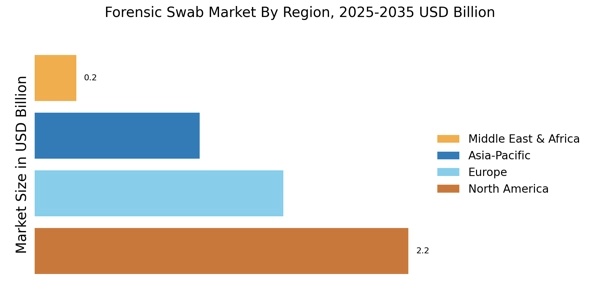
North America is the largest market for forensic swabs, holding approximately 45% of the global share. The region's growth is driven by increasing crime rates, advancements in forensic technologies, and stringent regulations mandating the use of forensic evidence in legal proceedings. The U.S. leads this market, followed closely by Canada, which contributes around 15% to the overall market share. Regulatory support from agencies like the FBI enhances the demand for forensic swabs.
The competitive landscape in North America is robust, featuring key players such as Thermo Fisher Scientific, Becton Dickinson, and Promega Corporation. These companies are investing in R&D to innovate and improve product offerings. The presence of advanced laboratories and a strong focus on forensic science education further bolster the market. The region's commitment to enhancing public safety through forensic advancements positions it as a leader in the global market.
Europe : Emerging Forensic Market
Europe is witnessing significant growth in the forensic swab market, accounting for approximately 30% of the global share. The demand is fueled by increasing criminal investigations and the adoption of advanced forensic technologies. Countries like Germany and the UK are the largest contributors, with Germany holding about 12% of the market. Regulatory frameworks, such as the European Union's guidelines on forensic evidence, are catalyzing this growth by ensuring standardized practices across member states.
The competitive landscape in Europe is characterized by the presence of major players like Merck KGaA and Qiagen N.V. These companies are focusing on strategic partnerships and collaborations to enhance their market presence. The region is also home to numerous research institutions that are advancing forensic science, thereby increasing the demand for innovative forensic swabs. The emphasis on quality and compliance with regulations further strengthens the market position in Europe.
Asia-Pacific : Rapidly Growing Forensic Sector
Asia-Pacific is rapidly emerging as a significant player in the forensic swab market, holding around 20% of the global share. The growth is driven by increasing crime rates, government initiatives to enhance forensic capabilities, and rising public awareness about forensic science. Countries like China and India are leading this growth, with China contributing approximately 10% to the market. The region is witnessing a surge in investments in forensic laboratories and training programs, which are essential for improving forensic practices.
The competitive landscape in Asia-Pacific is evolving, with both local and international players entering the market. Companies like Agilent Technologies and Bio-Rad Laboratories are expanding their operations in this region. The presence of a large population and the growing need for effective law enforcement are further propelling the demand for forensic swabs. As governments prioritize public safety, the forensic market in Asia-Pacific is expected to continue its upward trajectory.
Middle East and Africa : Developing Forensic Landscape
The Middle East and Africa region is gradually developing its forensic swab market, currently holding about 5% of the global share. The growth is primarily driven by increasing investments in law enforcement and forensic science, alongside rising crime rates. Countries like South Africa and the UAE are at the forefront, with South Africa accounting for approximately 3% of the market. Government initiatives aimed at improving forensic capabilities are crucial for the region's development.
The competitive landscape in this region is still emerging, with a mix of local and international players. Companies are focusing on establishing partnerships with law enforcement agencies to enhance their market presence. The region's unique challenges, such as varying levels of technological advancement, require tailored solutions for forensic swabs. As awareness of forensic science grows, the market is expected to expand, driven by both public and private sector investments.





 Noah Malgeri
Co-Founder

 Peter Groot koerkamp
Account and Business Manager

 Younghwan Choi
Senior Retail Manager

 Mark Irwin
Management Consultant

 Akif Moroglu
Strategy & Business Development Director

 Guilherme Gomes Martins
Product Management Director

 Joseph Aguayo
Sales Operations & Pricing Manager

 La Terria Dodd
Program Support Specialist

 Rob Kooiker
Group Product Manager HVAC & Fire Protection GMA



