Request Free Sample ×

Kindly complete the form below to receive a free sample of this Report

* Please use a valid business email

Leading companies partner with us for data-driven Insights

clients tt-cursor
Hero Background
English
Chinese
French
Japanese
Korean
German
Spanish

Food Service Packaging Market Size

ID: MRFR/PCM/2378-HCR
111 Pages
Snehal Singh
March 2026

Food Service Packaging Market Size, Share & Industry Analysis Research Report Information By Product (Flexible Packaging, Rigid Packaging, Paper and Pouches, Bags and Others), By Application (Dairy Products, Fruits and Vegetables, Baked Goods and Others) And By Region (North America, Europe, Asia-Pacific, And Rest Of The World) –Market Forecast Till 2035

Share:
Download PDF ×

We do not share your information with anyone. However, we may send you emails based on your report interest from time to time. You may contact us at any time to opt-out.

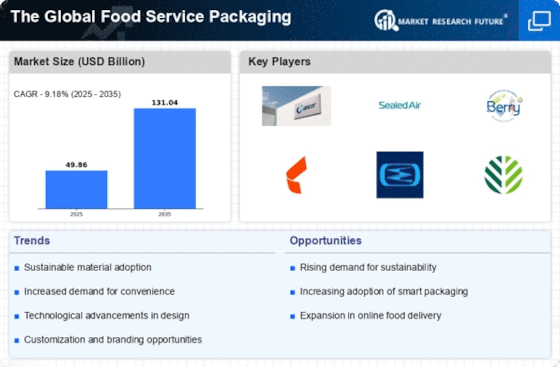
Food Service Packaging Market Infographic
Purchase Options

Food Service Packaging Size

Food Service Packaging Market Growth Projections and Opportunities

The global world food service packaging market has experienced immense growth in recent times, driven by several factors, such as the rapid expansion of the food service industry, the changing lifestyles of consumers, and increased demand for on-the-go foods and drinks. The Food Service Packaging Market Size was estimated at USD 40.8 Billion in 2022. Thus, the food service packaging sector will grow from USD 45.1 Billion in 2023 to USD 100.7 Billion by 2032, growing at a CAGR (Compound Annual Growth Rate) of 10.56%. A major driver of the global food service packaging market is the booming food service industry worldwide. There is, therefore, an increasing requirement for effective and sustainable packing solutions as more people prefer either eating out or ordering meals online. Packaging used by restaurants and coffee shops, among other catering services, should not only keep it fresh but also improve customer experiences. With fast-paced lifestyles and an expanding urban population, many people prefer consuming convenience foods nowadays. This trend has further boosted demand for food service packaging since customers look for quick solutions to their dining needs. Similarly, environmental concerns have significantly impacted the food service packaging market trends, too. The COVID-19 pandemic had significant impacts on various sectors, among them being food service packaging market areas due to increased takeout orders and, consequently, temporary shutdown of dine-in outlets at restaurants, leading to heightened demand for takeaway/delivery suitable packaging materials. Furthermore, health risks have necessitated using tamper-proofed and sealed packages that guarantee the safety of delivered meals. Innovation in materials and designs is a key trend in the global world food service packaging market; nowadays, Manufacturers still strive towards finding new materials with better insulation abilities and enhanced barrier properties against oxygen ingress apart from lowering their environmental footprints, among other properties such as reduced landfill waste or no waste generation altogether across life cycle impact assessment (LCIA) measures set according to ISO standards. The food service packaging sector is being forced to adopt more sustainable practices due to regulatory measures and initiatives that governments have put in place to curb the use of plastics. It is increasingly important for the global foodservice packaging market players to be present in Asia-Pacific. Rapid urbanization, changing dietary preferences, and the increasing number of food service shops in China and India are driving demand for creative packaging solutions. North America and Europe remain key markets with a focus on sustainability within the packaging landscape, leading to a preference towards ecological materials.
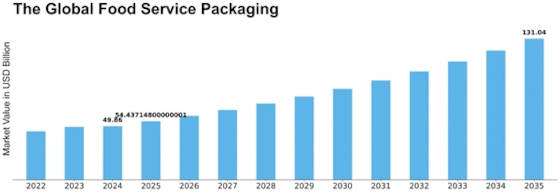

Food Service Packaging Market Size Graph
Author
Author Profile
Snehal Singh
Manager - Research

High acumen in analyzing complex macro & micro markets with more than 6 years of work experience in the field of market research. By implementing her analytical skills in forecasting and estimation into market research reports, she has expertise in Packaging, Construction, and Equipment domains. She handles a team size of 20-25 resources and ensures smooth running of the projects, associated marketing activities, and client servicing.

Leave a Comment

FAQs

What is the projected market valuation of The Global Food Service Packaging by 2035?

<p>The projected market valuation for The Global Food Service Packaging by 2035 is 131.04 USD Billion.</p>

What was the market valuation of The Global Food Service Packaging in 2024?

<p>The overall market valuation of The Global Food Service Packaging was 49.86 USD Billion in 2024.</p>

What is the expected CAGR for The Global Food Service Packaging during the forecast period 2025 - 2035?

<p>The expected CAGR for The Global Food Service Packaging during the forecast period 2025 - 2035 is 9.18%.</p>

Which product segment had the highest valuation in The Global Food Service Packaging in 2024?

<p>In 2024, the Flexible Packaging segment had the highest valuation at 15.0 USD Billion.</p>

What is the projected valuation for the Rigid Packaging segment by 2035?

<p>The projected valuation for the Rigid Packaging segment by 2035 is 30.0 USD Billion.</p>

Which application segment is expected to grow the most in The Global Food Service Packaging?

<p>The Baked Goods application segment is expected to grow the most, with a projected valuation of 40.0 USD Billion by 2035.</p>

Who are the key players in The Global Food Service Packaging?

Key players in The Global Food Service Packaging include Amcor, Sealed Air, Berry Global, and Mondi Group.

What was the valuation of the Dairy Products segment in 2024?

The valuation of the Dairy Products segment in 2024 was 12.0 USD Billion.

How does the valuation of the Fruits and Vegetables segment compare to the Baked Goods segment in 2024?

In 2024, the Fruits and Vegetables segment was valued at 10.0 USD Billion, whereas the Baked Goods segment was valued at 15.0 USD Billion.

What is the expected growth trend for the Others segment in The Global Food Service Packaging?

The Others segment is expected to grow from 4.86 USD Billion in 2024 to 17.04 USD Billion by 2035.

Market Summary

As per Market Research Future analysis, The Global Food Service Packaging Market was estimated at 128.7 USD Billion in 2024. The food service packaging industry is projected to grow from 134.1 USD Billion in 2025 to 202.4 USD Billion by 2035, exhibiting a compound annual growth rate (CAGR) of 4.2% during the forecast period 2025 - 2035

Key Market Trends & Highlights

The Global Food Service Packaging Market is experiencing a transformative shift towards sustainability and convenience.

  • The market is increasingly prioritizing sustainability, with a notable emphasis on eco-friendly materials and practices. Convenience and portability are driving innovations in packaging solutions, particularly in the takeaway and delivery sectors. Technological advancements are enhancing packaging efficiency and functionality, catering to evolving consumer preferences. Rising demand for takeaway and delivery, alongside sustainability initiatives, are key drivers propelling market growth in North America and Asia-Pacific.

Market Size & Forecast

2024 Market Size 128.7 (USD Billion)
2035 Market Size 202.4 (USD Billion)
CAGR (2025 - 2035) 4.2%%
Largest Regional Market Share in 2024 North America

Major Players

Amcor (AU), Sealed Air (US), Berry Global (US), Mondi Group (GB), Smurfit Kappa (IE), Graphic Packaging International (US), WestRock (US), Huhtamaki (FI), Dart Container (US)

Market Trends

The Global Food Service Packaging Market is currently experiencing a transformative phase, driven by evolving consumer preferences and increasing environmental awareness. As sustainability becomes a focal point for both consumers and businesses, there is a noticeable shift towards eco-friendly materials and practices. This trend is not merely a response to regulatory pressures but reflects a broader societal movement towards responsible consumption. Companies are increasingly adopting biodegradable, compostable, and recyclable packaging solutions, which not only meet consumer demand but also enhance brand loyalty. Furthermore, the rise of online food delivery services has necessitated innovative packaging solutions that ensure food safety and quality during transit. In addition to sustainability, convenience remains a critical factor influencing The Global Food Service Packaging Market. As lifestyles become busier, consumers seek packaging that facilitates on-the-go consumption. This has led to the development of portable and user-friendly packaging designs that cater to the needs of modern consumers. Moreover, advancements in technology are enabling the creation of smart packaging solutions that enhance the overall dining experience. These trends suggest that the market is poised for continued growth, as businesses adapt to the changing landscape and consumer expectations.

Sustainability Focus

The emphasis on sustainable packaging solutions is reshaping The Global Food Service Packaging Market. Companies are increasingly opting for materials that are biodegradable or recyclable, aligning with consumer preferences for environmentally friendly options.

Convenience and Portability

As lifestyles evolve, the demand for convenient packaging is rising. The market is witnessing a surge in portable designs that cater to on-the-go consumption, reflecting the need for practicality in food service.

Technological Innovations

Advancements in technology are driving the development of smart packaging solutions. These innovations enhance food safety and quality, offering consumers a more engaging and informative dining experience.

Food Service Packaging Market Market Drivers

Sustainability Initiatives

The increasing emphasis on sustainability is a pivotal driver in the Food Service Packaging Market. Consumers are becoming more environmentally conscious, leading to a demand for eco-friendly packaging solutions. This shift is reflected in the market, where biodegradable and compostable materials are gaining traction. In fact, the market for sustainable packaging is projected to grow significantly, with estimates suggesting a compound annual growth rate of over 10% in the coming years. Companies are responding by innovating their packaging processes to reduce waste and carbon footprints. As regulations tighten around plastic usage, businesses are compelled to adopt sustainable practices, thereby influencing their packaging choices. This trend not only aligns with consumer preferences but also enhances brand loyalty, as companies that prioritize sustainability are often viewed more favorably by their customers.

Technological Advancements

Technological advancements are playing a crucial role in transforming the Food Service Packaging Market. Innovations in materials science and manufacturing processes are leading to the development of smarter packaging solutions. For instance, the integration of smart sensors and QR codes into packaging allows for enhanced tracking and consumer engagement. The market is witnessing a shift towards packaging that not only preserves food but also provides information about freshness and safety. Furthermore, automation in packaging processes is improving efficiency and reducing costs for manufacturers. The adoption of advanced printing technologies is also enabling more personalized and attractive packaging designs. As these technologies continue to evolve, they are likely to drive competition within the industry, pushing companies to adopt cutting-edge solutions to meet consumer expectations and regulatory requirements.

Health and Safety Regulations

Health and safety regulations are increasingly influencing the Food Service Packaging Market. Governments and regulatory bodies are implementing stricter guidelines regarding food safety, which directly impacts packaging standards. Compliance with these regulations is essential for food service providers, as non-compliance can lead to significant penalties and loss of consumer trust. The market is seeing a rise in demand for packaging that ensures food safety, such as tamper-evident and child-resistant designs. Additionally, the focus on hygiene has led to innovations in packaging materials that minimize contamination risks. As these regulations evolve, companies are likely to invest in research and development to create packaging solutions that not only meet but exceed safety standards. This proactive approach not only safeguards public health but also enhances brand reputation in a competitive market.

Consumer Preferences for Customization

Consumer preferences for customization are emerging as a significant driver in the Food Service Packaging Market. As consumers seek personalized experiences, food service providers are increasingly offering customized packaging options. This trend is particularly evident in the rise of branded packaging that reflects a company's identity and values. The market is responding to this demand, with estimates suggesting that customized packaging can enhance customer engagement and loyalty by up to 20%. Furthermore, advancements in digital printing technology are making it more feasible for businesses to produce small batches of customized packaging without incurring prohibitive costs. This shift towards personalization not only caters to individual consumer preferences but also allows companies to differentiate themselves in a crowded marketplace. As a result, the industry is likely to see a growing emphasis on innovative and unique packaging designs that resonate with consumers.

Rising Demand for Takeaway and Delivery

The surge in demand for takeaway and delivery services is reshaping the Food Service Packaging Market. As more consumers opt for convenience, restaurants and food service providers are adapting their packaging strategies to accommodate this trend. The market for food delivery packaging is expected to witness substantial growth, with estimates indicating a potential increase of 15% annually. This shift necessitates packaging that is not only functional but also maintains food quality during transit. Consequently, innovations in insulation and leak-proof designs are becoming increasingly prevalent. Additionally, the rise of online food ordering platforms has further accelerated this demand, compelling businesses to invest in packaging solutions that enhance the customer experience. As a result, the industry is likely to see a diversification of packaging materials and designs tailored specifically for delivery and takeaway services.

Market Segment Insights

By Product: Flexible Packaging (Largest) vs. Rigid Packaging (Fastest-Growing)

The Global <a href="https://www.marketresearchfuture.com/reports/food-service-market-11595" target="_blank" title="food service">Food Service</a> Packaging Market showcases a diverse landscape, notably where <a href="https://www.marketresearchfuture.com/reports/flexible-packaging-market-1151">Flexible Packaging</a> holds the largest market share. This segment's popularity is driven by its adaptability and compatibility with various food types, allowing for better shelf life and consumer convenience. Rigid Packaging, while smaller in share, is witnessing rapid growth due to increasing demand for premium packaging solutions that enhance product presentation and sustainability. Both segments play crucial roles in catering to evolving consumer preferences and environmental considerations.

Flexible Packaging (Dominant) vs. Rigid Packaging (Emerging)

Flexible Packaging is currently dominating The Global Food Service Packaging Market, largely due to its lightweight nature, cost-effectiveness, and ability to preserve food freshness longer. This segment caters well to an array of food items, notably ready-to-eat meals, snacks, and beverages—advantages that resonate well with modern consumer lifestyles. In contrast, <a href="https://www.marketresearchfuture.com/reports/rigid-packaging-market-1772">Rigid Packaging</a> is emerging strongly, particularly in sectors focusing on aesthetics and structural integrity. Rigid solutions often feature innovative designs that communicate brand values and quality, making them appealing for premium products. As sustainability becomes central, Rigid Packaging is evolving through the introduction of recyclable materials, ensuring it stays relevant in a competitive market.

By Application: Dairy Products (Largest) vs. Fruits and Vegetables (Fastest-Growing)

The application segment of The Global Food Service Packaging Market is predominantly led by dairy products, which hold the largest share due to their essential role in meals and snacks. This segment includes milk, cheese, yogurt, and other dairy goods, which are often packaged for convenience and freshness. Following dairy, fruits and vegetables have emerged as a significant focus area, with an increasing share as consumers prioritize health and nutrition in their food choices.

Application: Dairy Products (Dominant) vs. Fruits and Vegetables (Emerging)

Dairy products dominate the packaging market due to their high demand for fresh and innovative packaging solutions that meet consumer safety and freshness requirements. The convenience in consumption and ready-to-eat formats drives their market position. On the other hand, the fruits and vegetables segment is rapidly emerging, fueled by consumer trends toward healthy eating and organic products. This segment is experiencing innovative packaging solutions aimed at extending shelf life and enhancing sustainability, attracting health-conscious consumers and retailers alike. Both segments are witnessing shifts towards eco-friendly materials and packaging designs.

Get more detailed insights about Food Service Packaging Market Research Report - Global Forecast to 2035

Regional Insights

By region, the study provides the market insights into North America, Europe, Asia-Pacific and Rest of the World. The North American food service packaging market area will dominate this market. The market is expanding due to consumers' heavy reliance on packaged food products and the strong regional presence of food processing businesses. The market is projected to be driven by the rising number of food service suppliers successfully digitalizing their operations. Additionally, the expanding vegan population and the shift in consumer tastes towards meat alternatives are expected to create new opportunities for growth for the food packaging industry.

Further, the major countries studied in the market report are The US, Canada, German, France, the UK, Italy, Spain, China, Japan, India, Australia, South Korea, and Brazil.

Figure 2:  FOOD SERVICE PACKAGING MARKET SHARE BY REGION 2022 (USD Billion)

Europe food service packaging market accounts for the second-largest market share because packaged food has a widespread customer base. The popularity of convenience foods has been facilitated by increased urbanization and rising disposable income, boosting demand for effective food service packages. Additionally, increased plastic production in developing economies will drive regional industrial trends. Further, the German food service packaging market held the largest market share, and the UK food service packaging market was the fastest growing market in the European region

The Asia-Pacific Food service packaging Market is expected to grow at the fastest CAGR from 2023 to 2032 due to rapid urbanization and changing customer preferences. The market is also anticipated to grow quickly due to consumer desire for ready-to-eat and fast food. Additionally, rising disposable income encourages consumers to choose instant meals, broadening the breadth of the fast food culture in China and India and driving the market for food service packaging. Moreover, China’s food service packaging market held the largest market share, and the Indian food service packaging market was the fastest growing market in the Asia-Pacific region.

Key Players and Competitive Insights

Leading market players are investing heavily in research and development in order to expand their product lines, which will help the food service packaging market, grow even more. Market participants are also undertaking a variety of strategic activities to expand their  footprint, with important market developments including new product launches, contractual agreements, mergers and acquisitions, higher investments, and collaboration with other organizations. To expand and survive in a more competitive and rising market climate, food service packaging industry must offer cost-effective items.
Manufacturing locally to minimize operational costs is one of the key business tactics used by manufacturers in the  food service packaging industry to benefit clients and increase the market sector. In recent years, the food service packaging industry has offered some of the most significant advantages to market. Major players in the food service packaging market attempting to increase market demand by investing in research and development operations include Rock-Tenn Company (U.S.), Amcor Limited (Australia), Letica Corporation (U.S.), Ball Corporation (U.S.), Greif Incorporated (U.S.), Ampac Packaging LLC (U.S.), BWAY Corporation (U.S.), Crown Holdings Incorporated and Bemis Company Incorporated.
Amcor Plc is a company that offers packaging services. Pet bottles, plastic bottles and jars, capsules and closures, specialty folding cartons, free films, rigid containers, bags and pouches, wrappers, laminates and flow packs are just a few of its fiber, plastic, metal and glass packaging solutions. Products from the company are used in various technical applications as well as the beverage, food, personal care, pharmaceutical, medical device, homecare, and animal care industries. Additionally, it services the markets for healthcare, pharmaceuticals, personal care, and home goods.
In April AmFiberTM is, a new platform of paper-based packaging goods introduced by Amcor.
Amcor's consumer-centric and flexible approach to innovation is on display in the AmFiber platform, which strives to reinvent the capabilities of conventional paper packaging by offering a larger range of features and functional advantages to meet shifting customer needs.
Berry Includes Food-Grade Recycled Content in Flexible Plastic Packaging September 2023 - Berry has introduced food-grade LDPE films containing at least 30% post-consumer recycled plastic (PCR) into the market. Therefore, through this addition to its already robust film portfolio, Berry provides brands with a solution to their sustainability commitments to include PCR in food packaging.
Metal packaging services are offered by Ball Corp (Ball). It produces metal packaging items such as steel, aluminum, general, and aerosol containers for the beverage, automotive, food, paint, healthcare, personal care, and household products industries. The business creates, develops, and produces cutting-edge aerospace systems and related technologies for government and commercial clients, including instruments and sensors, antennas and microwave systems, electronic warfare, aerospace technology and components, spacecraft and space science, radio frequency systems and components, and data exploitation solutions.

Key Companies in the Food Service Packaging Market include

Industry Developments

In April 2022, Burger King UK became the first quick-service restaurant corporation in the UK to trial a new range of reusable and returnable packaging for its burgers and sides. This pilot launch was done together with Loop—the global reuse platform—whereby the company was able to test reusable burger clamshells for the very first time. Thus, these cases have fuelled demand for environmentally friendly approaches in food service packaging.

In March 2023 Hinojosa Packaging Group launched a new line of food service packaging products that are printed using printing methods safe for contact with food. It is made from fully recyclable paper and is biodegradable and, thus, distinguishes it from all other similar kinds of packs.In February 2024, Berry launched its range of Reusable tableware to help satisfy the demand in the food service industry for more sustainable packing solutions. This is a response to growing legal and customer pressures across sectors to change their packaging practices.

An example of such laws includes France’s Anti-Waste Law for Circular Economy law (AGEC), which states that restaurants and other establishments with seating capacity of 20 or more people should provide reusable crockery.

In 2024: Huhtamaki launched new food service packaging solutions with improved sustainability and functionality for various food applications.

In 2023: Georgia-Pacific introduced advanced food service packaging materials with enhanced durability and user convenience.

Future Outlook

Food Service Packaging Market Future Outlook

The Global Food Service Packaging Market is projected to grow at a 4.2% CAGR from 2025 to 2035, driven by sustainability trends, convenience demands, and technological advancements.

New opportunities lie in:

  • <p>Expansion of biodegradable packaging solutions for eco-conscious consumers. Development of smart packaging with integrated technology for enhanced user experience. Investment in automated packaging systems to improve operational efficiency.</p>

By 2035, the market is expected to be robust, reflecting significant growth and innovation.

Market Segmentation

Food Service Packaging Market Product Outlook

  • Flexible Packaging
  • Rigid Packaging
  • Paper and Pouches
  • Bags
  • Others

Food Service Packaging Market Application Outlook

  • Dairy Products
  • Fruits and Vegetables
  • Baked Goods
  • Others

Report Scope

MARKET SIZE 2024 128.7(USD Billion)
MARKET SIZE 2025 134.1(USD Billion)
MARKET SIZE 2035 202.4(USD Billion)
COMPOUND ANNUAL GROWTH RATE (CAGR) 4.2% (2025 - 2035)
REPORT COVERAGE Revenue Forecast, Competitive Landscape, Growth Factors, and Trends
BASE YEAR 2024
Market Forecast Period 2025 - 2035
Historical Data 2019 - 2024
Market Forecast Units USD Billion
Key Companies Profiled Amcor (AU), Sealed Air (US), Berry Global (US), Mondi Group (GB), Smurfit Kappa (IE), Graphic Packaging International (US), WestRock (US), Huhtamaki (FI), Dart Container (US)
Segments Covered Product, Application, Region
Key Market Opportunities Adoption of sustainable materials and innovative designs in The Global Food Service Packaging.
Key Market Dynamics Rising consumer demand for sustainable packaging drives innovation and competition in food service packaging solutions.
Countries Covered North America, Europe, APAC, South America, MEA

FAQs

What is the projected market valuation of The Global Food Service Packaging by 2035?

<p>The projected market valuation for The Global Food Service Packaging by 2035 is 131.04 USD Billion.</p>

What was the market valuation of The Global Food Service Packaging in 2024?

<p>The overall market valuation of The Global Food Service Packaging was 49.86 USD Billion in 2024.</p>

What is the expected CAGR for The Global Food Service Packaging during the forecast period 2025 - 2035?

<p>The expected CAGR for The Global Food Service Packaging during the forecast period 2025 - 2035 is 9.18%.</p>

Which product segment had the highest valuation in The Global Food Service Packaging in 2024?

<p>In 2024, the Flexible Packaging segment had the highest valuation at 15.0 USD Billion.</p>

What is the projected valuation for the Rigid Packaging segment by 2035?

<p>The projected valuation for the Rigid Packaging segment by 2035 is 30.0 USD Billion.</p>

Which application segment is expected to grow the most in The Global Food Service Packaging?

<p>The Baked Goods application segment is expected to grow the most, with a projected valuation of 40.0 USD Billion by 2035.</p>

Who are the key players in The Global Food Service Packaging?

Key players in The Global Food Service Packaging include Amcor, Sealed Air, Berry Global, and Mondi Group.

What was the valuation of the Dairy Products segment in 2024?

The valuation of the Dairy Products segment in 2024 was 12.0 USD Billion.

How does the valuation of the Fruits and Vegetables segment compare to the Baked Goods segment in 2024?

In 2024, the Fruits and Vegetables segment was valued at 10.0 USD Billion, whereas the Baked Goods segment was valued at 15.0 USD Billion.

What is the expected growth trend for the Others segment in The Global Food Service Packaging?

The Others segment is expected to grow from 4.86 USD Billion in 2024 to 17.04 USD Billion by 2035.

  1. SECTION I: EXECUTIVE SUMMARY AND KEY HIGHLIGHTS
    1. | 1.1 EXECUTIVE SUMMARY
    2. | | 1.1.1 Market Overview
    3. | | 1.1.2 Key Findings
    4. | | 1.1.3 Market Segmentation
    5. | | 1.1.4 Competitive Landscape
    6. | | 1.1.5 Challenges and Opportunities
    7. | | 1.1.6 Future Outlook
  2. SECTION II: SCOPING, METHODOLOGY AND MARKET STRUCTURE
    1. | 2.1 MARKET INTRODUCTION
    2. | | 2.1.1 Definition
    3. | | 2.1.2 Scope of the study
    4. | | | 2.1.2.1 Research Objective
    5. | | | 2.1.2.2 Assumption
    6. | | | 2.1.2.3 Limitations
    7. | 2.2 RESEARCH METHODOLOGY
    8. | | 2.2.1 Overview
    9. | | 2.2.2 Data Mining
    10. | | 2.2.3 Secondary Research
    11. | | 2.2.4 Primary Research
    12. | | | 2.2.4.1 Primary Interviews and Information Gathering Process
    13. | | | 2.2.4.2 Breakdown of Primary Respondents
    14. | | 2.2.5 Forecasting Model
    15. | | 2.2.6 Market Size Estimation
    16. | | | 2.2.6.1 Bottom-Up Approach
    17. | | | 2.2.6.2 Top-Down Approach
    18. | | 2.2.7 Data Triangulation
    19. | | 2.2.8 Validation
  3. SECTION III: QUALITATIVE ANALYSIS
    1. | 3.1 MARKET DYNAMICS
    2. | | 3.1.1 Overview
    3. | | 3.1.2 Drivers
    4. | | 3.1.3 Restraints
    5. | | 3.1.4 Opportunities
    6. | 3.2 MARKET FACTOR ANALYSIS
    7. | | 3.2.1 Value chain Analysis
    8. | | 3.2.2 Porter's Five Forces Analysis
    9. | | | 3.2.2.1 Bargaining Power of Suppliers
    10. | | | 3.2.2.2 Bargaining Power of Buyers
    11. | | | 3.2.2.3 Threat of New Entrants
    12. | | | 3.2.2.4 Threat of Substitutes
    13. | | | 3.2.2.5 Intensity of Rivalry
    14. | | 3.2.3 COVID-19 Impact Analysis
    15. | | | 3.2.3.1 Market Impact Analysis
    16. | | | 3.2.3.2 Regional Impact
    17. | | | 3.2.3.3 Opportunity and Threat Analysis
  4. SECTION IV: QUANTITATIVE ANALYSIS
    1. | 4.1 Packaging & Transport, BY Product (USD Billion)
    2. | | 4.1.1 Flexible Packaging
    3. | | 4.1.2 Rigid Packaging
    4. | | 4.1.3 Paper and Pouches
    5. | | 4.1.4 Bags
    6. | | 4.1.5 Others
    7. | 4.2 Packaging & Transport, BY Application (USD Billion)
    8. | | 4.2.1 Dairy Products
    9. | | 4.2.2 Fruits and Vegetables
    10. | | 4.2.3 Baked Goods
    11. | | 4.2.4 Others
    12. | 4.3 Packaging & Transport, BY Region (USD Billion)
    13. | | 4.3.1 North America
    14. | | | 4.3.1.1 US
    15. | | | 4.3.1.2 Canada
    16. | | 4.3.2 Europe
    17. | | | 4.3.2.1 Germany
    18. | | | 4.3.2.2 UK
    19. | | | 4.3.2.3 France
    20. | | | 4.3.2.4 Russia
    21. | | | 4.3.2.5 Italy
    22. | | | 4.3.2.6 Spain
    23. | | | 4.3.2.7 Rest of Europe
    24. | | 4.3.3 APAC
    25. | | | 4.3.3.1 China
    26. | | | 4.3.3.2 India
    27. | | | 4.3.3.3 Japan
    28. | | | 4.3.3.4 South Korea
    29. | | | 4.3.3.5 Malaysia
    30. | | | 4.3.3.6 Thailand
    31. | | | 4.3.3.7 Indonesia
    32. | | | 4.3.3.8 Rest of APAC
    33. | | 4.3.4 South America
    34. | | | 4.3.4.1 Brazil
    35. | | | 4.3.4.2 Mexico
    36. | | | 4.3.4.3 Argentina
    37. | | | 4.3.4.4 Rest of South America
    38. | | 4.3.5 MEA
    39. | | | 4.3.5.1 GCC Countries
    40. | | | 4.3.5.2 South Africa
    41. | | | 4.3.5.3 Rest of MEA
  5. SECTION V: COMPETITIVE ANALYSIS
    1. | 5.1 Competitive Landscape
    2. | | 5.1.1 Overview
    3. | | 5.1.2 Competitive Analysis
    4. | | 5.1.3 Market share Analysis
    5. | | 5.1.4 Major Growth Strategy in the Packaging & Transport
    6. | | 5.1.5 Competitive Benchmarking
    7. | | 5.1.6 Leading Players in Terms of Number of Developments in the Packaging & Transport
    8. | | 5.1.7 Key developments and growth strategies
    9. | | | 5.1.7.1 New Product Launch/Service Deployment
    10. | | | 5.1.7.2 Merger & Acquisitions
    11. | | | 5.1.7.3 Joint Ventures
    12. | | 5.1.8 Major Players Financial Matrix
    13. | | | 5.1.8.1 Sales and Operating Income
    14. | | | 5.1.8.2 Major Players R&D Expenditure. 2023
    15. | 5.2 Company Profiles
    16. | | 5.2.1 Amcor (AU)
    17. | | | 5.2.1.1 Financial Overview
    18. | | | 5.2.1.2 Products Offered
    19. | | | 5.2.1.3 Key Developments
    20. | | | 5.2.1.4 SWOT Analysis
    21. | | | 5.2.1.5 Key Strategies
    22. | | 5.2.2 Sealed Air (US)
    23. | | | 5.2.2.1 Financial Overview
    24. | | | 5.2.2.2 Products Offered
    25. | | | 5.2.2.3 Key Developments
    26. | | | 5.2.2.4 SWOT Analysis
    27. | | | 5.2.2.5 Key Strategies
    28. | | 5.2.3 Berry Global (US)
    29. | | | 5.2.3.1 Financial Overview
    30. | | | 5.2.3.2 Products Offered
    31. | | | 5.2.3.3 Key Developments
    32. | | | 5.2.3.4 SWOT Analysis
    33. | | | 5.2.3.5 Key Strategies
    34. | | 5.2.4 Mondi Group (GB)
    35. | | | 5.2.4.1 Financial Overview
    36. | | | 5.2.4.2 Products Offered
    37. | | | 5.2.4.3 Key Developments
    38. | | | 5.2.4.4 SWOT Analysis
    39. | | | 5.2.4.5 Key Strategies
    40. | | 5.2.5 Smurfit Kappa (IE)
    41. | | | 5.2.5.1 Financial Overview
    42. | | | 5.2.5.2 Products Offered
    43. | | | 5.2.5.3 Key Developments
    44. | | | 5.2.5.4 SWOT Analysis
    45. | | | 5.2.5.5 Key Strategies
    46. | | 5.2.6 Graphic Packaging International (US)
    47. | | | 5.2.6.1 Financial Overview
    48. | | | 5.2.6.2 Products Offered
    49. | | | 5.2.6.3 Key Developments
    50. | | | 5.2.6.4 SWOT Analysis
    51. | | | 5.2.6.5 Key Strategies
    52. | | 5.2.7 WestRock (US)
    53. | | | 5.2.7.1 Financial Overview
    54. | | | 5.2.7.2 Products Offered
    55. | | | 5.2.7.3 Key Developments
    56. | | | 5.2.7.4 SWOT Analysis
    57. | | | 5.2.7.5 Key Strategies
    58. | | 5.2.8 Huhtamaki (FI)
    59. | | | 5.2.8.1 Financial Overview
    60. | | | 5.2.8.2 Products Offered
    61. | | | 5.2.8.3 Key Developments
    62. | | | 5.2.8.4 SWOT Analysis
    63. | | | 5.2.8.5 Key Strategies
    64. | | 5.2.9 Dart Container (US)
    65. | | | 5.2.9.1 Financial Overview
    66. | | | 5.2.9.2 Products Offered
    67. | | | 5.2.9.3 Key Developments
    68. | | | 5.2.9.4 SWOT Analysis
    69. | | | 5.2.9.5 Key Strategies
    70. | 5.3 Appendix
    71. | | 5.3.1 References
    72. | | 5.3.2 Related Reports
  6. LIST OF FIGURES
    1. | 6.1 MARKET SYNOPSIS
    2. | 6.2 NORTH AMERICA MARKET ANALYSIS
    3. | 6.3 US MARKET ANALYSIS BY PRODUCT
    4. | 6.4 US MARKET ANALYSIS BY APPLICATION
    5. | 6.5 CANADA MARKET ANALYSIS BY PRODUCT
    6. | 6.6 CANADA MARKET ANALYSIS BY APPLICATION
    7. | 6.7 EUROPE MARKET ANALYSIS
    8. | 6.8 GERMANY MARKET ANALYSIS BY PRODUCT
    9. | 6.9 GERMANY MARKET ANALYSIS BY APPLICATION
    10. | 6.10 UK MARKET ANALYSIS BY PRODUCT
    11. | 6.11 UK MARKET ANALYSIS BY APPLICATION
    12. | 6.12 FRANCE MARKET ANALYSIS BY PRODUCT
    13. | 6.13 FRANCE MARKET ANALYSIS BY APPLICATION
    14. | 6.14 RUSSIA MARKET ANALYSIS BY PRODUCT
    15. | 6.15 RUSSIA MARKET ANALYSIS BY APPLICATION
    16. | 6.16 ITALY MARKET ANALYSIS BY PRODUCT
    17. | 6.17 ITALY MARKET ANALYSIS BY APPLICATION
    18. | 6.18 SPAIN MARKET ANALYSIS BY PRODUCT
    19. | 6.19 SPAIN MARKET ANALYSIS BY APPLICATION
    20. | 6.20 REST OF EUROPE MARKET ANALYSIS BY PRODUCT
    21. | 6.21 REST OF EUROPE MARKET ANALYSIS BY APPLICATION
    22. | 6.22 APAC MARKET ANALYSIS
    23. | 6.23 CHINA MARKET ANALYSIS BY PRODUCT
    24. | 6.24 CHINA MARKET ANALYSIS BY APPLICATION
    25. | 6.25 INDIA MARKET ANALYSIS BY PRODUCT
    26. | 6.26 INDIA MARKET ANALYSIS BY APPLICATION
    27. | 6.27 JAPAN MARKET ANALYSIS BY PRODUCT
    28. | 6.28 JAPAN MARKET ANALYSIS BY APPLICATION
    29. | 6.29 SOUTH KOREA MARKET ANALYSIS BY PRODUCT
    30. | 6.30 SOUTH KOREA MARKET ANALYSIS BY APPLICATION
    31. | 6.31 MALAYSIA MARKET ANALYSIS BY PRODUCT
    32. | 6.32 MALAYSIA MARKET ANALYSIS BY APPLICATION
    33. | 6.33 THAILAND MARKET ANALYSIS BY PRODUCT
    34. | 6.34 THAILAND MARKET ANALYSIS BY APPLICATION
    35. | 6.35 INDONESIA MARKET ANALYSIS BY PRODUCT
    36. | 6.36 INDONESIA MARKET ANALYSIS BY APPLICATION
    37. | 6.37 REST OF APAC MARKET ANALYSIS BY PRODUCT
    38. | 6.38 REST OF APAC MARKET ANALYSIS BY APPLICATION
    39. | 6.39 SOUTH AMERICA MARKET ANALYSIS
    40. | 6.40 BRAZIL MARKET ANALYSIS BY PRODUCT
    41. | 6.41 BRAZIL MARKET ANALYSIS BY APPLICATION
    42. | 6.42 MEXICO MARKET ANALYSIS BY PRODUCT
    43. | 6.43 MEXICO MARKET ANALYSIS BY APPLICATION
    44. | 6.44 ARGENTINA MARKET ANALYSIS BY PRODUCT
    45. | 6.45 ARGENTINA MARKET ANALYSIS BY APPLICATION
    46. | 6.46 REST OF SOUTH AMERICA MARKET ANALYSIS BY PRODUCT
    47. | 6.47 REST OF SOUTH AMERICA MARKET ANALYSIS BY APPLICATION
    48. | 6.48 MEA MARKET ANALYSIS
    49. | 6.49 GCC COUNTRIES MARKET ANALYSIS BY PRODUCT
    50. | 6.50 GCC COUNTRIES MARKET ANALYSIS BY APPLICATION
    51. | 6.51 SOUTH AFRICA MARKET ANALYSIS BY PRODUCT
    52. | 6.52 SOUTH AFRICA MARKET ANALYSIS BY APPLICATION
    53. | 6.53 REST OF MEA MARKET ANALYSIS BY PRODUCT
    54. | 6.54 REST OF MEA MARKET ANALYSIS BY APPLICATION
    55. | 6.55 KEY BUYING CRITERIA OF PACKAGING & TRANSPORT
    56. | 6.56 RESEARCH PROCESS OF MRFR
    57. | 6.57 DRO ANALYSIS OF PACKAGING & TRANSPORT
    58. | 6.58 DRIVERS IMPACT ANALYSIS: PACKAGING & TRANSPORT
    59. | 6.59 RESTRAINTS IMPACT ANALYSIS: PACKAGING & TRANSPORT
    60. | 6.60 SUPPLY / VALUE CHAIN: PACKAGING & TRANSPORT
    61. | 6.61 PACKAGING & TRANSPORT, BY PRODUCT, 2024 (% SHARE)
    62. | 6.62 PACKAGING & TRANSPORT, BY PRODUCT, 2024 TO 2035 (USD Billion)
    63. | 6.63 PACKAGING & TRANSPORT, BY APPLICATION, 2024 (% SHARE)
    64. | 6.64 PACKAGING & TRANSPORT, BY APPLICATION, 2024 TO 2035 (USD Billion)
    65. | 6.65 BENCHMARKING OF MAJOR COMPETITORS
  7. LIST OF TABLES
    1. | 7.1 LIST OF ASSUMPTIONS
    2. | | 7.1.1
    3. | 7.2 North America MARKET SIZE ESTIMATES; FORECAST
    4. | | 7.2.1 BY PRODUCT, 2025-2035 (USD Billion)
    5. | | 7.2.2 BY APPLICATION, 2025-2035 (USD Billion)
    6. | 7.3 US MARKET SIZE ESTIMATES; FORECAST
    7. | | 7.3.1 BY PRODUCT, 2025-2035 (USD Billion)
    8. | | 7.3.2 BY APPLICATION, 2025-2035 (USD Billion)
    9. | 7.4 Canada MARKET SIZE ESTIMATES; FORECAST
    10. | | 7.4.1 BY PRODUCT, 2025-2035 (USD Billion)
    11. | | 7.4.2 BY APPLICATION, 2025-2035 (USD Billion)
    12. | 7.5 Europe MARKET SIZE ESTIMATES; FORECAST
    13. | | 7.5.1 BY PRODUCT, 2025-2035 (USD Billion)
    14. | | 7.5.2 BY APPLICATION, 2025-2035 (USD Billion)
    15. | 7.6 Germany MARKET SIZE ESTIMATES; FORECAST
    16. | | 7.6.1 BY PRODUCT, 2025-2035 (USD Billion)
    17. | | 7.6.2 BY APPLICATION, 2025-2035 (USD Billion)
    18. | 7.7 UK MARKET SIZE ESTIMATES; FORECAST
    19. | | 7.7.1 BY PRODUCT, 2025-2035 (USD Billion)
    20. | | 7.7.2 BY APPLICATION, 2025-2035 (USD Billion)
    21. | 7.8 France MARKET SIZE ESTIMATES; FORECAST
    22. | | 7.8.1 BY PRODUCT, 2025-2035 (USD Billion)
    23. | | 7.8.2 BY APPLICATION, 2025-2035 (USD Billion)
    24. | 7.9 Russia MARKET SIZE ESTIMATES; FORECAST
    25. | | 7.9.1 BY PRODUCT, 2025-2035 (USD Billion)
    26. | | 7.9.2 BY APPLICATION, 2025-2035 (USD Billion)
    27. | 7.10 Italy MARKET SIZE ESTIMATES; FORECAST
    28. | | 7.10.1 BY PRODUCT, 2025-2035 (USD Billion)
    29. | | 7.10.2 BY APPLICATION, 2025-2035 (USD Billion)
    30. | 7.11 Spain MARKET SIZE ESTIMATES; FORECAST
    31. | | 7.11.1 BY PRODUCT, 2025-2035 (USD Billion)
    32. | | 7.11.2 BY APPLICATION, 2025-2035 (USD Billion)
    33. | 7.12 Rest of Europe MARKET SIZE ESTIMATES; FORECAST
    34. | | 7.12.1 BY PRODUCT, 2025-2035 (USD Billion)
    35. | | 7.12.2 BY APPLICATION, 2025-2035 (USD Billion)
    36. | 7.13 APAC MARKET SIZE ESTIMATES; FORECAST
    37. | | 7.13.1 BY PRODUCT, 2025-2035 (USD Billion)
    38. | | 7.13.2 BY APPLICATION, 2025-2035 (USD Billion)
    39. | 7.14 China MARKET SIZE ESTIMATES; FORECAST
    40. | | 7.14.1 BY PRODUCT, 2025-2035 (USD Billion)
    41. | | 7.14.2 BY APPLICATION, 2025-2035 (USD Billion)
    42. | 7.15 India MARKET SIZE ESTIMATES; FORECAST
    43. | | 7.15.1 BY PRODUCT, 2025-2035 (USD Billion)
    44. | | 7.15.2 BY APPLICATION, 2025-2035 (USD Billion)
    45. | 7.16 Japan MARKET SIZE ESTIMATES; FORECAST
    46. | | 7.16.1 BY PRODUCT, 2025-2035 (USD Billion)
    47. | | 7.16.2 BY APPLICATION, 2025-2035 (USD Billion)
    48. | 7.17 South Korea MARKET SIZE ESTIMATES; FORECAST
    49. | | 7.17.1 BY PRODUCT, 2025-2035 (USD Billion)
    50. | | 7.17.2 BY APPLICATION, 2025-2035 (USD Billion)
    51. | 7.18 Malaysia MARKET SIZE ESTIMATES; FORECAST
    52. | | 7.18.1 BY PRODUCT, 2025-2035 (USD Billion)
    53. | | 7.18.2 BY APPLICATION, 2025-2035 (USD Billion)
    54. | 7.19 Thailand MARKET SIZE ESTIMATES; FORECAST
    55. | | 7.19.1 BY PRODUCT, 2025-2035 (USD Billion)
    56. | | 7.19.2 BY APPLICATION, 2025-2035 (USD Billion)
    57. | 7.20 Indonesia MARKET SIZE ESTIMATES; FORECAST
    58. | | 7.20.1 BY PRODUCT, 2025-2035 (USD Billion)
    59. | | 7.20.2 BY APPLICATION, 2025-2035 (USD Billion)
    60. | 7.21 Rest of APAC MARKET SIZE ESTIMATES; FORECAST
    61. | | 7.21.1 BY PRODUCT, 2025-2035 (USD Billion)
    62. | | 7.21.2 BY APPLICATION, 2025-2035 (USD Billion)
    63. | 7.22 South America MARKET SIZE ESTIMATES; FORECAST
    64. | | 7.22.1 BY PRODUCT, 2025-2035 (USD Billion)
    65. | | 7.22.2 BY APPLICATION, 2025-2035 (USD Billion)
    66. | 7.23 Brazil MARKET SIZE ESTIMATES; FORECAST
    67. | | 7.23.1 BY PRODUCT, 2025-2035 (USD Billion)
    68. | | 7.23.2 BY APPLICATION, 2025-2035 (USD Billion)
    69. | 7.24 Mexico MARKET SIZE ESTIMATES; FORECAST
    70. | | 7.24.1 BY PRODUCT, 2025-2035 (USD Billion)
    71. | | 7.24.2 BY APPLICATION, 2025-2035 (USD Billion)
    72. | 7.25 Argentina MARKET SIZE ESTIMATES; FORECAST
    73. | | 7.25.1 BY PRODUCT, 2025-2035 (USD Billion)
    74. | | 7.25.2 BY APPLICATION, 2025-2035 (USD Billion)
    75. | 7.26 Rest of South America MARKET SIZE ESTIMATES; FORECAST
    76. | | 7.26.1 BY PRODUCT, 2025-2035 (USD Billion)
    77. | | 7.26.2 BY APPLICATION, 2025-2035 (USD Billion)
    78. | 7.27 MEA MARKET SIZE ESTIMATES; FORECAST
    79. | | 7.27.1 BY PRODUCT, 2025-2035 (USD Billion)
    80. | | 7.27.2 BY APPLICATION, 2025-2035 (USD Billion)
    81. | 7.28 GCC Countries MARKET SIZE ESTIMATES; FORECAST
    82. | | 7.28.1 BY PRODUCT, 2025-2035 (USD Billion)
    83. | | 7.28.2 BY APPLICATION, 2025-2035 (USD Billion)
    84. | 7.29 South Africa MARKET SIZE ESTIMATES; FORECAST
    85. | | 7.29.1 BY PRODUCT, 2025-2035 (USD Billion)
    86. | | 7.29.2 BY APPLICATION, 2025-2035 (USD Billion)
    87. | 7.30 Rest of MEA MARKET SIZE ESTIMATES; FORECAST
    88. | | 7.30.1 BY PRODUCT, 2025-2035 (USD Billion)
    89. | | 7.30.2 BY APPLICATION, 2025-2035 (USD Billion)
    90. | 7.31 PRODUCT LAUNCH/PRODUCT DEVELOPMENT/APPROVAL
    91. | | 7.31.1
    92. | 7.32 ACQUISITION/PARTNERSHIP
    93. | | 7.32.1

Packaging & Transport Market Segmentation

Packaging & Transport By Product (USD Billion, 2025-2035)

  • Flexible Packaging
  • Rigid Packaging
  • Paper and Pouches
  • Bags
  • Others

Packaging & Transport By Application (USD Billion, 2025-2035)

  • Dairy Products
  • Fruits and Vegetables
  • Baked Goods
  • Others
Infographic

Free Sample Request

Kindly complete the form below to receive a free sample of this Report

Get Free Sample

Customer Strories

Compare Licence

×
Features License Type
Single User Multiuser License Enterprise User
Price $4,950 $5,950 $7,250
Maximum User Access Limit 1 User Upto 10 Users Unrestricted Access Throughout the Organization
Free Customization
Direct Access to Analyst
Deliverable Format
Platform Access
Discount on Next Purchase 10% 15% 15%
Printable Versions