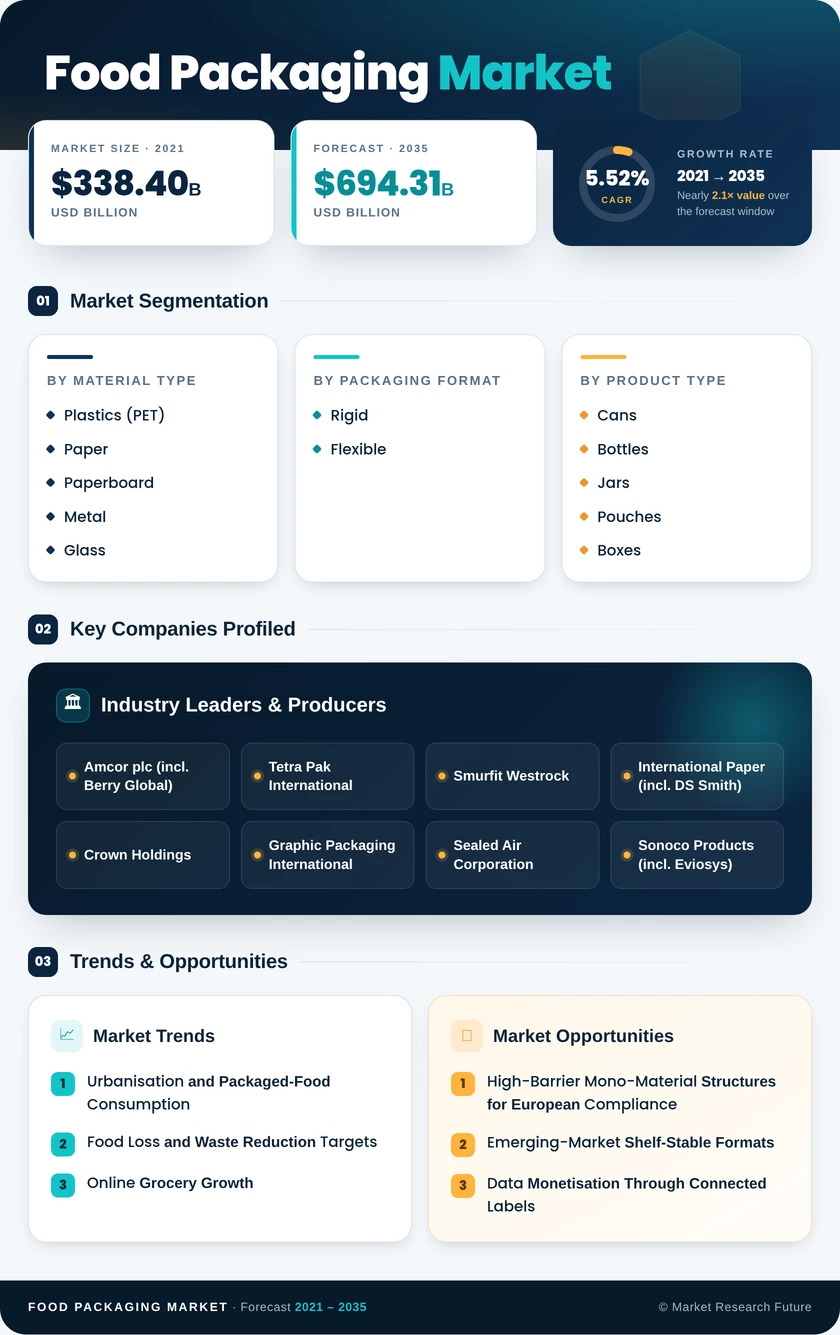
Segmentation Quick Reference
| Dimension | Sub-Segments | Dominant Segment | Fastest Growing Segment |
|---|---|---|---|
| By Material Type | Plastics (PET), Paper and Paperboard, Metal, Glass | Plastics (54.6% share) | Glass (6.62% CAGR) |
| By Packaging Format | Rigid, Flexible | Flexible (majority share) | Flexible (5.76% CAGR) |
| By Product Type | Cans, Bottles and Jars, Pouches, Boxes and Cartons, Other Product Types | Pouches (33.0% share) | Pouches (highest growth rate) |
| By Technology | Modified Atmosphere Packaging (MAP), Vacuum Packaging, Hot-Fill, Aseptic Packaging, Retort, Other Technologies | Modified Atmosphere Packaging (MAP) (30.0% share) | Aseptic Packaging (7.96% CAGR) |
| By Distribution Channel | Direct Sales, Indirect Sales | Direct Sales (54.2% share) | Indirect Sales (6.10% CAGR) |
| By Application | Dairy Products, Meat and Poultry, Fresh Produce, Bakery and Confectionery, Seafood, Ready Meals, Frozen Foods | Meat and Poultry (26.2% share) | Ready Meals (6.98% CAGR) |
| By Region | North America, Europe, Asia-Pacific, South America, Middle East & Africa | Asia-Pacific (41.6% share) | Asia-Pacific (highest growth rate) |
Market Segmentation Overview
By Material Type
| Sub-Segment | Key Trend |
|---|---|
| Plastics | PET recycled-content targets reshape resin sourcing |
| Paper and Paperboard | Substitution of plastic in bakery and quick-service |
| Metal | Lightweight cans sustain shelf-stable categories |
| Glass | Premium and returnable jars gain in sauces and spreads |
Plastics lead because PET and polyolefins deliver the best balance of cost, weight and barrier for bottles, trays and punnets. Glass grows fastest as premium brands use its inertness and deposit-system compatibility to support quality positioning. Paper and Paperboard gain wherever regulators restrict single-use plastics.
By Packaging Format
| Sub-Segment | Key Trend |
|---|---|
| Rigid | In-mould labelling and lightweighting defend share |
| Flexible | Mono-material pouches and wraps replace laminates |
Flexible formats both lead and grow fastest because they use less material and cut freight weight compared with jars and tubs. Rigid formats keep a 47.6% share in uses requiring tamper evidence, hot-fill resistance or microwave performance. Recyclability of flexible structures remains the main swing factor through 2030.
By Product Type
| Sub-Segment | Key Trend |
|---|---|
| Cans | Steady demand in seafood and pet food |
| Bottles and Jars | Ergonomic designs in ambient beverages and spreads |
| Pouches | Resealable stand-up and spouted formats expand |
| Boxes and Cartons | Growth tied to online grocery and frozen food |
| Other Product Types | Fibre trays and lids replace plastic foodservice items |
Pouches lead and grow fastest, driven by resealable stand-up designs and spouted infant-food packs that suit smaller households. Bottles and Jars remain the second-largest revenue pool through ambient beverages and spreads. Cans hold ground in seafood and pet food, where retort durability matters more than weight.
By Technology
| Sub-Segment | Key Trend |
|---|---|
| Modified Atmosphere Packaging (MAP) | Preservative-free shelf-life extension for chilled foods |
| Vacuum Packaging | Skin packs improve visibility for meat and cheese |
| Hot-Fill | Heat-resistant PET for juices and sauces |
| Aseptic Packaging | Ambient distribution for dairy and plant-based drinks |
| Retort | Pouches take share from cans in shelf-stable proteins |
| Other Technologies | High-pressure processing and active packaging in premium lines |
Modified Atmosphere Packaging (MAP) leads because chilled meat, produce and bakery depend on gas-flushed trays for preservative-free shelf life. Aseptic Packaging grows fastest as dairy and plant-based drink makers remove refrigeration from distribution. Retort pouches gain share from cans by shortening sterilisation times.
By Distribution Channel
| Sub-Segment | Key Trend |
|---|---|
| Direct Sales | Multi-year contracts bundle design and technical service |
| Indirect Sales | B2B platforms and distributors serve small brands |
Direct Sales lead because multinational food groups need co-development, shelf-life testing and compliance support that only direct relationships provide. Indirect Sales grow faster as private-label producers and start-up brands order stock formats in small volumes. Technical service needs keep direct channels dominant through 2035.
By Application
| Sub-Segment | Key Trend |
|---|---|
| Dairy Products | Aseptic cartons and yoghurt cups scale in Asia |
| Meat and Poultry | Vacuum skin packs and MAP trays dominate |
| Fresh Produce | Breathable films and fibre punnets replace plastic |
| Bakery and Confectionery | Portion packs and paper wraps expand |
| Seafood | Frozen and vacuum export packs |
| Ready Meals | CPET and fibre trays for microwave meals |
| Frozen Foods | Freezer-grade cartons and bags grow with e-grocery |
Meat and Poultry lead because strict hygiene and shelf-life requirements demand vacuum and MAP systems with high-barrier lidding. Ready Meals grow fastest as urban households trade cooking time for microwaveable convenience. Dairy Products remain a large revenue pool, anchored by aseptic cartons across Asia.


 Noah Malgeri
Co-Founder

 Peter Groot koerkamp
Account and Business Manager

 Younghwan Choi
Senior Retail Manager

 Mark Irwin
Management Consultant

 Akif Moroglu
Strategy & Business Development Director

 Guilherme Gomes Martins
Product Management Director

 Joseph Aguayo
Sales Operations & Pricing Manager

 La Terria Dodd
Program Support Specialist

 Rob Kooiker
Group Product Manager HVAC & Fire Protection GMA