×
Request Free Sample ×

Kindly complete the form below to receive a free sample of this Report

* Please use a valid business email

Leading companies partner with us for data-driven Insights

clients tt-cursor
Hero Background
English
Chinese
French
Japanese
Korean
German
Spanish

Food and Beverages Color Fixing Agents Market Trends

ID: MRFR/FnB/10794-CR
128 Pages
Pradeep Nandi
October 2023

Food and Beverages Color Fixing Agents Market Size, Share, Industry Trend & Analysis Research Report Information By Application (Dairy, Meat, Bakery, Poultry & Fish, Beverages), By Product (Potassium Nitrate, Potassium Nitrite, Sodium Nitrate And Sodium Nitrite) And By Region (North America, Europe, Asia-Pacific, And Rest Of The World) –Market Size, Share, Industry Trend & Analysis Forecast Till 2035

Share:
Download PDF ×

We do not share your information with anyone. However, we may send you emails based on your report interest from time to time. You may contact us at any time to opt-out.

Food and Beverages Color Fixing Agents Market Infographic
×
Food and Beverages Color Fixing Agents Market Infographic Full View
Purchase Options

Market Trends

Key Emerging Trends in the Food and Beverages Color Fixing Agents Market

Significant trends have been witnessed in Food and Beverages Color Fixing Agents Market which is an important sector within the food industry driven by consumer preference, regulatory pressures, and technological improvements. One of these major trends is increasingly high demand for natural color fixing agents. Consumers now prefer foods and drinks without many artificial additives because they are focusing more on clean label products made out of natural ingredients. This has led manufacturers to turn towards using natural color fixing agents derived from fruits, vegetables other plant sources that help make their food look like something fresh coming from nature itself.

Another trend worth mentioning is its focus on stability plus shelf-life extension. Advanced color fixing agents are used by producers of meals and drinks so as increase stability of natural colors in order to prolong shelf lives for their goods. A case can be made particularly when considering global supply chains where products must maintain their original coloring during transportation or storage processions along them till final consumers thereby necessitating the employment of efficient color fixing agents capable of tackling fading or other related color losses.

Also, the market is adapting to cater for increased need for personalized and customized products. Through such color-fixing agents, manufacturers are able to customize their products in accordance with specific consumer demands who want unique experiences in food and beverage industry. These include making various shades appealing to different customers as they strive to keep up with competitors while dealing with food safety challenges.

Author
Pradeep Nandi
Senior Research Analyst

I have a bachelor's degree in mechanical engineering and an MBA. I have more than two years of expertise in the retail, food, and beverage, chemical, and material industries, and hence have developed a sound cross-domain expertise. A firm believer in lifelong learning and sharing of knowledge. Having a proclivity for hatching ideas and trying to absorb as much information as possible in a short amount of time. Introducing corporates to the data and insight, which enables them to move from probability to possibility, has been my key areas of interest. 

Leave a Comment

FAQs

How much is the Food and Beverages Color Fixing Agents Market?

The Food and Beverages Color Fixing Agents Market size was valued at USD 3.1Billion in 2022.

What is the growth rate of the Food and Beverages Color Fixing Agents Market?

The market is projected to grow at a CAGR of 5.60% during the forecast period, 2023-2032.

Which region held the largest market share in the Food and Beverages Color Fixing Agents Market?

North America had the largest share in the market

Who are the key players in the Food and Beverages Color Fixing Agents Market?

The key players in the market are Merck KGaA, American Elements, Airedale Chemicals, Spectrum Chemicals, Yara International ASA, Sonac USA LLC.

Which Application led the Food and Beverages Color Fixing Agents Market?

The meat category dominated the market in 2022.

Which Product had the largest market share in the Food and Beverages Color Fixing Agents Market?

The sodium nitrate had the largest share in the market.

Market Summary

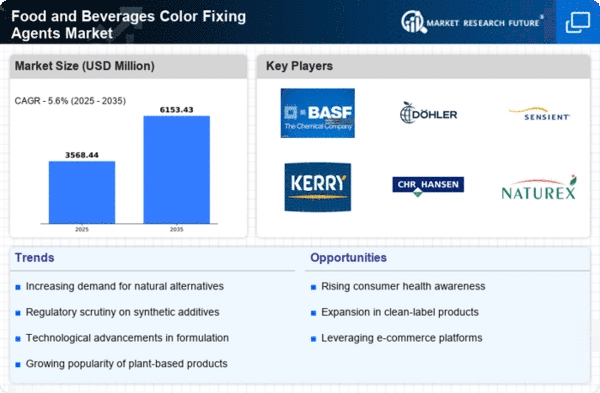
As per MRFR analysis, the Food and Beverages Color Fixing Agents Market was estimated at 3379.2 USD Million in 2024. The Food and Beverages Color Fixing Agents industry is projected to grow from 3568.44 USD Million in 2025 to 6153.43 USD Million by 2035, exhibiting a compound annual growth rate (CAGR) of 5.6 during the forecast period 2025 - 2035.

Key Market Trends & Highlights

The Food and Beverages Color Fixing Agents Market is experiencing a dynamic shift towards natural solutions and innovative technologies.

  • The market is witnessing a notable shift towards natural colorants, driven by consumer demand for healthier options.
  • Technological innovations are enhancing the efficacy and application of color fixing agents across various food products.
  • North America remains the largest market, while Asia-Pacific is emerging as the fastest-growing region in this sector.
  • The rising demand for processed foods and consumer preference for aesthetic appeal are key drivers propelling market growth.

Market Size & Forecast

2024 Market Size 3379.2 (USD Million)
2035 Market Size 6153.43 (USD Million)
CAGR (2025 - 2035) 5.6%
Largest Regional Market Share in 2024 North America

Major Players

BASF SE (DE), Döhler GmbH (DE), Sensient Technologies Corporation (US), Kerry Group plc (IE), Chr. Hansen Holding A/S (DK), Naturex S.A. (FR), Givaudan SA (CH), Tate & Lyle PLC (GB), FMC Corporation (US)

Market Trends

The Food and Beverages Color Fixing Agents Market is currently experiencing a notable evolution, driven by increasing consumer demand for visually appealing products. This market encompasses a variety of agents that enhance and stabilize colors in food and beverages, ensuring that they remain vibrant and attractive throughout their shelf life. As consumers become more health-conscious, there is a growing preference for natural colorants over synthetic alternatives. This shift is influencing manufacturers to explore innovative solutions that align with consumer preferences while maintaining product quality. Furthermore, regulatory frameworks are evolving, prompting companies to adapt their formulations to comply with safety standards and labeling requirements. In addition, the Food and Beverages Color Fixing Agents Market is witnessing advancements in technology that facilitate the development of new color fixing agents. These innovations not only improve the efficacy of color retention but also expand the range of applications across various food and beverage categories. As sustainability becomes a focal point for many industries, the market is likely to see an increase in the use of eco-friendly colorants. This trend suggests a potential shift towards more sustainable practices, which may resonate well with environmentally conscious consumers. Overall, the market appears poised for growth as it adapts to changing consumer preferences and regulatory landscapes.

Shift Towards Natural Colorants

There is a discernible trend towards the use of natural colorants in the Food and Beverages Color Fixing Agents Market. Consumers increasingly favor products that contain ingredients derived from nature, leading manufacturers to seek alternatives to synthetic dyes. This shift not only aligns with health-conscious consumer behavior but also reflects a broader movement towards transparency in food labeling.

Technological Innovations

Technological advancements are playing a crucial role in the evolution of the Food and Beverages Color Fixing Agents Market. Innovations in extraction and formulation techniques are enabling the development of more effective color fixing agents. These advancements enhance color stability and expand the potential applications of colorants across diverse food and beverage products.

Sustainability Initiatives

Sustainability is becoming a central theme in the Food and Beverages Color Fixing Agents Market. As environmental concerns rise, companies are increasingly focusing on eco-friendly practices. This includes sourcing raw materials responsibly and developing biodegradable packaging solutions, which resonate with the growing consumer demand for sustainable products.

Food and Beverages Color Fixing Agents Market Market Drivers

Rising Demand for Natural Colorants

The Global Food and Beverages Color Fixing Agents Market Industry experiences a notable shift towards natural colorants, driven by consumer preferences for clean label products. As health-conscious consumers increasingly seek transparency in food ingredients, manufacturers are compelled to adopt natural alternatives to synthetic dyes. This trend is reflected in the projected market value of 3.37 USD Billion in 2024, indicating a robust demand for natural colorants. Companies are investing in research and development to innovate and expand their portfolios of natural color fixing agents, thereby aligning with consumer expectations and regulatory standards.

Consumer Awareness and Health Trends

Growing consumer awareness regarding health and wellness is reshaping the Global Food and Beverages Color Fixing Agents Market Industry. Consumers are increasingly scrutinizing food labels and seeking products that align with their health goals. This trend is driving the demand for natural and organic color fixing agents, as consumers perceive them as safer alternatives to synthetic options. As the market adapts to these changing preferences, manufacturers are likely to prioritize the development of healthier color fixing solutions, thereby influencing market dynamics and growth trajectories.

Innovations in Color Fixing Technologies

Technological advancements in color fixing agents are significantly influencing the Global Food and Beverages Color Fixing Agents Market Industry. Innovations such as encapsulation techniques and improved extraction methods for natural colorants are enhancing the stability and efficacy of color fixing agents. These advancements enable manufacturers to create products that meet consumer demands for quality and safety. As a result, the market is likely to witness increased adoption of these innovative technologies, contributing to the overall growth and diversification of the industry.

Expansion of the Food and Beverage Sector

The continuous expansion of the global food and beverage sector plays a crucial role in driving the Global Food and Beverages Color Fixing Agents Market Industry. As the industry grows, the demand for visually appealing products increases, necessitating the use of effective color fixing agents. The market is anticipated to reach 5.89 USD Billion by 2035, reflecting the increasing need for vibrant and stable colors in food products. This growth is fueled by the rising consumption of processed foods and beverages, which often require colorants to enhance visual appeal and consumer acceptance.

Regulatory Support for Clean Label Products

Regulatory frameworks worldwide are evolving to support the use of clean label products, significantly impacting the Global Food and Beverages Color Fixing Agents Market Industry. Governments are implementing stricter regulations on synthetic additives, prompting manufacturers to explore natural color fixing agents. This regulatory shift is expected to enhance market growth, with a projected CAGR of 5.19% from 2025 to 2035. As food safety and quality become paramount, compliance with these regulations will likely drive innovation and investment in natural colorants, further shaping the industry's landscape.

Market Segment Insights

By Application: Beverages (Largest) vs. Dairy Products (Fastest-Growing)

In the Food and Beverages Color Fixing Agents Market, the application segment is broadly categorized into beverages, dairy products, confectionery, bakery, and meat products. Among these, beverages hold the largest market share, significantly influencing the demand for color fixing agents due to the variety of drinks requiring appealing colors for better consumer acceptance. Dairy products closely follow, utilizing color fixing agents to enhance visual appeal and consistency in products like cheese and yogurt.

Beverages (Dominant) vs. Dairy Products (Emerging)

Beverages are the dominant category in the Food and Beverages Color Fixing Agents Market, characterized by a vast array of products needing vibrant colors to attract consumers. Their extensive use of natural and synthetic color agents enhances the visual appeal of soft drinks, juices, and alcoholic beverages. Conversely, dairy products represent an emerging segment, increasingly relying on color fixing agents to improve product appeal and brand differentiation in a competitive market. As consumers seek visually appealing and consistently colored dairy items, the growth potential for color fixing agents in this segment is substantial, driven by innovation and shifting consumer preferences towards healthier and more visually attractive options.

By Type: Natural Color Fixing Agents (Largest) vs. Synthetic Color Fixing Agents (Fastest-Growing)

In the Food and Beverages Color Fixing Agents Market, Natural Color Fixing Agents hold the largest market share, driven by consumer preference for clean-label products and health-conscious choices. Following closely are Synthetic Color Fixing Agents, which, while currently smaller in share, are achieving significant traction due to their cost-effectiveness and versatility in various applications. Organic and Inorganic Color Fixing Agents contribute to the market as niche segments, appealing to specific consumer bases seeking organic certifications or inorganic solutions for stabilization.

Natural Color Fixing Agents (Dominant) vs. Organic Color Fixing Agents (Emerging)

Natural Color Fixing Agents are characterized by their plant-based origin, aligning with the growing trend towards sustainability and health. This segment dominates the market, supported by regulatory advantages and consumer demand for transparency in food ingredients. In contrast, Organic Color Fixing Agents are emerging, driven by the increasing popularity of organic food products. Though still a smaller segment, organic colorants are highly sought after for their purity and eco-friendliness. As consumers become more knowledgeable and discerning, the appeal of these organic agents grows, creating opportunities for manufacturers to innovate and expand their offerings in this space.

By Form: Liquid (Largest) vs. Powder (Fastest-Growing)

In the Food and Beverages Color Fixing Agents Market, the segment is primarily divided among Liquid, Powder, Granular, and Paste forms. Among these, Liquid forms dominate the segment, holding a significant market share due to their versatility and ease of incorporation into various food and beverage products. Powder forms, while smaller in share, are gaining traction owing to their convenience in storage and usage, appealing to manufacturers who require stable and easily dispersible agents.

Liquid (Dominant) vs. Powder (Emerging)

Liquid color fixing agents are widely recognized for their excellent solubility and ability to provide uniform color distribution in food and beverage applications. They cater to a broad range of products, from beverages to sauces, making them the preferred choice among manufacturers. In contrast, Powder forms are emerging as an attractive alternative due to their extended shelf life and straightforward application process. The growing trend towards clean-label products and natural colorants is facilitating the rise of powder forms in the market, where they are increasingly utilized for their ability to deliver consistent coloring effects with minimal processing.

By End Use: Food Industry (Largest) vs. Beverage Industry (Fastest-Growing)

The Food and Beverages Color Fixing Agents Market showcases notable distribution among its key end-use segments, with the Food Industry claiming the largest share. This segment undertakes significant utilization of color fixing agents to maintain visual appeal and enhance flavor perception, reflecting its foundational role in food processing. Despite the dominance of the food sector, the Beverage Industry is on an aggressive trajectory for market expansion, harnessing innovative color solutions to meet evolving consumer preferences and regulatory standards for beverages.

Food Industry (Dominant) vs. Beverage Industry (Emerging)

The Food Industry stands as the dominant force in the market for color fixing agents, driven by consumer demand for vibrant, visually appealing products that align with health and safety standards. This segment has established a robust framework for the integration of natural and synthetic color agents to amplify product attractiveness and compliance with food regulations. Meanwhile, the Beverage Industry is emerging strongly, increasingly adopting color fixing agents to enhance brand identity and meet dietary trends leaning towards organic and naturally derived colors. As consumer awareness grows, both segments are focused on innovation and sustainable practices, positioning themselves strategically to leverage changing market dynamics.

By Source: Plant-Based (Largest) vs. Synthetic (Fastest-Growing)

In the Food and Beverages Color Fixing Agents Market, the source segments have varied market shares, with plant-based agents currently leading due to their natural appeal and increasing demand among health-conscious consumers. Synthetic agents, while smaller in share, have been gaining ground rapidly as manufacturers look for cost-effective and stable solutions to meet diverse color needs in food processing. The animal-based and mineral-based segments, while essential, hold a smaller portion of the market due to limited applications and consumer preferences shifting towards plant-derived ingredients.

Plant-Based (Dominant) vs. Synthetic (Emerging)

Plant-based color fixing agents are dominating the Food and Beverages Color Fixing Agents Market, largely driven by consumer preferences for natural and organic products. These agents are not only appealing because of their health benefits but also due to regulatory support favoring clean label products. On the other hand, synthetic agents are emerging rapidly in the market as manufacturers recognize their advantages in terms of consistency, cost, and formulation flexibility. While they face criticism for being artificial, their effectiveness in maintaining color stability in processed food items makes them an attractive option for producers looking for practicality without compromising on quality.

Get more detailed insights about Food and Beverages Color Fixing Agents Market Research Report – Forecast till 2035

Regional Insights

North America : Market Leader in Color Fixing

North America leads the Food and Beverages Color Fixing Agents Market with a substantial share of $1695.0M in 2024. The region's growth is driven by increasing consumer demand for natural and synthetic colorants, alongside stringent food safety regulations. The rise in health-conscious consumers is pushing manufacturers to innovate, ensuring compliance with FDA guidelines and enhancing product appeal through vibrant colors. The U.S. stands out as the primary market, hosting key players like Sensient Technologies and BASF SE. The competitive landscape is characterized by a mix of established companies and emerging players, all vying for market share. The presence of advanced R&D facilities and a robust distribution network further solidifies North America's position as a hub for color fixing agents, catering to diverse food and beverage applications.

Europe : Regulatory Framework Drives Growth

Europe's Food and Beverages Color Fixing Agents Market is valued at $1007.0M, driven by a strong regulatory framework that emphasizes food safety and quality. The European Food Safety Authority (EFSA) plays a crucial role in regulating color additives, ensuring consumer safety and fostering innovation. The demand for clean-label products is also on the rise, pushing manufacturers to adopt natural colorants in response to consumer preferences. Leading countries like Germany, France, and the UK dominate the market, with key players such as Chr. Hansen and Givaudan leading the charge. The competitive landscape is marked by strategic partnerships and acquisitions aimed at enhancing product portfolios. The presence of a well-established food industry and a focus on sustainability further bolster the market's growth prospects in Europe.

Asia-Pacific : Emerging Market with High Potential

The Asia-Pacific region, valued at $550.0M, is witnessing rapid growth in the Food and Beverages Color Fixing Agents Market. Factors such as urbanization, changing dietary habits, and increasing disposable incomes are driving demand for processed foods, which in turn boosts the need for color fixing agents. Additionally, the region's regulatory bodies are gradually implementing stricter food safety standards, encouraging the use of approved colorants in food products. Countries like China and India are at the forefront of this growth, with a burgeoning food processing industry. The competitive landscape features both local and international players, including Kerry Group and Naturex. As consumer awareness regarding food quality and safety increases, the market is expected to expand further, with innovations in natural colorants gaining traction among manufacturers.

Middle East and Africa : Untapped Market Opportunities

The Middle East and Africa region, with a market size of $127.2M, presents significant growth potential for Food and Beverages Color Fixing Agents. The increasing demand for processed and packaged foods, driven by a growing population and urbanization, is a key growth driver. Additionally, the region's regulatory bodies are beginning to establish guidelines for food additives, which is expected to enhance market stability and consumer trust. Countries like South Africa and the UAE are leading the market, with a mix of local and international players striving to capture market share. The competitive landscape is evolving, with companies focusing on product innovation and sustainability. As the region continues to develop its food industry, the demand for effective color fixing agents is anticipated to rise, creating new opportunities for growth.

Key Players and Competitive Insights

The Food and Beverages Color Fixing Agents Market is characterized by a dynamic competitive landscape, driven by increasing consumer demand for visually appealing products and the growing trend towards natural ingredients. Key players such as BASF SE (DE), Sensient Technologies Corporation (US), and Kerry Group plc (IE) are strategically positioned to leverage innovation and sustainability in their operations. BASF SE (DE) focuses on developing natural colorants, which aligns with the rising consumer preference for clean-label products. Meanwhile, Sensient Technologies Corporation (US) emphasizes technological advancements in color formulation, enhancing product stability and performance. Kerry Group plc (IE) adopts a holistic approach, integrating flavor and color solutions to create comprehensive offerings for food manufacturers, thereby shaping a competitive environment that prioritizes quality and innovation.The market structure appears moderately fragmented, with several players competing for market share through localized manufacturing and optimized supply chains. Companies are increasingly investing in regional production facilities to reduce lead times and enhance responsiveness to local market demands. This strategy not only improves operational efficiency but also allows for better alignment with regional consumer preferences, thereby strengthening their competitive positions.

In November Kerry Group plc (IE) announced the launch of a new line of plant-based color fixing agents aimed at the beverage sector. This strategic move is significant as it addresses the growing demand for vegan and vegetarian products, positioning the company to capture a larger share of the health-conscious consumer segment. By expanding its product portfolio, Kerry Group plc (IE) enhances its competitive edge in a market that increasingly values sustainability and natural ingredients.

In October BASF SE (DE) unveiled a partnership with a leading organic farming cooperative to source raw materials for its colorants. This collaboration is pivotal as it not only secures a sustainable supply chain but also reinforces BASF's commitment to environmental stewardship. Such strategic alliances are likely to enhance brand reputation and consumer trust, which are critical in today’s market.

In September Sensient Technologies Corporation (US) invested in advanced AI-driven analytics to optimize its color formulation processes. This investment is indicative of a broader trend towards digitalization within the industry, allowing Sensient to enhance product development efficiency and reduce time-to-market. The integration of AI technologies is expected to provide a competitive advantage by enabling more precise and tailored solutions for clients.

As of December the competitive trends in the Food and Beverages Color Fixing Agents Market are increasingly defined by digitalization, sustainability, and technological integration. Strategic alliances are becoming more prevalent, facilitating innovation and resource sharing among key players. The shift from price-based competition to a focus on innovation, technology, and supply chain reliability is evident, suggesting that companies that prioritize these aspects will likely emerge as leaders in the evolving market landscape.

Key Companies in the Food and Beverages Color Fixing Agents Market include

Industry Developments

March 2019, Givaudan introduced vegemite ultimate spirulina food cooling to meet the growing demand in the confectionary and beverage industries for natural green and blue colours.

July 2019, Mitsubishi Chemical Corporation increased its yearly ethylene vinyl alcohol copolymer manufacturing capacity from 3000 to 41000 tons through its subsidiary Noltex till 2020. Ethylene vinyl alcohol copolymer is utilized in the manufacture of packaging materials that improve food quality.

Future Outlook

Food and Beverages Color Fixing Agents Market Future Outlook

The Food and Beverages Color Fixing Agents Market is projected to grow at a 5.6% CAGR from 2025 to 2035, driven by increasing consumer demand for natural ingredients and regulatory support for food safety.

New opportunities lie in:

  • Development of innovative plant-based colorants for health-conscious consumers.
  • Expansion into emerging markets with tailored product offerings.
  • Investment in sustainable packaging solutions to enhance brand value.

By 2035, the market is expected to achieve robust growth, positioning itself as a leader in food innovation.

Market Segmentation

Food and Beverages Color Fixing Agents Market Form Outlook

  • Liquid
  • Powder
  • Granular
  • Paste

Food and Beverages Color Fixing Agents Market Type Outlook

  • Natural Color Fixing Agents
  • Synthetic Color Fixing Agents
  • Organic Color Fixing Agents
  • Inorganic Color Fixing Agents

Food and Beverages Color Fixing Agents Market Source Outlook

  • Plant-Based
  • Animal-Based
  • Mineral-Based
  • Synthetic

Food and Beverages Color Fixing Agents Market End Use Outlook

  • Food Industry
  • Beverage Industry
  • Pharmaceutical Industry
  • Cosmetic Industry

Food and Beverages Color Fixing Agents Market Application Outlook

  • Beverages
  • Dairy Products
  • Confectionery
  • Bakery
  • Meat Products

Report Scope

MARKET SIZE 20243379.2(USD Million)
MARKET SIZE 20253568.44(USD Million)
MARKET SIZE 20356153.43(USD Million)
COMPOUND ANNUAL GROWTH RATE (CAGR)5.6% (2025 - 2035)
REPORT COVERAGERevenue Forecast, Competitive Landscape, Growth Factors, and Trends
BASE YEAR2024
Market Forecast Period2025 - 2035
Historical Data2019 - 2024
Market Forecast UnitsUSD Million
Key Companies ProfiledBASF SE (DE), Döhler GmbH (DE), Sensient Technologies Corporation (US), Kerry Group plc (IE), Chr. Hansen Holding A/S (DK), Naturex S.A. (FR), Givaudan SA (CH), Tate & Lyle PLC (GB), FMC Corporation (US)
Segments CoveredApplication, Type, Form, End Use, Source
Key Market OpportunitiesGrowing demand for natural colorants drives innovation in the Food and Beverages Color Fixing Agents Market.
Key Market DynamicsRising consumer demand for natural colorants drives innovation and regulatory scrutiny in food and beverage color fixing agents.
Countries CoveredNorth America, Europe, APAC, South America, MEA

FAQs

How much is the Food and Beverages Color Fixing Agents Market?

The Food and Beverages Color Fixing Agents Market size was valued at USD 3.1Billion in 2022.

What is the growth rate of the Food and Beverages Color Fixing Agents Market?

The market is projected to grow at a CAGR of 5.60% during the forecast period, 2023-2032.

Which region held the largest market share in the Food and Beverages Color Fixing Agents Market?

North America had the largest share in the market

Who are the key players in the Food and Beverages Color Fixing Agents Market?

The key players in the market are Merck KGaA, American Elements, Airedale Chemicals, Spectrum Chemicals, Yara International ASA, Sonac USA LLC.

Which Application led the Food and Beverages Color Fixing Agents Market?

The meat category dominated the market in 2022.

Which Product had the largest market share in the Food and Beverages Color Fixing Agents Market?

The sodium nitrate had the largest share in the market.

  1. SECTION I: EXECUTIVE SUMMARY AND KEY HIGHLIGHTS
    1. | 1.1 EXECUTIVE SUMMARY
    2. | 1.1.1 Market Overview
    3. | 1.1.2 Key Findings
    4. | 1.1.3 Market Segmentation
    5. | 1.1.4 Competitive Landscape
    6. | 1.1.5 Challenges and Opportunities
    7. | 1.1.6 Future Outlook
  2. SECTION II: SCOPING, METHODOLOGY AND MARKET STRUCTURE
    1. | 2.1 MARKET INTRODUCTION
    2. | 2.1.1 Definition
    3. | 2.1.2 Scope of the study
    4. |-- 2.1.2.1 Research Objective
    5. |-- 2.1.2.2 Assumption
    6. |-- 2.1.2.3 Limitations
    7. | 2.2 RESEARCH METHODOLOGY
    8. | 2.2.1 Overview
    9. | 2.2.2 Data Mining
    10. | 2.2.3 Secondary Research
    11. | 2.2.4 Primary Research
    12. |-- 2.2.4.1 Primary Interviews and Information Gathering Process
    13. |-- 2.2.4.2 Breakdown of Primary Respondents
    14. | 2.2.5 Forecasting Model
    15. | 2.2.6 Market Size Estimation
    16. |-- 2.2.6.1 Bottom-Up Approach
    17. |-- 2.2.6.2 Top-Down Approach
    18. | 2.2.7 Data Triangulation
    19. | 2.2.8 Validation
  3. SECTION III: QUALITATIVE ANALYSIS
    1. | 3.1 MARKET DYNAMICS
    2. | 3.1.1 Overview
    3. | 3.1.2 Drivers
    4. | 3.1.3 Restraints
    5. | 3.1.4 Opportunities
    6. | 3.2 MARKET FACTOR ANALYSIS
    7. | 3.2.1 Value chain Analysis
    8. | 3.2.2 Porter's Five Forces Analysis
    9. |-- 3.2.2.1 Bargaining Power of Suppliers
    10. |-- 3.2.2.2 Bargaining Power of Buyers
    11. |-- 3.2.2.3 Threat of New Entrants
    12. |-- 3.2.2.4 Threat of Substitutes
    13. |-- 3.2.2.5 Intensity of Rivalry
    14. | 3.2.3 COVID-19 Impact Analysis
    15. |-- 3.2.3.1 Market Impact Analysis
    16. |-- 3.2.3.2 Regional Impact
    17. |-- 3.2.3.3 Opportunity and Threat Analysis
  4. SECTION IV: QUANTITATIVE ANALYSIS
    1. | 4.1 Food, Beverages & Nutrition, BY Application (USD Million)
    2. | 4.1.1 Beverages
    3. | 4.1.2 Dairy Products
    4. | 4.1.3 Confectionery
    5. | 4.1.4 Bakery
    6. | 4.1.5 Meat Products
    7. | 4.2 Food, Beverages & Nutrition, BY Type (USD Million)
    8. | 4.2.1 Natural Color Fixing Agents
    9. | 4.2.2 Synthetic Color Fixing Agents
    10. | 4.2.3 Organic Color Fixing Agents
    11. | 4.2.4 Inorganic Color Fixing Agents
    12. | 4.3 Food, Beverages & Nutrition, BY Form (USD Million)
    13. | 4.3.1 Liquid
    14. | 4.3.2 Powder
    15. | 4.3.3 Granular
    16. | 4.3.4 Paste
    17. | 4.4 Food, Beverages & Nutrition, BY End Use (USD Million)
    18. | 4.4.1 Food Industry
    19. | 4.4.2 Beverage Industry
    20. | 4.4.3 Pharmaceutical Industry
    21. | 4.4.4 Cosmetic Industry
    22. | 4.5 Food, Beverages & Nutrition, BY Source (USD Million)
    23. | 4.5.1 Plant-Based
    24. | 4.5.2 Animal-Based
    25. | 4.5.3 Mineral-Based
    26. | 4.5.4 Synthetic
    27. | 4.6 Food, Beverages & Nutrition, BY Region (USD Million)
    28. | 4.6.1 North America
    29. |-- 4.6.1.1 US
    30. |-- 4.6.1.2 Canada
    31. | 4.6.2 Europe
    32. |-- 4.6.2.1 Germany
    33. |-- 4.6.2.2 UK
    34. |-- 4.6.2.3 France
    35. |-- 4.6.2.4 Russia
    36. |-- 4.6.2.5 Italy
    37. |-- 4.6.2.6 Spain
    38. |-- 4.6.2.7 Rest of Europe
    39. | 4.6.3 APAC
    40. |-- 4.6.3.1 China
    41. |-- 4.6.3.2 India
    42. |-- 4.6.3.3 Japan
    43. |-- 4.6.3.4 South Korea
    44. |-- 4.6.3.5 Malaysia
    45. |-- 4.6.3.6 Thailand
    46. |-- 4.6.3.7 Indonesia
    47. |-- 4.6.3.8 Rest of APAC
    48. | 4.6.4 South America
    49. |-- 4.6.4.1 Brazil
    50. |-- 4.6.4.2 Mexico
    51. |-- 4.6.4.3 Argentina
    52. |-- 4.6.4.4 Rest of South America
    53. | 4.6.5 MEA
    54. |-- 4.6.5.1 GCC Countries
    55. |-- 4.6.5.2 South Africa
    56. |-- 4.6.5.3 Rest of MEA
  5. SECTION V: COMPETITIVE ANALYSIS
    1. | 5.1 Competitive Landscape
    2. | 5.1.1 Overview
    3. | 5.1.2 Competitive Analysis
    4. | 5.1.3 Market share Analysis
    5. | 5.1.4 Major Growth Strategy in the Food, Beverages & Nutrition
    6. | 5.1.5 Competitive Benchmarking
    7. | 5.1.6 Leading Players in Terms of Number of Developments in the Food, Beverages & Nutrition
    8. | 5.1.7 Key developments and growth strategies
    9. |-- 5.1.7.1 New Product Launch/Service Deployment
    10. |-- 5.1.7.2 Merger & Acquisitions
    11. |-- 5.1.7.3 Joint Ventures
    12. | 5.1.8 Major Players Financial Matrix
    13. |-- 5.1.8.1 Sales and Operating Income
    14. |-- 5.1.8.2 Major Players R&D Expenditure. 2023
    15. | 5.2 Company Profiles
    16. | 5.2.1 BASF SE (DE)
    17. |-- 5.2.1.1 Financial Overview
    18. |-- 5.2.1.2 Products Offered
    19. |-- 5.2.1.3 Key Developments
    20. |-- 5.2.1.4 SWOT Analysis
    21. |-- 5.2.1.5 Key Strategies
    22. | 5.2.2 Döhler GmbH (DE)
    23. |-- 5.2.2.1 Financial Overview
    24. |-- 5.2.2.2 Products Offered
    25. |-- 5.2.2.3 Key Developments
    26. |-- 5.2.2.4 SWOT Analysis
    27. |-- 5.2.2.5 Key Strategies
    28. | 5.2.3 Sensient Technologies Corporation (US)
    29. |-- 5.2.3.1 Financial Overview
    30. |-- 5.2.3.2 Products Offered
    31. |-- 5.2.3.3 Key Developments
    32. |-- 5.2.3.4 SWOT Analysis
    33. |-- 5.2.3.5 Key Strategies
    34. | 5.2.4 Kerry Group plc (IE)
    35. |-- 5.2.4.1 Financial Overview
    36. |-- 5.2.4.2 Products Offered
    37. |-- 5.2.4.3 Key Developments
    38. |-- 5.2.4.4 SWOT Analysis
    39. |-- 5.2.4.5 Key Strategies
    40. | 5.2.5 Chr. Hansen Holding A/S (DK)
    41. |-- 5.2.5.1 Financial Overview
    42. |-- 5.2.5.2 Products Offered
    43. |-- 5.2.5.3 Key Developments
    44. |-- 5.2.5.4 SWOT Analysis
    45. |-- 5.2.5.5 Key Strategies
    46. | 5.2.6 Naturex S.A. (FR)
    47. |-- 5.2.6.1 Financial Overview
    48. |-- 5.2.6.2 Products Offered
    49. |-- 5.2.6.3 Key Developments
    50. |-- 5.2.6.4 SWOT Analysis
    51. |-- 5.2.6.5 Key Strategies
    52. | 5.2.7 Givaudan SA (CH)
    53. |-- 5.2.7.1 Financial Overview
    54. |-- 5.2.7.2 Products Offered
    55. |-- 5.2.7.3 Key Developments
    56. |-- 5.2.7.4 SWOT Analysis
    57. |-- 5.2.7.5 Key Strategies
    58. | 5.2.8 Tate & Lyle PLC (GB)
    59. |-- 5.2.8.1 Financial Overview
    60. |-- 5.2.8.2 Products Offered
    61. |-- 5.2.8.3 Key Developments
    62. |-- 5.2.8.4 SWOT Analysis
    63. |-- 5.2.8.5 Key Strategies
    64. | 5.2.9 FMC Corporation (US)
    65. |-- 5.2.9.1 Financial Overview
    66. |-- 5.2.9.2 Products Offered
    67. |-- 5.2.9.3 Key Developments
    68. |-- 5.2.9.4 SWOT Analysis
    69. |-- 5.2.9.5 Key Strategies
    70. | 5.3 Appendix
    71. | 5.3.1 References
    72. | 5.3.2 Related Reports

Food, Beverages & Nutrition Market Segmentation

Food, Beverages & Nutrition By Application (USD Million, 2025-2035)

  • Beverages
  • Dairy Products
  • Confectionery
  • Bakery
  • Meat Products

Food, Beverages & Nutrition By Type (USD Million, 2025-2035)

  • Natural Color Fixing Agents
  • Synthetic Color Fixing Agents
  • Organic Color Fixing Agents
  • Inorganic Color Fixing Agents

Food, Beverages & Nutrition By Form (USD Million, 2025-2035)

  • Liquid
  • Powder
  • Granular
  • Paste

Food, Beverages & Nutrition By End Use (USD Million, 2025-2035)

  • Food Industry
  • Beverage Industry
  • Pharmaceutical Industry
  • Cosmetic Industry

Food, Beverages & Nutrition By Source (USD Million, 2025-2035)

  • Plant-Based
  • Animal-Based
  • Mineral-Based
  • Synthetic
Infographic

Free Sample Request

Kindly complete the form below to receive a free sample of this Report

Get Free Sample

Customer Strories

Compare Licence

×
Features License Type
Single User Multiuser License Enterprise User
Price $4,950 $5,950 $7,250
Maximum User Access Limit 1 User Upto 10 Users Unrestricted Access Throughout the Organization
Free Customization
Direct Access to Analyst
Deliverable Format
Platform Access
Discount on Next Purchase 10% 15% 15%
Printable Versions