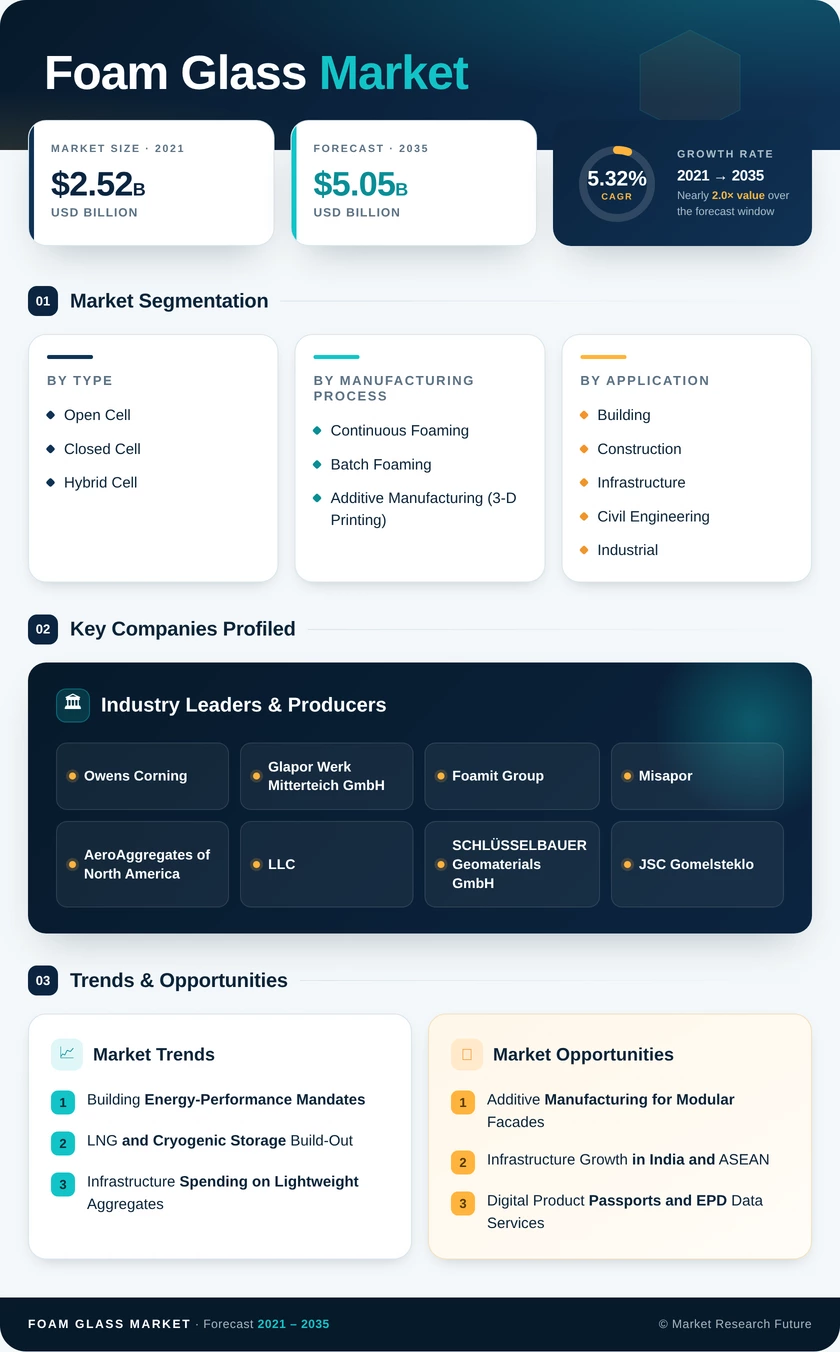
Segmentation Quick Reference
| Dimension | Sub-Segments | Dominant Segment | Fastest Growing Segment |
|---|
| By Type | Open Cell, Closed Cell, Hybrid Cell | Closed Cell (57.1% share) | Hybrid Cell (6.1% CAGR) |
| By Manufacturing Process | Continuous Foaming, Batch Foaming, Additive Manufacturing (3-D Printing) | Continuous Foaming (58.2% share) | Additive Manufacturing (3-D Printing) (6.2% CAGR) |
| By Application | Building and Construction, Infrastructure and Civil Engineering, Industrial and Chemical Processing, Cryogenic and LNG, Agriculture and Water Treatment, Other Applications (Roofing Granules, Landscaping) | Building and Construction (41.9% share) | Cryogenic and LNG (6.3% CAGR) |
| By End-user Industry | Residential, Commercial, Industrial | Industrial (6.3% CAGR) | Industrial (6.3% CAGR) |
| By Region | Asia-Pacific, North America, Europe, South America, Middle East and Africa | Asia-Pacific (38.4% share) | Asia-Pacific (38.4% share) |
Market Segmentation Overview
| Sub-Segment | Key Trend |
|---|
| Open Cell | Adoption in acoustic, vapor-permeable architectural elements |
| Closed Cell | Standard for LNG tank bases and vapor-tight process insulation |
| Hybrid Cell | Density tuning for combined structural and acoustic duty |
Closed Cell leads because sealed pores give the vapor resistance and compressive strength that LNG bases and industrial pipework demand. Hybrid Cell grows fastest as producers engineer mixed pore structures that carry load while damping sound. Open Cell stays specialized, chosen where indoor-air certifications reward breathable insulation.
| Sub-Segment | Key Trend |
|---|
| Continuous Foaming | Shift from gas-fired to electric tunnel furnaces |
| Batch Foaming | Retained for density-critical, low-volume parts |
| Additive Manufacturing (3-D Printing) | Printed facade and industrial components |
Continuous Foaming leads on unit cost for standard boards and blocks, and its next step is electrification of tunnel furnaces. Additive Manufacturing (3-D Printing) grows fastest because printable binders remove mold costs for complex facade geometry. Batch Foaming holds niche positions where density precision outweighs throughput.
| Sub-Segment | Key Trend |
|---|
| Building and Construction | Inverted roofs and A1 fire-rated envelopes |
| Infrastructure and Civil Engineering | Agency approvals for embankment and backfill aggregate |
| Industrial and Chemical Processing | Corrosion-under-insulation retrofits |
| Cryogenic and LNG | Terminal and carrier investment, then hydrogen |
| Agriculture and Water Treatment | Inert media for basins and digesters |
| Other Applications (Roofing Granules, Landscaping) | Lightweight substrates and decorative granules |
Building and Construction leads as energy-performance codes push specifiers toward insulation that survives water exposure and fire. Cryogenic and LNG grows fastest, driven by export terminals and the qualification of grades for colder hydrogen service. Infrastructure and Civil Engineering gains share as each transport-agency approval opens a new procurement channel.
| Sub-Segment | Key Trend |
|---|
| Residential | Under-slab insulation in premium homes |
| Commercial | Data centers and cold-chain warehouses |
| Industrial | Refinery, chemical, and food-plant retrofits |
Industrial is both the largest and the fastest-growing end user, because refinery and chemical operators replace absorbent insulation that accelerates corrosion. Commercial buyers follow for data centers and cold storage, where avoided maintenance justifies the premium. Residential demand grows slowly, limited by first-cost bidding and specifier familiarity.


 Noah Malgeri
Co-Founder

 Peter Groot koerkamp
Account and Business Manager

 Younghwan Choi
Senior Retail Manager

 Mark Irwin
Management Consultant

 Akif Moroglu
Strategy & Business Development Director

 Guilherme Gomes Martins
Product Management Director

 Joseph Aguayo
Sales Operations & Pricing Manager

 La Terria Dodd
Program Support Specialist

 Rob Kooiker
Group Product Manager HVAC & Fire Protection GMA