Request Free Sample ×

Kindly complete the form below to receive a free sample of this Report

* Please use a valid business email

Leading companies partner with us for data-driven Insights

clients tt-cursor
Hero Background
English
Chinese
French
Japanese
Korean
German
Spanish

Fly Ash Market Trends

ID: MRFR/CnM/5257-HCR
111 Pages
Chitranshi Jaiswal
Last Updated: April 06, 2026

Fly Ash Market Research Report By Application (Cement, Concrete, Geopolymers, Lightweight Fill, Soil Stabilization), By Type (Class F, Class C, Low Carbon Fly Ash, High Carbon Fly Ash), By End Use (Residential, Commercial, Infrastructure, Industrial), By Process (Dry Process, Wet Process, Mechanical Activation) and By Regional (North America, Europe, South America, Asia Pacific, Middle East and Africa) - Forecast to 2035

Share:
Download PDF ×

We do not share your information with anyone. However, we may send you emails based on your report interest from time to time. You may contact us at any time to opt-out.

Fly Ash Market Infographic
Purchase Options

Market Trends

Key Emerging Trends in the Fly Ash Market

The Fly Ash Market is currently witnessing notable trends that are reshaping its landscape across various industries. One significant trend is the increasing use of fly ash in construction materials, particularly in the production of concrete. With a growing emphasis on sustainable and eco-friendly practices, fly ash, a byproduct of coal combustion, is being utilized as a supplementary cementitious material. This trend aligns with the global push for greener construction practices, as fly ash helps reduce the carbon footprint of concrete and enhances its durability.

Environmental sustainability is a key driver influencing market trends in the Fly Ash Market. As industries worldwide strive to minimize their environmental impact, the utilization of fly ash in various applications is gaining prominence. Regulatory initiatives promoting the responsible disposal and recycling of industrial byproducts further contribute to the market's growth. The versatile nature of fly ash allows it to be incorporated into multiple industries, including construction, agriculture, and waste stabilization, fostering sustainable practices across diverse sectors.

Technological advancements play a pivotal role in shaping market trends in the Fly Ash Market. Innovations in extraction and processing technologies are enhancing the quality and properties of fly ash, making it more suitable for advanced applications. Additionally, advancements in concrete technology are driving the development of high-performance concrete formulations that leverage the benefits of fly ash, such as improved strength, workability, and durability. These technological trends contribute to the market's evolution and broaden its scope across various industries.

The energy sector is another significant influencer of market trends in the Fly Ash Market. As coal-fired power generation remains prevalent in many regions, the production of fly ash continues to grow. Efforts to increase energy efficiency and reduce greenhouse gas emissions have led to the installation of advanced combustion technologies, influencing the composition and characteristics of fly ash. The demand for fly ash from power plants for beneficial reuse and effective waste management is a notable trend in the market.

Supply chain dynamics and regulatory changes are critical factors impacting market trends in the Fly Ash Market. Fluctuations in coal consumption, power generation, and environmental regulations can influence the availability and quality of fly ash. Additionally, changes in waste management policies and disposal practices can affect the market dynamics. Market participants are closely monitoring these factors and adapting strategies to ensure a stable supply chain and compliance with evolving regulatory requirements.

Furthermore, there is a growing trend towards international trade in the Fly Ash Market. As the demand for fly ash expands globally, market players are exploring opportunities to export and import fly ash to meet regional demands. This trend is driven by the need for consistent quality and reliable sources of fly ash for construction projects worldwide. The international trade of fly ash enhances market competitiveness and allows companies to tap into diverse markets.

Author
Author Profile
Chitranshi Jaiswal
Team Lead - Research

Chitranshi is a Team Leader in the Chemicals & Materials (CnM) and Energy & Power (EnP) domains, with 6+ years of experience in market research. She leads and mentors teams to deliver cross-domain projects that equip clients with actionable insights and growth strategies. She is skilled in market estimation, forecasting, competitive benchmarking, and both primary & secondary research, enabling her to turn complex data into decision-ready insights. An engineer and MBA professional, she combines technical expertise with strategic acumen to solve dynamic market challenges. Chitranshi has successfully managed projects that support market entry, investment planning, and competitive positioning, while building strong client relationships. Certified in Advanced Excel & Power BI she leverages data-driven approaches to ensure accuracy, clarity, and impactful outcomes.

Leave a Comment

FAQs

What is the projected market valuation of the Fly Ash Market by 2035?

<p>The Fly Ash Market is projected to reach a valuation of 12.0 USD Billion by 2035.</p>

What was the overall market valuation of the Fly Ash Market in 2024?

<p>In 2024, the overall market valuation of the Fly Ash Market was 8.44 USD Billion.</p>

What is the expected CAGR for the Fly Ash Market during the forecast period 2025 - 2035?

<p>The expected CAGR for the Fly Ash Market during the forecast period 2025 - 2035 is 3.25%.</p>

Which application segment is anticipated to have the highest valuation by 2035?

<p>The Infrastructure application segment is anticipated to reach a valuation of 6.0 USD Billion by 2035.</p>

What are the projected valuations for Class F and Class C fly ash by 2035?

<p>By 2035, Class F fly ash is projected to reach 3.6 USD Billion, while Class C fly ash is expected to reach 2.4 USD Billion.</p>

Which end-use segment is expected to grow the most in the Fly Ash Market by 2035?

<p>The Infrastructure end-use segment is expected to grow the most, reaching 6.0 USD Billion by 2035.</p>

What are the projected valuations for the Dry Process and Wet Process segments by 2035?

<p>The Dry Process segment is projected to reach 3.75 USD Billion, while the Wet Process segment is expected to reach 4.5 USD Billion by 2035.</p>

Who are the key players in the Fly Ash Market?

<p>Key players in the Fly Ash Market include CEMEX, Boral Limited, Charah Solutions, HeidelbergCement AG, LafargeHolcim Ltd, Ash Grove Cement Company, Martin Marietta Materials, and UltraTech Cement Limited.</p>

What is the projected valuation for Lightweight Fill and Soil Stabilization segments by 2035?

<p>By 2035, the Lightweight Fill segment is projected to reach 0.9 USD Billion, while the Soil Stabilization segment is expected to reach 1.8 USD Billion.</p>

How does the market valuation of Concrete compare to that of Geopolymers by 2035?

<p>By 2035, the market valuation for Concrete is projected to be 4.2 USD Billion, significantly higher than the 1.5 USD Billion projected for Geopolymers.</p>

Market Summary

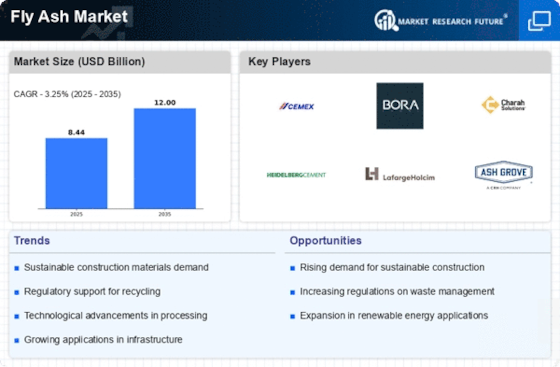
As per Market Research Future analysis, the Fly Ash Market Size was estimated at 8.44 USD Billion in 2024. The Fly Ash industry is projected to grow from 8.714 USD Billion in 2025 to 12.0 USD Billion by 2035, exhibiting a compound annual growth rate (CAGR) of 3.25% during the forecast period 2025 - 2035

Key Market Trends & Highlights

The Fly Ash Market is experiencing robust growth driven by sustainability initiatives and technological advancements.

  • North America remains the largest market for fly ash, driven by increasing infrastructure projects and regulatory support. Asia-Pacific is the fastest-growing region, with a surge in urbanization and demand for sustainable construction materials. The concrete segment continues to dominate the market, while geopolymers are emerging as the fastest-growing segment due to their innovative applications. Key market drivers include rising demand in the construction sector and growing awareness of the environmental benefits of fly ash utilization.

Market Size & Forecast

2024 Market Size 8.44 (USD Billion)
2035 Market Size 12.0 (USD Billion)
CAGR (2025 - 2035) 3.25%
Largest Regional Market Share in 2024 Asia Pacific

Major Players

CEMEX (MX), Boral Limited (AU), Charah Solutions (US), HeidelbergCement AG (DE), LafargeHolcim Ltd (CH), Ash Grove Cement Company (US), Martin Marietta Materials, Inc. (US), UltraTech Cement Limited (IN)

Market Trends

The Fly Ash Market is currently experiencing a notable transformation, driven by increasing awareness regarding sustainable construction practices and the need for eco-friendly materials. As industries seek to reduce their carbon footprint, fly ash emerges as a viable alternative to traditional cement, offering enhanced durability and strength to concrete. This shift towards greener solutions appears to be influencing various sectors, including construction, infrastructure, and manufacturing, as stakeholders recognize the potential benefits of incorporating fly ash into their projects. Furthermore, regulatory frameworks promoting the use of recycled materials are likely to bolster the demand for fly ash, as companies strive to comply with environmental standards and enhance their sustainability profiles.

In addition to sustainability, the fly ash market is also witnessing advancements in technology that facilitate the efficient processing and utilization of fly ash. Innovations in production techniques and quality control measures may enhance the performance characteristics of fly ash, making it an even more attractive option for construction applications. These innovations are shaping modern fly ash market trends, particularly as companies focus on improving material consistency and application efficiency. Moreover, the growing trend of urbanization and infrastructure development in emerging economies is expected to significantly boost the india fly ash market, where large-scale construction activities are driving the adoption of sustainable materials. This growth is also supporting the development of the fly ash bricks market, as fly ash bricks offer improved strength, lower environmental impact, and cost advantages compared to traditional clay bricks. Overall, the fly ash market appears poised for growth, with multiple factors converging to create a favorable environment for its expansion.

Sustainability Focus

The emphasis on sustainable construction practices is reshaping the Fly Ash Market. Stakeholders are increasingly prioritizing eco-friendly materials, leading to a rise in the adoption of fly ash as a substitute for traditional cement.

Technological Advancements

Innovations in processing and quality control are enhancing the performance of fly ash. These advancements may improve its applicability in various construction projects, making it a more appealing choice for builders.

Urbanization and Infrastructure Growth

The ongoing urbanization and infrastructure development in emerging markets are likely to drive demand for fly ash. As these regions seek durable and cost-effective materials, fly ash could play a crucial role in meeting their construction needs.

Fly Ash Market Market Drivers

Rising Demand in Construction Sector

The Fly Ash Market is significantly influenced by the rising demand in the construction sector. With urbanization trends continuing to escalate, there is an increasing need for infrastructure development, including roads, bridges, and residential buildings. Fly ash is increasingly recognized for its ability to enhance the properties of concrete, making it a preferred choice among construction companies. Recent data indicates that the construction sector is expected to grow at a compound annual growth rate of 4.5% over the next few years, which directly correlates with the rising consumption of fly ash. This growth presents a substantial opportunity for the Fly Ash Market, as more construction projects seek to incorporate fly ash to improve material performance and sustainability.

Economic Benefits of Fly Ash Utilization

The economic advantages of utilizing fly ash are becoming increasingly apparent within the Fly Ash Market. The incorporation of fly ash in concrete not only enhances performance but also reduces costs associated with raw materials. By substituting a portion of cement with fly ash, construction companies can achieve significant savings, as fly ash is often less expensive than traditional cement. Additionally, the use of fly ash can lead to lower transportation costs due to its availability in proximity to coal-fired power plants. Recent analyses suggest that the cost savings from using fly ash can range from 10% to 20% in concrete production. This economic incentive is likely to drive further adoption of fly ash in the construction sector, thereby bolstering the Fly Ash Market.

Growing Awareness of Environmental Benefits

The Fly Ash Market is benefiting from a growing awareness of the environmental advantages associated with the use of fly ash in construction. As stakeholders in the construction industry become more conscious of their environmental impact, there is a marked shift towards materials that contribute to sustainability. Fly ash, being a byproduct of coal combustion, offers a viable solution for reducing waste and minimizing the need for virgin materials. This awareness is leading to increased adoption of fly ash in concrete production, with studies indicating that using fly ash can reduce greenhouse gas emissions by up to 30%. Consequently, the Fly Ash Market is poised for growth as more companies prioritize sustainable practices and seek to incorporate fly ash into their projects.

Regulatory Support for Sustainable Practices

The Fly Ash Market is experiencing a notable boost due to increasing regulatory support for sustainable construction practices. Governments are implementing stringent regulations aimed at reducing carbon emissions and promoting the use of recycled materials in construction. This regulatory environment encourages the adoption of fly ash as a supplementary cementitious material, which not only enhances the durability of concrete but also reduces the overall carbon footprint of construction projects. As a result, the demand for fly ash is projected to rise, with estimates suggesting a growth rate of approximately 5% annually over the next five years. This trend indicates a shift towards more environmentally friendly construction practices, positioning the Fly Ash Market favorably in the context of sustainable development.

Technological Innovations in Fly Ash Utilization

Technological advancements are playing a crucial role in shaping the Fly Ash Market. Innovations in processing and application techniques are enhancing the efficiency and effectiveness of fly ash in various construction applications. For instance, advancements in the production of high-quality fly ash and its integration into concrete formulations are leading to improved performance characteristics, such as increased strength and reduced permeability. Furthermore, the development of new technologies for the utilization of fly ash in other sectors, such as road construction and soil stabilization, is expanding its market potential. As these technologies continue to evolve, they are likely to drive further growth in the Fly Ash Market, potentially increasing its market share in the construction materials sector.

Market Segment Insights

By Application: Concrete (Largest) vs. Geopolymers (Fastest-Growing)

The Fly Ash Market displays a diverse application distribution, with concrete emerging as the dominant use accounting for a substantial portion of the market share. This is largely due to its enhanced properties, including improved strength and durability, making it the preferred choice across various construction projects. Following concrete, the geopolymer segment is garnering attention as an innovative alternative, benefiting from increasing industrialization and the push for sustainable materials.

Concrete (Dominant) vs. Geopolymers (Emerging)

Concrete has carved out its place as the dominant application in the Fly Ash Market, esteemed for its utility in enhancing structural integrity and sustainability in construction. Its wide acceptance is bolstered by the growing demand for high-performance concrete that meets stringent durability standards. On the other hand, geopolymers are making significant strides as an emerging market force, characterized by their lower carbon footprint and innovative formulations. This segment is propelled by increasing awareness of environmental impacts and breakthroughs in production technology, making geopolymers a promising substitute for traditional materials.

By Type: Class F (Largest) vs. Class C (Fastest-Growing)

The Fly Ash Market is primarily divided into Class F and Class C, with Class F taking the largest share due to its superior pozzolanic properties that enhance concrete strength and durability. It is widely utilized in various construction projects, including infrastructure and commercial buildings, providing a significant market foundation. Conversely, Class C is emerging rapidly, catering to the demand in specific applications that require a higher calcium content, thus filling the gaps in specialty concrete mixes.

Fly Ash: Class F (Dominant) vs. Class C (Emerging)

Class F fly ash is known for its exceptional pozzolanic reactivity, making it highly effective in improving the mechanical properties of concrete. Its dominance in the market is attributed to its widespread use in concrete construction, where it replaces a significant portion of Portland cement, ultimately leading to lower carbon footprints and enhanced long-term durability. In contrast, Class C fly ash, which includes a higher percentage of calcium, is gaining traction as an emerging option for applications where rapid strength gain is essential, such as in road construction and precast concrete products. This shift is driven by the growing trend of sustainable construction practices, highlighting the benefits of both classes.

By End Use: Infrastructure (Largest) vs. Residential (Fastest-Growing)

The fly ash market exhibits a diverse segmentation in terms of end use, with infrastructure applications leading in market share. This segment encompasses a wide range of applications including roads, bridges, and buildings where fly ash is used as a vital component in concrete production. Its properties enhance durability and reduce the overall carbon footprint of construction projects, making it a preferred choice among builders and developers. In contrast, the residential segment is seeing rapid growth, driven by increasing awareness of sustainable building practices and the benefits of incorporating fly ash in home construction. As more homeowners and builders emphasize eco-friendly materials, the use of fly ash in residential applications is expected to rise significantly, further contributing to industry's expansion.

Infrastructure (Dominant) vs. Residential (Emerging)

The infrastructure sector remains the dominant end-use segment for fly ash, primarily due to ongoing urbanization and infrastructure development projects worldwide. Fly ash is integral to concrete production, enhancing strength, workability, and durability. Its adoption in roads, highways, and other critical structural elements typifies its importance in construction. Conversely, the residential segment is emerging as a significant player, fueled by the desire for sustainable and green building materials. Homeowners and builders are increasingly recognizing the long-term benefits of fly ash, including improved thermal performance and lower maintenance needs. This shift not only boosts the demand within the residential space but also supports broader sustainability goals, positioning fly ash as a favorable choice in modern homebuilding.

By Process: Wet Process (Largest) vs. Dry Process (Fastest-Growing)

In the Fly Ash Market, the distribution among processing methods reveals that the Wet Process currently holds the largest market share, capitalizing on its efficiency and established technology. This method is favored in various applications due to its ability to produce a high-quality fly ash product that meets stringent specifications. Conversely, the Dry Process, while smaller in share, is quickly gaining traction. This rise can be attributed to advancements in technology and a growing interest in sustainable practices, making it a compelling option for manufacturers seeking eco-friendly solutions. Growth trends indicate that the Dry Process is emerging as the fastest-growing method in the sector, driven by an increase in demand for high-performance construction materials. As industries push towards minimizing environmental impacts, the Dry Process is increasingly seen as a competitive alternative due to its lower water usage and energy consumption. Similarly, innovations in mechanical activation technology are also boosting the appeal of these processes, as they enhance the material characteristics of fly ash and expand its application scope in multiple construction and engineering domains.

Wet Process (Dominant) vs. Mechanical Activation (Emerging)

The Wet Process has established itself as the dominant processing method in the Fly Ash Market, attributed to its ability to produce consistent and high-quality fly ash suitable for a diverse range of applications. This technique allows for better control over the properties of the final product, making it ideal for use in concrete and other construction materials. In contrast, Mechanical Activation is gaining recognition as an emerging method that enhances the reactivity of fly ash through mechanical energy application. This growing interest is largely driven by the need for efficiency and performance improvement in construction applications. As stakeholders increasingly recognize the advantages of mechanically activated fly ash, this segment is likely to witness significant growth, provided it meets the specific requirements of a wider array of engineering applications.

Get more detailed insights about Fly Ash Market Research Report—Global Forecast to 2035

Regional Insights

North America : Sustainable Growth Leader

North America is the largest market for fly ash, holding approximately 45% of the global share. The region's growth is driven by increasing infrastructure projects, stringent environmental regulations promoting sustainable construction, and a shift towards green building materials. The demand for fly ash is further supported by government initiatives aimed at reducing carbon emissions in the construction sector. The United States is the leading country in this market, with significant contributions from states like Texas and California. Key players such as Charah Solutions and Martin Marietta Materials are actively involved in expanding their operations. The competitive landscape is characterized by a mix of established companies and emerging players, all vying for market share in a rapidly evolving industry.

Europe : Regulatory-Driven Market

Europe is the second-largest market for fly ash, accounting for around 30% of the global share. The region's growth is propelled by stringent EU regulations on waste management and sustainability, which encourage the use of fly ash in construction. Countries like Germany and the UK are leading the charge, with increasing investments in infrastructure and green building initiatives driving demand for fly ash products. Germany stands out as a key player, with companies like HeidelbergCement AG and LafargeHolcim Ltd leading the market. The competitive landscape is robust, with a focus on innovation and sustainability. The presence of regulatory bodies ensures that the market adheres to high environmental standards, fostering a culture of responsible sourcing and usage of fly ash in construction projects.

Asia-Pacific : Emerging Market Potential

Asia-Pacific is witnessing rapid growth in the fly ash market, holding approximately 20% of the global share. The region's expansion is driven by increasing urbanization, infrastructure development, and a growing emphasis on sustainable construction practices. Countries like India and China are at the forefront, with significant investments in infrastructure projects that utilize fly ash as a key material for concrete production. India, in particular, is a major player, with UltraTech Cement Limited leading the market. The competitive landscape is evolving, with both domestic and international companies vying for market presence. The region's focus on reducing carbon footprints and enhancing construction efficiency is expected to further boost the demand for fly ash in the coming years.

Middle East and Africa : Resource-Rich Opportunities

The Middle East and Africa region is gradually emerging in the fly ash market, holding about 5% of the global share. The growth is primarily driven by increasing construction activities and a rising awareness of sustainable building materials. Countries like South Africa and the UAE are leading the way, with government initiatives promoting the use of fly ash in various construction projects to enhance sustainability and reduce waste. South Africa is a key player in this market, with local companies exploring innovative ways to utilize fly ash in construction. The competitive landscape is still developing, with opportunities for both local and international players to establish a foothold. As the region continues to invest in infrastructure, the demand for fly ash is expected to grow, supported by favorable regulations and market conditions.

Key Players and Competitive Insights

The Fly Ash Market has been experiencing significant growth due to the increasing demand for eco-friendly construction materials and sustainable building practices. Fly ash, a byproduct from coal combustion, is increasingly being recognized for its advantageous properties, including improved strength and durability in concrete applications. With the rise of various industries such as construction, cement production, and mining, stakeholders within the fly ash market are continually exploring innovative strategies to establish their presence and enhance their competitive edge.The market is characterized by key players actively pursuing research and development initiatives, thereby refining their offerings and expanding their market footprint on a scale.Construction Resources has effectively carved out a prominent niche within the Fly Ash Market by leveraging its extensive distribution channels and strong customer relationships. Known for its strategic marketing approaches, the company has solidified its position by providing high-quality products that meet stringent industry standards. The strength of Construction Resources lies in its diverse range of services, which encompass the sourcing and supply of fly ash for various applications such as concrete production and road construction.With a robust logistical framework and a commitment to sustainability, the company is well-positioned to meet the evolving demands of the market, thereby enhancing its competitive stance. It continues to innovate its offerings in line with environmental regulations, showcasing its dedication to promoting green building practices.Severstal, another key player in the Fly Ash Market, is recognized for its comprehensive portfolio that encompasses a variety of building materials and solutions. The company is committed to enhancing the quality and sustainability of construction projects through the innovative use of fly ash in concrete mixes.Its significant market presence is underscored by strategic mergers and acquisitions aimed at strengthening its product offerings and expanding its geographical reach. The strength of Severstal lies in its focus on technological advancements and sustainable practices that cater to the needs of environmentally conscious consumers. With key products and services that emphasize efficiency and durability, Severstal is aligned with trends favoring sustainable construction materials, providing it an advantageous position in the competitive landscape of the Fly Ash Market.

Key Companies in the Fly Ash Market include

Industry Developments

The Fly Ash Market is witnessing significant developments, with an increasing demand due to the construction sector's growth and the rising focus on sustainable building materials. Companies such as Boral Resources, HeidelbergCement AG, and LafargeHolcim are enhancing their operational capacities to capture the growing market. Notably, in May 2023, CEMEX announced an acquisition of a leading fly ash supplier to strengthen its footprint in the United States, aligning with the trend of consolidation among major players. Similarly, in July 2023, Charah Solutions expanded its services by partnering with Titan America to provide enhanced fly ash management solutions.

The market is also seeing a surge in valuations, spurred by the robust recovery pathways post-pandemic and increased government initiatives supporting green construction practices. Past developments, including the integration of advanced recycling technologies by Ash Grove Cement Company in March 2022, have further fueled innovation in fly ash applications. The overall growth strategy includes expanded distribution capabilities and enhanced product offerings, echoing a broader trend of prioritizing sustainability within the industry. As the construction sector accelerates, the Fly Ash Market is positioned for continued expansion.

Future Outlook

Fly Ash Market Future Outlook

The Fly Ash Market is projected to grow at a 3.25% CAGR from 2025 to 2035, driven by increasing demand in construction and sustainable practices.

New opportunities lie in:

  • <p>Development of high-performance concrete incorporating fly ash Expansion into emerging markets with infrastructure needs Innovative recycling technologies for enhanced fly ash utilization</p>

By 2035, the Fly Ash Market is expected to solidify its role in sustainable construction.

Market Segmentation

Fly Ash Market Type Outlook

  • Class F
  • Class C
  • Low Carbon Fly Ash
  • High Carbon Fly Ash

Fly Ash Market End Use Outlook

  • Residential
  • Commercial
  • Infrastructure
  • Industrial

Fly Ash Market Process Outlook

  • Dry Process
  • Wet Process
  • Mechanical Activation

Fly Ash Market Application Outlook

  • Cement
  • Concrete
  • Geopolymers
  • Lightweight Fill
  • Soil Stabilization

Report Scope

MARKET SIZE 2024 8.44(USD Billion)
MARKET SIZE 2025 8.714(USD Billion)
MARKET SIZE 2035 12.0(USD Billion)
COMPOUND ANNUAL GROWTH RATE (CAGR) 3.25% (2025 - 2035)
REPORT COVERAGE Revenue Forecast, Competitive Landscape, Growth Factors, and Trends
BASE YEAR 2024
Market Forecast Period 2025 - 2035
Historical Data 2019 - 2024
Market Forecast Units USD Billion
Key Companies Profiled CEMEX (MX), Boral Limited (AU), Charah Solutions (US), HeidelbergCement AG (DE), LafargeHolcim Ltd (CH), Ash Grove Cement Company (US), Martin Marietta Materials, Inc. (US), UltraTech Cement Limited (IN)
Segments Covered Application, Type, End Use, Process, Regional
Key Market Opportunities Increasing demand for sustainable construction materials drives growth in the Fly Ash Market.
Key Market Dynamics Rising demand for sustainable construction materials drives innovation and competition in the fly ash market.
Countries Covered North America, Europe, APAC, South America, MEA

FAQs

What is the projected market valuation of the Fly Ash Market by 2035?

<p>The Fly Ash Market is projected to reach a valuation of 12.0 USD Billion by 2035.</p>

What was the overall market valuation of the Fly Ash Market in 2024?

<p>In 2024, the overall market valuation of the Fly Ash Market was 8.44 USD Billion.</p>

What is the expected CAGR for the Fly Ash Market during the forecast period 2025 - 2035?

<p>The expected CAGR for the Fly Ash Market during the forecast period 2025 - 2035 is 3.25%.</p>

Which application segment is anticipated to have the highest valuation by 2035?

<p>The Infrastructure application segment is anticipated to reach a valuation of 6.0 USD Billion by 2035.</p>

What are the projected valuations for Class F and Class C fly ash by 2035?

<p>By 2035, Class F fly ash is projected to reach 3.6 USD Billion, while Class C fly ash is expected to reach 2.4 USD Billion.</p>

Which end-use segment is expected to grow the most in the Fly Ash Market by 2035?

<p>The Infrastructure end-use segment is expected to grow the most, reaching 6.0 USD Billion by 2035.</p>

What are the projected valuations for the Dry Process and Wet Process segments by 2035?

<p>The Dry Process segment is projected to reach 3.75 USD Billion, while the Wet Process segment is expected to reach 4.5 USD Billion by 2035.</p>

Who are the key players in the Fly Ash Market?

<p>Key players in the Fly Ash Market include CEMEX, Boral Limited, Charah Solutions, HeidelbergCement AG, LafargeHolcim Ltd, Ash Grove Cement Company, Martin Marietta Materials, and UltraTech Cement Limited.</p>

What is the projected valuation for Lightweight Fill and Soil Stabilization segments by 2035?

<p>By 2035, the Lightweight Fill segment is projected to reach 0.9 USD Billion, while the Soil Stabilization segment is expected to reach 1.8 USD Billion.</p>

How does the market valuation of Concrete compare to that of Geopolymers by 2035?

<p>By 2035, the market valuation for Concrete is projected to be 4.2 USD Billion, significantly higher than the 1.5 USD Billion projected for Geopolymers.</p>

  1. SECTION I: EXECUTIVE SUMMARY AND KEY HIGHLIGHTS |
    1. EXECUTIVE SUMMARY | |
      1. Market Overview | |
      2. Key Findings | |
      3. Market Segmentation | |
      4. Competitive Landscape | |
      5. Challenges and Opportunities | |
      6. Future Outlook 2
  2. SECTION II: SCOPING, METHODOLOGY AND MARKET STRUCTURE |
    1. MARKET INTRODUCTION | |
      1. Definition | |
      2. Scope of the study | | |
    2. RESEARCH METHODOLOGY | |
      1. Overview | |
      2. Data Mining | |
      3. Secondary Research | |
      4. Primary Research | | |
      5. Forecasting Model | |
      6. Market Size Estimation | | |
      7. Data Triangulation | |
      8. Validation 3
  3. SECTION III: QUALITATIVE ANALYSIS |
    1. MARKET DYNAMICS | |
      1. Overview | |
      2. Drivers | |
      3. Restraints | |
      4. Opportunities |
    2. MARKET FACTOR ANALYSIS | |
      1. Value chain Analysis | |
      2. Porter's Five Forces Analysis | | |
      3. COVID-19 Impact Analysis | | |
  4. SECTION IV: QUANTITATIVE ANALYSIS |
    1. Chemicals and Materials, BY Application (USD Billion) | |
      1. Cement | |
      2. Concrete | |
      3. Geopolymers | |
      4. Lightweight Fill | |
      5. Soil Stabilization |
    2. Chemicals and Materials, BY Type (USD Billion) | |
      1. Class F | |
      2. Class C | |
      3. Low Carbon Fly Ash | |
      4. High Carbon Fly Ash |
    3. Chemicals and Materials, BY End Use (USD Billion) | |
      1. Residential | |
      2. Commercial | |
      3. Infrastructure | |
      4. Industrial |
    4. Chemicals and Materials, BY Process (USD Billion) | |
      1. Dry Process | |
      2. Wet Process | |
      3. Mechanical Activation |
    5. Chemicals and Materials, BY Region (USD Billion) | |
      1. North America | | |
      2. Europe | | |
      3. APAC | | |
      4. South America | | |
      5. MEA | | |
  5. SECTION V: COMPETITIVE ANALYSIS |
    1. Competitive Landscape | |
      1. Overview | |
      2. Competitive Analysis | |
      3. Market share Analysis | |
      4. Major Growth Strategy in the Chemicals and Materials | |
      5. Competitive Benchmarking | |
      6. Leading Players in Terms of Number of Developments in the Chemicals and Materials | |
      7. Key developments and growth strategies | | |
      8. Major Players Financial Matrix | | |
    2. Company Profiles | |
      1. CEMEX (MX) | | |
      2. Boral Limited (AU) | | |
      3. Charah Solutions (US) | | |
      4. HeidelbergCement AG (DE) | | |
      5. LafargeHolcim Ltd (CH) | | |
      6. Ash Grove Cement Company (US) | | |
      7. Martin Marietta Materials, Inc. (US) | | |
      8. UltraTech Cement Limited (IN) | | |
    3. Appendix | |
      1. References | |
      2. Related Reports 6 LIST OF FIGURES |
    4. MARKET SYNOPSIS |
    5. NORTH AMERICA MARKET ANALYSIS |
    6. US MARKET ANALYSIS BY APPLICATION |
    7. US MARKET ANALYSIS BY TYPE |
    8. US MARKET ANALYSIS BY END USE |
    9. US MARKET ANALYSIS BY PROCESS |
    10. CANADA MARKET ANALYSIS BY APPLICATION |
    11. CANADA MARKET ANALYSIS BY TYPE |
    12. CANADA MARKET ANALYSIS BY END USE |
    13. CANADA MARKET ANALYSIS BY PROCESS |
    14. EUROPE MARKET ANALYSIS |
    15. GERMANY MARKET ANALYSIS BY APPLICATION |
    16. GERMANY MARKET ANALYSIS BY TYPE |
    17. GERMANY MARKET ANALYSIS BY END USE |
    18. GERMANY MARKET ANALYSIS BY PROCESS |
    19. UK MARKET ANALYSIS BY APPLICATION |
    20. UK MARKET ANALYSIS BY TYPE |
    21. UK MARKET ANALYSIS BY END USE |
    22. UK MARKET ANALYSIS BY PROCESS |
    23. FRANCE MARKET ANALYSIS BY APPLICATION |
    24. FRANCE MARKET ANALYSIS BY TYPE |
    25. FRANCE MARKET ANALYSIS BY END USE |
    26. FRANCE MARKET ANALYSIS BY PROCESS |
    27. RUSSIA MARKET ANALYSIS BY APPLICATION |
    28. RUSSIA MARKET ANALYSIS BY TYPE |
    29. RUSSIA MARKET ANALYSIS BY END USE |
    30. RUSSIA MARKET ANALYSIS BY PROCESS |
    31. ITALY MARKET ANALYSIS BY APPLICATION |
    32. ITALY MARKET ANALYSIS BY TYPE |
    33. ITALY MARKET ANALYSIS BY END USE |
    34. ITALY MARKET ANALYSIS BY PROCESS |
    35. SPAIN MARKET ANALYSIS BY APPLICATION |
    36. SPAIN MARKET ANALYSIS BY TYPE |
    37. SPAIN MARKET ANALYSIS BY END USE |
    38. SPAIN MARKET ANALYSIS BY PROCESS |
    39. REST OF EUROPE MARKET ANALYSIS BY APPLICATION |
    40. REST OF EUROPE MARKET ANALYSIS BY TYPE |
    41. REST OF EUROPE MARKET ANALYSIS BY END USE |
    42. REST OF EUROPE MARKET ANALYSIS BY PROCESS |
    43. APAC MARKET ANALYSIS |
    44. CHINA MARKET ANALYSIS BY APPLICATION |
    45. CHINA MARKET ANALYSIS BY TYPE |
    46. CHINA MARKET ANALYSIS BY END USE |
    47. CHINA MARKET ANALYSIS BY PROCESS |
    48. INDIA MARKET ANALYSIS BY APPLICATION |
    49. INDIA MARKET ANALYSIS BY TYPE |
    50. INDIA MARKET ANALYSIS BY END USE |
    51. INDIA MARKET ANALYSIS BY PROCESS |
    52. JAPAN MARKET ANALYSIS BY APPLICATION |
    53. JAPAN MARKET ANALYSIS BY TYPE |
    54. JAPAN MARKET ANALYSIS BY END USE |
    55. JAPAN MARKET ANALYSIS BY PROCESS |
    56. SOUTH KOREA MARKET ANALYSIS BY APPLICATION |
    57. SOUTH KOREA MARKET ANALYSIS BY TYPE |
    58. SOUTH KOREA MARKET ANALYSIS BY END USE |
    59. SOUTH KOREA MARKET ANALYSIS BY PROCESS |
    60. MALAYSIA MARKET ANALYSIS BY APPLICATION |
    61. MALAYSIA MARKET ANALYSIS BY TYPE |
    62. MALAYSIA MARKET ANALYSIS BY END USE |
    63. MALAYSIA MARKET ANALYSIS BY PROCESS |
    64. THAILAND MARKET ANALYSIS BY APPLICATION |
    65. THAILAND MARKET ANALYSIS BY TYPE |
    66. THAILAND MARKET ANALYSIS BY END USE |
    67. THAILAND MARKET ANALYSIS BY PROCESS |
    68. INDONESIA MARKET ANALYSIS BY APPLICATION |
    69. INDONESIA MARKET ANALYSIS BY TYPE |
    70. INDONESIA MARKET ANALYSIS BY END USE |
    71. INDONESIA MARKET ANALYSIS BY PROCESS |
    72. REST OF APAC MARKET ANALYSIS BY APPLICATION |
    73. REST OF APAC MARKET ANALYSIS BY TYPE |
    74. REST OF APAC MARKET ANALYSIS BY END USE |
    75. REST OF APAC MARKET ANALYSIS BY PROCESS |
    76. SOUTH AMERICA MARKET ANALYSIS |
    77. BRAZIL MARKET ANALYSIS BY APPLICATION |
    78. BRAZIL MARKET ANALYSIS BY TYPE |
    79. BRAZIL MARKET ANALYSIS BY END USE |
    80. BRAZIL MARKET ANALYSIS BY PROCESS |
    81. MEXICO MARKET ANALYSIS BY APPLICATION |
    82. MEXICO MARKET ANALYSIS BY TYPE |
    83. MEXICO MARKET ANALYSIS BY END USE |
    84. MEXICO MARKET ANALYSIS BY PROCESS |
    85. ARGENTINA MARKET ANALYSIS BY APPLICATION |
    86. ARGENTINA MARKET ANALYSIS BY TYPE |
    87. ARGENTINA MARKET ANALYSIS BY END USE |
    88. ARGENTINA MARKET ANALYSIS BY PROCESS |
    89. REST OF SOUTH AMERICA MARKET ANALYSIS BY APPLICATION |
    90. REST OF SOUTH AMERICA MARKET ANALYSIS BY TYPE |
    91. REST OF SOUTH AMERICA MARKET ANALYSIS BY END USE |
    92. REST OF SOUTH AMERICA MARKET ANALYSIS BY PROCESS |
    93. MEA MARKET ANALYSIS |
    94. GCC COUNTRIES MARKET ANALYSIS BY APPLICATION |
    95. GCC COUNTRIES MARKET ANALYSIS BY TYPE |
    96. GCC COUNTRIES MARKET ANALYSIS BY END USE |
    97. GCC COUNTRIES MARKET ANALYSIS BY PROCESS |
    98. SOUTH AFRICA MARKET ANALYSIS BY APPLICATION |
    99. SOUTH AFRICA MARKET ANALYSIS BY TYPE |
    100. SOUTH AFRICA MARKET ANALYSIS BY END USE |
    101. SOUTH AFRICA MARKET ANALYSIS BY PROCESS |
    102. REST OF MEA MARKET ANALYSIS BY APPLICATION |
    103. REST OF MEA MARKET ANALYSIS BY TYPE |
    104. REST OF MEA MARKET ANALYSIS BY END USE |
    105. REST OF MEA MARKET ANALYSIS BY PROCESS |
    106. KEY BUYING CRITERIA OF CHEMICALS AND MATERIALS |
    107. RESEARCH PROCESS OF MRFR |
    108. DRO ANALYSIS OF CHEMICALS AND MATERIALS |
    109. DRIVERS IMPACT ANALYSIS: CHEMICALS AND MATERIALS |
    110. RESTRAINTS IMPACT ANALYSIS: CHEMICALS AND MATERIALS |
    111. SUPPLY / VALUE CHAIN: CHEMICALS AND MATERIALS |
    112. CHEMICALS AND MATERIALS, BY APPLICATION, 2024 (% SHARE) |
    113. CHEMICALS AND MATERIALS, BY APPLICATION, 2024 TO 2035 (USD Billion) |
    114. CHEMICALS AND MATERIALS, BY TYPE, 2024 (% SHARE) |
    115. CHEMICALS AND MATERIALS, BY TYPE, 2024 TO 2035 (USD Billion) |
    116. CHEMICALS AND MATERIALS, BY END USE, 2024 (% SHARE) |
    117. CHEMICALS AND MATERIALS, BY END USE, 2024 TO 2035 (USD Billion) |
    118. CHEMICALS AND MATERIALS, BY PROCESS, 2024 (% SHARE) |
    119. CHEMICALS AND MATERIALS, BY PROCESS, 2024 TO 2035 (USD Billion) |
    120. BENCHMARKING OF MAJOR COMPETITORS 7 LIST OF TABLES |
    121. LIST OF ASSUMPTIONS | |
      1. |
    122. North America MARKET SIZE ESTIMATES; FORECAST | |
      1. BY APPLICATION, 2025-2035 (USD Billion) | |
      2. BY TYPE, 2025-2035 (USD Billion) | |
      3. BY END USE, 2025-2035 (USD Billion) | |
      4. BY PROCESS, 2025-2035 (USD Billion) |
    123. US MARKET SIZE ESTIMATES; FORECAST | |
      1. BY APPLICATION, 2025-2035 (USD Billion) | |
      2. BY TYPE, 2025-2035 (USD Billion) | |
      3. BY END USE, 2025-2035 (USD Billion) | |
      4. BY PROCESS, 2025-2035 (USD Billion) |
    124. Canada MARKET SIZE ESTIMATES; FORECAST | |
      1. BY APPLICATION, 2025-2035 (USD Billion) | |
      2. BY TYPE, 2025-2035 (USD Billion) | |
      3. BY END USE, 2025-2035 (USD Billion) | |
      4. BY PROCESS, 2025-2035 (USD Billion) |
    125. Europe MARKET SIZE ESTIMATES; FORECAST | |
      1. BY APPLICATION, 2025-2035 (USD Billion) | |
      2. BY TYPE, 2025-2035 (USD Billion) | |
      3. BY END USE, 2025-2035 (USD Billion) | |
      4. BY PROCESS, 2025-2035 (USD Billion) |
    126. Germany MARKET SIZE ESTIMATES; FORECAST | |
      1. BY APPLICATION, 2025-2035 (USD Billion) | |
      2. BY TYPE, 2025-2035 (USD Billion) | |
      3. BY END USE, 2025-2035 (USD Billion) | |
      4. BY PROCESS, 2025-2035 (USD Billion) |
    127. UK MARKET SIZE ESTIMATES; FORECAST | |
      1. BY APPLICATION, 2025-2035 (USD Billion) | |
      2. BY TYPE, 2025-2035 (USD Billion) | |
      3. BY END USE, 2025-2035 (USD Billion) | |
      4. BY PROCESS, 2025-2035 (USD Billion) |
    128. France MARKET SIZE ESTIMATES; FORECAST | |
      1. BY APPLICATION, 2025-2035 (USD Billion) | |
      2. BY TYPE, 2025-2035 (USD Billion) | |
      3. BY END USE, 2025-2035 (USD Billion) | |
      4. BY PROCESS, 2025-2035 (USD Billion) |
    129. Russia MARKET SIZE ESTIMATES; FORECAST | |
      1. BY APPLICATION, 2025-2035 (USD Billion) | |
      2. BY TYPE, 2025-2035 (USD Billion) | |
      3. BY END USE, 2025-2035 (USD Billion) | |
      4. BY PROCESS, 2025-2035 (USD Billion) |
    130. Italy MARKET SIZE ESTIMATES; FORECAST | |
      1. BY APPLICATION, 2025-2035 (USD Billion) | |
      2. BY TYPE, 2025-2035 (USD Billion) | |
      3. BY END USE, 2025-2035 (USD Billion) | |
      4. BY PROCESS, 2025-2035 (USD Billion) |
    131. Spain MARKET SIZE ESTIMATES; FORECAST | |
      1. BY APPLICATION, 2025-2035 (USD Billion) | |
      2. BY TYPE, 2025-2035 (USD Billion) | |
      3. BY END USE, 2025-2035 (USD Billion) | |
      4. BY PROCESS, 2025-2035 (USD Billion) |
    132. Rest of Europe MARKET SIZE ESTIMATES; FORECAST | |
      1. BY APPLICATION, 2025-2035 (USD Billion) | |
      2. BY TYPE, 2025-2035 (USD Billion) | |
      3. BY END USE, 2025-2035 (USD Billion) | |
      4. BY PROCESS, 2025-2035 (USD Billion) |
    133. APAC MARKET SIZE ESTIMATES; FORECAST | |
      1. BY APPLICATION, 2025-2035 (USD Billion) | |
      2. BY TYPE, 2025-2035 (USD Billion) | |
      3. BY END USE, 2025-2035 (USD Billion) | |
      4. BY PROCESS, 2025-2035 (USD Billion) |
    134. China MARKET SIZE ESTIMATES; FORECAST | |
      1. BY APPLICATION, 2025-2035 (USD Billion) | |
      2. BY TYPE, 2025-2035 (USD Billion) | |
      3. BY END USE, 2025-2035 (USD Billion) | |
      4. BY PROCESS, 2025-2035 (USD Billion) |
    135. India MARKET SIZE ESTIMATES; FORECAST | |
      1. BY APPLICATION, 2025-2035 (USD Billion) | |
      2. BY TYPE, 2025-2035 (USD Billion) | |
      3. BY END USE, 2025-2035 (USD Billion) | |
      4. BY PROCESS, 2025-2035 (USD Billion) |
    136. Japan MARKET SIZE ESTIMATES; FORECAST | |
      1. BY APPLICATION, 2025-2035 (USD Billion) | |
      2. BY TYPE, 2025-2035 (USD Billion) | |
      3. BY END USE, 2025-2035 (USD Billion) | |
      4. BY PROCESS, 2025-2035 (USD Billion) |
    137. South Korea MARKET SIZE ESTIMATES; FORECAST | |
      1. BY APPLICATION, 2025-2035 (USD Billion) | |
      2. BY TYPE, 2025-2035 (USD Billion) | |
      3. BY END USE, 2025-2035 (USD Billion) | |
      4. BY PROCESS, 2025-2035 (USD Billion) |
    138. Malaysia MARKET SIZE ESTIMATES; FORECAST | |
      1. BY APPLICATION, 2025-2035 (USD Billion) | |
      2. BY TYPE, 2025-2035 (USD Billion) | |
      3. BY END USE, 2025-2035 (USD Billion) | |
      4. BY PROCESS, 2025-2035 (USD Billion) |
    139. Thailand MARKET SIZE ESTIMATES; FORECAST | |
      1. BY APPLICATION, 2025-2035 (USD Billion) | |
      2. BY TYPE, 2025-2035 (USD Billion) | |
      3. BY END USE, 2025-2035 (USD Billion) | |
      4. BY PROCESS, 2025-2035 (USD Billion) |
    140. Indonesia MARKET SIZE ESTIMATES; FORECAST | |
      1. BY APPLICATION, 2025-2035 (USD Billion) | |
      2. BY TYPE, 2025-2035 (USD Billion) | |
      3. BY END USE, 2025-2035 (USD Billion) | |
      4. BY PROCESS, 2025-2035 (USD Billion) |
    141. Rest of APAC MARKET SIZE ESTIMATES; FORECAST | |
      1. BY APPLICATION, 2025-2035 (USD Billion) | |
      2. BY TYPE, 2025-2035 (USD Billion) | |
      3. BY END USE, 2025-2035 (USD Billion) | |
      4. BY PROCESS, 2025-2035 (USD Billion) |
    142. South America MARKET SIZE ESTIMATES; FORECAST | |
      1. BY APPLICATION, 2025-2035 (USD Billion) | |
      2. BY TYPE, 2025-2035 (USD Billion) | |
      3. BY END USE, 2025-2035 (USD Billion) | |
      4. BY PROCESS, 2025-2035 (USD Billion) |
    143. Brazil MARKET SIZE ESTIMATES; FORECAST | |
      1. BY APPLICATION, 2025-2035 (USD Billion) | |
      2. BY TYPE, 2025-2035 (USD Billion) | |
      3. BY END USE, 2025-2035 (USD Billion) | |
      4. BY PROCESS, 2025-2035 (USD Billion) |
    144. Mexico MARKET SIZE ESTIMATES; FORECAST | |
      1. BY APPLICATION, 2025-2035 (USD Billion) | |
      2. BY TYPE, 2025-2035 (USD Billion) | |
      3. BY END USE, 2025-2035 (USD Billion) | |
      4. BY PROCESS, 2025-2035 (USD Billion) |
    145. Argentina MARKET SIZE ESTIMATES; FORECAST | |
      1. BY APPLICATION, 2025-2035 (USD Billion) | |
      2. BY TYPE, 2025-2035 (USD Billion) | |
      3. BY END USE, 2025-2035 (USD Billion) | |
      4. BY PROCESS, 2025-2035 (USD Billion) |
    146. Rest of South America MARKET SIZE ESTIMATES; FORECAST | |
      1. BY APPLICATION, 2025-2035 (USD Billion) | |
      2. BY TYPE, 2025-2035 (USD Billion) | |
      3. BY END USE, 2025-2035 (USD Billion) | |
      4. BY PROCESS, 2025-2035 (USD Billion) |
    147. MEA MARKET SIZE ESTIMATES; FORECAST | |
      1. BY APPLICATION, 2025-2035 (USD Billion) | |
      2. BY TYPE, 2025-2035 (USD Billion) | |
      3. BY END USE, 2025-2035 (USD Billion) | |
      4. BY PROCESS, 2025-2035 (USD Billion) |
    148. GCC Countries MARKET SIZE ESTIMATES; FORECAST | |
      1. BY APPLICATION, 2025-2035 (USD Billion) | |
      2. BY TYPE, 2025-2035 (USD Billion) | |
      3. BY END USE, 2025-2035 (USD Billion) | |
      4. BY PROCESS, 2025-2035 (USD Billion) |
    149. South Africa MARKET SIZE ESTIMATES; FORECAST | |
      1. BY APPLICATION, 2025-2035 (USD Billion) | |
      2. BY TYPE, 2025-2035 (USD Billion) | |
      3. BY END USE, 2025-2035 (USD Billion) | |
      4. BY PROCESS, 2025-2035 (USD Billion) |
    150. Rest of MEA MARKET SIZE ESTIMATES; FORECAST | |
      1. BY APPLICATION, 2025-2035 (USD Billion) | |
      2. BY TYPE, 2025-2035 (USD Billion) | |
      3. BY END USE, 2025-2035 (USD Billion) | |
      4. BY PROCESS, 2025-2035 (USD Billion) |
    151. PRODUCT LAUNCH/PRODUCT DEVELOPMENT/APPROVAL | |
      1. |
    152. ACQUISITION/PARTNERSHIP | |

Chemicals and Materials Market Segmentation

Chemicals and Materials By Application (USD Billion, 2025-2035)

  • Cement
  • Concrete
  • Geopolymers
  • Lightweight Fill
  • Soil Stabilization

Chemicals and Materials By Type (USD Billion, 2025-2035)

  • Class F
  • Class C
  • Low Carbon Fly Ash
  • High Carbon Fly Ash

Chemicals and Materials By End Use (USD Billion, 2025-2035)

  • Residential
  • Commercial
  • Infrastructure
  • Industrial

Chemicals and Materials By Process (USD Billion, 2025-2035)

  • Dry Process
  • Wet Process
  • Mechanical Activation
Infographic

Free Sample Request

Kindly complete the form below to receive a free sample of this Report

Get Free Sample

Customer Strories

Compare Licence

×
Features License Type
Single User Multiuser License Enterprise User
Price $4,950 $5,950 $7,250
Maximum User Access Limit 1 User Upto 10 Users Unrestricted Access Throughout the Organization
Free Customization
Direct Access to Analyst
Deliverable Format
Platform Access
Discount on Next Purchase 10% 15% 15%
Printable Versions