Fluoroelastomers Market (2026 - 2035)

ID: MRFR/CnM/7094-HCR 185 Pages Priya Nagrale Last Updated: November 12, 2026
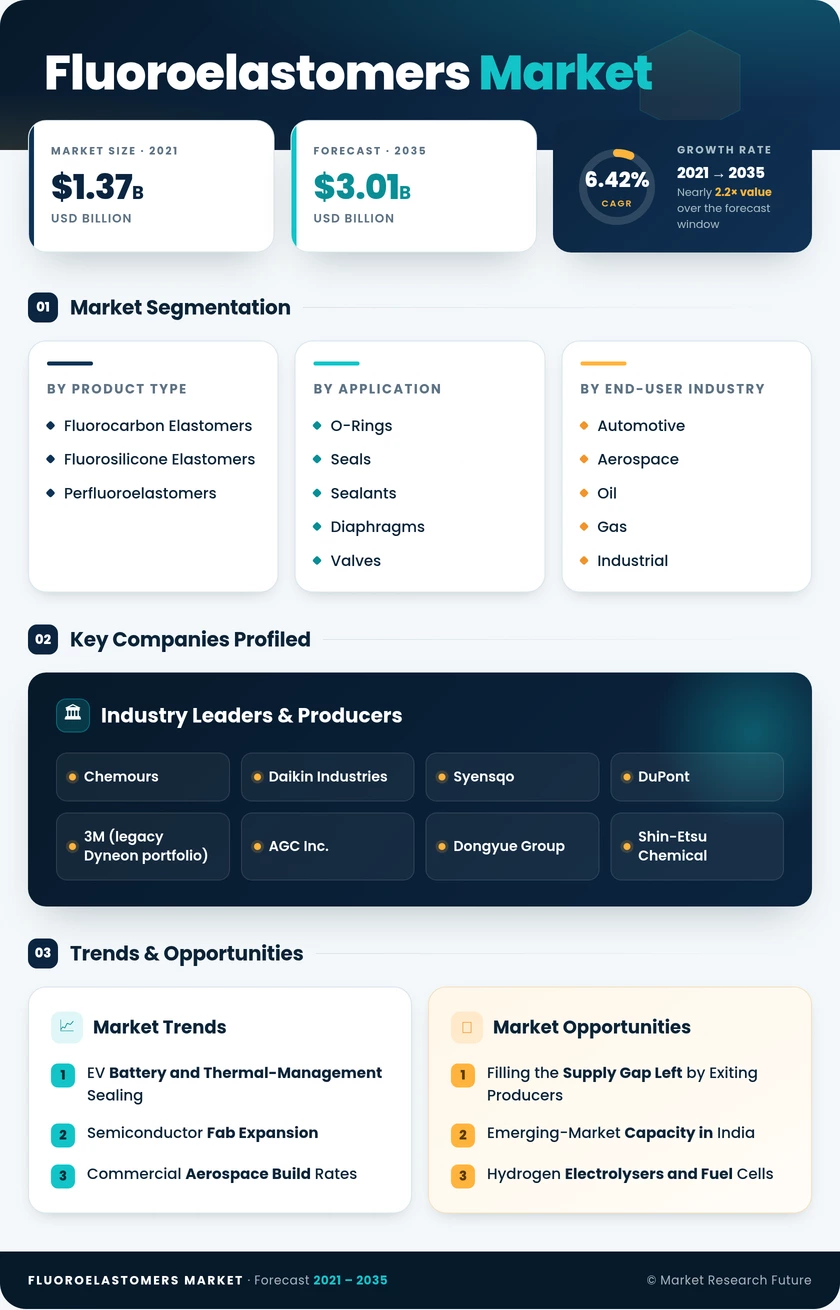
Fluoroelastomers Market Research Report Information By Product Type (Fluorocarbon Elastomers, Fluorosilicone Elastomers, and Perfluoroelastomers), By Application (O-Rings, Seals and Sealants, Diaphragms, Valves, and Other Applications (Hoses and Tubes)), By End-user Industry (Automotive, Aerospace, Oil and Gas, Industrial, and Other End-user Industries (Semiconductor and Electronics, Medical Devices, and Energy Storage)), and By Region (North America, Europe, Asia-Pacific, and Rest of the World) – Market Forecast Till 2035.
Fluoroelastomers Market
Market Size
Forecast Period2026-2035
CAGR (2026-2035)6.42%
2025 Market SizeUSD 1.62 Billion
2035 Market SizeUSD 3.01 Billion
Key Players
Chemours
Daikin Industries
Syensqo
DuPont
3M
AGC Inc.
Opportunities
  • Filling the Supply Gap Left by Exiting Producers
  • Emerging-Market Capacity in India
  • Hydrogen Electrolysers and Fuel Cells
  1. 1 Market Summary | |
    1. 1.1 Study Assumptions & Market Definition | |
    2. 1.2 Scope of the Study | |
    3. 1.3 Research Methodology | |
  2. 2 Key Report Takeaways | |
    1. 2.1 By Product Type | |
    2. 2.2 By Application | |
    3. 2.3 By End-user Industry | |
    4. 2.4 By Region | |
  3. 3 Market Size and Forecast (2021–2035) | |
    1. 3.1 Historical Market Size (2021–2025) | |
    2. 3.2 Current & Forecast Market Size (2026–2035) | |
    3. 3.3 Year-over-Year Growth Analysis | |
  4. 4 Driver Impact Analysis | |
    1. 4.1 EV Battery and Thermal-Management Sealing | |
    2. 4.2 Semiconductor Fab Expansion | |
    3. 4.3 Commercial Aerospace Build Rates | |
    4. 4.4 LNG and Upstream High-Pressure Sealing | |
    5. 4.5 Tighter Emission Rules for Combustion and Hybrid Vehicles | |
    6. 4.6 Compliant Non-Fluorosurfactant Production | |
  5. 5 Restraints Impact Analysis | |
    1. 5.1 Universal PFAS Restriction Uncertainty | |
    2. 5.2 Fluorspar and Monomer Supply Concentration | |
    3. 5.3 Producer Exits and Capacity Consolidation | |
    4. 5.4 High Cost Versus Alternative Elastomers | |
    5. 5.5 Loss of Fuel-System Content in Battery-Electric Vehicles | |
  6. 6 Opportunities | |
    1. 6.1 Filling the Supply Gap Left by Exiting Producers | |
    2. 6.2 Emerging-Market Capacity in India | |
    3. 6.3 Hydrogen Electrolysers and Fuel Cells | |
    4. 6.4 Compliance Data and Circular-Content Business Models | |
    5. 6.5 Seal Monitoring and Predictive Replacement | |
  7. 7 Regional Market Share and Country-Level Analysis | |
    1. 7.1 Asia-Pacific | | |
      1. 7.1.1 China | | |
      2. 7.1.2 Japan | | |
      3. 7.1.3 India | | |
      4. 7.1.4 South Korea | | |
      5. 7.1.5 Rest of Asia-Pacific | |
    2. 7.2 North America | | |
      1. 7.2.1 United States | | |
      2. 7.2.2 Canada | | |
      3. 7.2.3 Mexico | |
    3. 7.3 Europe | | |
      1. 7.3.1 Germany | | |
      2. 7.3.2 United Kingdom | | |
      3. 7.3.3 France | | |
      4. 7.3.4 Italy | | |
      5. 7.3.5 Rest of Europe | |
    4. 7.4 South America | | |
      1. 7.4.1 Brazil | | |
      2. 7.4.2 Argentina | | |
      3. 7.4.3 Rest of South America | |
    5. 7.5 Middle East and Africa | | |
      1. 7.5.1 Saudi Arabia | | |
      2. 7.5.2 South Africa | | |
      3. 7.5.3 Rest of Middle East and Africa | |
  8. 8 Future Outlook (2026–2035) | |
    1. 8.1 Electrification and Hydrogen | |
    2. 8.2 Semiconductor and AI Compute Build-Out | |
    3. 8.3 PFAS Regulation and Sustainability Reporting | |
    4. 8.4 Supply-Chain Regionalization | |
  9. 9 Segmentation Analysis | |
    1. 9.1 By Product Type | | |
      1. 9.1.1 Fluorocarbon Elastomers | | |
      2. 9.1.2 Fluorosilicone Elastomers | | |
      3. 9.1.3 Perfluoroelastomers | |
    2. 9.2 By Application | | |
      1. 9.2.1 O-Rings, Seals and Sealants | | |
      2. 9.2.2 Diaphragms | | |
      3. 9.2.3 Valves | | |
      4. 9.2.4 Other Applications (Hoses and Tubes, etc.) | |
    3. 9.3 By End-user Industry | | |
      1. 9.3.1 Automotive | | |
      2. 9.3.2 Aerospace | | |
      3. 9.3.3 Oil and Gas | | |
      4. 9.3.4 Industrial | | |
      5. 9.3.5 Other End-user Industries (Semiconductor and Electronics, etc.) | |
  10. 10 Competitive Landscape | |
    1. 10.1 Market Concentration Analysis (2025) | |
    2. 10.2 Competitive Benchmarking Matrix | |
    3. 10.3 Company Profiles | | |
      1. 10.3.1 Chemours | | |
      2. 10.3.2 Daikin Industries | | |
      3. 10.3.3 Syensqo | | |
      4. 10.3.4 DuPont | | |
      5. 10.3.5 3M | | |
      6. 10.3.6 AGC Inc. | | |
      7. 10.3.7 Dongyue Group | | |
      8. 10.3.8 Shin-Etsu Chemical | | |
      9. 10.3.9 Gujarat Fluorochemicals | | |
      10. 10.3.10 Greene Tweed | | |
      11. 10.3.11 James Walker | | |
      12. 10.3.12 Eagle Elastomer | |
  11. 11 Recent News & Developments | |
  12. 12 Report Scope and Methodology | |
  13. 13 Detailed Sources and Citations | |
  14. 14 Frequently Asked Questions (FAQs) | | LIST OF TABLES | |
  15. TABLE 1 Global Fluoroelastomers Size & Forecast, by Revenue (USD Billion), 2021–2035 | |
  16. TABLE 2 Global Fluoroelastomers – Year-over-Year Growth Analysis, 2021–2035 | |
  17. TABLE 3 Driver Impact Analysis | |
  18. TABLE 4 Restraints Impact Analysis | |
  19. TABLE 5 Global Fluoroelastomers Size, by Region, 2021–2035 (USD Billion) | |
  20. TABLE 6 Asia-Pacific Fluoroelastomers Size, by Country, 2021–2035 (USD Billion) | |
  21. TABLE 7 North America Fluoroelastomers Size, by Country, 2021–2035 (USD Billion) | |
  22. TABLE 8 Europe Fluoroelastomers Size, by Country, 2021–2035 (USD Billion) | |
  23. TABLE 9 South America Fluoroelastomers Size, by Country, 2021–2035 (USD Billion) | |
  24. TABLE 10 Middle East and Africa Fluoroelastomers Size, by Country, 2021–2035 (USD Billion) | |
  25. TABLE 11 Global Fluoroelastomers Size, by Product Type, 2021–2035 (USD Billion) | |
  26. TABLE 12 Global Fluoroelastomers Size, by Application, 2021–2035 (USD Billion) | |
  27. TABLE 13 Global Fluoroelastomers Size, by End-user Industry, 2021–2035 (USD Billion) | |
  28. TABLE 14 Competitive Benchmarking Matrix, 2025 | |
  29. TABLE 15 Recent Developments & Strategic Announcements, 2023–2025 | |
  30. TABLE 16 Report Scope and Methodology | |
  31. TABLE 17 Detailed Sources and Citations | | LIST OF FIGURES | |
  32. FIGURE 1 Market Dynamics – Drivers, Restraints and Opportunities | |
  33. FIGURE 2 Industry Value Chain Analysis | |
  34. FIGURE 3 Porter's Five Forces Analysis | |
  35. FIGURE 4 Global Fluoroelastomers Size Trend, 2021–2035 (USD Billion) | |
  36. FIGURE 5 Share by Product Type, 2025 (%) | |
  37. FIGURE 6 Share by Application, 2025 (%) | |
  38. FIGURE 7 Share by End-user Industry, 2025 (%) | |
  39. FIGURE 8 Regional Share, 2025 (%) | |
  40. FIGURE 9 Asia-Pacific Share by Country, 2025 (%) | |
  41. FIGURE 10 Competitive Landscape – Estimated Revenue Share Ranges, 2025

Segmentation Quick Reference

DimensionSub-SegmentsDominant SegmentFastest Growing Segment
By Product TypeFluorocarbon Elastomers; Fluorosilicone Elastomers; PerfluoroelastomersFluorocarbon Elastomers (65.3% share)Perfluoroelastomers (7.5% CAGR)
By ApplicationO-Rings, Seals and Sealants; Diaphragms; Valves; Other Applications (Hoses and Tubes, etc.)O-Rings, Seals and Sealants (47.1% share)Other Applications (Hoses and Tubes, etc.) (8.2% CAGR)
By End-user IndustryAutomotive; Aerospace; Oil and Gas; Industrial; Other End-user Industries (Semiconductor and Electronics, etc.)Automotive (44.6% share)Other End-user Industries (Semiconductor and Electronics, etc.) (7.9% CAGR)
By RegionAsia-Pacific; North America; Europe; South America; Middle East and AfricaAsia-Pacific (46.8%)Asia-Pacific (46.8%)

Market Segmentation Overview

By Product Type

Sub-SegmentKey Trend
Fluorocarbon ElastomersShift to non-fluorosurfactant production for automotive and industrial grades
Fluorosilicone ElastomersSteady aerospace demand for low-temperature fuel resistance
PerfluoroelastomersPlasma-resistant grades for advanced semiconductor nodes

Fluorocarbon Elastomers lead on volume because fuel-system and chemical-plant seals need their mix of heat and fluid resistance at a manageable cost. Perfluoroelastomers grow fastest, driven by fab tools whose plasma chemistries degrade lesser grades within weeks. Fluorosilicone Elastomers stay a specialist product tied to aircraft fuel and cold-climate sealing.

By Application

Sub-SegmentKey Trend
O-Rings, Seals and SealantsMulti-cavity molding keeps unit costs low at high volume
DiaphragmsDemand follows pump and fuel-regulator production
ValvesTied to chemical and oil and gas capital spending
Other Applications (Hoses and Tubes, etc.)Custom profiles for low-permeation fuel hoses and energy storage

O-Rings, Seals and Sealants dominate because nearly every engine, pump and fab tool uses many standard seals. Other Applications (Hoses and Tubes, etc.) grow fastest as low-permeation fuel hoses and flow-battery gaskets move into production. Valves and Diaphragms rise and fall with process-industry capital budgets.

By End-user Industry

Sub-SegmentKey Trend
AutomotiveHybrid fuel systems plus new EV thermal-management seals
AerospaceLong qualification cycles protect incumbent compounds
Oil and GasSour-service and LNG cryogenic sealing
IndustrialChemical processing and pump retrofits
Other End-user Industries (Semiconductor and Electronics, etc.)Recurring fab-tool seal replacement

Automotive leads because combustion and hybrid fuel systems still carry the highest fluoroelastomer content per vehicle. Other End-user Industries (Semiconductor and Electronics, etc.) grow fastest, since fab operators replace perfluoroelastomer seals on fixed maintenance schedules. Aerospace and Oil and Gas add higher-margin demand that is less exposed to the shift to battery-electric cars.


Download PDF ×

We do not share your information with anyone. However, we may send you emails based on your report interest from time to time. You may contact us at any time to opt-out.